
Crypto World
CLARITY Act odds drop to 10%: what killed the bill



The Digital Asset Market Clarity Act was not supposed to fail. It had bipartisan committee support, a White House willing to sign, and an industry that spent over $100 million lobbying for it. Six months ago prediction markets gave it better than four in five odds. The collapse from 82% to under 20% is not the story of a bill that lacked support. It is the story of a bill that could not survive the collision between three constituencies whose demands were mutually exclusive, on a calendar that left no room for compromise.
Summary
- Polymarket priced the CLARITY Act’s chances of becoming law in 2026 at 82% in February; by mid August that number had collapsed to under 20%, with Galaxy Digital cutting its own estimate to 10% on August 14.
- The Senate confirmed on August 6 that it would not vote on the 309 page market structure bill before the August 7 recess, pushing the fight to a September 14 return window with only 14 working days before midterm politics consume the floor.
- Three unresolved disputes stalled the bill: stablecoin yield provisions that threaten Coinbase’s $1.35 billion annual USDC rewards revenue, DeFi protocol classification rules, and ethics requirements targeting President Trump’s $1.4 billion in crypto income from World Liberty Financial and the TRUMP memecoin.
- Republicans hold 53 seats but are expected to lose Senators Hawley and Paul on the vote, meaning at least eight Democrats must cross over; only two did so in committee.
- The SEC and CFTC are now racing to fill the regulatory void with agency rulemaking, including the SEC’s Regulation Crypto package covering token launch exemptions, decentralization safe harbors and broker dealer custody.
This piece traces the three disputes that stalled the bill, examines why the Senate calendar makes September passage unlikely, and maps what happens to the industry if the CLARITY Act dies in 2026.
The February consensus and how it unraveled
The CLARITY Act emerged from the Senate Banking Committee in January 2026 with a 15 to 9 vote. Two Democrats crossed over to support it. The bill ran 309 pages and attempted to do what no previous legislation had accomplished: draw a permanent line between the SEC and CFTC’s jurisdiction over digital assets, define when a token stops being a security and starts being a commodity, and create registration pathways for exchanges, brokers and custodians.
Polymarket reflected the optimism. Traders priced passage at 82% in February. Galaxy Digital’s research team put it at 75%. The logic was straightforward: Republicans had the votes, the White House had signaled it would sign, and the industry had spent aggressively to ensure floor time.
The first crack appeared in April when Senate negotiations stalled over three open items that the committee had deferred to floor debate: stablecoin yield rules, DeFi protocol classification, and ethics provisions for government officials with crypto holdings. Each of these disputes had a constituency with enough leverage to block the bill.
The stablecoin yield fight
The current draft of the CLARITY Act prohibits interest or yield on idle stablecoin balances while permitting activity based rewards through DeFi mechanisms such as liquidity pools and lending protocols. The distinction matters because it determines whether centralized exchanges can continue paying customers to hold stablecoins.
Coinbase earns approximately $1.35 billion annually from USDC rewards, a program that pays customers yield for holding Circle’s stablecoin on the platform. Under the proposed framework, that revenue model would be restricted. Coinbase has lobbied intensely to modify the provision, arguing that prohibiting yield on idle balances while permitting it through DeFi creates an arbitrary distinction that pushes activity toward less regulated protocols.
The banking lobby wants the prohibition to stand. Traditional banks view stablecoin yield as a deposit product offered without deposit insurance, capital requirements or FDIC oversight. Allowing exchanges to pay yield on stablecoins while banks must comply with Basel III capital rules creates a competitive asymmetry that the banking industry will not accept quietly.
The compromise that the committee deferred, permitting yield only through regulated DeFi mechanisms, satisfies neither side. Coinbase loses its largest revenue stream. Banks still face competition from protocols that are harder to regulate. The provision has consumed more negotiating time than any other section of the bill.
The DeFi classification problem
The CLARITY Act attempts to define when a blockchain network is sufficiently decentralized that its tokens are no longer securities. The bill creates a framework under which the SEC would evaluate whether essential managerial efforts have ceased, using criteria including the distribution of governance tokens, the absence of a controlling entity, and the degree to which protocol upgrades require community consensus rather than unilateral developer action.
Democrats on the committee argued the criteria are too permissive. Senator Sherrod Brown’s staff circulated a memo in May contending that under the proposed standards, FTX’s FTT token would have qualified for commodity treatment within 18 months of launch, despite Sam Bankman-Fried’s centralized control of the exchange. The memo was disputed by the bill’s sponsors, but it reframed the debate: any standard that could retroactively validate FTT is a standard that will face political resistance.
The deeper issue is that decentralization exists on a spectrum, and the bill needs a binary threshold. A protocol is either sufficiently decentralized or it is not. Drawing that line through legislation means choosing a point on the spectrum that will be wrong for some projects on either side. The committee chose to defer the final calibration to floor debate, and floor debate has not happened.
The Trump problem
The most politically toxic dispute has nothing to do with technology. President Trump’s 2025 financial disclosure showed approximately $1.4 billion in crypto related income: $799 million from World Liberty Financial and $635 million from the TRUMP memecoin. Democrats have demanded enforceable divestiture or blind trust requirements for senior officials as a condition for supporting cloture.
The ethics provision in the current draft falls short of what Democrats want. It prohibits federal officials from issuing digital assets but does not require divestiture of existing holdings. Senator Elizabeth Warren called the provision inadequate, arguing that it allows the president to profit from the regulatory clarity the bill provides while the bill is being debated.
The Trump administration has complicated the politics further. On August 14, the Office of the Comptroller of the Currency granted World Liberty Financial a conditional national trust bank charter, allowing the firm to issue stablecoins directly. Senator Warren called it “the most brazen act of self dealing our financial system has ever seen.” The timing, one day before Galaxy cut passage odds to 10%, was not coincidental in the eyes of Democratic leadership.
Republicans argue that ethics provisions should be handled in separate legislation and that linking them to market structure creates a poison pill designed to kill the bill. The impasse is structural: Democrats have enough votes to block cloture, and they will not provide them without ethics requirements that Republicans view as targeted at the president.
The calendar problem
Even if all three disputes were resolved tomorrow, the Senate calendar makes 2026 passage difficult. The Senate returns on September 14. Senator Thune filed cloture on August 8, and the motion ripens on September 15. If cloture succeeds, floor debate and amendments follow. The midterm election is November 3. The Senate typically loses productive floor time to campaign travel by mid October.
That leaves roughly 14 working days for floor debate, amendments and a final vote on a 309 page bill with at least three contested provisions. The GENIUS Act, a narrower stablecoin bill, took 11 days of floor time. The CLARITY Act is broader and more contentious.
Galaxy Digital’s August 14 note cited the calendar as the primary reason for cutting odds to 10%. The firm noted that even with bipartisan goodwill, the procedural mechanics of the Senate do not support passing a bill of this complexity in the available window.
The prediction market as legislative thermometer
The CLARITY Act’s trajectory is one of the clearest demonstrations of prediction markets functioning as real time policy sensors. Polymarket’s contract on 2026 passage has tracked every major development with a precision that traditional polling and expert commentary have not matched.
The February peak of 82% followed the committee vote. The first drop to 60% came in April after the three disputed provisions surfaced. The decline to 42% tracked the July 17 hearing where Democratic members signaled they would not provide cloture votes without ethics language. The fall to 27% followed the Senate’s confirmation that no pre recess vote would occur. The current reading near 17% reflects Galaxy’s 10% estimate and the absence of any public indication that a deal is forming during the recess.
The prediction market has been consistently ahead of media coverage and industry commentary. When Coinbase’s CEO expressed optimism about passage in a July earnings call, Polymarket was already pricing the bill below 50%. When Galaxy published its 10% estimate on August 14, Polymarket had been below 20% for a week.
The implication for the September 15 cloture vote is that the market will price in a deal before it is announced. A sharp move above 30% in the days before the vote would signal that negotiations have produced a framework that both parties can accept. The absence of that move would signal that the vote is performative.
The international comparison
The CLARITY Act’s stall is happening against a backdrop of accelerating regulation elsewhere. The European Union’s Markets in Crypto Assets regulation has been in force since June 2024. The United Kingdom’s Financial Conduct Authority finalized its crypto regime in March 2026. Singapore, Japan, Hong Kong and the United Arab Emirates all have operational frameworks.
The practical consequence is regulatory arbitrage. Companies that need clarity to operate are moving to jurisdictions that provide it. The concern that crypto regulation failure would push activity offshore is not theoretical. Coinbase, Kraken and Gemini all expanded their European and Asian operations in 2026 while US focused compliance teams waited for a framework that has not materialized.
The industry argument is that the US is falling behind. The counterargument is that moving slowly is preferable to moving fast and getting the framework wrong. Both positions have merit, but the calendar does not care about the merits. Every month without legislation is a month in which the regulatory gap between the US and its competitors widens.
What replaces it if it fails
The SEC and CFTC are not waiting. Both agencies have accelerated rulemaking that effectively substitutes for legislation.
The SEC’s Regulation Crypto package, which Chair Paul Atkins has described as ready for notice and comment, covers four areas: registration exemptions for token launches, a safe harbor for teams that have fully decentralized, broker dealer custody treatment, and trading venue structure. The safe harbor would codify the joint SEC CFTC interpretive release from March 2026, giving issuers a rule based path to commodity status without congressional action.
The CFTC has moved toward a spot listing regime that would allow regulated exchanges to list digital asset spot contracts alongside futures. The August 19 White House meeting, which includes executives from Coinbase, Ripple and Kraken alongside SEC Chair Atkins and CFTC Chair Selig, is expected to discuss how agency rulemaking can fill the gap if the CLARITY Act does not pass.
The industry’s concern with agency rulemaking is durability. Rules can be reversed by a future administration. Legislation cannot. A Democratic president in 2029 could direct the SEC to withdraw Regulation Crypto and return to enforcement based regulation. The CLARITY Act was supposed to prevent that by writing the framework into statute. Without it, the industry operates under rules that last only as long as the current administration’s appointees remain in office.
The precedent is instructive. The SEC’s 2024 approval of spot Bitcoin ETFs came through an agency decision, not legislation. That decision survived a change in SEC leadership because the new chair supported it. A future chair who does not support crypto could reverse course on Regulation Crypto in a way that would not be possible if the framework were statutory.
There is also a sequencing problem. If the SEC finalizes Regulation Crypto before the September 15 cloture vote, it reduces the urgency argument for passing the CLARITY Act. Senators who might have voted for the bill because the alternative was regulatory chaos may conclude that the alternative is now agency rulemaking that provides adequate clarity. The SEC’s timeline therefore directly affects the bill’s political dynamics.
The CFTC’s spot listing regime adds another layer. If regulated exchanges can list digital asset spot contracts alongside futures under CFTC oversight, a significant portion of what the CLARITY Act was designed to enable happens without Congress acting. The gap narrows between what the bill provides and what agency action can deliver, making the remaining benefits of legislation, primarily durability, a harder sell to senators with limited floor time.
The opposing case: why it could still pass
The case for passage rests on three arguments. First, the September 15 cloture vote is a real procedural step, not a symbolic gesture. Thune would not have filed it without some expectation that negotiations could produce a deal during the recess. Second, the August 19 White House meeting signals executive branch engagement at a level that suggests the administration wants a legislative win, not just agency rules. Third, the industry’s lobbying spend exceeds $100 million, and that money buys access to the eight Democratic crossover votes the bill needs.
The weakness in this case is that it relies on resolving three disputes in the remaining calendar days that the Senate could not resolve in seven months of committee work and floor negotiations. The stablecoin yield provision alone involves Coinbase’s largest revenue stream, the banking lobby’s core competitive concern, and a DeFi ecosystem that views any yield restriction as existential. Finding a formula that satisfies all three in 14 working days requires a level of legislative productivity the Senate has not demonstrated on crypto.
There is also a historical pattern that favors passage. Major financial legislation in the United States often passes in compressed timelines after extended delays. The Dodd Frank Act took 11 months from introduction to signature but the final negotiations concluded in weeks. The JOBS Act moved from stalled committee work to bipartisan passage in under a month when both parties found electoral motivation. The CLARITY Act could follow the same pattern if midterm pressure creates sufficient incentive for both parties to claim a legislative achievement.
The strongest version of the bull case is that prediction markets are wrong about the remaining probability because they cannot price in private negotiations. If Senate staff are working on a compromise during the recess, that work does not produce public signals until an announcement. Polymarket’s 17% could be accurately pricing public information while missing a deal that has been reached in principle but not yet disclosed.
What would prove this analysis wrong: a cloture vote on September 15 that succeeds with 60 or more votes, followed by a rapid amendment process. If that happens, the bill’s sponsors found a deal during recess that is not yet public. The specific tell would be simultaneous statements from both a Republican and a Democratic senator endorsing a revised ethics provision in the days before the vote.
What to watch
- September 15 cloture vote. This is the binary event. If cloture fails, the CLARITY Act is dead for 2026. If it succeeds, floor debate begins and passage becomes plausible within weeks.
- Polymarket odds in the 48 hours before the vote. Prediction markets have been the most accurate tracker of this bill’s trajectory. A sharp move above 30% in the days before September 15 would signal that a deal has leaked.
- SEC Regulation Crypto timeline. If the SEC publishes a notice of proposed rulemaking before the cloture vote, it signals the agency expects the bill to fail and is moving to fill the gap independently.
- Democratic crossover count. The bill needs eight Democrats. Two voted yes in committee. The six additional votes are the entire negotiation. Any public commitments from Democratic senators during the recess will move the odds.
- World Liberty Financial activity. Any additional regulatory approvals or charter expansions for the Trump linked crypto venture during the negotiation window will harden Democratic opposition and reduce the odds of a deal on ethics provisions.
Frequently asked questions
What is the CLARITY Act?
The Digital Asset Market Clarity Act is a 309 page bill that would create a permanent regulatory framework for cryptocurrency in the United States, defining which digital assets fall under SEC jurisdiction as securities and which fall under CFTC jurisdiction as commodities.
Why did the odds of passage collapse?
Three unresolved disputes stalled the bill: stablecoin yield provisions, DeFi protocol classification criteria, and ethics requirements for government officials with crypto holdings. The Senate’s decision not to vote before the August recess pushed negotiations into a 14 day September window that most analysts consider insufficient.
What is the stablecoin yield dispute?
The bill prohibits interest or yield on idle stablecoin balances while permitting activity based rewards through DeFi. This would restrict Coinbase’s $1.35 billion annual USDC rewards program. The banking industry supports the prohibition; Coinbase and DeFi protocols oppose it.
How does President Trump’s crypto income affect the bill?
Trump reported $1.4 billion in crypto income in 2025, including $799 million from World Liberty Financial. Democrats demand enforceable divestiture or blind trust requirements for officials as a condition for supporting the bill. Republicans view these demands as a targeted poison pill.
What happens if the CLARITY Act fails in 2026?
The SEC and CFTC would proceed with agency rulemaking, including the SEC’s Regulation Crypto package covering token launch exemptions and decentralization safe harbors. These rules can be reversed by a future administration, unlike legislation.
When is the next critical vote?
Senate Majority Leader Thune filed cloture on August 8 with the motion ripening on September 15. If cloture fails, the bill is effectively dead for 2026.
How many votes does the bill need?
The bill needs 60 votes to clear cloture. Republicans hold 53 seats but are expected to lose two members on this vote, meaning at least eight Democrats must cross over. Only two did so in committee.
Could agency rules replace the CLARITY Act permanently?
Agency rules provide regulatory clarity but lack durability. A future administration could direct the SEC to withdraw Regulation Crypto and return to enforcement based regulation. The industry’s concern is that without legislation, the framework lasts only as long as the current appointees remain in office. This is educational analysis, not investment advice.
Disclaimer: This article was published on August 17, 2026. It reflects information available at the time of writing. Legislative negotiations are ongoing and the status of the bill may change. This is educational analysis, not investment advice.

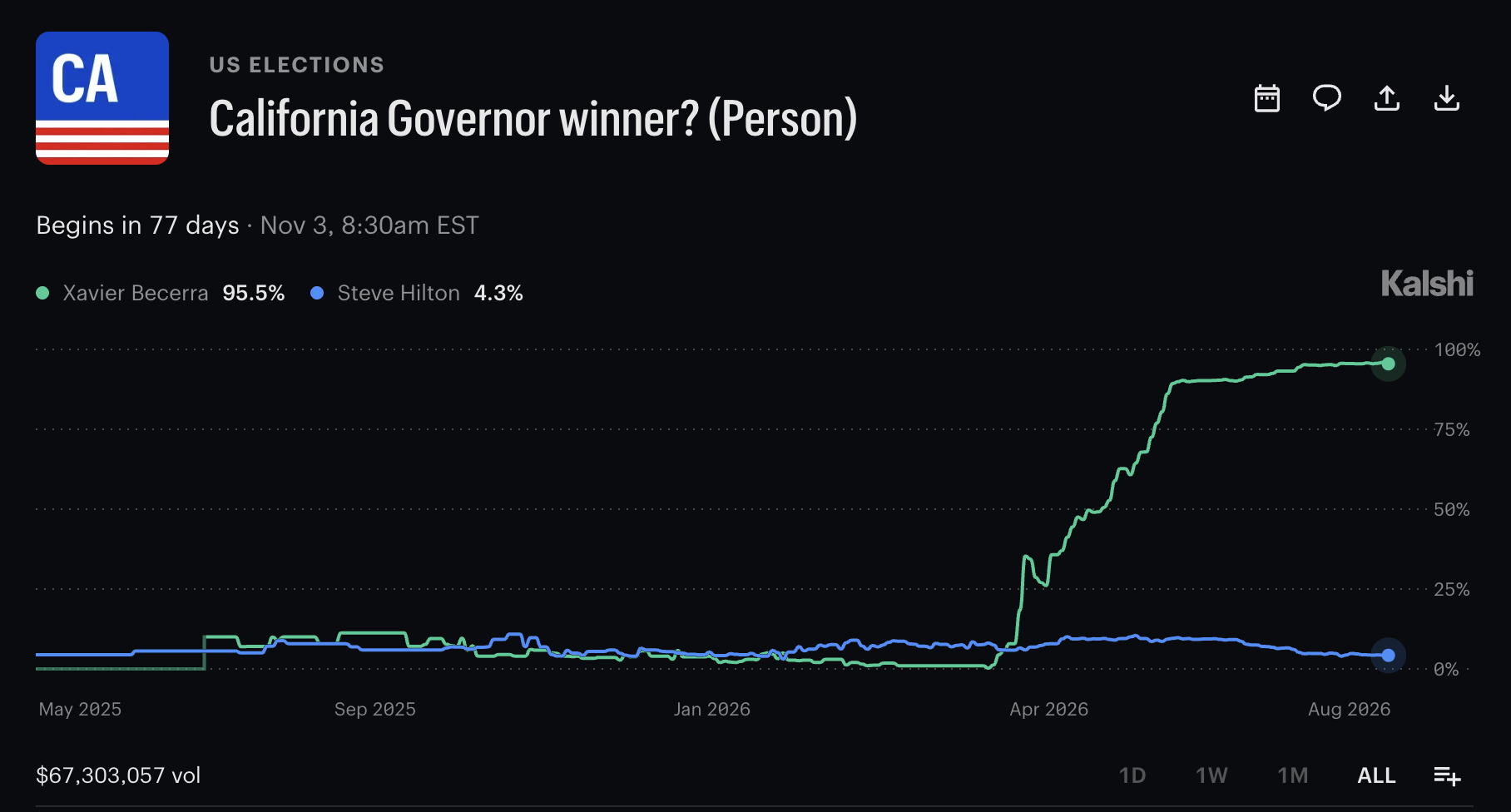
Prediction markets and polling odds pointed toward Xavier Becerra as the leading candidate in California crowded governor primary ahead of the vote. In Kalshi pricing published on primary day, Becerra was the favorite both to advance from the top-two primary and to win the governor’s race.
With only hours remaining before polls closed, Kalshi’s primary-advancer market placed Becerra at 95% to move on to the general election. Republican Steve Hilton was priced at 4%.
Recent surveys also put Becerra in front, though the order behind him varied. An Emerson College poll cited by Kalshi showed Becerra at 28%, Steyer at 22%, and Hilton at 21%. The Berkeley Institute of Governmental Studies placed Becerra at 25%, Hilton at 21%, and Steyer at 19%, while a Public Policy Institute of California poll showed Becerra at 23%, Hilton at 20%, and Steyer at 15%.

A separate report published before the primary described polling at 23% for Becerra and 20% for Hilton. It characterized the race as crowded, while identifying Becerra as the Democrat most likely to lead the field and Hilton as the Republican with the clearest route through the primary.
Discover: Trade the odds on Kalshi and get a free $25
California Governor Odds: Race Reshaped by a Changing Field
Kalshi reported that Becerra had entered the race polling at 5% and trading at less than 1% on its governor market in early April. The article linked his subsequent rise to Eric Swalwell’s departure from the contest and to setbacks affecting several other candidates.
Steyer remained a significant factor before the vote. Kalshi cited CalMatters reporting that he had heavily financed his campaign to a total of $200 million, including spending on social media influencers. Late primary-day movement also lifted Steyer from 33% to 40% in Kalshi’s advancers market before the article’s stated 39% takeaway figure.

Hilton’s campaign had the endorsement of President Donald Trump. Kalshi, citing The New York Times, reported that the endorsement may have hurt Hilton’s chances in California.
Prediction-market prices reflect trading at a particular time and can change as polling, campaign developments and voting information evolve. The June 2 Kalshi figures showed traders favoring Becerra, but they did not establish a final election outcome.
Discover: Trade the odds on Kalshi and get a free $25
The post California Governor Odds: Becerra Leads as Primary Day Nears appeared first on Cryptonews.
Bitcoin’s rather modest price revival that began yesterday continued earlier this morning as the asset climbed to $64,500 for the first time in just over a week.
Although it was stopped there, its daily performance is slightly more impressive than most altcoins, which is why its dominance over them has gradually increased.
BTC Dominance Jumps
The primary cryptocurrency began the previous business week on the wrong foot and was not really able to correct it. At the time, it traded above $65,000 before the bears stepped up and pushed it south to under $64,000. The two subsequent rebound attempts were halted at $64,400, and the following leg downs were quite painful. Especially the second one, which culminated on Friday, with a nosedive to a 10-day low of $62,500.
The bulls finally reemerged after this decline, but not in their full force. They helped bitcoin reclaim some ground to around $63,000, but lacked the power to push it further. The weekend was extremely stagnant as BTC spent it in a very tight range at around $63,000.
It dipped again on Monday to $62,650, but reacted better in the following hours. It quickly jumped to $63,600, where it faced some resistance but resumed its local run in the evening and earlier this morning. The peak came at $64,550, which was the highest level since the previous Monday’s drop.
Although it was stopped there, it remains above $64,000 as of press time. Moreover, its dominance over the alts is up by almost 0.5% in just a day to 57.2% on CG, while its market cap has neared $1.290 trillion.

Sluggish Alts
Most alts have failed to produce any large moves over the past day. ETH is slightly below $1,900, while XRP continues to fight for the $1.00 support despite the growing whale activity. SOL, TRX, HYPE, and LINK are with minor gains.
In contrast, CC has dropped by over 4%, while XLM is down by 3%. RAIN, XMR, ZEC, and DOGE are also slightly in the red. The biggest daily gains come from VVV (17%) and HASH (11%).
The total crypto market cap has added around $20 billion in a day and is up to $2.260 trillion on CG.

The post Bitcoin Dominance Rises as BTC Hits a Weekly High Above $64K: Market Watch appeared first on CryptoPotato.


In an interview with crypto.news, Selva Ozelli speaks with TEXITcoin founder Richard W. Wisher about the Proof-of-Work network, its Texas mining operations and how merge mining allows TXC to be mined alongside Litecoin and Dogecoin.
Summary
- TEXITcoin operates a Texas based Proof of Work network and uses merge mining alongside Litecoin and Dogecoin.
- The project has invested $5.5 million to expand mining sites in McKinney, Mansfield and Conroe.
- TEXITcoin is contesting a Texas State Securities Board case alleging unregistered investment offerings and misleading statements.
- Founder Richard W. Wisher argues that TXC mining involves a Proof of Work commodity rather than a security.
The discussion also covers regulation and the Texas State Securities Board case against TEXITcoin, MineTXC, Blockchain Mint and Wisher. The founder disputes the regulator’s allegations and argues that mining a Proof-of-Work commodity does not constitute a securities offering.
Tell us about your journey to establishing TEXITcoin (TXC)
I began minting coins in 2008, the same year Satoshi introduced Bitcoin. My goal was to provide money that no government can print. While gold and silver served this purpose for centuries, I wanted to bring that same security to the digital age. In 2012, I even testified before Congress to advocate for these alternative currencies. By 2017, I started laser-etching private keys onto physical coins to bridge the gap between digital assets and tangible wealth. This journey led to TEXITcoin. We built it as a Texas-rooted, Proof-of-Work network with no pre-mine and no special favors for the team. Honest money isn’t a slogan, it’s just money that has to be earned the same way for everybody who touches it, and that is the only kind of money I have ever wanted to build.
Which platforms does TXC trade on?
TXC trades on MEXC, XT.COM, BitMart, and Pionex, with wrapped TXC also available on Ethereum. We’re in discussions with a number of other exchanges right now, so this list is likely to change and grow as new partnerships come together.
Why does Texas rank at the top for crypto mining?
Texas offers a competitive energy market and a massive network of wind and solar power. You will find plenty of land here and a state government that welcomes your business. This environment allows us to build real, physical infrastructure. We mine TXC in the open, using verifiable hardware and actual electricity. Plus, you can power down quickly when the grid is busy, which helps everyone.
Of course, the process is not always easy. Miners face long waits to connect to the grid and unpredictable power prices. You will also deal with transmission limits and more oversight from officials. Despite these hurdles, Texas remains the strongest place to build.
TXC is described as using multi-level marketing to sell mining packages. What are the challenges and growth concerns for crypto mining in Texas?
TEXITcoin is a Layer 1 crypto network, meaning it operates as its own currency, much like Bitcoin. We crowdsourced our mining infrastructure, which fostered a community where people actively participate rather than just watch from the sidelines. If you value collaboration and building real connections, this project is for you. We have created something fundamentally different from traditional network marketing and the scams common in the space.
However, scaling in Texas comes with real challenges. Companies must navigate long grid wait times, volatile power prices, and high startup costs. We also address complex factors like curtailment economics, local noise concerns, and the need for complete transparency when offering products to the public. We are building a sustainable model that accounts for these realities head-on.
How does TXC rank among major crypto-mining companies operating large facilities across Texas?
Comparing TXC to public Bitcoin-mining companies is misleading. We are a Layer 1 network, not a massive mining corporation. We operate on a different scale, so measuring us by megawatts or market cap ignores our true purpose.
We focus on building real infrastructure. We recently invested $5.5 million to expand our mining sites in McKinney, Mansfield, and Conroe. That money bought hardware that performs actual work rather than chasing a leaderboard. I have no interest in claiming a rank that we have not earned. My priority is the growth, security, and utility of the TXC network. That is the only scoreboard that matters.
How do TXC merge mining and energy use work?
TXC uses Scrypt, just like Litecoin and Dogecoin. Because they share the same algorithm, one machine can secure all three networks at the same time. This is called merge mining. It is highly efficient because you do not waste computing power on redundant tasks.
However, it is important to be clear that merge mining does not make mining free. Your machines still consume real electricity. You must manage them carefully to stay profitable. Merge mining simply makes every watt of energy go further rather than make the energy costs disappear.
How is merge mining regulated at state and federal level?
Merge mining does not trigger its own specific set of regulations. Regulators are less worried about the technical labels you use, but instead are focused on your actual activities. You must still follow the rules that apply to any business. This includes things like local environmental permits, electricity market standards, and building codes. If your operations involve financial products or transactions, you must also comply with anti-money laundering, consumer protection, and other applicable laws. Ultimately, authorities judge you by what you do, not by the technology you choose to use.
How is merge mining taxed at federal and state level?
Federal law views mined digital assets as taxable income. You must report their value the moment they become usable. If you sell these assets later, any change in price results in a separate capital gain or loss.
If, like us, you mine as a business, you face additional self-employment or corporate taxes. Texas offers an advantage by having no state income tax, but your business is not exempt from other costs. You must still pay franchise, sales, property, and local taxes. Additionally, the IRS taxes rewards from every network you secure, regardless of your mining efficiency. Because tax laws are complex, please consult a professional regarding your specific business needs.
How could the Texas PUC v. Attorney General public-records case affect the mining industry?
This legal case is not about mining regulations. It is about whether the state must release private data on facility locations and power use. People often confuse these two issues, but they are separate.
If the court chooses confidentiality, it protects mining companies from security risks. This is the position held by the Public Utility Commission. However, if the court mandates disclosure, the public gains vital clarity about the demands these companies place on the Texas power grid.
It is important to note that this case does not excuse companies from complying with the rules. They must still report their data to regulators. The core disagreement is simply about who has the right to see that data. This decision is one small part of a larger debate about how Texas manages its energy grid and the public’s right to know how its power is being used.
How did the Texas Blockchain Council/EIA survey case affect the mining industry?
The 2024 EIA case demonstrates that agencies must follow the law when collecting data. The agency tried to force Bitcoin miners to complete an emergency survey without using the standard notice and comment process. A federal court stopped them with a restraining order, ultimately forcing the EIA to delete the data they had already collected.
That’s the real lesson here, government agencies cannot bypass rules to demand private information. They must follow the Paperwork Reduction Act and allow for public feedback. This decision does not mean the EIA cannot request energy data in the future. It also does not excuse miners from standard reporting requirements. Instead, it ensures that agencies follow the law instead of taking shortcuts.
TXC is a fork of Litecoin, which is a fork of Bitcoin. How does that affect TXC’s classification under Texas securities law and the SEC/CFTC interpretation issued March 17, 2026?
This is the regulatory clarity we have been waiting for. On March 17, the SEC and CFTC officially classified Litecoin as a commodity. TXC uses the exact same Proof-of-Work structure, issuance logic, and mechanics as Litecoin. The only difference is that TXC is built and mined in Texas.
Regulators have now confirmed that protocol mining does not turn an asset into a security. Miners contribute their own computing power, which is an administrative task rather than reliance on someone else’s management. Because TXC is a permissionless network built on this established foundation, its status as a commodity is clear. Our structure matches the model that regulators just validated, proving that TXC is a commodity from the ground up.
Tell us about the TSSB case, your counterarguments and its possible industry impact.
In February 2026, the Texas State Securities Board issued an order against TEXITcoin, MineTXC, Blockchain Mint, and me. They allege that we offered unregistered investments and made misleading statements. It is important to remember that these are unproven allegations, not facts determined by a hearing.
We retained Quinn Emanuel to represent us. We have requested a formal hearing to present our defense through the proper legal channels instead of the press.
Our position remains that we believe mining a Proof-of-Work commodity is not a security. Furthermore, our mining activity and equipment are real and fully verifiable. We look forward to proving this during the legal process. Because this case is ongoing, I will not speculate on the outcome or its impact on the industry. I prefer to let the facts of the legal record speak for themselves.
Can state regulators act independently even where a token is not treated as a security federally?
States do have their own security laws and regulators. Federal rules do not automatically replace them. However, these systems are deeply connected. Texas uses the same “Howey test” as the SEC and CFTC to define a security. When federal regulators decide an asset is not a security, that logic remains relevant at the state level. It does not simply disappear at the state border.
States should certainly protect consumers and stop fraud under their own authority. But that is different from labeling a legitimate Proof-of-Work asset a “security” just because it crossed a state line.
What are your views on the CLARITY Act and promises of daily passive mining returns?
The CLARITY Act is essential for fixing market structure. It draws clear lines between the SEC and the CFTC so builders know exactly which regulator oversees their work. This transparency rewards those who follow the rules.
In regard to the timeline, the process remains lengthy. We face a cloture vote on September 15, which requires 60 votes just to begin debate. After that, we have to navigate floor debates, amendments, and a final vote. Anyone suggesting this bill is already law is jumping to conclusions. I prefer to be honest about our progress rather than promise a result that is not yet guaranteed.
Anything else you would like to add?
Just that I’m excited for what’s ahead. We’re building real momentum right now, we’re investing in expanding our mining network, we’re pushing crypto payment adoption forward across Texas, and every day we get to bring the idea of honest money to more people who’ve never really had it explained to them properly before. That’s the work, and I’m genuinely excited to keep doing it.
How can people reach you?
You can visit our website at Texitcoin.org and keep up to date with everything we’re doing on X https://x.com/TEXITcoin.
About the Author:
Selva Ozelli Esq, CPA, is an international digital asset legal expert and author of Sustainably Investing in Digital Assets Globally and an award winning artist. Her writings are translated into 45 languages and republished in over 200 global publications. She is recognized as an expert media/TV commentator on global AI, digital asset regulation, tax, and technology matters.
Disclosure: The views and opinions expressed here belong solely to the author and do not represent the views and opinions of crypto.news’ editorial.
The Aussie enters this week with genuine hawkish backing. RBA Assistant Governor Christopher Kent reaffirmed that tighter policy is working as intended, with markets now pricing roughly a 70% chance of one final hike to 4.60% by early next year, even as inflation eased below forecasts last quarter. That combination of commodity strength, gold, iron ore and LNG all running above forecast, and a still-hawkish central bank has kept AUD broadly supported near multi-week highs, with all eyes now on Thursday’s July employment report.
The loonie tells an even stronger story. Canada’s economy expanded at a blistering 3.4% annualised pace in Q2, well above the Bank of Canada’s own 2.5% forecast, while July employment surged by 75,100 jobs against expectations of just 15,000, pulling unemployment down to a two-year low of 6.4%. That combination of surprising growth and labour market strength has fuelled speculation the BoC could hike if elevated energy prices persist, giving CAD real independent momentum of its own.
The result: two resource-linked currencies both riding genuinely hawkish narratives, leaving AUD/CAD’s next move to hinge on which central bank blinks first.
Technical Analysis of AUD/CAD
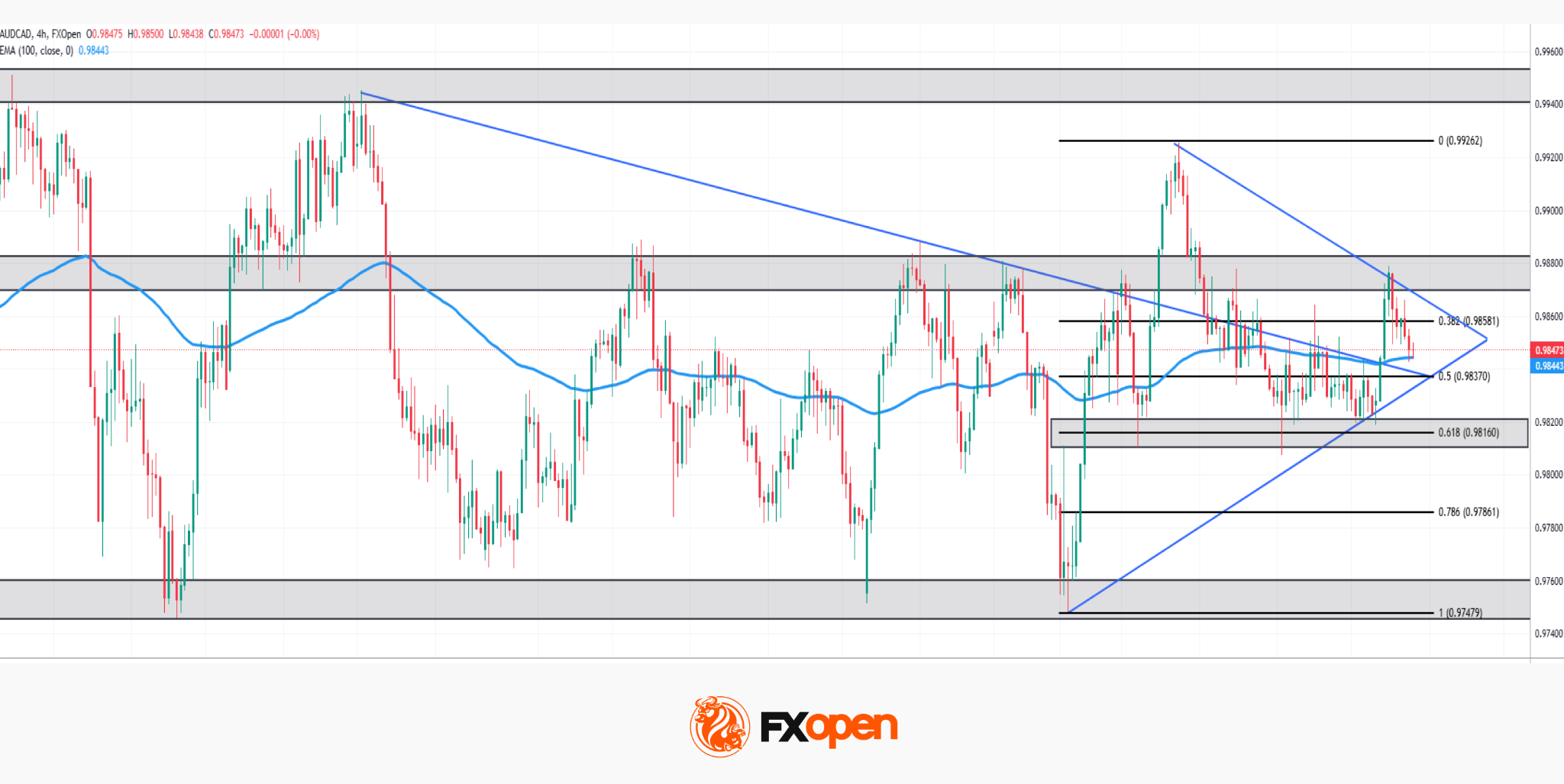
As the chart shows, AUD/CAD has been compressing into a symmetrical triangle since early August, with a descending trendline from the 0.9926 high converging with an ascending trendline off the 0.9748 low, both meeting right around current price near 0.9847, exactly where the 100-period EMA also sits.
Bullish Scenario
Should buyers break above the descending trendline and the 0.382 retracement near 0.9858, the path would open towards the 0 level at 0.9926, a confirmed breakout that would suggest genuine momentum returning to the pair.
Bearish Scenario
Conversely, a break below the ascending trendline and the 0.5 retracement near 0.9837 would expose the 0.618 level near 0.9816, with a deeper slide risking a retest of the 0.786 retracement around 0.9786, or even the 0.9748 low that anchored this entire structure.With price coiled right at the apex of this triangle, sitting exactly on the 100-period EMA, AUD/CAD looks primed for a decisive break, will the Aussie’s hawkish backing prove enough, or does the loonie’s stronger data ultimately win out?
Trade over 50 forex markets 24 hours a day with FXOpen. Take advantage of low commissions, deep liquidity, and spreads from 0.0 pips (additional fees may apply). Open your FXOpen account now or learn more about trading forex with FXOpen.
This article represents the opinion of the Companies operating under the FXOpen brand only. It is not to be construed as an offer, solicitation, or recommendation with respect to products and services provided by the Companies operating under the FXOpen brand, nor is it to be considered financial advice.


The newly authorized lenders will begin offering e-CNY services after completing operational and technical preparations.

As a writer, a university professor, artist, and designer, I worry about the risk that generative AI might destroy the delightful, human experience of carrying out acts of creation, not to mention making careers in the pursuit of that creativity unviable. Whether or not AI will improve work or destroy jobs, it already distances people from some of the moment-to-moment acts that might have felt gratifying just a few years ago. If AI can write your emails, then you don’t need to feel the click of keys under your fingertips or hear the clack they produce when you type with them. If AI can generate a gift list for the holidays or a vacation plan for Spring Break, then you don’t need to swipe through catalogs or thumb through guidebooks. In this way, AI can amplify the same dematerializing effects of technology people have encountered for years.
But that’s not the whole story. As critical of AI as I sometimes am, I have also found that AI can direct people back toward the physical world and the gratifying feelings it offers. LLMs can be quite adept at helping people figure out how to plan and carry out real-world tasks, such as fixing a plumbing leak, repairing a car, or learning a new hobby.
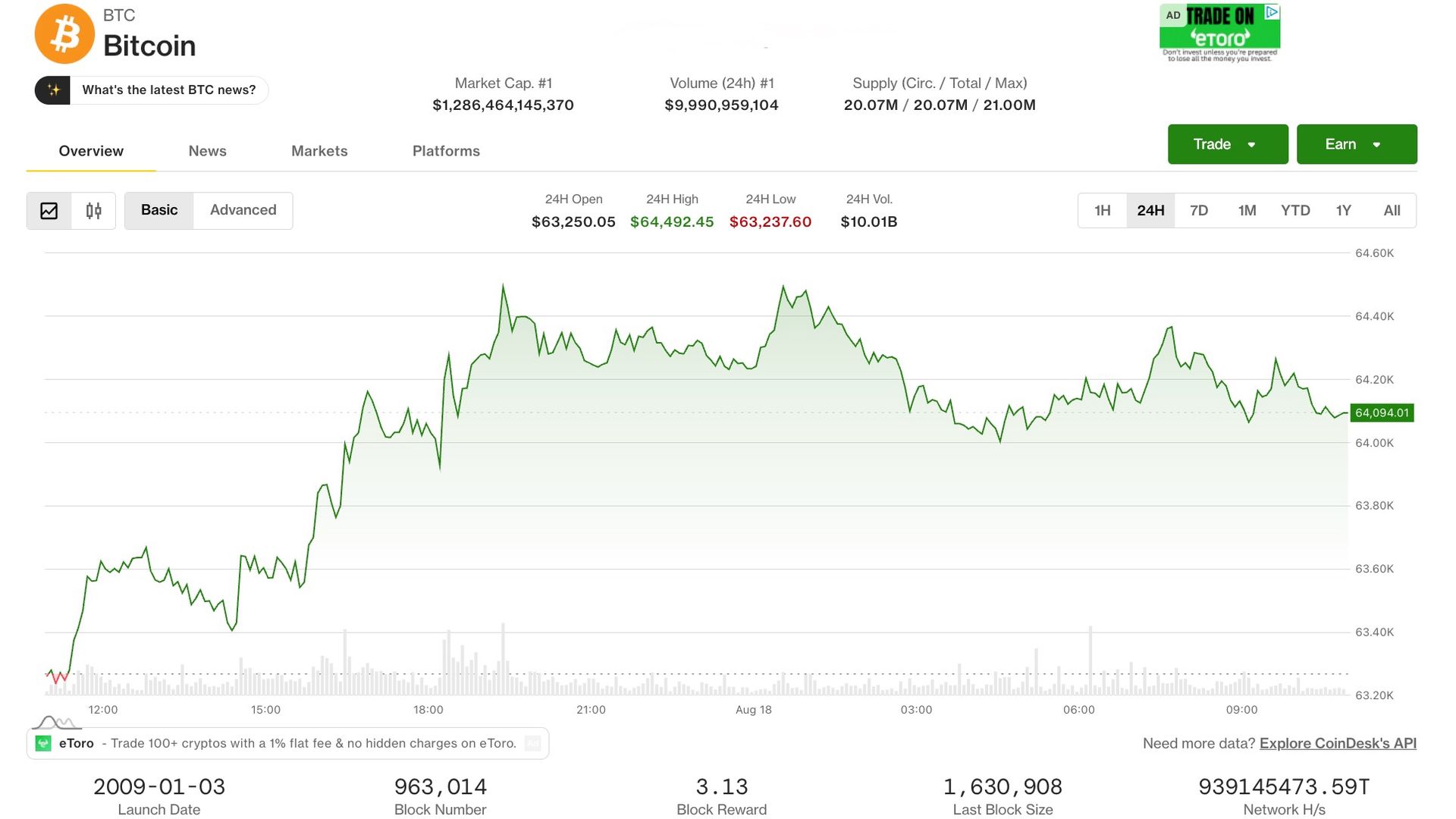
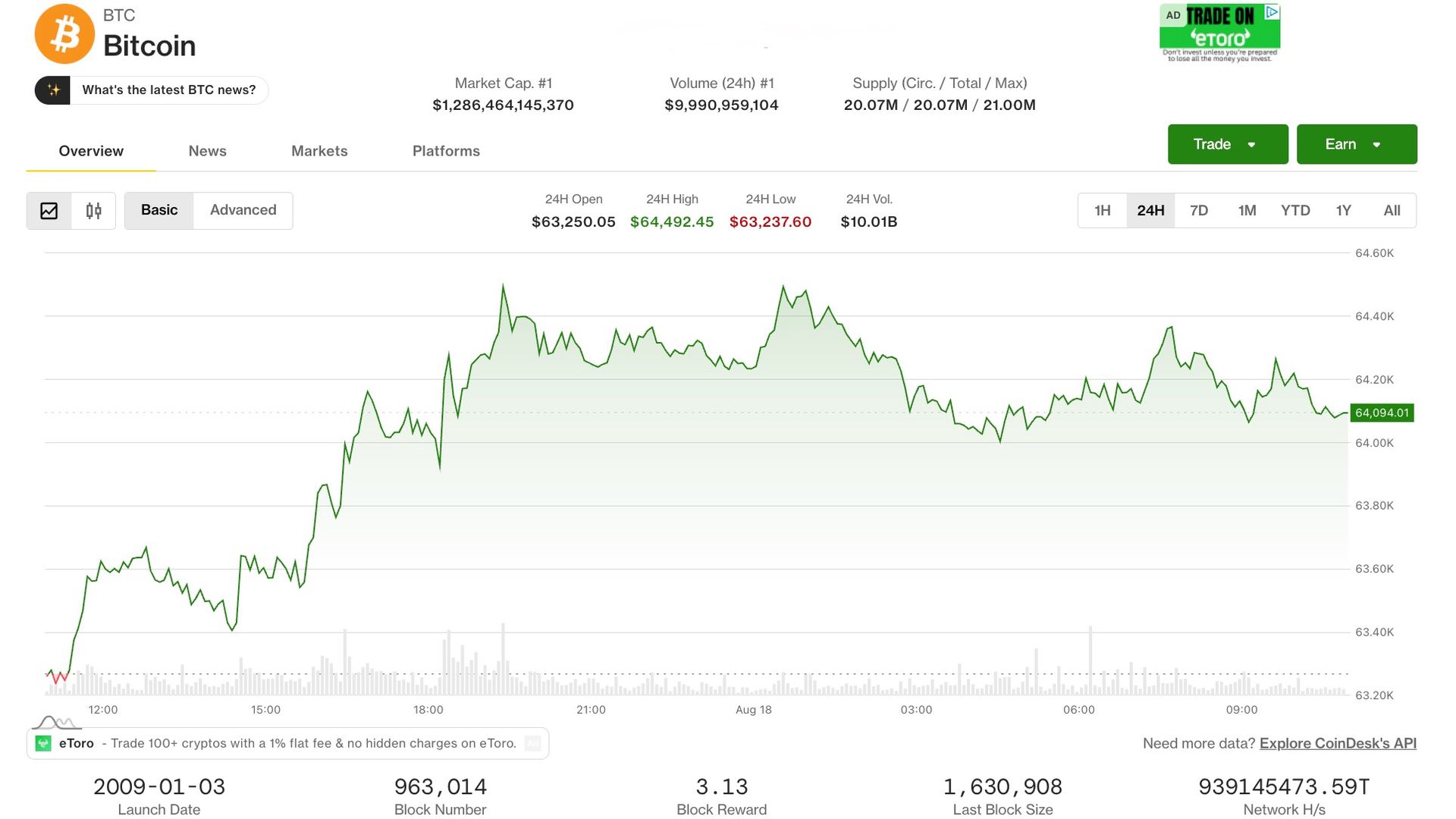
Bitcoin recently traded around $64,000, pausing after a rally that saw it rise from $62,600 on Monday. The largest cryptocurrency has dropped 0.6% since midnight UTC, trailing after Nasdaq 100 index futures, which lost 1.1% as U.S. Treasury bond yields and oil prices rose.
Ether lost around 1% since midnight and coins including SUI, XLM and TAO also dropped.
The increase in yields reflects unease ahead of the Federal Reserve minutes release due Wednesday after two consecutive softer inflation prints. Brent crude oil rose back to $94 per barrel after a 60-day US-Iran ceasefire expired Monday without a deal.
Also on Wednesday, U.S. President Donald Trump is expected to attend a meeting with crypto CEOs at the White House, with U.S. policy being a key driver of price action of late, contributing to the stop-start nature of bitcoin’s range-bound performance.
Derivatives positioning
- Taker ratio flips bullish: With BTC outperforming U.S. stocks on Monday, the long-short taker volume ratio in crypto futures flipped decisively from neutral to bullish, with longs accounting for over 51% of flow. Takers are traders who buy or sell at available prices, pulling liquidity from the order book.
- Funding rates confirm the chase for longs: BTC traders are chasing bullish bets, as evidenced by annualized perpetual funding rates surging to a 20-month high, according to data source CryptoQuant. Positive funding rates mean futures are trading at a premium to spot price, reflecting a bullish bias.
- BTC OI holds steady despite the move: Overall open interest (OI) in bitcoin futures remains near 750,000 BTC, a level it’s largely held for weeks.
- SOL sees a pickup in activity: OI in SOL futures rose to 66.88 million tokens, the most since July 10. Funding rates remain near zero.
- XLM shows a clear bearish tilt: The token has dropped nearly 3% to 15 cents since midnight, its lowest since May 27, reversing a pop to 27 cents at the end of May. Traders appear to be shorting the dip: OI in XLM futures rose 3.5% over the past 24 hours, the highest level since June 4. With annualized funding rates at -28%, that indicates a strong bearish bias. A negative 24-hour OI-adjusted cumulative volume delta (CVD) reinforces this picture, suggesting sellers are trading more aggressively via market orders rather than passive limit orders.
- Other notable OI movers: CC, DOGE and SUI are also among the notable OI gainers, though prices of all three are trading little-changed to negative. HBAR and CRO are notable OI losers.
- Bullishness looks selective, not broad-based: BTC is buoyant and showing buyer leadership, with a positive 24-hour CVD. Most of the other major cryptocurrencies, including ETH, SOL, LTC, LINK and DOGE, show negative CVD, suggesting the bullish sentiment is concentrated in BTC.
- Low volatility is inviting fresh positioning: Bitcoin and ether’s 30-day implied volatility indexes remain at the year’s lows. Trading firm TDX Strategies suggested using this low-vol environment to build tactical positioning favoring December optionality across BTC and select altcoins such as SOL and HYPE.
- Options flow leans toward upside bets: On Deribit, calls struck above BTC’s spot price continue to dominate 24-hour volume rankings. The $70,000-strike call expiring Sept. 25 is the most-traded bitcoin option of the past 24 hours. For ether, the $2,080 call expiring Aug. 28 leads.
Token talk
- PUMP rose 1.31%, holding a portion of Monday’s 7.8% surge that came alongside a 55% jump in daily trading volume to $90 million. The token has now stabilized above $0.00277.
- XMR added 0.59% since midnight to $417, taking the seven-day gain to more than 11%. The privacy coin has been one of August’s outperformers.
- SUI is the biggest laggard since midnight, sliding 4.62% to 64.36 cents, reversing a stretch of relative strength that had seen it outperform most layer-1s through late July.
- FET has shed 2.10% since midnight to 12.13 cents, extending a run of underperformance that has seen AI-adjacent tokens give back much of their late-July gains.
- LINK is down 1.45% at $9.39, retracing some of the gains that followed Standard Chartered’s prediction that called for it to rise by 2,000% by 2030. It remains up by 8% since that forecast.
Bitcoin price analysis is at a standstill, with BTC trading at $63,500 as of this writing, up around +1% on the day, a print that tells you almost nothing and everything about where this market sits right now. Rangebound is where we’re at right now, and only a significant catalyst, good or bad, can break Bitcoin out of its lull.
Jane Street’s disclosure of a $990M bitcoin ETF stake, coming on the heels of a reported $15Bn loss elsewhere in its book, has traders wondering if the near-billion-dollar BTC exposure is as bullish as it seems.
The broader tape backs that skepticism. Spot ETFs logged back-to-back outflows for the first time since late July, and BTC has slid from roughly $65,000 into the $63,000–$63,500 zone over the past week, about a 3% weekly drawdown. BTC feels trapped near $63,500 and capped below $64,000 through Monday’s session.
Layer in a 30-year Treasury yield hitting its highest level since 2007, and risk assets broadly are getting squeezed by a tightening liquidity backdrop that doesn’t discriminate between stocks and crypto.
Bitcoin Price Analysis: Can BTC USD Hit $65,000 This Week?
At $63,500 and up, just +0.8% over the past 24 hours, Bitcoin remains locked in the same range that’s defined trading since mid-August. CoinGecko data flags $62,600–$62,700 as the zone where dip-buyers keep stepping in, with $63,800 acting as near-term resistance on the way back up.
Zoom out and the wider structure holds: $62,000 as the key downside reference, $65,000 as the resistance level everyone’s watching on social feeds.
Volume hasn’t confirmed a breakout in either direction, which is the tell here. Miner selling and long liquidations have added friction on dips, while ETF outflows cap enthusiasm on bounces.
Bull case: a reclaim above $64,500, with volume follow-through, opens the door to a retest of $65,000.
Base case: continued chop between $62,800 and $64,000 while the market digests Jane Street’s position and waits on macro clarity.
Bear case: a break below $62,000 with rising Treasury yields accelerating outflows, dragging BTC toward the low-$60,000s. For a deeper technical breakdown on where support could give way next, this recent BTC forecast is worth a look.
Trade Bitcoin on Bybit and Get a Chance to Win Our $1,000 USDT Airdrop
Maxi Doge Targets Early Mover Upside as Bitcoin Tests Key Levels
The current Bitcoin price analysis highlights a market where the largest asset can’t clear $65,000, despite a near-billion-dollar institutional stake, which tells you something about the appetite for size.
Big positions moving at Jane Street’s scale don’t translate into 10x moves from here; the market cap is too large for that kind of convexity. That’s precisely the calculation driving traders toward earlier-stage plays where upside isn’t capped by nine-figure liquidity requirements.
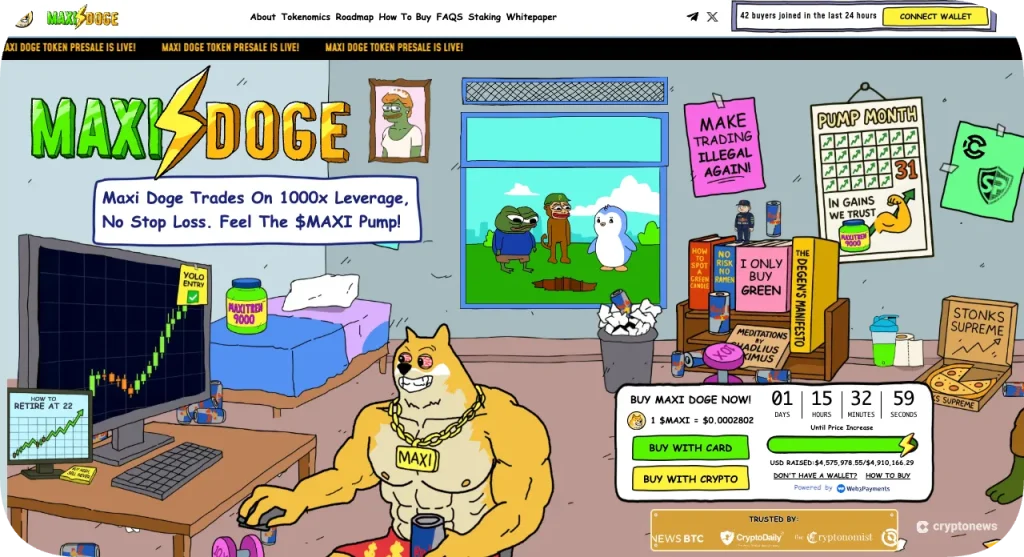
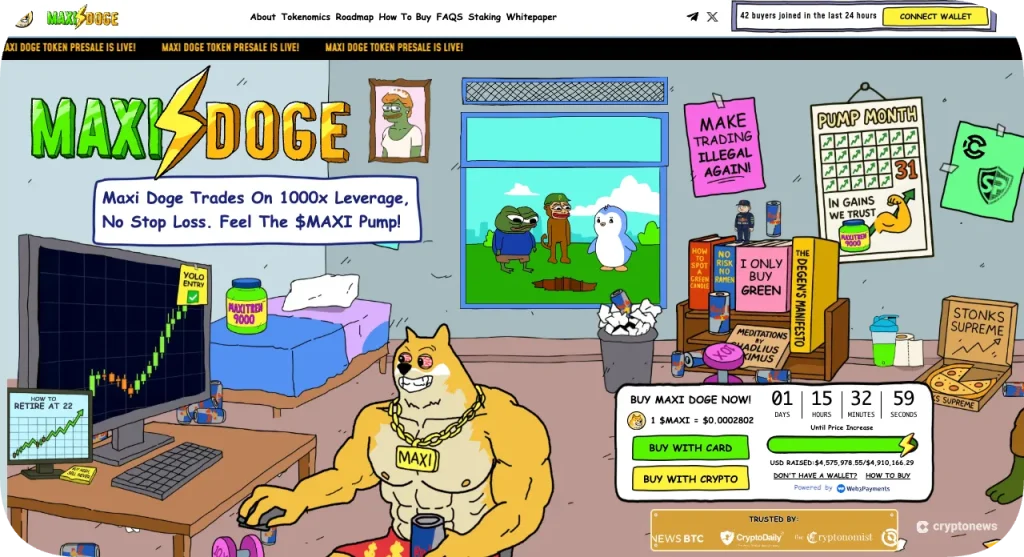
Maxi Doge ($MAXI) is leaning into that rotation with an unapologetic pitch: a 240-lb canine mascot built around 1000x leverage trading culture and holder-only trading competitions with leaderboard rewards. The presale has raised $4,844,784.51 at a current token price of $0.0002834, with dynamic APY staking live for early participants.
A Maxi Fund treasury backs liquidity and partnerships, and the meme-first marketing, gym-bro humor, “never skip leg-day, never skip a pump”, is clearly aimed at the same degenerate-trader demographic that made DOGE a household name.
Visit the Maxi Doge Presale Website Here.
Discover: The Best Crypto to Diversify Your Portfolio
The post Bitcoin Price Analysis: Can BTC Break Out of This Range and Hit $65K? appeared first on Cryptonews.


BitBox has released a firmware update fixing two severe vulnerabilities that could have exposed hardware wallet users to malicious firmware or caused Bitcoin to be locked to an unintended address.
Summary
- BitBox has patched two severe vulnerabilities affecting its BitBox02 and BitBox02 Nova hardware wallets.
- One flaw could have allowed malicious firmware installation, while another could have locked Bitcoin to an unintended address.
- BitBox said neither vulnerability had been exploited and no user funds were reported lost.
- The fixes follow a Coldcard firmware flaw linked to more than $112 million in Bitcoin thefts.
BitBox said in a security disclosure on Monday that the first vulnerability involved memory corruption affecting unconfigured Multi editions of the BitBox02 and BitBox02 Nova, while a second flaw affected the wallet maker’s Silent Payments implementation.
The company said it had found no evidence that either vulnerability had been exploited and had received no reports of users losing funds because of the flaws.
BitBox vulnerability could have allowed malicious firmware
For the first vulnerability, BitBox said a malicious host connected to an affected wallet could exploit memory corruption to execute arbitrary code before the device had been configured with a wallet.
Successful exploitation could potentially allow the host to install malicious firmware, creating a route through which funds could later be compromised, according to the company.
The exposure was limited to Multi editions of the BitBox02 and BitBox02 Nova that had not yet been set up. BitBox classified the vulnerability as severe because arbitrary code execution could undermine protections designed to prevent unauthorised software from running on the hardware wallet.
Firmware controls how a hardware wallet handles cryptographic operations, verifies transactions and communicates with a connected computer. BitBox said the vulnerability could therefore put funds at risk if an attacker managed to use the flaw to install malicious firmware on an affected device.
Similar hardware and firmware weaknesses have surfaced at other wallet makers in recent months. In June, crypto.news reported on a flaw in the TROPIC01 Secure Element used by Trezor Safe 7 devices after Ledger Donjon researchers carried out a laser fault injection attack during laboratory testing.
Trezor said its Safe 7 remained protected because the device uses three independent hardware security layers. According to the company, compromising TROPIC01 alone did not provide access to a user’s PIN, wallet or funds.
Tropic Square had provided the chip to Ledger Donjon for independent testing, with researchers notifying the company in January that they had extracted some chip secrets and bypassed firmware signature checks using the laboratory attack.
Another hardware attack disclosed in July allowed Ledger Donjon researchers to reset the password on a Tangem wallet card using a targeted laser pulse against its secure element.
Ledger Donjon said the attack required physical possession of the card, invasive preparation, specialist knowledge and laboratory equipment costing about $250,000. Tangem described the everyday risk to customers as “virtually non-existent,” while advising users to keep their wallet cards physically secure.
Silent Payments flaw could have locked Bitcoin
BitBox’s second severe vulnerability affected Silent Payments, a Bitcoin privacy feature that allows users to receive payments without publishing a new address for each transaction.
According to BitBox, a malicious host could exploit the implementation to cause Bitcoin to be locked to an unintended address.
Direct theft was not possible through the vulnerability, the company said. An attacker could instead leave the victim unable to recover the Bitcoin without cooperation and potentially demand a ransom in exchange for helping unlock the coins.
Such an attack would not automatically transfer control of the affected Bitcoin to the malicious host, but BitBox said the vulnerability could still put funds at risk by making them inaccessible to their owner.
The company addressed the problem through its latest firmware update and said it had received no reports of the Silent Payments flaw being exploited.
BitBox has dealt with other security issues through firmware updates this year. Its Oeschinen update in July included several security fixes, including one for a buffer out-of-bounds write affecting the BitBox02 firmware and bootloader.
According to the company’s disclosure at the time, a USB request accepted a length value without properly checking it against the size of the destination buffer, creating a potential route for a malicious host to trigger an out-of-bounds write.
BitBox said no working exploit had been demonstrated for that vulnerability, although an effect on control flow could not be completely ruled out.
Earlier in January, the company also patched two BitBox02 Nova vulnerabilities reported through its bug bounty programme. BitBox classified the issues as minor and moderate because exploitation required advanced physical access and applied only under specific conditions.
Coldcard firmware flaw has put wallet security under scrutiny
BitBox’s update follows the disclosure of a separate Coldcard firmware flaw linked to more than $112 million in stolen Bitcoin after the vulnerability remained undetected for more than five years.
Galaxy Research said Friday that Coldcard-related losses had exceeded $112 million, with approximately 1,778.6 BTC swept from more than 8,600 addresses.
The vulnerability was traced to a firmware change introduced in March 2021 that affected the randomness used to generate wallet seeds. Attackers could brute-force impacted seeds and derive the corresponding private keys without obtaining physical access to the hardware wallet, according to research into the incident.
A wallet seed is used to derive the private keys controlling its cryptocurrency. Weaknesses that reduce the randomness used during seed generation can therefore reduce the number of possible combinations an attacker needs to test.
For users whose wallets were created with affected Coldcard firmware, updating the device alone would not repair a seed that had already been generated with weak randomness. Moving funds to a wallet created from a newly generated secure seed would be required to remove exposure associated with the compromised seed.
The incident affected a hardware wallet line that received its first major hardware revision in several years earlier in 2026. Coinkite launched the Coldcard MK5 in March, with the device becoming the first hardware update to its flagship MK series since the MK4 arrived in 2022.
The MK5 retained the previous model’s dual secure-element architecture using chips from two different vendors and kept private keys air-gapped. Its main changes included a 1.54-inch Gorilla Glass display, redesigned physical buttons and improved NFC functions.
Coinkite said at the time that the five major MK5 upgrades focused on usability while preserving the security architecture used by the previous model.
Customer data leaks have created separate phishing risks
Hardware wallet owners have also faced security incidents outside the devices themselves, with recent breaches involving Trezor and SafePal exposing customer and order information belonging to more than 53,000 people.
Trezor attributed the exposure of information belonging to 13,689 customers to shipping provider ShipMonk. SafePal separately said an authorisation flaw in an order-tracking plug-in exposed details connected to 39,798 customers.
Neither incident compromised the companies’ hardware wallets, private keys or recovery phrases, according to the respective disclosures. Both companies warned that exposed personal and order information could instead be used for targeted phishing and impersonation attempts.
Such information can give attackers details needed to make wallet-related scams appear more credible. Earlier in February, attackers sent physical letters impersonating Trezor and Ledger and instructed recipients to complete supposed authentication or transaction checks.
The physical phishing campaign used official-looking correspondence containing QR codes that directed recipients to malicious websites. Some letters created urgency by claiming users had to complete an authentication process to avoid problems accessing their wallets.
The websites asked victims to enter 12-, 20- or 24-word recovery phrases under the pretence of verifying ownership. Once submitted, the phrases were transmitted to the attackers, allowing them to recreate the wallets and gain control over the associated funds.
Trezor and Ledger said legitimate hardware wallet providers do not ask customers to enter, scan, upload or share recovery phrases through websites or other external channels. Recovery phrases should only be entered directly on a hardware wallet when restoring a wallet, according to the companies.


Crypto exchange Kraken has launched trading in more than 7,000 U.S.-listed stocks for eligible customers across the European Economic Area, placing traditional shares alongside more than 700 tokenized xStocks and over 600 crypto assets in the same account.
Summary
- Kraken has launched trading in more than 7,000 U.S. stocks for eligible customers across the EEA.
- Customers can access traditional U.S. shares alongside more than 700 xStocks and over 600 crypto assets.
- The stock service is provided through Kraken’s MiFID II authorised Cyprus investment firm.
- xStocks have generated more than $38 billion in total transaction volume since launching in June 2025.
The Block reported on Aug. 18 that the service has become available across the EEA after Kraken quietly began introducing stock trading to customers in Germany, the Netherlands and France in recent days.
The rollout takes Kraken’s traditional equities business outside the United States, where the exchange first entered stock trading in 2025, while giving European customers two ways to gain exposure to U.S.-listed companies through the same platform.
Kraken said eligible EEA customers can buy traditional shares or use xStocks, its blockchain-based products tied to listed equities and exchange-traded funds. Both products can be accessed without transferring funds between separate platforms.
“With U.S.-listed stocks and xStocks available side-by-side in a single regulated account, customers can choose how they access the same underlying exposure — whether through traditional shares or tokenized representation — without moving capital or changing platforms,” Mark Greenberg, chief commercial officer of Kraken parent Payward and head of Payward Services, said in a statement.
Kraken U.S. stock trading reaches eligible EEA customers
Access covers more than 7,000 traditional U.S. stocks through the desktop and mobile versions of Kraken Pro as well as the main Kraken mobile app.
Kraken said stock trades will carry no trading commission, subject to its applicable terms. Eligibility will not be automatic for every existing customer, however, as users must accept additional terms and conditions before the equities feature becomes available.
The service is being provided by Payward Europe Digital Solutions (CY) Limited, a Cyprus investment firm authorised under the European Union’s Markets in Financial Instruments Directive II, or MiFID II.
Alongside the conventional securities offering, customers can access more than 700 xStocks and over 600 crypto assets through their Kraken accounts. The company said xStocks have processed more than $38 billion in total transaction volume since launching in June 2025.
Kraken describes the setup as distinct from European platforms that provide only one form of U.S. equity exposure. Bitpanda offers traditional U.S. stock trading, while platforms including Robinhood and Crypto.com have introduced tokenized U.S. equity products for European users.
Crypto.com, for example, recently launched tokenized stock derivatives tracking about 1,500 U.S. stocks and ETFs for eligible EEA customers and users in other approved markets. Its products provide synthetic price exposure and do not give buyers legal or beneficial ownership of the underlying securities.
xStocks have moved into more parts of Kraken’s trading system
Kraken has continued adding functions to xStocks since the products were introduced in June 2025, taking them beyond instruments used solely to track the price of conventional equities.
In July, crypto.news reported on Kraken allowing eligible users to post selected xStocks as collateral for futures and margin positions on Kraken Pro. Ten assets initially qualified, including tokenized versions of Apple, Nvidia, Tesla, Strategy, Robinhood, the SPDR S&P 500 ETF and the Invesco QQQ ETF.
Futures collateral was made available to qualifying clients outside the United States, including customers in the EEA. Margin collateral was offered outside the U.S. but excluded EEA clients.
Kraken had also developed dedicated onchain infrastructure for the product earlier in 2026. Its xStocks platform introduced xChange in March, an execution layer initially supporting more than 70 tokenized equities across Ethereum and Solana.
At that point, xStocks had generated about $25 billion in total trading volume, including $3.5 billion in onchain transactions, while more than 80,000 onchain holders had interacted with the products. Each token was described as fully collateralised and backed 1:1 by its corresponding underlying security.
Kraken’s current figures put total xStocks transaction volume above $38 billion, showing how quickly activity has increased since the March tally.
Payward is taking xStocks into more international markets
Payward has also been preparing to add equities from markets outside the United States to the xStocks system.
A July partnership with GTN set out plans to begin with Hong Kong-listed shares before adding securities from the United Kingdom, Europe, South Korea and other markets, subject to the necessary licences and regulatory approvals.
Under the agreement, GTN is providing execution, custody, ledgering and record-keeping infrastructure across more than 90 financial markets, while Payward continues to supply the tokenization infrastructure used to create the blockchain-based assets.
At the time of the July announcement, xStocks supported more than 500 tokenized assets and had generated over $37 billion in transaction volume. Payward also said GTN could eventually distribute xStocks to institutional customers once the required approvals are secured in individual markets.
The latest EEA rollout concerns conventional U.S.-listed securities alongside existing xStocks, while Kraken said it plans to take the combined traditional-stock and tokenized-equity service into additional markets over the coming months.
Tokenized equities have taken a larger share of RWA activity
The expansion comes as tokenized equities have become a larger part of the real-world asset market.
According to figures cited by The Block, tokenized equities now account for about 15% of the RWA market, around three times their share at the start of 2026. The segment has reached roughly $2.8 billion in total market capitalisation, with Ondo Finance, Binance’s bStocks and Kraken’s xStocks accounting for a combined 77%.
Kraken has also expanded what holders can do with the securities represented through xStocks. Earlier in August, the platform extended shareholder voting rights to more than 125,000 xStocks holders, allowing eligible investors to instruct the underlying custodian on how votes should be cast at company shareholder meetings.
The feature changed the original structure of xStocks, which did not provide voting rights when the products launched in June 2025. The arrangement relies on the custody structure operated by Backed Assets (JE) Limited, according to the report.
Kraken parent Payward, meanwhile, reported $508 million in adjusted revenue for the second quarter, up 17% from the same period a year earlier. Adjusted EBITDA reached $23 million for the three months ended June 30.
Total platform transaction volume fell 13% year over year to $310 billion during the quarter, while Payward reported that the composition of trading activity moved toward equities and tokenized equities.

Welsh city hit with another blow as store to close its doors

Pfizer: Still Cheap Valuation Meets A Looming Patent Cliff

California Governor Odds: Becerra Leads as Primary Day Nears


-

 Fashion4 days ago
Weekend Open Thread: Ann Taylor
-
 NewsBeat6 days ago
Communication cards help banking customers access services or report scams
-
 Sports4 days ago
This U.S. Amateur is a glimpse into golf’s future in more ways than you think
-

 Sports3 days ago
Birmingham 2026: Day 6 Timetable for Irish Athletes
-
 NewsBeat3 days ago
Myanmar says over 300,000 Rohingya refugees verified for repatriation as exodus enters ninth year
-

 Politics3 days ago
SEQ Code: The Three Letter Boarding Pass Code That Could Give You The Worst Seat
-
 Entertainment6 days ago
Keke Palmer Subtly Hints At Sean Evans Drama With Cryptic Post
-
 Tech4 days ago
11 Ways to Rank Your Videos
-

 Fashion7 days ago
Coffee Break: The Fonteyn Jane Flat
-

 Fashion7 days ago
Should you refinance your debt? Pros, cons, and real numbers
-

 Tech7 days ago
Zoom Screen-Sharing Bug Let People Fully Take Over Other Devices On A Call
-

 Fashion7 days ago
Claire Life: Kicking Off MVAAFF With the C Suite Luncheon Featuring Phylicia Rashad, Letoya Luckett, and More!
-
 Crypto World6 days ago
XRP bridge drained after software mistook fake deposits for real ones
-

 Tech5 days ago
DeepSeek Harness launches as open source rival to Claude Code, alongside V4-Pro on API with higher prices
-

 Sports6 days ago
DeQuan Jones in ‘high spirits’ after successful leg surgery
-

 Tech6 days ago
SpaceXAI’s Grok Bot turns agents into persistent digital coworkers that can operate your apps for $120-per-month
-

 Politics6 days ago
How Average Are You In The UK?
-
 Crypto World6 days ago
Perplexity AI Predicts an XRP Scenario Few Analysts Are Discussing
-

 Politics7 days ago
In the Chris Kaba case, the police watchdog capitulated to the mob
-

 Business6 days ago
Evolv Technologies Holdings, Inc. (EVLV) Q2 2026 Earnings Call Transcript
You must be logged in to post a comment Login