
Business
Macquarie advising Rio Tinto on Mt Cattlin sale



Business
Chinese Robot Maker Unitree Sees Shares Surge Nearly 500% on Stock Market Debut in Shanghai

Shares in Unitree, the world’s largest maker of humanoid robots, surged as much as 600% before paring back to a gain of nearly 500% on the company’s debut on China’s stock market Wednesday, marking one of the most explosive public listings of the year as investors race to identify winners in the fast-growing robotics sector.
Shares in the company, officially known as Yushu Technology Co., rose to as high as 1,100 yuan, or roughly £120.39, from an initial public offering price of just 150.8 yuan, before settling to a still-remarkable gain of nearly 500% by the end of trading. The listing places Unitree among the standout technology debuts on Chinese exchanges this year, reflecting intense investor appetite for exposure to humanoid robotics, an industry widely viewed as one of the central battlegrounds in the broader global race around artificial intelligence.
Unitree, founded in 2016, has built global recognition largely through viral videos showcasing its robots performing martial arts routines, running at speeds comparable to Olympic athletes, and serving as backup dancers during pop star performances. The company shipped more than 5,500 humanoid robots last year, positioning it as one of the most commercially established players in a market still in its relatively early stages of large-scale deployment.
The broader humanoid robotics market is projected to grow dramatically over the coming decade. Analysts estimate that global sales of humanoid robots could climb from roughly $2 billion in 2025 to as much as $300 billion by 2035, a growth trajectory that has fueled significant investor enthusiasm for companies positioned to capture a meaningful share of that expansion.
Retail investor demand for Unitree’s IPO proved exceptionally strong. According to reporting on the listing, the portion of shares set aside for non-professional individual investors was oversubscribed by thousands of times, reflecting the scale of public enthusiasm surrounding the offering among ordinary Chinese stock market participants, in addition to institutional interest.
Unitree occupies a relatively unique position within the still-developing humanoid robotics industry as one of the few publicly listed pure-play companies in the space. Its largest competitor, AgiBot, remains privately held, while a smaller rival, UBTech, is listed on the Hong Kong stock exchange rather than mainland Chinese markets. At least half a dozen other Chinese humanoid robotics companies, including Deep Robotics and Leju Robotics, are reportedly preparing their own public listings, suggesting Unitree’s debut could serve as an early bellwether for investor appetite toward the broader sector as additional competitors move toward going public.
The scale of Wednesday’s share price surge has had a dramatic personal financial impact on Unitree founder and chief executive Wang Xingxing, who founded the company in 2016 and continues to own roughly a fifth of the business. According to Reuters, the jump in Unitree’s valuation means Wang’s personal stake is now worth more than $12 billion on paper, a significant increase to his net worth driven entirely by the market’s reaction to the company’s public debut.
Unitree’s stock market listing coincided with the opening of the World Robot Conference in Beijing on Wednesday, an event that brings together hundreds of companies, the vast majority of them Chinese, to unveil new products and showcase recent technical advances across the robotics industry. The timing of the listing alongside the high-profile conference likely amplified investor attention on the sector more broadly, contributing to the intensity of demand for Unitree shares.
Unitree’s rapid rise has not been without controversy or geopolitical friction. Last month, the U.S. Federal Communications Commission moved to ban imports of future models of foreign-made humanoid and quadruped robots, citing national security concerns, a decision widely understood to be aimed primarily at Chinese manufacturers such as Unitree given the country’s dominant position in the global humanoid robotics supply chain. Separately, the Pentagon added Unitree to a list of Chinese companies it has identified as contributors to China’s defense industrial base earlier this summer, a designation Unitree has pushed back against, with the company previously stating that its robots are intended for civilian use rather than military applications.
Despite the friction with U.S. regulators, Unitree has continued to attract substantial backing from major Chinese technology companies, with both Tencent and Alibaba among the firm’s corporate investors, underscoring the strategic importance domestic Chinese technology giants have placed on securing early positions within the country’s rapidly developing robotics ecosystem.
Unitree’s stock market debut adds to a broader wave of attention on China’s robotics sector this year, as the country has increasingly positioned humanoid and quadruped robots as a strategic priority within its broader technology development agenda, alongside ongoing investment in artificial intelligence more generally. The intense investor demand seen in Wednesday’s listing suggests that enthusiasm extends well beyond government-level strategic interest and into broad-based public market appetite for exposure to companies at the forefront of the robotics industry.
With several additional Chinese humanoid robotics companies reportedly preparing their own initial public offerings in the coming months, market analysts are likely to closely watch how sustained investor interest proves to be following Wednesday’s dramatic debut, both as a signal of confidence in Unitree specifically and as a broader indicator of how receptive Chinese capital markets may prove to be toward the wave of robotics-focused listings expected to follow in the sector over the remainder of the year.

Morgan Stanley upgrades Merck stock rating on drug pipeline strength

Check out what’s clicking on FoxBusiness.com.
State Farm Mutual Automobile Insurance recently began distributing a record $5 billion dividend to qualifying auto insurance customers, marking the largest payout of its kind in the company’s more than 100-year history.
Millions of customers have already received payments, with additional distributions on the way, State Farm said in a July 31 news release.
The dividend is being paid to eligible customers covering more than 49 million State Farm Mutual auto vehicles nationwide.
“Because the distribution covers more than 49 million auto vehicles, the payment process will take several months to be completed nationwide,” the company said.
COSTCO PLOTS MAJOR EXPANSION INTO SENIOR HEALTHCARE WITH MEDICARE PARTNERSHIP

Millions of customers have already received payments. (Marcin Golba/NurPhoto via Getty Images)
Each customer’s payment is calculated as a percentage of the premium paid for each qualifying policy in 2025.
The percentage varies by state and ranges from 4% to 10%, according to State Farm.
State Farm previously told USA Today that customers who had an active personal auto insurance policy in 2025 are eligible for the payment.
MAJOR PBMS TO BOOST PRESCRIPTION DRUG PRICE TRANSPARENCY THROUGH TRUMPRX

The dividend is being paid to eligible customers covering more than 49 million State Farm Mutual auto vehicles nationwide. (Eric Thayer/Bloomberg via Getty Images)
The company said qualifying customers will be notified about a pending payment either by email or through a letter in the mail.
Customers with an email address on file will get instructions to choose how they want to be paid.
Those without an email address on file will receive a check by mail.
The insurer did not specify an exact date for when the payments would be completed.
OBAMACARE EXCHANGE FLAW EXPOSED AMERICANS TO UNEXPECTED HEALTH PLAN SWITCHES, WATCHDOG FINDS

The company said qualifying customers will be notified about a pending payment either by email or through a letter in the mail. (Christoph Dernbach / Getty Images)
State Farm initially unveiled plans for the $5 billion dividend in February.
“This dividend is possible due to State Farm Mutual’s financial strength and a stronger than expected underwriting performance, which has been reported industry wide,” State Farm said at the time.
GET FOX BUSINESS ON THE GO BY CLICKING HERE
FOX Business reached out to State Farm for comment.
Business
PETRONAS Chemicals Group Berhad 2026 Q2 – Results – Earnings Call Presentation (OTCMKTS:PECGF) 2026-08-19


Seeking Alpha’s transcripts team is responsible for the development of all of our transcript-related projects. We currently publish thousands of quarterly earnings calls per quarter on our site and are continuing to grow and expand our coverage. The purpose of this profile is to allow us to share with our readers new transcript-related developments. Thanks, SA Transcripts Team

MILWAUKEE — The Milwaukee Brewers set a franchise record for largest margin of victory and matched the club mark for runs scored in a stunning 22-0 rout of the Seattle Mariners on Tuesday night at American Family Field, a win that tied for the most lopsided shutout victory in Major League Baseball since 1887.
The game bore little resemblance to its early innings. Jake Bauers scored Milwaukee’s first run in what became a controversial and hard-fought play at home plate, sliding in against Mariners catcher Cal Raleigh in a 1-0 game heading into the bottom of the fifth. From there, the Brewers exploded, scoring 21 of their 22 total runs across their final four turns at bat in a display that left both dugouts, and the record books, scrambling to keep up.
“It was kind of crazy, and it happened fast,” said Brewers outfielder Christian Yelich, who played a central role in breaking the game open. Mariners manager Dan Wilson offered a more subdued assessment of the historic defeat. “It’s a tough one to even think about,” Wilson said. Brewers manager Pat Murphy, by contrast, embraced the outcome. “I’d like to order that every night,” Murphy said.
The 22-0 final score tied for the most lopsided shutout win in MLB history since June 28, 1887, when the Philadelphia Quakers, the franchise now known as the Phillies, defeated the Indianapolis Hoosiers by the same 24-0 margin comparison point. It also marked the largest shutout win at a home ballpark in 141 years, dating back to when the New York Giants defeated the Buffalo Bisons 24-0 on May 27, 1885. Only two teams have posted 22-0 victories in the years since — Pittsburgh in 1975 and Cleveland in 2004 — but both of those wins came on the road, making Milwaukee’s Tuesday night performance the first of its magnitude achieved at home in more than a century.
The win also set a new franchise mark for Milwaukee, surpassing the club’s previous record margin of victory by two runs. That prior record had been set with a 20-0 win in Pittsburgh on April 22, 2010. The Brewers’ 22 runs also matched the franchise’s all-time single-game scoring record, tying a 22-2 victory over Toronto on Aug. 28, 1992, a game that featured Hall of Famers Robin Yount and Paul Molitor as teammates during Milwaukee’s tenure in the American League. That 1992 game remains the franchise record for hits in a single contest, with 31 against the Blue Jays.
Tuesday’s Brewers offense, while producing fewer hits at 22, made them count in dramatic fashion, including four home runs, all coming from the fifth inning onward. The power surge stood out for a Milwaukee team that, even after Tuesday’s outburst, ranks last in the major leagues with 117 home runs on the season. Yelich capped a five-run fifth inning with a three-run home run. David Hamilton and Bauers each added multi-run home runs during a five-run sixth inning. Then, in a nine-run eighth inning that Yelich described as the moment the game shifted from lopsided to absurd, rookie outfielder Luis Lara hit his first career major league home run, a two-run shot that came off Mariners infielder Leo Rivas, a position player pressed into pitching duty. “Maybe we’ll have a [celebration] for his second career homer when he gets one off an actual pitcher,” Yelich said. “But they all count. You’ll take every single one of them.”
The eighth inning brought additional chaos beyond Lara’s milestone home run. With the bases loaded, Yelich, batting for the second time in the inning, lifted a fly ball to center field. Mariners center fielder Julio Rodríguez fielded the ball and threw it into the stands, apparently unaware that it was only the second out of the inning. Yelich’s flyout was ruled a sacrifice fly, extending Milwaukee’s lead to 20-0, while the baserunners were awarded two additional bases due to Rodríguez’s throwing error, pushing the score to 21-0. Lara then delivered an RBI single to make it 22-0. “It was kind of chaos there in the last inning with the lineup turning over and all the action going,” Yelich said. “It just happens sometimes. You lose track of the outs.”
Amid the lopsided later innings, the game’s opening stretch featured a far tighter and more contentious sequence. Bauers scored Milwaukee’s first run of the night on a two-out single by William Contreras, sliding into home plate where Raleigh was waiting with the ball already in his mitt. Bauers said he attempted a slide similar to one he had executed successfully days earlier in Los Angeles, but Raleigh’s positioning in the baseline appeared to result in Bauers knocking the ball loose from the catcher’s glove with his hands. Both players scrambled after the loose ball, with Raleigh diving back toward the plate and Bauers alerted by an on-deck Yelich to the ball’s location, ultimately being ruled safe. Reflecting on the play afterward, Bauers said the contact was unintentional. “I saw the replay. I definitely wasn’t trying to hit his glove,” he said. “I was more trying to protect him and me, because I didn’t want to barrel through him. I didn’t want to break my neck on his chest protector. It sucks that that’s the way it looks on video, but I definitely wasn’t trying to knock the ball out of his glove.”
What began as a tightly contested, potentially controversial 1-0 baseball game ultimately transformed into one of the most lopsided victories in the sport’s long history, a result that left both organizations and longtime observers of the game reaching for the record books to properly contextualize just how unusual Tuesday night’s outcome in Milwaukee truly was.

Previously known as FloridaDoug-HQ. Member since 2017.”The portfolio doesn’t have to survive you. You are the end point. It needs to survive for you.” – The Philosophy of the Wealth and Legacy Optimization retirement plan.We are entering retirement focused on high-quality assets supporting a portfolio delivering exceptional Income, Growth and Resiliency. My focus is navigating the retirement pathways, sharing solutions, and providing clarity over complexity, for the average investor. Common sense, flexibility, simplicity and results reside here, along with a healthy sense of humor.I am not a registered financial advisor and my work is for educational purposes only. Readers need to do their due diligence.
Analyst’s Disclosure: I/we have no stock, option or similar derivative position in any of the companies mentioned, and no plans to initiate any such positions within the next 72 hours. I wrote this article myself, and it expresses my own opinions. I am not receiving compensation for it (other than from Seeking Alpha). I have no business relationship with any company whose stock is mentioned in this article.
Seeking Alpha’s Disclosure: Past performance is no guarantee of future results. No recommendation or advice is being given as to whether any investment is suitable for a particular investor. Any views or opinions expressed above may not reflect those of Seeking Alpha as a whole. Seeking Alpha is not a licensed securities dealer, broker or US investment adviser or investment bank. Our analysts are third party authors that include both professional investors and individual investors who may not be licensed or certified by any institute or regulatory body.

Enbridge: A $41 Billion Growth Backlog Meets A Mainline Volume Threat

Investors barely reacted to minutes from the U.S. Federal Reserve’s July meeting, which showed deepening concern about inflation with “several” policymakers ready to raise interest rates. “Many” said a rate hike would be needed if inflation does not decline to the U.S. central bank’s 2% target.
But a day after the yield on the 30-year Treasury bond hit its highest level since 2007, the yield fell on Wednesday along with the 10-year Treasury yield. The moves came after the U.S. Treasury announced it would double the size of liquidity support buyback operations for longer-dated bonds.
“The risk-on trade is trying to hang on to the lifeline that Treasury Secretary Bessent sent,” said Carol Schleif, chief market strategist at BMO Private Wealth, noting that riskier assets including high-profile technology stocks had sold off in recent days as bond yields rose.
Concerns over ballooning government debt and rising inflation had pushed global bond yields to multi-decade highs on Tuesday. Schleif said investors were relieved by the government support as higher rates “could potentially impact the AI trade” as technology companies have been issuing debt and equity and using their own cash to fund construction of data centers supporting AI.

However, equity indexes pared gains as the session wore on. Jim Baird, chief investment officer at Plante Moran Financial Advisors, said that investors likely took some profits after the initial rally and he added that the morning’s announcement “doesn’t mean that the longer-term issue of higher rates is off the table.”
According to preliminary data, the S&P 500 gained 18.15 points, or 0.24%, to end at 7,709.91 points, while the Nasdaq Composite gained 40.08 points, or 0.15%, to 26,331.09. The Dow Jones Industrial Average rose 123.94 points, or 0.23%, to 53,467.34.Moderna’s shares surged more than after the company said its personalized mRNA cancer therapy developed with Merck cut the risk of melanoma recurrence and spread in a late-stage trial. Merck shares also jumped and it was the biggest gainer in the blue-chip Dow.
Moderna’s rallyboosted healthcare peers such as Novavax and U.S.-listed shares of BioNTech.
The S&P 500 healthcare sector rallied sharply, hitting a record high and providing the biggest boost to the benchmark index from any of its 11 major industry sectors. The Nasdaq biotechnology index also jumped.
S&P 500 information technology stocks dipped during the session with chip stocks leading losses.
However, Marvell Technologies shares climbed after it said it will help develop Google’s in-demand custom chips and has offered the search giant the right to buy a potential $12.2 billion stake.
Marvell was one of the few gainers in the volatile Philadelphia semiconductor index, which ended lower. Google parent Alphabet’s shares were little changed during the session.
Target shares rose after the retailer raised its annual sales forecast. Lowe’s shares gained even after it trimmed its annual sales growth forecast and Estee Lauder shares jumped after the cosmetics maker forecast annual profit above Wall Street estimates.
Brent crude futures settled higher with Middle East progress still unclear. U.S. President Donald Trump said no talks were taking place with Iran and insisted the Strait of Hormuz was open, contradicting Iran’s assertion that the strait remained shut to shipping.
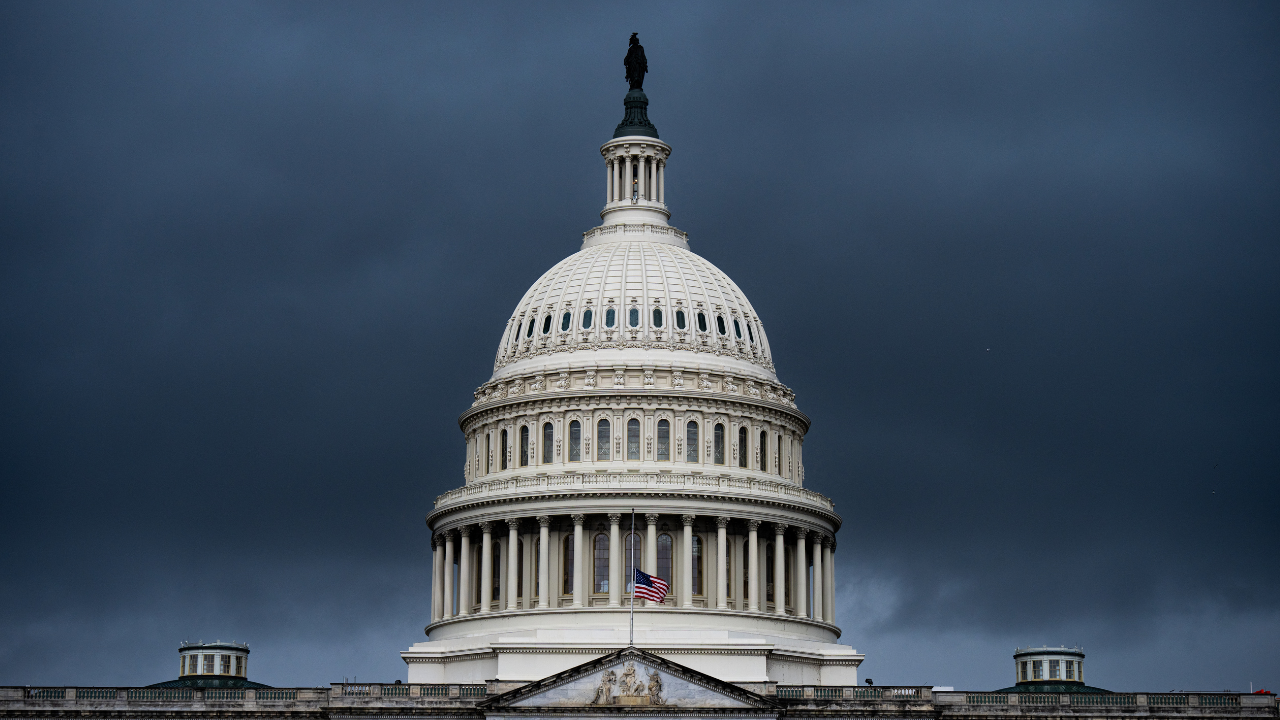
Rep. Jodey Arrington, R-Texas, speaks about the need for fiscal reform, including spending caps and reining in government waste, on ‘The Bottom Line.’
The U.S. national debt crossed another historic milestone on Wednesday as it topped $40 trillion for the first time in history amid persistent federal budget deficits that are causing the debt to soar higher.
Data from the Treasury Department released on Wednesday showed that the gross national debt reached $40,047,425,768,420.22 as of August 18.
The $40 trillion milestone comes after the federal government’s debt burden crossed the $39 trillion threshold about five months ago in March, which closely followed the $38 trillion mark being crossed in October 2025.
America’s national debt is growing rapidly due to surging interest costs, which are rising because of a larger debt burden and higher interest rates, as well as growth in federal spending on Social Security and Medicare amid the aging of the U.S. population.
FEDERAL BUDGET DEFICIT ON TRACK TO SURPASS $2T THIS FISCAL YEAR AS SPENDING OUTPACES REVENUE
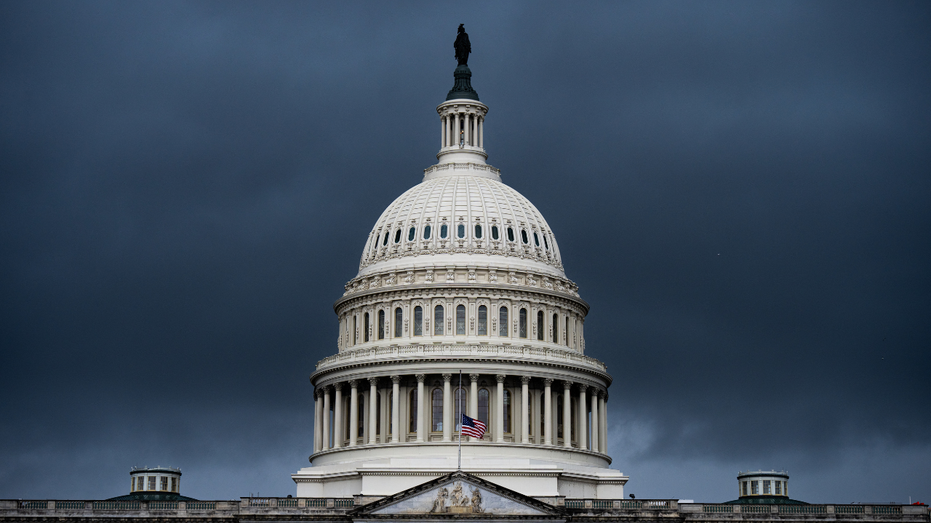
The U.S. gross national debt surpassed $40 trillion for the first time amid surging federal spending. (Bill Clark/CQ-Roll Call, Inc/Getty Images)
A March estimate by the nonpartisan Congressional Budget Office (CBO) estimated that the gross national debt will rise to $63 trillion in 2036, with annual budget deficits widening from about $2.1 trillion, the agency’s estimate for the current fiscal year, to $3.1 trillion a year a decade from now.
The gross national debt topping $40 trillion follows another recent debt milestone that puts the burden in context relative to the size of the U.S. economy.
The debt held by the public, a measure economists prefer to use in comparing a nation’s debt to the size of its economy, reached $31.27 trillion in late March the $31.22 trillion in gross domestic product (GDP) – marking the first time in about 80 years the public debt was larger than the economy.
Debt held by the public is projected to break the record of 106% of GDP that was set in 1946, when the U.S. was in the process of demobilization after the war ended, in the next few years, before rising to an estimated 120% of GDP in 2036, per the CBO’s estimate.
US NATIONAL DEBT SURPASSES SIZE OF THE ECONOMY FOR FIRST TIME SINCE WORLD WAR II
Michael A. Peterson, CEO of the Peter G. Peterson Foundation, told FOX Business that “For the millions concerned about affordability, let’s start by asking Washington to take notice that the national debt just hit $40 trillion,” adding that the debt has doubled in under 10 years and that “we must change course.”
“The more debt we take on, the more interest costs we have to bear, which now even exceed the cost of national defense. And every trillion we add to our debt contributes to higher interest rates and inflation, increasing the mortgages, car loans and credit card bills of all Americans,” he said.
“At the same time, debt harms economic growth, slowing wage increases while the cost of living continues to rise.”
US DEBT SET TO CRUSH WORLD WAR II RECORD AS ANNUAL DEFICITS EXPLODE TO $3T WITHIN DECADE
The CBO’s budget outlook from this spring noted that the debt held by the public is projected to grow faster than the U.S. GDP in the years ahead, which could slow economic growth and reduce private investment, while causing interest costs to rise further.
CBO warned that would also increase the risk of a fiscal crisis, in which investors lose confidence in the value of the U.S. government’s debt, as that could cause interest rates to rise abruptly and cause other economic and financial disruptions.
For example, those dynamics could increase inflation expectations that may, in turn, degrade the dollar’s status as the dominant international reserve currency.
“The only good thing about our fiscal challenge is that there are many available solutions, and the budget is entirely within our control,” Peterson said, noting that U.S. adversaries like China, Russia and Iran likely enjoy seeing the country devalue its economic future.
GET FOX BUSINESS ON THE GO BY CLICKING HERE
“If we want to improve our living standards, today and for the next generation, now is the time for lawmakers to put our nation on a more affordable and sustainable path,” he added.

Wells Fargo launches new Series HH preferred stock and completes depositary share sale

Prince Harry and Meghan Markle to move back to the UK

Chinese Robot Maker Unitree Sees Shares Surge Nearly 500% on Stock Market Debut in Shanghai

Trump Backs CLARITY Act as Crypto Industry Calls for Legal Clarity





-

 Fashion5 days ago
Weekend Open Thread: Ann Taylor
-
 Sports6 days ago
This U.S. Amateur is a glimpse into golf’s future in more ways than you think
-

 Tech5 days ago
11 Ways to Rank Your Videos
-
 NewsBeat5 days ago
Myanmar says over 300,000 Rohingya refugees verified for repatriation as exodus enters ninth year
-

 Sports5 days ago
Birmingham 2026: Day 6 Timetable for Irish Athletes
-

 Politics4 days ago
SEQ Code: The Three Letter Boarding Pass Code That Could Give You The Worst Seat
-

 Tech6 days ago
DeepSeek Harness launches as open source rival to Claude Code, alongside V4-Pro on API with higher prices
-

 Crypto World2 days ago
OCC Greenlights Trump Family Crypto Firm for Trust Charter
-

 Tech2 days ago
Qwen3.8-27B runs frontier-class coding agents and reasoning locally, no cloud API required
-
 Entertainment5 days ago
10 Netflix Shows That Quietly Became Modern Classics
-

 Fashion5 days ago
Weekly News Update, 8.14.26 – Corporette.com
-
 Tech4 days ago
Every fusion startup that has raised over $100M
-
 Entertainment5 days ago
Marvel Studios Reveals New X-Men Cast Including Adam Driver and Sadie Sink
-

 Fashion7 days ago
The Details Do the Dressing
-

 Business5 days ago
Facebook Down Now? Users Report Login And Loading Problems As Outage Trackers Monitor Ongoing Issues
-

 Crypto World6 days ago
Robinhood Chain Approaches $1B TVL as Uniswap Integration Boosts Liquidity
-

 Fashion5 days ago
Cart Confidential Vol. 44 – Julia Berolzheimer
-
 Business4 days ago
Monarch Mutual Fund set to enter MF space with maiden overnight fund; files draft with Sebi
-

 Politics6 days ago
The migrant mega-dinghy – spiked
-

 Tech6 days ago
Troubleshooting Video Delay On The Raspberry Pi
You must be logged in to post a comment Login