
Crypto World
Trump Backs CLARITY Act as Crypto Industry Calls for Legal Clarity


U.S. President Donald Trump renewed pressure for passage of the Digital Asset Market Clarity (CLARITY) Act as the Senate remains in recess, urging lawmakers to move quickly on a bill he framed as essential for keeping the United States competitive.
During a Wednesday press conference with prominent crypto executives—including Coinbase CEO Brian Armstrong and Gemini co-founders Cameron and Tyler Winklevoss—Trump said Congress should adopt “a fair version” of CLARITY, arguing the measure would help the U.S. stay “ahead of China.” The bill already cleared the House of Representatives in July 2025, but its momentum in the Senate has stalled for months amid concerns raised by market structure provisions related to tokenized equities, stablecoin-related rewards, and potential conflicts of interest involving the Trump family.
Key takeaways
- Trump pushed for a Senate advance of the CLARITY Act while lawmakers are out of session, emphasizing long-term competitiveness.
- Coinbase CEO Brian Armstrong argued the bill could provide “durable” U.S. crypto policy and suggested it may attract a large Senate coalition.
- Trump referenced former Sen. Lindsey Graham as a key early supporter and urged action in his honor.
- Industry comments came as the CFTC prepared for an Innovation Advisory Committee meeting before Congress returned.
- At the same time, the SEC has proposed a framework aimed at offering certain safe harbors in the absence of CLARITY.
Trump links CLARITY to competitiveness and legislative urgency
Trump’s remarks positioned CLARITY as both a regulatory and economic strategy. He told reporters that members of Congress should pass a version he described as “fair,” asserting it would help the U.S. remain competitive with China.
While the Senate is not currently in session, Trump used the moment to press for momentum. He also characterized support as broad, saying “Lot of Democrats support,” and described CLARITY as “very bipartisan.” The president’s framing suggests the White House is treating the bill as a priority item not only for crypto-focused constituencies, but for the broader political calculus around technology leadership.
Coinbase and Gemini executives emphasize potential durability
Brian Armstrong spoke after Trump and top U.S. regulators at the press event. Armstrong argued that CLARITY would make U.S. crypto policy “durable into the future,” implying that clearer rules could outlast short-term political shifts and help businesses plan beyond election cycles.
Armstrong also floated a potential path to Senate progress. He speculated the bill could garner “more than 60 votes” once the Senate addresses a cloture motion on Sept. 18—an important procedural step that can limit debate and allow a final vote on legislation. Even without claiming certainty, Armstrong’s estimate reflects an industry belief that the bill may be closer to a legislative breakthrough than critics suggest.
Why the Senate delay matters: provisions under scrutiny
CLARITY’s legislative trail provides key context for why the delay has become politically and technically significant. The House approved the bill in July 2025, but the Senate has not taken it up decisively for months. The stall has been tied to debates over specific components, including how tokenized equities would be treated, how stablecoin rewards could operate under the proposed structure, and whether the Trump family’s involvement creates conflicts of interest perceptions within the crypto industry.
These concerns matter for investors and market participants because they affect not just legal interpretation, but also product design and market structure. Rules shaping how digital assets are regulated can influence liquidity, custody practices, exchange operations, and the willingness of traditional finance firms to engage with tokenized markets.
Regulators move in parallel: CFTC planning and SEC proposals
Trump’s push came amid a busy regulatory backdrop. Industry executive remarks arrived one day before the CFTC was scheduled to hold an Innovation Advisory Committee meeting. CFTC Chair Michael Selig said the agency would explore how it can move forward on crypto regulation at the meeting, noting that Congress would not return for another month. The timing highlights a tension investors frequently face during legislative gridlock: while Congress debates market structure, agencies continue attempting to build practical frameworks through their own processes.
That parallel effort extends to the SEC as well. Earlier coverage noted that the Securities and Exchange Commission proposed crypto rules designed to offer companies a safe harbor from tokens being treated as “investment contracts,” along with exemptions related to token issuance. The implication is that, even if CLARITY remains stuck, regulated entities are still being offered potential pathways to compliance—though the approach is necessarily narrower and varies by agency authority.
Taken together, the developments suggest the U.S. regulatory landscape is moving forward on multiple tracks at once: one involving comprehensive legislation through CLARITY, and another involving agency rulemaking or proposed regulatory guidance in the interim.
What to watch next
Attention is likely to center on whether the Senate advances the cloture motion discussed by Armstrong for Sept. 18, and on how the SEC and CFTC continue building workable rules while Congress remains out of session. For market participants, the key question is whether CLARITY ultimately resolves the structural uncertainties that agencies are trying to address piecemeal.


“Zelenskyy won elections in 2019, defeating the incumbent, and since then navigated an extremely complex terrain of Ukrainian politics,” he says. “He would defeat any other candidate.”
Sonin says in years past there were potential presidential alternatives—including General Valerii Zaluzhnyi—who might have been perceived as someone who could “prosecute the war better.”
Zaluzhnyi long held that he had no political ambitions; however, in July, Ukrainska Pravda reported that Zaluzhnyi told Zelenskyy he would run if elections were held in the fall, citing sources close to both men. Sources told the outlet that Zaluzhnyi had changed his mind because he didn’t want to disregard the trust that people had placed in him.
“Ukraine is not losing, and there is so much hope,” Sonin says. “I do not see how Zelenskyy would not win these elections.”
Recent polling, however, complicates Sonin’s assessment. SOCIS, a polling firm, found that Zelenskyy would finish first in the first round in an election against Fedorov, Zaluzhnyi, and Kyrylo Budanov—the current chief of staff for the President, who has not publicly expressed any intention to run. Zelenskyy would capture 22% of the vote as compared with Zaluzhnyi’s 21% and Fedorov’s 13%.
Bitcoin’s price suddenly jumped by a grand yesterday and tapped $65,000 for the first time in over a week, before it was stopped and now sits at around $64,000 again.
Most larger-cap alts have produced minor gains within the same timeframe, with ETH climbing above $1,900 and SOL trading above $75. BTW has stolen the show again.
BTC Tapped $65K
Bitcoin went through a few legs down last week after it was rejected at $65,400 first and then at $64,400. The culmination took place on Friday afternoon when the asset slumped to $62,500 for the first time in ten days. The bulls finally intervened after this nosedive and helped the asset recover to $63,000, where it spent the entire weekend without any moves in either direction.
Monday began with a dip to $62,600 before BTC jumped by a grand to $63,600. After a minor rejection there, the cryptocurrency went on the offensive again to $64,500. It was stopped there at first and slipped to $64,000. Then came the surprising uptick to $65,000, which became its highest price tag since last Monday.
BTC failed there and dipped to $64,100 earlier today, where it found some support and now sits a few hundred dollars higher. Its market cap has remained sideways at $1.290 trillion, while its dominance over the altcoins has lost some traction and is below 57% on CG now.

BTW In a League of Its Own
The top performer in the crypto market continues to be Bitway (BTW). The token has skyrocketed by over 900% in the past month. Its daily gains stand at a whopping 85%, and it just reached a new all-time high of $0.067 (CoinGecko data).
PUMP, CAKE, LINK, and DOT follow suit in terms of daily gains, but are significantly more modest at somewhere between 4% and 7%. Ethereum has jumped by just over 1% to $1,920, while SOL is at $77 after a 1.5% increase. XRP, TRX, DOGE, and ZEC are also slightly in the green, while HYPE and CC are down by around 2% each.
The total crypto market cap has added around $20 billion daily and is up to $2.280 trillion on CG.

The post Viral Altcoin Explodes to New All-Time High, Bitcoin (BTC) Touched $65K: Market Watch appeared first on CryptoPotato.

Although the past week was quite unpleasant for XRP token holders in terms of price action, the company behind the asset made a few significant moves.
Additionally, there’s more information on the XRP whale activity, which has shown a clear uptick. We will review all of that and much more, so let’s dive in.
Big Partnership
We kick things off with a fresh announcement from yesterday, which stated that Ripple collaborated with Jeonbuk Bank to begin the first deployment of Ripple Payments in South Korea to enable faster cross-border remittances.
The partnership aims to expedite international transfers for businesses and reduce delays associated with traditional banking methods.
“With this partnership with Ripple, JB Jeonbuk Bank is ready to move beyond its role as a regional bank and emerge as a digital finance leader that meets global standards. This partnership will become a new growth engine for the bank, and we will lead innovation that reshapes the financial paradigm, going beyond the adoption of new technology,” commented Jeonbuk Bank’s President, Park Choon-won.
The company’s recent activities in South Korea include another collaboration with Kyobo Life Insurance and KBank to enhance digital finance and blockchain integration.
Ripple Price Raises $275M
Another statement from yesterday said the company had secured a $275 million private placement of senior unsecured notes issued by Ripple Prime to support its ongoing and expanding business in the US. According to the team, a “diverse base of institutional investors in key financial markets” participated in the fundraiser.
Ripple Prime will use the proceeds for working capital and general corporate purposes within a regulated entity as client demand for a modern, multi-asset clearing, prime brokerage, and financial services platform rises.
Wall Street and XRP ETFs
The most recent SEC filings in the US showed that a growing number of Wall Street behemoths have gained exposure to XRP through the spot exchange-traded funds. Jane Street Group leads the pack with more than 1.2 million shares.
Other notable names that disclosed such exposure included Bank of America, Morgan Stanley, Wolverine Asset Management, Gallagher Capital Management, Main Street Group, and National Bank of Canada.
Meanwhile, the XRP ETFs ended the previous business week in the green again, but attracted a very modest amount of just over $2 million. On the plus side, net inflows reached $5.81 million on August 19, the highest for the month.
XRP Price Update
Ripple’s partnership, expansion news, or any other recent initiatives have failed to boost the underlying asset. Just the opposite, XRP has been consistently losing value, which eventually led to the almost inevitable dip below $1.00 for the first time in nearly two years. As of press time, the asset has been unable to reclaim that level decisively despite BTC’s resurgence to over $64,000.
On the flip side, the network activity has picked up the pace lately. Daily active addresses topped 35,500 in August, while the number of whales holding at least a million XRP increased by 32 in three months. In addition, these large market participants went on an impressive accumulation spree last week, scooping 72 million tokens in 24 hours.
Meanwhile, analysts continue with contradictory predictions about the asset’s future price performance. Some claimed that the dip below $1.00 could get a lot worse before the token rebounds, while others are adamant that it could bounce off the recent levels.
The post Important Ripple News and XRP Price Update: August 19 appeared first on CryptoPotato.
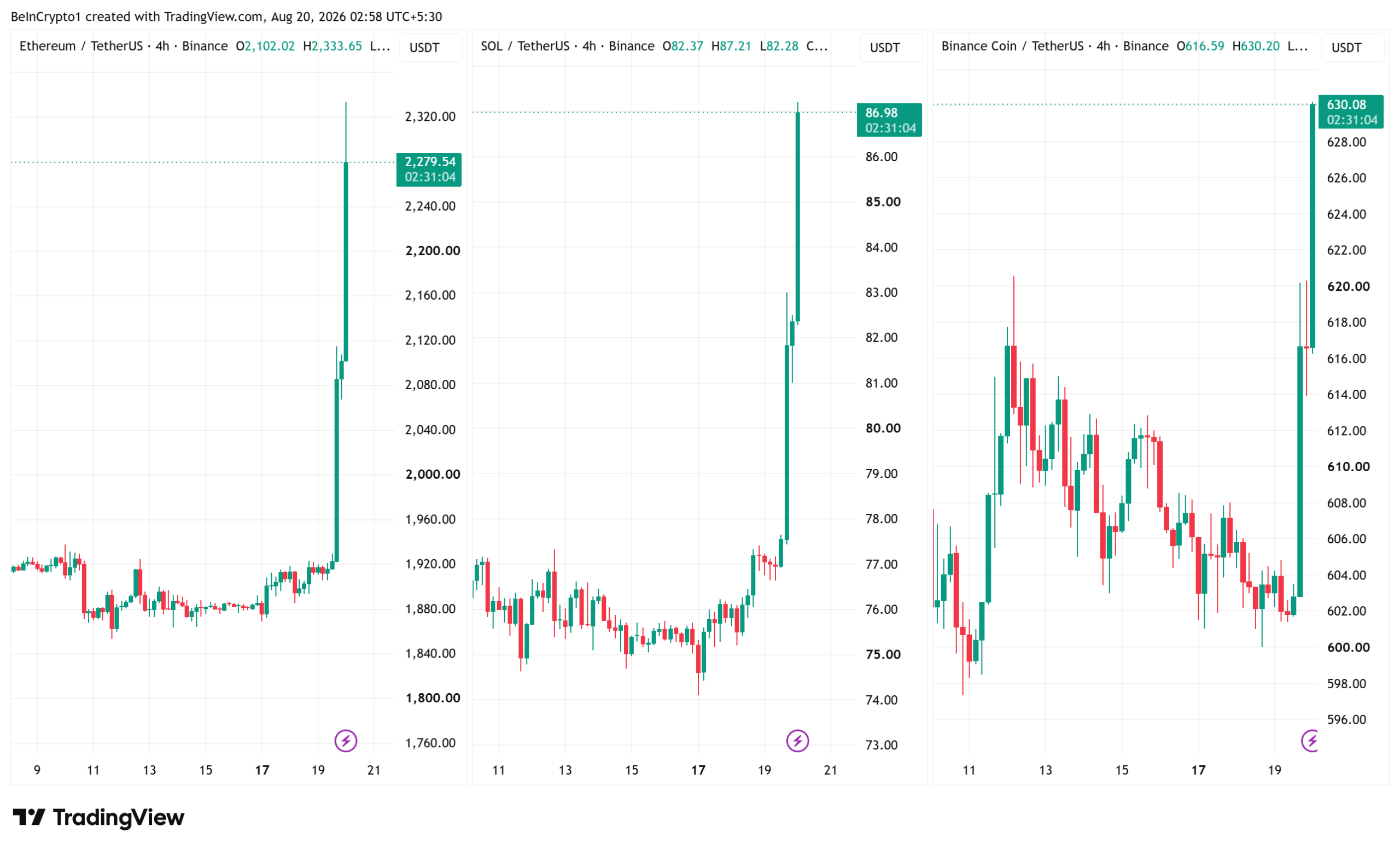
Grayscale Research says three altcoins could be the biggest winners from new US token rules. The asset manager points to Ethereum (ETH), Solana (SOL), and BNB Chain.
The Securities and Exchange Commission (SEC) proposed Regulation Crypto Assets, or Reg Crypto, on Tuesday. The plan would let startups sell newly issued tokens to US investors after years without a clear path.
Why Grayscale Sees ETH, SOL, and BNB as Winners
Grayscale published its case hours after the SEC released the proposal. Its logic is simple. Legal token sales would pull founders and investors onchain. The networks hosting those sales would capture the activity and the value.
The demand already has a track record. More than 1,500 projects raised a combined $12.9 billion through initial coin offerings (ICOs). That figure comes from research by the National Bureau of Economic Research (NBER). The wave peaked in 2017-18. However, later fundraising models moved offshore and shut out US investors.
“The SEC just proposed new crypto regulation. Since the ICO boom of 2017, token-based fundraising in the US has lacked regulations. “Reg Crypto” would change that,” Grayscale wrote.
The market is already moving. ETH trades near $2,179 after a 15% jump in 24 hours. Meanwhile, SOL sits at $86.98, and BNB holds near $630.

Grayscale has also put money behind the theme. This month, the firm made BNB its largest fund holding in its Smart Contract Fund, with a 30.6% weighting.
What the New US Token Rules Would Change
Reg Crypto creates two fundraising lanes. Startups could raise up to $5 million over four years under a one-time option. A second lane allows $75 million per year. That route requires financial statements and ongoing reports.
The proposal also gives tokens an exit from securities treatment. A token leaves once its issuer completes all essential managerial efforts. Officials call this the Investment Contract Safe Harbor.
That exit question fueled the SEC’s long court fight with Ripple over XRP. The new SEC crypto rules now answer it on paper.
SEC Commissioner Mark Uyeda backed the shift. He said clear rules should cut the incentive for founders to launch offshore. The proposal would also stand in for parts of the CLARITY Act. That broader market structure bill slipped to September in the Senate.
A 60-day comment period opens once the plan reaches the Federal Register. A separate innovation exemption for trading rules is expected later this year. The next test is simple. Will US founders actually bring their raises onchain?
The post 3 Altcoins Grayscale Says Could Win From New US Token Rules appeared first on BeInCrypto.

Much in the way oceans can become more acidic as they absorb more carbon dioxide, the same can be said for blood. “Bicarbonate,” said Larcombe in an email to TIME, “is the body’s main chemical ‘shock absorber’ for keeping blood from becoming too acidic, and a rising level is an indicator of the body compensating for more CO2.”
But bicarbonate can do only so much, and even over relatively small stretches, higher levels of CO2 in the blood can take a toll. “From short-term studies at moderately elevated CO2 (the sort of levels common in poorly ventilated rooms),” wrote Larcombe, “that means headache, tiredness, and declines in concentration and decision-making. Over longer periods, animal studies raise the possibility of oxidative stress, inflammation, tissue calcification in the kidneys and arteries, and effects on bone.”
At the same time bicarbonate levels have been rising in the blood, calcium and phosphorus levels have been falling, the study found. In addition to producing higher levels of bicarbonate, the body responds to rising carbon dioxide by drawing CO2 molecules out of the blood and storing them in bones in the form of carbonate—an ion composed of one carbon atom and three oxygen atoms. Phosphorus and calcium, which assist in this process, are drawn from blood into bone as well.
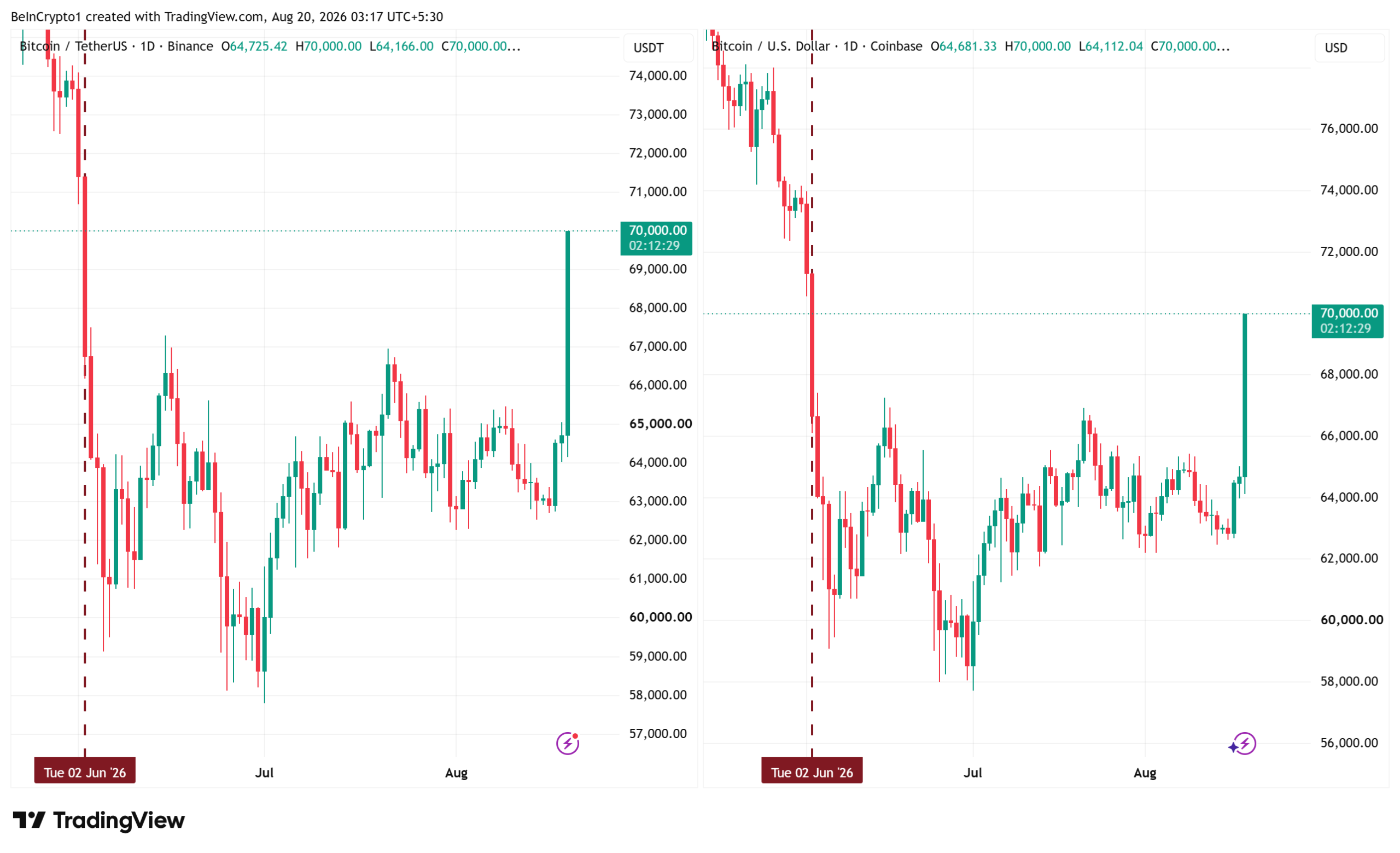
Bitcoin (BTC) just reclaimed $70,000 for the first time since June 2. The 78-day wait ended after President Donald Trump said a “sizable” government Bitcoin purchase has “been talked about.”
The Fed’s July minutes came and went without damage. Trump’s remarks gave the rally its second engine of the day.
How Bitcoin Reclaimed $70,000 After 78 Days
The BTC price briefly tested $70,000 today. Two days ago, it sat below $64,000. In early July, it was near $62,000.
The move crushed the other side of the trade. Crypto shorts lost $1.23 billion in a single hour. One whale on Hyperliquid lost an entire 1,800 BTC short worth about $117 million.
Washington lit the first fuse. The Treasury said it will double its long-end debt buybacks to at least $4 billion per operation. The 30-year yield fell from 5.337%, its highest since 2007. Cheaper long-term money favors assets that pay no income.
Perspective still matters. Even at $70,000, Bitcoin trades about 44% below its record of $126,080, set last October. But the reclaim breaks this year’s pattern, where gold beat bitcoin decisively, gaining 33% while BTC fell 46%.

The king of crypto topped out at $70,000 on Binance and $70,022 on Coinbase, as of this writing.
Trump Floats a ‘Sizable’ Bitcoin Buy as the Fed Stays Quiet
Then came the second fuse. Asked whether the administration plans to accumulate a sizable amount of Bitcoin, Trump did not rule it out. He tied the idea directly to the dollar.
“It’s been talked about. It’s been very, very good for the dollar. If you came in with recommendations, I would certainly listen.”
The remarks land on fertile ground. Trump created a Strategic Bitcoin Reserve in March 2025, built from seized coins rather than open-market buying. A sizable purchase would be a first.
The Fed offered no resistance either. The July minutes said inflation “remained elevated” but showed no hawkish push beyond the three known dissenters. September hike odds slipped to 34%, and the dollar weakened.
The mix is potent. Falling yields, a quiet Fed, and a president musing about buying. Whether BTC holds $70,000 overnight will show if the words carry real weight.
The post Bitcoin Reclaims $70,000 First Time Since June and Trump Just Hinted at More appeared first on BeInCrypto.

David Schwartz, Ripple’s CTO emeritus, has warned that government rules around AI safety and copyright could give authorities unprecedented control over political and social speech.
His argument centers on who gets to decide what AI systems can create, know, and discuss.
Two Legal Fights, One Argument
Schwartz laid out the case in a reply thread on X that started almost by accident. On August 18, he quote-posted a Change.org UK campaign asking the British government to limit how much coverage any one person can receive in the press, a petition launched after 249 articles covered sociology professor Jason Arday in the 22 days before his death on August 14.
Schwartz’s response to that campaign was a question: which poses more of a threat to free speech, artificial intelligence or, as he put it, natural stupidity.
When a user named Athena asked what he actually meant, Schwartz explained that AI has become the most effective tool for producing speech that exists, and that governments are currently fighting on multiple fronts over how much they can regulate it.
He then spelled out two specific fights. The first is over whether training an AI model on copyrighted material counts as infringement. Since Congress controls what exceptions to copyright law exist, a ruling against AI companies would mean the most powerful speech-generating tool in existence could only be used in ways Congress permits, effectively letting lawmakers decide what speech looks like.
The second fight is over AI safety regulation itself, which Schwartz argued follows the same logic: if the government sets the rules for what counts as safe, the most powerful tool for producing political and social speech becomes usable only in the ways officials allow.
“Again, a totally unprecedented threat to freedom of speech,” he wrote.
A Recurring Argument on X
This is not the first time Schwartz has pushed this line of thinking. In late July, Bitcoin advocate and ShapeShift founder Erik Voorhees argued on X that states should not get to decide what forms of intelligence count as safe, warning that a rule against discussing something as narrow as bioweapons could eventually expand into a broader government veto over speech and even encryption. Schwartz replied to that post with a simple agreement at the time.
The broader question of who gets to police speech-enabling technology has come up elsewhere too. Telegram founder Pavel Durov, already facing terrorism-related charges tied to content on his messaging app, drew a fresh international arrest warrant from Russia’s security service in late July, adding to a case that started with his 2024 arrest in France over similar allegations.
The debate also extends to proposals for government-backed AI testing after Google DeepMind CEO Demis Hassabis previously proposed a federally backed body to test and certify advanced models. While OpenAI CEO Sam Altman and Microsoft’s Satya Nadella expressed support for the idea, Coinbase chief Brian Armstrong took the opposite view, contending that existing laws covering fraud, torts, and consumer protection could already address harms caused by AI systems.
The post Ripple CTO Emeritus: AI Safety Rules and Copyright Laws Pose Threat to Free Speech appeared first on CryptoPotato.
[PRESS RELEASE – Dubai, United Arab Emirates, August 19th, 2026]
Swapiz Telegram Swap Bot announces its public launch. Designed with Telegram users in mind, the Swapiz Telegram Swap Bot allows users to make crypto-to-crypto swaps directly within the Telegram messaging app, without opening an external browser or exchange interface. Swapiz currently supports more than 50 cryptocurrencies and requires no KYC.
Swapiz is not the first crypto platform to turn to Telegram for swap capabilities. Over the past few years, Telegram has become a preferred channel for platforms offering crypto swap capabilities, emerging as one of the most important distribution channels in the crypto and blockchain space. The popular messaging app has more than 1 billion monthly active users and hosts numerous dedicated crypto communities. Swapiz is the latest platform to join the Telegram trend.
While the Swapiz Telegram Swap Bot is designed for users of all experience levels, its simple mechanics make it particularly accessible to crypto newcomers. After opening the bot on Telegram, users first create their Swapiz wallet and choose the cryptocurrency they want to deposit.
Once the deposit is confirmed and the funds appear in their balance, users can select “Exchange”, choose the cryptocurrency they want to swap and the cryptocurrency they want to receive, and enter the amount. The bot then displays the available exchange details for the transaction. After reviewing and confirming the swap, Swapiz processes the exchange using the funds already held in the user’s wallet, and the swapped new cryptocurrency is credited.
“We made the Swapiz Telegram Swap Bot with the Telegram crypto user in mind,” said Michael Rodriguez, Chief Technology Officer at Swapiz. “This is the convenience economy. People are looking for the easiest and quickest way to complete their crypto swaps. The Swapiz Telegram Swap Bot makes this possible.”
The Swapiz Telegram Swap Bot also incorporates secure data encryption and non-custodial swap technology to help protect transactions against potential threats. In addition to processing swaps quickly, the bot allows users to manage, track, and trade their assets without leaving the Telegram chat. Swapiz Support is also available around the clock via Telegram.
“The one area we refuse to compromise on is speed,” Rodriguez added. “At the moment, our swaps are completed in 2–15 minutes. We expect that time to drop to under two minutes within the next few months. This is the direction the entire industry is headed. Latency will no longer be tolerated, particularly in cross-chain and payment-focused applications. We want to be at the forefront of this transformation.”
About Swapiz
Swapiz is a privacy-first, non-custodial Telegram tool that allows users to instantly exchange cryptocurrencies across multiple blockchains. To use Swapiz for crypto-to-crypto swaps, users are not required to create an account, provide an email, or complete KYC verification.
The post Swapiz Telegram Swap Bot Launches to Remove Friction in Crypto-to-Crypto Swaps appeared first on CryptoPotato.

After weeks and weeks of sideways movements without any clear signs of a breakout in either direction, the crypto market is finally on the move.
Bitcoin led the charge with a massive surge that drove it to its highest price tag since the middle of June at just over $69,000.
Recall that BTC dipped below $63,000 at the end of the previous business week before it found some support and recovered to $63,000 during the weekend.
It started to show revival signs on Monday and Tuesday, but today’s increase is the most impressive in months.
Ethereum has soared past $2,000 for the first time in months as well, and has even tapped the $2,100.
XRP has finally rebounded above the key $1 support after dipping below it on a couple of occasions last week.
The liquidations are also on the rise given the sharp movement. Data from CoinGlass shows that $1.2 billion worth of leveraged positions has been wrecked in the past hour alone.
Naturally, the lion’s share is from shorts, as they are responsible for $1.14 billion out of the total.
BTC and ETH lead the pack, with $680 million and $425 million liquidated longs, respectively.
The post Over $1B in Liquidations as Bitcoin Surges to 2-Month High Above $69K appeared first on CryptoPotato.

Arthur Hayes has said that he is coming out of retirement to lead Flop Labs, a new project centered on a token called $FLOP that aims to work as a kind of currency for AI agents.
The announcement doubled as a defense of the move: Hayes, who has spent months warning that AI investment is a bubble, argued the excess sits in the debt piling up to build data centers, not in the underlying technology his new venture is built on.
A Fair Launch and a Compute-Backed Token
Hayes described $FLOP as “food for your AI agent” and said the token would launch without a presale or venture capital funding. “100% fair launch,” he wrote, adding that he expects a “massive airdrop in Q4” followed by a genesis block in the first quarter of 2027.
Flop Labs’ announcement describes the network as a proof-of-useful-inference protocol. Its stated goal is to give AI agents a native currency for buying computing power and storing memories. The project uses floating-point operations, or FLOPs, as the basis for its economic model. Miners would provide computing power and receive $FLOP through block rewards and inference payments.
Validators would verify that miners delivered the computing work requested by agents. They would also store agent memories and receive $FLOP through block rewards and inference payments.
On their part, AI agents would spend the token on computing and memory services, while community partners could receive $FLOP based on network activity.
Flop Labs stresses that the network has not launched and remains under development. Its current design can change, and the project makes no guarantees about receiving tokens or making money.
The AI Bubble Argument
Before announcing Flop Labs, Hayes had compared the AI buildout to the 2008 housing crisis, arguing that lenders, private credit funds, and governments are financing data centers on the assumption that demand keeps climbing without limit.
He expects AI capital spending to slow in 2027 before contracting, which he said would force governments into bailouts larger than those that followed the 2008 financial crisis, sending new money into crypto markets and potentially pushing Bitcoin toward $1 million.
When asked why he would build an AI project while calling AI a bubble, Hayes said the excess lies in debt used to fund data centers and in the shares of hyperscalers and frontier labs that are not yet profitable, not in agentic technology itself.
“Price is what you pay, value is what you get,” he wrote, adding that the compute overcapacity built on borrowed money strengthens his case for Flop Labs.
Hayes’s bet on an agent-native currency also arrives against thin real-world usage elsewhere. Analyst Jamie Coutts reported on August 12 that daily settlement volume on x402, the Coinbase-built payment protocol for AI agents, is down 93% year-to-date, with the seven-day average around $41,800, well below the $800,000 to $1 million peaks seen in late 2025.
Coutts called the drop a “reality check” on claims that the agentic economy has arrived, though he expects volume to climb again in the fourth quarter.
The post Arthur Hayes Called AI a Bubble, Now He’s Launching an AI Project appeared first on CryptoPotato.

LARRY KUDLOW: Rising Bond Yields from Trumpian Growth, not Trumpian Inflation

Zelenskyy Faces Pressure to Hold Elections. What Stands in the Way?

Australian state supreme court rejects Israel lobby’s “preposterous” ‘IHRA definition’





-

 Fashion5 days ago
Weekend Open Thread: Ann Taylor
-
 Sports6 days ago
This U.S. Amateur is a glimpse into golf’s future in more ways than you think
-
 Tech6 days ago
11 Ways to Rank Your Videos
-
 NewsBeat5 days ago
Myanmar says over 300,000 Rohingya refugees verified for repatriation as exodus enters ninth year
-

 Sports5 days ago
Birmingham 2026: Day 6 Timetable for Irish Athletes
-

 Politics4 days ago
SEQ Code: The Three Letter Boarding Pass Code That Could Give You The Worst Seat
-

 Tech6 days ago
DeepSeek Harness launches as open source rival to Claude Code, alongside V4-Pro on API with higher prices
-

 Crypto World2 days ago
OCC Greenlights Trump Family Crypto Firm for Trust Charter
-

 Tech2 days ago
Qwen3.8-27B runs frontier-class coding agents and reasoning locally, no cloud API required
-
 Entertainment6 days ago
10 Netflix Shows That Quietly Became Modern Classics
-

 Fashion5 days ago
Weekly News Update, 8.14.26 – Corporette.com
-
 Tech4 days ago
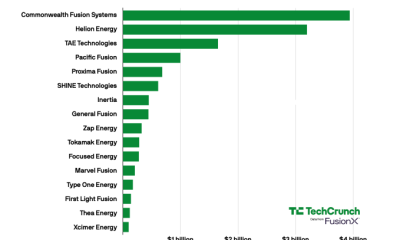
Every fusion startup that has raised over $100M
-
 Entertainment5 days ago
Marvel Studios Reveals New X-Men Cast Including Adam Driver and Sadie Sink
-

 Fashion7 days ago
The Details Do the Dressing
-

 Business5 days ago
Facebook Down Now? Users Report Login And Loading Problems As Outage Trackers Monitor Ongoing Issues
-

 Business1 day ago
SMA Solar Technology AG (SMTGY) Q2 2026 Earnings Call Transcript
-

 Crypto World6 days ago
Robinhood Chain Approaches $1B TVL as Uniswap Integration Boosts Liquidity
-

 Fashion5 days ago
Cart Confidential Vol. 44 – Julia Berolzheimer
-
 Business5 days ago
Monarch Mutual Fund set to enter MF space with maiden overnight fund; files draft with Sebi
-

 Politics6 days ago
The migrant mega-dinghy – spiked
You must be logged in to post a comment Login