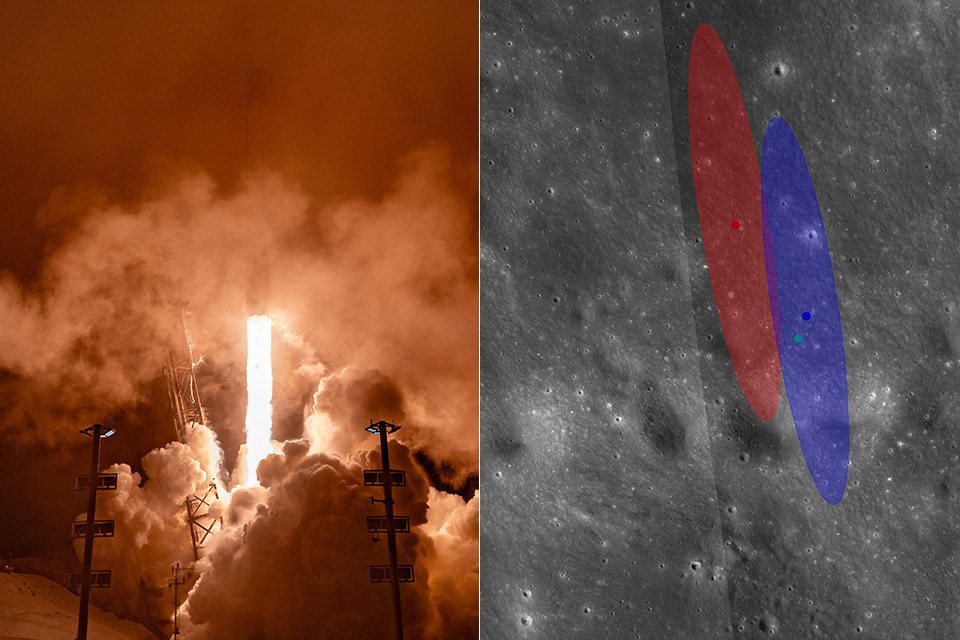
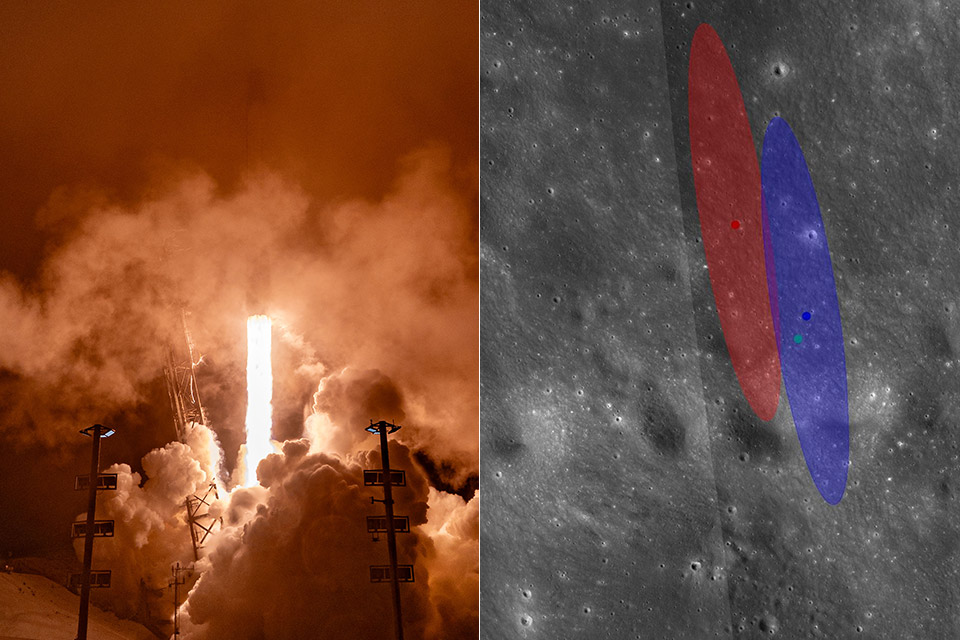
Between August 11 and 12 NASA’s Lunar Reconnaissance Orbiter locked onto a quiet patch of lunar ground and returned the clearest views yet of a brand-new scar. The crater formed six days earlier when a spent Falcon 9 upper stage struck the surface at roughly 5,400 miles per hour.
On January 15, 2025, a Falcon 9 upper stage launched Firefly Aerospace’s Blue Ghost 1 lander toward the Moon. After that happened, that section had almost no fuel remaining. Going through the motions, attempting to manage re-entry into Earth’s atmosphere, was no longer possible. So, starting in January 2025, for well over a year, this empty rocket stage just kinda hung there, floating in a roughly elliptical orbit under the gravitational influences of the Earth, the Moon, and the Sun, and then suddenly on August 5, its path came to an end on the lunar surface, at 6:35 in the morning (according to the clocks on UTC).
NASA rocket model kit – Launch into a creative project with the LEGO Icons NASA Artemis Space Launch System model building project for adult space…
What’s in the box? – This creative building set includes everything you need to craft a multistage rocket with 2 solid-fuel boosters, an Orion…
Features and Functions – This NASA-themed rocket model features retractable launch tower umbilicals, rocket support and crew bridge, detachable…
Independent observers first noticed that the stage was heading for a collision with the Moon’s surface in April, prompting NASA’s Center for Near Earth Object Studies to take a closer look at the trajectory, essentially refining the math to improve their models; once completed, the predicted zones were passed on to South Korea’s Danuri orbiter. Danuri then took some images of the new crater site, barely hours after the impact, which turned out to provide them a very accurate position, not too far from the expected collision zone, allowing the LRO team to plan their own passes.
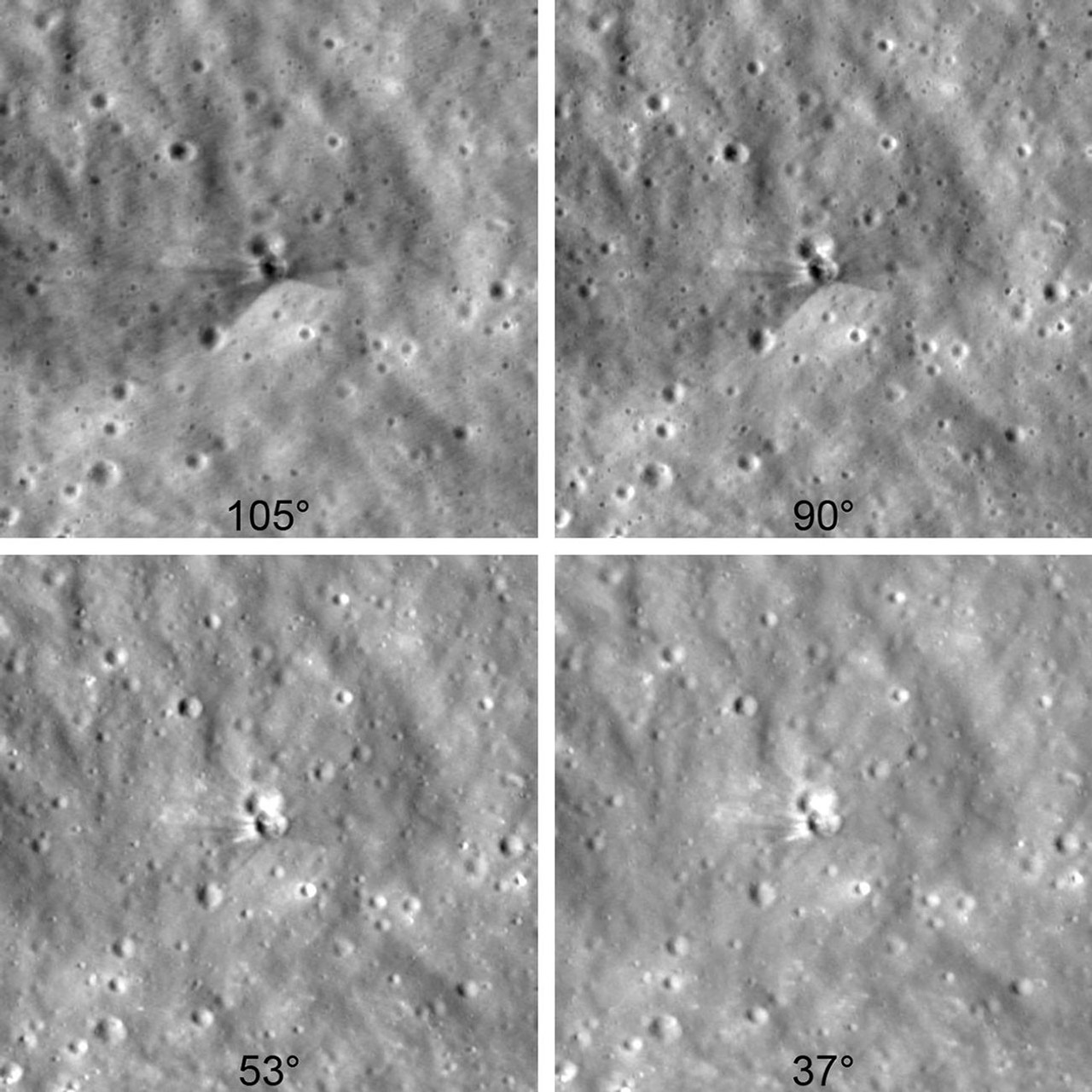
Every two hours, the LRO orbiter passes by the Moon from pole to pole at a speed of about a mile per second and an altitude of about 60 miles, which is the type of speed that requires some effort to tilt. The Narrow-Angle Camera on board has fairly decent resolution at that speed, and can pick up details as small as three feet across – but in order to keep the new crater centered, the spaceship had to make some very severe rotations on repeated orbits, tilting by more than 20 degrees at times. It also had to be precise in terms of time, because even a ten-second delay would have relocated the target nearly ten miles out of the frame. Only by imaging the stage in various lighting settings were they able to obtain the series of views presented this week.
Advertisement
The measurements they took of the rim put the crater at 60 feet across, and based on the shadows on the floor, they estimate the depth is less than 10 feet. The impact occurred at an angle of about 31 degrees to the horizontal, resulting in the V-shaped spray of ejecta on the southern side, and the darker material fanning out was all from the top foot and a half of the regolith, a layer that had been exposed to solar wind, cosmic rays, and micrometeorites for a long time, so it is naturally rougher in texture and more muted in color. The brighter pieces near the rim, on the other hand, are most likely younger rock and dust that was pulled up from deeper underground and has not yet had time to change color.
The crater’s updated coordinates are 19.4759 degrees north, 266.7138 degrees east, and 511 meters elevation, and comparing the new images to earlier images of the same area, there’s no doubt that this change is relatively recent, and engineers will find it an interesting opportunity to test their tools for predicting collisions with objects of known size, mass, and speed. Furthermore, it demonstrates how a seemingly minor collision can mess up strata on the Moon that have been in place for millions of years.
Sudan’s army has destroyed at least six Chinese-made CH-95 drones since June 2026
The Akıncı costs roughly $25 million, twelve times more than the CH-95
Armed drones are now the leading cause of civilian deaths in Sudan
Sudan’s civil war has continued since April 2023, when the Sudanese Armed Forces and the paramilitary Rapid Support Forces (RSF) first clashed across the country’s cities and provinces.
Above the battlefields, a quieter contest has unfolded between two very different classes of unmanned aircraft flying for opposing sides.
A Turkish-built Bayraktar Akıncı has repeatedly intercepted Chinese-made CH-95 drones flown by the RSF this summer.
Latest Videos FromTechRadar
Advertisement
Turkish Akıncı takes on Chinese CH-95
The CH-95 is a medium-altitude, long-endurance aircraft built for reconnaissance, electronic warfare, and strike missions.
It weighs around 650 to 1,000 kilograms, carries a payload of up to 170 kilograms, and its endurance can exceed 12 hours depending on configuration, with a reported flight ceiling above 7,000 meters.
The Akıncı belongs to a substantially heavier class, with a maximum takeoff weight around 6,000 kilograms, payload capacity of up to 1,350 kilograms, and endurance exceeding 24 hours.
Its reported service ceiling is about 13,700 meters, while its wingspan is roughly 20 meters (66 feet).
Sign up to the TechRadar Pro newsletter to get all the top news, opinion, features and guidance your business needs to succeed!
According to footage shared by Clash Report on X, a Bayraktar Akıncı is shown engaging a Chinese-made CH-95 in midair.
Advertisement
The footage appears to capture the interception from the Akıncı’s perspective, with the opposing drone visible before the engagement ends.
The incident followed several other reported CH-95 and FH-95 losses since June 23, creating a growing pattern involving these aircraft families.
At least six Chinese-made drones have reportedly been destroyed since then, with several losses attributed to Akıncı interceptions.
Advertisement
A costly contest above Sudan
This drone contest above Sudan is proving to be very expensive both in human losses and financially.
Reported estimates show the Akıncı costs about $25 million per aircraft, while an Air University study puts the CH-95 near $2 million from Serbia’s SIPRI-recorded purchase.
This is a lot of money to spend on drone warfare for a region that has practically been at war since 2003, when the first Darfur conflict erupted.
Advertisement
United Nations officials have separately warned that drone warfare is causing severe civilian harm across Sudan, especially in Kordofan and other contested regions.
“Armed drones have now become by far and away the leading cause of civilian deaths,” said Volker Türk, UN High Commissioner for Human Rights.
The United Nations said drone strikes accounted for at least 880 civilian deaths between January and April 2026, representing more than 80% of conflict-related civilian deaths.
Those figures put the reported Akıncı and CH-95 encounters within a much broader drone war whose consequences extend well beyond military aircraft.
Advertisement
The Akıncı carries radar and air combat weapons, allowing it to engage aircraft without relying solely on ground-based air defenses.
That capability matters because the CH-95 is intended to remain airborne for long periods while gathering information across wide areas.
Sudanese forces have therefore used the Akıncı for a role differing from conventional armed drone missions against ground positions.
Earlier reports from July described an Akıncı firing an air combat missile at a CH-95 northwest of El Obeid in North Kordofan.
Advertisement
Another operation reportedly destroyed a second Chinese-made aircraft on the ground, although involved forces did not independently confirm those claims.
Human rights investigators have documented Chinese equipment among RSF weapons, while allegations of Emirati involvement in supply routes remain disputed.
The United Arab Emirates has repeatedly denied supplying military support to either side, making claims about specific aircraft difficult to independently verify.
Before summer gives way to fall, it’s worth taking a look at what kind of discounts Lowe’s has on cordless power tools this month. That way, you can get what you need for all the yard work, home reno, and DIY projects you’ve been planning once the weather cools off. Lucky for you, Lowe’s has no shortage of deep discounts on major power tool brands such as Craftsman, Kobalt, and DeWalt.
From saws and multi-tools to money-saving combo kits, these Lowe’s deals could save you as much as $130 in all — and that’s without factoring in the amount of savings you’d get if you took advantage of multiple offers on this list. We’ve brought together five of the steepest discounts available on the Lowe’s website this month, including how much you’ll save on each, what they were priced at before, and how long you have left to lock in the deal.
Advertisement
$90 off a Craftsman 2-Tool Combo Kit
The Craftsman V20 20-volt two-tool combo kit has dropped from its original price of $169 down to $79. That’s $90 in savings on a kit that’s already giving you a two-for-one bargain. The kit combines the Craftsman CMCD702 V20 cordless ½-inch drill/driver with the CMCF801 V20 impact driver, plus a 2Ah battery and a charger.
The drill/driver gives you up to 300 unit watts out (UWO), which Craftsman says can drill up to 90 holes per charge. The impact driver gives you up to 1,800 inch-pounds of maximum torque, which should be more than enough for your fastening jobs around the house or in the workshop. Both tools also have VersaTrack compatibility, so they’ll fit right into your existing tool organizer if you’ve got that setup. The promotion ends Oct. 28, so you have a little more time than some of the other offers in this roundup to get on it.
Advertisement
$70 off a DeWalt Brushless Cordless Circular Saw
This month at Lowe’s, the DeWalt XTREME 12-volt Max 5 ⅜-inch brushless cordless circular saw is marked down $70 from $169 to $99. That’s under $100 in all, likely due to the fact that this tool doesn’t come with a battery or charger included. Still, not a bad deal for a 12V Max-compatible DeWalt tool. You’ve got until Nov. 4 to get it.
Advertisement
The saw uses a brushless motor and a 5 ⅜-inch blade to cut to a maximum depth of 1 ¾ inches at 90 degrees and 1 ¼ inches at 45 degrees. Its tool-free bevel lever also lets you make adjustments from 0 to 50 degrees, which is just the kind of flexibility you’ll need to make nice and clean angled cuts. It also includes a built-in rafter hook for storage’s sake and an electric brake that stops the blade whenever the trigger’s released.
Advertisement
$80 off a Kobalt Brushless Cordless Impact Wrench
Automotive work on the docket? You can get the Kobalt 24-volt variable-speed brushless ½-inch drive cordless impact wrench for $80 off at Lowe’s now until Oct. 21. The regular price listed for the tool is $229, but the current sale price is $149. That price includes both a battery and fast charger, as well. Plus, you get a soft storage bag to keep it all in. Don’t forget: Lowe’s owns this brand, so don’t expect to find it this cheap for new elsewhere.
The impact wrench and its brushless motor give you up to 650 foot-pounds of torque in all. It’s also been designed with a compact body, so work in tight spaces (like a car) shouldn’t be a problem for you. There’s also convenience features like a soft-overmold grip and balanced construction to make extended use more comfortable. It also comes with three speed and torque settings to give you those 650 foot-pounds of loosening torque and 500 foot-pounds of fastening torque.
Advertisement
$60 off a DeWalt Cordless Brushless Oscillating Multi-Tool
Conveniently, the compact multi-tool comes with a universal accessory adaptor that works with most oscillating tool accessory brands. The Quick-Change accessory system also lets you replace blades and attachments without needing to use a wrench. That combo gives this tool a nice range of potential uses without needing you to go and grab a separate tool for every attachment your project demands. The package includes DeWalt’s cordless oscillating tool, a wood-cutting blade, a wood-and-metal blade, and the universal accessory adaptor.
Advertisement
$130 off a Craftsman Single Bevel Sliding Compound Cordless Miter Saw
Rounding out this month’s featured deep discounts is the Craftsman V20 7 ¼-inch 20-volt Max single-bevel sliding compound cordless miter saw. Its actual listed price is $329, but Lowe’s is selling it for $199 from now until Sept. 16. That’s $130 off the total if you hurry. For that price, you get the tool, a 4.0Ah V20 lithium-ion battery, a V20 lithium-ion fast charger, a carbide-tipped blade, a blade wrench, a material clamp, and a dust bag.
The saw uses a 3,800 RPM motor and sliding 7 ¼-inch blade that can cut 2-by dimensional lumber, hardwoods, baseboards and trim. It offers a crosscut capacity of up to 8 inches at 90 degrees and 5 ½ inches at 45 degrees, plus nine casted miter detent stops and a single-bevel blade configuration for making angle adjustments and cuts. There’s a convenient LED cut-line positioning system, too, so that’ll definitely make your cutting line easier to follow.
AI-generated content in the Apple Music app may get easier than ever to spot, as record labels and distributors will be required to label it as such later in 2026.
Back in March 2026, Apple introduced Transparency Tags for Apple Music. These are entirely optional disclosure labels, which were used to indicate that specific content was “materially generated” with the help of artificial intelligence.
At the time, Apple said it believed distributors should “take an active role in reporting when the content they deliver is created using AI,” and that its AI-focused tags were “the first concrete step” in the process. So far, however, Apple hasn’t forced labels or distributors to label AI-generated content, but that might soon change.
In an email to Apple Music content distributors, detailed byThe Hollywood Reporter, Apple now says that “content providers will be required to include AI Transparency Tags in any instance where AI was used to create a material portion of the content, including tracks that are AI platform generated.”
Advertisement
The change is set to take effect later this year, though it remains to be seen how Apple aims to enforce its new requirements.
At the time of writing, Apple’s AI Transparency Tags are not visible to end users of Apple Music. However, the company’s email to Apple Music content distributors says that it wants to “provide listeners with as much transparency as possible,” so there’s always a chance the AI-disclosure tags will become visible to all.
Apple’s decision to force distributors and record labels to use AI labels is a bit of a pivot, compared to its earlier stance. Even so, the move is part of a larger strategy to combat misleading AI-generated content.
Apple’s efforts to reduce AI spam, impersonation, and play count manipulation
In an open letter to the music industry, back in May 2026, Apple highlighted the benefits of AI, but cautioned that artificial intelligence should never replace artists, but only amplify their work.
Advertisement
To that end, Apple claims that it has created internal tools to identify AI-made tracks, fight spam tracks, and combat impersonation, all by monitoring music streams. If an AI-generated track is getting Apple Music can even automatically pull AI-generated tracks that get their plays from manipulated streams.
In 2025, Apple redistributed royalties from approximately 2 billion manipulated streams, with the funds diverted to the company’s payout pool for artists and labels.
Apple has “developed technology in-house that would allow us to exactly see what music people are delivering us,” said Apple Music VP Oliver Schusser in April 2026. He added that these tools let Apple see “what AI [model] it is and all that.”
The company’s current assortment of AI and spam-prevention tools is seemingly effective. According to Schusser, more than a third of songs uploaded to the Apple Music service are “100% AI,” but listening remains below 0.5%. In other words, nobody’s actually listening to these fully AI-generated songs.
Advertisement
How other music streaming services handle AI disclosure
Overall, Apple’s efforts targeting the abuse of AI are admirable, but the company is late to the party, especially compared to Deezer’s approach.
Spotify will apply an AI Persona badge to select artist profiles.
Apple Music rival Deezer has had AI-detection systems for well over a year, catching 60,000 AI-generated songs each day. Its CEO claimed most AI-generated content on Deezer was used to commit fraud.
Spotify, meanwhile, has taken a restrictive yet nuanced approach regarding AI. The streaming service excludes songs associated with “AI Personas” from editorial recommendations. Artists themselves have the option to disclose whether they use generative AI by labeling their profile as an AI Persona, but Spotify itself will step in and apply the label if it’s deemed necessary.
Advertisement
Once a preset listener threshold is met, Spotify will apply the AI Persona badge if an artist’s public identity “appears to represent photorealistic AI-generated identities.” Notably, however, the AI Persona badge will display if the designation was applied by Spotify or by the artist themselves. Artists will have the option to appeal Spotify’s decisions as well.
While it remains to be seen when Apple Music’s AI label requirements will roll out, Spotify’s AI Persona badges will become available in mid-September 2026, while Deezer’s anti-AI measures remain in use.
All in all, Apple’s approach to AI in music is now more decisive, with its idea of mandatory labels. The company recognizes the potential of AI, and while it hasn’t banned AI songs outright, it won’t tolerate manipulated play counts or impersonation of real human artists.
Google is investigating an issue that some Android devices are encountering when trying to use RCS messaging. According to Reddit threads and Android-focused websites, some people switching to new devices, most commonly smartphones from Samsung, or who are switching carriers, are encountering error code 3100, a connection error, when using Google Messages.
“We’re aware of this issue and are working with our carrier partners to get it fixed as soon as possible,” a Google spokesperson said in an email to CNET.
A spokesperson for Samsung did not immediately respond to a request for comment.
Workarounds for solving the issue range from the elaborate, like a six-step plan that includes turning off two-step verification and removing Google Play Services updates, to a trick using a VPN to connect to another country before trying RCS again. Others have suggested a factory reset or, if dealing with the issue in hindsight isn’t the problem, turning off RCS messaging before migrating to a new Android device or switching carriers.
The rise of RCS
For years, Google championed RCS as a messaging standard to succeed SMS, which it hoped Apple would adopt, something that eventually happened in 2024. The protocol, which stands for Rich Communication Services, allows people with Android and iOS phones to message each other in ways that bridge the gap between the two different operating systems.
Until both OpenAI and Anthropic get close enough to their planned IPOs to release their financials, we have to look to other sources for signs of how well their businesses are doing. One of those sources, Ramp, the corporate credit card and expense management company, has just released some surprising new data: OpenAI has started gaining on Anthropic with US businesses.
OpenAI, which was once the runaway leader with both businesses and consumers, lost the lead among Ramp’s paying business users back in May. That’s when Anthropic hit 41% market share to OpenAI’s 39%. The ChatGPT maker has never regained that lead. As of July, Anthropic has nearly 44% to OpenAI’s nearly 40%.
The data covers more than 70,000 American businesses that spend billions via Ramp’s bill pay and corporate card products. Ramp’s customers are spread across industries but, as a popular Silicon Valley corporate credit card, they do skew toward the tech industry.
A closer look at the most recent data, according to Ramp economist Ara Kharazian, shows that OpenAI is currently growing faster among this segment in Q3 to date than Anthropic. Mind you, there’s still a month left in the quarter and that’s like 30 AI years, so the trend could easily shift again before it’s over. Ramp also declined to provide actual dollars spent, sharing only percentages.
Advertisement
To borrow ChatGPT’s own hedging style for a moment: this isn’t a measure of the the total market. It excludes large enterprises that use spend-management tools from providers like American Express, rather than Ramp. But it’s enough data to show market indications. And what it shows is that Anthropic hasn’t won permanently. Businesses are willing to flop back and forth as each lab releases new models, volatility that should give both companies’ investors pause about how “sticky” enterprise AI spending really is.
“GPT-5.6 Sol is really good, increasingly the choice for developers,” Kharazian posted on X about OpenAI’s new growth. “Fable 5, meanwhile, disappointed both in adoption and real-world application given price + data retention requirements imposed by regulators,” he continued.
That may be an over simplification. Fable — Anthropic’s higher-end model tier — is expensive but it’s also built for a more targeted set of use cases than a general chatbot. Still, Anthropic did cause some outrage when it warned Fable users that it must retain their data for 30 days.
Ramp’s data also suggests that both companies should be growing business revenue, even as they duke it out for market share, because the market overall is expanding. The percentage of companies that pay for AI among these Ramp customers has been steadily climbing. It topped 50% in March. It reached nearly 56% by July.
Advertisement
When you purchase through links in our articles, we may earn a small commission. This doesn’t affect our editorial independence.
Ripple effect: The Federal Trade Commission is putting companies on notice over their use of personal consumer data to set individualized prices. In a bulletin issued Wednesday, the FTC said businesses must clearly disclose when they use detailed information about a consumer to generate a personalized price offer, including the types of data used.
The agency said it cannot ban personalized pricing under its current authority, but it will pursue enforcement action against companies that fail to meet its disclosure requirements.
The warning addresses the growing use of automated pricing systems that rely on consumer data. Companies can use browsing histories, location, device type, shopping behavior, and other signals to estimate how much a person may be willing to pay. AI-based pricing software can process that information quickly and adjust offers for individual users.
The FTC cited several examples. A food-delivery company would need to disclose if it charges a consumer more based on personal data. A ride-share company would face the same requirement if it increases a fare because it knows a customer does not have a competing app installed on their phone.
Advertisement
The practice differs from traditional discounts offered to broad groups, such as students or senior citizens. Personalized pricing uses data to make decisions at the individual level. This has become easier as retailers and platforms collect more information through websites, apps, and connected devices.
The FTC began studying the practice during the Biden administration. The agency found that companies could use personal data to charge more when shoppers appear unfamiliar with a market, including new parents and first-time car buyers. The commission has not released a full report from that study.
FTC Chairman Andrew Ferguson, who was then a Republican minority commissioner, criticized the earlier release of the preliminary findings. He also closed a public-comment effort on surveillance pricing that former FTC Chair Lina Khan had opened during her final week in office.
Personalized pricing drew more attention after Instacart allowed retailers to test different prices for individual shoppers in four cities. Consumers who added the same products to their carts at the same time could receive different prices. Instacart said the tests were intended to help retailers understand consumer preferences. The company ended the tests after customers objected.
Advertisement
The FTC said it does not know how widely businesses use individualized pricing. However, it said consumers can suffer “substantial injury” when they pay more because a company used their personal information without disclosing it.
“The more sophisticated personalized pricing practices become, the less likely consumers are to benefit,” the commission added.
Some Democrats and consumer advocates say the FTC’s action does not go far enough. Sen. Elizabeth Warren has criticized dynamic pricing as a way for companies to extract more money from consumers.
“Today’s announcement by the FTC is two years too late and not nearly enough,” said Nidhi Hegde, executive director of the American Economic Liberties Project, a progressive group focused on antitrust and other consumer issues.
Advertisement
States have taken a more direct approach. New York last year required companies to disclose their use of personalized pricing, while Maryland prohibited algorithms from changing food prices at the individual level.
Now, at the national level, the FTC’s message is clear: Companies that use personal information to determine what a customer pays must tell that customer.
A source has exclusively revealed to us that Apple has just laid off a significant number of people dedicated to VR development, which aligns with incoming CEO John Ternus reportedly putting the category “on ice.”
Apple Vision Pro was a necessary product launched to let Apple develop visionOS in public. The category is expected to eventually result in a set of full AR glasses we’ve dubbed Apple Glass.
According to a reliable source speaking to AppleInsider, Apple has laid off an unknown but significant number of employees tied to Apple’s VR team, the Apple Vision Group, and similar positions. We’ve heard this tale before, and while this doesn’t mean the end of Apple Vision Group, it is a sign of a cooling off for that category.
Apple Vision Pro arrived with a high price tag and a high barrier to entry with its heavy design and limited developer support. In the years since, Apple hasn’t done much to move the needle, though it isn’t clear if it needs to.
Advertisement
Apple Vision Pro isn’t dead, yet
With component pricing increasing as it has been, Apple had to raise the already high price of the Apple Vision Pro. If the device was out of reach before, it most certainly is now.
Combine that with the fact that consumers are looking to smart glasses as the near future, not heavy VR headsets, and you’ve got the perfect storm. The technology either doesn’t exist or is too expensive to make a thinner, lighter model that’s more affordable.
Rather than have a product group sitting on its hands, restructuring has occurred in recent months within Apple. The priority is on Siri AI and smart glasses, not a headset that can’t feasibly be built today.
We have some information about the layoffs that we’d like to confirm before we talk about it more, but for now, it seems the team hasn’t been totally disbanded. Expect Apple to continue work on Apple Vision Pro, its future iterations, and smart glasses running visionOS.
Advertisement
However, the team dedicated to VR has shrunk in light of the difficulties. It is highly unlikely that John Ternus plans to kill the product line entirely, but downsizing the team and focusing on the smart glasses makes sense for now.
This news will undoubtedly lead to speculation around Apple having abandoned the Apple Vision Pro. Given that we just got visionOS 27 in June and Apple’s work on future iterations is still ongoing, that doesn’t seem to be the case.
Serval is making Catalyst, its AI agent for building enterprise automations, generally available Thursday and enabling it by default for customers — allowing teams of AI agents to decide what should be automated and then build the automation itself.
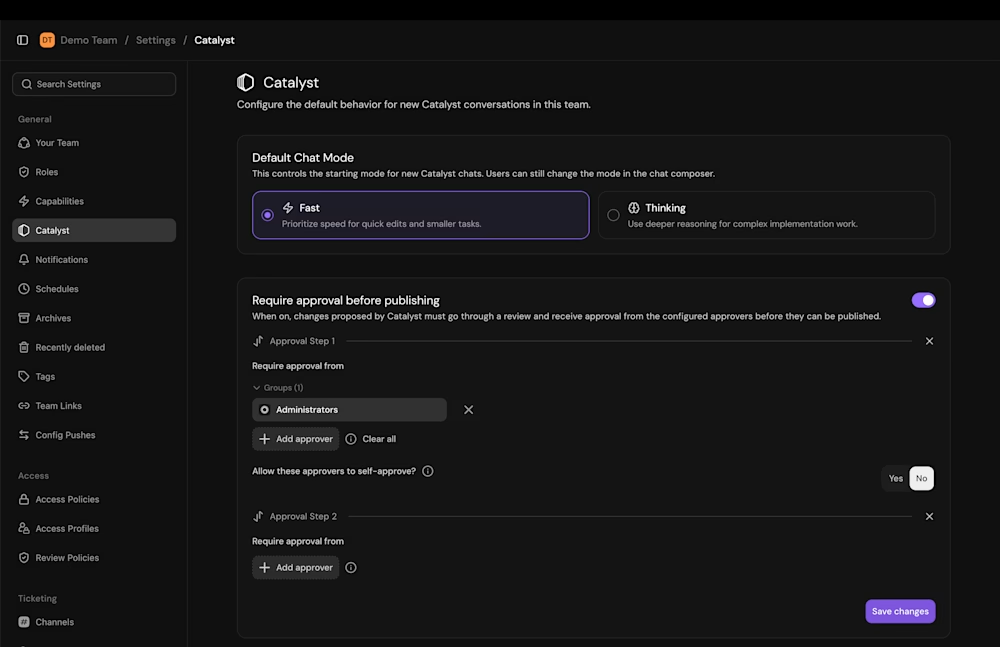
Catalyst sits above Serval’s AI-native service management platform as an admin-facing “super agent.” It can inspect ticket history, standard operating procedures or natural-language instructions, identify recurring work, and draft the workflows, skills, forms, access policies, journeys and dashboards needed to automate it.
Promotional screenshot of Serval’s drafting interface. Credit: Serval
Serval is also using Catalyst to create background agents that continuously inspect connected systems for emerging problems and propose fixes before an employee files a ticket.
Advertisement
That distinction matters because enterprise service management vendors are rapidly converging on AI-assisted workflow creation.
ServiceNow’s Build Agent can already translate natural-language instructions into full-stack applications, flows, scripts and other platform metadata, while its AI Agent Advisor can analyze instance records to identify automation opportunities. Atlassian’s Rovo can generate Jira automation flows from plain-English requirements, and Freshworks offers Freddy AI Agent Studio for creating service agents that act across Freshservice workflows.
So Serval’s claim to differentiation is narrower — and potentially more consequential — than simply “we use AI to build workflows.” Catalyst is designed as a single administrative layer that can move from discovering an opportunity, to assembling multiple kinds of governed automation, to creating proactive agents that keep looking for new work to automate.
“You just started with a single prompt, and now you’ve got enterprise-grade workflows ready to deploy that are going to solve all password resets for the entire company,” Serval co-founder and CEO Jake Stauch told VentureBeat in an interview.
Advertisement
From ticket history to working automation
Serval says Catalyst analyzes existing help desk data before an organization has decided what to automate. If it finds a repetitive category of requests, it can draft the automation required to resolve those requests and stage the result for administrator review. Users can also upload an SOP or spreadsheet and ask Catalyst to turn the documented process into an executable system.
Serval’s documentation says Catalyst can build workflows, author help desk skills, create onboarding and offboarding journeys, configure access-management policies, construct dashboards, investigate operational issues and debug failed workflow runs. Unlike Serval’s earlier workflow builder, Catalyst is intended to become the primary interface for configuring the platform; the company says its long-term goal is that anything an administrator can do through the UI should also be possible through Catalyst.
The actual workflows are code-backed. In a demonstration, Stauch showed Catalyst taking a request to build password-reset workflows, detecting connected systems including Okta, Google Workspace and Microsoft Entra, and generating the underlying TypeScript needed to perform those actions. Administrators could then add approvals or restrict who was allowed to run the workflow.
The models underneath Catalyst are deliberately swappable
Serval is not building its own foundation model. Stauch said in the interview that the company uses models from “frontier labs,” runs evaluations to determine which models work best for particular jobs, and is deliberately model-agnostic. “You can swap different models in,” he said, adding that Serval also works with enterprises that build their own models.
Advertisement
Stauch provided more detail in a May 2026 interview with Sequoia Capital, saying Serval was using both OpenAI and Anthropic models. He said OpenAI’s GPT models had performed best for end-user interactions and tool calling, while Anthropic’s Sonnet and Opus models were producing the strongest results for the code-generation side of Serval’s automation system — the workload most directly relevant to Catalyst. Serval continuously runs evals rather than automatically moving every workload to the newest model release, Stauch said.
That architecture makes the underlying LLM less central to Serval’s differentiation. The company’s own documentation now lets organization administrators supply their own OpenAI or Anthropic API keys, including a compatible custom endpoint, while Stauch said the broader architecture can accommodate different models.
The materials do not, however, establish that every Catalyst user gets a self-service menu for arbitrarily choosing an individual model. Serval’s pitch is instead that its proprietary value sits in the harness around those models: enterprise context and memory, integrations, generated code, permissions, approvals and the controls governing what an agent can actually do.
That code-generation model is central to Serval’s pitch against ServiceNow. Stauch argues that legacy ITSM deployments often accumulate custom tables, business rules, workflows and platform-specific expertise that make seemingly simple automation changes expensive to implement. Serval, by contrast, wants administrators and business teams to describe the outcome they need and let the model generate the implementation.
Advertisement
But ServiceNow is no longer standing still on that front. Its current Build Agent similarly creates applications and code from natural-language prompts, supports flow design and testing, and operates inside ServiceNow’s governance framework. ServiceNow’s AI Agent Studio lets customers create agents and agentic workflows, while AI Agent Advisor is explicitly designed to analyze operational records for automation candidates.
The competitive question is therefore shifting from “who has generative AI?” to how many separate tools, configuration concepts and specialists are required to get from an observed operational problem to a production automation.
Serval is effectively arguing that Catalyst compresses those steps into one conversational surface and a smaller platform model. ServiceNow, by comparison, now has a powerful but broader set of AI and development surfaces spanning Build Agent, AI Agent Studio, AI Agent Advisor, Workflow Studio and AI Control Tower. That breadth is an advantage for customers already deeply invested in ServiceNow, but it also illustrates the complexity Serval is attacking. ServiceNow itself notes that Build Agent is aimed at admins and developers who understand and can support what it generates.
Atlassian is moving in the same direction from a different starting point. Rovo can generate “if this happens, then that happens” automation flows from natural-language descriptions, while Jira Service Management increasingly supports agents that triage, investigate and execute service work.
Advertisement
Freshworks’ Freddy AI Agent Studio likewise emphasizes agents that resolve requests end-to-end, with prebuilt IT and HR agents and more than 30 workflow templates.
Catalyst’s differentiator, then, is not that rivals cannot generate an automation from a sentence. It is Serval’s attempt to make the entire automation lifecycle itself agentic.
Building agents that look for trouble before a ticket exists
That approach becomes clearest with Serval’s background agents.
Rather than waiting for a help desk request, a background agent can run on a schedule across connected systems, correlate signals and draft a remediation. In one customer example provided by Serval, an agent correlated network incidents across two offices using switch telemetry, DHCP data and historical tickets, ruled out hardware and wireless interference, traced the issue to configuration drift, and generated a remediation workflow for an administrator to approve.
Advertisement
“Most AI agents today wait for an employee to ask a question or submit a ticket,” Stauch said. “We believe the future is AI that acts before an employee ever submits a request.”
That framing also highlights a philosophical difference in Serval’s pitch. The startup does not want service management to revolve around creating, routing and tracking better tickets. It wants the system to eliminate as many requests as possible by turning repeated support work into executable automation.
“A lot of the code written in enterprises has nothing to do with software engineering,” Stauch explained. “It’s actually internal automations and other scripts for the company, and so we use that technology to build a better service management platform.”
Serval’s pitch to enterprises is that it can largely automate those scripts. And the governance model is critical because Catalyst can generate code and potentially initiate changes across production systems. Serval says Catalyst inherits the permissions of the user operating it and remains scoped to that user’s team workspace.
Advertisement
Everything it builds starts as a draft, and organizations can restrict publishing privileges or require formal review and approval before an automation becomes active.
Customer data remains customer-owned, with several deployment options
Those controls also extend to the enterprise data Catalyst examines. Stauch said Serval is intended to operate as the customer’s system of record and told VentureBeat that “they own all the data.”
Serval’s current Master Services Agreement is more precise: customers retain rights, title and interest in both their “Customer Materials” — a category that includes records, documents, workflows, prompts, inputs and configurations — and the output Serval generates from them. Serval receives the rights necessary to process that information to provide, maintain, support and secure the service.
Serval also says it does not retain or use customer materials, inputs or outputs to train, fine-tune or improve its own or third-party AI models.
Advertisement
Its Data Processing Addendum identifies Serval as the processor of customer personal data and allows processing for operating the service, responding to support requests, diagnosing issues and protecting the platform, while authorized subprocessors can also be involved. Serval’s acceptable-use terms say it maintains a current list of AI subprocessors and model providers for customers.
Where that data resides can vary by deployment. Stauch said customers can use Serval as a cloud SaaS service, run it on-premises or place it in their own VPC. Serval’s self-hosting documentation now describes two fuller options: a Serval-managed single-tenant deployment inside an AWS account owned by the customer, or a self-managed deployment on the customer’s Kubernetes cluster in any cloud or on-premises environment.
In the AWS option, Serval says it operates the installation without persistent IAM access to the customer’s AWS account.
There are therefore two distinct access boundaries for enterprise buyers to consider.
Advertisement
At the Catalyst level, the agent can only reach data, integrations and automations available to the user and team workspace under which it is operating.
At the platform level, Serval and authorized subprocessors necessarily process customer information to deliver and support the service, subject to the company’s contractual confidentiality and data-processing terms.
That makes Stauch’s informal statement that Serval “doesn’t touch” customer data better understood as an ownership and deployment claim, rather than a literal assertion that the service never processes it.
Ramp and other customers provide an early test
Customer deployments provide some evidence that the faster-build thesis can translate into operational changes, although the metrics come from Serval’s own case studies.
Corporate expense and financial technology firm Ramp says in a Serval case study that Catalyst has made workflow building 50% faster and helped extend Serval across roughly 10 teams, including IT, finance, facilities, people and talent, legal and business operations. In one hardware replacement program, Serval says Ramp automated 600 laptop replacements and saved 150 hours, leaving approval as the principal human step.
The more telling Catalyst example may be what happened afterward. Ramp had already automated laptop replacement when Catalyst suggested splitting its shipping logic into separate office and home workflows to reduce errors. The company also says employees outside IT now use Catalyst for analytics, bulk ticket operations, workflow troubleshooting and HR process automation.
Advertisement
Other Serval deployments show the broader operating environment Catalyst is meant to configure. Mercor says it has onboarded more than 4,000 external experts through Serval automations and expanded the platform across seven teams. Together AI says Serval automates 95% of its just-in-time infrastructure access requests, with approval and auditing controls around sensitive access. Perplexity says Serval automatically handles more than half of its incoming IT requests and all employee onboarding.
Those deployments extend beyond Catalyst itself, but they demonstrate the type of cross-system automation substrate Catalyst is now being asked to build and maintain.
Serval says more than 90% of customers adopted Catalyst as their starting point for automation during beta. Catalyst is generally available Aug. 20 and will be enabled by default for all Serval organizations.
Pricing and the battle with ServiceNow
Pricing is customized depending on the size of the deployment and is not publicly listed on Serval’s website or documentation.
Advertisement
Serval describes a single platform fee and typically runs a pilot to determine expected deployment and usage.
Stauch said the software license can be similar to ServiceNow’s, but argues total cost of ownership can be substantially lower because customers require fewer implementation and maintenance services.
“The total cost of ownership is going to be dramatically less — usually half as much, sometimes 10 to 20% of the total cost of ownership of ServiceNow,” Stauch said. “But the actual software license fee is not necessarily going to be all that different.”
Serval’s origin story and history
Serval was founded in 2024 by Stauch and CTO Alex McLeod, former Verkada product and engineering leaders, after they repeatedly heard IT customers complain about overburdened help desks and the limitations of established IT service-management software.
Advertisement
Serval has positioned itself as an AI-native alternative to platforms such as ServiceNow and Jira Service Management, combining help-desk ticketing, access management, asset management and workflow automation within a single system.
Serval and Sequoia Capital describe the company’s goal as moving IT software beyond merely recording and routing requests toward resolving them automatically.
The company can operate as an organization’s primary IT service-management system or add automation to an existing one. Its publicly identified customers include Perplexity, Mercor, Clay, Verkada and Together AI.
Serval says customers can automatically resolve more than half of their incoming IT requests; its Together AI case study reports automation of 95% of that customer’s just-in-time access requests.
Advertisement
Investor interest accelerated rapidly in late 2025. Serval announced a $47 million Series A led by Redpoint Ventures in October, bringing its funding at that point to $52 million.
In December, it raised another $75 million in a Sequoia-led Series B at a $1 billion valuation, lifting total capital raised to approximately $127 million; Redpoint, Meritech Capital and General Catalyst also participated.
Serval told Reuters that revenue had grown 500% since August 2025 and that it was expanding beyond IT into operational work performed by human resources, finance and legal departments.
The big test for enterprise customers
For enterprise buyers, Catalyst’s biggest test will be whether its compression of the automation lifecycle survives contact with large, messy, highly customized environments.
Advertisement
ServiceNow can now generate applications and discover automation opportunities with AI. Atlassian and Freshworks are adding increasingly capable agentic automation to their own service platforms. Serval therefore cannot rely on natural-language creation alone as its moat.
Its stronger wager is that an AI-native platform can make the administrative layer itself agentic: continuously finding repetitive work, building the necessary resources across the service stack, exposing generated code for review, and proposing the next automation before an administrator has opened a workflow designer.
If Catalyst works at that scope, the competitive unit is no longer the ticket — or even the workflow. It is the system that keeps turning an enterprise’s operational history into new automation.
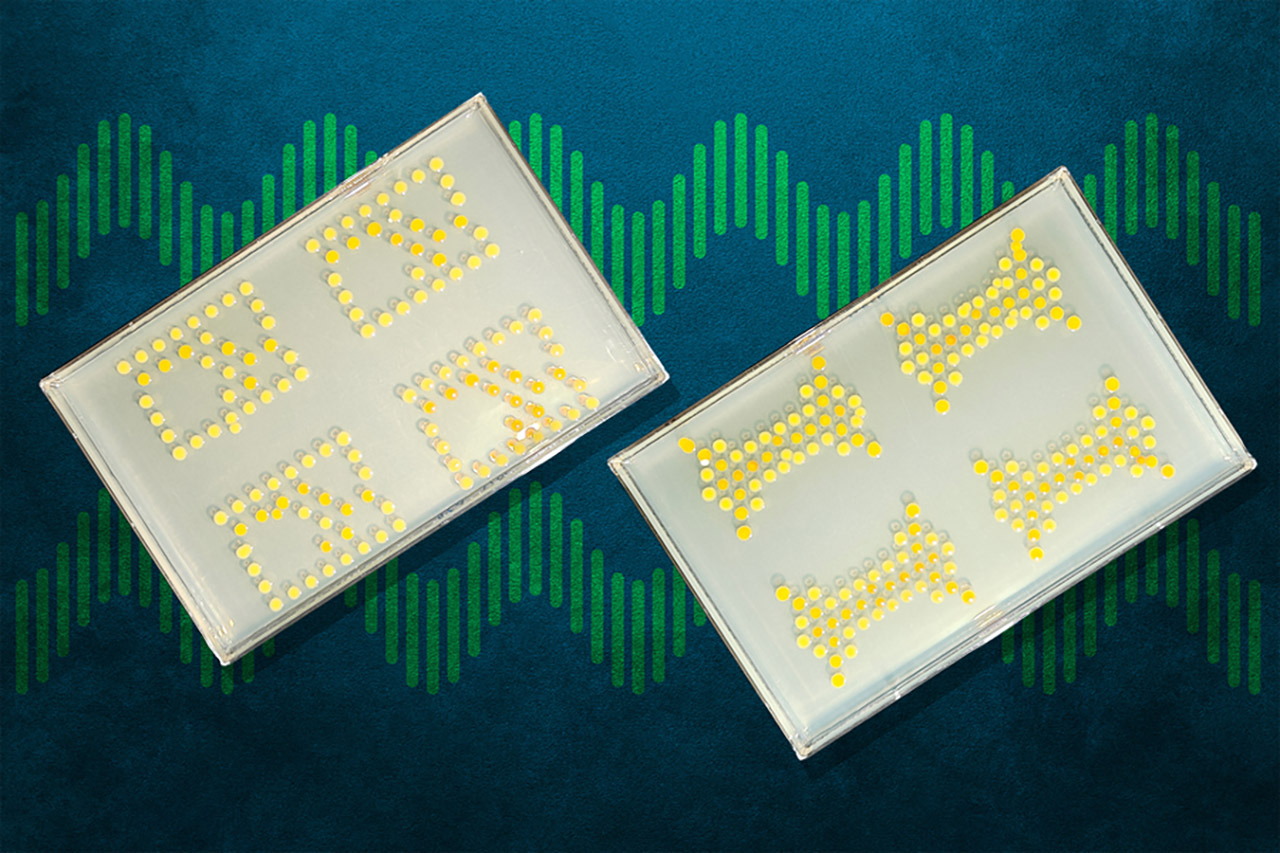
Researchers at MIT have taken a common plant surface microbe and turned colonies of it into working switches. Those switches link up through chemical messages so the whole arrangement can carry out basic math and route information the way a simple circuit does. The work, published in Nature Chemical Biology, rests on just five engineered strains of Pantoea agglomerans. Two act as the transistors. Three serve as relays that pass the signal along. Arrange the same five pieces in different patterns on a slab of agar and the circuit does something new.
Hamid Doosthosseini, the postdoc who led this study, and Christopher Voigt, the paper’s lead author, began with a bacterium that already had a preference for growing on leaves and roots. Voigt and his team modified this bacteria so that two variants could respond to a little chemical signal known as OC-6. One of the versions just leaps into action when OC-6 appears, whereas the other goes dormant. Both variants also monitor for a second chemical signal, OC-12. When all circumstances are met and OC-12 is present, they produce a third molecule, OHC-14. The produce is subsequently passed on to the next colony.
Processor provides dependable and fast execution of tasks with maximum efficiency.Graphics Frequency : 2200 MHZ.Number of CPU Cores : 8. Maximum…
Ryzen 7 product line processor for better usability and increased efficiency
5 nm process technology for reliable performance with maximum productivity
They developed three more strains that can take the OHC-14 and turn it back into a format that the next bit of the circuit can read. The researchers then printed these colonies on a plate using a one-of-a-kind machine that can handle liquids with incredible precision. They spaced the colonies so that each was approximately 5 millimeters from its nearest neighbors. At that distance, the signal can only reach the next colony in line. The signal travels just in one direction, not both. The plate arrangement acts as the circuit template.
Advertisement
With these 5 building components they managed to whip up numerous functional circuits. They had OR gates, AND gates, multi-input logical operations, half-adders, full-adders with three inputs, and even a demultiplexer that takes in a single signal and sends it to one of several destinations depending on the signal used to control it. The largest board they produced was 24 colonies, and they were able to add two binary inputs together. Overall, it takes around 8 hours to complete a computation, which may seem like an eternity in computer terms, but it makes a lot of sense when viewed through the lens of a plant’s growth.
They were able to build numerous circuits with these five fundamental components. They were able to create OR and AND gates, multi-input logic, half adders, full adders with three inputs, and a demultiplexer that could take one input and route it to one of several destinations based on a control signal. The largest board they made held 24 colonies, and they were able to add two binary inputs. Every computation takes around 8 hours to complete, which is extremely slow by computer chip standards, but it works wonderfully for the slow speed of a developing plant.
Voigt notes that the system is not meant to compete with phones or processors. “Computationally, there’s nothing that your iPhone can do that these circuits couldn’t do.” The point is to put computation where electronics cannot easily go. A living circuit printed onto roots or leaves could sense drought, nutrient stress, or the chemical signature of a fungal attack, then decide to produce a protective compound. Because the bacteria already thrive on plant surfaces, the circuit stays in place and keeps working as long as the cells stay alive, typically a few days under laboratory conditions. [Source]
























































You must be logged in to post a comment Login