
Crypto World
Who holds America’s Bitcoin? The bank custody race



Wall Street did not wake up one morning and decide it liked Bitcoin. It woke up and realized the custody fees were too large to leave on someone else’s balance sheet.
Summary
- Citigroup announced Custody+ on Aug. 18, folding Bitcoin into the same rails that hold $34.5 trillion in traditional assets, with a live launch expected before year end 2026.
- BNY Mellon, the world’s largest custodian at $59.4 trillion in assets under custody, already holds crypto for ETF issuers and expanded Bitcoin and Ethereum custody to Abu Dhabi in May 2026.
- Coinbase Custody manages $376 billion in institutional crypto assets and serves as custodian for more than 80% of U.S. spot Bitcoin and Ethereum ETFs, making it the single largest target if banks bundle custody with prime brokerage.
- The regulatory runway cleared in 2025 when the SEC rescinded SAB 121 and the OCC confirmed that national banks may custody crypto without prior approval, removing the two largest barriers to bank entry.
- Only roughly 1% of all cryptocurrency by market value carries insurance coverage, creating a protection gap that neither banks nor crypto natives have solved and that could define the next wave of competition.
For most of the past decade, holding digital assets for institutions was a job only crypto-native firms would touch. Coinbase built a custody arm. BitGo pioneered multi-signature wallets for institutional clients. Anchorage Digital became the first federally chartered crypto bank. They earned the business because traditional banks either could not or would not hold the keys.
That era is ending. In the span of 18 months, BNY Mellon, State Street, Standard Chartered, U.S. Bank, and now Citigroup have either launched or committed to launching direct crypto custody services. The question is no longer whether banks will hold Bitcoin. It is what happens to the companies that held it first.
The regulatory gates that opened everything
Two regulatory changes made the bank custody wave possible, and both arrived within weeks of each other. Understanding the sequence matters because it explains why the bank entry wave happened in 2025 and 2026 and not before: the barriers were legal and accounting constraints, not technological ones.
In January 2025, the SEC rescinded Staff Accounting Bulletin 121 through SAB 122, removing the rule that had forced any company holding crypto on behalf of clients to record a corresponding liability on its own balance sheet. SAB 121 had been the single most effective barrier to bank participation in crypto custody since its introduction in March 2022. The math was simple and punishing: a bank holding $10 billion in client Bitcoin had to treat that $10 billion as its own liability, which meant setting aside capital against it. For institutions already managing trillions in traditional custody without any such requirement, the asymmetry made crypto custody economically irrational. No amount of client demand could overcome a rule that turned a fee business into a capital drain.
The OCC followed months later with Interpretive Letters 1183 and 1184, which confirmed that national banks and federal savings associations may custody crypto assets, execute buy and sell orders on behalf of custodial clients, and use sub-custodians for digital asset services. Critically, Letter 1183 also rescinded the requirement for banks to obtain supervisory nonobjection before engaging in crypto custody. Under the prior regime, a bank wanting to hold Bitcoin had to apply to its regulator and wait for written permission, a process that could take months and carried no guaranteed timeline. Removing that requirement turned crypto custody from a special privilege into a standard banking power.
Then came the GENIUS Act, signed into law in July 2025. While written primarily for stablecoins, the Act created new national trust bank charter pathways that Circle, Paxos, BitGo, Fidelity Digital Assets, and Ripple have all used to secure preliminary OCC approval. The OCC conditionally granted national trust bank charters to all five firms by the end of 2025. The legislation codified for the first time that digital asset custody is a permissible banking activity under federal law, not merely an interpretive stretch of existing authority. The Financial Stability Oversight Council simultaneously dropped its classification of crypto as a systemic “vulnerability,” signaling that the broader regulatory posture had shifted from containment to integration.
The combined effect was immediate. Within months of SAB 121’s repeal, BNY Mellon expanded its crypto ETF custody operations. State Street launched its Digital Asset Platform. Morgan Stanley applied for a bank charter specifically to custody crypto. Nomura’s Laser Digital applied for a U.S. national trust bank charter dedicated to crypto custody. Even Charles Schwab began exploring direct crypto services for its advisory clients. The regulatory question shifted from “may banks hold crypto?” to “how quickly can they staff up?”
Who is already live
The landscape of bank crypto custody in mid-2026 is more developed than most market participants realize.
BNY Mellon is the furthest along. The world’s largest custodian, with $59.4 trillion in assets under custody, began holding Bitcoin and Ethereum for ETF issuers in 2022 and has since expanded the service. In May 2026, BNY announced a collaboration with Finstreet Limited and ADI Foundation to offer crypto custody in Abu Dhabi Global Market, marking its first expansion of direct crypto custody outside the United States. BNY serves as custodian for Morgan Stanley’s MSBT Bitcoin ETF and as primary reserve custodian for Ripple’s RLUSD stablecoin.
State Street, the world’s second-largest custody bank at $51.7 trillion in assets under custody, launched its Digital Asset Platform in January 2026 in partnership with Taurus, a Swiss digital asset infrastructure provider. The platform supports wallet management, custody, and settlement for tokenized money market funds, ETFs, tokenized deposits, and stablecoins across both public and permissioned blockchains.
Standard Chartered took a different path. Rather than building from scratch, the bank is absorbing Zodia Custody, the subsidiary it co-founded with Northern Trust in 2020. The acquisition, expected to close by end of August 2026, merges Zodia’s seven global offices and custody support for more than 75 cryptocurrencies into Standard Chartered’s corporate and investment banking division. Standard Chartered also holds a $1 billion-plus investment in crypto market maker GSR, giving it adjacency across custody, trading, and market making.
U.S. Bank was among the earliest traditional banks to move into the space, offering cryptocurrency custody services to fund administrators and providing reserve custody for Anchorage Digital Bank’s payment stablecoins. U.S. Bank brings more than 150 years of securities custody experience and has described its strategy as evolving the crypto offering in step with market demand, a measured approach that prioritizes regulatory alignment over speed. Its focus has been on the plumbing of the stablecoin ecosystem, reserve management, and fund administration support, areas where reliability matters more than headlines.
The Citi catalyst
When Citi unveiled Custody+ on Aug. 18, the announcement carried weight not because of novelty but because of scale. Citi holds $34.5 trillion in assets under custody and administration as of June 2026, making it the third-largest custodian in the world.
Custody+ is not a standalone crypto product bolted onto existing infrastructure. Citi described it as a modular suite covering eight capabilities across three categories: speed and certainty, intelligence, and control. Digital asset custody sits alongside real-time asset servicing, instant settlement, liquidity management, foreign exchange, and AI-powered market data. An asset manager holding Bitcoin and conventional securities would use one Citi environment for all custody services rather than running parallel operating stacks.
Bitcoin will be the first cryptocurrency supported. Citi will handle key management, wallet infrastructure, and safekeeping, meaning institutional clients will not touch private keys or manage wallets directly. The timeline targets a live launch before the end of 2026.
The strategic logic is straightforward. Citi already serves as custodian for the world’s largest asset managers, sovereign wealth funds, and pension systems. If those clients want Bitcoin exposure, and a growing number of them do, Citi would prefer to custody the Bitcoin itself rather than watch the fees flow to Coinbase or BitGo.
What the crypto natives stand to lose
The competitive threat to crypto-native custodians is not theoretical. It is structural.
Coinbase Custody manages approximately $376 billion in institutional crypto assets and custodies more than 80% of U.S. spot Bitcoin and Ethereum ETF assets. BitGo’s assets under custody crossed $90 billion in mid-2025, and it expanded its regulatory footprint with MiCA-compliant licenses in Germany and broker-dealer approval in Dubai. Together with Gemini, Ledger Enterprise, and Fireblocks, the top five crypto-native custodians hold roughly 46% of the global market.
That dominance was built on a simple fact: banks could not compete. SAB 121, regulatory ambiguity, and institutional caution kept traditional finance on the sideline. Every one of those barriers has now fallen.
The specific danger is the bundle. Charles Schwab, which manages over $5 trillion in client assets, illustrates the dynamic. If a registered investment adviser can get custody, trading, compliance reporting, and client portal access for both traditional securities and crypto in one place, and that place already manages the rest of the client’s portfolio, the crypto-native custodian needs to offer something meaningfully better to keep the relationship. Schwab can afford to compress margins on crypto custody if it retains the broader advisory business. Coinbase and BitGo cannot subsidize the same way.
Coinbase has responded by building what it describes as the only full-service prime brokerage in crypto: trading, custody, a $1 billion lending book, derivatives through its Deribit integration, and staking across 10 to 20 tokens. BitGo runs adjacent prime brokerage, staking, and lending intermediation businesses under separate entities. Both are betting that depth of crypto-specific services will matter more than breadth of traditional financial infrastructure.
Whether that bet holds depends largely on a question neither side has answered well: insurance.
The numbers illustrate the stakes. A 2026 survey found that roughly three in four institutional investors plan to increase their digital asset allocations this year, with 66% naming regulatory uncertainty as a top concern. Even as ETF flows normalize and the initial rush of passive inflows slows, active institutional demand for direct Bitcoin exposure continues to grow. As that uncertainty fades and allocations grow, custody becomes the bottleneck. Every new dollar of institutional Bitcoin exposure needs a custodian, and the winner of that race captures not just the custody fee but the relationship that unlocks lending, trading, settlement, and advisory revenue downstream.
The custody tech stack no one talks about
This is where the bank versus crypto-native comparison gets technical, and where the differences matter most for the institutions writing the checks.
Crypto custody technology falls into three broad categories, and every custodian uses some combination of all three.
Cold storage keeps private keys entirely offline in air-gapped environments. Keys never touch a network-connected device. Withdrawals require physical intervention and typically take hours or days to process. Cold storage is the most secure option against remote attacks and remains the standard for strategic reserves. Most institutional custodians hold 90% or more of client assets in cold storage.
Hardware Security Modules are tamper-resistant physical devices purpose-built to generate, store, and manage cryptographic keys. HSMs provide auditable logs of every key operation and meet FIPS 140-2 Level 3 or Level 4 certification standards, the same standards used by central banks and military organizations. Banks like BNY Mellon and State Street default to HSM-based architectures because they map directly onto the security infrastructure banks already operate for traditional securities.
Multi-Party Computation splits a private key into multiple shares distributed across independent parties. Transaction signing happens through a cryptographic protocol that produces a valid signature without ever reconstructing the full key. MPC eliminates the single point of failure inherent in traditional key management and enables faster transaction processing than pure cold storage. Coinbase, BitGo, and Fireblocks all built their custody platforms around MPC architectures.
The industry trend in 2026 is toward hybrid models. Leading custodians use HSMs as hardware roots of trust providing secure randomness and tamper-evident storage, while layering MPC protocols on top for the actual signing workflows. Tiered storage has become standard: cold storage for long-term holdings, HSM-protected warm storage for operational liquidity, and MPC-based hot wallets for active trading, with automated rebalancing based on velocity and exposure limits.
Banks enter with a structural advantage in HSM deployment because they already operate these devices at scale for traditional markets. Crypto natives hold the advantage in MPC innovation, where they have years of production experience banks cannot replicate overnight. The competitive question is whether hybrid convergence favors the party that starts with better hardware infrastructure or the party that starts with better cryptographic software.
The insurance arithmetic that should worry everyone
The protection gap in crypto custody is the industry’s open secret and its most dangerous unresolved problem.
Only approximately 1% of the cryptocurrency market by value carries insurance coverage. The crypto insurance market totaled roughly $1.9 billion in premiums in 2024 against a total crypto market then valued at approximately $2.5 trillion. That ratio has not materially improved as the market has grown.
Leading custody insurance programs offer between $75 million and $320 million in coverage limits, with some providers reaching $1 billion in aggregate. But if a custodian holds $5 billion in client assets and carries $200 million in coverage, the policy functions as partial risk transfer, not protection. For an institution accustomed to SIPC coverage on brokerage accounts or FDIC insurance on deposits, that gap is difficult to explain to a compliance committee.
The FDIC proposed its first custody and reserve standards for FDIC-supervised institutions providing crypto safekeeping in April 2026, but the proposal explicitly states that digital assets will not receive deposit insurance. This means bank custody of Bitcoin operates under a fundamentally different protection framework than bank custody of dollars. A client whose Bitcoin is stolen from bank custody has no federal insurance backstop.
Banks bring balance sheet strength that theoretically provides a different kind of protection. If Citi loses client Bitcoin through a custody failure, the bank’s $2.4 trillion balance sheet stands behind any claim. If Coinbase suffers the same failure, its balance sheet, while substantial for a crypto company, is orders of magnitude smaller. But “the bank will make you whole” is an assumption, not a contractual guarantee, and it has never been tested in the context of a large-scale digital asset loss.
The insurance gap creates an unexpected competitive dynamic. Crypto-native custodians have spent years building specialized insurance programs, negotiating with Lloyd’s syndicates, and structuring coverage specifically for digital asset risks. Banks are entering the market with reputational credibility but without existing crypto-specific insurance relationships. Neither side has solved the fundamental problem: the insurance market does not have the capacity to fully cover the assets being custodied.
The tokenization bridge
Custody is not the end of the story. It is the beginning.
The banks entering crypto custody are simultaneously building tokenized deposit networks and settlement infrastructure. JPMorgan, Citigroup, Bank of America, and Wells Fargo are constructing a shared tokenized deposit network through The Clearing House, targeting the first half of 2027. JPMorgan already lets institutional clients pledge Bitcoin and Ethereum as collateral for U.S. dollar loans, placing crypto on the same ledger as Treasuries and blue-chip equities.
The tokenized real-world asset market has expanded more than 420% since the start of 2025, reaching $31.6 billion. State Street’s Digital Asset Platform was designed from the start to handle tokenized money market funds and ETFs alongside native crypto. Standard Chartered’s absorption of Zodia Custody positions it to offer custody for more than 75 cryptocurrencies and tokenized assets under a single institutional brand.
This is where the bank custody play reveals its full scope. Custody is the entry point. Once a bank holds an institution’s Bitcoin, it can offer lending against that Bitcoin, settlement of tokenized assets alongside that Bitcoin, and eventually a fully integrated platform where the distinction between traditional and digital assets disappears from the client’s perspective.
For crypto-native custodians, the tokenization wave presents both threat and opportunity. Coinbase and BitGo do not have the balance sheet capacity to compete on collateral lending at the scale JPMorgan or Citi can offer. But they do have the technological infrastructure to custody tokenized assets that banks are only beginning to issue, creating potential for a custody relationship that flows in the reverse direction. A bank might issue a tokenized Treasury product and then need a crypto-native custodian to safeguard it on a public blockchain, a scenario that would turn today’s competitor into tomorrow’s sub-custodian.
The digital asset custody market is projected to grow from roughly $953 billion in 2026 to more than $4.3 trillion by 2030, according to industry estimates. That growth trajectory means the market is large enough for both bank custodians and crypto natives to expand, at least in aggregate. The question is whether the most valuable slice of the market, the largest institutional accounts with the highest fee revenue, will consolidate around banks that offer one-stop access to traditional and digital assets, or whether those accounts will continue to split their custody across specialists who offer superior technology and deeper asset coverage.
What to watch
- ETF custody rotation: whether any major ETF issuer moves custody from Coinbase to a bank custodian in the next 12 months, which would signal that the bundle is winning over specialization.
- Insurance capacity growth: whether Lloyd’s syndicates or new entrants expand crypto custody insurance capacity above $5 billion in aggregate, which would begin to close the protection gap that currently defines the market.
- OCC charter applications: the number of new national trust bank charter applications filed for digital asset custody, which indicates whether crypto-native firms believe they must become banks to survive.
- Citi Custody+ live date: whether Citi meets its year-end 2026 target and which institutional clients move first, setting the pace for other banks still building.
- Coinbase Prime retention: whether Coinbase’s prime brokerage bundle, including its $1 billion lending book and Deribit derivatives integration, holds institutional clients who could consolidate with a bank.
What is bank crypto custody?
Bank crypto custody refers to regulated depository institutions holding digital assets like Bitcoin on behalf of institutional clients, using the same legal and operational frameworks they apply to traditional securities such as equities and bonds. The bank manages private keys, wallet infrastructure, and safekeeping so clients do not handle cryptographic material directly.
Which banks currently offer crypto custody in the United States?
BNY Mellon has been live with crypto custody since 2022 and serves as custodian for multiple Bitcoin and Ethereum ETFs. State Street launched its Digital Asset Platform in January 2026. U.S. Bank offers cryptocurrency custody for fund administrators. Citigroup announced Custody+ in August 2026, with a launch expected before year end.
What happened to SAB 121 and why did it matter?
Staff Accounting Bulletin 121 was an SEC rule introduced in March 2022 that required companies holding crypto assets for clients to record a corresponding liability on their own balance sheets. This capital charge made crypto custody economically unviable for banks. The SEC rescinded SAB 121 in January 2025 through SAB 122, removing the primary accounting barrier to bank participation.
How does bank custody differ from Coinbase or BitGo custody?
Banks typically build custody around Hardware Security Modules and infrastructure they already operate for traditional securities. Crypto-native custodians like Coinbase and BitGo built their platforms around Multi-Party Computation, which splits private keys across multiple parties to eliminate single points of failure. Banks offer the advantage of bundling crypto custody with existing services. Crypto natives offer deeper specialization in digital asset security.
Is Bitcoin held in bank custody insured by the FDIC?
No. The FDIC proposed custody and reserve standards for FDIC-supervised institutions in April 2026 but explicitly stated that digital assets will not receive deposit insurance. Bitcoin held in bank custody does not carry the same federal insurance protection as dollar deposits.
What is Citi Custody+ and when does it launch?
Custody+ is a modular custody suite announced by Citigroup on Aug. 18, 2026. It covers eight capabilities across three categories: speed and certainty, intelligence, and control. Bitcoin custody is one component alongside real-time settlement, liquidity management, and AI-powered market intelligence. Citi targets a live launch before the end of 2026.
What does the GENIUS Act mean for crypto custody?
The GENIUS Act, signed into law in July 2025, created the first federal framework for payment stablecoins and opened new national trust bank charter pathways. Circle, Paxos, BitGo, Fidelity Digital Assets, and Ripple have all used these pathways to secure preliminary OCC approval. The Act codified digital asset custody as a permissible banking activity under federal law.
Will crypto-native custodians survive the bank custody wave?
Crypto-native custodians hold structural advantages in MPC technology, specialized insurance programs, and depth of digital asset support. Coinbase manages $376 billion in institutional crypto assets and has built a full prime brokerage suite. BitGo operates across multiple jurisdictions with integrated custody, brokerage, and lending. The competitive outcome likely depends on whether institutional clients prioritize the convenience of bundled traditional and crypto services at a bank or the specialized depth of a crypto-native platform.
Disclaimer: This article is for informational purposes only and does not constitute financial, investment, or legal advice. Cryptocurrency investments carry significant risk. Always conduct your own research and consult qualified professionals before making investment decisions. Published Aug. 20, 2026.

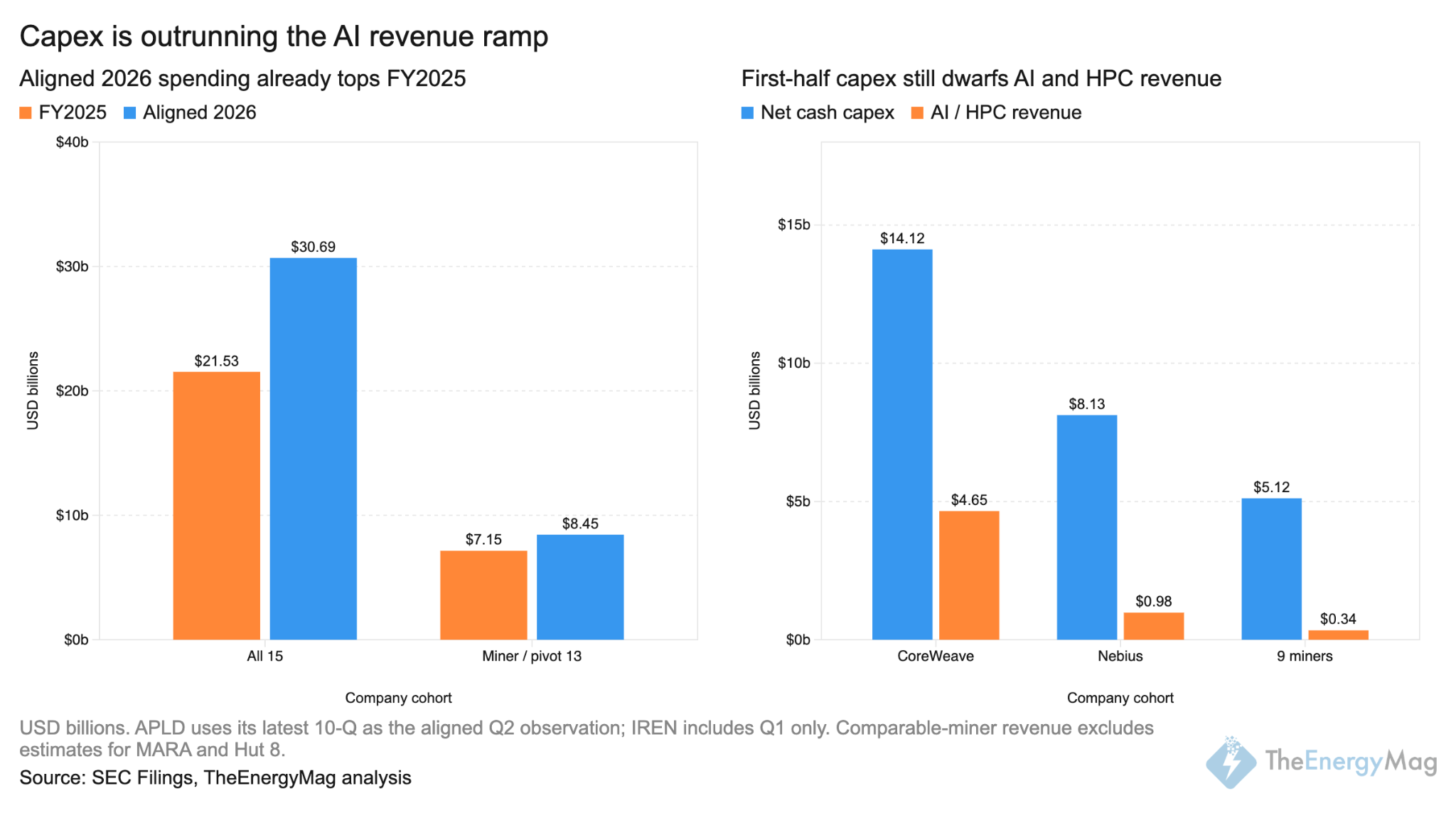
Public Bitcoin miners are spending billions chasing artificial intelligence and high-performance computing revenue, though returns have yet to keep pace, underscoring the massive upfront investment required to diversify beyond Bitcoin mining.
In its latest Miner Weekly newsletter, BlocksBridge Consulting reported that a group of 15 Bitcoin miners and AI data-center companies spent a combined $30.7 billion on capital assets in their latest 2026 reporting periods, already 42.6% more than the $21.53 billion they spent throughout 2025.
Among Bitcoin miners specifically, the gap between capital spending and AI revenue remains significant. Nine comparable miners spent $5.11 billion on capital assets during the first half of 2026 while generating just $341.2 million in directly reported AI and HPC revenue — a roughly 15-to-1 capex-to-revenue ratio.
BlocksBridge calculated capital spending based on cash purchases and allocations to hardware, property, equipment and other productive assets, after accounting for proceeds and refunds from asset sales.
Despite the gap, AI and HPC revenue is accelerating. The nine miners generated $205.8 million from those businesses in the second quarter, up 52% quarter-on-quarter, with Core Scientific, TeraWulf and Bitdeer among the companies reporting gains.
Bitcoin miners’ capital expenditures are vastly outpacing AI and HPC revenue so far. Source: Miner Weekly
Related: Public Bitcoin miners cut hashrate 13.4% as AI infrastructure revenue grows
The steep cost of pivoting to AI
AI and data centers have been touted as a way for Bitcoin mining companies to diversify amid challenging conditions in the mining sector, but BlocksBridge’s data shows that the pivot comes with substantial upfront costs.
“Power contracts and available land may give miners a starting advantage, but converting those assets into AI-ready capacity requires substations, buildings, cooling systems, networking equipment and, in some business models, GPUs,” BlocksBridge said.
It remains to be seen whether Bitcoin’s latest price recovery will provide relief for companies that still maintain sizable mining operations.
Bitcoin has surged more than 13% this week and climbed back above $72,000 after the US Treasury said it would at least double the maximum size of its long-term bond buybacks to $4 billion per operation, a move aimed at improving liquidity in the Treasury market that initially pushed yields lower and boosted risk appetite.
In a sign of the pivot to AI and HPC, CoinShares this week announced a change in strategy for its industry tracking exchange-traded fund.
Now branded the CoinShares Bitcoin Mining and Digital Power ETF (WGMI), with $222.4 million in assets under management, the fund’s universe includes 29 holdings drawn from bitcoin miners, data center operators, AI semiconductors, power generation, and HPC, which Coinshares describes as “the businesses powering the digital economy.”
Related: Crypto Biz: Bitcoin’s $116M self-custody wake-up call


A French couple has been kidnapped from their home in Rion-des-Landes in an alleged crypto extortion attack that left the man injured and led to two arrests.
Summary
- Two residents were allegedly taken from their home during the night of Aug. 10–11.
- The attackers reportedly sought access to a large amount of Bitcoin and other cryptocurrencies.
- The man was found naked and injured, while the woman was recovered in another department.
- Two men were arrested as the Bordeaux specialized jurisdiction took charge of the investigation.
Actu Landes reported on Aug. 20 that several people entered the couple’s home at around 4 a.m. and allegedly threatened them while seeking access to their Bitcoin and other crypto holdings.
The Bitcoin kidnapping began with an early-morning home invasion
According to the local news outlet, the attackers initially held the two residents inside their home in Rion-des-Landes, a town in the Landes department of southwestern France. The group allegedly tried to force the victims to hand over what the report described as a large amount of Bitcoin and other digital assets.
After the confrontation inside the property, the assailants allegedly removed both victims from the house and transported them to separate locations. Actu Landes did not report whether any cryptocurrency was transferred, how the attackers identified the couple, or how long the two residents remained in captivity.
The man was later found in Solférino, about 20 kilometers from Rion-des-Landes. According to the report, he was naked and had several cuts when authorities located him. No information was provided about the seriousness of his injuries or whether he required hospital treatment.
Several kilometers away, investigators found the woman inside a vehicle in another French department, the outlet reported. Authorities did not disclose the location where she was recovered, her physical condition, or the circumstances that led officers to the car.
Details about the couple have also remained limited. Their names, professions and estimated crypto holdings were not released, while the report did not establish whether either victim worked in the digital asset sector or had publicly discussed owning cryptocurrency.
Two suspects were arrested after a large police response
Shortly after the reported abduction, French gendarmes deployed across the area and began stopping vehicles on the road connecting Rion-des-Landes and Lesperon, according to witnesses cited by Actu Landes.
The operation involved a large number of officers, with the road controls apparently intended to locate the victims and identify vehicles connected to the attack. Investigators returned to the couple’s home the following day to preserve evidence, examine the property and collect fingerprints.
Two men were arrested soon after the incident, the report said, although officials have not released their identities, ages, or suspected roles. Authorities have also not said where the arrests occurred, whether the suspects remain in custody, or whether officers recovered weapons, vehicles or digital devices.
Contacted by the outlet, France’s National Anti-Organized Crime Prosecutor’s Office, known as PNACO, confirmed that the Specialized Interregional Jurisdiction in Bordeaux was handling the case. The Bordeaux office had not responded to the publication’s questions when the report was released.
French authorities assign specialized interregional jurisdictions to complex organized crime cases that may require work across several departments. PNACO’s involvement and the transfer to the Bordeaux jurisdiction indicate how prosecutors have classified the investigation, but neither office has publicly announced charges against the two arrested men.
No official statement has confirmed the value of the cryptocurrency allegedly sought, whether the attackers obtained wallet credentials, or whether investigators traced any transactions. The available account also does not establish a link between the two suspects and any other crypto-related attacks in France.
France has recorded 77 crypto-linked violent cases in 2026
The Landes incident follows a series of kidnappings, home invasions, and extortion attempts involving French crypto holders and their relatives.
As crypto.news reported in July, Interior Minister Laurent Nuñez said France had recorded 77 kidnappings, unlawful detentions, extortion cases or attempted offenses connected to the crypto sector during 2026. Authorities recorded 45 comparable cases in 2025.
Nuñez also said that about 200 people had been arrested after attacks or during operations intended to prevent them. During a June 30 address to the Association for the Development of Digital Assets, the minister said 724 industry participants had registered with rapid-identification platforms used to help authorities respond when someone considered at risk contacts police.
The Interior Ministry’s security plan included more intelligence sharing, coordination with the digital asset industry group Adan, and cooperation with countries where suspected organizers may be located. Nuñez said some people directing the attacks appeared to operate from outside France, while lower-level recruits carried out the violence.
A separate Chainalysis report found that France recorded 30 publicly known violent crypto incidents through the first half of 2026, up from 19 during all of 2025. The analytics company used a narrower dataset than the French government, which explains why its public-incident count differs from the 77 cases cited by Nuñez.
According to Chainalysis, criminals stole more than $30 million through successful physical attacks worldwide during the first half of 2026. The company counted 12 successful attempts among 46 documented incidents through late June, producing a 26% success rate compared with 49% in 2025 and 67% in 2024.
Home invasions represented 37% of documented attacks through mid-2026, up from 14% in 2025, while kidnappings remained the most common category. Chainalysis said family members or other people connected to crypto holders accounted for around 25% to 30% of known incidents by early 2026.
Within France, more than 40% of cases involved a relative or associate rather than the identified holder, according to the firm. Local residents made up 93% of French victims whose residency was known, a pattern Chainalysis linked to advanced research using leaked information, social media activity, blockchain records, or knowledge supplied by insiders.
The company cited an alleged 2024 theft of French tax records containing names, addresses, holdings, telephone numbers and tax information associated with wealthy crypto owners. It also referred to crypto tax platform Waltio’s January disclosure that unauthorized access had affected information tied to around 50,000 users, while noting that no direct connection had been established between either exposure and a specific attack.
US cases show similar home-invasion tactics
Physical attacks against crypto holders have also resulted in federal prosecutions in the United States, where Chainalysis said home invasions have accounted for a larger share of incidents than in many other countries.
In May, a US wrench attack case involved three Tennessee men accused of targeting cryptocurrency holders in San Francisco, San Jose, Sunnyvale, and Los Angeles. Federal prosecutors alleged that the defendants posed as delivery workers to enter or attempt to enter homes before using firearms, duct tape, and zip ties to restrain victims.
According to the U.S. Department of Justice, one victim was forced at gunpoint to sign in to cryptocurrency accounts, allowing an alleged accomplice to transfer about $6.5 million in digital assets to a wallet controlled by the group.
The indictment was filed on March 31 and unsealed after the arrests of Elijah Armstrong, Nino Chindavanh, and Jayden Rucker. The Justice Department said the charges were allegations and that each defendant remained presumed innocent unless proven guilty in court.

Grayscale Research sees the SEC’s proposed Regulation Crypto Assets as a potential reset for U.S. token-based fundraising. The framework could give issuers new capital routes while directing more activity toward established public blockchain networks. Ethereum, Solana, and BNB Chain could benefit if companies move token launches back into the United States.
Ethereum Could Gain From Expanded Token Issuance
Ethereum could capture additional network activity because many token projects already use its infrastructure for issuance and settlement. Grayscale identified Ethereum among the major networks positioned to benefit from renewed U.S. token fundraising. More domestic offerings could increase transactions, smart-contract use, and applications built around Ethereum’s existing ecosystem.
The SEC proposed Regulation Crypto Assets on August 18 and targeted certain investment contracts involving newly issued crypto assets. The proposal creates two exemptions from standard Securities Act registration requirements for qualifying token offerings. One exemption allows issuers to raise to $5 million during four years.
The second exemption would permit eligible issuers to raise to $75 million in any 12 months. However, those issuers would face financial statement requirements and continued reporting obligations under the proposed framework. Federal antifraud and market-manipulation requirements would also continue to apply to offerings made under the exemptions.
Solana Could Attract New Fundraising Activity
Solana could also gain activity because its network supports token launches, payments, decentralized applications, and other blockchain services. Grayscale included Solana among networks that could receive additional usage if U.S. fundraising rules become clearer. More token issuance could therefore create new demand for transactions and applications operating through the Solana network.
The proposed regulation focuses on newly issued crypto assets rather than blockchain representations of existing securities. That distinction separates Reg Crypto from tokenized stocks, which link digital assets with shares already issued elsewhere. Instead, the SEC wants a dedicated framework for companies raising capital through certain crypto-related investment contracts.
The SEC also proposed a conditional safe harbor addressing when crypto assets remain linked to investment contracts. An issuer could qualify after completing or permanently ending the essential managerial work originally promised under the contract. Qualified assets would then fall outside investment-contract treatment under federal securities definitions covered by the proposal.
BNB Chain Could Benefit From More U.S. Token Launches
BNB Chain represents another major network that Grayscale believes could gain from expanded token-based capital formation. The network already hosts applications, digital assets, and decentralized finance services requiring frequent blockchain transactions. New U.S. token offerings could therefore expand network use if issuers select BNB Chain for distribution.
Reg Crypto follows years of uncertainty surrounding U.S. token offerings after the initial coin offering boom. That uncertainty pushed many projects toward overseas structures or offerings that excluded participation from the United States. The SEC said its proposal aims to reduce incentives for issuers to establish and operate offshore.
The framework still requires completion of the SEC rulemaking process before issuers can use its proposed exemptions. The SEC opened a 60-day public comment period following publication of the proposal in the Federal Register. Meanwhile, Congress continues work on broader digital asset legislation that could further define federal market oversight.

The NPT, also known as the Nuclear Non-Proliferation Treaty, is an international agreement aimed at stopping the spread of nuclear weapons.
The Islamic Republic of Iran signed the treaty in 1968 and ratified it in 1970, committing as a non-nuclear-weapon state not to manufacture or acquire nuclear weapons.
Trump has repeatedly cited preventing Iran from obtaining a nuclear weapon as a justification for U.S. military action
“They have to get rid of it completely. They have to get rid of nuclear weapons. Iran cannot have a nuclear weapon,” Trump repeated Wednesday during the unveiling of the new White House helipad.
Where U.S.-Iran negotiations stand
Trump’s renewed economic threats come as negotiations between Washington and Tehran appear to have stalled amid disagreements over the Memorandum of Understanding (MOU), signed by both countries on June 17.
The document outlined commitments aimed at ensuring the full, toll-free reopening of the Strait of Hormuz, and established a 60-day cease-fire intended to allow technical talks to take place, including over Iran’s nuclear capabilities. Before the war, roughly a fifth of the world’s global petroleum liquids consumptions passed through the waterway.

In the interview, Harry said the decision to withdraw from public duties and move to California was both due to the amount of tabloid press scrutiny and harassment, as well as a lack of support from “The Firm.”
Tabloid headlines focused on Meghan have included descriptions of the Duchess as “gangster royalty” and coming from a “crime-ridden neighborhood.”
In 2023, Harry published his memoir, Spare, outlining details of Royal life. In his book, the Duke revealed how he learned of his grandmother’s death, Queen Elizabeth II, via the BBC, and how his father, Charles, did not hug him following the death of his mother, Princess Diana, in 1997.
While in the U.S., the couple have launched a number of business ventures, including several with Netflix. In December 2022, the couple released a six-episode docuseries on Netflix detailing more details about the early days of their relationship, as well as discussions around racism and stereotypes experienced by the Duchess since the start of their relationship.

BTC broke above $70,000 after a fast recovery on August 20, with experienced trader Sykodelic putting $67,000 as the mark that bulls need to defend.
The idea is straightforward: a close above $67,000 for a week may be a sign of bottoming out for Bitcoin, allowing bulls to target $74,000.
Bitcoin Clears Levels That Analysts Have Watched
Bitcoin first reclaimed $69,000 and then started a determined move upward that, at the time of writing, had taken it above $72,000, leading to Sykodelic’s comment. In a post on X, he wrote “Hold above $67,000 this week, and $74,000 comes fast,” while adding that $60,000 had been “a strong low.”
Before that, the trader had posted, explaining why $67,000 and $69,000 matter to his setup. The latter is Bitcoin’s previous 2021 all-time high and the current cost basis for short-term holders. That cost basis represents the average price paid by recent buyers, and Bitcoin holding above it would leave many short-term holders in profit.
The analyst also compared the current move with previous bear markets, with Bitcoin historically needing several attempts to hold this area before a lasting bottom formed. He explained that the current attempt would be the third.
Another technical signal that Sykodelic noted was Bitcoin’s closing of its first daily candle above the 200-day simple moving average since November 2025. He claimed every previous break above that average in the cryptocurrency’s history coincided with the end of a bear market. However, he still wants to see the weekly close before declaring victory.
“As long as we are above $67,000, we are golden,” he wrote.
A view that fit Sykodelic’s argument came from trader Nik. While responding to a question from an X user on how to read a chart with “absolutely no structure,” they said they see no resistance until $74,000, with the next major wall around $80,000 to $83,000, and identified $65,000 to $67,000 as the more important support zone.
However, neither trader treats the move as a straight path higher, and Nik specifically warned that Bitcoin could see more “fuckery” before reaching higher levels.
Bitcoin’s run to $70,000 also came with heavy forced selling, described as its largest short-liquidation candle on record, with more than $1.2 billion in leveraged positions liquidated within an hour, $1.14 billion of that being shorts.
Crypto Market Grows By More Than $200 Billion
At the time of writing, BTC was still making huge strides, up more than 11% in 24 hours to put it above $72,000. Other timeframes were also similarly green, with the asset gaining over 12% in seven days and more than 10% in two weeks, while its one-month jump was 8%.
Nonetheless, it’s still in the red across one year at almost 37% and sits 43% below its all-time high.
The broader market has moved with the OG cryptocurrency, adding about $200 billion within 24 hours, as CryptoPotato reported. Ethereum briefly jumped past $2,300, and HYPE gained around 25% to $74, with several other large tokens turning green alongside them.
The post Bitcoin Eyes $74K After Rally as Analyst Flags $67K Support appeared first on CryptoPotato.


The CLARITY Act has stalled ahead of a Sept. 15 procedural vote requiring 60 senators, as Senate Banking Committee Chairman Tim Scott accused Elizabeth Warren’s team of trying to drive crypto activity from the United States.
Summary
- The Senate will hold a Sept. 15 cloture vote on whether to begin considering H.R. 3633.
- Scott accused Warren’s team of repeatedly changing its demands during negotiations.
- Republicans need Democratic support because advancing the bill requires at least 60 Senate votes.
- Ethics rules, stablecoin rewards and financial-crime provisions remain unresolved.
SALT Conference footage from the Wyoming Blockchain Symposium showed Scott blaming Warren and her allies for holding up the Digital Asset Market Clarity Act during his Aug. 18 appearance.
“Elizabeth Warren’s team wants to run Bitcoin and crypto out of the country,” Scott said.
Addressing the remaining negotiations, the South Carolina Republican also accused Democrats of repeatedly moving the “goalposts” for political reasons. Scott argued that the bill would not advance unless Republican lawmakers applied direct pressure and forced a Senate vote.
His remarks place Warren, the Banking Committee’s ranking Democrat, at the center of the dispute over the most extensive digital asset market structure proposal considered by Congress. Warren and other Democrats have sought stronger investor safeguards, financial-crime controls and restrictions covering crypto businesses tied to elected officials.
Scott’s criticism came one day before Democratic Sen. Ruben Gallego warned that taking the bill to the floor too quickly could damage bipartisan negotiations. Gallego, one of two Democrats who supported the Banking Committee’s version, said lawmakers still needed to resolve several parts of the proposal before a vote.
CLARITY Act faces a 60-vote Senate test
Senate Majority Leader John Thune filed cloture on the motion to proceed to H.R. 3633 before the Senate began its August recess, according to the Senate Daily Press.
The cloture motion will ripen at 2:15 p.m. on Sept. 15, one day after senators return to regular business. Approval would allow the chamber to begin formally considering the legislation, but it would not constitute final passage.
Senators could still debate the proposal, offer amendments, and vote on the resulting text. Any Senate version that differs from the measure approved by the House would also require further action from the lower chamber before reaching President Donald Trump.
Supporters need at least 60 votes to overcome the Senate’s cloture threshold. Republicans cannot reach that number alone, leaving Scott dependent on Democrats and independents even as he criticizes Warren’s role in the negotiations.
The House passed its version in July 2025 by 294 votes to 134, with 78 Democrats joining Republicans. In May, the Senate Banking Committee advanced its section of the legislation by 15 votes to nine.
Democratic Sens. Gallego and Angela Alsobrooks supported the committee measure. Their votes gave Scott a bipartisan result but fell well short of the Democratic support needed on the Senate floor.
The Sept. 15 proceeding would therefore measure whether negotiators have secured enough support to open debate. As crypto.news previously reported, Solana Policy Institute CEO Miller Whitehouse-Levine placed the bill’s chance of passing before the November midterms at 10%, while prediction markets remained somewhat more optimistic.
Polymarket traders assigned about a 20% probability to the bill becoming law during 2026 as of Aug. 19. Whitehouse-Levine’s estimate covered passage before the midterms, while the Polymarket contract allows lawmakers until Dec. 31.
What the CLARITY Act would change
H.R. 3633 would divide authority over digital assets between the Securities and Exchange Commission and the Commodity Futures Trading Commission.
Under the proposal, the CFTC would receive primary authority over spot markets for qualifying digital commodities. The SEC would continue regulating securities and certain investment contracts, while both agencies would receive responsibilities tied to registration, disclosure, and market conduct.
Crypto exchanges, brokers, and dealers covered by the legislation would have to register under new federal rules. The bill also contains provisions addressing customer asset protection, anti-money laundering requirements, and disclosures for digital asset businesses.
Developers of certain non-custodial software could receive protection from being treated as money transmitters solely because they publish or maintain software. Law enforcement groups previously objected to parts of the language, arguing that it could limit investigations involving decentralized finance.
Several organizations later changed their positions after lawmakers revised the relevant provisions. The National Fraternal Order of Police, which represents more than 382,000 members, endorsed the updated language in July after concluding that it preserved authorities used in digital asset investigations.
A separate coalition of police chiefs also backed the revised proposal, while other prosecutors and enforcement organizations continued seeking changes. The disagreement has made the developer provisions one of several issues that senators must manage before securing enough floor votes.
Lawmakers released a 616-page merged draft in late July, combining work completed by the Banking and Agriculture committees. Each committee oversees different parts of the proposed regulatory structure because the SEC falls under Banking jurisdiction and the CFTC falls under Agriculture jurisdiction.
Ethics and stablecoin rewards divide negotiators
Restrictions involving elected officials and their crypto interests remain among the hardest issues for senators to settle.
Democrats have sought rules addressing digital asset ventures connected to the president, senior officials, and their families. Their concerns include Trump-linked crypto businesses and whether a sitting president should be allowed to issue, promote, or profit from digital assets while influencing federal policy.
Republican Sen. Thom Tillis has worked on a bipartisan ethics proposal intended to address some of the objections. Industry executives have also pointed to negotiations with the White House as a possible route to an agreement, but lawmakers had not released a final compromise as of Aug. 20.
Stablecoin rewards have created another divide. Banks have pushed for restrictions preventing crypto platforms from paying yield or rewards on payment stablecoins, warning that such products could draw deposits away from regulated financial institutions.
Crypto companies argue that a sweeping restriction could limit competition and extend beyond the rules Congress adopted for stablecoin issuers. Negotiators have not publicly confirmed final language that satisfies both groups.
Financial-crime controls and the treatment of decentralized protocols also remain under discussion. Warren and aligned Democrats have pressed for stronger measures covering illicit finance and national security, while crypto advocates have warned against applying obligations designed for financial intermediaries to software developers who do not control customer funds.
A July report on the Senate’s delayed vote found that disputes over ethics, DeFi protections and stablecoin rewards persisted even after major law enforcement groups supported revised provisions.
Scott’s criticism meets Democratic resistance
Scott presented the dispute in Wyoming as a choice between passing federal rules and allowing crypto businesses to leave the country. His accusation against Warren’s team went further than earlier Republican appeals for bipartisan cooperation.
Warren has argued that digital asset legislation must contain sufficient consumer protections and prevent public officials from using their positions for personal financial gain. Democrats aligned with her have also questioned whether the current enforcement provisions would adequately cover money laundering and national security risks.
Not every Democrat opposing an immediate vote has rejected market structure legislation. Gallego said on Aug. 19 that rushing the process could weaken the chance of reaching a bipartisan deal, according to a recent report.
Gallego also said the White House had not supplied detailed feedback on bipartisan ethics language sent by Senate negotiators. Along with the ethics dispute, he identified stablecoin rewards and unresolved Agriculture Committee provisions as matters requiring further work before the legislation advances.

A Wall Street analyst initiated coverage of SiTime (SITM) stock with a buy rating, calling the timing-chip specialist a “technology disruptor.” Benchmark analyst Gary Mobley gave SiTime stock a positive report Thursday and set a price target of 850. In late morning trades on the stock market today, SiTime stock slid more than 3% to 598.29. Semiconductor stocks in general…
Copyright ©2026 Investor’s Business Daily, LLC. All rights reserved. 87990cbe856818d5eddac44c7b1cdeb8

Since bottoming out in April 2025, Relay Therapeutics (RLAY) shares have skyrocketed by as much as 1,074%. Now the biotech firm has a fresh breakout in its sights. With its 10-week moving average continuing its long ascent, the Cambridge, Mass.-based company earns a coveted blue dot in MarketSurge, a clear indication of stock market leadership. Biotech Taps AI And Machine…
Copyright ©2026 Investor’s Business Daily, LLC. All rights reserved. 87990cbe856818d5eddac44c7b1cdeb8


Cointelegraph is committed to providing independent, high-quality journalism across the crypto, blockchain, AI, and fintech industries.
All news, reviews, and analyses are produced with full journalistic independence and integrity. For more details on our standards and processes, please read our Editorial Policy.

Bitcoin Miners Spend Billions on AI as Revenue Lags

6 Most Intense Movies Released Since 2000

Emergency services attend three-vehicle collision on M1





-

 Fashion6 days ago
Weekend Open Thread: Ann Taylor
-
 Sports7 days ago
This U.S. Amateur is a glimpse into golf’s future in more ways than you think
-

 Tech6 days ago
11 Ways to Rank Your Videos
-

 Sports6 days ago
Birmingham 2026: Day 6 Timetable for Irish Athletes
-
 NewsBeat5 days ago
Myanmar says over 300,000 Rohingya refugees verified for repatriation as exodus enters ninth year
-

 Politics5 days ago
SEQ Code: The Three Letter Boarding Pass Code That Could Give You The Worst Seat
-

 Tech7 days ago
DeepSeek Harness launches as open source rival to Claude Code, alongside V4-Pro on API with higher prices
-

 Tech3 days ago
Qwen3.8-27B runs frontier-class coding agents and reasoning locally, no cloud API required
-

 Crypto World6 days ago
Pi Network Protocol 27 endgame: last upgrade before what?
-

 Business2 days ago
SMA Solar Technology AG (SMTGY) Q2 2026 Earnings Call Transcript
-

 Crypto World3 days ago
OCC Greenlights Trump Family Crypto Firm for Trust Charter
-
 Tech5 days ago
Every fusion startup that has raised over $100M
-

 Business6 days ago
15 Ways to Make Money From Your Phone (2026 Guide)
-
 Entertainment6 days ago
10 Netflix Shows That Quietly Became Modern Classics
-

 Fashion6 days ago
Weekly News Update, 8.14.26 – Corporette.com
-
 Entertainment5 days ago
Marvel Studios Reveals New X-Men Cast Including Adam Driver and Sadie Sink
-

 News Videos12 hours ago
Don’t Leave Your Financial Future To Chance | August 19, 2026
-

 Business5 days ago
Facebook Down Now? Users Report Login And Loading Problems As Outage Trackers Monitor Ongoing Issues
-

 Fashion6 days ago
Silver bangles for women – Newbridge Silverware
-
 Business5 days ago
Monarch Mutual Fund set to enter MF space with maiden overnight fund; files draft with Sebi
You must be logged in to post a comment Login