






Connect with us

Tech

Gangstar Mirage City Launches Globally With Open-World Multiplayer and Heists

Published

on

Level Infinite and Gameloft have officially launched Gangstar Mirage City across South Asia, Southeast Asia, MENA, Eastern and Central Europe, and Latin America. The free-to-play multiplayer open-world action game is now available on Android and iOS, following more than 30 million pre-registrations worldwide. Set in a futuristic urban playground called Mirage City, the game combines story-driven missions with multiplayer gameplay, heists, business management, and vehicle combat. Players can also customize cars, build their criminal empire, and create cinematic videos using the game’s built-in Director’s Mode.

Gangstar Mirage City brings a new open-world experience

Gangster mirage city

Unlike traditional mission-based action games, Gangstar Mirage City blends a structured narrative with dynamic events that change depending on how you play. The city is filled with real-time quests, spontaneous encounters, and multiple competitive game modes.

Some of the key gameplay features include:

  • Open-world story missions with dynamic city events
  • Featured multiplayer modes including Taxi Takeover, Treasure Rush, Big Head Mode, and battle royale-style Orarra Fight
  • Business Empire system that lets players capture districts and grow their in-game net worth
  • Vehicle combat mechanics featuring shoot-and-drive gameplay, Digital Disruptor abilities, Sentry Systems, and Siege Plating upgrades

The game also includes Director’s Mode, allowing players to record custom cinematic sequences and create their own stories inside Mirage City.

Players who pre-registered before August 19 can now claim their launch rewards through the in-game mailbox. The rewards include 300 Diamonds, Vehicle Upgrade Vouchers, and a Vehicle Pack earned through the Global Vault Heist campaign. Indian players belonging to winning factions will receive an additional 300 Diamonds, while players who recruited friends during the pre-registration campaign may also receive extra cosmetic vouchers.

Creator Program

Gameloft has also launched the Gangstar Creator Program, giving content creators access to incentives such as a shared cash prize pool, in-game currency rewards, and promotion through the game’s official channels. To celebrate the launch, the company will host a month-long All Gangstar Show livestream series featuring popular creators competing to become the boss of Mirage City. More details for South Asia will be announced later.

Advertisement

Source link

Continue Reading
Click to comment

You must be logged in to post a comment Login

Leave a Reply

Tech

Musk fumbles the timetable for first Starship catch

Published

on

OFFBEAT

Billionaire walks back earnings call optimism as orbital test approaches

CEO Elon Musk says SpaceX probably won’t attempt to catch a returning Starship for several months, walking back his earlier suggestion that it could happen on the next test flight.

In a post on his social media platform, X, Musk said: “We will probably catch the ship with the tower in a few months.” He added that if a tower had been waiting at sea where Starship splashed down last month, “it would have been caught.”

Advertisement

During SpaceX’s first earnings call as a public company, Musk was more bullish, saying: “We could possibly catch the ship as soon as the next flight.” A few weeks later, that attempt appears to be off the table.

In his post, Musk also predicted that the “first reflight of the ship will be either end of this year or early next” – a timeline that, given his record for hitting Starship targets, should perhaps be written in pencil.

Musk’s post coincided with a SpaceX static-fire test of a single Raptor engine on Starship. The test simulated the deorbit burn required for upcoming orbital missions.

Starship’s previous test flight went relatively well. The Super Heavy booster made a hard splashdown in the Gulf of Mexico, while the upper stage settled into the Indian Ocean more gently and survived intact. This was not anticipated, and the vehicle ended up having to be towed into port – something Starship wasn’t designed for.

Advertisement

Starship is expected to reach operational orbit on its next test flight and deploy a batch of Starlink V3 satellites if all goes to plan, according to Musk’s comments during the earnings call.

Reaching orbit consistently is also critical to SpaceX’s work for NASA. Artemis III, scheduled for 2027, is intended to test rendezvous and docking between Orion and one or more commercial lunar lander test articles in low Earth orbit. NASA plans to use the results to prepare for the Artemis IV crewed lunar landing in 2028.

Catching Starship is not required for the Artemis III demonstration, but a faster launch cadence will become increasingly important as SpaceX prepares for later missions, including the multiple launches needed to fuel a lunar lander in orbit. As Musk’s latest post demonstrates, however, Starship milestones have a habit of slipping.

Full reuse is also central to the economics SpaceX has pitched to investors since its IPO. Catching the upper stage, rather than fishing it out of an ocean, is a substantial part of that promise. ®

Advertisement

Source link

Continue Reading

Tech

Homeland security cybercops say patch TrueConf (Russia’s Zoom) if you’re using it

Published

on

PATCHES

Ukrainian hacktivists exploiting the bugs, but TrueConf’s reach stretches well beyond home turf 

CISA has ordered US federal agencies to patch two exploited flaws in TrueConf, a Russian-built video conferencing platform, after compromised servers were caught handing malware to unsuspecting meeting participants.

The US cybersecurity agency on Thursday added CVE-2026-72529 and CVE-2026-72530 to its Known Exploited Vulnerabilities catalog, saying both have been used in real-world attacks. What CISA doesn’t say is who is being attacked, or where.

Advertisement

The only publicly documented attacks exploiting these two bugs so far come from Kaspersky, which linked them to Head Mare, a pro-Ukrainian hacktivist group that has repeatedly gone after Russian organizations. Its latest campaign targeted Russian companies across industries including transport, energy, electronics, IT, and software development.

CISA doesn’t say whether it added the flaws to KEV because of those attacks or because it has evidence of exploitation elsewhere, potentially including against organizations in the US.

That question is particularly interesting given what TrueConf is and who uses it.

TrueConf is a Moscow-based maker of video conferencing software that offers an on-premises alternative to cloud services such as Zoom and Microsoft Teams. Organizations can run TrueConf Server on their own infrastructure, including in private networks, giving them control over where their calls and associated data go.

Advertisement

While the company’s roots and much of its customer base are Russian, TrueConf has users worldwide. It says it has users in its portfolio that include Switzerland’s Department of Justice and Home Affairs, Istanbul Airport, and a news org, which The Reg has contacted to confirm. Most of the customer success stories are dated before 2022.

Used together, the two bugs flagged by CISA can give an attacker control of the underlying server. According to Kaspersky, an unauthenticated attacker with network access to TCP port 4307, which TrueConf documentation says is open by default, can exploit the first flaw to run a malicious script. The second flaw lets the attacker break out of the isolated environment where the script runs and execute arbitrary code on the underlying server.

Kaspersky says Head Mare used that access to plant a web shell, move through victims’ infrastructure, and gain privileged access to the TrueConf database. From there, the attackers replaced the legitimate TrueConf Windows client installer on compromised servers with a trojanized version carrying the PhantomCore backdoor.

Kaspersky warns that this creates a risk beyond organizations actually running vulnerable TrueConf servers. Employees joining conferences hosted by suppliers or other third parties could potentially download a compromised client from someone else’s hacked infrastructure.

Advertisement

The researcher says the flaws affect TrueConf Server releases going back to 2022. TrueConf shipped fixes in versions 5.3.9, 5.4.9 and 5.5.5 on June 18, warning customers that skipping the update could leave their conferencing systems exposed to attacks over the public internet.

That doesn’t mean every TrueConf box is sitting on the internet waiting to be popped. Exploitation requires network access to the vulnerable service, so a server confined to an internal network would not be directly reachable from outside unless an attacker had another route in.

Federal agencies have until September 10 to patch the flaws. Other TrueConf admins can take their time, as long as they’re comfortable with a conferencing server potentially moonlighting as a malware distribution point. ®

Source link

Advertisement
Continue Reading

Tech

Faster chip in a familiar form factor

Published

on

There’s more coming than just an OLED MacBook Pro in the fall. Apple’s 14-inch MacBook Pro is expected to get a big speed boost with the M6 chip. Here’s what the rumor mill has to say.

While Apple plans to overhaul its MacBook Pro line with OLED panels and touchscreen support, we’ll still see one more model boasting the current design. Known internally as the J804, the base model 14-inch MacBook Pro will likely mark the debut of the M6 chip, in an all-too-familiar laptop chassis.

In essence, the M6 MacBook Pro will feature the same miniLED screen with ProMotion support, the same six-speaker sound system, the same assortment of ports, and presumably the same $1,999 starting price as the current M5 model. However, the chip inside might be a lot more powerful.

According to a July 2026 report, Apple’s M6 chip will offer a memory bandwidth of 200 gigabytes per second, up from 153 gigabytes per second with the M5 chip. Apple will allegedly improve memory bandwidth by adopting a new memory architecture with the M6 chip, and by increasing the core count of the Neural Engine from 10 to 12.

Advertisement

The same source also said in June 2026 that Apple tested standard M6 chips with 12 GPU cores. This would give the base M6 MacBook Pro two extra GPU cores as well, relative to its M5 counterpart. While a more powerful graphics processing setup will be useful for gaming and 3D rendering, it looks as though Apple’s focus lies elsewhere.

A powerful GPU and Neural Engine, coupled with improved memory bandwidth, would make the M6 MacBook Pro better at Apple Intelligence and Siri-related tasks, compared to the preceding M5 model. The hardware improvements planned for the M6 may also enable more advanced on-device capabilities.

According to a February 2026 rumor, meanwhile, the M6 chip will use TSMC’s first-generation 2nm process known as N2. This means the M6 chip will have a smaller die than the preceding M5, meaning the MacBook Pro will run faster, generate less heat, and use less power than the current model.

AI-focused hardware improvements and processing power aside, though, the base M6 MacBook Pro won’t offer anything new. It will continue to use the chassis and design that debuted in 2021 for the M1 Pro and M1 Max 14-inch MacBook Pro. The lack of a redesign was outlined in a November 2025 rumor, but it’s not exactly a groundbreaking discovery.

Advertisement

In July 2025, AppleInsider outlined Apple’s plans for the Mac lineup through 2026, revealing the identifiers for every Mac in development at the time. In October 2025, we received additional details about when these Mac models were scheduled to debut.

Our findings revealed that, while the OLED-equipped touchscreen MacBook Pro had the identifiers K114 and K116, Apple’s low-end M6 MacBook Pro used the product identifier J804. Rather than adopting a new starting letter for the M6 MacBook Pro, Apple chose to stay with the letter J, like the preceding J704 and J604 MacBook Pros. For reference, the latter two are the base M5 and M4 MacBook Pro, respectively.

The identifiers make it readily apparent that Apple had always planned to launch two completely different MacBook Pro variants. The low-end MacBook Pro will use the existing platform design, as indicated by the J at the beginning of J804, while high-end K114 and K116 MacBook Pros will adopt a new chassis, differentiated by the letter K.

The information we received regarding pre-release builds of macOS Tahoe never mentioned new high-end models using the existing MacBook Pro design. In short, there was never a J814 or J816 to replace the M5 Pro and M5 Max MacBook Pro, known broadly as the J714 and J716.

Advertisement

The entry-level 14-inch MacBook Pro with the M6 chip is looking like a worthwhile speed bump, but that’s about it.

It might even be replaced within six months, according to a July 2026 rumor. It won’t be until the M7 model, codenamed K104, that the base model MacBook Pro gets a redesign, per the same source.

While the M6 14-inch MacBook Pro might be a model worth skipping if you have a relatively new MacBook Pro, more exciting changes for the MacBook Pro remain on the horizon with the revamped K114 and K116 models.

For the high-end MacBook Pros, the rumor mill says to expect OLED panels, touchscreen support, and the same M5 Pro and M5 Max chips found in the current MacBook Pro lineup.

Advertisement

Source link

Continue Reading

Tech

6 exciting, must-attend Irish finance events to check out this year

Published

on

Professionals working in Ireland’s growing finance sphere should consider attending one of the exciting events set to happen between now and the end of the year.

Finance events, like the vast majority of industry events in the STEM space, are a great way of staying connected to your peers, expanding your knowledge and making a name for yourself.

For professionals working in finance and fintech, the last few months of 2026 feature a number of events open to those looking to upskill and network. With that in mind, SiliconRepublic.com has compiled a list of some of the year’s most exciting financial industry events – keep reading for all the details. 

ISWE

On 4 September, interested professionals can attend the  annual Irish Society for Women in Economics conference at the Central Bank of Ireland, North Wall Quay, Dublin. The theme is ‘Diversity, economics, and society’, and speakers will include: Philip Lane, a European Central Bank executive board member; Vicky Pryce of the Centre for Economics and Business Research; Karina Doorley from ESRI; and Oisín O’Reilly of Outhouse.

Advertisement

The event will run from 9am until 7pm and will be a mix of academic paper presentations, a keynote lecture, a poster session and a panel discussion. The day concludes with a reception and networking session. Attendance is free but registration is necessary. 

FintechNation26

On 22 September, in the Round Room of Dublin’s Mansion House, professionals can attend the FintechNation26 event, with tickets starting at €220 per person.

From 9am, attendees will be part of an industry event showcasing expert perspectives, emerging trends and networking opportunities across Ireland’s fintech landscape. The theme is ‘Small island, big ambition: Powering Ireland’s fintech future’, and it aims to bring together the people shaping the future of fintech, payments and digital finance in Ireland and internationally.

The event is hosted by the Fintech and Payments Association of Ireland and will gather senior leaders from across financial services, payments, technology and regulation, for panel discussions, lively debate, tech talks, pitches and networking. 

Advertisement

Global Funds Conference

On 1 October, from 8am to 6pm, at The Convention Centre Dublin, attendees can take part in the Irish Funds Annual Global Funds Conference. The event typically attracts more than 500 senior participants from across the global funds community. This year’s theme is ‘Ireland: Powering the global investment future’, with an aim of showcasing Ireland’s expanding role as a global centre for investment funds, including private assets and exchange-traded fund (ETF) innovation.

The day will include high-profile keynote speakers – such as Taoiseach Micheál Martin, TD – expert panels and presentations addressing key industry trends, such as the rapid growth of ETFs, Ireland’s developing private assets ecosystem, the Savings and Investments Union, financial literacy, and evolving regulatory and operational landscapes. Additional sessions will cover digital assets, tokenisation and the future of cross-border investments.

The event requires registration, there will be a drinks reception at the end and there are also a range of pre-conference events which attendees can purchase tickets for.  

IOB Future of Finance Summit 

With tickets starting at €255, those interested can attend the IOB Future of Finance Summit 2026 on 13 October, from 9.30am to 1pm, at Dublin’s Abbey Theatre. The flagship event offers a line-up of industry experts ready to discuss what’s next for the financial services industry, offering fresh perspectives on the trends shaping the industry’s future and exploring what this means for leaders in the space.

Advertisement

Registration closes when the event is fully booked or the night before, depending on which occurs first. 

Financial Services Ireland Annual Dinner 

Ibec is inviting people to register for the Financial Services Ireland Annual Dinner 2026, taking place on 18 November from 6.30pm to 11.30pm. The event will take place at the Radisson Blu Royal Hotel, Golden Lane, Dublin. The dinner is designed to bring together the diverse membership of the financial services community in Ireland, giving professionals the opportunity to network with colleagues, clients and guests. 

Fintech Ireland Summit 

The Fintech Ireland Summit 2026 is looking for people to register for the event on 26 November, which will run from 9am until 3.40pm, at the Clayton Hotel, Cardiff Lane, Dublin.

The event, which is run by Investnet and Fintech Ireland, offers fresh insights, leading perspectives and thought‑provoking discussions regarding the future of Ireland’s rapidly evolving fintech ecosystem. According to the organisers, it is aimed at forward‑thinking fintech professionals and financial leaders who are passionate about innovation, continuous learning and shaping the future of financial services. 

Advertisement

So, whether you’re a founder, executive, policymaker, innovator, investor, or simply curious about what’s coming next, why not check it out this November? 

Don’t miss out on the knowledge you need to succeed. Sign up for the Daily Brief, Silicon Republic’s digest of need-to-know sci-tech news.

Source link

Advertisement
Continue Reading

Tech

Starcloud raises $250M to support the creation of data center satellite network in league with Nvidia

Published

on

Illustration: Satellite swinging around Earth
Nvidia’s next-generation AI chip, the Space-1 Vera Rubin Module, is set to be used on Starcloud’s future satellites. (Nvidia Illustration)

Starcloud says it has raised $250 million in new funding to support the creation of a constellation of data center satellites powered by Nvidia’s next-generation AI chips.

The Series A extension funding round was led by Manhattan West, with participation from existing investors including Benchmark, EQT, Soma, NFX and 776. Among the new investors joining for this round are Nvidia, Cisco Investments, Cedar Capital, Goanna Capital and Standard Capital.

Founded in 2024, Starcloud is headquartered in Redmond, Wash., and is building production lines for its Starcloud-3 spacecraft at a new 100,000-square-foot manufacturing facility in Woodinville, Wash. The newly announced round brings the startup’s total capital raised to $450 million, with a post-money valuation of $2.3 billion.

Nvidia’s participation in the funding round brings Starcloud’s collaboration with the computer-chip titan to a new level. In November 2025, Starcloud flew Nvidia’s H100 GPU to orbit for the first time. It used the chip to train a large language model called NanoGPT — marking a milestone in space-based AI data processing.

Starcloud plans to equip future satellites with Nvidia’s Space-1 Vera Rubin Module, which Nvidia says will deliver 25 times as much in-space compute capability as the H100. Starcloud’s satellites will serve as an early flight platform for the space-rated chips.

Advertisement

“This fresh capital empowers us to build the infrastructure to launch many more of Nvidia’s most advanced GPUs into space,” Starcloud co-founder and CEO Philip Johnston said today in a news release.

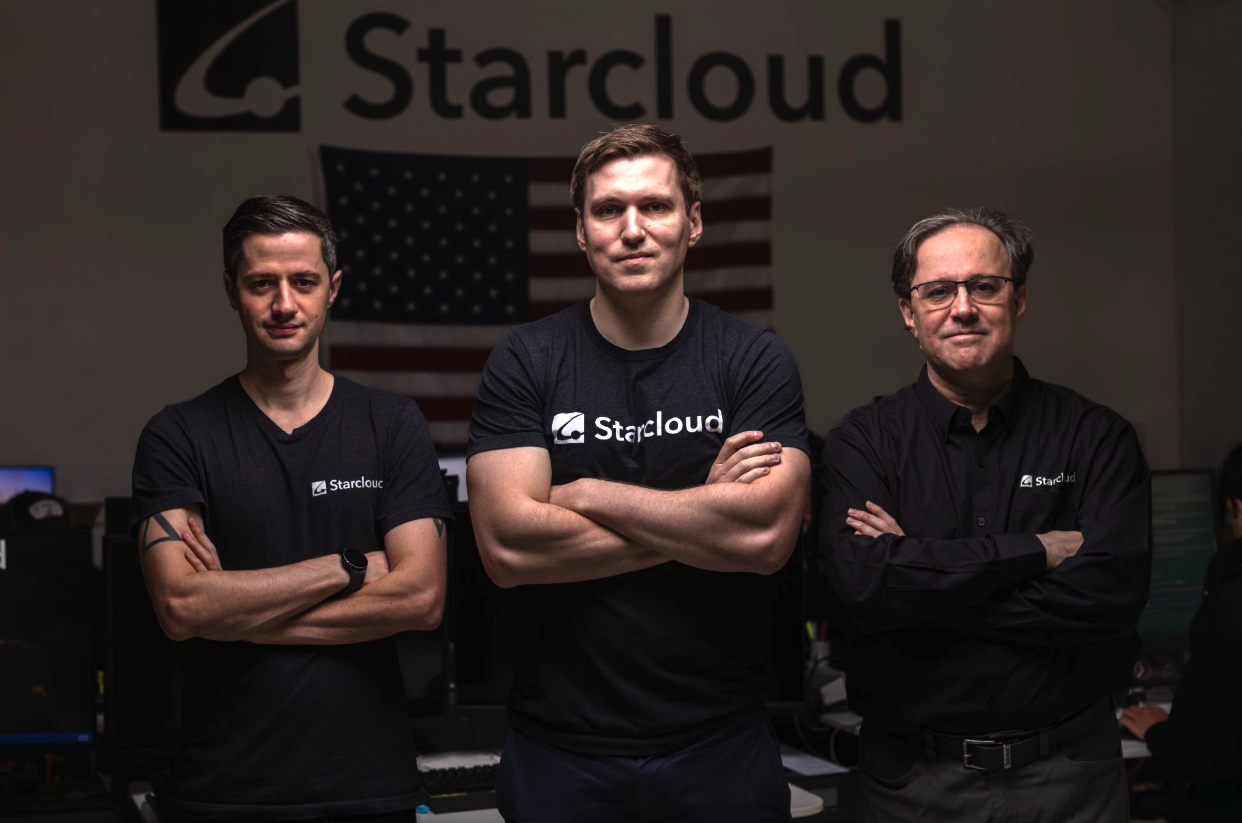
Portrait of Starcloud founders
Starcloud was founded by chief technology officer Ezra Feilden, CEO Philip Johnston and chief engineer Adi Oltean. (Starcloud Photo)

Starcloud says the new investment will fund the continued buildout of manufacturing capacity, engineering work in collaboration with Nvidia and the procurement of future launch slots. Manhattan West’s Lauren Selig will join Starcloud’s team as a board observer.

Starcloud has filed an application with the Federal Communications Commission to operate as many as 88,000 satellites as orbital data centers for AI and other applications. It’s not the only company targeting the market for orbital data centers. Most notably, SpaceX has filed its own plans to put up to a million data center satellites in space, for a project called Starmind.

The push to move AI infrastructure into space is driven by growing terrestrial bottlenecks surrounding land, power and water consumption — and by the political controversies those bottlenecks have sparked.

Source link

Advertisement
Continue Reading

Tech

The Patrick Clancy Conspiracy Theories Are Rooted in the Harsh Realities of Motherhood

Published

on

For many watching Lindsay Clancy’s murder trial, the primary takeaway has been how the deaths of her three small children—Cora, 5; Dawson, 3; and Callen, eight months—were tragically preventable.

Lawyers for the Massachusetts nurse are arguing that she’s not criminally responsible for strangling her children, because she suffered from severe postpartum psychosis, a rare mental health condition that causes new mothers to experience delusions and intrusive thoughts. Defense attorney Kevin Reddington has put Lindsay’s health care providers on the stand, in an attempt to demonstrate how his client repeatedly sought help for her terrifying thoughts, only for her to be minimized, dismissed, and overmedicated at every turn.

For others, including a thriving community of TikTok armchair detectives and conspiracy theorists, the Clancy trial has resulted in a much different takeaway: Lindsay’s husband, Patrick Clancy, was responsible, either literally or by virtue of being a neglectful husband. Many TikTokkers are convinced that he actually committed the murders and framed his mentally ill wife so she would take the fall.

To be clear, there is no evidence whatsoever to suggest this is true. Patrick is not on trial for the deaths of his children, and there has been no indication that he ever will be, or that he is anything other than a deeply grieving father. (Clancy did not respond to a request for comment.) But it’s hard to overstate just how popular this conspiracy theory is, and how rapidly it has overtaken discussion of the trial. The tabloid media has obsessively focused on Patrick, constantly publishing headlines about his life with his new wife Rachel Danis in New York (Patrick remarried earlier this year), and there are countless Reddit threads parsing their social media posts and analyzing his testimony.

Advertisement

Much of the TikTok commentariat’s focus has been on Patrick’s behavior prior to the murders, especially as it pertained to his wife’s postpartum mental health struggles. Per his own testimony, he was not always present at home, even at the height of her suffering. He went to brunch with his friends amidst her struggles with suicidal ideation, and took his daughter on a skiing trip. A month prior to the killings, Lindsay had disclosed to him that she had thoughts of harming the children, but according to his own testimony he had waved them off after she’d assuaged his concerns.

Some experts following the case say that while they understand the impulse to cast suspicion on Patrick, they caution against speculation or cruelly attacking the grieving father of three brutally slain children.

“It’s very easy to try to vilify the husband,” says Leslie Dobson, a forensic psychologist who covers the case on her social media platforms. “But the idea that he actually set her up, or drugged her, or actually killed the children—that’s very extreme.”

But a major driving force behind the antipathy toward Patrick appears to be that women recognize the broad contours of his alleged behavior toward his wife—and they are pissed as hell about it. This is evident when you look at the social media comments on the TikToks accusing Patrick, which are filled with harrowing stories from women whose husbands treated them insensitively while they were struggling with postpartum anxiety or depression, left them for another woman while they were at their lowest, or even emotionally or physically abused them.

Advertisement

(As many TikTokkers have pointed out, Rusty Yates, the husband of Andrea Yates, the woman suffering from severe postpartum psychosis who drowned her children in 2001, reportedly urged her to get pregnant again while she was in recovery from postpartum depression after her fourth pregnancy, against her psychiatrist’s advisement.)

Source link

Continue Reading

Tech

This fully walkable 3D city was built entirely out of ASCII art

Published

on

In a nutshell: Cutting-edge hardware and advanced game engines have allowed developers to create increasingly realistic 3D worlds. Even the latest and greatest titles still have a long way to go before virtual environments become indistinguishable from reality, but at the current rate of progress, that eventuality may not be too far off. On the opposite end of the spectrum – and to some, even more impressive – are projects that do more with less, like this walkable city made entirely of ASCII characters.

Grow Now Games, a self-professed one person indie game developer, recently shared the project on YouTube. The dev said his goal was to build a cyberpunk-style city that felt alive, and to build the whole thing using only ASCII characters. So, that’s what he did.

The project uses a small custom engine made using JavaScript and Canvas. The virtual environment is populated with buildings, roads, trees, cars, and pedestrians, and uses camera tricks to work out perspective, depth, and collision for added realism. For something built using only letters, numbers, and symbols, it’s incredibly immersive.

Related: Watch this typewriter pound out ASCII selfies

Advertisement

Games like Minecraft have proven that you don’t need advanced graphics to create a fun and compelling experience, and this is yet another example of that.

Modern ASCII art dates back to the mid-60s but was more widely adopted in the 70s and 80s. Usage declined as computer graphics evolved, but the style remained popular among certain segments of computing enthusiasts and in the hacker community.

The dev said the walkable city is still a work in progress, and noted that he plans to keep advancing the atmosphere, the amount of detail, and interactive elements further. The video already has north of a million views and has generated over 9,000 comments. With any luck, the project will continue and who knows, perhaps it could evolve into the next big thing.

Found is a TechSpot feature where we share clever, funny or otherwise interesting stuff from around the web.

Advertisement

Source link

Continue Reading

Tech

A new Gemini for Home update is rolling out, but users are slamming Google for not fixing ‘missing and broken features’ despite the voice upgrades

Published

on


  • Google is rolling out a new Gemini for Home update to fix voice commands for Spotify
  • The company is also fixing message broadcasting and smart light controls
  • Despite the upgrades, users are criticizing Google for not fixing the issues they’ve been experiencing for a while

The transition to Gemini has been rough — even Google knows that, but the latest Google Home update aims to tackle a handful of pain points with voice commands.

In an announcement issued yesterday (August 20), Google shared three fixes coming to the Gemini for Home voice assistant, which is still in early access. Additionally, features in the Google Home app are also tipped to get a glow-up.

Source link

Advertisement
Continue Reading

Tech

Nvidia and Korea’s Rebellions reportedly hold partnership talks

Published

on

Nvidia has poured more than $63bn in investments into other companies.

Nvidia and South Korean chipmaker Rebellions are in talks for a partnership that could result in an investment or an acquisition, Bloomberg News has reported. Talks are in early stages and may not result in a deal, sources told the publication.

According to the publication, Nvidia CEO Jensen Huang and Rebellions co-founder and CEO Sunghyun Park met in person to discuss a potential deal. This comes a year after the company’s chief financial officer Sungkyue Shin said that Rebellions’ “master plan” was to go public.

It raised $400m in a funding round in March, taking it to a valuation of around $2.3bn. Rebellions, at the time, said it is prepping to go public, but did not share details.

Advertisement

Founded in 2020, Rebellions is an Nvidia competitor best known for chips that focus on AI inferencing, as opposed to training. As IBM puts it, AI inference is the ability of trained AI models to recognise patterns and draw conclusions from data it hasn’t seen before.

In 2024, the start-up merged with SK Telecom’s AI chip start-up Sapeon. The idea was that they would together take on global AI giants such as Nvidia.

Nvidia has poured money into dozens of companies over recent years, including frontier developers and infrastructure providers, all in a bid to continue keeping itself central to the AI boom.

In 2025, the company signed US AI company Groq in a licensing deal that saw much of its talent hired away by the chipmaking giant. The start-up announced its first European data centre in Helsinki last year and announced a new $350m funding round earlier this month – though its valuation dropped by nearly half.

Advertisement

Meanwhile, in recent days, the $5.2trn Nvidia has agreed to pay Poolside AI $6bn to license its models and poured an undisclosed amount into Atomic Canyon. Its $63bn investment portfolio, however, majorly consists of Intel and SpaceX, which together amount to more than $50bn.

Don’t miss out on the knowledge you need to succeed. Sign up for the Daily Brief, Silicon Republic’s digest of need-to-know sci-tech news.
Source link

Advertisement
Continue Reading

Tech

Stop Hunting, Start Solving: Accelerating Root Cause Analysis with Agentic AI

Published

on

About this Webinar

Turn Yield Excursions into Faster, More Confident Root Cause Analysis

When a yield issue emerges, the answer rarely lives in a single system. Critical clues are spread across metrology data, tool traces, chemical analysis, and facilities systems, while growing data volumes make traditional dashboards slow, fragmented, and difficult to act on.

What You’ll Learn:

Advertisement

Discover how a purpose-built semiconductor analytics platform can help engineers connect insights across domains without moving data. See how Agentic AI, semiconductor-specific visualizations, and push-down compute enable faster investigation of yield excursions and process issues, even across billions of data points. In the session, a live demonstration shows how to conduct a multi-domain root cause investigation using Spotfire® Industry Pro.


Key Takeaways:

  • Understand why siloed manufacturing data delays yield recovery and inflates costs
  • Learn how Agentic AI automates complex cross-domain analytics and visualization generation
  • Explore methods for scaling high-performance analytics across massive fab datasets

Who Should Attend:

Yield, Process, and Integration Engineers; Fab and Manufacturing Operations Managers; Quality and Reliability Engineers; and Data & Analytics leaders supporting wafer fabs, foundries, OSATs, and IDMs who need to identify issues faster while maintaining confidence in decision-making.

Save Your Spot!

Advertisement

Join this webinar to learn how leading semiconductor teams are accelerating root cause investigations, scaling analytics across massive datasets, and transforming disconnected data into actionable manufacturing intelligence. Reserve your seat today.

Register now for this free webinar!

Source link

Advertisement
Continue Reading

Trending

Copyright © 2025