
Crypto World
Bitcoin breaks above 200-day moving average for first time since November



The BTC price reclaimed its 200-day moving average for the first time in nine months as its rally gained momentum after the US Treasury expanded its bond buybacks.

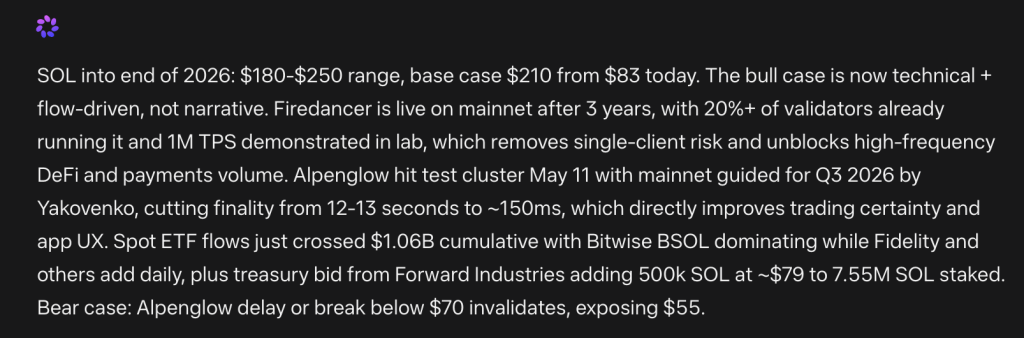
Three years of development have just become a live production system. Meta AI predicts that changes the argument entirely, and the price prediction places Solana at $180 to $250 by the end of 2026, with a $210 base case from $83 today.
The framing matters as much as the numbers. Meta AI calls this bull case technical and flow-driven rather than narrative. Firedancer is live on mainnet after three years of building. More than 20% of validators already run it, with 1M TPS demonstrated in lab conditions.

That removes single-client risk. It also unblocks high-frequency DeFi and payments volume that could not previously exist here. Alpenglow hit test cluster on May 11 with mainnet guided for Q3 2026 by Yakovenko. It cuts finality from 12 to 13 seconds down to roughly 150ms.
Faster settlement improves trading certainty and app experience directly. Flows are arriving alongside the technology.
Spot ETF flows just crossed $1.06B cumulative, with Bitwise BSOL dominating while Fidelity and others add daily. Forward Industries added a treasury bid of 500k SOL near $79, bringing 7.55M SOL staked, and the bear case is an Alpenglow delay or a break below $70 that exposes $55.

Discover: Everyone’s Got a Take. Get Free $25 from Kalshi to Actually Trade Yours
Solana Price Prediction: Meta AI Predicts Three Years Of Building Finally Reaches Production
The daily chart just resolved a two-month squeeze. SOL traded between $86 and $98 through spring before breaking down in June.
That drop carved a low near $61. Buyers stepped in immediately and built a rising trendline from there.
July produced a bounce to $84 that failed against descending resistance. August compressed price between those two converging lines.
The latest session broke that pattern decisively. SOL cleared the upper boundary and closed near the highs.
The close reads $83.89, up 8.93% and $6.88. The daily range covered $76.58 to $84.29.
Support sits at $79 at the broken resistance line, then $70 and $61. Resistance appears at $88, then $92 and $98.
RSI reads 73.04 with its signal line well below at 53.42. That gap of nearly 20 points confirms an abrupt shift in buying pressure.
The oscillator has entered overbought territory. Momentum is strongly bullish, though such readings often precede a pause.
Meta AI’s base case needs a 150% move from here. Alpenglow reaching mainnet in Q3 is the event that would justify the market underwriting it.
Discover: Your Market Calls Are Worth Something. Start with a free $25 on Kalshi
Solana Just Delivered the Breakout. Kalshi Lets Traders Position for the Next Catalyst Before Price Does.
SOL has already reacted to Firedancer. The next question is whether Alpenglow reaches mainnet on schedule and gives the market another reason to reprice the network.
Kalshi is built for that kind of event-driven setup.
The platform lets users trade directly on real-world outcomes across crypto, regulation, economics, Fed policy, politics, and other market-moving events. Instead of buying SOL and taking exposure to every variable affecting the token, traders can isolate the specific outcome they actually have conviction in.
That distinction matters after a nearly 9% daily move. Price has already absorbed part of the bullish story, while the next major catalyst still sits ahead.
Kalshi gives traders another way to express that view before the event becomes another breakout candle.
Eligible new users who sign up through CryptoNews can also receive $25 through our referral link.
The post Mark Zuckerberg Meta AI Predicts a Price for Solana By The End of 2026 appeared first on Cryptonews.
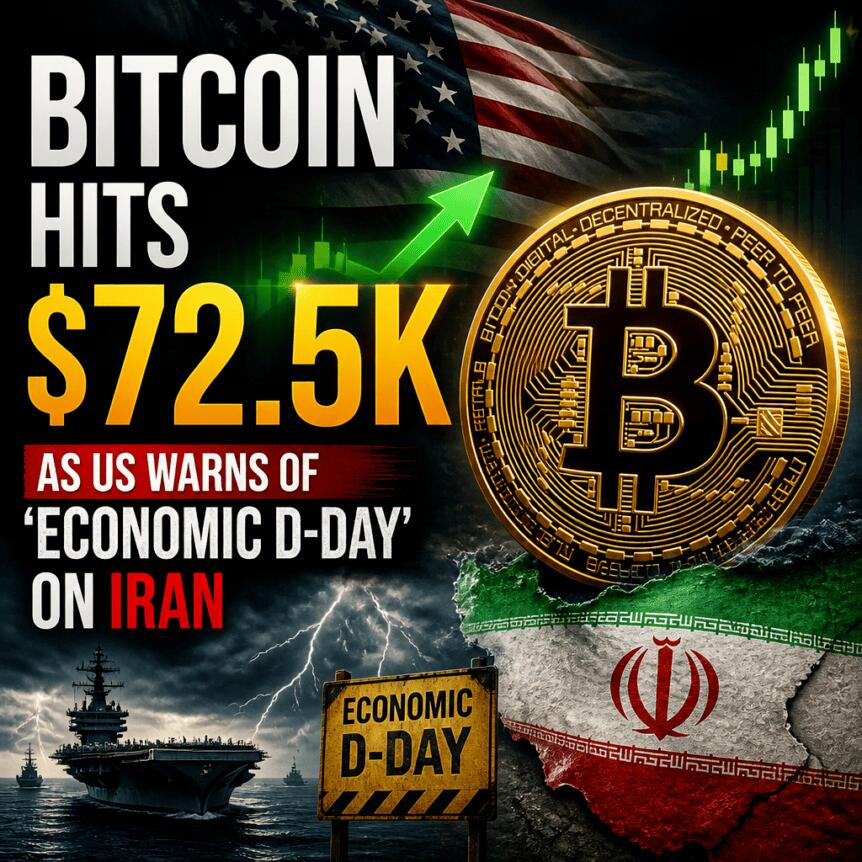
Bitcoin pushed to a fresh 11-week high on Thursday as trading activity strengthened during the early Wall Street session, reaching $72,505 on Bitstamp. The move unfolded alongside a macro backdrop that turned riskier rather than calmer: US equities opened lower and bond yields rebounded after renewed geopolitical alarm around US-Iran tensions.
While BTC gained more than 4% on the day, several analysts and on-chain observers cautioned that the rally may still be too early to treat as a full “bear market over” signal—especially given the market’s prior sensitivity to liquidity and risk conditions.
Key takeaways
- BTC/USD retested around $71,000 before rising to $72,505 on Bitstamp, according to TradingView data referenced in the coverage.
- Trump’s “economic warfare” language on Iran coincided with a reversal higher in US government bond yields after a sharp prior-day drop.
- WTI crude climbed to $87.69 per barrel, reflecting an energy market that continues to price geopolitical risk.
- Analysts argued technical levels and demand signals still need confirmation before calling a lasting bull-cycle shift.
- CryptoQuant highlighted renewed spot-and-derivatives demand, though the scale was described as “modest” and will require follow-through.
Bitcoin breaks higher as macro nerves return
TradingView data cited in the report shows BTC/USD moving back above $71,000 prior to setting a new 11-week peak at $72,505 on Bitstamp. The price action came after US markets opened on a weaker footing, with bond yields recovering after falling the day before.
This matters for crypto because Bitcoin’s recent trading has often correlated with shifts in broader risk appetite and expectations for market liquidity. When yields rise quickly—particularly after a period of decline—investors tend to reassess discount rates and near-term risk exposure, which can quickly change the tone of crypto rallies.
US-Iran “economic warfare” rhetoric sparks yield volatility
Equities traded softer after President Donald Trump threatened Iran with what he described as the “most crushing economic operation ever taken against any country,” calling it “Economic D-Day.” The comments were posted on Truth Social, where Trump also framed the escalation as “economic warfare and isolation on an unprecedented scale,” tied to frustration over the absence of a deal concerning the Strait of Hormuz oil route.
Energy pricing reinforced the risk narrative. WTI crude reportedly reached $87.69 per barrel, the highest level since July 24.
At the rates level, the report notes that Treasuries volatility increased after the earlier selloff in yields. The US 30-year yield reportedly traded as low as 5.179% before rebounding to 5.266%—an increase of 9 basis points—nearly erasing the prior day’s downside. The 10-year yield also reversed the previous day’s decline.
In parallel, the US Treasury had announced it would revisit the size of debt buyback operations on Nov. 4, after earlier messaging indicated intervention would at least double the size of liquidity actions from September. However, the report also cites commentary from The Kobeissi Letter suggesting that the intervention might not be enough to stabilize markets if pressure continues, writing on X: “It’s going to take a lot more intervention to tame this beast.”
Rally durability questioned: technicals and cycle timing
After gaining nearly $10,000 over four days, Bitcoin’s advance appeared to raise more questions than it answered. The report highlights trader and analyst Rekt Capital’s view that BTC needs to hold and extend its strength to invalidate a “weakening support” theme. Rekt Capital wrote that technicals were still pointing to $60,000 as a weakening macro support level.
That assessment is important because it frames the move as more than a simple breakout. If price can’t maintain higher levels long enough to alter key technical narratives, rallies can fade quickly—particularly when macro conditions remain unsettled.
The report also references a separate post arguing that four-year BTC cycle patterns may allow for a new macro low before the end of 2026. While cycle timing is inherently uncertain, the key takeaway for readers is that not all market participants are treating the current rebound as evidence of an immediate, uninterrupted trend reversal.
Demand signals return, but confirmation is the next test
One of the more constructive points in the coverage came from on-chain analytics firm CryptoQuant. Its CEO, Ki Young Ju, flagged a return of positive demand for Bitcoin across both spot and derivatives markets—something he said had not been seen since October 2025, when BTC/USD set its most recent all-time high at $126,200.
Ki Young Ju described the demand shift as “modest,” but argued that if it holds for another month, it may be reasonable to conclude that the bear market has ended and a new bull cycle has begun. The report also notes that earlier coverage from Cointelegraph had emphasized missing spot demand as a key catalyst behind the lack of sustained momentum in prior attempts at reversal.
Putting the pieces together, the picture is mixed: Bitcoin is making price progress while macro risk indicators—yields and crude—remain volatile. At the same time, measurable demand dynamics are improving, though observers want to see whether the current uptick sustains rather than disappears after a short burst.
As traders look ahead, the biggest near-term question is whether Bitcoin can maintain levels that matter technically while macro conditions stabilize enough to support the flow of new demand. The next signals to watch are continued strength in spot/derivatives metrics and whether bond yields keep rebounding on renewed geopolitical headlines—or settle into a less disruptive range.
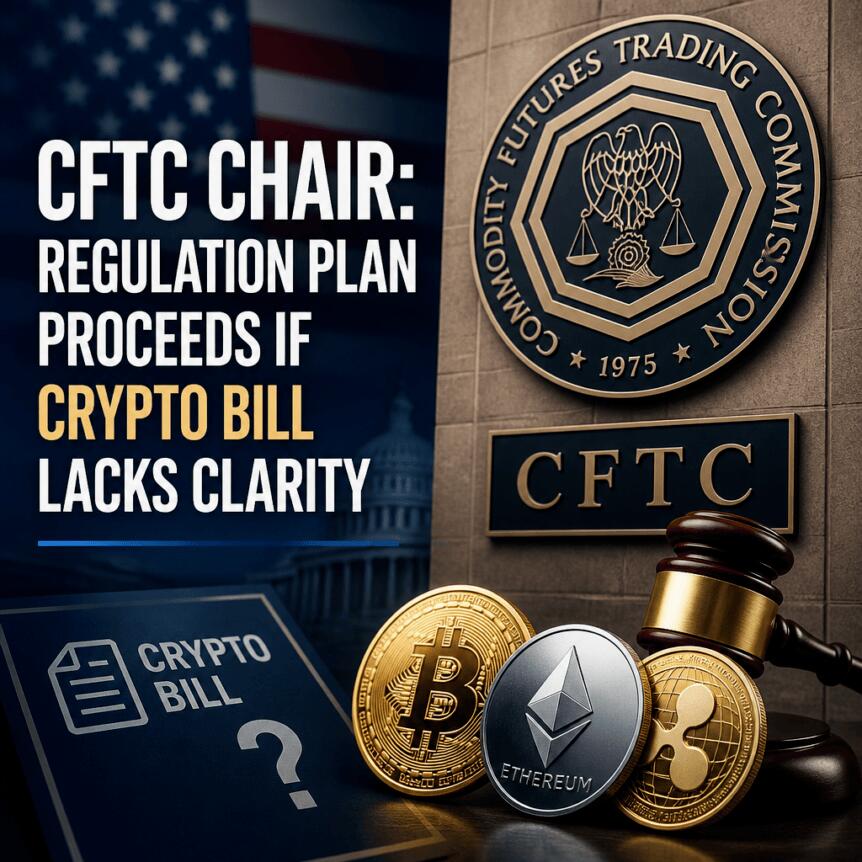
US CFTC Chair Michael Selig has told lawmakers and the crypto industry that the agency will continue moving on digital-asset regulation even if Congress does not pass the Digital Asset Market Clarity (CLARITY) Act. Speaking in prepared remarks at the CFTC’s Innovation Advisory Committee’s inaugural meeting on Thursday, Selig framed the agency’s approach as a way to “give CLARITY its breathing room” while still preparing rulemaking that could be deployed quickly if the bill stalls.
Selig also described actions already set in motion inside the commission, including work aimed at allowing both registered and non-registered entities to offer leveraged or margined crypto asset trading, alongside efforts to develop protections for developers. His comments came as the broader crypto policy debate in Washington remains tied to the timing of Senate proceedings and ongoing negotiations over the bill’s content.
Key takeaways
- Despite CLARITY being the central market-structure proposal, CFTC leadership signaled it will pursue crypto rules independently if Congress cannot finalize the legislation.
- Selig said staff have already been directed to consider rules that would enable leveraged or margined crypto trading by both registered and non-registered entities.
- The CLARITY bill appears paused until the US Senate returns in September, with a cloture vote requiring 60 support to advance.
- Selig’s agenda aligns with the SEC’s parallel approach: proposed digital-asset rules designed to provide clearer regulatory pathways for market participants.
- The CFTC is currently operating with a limited leadership panel, with Selig described as the only Senate-confirmed commissioner directing agenda-setting since December.
CFTC: rulemaking won’t wait for CLARITY
In his remarks, Selig argued that the CFTC should not stand still while Congress deliberates. He said the commission would move forward on crypto regulations even without CLARITY’s passage, suggesting the agency could help ensure implementation of the administration’s priorities if the bill is delayed or revised.
“We’re going to give CLARITY its breathing room for a vote,” Selig said, but added that if Democrats cannot support a bipartisan product that reflects compromises from both sides of the aisle and reaches the President, he would direct CFTC staff to “move swiftly” to propose new rules for the industry.
In practical terms, Selig said he has already instructed staff to advance policy work related to crypto trading structures, including allowing leveraged or margined trading on a broader basis. He also pointed to an effort to explore developer protections—an element that has been gaining attention in US crypto policymaking as regulators attempt to distinguish between consumer-facing activity and other categories of software and infrastructure.
Where CLARITY stands in Congress—and why it matters
Although Selig indicated the CFTC is prepared to act on its own, the legislative path for CLARITY remains the major determinant of a unified national market-structure framework. The market-structure bill is currently effectively paused until the Senate returns to session in September. At that point, Majority Leader John Thune is expected to seek a cloture vote.
Under the Senate’s rules as described in the reporting, CLARITY would need 60 votes to pass the chamber and then return to the House of Representatives for final legislative approval before reaching President Donald Trump for signature or veto. This 60-vote threshold is especially consequential because it signals that the bill’s fate depends not only on broad support, but on overcoming procedural resistance.
Any uncertainty around the number of votes needed has been heightened by political questions tied to ethics. The source notes that some Democrats have called for stronger ethics provisions related to the Trump family’s crypto investments, reported as totaling $1.4 billion in 2025. Trump has claimed that a “lot of Democrats” support CLARITY, but it remains unclear whether that support is sufficient to reach the Senate threshold.
For market participants, the distinction is important: if CLARITY passes, it could standardize how US regulators approach key aspects of crypto trading and market structure. If it does not, the CFTC’s willingness to proceed suggests the industry could face a more fragmented regulatory landscape driven by agency rulemaking rather than legislation.
Coordination signal with the SEC’s proposed rules
Selig’s comments also echoed the direction taken by the Securities and Exchange Commission. According to the source, the SEC on Tuesday released proposed rules for digital asset regulation that would offer crypto companies a safe harbor policy from tokens being treated as “investment contracts,” along with certain exemptions for issuers.
While the SEC and CFTC operate in different jurisdictional domains, the alignment in messaging suggests regulators are attempting to reduce uncertainty in overlapping areas of the market—especially for trading, token offerings, and associated activities. For investors and operators, that could mean a clearer set of expectations on how rules might apply, even if Congress is still debating a comprehensive framework.
At the same time, regulatory coordination remains imperfect. The SEC proposal is designed around its own statutory interpretation and enforcement priorities, while the CFTC focuses on commodities and derivatives-related market activity. That difference is why agency-by-agency rulemaking may not fully substitute for legislative clarity.
Innovation committee focus: AI, prediction markets, and CFTC jurisdiction
Selig delivered his remarks alongside Innovation Advisory Committee Chair Walt Lukken and the committee’s Designated Federal Officer Michael Passalacqua. Beyond the CLARITY debate, the meeting agenda reportedly included artificial intelligence and prediction markets.
The CFTC has claimed “exclusive jurisdiction” over prediction markets, according to the source, based on its view that event contracts on relevant platforms are “swaps.” Selig has said he directed the commission to pursue lawsuits against state-level authorities that challenge this position—referenced in the source in connection with matters involving companies such as Kalshi and Polymarket.
For builders and traders in prediction markets, these jurisdictional disputes are not abstract. They can influence where platforms operate, how products are structured, and what legal risk markets face when expanding into new states or audiences. In that context, CFTC momentum on broader digital-asset rulemaking may also affect how prediction-market platforms plan future product design and compliance programs.
CFTC leadership constraints add urgency
The meeting also highlighted an internal constraint: the CFTC, as described in the source, currently lacks a full panel of commissioners. Selig has been operating as the only Senate-confirmed commissioner within a leadership group expected to consist of a bipartisan five-member panel.
Because of that imbalance, Selig has been solely responsible for directing the agency’s agenda since December, which may help explain the emphasis in his remarks on speed—both in continuing existing initiatives and in preparing contingencies should Congress not reach a legislative conclusion.
In the near term, investors and industry participants should watch whether the CFTC’s ongoing rulemaking work translates into formal proposals, and whether CLARITY can clear the Senate’s procedural and political hurdles in September. The immediate uncertainty is legislative, but the immediate regulatory direction is already becoming clearer from agency-level activity.

One of Duncan’s major findings is that ovaries become increasingly inflamed, fibrotic—or scarred—and stiff over time. This stiffness affects egg quality and can hinder egg release, Duncan says, and could increase risks of diseases including ovarian cancer.
Other organs, including the heart, lungs and liver, also become more fibrotic over time, and Duncan says the ovary could offer clues into aging across the body. “This is one of the reasons why I think studying the ovary is important. By comparing the ovary to these other organ systems, we could potentially really understand what’s happening and find shared mechanisms,” she says.
In April 2026, Duncan published a study that showed how post-menopausal ovaries—previously assumed to, as she put it, “just sit there and not do anything”—become more scarred and inflamed over time. Duncan says she was “totally stunned” by this discovery and says it’s possible that post-menopausal ovaries send out inflammatory signals that could be damaging to health. “I think this is a big frontier,” she says. “It highlights just how much we don’t know.”
Duncan’s lab is currently developing an ultrasound test to measure ovarian stiffness that she says could be used as a biomarker of aging and ovarian health, and also to predict outcomes of fertility treatments like in-vitro fertilization.
Already, researchers are exploring therapies based on the findings. Building on Duncan’s research, a group in China published a paper in February 2026 that showed how an existing anti-fibrotic drug could boost ovary function in mice and possibly people too. The drug appeared to restore fertility in women with primary ovarian insufficiency, which happens when the ovaries stop working normally before age 40.
Earlier in her career, Duncan found that proteins known as cohesins diminish with age, leading to chromosomal instability and other problems. Now, in Germany, researchers are looking for therapeutic ways to replenish those proteins in the ovary as a way to enhance fertility.
Though much is still unknown about the ovary’s link to health span, the field of aging research has finally come around to the idea, Duncan says. She remembers attending a program for early-career scientists in 2013 on the biology of aging, and feeling “totally like the oddball out.”
“We had to go around the room and say what we worked on. I said I was studying the ovary, and everyone was like, ‘That’s nice. That’s not aging.’ And that was really the attitude for many years,” she says. But not anymore.
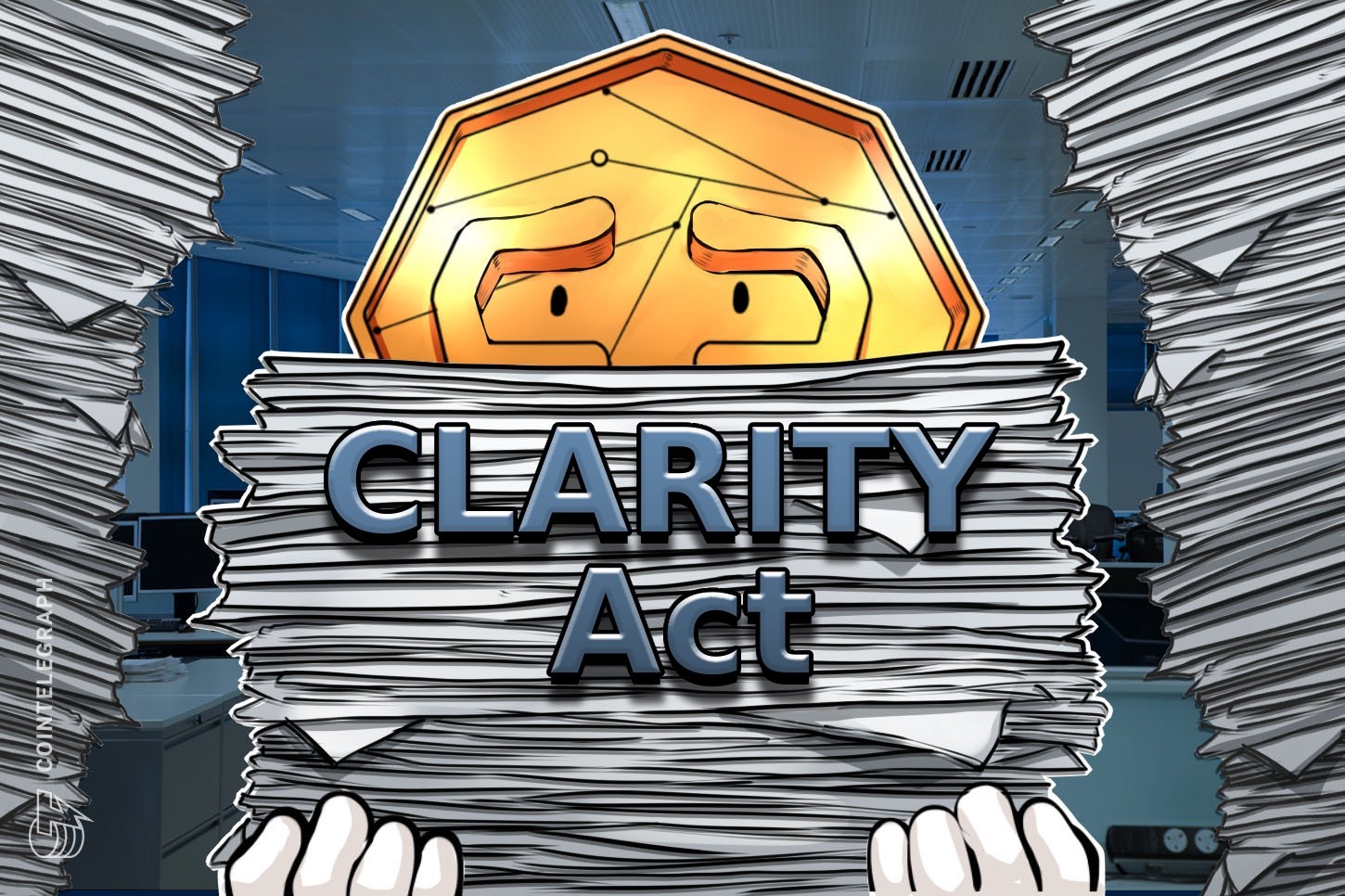
Michael Selig, who chairs the US Commodity Futures Trading Commission (CFTC), signaled that the agency would not be idle while Congress continued to debate provisions in a cryptocurrency market structure bill.
In prepared remarks for the inaugural meeting of the CFTC’s Innovation Advisory Committee on Thursday, Selig said that the commission would move forward on crypto regulations even in the absence of the Digital Asset Market Clarity (CLARITY) Act being passed by lawmakers, adding it would “help [Donald Trump] deliver if Congress will not.” According to the chair, he had already directed staff to allow registered and non-registered entities to offer “crypto asset trading on a leveraged or margined basis” and explore developer protections.
“We’re going to give CLARITY its breathing room for a vote, but if the Democrats cannot support a bipartisan work product, which reflects compromises from both sides of the aisle, and ultimately send a fair version of the bill to the President’s desk, then rest assured, I will direct CFTC staff to move swiftly to propose these new rules for the industry,” said Selig.
The market structure bill is effectively paused until the US Senate returns to session in September, when Majority Leader John Thune is expected to hold a cloture vote on the legislation. CLARITY would need 60 votes to pass the chamber and return to the House of Representatives, whereupon it could go to Trump’s desk for final approval or a veto.
Related: Trump claims he can ‘future proof’ crypto regulation with CLARITY Act
Selig’s remarks came just a day after the CFTC chair stood alongside Trump and other crypto industry leaders at a White House meeting. The president urged Congress to pass a “fair version” of CLARITY to keep the country “ahead of China.”
Many Democrats in Congress have been calling for stronger ethics provision in the market structure bill specifically to address the Trump family’s crypto investments, which netted the president $1.4 billion in 2025. Although Trump said on Wednesday that a “lot of Democrats” approved of CLARITY, it’s unclear whether enough lawmakers will support the bill to meet the 60-vote threshold to pass the Senate.
The CFTC chair’s agenda echoed that of the US Securities and Exchange Commission (SEC), which on Tuesday released proposed rules for digital asset regulation. The securities regulator said the rules could provide crypto companies with a safe harbor policy from tokens being treated as “investment contracts” and certain exemptions for issuers.
CFTC still lacks a full panel of commissioners
Selig spoke alongside Innovation Advisory Committee Chair Walt Lukken and the body’s Designated Federal Officer Michael Passalacqua on Thursday. As the only Senate-confirmed commissioner at the CFTC in a leadership panel expected to consist of a bipartisan group of five members, Selig has been solely responsible for directing the agency’s agenda since December.
The CFTC committee also discussed issues related to artificial intelligence and prediction markets on Thursday. Under Selig, the agency has claimed that it has “exclusive jurisdiction” over prediction markets due to event contracts on the platforms being considered “swaps.” The chair has directed the commission to file lawsuits against state-level authorities challenging this position in cases involving companies like Kalshi and Polymarket.
Magazine: Here’s why the CLARITY Act’s ethics deal may be so hard to reach

Bitcoin miners are pouring large sums into AI and high-performance computing (HPC) ventures, but early financial results show that the shift is still far from economically catching up with the scale of the investment. According to BlocksBridge Consulting’s latest Miner Weekly update, miners and AI-adjacent data center operators have committed tens of billions to capital assets—much of it happening before meaningful revenue ramps up.
BlocksBridge reported that 15 publicly listed Bitcoin miners and AI data center companies collectively spent $30.7 billion on capital assets in their latest 2026 reporting periods. That figure is already 42.6% higher than the $21.53 billion they spent across all of 2025. For investors, the key question is whether current AI/HPC revenue growth can narrow the gap between upfront spending and cash returns fast enough to justify the pivot.
Key takeaways
- BlocksBridge Consulting says 15 public Bitcoin miners and AI data-center companies spent $30.7 billion on capital assets in their latest 2026 reporting periods—42.6% more than total 2025 capex.
- Nine comparable miners spent $5.11 billion on capital assets in the first half of 2026 while generating $341.2 million in directly reported AI and HPC revenue (about a 15-to-1 capex-to-revenue ratio).
- AI and HPC revenue from those nine miners rose to $205.8 million in the second quarter, up 52% quarter-on-quarter.
- BlocksBridge cautions that converting power and land advantages into AI-ready infrastructure requires expensive build-outs, including substations, buildings, cooling, networking—and sometimes GPUs.
Capex surges, revenue lags in the AI pivot
The strongest signal in BlocksBridge’s data is the imbalance between spending and monetization. While AI and data-center strategies are widely viewed as diversification pathways for miners facing cyclically tough mining economics, BlocksBridge’s numbers suggest the transition remains capital intensive.
BlocksBridge calculated capital spending by combining cash purchases with allocations to hardware, property, equipment and other productive assets—netting out proceeds and refunds from asset sales. The methodology matters because it points to a “build” phase rather than a purely expansionary one: companies are acquiring and deploying physical assets at speed, even as revenue capture is still ramping.
Drilling into Bitcoin miners specifically, BlocksBridge noted that nine comparable miners invested $5.11 billion in capital assets during the first half of 2026. Yet those firms generated only $341.2 million in directly reported AI and HPC revenue during the same window. The resulting ratio—roughly 15-to-1—illustrates how far the industry is from turning capital deployment into proportionate operating returns.
What is changing: faster AI/HPC revenue growth
Despite the gap, BlocksBridge reported signs of acceleration. In the second quarter, the same group of nine miners generated $205.8 million from AI and HPC businesses, representing a 52% quarter-on-quarter increase. BlocksBridge highlighted Core Scientific, TeraWulf and Bitdeer among the companies showing gains.
For readers watching diversification outcomes, the practical implication is that the pivot may be entering a more revenue-generating stage—at least for some participants. However, the magnitude of earlier spending underscores that even sharp quarter-to-quarter growth may still be insufficient to erase the balance-sheet effect of large capex programs in the near term.
What investors should watch next is whether accelerating revenue translates into improving margins and more consistent demand. BlocksBridge’s figures focus on “directly reported” AI and HPC revenue; the market will likely scrutinize whether additional segments scale without requiring equally steep follow-on investments.
Why the transition is expensive: power and land aren’t enough
BlocksBridge also framed why miners can’t simply repurpose existing infrastructure and expect AI profits quickly. In its analysis, the firm said that power contracts and available land may provide a starting advantage, but turning those inputs into AI-ready capacity involves additional, costly components.
According to BlocksBridge, the build-out can require substations, buildings, cooling systems, networking equipment, and in some business models, GPUs. This helps explain why capex-to-revenue ratios can remain elevated: building AI-capable data center and compute infrastructure is not just an incremental upgrade—it is a construction and integration project with multiple dependency layers.
At the same time, the source notes that it remains unclear whether any recovery in Bitcoin’s price will ease near-term pressure on miners that still operate sizable mining fleets. When cash flows from traditional mining are volatile, the timing of AI revenue maturation becomes even more important.
Broader market signals: miners still betting big as policy improves liquidity
While BlocksBridge’s report centers on AI/HPC economics, the surrounding market context matters because it influences how much funding and operational stress miners can absorb. The article points out that Bitcoin rose more than 13% over the week and returned above $72,000 following a US Treasury announcement that it would at least double the maximum size of its long-term bond buybacks to $4 billion per operation. The move was described as intended to improve liquidity in the Treasury market and was associated with lower yields and a boost to risk appetite.
Even with that supportive backdrop, the central takeaway from BlocksBridge remains: AI diversification is expensive upfront. For investors, this creates a tension—markets may improve financing conditions while the underlying monetization timeline lags behind construction.
Separately, the pivot to AI-linked compute and power has also appeared in investment products. CoinShares announced a strategic change to its industry tracking exchange-traded fund, rebranding it as the CoinShares Bitcoin Mining and Digital Power ETF (WGMI). CoinShares says the fund holds 29 companies spanning bitcoin miners, data center operators, AI semiconductors, power generation and HPC. As of the announcement, the ETF reported $222.4 million in assets under management, and CoinShares described the theme as “the businesses powering the digital economy,” according to its listing page.
For market participants, the launch and rebranding of a targeted ETF can be interpreted as demand from investors for exposure beyond pure mining. Still, such products ultimately depend on underlying company execution—especially whether AI/HPC revenue continues to grow fast enough to justify large capital programs.
Going forward, the most important uncertainty is whether rising AI and HPC revenues can outpace the continuing cost of expansion and integration. BlocksBridge’s quarter-on-quarter growth is encouraging, but investors should monitor whether that momentum persists, improves profitability, and reduces the still-wide spending-to-return gap highlighted in its capex-to-revenue calculations.

Binance has launched Agent OS, a new developer platform designed to let AI agents access market data, monitor user accounts, and execute crypto trades directly on the exchange. The announcement frames Agent OS as an infrastructure layer that can be connected to popular AI tools, with controls that aim to keep permissions and risk limits under the user’s authority.
According to Binance, Agent OS supports AI environments including ChatGPT, Claude Code, Codex, and Cursor. Users can authorize agents to view account information and place orders only within configured permissions and limits, and they can assign agents to dedicated subaccounts so trading activity and funds remain compartmentalized.
Key takeaways
- Agent OS gives AI agents access to Binance market data, the ability to monitor user accounts, and the option to execute trades.
- Binance’s model is authorization-based: users define which actions agents can take and impose trading limits.
- Agents can be tied to dedicated Binance subaccounts for clearer separation of funds and activity.
- Binance says it can observe trades executed via Agent OS but does not see the agent’s external data sources or internal decision-making.
- Agent OS also links agents to Binance’s payment and onchain tools for wallet and onchain-service interactions.
What Binance’s Agent OS is designed to do
Agent OS is positioned as a bridge between AI applications and exchange operations. Binance states that developers can connect agents to market information and to user account functionality, then grant those agents the ability to place trades through the exchange under a permissioned setup.
In practical terms, this matters because it reduces the friction of building agent-driven trading systems. Instead of relying solely on custom integrations, users can route trading actions through a platform that is already integrated with Binance’s account and execution infrastructure. At the same time, Binance emphasizes user control by allowing permissions to be configured and access to be revoked at any time.
Permissions, subaccounts, and the limits of what Binance can see
Binance’s announcement highlights a key operational safeguard: users can assign agents to dedicated subaccounts. That approach can help separate balances and trading activity for different strategies or different agent instances, which is particularly relevant when multiple automated systems operate under the same main account.
Binance also describes a visibility boundary. It says it can monitor the trades placed through Agent OS, but it cannot see an agent’s external information sources, interpretation, or decision-making logic—elements that occur within the user’s chosen AI application. That separation is important for privacy and for reducing the need to centralize all agent reasoning inside the exchange environment.
How this fits into the broader “agents” push by exchanges
Agent OS arrives amid a broader trend: crypto trading venues are moving from basic automation toward infrastructure that supports more autonomous AI-driven behavior.
Earlier in the year, Coinbase launched “Coinbase for Agents” in June. That tool also targets AI models such as ChatGPT and Claude, enabling connections to user accounts so models can execute trades and strategies, alongside support for agent-driven payments through Coinbase’s x402 protocol.
Different exchanges are taking different stances on autonomy. In July, Kraken unveiled an AI-powered investing assistant that monitors markets and recommends trades based on users’ goals and risk preferences, but requires user approval before executing trades.
Other players are extending the concept beyond trading. OKX launched a beta marketplace where AI agents can find work, transact using stablecoin payments, and hire other agents for tasks, backed by an onchain reputation system.
Taken together, the sector is converging on a common idea—agents should be able to interact with financial rails—but it’s still diverging on the degree of autonomy and how much responsibility belongs to the user versus the system.
From trading to payments and onchain interaction
Beyond order placement, Binance says Agent OS can connect agents to its payment and onchain tools. The stated goal is to allow agents to make payments and interact with wallets and other onchain services.
This broader scope is a notable shift from “agent as a trading bot” toward “agent as an onchain operator.” If agents can perform payments and wallet interactions in addition to trading, they can potentially be used for a wider range of workflows—such as managing funds across strategies, executing routine onchain actions, or coordinating multi-step operations that blend exchange and onchain activity.
However, the same expansion also raises the stakes for governance and risk controls. Binance’s emphasis on permissions, subaccounts, and revocation becomes even more important when an agent can potentially do more than place orders.
Why industry leaders see agents as a major onchain driver
Binance is not operating in a vacuum. The announcement echoes comments from other crypto executives who have argued that AI agents could take on a meaningful portion of onchain activity. Coinbase CEO Brian Armstrong and Circle CEO Jeremy Allaire have both pointed to the potential for agents to become active participants in onchain ecosystems.
Binance co-founder Changpeng Zhao has also described cryptocurrency as a “native currency” for AI agents, reinforcing the idea that exchanges and payment infrastructure could become the operational backbone for agent-driven finance.
Agent OS can be viewed as a concrete attempt to operationalize that vision—turning “agents will use crypto” into “agents can securely interact with exchange systems.” The key question for users and developers will be how quickly these platforms converge on shared standards for authorization, auditing, and safety.
For now, investors, traders, and builders should watch how Agent OS performs in real deployments—especially around permission granularity, subaccount segregation, and what types of agent workflows users actually adopt. The most important unknown is how these exchange-based agent systems will balance autonomy with practical safeguards as AI-driven onchain activity scales.
[PRESS RELEASE – Montevideo, Uruguay, August 20th, 2026]
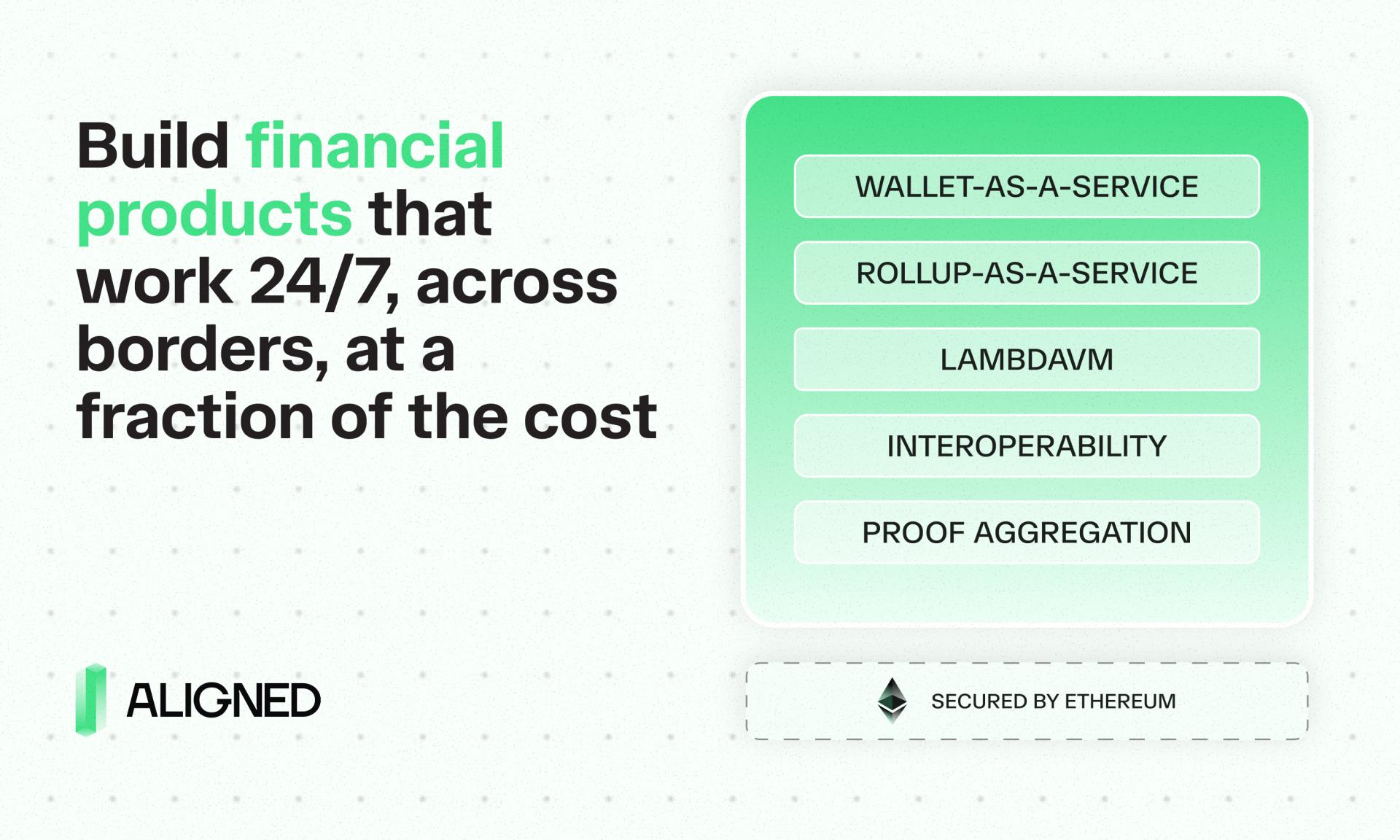
Aligned allows fintechs and institutions to build financial products on Ethereum, with one-click solutions for wallets, rollups, interoperability, and zero-knowledge services.
Today, Aligned, a full-stack Ethereum infrastructure project, has launched $ALIGN*, the native token of its ecosystem, with listings on major exchanges. Aligned is working to turn Ethereum into the world’s financial backend, and its ecosystem is the single integration fintechs, institutions, and enterprises use to build financial products on Ethereum.
Less than one percent of the world’s assets are onchain, and most of what has moved sits on Ethereum as stablecoins, tokenized treasuries, and wrapped assets. Building on top of them is still harder than it should be. A fintech going onchain usually signs with multiple vendors, one for wallets, another for scalability solutions (including rollups and proving systems), then spends months wiring them together and keeping them in sync. There is no standard way to ship a financial product on Ethereum yet.
Aligned was built to fix that. It’s built in close collaboration with LambdaClass, a company behind key contributions across the Ethereum ecosystem, including work on Starknet, zkSync, Polygon Miden, and EigenCloud (formerly EigenLayer), as well as Ethrex (the execution client which powers Aligned’s Rollup-as-a-Service) and lambdaworks, a cryptography library written in Rust. By integrating with Aligned, users can access wallets, rollups, interoperability, and zero-knowledge services through a single stack.
Aligned ships the stack one piece at a time:
- Proof Aggregation Service: live on mainnet alpha. Batching the proofs a rollup generates so verification stays cheap as Ethereum scales.
- Wallet-as-a-Service: MVP already launched. Users sign in with Google or Face ID and get a real Ethereum wallet, with no seed phrases, extensions, or gas fees.
- Rollup-as-a-Service, the LambdaVM, and the interoperability protocol: in development. The LambdaVM is Aligned’s RISC-V zkVM (zero-knowledge virtual machine), built in collaboration with LambdaClass and 3MI Labs. Each ships as it’s ready.
The world’s assets are moving onto Ethereum, and Aligned is creating the stack that makes it easy to build on. In the future, $ALIGN will be available as an option to pay for the services across that stack, from Proof Aggregation to Wallet-as-a-Service. As more teams build on Aligned, it will be the asset they use to pay for that usage. It is a utility token. It is not equity, a share, or a claim on revenue or dividends, and it does not promise a yield or a price.
$ALIGN has a fixed supply of 10 billion tokens, with about 16% circulating at launch. The full allocation and the Genesis airdrop are laid out in the ALIGN tokenomics. The airdrop was distributed across several waves spanning developers and researchers, the Discord and Galxe communities, distinguished contributors to Ethereum and ZK such as Protocol Guild, L2BEAT, ZachXBT, and ZK Podcast, and holders of ecosystem tokens including Starknet, Mina, zkSync, Polygon, Scroll, Taiko, and EigenCloud.
Aligned is committed to Ethereum by choice, focusing all of its efforts on it. Through the rest of the year, the team plans to ship the remaining pieces of the stack and grow the number of products built on it. The longer-term goal is to make building a financial product on Ethereum a single decision, not a systems-integration project.
Check eligibility and follow the launch at community.alignedlayer.com. To hear more, read the ALIGN tokenomics at blog.alignedlayer.com and follow @alignedlayer.
About Aligned
Aligned builds the tools that turn Ethereum into the world’s financial backend. It gives fintechs, institutions, and enterprises one integration for wallets, rollups, interoperability, and zero-knowledge services, so they can build real financial products on Ethereum instead of assembling a stack from separate vendors. Users can learn more at alignedlayer.com.
*$ALIGN is the native asset of the Aligned ecosystem, built on Ethereum as an ERC-20 token and also available on Base, with a fixed total supply of 10 billion and an initial circulating supply equal to approximately 16% of the total token supply. It will be used across the Aligned stack. $ALIGN is not equity, a share, or a claim on revenue or dividends. This announcement is informational only and is not financial advice. Do your own research.
The post Aligned Launches $ALIGN, the Native Token of Its Full Ethereum Stack appeared first on CryptoPotato.

Geneticist Nir Barzilai’s work has helped drive a new approach to medicine. Instead of treating individual diseases, his research has supported the idea that targeting the biology of aging with drugs and lifestyle interventions could more broadly extend “health span,” the healthy years of a person’s life.
“Right now, our maximum lifespan is 115, and about half of us die at around the age of 80,” Barzilai says. “I don’t know if we’ll ever break the 115-year mark, but we should get decades more of life and good health.”
Over decades studying centenarians and “superagers,” people who live past the age of 95 in good health, and the biological and genetic factors that help them defy disease and delay aging, Barzilai and his collaborators have found several factors associated with healthy longevity, including variations in genes linked to cholesterol and lipid metabolism. Researchers are now exploring whether they can create drugs that mimic these so-called longevity genes, and Barzilai is co-leading an ambitious project, the SuperAgers Initiative, in search of more genes that help slow aging and disease. The project aims to recruit 10,000 people over the age of 95 and their family members for study. “People don’t get over the age of 100 without some genetic explanation, so we’re trying to understand the biology behind that,” he says. “That knowledge will help us develop more drugs.”
Barzilai has played an instrumental role in pushing the idea that existing drugs could be repurposed as longevity-boosting treatments. He designed a clinical trial testing whether metformin, a diabetes drug, could delay the onset and progression of age-related diseases such as cardiovascular disease and cancer. That trial has yet to launch, but Barzilai says the study design could be adapted by other groups looking to test whether drugs such as GLP-1 medications could be used not just to treat a single disease but to prevent multiple age-related conditions.
Barzilai is also helping lead a project aimed at finding reliable biomarkers for aging that could be used to test whether drugs and lifestyle improvements, such as exercise and sleep, actually slow someone’s aging.
This all has massive implications for how we could live and age, and Barzilai is eager to persuade the world just how transformative longevity science could be. “There’s a lot of junk out there,” he says—and that junk sometimes obscures what he sees as truly revolutionary research. He even eschews the term that often accompanies his title; “longevity” has been sullied by too much hype and misinformation, he says. Instead, he favors “geroscience,” the study of how biological processes of aging contribute to disease. “Longevity is the outcome. Geroscience is the mechanism,” he says.
For Barzilai, changing the language is part of transforming the field. He heads the Albert Einstein College of Medicine’s Institute of Geroscience in New York and is president of the Academy of Geroscience, a coalition of scientists aimed at advancing research on the biology of aging. Both organizations recently changed their names under his leadership. “We need to distinguish ourselves from all the noise,” Barzilai says. “It’s become important to have the word ‘science’ in there.”

The breakthrough, and subsequent report, reflected how the bottleneck that holds us back from forging new discoveries in mathematics, and, increasingly, in every other field, is changing. For most of history, the scarce resource was discovery. With AI, discovery is nonstop, and human confirmation is now what is scarce.
To be clear, we are AI optimists. We believe AI tools will complement human ingenuity and expand what we can know and build, but our infrastructure for vetting and certifying discoveries was built for human throughput, and that is now the binding constraint. That is what holds innovation back. The answer to this problem is formalization: translating AI’s outputs into precise forms whose correctness can be checked automatically. Building the infrastructure to make verification routine is now a national-scale engineering problem.
Machines are outrunning us in more than math. The same is happening to the code that runs hospitals, banks, and power grids. In April, for example, Anthropic disclosed that its Mythos model could find unknown vulnerabilities in major operating systems and browsers, and restricted access to fifty organizations racing to patch them. Soon after, Microsoft engineers found 90 critical flaws in a widely used product; and in June, Sen. Mark Warner told a Senate hearing, citing the NSA director, that the tool “broke into almost all of our classified systems, not in weeks but in hours.”

Top 5 Hair Transplant Clinics in Turkey for Celebrity-Grade Results

Mark Zuckerberg Meta AI Predicts a Price for Solana By The End of 2026

Hind Rajab’s mother speaks: Israel’s ‘investigation’ ploy is not justice

Weekend Open Thread – Corporette.com

Weekend Open Thread: Brooks Brothers

London Mayor Sadiq Khan handed a peerage by Keir Starmer alongside 15 other Labour figures… just days before the PM leaves No10

UAE Iran All trade and Financial Deals Halted!Adnoc Ships meeda Attacks!Trump control on Hormuz!

THEY ARE SELLING ALL BITCOIN !!!!!

XRP And Ethereum Won’t Be The Same After This The Buy Signals Are MASSIVE And People Don’t See It
-

 Fashion6 days ago
Weekend Open Thread: Ann Taylor
-
 Sports7 days ago
This U.S. Amateur is a glimpse into golf’s future in more ways than you think
-
 Tech7 days ago
11 Ways to Rank Your Videos
-

 Sports6 days ago
Birmingham 2026: Day 6 Timetable for Irish Athletes
-
 NewsBeat6 days ago
Myanmar says over 300,000 Rohingya refugees verified for repatriation as exodus enters ninth year
-

 Politics5 days ago
SEQ Code: The Three Letter Boarding Pass Code That Could Give You The Worst Seat
-

 Tech3 days ago
Qwen3.8-27B runs frontier-class coding agents and reasoning locally, no cloud API required
-

 Business2 days ago
SMA Solar Technology AG (SMTGY) Q2 2026 Earnings Call Transcript
-

 Crypto World6 days ago
Pi Network Protocol 27 endgame: last upgrade before what?
-

 Crypto World3 days ago
OCC Greenlights Trump Family Crypto Firm for Trust Charter
-
 Tech5 days ago
Every fusion startup that has raised over $100M
-

 Business7 days ago
15 Ways to Make Money From Your Phone (2026 Guide)
-
 Entertainment7 days ago
10 Netflix Shows That Quietly Became Modern Classics
-

 Fashion6 days ago
Weekly News Update, 8.14.26 – Corporette.com
-
 Entertainment6 days ago
Marvel Studios Reveals New X-Men Cast Including Adam Driver and Sadie Sink
-

 Crypto World7 days ago
Robinhood Chain Approaches $1B TVL as Uniswap Integration Boosts Liquidity
-

 News Videos18 hours ago
Don’t Leave Your Financial Future To Chance | August 19, 2026
-

 Fashion6 days ago
Silver bangles for women – Newbridge Silverware
-

 Business6 days ago
Facebook Down Now? Users Report Login And Loading Problems As Outage Trackers Monitor Ongoing Issues
-

 Fashion6 days ago
Cart Confidential Vol. 44 – Julia Berolzheimer
You must be logged in to post a comment Login