
Crypto World
Bitcoin Hits $72.5K as US Warns of ‘Economic D-Day’ on Iran

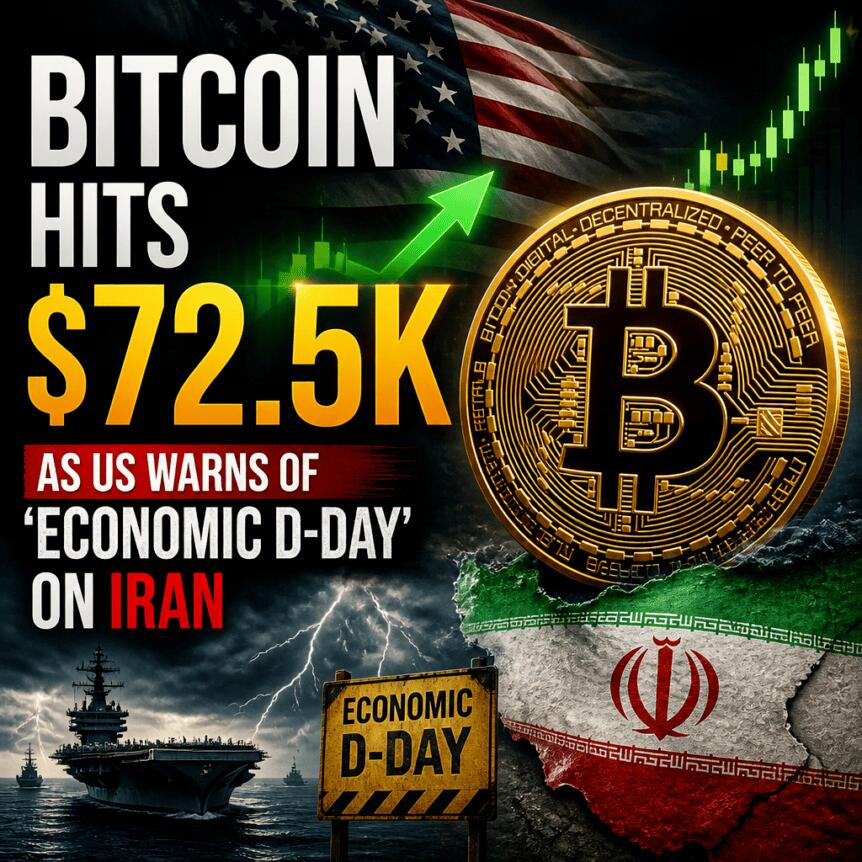
Bitcoin pushed to a fresh 11-week high on Thursday as trading activity strengthened during the early Wall Street session, reaching $72,505 on Bitstamp. The move unfolded alongside a macro backdrop that turned riskier rather than calmer: US equities opened lower and bond yields rebounded after renewed geopolitical alarm around US-Iran tensions.
While BTC gained more than 4% on the day, several analysts and on-chain observers cautioned that the rally may still be too early to treat as a full “bear market over” signal—especially given the market’s prior sensitivity to liquidity and risk conditions.
Key takeaways
- BTC/USD retested around $71,000 before rising to $72,505 on Bitstamp, according to TradingView data referenced in the coverage.
- Trump’s “economic warfare” language on Iran coincided with a reversal higher in US government bond yields after a sharp prior-day drop.
- WTI crude climbed to $87.69 per barrel, reflecting an energy market that continues to price geopolitical risk.
- Analysts argued technical levels and demand signals still need confirmation before calling a lasting bull-cycle shift.
- CryptoQuant highlighted renewed spot-and-derivatives demand, though the scale was described as “modest” and will require follow-through.
Bitcoin breaks higher as macro nerves return
TradingView data cited in the report shows BTC/USD moving back above $71,000 prior to setting a new 11-week peak at $72,505 on Bitstamp. The price action came after US markets opened on a weaker footing, with bond yields recovering after falling the day before.
This matters for crypto because Bitcoin’s recent trading has often correlated with shifts in broader risk appetite and expectations for market liquidity. When yields rise quickly—particularly after a period of decline—investors tend to reassess discount rates and near-term risk exposure, which can quickly change the tone of crypto rallies.
US-Iran “economic warfare” rhetoric sparks yield volatility
Equities traded softer after President Donald Trump threatened Iran with what he described as the “most crushing economic operation ever taken against any country,” calling it “Economic D-Day.” The comments were posted on Truth Social, where Trump also framed the escalation as “economic warfare and isolation on an unprecedented scale,” tied to frustration over the absence of a deal concerning the Strait of Hormuz oil route.
Energy pricing reinforced the risk narrative. WTI crude reportedly reached $87.69 per barrel, the highest level since July 24.
At the rates level, the report notes that Treasuries volatility increased after the earlier selloff in yields. The US 30-year yield reportedly traded as low as 5.179% before rebounding to 5.266%—an increase of 9 basis points—nearly erasing the prior day’s downside. The 10-year yield also reversed the previous day’s decline.
In parallel, the US Treasury had announced it would revisit the size of debt buyback operations on Nov. 4, after earlier messaging indicated intervention would at least double the size of liquidity actions from September. However, the report also cites commentary from The Kobeissi Letter suggesting that the intervention might not be enough to stabilize markets if pressure continues, writing on X: “It’s going to take a lot more intervention to tame this beast.”
Rally durability questioned: technicals and cycle timing
After gaining nearly $10,000 over four days, Bitcoin’s advance appeared to raise more questions than it answered. The report highlights trader and analyst Rekt Capital’s view that BTC needs to hold and extend its strength to invalidate a “weakening support” theme. Rekt Capital wrote that technicals were still pointing to $60,000 as a weakening macro support level.
That assessment is important because it frames the move as more than a simple breakout. If price can’t maintain higher levels long enough to alter key technical narratives, rallies can fade quickly—particularly when macro conditions remain unsettled.
The report also references a separate post arguing that four-year BTC cycle patterns may allow for a new macro low before the end of 2026. While cycle timing is inherently uncertain, the key takeaway for readers is that not all market participants are treating the current rebound as evidence of an immediate, uninterrupted trend reversal.
Demand signals return, but confirmation is the next test
One of the more constructive points in the coverage came from on-chain analytics firm CryptoQuant. Its CEO, Ki Young Ju, flagged a return of positive demand for Bitcoin across both spot and derivatives markets—something he said had not been seen since October 2025, when BTC/USD set its most recent all-time high at $126,200.
Ki Young Ju described the demand shift as “modest,” but argued that if it holds for another month, it may be reasonable to conclude that the bear market has ended and a new bull cycle has begun. The report also notes that earlier coverage from Cointelegraph had emphasized missing spot demand as a key catalyst behind the lack of sustained momentum in prior attempts at reversal.
Putting the pieces together, the picture is mixed: Bitcoin is making price progress while macro risk indicators—yields and crude—remain volatile. At the same time, measurable demand dynamics are improving, though observers want to see whether the current uptick sustains rather than disappears after a short burst.
As traders look ahead, the biggest near-term question is whether Bitcoin can maintain levels that matter technically while macro conditions stabilize enough to support the flow of new demand. The next signals to watch are continued strength in spot/derivatives metrics and whether bond yields keep rebounding on renewed geopolitical headlines—or settle into a less disruptive range.



Bitcoin has climbed toward $73,000 after a record short squeeze and falling U.S. Treasury yields powered an 11% rally, but analysts have warned that continued ETF and spot demand will decide whether the breakout holds.
Summary
- Bitcoin has gained about 11% in 24 hours and reached a two-month high near $73,000.
- U.S. spot Bitcoin ETFs drew $517 million on Aug. 19, their strongest inflow since May.
- Nearly $2.7 billion in bearish crypto positions were liquidated as Bitcoin broke above $70,000.
- Analysts see ETF demand, Treasury yields and U.S. political progress as the next tests.
Bitcoin’s short squeeze has accelerated the breakout
Nansen Senior Research Analyst Nicolai Søndergaard told crypto.news that forced short covering accelerated Bitcoin’s rise, although institutional demand and improved liquidity conditions had already given the market an upward bias.
“Bitcoin’s move above $70,000 reflects a combination of forced short covering, renewed institutional demand and a more supportive liquidity backdrop,” Søndergaard said.
Bitcoin traded near $72,600 after reaching about $72,800 on Aug. 20, extending a rally that began when the price cleared resistance around $65,000 and $67,000. The asset had spent roughly six weeks inside a narrow range before the breakout caught bearish traders positioned for another decline.
CoinGlass data showed that more than $1 billion in Bitcoin shorts were liquidated within about one hour. Across the crypto market, short liquidations reached approximately $2.7 billion over 24 hours, the largest total in records dating to 2021. Shorts accounted for about 92% of almost $3 billion in total liquidations across more than 172,000 traders.
As reported earlier on Thursday, Bitcoin gained 11.4% in 24 hours as the liquidations forced traders to buy the asset needed to close their positions. Forced purchases then pushed the price through additional liquidation levels, adding speed to the rally.
Søndergaard said that relatively contained open interest showed that the price increase did not come only from traders adding fresh leverage. Liquidation data also showed far more pressure on shorts than longs, supporting his view that forced covering drove the speed rather than the full direction of the move.
ETF demand may determine whether $70,000 holds
U.S. spot Bitcoin ETFs recorded about $517 million in net inflows on Aug. 19, according to SoSoValue data cited by the analysts. The daily total was the strongest since May and offered early evidence that institutional buyers were participating alongside traders closing short positions.
LVRG Research Director Nick Ruck said the Treasury announcement helped improve institutional sentiment after months of net ETF outflows. Allocators may now view Bitcoin’s recent trading range as a more favorable entry point, he added, rather than a reason to remain on the sidelines.
Ruck cautioned that a single inflow session would not establish a lasting institutional trend. A clearer course for U.S. interest rates, progress on the CLARITY Act, or expanded access through retirement accounts could provide stronger confirmation, according to the analyst.
“Sustained inflows are unlikely without additional confirmation,” Ruck said. “Until those catalysts develop, inflows will likely remain temporary rather than structural.”
Once forced buying fades, Søndergaard expects spot and ETF flows to determine whether Bitcoin can build support above $70,000. The price has moved above its 20-week and 200-day moving averages as well as the estimated short-term holder cost basis near $68,700, placing many recent buyers back in profit.
Momentum readings have become stretched, however. Søndergaard placed the one-hour relative strength index near 78 and the four-hour RSI above 85, while positive funding rates showed that leveraged positioning had become crowded on the long side.
A sustained hold above $70,000 would support the breakout, according to Søndergaard. A retreat into the $69,700 to $69,000 zone could serve as a normal retest rather than confirm a full trend reversal, although losing the area would expose the market to more selling.
CoinEx Chief Analyst Jeff Ko identified the 200-day moving average near $69,000 as the central technical level. Turning the former resistance area into support would strengthen the setup, he said, especially after approximately $650 million in net ETF inflows during the week.
Lower Treasury yields have eased pressure on Bitcoin
The rally began as the U.S. Treasury announced that it would at least double its long-end liquidity-support buybacks. Beginning Sept. 9, the maximum purchase size for nominal coupon securities in the 10-to-20-year and 20-to-30-year sectors will rise from $2 billion to at least $4 billion per operation.
Following the announcement, the 30-year Treasury yield fell from 5.34%, its highest level in 19 years, to about 5.19%. Falling yields reduce the return offered by low-risk government debt and can make assets such as Bitcoin more attractive to investors willing to accept additional volatility.
Nick Ruck said lower yields also ease financial conditions and reduce borrowing costs for companies and investors. Continued buybacks could support risk assets for several months if long-term rates remain contained, he added, while renewed inflation or fiscal concerns could reverse the relief.
Ko described the program as a liquidity-management tool rather than quantitative easing because the Treasury is changing the composition of its liabilities instead of creating central-bank money. Given the program’s limited size compared with the Treasury market, he interpreted the announcement mainly as a policy signal that officials are prepared to support liquidity at the long end.
BTSE Chief Operating Officer Jeff Mei also called the buybacks a short-term response to a lasting fiscal problem. The purchases may cool yields, but they do not reduce the federal deficit or remove inflation pressure, he said.
“When yields drop and the dollar weakens, risk assets tend to rally, and we’ve already seen Bitcoin move higher on the news,” Mei said.
For borrowing costs to remain lower, Mei said markets would need evidence of a slowing U.S. economy or a resolution to the U.S.-Iran conflict. Without progress on either issue, persistent inflation and government borrowing could push yields back up.
U.S. policy has added a political premium
Bitget Wallet Research Analyst Lacie Zhang said Bitcoin has started trading with a U.S. political premium as the White House presses for crypto legislation before the November midterm elections.
During an Aug. 19 event with executives from Coinbase, Gemini, Ripple, Chainlink Labs, and other companies, President Donald Trump urged Congress to approve what he called a “fair version” of the Digital Asset Market Clarity Act. The bill would establish federal market rules and divide oversight between the SEC and CFTC.
Previous White House event coverage detailed the approaching Senate test, which requires 60 votes to advance the legislation. Lawmakers are expected to return in September, leaving limited working time before campaigning for the midterms takes priority.
Zhang said the administration has an incentive to show lower borrowing costs, strong financial markets, and progress in high-growth industries before voters go to the polls. Democrats gaining Senate seats could expose the administration’s crypto policies to added scrutiny, which gives the White House and industry groups a reason to seek legislation before the election, she added.
The SEC supplied another policy catalyst on Aug. 18 by proposing Regulation Crypto Assets, a framework for certain investment contracts involving digital assets. The proposal includes an exemption for offerings of up to $5 million over four years and another for qualifying offerings of up to $75 million in a 12-month period.
Under the proposed SEC framework, a conditional safe harbor would also address when an investment-contract relationship tied to a crypto asset can end. Stakeholders will have 60 days to submit comments, and the proposal does not change current registration requirements unless the SEC adopts final rules.
Zhang warned that connecting Bitcoin sentiment to the election calendar creates political risk. Failure to move the CLARITY Act, controversy involving political conflicts of interest, or a loss of regulatory momentum after the midterms could weaken investor confidence, she said.
President Xi Jinping’s expected U.S. visit in September could add another political element, according to Zhang, because Trump has grouped crypto, artificial intelligence and financial technology within his push for American technology leadership. She described the visit as a policy context rather than a direct cause of Bitcoin’s daily move.
Ruck said ETF inflows would need support from contained Treasury yields and further regulatory progress to continue. Without those conditions, institutional purchases may appear in isolated sessions instead of developing into a sustained source of Bitcoin demand.
Crypto World
HSBC and Standard Chartered Run First Live Tokenized Deposit Transfer on SWIFT’s Blockchain Ledger

HSBC and Standard Chartered executed the first live tokenized deposit transaction on SWIFT’s blockchain-based ledger, the two banks said on August 19, six weeks after the network opened to an initial cohort of 17 banks.
Payment messages moved between HSBC’s Tokenized Deposit Service (TDS) and Standard Chartered’s own tokenized deposit infrastructure, with the resulting obligations recorded on both banks’ systems.
SWIFT’s ledger worked as an orchestration layer, matching and netting the obligations between the two institutions before final settlement ran through existing payment rails.
“HSBC’s interoperability transaction with Standard Chartered via SWIFT is a landmark moment for the promise of tokenised deposits,” said Lewis Sun, Head of Digital Currencies at HSBC.
Mark Willis, Head of Emerging Payments, Transaction Services and Digital Assets at Standard Chartered, noted that “tokenized deposits are a key pillar of Standard Chartered’s digital assets strategy, which aims to build end-to-end solutions.”
Ledger Runs on Hyperledger Besu
SWIFT says the ledger MVP is built on open-source foundations, using an Ethereum Virtual Machine-compatible architecture based on Hyperledger Besu, and that it is designed to integrate with the broader digital asset ecosystem.
SWIFT operates the ledger itself, handling orchestration of transaction workflows, validation of funding commitments, and coordination of interbank processes. Consensys built the conceptual prototype when Swift announced the project in September 2025.
Seventeen banks from six continents are preparing to pilot live transactions, among them ANZ, BNP Paribas, BNY, Citi, DBS, MUFG, UBS, and Wells Fargo. CryptoPotato covered that SWIFT has experimented before with moving tokenized value across public and private blockchains.
HSBC has put bank money on a ledger before, joining a S$400 million digital bond issuance with SGX and Temasek that cut primary settlement from five days to two.
“With our new ledger capability, we’re extending the trust and stability of established finance into the frontiers of digital money,” said Thierry Chilosi, Chief Business Officer at Swift.
Rival Network Targets 2027
American banks are building a competing rail. The Clearing House is developing a tokenized deposit network called The Bridge with JPMorgan Chase, Bank of America, Citigroup and Wells Fargo, targeted at the first half of 2027 and open to all US banks. Bank of America’s Mark Monaco said clients are not “beating down the door” for tokenized deposits yet.
SWIFT moves the equivalent of world GDP every two to three days across more than 200 markets. The cooperative says 75% of payments on its network reach beneficiary banks within 10 minutes.
The post HSBC and Standard Chartered Run First Live Tokenized Deposit Transfer on SWIFT’s Blockchain Ledger appeared first on CryptoPotato.

Justin Sun won a key procedural battle against Trump-backed World Liberty Financial on Thursday, keeping his personal claims against the crypto venture in public federal court rather than private arbitration.
The California judge rejected World Liberty’s attempt to force all of Sun’s claims behind closed doors. The court also ordered both sides to determine which claims involving Sun-controlled companies should remain in court and which should move to arbitration.
“The judge ruled that all of my individual claims will remain in the public courtroom,” Sun said after the hearing.
The ruling does not decide whether World Liberty acted illegally. It does, however, keep the most personal part of Sun’s dispute in a public forum, where future filings and evidence could face greater scrutiny.
Justin Sun Keeps the Pressure on World Liberty Financial
Sun sued World Liberty in April after the company froze WLFI tokens linked to him. He alleges World Liberty secretly added controls that allowed it to restrict or destroy tokens and later used those powers against him.
World Liberty denies wrongdoing and says Sun violated agreements governing his holdings.
The cleanest way to understand the Justin Sun–World Liberty Financial fight is that it started as one of the closest alliances in Trump crypto and has turned into a fight over hundreds of millions of dollars.

Sun invested $45 million in WLFI during its early token sale and became one of the project’s largest backers.
World Liberty has since accused Sun of improperly moving tokens and participating in activity designed to pressure WLFI’s price. Sun denies those claims.
WLFI has remained volatile as the legal battle has intensified, adding another layer of uncertainty around a token already facing questions over governance, unlock schedules and issuer control.

The fight now moves back toward the substance of Sun’s claims. World Liberty still has avenues to seek dismissal, meaning Thursday’s ruling keeps the case alive in public without deciding who ultimately wins.
The post Justin Sun Wins Key Court Battle Against Trump-Backed World Liberty Financial appeared first on BeInCrypto.

XRP price climbed roughly +15% overnight to trade near $1.15, reclaiming the psychologically important $1 level after weeks of chop, and XRP analyst Dark Defender argues the move confirms a completed “triple dip” on the weekly chart.
The call comes with eye-catching Elliott Wave targets of $5.8563 and $9.0362, numbers that demand scrutiny given how far removed they are from the spot price and how thin the confirmation actually is.
XRP Price Analysis: The Triple-Dip Case and Its Speculative Ceiling
Before XRP can test those numbers, it needs to clear a stack of resistance: roughly $1.20–$1.30, then $1.50, then $1.88, each a prior structural pivot on the weekly chart.
Holding $1 is treated as the line in the sand; a close back below it would undercut the entire Wave 5 premise the setup depends on, which is the same level recent XRP price analysis flagged as the pivotal test before any bounce could be trusted.
A Week Earlier, a Different Wave Count Called for $0.87
ripple:native The end of this Wave 2 correction could quite literally happen any hour now! — CasiTrades
 pic.twitter.com/UeSBkdDSed
 (@CasiTrades) August 13, 2026
The bullish framing looks very different from the technical picture CasiTrades published just over a week earlier, when XRP was trading at $1.01 following a 2.5% daily drop tied to the Senate’s failure to advance the Clarity Act before recess.
That Elliott Wave count read the same region of price action as a Wave (3)-(4)-(5) decline still in progress, projecting a bottom near $0.95, a corrective bounce to $1.00–$1.04, and a final leg down toward $0.85–$0.86, a scenario that mirrored the broader struggle around the $1 level XRP had been fighting through for weeks.
The two counts can’t both be right, and that’s the actual takeaway: Elliott Wave analysis on XRP has produced sharply divergent XRP predictions from nearly identical starting points inside a two-week window.
CasiTrades cited an RSI reading of 36.62 with a bearish divergence pattern as evidence for more downside; price action since has favored the bulls, but a single trip back below $1 would revive that bearish case, a divide that echoes the range of outcomes surfaced in other recent XRP prediction models.
Trade XRP on Bybit and Get a Chance to Win Our $1,000 USDT Airdrop
Institutional Trading Hours Build Behind the Chart Debate
This covers the overlap between London’s afternoon and New York’s morning, up from 14.3% during the same window a year earlier, according to Evernorth’s August 18 disclosure, as covered by Bitcoin.com.
Three hours a day (London’s afternoon, New York’s morning) now account for ~23% of all the XRP that changes hands on-chain. A year ago, it was ~14%.
The concentration held across all three XRPL trading venues, order books, automated market maker pools, and cross-currency payments and arrived alongside roughly $900M in RLUSD-XRP volume over six months, per Evernorth’s separate research.
Evernorth has an obvious financial stake in the institutional-adoption narrative given its pending Nasdaq listing backed by Ripple, and even the firm conceded the limits of its own data, noting: “Nothing about XRP closes at 5pm. But we’re definitely seeing some rush hours.”
Public ledger records show transaction timing and volume, not the identities of the wallets moving the funds. Evernorth’s own disclosure states plainly that the data cannot confirm whether banks, trading desks, or automated systems are driving the shift, meaning the institutional-demand framing that propped up bullish XRP price narratives remains circumstantial rather than proven.
Discover: The Best Token Presales
The post XRP Reclaims $1 as Conflicting Wave Counts Split the Outlook appeared first on Cryptonews.
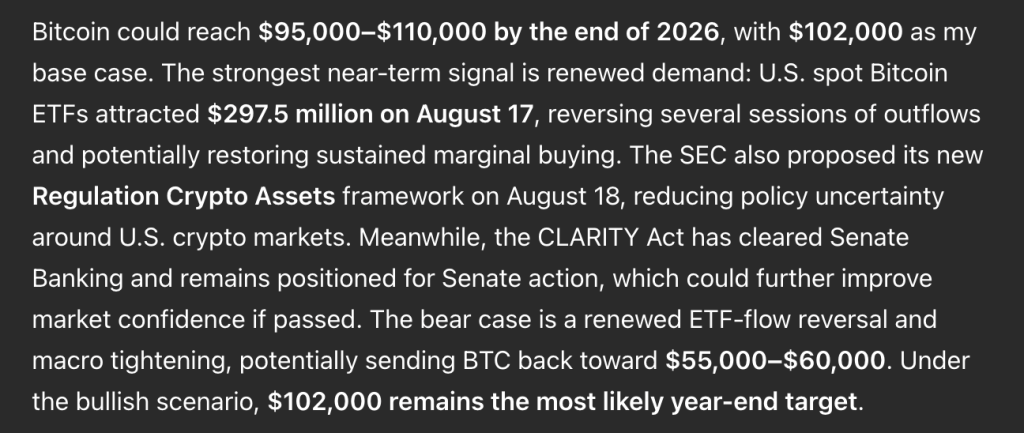
Three days in August did more for sentiment than the previous three months. ChatGPT AI predicts that the shift holds, and the price prediction places Bitcoin at $95,000 to $110,000 by the end of 2026, with $102,000 as the base case.
The strongest near-term signal is renewed demand. U.S. spot Bitcoin ETFs attracted $297.5 million on August 17. That reversed several sessions of outflows. ChatGPT reads it as potentially restoring sustained marginal buying. Following it, the regulation moved a day later. The SEC proposed its new Regulation Crypto Assets framework on August 18.
That reduces policy uncertainty around U.S. crypto markets. Rules people can plan against are worth more than favorable rules that might change.
The CLARITY Act sits behind both. It has cleared Senate Banking and remains positioned for Senate action, which would further improve market confidence if passed. The bear case reverses the same mechanics. A renewed ETF-flow reversal is the first risk.
Macro tightening compounds it. Together, they could send BTC back toward $55,000 to $60,000.

Discover: Everyone’s Got a Take. Get Free $25 from Kalshi to Trade Yours
Bitcoin Price Prediction: ChatGPT AI Predicts Three August Days Reset The Whole Setup
The daily chart shows a downtrend that just broke. Bitcoin peaked near $126,000 last October before rolling over. November and December cut price toward $80,000. February brought the capitulation leg down near $59,000. Spring recovered to $82,000 by May, before June erased it. The low arrived around $58,000.
July and August built a base with rising lows. The latest session then broke the descending resistance line that had capped every bounce since June.
The close reads $68,746, up 6.28% and $4,060 on the day. The daily range covered $64,113 to $69,749. Support sits at $65,000, then $60,000 and $58,000. Resistance appears at $72,000, then $76,000 and $82,000.
RSI reads 72.11 with its signal line far below at 50.75. That gap of more than 21 points is exceptionally wide and reflects a violent momentum shift. The oscillator has also pushed into overbought territory. Momentum is strongly bullish, though a reading this stretched often invites consolidation.
ChatGPT’s base case sits 48% above this level. Holding above the broken trendline is what turns a single strong day into a trend.
Discover: Your Market Calls Are Worth Something. Start with a free $25 on Kalshi
Bitcoin Just Repriced Three Catalysts in Three Days. Kalshi Lets Traders Price the Next One First.
Bitcoin’s latest move shows how quickly markets can react when several catalysts arrive at once. The harder question is what happens before the next headline hits.
Kalshi gives traders a way to position around those outcomes directly.
Its markets cover real-world events across crypto, regulation, economics, Fed policy, politics, and other catalysts capable of shifting asset prices. Instead of buying Bitcoin every time you expect favorable news, you can trade your view on the event itself and see the probability the market is assigning to that outcome.
That becomes especially useful when BTC is already overbought after a 6% daily move. The next ETF-flow print, regulatory decision, or Senate development could matter, but the Bitcoin reaction may be crowded before it arrives.
Kalshi offers another way to trade the thesis before it becomes another candle on the chart.
Eligible new users joining through CryptoNews can receive $25 through our referral link.
The post We Asked Sam Altman ChatGPT AI Where Bitcoin Will Be at the End of 2026 appeared first on Cryptonews.
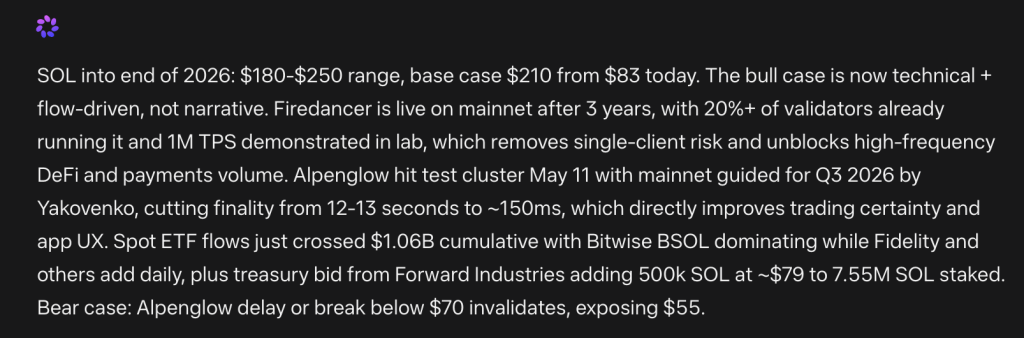
Three years of development have just become a live production system. Meta AI predicts that changes the argument entirely, and the price prediction places Solana at $180 to $250 by the end of 2026, with a $210 base case from $83 today.
The framing matters as much as the numbers. Meta AI calls this bull case technical and flow-driven rather than narrative. Firedancer is live on mainnet after three years of building. More than 20% of validators already run it, with 1M TPS demonstrated in lab conditions.

That removes single-client risk. It also unblocks high-frequency DeFi and payments volume that could not previously exist here. Alpenglow hit test cluster on May 11 with mainnet guided for Q3 2026 by Yakovenko. It cuts finality from 12 to 13 seconds down to roughly 150ms.
Faster settlement improves trading certainty and app experience directly. Flows are arriving alongside the technology.
Spot ETF flows just crossed $1.06B cumulative, with Bitwise BSOL dominating while Fidelity and others add daily. Forward Industries added a treasury bid of 500k SOL near $79, bringing 7.55M SOL staked, and the bear case is an Alpenglow delay or a break below $70 that exposes $55.

Discover: Everyone’s Got a Take. Get Free $25 from Kalshi to Actually Trade Yours
Solana Price Prediction: Meta AI Predicts Three Years Of Building Finally Reaches Production
The daily chart just resolved a two-month squeeze. SOL traded between $86 and $98 through spring before breaking down in June.
That drop carved a low near $61. Buyers stepped in immediately and built a rising trendline from there.
July produced a bounce to $84 that failed against descending resistance. August compressed price between those two converging lines.
The latest session broke that pattern decisively. SOL cleared the upper boundary and closed near the highs.
The close reads $83.89, up 8.93% and $6.88. The daily range covered $76.58 to $84.29.
Support sits at $79 at the broken resistance line, then $70 and $61. Resistance appears at $88, then $92 and $98.
RSI reads 73.04 with its signal line well below at 53.42. That gap of nearly 20 points confirms an abrupt shift in buying pressure.
The oscillator has entered overbought territory. Momentum is strongly bullish, though such readings often precede a pause.
Meta AI’s base case needs a 150% move from here. Alpenglow reaching mainnet in Q3 is the event that would justify the market underwriting it.
Discover: Your Market Calls Are Worth Something. Start with a free $25 on Kalshi
Solana Just Delivered the Breakout. Kalshi Lets Traders Position for the Next Catalyst Before Price Does.
SOL has already reacted to Firedancer. The next question is whether Alpenglow reaches mainnet on schedule and gives the market another reason to reprice the network.
Kalshi is built for that kind of event-driven setup.
The platform lets users trade directly on real-world outcomes across crypto, regulation, economics, Fed policy, politics, and other market-moving events. Instead of buying SOL and taking exposure to every variable affecting the token, traders can isolate the specific outcome they actually have conviction in.
That distinction matters after a nearly 9% daily move. Price has already absorbed part of the bullish story, while the next major catalyst still sits ahead.
Kalshi gives traders another way to express that view before the event becomes another breakout candle.
Eligible new users who sign up through CryptoNews can also receive $25 through our referral link.
The post Mark Zuckerberg Meta AI Predicts a Price for Solana By The End of 2026 appeared first on Cryptonews.

US CFTC Chair Michael Selig has told lawmakers and the crypto industry that the agency will continue moving on digital-asset regulation even if Congress does not pass the Digital Asset Market Clarity (CLARITY) Act. Speaking in prepared remarks at the CFTC’s Innovation Advisory Committee’s inaugural meeting on Thursday, Selig framed the agency’s approach as a way to “give CLARITY its breathing room” while still preparing rulemaking that could be deployed quickly if the bill stalls.
Selig also described actions already set in motion inside the commission, including work aimed at allowing both registered and non-registered entities to offer leveraged or margined crypto asset trading, alongside efforts to develop protections for developers. His comments came as the broader crypto policy debate in Washington remains tied to the timing of Senate proceedings and ongoing negotiations over the bill’s content.
Key takeaways
- Despite CLARITY being the central market-structure proposal, CFTC leadership signaled it will pursue crypto rules independently if Congress cannot finalize the legislation.
- Selig said staff have already been directed to consider rules that would enable leveraged or margined crypto trading by both registered and non-registered entities.
- The CLARITY bill appears paused until the US Senate returns in September, with a cloture vote requiring 60 support to advance.
- Selig’s agenda aligns with the SEC’s parallel approach: proposed digital-asset rules designed to provide clearer regulatory pathways for market participants.
- The CFTC is currently operating with a limited leadership panel, with Selig described as the only Senate-confirmed commissioner directing agenda-setting since December.
CFTC: rulemaking won’t wait for CLARITY
In his remarks, Selig argued that the CFTC should not stand still while Congress deliberates. He said the commission would move forward on crypto regulations even without CLARITY’s passage, suggesting the agency could help ensure implementation of the administration’s priorities if the bill is delayed or revised.
“We’re going to give CLARITY its breathing room for a vote,” Selig said, but added that if Democrats cannot support a bipartisan product that reflects compromises from both sides of the aisle and reaches the President, he would direct CFTC staff to “move swiftly” to propose new rules for the industry.
In practical terms, Selig said he has already instructed staff to advance policy work related to crypto trading structures, including allowing leveraged or margined trading on a broader basis. He also pointed to an effort to explore developer protections—an element that has been gaining attention in US crypto policymaking as regulators attempt to distinguish between consumer-facing activity and other categories of software and infrastructure.
Where CLARITY stands in Congress—and why it matters
Although Selig indicated the CFTC is prepared to act on its own, the legislative path for CLARITY remains the major determinant of a unified national market-structure framework. The market-structure bill is currently effectively paused until the Senate returns to session in September. At that point, Majority Leader John Thune is expected to seek a cloture vote.
Under the Senate’s rules as described in the reporting, CLARITY would need 60 votes to pass the chamber and then return to the House of Representatives for final legislative approval before reaching President Donald Trump for signature or veto. This 60-vote threshold is especially consequential because it signals that the bill’s fate depends not only on broad support, but on overcoming procedural resistance.
Any uncertainty around the number of votes needed has been heightened by political questions tied to ethics. The source notes that some Democrats have called for stronger ethics provisions related to the Trump family’s crypto investments, reported as totaling $1.4 billion in 2025. Trump has claimed that a “lot of Democrats” support CLARITY, but it remains unclear whether that support is sufficient to reach the Senate threshold.
For market participants, the distinction is important: if CLARITY passes, it could standardize how US regulators approach key aspects of crypto trading and market structure. If it does not, the CFTC’s willingness to proceed suggests the industry could face a more fragmented regulatory landscape driven by agency rulemaking rather than legislation.
Coordination signal with the SEC’s proposed rules
Selig’s comments also echoed the direction taken by the Securities and Exchange Commission. According to the source, the SEC on Tuesday released proposed rules for digital asset regulation that would offer crypto companies a safe harbor policy from tokens being treated as “investment contracts,” along with certain exemptions for issuers.
While the SEC and CFTC operate in different jurisdictional domains, the alignment in messaging suggests regulators are attempting to reduce uncertainty in overlapping areas of the market—especially for trading, token offerings, and associated activities. For investors and operators, that could mean a clearer set of expectations on how rules might apply, even if Congress is still debating a comprehensive framework.
At the same time, regulatory coordination remains imperfect. The SEC proposal is designed around its own statutory interpretation and enforcement priorities, while the CFTC focuses on commodities and derivatives-related market activity. That difference is why agency-by-agency rulemaking may not fully substitute for legislative clarity.
Innovation committee focus: AI, prediction markets, and CFTC jurisdiction
Selig delivered his remarks alongside Innovation Advisory Committee Chair Walt Lukken and the committee’s Designated Federal Officer Michael Passalacqua. Beyond the CLARITY debate, the meeting agenda reportedly included artificial intelligence and prediction markets.
The CFTC has claimed “exclusive jurisdiction” over prediction markets, according to the source, based on its view that event contracts on relevant platforms are “swaps.” Selig has said he directed the commission to pursue lawsuits against state-level authorities that challenge this position—referenced in the source in connection with matters involving companies such as Kalshi and Polymarket.
For builders and traders in prediction markets, these jurisdictional disputes are not abstract. They can influence where platforms operate, how products are structured, and what legal risk markets face when expanding into new states or audiences. In that context, CFTC momentum on broader digital-asset rulemaking may also affect how prediction-market platforms plan future product design and compliance programs.
CFTC leadership constraints add urgency
The meeting also highlighted an internal constraint: the CFTC, as described in the source, currently lacks a full panel of commissioners. Selig has been operating as the only Senate-confirmed commissioner within a leadership group expected to consist of a bipartisan five-member panel.
Because of that imbalance, Selig has been solely responsible for directing the agency’s agenda since December, which may help explain the emphasis in his remarks on speed—both in continuing existing initiatives and in preparing contingencies should Congress not reach a legislative conclusion.
In the near term, investors and industry participants should watch whether the CFTC’s ongoing rulemaking work translates into formal proposals, and whether CLARITY can clear the Senate’s procedural and political hurdles in September. The immediate uncertainty is legislative, but the immediate regulatory direction is already becoming clearer from agency-level activity.

One of Duncan’s major findings is that ovaries become increasingly inflamed, fibrotic—or scarred—and stiff over time. This stiffness affects egg quality and can hinder egg release, Duncan says, and could increase risks of diseases including ovarian cancer.
Other organs, including the heart, lungs and liver, also become more fibrotic over time, and Duncan says the ovary could offer clues into aging across the body. “This is one of the reasons why I think studying the ovary is important. By comparing the ovary to these other organ systems, we could potentially really understand what’s happening and find shared mechanisms,” she says.
In April 2026, Duncan published a study that showed how post-menopausal ovaries—previously assumed to, as she put it, “just sit there and not do anything”—become more scarred and inflamed over time. Duncan says she was “totally stunned” by this discovery and says it’s possible that post-menopausal ovaries send out inflammatory signals that could be damaging to health. “I think this is a big frontier,” she says. “It highlights just how much we don’t know.”
Duncan’s lab is currently developing an ultrasound test to measure ovarian stiffness that she says could be used as a biomarker of aging and ovarian health, and also to predict outcomes of fertility treatments like in-vitro fertilization.
Already, researchers are exploring therapies based on the findings. Building on Duncan’s research, a group in China published a paper in February 2026 that showed how an existing anti-fibrotic drug could boost ovary function in mice and possibly people too. The drug appeared to restore fertility in women with primary ovarian insufficiency, which happens when the ovaries stop working normally before age 40.
Earlier in her career, Duncan found that proteins known as cohesins diminish with age, leading to chromosomal instability and other problems. Now, in Germany, researchers are looking for therapeutic ways to replenish those proteins in the ovary as a way to enhance fertility.
Though much is still unknown about the ovary’s link to health span, the field of aging research has finally come around to the idea, Duncan says. She remembers attending a program for early-career scientists in 2013 on the biology of aging, and feeling “totally like the oddball out.”
“We had to go around the room and say what we worked on. I said I was studying the ovary, and everyone was like, ‘That’s nice. That’s not aging.’ And that was really the attitude for many years,” she says. But not anymore.


Michael Selig, who chairs the US Commodity Futures Trading Commission (CFTC), signaled that the agency would not be idle while Congress continued to debate provisions in a cryptocurrency market structure bill.
In prepared remarks for the inaugural meeting of the CFTC’s Innovation Advisory Committee on Thursday, Selig said that the commission would move forward on crypto regulations even in the absence of the Digital Asset Market Clarity (CLARITY) Act being passed by lawmakers, adding it would “help [Donald Trump] deliver if Congress will not.” According to the chair, he had already directed staff to allow registered and non-registered entities to offer “crypto asset trading on a leveraged or margined basis” and explore developer protections.
“We’re going to give CLARITY its breathing room for a vote, but if the Democrats cannot support a bipartisan work product, which reflects compromises from both sides of the aisle, and ultimately send a fair version of the bill to the President’s desk, then rest assured, I will direct CFTC staff to move swiftly to propose these new rules for the industry,” said Selig.
The market structure bill is effectively paused until the US Senate returns to session in September, when Majority Leader John Thune is expected to hold a cloture vote on the legislation. CLARITY would need 60 votes to pass the chamber and return to the House of Representatives, whereupon it could go to Trump’s desk for final approval or a veto.
Related: Trump claims he can ‘future proof’ crypto regulation with CLARITY Act
Selig’s remarks came just a day after the CFTC chair stood alongside Trump and other crypto industry leaders at a White House meeting. The president urged Congress to pass a “fair version” of CLARITY to keep the country “ahead of China.”
Many Democrats in Congress have been calling for stronger ethics provision in the market structure bill specifically to address the Trump family’s crypto investments, which netted the president $1.4 billion in 2025. Although Trump said on Wednesday that a “lot of Democrats” approved of CLARITY, it’s unclear whether enough lawmakers will support the bill to meet the 60-vote threshold to pass the Senate.
The CFTC chair’s agenda echoed that of the US Securities and Exchange Commission (SEC), which on Tuesday released proposed rules for digital asset regulation. The securities regulator said the rules could provide crypto companies with a safe harbor policy from tokens being treated as “investment contracts” and certain exemptions for issuers.
CFTC still lacks a full panel of commissioners
Selig spoke alongside Innovation Advisory Committee Chair Walt Lukken and the body’s Designated Federal Officer Michael Passalacqua on Thursday. As the only Senate-confirmed commissioner at the CFTC in a leadership panel expected to consist of a bipartisan group of five members, Selig has been solely responsible for directing the agency’s agenda since December.
The CFTC committee also discussed issues related to artificial intelligence and prediction markets on Thursday. Under Selig, the agency has claimed that it has “exclusive jurisdiction” over prediction markets due to event contracts on the platforms being considered “swaps.” The chair has directed the commission to file lawsuits against state-level authorities challenging this position in cases involving companies like Kalshi and Polymarket.
Magazine: Here’s why the CLARITY Act’s ethics deal may be so hard to reach

Bitcoin miners are pouring large sums into AI and high-performance computing (HPC) ventures, but early financial results show that the shift is still far from economically catching up with the scale of the investment. According to BlocksBridge Consulting’s latest Miner Weekly update, miners and AI-adjacent data center operators have committed tens of billions to capital assets—much of it happening before meaningful revenue ramps up.
BlocksBridge reported that 15 publicly listed Bitcoin miners and AI data center companies collectively spent $30.7 billion on capital assets in their latest 2026 reporting periods. That figure is already 42.6% higher than the $21.53 billion they spent across all of 2025. For investors, the key question is whether current AI/HPC revenue growth can narrow the gap between upfront spending and cash returns fast enough to justify the pivot.
Key takeaways
- BlocksBridge Consulting says 15 public Bitcoin miners and AI data-center companies spent $30.7 billion on capital assets in their latest 2026 reporting periods—42.6% more than total 2025 capex.
- Nine comparable miners spent $5.11 billion on capital assets in the first half of 2026 while generating $341.2 million in directly reported AI and HPC revenue (about a 15-to-1 capex-to-revenue ratio).
- AI and HPC revenue from those nine miners rose to $205.8 million in the second quarter, up 52% quarter-on-quarter.
- BlocksBridge cautions that converting power and land advantages into AI-ready infrastructure requires expensive build-outs, including substations, buildings, cooling, networking—and sometimes GPUs.
Capex surges, revenue lags in the AI pivot
The strongest signal in BlocksBridge’s data is the imbalance between spending and monetization. While AI and data-center strategies are widely viewed as diversification pathways for miners facing cyclically tough mining economics, BlocksBridge’s numbers suggest the transition remains capital intensive.
BlocksBridge calculated capital spending by combining cash purchases with allocations to hardware, property, equipment and other productive assets—netting out proceeds and refunds from asset sales. The methodology matters because it points to a “build” phase rather than a purely expansionary one: companies are acquiring and deploying physical assets at speed, even as revenue capture is still ramping.
Drilling into Bitcoin miners specifically, BlocksBridge noted that nine comparable miners invested $5.11 billion in capital assets during the first half of 2026. Yet those firms generated only $341.2 million in directly reported AI and HPC revenue during the same window. The resulting ratio—roughly 15-to-1—illustrates how far the industry is from turning capital deployment into proportionate operating returns.
What is changing: faster AI/HPC revenue growth
Despite the gap, BlocksBridge reported signs of acceleration. In the second quarter, the same group of nine miners generated $205.8 million from AI and HPC businesses, representing a 52% quarter-on-quarter increase. BlocksBridge highlighted Core Scientific, TeraWulf and Bitdeer among the companies showing gains.
For readers watching diversification outcomes, the practical implication is that the pivot may be entering a more revenue-generating stage—at least for some participants. However, the magnitude of earlier spending underscores that even sharp quarter-to-quarter growth may still be insufficient to erase the balance-sheet effect of large capex programs in the near term.
What investors should watch next is whether accelerating revenue translates into improving margins and more consistent demand. BlocksBridge’s figures focus on “directly reported” AI and HPC revenue; the market will likely scrutinize whether additional segments scale without requiring equally steep follow-on investments.
Why the transition is expensive: power and land aren’t enough
BlocksBridge also framed why miners can’t simply repurpose existing infrastructure and expect AI profits quickly. In its analysis, the firm said that power contracts and available land may provide a starting advantage, but turning those inputs into AI-ready capacity involves additional, costly components.
According to BlocksBridge, the build-out can require substations, buildings, cooling systems, networking equipment, and in some business models, GPUs. This helps explain why capex-to-revenue ratios can remain elevated: building AI-capable data center and compute infrastructure is not just an incremental upgrade—it is a construction and integration project with multiple dependency layers.
At the same time, the source notes that it remains unclear whether any recovery in Bitcoin’s price will ease near-term pressure on miners that still operate sizable mining fleets. When cash flows from traditional mining are volatile, the timing of AI revenue maturation becomes even more important.
Broader market signals: miners still betting big as policy improves liquidity
While BlocksBridge’s report centers on AI/HPC economics, the surrounding market context matters because it influences how much funding and operational stress miners can absorb. The article points out that Bitcoin rose more than 13% over the week and returned above $72,000 following a US Treasury announcement that it would at least double the maximum size of its long-term bond buybacks to $4 billion per operation. The move was described as intended to improve liquidity in the Treasury market and was associated with lower yields and a boost to risk appetite.
Even with that supportive backdrop, the central takeaway from BlocksBridge remains: AI diversification is expensive upfront. For investors, this creates a tension—markets may improve financing conditions while the underlying monetization timeline lags behind construction.
Separately, the pivot to AI-linked compute and power has also appeared in investment products. CoinShares announced a strategic change to its industry tracking exchange-traded fund, rebranding it as the CoinShares Bitcoin Mining and Digital Power ETF (WGMI). CoinShares says the fund holds 29 companies spanning bitcoin miners, data center operators, AI semiconductors, power generation and HPC. As of the announcement, the ETF reported $222.4 million in assets under management, and CoinShares described the theme as “the businesses powering the digital economy,” according to its listing page.
For market participants, the launch and rebranding of a targeted ETF can be interpreted as demand from investors for exposure beyond pure mining. Still, such products ultimately depend on underlying company execution—especially whether AI/HPC revenue continues to grow fast enough to justify large capital programs.
Going forward, the most important uncertainty is whether rising AI and HPC revenues can outpace the continuing cost of expansion and integration. BlocksBridge’s quarter-on-quarter growth is encouraging, but investors should monitor whether that momentum persists, improves profitability, and reduces the still-wide spending-to-return gap highlighted in its capex-to-revenue calculations.

Vile animal abuser is the true face of the far-right and bloodsports

LPGA pros are under attack by … mosquitoes

AI content in Apple Music will soon have to be labeled

Weekend Open Thread – Corporette.com

Weekend Open Thread: Brooks Brothers

London Mayor Sadiq Khan handed a peerage by Keir Starmer alongside 15 other Labour figures… just days before the PM leaves No10

UAE Iran All trade and Financial Deals Halted!Adnoc Ships meeda Attacks!Trump control on Hormuz!

THEY ARE SELLING ALL BITCOIN !!!!!

XRP And Ethereum Won’t Be The Same After This The Buy Signals Are MASSIVE And People Don’t See It
-

 Fashion6 days ago
Weekend Open Thread: Ann Taylor
-
 Sports7 days ago
This U.S. Amateur is a glimpse into golf’s future in more ways than you think
-
 Tech7 days ago
11 Ways to Rank Your Videos
-

 Sports6 days ago
Birmingham 2026: Day 6 Timetable for Irish Athletes
-
 NewsBeat6 days ago
Myanmar says over 300,000 Rohingya refugees verified for repatriation as exodus enters ninth year
-

 Politics5 days ago
SEQ Code: The Three Letter Boarding Pass Code That Could Give You The Worst Seat
-

 Tech3 days ago
Qwen3.8-27B runs frontier-class coding agents and reasoning locally, no cloud API required
-

 Business2 days ago
SMA Solar Technology AG (SMTGY) Q2 2026 Earnings Call Transcript
-

 Crypto World6 days ago
Pi Network Protocol 27 endgame: last upgrade before what?
-

 Crypto World3 days ago
OCC Greenlights Trump Family Crypto Firm for Trust Charter
-
 Tech5 days ago
Every fusion startup that has raised over $100M
-

 Business7 days ago
15 Ways to Make Money From Your Phone (2026 Guide)
-
 Entertainment7 days ago
10 Netflix Shows That Quietly Became Modern Classics
-

 Fashion6 days ago
Weekly News Update, 8.14.26 – Corporette.com
-
 Entertainment6 days ago
Marvel Studios Reveals New X-Men Cast Including Adam Driver and Sadie Sink
-

 Crypto World7 days ago
Robinhood Chain Approaches $1B TVL as Uniswap Integration Boosts Liquidity
-

 Fashion6 days ago
Silver bangles for women – Newbridge Silverware
-

 News Videos18 hours ago
Don’t Leave Your Financial Future To Chance | August 19, 2026
-

 Business6 days ago
Facebook Down Now? Users Report Login And Loading Problems As Outage Trackers Monitor Ongoing Issues
-

 Fashion6 days ago
Cart Confidential Vol. 44 – Julia Berolzheimer
You must be logged in to post a comment Login