
Crypto World
Regulation plan proceeds if crypto bill lacks clarity

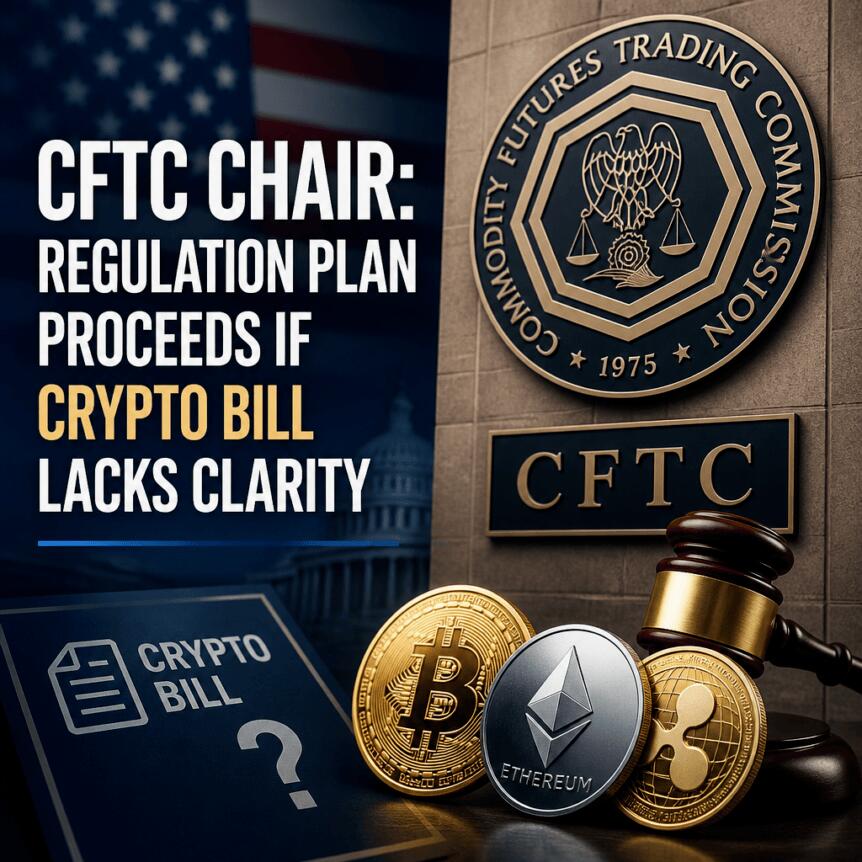
US CFTC Chair Michael Selig has told lawmakers and the crypto industry that the agency will continue moving on digital-asset regulation even if Congress does not pass the Digital Asset Market Clarity (CLARITY) Act. Speaking in prepared remarks at the CFTC’s Innovation Advisory Committee’s inaugural meeting on Thursday, Selig framed the agency’s approach as a way to “give CLARITY its breathing room” while still preparing rulemaking that could be deployed quickly if the bill stalls.
Selig also described actions already set in motion inside the commission, including work aimed at allowing both registered and non-registered entities to offer leveraged or margined crypto asset trading, alongside efforts to develop protections for developers. His comments came as the broader crypto policy debate in Washington remains tied to the timing of Senate proceedings and ongoing negotiations over the bill’s content.
Key takeaways
- Despite CLARITY being the central market-structure proposal, CFTC leadership signaled it will pursue crypto rules independently if Congress cannot finalize the legislation.
- Selig said staff have already been directed to consider rules that would enable leveraged or margined crypto trading by both registered and non-registered entities.
- The CLARITY bill appears paused until the US Senate returns in September, with a cloture vote requiring 60 support to advance.
- Selig’s agenda aligns with the SEC’s parallel approach: proposed digital-asset rules designed to provide clearer regulatory pathways for market participants.
- The CFTC is currently operating with a limited leadership panel, with Selig described as the only Senate-confirmed commissioner directing agenda-setting since December.
CFTC: rulemaking won’t wait for CLARITY
In his remarks, Selig argued that the CFTC should not stand still while Congress deliberates. He said the commission would move forward on crypto regulations even without CLARITY’s passage, suggesting the agency could help ensure implementation of the administration’s priorities if the bill is delayed or revised.
“We’re going to give CLARITY its breathing room for a vote,” Selig said, but added that if Democrats cannot support a bipartisan product that reflects compromises from both sides of the aisle and reaches the President, he would direct CFTC staff to “move swiftly” to propose new rules for the industry.
In practical terms, Selig said he has already instructed staff to advance policy work related to crypto trading structures, including allowing leveraged or margined trading on a broader basis. He also pointed to an effort to explore developer protections—an element that has been gaining attention in US crypto policymaking as regulators attempt to distinguish between consumer-facing activity and other categories of software and infrastructure.
Where CLARITY stands in Congress—and why it matters
Although Selig indicated the CFTC is prepared to act on its own, the legislative path for CLARITY remains the major determinant of a unified national market-structure framework. The market-structure bill is currently effectively paused until the Senate returns to session in September. At that point, Majority Leader John Thune is expected to seek a cloture vote.
Under the Senate’s rules as described in the reporting, CLARITY would need 60 votes to pass the chamber and then return to the House of Representatives for final legislative approval before reaching President Donald Trump for signature or veto. This 60-vote threshold is especially consequential because it signals that the bill’s fate depends not only on broad support, but on overcoming procedural resistance.
Any uncertainty around the number of votes needed has been heightened by political questions tied to ethics. The source notes that some Democrats have called for stronger ethics provisions related to the Trump family’s crypto investments, reported as totaling $1.4 billion in 2025. Trump has claimed that a “lot of Democrats” support CLARITY, but it remains unclear whether that support is sufficient to reach the Senate threshold.
For market participants, the distinction is important: if CLARITY passes, it could standardize how US regulators approach key aspects of crypto trading and market structure. If it does not, the CFTC’s willingness to proceed suggests the industry could face a more fragmented regulatory landscape driven by agency rulemaking rather than legislation.
Coordination signal with the SEC’s proposed rules
Selig’s comments also echoed the direction taken by the Securities and Exchange Commission. According to the source, the SEC on Tuesday released proposed rules for digital asset regulation that would offer crypto companies a safe harbor policy from tokens being treated as “investment contracts,” along with certain exemptions for issuers.
While the SEC and CFTC operate in different jurisdictional domains, the alignment in messaging suggests regulators are attempting to reduce uncertainty in overlapping areas of the market—especially for trading, token offerings, and associated activities. For investors and operators, that could mean a clearer set of expectations on how rules might apply, even if Congress is still debating a comprehensive framework.
At the same time, regulatory coordination remains imperfect. The SEC proposal is designed around its own statutory interpretation and enforcement priorities, while the CFTC focuses on commodities and derivatives-related market activity. That difference is why agency-by-agency rulemaking may not fully substitute for legislative clarity.
Innovation committee focus: AI, prediction markets, and CFTC jurisdiction
Selig delivered his remarks alongside Innovation Advisory Committee Chair Walt Lukken and the committee’s Designated Federal Officer Michael Passalacqua. Beyond the CLARITY debate, the meeting agenda reportedly included artificial intelligence and prediction markets.
The CFTC has claimed “exclusive jurisdiction” over prediction markets, according to the source, based on its view that event contracts on relevant platforms are “swaps.” Selig has said he directed the commission to pursue lawsuits against state-level authorities that challenge this position—referenced in the source in connection with matters involving companies such as Kalshi and Polymarket.
For builders and traders in prediction markets, these jurisdictional disputes are not abstract. They can influence where platforms operate, how products are structured, and what legal risk markets face when expanding into new states or audiences. In that context, CFTC momentum on broader digital-asset rulemaking may also affect how prediction-market platforms plan future product design and compliance programs.
CFTC leadership constraints add urgency
The meeting also highlighted an internal constraint: the CFTC, as described in the source, currently lacks a full panel of commissioners. Selig has been operating as the only Senate-confirmed commissioner within a leadership group expected to consist of a bipartisan five-member panel.
Because of that imbalance, Selig has been solely responsible for directing the agency’s agenda since December, which may help explain the emphasis in his remarks on speed—both in continuing existing initiatives and in preparing contingencies should Congress not reach a legislative conclusion.
In the near term, investors and industry participants should watch whether the CFTC’s ongoing rulemaking work translates into formal proposals, and whether CLARITY can clear the Senate’s procedural and political hurdles in September. The immediate uncertainty is legislative, but the immediate regulatory direction is already becoming clearer from agency-level activity.



Optimism governance approved a proposal to move 546.9 million OP tokens, valued at roughly $49.7 million at the time of the vote, from an allocation reserved for future user airdrops into a Strategic Ecosystem Fund administered by the Optimism Foundation. The change removes the remaining dedicated… Read the full story at The Defiant

X is exploring stablecoin payments for content creators as it replaces its long-running Revenue Sharing program with a new rewards system.
The talks could put USDC at the center of creator payouts just as X expands its broader payments offering.
X Explores Stablecoins for Creator Payments
CoinDesk reported on August 20 that X is discussing the use of stablecoins such as Circle’s USDC to pay royalties to influential users for their content.
The conversations are still ongoing, according to a person familiar with the plans who also works with other social media platforms testing stablecoins for influencer commissions, suggesting X is not alone in weighing the move.
The report comes as X changes how creators earn money on the platform. The company announced early this month that it is ending new enrollment for its Revenue Sharing program and introducing the Original Content Rewards Program.
Under the new system, eligible creators earn money from qualified impressions generated by their original content. Those impressions must come from Premium users on the Home Timeline, with at least half of the post visible. Creators need at least 500 verified followers and 500,000 Home Timeline impressions from verified users during the previous 90 days. They must also subscribe to X Premium, Premium+ or Premium Business and maintain an account in good standing.
Existing Revenue Sharing participants can continue earning through September 7, but X plans to begin allowing such users to apply for Original Content Rewards from September 8, with their first payment under the new program scheduled for September 25. The stablecoin discussion could therefore affect how these payments are eventually delivered.
X Money Adds Another Piece
Stablecoins now carry a combined market value of over $300 billion and are already used by businesses to move money across borders faster and more cheaply than traditional banking rails allow.
X’s interest in the fiat-pegged digital assets for creator pay follows Elon Musk’s broader financial ambitions for the platform. In March, he confirmed that X Money, the app’s in-house payment product, would open to early public access within weeks, a step toward what he called an “everything app” that folds financial services into social media.
The product launched to a limited group of US Premium+ users in June before expanding to a wider set of paid subscribers by late July. It currently works as a dollar-based wallet, letting eligible users hold balances, send free instant transfers to other X Money users, receive direct deposits, and spend through a Visa debit card, with up to 6% annual yield on balances and cashback on purchases.
However, it does not yet support crypto or stablecoins, despite heavy speculation before its launch. Some of Musk’s other companies have leaned on the technology before, including SpaceX, which reportedly collects cross-border payments from Starlink customers in emerging markets using stablecoins, a precedent that makes X’s interest less of a surprise.
The post X in Talks to Use Stablecoins for Content Creator Royalties: Report appeared first on CryptoPotato.

“Pop culture today is thinking about living longer and what we want our lives to look like,” Minter-Jordan says. “We’re able to really home in on that as a means of engaging younger demographics, but also bringing visibility to the growing ‘50-plus’ in our country.”
That includes reminding people age 65 and older that Social Security and Medicare are instrumental for health and financial resiliency later in life. In 2025, the 90th anniversary of the Social Security Act, Minter-Jordan traveled the country highlighting the importance of both programs and telling the stories of members who depend on them. More than 3 million AARP activists contacted their Congressional leaders to remind them that Social Security and Medicare aren’t handouts, she says, but benefits that people have earned.
As a physician, Minter-Jordan knows that living longer isn’t always as good as it sounds. The gap between people’s “health span”—how long they’re healthy—and lifespan is about 12.5 years, she says. (It’s typically worse for women.) But AARP wants to help to close that gap. AgeTech Collaborative, AARP’s startup accelerator, connects hundreds of companies that are designing products to help people age better with investors and entrepreneurs who can help bring their products to market. Its Community Challenge grants invest in small local projects nationwide that make age-oriented design changes to public places. Under Minter-Jordan, AARP has doubled the amount of money it grants to fund practical improvements that benefit older Americans, like more benches in community parks.
Minter-Jordan, who is in her 50s, says that people are sometimes surprised to see someone relatively young as the face of an organization representing an aging America. But that’s kind of the point, she says. Beyond middle age, people are still contributing a great deal to American society and the economy. There are now 57 million Americans over age 50 in the workforce, and Minter-Jordan wants the rest of the country to realize that their experience makes them valuable.
“This is a longevity revolution,” she says. “The businesses, employers, and policymakers who take older Americans seriously and design for their actual lives are the ones that are going to be positioned to grow and lead.”


US stablecoin issuers have entered a five-month preparation window before the GENIUS Act’s expected Jan. 18, 2027, effective date, which places licensing and operating controls at the center of market access.
Summary
- Stablecoin issuers will generally need a federal or state license from Jan. 18, 2027.
- Patrick Gerhart said integrated compliance systems will present the hardest licensing challenge.
- US platforms face separate restrictions on distributing unapproved stablecoins from July 18, 2028.
- Treasury is considering customer and location checks that could affect offshore issuers and platforms.
The US Treasury proposed new definitions on Aug. 17 covering when a company issues a payment stablecoin in the United States and when a digital asset platform offers one to a US customer.
Although the proposal clarifies which activities fall under the law, Patrick Gerhart, president of Telcoin Digital Asset Bank, told crypto.news that securing a license will require issuers to prove their compliance, reserves, and technology systems work together under daily operating conditions.
“The hardest part will be building the operating infrastructure behind the license,” Gerhart said. “A stablecoin issuer needs much more than a reserve account and a compliance policy on paper.”
President Donald Trump signed the GENIUS Act into law on July 18, 2025, establishing separate regulatory paths for federally supervised issuers and qualifying state-regulated companies. Under the law, only permitted issuers may issue payment stablecoins in the United States once the framework takes effect.
Its effective date is technically the earlier of Jan. 18, 2027, or 120 days after the responsible federal agencies complete their final regulations. Regulators missed a July 18, 2026, statutory deadline for finishing the rules, however, leaving issuers with less time to adapt before the expected January start.
Stablecoin licensing will require working controls
Based on Telcoin’s chartering process, Gerhart said regulators will expect an issuer to show how it identifies customers, traces incoming funds, monitors transactions, manages reserves and handles redemptions.
Each function may require a separate policy, but the licensing test will involve how the controls operate as a single system. According to Gerhart, compliance, risk, technology, reserve management, and banking relationships cannot remain isolated workstreams.
“For issuers working toward 2027, I would expect the biggest challenge to be demonstrating that those controls actually work together operationally,” he said.
“They have to function as one operating model, and regulators will want to see that the institution is ready to manage that model at scale.”
Federal proposals support his assessment. The Office of the Comptroller of the Currency’s draft framework covers reserve assets, redemptions, custody, liquidity, capital, audits, risk management, regulatory reporting and operational backstops. Application, examination, and wind-down procedures also form part of the proposed rules.
OCC-supervised issuers would have to maintain eligible reserves and redeem stablecoins at par. Nonbank companies seeking approval as federal qualified payment stablecoin issuers would follow a separate application process, while bank subsidiaries, qualifying state issuers, and foreign companies would face requirements suited to their regulatory status.
Comptroller Jonathan Gould reportedly expects the agency to finalize its rules by November after considering industry comments. Completion by then would give issuers only about two months before Jan. 18, although the rules remain subject to revision.
Meanwhile, a separate proposal from the Financial Crimes Enforcement Network and the Office of Foreign Assets Control would treat permitted stablecoin issuers as financial institutions under the Bank Secrecy Act.
FinCEN and OFAC have proposed requirements for customer identification, due diligence, suspicious-activity reporting, and sanctions compliance. Issuers would also need the technical ability to block, freeze, or reject prohibited transactions and comply with lawful government orders.
Telcoin spent years preparing its banking model
Telcoin’s experience provides Gerhart with a direct view of the work involved. Nebraska granted Telcoin Digital Asset Bank its final charter in November 2025 under the Nebraska Financial Innovation Act, which the state enacted in 2021 to create a regulated path for digital asset depositories.
The state described Telcoin’s charter as the first of its kind in the United States. Nebraska officials said the bank’s stablecoin reserves would primarily consist of US government bonds or deposits at FDIC-insured banks in the state.
Before granting final approval, Nebraska regulators required an operating structure covering capital, reporting, security, and customer safeguards. State rules impose surety bond and insurance requirements, as well as funding for three years of operating expenses.
Digital asset depositories must also maintain customer-complaint procedures and written plans for responding to data breaches or other cybersecurity incidents. Certain security events require immediate notice to the Nebraska Department of Banking and Finance.
While developing its model, Telcoin worked with state regulators to explain how its technology operated and determine how existing banking requirements applied to the business, Gerhart said.
“We spent years working with Nebraska regulators and building the policies, procedures, reporting, and risk controls needed to operate a digital asset bank within a regulated banking framework,” he said.
Telcoin is building its services around eUSD, a bank-issued stablecoin designed to connect conventional dollar accounts with public blockchain networks. According to Gerhart, customers could move between bank-held dollars and an on-chain dollar asset without combining services from a separate bank, exchange, and stablecoin company.
For businesses, he said the model could support faster settlement and allow payments to be built into blockchain-based products. Consumers could access blockchain applications while retaining a relationship with a regulated bank.
Gerhart attributed another potential benefit to the banking controls governing reserves, custody, compliance, and redemptions. Blockchain supplies the transfer speed and programmability, he said, while the regulated institution provides a familiar operating structure.
US rules could favor prepared issuers
The GENIUS Act allows issuers with no more than $10 billion in consolidated outstanding stablecoins to choose state-level supervision when the Treasury determines that the state’s rules are substantially similar to the federal framework.
Companies exceeding the threshold generally fall under federal supervision. The OCC will oversee federally qualified nonbank issuers, stablecoin subsidiaries of national banks and federal savings associations, along with certain state-qualified companies under its authority.
Gerhart said institutions that have already invested in banking and regulatory systems may enter the new regime with an advantage. Existing controls, reporting systems, and regulator relationships could take years for less-prepared competitors to reproduce.
Under his assessment, however, banks will not simply displace established nonbank stablecoin companies. Issuers will still need interoperability and practical uses alongside regulatory approval to win customers.
“The issuers that succeed will be the ones that can combine regulatory compliance with interoperability and real utility. Regulation opens the door to more participants, but the ability to integrate with existing financial infrastructure and actually serve customers will determine who gains traction.”
An earlier explanation of the law detailed additional issuer obligations, including one-to-one reserve backing, monthly attested disclosures and a ban on paying yield directly to stablecoin holders.
Eligible reserves include cash, insured bank deposits, short-term Treasury bills, Treasury-backed repurchase agreements and qualifying money market funds. Corporate debt, loans, precious metals and cryptocurrencies do not qualify as reserve assets under the framework.
Platforms face a separate 2028 access deadline
From July 18, 2028, digital asset service providers generally cannot offer or sell a payment stablecoin to people in the United States unless an approved issuer issues it.
Treasury’s proposal treats exchanges, custodians, transfer providers and businesses offering financial services tied to digital asset issuance as service providers. Its US restrictions are intended to reach offshore activity when a platform offers or sells stablecoins to a person located in the country.
Under the proposed definitions, direct solicitation and US-facing advertising could count as an offer. A platform may also fall within the rule if it responds to an unsolicited request by agreeing to sell a stablecoin or telling potential customers how to bypass location restrictions.
Treasury is seeking feedback on whether platforms should use customer identification, account-opening data, geographic restrictions, device or network checks, contractual declarations and transaction monitoring to determine a customer’s location. IP address and identity-document checks are among the specific controls under consideration.
Foreign issuers would retain a route into the American market if the Treasury considers their home regulatory regime comparable, they register with the OCC, and they can comply with lawful orders and reciprocal arrangements.
Given the operational work involved, Gerhart said platforms should already be identifying every stablecoin they list, its issuer, the issuer’s home jurisdiction and the controls needed to limit customer access when required.
“The 2028 deadline gives platforms more time, but it is not something they should leave until 2028 to address,” he said.
Issuers should also begin reviewing reserve reconciliation, redemption procedures, KYC, anti-money laundering controls, sanctions systems, and regulatory reporting, according to Gerhart. Treasury will accept comments on its latest proposal for 60 days after the notice is published in the Federal Register.
When will customers get their dividend payments?
The payments began going out on July 31. State Farm has not indicated when they will stop.
“Millions of customers have already received their individual dividend payments, with more on the way,” State Farm announced when the payments began.
Customers will be notified by State Farm regarding their pending payments “beginning late summer of 2026,” the company’s website states, adding that dividend payments are being sent out “in waves by state where the policy is assigned.”
Over 7.2 million checks have been mailed since payments began, with another 3.8 million set to go out this week, a State Farm spokesperson told CBS News in an email.
How much could eligible customers get paid?
The dividend payments average $100 per vehicle, according to State Farm.
The amount an eligible customer receives will vary based on a couple of factors, however. The payment a customer gets will be based on a percentage of the premiums they paid, and that percentage ranges from 4% to 10% depending on the customer’s state.


Ethos Network has scheduled a September 1 auction for 20% of the WHUF token supply, setting its opening fully diluted valuation at $1 million and its maximum valuation at $99 million.
Summary
- 20% of the total WHUF supply will be offered through the September 1 auction.
- Bidding will begin at a $1 million FDV and cannot exceed a $99 million FDV.
- Buyers can qualify for protection covering 85% of their purchase price for 12 months.
- Contributor XP and qualified referrals will determine additional token rewards.
Ethos Network said in an Aug. 20 X post that registration had opened for the WHUF auction, which includes added rewards tied to Contributor XP and participant referrals.
“Hello, Whuffie,” the protocol wrote while introducing WHUF and listing the main auction terms.
Under the announced limits, selling 20% of the supply at a $1 million FDV would value the auctioned portion at $200,000. The same allocation would be worth as much as $19.8 million at the $99 million cap, based on the relationship between the offered supply and the stated valuation range.
Ethos has not disclosed how much capital it expects to raise because the final amount will depend on bids submitted during the auction. The announcement also did not provide a final token price, circulating supply at launch, exchange listing schedule, or complete allocation plan for the remaining 80%.
WHUF auction includes conditional price protection
The official WHUF sale page describes the 85% price guarantee as conditional protection rather than an automatic refund for every buyer.
Participants must vouch their WHUF tokens in an Ethos account during a 30-day guarantee period and keep the tokens vouched to retain coverage at 85% of their purchase price for 12 months, according to the page. The available information indicates that removing the tokens from the vouch may affect eligibility, although Ethos has not yet published complete redemption instructions in an accessible auction document.
Vouching is an existing part of the Ethos reputation system. Users deposit assets behind another account to signal that they trust its owner, giving the endorsement more weight than a standard written review, according to the protocol’s website.
Applying the same action to the guarantee ties the protection to participation in Ethos rather than passive token ownership. Buyers seeking coverage would need to commit the purchased WHUF to the protocol under the stated conditions, limiting how freely they could use the tokens while preserving the guarantee.
Ethos has not explained which asset or reserve will fund guarantee claims, how claims will be processed, or whether geographic and identity checks will apply. The project also has not published information on the auction’s accepted payment assets, minimum bid, maximum individual contribution or final allocation method.
Contributor XP will influence WHUF bonuses
Auction contributors will receive additional rewards weighted by their commitment and Contributor XP, the sale page states. Referrers can also receive a share linked to each qualified bid they bring into the auction, although the project has not publicly listed the exact reward percentages.
Contributor XP has operated as Ethos’s recognition system since the protocol launched on Base in January 2025, as crypto.news previously reported. The system assigns credit to users who help document reputation through reviews, vouches, invitations, and other activity.
At the mainnet launch, Ethos said around 4,500 accounts were eligible for its first XP claim after it screened the distribution for Sybil activity. Each eligible account received 10 referral links, while both parties could gain a 20% increase on their base XP claim when the invited user already had an allocation.
Later campaigns expanded the XP system through daily review bounties and reputation markets. In July, Ethos announced a trading competition carrying almost 35 million XP as its second XP season approached its end.
The WHUF auction now gives accumulated XP a role in token-sale rewards. Ethos has not said whether XP will convert directly into WHUF, determine a multiplier, or place participants into separate allocation groups.
Ethos has built WHUF around onchain reputation
Ethos describes WHUF as a “Proof of Credibility” token connected to its onchain reputation network. The platform combines social and financial signals to create credibility scores for crypto accounts.
Reviews allow users to submit positive, neutral, or negative assessments, while the credibility of the reviewer and the account’s history can affect each review’s weight. Vouching lets users back an account with deposited ETH, and slashing allows the community to propose penalties against users accused of misconduct.
Ethos also uses wallet age, attestations, social accounts, review history, vouching activity, and suspected Sybil behavior when calculating its credibility scores. The protocol says developers can connect the scoring infrastructure to external applications through its smart contracts.
The project launched on Base mainnet on Jan. 22, 2025, after operating on the Base Sepolia test network. Its browser extension can display Ethos scores on X and OpenSea, giving users access to reputation data outside the main Ethos application.
In July 2024, Ethos raised $1.75 million from 59 angel investors without a lead venture capital firm. The current sales page says the project later received backing from more than 450 participants through Echo and claims WHUF has only 1% venture capital ownership. A full token allocation table has not yet been published to verify how the remaining ownership categories are divided.
US buyers face unresolved access and securities questions
Ethos has not publicly confirmed whether people in the United States can enter the WHUF auction. The registration page should therefore not be treated as confirmation that US residents are eligible, particularly while the project has yet to publish complete sale terms and jurisdictional restrictions.
Federal treatment of token offerings is also under review. The US Securities and Exchange Commission proposed Reg Crypto on Aug. 18, creating possible registration exemptions for qualifying crypto investment contracts.
One proposed route would cover offerings of up to $5 million during four years, while another would allow eligible issuers to raise as much as $75 million in a 12-month period. The larger exemption would carry added financial statement and continuing reporting requirements, according to the SEC proposal.
Reg Crypto does not automatically exempt every public token sale. Eligibility would depend on the offering structure, issuer disclosures, and other conditions, while the proposal must still pass through a public comment process before any final rules take effect.
Token distribution will also matter once WHUF becomes transferable. A July token-unlock explainer noted that vesting schedules and cliffs can limit immediate selling by team members and early investors. Ethos has not yet released WHUF vesting periods, team allocations, insider lockups, or the amount expected to circulate when the token launches.

A criminal complaint filed in federal court on Thursday outlines the FBI’s investigation into Bowie, including how agents reviewed social media posts she had shared with “anti-American messages” and the ensuing sting operation that led them to apprehend her.
An FBI confidential source, the document details, posed as an “ISIS facilitator” and began messaging with Bowie in July about “her plans to attack the New York State Capitol building in Albany.”
Bowie visited the building several times, according to the complaint. Included in the filing and the Justice Department’s press release was an image of an individual wearing all black and holding up a phone, seemingly to take a photo. The individual’s face is not visible in the photo, but authorities identified them as Bowie; the complaint says the image shows Bowie “doing reconnaissance on July 21” on the Capitol building.
The complaint goes on to describe an in-person meeting that Bowie had with two other FBI confidential sources on Aug. 5. The meeting was filmed and recorded, and the complaint alleges that Bowie “reaffirmed her desire to bomb the New York State Capitol” during the encounter. The filing includes part of the transcript from that meeting, during which she allegedly said that she would “ideally do [the attack] on a day when the most amount of senators are there, maybe we time it where there we know there’s a meeting with the senators, try and get a good enough explosive in there to kill the senators and ideally to destroy as much of the building as possible really.” She then said that she wanted “to be able to get away and migrate,” according to the complaint.

The ceasefire between the U.S. and Iran officially came to a close this week. That led oil prices to surge — always a positive for oil-related stocks. This group of industry stocks are breaking out and stand to benefit from the ongoing closure of the Strait of Hormuz. Four energy stocks — Shell (SHEL), Suncor Energy (SU), Ecopetrol (EC) and…
Copyright ©2026 Investor’s Business Daily, LLC. All rights reserved. 87990cbe856818d5eddac44c7b1cdeb8

Disclosure: This article does not represent investment advice. The content and materials featured on this page are for educational purposes only.
XRP rebounds 10% as Bitcoin short liquidations top $1 billion, while UE Crypto expands cloud mining access
Summary
- XRP rebounds 10.17% near $1.10 as Bitcoin surges 8%, triggering more than $1B in short liquidations.
- Bitcoin hits $72,281 after a sharp rebound, fueling a major short squeeze and lifting XRP toward $1.10.
- XRP and BTC volatility sparks interest in UE Crypto’s contract-based cloud mining as an alternative income option.
XRP has recently staged a strong rebound, with its price briefly climbing near $1.10 — a single-day gain of 10.17% and its largest daily increase since February 6, 2026. Meanwhile, Bitcoin (BTC) also rebounded rapidly, rising over 8% at one point to hit a high of $72,281.12; this marked a new peak since early June and the largest single-day gain since March 2026.
This rapid market reversal triggered a massive wave of short position liquidations. According to CoinGlass data, over $1 billion in Bitcoin short positions were forcibly liquidated within roughly an hour, marking one of the largest Bitcoin short liquidation events since such data tracking began in 2021.
Prior to this, Bitcoin had experienced months of decline, with bearish sentiment building as the price retreated. The sudden price rebound — fueled by heavy buying as short sellers covered their positions — pushed prices even higher, creating a classic “short squeeze” scenario.
Amidst heightened market volatility, UE Crypto has launched a contract-based cloud mining service. This offers holders of XRP, BTC, and other digital assets a way to utilize their holdings that goes beyond merely relying on price appreciation, helping users explore potential sources of consistent returns.

From price fluctuations to asset utilization: Investors seek more stable returns
For a long time, many XRP and BTC holders have primarily employed a “buy low, hold long” strategy, hoping to realize capital gains from future market rallies.
While this approach can yield high returns during bull markets, profitability is heavily dependent on asset price performance. When the market enters a phase of consolidation, correction, or decline, holders must not only endure fluctuations in asset value but may also face long waiting periods.
Consequently, an increasing number of digital asset holders are turning their attention to more diversified asset management strategies. Moving beyond the simple “buy low, sell high” model, some investors are exploring ways to enhance the utilization of their existing digital assets and seeking sources of relatively consistent potential returns. Amidst this trend, cloud mining has emerged as a way to engage with digital assets that differs from simply relying on price appreciation. By combining cloud computing power with contract services, UE Crypto offers holders of XRP, BTC, and other mainstream digital assets the option to participate in cloud mining remotely.
UE Crypto Cloud Mining: Simplifying digital asset participation
UE Crypto’s contract-based cloud mining platform integrates computing power allocation, contract services, and automated operational mechanisms.
Users can select cloud mining plans tailored to their budgets, contract durations, and computing power requirements without the need to purchase, deploy, or maintain mining hardware themselves. Once a contract is activated, the allocated computing power operates automatically according to the chosen plan, thereby lowering the equipment and technical barriers associated with traditional mining.
Compared to merely waiting for the price of XRP or BTC to rise, cloud mining offers holders an alternative potential source of income. According to UE Crypto, potential daily earnings for some high-capacity plans can reach up to $10,000, with actual returns depending on the specific investment amount, contract plan, and computing power allocation.
Key features of UE Crypto Cloud Mining
Low barrier to entry
With a minimum investment of $100, the platform offers an accessible starting point for users wishing to try cloud mining.
Automated operation
Once a user selects and activates a contract, the computing power runs automatically according to the plan; there is no need for the user to manage mining hardware or perform complex technical maintenance.
Support for multiple mainstream digital assets
The platform supports a wide range of mainstream digital assets, including BTC, USDT, ETH, LTC, USDC, XRP, SOL, and BNB.
Clear earnings plans
Different contracts correspond to varying durations and projected returns; users can choose to withdraw their earnings or reinvest them in accordance with platform rules.
Emphasis on sustainable operations
UE Crypto states that its mining infrastructure utilizes renewable energy sources — including solar and wind power — to enhance efficiency and reduce carbon emissions.
Three Steps to Get Started with UE Crypto
1. Register an account
2. Top up and select a plan
Users can top up their accounts using major digital assets supported by the platform — such as BTC, ETH, USDC, and XRP — and select a cloud mining plan that suits their budget, contract duration, and hashrate requirements.
3. Activate the contract and earn returns
Once the contract is activated, the corresponding hashrate operates automatically according to the selected plan. Earnings are settled based on the specific contract terms, and users can choose to withdraw or reinvest their profits in accordance with platform rules.
Featured cloud mining contracts
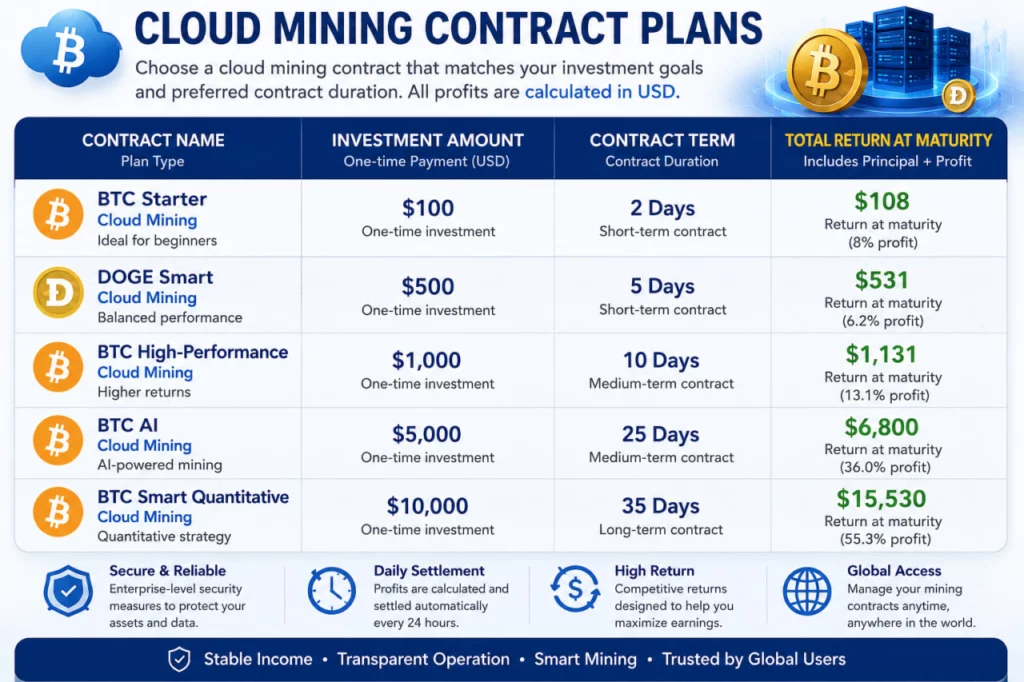
Click here to view the full list of cloud mining contracts and applicable terms.
Looking ahead: From market volatility to diversified returns
Price volatility in the cryptocurrency market is here to stay. For holders of XRP, BTC, ETH, and other digital assets, relying solely on price appreciation for returns means investment outcomes are heavily tied to market cycles. Consequently, asset diversification, improved asset utilization, and the exploration of potential, sustainable income sources are becoming key priorities for digital asset holders.
By combining cloud computing power, contract services, and digital asset infrastructure, UE Crypto offers users a convenient way to participate in cloud mining. Its goal is to enable digital asset holders to explore paths to more stable and sustainable potential returns — moving beyond a sole reliance on rising coin prices — while continuing to monitor market trends.
About UE Crypto
Founded in 2015 and headquartered in London, UK, UE Crypto specializes in smart cloud mining, cloud computing, and digital asset services. According to the company, its platform services cover more than 150 countries and regions worldwide.
Users interested in UE Crypto’s cloud mining services can visit the official website to view the full range of contract plans, platform services, and relevant terms.
Disclosure: This content is provided by a third party. Neither crypto.news nor the author of this article endorses any product mentioned on this page. Users should conduct their own research before taking any action related to the company.
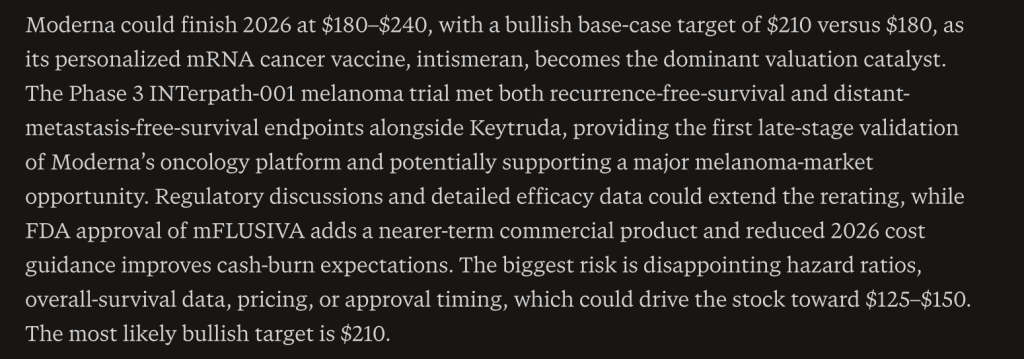
A single trial readout just doubled a company’s market value in one session. Perplexity AI predicts the rerating continues, and the price prediction places Moderna at $180 to $240 by the end of 2026 with a $210 bullish base case.
The catalyst is Intismeran, the personalized mRNA cancer vaccine. Perplexity calls it the dominant valuation driver going forward. The Phase 3 INTerpath-001 melanoma trial met both primary endpoints. Recurrence-free survival and distant-metastasis-free survival both cleared alongside Keytruda.
That is the first late-stage validation of Moderna’s oncology platform. Perplexity frames it as potentially supporting a major melanoma-market opportunity.

Two near-term items support the case. FDA approval of mFLUSIVA adds a commercial product with revenue before oncology arrives. Even more, its reduced 2026 cost guidance improves cash-burn expectations. Together, they buy time for the oncology thesis to develop.
The risks are all data-dependent. Disappointing hazard ratios sit at the top of the list. Overall-survival data, pricing, and approval timing follow. Any of those could drive the stock toward $125 to $150.
Discover: Everyone’s Got a Take. Get Free $25 from Kalshi to Actually Trade Yours
Moderna (MRNA) Price Prediction: Perplexity AI Predicts One Melanoma Trial Rewrites The Entire Company
The daily chart shows a four-year collapse followed by a violent reversal. Moderna peaked near $170 in mid-2024 before entering a prolonged decline. That slide carried the price from $120 down to roughly $23 by late 2025. A base formed there through the autumn.
In early 2026, the recovery began, lifting prices toward $60 by March. July produced a run to $85 before a pullback. The latest session detonated. Price gapped from $116 to close at $174.38 on the trial news.

The close reads $174.38, up 176.97%, and $111.42. The daily range covered $114.46 to $176.66, with post-market at $180.17. Support sits at $150, then $120 and $85. Resistance appears at $180, then $210, and $240.
RSI reads 92.21 with its signal line far below at 52.98. That gap of nearly 40 points is extraordinary and reflects a one-day repricing rather than a trend. The oscillator is deeply overbought. Momentum is extreme, and readings at this level rarely persist without consolidation.
Perplexity’s base case sits 20% above this close. Detailed efficacy data and regulatory discussions are what decide whether the market holds this new level.
Discover: Your Market Calls Are Worth Something. Start with a free $25 on Kalshi
Moderna Just Showed What One Event Can Do. Kalshi Lets You Trade the Outcome Before the Repricing.
Moderna’s 177% move is the clearest reminder that markets often spend months waiting for one binary event to settle the argument.
Kalshi is built around that exact dynamic.
Instead of buying an asset and hoping the eventual market reaction matches your thesis, users can trade directly on real-world outcomes across economics, politics, crypto, technology, sports, and other event-driven markets. You decide what you think happens, see the probability other traders are assigning to it, and take a position before the outcome is known.
That can be especially useful when a stock has already repriced violently. Moderna buyers entering after the trial result are paying for information the market now knows. Event markets are about positioning while the uncertainty still exists.
Eligible new users who join Kalshi through CryptoNews can receive $25 through our referral link.
The post Perplexity AI Predicts Whether Moderna Stock Can Make Investors Rich in 2026 appeared first on Cryptonews.

How landscape gardening is being electrified

Optimism Redirects $49.7 Million Airdrop Reserve After Late Deciding Vote

Netflix Officially Confirms ‘One Piece’ Is Changing Its Winning Formula With New Release

Weekend Open Thread – Corporette.com

Weekend Open Thread: Brooks Brothers

London Mayor Sadiq Khan handed a peerage by Keir Starmer alongside 15 other Labour figures… just days before the PM leaves No10

Yang bikin kaya bukan uang #motivasi #money #kaya #fypdong #fyppppppppppppppppppppppp

WARNING! The Next XRP Liquidation Event!

UAE Adviser Denies Providing Financial Aid to Iran | Middle East Crisis | Breaking News | Dawn News
-

 Fashion6 days ago
Weekend Open Thread: Ann Taylor
-
 Tech7 days ago
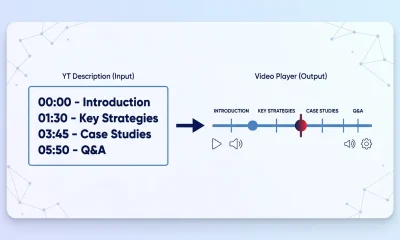
11 Ways to Rank Your Videos
-

 Sports6 days ago
Birmingham 2026: Day 6 Timetable for Irish Athletes
-
 NewsBeat6 days ago
Myanmar says over 300,000 Rohingya refugees verified for repatriation as exodus enters ninth year
-

 Politics6 days ago
SEQ Code: The Three Letter Boarding Pass Code That Could Give You The Worst Seat
-

 Tech3 days ago
Qwen3.8-27B runs frontier-class coding agents and reasoning locally, no cloud API required
-

 Business2 days ago
SMA Solar Technology AG (SMTGY) Q2 2026 Earnings Call Transcript
-

 Crypto World6 days ago
Pi Network Protocol 27 endgame: last upgrade before what?
-

 Crypto World3 days ago
OCC Greenlights Trump Family Crypto Firm for Trust Charter
-
 Tech5 days ago
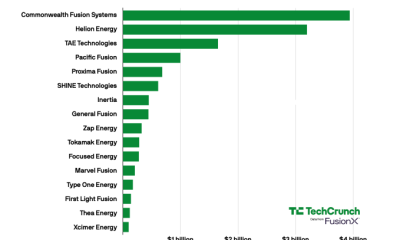
Every fusion startup that has raised over $100M
-

 Business7 days ago
15 Ways to Make Money From Your Phone (2026 Guide)
-
 Entertainment7 days ago
10 Netflix Shows That Quietly Became Modern Classics
-
 Entertainment6 days ago
Marvel Studios Reveals New X-Men Cast Including Adam Driver and Sadie Sink
-

 News Videos19 hours ago
Don’t Leave Your Financial Future To Chance | August 19, 2026
-

 Crypto World7 days ago
Robinhood Chain Approaches $1B TVL as Uniswap Integration Boosts Liquidity
-

 Fashion6 days ago
Weekly News Update, 8.14.26 – Corporette.com
-

 Fashion6 days ago
Silver bangles for women – Newbridge Silverware
-

 Business6 days ago
Facebook Down Now? Users Report Login And Loading Problems As Outage Trackers Monitor Ongoing Issues
-

 Crypto World3 days ago
NAVI Prime launches institutional lending framework on Sui
-

 Fashion6 days ago
Cart Confidential Vol. 44 – Julia Berolzheimer
You must be logged in to post a comment Login