

Crypto World
Veteran Analyst Says Bitcoin is Dead, But Long Live Crypto



Bitcoin’s long-held narrative as a safe haven and digital gold is under scrutiny, as veteran analyst Ran Neuner, among others, questions the pioneer crypto’s future.
Experts outline why Bitcoin may no longer serve the role it once claimed, and why the broader crypto ecosystem could be on the brink of a new era.
Sponsored
Bitcoin’s Store-of-Value Thesis Faces Crisis as Crypto Evolves
Despite a weakening US Dollar and mounting global uncertainty, Bitcoin underperformed expectations as a hedge against fiat debasement.
The US Dollar Index (DXY) fell roughly 9% in 2025, and another 2% year-to-date in 2026, yet Bitcoin declined 20–22% YTD, trading for $68,255 as of this writing. Gold, by contrast, surged, proving resilient in risk-off scenarios.
“When tariffs, currency tension, and fiscal instability hit, this was the moment Bitcoin was supposed to behave like a store of value. Instead, capital ran to gold,” wrote analyst Ran Neuner.
Analysts, including Willy Woo and Henrik Zeberg, reinforce this view, highlighting that Bitcoin behaves as a high-beta, risk-on asset rather than a safe haven.
Bitcoin’s ideological allure appears to be fading. Retail participation has reached multi-year lows, and early evangelists have largely exited the market.
Sponsored
“We fought for ETF approval. We fought for institutional access. We wanted it inside the system. Now it is. There is nothing to fight for anymore…If it’s not used as cash, and it didn’t meaningfully absorb the stress bid, then what exactly is the narrative?” Neuner said, describing the post-ETF era as a turning point.
Institutional Access Achieved, But at a Cost
With 11 spot Bitcoin ETFs approved, corporate treasuries holding large allocations, and pro-crypto regulatory frameworks in place, Bitcoin has fully integrated into TradFi systems.
Michael Burry warned that this shift exposes companies holding BTC to significant value erosion if markets continue to correct:
Sponsored
“BTC has failed as a safe haven like gold and behaves more like a volatile stock tied to the S&P 500,” SwanDesk reported, citing Burry.
Crypto’s Next Phase: AI and Machine-Native Finance Amid Narrative Shift
Neuner sees the future not in Bitcoin’s store-of-value thesis, but in the emerging economy powered by AI agents.
Trillions of autonomous microtransactions will require instant, programmable settlement rails, a need that blockchain networks are uniquely positioned to serve.
“AI agents won’t use banks. They won’t use credit cards. They’ll need instant, programmable settlement rails. That’s crypto,” he said.
Sponsored
While Bitcoin struggles to retain its original purpose, broader crypto infrastructure could become the foundation for the next digital economy.
Analysts suggest that even if Bitcoin bled to death, decentralized networks, altcoins, and blockchain-based solutions may capture real utility and revenue models in the AI-driven era.
Neuner’s assessment highlights a critical turning point for crypto. Bitcoin may no longer be the ideological engine it once was, but the industry’s potential extends far beyond a single token.



Spot Ethereum ETFs see four straight weeks of outflows as price and sentiment slide.
Summary
- Spot Ethereum ETFs post longest outflow streak since spring 2025, with a likely fifth week looming.
- Ethereum price, volumes, and total crypto market cap have all declined alongside U.S. spot ETF redemptions.
- Fear & Greed Index flashes “Extreme Fear” as ETH trades below key moving averages and tests critical supports.
Recent reports from Lookonchain indicated funds recorded additional losses in recent trading sessions, as Ethereum price continues to face downward momentum hovering around $2,000 USD.
Spot Ethereum exchange-traded funds have recorded four consecutive weeks of net outflows, with signs pointing to a fifth straight week of redemptions, according to historical data from SoSoValue.
The outflows have coincided with a sharp correction in Ethereum prices, with the spot price declining significantly over the same timeframe. U.S. spot Bitcoin ETFs have similarly experienced notable outflows as cryptocurrency prices fell, according to market data.
Ethereum traded lower during the reporting period, while total cryptocurrency market capitalization declined, according to market tracking services.
The Crypto Fear & Greed Index has fallen into “Extreme Fear” territory, indicating heightened risk aversion among market participants. Daily Ethereum trading volumes have also decreased during the period.
Technical analysis showed the digital currency trading below its longer-term moving average, with the short-term moving average functioning as near-term resistance. Market analysts noted that until Ethereum reclaims its prior higher range, downward pressure may persist.
The cryptocurrency’s ability to defend key support levels remains a critical factor, as a breach could trigger a deeper correction, according to market observers.

Disclosure: The views and opinions expressed here belong solely to the author and do not represent the views and opinions of crypto.news’ editorial.
Quantum computing is often framed as a distant storm on the horizon, and not yet relevant to today’s cryptographic systems. In 2026, that framing is dangerously misguided. The Ethereum Foundation’s recent decision to launch a dedicated Post-Quantum (PQ) cryptography team, backed by $2 million in funding, is a watershed moment for the industry. The world’s most influential smart contract ecosystem is no longer treating quantum risk as theoretical; it is acting on the correct assumption that cryptographic disruption could arrive far sooner than expected.
Summary
- Quantum risk is no longer theoretical: The Ethereum Foundation’s post-quantum team signals that cryptographic disruption is being treated as an imminent infrastructure threat, not a distant possibility.
- Harvest-now, decrypt-later is the real danger: Millions of exposed public keys could be drained overnight once quantum capability crosses the threshold — no gradual warning, just systemic shock.
- Migration won’t be seamless: Upgrading trillion-dollar blockchains to post-quantum cryptography could require massive downtime, creating ripple effects across ETFs, custody, banking, and global markets.
The quantum threat is already a present market risk, not a future technical problem, and crypto’s failure to treat it as such will define the next systemic crisis. Some readers may find this view overly alarmist or argue that highlighting quantum risk could undermine confidence in digital assets. Others may object that this perspective challenges long-held assumptions about Bitcoin’s resilience and the pace of technological change. However, these contentions radically underestimate how close we are to a cryptographic collapse.
From theory to strategic priority
It’s important to note that quantum computing is no longer confined to academic research. Nation-states, defense agencies, and major technology companies are racing to build machines capable of solving problems classical computers can’t. The risk is not merely computational speed but the potential collapse of cryptographic trust itself.
This urgency is now reflected in some landmark policy developments. The European Commission and EU Member States recently released a coordinated roadmap to transition the bloc’s digital infrastructure to post-quantum cryptography. It stipulates that by 2026, all Member States must begin national PQC strategies; by 2030, critical infrastructure must adopt quantum-resistant encryption; and by 2035, the transition should be completed across all feasible systems.
The Ethereum Foundation’s decision to allocate funding and talent toward post-quantum research mirrors this new reality.
The dangerous comfort of long timelines
Despite these developments, some industry voices continue to downplay the risk. Bitcoin (BTC) pioneer Adam Back has argued that Bitcoin faces no meaningful quantum threat for 20 to 40 years. This position rests on the assumption that danger only begins when a quantum computer can break cryptographic keys in real time.
The threat does not start when quantum machines arrive at full strength; it starts when attackers can harvest public keys today and wait. Deloitte recently reported that roughly four million Bitcoin, around 25% of all usable supply, sit in addresses that expose public keys vulnerable to quantum attacks. Once a sufficiently advanced quantum computer exists, those wallets could be drained almost instantly using Shor’s algorithm.
The damage would not unfold gradually. It would be sudden, asymmetric, and irreversible.
Why upgrading is not a simple fix
Supporters of the long-horizon view argue that Bitcoin and other blockchains can simply adopt the National Institute of Standards and Technology’s post-quantum cryptography standards when the time comes. But cryptographic migration is a protocol-level transformation, not a routine patch.
Researchers estimate that upgrading Bitcoin to a quantum-resistant cryptosystem could require up to 75 days of downtime, or over 300 days if the network must operate at reduced capacity to limit attack vectors during migration. For a trillion-dollar asset class, such a disruption would ripple through exchanges, derivatives markets, ETFs, institutional custody systems, and payment rails. This is a risk the market is not currently pricing in.
Blockchains are not alone in this exposure, as the global banking and payments infrastructure relies on the same cryptographic standards now considered vulnerable. A quantum breach would compromise not just assets, but identity systems, digital signatures, interbank settlements, and automated clearing mechanisms.
In practical terms, this could mean frozen payment rails, invalidated digital contracts, and emergency shutdowns of financial networks. The shock would move beyond crypto into equity markets, foreign exchange, and sovereign debt, creating a systemic crisis rooted in broken trust.
When AI and quantum outpace governance
This risk is amplified by the ongoing proliferation of AI, which is accelerating discovery, automation, and exploitation. When paired with quantum computing, it creates a scenario in which machine-scale attacks outpace human governance and regulatory response. Laws move in years. Algorithms move in milliseconds, and the gap is widening continuously. Decentralized systems were designed to remove single points of failure, yet cryptographic fragility threatens to reintroduce them at the foundation layer.
If cryptographic assumptions change, valuations will follow, and capital will increasingly favor quantum-resilient infrastructure. Risk premiums on legacy chains will widen, and regulators will increasingly demand transparency around cryptographic readiness, and institutional investors will expect quantum-risk disclosures. The Ethereum Foundation’s decision is an early signal that the markets will not ignore for long.


Building a swap DApp is relatively straightforward. Running it under real market conditions — with bots, arbitrageurs, and volatile liquidity — is not. BeInCrypto sat down with Andrey Fedorov, CMO & CBDO at STON.fi Dev at Consensus Hong Kong to hear what that process actually looked like.
STON.fi launched as an AMM (automated market maker) on TON Blockchain — a swap interface with liquidity pools. Omniston, its liquidity aggregation protocol, came later as a response to fragmentation: multiple DEXs on TON meant users had to manually compare prices across protocols. Omniston was supposed to fix that by aggregating liquidity into a single access point.
Aggregation worked. But scale exposed new constraints.
Three Lessons From Production
Fedorov is candid about what went wrong early on. “First there was just one token, and it was very easy to provide the technology. Activity levels were minimal, and the user base was still small. But over time it exploded.”
The first lesson was scaling. Both the front end and back end buckled under unexpected demand. The second was subtler: multi-hop swaps — routing trades through intermediate tokens — worked in testing but revealed edge cases under live conditions. “In theory, both hops execute seamlessly,” Fedorov explains. “In practice, you have simultaneous transactions, liquidity shifting across pools, and multiple DEXs updating state at once. The first hop can succeed while the second fails.”
The third lesson was about complexity itself. The initial model assumed a simple set of actors: users swap, liquidity providers provide. Reality added arbitrageurs, bots, and more complex interaction patterns that hadn’t yet been fully anticipated. “I don’t think it is actually possible to work out all these things in the beginning. You need to launch it, see how it goes, then fix something if it breaks.”
STON.fi now accounts for 80 to 90 percent of DEX activity on TON, underscoring its dominant share of swap volume on the chain. But cross-chain swaps, next on the roadmap, will reset that counter. “The fundamentals will be the same, but I’m sure we will see new challenges.”

Why Aggregation Wasn’t Enough
Omniston’s original proposition was to connect all TON DEX pools and find the best route. But aggregating public liquidity has a ceiling. If nobody has added liquidity to a particular pair, no amount of smart routing helps.
“Sometimes people just don’t want to provide liquidity in a specific pool,” Fedorov says. “When a user wants to swap a token in this pool, they can’t get a good price because there is no liquidity.”
The answer was escrow swaps — a parallel execution path that taps into private liquidity from professional market makers, or “resolvers.” Instead of relying solely on AMM pools, Omniston now evaluates both public and private sources and routes each swap through whichever delivers the better outcome.
“It’s not a silver bullet, because we need to have both. The combination provides the best experience.”
Tokenized Equities as a Stress Test
The escrow model proved its value when STON.fi integrated xStocks — tokenized representations of US equities issued by Backed Finance. These are technically TON jettons, but they behave differently from crypto-native tokens in ways that matter for execution.
The harder challenge was liquidity: unlike established crypto pairs, xStocks don’t yet have deep AMM pools across pairs. Technically, AMM support is there. But we also introduced an additional execution path — escrow swaps — so users can access deeper liquidity. Today, most xStocks volume executes through escrow.
From the user’s perspective, Fedorov insists the experience should feel identical to any other swap. “We want our users to forget about technical complexity. Under the hood it is different, but users don’t see it.”
The Self-Custody Trade-off
Fedorov is direct about the constraints of remaining fully non-custodial.
“Sometimes we see solutions with strong traction — big user bases, high volume. From a business standpoint, integrating them would boost our growth immediately. But many of them are centralized. When I bring those options to our technical team, the answer is simple: it doesn’t work like that.” STON.fi is non-custodial. Users keep their assets in their wallets. Swaps are executed by smart contracts.
Centralized integrations are faster and simpler — often just an API connection. DeFi integrations require trustless, contract-level logic where assets never leave the user’s wallet. “We could grow faster if we compromised on custody. But then we wouldn’t be building DeFi infrastructure — we’d be building another fintech layer.”
The trade-off isn’t only technical. It’s educational. Sometimes this creates a marketing and communication challenge. Self-custody shifts responsibility to the user — something many newcomers underestimate. “If someone loses their seed phrase, we can’t restore access. We don’t have it. We’ve never had it. But quite often users still come to us expecting support, like they would from a bank or centralized exchange.”
In centralized systems, there’s a safety net — password reset, account recovery, customer service with override power. In DeFi, security comes from not having that backdoor. The same mechanism that protects users also removes our ability to intervene.
For STON.fi, that means investing more in onboarding, education, and clearer UX — without diluting the core principle of self-custody.
“It’s a long-term bet. In the short term, education is harder. But in the long term, users understand the value of ownership. Especially in Web3, that’s the point.”
Distribution First, Then Depth
Fedorov frames TON not only as a blockchain choice but also as a distribution strategy because of its integration with Telegram. STON.fi and Omniston integrate with wallets, apps, games, and bots across the Telegram ecosystem — each one a potential swap surface. “They want to use the protocol because they want to enable swaps in their applications. But it is also our distribution network. It’s a win-win.”
The next phase is cross-chain aggregation — starting with Tron, then expanding to EVM chains — to unify liquidity across ecosystems rather than just across DEXs on a single chain.
“Make things easier for those who don’t want to think about technical stuff. Get wider distribution by integrating into all the apps. And aggregate liquidity from multiple blockchains, not just one,” Fedorov says. “That’s the roadmap. Now it’s about scaling it.”
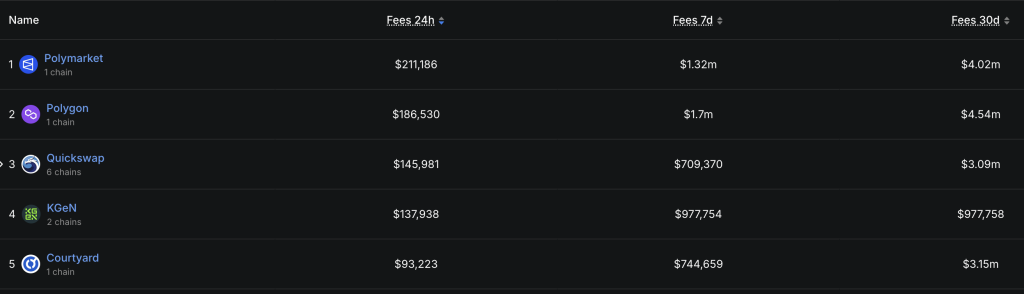
Polygon just pulled off something no one saw coming. It flipped Ethereum in daily transaction fees. For the first time ever.
On Friday alone, Polygon brought in about $407,100 in fees. Ethereum? Around $211,700. That is almost double.
Activity on Polymarket has exploded, and prediction markets are suddenly turning into serious revenue engines.
- Polygon generated $407,100 in daily fees, surpassing Ethereum’s $211,700 for the first time.
- Polymarket drove the surge with $15 million wagered on a single Oscars betting category.
- The platform accounted for over $1 million in generated fees on the Layer 2 network in just seven days.
What Is Driving the Fee Flip?
The reason is simple, Polymarket. Oscars pulled in serious retail flow, with more than $15 million wagered on a single category over the weekend.
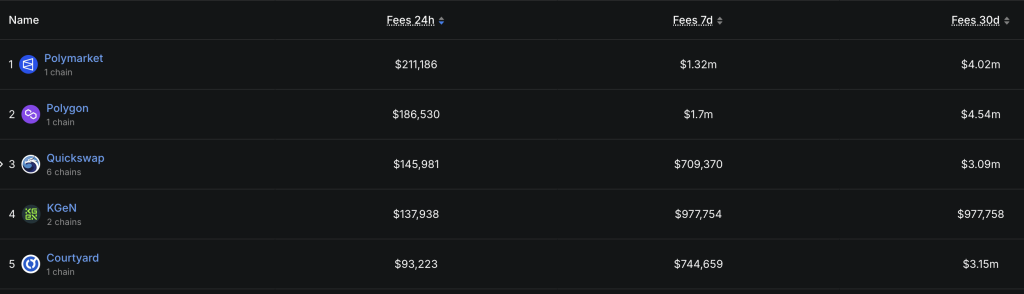
Polygon did not climb the fee charts by accident. Almost all of the recent growth came from Polymarket activity, which generated over $1 million in network fees in just a week.
Compared to Polymarket, the next biggest app on Polygon barely made a dent.
Polygon vs Ethereum: The Numbers Behind the Shift
Over the weekend, Polygon briefly pulled ahead in daily fees before the gap tightened again, with both chains trading blows within a narrow range.
Polygon just hit an all-time high in daily USDC transactions
And it's not even close.
12M+ daily USDC txs on Polygon
Every other chain? Below 3MBase, Arbitrum, Ethereum Mainnet barely register pic.twitter.com/SVlf5ci2xm
— Leon Waidmann (@LeonWaidmann) February 17, 2026
The reason is practical. Cost. Polygon transactions average around $0.0026. On Ethereum, you are looking at roughly $1.68. If you are placing multiple small bets or making quick moves, that difference matters. A lot.
Lower fees mean more volume. More volume means more revenue. It is that simple.
At the same time, Ethereum is dealing with its own narrative pressure after large whale movements added volatility concerns. So while Ethereum remains dominant structurally, Polygon is proving that consumer driven activity can shift revenue flows quickly.
The post Polygon Flips Ethereum in Daily Fees as Polymarket Oscar Betting Hits $15M appeared first on Cryptonews.


Crypto fear drops below zero on Matrixport index, hinting selling pressure may be exhausted and a reversal could be near.
Bitcoin sentiment has dropped to its most pessimistic levels in years, with Matrixport’s proprietary Greed and Fear Index signaling that selling pressure may be nearing exhaustion.
The financial services firm suggested in its most recent analysis that the market could be approaching a turning point, even as prices face continued short-term uncertainty.
Sentiment Plummets to Multi-Year Lows
In a chart published on February 17, Matrixport revealed that its Greed and Fear Index has fallen below zero on its 21-day average, a zone that in past cycles appeared close to price floors.
The model tracks changes in positioning and volatility, and earlier instances of similar readings often occurred shortly before markets stabilized. The note added that prices could still drop further before any recovery, though historically such pessimistic sentiment often coincided with what it called “attractive” entry periods.
“Given the cyclical relationship between sentiment and Bitcoin price action, the latest reading suggests the market may be approaching another inflection point,” the company stated.
Matrixport also pointed out that traders needed to be careful, with the current environment demanding they “sharpen” their focus in preparation for “conditions that typically precede a meaningful rebound.”
And their call isn’t without merit if observable signals like institutional flows are anything to go by. According to Lookonchain, Bitcoin investment products recorded another week of outflows, with $380 million exiting in the last seven days. In that time, BlackRock’s IBIT hemorrhaged 3,538 BTC, closely followed by Fidelity, which saw over 2,000 BTC worth upwards of $143 million withdrawn.
Additionally, while BTC was trading around the $68,000 level at the time of writing, barely slipping in the last 24 hours, the king cryptocurrency is down nearly 3% on the week, with steeper drops on longer timeframes, including a 28% collapse over 30 days and a more than 40% decline across the past six months, per data from CoinGlass.
You may also like:
Derivatives Contraction Signals
Matrixport’s analysts aren’t the only ones who’ve noticed the mood of trepidation in the market. Earlier in the month, Alternative.me’s widely followed Fear and Greed Index told a similar story, dropping to its lowest level since 2019, after Bitcoin shaved about $30,000 from its price in less than ten days.
Interestingly, data shared earlier today by analyst Darkfost pointed to another pressure point. According to them, open interest across exchanges has been shrinking steadily since the October 2025 market top, with positions on Binance down about 39% and declines of approximately 33% on Bybit and 24% on BitMEX.
“This environment indicates that investors are actively reducing exposure, cutting risk, or being forced out through liquidations driven by ongoing volatility,” Darkfost explained. “Under these conditions, it is difficult to envision Bitcoin stabilizing sustainably and reigniting a bullish trend in the short term.”
SECRET PARTNERSHIP BONUS for CryptoPotato readers: Use this link to register and unlock $1,500 in exclusive BingX Exchange rewards (limited time offer).

In 2026, documents are no longer passive records. They are high-value operational assets. Invoices dictate cash velocity. Contracts determine legal exposure. KYC forms influence compliance posture. Insurance claims impact profitability. Regulatory filings define reputational stability. Yet most enterprises still rely on rule-based OCR tools that fail to understand context, interpret intent, or scale with unstructured data growth.
According to industry research from Mordor Intelligence: The global Intelligent Document Processing market is growing rapidly due to AI adoption, automation demand, and regulatory pressures. Similarly, Fortune Business Insights projects significant expansion of IDP across BFSI, healthcare, and logistics: This transformation is not incremental. It is structural. Partnering with a Top Intelligent Document Processing Company is no longer an operational decision; it is a strategic one.
Modern Intelligent Document Processing Solutions combine:
- Artificial Intelligence (AI)
- Machine Learning (ML)
- Natural Language Processing (NLP)
- Large Language Models (LLMs)
- Computer Vision
- Robotic Process Automation (RPA)
- Workflow orchestration
The result? A self-optimizing document lifecycle engine that extracts, validates, interprets, and routes information autonomously.
What is Intelligent Document Processing (IDP)?
Enterprise Intelligent Document Processing is an AI-driven automation framework that transforms document-heavy workflows into structured, validated, and decision-ready intelligence streams.
Unlike traditional OCR which captures text without understanding, AI-Based Intelligent Document Processing Solutions interpret relationships, intent, risk signals, and contextual meaning within documents. According to Gartner, IDP combines:
- Artificial Intelligence (AI)
- Machine Learning (ML)
- Optical Character Recognition (OCR)
- Natural Language Processing (NLP)
- Analytics
To convert structured and unstructured documents into reliable business data, thus reducing manual effort while accelerating enterprise decision cycles.
How a Leading Intelligent Document Processing Company Delivers Value
Capture Seamlessly
Documents are ingested across omnichannel inputs email, APIs, mobile uploads, cloud repositories, scanners, and enterprise applications. Advanced pre-processing enhances image quality, ensuring the accuracy of downstream extraction.
Extract Intelligently
Using computer vision and domain-trained models, the platform extracts:
- Structured fields
- Multi-level tables
- Handwritten inputs
- Clause-level intelligence
Models continuously self-improve through feedback loops, reducing template dependency and manual retraining.
Interpret Context
LLMs and NLP engines evaluate semantic meaning, detect anomalies, identify contractual risk, and distinguish between similar data elements while maintaining explainability and traceability.
Validate Dynamically
Data is cross-validated against ERP, CRM, compliance rules, and external databases. Confidence thresholds and rule engines ensure only high-integrity data proceeds downstream.
Orchestrate Autonomously
Integrated with RPA and workflow engines, the system routes documents, triggers actions, and escalates exceptions using intelligent human-in-the-loop (HITL) controls.
Generate Decision Intelligence
Modern Intelligent Document Processing Solutions go beyond extraction; they deliver:
- Automated contract summaries
- Fraud pattern detection
- Cross-document analysis
- Conversational document querying
Why Enterprise Intelligent Document Processing is Dominating 2026
- The Explosion of Unstructured Data
Industry reports consistently highlight that most enterprise data remains unstructured. Emails, PDFs, contracts, ESG disclosures, and scanned forms contain high-value insights but lack structured formatting.
Persistence Market Research forecasts continued enterprise adoption of IDP technologies for unstructured data management. A leading Intelligent Document Processing Company transforms unstructured chaos into structured intelligence in real time.
- Regulatory Complexity & Compliance Automation
Regulatory frameworks such as financial compliance mandates, healthcare documentation rules, and data protection standards are increasing globally. Organizations are adopting Enterprise Intelligent Document Processing to ensure:
- Complete audit trails
- Automated validation
- Reduced human error
- Secure data handling
AIIM’s industry survey shows enterprises accelerating IDP adoption beyond basic automation into compliance and governance applications. Compliance is no longer reactive. It is algorithmically enforced.
- Generative AI Is Transforming Document Intelligence
The integration of LLMs into document workflows is redefining how enterprises interact with data. Gartner research on Generative AI’s impact on document processing highlights how AI models are enhancing contextual understanding and reasoning. Modern AI-Based Intelligent Document Processing Solutions now enable:
- Automated contract summarization
- Risk clause identification
- Conversational document querying
- Compliance gap analysis
- Executive-ready reporting
Documents are becoming interactive intelligence systems.
- Operational Efficiency & Cost Optimization
Expert Market Research projects continued market growth driven by cost-reduction initiatives and automation acceleration. Organizations implementing Enterprise Intelligent Document Processing commonly report:
- Reduced processing time
- Lower operational costs
- Improved SLA adherence
- Faster decision cycles
- Reduced fraud exposure
This is operational leverage at scale.
Our Intelligent Document Processing Solutions
As a leading Intelligent Document Processing Company, we engineer enterprise-grade platforms built for scale, security, and performance.
AI-Powered Document Classification
Our Enterprise Intelligent Document Processing platform auto-classifies:
- Invoices vs. Purchase Orders
- KYC vs. onboarding forms
- Claims vs. policies
- Contracts vs. amendments
Models continuously learn and adapt to new document formats.
Advanced Contextual Data Extraction
Unlike static OCR templates, our AI-Based Intelligent Document Processing Solutions extract:
- Multi-level tables
- Financial figures
- Embedded metadata
- Signatures and stamps
- Clause-level intelligence
This capability aligns with multimodal AI advancements described in emerging IDP research.
Generative AI Document Reasoning
We integrate LLM-driven reasoning to deliver:
- Contract summaries in seconds
- Comparative clause analysis
- Risk detection
- Cross-document anomaly identification
- Conversational search interfaces
Enterprise Intelligent Document Processing is evolving into autonomous reasoning engines.
Human-in-the-Loop Governance
Enterprise accuracy demands oversight.
Our Intelligent Document Processing Solutions include:
- Confidence scoring
- Smart exception handling
- Validation workflows
- Continuous retraining
This hybrid AI-human model ensures compliance-grade precision.
Enterprise Integrations & Infrastructure
A top-tier Intelligent Document Processing Company must integrate seamlessly with:
- ERP systems
- CRM platforms
- RPA environments
- Cloud storage
- Hybrid infrastructure
Gartner’s Magic Quadrant resource for IDP vendors demonstrates the increasing enterprise integration maturity of the sector:
Security & Compliance by Design
Security is foundational in our AI-Based Intelligent Document Processing Solutions:
- End-to-end encryption
- Role-based access controls
- Immutable audit logs
- Zero-trust architecture
Enterprise security cannot be an afterthought.
Industry-Specific Impact of Enterprise Intelligent Document Processing
Enterprise Intelligent Document Processing (IDP) is no longer a horizontal efficiency tool; it has evolved into a verticalized transformation engine tailored to the regulatory, operational, and risk dynamics of specific industries. By combining AI-driven extraction, contextual intelligence, validation engines, and workflow orchestration, IDP delivers measurable impact across high-document-volume sectors.
Banking & Financial Services
- Automated KYC verification
- Loan document structuring
- Fraud anomaly detection
- Regulatory audit readiness
Insurance
- Claims data extraction
- Underwriting risk validation
- Policy clause digitization
Healthcare
- Patient onboarding automation
- Medical record digitization
- Insurance eligibility validation
Legal
- Contract lifecycle automation
- Clause-level risk detection
- Due diligence acceleration
Logistics & Supply Chain
- Bill of lading automation
- Three-way invoice matching
- Trade compliance validation
Key Benefits of Choosing a Top Intelligent Document Processing Company
Choosing a leading Intelligent Document Processing Company is not just a technology upgrade; it’s a strategic enterprise transformation decision. High-performing Enterprise Intelligent Document Processing Solutions drive measurable gains in efficiency, financial performance, compliance strength, and scalable growth.
- Structural Cost Reduction
Automation reduces manual review dependency and operational overhead.
- Accelerated Processing Cycles
Straight-through processing eliminates bottlenecks and improves customer responsiveness.
- Higher Data Accuracy
Continuous model training reduces correction rates and increases confidence scores.
- Embedded Compliance Governance
Validation engines and audit logs reduce regulatory exposure.
- Enterprise-Grade Scalability
Cloud-native, API-driven architecture scales across geographies and departments.
- Real-Time Decision Intelligence
Structured document data feeds dashboards, analytics, and AI models instantly.
2026 Trends Shaping the Future of IDP
Intelligent Document Processing is rapidly evolving from a tactical automation tool into a strategic enterprise intelligence layer powered by AI, generative reasoning, and autonomous workflows. Multiple industry sources and market analyses show that IDP is transitioning from static extraction toward adaptive, context-aware, and integrated intelligence systems.
- Multimodal AI Unlocks Next-Gen Document Understanding
Modern IDP platforms combine computer vision, NLP, and deep learning to interpret text, layout, images, tables, and handwritten inputs simultaneously. This enables systems to understand both structure and meaning across complex, multi-format documents. The result is higher automation accuracy and contextual intelligence beyond traditional OCR limitations.
- Intelligent, Agentic Reasoning Engines
IDP is evolving into an AI-driven reasoning layer that not only extracts data but also evaluates context, detects risk, and recommends actions. By embedding large language models and validation logic, platforms can autonomously interpret intent and support decision-making. Documents are no longer processed; they are analyzed and reasoned over.
- Zero-Touch & Autonomous Workflow Orchestration
Organizations are adopting zero-touch workflows where high-confidence documents move through validation and system updates without human intervention. Confidence scoring, real-time rule checks, and intelligent exception routing minimize manual review. This dramatically reduces cycle times while preserving governance and auditability.
- Regulatory & ESG Reporting Automation
With the expansion of global compliance mandates, IDP is increasingly used to extract, validate, and structure regulatory and ESG disclosures. Automated audit trails and rule-based verification improve transparency and reporting accuracy. This capability is becoming essential for risk management and corporate accountability.
- Cloud-First & Integrated Enterprise Architectures
Cloud-native IDP deployments offer elastic scalability, global accessibility, and seamless integration with ERP, CRM, and automation platforms. API-driven connectivity enables real-time data exchange across enterprise ecosystems. IDP is shifting from a standalone tool to a foundational layer within intelligent automation stacks.
Why Choose Us as Your Intelligent Document Processing Company?
Our Intelligent Document Processing Solutions are built on:
AI-First Architecture
Built from the ground up with artificial intelligence at its core, enabling adaptive learning, contextual understanding, and long-term scalability. This ensures smarter automation that evolves with your business.
Domain-Trained Enterprise Models
Industry-specific AI models designed to understand complex documents in regulated sectors. They deliver higher accuracy, reduced risk, and minimal manual intervention.
Generative AI Reasoning
Advanced AI that not only extracts data but also interprets intent, summarizes content, and identifies risks. It transforms documents into actionable intelligence.
Secure, Scalable Infrastructure
Enterprise-grade architecture with robust security, compliance controls, and cloud scalability. Designed to handle high volumes while maintaining resilience and governance.
Dedicated AI Architects
Expert AI strategists who align automation with your business objectives and continuously optimize performance. We act as long-term transformation partners, not just vendors.
Continuous Optimization
Ongoing monitoring, model refinement, and workflow enhancement to maximize ROI. Your automation improves over time as business needs evolve.
The Autonomous Enterprise Starts Here
The document-heavy enterprise of the past cannot thrive in an AI-driven economy where speed, intelligence, and adaptability define market leaders. A Top Intelligent Document Processing Company transforms static documents into actionable intelligence, operational friction into measurable velocity, and compliance complexity into strategic strength.
Modern Enterprise Intelligent Document Processing now serves as the core digital infrastructure powering automation, real-time insight, governance control, and data-driven decision-making at scale. Organizations that embed IDP deeply within their workflows accelerate performance, reduce risk exposure, and unlock sustainable growth.
The question is no longer whether to adopt IDP but how fast you can deploy it. Partner with Antier to build a secure, future-ready foundation for an autonomous enterprise.


Authorities in Russia’s Republic of Dagestan have opened a criminal investigation against a local man suspected of financing terrorism, the state news agency TASS reported.
Summary
- Russian authorities have opened a criminal case against a Dagestan resident suspected of financing terrorism, according to TASS.
- Investigators in Makhachkala allege the man provided funds or material support linked to extremist activity, though specific details have not been disclosed.
- The case comes amid heightened global scrutiny of cryptocurrency’s potential role in illicit finance, as the EU moves to tighten restrictions on Russian crypto-related transactions.
Russian arrested as scrutiny grows over crypto and terror financing
The case was initiated by investigators in Makhachkala, the region’s capital, where a man is accused of providing funds or material support that could have been used to assist extremist activities. The move reflects ongoing efforts by Russian law enforcement to clamp down on suspected financial networks linked to terrorism.
According to the TASS report, specific details about the actions that triggered the probe have not been disclosed publicly, but the initiation of a formal criminal case indicates that authorities believe there are sufficient grounds to pursue charges.
The suspect is currently under investigation while law enforcement continues to gather evidence.
Russia has been actively investigating and prosecuting individuals and groups accused of involvement in terrorism-related activity, particularly in the North Caucasus region where separatist and extremist networks have historically been a concern for federal authorities. Previous high-profile terrorism cases have drawn significant media attention and have often involved complex financial structures alleged to support violent acts.
The investigation comes amid heightened global attention on the role cryptocurrencies can play in illicit finance. Law enforcement agencies in Europe and elsewhere have increasingly warned that digital assets, particularly when routed through opaque or loosely regulated services, can create opportunities for money laundering, sanction evasion, and covert transfers.
This dynamic has placed crypto transactions under close watch by both national security and financial regulators.
Meanwhile, the European Union is preparing a sweeping ban on cryptocurrency transactions involving Russian entities as part of its latest sanctions package, aiming to close loopholes that allowed sanctioned actors to shift value via digital asset service providers.

The head of the Germany Bundesbank is now openly backing euro based crypto stablecoins and even a retail CBDC. That is a big shift.
Joachim Nagel is not framing this as optional. He says Europe needs these tools to protect itself from the dominance of the US dollar.
The tone has changed from cautious to urgent. With the EU pushing ahead on MiCA rules, Europe clearly does not want to fall behind the US in shaping the future of digital money.
- Strategic Pivot: Bundesbank President Nagel backs private stablecoins to reduce cross-border payment costs and bolster EU financial independence.
- Monetary Sovereignty: The move aims to counter the dominance of USD-pegged assets, which currently control the majority of the stablecoin market.
- Wholesale Innovation: Nagel specifically highlighted wholesale CBDCs for enabling programmable payments between financial institutions.
Why Is The Germany Bundesbank Pushing for Crypto Adoption Now?
This is not just policy talk. It is about control of the digital payment rails. Speaking in Frankfurt, Nagel made it clear that Europe needs to secure its own settlement infrastructure before it falls further behind.

Dollar backed stablecoins already command more than $310 billion in market value. Euro based liquidity is tiny in comparison. That gap worries regulators. Without a serious alternative, Europe risks drifting into what some call digital dollarization.
And the clock is ticking. The US is moving quickly on stablecoin legislation, which could lock in dollar dominance even deeper. Nagel stance reflects a push to protect monetary sovereignty before the balance tilts too far.
The Blueprint: Programmable Money and Wholesale CBDCs
Nagel drew a clear line between retail tools and banking infrastructure. For institutions, he favors a wholesale CBDC that would let banks settle programmable payments directly in central bank money. That is something traditional systems simply cannot do today.
For the private sector, he is more open to stablecoins. He acknowledged that euro denominated stablecoins could offer cheap and efficient cross border payments for both individuals and businesses.
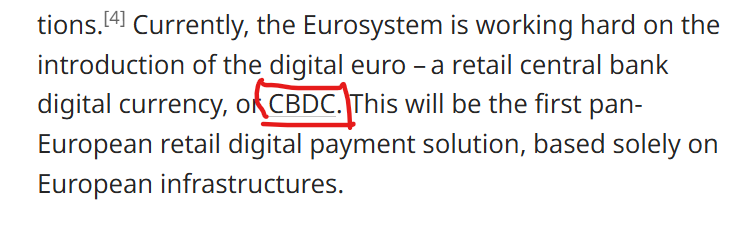
The tone is noticeably different from recent warnings about the risks of foreign stablecoins dominating the system. Now the focus is on building competitive euro based options instead of just sounding the alarm. It shows how quickly the global conversation around digital payments is evolving.
Can the Euro Compete with the Dollar?
The upside is huge if Europe actually follows through. S&P Global Ratings estimates euro pegged stablecoins could reach €570 billion by 2030 under normal adoption trends. That is not niche. That is systemic scale.
LATEST: — CoinMarketCap (@CoinMarketCap) February 4, 2026
 Euro-pegged stablecoins could explode 1,600x to €1.1 trillion by 2030 as 11 European banks prepare to launch a joint euro stablecoin in late 2026, according to S&P Global Ratings. pic.twitter.com/aO5faRR287
But regulation cuts both ways. MiCA gives Europe clearer rules than the US right now, yet strict capital requirements could slow innovation if applied too aggressively.
At the same time, political scrutiny around foreign digital assets is rising everywhere. The fight over stablecoin dominance will not just play out on chain. It will unfold in legislative chambers too.
The key is timing. Both the US and Europe are moving on final rules. A digital Euro is no longer theoretical. The only question left is how quickly it rolls out.
The post Germany Central Bank President Endorses Crypto Stablecoins Under EU MiCA Framework appeared first on Cryptonews.
Crypto World
Crypto slides as tech stocks and gold retreat; bitcoin-Nasdaq correlation turns positive


The crypto market continued to exhibit weakness on Tuesday morning, broadly following a tech selloff across U.S. equities and a correction in the price of precious metals.
Bitcoin trades at $68,000, down 1.25% since midnight UTC, while Nasdaq futures and gold lost 0.55% and 2.4% respectively over the same period.
Altcoins also lost ground as popular memecoins PEPE, DOGE and TRUMP led the drawdown, losing between 3.5% and 4.5%.
The tech selloff has been driven by fears around artificial intelligence and how it might disrupt several industries. Bitcoin has been closely tied to Nasdaq since Feb. 3, with the correlation coefficient indicator rising from negative 0.68 to positive 0.72 over the past two weeks.
Gold, meanwhile, is currently trading at $4,928 after failing to establish a level of support above $5,000. The precious metal hit a record high of $5,600 on Jan. 28 before a historic 21.5% correction over the subsequent four days.
Derivatives positioning
- Crypto futures continue to see capital outflows. The cumulative industry wide notional open interest has declined by 1.5% to $93 billion in 24 hours, reaching fresh multi-month lows.
- Leveraged bets worth $229 billion have been liquidated by exchanges over 24 hours, with longs (bullish plays) accounting for most of the tally.
- Open interest in DOGE futures has declined by 4%, leading the trend in most majors. PEPE, LINK and AVAX have seen 3% to 5% declines in open interest.
- Open interest in futures tied to HYPE, the recent outperformer, has cooled to 44.45 million HYPE, the lowest since early December. This likely reflects profit-taking after the token outpeformed bitcoin and other majors during the recent crash.
- The market panic has ebbed, as evidenced from the sharp pullback in bitcoin and ether’s implied volatility indices from monthly highs.
- On Deribit, bitcoin and ether puts continue to trade pricier than calls, indicating lingering downside fears, however, the positioning is now longer as defensive as it was two weeks ago.
Token talk
- Altcoins continue to track bitcoin on as the “bitcoin dominance” metric has now ranged between 57.4% and 60.1% since September.
- Over the past seven days AI token MORPHO has posted a 23.5% gain, while privacy coin zcash is up by 19% over the same period.
- Conversely, layer 1 blockchain token layer zero (ZRO) has lost 16% over the past week as it continues to lose momentum after announcing a deal to collaborate with Citadel Securities and DTCC.
- The relative weakness of several altcoins continues to persist on lower time frames, with HYPE, SUI and ASTER all losing between 3% and 4.8% since midnight UTC as the crypto market awaits a bullish catalyst.


Congress races to finalize US crypto market rules as Trump-backed bill nears passage, splitting SEC–CFTC powers and setting deadlines on exchanges and stablecoins.
Summary
- Trump says crypto market structure bill S. 3755/H.R. 3633 could pass soon, cementing a split between SEC and CFTC oversight with a 180-day exchange registration window.
- Senate Agriculture and Banking Committees must reconcile their drafts before a Feb. 28 White House stablecoin framework deadline, after a narrow 12–11 committee vote.
- The bill would give CFTC primacy over Bitcoin and Ethereum, mandate joint CFTC–SEC rulemaking within 18 months, and comes amid calls to probe Trump-linked token WLFI.
President Donald Trump confirmed that comprehensive cryptocurrency market structure legislation is approaching passage, according to recent statements from the administration.
The legislation, identified as S. 3755/H.R. 3633, would formally divide regulatory oversight between the Securities and Exchange Commission for securities and the Commodity Futures Trading Commission for commodities. The framework includes provisions for provisional registration of exchanges within 180 days of enactment.
The House of Representatives passed the Digital Asset Market Clarity Act in July, establishing a framework that splits oversight responsibilities between the CFTC and SEC. The Senate has presented the primary obstacle to advancement.
In late January, the Senate Agriculture Committee advanced the Digital Commodity Intermediaries Act by a vote of 12 to 11, according to committee records.
Industry participants, including cryptocurrency exchange Coinbase, have criticized earlier versions of the legislation, stating the drafts imposed excessive restrictions on decentralized finance protocols and stablecoin regulations.
CFTC launches CEO Innovation Council for crypto oversightUnder the proposed framework, the CFTC would assume primary regulatory authority over digital commodities including Bitcoin and Ethereum. The legislation provides brokers and exchanges a 180-day registration window to obtain provisional status following enactment.
CFTC Chairman Michael Selig has indicated the bill could reach the President’s desk within months, according to public statements. The framework would require joint SEC and CFTC rulemaking within 18 months to address complex areas including mixed transactions and margin structures.
The Senate Banking Committee must reconcile its version with the Agriculture Committee’s draft before the February 28 White House deadline for stablecoin frameworks, according to congressional schedules.
Congressional leaders continue to call for investigations into Trump-linked cryptocurrency ventures, including WLFI, according to statements from members of Congress.

Stocks to Watch Tuesday: Warner, Danaher, Masimo, Medtronic

Ethereum price under pressure as ETF outflows align with extreme fear index

The House | LGBT History Month allows us to reflect on how far we’ve come, but hate crime is on the rise again


-

 Sports5 days ago
Big Tech enters cricket ecosystem as ICC partners Google ahead of T20 WC | T20 World Cup 2026
-

 Tech6 days ago
SpaceX’s mighty Starship rocket enters final testing for 12th flight
-

 Video20 hours ago
Bitcoin: We’re Entering The Most Dangerous Phase
-

 Tech2 days ago
Luxman Enters Its Second Century with the D-100 SACD Player and L-100 Integrated Amplifier
-

 Video4 days ago
The Final Warning: XRP Is Entering The Chaos Zone
-
 Tech8 hours ago
The Music Industry Enters Its Less-Is-More Era
-

 Crypto World7 days ago
Blockchain.com wins UK registration nearly four years after abandoning FCA process
-

 Crypto World3 days ago
Bhutan’s Bitcoin sales enter third straight week with $6.7M BTC offload
-
 Crypto World6 days ago
Pippin (PIPPIN) Enters Crypto’s Top 100 Club After Soaring 30% in a Day: More Room for Growth?
-

 Video5 days ago
Prepare: We Are Entering Phase 3 Of The Investing Cycle
-

 Crypto World3 hours ago
Can XRP Price Successfully Register a 33% Breakout Past $2?
-
 NewsBeat2 days ago
The strange Cambridgeshire cemetery that forbade church rectors from entering
-

 Business5 days ago
Barbeques Galore Enters Voluntary Administration
-

 Sports9 hours ago
GB's semi-final hopes hang by thread after loss to Switzerland
-

 Crypto World6 days ago
Crypto Speculation Era Ending As Institutions Enter Market
-
 Crypto World5 days ago
Ethereum Price Struggles Below $2,000 Despite Entering Buy Zone
-

 Politics7 days ago
Why was a dog-humping paedo treated like a saint?
-
 NewsBeat2 days ago
Man dies after entering floodwater during police pursuit
-

 Crypto World3 days ago
BlackRock Enters DeFi Via UniSwap, Bitcoin Stages Modest Recovery
-

 NewsBeat3 days ago
UK construction company enters administration, records show