
Crypto World
NYSE parent may invest again in Polymarket as valuation crosses $20B: report



Intercontinental Exchange has signaled it may put more money into Polymarket’s next funding round after building a $1.64 billion stake in the prediction market platform.
Summary
- ICE may invest in Polymarket again after building a $1.64 billion stake by March.
- Polymarket is seeking fresh capital at a valuation above $20 billion.
- ICE CEO Jeff Sprecher said the investment relationship centers on exchanging information and expertise.
- Sprecher said perpetual futures do not fit ICE’s core hedging client base.
Bloomberg reported Thursday that ICE Chief Executive Officer Jeff Sprecher said the New York Stock Exchange parent would consider participating if its involvement could help Polymarket complete the round.
“We’ll look at it, if it would help the round in order to have our imprimatur on it, we are always interested,” Sprecher told Bloomberg Television.
ICE may join Polymarket’s new funding round
Polymarket is seeking fresh capital at a valuation above $20 billion, according to Bloomberg, more than twice the valuation attached to the company in October. The report said the platform has continued to draw investor interest as prediction markets expand across sports, politics, geopolitics and other event based contracts.
ICE has already participated in two Polymarket funding rounds, with Bloomberg putting the exchange operator’s stake at $1.64 billion by March. Sprecher said the relationship was designed partly to allow the companies to exchange information and expertise, instead of turning ICE into a regular investor in technology startups.
As crypto.news reported in March, ICE invested another $600 million in Polymarket as part of a previously announced commitment of up to $2 billion. ICE said at the time that the investment was not expected to have a material effect on its financial results or capital return plans.
“The reality is we’re not a venture firm,” Sprecher said Thursday, describing the Polymarket investment as a relationship built around the “transfer of information and expertise.”
The distinction is important to ICE’s approach, according to Sprecher, because the company operates some of the world’s largest financial exchanges and clearing businesses and does not plan to build a portfolio of venture investments simply because technology companies are attracting capital.
Polymarket, meanwhile, has continued adding infrastructure around its prediction market business. A March report on Polymarket’s Brahma acquisition detailed its purchase of the DeFi infrastructure startup after earlier acquisitions of QCEX and Dome. The report said the transactions added U.S. regulatory access, developer infrastructure and onchain execution capabilities to Polymarket’s operations.
Prediction markets are drawing more institutional capital
Prediction markets have attracted more attention since the 2024 U.S. presidential election, Bloomberg reported, as traders increasingly use yes or no contracts to speculate on outcomes ranging from elections and sporting events to geopolitical developments.
Investor money has followed that activity. Polymarket is now seeking funding at a valuation above $20 billion, while rival Kalshi has also completed major fundraising rounds as both companies compete for traders and distribution partnerships.
Robinhood Markets has become another major participant in the sector. During the same Bloomberg Television coverage, Chief Executive Officer Vlad Tenev said prediction markets should remain under federal supervision through the Commodity Futures Trading Commission, not individual state regulators.
The question has become increasingly important as several states attempt to apply their own rules to sports and election linked contracts. According to Bloomberg, some state authorities contend that certain contracts should fall under state gambling or gaming laws, while prediction market companies have argued that federally regulated event contracts belong under the CFTC.
A July report on North Carolina’s new law showed one state taking the federal route. Governor Josh Stein signed legislation recognizing CFTC authority over prediction markets and allowing federally registered platforms, including Kalshi and Polymarket, to operate in the state from 2027. The law also imposed a 6% state tax on trading fee revenue generated by the platforms.
State challenges keep the CFTC fight active
Other states have continued to challenge prediction market operators, leaving courts to consider how federal derivatives law interacts with state gambling powers.
Tenev told Bloomberg that he expects event contracts to remain a viable business even if the jurisdictional fight eventually reaches the U.S. Supreme Court and the court gives states more control over some products.
“I don’t think it’s going to be, ‘prediction markets are gone,’” Tenev said. He added that a legal ruling could establish a boundary that would require companies such as Robinhood to adapt their offerings.
The dispute has already produced different regulatory approaches across the country. North Carolina has explicitly recognized federal oversight, while lawsuits and enforcement actions elsewhere have challenged sports related contracts offered through federally regulated platforms.
Alongside prediction markets, the CFTC has also started allowing new forms of crypto derivatives to enter regulated U.S. venues.
In May, Kalshi received approval to launch the first regulated Bitcoin perps in the United States. The same report said Coinbase received a no action letter allowing certain crypto perpetual futures products to use Bitcoin, Ether and stablecoins as collateral.
The approvals have created another point of comparison between newer crypto trading products and the traditional futures contracts offered by established derivatives exchanges.
ICE remains cautious on perpetual futures
Perpetual futures became another focus of Sprecher’s interview after President Donald Trump said earlier this week that U.S. regulators were working on a route to bring Hyperliquid into the country in a fully compliant form.
Hyperliquid is best known for perpetual futures, leveraged derivatives that allow traders to take positions on crypto and other asset prices without an expiration date. Bloomberg reported that the product category has moved outside its long standing crypto use case, particularly during the Iran war.
During periods when traditional oil futures venues operated by CME Group and ICE were closed, Bloomberg said perpetual contracts became one of the available ways for investors to trade oil exposure.
Sprecher said ICE is not currently pursuing the products because the company’s core derivatives customers primarily use futures for hedging. Traditional futures contracts with different expiration dates also produce a forward pricing curve that companies can use to manage future costs and prices, while perpetual contracts do not create the same structure.
“Our client base is really a hedging client base, and there’s no forward pricing curve that is created by a perpetual future,” Sprecher told Bloomberg.
For ICE, Sprecher said the product does not fit the customers the exchange primarily serves, describing perpetual futures as “really a speculative” product that “doesn’t cater to our distribution or client base.”


We are squarely in a longevity boom, and the field is now well established as serious science. But we are still near the beginning. Right now, there is no proven longevity drug you can take to make yourself live longer. (That we know of: Nir Barzilai, who thinks some existing drugs could be repurposed as longevity-boosting treatments, is eager to change that.) Some things are within your control, however. You can exercise, like Yamanaka; build muscle, which Dr. Gabrielle Lyon calls the “organ of longevity”; and strengthen your social ties, which Dr. Robert Waldinger has learned are crucial from directing the world’s longest study of human happiness. TIME’s 12 Longevity Leaders know that all of these approaches—medical, physical, social—are key in the quest to live as well as possible for as long as possible.
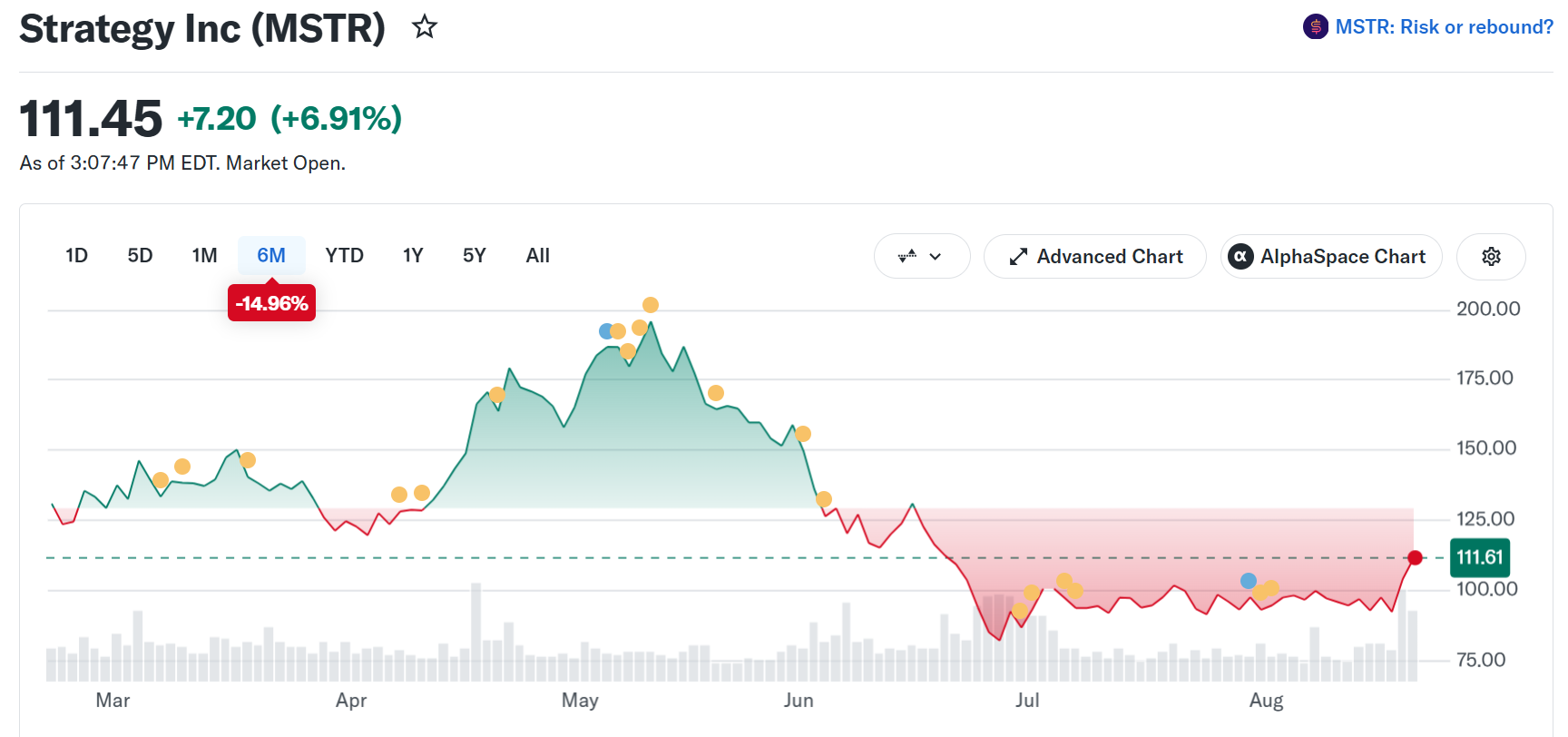
Strategy, the company once called MicroStrategy (MSTR), rose 6.9% to $111.14 on Thursday afternoon. That is its best price since June 18, which wipes out a two-month slide.
The stock market has forgiven the company. The balance sheet has not. MicroStrategy’s Bitcoin is still worth billions less than it paid.

How MicroStrategy Clawed Back Two Months
MSTR traded at $111.45 as of 3.05 p.m. ET, up 6.91% from Wednesday’s $104.25 close. The shares had bottomed at $81.81 in late June.
That is a 35.9% climb off the floor. July never produced a close above $101.95, so Thursday’s move clears the whole summer.
The fuel came from Bitcoin topping $70,000, marking the first time in 78 days. The token had not held that level since early June.
Two decisions in Washington did the heavy lifting. On Wednesday the Treasury doubled the size of its long-end bond buybacks. Each operation will now buy at least $4 billion from Sept. 9.
A day earlier, the Securities and Exchange Commission (SEC) proposed Regulation Crypto Assets. The rule would let crypto firms raise up to $75 million a year without full registration.
Short sellers were caught out. Traders covered roughly $1.5 billion of bearish bets, including $700 million inside one minute.
“…a quiet form of quantitative easing, a move that weakens the dollar and sends scarce, debasement-hedge assets like Bitcoin higher,” Matt Mena, crypto research strategist at 21Shares, on the Treasury move.
Follow us on X to get the latest news as it happens
The Bitcoin Stack is Still Underwater
Strategy holds 840,447 bitcoin. It paid an average $75,385 per coin, or $63.36 billion in total, according to its own ledger.
At $69,803 that pile is worth $58.67 billion. So the company sits about $4.69 billion in the red. Bitcoin has to rise another 8% before the treasury breaks even.
The gap already forced a change of habit. Strategy bought its first 21,454 coins on August 10, 2020, paying $11,652 each. The ledger records no sales at all until this year.
Then came four of them. The company sold 6,916 bitcoin between June 30 and August 10, at prices from $59,256 to $64,262. Measured against its average cost, that booked roughly $92 million in real losses on less than 1% of the stack.
The paper damage is far larger. Strategy reported an $8.22 billion second quarter net loss in July. It has also paused new bitcoin buying, raising $333.7 million last week without adding a single coin. In February, management spelled out its own breaking point in a deep bitcoin crash.
Which Crypto Stocks Really Got Back to June
The rebound was broad, but it was not equal.

BitMine, an ether treasury company, leads the group by a wide margin. Circle has climbed back above its June 18 level.
Coinbase beat every June close, yet it trails its July 21 peak of $175.85. Bitdeer is the outlier. The miner rose 8.57% and stays 41.7% below June.
The split is telling. Money returned to the treasury companies and the exchanges, which move with bitcoin most directly. It has not returned to the miners.
Big investors were already positioned. Twelve of the 15 largest MSTR institutional holders added shares in the second quarter, while the stock was falling.

“it’s a compelling time for investors with longer-term horizons to be allocating to Bitcoin and the crypto asset class,” said Zach Pandl, head of research at Grayscale.
One number decides whether this holds. Bitcoin must reach $75,385 for Strategy’s treasury to turn green again, and for Michael Saylor to start buying without booking a loss.
The post MicroStrategy Erases 2-Month Loss as Crypto Stocks Rally: Is the Damage Over? appeared first on BeInCrypto.
Disclosure: This article does not represent investment advice. The content and materials featured on this page are for educational purposes only.
XRP liquidity on Binance is declining as prices face resistance, while UE Crypto promotes cloud mining and yield aggregation as alternative return strategies.
Summary
- XRP’s Binance balance slips to 2.62 billion as the token struggles to reclaim $1.07, keeping near-term price gains under pressure.
- With XRP facing volatile trading conditions, investors are exploring cloud mining as an alternative way to seek passive returns.
- UE Crypto highlights cloud mining, multi-asset support, and automated yield services as XRP holders seek diversified income options.
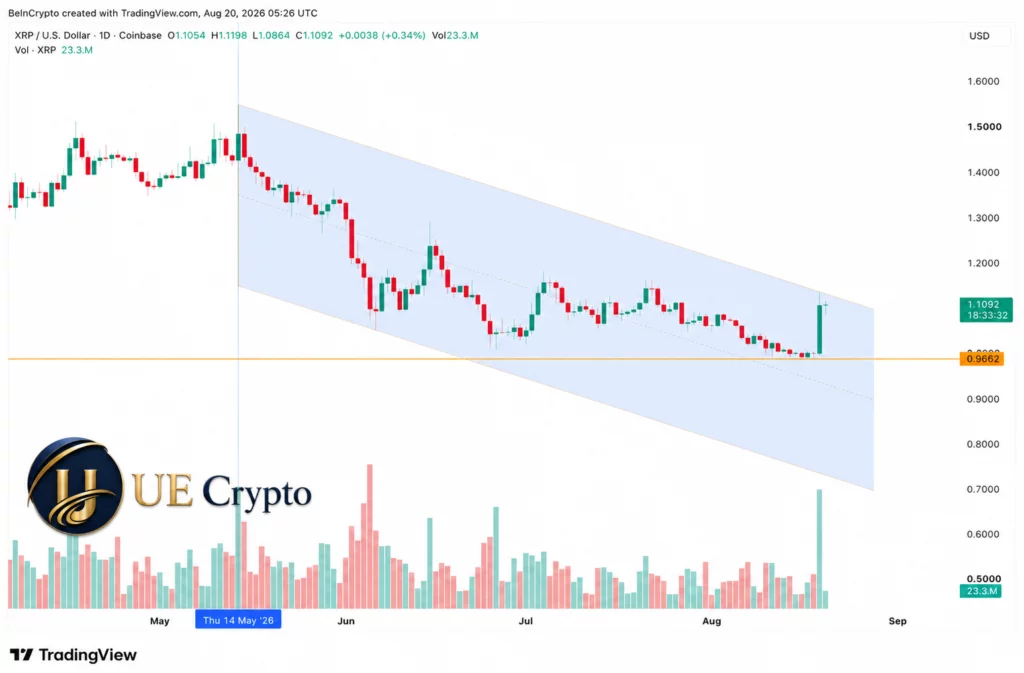
XRP is trading above $1 and continues to decline below key exponential moving averages (EMAs), with the short-term bearish trend remaining in place. The 50-day EMA is at $1.07, the 100-day EMA is at $1.15, and the 200-day EMA is at $1.34. All remain above the current price, indicating that the overall trend remains constrained despite the previous breakout above the descending resistance trendline, with the current breakout price near $1.06.
Momentum remains weak, with the Relative Strength Index (RSI) hovering around 38 and the Moving Average Convergence/Divergence (MACD) remaining below zero, suggesting that downward pressure continues rather than an immediate bullish reversal.
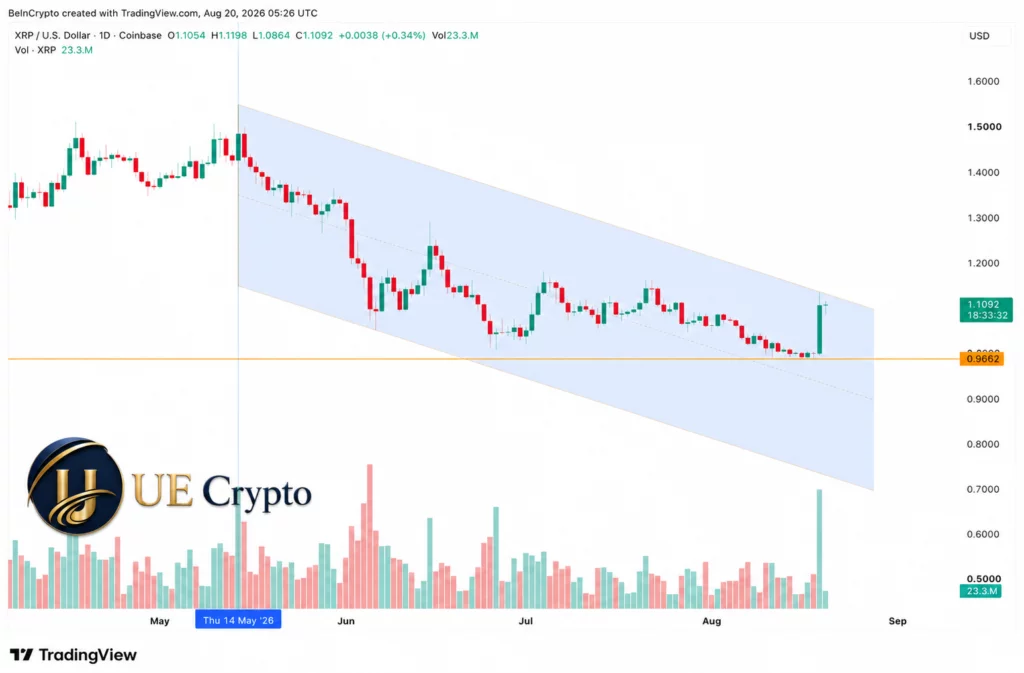
XRP balances on Binance have narrowed slightly to 2.62 billion, indicating declining liquidity. Unless XRP can decisively reclaim the 50-day moving average support level at $1.07, its short-term rally may continue to face selling pressure.
Despite some potentially favorable factors, such as the passage of the CLARITY Act, the market reflects limited expectations for the project’s growth potential amid increased exchange-rate volatility. As a result, more and more XRP investors are turning their attention to UE Crypto’s cloud mining digital asset platform.
Facing selling pressure, UE Crypto’s cloud mining platform is attracting increasing attention from investors who hope to use cloud mining and yield aggregation mechanisms to mitigate market volatility and improve returns.
Recent events and risks
Institutional spot ETF inflows have stalled:
Capital inflows into spot XRP exchange-traded products have stalled, with multiple instances of zero inflows and net asset outflows, leaving the spot market vulnerable to volatility in the absence of sustained institutional buying.
Derivatives leverage unwinding and forced liquidations:
As price action tests and briefly breaks through the key psychological support level of $1.00, forced long liquidations in the perpetual futures market have intensified alongside the expansion of short open interest, further accelerating the intraday downward momentum.
Regulatory friction and stalled legislative catalysts:
Following the U.S. Senate recess, key cryptocurrency framework legislation such as the CLARITY Act failed to pass. Continued uncertainty surrounding the regulatory framework proposed by the U.S. Securities and Exchange Commission has also stalled legislative progress, continuing to suppress broader market risk appetite.
Contraction in on-chain network activity:
During recent trading cycles, transaction throughput and active wallet usage on the XRP Ledger have contracted sharply, indicating declining demand driven by immediate utility, while large deposits of tokens into centralized venues have increased supply pressure.
Meanwhile, an increasing number of digital asset investors are turning their attention to the UE Crypto cloud mining platform, seeking to explore diversified income models through cloud mining and yield aggregation. Although they remain optimistic about XRP’s long-term prospects, the question is whether the impact of short-term price volatility can be effectively reduced while continuing to generate additional returns from their XRP holdings.
Why is UE Crypto increasingly attracting attention?
1. Security and stability
UE Crypto adopts a multi-layer security architecture, integrating technologies from McAfee and Cloudflare and implementing measures such as offline cold wallets to provide comprehensive protection for platform operations and user assets.
2. Environmentally friendly and efficient
The platform’s mining operations utilize renewable energy sources such as solar, wind, and hydropower, aiming to minimize the environmental impact of energy consumption while maximizing computing efficiency.
3. Compliance and transparency
The platform continuously improves its operational standards, data transparency, and user protection mechanisms to provide a clearer and more reliable environment for cryptocurrency services.
4. Smart custody
UE Crypto handles daily operations, computing power management, and yield settlement through professional teams and automated systems, enabling users to easily generate passive income.
5. Multi-currency support
The platform supports a variety of mainstream digital assets, including BTC, ETH, DOGE, SOL, XRP, USDC, LTC, and USDT, providing greater flexibility for different users.
6. Affiliate rewards
The platform offers an affiliate program through which users can earn 3% + 2% referral commissions by inviting friends, with rewards of up to $50,000. Users can increase their passive income even without making any investment.
About UE Crypto’s cloud mining digital asset platform
UE Crypto is headquartered in the United Kingdom and operates within European regulatory frameworks such as MiCA and MiFID II, continuously improving its transparency, operational standards, and user protection mechanisms.
The platform adopts a multi-layer security architecture, including:
- Annual financial and security compliance audits conducted by PwC.
- Digital asset custody insurance provided by Lloyd’s of London.
- Enterprise-grade network protection from Cloudflare and McAfee® security systems.
- Bank-grade data encryption and professional security infrastructure to provide multiple layers of protection for users’ assets and accounts.
How to use UE Crypto?
1. Register an Account
2. Choose a mining package
Choose a suitable cloud mining contract according to a personal budget and needs, and start mining with one click.
3. Start earning
Once the contract is activated, the system will automatically allocate computing power, and returns will be settled automatically every 24 hours. Users can withdraw their earnings at any time or continue participating according to their own needs, thereby achieving long-term compound growth of their assets.
Popular UE Crypto contracts
BTC (Beginner Experience Contract)Investment amount: $100, Contract duration: 2 days,Daily return: $4,Total return at contract expiration: $100 + $8
Dogecoin (DOGE, Digital Intelligent System Contract)Investment amount: $500,Contract duration: 5 days, Daily return: $6.25 ,Total return at contract expiration: $500 + $31.25
BTC (Super Computing System Contract)Investment amount: $1,000,Contract duration: 10 days, Daily return: $13.10 ,Total return at contract expiration: $1,000 + $131
LTC (Algorithm-Driven System Contract) Investment amount: $5,000,Contract duration: 25 days, Daily return: $72,Total return at contract expiration: $5,000 + $1,800
BTC (Quantitative Intelligent System Contract)Investment amount: $10,000,Contract duration: 35 days, Daily return: $158, Total return at contract expiration: $10,000 + $5,530
For more details about the contract plans, please visit the official UE Crypto website.
Overview
XRP’s price surge is facing selling pressure. Despite some potentially favorable factors, such as the passage of the CLARITY Act, the increased exchange-rate volatility reflects the market’s limited expectations for the project’s growth potential.
For long-term XRP investors, in addition to focusing on price trends and market cycles, it is equally important to consider how to reduce the risks associated with relying on a single storage method and explore more diversified digital asset management approaches. UE Crypto aims to create more resilient and sustainable passive income for users through cloud mining, computing power management, renewable energy, and other methods.
Disclosure: This content is provided by a third party. Neither crypto.news nor the author of this article endorses any product mentioned on this page. Users should conduct their own research before taking any action related to the company.

CME Group CEO Terry Duffy told the Commodity Futures Trading Commission (CFTC) it clears contracts that traders can rig. Chairman Michael Selig cut him off and called the claim fake news.
The exchange happened Thursday in Washington, at the first meeting of the CFTC’s Innovation Advisory Committee. Duffy runs the largest futures exchange in the world. Selig regulates it.
2,500 Filings and Zero Objections
Selig built the 35-member committee in February. Its roster includes the chief executives of Kalshi, Polymarket and DraftKings. Thursday’s agenda covered crypto, artificial intelligence and event contracts.
Duffy used his turn to attack the last one.
Roughly 2,500 self-certifications have landed at the agency since January 2025, he said. None were opposed.
Self-certification is the fast lane. An exchange files a contract, attests that it follows the law, and lists it. Nobody has to approve it.
Duffy said some of those filings break core principle 3. That rule bars any contract that traders can readily manipulate.
There is a structural reason few filings get challenged. Selig is the only sitting commissioner at the CFTC. Four of the agency’s five seats are empty.
“We’re not a bunch of carnival barkers at a circus. We are running the most envious markets in the world in the United States of America.”
Follow us on X to get the latest news as it happens
Selig Calls It Fake News, But The Record Is Messier
Duffy raised two cases.
In the first, a Fort Bragg soldier named Gannon Van Dyke turned $33,034 into $409,881 on Polymarket. He bet on whether US forces would enter Venezuela. He also held classified details of the raid that captured Nicolás Maduro. Prosecutors charged him in April.
In the second, Trump’s teleprompter operator Gabriel Perez cleared more than $100,000 on Kalshi. He traded on what the president would say. Investigators found bets on more than a dozen speeches.
Selig cut in before Duffy finished.
“…those products are not listed in the United States. They never were. This occurred offshore, and that’s fake news.”
Duffy called that a cute comment. He granted that the Maduro market was Polymarket’s, which trades offshore.
The teleprompter case is different. Those trades ran on Kalshi, an exchange the CFTC itself designates and oversees. Kalshi’s own surveillance team flagged the activity and reported it to the agency.
So one example landed offshore. The other did not.
Kalshi Trades Compute Today. CME Waits for October.
Duffy then moved to timing, and the complaint got sharper.
Kalshi already runs markets on the cost of renting Nvidia chips. It launched them in July.
CME wants in on the same trade. On August 11 it said it would list rental futures for Nvidia H100 and B200 chips. Its partner is Silicon Data, a firm backed by trading house DRW. Target date, October 5, pending review.
Then the agency opened a consultation. On August 19 it asked the public to comment on compute derivatives for 60 days.
Count the days. A 60-day window starting from Federal Register publication closes after October 5.
DRW founder Don Wilson, also on the committee, asked why compute needed 60 days at all.
Duffy added a second detail. Cantor Fitzgerald had opened institutional trading in Kalshi contracts hours earlier. “Let’s call that a coincidence,” he said.
Cantor’s announcement covered event contracts broadly and never mentioned compute.
The Man Attacking Self-Certification Once Used It
Duffy’s frustration is not abstract. His own filings keep stalling.
In July the agency froze CME’s 24-hour crude oil contract while a rulemaking ran. Selig called the timing wholly inappropriate. That comment period closes on August 26.
CME has already gone to court. On June 18 it sued the CFTC over Kalshi’s Bitcoin perpetual contract, arguing the agency rubberstamped Kalshi’s reasoning. Those perps cleared $1 billion in volume in their first week.
Duffy also pressed on offshore venues. Traders in the US cannot legally touch them, he said, yet they get there anyway. He asked what the commission is doing to “police everybody’s VPN.”
Subscribe to our YouTube channel to watch leaders and journalists provide expert insights
He named Hyperliquid. President Donald Trump had floated bringing Hyperliquid onshore at a White House crypto summit the previous day.
One point cuts against Duffy. CME self-certified its own Bitcoin futures in December 2017, using the same fast lane he now calls dangerous. Duffy signed the announcement.
He closed on 2008. Bad behavior in finance does not cost the industry one step, he said. It costs 20, and the rebuild takes years.
Duffy hands the CEO job to Lynne Fitzpatrick in March 2027. The committee he was addressing cannot write rules. Selig can, alone, and two of his clocks run out within weeks.
The post CME Group CEO Terry Duffy Clashes With CFTC Chair Over Prediction Markets appeared first on BeInCrypto.


Polymarket pays a former FBI staffer to watch its traders full time. Chief executive Shayne Coplan revealed the role to US regulators on Thursday.
He spoke at the first meeting of the Commodity Futures Trading Commission’s Innovation Advisory Committee. His message was blunt. Polymarket users have almost no privacy.
Polymarket Surveillance Goes Further Than the Company Says
Coplan described the hire while defending his platform in Washington.
“We have someone here right now who… is ex-FBI who works full-time at Polymarket.”
That staffer built custom surveillance software in-house, he said. Outside firms were impressed it was not outsourced.
The detail is new. Polymarket’s public integrity page names Chainalysis and Palantir as partners. It never mentions building tools of its own.
Coplan knew the news would sting. He said some users would be upset to hear it.
Subscribe to our YouTube channel to watch leaders and journalists provide expert insights
The Numbers Behind the Monitoring
Polymarket reports handing 315 or more wallet records to authorities. It also claims 90 or more account referrals and two arrests. The company gives no date for those totals.
Two traders learned what that means this year. In April, the CFTC charged Army Master Sgt. Gannon Ken Van Dyke over the Nicolas Maduro market.
He bought more than 436,000 “Yes” shares in four days. He made roughly $404,000. His handle, Burdensome-Mix, sat in public view the whole time.
In May, regulators charged Google engineer Michele Spagnuolo over 23 contracts on the firm’s Year in Search list. He allegedly cleared about $1.2 million as AlphaRaccoon.
Why Anonymity Was Never Real
Coplan argues the openness is the point.
“It’s all public. It’s all on chain. It’s the least anonymous financial market of all time.”
Anyone can open a market and read a trader’s full history. Therefore the tool that catches cheats also exposes everyone else.
The walls are rising elsewhere too. Polymarket bars 39 countries and bans VPNs outright under its terms. It began blocking VPN access and demanding documents from big accounts this year. South Korea cut access entirely in August.
Not everyone thinks self-policing works. CME Group chief Terry Duffy told the same meeting that regulators wave through manipulable contracts. Chairman Michael Selig rejected that.
For traders, the lesson is simpler. A Polymarket wallet is not a disguise. It is a permanent record, and a former FBI staffer is reading it.
The post Ex-FBI Officer is Watching Every Polymarket Trader, Says CEO Coplan appeared first on BeInCrypto.

Chinese consumer electronics company Xiaomi showed off its humanoid robot in Beijing at the World Humanoid Conference in August 2026.
Evelyn Cheng | CNBC
BEIJING — The big challenge for humanoid robots is still getting the technology to work well, according to industry leaders speaking alongside the World Robot Conference in Beijing this week.
Robots are not yet as efficient as humans, and take time to learn new skills, creating a bottleneck for the industry, Unitree’s founder Wang Xingxing said, addressing the conference one day after his company’s 460% IPO-day surge. His remarks underscored the challenges for humanoid robots entering the human workforce. Shares of Unitree fell 18.7% on Thursday.
The U.S. Federal Communications Commission last month added foreign-made advanced robotic devices, including humanoids, to a list restricting imports to the U.S. The statement did not specify a country, and said retailers could still import models the FCC has previously approved.
But the impact of that limitation isn’t that great right now because there aren’t that many humanoids being used in the U.S., Jeff Burnstein, president of the Association for Advancing Automation, told CNBC.
“Where the impact might be in the U.S. is on autonomous mobile robots, which are used in factories that much more than humanoids are,” he said.
The state of technology means companies deploying robots to increase efficiency aren’t even focused on humanoids right now.
“What I hear from customers in the U.S. [is that] ‘we want solutions. We have a problem. We need a solution. We don’t care if it’s a humanoid. We don’t care if it’s a traditional robot, a collaborative robot. We don’t even care if it’s a robot. We need a solution,” Burnstein said.
“So the onus is on the humanoid players to show we have a solution,” he said, noting the robots need to be affordable, safe and ready to use.
Keenon, a startup, develops humanoids to use in conjunction with simpler delivery robots to handle laundry services in hotels, for example, according to COO Wan Bin. Keenon’s business partners include Buffalo Wild Wings and Hilton.
Completing 50% of a task well is relatively easy, even 80%, he said. But to reach a 99.9% completion rate really tests engineering and training capabilities, Wan said.
He said the company has shipped more than 100,000 robots, and expects that to exceed 150,000 units by the end of next year.



GnosisDAO has approved a major change for Gnosis Chain, clearing the way for the network to transition from a standalone layer-1 into a ZK-proven Ethereum Economic Zone (EEZ) rollup. The vote centered on GIP-153, which would effectively retire the existing validator set and move transaction settlement to Ethereum.
According to Gnosis Chain, the proposal passed with 123,158 GNO in support, 115 against, and 151 abstaining across 54 voters. Turnout totaled 123,425 GNO, surpassing the 75,000 GNO quorum threshold.
Key takeaways
- GIP-153 clears governance approval to transition Gnosis Chain into an EEZ rollup settled on Ethereum.
- Existing validator infrastructure would be retired, shifting settlement responsibilities to Ethereum validators.
- Target timing is late 2026 or early 2027, contingent on EEZ technology readiness.
- The EEZ concept aims to reduce fragmentation by enabling cross-rollup smart contract execution without bridges.
- Standard Chartered expects fewer bridge dependencies and improved on-chain usability, which could increase Ethereum activity.
What GIP-153 approved and what it changes for users
In the proposal, Gnosis Chain outlined a pathway to make Gnosis Chain “Ethereum-aligned” by converting it into a rollup instance under the EEZ framework. The core mechanics are straightforward: the current validator set would be retired, and transactions would settle on Ethereum. In that structure, Gnosis Chain becomes a layer-2 that relies on Ethereum for settlement, while still supporting “Gnosis Chain-native smart contracts.”
The proposal also points to functionality changes intended to matter for developers and dApps: Gnosis Chain contracts would be able to call Ethereum and use the result within the same transaction. If implemented as described, that design is meant to provide tighter integration with Ethereum mainnet assets and liquidity than what the proposal claims is currently available on existing L2 deployments.
Gnosis Chain further states it would preserve key user-facing continuity, including keeping its existing applications and balances, along with the xDAI gas token.
The EEZ framework: aligning rollups to address L2 fragmentation
The EEZ concept is not limited to one network. It is described as a framework for building Ethereum-aligned rollups developed by Gnosis and ZisK, with funding from the Ethereum Foundation. The intent is to unify parts of Ethereum’s currently fragmented scaling landscape.
Ethereum’s scaling reality today is defined by the proliferation of multiple rollups, each with its own liquidity pools, infrastructure choices, and user access patterns. That separation can reduce composability—especially when applications want to interact with state or assets across different rollups. The EEZ approach targets one of the most persistent scaling trade-offs: improved throughput at the cost of fragmentation.
Under the proposal’s vision, the first production EEZ instance would be deployed through Gnosis Chain while still keeping its existing ecosystem. The broader objective is to enable smart contracts across different participating rollups to execute synchronously without relying on bridges, which the proposal presents as a structural weakness in today’s cross-chain interactions.
This argument fits into an earlier critique of L2 designs. Ethereum co-founder Vitalik Buterin previously raised concerns about centralized sequencers and trusted bridging mechanisms as potential vulnerabilities, writing in a Feb. 3 X post that “the original vision of L2s and their role in Ethereum no longer makes sense, and we need a new path.”
For context, L2Beat data cited by the Gnosis-related reporting indicates that 22 Ethereum rollups are currently “secure” with $27.82 billion in value secured. When expanded to include validiums, optimiums, and other scaling networks, the total tracked value secured rises to $34.88 billion.
Why reduced bridge reliance is a key selling point
Bridge risk is a frequent topic in Ethereum scaling discussions because bridges are often the point of failure in major cross-chain incidents. Standard Chartered’s Geoffrey Kendrick, global head of digital assets research, argued that EEZ could help reduce reliance on those vulnerable components.
In a May 28 report shared with Cointelegraph, Kendrick wrote that the EEZ “will have the benefit of reducing the need for bridges (where hacks tend to occur) and increasing the usability of assets in EVM chains.” He added that both factors are “likely to lead to greater activity in the Ethereum ecosystem.”
Kendrick’s view also emphasized composability. He suggested that EEZ could allow smart contracts on different participating networks to interact within the same transaction. For investors, traders, and users, that distinction matters because better composability can translate into smoother execution paths for complex DeFi operations—potentially reducing the friction that users face when assets must move across ecosystems before a transaction can complete.
Still, the practical timeline remains dependent on development readiness. Gnosis Chain says an initial launch is targeted for late 2026 or early 2027, subject to the required EEZ technology being ready. Until then, many questions—especially around performance, finality characteristics, and integration details—will likely remain in the realm of documentation and engineering milestones rather than lived production behavior.
What to watch as Gnosis Chain moves toward EEZ
The governance vote is a significant milestone, but it is not the final word on execution. Readers should watch for how Gnosis Chain and its partners operationalize the EEZ transition: whether settlement on Ethereum is implemented in the intended manner, how the ability for contracts to call Ethereum within a single transaction is achieved, and how users experience the migration while keeping existing apps, balances, and the xDAI gas token.
The next critical signals will likely come in the form of engineering updates leading up to the late-2026/early-2027 target—especially benchmarks or test deployments that clarify what “ZK-proven” and “Ethereum Economic Zone” mean in day-to-day performance and developer tooling. If the EEZ thesis holds, the broader impact could be a more cohesive Ethereum environment where interoperability is handled by design rather than bridged after the fact.


Bitdeer AI has signed a five-year customer agreement expected to generate about $400 million from roughly half of its A102 data center capacity in Malaysia before the facility has been energized.
Summary
- Bitdeer AI signed a five-year deal expected to generate about $400 million.
- The contract covers roughly half of the capacity at its A102 Malaysia facility.
- Revenue from the agreement is expected to begin in the first quarter of 2027.
- Bitdeer is targeting 350 MW of AI cloud data center capacity by early 2028.
Bitdeer AI said in a Wednesday announcement that the agreement covers about 50% of the A102 site’s available capacity and was signed with an undisclosed customer it described as being of “high credit quality.”
Revenue from the contract, along with the costs associated with delivering the service, is expected to begin in the first quarter of 2027 when operations under the agreement start.
The deal gives the Bitcoin miner’s AI business a contracted customer for a large portion of the Malaysian facility before commercial operations begin, while Bitdeer AI continues building data center capacity across several markets.
Bitdeer AI has secured half of A102 capacity before launch
Under the five-year agreement, the unnamed customer will use about half of the available capacity at Bitdeer AI’s A102 facility in Malaysia.
Bitdeer did not disclose the customer’s identity or provide a detailed breakdown of the contract’s pricing structure. The company estimated total revenue from the agreement at approximately $400 million over its five-year term.
Service is scheduled to begin during the first quarter of 2027, meaning the contract is not expected to contribute revenue or related operating costs before then.
Securing a customer before energization reduces the amount of uncommitted capacity Bitdeer will need to commercialize once A102 enters operation. The company has not disclosed agreements covering the remaining capacity at the site.
Malaysia is already part of Bitdeer’s AI operations. As crypto.news reported in June on, the company had been expanding AI cloud services while reviewing infrastructure across several countries for AI and colocation use. Its AI cloud annual recurring revenue stood at about $69 million during that period, according to company disclosures cited in the report.
Bitdeer has set a target of reaching 350 megawatts of AI cloud data center capacity by the first quarter of 2028, placing the Malaysian agreement within a multi-year buildout that includes both cloud computing and dedicated infrastructure contracts.
AI contracts are becoming a larger part of Bitdeer’s business
Bitdeer began as a Bitcoin mining company but has increasingly committed capital and existing infrastructure to artificial intelligence and high-performance computing.
The company still operates a large mining business, including sites in the United States, Bhutan, Norway and Ethiopia, while developing its own SEALMINER machines. Its AI business has expanded alongside those operations through GPU cloud services, data center conversions and long-duration infrastructure agreements.
Earlier this month, Bitdeer signed a 16-year lease covering 121 megawatts of AI computing capacity at its Tydal campus in Norway. The agreement carries about $4.7 billion in contracted revenue over its initial term.
Bitdeer said the entire 121 MW of contracted IT capacity at Tydal will be configured to run Nvidia GPUs for a leading AI lab through Volta, an Nvidia Cloud Partner. The project is being developed in two phases, with the first scheduled to begin operations at the end of 2026 and the second targeted for the first quarter of 2027.
The Norwegian agreement also contains an eight-year renewal option that could increase its potential contract value to about $8 billion over 24 years, according to Bitdeer. Electricity costs are set to be reimbursed by the tenant under the lease structure.
At the same time, the company has continued investing in its mining hardware operations. A July expansion included a $36 million manufacturing facility in Nevada focused on Bitcoin mining equipment, while its AI cloud and data center businesses remained separate from the production site.
Bitcoin miners are locking in long AI leases
Bitdeer is one of several publicly traded Bitcoin miners using existing access to power and data center sites to build businesses serving AI customers.
Hut 8 and IREN announced large contracts in July, with new AI infrastructure deals adding billions of dollars in contracted revenue for both companies. Hut 8 signed its second 15-year, $9.8 billion agreement at the Beacon Point campus in Texas, while IREN announced $2.8 billion in new multi-year AI cloud contracts.
Hut 8’s second contract covered another 352 MW of IT capacity, taking the tenant’s total contracted footprint at Beacon Point to 704 MW. Combined base-term contract value at the Texas campus reached $19.6 billion following the agreement.
IREN, meanwhile, raised its 2026 annualized AI cloud revenue target to more than $4 billion after signing the additional contracts. The company has also been developing hundreds of megawatts of cloud capacity as it puts more of its power portfolio toward GPU-based computing.
MARA Holdings has taken a different route into the same market. In July, the miner expanded its Texas footprint through an agreement to acquire a 1,200-acre powered site with planned grid capacity of up to 2 gigawatts for AI, high-performance computing and Bitcoin mining infrastructure.
TeraWulf has already reached the point where its computing business produces more quarterly revenue than its Bitcoin mining operation. During the first quarter of 2026, the company generated $21 million from high-performance computing hosting compared with less than $13 million from digital asset mining, according to its first-quarter revenue results.
Bitdeer shares have risen after the Malaysia deal
Investors responded positively after Bitdeer disclosed the Malaysian customer agreement.
Bitdeer shares rose about 7% during Wednesday trading before adding nearly 6% in Thursday pre-market trading, according to Yahoo Finance data cited in the original report.
The stock was changing hands at about $10.20 as of 12:16 p.m. UTC on Thursday.
Bitdeer’s latest customer contract follows its second-quarter results earlier this month, when the company reported $228.8 million in total revenue compared with $155.6 million a year earlier. The company recorded a net loss of $92.3 million for the quarter and held $496.3 million in cash, cash equivalents, and restricted cash as of June 30.
Its data center portfolio continues to include both Bitcoin mining and AI facilities, with additional sites being assessed or converted for cloud and colocation workloads as capacity becomes available.
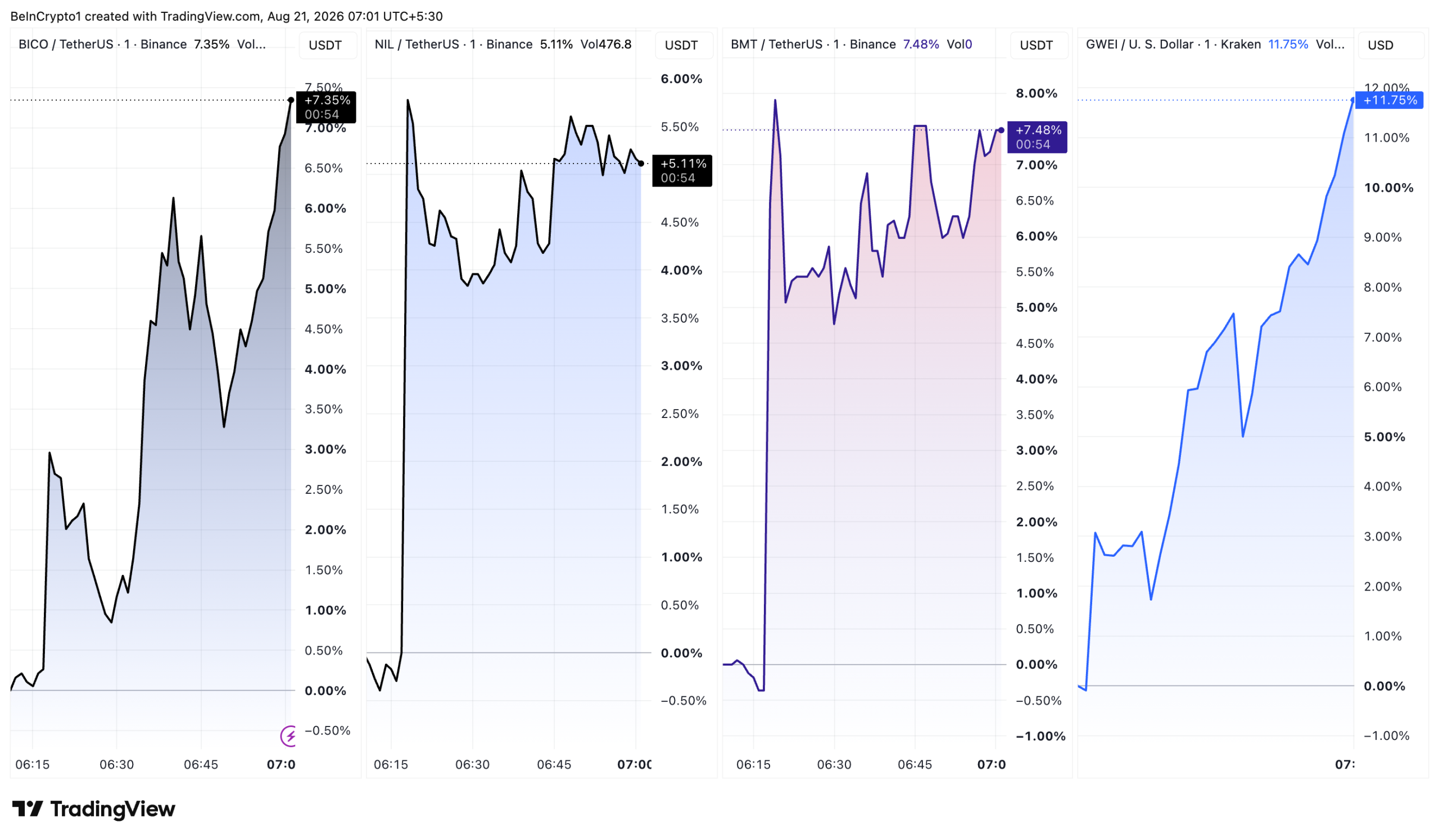
Upbit announced 4 new altcoin listings today. The exchange will open trading for Biconomy (BICO), Bubblemaps (BMT), Nillion (NIL), and ETHGas (GWEI).
South Korea’s largest exchange set trading to begin at 1 p.m. Korea Standard Time (KST). All four tokens moved higher after the notice.
Upbit Listing Confirmation Sends 4 Altcoins Sharply Higher
GWEI led the market reaction, rising 11.75% against the dollar on Kraken following the announcement. BMT gained 7.48%, while BICO climbed 7.35% on their respective Binance Tether (USDT) pairs over the same period.
NIL posted the smallest gain among the four tokens, up 5.11% at press time.
Follow us on X to get the latest news as it happens

Trading activity climbed alongside the prices, and GWEI led again. According to CoinGecko, ETHGas’ trading volume jumped 197.70% to $11.1 million over 24 hours, the sharpest increase of the four.
BICO followed with $34.5 million, up 46.70%. BMT handled $12 million, a 25.70% gain, while NIL recorded $14.6 million, up 21.40%.
Meanwhile, the pattern here is familiar. Six new Upbit listings earlier this month lifted Cysic (CYS) by 32% and AIOZ Network (AIOZ) by 12.6%.
Upbit Applies Standard Opening Restrictions
The exchange will list all four tokens against Bitcoin (BTC) and USDT. Upbit did not announce Korean won (KRW) trading pairs.
Deposits and withdrawals will open within two hours of the notice being published.
“Deposits and withdrawals are supported only through the networks specified in this announcement. Always check the network before depositing,” the exchange said.
Upbit is also applying its standard launch restrictions. Buy orders will be restricted for approximately five minutes after trading begins.
Sell orders priced 10% or more below the previous day’s closing price will also be restricted during that period. For approximately two hours after launch, only limit orders will be available.
Whether the four hold these gains past 1 p.m. KST is the open question. Earlier Upbit debuts have often faded once the initial listing bid clears.
Subscribe to our YouTube channel to watch leaders and journalists provide expert insights
The post Upbit Listings Send 4 Tokens Higher as ETHGas Leads With 11% Gain appeared first on BeInCrypto.

Go updates may delight diehard gophers but displease AI overlords

Plane carrying 8 crashes near remote radar site in western Alaska

(VIDEO) Amazon Delivery Drone Drops Texas Woman’s Package Into Pool as Prime Air Plans 500-City Expansion





-

 Fashion6 days ago
Weekend Open Thread: Ann Taylor
-
 Tech7 days ago
11 Ways to Rank Your Videos
-

 Sports6 days ago
Birmingham 2026: Day 6 Timetable for Irish Athletes
-
 NewsBeat6 days ago
Myanmar says over 300,000 Rohingya refugees verified for repatriation as exodus enters ninth year
-

 Politics6 days ago
SEQ Code: The Three Letter Boarding Pass Code That Could Give You The Worst Seat
-

 Tech3 days ago
Qwen3.8-27B runs frontier-class coding agents and reasoning locally, no cloud API required
-

 Business3 days ago
SMA Solar Technology AG (SMTGY) Q2 2026 Earnings Call Transcript
-

 Crypto World6 days ago
Pi Network Protocol 27 endgame: last upgrade before what?
-

 Crypto World3 days ago
OCC Greenlights Trump Family Crypto Firm for Trust Charter
-
 Tech6 days ago
Every fusion startup that has raised over $100M
-
 Entertainment6 days ago
Marvel Studios Reveals New X-Men Cast Including Adam Driver and Sadie Sink
-

 Business7 days ago
15 Ways to Make Money From Your Phone (2026 Guide)
-

 Crypto World7 days ago
Robinhood Chain Approaches $1B TVL as Uniswap Integration Boosts Liquidity
-
 Entertainment7 days ago
10 Netflix Shows That Quietly Became Modern Classics
-

 Fashion6 days ago
Weekly News Update, 8.14.26 – Corporette.com
-

 News Videos23 hours ago
Don’t Leave Your Financial Future To Chance | August 19, 2026
-

 Fashion7 days ago
Silver bangles for women – Newbridge Silverware
-

 Business6 days ago
Facebook Down Now? Users Report Login And Loading Problems As Outage Trackers Monitor Ongoing Issues
-

 Fashion6 days ago
Cart Confidential Vol. 44 – Julia Berolzheimer
-
 Business6 days ago
Monarch Mutual Fund set to enter MF space with maiden overnight fund; files draft with Sebi
You must be logged in to post a comment Login