
Crypto World
Longevity Is More Genetic than We Thought. That’s a Good Thing





GnosisDAO has approved a major change for Gnosis Chain, clearing the way for the network to transition from a standalone layer-1 into a ZK-proven Ethereum Economic Zone (EEZ) rollup. The vote centered on GIP-153, which would effectively retire the existing validator set and move transaction settlement to Ethereum.
According to Gnosis Chain, the proposal passed with 123,158 GNO in support, 115 against, and 151 abstaining across 54 voters. Turnout totaled 123,425 GNO, surpassing the 75,000 GNO quorum threshold.
Key takeaways
- GIP-153 clears governance approval to transition Gnosis Chain into an EEZ rollup settled on Ethereum.
- Existing validator infrastructure would be retired, shifting settlement responsibilities to Ethereum validators.
- Target timing is late 2026 or early 2027, contingent on EEZ technology readiness.
- The EEZ concept aims to reduce fragmentation by enabling cross-rollup smart contract execution without bridges.
- Standard Chartered expects fewer bridge dependencies and improved on-chain usability, which could increase Ethereum activity.
What GIP-153 approved and what it changes for users
In the proposal, Gnosis Chain outlined a pathway to make Gnosis Chain “Ethereum-aligned” by converting it into a rollup instance under the EEZ framework. The core mechanics are straightforward: the current validator set would be retired, and transactions would settle on Ethereum. In that structure, Gnosis Chain becomes a layer-2 that relies on Ethereum for settlement, while still supporting “Gnosis Chain-native smart contracts.”
The proposal also points to functionality changes intended to matter for developers and dApps: Gnosis Chain contracts would be able to call Ethereum and use the result within the same transaction. If implemented as described, that design is meant to provide tighter integration with Ethereum mainnet assets and liquidity than what the proposal claims is currently available on existing L2 deployments.
Gnosis Chain further states it would preserve key user-facing continuity, including keeping its existing applications and balances, along with the xDAI gas token.
The EEZ framework: aligning rollups to address L2 fragmentation
The EEZ concept is not limited to one network. It is described as a framework for building Ethereum-aligned rollups developed by Gnosis and ZisK, with funding from the Ethereum Foundation. The intent is to unify parts of Ethereum’s currently fragmented scaling landscape.
Ethereum’s scaling reality today is defined by the proliferation of multiple rollups, each with its own liquidity pools, infrastructure choices, and user access patterns. That separation can reduce composability—especially when applications want to interact with state or assets across different rollups. The EEZ approach targets one of the most persistent scaling trade-offs: improved throughput at the cost of fragmentation.
Under the proposal’s vision, the first production EEZ instance would be deployed through Gnosis Chain while still keeping its existing ecosystem. The broader objective is to enable smart contracts across different participating rollups to execute synchronously without relying on bridges, which the proposal presents as a structural weakness in today’s cross-chain interactions.
This argument fits into an earlier critique of L2 designs. Ethereum co-founder Vitalik Buterin previously raised concerns about centralized sequencers and trusted bridging mechanisms as potential vulnerabilities, writing in a Feb. 3 X post that “the original vision of L2s and their role in Ethereum no longer makes sense, and we need a new path.”
For context, L2Beat data cited by the Gnosis-related reporting indicates that 22 Ethereum rollups are currently “secure” with $27.82 billion in value secured. When expanded to include validiums, optimiums, and other scaling networks, the total tracked value secured rises to $34.88 billion.
Why reduced bridge reliance is a key selling point
Bridge risk is a frequent topic in Ethereum scaling discussions because bridges are often the point of failure in major cross-chain incidents. Standard Chartered’s Geoffrey Kendrick, global head of digital assets research, argued that EEZ could help reduce reliance on those vulnerable components.
In a May 28 report shared with Cointelegraph, Kendrick wrote that the EEZ “will have the benefit of reducing the need for bridges (where hacks tend to occur) and increasing the usability of assets in EVM chains.” He added that both factors are “likely to lead to greater activity in the Ethereum ecosystem.”
Kendrick’s view also emphasized composability. He suggested that EEZ could allow smart contracts on different participating networks to interact within the same transaction. For investors, traders, and users, that distinction matters because better composability can translate into smoother execution paths for complex DeFi operations—potentially reducing the friction that users face when assets must move across ecosystems before a transaction can complete.
Still, the practical timeline remains dependent on development readiness. Gnosis Chain says an initial launch is targeted for late 2026 or early 2027, subject to the required EEZ technology being ready. Until then, many questions—especially around performance, finality characteristics, and integration details—will likely remain in the realm of documentation and engineering milestones rather than lived production behavior.
What to watch as Gnosis Chain moves toward EEZ
The governance vote is a significant milestone, but it is not the final word on execution. Readers should watch for how Gnosis Chain and its partners operationalize the EEZ transition: whether settlement on Ethereum is implemented in the intended manner, how the ability for contracts to call Ethereum within a single transaction is achieved, and how users experience the migration while keeping existing apps, balances, and the xDAI gas token.
The next critical signals will likely come in the form of engineering updates leading up to the late-2026/early-2027 target—especially benchmarks or test deployments that clarify what “ZK-proven” and “Ethereum Economic Zone” mean in day-to-day performance and developer tooling. If the EEZ thesis holds, the broader impact could be a more cohesive Ethereum environment where interoperability is handled by design rather than bridged after the fact.


Bitdeer AI has signed a five-year customer agreement expected to generate about $400 million from roughly half of its A102 data center capacity in Malaysia before the facility has been energized.
Summary
- Bitdeer AI signed a five-year deal expected to generate about $400 million.
- The contract covers roughly half of the capacity at its A102 Malaysia facility.
- Revenue from the agreement is expected to begin in the first quarter of 2027.
- Bitdeer is targeting 350 MW of AI cloud data center capacity by early 2028.
Bitdeer AI said in a Wednesday announcement that the agreement covers about 50% of the A102 site’s available capacity and was signed with an undisclosed customer it described as being of “high credit quality.”
Revenue from the contract, along with the costs associated with delivering the service, is expected to begin in the first quarter of 2027 when operations under the agreement start.
The deal gives the Bitcoin miner’s AI business a contracted customer for a large portion of the Malaysian facility before commercial operations begin, while Bitdeer AI continues building data center capacity across several markets.
Bitdeer AI has secured half of A102 capacity before launch
Under the five-year agreement, the unnamed customer will use about half of the available capacity at Bitdeer AI’s A102 facility in Malaysia.
Bitdeer did not disclose the customer’s identity or provide a detailed breakdown of the contract’s pricing structure. The company estimated total revenue from the agreement at approximately $400 million over its five-year term.
Service is scheduled to begin during the first quarter of 2027, meaning the contract is not expected to contribute revenue or related operating costs before then.
Securing a customer before energization reduces the amount of uncommitted capacity Bitdeer will need to commercialize once A102 enters operation. The company has not disclosed agreements covering the remaining capacity at the site.
Malaysia is already part of Bitdeer’s AI operations. As crypto.news reported in June on, the company had been expanding AI cloud services while reviewing infrastructure across several countries for AI and colocation use. Its AI cloud annual recurring revenue stood at about $69 million during that period, according to company disclosures cited in the report.
Bitdeer has set a target of reaching 350 megawatts of AI cloud data center capacity by the first quarter of 2028, placing the Malaysian agreement within a multi-year buildout that includes both cloud computing and dedicated infrastructure contracts.
AI contracts are becoming a larger part of Bitdeer’s business
Bitdeer began as a Bitcoin mining company but has increasingly committed capital and existing infrastructure to artificial intelligence and high-performance computing.
The company still operates a large mining business, including sites in the United States, Bhutan, Norway and Ethiopia, while developing its own SEALMINER machines. Its AI business has expanded alongside those operations through GPU cloud services, data center conversions and long-duration infrastructure agreements.
Earlier this month, Bitdeer signed a 16-year lease covering 121 megawatts of AI computing capacity at its Tydal campus in Norway. The agreement carries about $4.7 billion in contracted revenue over its initial term.
Bitdeer said the entire 121 MW of contracted IT capacity at Tydal will be configured to run Nvidia GPUs for a leading AI lab through Volta, an Nvidia Cloud Partner. The project is being developed in two phases, with the first scheduled to begin operations at the end of 2026 and the second targeted for the first quarter of 2027.
The Norwegian agreement also contains an eight-year renewal option that could increase its potential contract value to about $8 billion over 24 years, according to Bitdeer. Electricity costs are set to be reimbursed by the tenant under the lease structure.
At the same time, the company has continued investing in its mining hardware operations. A July expansion included a $36 million manufacturing facility in Nevada focused on Bitcoin mining equipment, while its AI cloud and data center businesses remained separate from the production site.
Bitcoin miners are locking in long AI leases
Bitdeer is one of several publicly traded Bitcoin miners using existing access to power and data center sites to build businesses serving AI customers.
Hut 8 and IREN announced large contracts in July, with new AI infrastructure deals adding billions of dollars in contracted revenue for both companies. Hut 8 signed its second 15-year, $9.8 billion agreement at the Beacon Point campus in Texas, while IREN announced $2.8 billion in new multi-year AI cloud contracts.
Hut 8’s second contract covered another 352 MW of IT capacity, taking the tenant’s total contracted footprint at Beacon Point to 704 MW. Combined base-term contract value at the Texas campus reached $19.6 billion following the agreement.
IREN, meanwhile, raised its 2026 annualized AI cloud revenue target to more than $4 billion after signing the additional contracts. The company has also been developing hundreds of megawatts of cloud capacity as it puts more of its power portfolio toward GPU-based computing.
MARA Holdings has taken a different route into the same market. In July, the miner expanded its Texas footprint through an agreement to acquire a 1,200-acre powered site with planned grid capacity of up to 2 gigawatts for AI, high-performance computing and Bitcoin mining infrastructure.
TeraWulf has already reached the point where its computing business produces more quarterly revenue than its Bitcoin mining operation. During the first quarter of 2026, the company generated $21 million from high-performance computing hosting compared with less than $13 million from digital asset mining, according to its first-quarter revenue results.
Bitdeer shares have risen after the Malaysia deal
Investors responded positively after Bitdeer disclosed the Malaysian customer agreement.
Bitdeer shares rose about 7% during Wednesday trading before adding nearly 6% in Thursday pre-market trading, according to Yahoo Finance data cited in the original report.
The stock was changing hands at about $10.20 as of 12:16 p.m. UTC on Thursday.
Bitdeer’s latest customer contract follows its second-quarter results earlier this month, when the company reported $228.8 million in total revenue compared with $155.6 million a year earlier. The company recorded a net loss of $92.3 million for the quarter and held $496.3 million in cash, cash equivalents, and restricted cash as of June 30.
Its data center portfolio continues to include both Bitcoin mining and AI facilities, with additional sites being assessed or converted for cloud and colocation workloads as capacity becomes available.
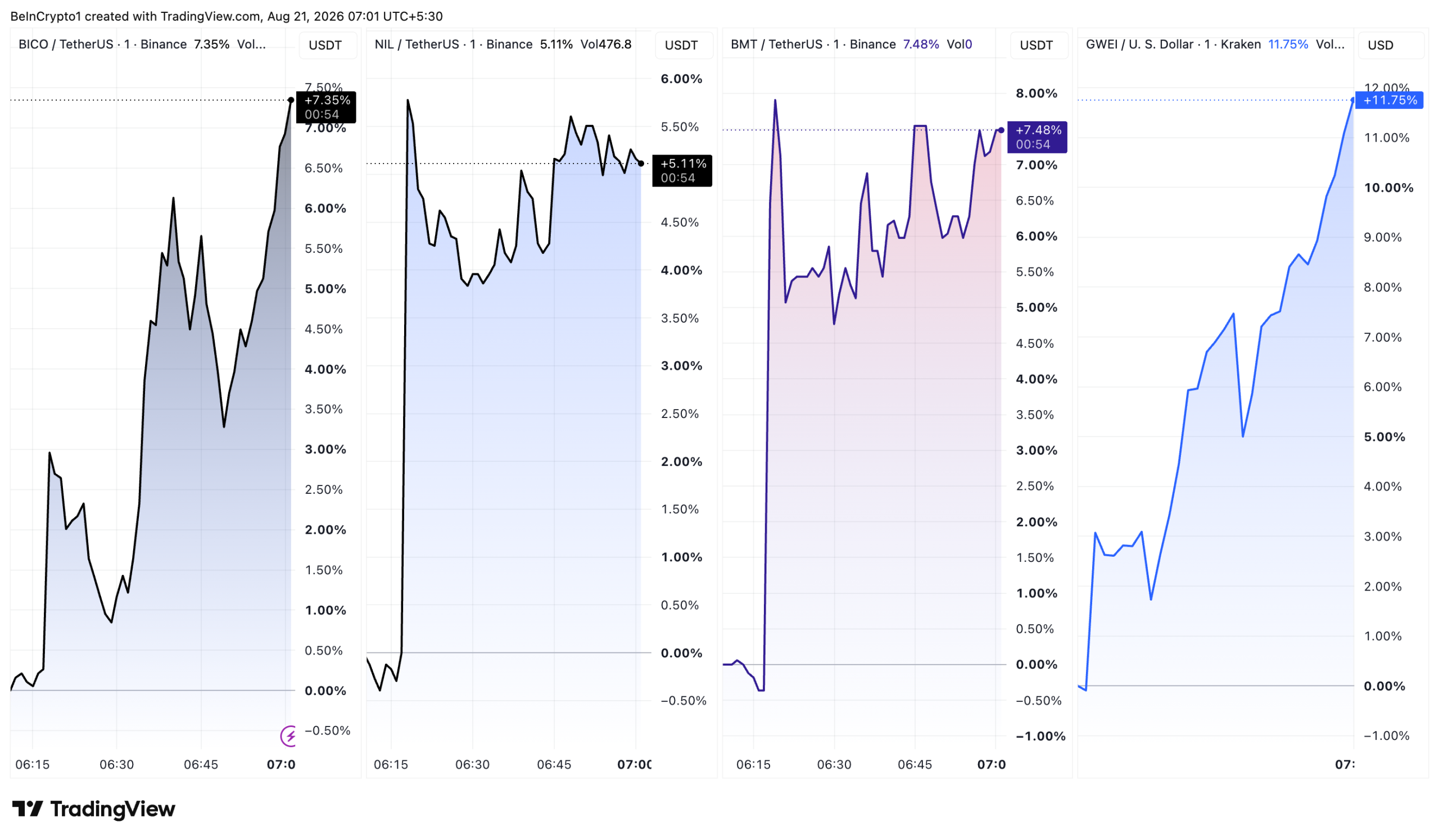
Upbit announced 4 new altcoin listings today. The exchange will open trading for Biconomy (BICO), Bubblemaps (BMT), Nillion (NIL), and ETHGas (GWEI).
South Korea’s largest exchange set trading to begin at 1 p.m. Korea Standard Time (KST). All four tokens moved higher after the notice.
Upbit Listing Confirmation Sends 4 Altcoins Sharply Higher
GWEI led the market reaction, rising 11.75% against the dollar on Kraken following the announcement. BMT gained 7.48%, while BICO climbed 7.35% on their respective Binance Tether (USDT) pairs over the same period.
NIL posted the smallest gain among the four tokens, up 5.11% at press time.
Follow us on X to get the latest news as it happens

Trading activity climbed alongside the prices, and GWEI led again. According to CoinGecko, ETHGas’ trading volume jumped 197.70% to $11.1 million over 24 hours, the sharpest increase of the four.
BICO followed with $34.5 million, up 46.70%. BMT handled $12 million, a 25.70% gain, while NIL recorded $14.6 million, up 21.40%.
Meanwhile, the pattern here is familiar. Six new Upbit listings earlier this month lifted Cysic (CYS) by 32% and AIOZ Network (AIOZ) by 12.6%.
Upbit Applies Standard Opening Restrictions
The exchange will list all four tokens against Bitcoin (BTC) and USDT. Upbit did not announce Korean won (KRW) trading pairs.
Deposits and withdrawals will open within two hours of the notice being published.
“Deposits and withdrawals are supported only through the networks specified in this announcement. Always check the network before depositing,” the exchange said.
Upbit is also applying its standard launch restrictions. Buy orders will be restricted for approximately five minutes after trading begins.
Sell orders priced 10% or more below the previous day’s closing price will also be restricted during that period. For approximately two hours after launch, only limit orders will be available.
Whether the four hold these gains past 1 p.m. KST is the open question. Earlier Upbit debuts have often faded once the initial listing bid clears.
Subscribe to our YouTube channel to watch leaders and journalists provide expert insights
The post Upbit Listings Send 4 Tokens Higher as ETHGas Leads With 11% Gain appeared first on BeInCrypto.


The Commission published 400 pages of token offering rules while Congress left town. If both frameworks survive, they will contradict each other on the questions that matter most.
Summary
- The SEC proposed Regulation Crypto Assets on Aug. 18, 2026, creating a $5 million startup exemption, a $75 million fundraising exemption, and an investment contract safe harbor that lets tokens exit securities status entirely.
- The CLARITY Act passed the House with 294 votes in July 2025 and cleared the Senate Banking Committee 15 to 9 in May 2026, but the Senate adjourned for August recess without a floor vote, and Polymarket odds for 2026 passage collapsed from 82% to roughly 16%.
- The two frameworks define decentralization differently: the CLARITY Act uses a statutory four part mature blockchain test with a hard 20% ownership cap, while the SEC safe harbor relies on issuer self certification that essential managerial efforts have ceased.
- Regulation Crypto Assets does not resolve the foundational jurisdictional question of whether a given token answers to the SEC or the CFTC, the exact problem the CLARITY Act was written to solve.
- Commissioner Hester Peirce, architect of the safe harbor concept, departs in November 2026, creating a narrow window in which the proposal must advance before the Commission loses the votes to finalize it.
The timing was not subtle. On Aug. 7, 2026, the United States Senate adjourned for its August recess without voting on the CLARITY Act, the most ambitious piece of crypto legislation to reach the chamber floor since the industry began lobbying for a federal framework. One week later, on Aug. 14, the Securities and Exchange Commission voted to publish Regulation Crypto Assets, a 400 page proposed rulemaking that would create the agency’s first bespoke offering regime for digital tokens. The full text landed on Aug. 18, the same week Polymarket odds for the CLARITY Act’s passage in 2026 dropped to roughly 16%.
The market read it as coordination. The SEC, under Chairman Paul Atkins, stepped into the vacuum that Congress left behind. But calling it a replacement misses the structural problem. The CLARITY Act is not dead. It sits on the Senate Legislative Calendar with a September 14 return window and three working weeks before the session runs out. If both frameworks proceed in parallel, the crypto industry will face two overlapping regimes that disagree on token classification, startup capital thresholds, the meaning of decentralization, and whether software developers owe regulatory obligations at all.
This is not a question of which framework is better. It is a question of which one survives.
What Regulation Crypto Assets actually proposes
The SEC’s proposal, filed as Release No. 33 11434 under docket S7 2026 27, runs roughly 400 pages and creates three distinct pathways for token projects that currently lack a workable compliance route.
The startup exemption, housed in Subpart B, allows teams to raise up to $5 million over four years with no accredited investor requirement and no per investor cap. The lane covers not just capital raises but also airdrops and network rewards, a deliberate expansion of scope that signals the Commission views token distribution itself as an offering event. Issuers must file a Form NOR (notice of reliance) before any distribution and post principles based disclosures on their website covering ten mandated topics, from token economics to governance mechanisms. There is no resale lockup, and general solicitation is permitted.
The fundraising exemption, in Subpart C, offers two tiers modeled loosely on Regulation A. Tier 1 allows $20 million per 12 month period with no audit requirement. Tier 2 raises the ceiling to $75 million annually but demands audited financial statements prepared under GAAS or PCAOB standards, plus ongoing reporting through annual (Form 1 KC), semiannual (Form 1 SC), and current (Form 1 UC) filings. Non accredited investors face a cap of 10% of the greater of their annual income or net worth. The offering circular, filed on Form 1 CRYPTO, requires disclosure across the same ten topic areas.
The investment contract safe harbor, in Subpart D, addresses the exit question. A token can shed its securities classification when the issuer has completed or permanently ceased all promised essential managerial efforts, made no new representations about such efforts, and filed a Form TR certifying compliance. The mechanism is issuer driven: the founding team decides when it has finished, self certifies, and the SEC retains the right to challenge.
Antifraud and antimanipulation provisions apply across all three lanes. Bad actor disqualification mirrors Regulation A. The comment period runs 60 days from Federal Register publication.
What the CLARITY Act would do instead
The Digital Asset Market Clarity Act, which the House passed with 294 votes in July 2025, takes a fundamentally different approach. Where Regulation Crypto Assets builds exemptions within the SEC’s existing authority, the CLARITY Act rewrites the jurisdictional map from scratch.
The bill classifies every digital asset into one of three categories: investment contract assets regulated by the SEC, digital commodities regulated by the Commodity Futures Trading Commission, and stablecoins subject to joint oversight under the separate GENIUS Act framework. The classification turns on an asset’s characteristics, issuance method, sale context, and whether it meets the mature blockchain test.
That test is the bill’s structural centerpiece. A token transitions from SEC to CFTC oversight when its underlying network satisfies four statutory conditions: the system must operate for actual transactions, services, validation, or governance; the code must be publicly accessible without permission requirements; operation must follow preset, transparent rules applied consistently; and no person or commonly controlled group may hold 20% or more of tokens or voting power.
The 20% threshold is the bill’s working definition of sufficient decentralization. Meeting it creates a rebuttable presumption that the asset qualifies as a digital commodity. The issuer can self certify, and the SEC has 60 days to contest the classification, with appeals heard in federal court.
On capital formation, the CLARITY Act allows new issuers to raise up to $75 million over 12 months without full securities registration, conditional on filing an offering statement covering blockchain details, source code, consensus mechanism, and insider holdings. The bill also includes DeFi developer protections, carving out software that never touches customer funds from both SEC and CFTC registration requirements. A separate provision exempts non controlling blockchain developers from money transmitter classification.
Three fights stalled the bill in the Senate: who enforces the ethics rules barring government officials from sponsoring digital assets, whether stablecoin yield arrangements survive a provision prohibiting interest on idle balances, and how far developer protections extend into the DeFi stack.
The collision map: clause by clause
The two frameworks agree on the broadest principle, that crypto assets need a regulatory home, and diverge on nearly everything else. The following comparison isolates the points of direct contradiction.
Token classification. The CLARITY Act creates a statutory three category system (security, digital commodity, stablecoin) and assigns each to a specific regulator. Regulation Crypto Assets does not classify tokens at all. It builds offering exemptions for assets already deemed securities and provides an exit ramp from that status, but it does not address what happens after the exit. A token that sheds its investment contract classification under the SEC safe harbor enters a jurisdictional void: it is no longer a security, but no rule designates it a commodity or routes it to the CFTC. The CLARITY Act fills that gap. Regulation Crypto Assets leaves it open.
Decentralization test. The CLARITY Act defines decentralization through four objective, statutory criteria anchored by the hard 20% ownership cap. The SEC safe harbor uses a subjective standard: the issuer must have ceased all essential managerial efforts and self certify that fact. There is no ownership threshold, no code transparency requirement, and no governance test. A project with a single entity holding 40% of tokens could theoretically qualify for the safe harbor if that entity convincingly argues it has stopped managing the network. Under the CLARITY Act, the same project would fail the mature blockchain test and remain a security.
Startup exemptions. Regulation Crypto Assets caps the startup lane at $5 million over four years. The CLARITY Act does not include a comparable small raise exemption; its $75 million offering pathway is the floor, not the ceiling. For a team seeking to raise $3 million through a token sale, the SEC framework offers a lighter compliance path. For a team raising $50 million, the CLARITY Act’s single tier structure may prove simpler than Regulation Crypto’s Tier 2, which demands PCAOB audited financials and ongoing semiannual reporting.
DeFi treatment. The CLARITY Act explicitly carves out DeFi developers who build non custodial software from registration requirements on both the SEC and CFTC sides. Regulation Crypto Assets contains no DeFi provisions. The March 2026 joint SEC CFTC interpretation placed staking, mining, and airdrops outside securities law as a temporary classification, but the proposed rule does not codify those carve outs. A DeFi protocol builder operating under the SEC framework today relies on guidance that a future commission could withdraw.
Staking. The joint interpretation treats staking as a non securities activity. Regulation Crypto Assets includes airdrops and network rewards as covered transactions under the startup exemption, which means distributing staking rewards could count against the $5 million cap. The CLARITY Act does not subject staking to offering limits; its mature blockchain test treats validation activity as evidence of decentralization, not as an offering event.
State preemption. Regulation Crypto Assets preempts state registration requirements for qualified purchasers in primary offerings and conditionally preempts state rules for secondary trading if the issuer maintains ongoing disclosure. The CLARITY Act goes further, preempting state property laws that would classify self custodied digital assets as abandoned due to inactivity and asserting federal primacy over token classification. Both frameworks preserve state antifraud authority, but the CLARITY Act’s preemption is broader and statutory, while the SEC’s is narrower and regulatory.
Resale and secondary markets. Regulation Crypto Assets imposes no resale lockup on tokens sold under either exemption, but the proposal explicitly does not address Exchange Act registration for secondary market participants such as exchanges, brokers, and dealers. The CLARITY Act requires digital commodity exchanges, brokers, and dealers to register with the CFTC and meet standards for custody, customer asset segregation, qualified custodian requirements, and market surveillance.
What this means for teams building today
The collision is not theoretical. Projects at different stages of development face materially different outcomes depending on which framework prevails, and many cannot afford to wait for resolution.
A pre launch token project seeking to raise $4 million has a clear path under Regulation Crypto Assets: file Form NOR, post the ten topic disclosures, distribute tokens under the startup exemption, and skip the accredited investor gatekeeping entirely. Under the CLARITY Act, the same team would need to file a full offering statement covering blockchain details, source code, and insider holdings, then navigate the $75 million pathway designed for much larger raises. The SEC framework is objectively lighter for small teams. But if the CLARITY Act passes six months later, every disclosure filed under Form NOR becomes legally uncertain, and the team may need to reclassify its token under the statutory three category system.
A mid stage protocol that has already distributed tokens and wants to exit securities status faces the opposite problem. Under Regulation Crypto Assets, the founding team self certifies through Form TR that it has ceased essential managerial efforts. Under the CLARITY Act, the protocol must pass the mature blockchain test, including the 20% ownership cap and the open source code requirement. A protocol where the founding entity still holds 25% of governance tokens qualifies for the SEC safe harbor (assuming it has stopped active management) but fails the CLARITY Act’s statutory test. If both frameworks apply simultaneously, that protocol sits in regulatory limbo.
DeFi builders face the starkest divide. A developer who writes and deploys a non custodial automated market maker has explicit statutory protection under the CLARITY Act’s carve out for software that never touches customer funds. Under Regulation Crypto Assets, that same developer has no explicit protection at all. The March 2026 joint interpretation offers informal comfort, but informal comfort is not a compliance program. Teams building DeFi infrastructure today must decide whether to invest in compliance architecture for a rule that may be superseded or to wait for a statute that may never arrive.
Staking service providers confront a subtler trap. The SEC framework treats network rewards as covered transactions under the startup exemption, which means a validator distributing staking yields to delegators could be conducting an unregistered offering if the aggregate value exceeds $5 million. The CLARITY Act treats validation as evidence of decentralization. Under one framework, staking is an offering. Under the other, it is proof that a token should no longer be treated as a security. The contradiction is not a matter of interpretation. It is a matter of text.
Why one framework could kill the other
The legal hierarchy is straightforward. Federal statute trumps agency rulemaking. If the CLARITY Act passes, its provisions override any SEC rule that conflicts with the statutory text. The token classification system, the mature blockchain test, the CFTC jurisdiction over digital commodities, and the DeFi developer protections would all supersede Regulation Crypto Assets to the extent they contradict.
But the reverse is also true in practice, if not in law. If the CLARITY Act dies in the Senate, Regulation Crypto Assets becomes the only structured framework available. Projects will build compliance programs around the SEC’s three lanes. Exchanges will develop listing standards based on the safe harbor criteria. Lawyers will advise clients using the Form NOR and Form 1 CRYPTO templates. Within 12 to 18 months, the industry’s operational infrastructure will have calcified around the SEC’s architecture, making any subsequent legislation politically and practically harder to implement.
This is the pattern that played out with the SEC CFTC joint framework announced in March 2026. That interpretation classified 16 major tokens as digital commodities, effectively pre deciding a classification question that Congress intended to resolve through legislation. By the time the CLARITY Act reached the Senate Banking Committee, those 16 classifications had already shaped exchange operations, custody arrangements, and compliance budgets across the industry.
Regulation Crypto Assets extends the same dynamic. TD Cowen managing director Jaret Seiberg described the proposal as creating a distinct compliance regime that eliminates the binary choice between registration and litigation risk. That is precisely the value proposition the CLARITY Act was supposed to deliver. If the SEC delivers it first through rulemaking, the legislative urgency evaporates.
The vulnerability the market is not pricing
The structural weakness of Regulation Crypto Assets is not its provisions. It is its durability. An SEC rule adopted under one commission can be amended, suspended, or repealed by the next. Commissioner Hester Peirce, whose safe harbor concept anchors Subpart D, departs the Commission in November 2026. If the proposal is not finalized before her exit, the Commission could lose the three vote majority needed to advance it. Even if finalized, a future commission hostile to crypto asset innovation could reopen the rulemaking, narrow the exemptions, or redefine essential managerial efforts so broadly that no project qualifies for the safe harbor.
The CLARITY Act, by contrast, would require an act of Congress to amend. Its classification system, once enacted, would bind every future SEC and CFTC chair until lawmakers chose to change it. The ethics provision, which bars the president, vice president, members of Congress, and federal judges from sponsoring digital assets for compensation while in office, carries civil penalties reported at up to $250,000 daily. That provision is one reason the bill stalled, but it is also one reason the bill, if passed, would be extraordinarily difficult to reverse.
The market is pricing Regulation Crypto Assets as a win and the CLARITY Act’s stall as a manageable delay. That framing ignores the possibility that the SEC framework, precisely because it is easier to enact, is also easier to dismantle. A regulatory framework that depends on the composition of a five member commission is not a framework. It is a truce.
Industry reaction reflected this tension. Groups broadly welcomed the proposal as a constructive step away from regulation by enforcement. But a16z, one of crypto’s most influential venture firms, supported the goal while urging the Commission to defer to Congress. That position captures the split: the SEC’s rules are better than no rules, but they are not better than statute.
The September window
The Senate returns on Sept. 14, 2026, with three working weeks before the session effectively ends. Senator Cynthia Lummis has circulated a consolidated draft merging Senate committee versions of the CLARITY Act, but Majority Leader John Thune publicly cast doubt on passage before the August recess, and the Senate prioritized other legislation.
The comment period for Regulation Crypto Assets runs 60 days from Federal Register publication, placing the deadline in mid to late October. If the CLARITY Act passes during the September window, the SEC would need to reconcile its proposal with the new statutory framework, potentially withdrawing or substantially revising the rule. If the CLARITY Act fails, the SEC proceeds to finalize Regulation Crypto Assets with no competing legislative constraint.
Both outcomes carry costs. Passage of the CLARITY Act after Regulation Crypto Assets has already shaped industry compliance would create a disruptive transition. Failure of the CLARITY Act would consolidate regulatory authority in an agency that, by design, can change its mind every time the White House changes hands.
The crypto industry spent three years asking for regulatory clarity. It may get two incompatible versions of it in the same quarter.
What to watch
Polymarket odds for CLARITY Act passage crossing 30% before Sept. 14. A sustained move above that threshold would signal that Senate leadership has committed floor time, changing the calculus for every project building compliance around Regulation Crypto Assets.
SEC comment letter volume during the first 30 days. If major exchanges and venture firms submit letters urging the Commission to defer to Congress, it signals the industry views the rule as a backstop, not a destination.
Whether the SEC schedules a second open meeting on Regulation Crypto Assets before Peirce’s November departure. Acceleration of the finalization timeline would indicate the Commission is racing the clock on its own composition.
Any amendment to the CLARITY Act’s ethics provision. The provision barring government officials from sponsoring tokens is the single largest obstacle to a floor vote. A narrowing or sunset clause would materially increase passage odds.
CFTC public statements on the safe harbor exit ramp. If the CFTC signals it will not automatically accept tokens that exit SEC jurisdiction under Subpart D, the safe harbor’s practical value collapses.
What is Regulation Crypto Assets?
Regulation Crypto Assets is a proposed SEC rulemaking published on Aug. 18, 2026, that creates three pathways for token offerings: a $5 million startup exemption, a $75 million fundraising exemption, and a safe harbor that allows tokens to exit securities classification when their founding teams cease essential managerial efforts.
What is the CLARITY Act?
The CLARITY Act, formally the Digital Asset Market Clarity Act, is federal legislation that classifies every digital asset as a security, digital commodity, or stablecoin and assigns regulatory authority to the SEC, CFTC, or joint oversight accordingly. The House passed it with 294 votes in July 2025.
How do the two frameworks define decentralization differently?
The CLARITY Act uses a four part mature blockchain test with a hard 20% ownership cap: no single entity or commonly controlled group may hold 20% or more of tokens or voting power. The SEC safe harbor relies on issuer self certification that essential managerial efforts have ceased, with no ownership threshold.
Can both frameworks exist at the same time?
If the CLARITY Act becomes law, its statutory provisions override any conflicting SEC rule. If it does not pass, Regulation Crypto Assets proceeds as the sole structured framework, but it lacks the jurisdictional clarity and CFTC integration that the CLARITY Act provides.
What happens to DeFi developers under each framework?
The CLARITY Act explicitly exempts non custodial software builders from SEC and CFTC registration. Regulation Crypto Assets contains no DeFi provisions. DeFi developers currently rely on the March 2026 joint interpretation, which a future commission could withdraw.
Does the SEC safe harbor send tokens to the CFTC?
No. The safe harbor ends a token’s securities classification but does not route it to any other regulator. A token that exits through Subpart D enters a jurisdictional gap unless the CLARITY Act or separate legislation assigns it to the CFTC.
Why did the CLARITY Act stall in the Senate?
Three unresolved disputes blocked a floor vote: enforcement of the ethics provision barring officials from sponsoring tokens, whether platforms may pay yield on stablecoin balances, and how far DeFi developer protections extend. The Senate adjourned for August recess without resolving any of them.
What is the deadline for the Regulation Crypto Assets comment period?
Public comments are due 60 days after the proposal is published in the Federal Register. Based on the Aug. 18 publication date, the deadline falls in mid to late October 2026. This is educational analysis, not investment advice.
Disclaimer: This article is for informational purposes only and does not constitute financial or legal advice. Cryptocurrency investments carry significant risk. Always conduct your own research before making investment decisions. Published Aug. 20, 2026.


An options trader opened a large straddle on XRP, betting on wild price swings by Aug. 28.

He started by trying to identify which genes were responsible for driving the development of embryonic cells. Then, he used engineered viruses that could infect cells (but no longer cause disease) to introduce these genes to adult cells; these, in turn, would instruct the cell to make the proteins that help the mature cells act more like embryonic ones. Yamanaka and his team winnowed 24 possible genes down to four.
Even Yamanaka was surprised that the process worked. When his colleague first showed him the older mouse cells that seemed to have reverted back to young versions of themselves, he refused to believe it. “I thought it was a mistake,” he says. “I asked my colleague to repeat the experiment again and again and again, but it always worked,” even with different types of mature mouse and human cells. “So we gradually became confident in the results.”
He called the cells induced pluripotent stem cells (iPS cells for short), and researchers raced to capitalize on the potential of these “Yamanaka factors” to generate replacements for diseased cells in conditions like diabetes and Parkinson’s disease. “iPS cells impact all sorts of areas, from the study of disease to the study of development,” says Dieter Egli, associate professor of developmental cell biology at Columbia University and a leading stem-cell scientist. “This fundamental insight of the reversion of time and cell specialization is absolutely a miracle.”
To capitalize on the discovery, the Japanese government invested heavily in CiRA—where the scientists’ teams still call him Yamanaka-sensei—to refine the production of iPS cells. One of the key genes involved in the process can also promote tumors; Yamanaka found a way to omit it while reprogramming the cells, albeit less efficiently, and has since developed ways to manufacture high-quality iPS cells for use in human studies. He also initiated important discussions with the government on the ethical use of these cells.
“When we succeeded in making human iPS cells, I was very happy for just one week,” Yamanaka says. The process bypassed the ethical challenges of needing embryos as a stem-cell source. “But I realized, ‘Wow, maybe I overcame one ethical hurdle, but now I generated another, even higher hurdle.’”


Intercontinental Exchange has signaled it may put more money into Polymarket’s next funding round after building a $1.64 billion stake in the prediction market platform.
Summary
- ICE may invest in Polymarket again after building a $1.64 billion stake by March.
- Polymarket is seeking fresh capital at a valuation above $20 billion.
- ICE CEO Jeff Sprecher said the investment relationship centers on exchanging information and expertise.
- Sprecher said perpetual futures do not fit ICE’s core hedging client base.
Bloomberg reported Thursday that ICE Chief Executive Officer Jeff Sprecher said the New York Stock Exchange parent would consider participating if its involvement could help Polymarket complete the round.
“We’ll look at it, if it would help the round in order to have our imprimatur on it, we are always interested,” Sprecher told Bloomberg Television.
ICE may join Polymarket’s new funding round
Polymarket is seeking fresh capital at a valuation above $20 billion, according to Bloomberg, more than twice the valuation attached to the company in October. The report said the platform has continued to draw investor interest as prediction markets expand across sports, politics, geopolitics and other event based contracts.
ICE has already participated in two Polymarket funding rounds, with Bloomberg putting the exchange operator’s stake at $1.64 billion by March. Sprecher said the relationship was designed partly to allow the companies to exchange information and expertise, instead of turning ICE into a regular investor in technology startups.
As crypto.news reported in March, ICE invested another $600 million in Polymarket as part of a previously announced commitment of up to $2 billion. ICE said at the time that the investment was not expected to have a material effect on its financial results or capital return plans.
“The reality is we’re not a venture firm,” Sprecher said Thursday, describing the Polymarket investment as a relationship built around the “transfer of information and expertise.”
The distinction is important to ICE’s approach, according to Sprecher, because the company operates some of the world’s largest financial exchanges and clearing businesses and does not plan to build a portfolio of venture investments simply because technology companies are attracting capital.
Polymarket, meanwhile, has continued adding infrastructure around its prediction market business. A March report on Polymarket’s Brahma acquisition detailed its purchase of the DeFi infrastructure startup after earlier acquisitions of QCEX and Dome. The report said the transactions added U.S. regulatory access, developer infrastructure and onchain execution capabilities to Polymarket’s operations.
Prediction markets are drawing more institutional capital
Prediction markets have attracted more attention since the 2024 U.S. presidential election, Bloomberg reported, as traders increasingly use yes or no contracts to speculate on outcomes ranging from elections and sporting events to geopolitical developments.
Investor money has followed that activity. Polymarket is now seeking funding at a valuation above $20 billion, while rival Kalshi has also completed major fundraising rounds as both companies compete for traders and distribution partnerships.
Robinhood Markets has become another major participant in the sector. During the same Bloomberg Television coverage, Chief Executive Officer Vlad Tenev said prediction markets should remain under federal supervision through the Commodity Futures Trading Commission, not individual state regulators.
The question has become increasingly important as several states attempt to apply their own rules to sports and election linked contracts. According to Bloomberg, some state authorities contend that certain contracts should fall under state gambling or gaming laws, while prediction market companies have argued that federally regulated event contracts belong under the CFTC.
A July report on North Carolina’s new law showed one state taking the federal route. Governor Josh Stein signed legislation recognizing CFTC authority over prediction markets and allowing federally registered platforms, including Kalshi and Polymarket, to operate in the state from 2027. The law also imposed a 6% state tax on trading fee revenue generated by the platforms.
State challenges keep the CFTC fight active
Other states have continued to challenge prediction market operators, leaving courts to consider how federal derivatives law interacts with state gambling powers.
Tenev told Bloomberg that he expects event contracts to remain a viable business even if the jurisdictional fight eventually reaches the U.S. Supreme Court and the court gives states more control over some products.
“I don’t think it’s going to be, ‘prediction markets are gone,’” Tenev said. He added that a legal ruling could establish a boundary that would require companies such as Robinhood to adapt their offerings.
The dispute has already produced different regulatory approaches across the country. North Carolina has explicitly recognized federal oversight, while lawsuits and enforcement actions elsewhere have challenged sports related contracts offered through federally regulated platforms.
Alongside prediction markets, the CFTC has also started allowing new forms of crypto derivatives to enter regulated U.S. venues.
In May, Kalshi received approval to launch the first regulated Bitcoin perps in the United States. The same report said Coinbase received a no action letter allowing certain crypto perpetual futures products to use Bitcoin, Ether and stablecoins as collateral.
The approvals have created another point of comparison between newer crypto trading products and the traditional futures contracts offered by established derivatives exchanges.
ICE remains cautious on perpetual futures
Perpetual futures became another focus of Sprecher’s interview after President Donald Trump said earlier this week that U.S. regulators were working on a route to bring Hyperliquid into the country in a fully compliant form.
Hyperliquid is best known for perpetual futures, leveraged derivatives that allow traders to take positions on crypto and other asset prices without an expiration date. Bloomberg reported that the product category has moved outside its long standing crypto use case, particularly during the Iran war.
During periods when traditional oil futures venues operated by CME Group and ICE were closed, Bloomberg said perpetual contracts became one of the available ways for investors to trade oil exposure.
Sprecher said ICE is not currently pursuing the products because the company’s core derivatives customers primarily use futures for hedging. Traditional futures contracts with different expiration dates also produce a forward pricing curve that companies can use to manage future costs and prices, while perpetual contracts do not create the same structure.
“Our client base is really a hedging client base, and there’s no forward pricing curve that is created by a perpetual future,” Sprecher told Bloomberg.
For ICE, Sprecher said the product does not fit the customers the exchange primarily serves, describing perpetual futures as “really a speculative” product that “doesn’t cater to our distribution or client base.”
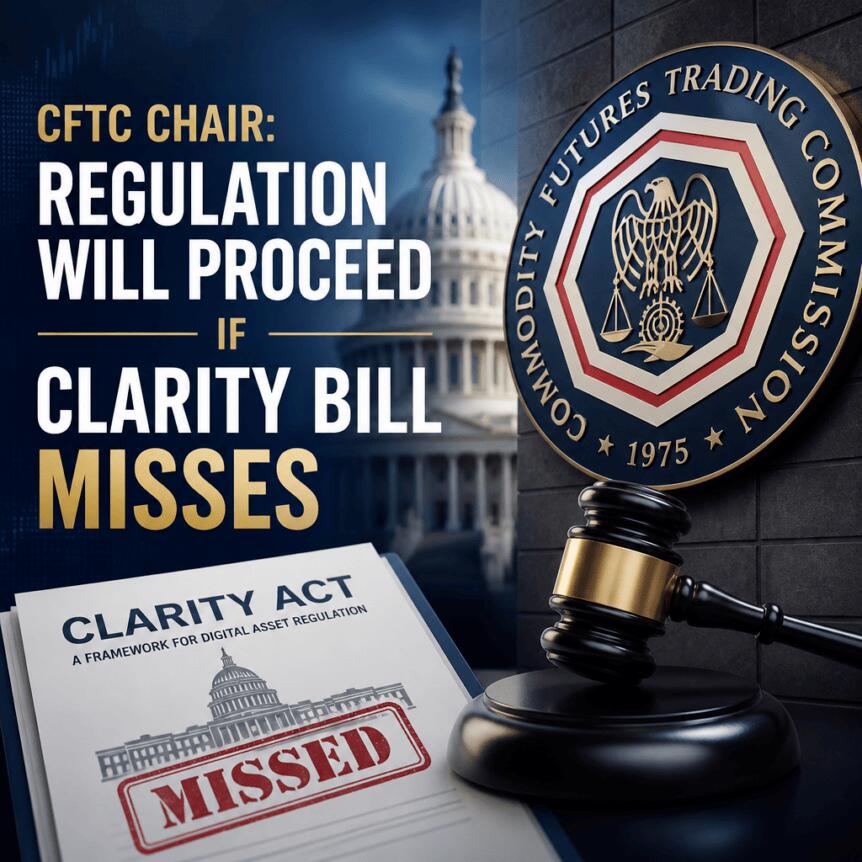
US CFTC Chair Michael Selig used remarks at the agency’s inaugural Innovation Advisory Committee meeting to make clear that crypto regulation is not “waiting on Washington” to catch up. While lawmakers continue to debate the proposed Digital Asset Market Clarity (CLARITY) Act, Selig said the commission would still pursue rulemaking and regulatory steps it believes are available under existing authority.
In prepared remarks on Thursday, Selig indicated that CFTC staff had already been directed to permit both registered and non-registered entities to provide “crypto asset trading on a leveraged or margined basis,” and to explore protections for developers. He framed this approach as giving CLARITY “breathing room” for a vote, but accelerating implementation if Congress fails to send what he described as a fair, bipartisan bill to the White House.
Key takeaways
- CFTC Chair Michael Selig said the agency will move forward on crypto rules even if the CLARITY Act is not enacted.
- Selig pointed to internal direction allowing leveraged or margined crypto trading by both registered and non-registered entities.
- The CFTC chair linked any legislative delay to a potential “swift” push for new industry rules should Congress not produce enough consensus.
- The CLARITY Act’s timeline is tied to a planned Senate cloture vote expected when the chamber returns in September.
- Selig also discussed the CFTC’s continuing push on prediction markets, including its view of “exclusive jurisdiction” tied to event contracts.
Why Selig is signaling “move now, not later”
Selig’s message was aimed at the reality of congressional gridlock. He said the CFTC would effectively pause “breathing room” for CLARITY to reach the necessary decision process, but only for so long. If lawmakers—including Democrats and Republicans—do not converge on a bipartisan compromise and deliver a version Selig described as “fair” to President Donald Trump, the chair said he would instruct CFTC staff to propose rules for the industry quickly.
The central point is that the CFTC believes it can regulate aspects of the crypto market structure through existing mechanisms, even if broader statutory clarity remains unsettled. For market participants, that matters because it shifts expectations away from a single legislative moment and toward continuing, agency-driven regulatory development.
What happens to CLARITY if Congress stalls
According to the account of the legislative path described alongside Selig’s remarks, the market structure bill is essentially on hold until the US Senate returns to session in September. At that time, Majority Leader John Thune is expected to bring the legislation for a cloture vote.
For CLARITY to move forward in the Senate and return to the House, it would need 60 votes. If it clears that threshold, the bill would proceed back to the House for approval before reaching Trump’s desk, where it could be signed or vetoed.
That voting math is one reason Selig’s warning carries weight. If CLARITY does not clear the Senate bar, the CFTC’s willingness to use regulatory tools available now could effectively reduce the practical impact of the delayed statute—at least in the areas where the commission believes it has room to act.
CLARITY’s prospects are further complicated by ongoing political disagreements. The article notes that many Democrats have sought stronger ethics provisions in the market structure bill, specifically to address the Trump family’s crypto investments—reported as having netted the president $1.4 billion in 2025. Trump, meanwhile, said Wednesday that “a lot of Democrats” approved of CLARITY, but it remained unclear whether support would be sufficient for the 60-vote requirement in the Senate.
Consistency with the SEC’s broader approach
Selig’s comments also echoed a wider regulatory push happening in parallel at the Securities and Exchange Commission (SEC). Earlier in the week, the SEC released proposed rules for digital asset regulation. The SEC said the proposals could give crypto firms a safe harbor approach from tokens being treated as “investment contracts,” alongside exemptions for certain issuers.
For investors and industry compliance teams, simultaneous signals from both agencies can matter as much as the content itself. Even when rules differ—CFTC frameworks often focus on futures, derivatives, and commodity-related market conduct, while SEC frameworks address securities-law questions—the overall direction can influence how companies structure products, marketing language, and legal risk assessments.
In that sense, Selig’s remarks read as part of a broader “regulate regardless” posture, where agencies seek to provide certainty and operational pathways rather than waiting for a single piece of legislation to settle all questions at once.
Regulatory priorities beyond market structure: leverage, developers, and prediction markets
Selig’s remarks also highlighted internal CFTC priorities reaching beyond the CLARITY debate. He said he had directed staff to allow leveraged or margined crypto asset trading by both registered and non-registered entities and to explore developer protections.
Separately, Thursday’s Innovation Advisory Committee agenda included artificial intelligence and prediction markets. The chair reiterated the CFTC’s position that it has “exclusive jurisdiction” over prediction markets, based on its view that event contracts on the platforms it is considering qualify as “swaps.”
According to the account, Selig has directed the commission to file lawsuits against state-level authorities that challenge the CFTC’s jurisdictional view, including cases involving companies such as Kalshi and Polymarket.
These prediction market efforts underscore a theme in Selig’s leadership: the CFTC is not treating the legislative agenda as the only route to policy outcomes. Instead, it appears willing to pursue enforcement and litigation strategies to establish boundaries of its authority even while Congress works through a broader market structure bill.
What to watch next
The immediate question is whether the Senate can reach the 60-vote threshold for CLARITY when it returns in September. In the meantime, market participants should track how the CFTC operationalizes Selig’s direction—especially around leveraged or margined trading allowances—and whether prediction market litigation continues to expand as the agency tests its “exclusive jurisdiction” position.
U.S. Treasury Secretary Scott Bessent told CNBC on Thursday that the government’s bond buyback program could grow.
He noted that there is every indication that the buybacks could exceed the $4 billion per operation ceiling it set just a day earlier, a signal that helped drive Bitcoin (BTC) toward its highest level since June.
Bessent Leaves the Door Open on Size
Treasury doubled its buyback cap for longer-dated debt from $2 billion to at least $4 billion per operation on Wednesday, targeting securities maturing in 10 to 30 years starting September 9.
Speaking a day later, Bessent made clear that figure was a floor, not a ceiling.
“I would note that it could be more than the 4 billion per issue.”
Bessent declined to attach a specific number, saying the eventual size will depend on market conditions. He framed the move as an effort to restore trading depth in a market he called thinly traded, pointing to heavy corporate bond issuance and what he described as poor liquidity in the 30-year sector.
Why Bond Buybacks Moved Crypto
Bitcoin’s link to Treasury buybacks runs through yields and liquidity, not direct policy. The 30-year yield had touched its highest level since 2007 before Wednesday’s announcement pulled it sharply lower, and Treasury’s buyback move eased broader financial conditions just as risk appetite was already improving.
Lower long-duration yields reduce competition for investor capital, a dynamic that tends to support assets like Bitcoin and gold alike, as gold’s own rally this week showed.
Bessent also pointed to the U.S.-Iran conflict as a temporary distortion on yields, saying markets would normalize once that situation resolves. His comments on Thursday briefly pulled yields lower again, though the effect faded and the 10-year yield ended the session higher.
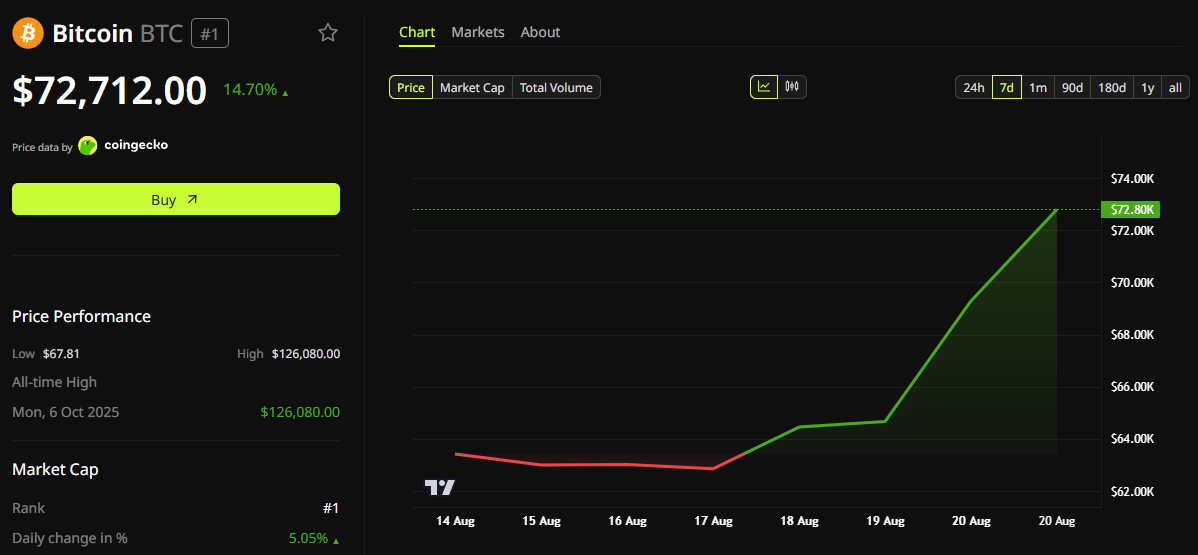
Bitcoin trades near $72,712 at the time of writing, up 5% over the past 24 hours, according to BeInCrypto data. That places it near its highest level since June, part of a rally that also drew on a wave of short-position liquidations and renewed optimism around crypto market momentum.

Bessent’s broader message centered on U.S. fiscal trajectory. He argued that record government debt does not by itself signal distress, pointing to fiscal consolidation through 2025 and expected tariff revenue holding steady into 2026.
Whether the buyback expansion keeps supporting Bitcoin past the initial reaction will likely hinge on how large future operations get, and whether yields stay contained once the enlarged buybacks begin on September 9.
The post Treasury Secretary Bessent Says Buybacks Can Exceed $4B: Bullish for Bitcoin? appeared first on BeInCrypto.

Optimism’s on-chain governance has approved a plan to redirect 546.9 million OP tokens, previously earmarked for user airdrops, into a new Strategic Ecosystem Fund designed to back ecosystem growth and institutional adoption.
According to CoinGecko data, OP is currently valued at roughly $214 million in market capitalization with a circulating supply of about 2.29 billion tokens (CoinGecko). At today’s price levels mentioned in the coverage, the repurposed allocation is roughly $50 million—about a quarter of the token’s market cap.
Key takeaways
- Optimism governance voted to move 546.9M OP from planned user airdrops into a new Strategic Ecosystem Fund.
- The fund is intended to support partnerships with chains, protocols, and institutions, alongside incentives to boost activity and liquidity on OP Mainnet.
- Some delegates pushed back, arguing the tokens were previously promised to users and questioning how returns would be measured.
- Optimism says it does not plan additional airdrops after distributing 269.1M OP across five rounds, framing this as a shift from user acquisition to institutional focus.
A shift from user distribution to ecosystem and enterprise growth
The approved proposal creates a fund meant to accelerate broader adoption rather than focusing on further token distribution. In the plan, the Strategic Ecosystem Fund will back initiatives including partnerships with other networks and protocols, as well as incentives aimed at increasing activity and liquidity on OP Mainnet.
It also explicitly points to growth for OP Enterprise, a component of Optimism’s wider push to serve institutional and enterprise users. Supporters of the change argued that the redeployment better positions Optimism to compete for enterprise-focused deals and drive measurable ecosystem expansion.
Governance debate highlights trust and accountability questions
Not all delegates were convinced. The proposal faced pushback from some participants who argued that the tokens were already committed to user airdrops. They also raised concerns about how Optimism would evaluate the fund’s outcomes, including what “success” would look like for the foundation and how investments would be assessed.
Optimism’s proponents, by contrast, framed the allocation as a pragmatic reallocation toward later-stage priorities. They argued that the ecosystem’s next growth phase requires resources targeted at institutional adoption and increased network utilization—goals they believe align more closely with a fund built for partnerships and liquidity incentives.
Optimism: airdrops are largely done, institutional push is next
Optimism stated that it has no additional airdrops planned following the distribution of 269.1 million OP across five rounds. The project’s rationale is that airdrops were most appropriate for an earlier phase focused on broad user acquisition, whereas Optimism says it has now moved toward a different growth strategy centered on institutional adoption.
The network emphasized that this change reflects an evolution in its priorities rather than a reversal. The governance decision, however, makes the measurement question central: if a fund is moved away from token distribution, stakeholders will likely want clearer metrics around ecosystem impact, partnership quality, and any resulting activity or revenue tied back to the spending.
OP price reacts as token remains far below its peak
While the governance vote addresses long-term allocation, OP’s market behavior shows how quickly investor attention can move to any major token-related decision. The coverage notes that OP traded around $0.09 on Thursday, up about 11% over the prior 24 hours amid a broader market rally. Even after the rebound, the token remains more than 93% below its all-time high.
At the referenced price, the repurposed 546.9M token allocation would be worth around $50 million, consistent with roughly one-quarter of OP’s market capitalization at the time mentioned. That comparison underscores why the vote is relevant to market participants: shifting a large token reserve allocation can influence expectations about future supply dynamics, ecosystem spending priorities, and how investors think about the project’s runway.
Where the OP Stack fits into the next growth phase
Optimism is the Ethereum scaling project behind OP Mainnet and the OP Stack, the modular blockchain framework that supports other networks. Among projects cited in the coverage are Base, Unichain, Kraken’s Ink, and Sony’s Soneium. Optimism also states that more than 30 OP Stack chains currently contribute revenue to Optimism.
This matters for the governance decision because the new fund is designed to complement an ecosystem model that depends on both network activity and partnerships. If OP Stack chains continue to expand, the foundation’s ability to attract additional enterprises and liquidity could become a more direct driver of usage across OP Mainnet and related tooling.
Investors and builders will likely watch for how Optimism operationalizes the Strategic Ecosystem Fund—particularly whether it publishes clear allocation criteria and measurable targets for partnerships, liquidity incentives, and OP Enterprise outcomes. The governance vote moves the budget needle now, but the next phase will depend on follow-through and transparency about results.

Lindsay Clancy’s Trial Has Jurors Making ‘Agonizing Choice’

Some in royal circles who have dealt with the Sussexes tell me they fear ‘there is more to this than we know’, writes REBECCA ENGLISH

Walmart e-commerce sales jump in Q2 as online growth accelerates





-

 Fashion6 days ago
Weekend Open Thread: Ann Taylor
-
 Tech7 days ago
11 Ways to Rank Your Videos
-

 Sports6 days ago
Birmingham 2026: Day 6 Timetable for Irish Athletes
-
 NewsBeat6 days ago
Myanmar says over 300,000 Rohingya refugees verified for repatriation as exodus enters ninth year
-

 Politics6 days ago
SEQ Code: The Three Letter Boarding Pass Code That Could Give You The Worst Seat
-

 Tech3 days ago
Qwen3.8-27B runs frontier-class coding agents and reasoning locally, no cloud API required
-

 Business3 days ago
SMA Solar Technology AG (SMTGY) Q2 2026 Earnings Call Transcript
-

 Crypto World6 days ago
Pi Network Protocol 27 endgame: last upgrade before what?
-

 Crypto World3 days ago
OCC Greenlights Trump Family Crypto Firm for Trust Charter
-
 Tech6 days ago
Every fusion startup that has raised over $100M
-
 Entertainment6 days ago
Marvel Studios Reveals New X-Men Cast Including Adam Driver and Sadie Sink
-

 Business7 days ago
15 Ways to Make Money From Your Phone (2026 Guide)
-

 Crypto World7 days ago
Robinhood Chain Approaches $1B TVL as Uniswap Integration Boosts Liquidity
-
 Entertainment7 days ago
10 Netflix Shows That Quietly Became Modern Classics
-

 Fashion6 days ago
Weekly News Update, 8.14.26 – Corporette.com
-

 News Videos22 hours ago
Don’t Leave Your Financial Future To Chance | August 19, 2026
-
 Fashion7 days ago
Silver bangles for women – Newbridge Silverware
-

 Business6 days ago
Facebook Down Now? Users Report Login And Loading Problems As Outage Trackers Monitor Ongoing Issues
-
 Business6 days ago
Monarch Mutual Fund set to enter MF space with maiden overnight fund; files draft with Sebi
-

 Fashion6 days ago
Cart Confidential Vol. 44 – Julia Berolzheimer
You must be logged in to post a comment Login