
Crypto World
Shinya Yamanaka Made Cells Young Again. Can That Reverse Aging?


He started by trying to identify which genes were responsible for driving the development of embryonic cells. Then, he used engineered viruses that could infect cells (but no longer cause disease) to introduce these genes to adult cells; these, in turn, would instruct the cell to make the proteins that help the mature cells act more like embryonic ones. Yamanaka and his team winnowed 24 possible genes down to four.
Even Yamanaka was surprised that the process worked. When his colleague first showed him the older mouse cells that seemed to have reverted back to young versions of themselves, he refused to believe it. “I thought it was a mistake,” he says. “I asked my colleague to repeat the experiment again and again and again, but it always worked,” even with different types of mature mouse and human cells. “So we gradually became confident in the results.”
He called the cells induced pluripotent stem cells (iPS cells for short), and researchers raced to capitalize on the potential of these “Yamanaka factors” to generate replacements for diseased cells in conditions like diabetes and Parkinson’s disease. “iPS cells impact all sorts of areas, from the study of disease to the study of development,” says Dieter Egli, associate professor of developmental cell biology at Columbia University and a leading stem-cell scientist. “This fundamental insight of the reversion of time and cell specialization is absolutely a miracle.”
To capitalize on the discovery, the Japanese government invested heavily in CiRA—where the scientists’ teams still call him Yamanaka-sensei—to refine the production of iPS cells. One of the key genes involved in the process can also promote tumors; Yamanaka found a way to omit it while reprogramming the cells, albeit less efficiently, and has since developed ways to manufacture high-quality iPS cells for use in human studies. He also initiated important discussions with the government on the ethical use of these cells.
“When we succeeded in making human iPS cells, I was very happy for just one week,” Yamanaka says. The process bypassed the ethical challenges of needing embryos as a stem-cell source. “But I realized, ‘Wow, maybe I overcame one ethical hurdle, but now I generated another, even higher hurdle.’”

Crypto World
Solana, Robinhood, BNB Clash for Meme Coin Season: Who is Winning the $3 Billion Rally?
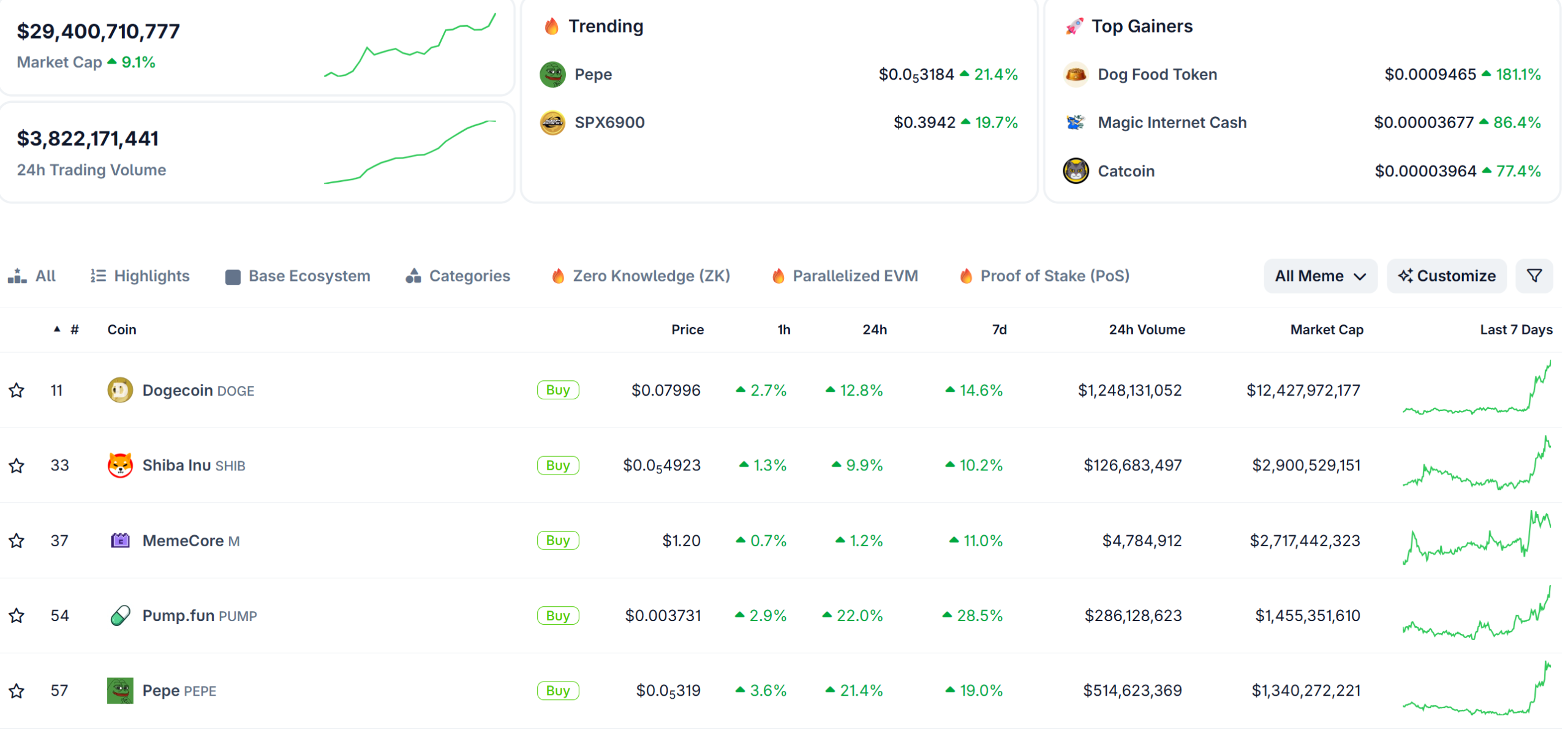
Meme coin market added close to $3 billion on Thursday. The sector is now worth $29.3 billion, up almost 10% today. Three blockchains are fighting over that money.
Solana, BNB Chain and Robinhood Chain each claim a share of it. Thursday’s trading data says only one of them is really winning.
Most of the $3 Billion Never Touched These Three Chains
The headline number flatters all three. Meme tokens traded $3.6 billion on Thursday, and three coins accounted for 59% of it.
Dogecoin (DOGE) led with $1.24 billion, and it runs on its own network. DOGE price rose 12.3%. Pepe (PEPE) followed with $514 million, and it sits on Ethereum. Official Trump (TRUMP) took $421 million.

So the contested pool is far smaller than the headline suggests. Market cap shows what a token is worth, not where traders went.
Two numbers show that. Volume records where money moved. Fees record what the chain kept.
Solana Wins Thursday’s Volume Test
Solana processed $3.01 billion in decentralized exchange trades over 24 hours, DefiLlama data show. BNB Chain handled $1.25 billion.
Robinhood Chain managed $510.8 million. It is the newest of the three, launched in July as a network for tokenized stocks.

Solana therefore out-traded both rivals combined. It took 63% of the three chains’ total flow.
Its launchpad token drew much of that. Pump.fun (PUMP) traded $286 million, fourth among all meme tokens.
One caveat applies to every figure here. These totals cover all tokens on each chain, not meme coins alone.
Fees Show Whose Volume Is Worth Something
Volume is the easier number to grow. Blockspace is cheap, and a dollar can change hands many times in a day.
Fees are harder. Solana earned $925,809 in chain fees on Thursday. BNB Chain took $689,745. Robinhood Chain collected $59,275.

The distance is stark. Solana moved 5.9 times Robinhood’s volume but earned 15.6 times its fees.
Now measure fees per dollar traded. BNB Chain converted 0.055% of its volume. Solana managed 0.031%. Robinhood Chain kept 0.012%.
That reorders the podium. Solana wins on scale, but BNB Chain extracts nearly twice as much value from each dollar.
The effect shows in the totals. Solana takes 63% of the three chains’ volume but only 55% of their fees.
Chains with no meme scene still earned more. Ethereum collected $1.22 million and Tron took $876,853.
Robinhood Chain ranked tenth among all chains, behind Polygon.
Who is Winning Meme Coin Season
Solana, on both measures. It leads on volume traded and on total fees earned, and no rival is close on either.
BNB Chain is the credible number two and the sharpest earner per dollar. Its flagship token lagged, with the Chinese-language meme BinanceLife up 4.7% against a sector up 10.1%.
Robinhood Chain runs third on everything. It can still produce a mover, and its flagship Cash Cat (CASHCAT) gained 30.3% on $32.27 million of volume.

One rival sits outside the three-way frame. Base matched BNB Chain on volume at $1.255 billion.
Its economics resemble Robinhood’s, however. Base earned $189,724, converting 0.015% of volume into fees.
The clash may already have four sides. Whether Solana keeps the crown rests on a number few traders watch.
Not how much volume it attracts, but how much of that volume it converts.
The post Solana, Robinhood, BNB Clash for Meme Coin Season: Who is Winning the $3 Billion Rally? appeared first on BeInCrypto.


Warning: This post contains spoilers for Outer Banks Season 5.
After years of treasure hunts, betrayals, shipwrecks, family feuds and increasingly improbable escapes, the Pogues finally make it home. The fifth and final season of Netflix’s Outer Banks sends John B (Chase Stokes), Sarah (Madelyn Cline), Kiara (Madison Bailey), Pope (Jonathan Daviss), Cleo (Carlacia Grant), and Rafe (Drew Starkey) through one last race for treasure—this time involving the Royal Merchant gold, the Blue Crown, a deadly hurricane, and the ghosts of everything they have lost along the way.
The finale takes the Pogues far beyond the Outer Banks before bringing them back. First, they learn that the arms dealer Anton Finch is planning to use the Blue Crown during a meteor shower. The group travels to Azerbaijan to stop him, while Cleo is arrested as they are leaving for the private plane. She tries to board as the plane is taking off, but a police officer shoots at the plane’s stairs, causing her to fall. Pope is already in Azerbaijan with the others when he discovers that Cleo has been deported to Nassau, Bahamas.
Kiara eventually gets the Blue Crown from Finch and takes it to the lake during the meteor shower, hoping it can bring JJ (Rudy Pankow) back. The crown doesn’t resurrect him, but it gives Kiara a powerful final connection to her memories of JJ and everything they shared. Finch later takes the crown back, meaning the Pogues return to the Outer Banks without it. They arrive just hours before Hurricane Cassandra hits.
Meanwhile, back in Kildare, Rose has the Royal Merchant gold after stealing it from the Pogues. Chandler Groff (J. Anthony Crane) attacks and tries to kill Rose, but Wheezie shoots him in the arm and saves her stepmother. Groff escapes in Rose’s car with the gold. During the hurricane, Kiara finds him aboard the stolen boat and confronts him about killing JJ. Their fight ends with Groff going overboard and presumed dead, while Kiara discovers that the boat is sinking.
Trying to keep the boat afloat, Kiara begins throwing heavy cargo into the ocean. Among the crates is the Royal Merchant gold Groff stole from Rose. She reluctantly pushes the gold overboard and soon falls into the water herself, but the Pogues find and rescue her.
The gold, however, isn’t lost for good. After the hurricane passes, Pope calculates where the treasure should have drifted by triangulating the fort, the lighthouse and the location where they rescued Kiara, while accounting for the currents and wind. John B dives into the ocean and discovers the gold beneath the debris and sand. The Pogues are able to recover part of it in the moment and retrieve the rest over the following days.
With the Royal Merchant fortune finally in their hands, the Pogues use the money to rebuild Kildare, buy back properties and restore their homes. They help create the community they always wanted, where Kooks and Pogues can live together.
So, where does everyone end up as the Outer Banks adventure finally comes to a close? Here’s what happens to the Pogues, their families and the people who shaped their story.

John B and Sarah Cameron
After everything John B has been through, the finale gives him the future he has been fighting for: a family and a home. He and Sarah welcome their first child, a son named JJ in honor of their late best friend.
One year later, John B and Sarah get married in a ceremony surrounded by their friends and family. Their son is also part of the celebration, with Kiara carrying him into the ceremony before Sarah walks down the aisle with Pope.
John B and Sarah begin their married life raising their son in the community they helped rebuild. In the final moments, John B rings the bell near their home and calls for JJ.
“I think he’s traveled the world searching for happiness and peace, and his identity has been around this treasure that is significant to him and his father, and it’s this weird relationship to it,” Stokes says. “You can travel the world, you can see beautiful places and meet incredible people, but home is always going to be home.”
Meanwhile, Sarah finally gets the freedom and stability she has spent years searching for. After breaking away from the unstable[?] world she grew up in, she builds a family of her own with John B and their son.
With Kildare rebuilt and the Pogues no longer living from one treasure hunt to the next, Sarah can settle into a life she chose for herself. Her journey from the daughter of a powerful Kook family to a member of the Pogues ultimately brings her to the family and sense of belonging she had been looking for all along.
“And I think a very, very full heart,” Cline says. “She finally got out of the bubble wrap, and that’s what she always wanted. She made her dreams come true, and I hope she feels that.”

Kiara Carrera
Kiara’s final chapter is defined by what comes after JJ’s death. The Blue Crown gives her an unexpected sense of closure, allowing her to revisit the memories she shared with him rather than simply focusing on what she lost.
Back in Kildare, Kiara confronts Groff and eventually turns her attention toward the future. She buys back the Maybank property with her share of the fortune and begins rebuilding it, while also pursuing her passion for marine life as an intern with North Carolina Marine Fisheries.
“I feel at peace with where she ends up,” Bailey says. “It’s a sweet ending for her, and I hope the fans love it too.”
.jpg?branch=production)
Pope Heyward and Cleo Anderson
After being arrested while trying to board the plane with the Pogues, Cleo is deported to Nassau, Bahamas and separated from Pope. But their story doesn’t end there. Pope eventually makes his way to Nassau and proposes to Cleo. She accepts and once the Pogues recover their fortune, Pope and his family are able to help Cleo resolve her immigration situation so they can live in Kildare together.
Cleo settles into a life with Pope and becomes part of the community the Pogues helped rebuild.
“It’s just a full 360 of how we met her,” Grant says. “We met her sort of on her own, or with a group of robbers, and now we see her in family, in a relationship, really blossoming into a young woman—still badass, but showing other sides of herself.”
Back home, Pope helps his father rebuild Heyward’s Seafood and uses his share of the fortune to buy a house for himself and Cleo. He also repairs his relationship with his father, bringing his personal and family lives into a more stable place.
“I think he’s proud of his growth as a person, and he’s proud of his relationship with the people he loves,” Daviss says. “His relationship with Cleo, his relationship with the Pogues, his family, him mending that relationship with his father, his own relationship with himself, growing up from a kid to being grown and being more confident.”
Rafe Cameron and Sofia
Rafe leaves Kildare with Sofia after helping her escape from jail during the evacuation. Sofia was arrested after helping Rafe evade the police, following the discovery of new evidence linking him to the murder of Sheriff Peterkin. Rafe believes the authorities will come down hard on Sofia if he doesn’t turn himself in, so he cuts the power to the station, frees her from her cell, and flees with her.
They are later confronted by Sheriff Shoupe, who reminds Rafe that he killed Peterkin, one of Shoupe’s friends. Rafe admits that he was responsible for her death, saying he never wanted it to happen. He tells Shoupe that he plans to disappear after the hurricane and asks him not to come looking for him.
Rafe and Sofia eventually take shelter from the storm before the Pogues help them leave Kildare by boat. Pope gives them enough fuel to reach New Bern, from where they plan to make their way to South America. Before leaving, Rafe says goodbye to the Pogues, thanking Sarah and telling John B that he is happy for him.
“I think Rafe in the end feels finally important, wanted and loved,” Starkey says. “There’s a lot of things that he’s leaving behind. It kind of feels like he’s leaving behind the worst parts of himself, and I think he needs to leave that location in order to do so. It’s a bit of a rebirth for him at the end.”

Rose and Wheezie Cameron
Rose and Wheezie evacuate Kildare along with the other residents as Hurricane Cassandra approaches, leaving the island behind as the storm tears through the community. With the Cameron family’s old life permanently changed, the two eventually return to Kildare as the island begins to recover.
Rose and Wheezie are among the guests at Sarah and John B’s wedding, marking their continued place in Sarah’s life and in the community the Pogues helped rebuild.
Dale Zeasy and Sheriff Shoupe
Dale’s plans to reshape Kildare fall apart after an insurance investigation discovers that his financing was illegitimate. He had been trying to acquire land to build apartments and pressured Pope’s father to sell his property, threatening to use a video of Pope and the Pogues trespassing on private property against him.
After Hurricane Cassandra damages the island, the Pogues use their fortune to buy back the properties and rebuild Kildare on their own terms, leaving Dale without the foothold he had been trying to establish. In the final moments, Shoupe arrests Dale, bringing his attempt to take over the island to an end.
A year later, Shoupe is among the guests at Sarah and John B’s wedding, showing how his relationship with the Pogues has also evolved over the years.
Binance said on Aug. 20 that two employees detained in the United Arab Emirates had been cleared and released after answering questions about third-party fund flows.
Summary
- Two Binance employees were detained, questioned and released after UAE authorities examined third-party fund flows.
- Binance says the employees provided statements and were not targets of the authorities’ financial investigation.
- UAE authorities have not publicly detailed suspected offenses, named subjects or announced any formal charges.
- Binance FZE retains an active Dubai license covering exchange, brokerage, lending and investment services activities.
- The company says it is developing clearer coordination procedures with police authorities across the Emirates.
The New York Times first reported the detentions, citing four people familiar with the matter. According to the report, authorities stopped the employees at airports in the Emirates during recent weeks.
Binance later told Reuters that a small number of employees had provided statements during what the company called a “routine inquiry.”
The inquiry involved third-party fund flows passing through a Binance client money account, according to the exchange. The exchange said the employees were not subjects of the investigation.
Binance employees were questioned about client money flows
The exact transactions under review remain unknown. UAE authorities have not published a statement identifying suspected offenses, the parties controlling the third-party funds or the intended recipients.
No formal charges against the employees were disclosed. Binance’s statement that they were “cleared” reflects the company’s account of events and has not been independently confirmed through a police announcement or court record.
Client money accounts generally separate customer funds from a company’s operating capital. Such accounts can involve banks, payment providers, corporate customers and other intermediaries. The presence of third-party transfers does not by itself establish unlawful activity.
The exchange said it was cooperating with Dubai Police and authorities in other Emirates. The company added that it was working to create clearer procedures for responding to similar inquiries.
Binance retains its active Dubai license
The inquiry has not resulted in a publicly announced change to Binance’s regulatory status in Dubai. The Virtual Assets Regulatory Authority lists Binance FZE as an active licensed provider in its public registry.
The license covers exchange, broker-dealer, lending, borrowing, management and investment services. It also permits the company FZE to serve retail, qualified and institutional investors. Derivatives and margin trading carry additional customer restrictions.
Meanwhile, the exchange received its current VASP license in April 2024. As crypto.news previously reported, the approval supported the exchange’s transition into Dubai’s regulated local market.
The UAE has since become a central part of Binance’s regulatory strategy. In related coverage, the exchange also expanded its regulated presence across Abu Dhabi through separately supervised entities.
UAE authorities have not announced further action
Binance said cryptocurrency transactions and institutional client money arrangements remain unfamiliar to some authorities. It described its discussions with UAE officials as an effort to establish “clear, appropriate coordination procedures.”
However, the exchange did not identify the client account, third parties or transaction values involved. It also did not disclose how long the employees were held or whether authorities imposed travel restrictions.
The case comes as Binance continues to defend its controls against money laundering and sanctions violations. As previously reported, the company has pointed to expanded compliance staffing and monitoring when responding to scrutiny of its transaction controls.
The situation differs from Binance’s dispute in Nigeria, where authorities detained executives in 2024 and filed criminal charges. One executive, Tigran Gambaryan, was later released after Nigerian prosecutors dropped the case against him personally.
For now, the UAE matter appears limited to questioning connected to particular fund flows. No deadline, court hearing or enforcement proceeding has been announced. Further clarity would require a statement from UAE authorities or the release of formal legal documents.
Jim Cramer said he sold his entire Bitcoin (BTC) position over quantum computing fears less than a month ago, then turned around and told a caller on the latest episode of Mad Money to buy the same asset.
The reversal has traders once again invoking “Inverse Cramer,” the running theory that fading the CNBC host’s calls beats following them.
The Sale
Cramer’s exit traces back to a July 31 Mad Money interview with IBM Chairman and CEO Arvind Krishna, who warned that quantum computers could eventually crack the cryptography protecting Bitcoin.
“I think that you should give yourself three or four years, and at that point, I would get rather paranoid about it.”
Arvind Krishna, IBM chief executive, on the quantum timeline.
Days later, Cramer said on air that he would sell his Bitcoin. No wallet address, filing, or position size has confirmed the trade actually happened though.
Then a Caller Asks
On a later episode, a viewer named Sanjay called into the show’s lightning round asking about Bitmine Immersion Technologies (BMNR), an Ethereum treasury stock he had bought before. Cramer waved him off the derivative play entirely, telling him to skip it and buy Bitcoin directly instead, warning that crypto-linked derivatives carry too much risk.
The advice landed awkwardly given Cramer’s own stated exit from Bitcoin weeks earlier. The so-called Inverse Cramer trade treats his calls as a contrarian signal rather than a forecast, a reputation built over years of flip-flopping on the asset.
Tuttle Capital once listed an ETF betting against his picks; the fund lost 15.7% against a 25.4% gain for the S&P 500 before it closed in February 2024, proof that fading any single pundit consistently carries its own risk.
Price Action Since
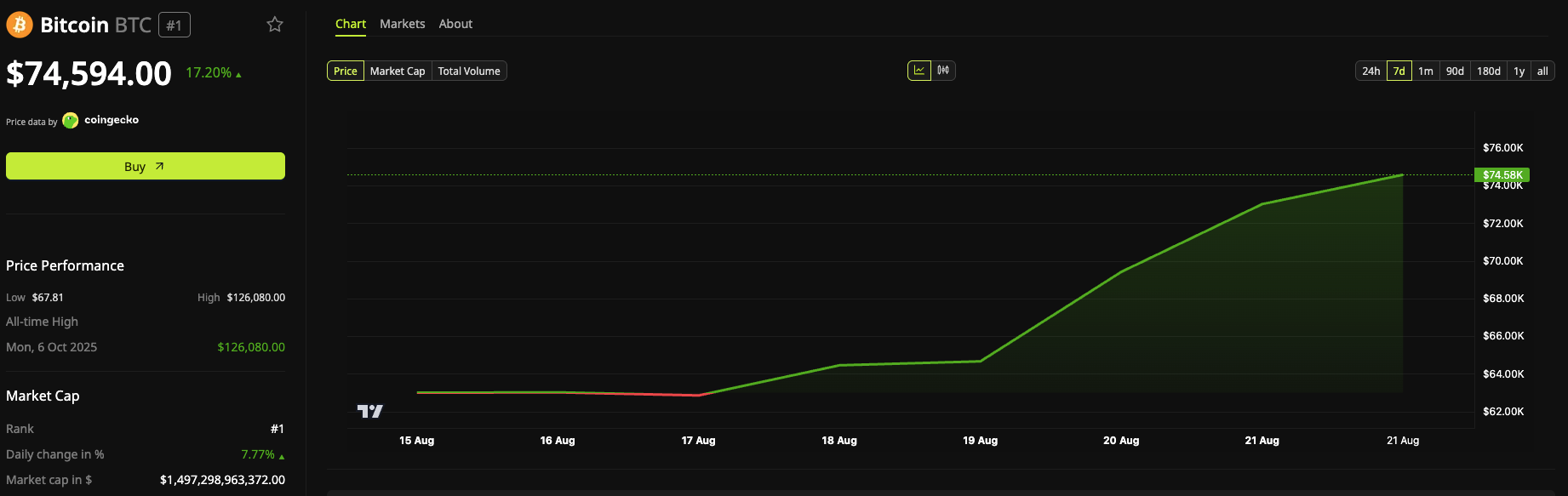
Bitcoin has climbed since Cramer’s original sell call, when it traded near $63,700. It now trades near $74,300 and touched an intraday high of $75,500, a run that has continued regardless of his stated exit.

Whether Cramer actually holds, sold, or has quietly bought back into Bitcoin remains unverified. What is clear is that his on-air signals now contradict each other within weeks, leaving viewers to decide which Cramer to listen to, if either.
The post Inverse Cramer Strikes Again as Jim Tells Caller to Buy the Bitcoin He Sold appeared first on BeInCrypto.

We are squarely in a longevity boom, and the field is now well established as serious science. But we are still near the beginning. Right now, there is no proven longevity drug you can take to make yourself live longer. (That we know of: Nir Barzilai, who thinks some existing drugs could be repurposed as longevity-boosting treatments, is eager to change that.) Some things are within your control, however. You can exercise, like Yamanaka; build muscle, which Dr. Gabrielle Lyon calls the “organ of longevity”; and strengthen your social ties, which Dr. Robert Waldinger has learned are crucial from directing the world’s longest study of human happiness. TIME’s 12 Longevity Leaders know that all of these approaches—medical, physical, social—are key in the quest to live as well as possible for as long as possible.
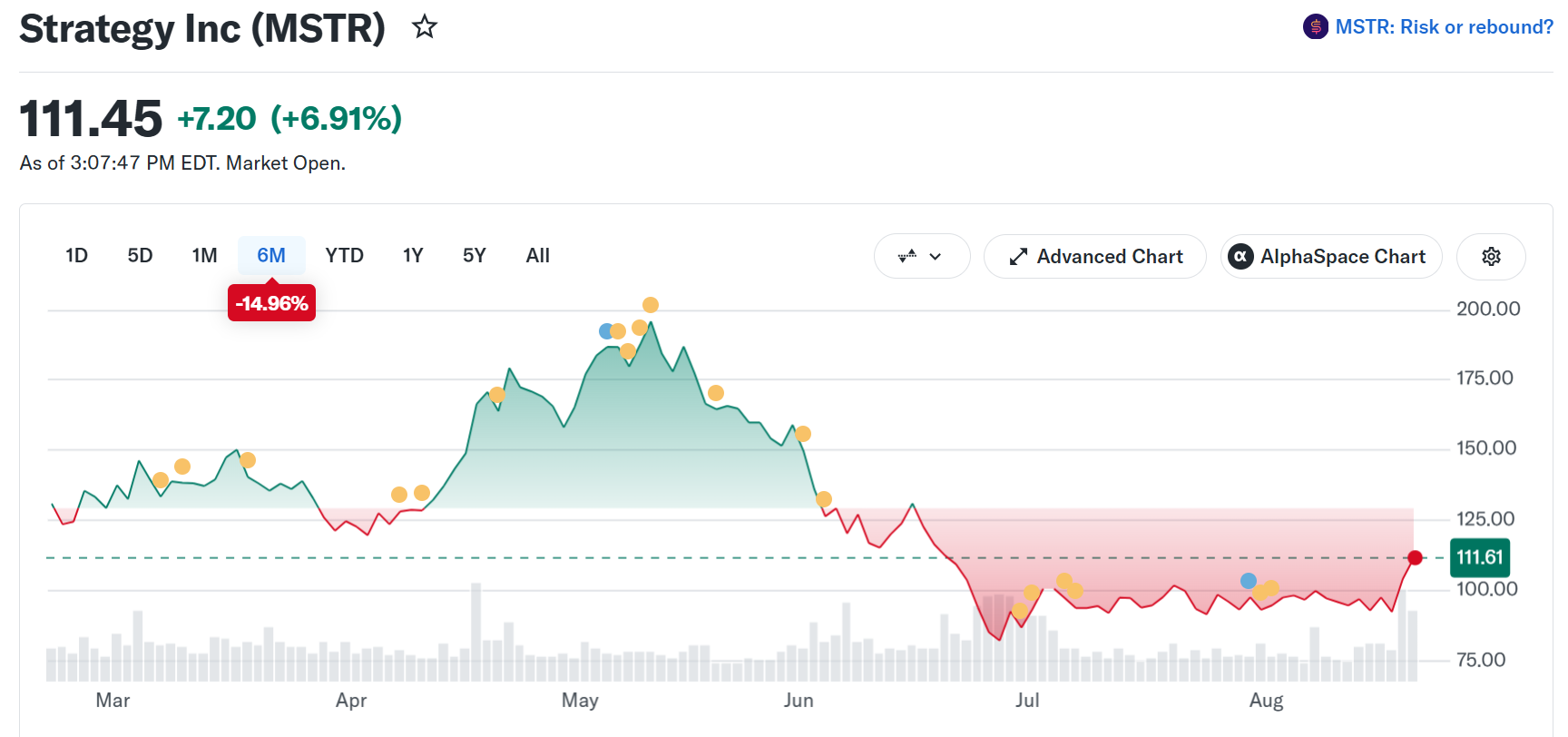
Strategy, the company once called MicroStrategy (MSTR), rose 6.9% to $111.14 on Thursday afternoon. That is its best price since June 18, which wipes out a two-month slide.
The stock market has forgiven the company. The balance sheet has not. MicroStrategy’s Bitcoin is still worth billions less than it paid.

How MicroStrategy Clawed Back Two Months
MSTR traded at $111.45 as of 3.05 p.m. ET, up 6.91% from Wednesday’s $104.25 close. The shares had bottomed at $81.81 in late June.
That is a 35.9% climb off the floor. July never produced a close above $101.95, so Thursday’s move clears the whole summer.
The fuel came from Bitcoin topping $70,000, marking the first time in 78 days. The token had not held that level since early June.
Two decisions in Washington did the heavy lifting. On Wednesday the Treasury doubled the size of its long-end bond buybacks. Each operation will now buy at least $4 billion from Sept. 9.
A day earlier, the Securities and Exchange Commission (SEC) proposed Regulation Crypto Assets. The rule would let crypto firms raise up to $75 million a year without full registration.
Short sellers were caught out. Traders covered roughly $1.5 billion of bearish bets, including $700 million inside one minute.
“…a quiet form of quantitative easing, a move that weakens the dollar and sends scarce, debasement-hedge assets like Bitcoin higher,” Matt Mena, crypto research strategist at 21Shares, on the Treasury move.
Follow us on X to get the latest news as it happens
The Bitcoin Stack is Still Underwater
Strategy holds 840,447 bitcoin. It paid an average $75,385 per coin, or $63.36 billion in total, according to its own ledger.
At $69,803 that pile is worth $58.67 billion. So the company sits about $4.69 billion in the red. Bitcoin has to rise another 8% before the treasury breaks even.
The gap already forced a change of habit. Strategy bought its first 21,454 coins on August 10, 2020, paying $11,652 each. The ledger records no sales at all until this year.
Then came four of them. The company sold 6,916 bitcoin between June 30 and August 10, at prices from $59,256 to $64,262. Measured against its average cost, that booked roughly $92 million in real losses on less than 1% of the stack.
The paper damage is far larger. Strategy reported an $8.22 billion second quarter net loss in July. It has also paused new bitcoin buying, raising $333.7 million last week without adding a single coin. In February, management spelled out its own breaking point in a deep bitcoin crash.
Which Crypto Stocks Really Got Back to June
The rebound was broad, but it was not equal.

BitMine, an ether treasury company, leads the group by a wide margin. Circle has climbed back above its June 18 level.
Coinbase beat every June close, yet it trails its July 21 peak of $175.85. Bitdeer is the outlier. The miner rose 8.57% and stays 41.7% below June.
The split is telling. Money returned to the treasury companies and the exchanges, which move with bitcoin most directly. It has not returned to the miners.
Big investors were already positioned. Twelve of the 15 largest MSTR institutional holders added shares in the second quarter, while the stock was falling.

“it’s a compelling time for investors with longer-term horizons to be allocating to Bitcoin and the crypto asset class,” said Zach Pandl, head of research at Grayscale.
One number decides whether this holds. Bitcoin must reach $75,385 for Strategy’s treasury to turn green again, and for Michael Saylor to start buying without booking a loss.
The post MicroStrategy Erases 2-Month Loss as Crypto Stocks Rally: Is the Damage Over? appeared first on BeInCrypto.
Disclosure: This article does not represent investment advice. The content and materials featured on this page are for educational purposes only.
XRP liquidity on Binance is declining as prices face resistance, while UE Crypto promotes cloud mining and yield aggregation as alternative return strategies.
Summary
- XRP’s Binance balance slips to 2.62 billion as the token struggles to reclaim $1.07, keeping near-term price gains under pressure.
- With XRP facing volatile trading conditions, investors are exploring cloud mining as an alternative way to seek passive returns.
- UE Crypto highlights cloud mining, multi-asset support, and automated yield services as XRP holders seek diversified income options.
XRP is trading above $1 and continues to decline below key exponential moving averages (EMAs), with the short-term bearish trend remaining in place. The 50-day EMA is at $1.07, the 100-day EMA is at $1.15, and the 200-day EMA is at $1.34. All remain above the current price, indicating that the overall trend remains constrained despite the previous breakout above the descending resistance trendline, with the current breakout price near $1.06.
Momentum remains weak, with the Relative Strength Index (RSI) hovering around 38 and the Moving Average Convergence/Divergence (MACD) remaining below zero, suggesting that downward pressure continues rather than an immediate bullish reversal.
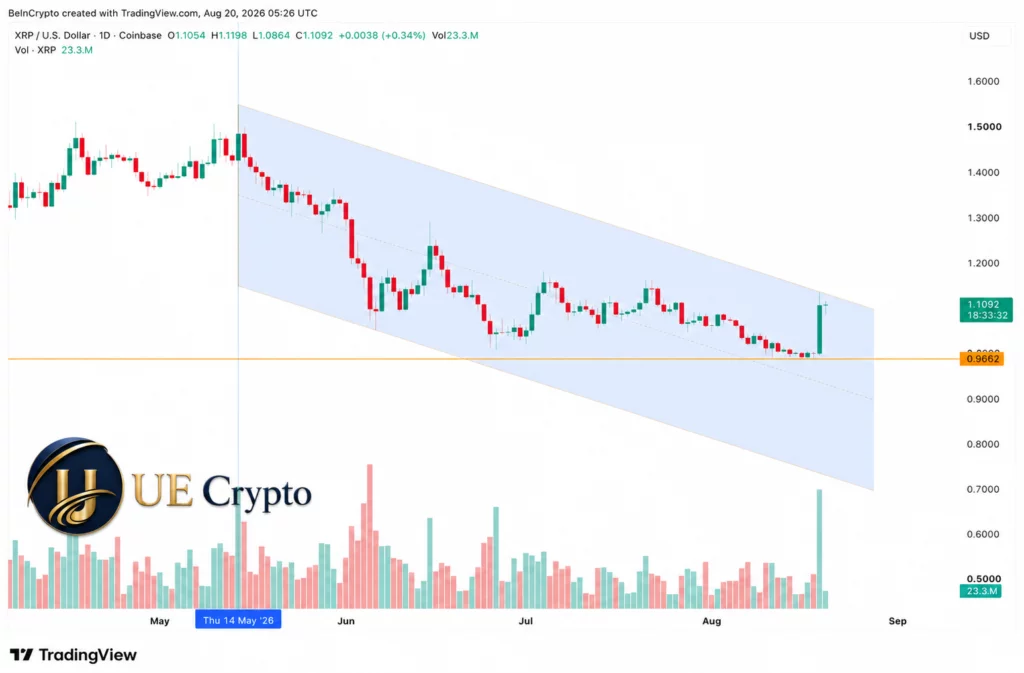
XRP balances on Binance have narrowed slightly to 2.62 billion, indicating declining liquidity. Unless XRP can decisively reclaim the 50-day moving average support level at $1.07, its short-term rally may continue to face selling pressure.
Despite some potentially favorable factors, such as the passage of the CLARITY Act, the market reflects limited expectations for the project’s growth potential amid increased exchange-rate volatility. As a result, more and more XRP investors are turning their attention to UE Crypto’s cloud mining digital asset platform.
Facing selling pressure, UE Crypto’s cloud mining platform is attracting increasing attention from investors who hope to use cloud mining and yield aggregation mechanisms to mitigate market volatility and improve returns.
Recent events and risks
Institutional spot ETF inflows have stalled:
Capital inflows into spot XRP exchange-traded products have stalled, with multiple instances of zero inflows and net asset outflows, leaving the spot market vulnerable to volatility in the absence of sustained institutional buying.
Derivatives leverage unwinding and forced liquidations:
As price action tests and briefly breaks through the key psychological support level of $1.00, forced long liquidations in the perpetual futures market have intensified alongside the expansion of short open interest, further accelerating the intraday downward momentum.
Regulatory friction and stalled legislative catalysts:
Following the U.S. Senate recess, key cryptocurrency framework legislation such as the CLARITY Act failed to pass. Continued uncertainty surrounding the regulatory framework proposed by the U.S. Securities and Exchange Commission has also stalled legislative progress, continuing to suppress broader market risk appetite.
Contraction in on-chain network activity:
During recent trading cycles, transaction throughput and active wallet usage on the XRP Ledger have contracted sharply, indicating declining demand driven by immediate utility, while large deposits of tokens into centralized venues have increased supply pressure.
Meanwhile, an increasing number of digital asset investors are turning their attention to the UE Crypto cloud mining platform, seeking to explore diversified income models through cloud mining and yield aggregation. Although they remain optimistic about XRP’s long-term prospects, the question is whether the impact of short-term price volatility can be effectively reduced while continuing to generate additional returns from their XRP holdings.
Why is UE Crypto increasingly attracting attention?
1. Security and stability
UE Crypto adopts a multi-layer security architecture, integrating technologies from McAfee and Cloudflare and implementing measures such as offline cold wallets to provide comprehensive protection for platform operations and user assets.
2. Environmentally friendly and efficient
The platform’s mining operations utilize renewable energy sources such as solar, wind, and hydropower, aiming to minimize the environmental impact of energy consumption while maximizing computing efficiency.
3. Compliance and transparency
The platform continuously improves its operational standards, data transparency, and user protection mechanisms to provide a clearer and more reliable environment for cryptocurrency services.
4. Smart custody
UE Crypto handles daily operations, computing power management, and yield settlement through professional teams and automated systems, enabling users to easily generate passive income.
5. Multi-currency support
The platform supports a variety of mainstream digital assets, including BTC, ETH, DOGE, SOL, XRP, USDC, LTC, and USDT, providing greater flexibility for different users.
6. Affiliate rewards
The platform offers an affiliate program through which users can earn 3% + 2% referral commissions by inviting friends, with rewards of up to $50,000. Users can increase their passive income even without making any investment.
About UE Crypto’s cloud mining digital asset platform
UE Crypto is headquartered in the United Kingdom and operates within European regulatory frameworks such as MiCA and MiFID II, continuously improving its transparency, operational standards, and user protection mechanisms.
The platform adopts a multi-layer security architecture, including:
- Annual financial and security compliance audits conducted by PwC.
- Digital asset custody insurance provided by Lloyd’s of London.
- Enterprise-grade network protection from Cloudflare and McAfee® security systems.
- Bank-grade data encryption and professional security infrastructure to provide multiple layers of protection for users’ assets and accounts.
How to use UE Crypto?
1. Register an Account
2. Choose a mining package
Choose a suitable cloud mining contract according to a personal budget and needs, and start mining with one click.
3. Start earning
Once the contract is activated, the system will automatically allocate computing power, and returns will be settled automatically every 24 hours. Users can withdraw their earnings at any time or continue participating according to their own needs, thereby achieving long-term compound growth of their assets.
Popular UE Crypto contracts
BTC (Beginner Experience Contract)Investment amount: $100, Contract duration: 2 days,Daily return: $4,Total return at contract expiration: $100 + $8
Dogecoin (DOGE, Digital Intelligent System Contract)Investment amount: $500,Contract duration: 5 days, Daily return: $6.25 ,Total return at contract expiration: $500 + $31.25
BTC (Super Computing System Contract)Investment amount: $1,000,Contract duration: 10 days, Daily return: $13.10 ,Total return at contract expiration: $1,000 + $131
LTC (Algorithm-Driven System Contract) Investment amount: $5,000,Contract duration: 25 days, Daily return: $72,Total return at contract expiration: $5,000 + $1,800
BTC (Quantitative Intelligent System Contract)Investment amount: $10,000,Contract duration: 35 days, Daily return: $158, Total return at contract expiration: $10,000 + $5,530
For more details about the contract plans, please visit the official UE Crypto website.
Overview
XRP’s price surge is facing selling pressure. Despite some potentially favorable factors, such as the passage of the CLARITY Act, the increased exchange-rate volatility reflects the market’s limited expectations for the project’s growth potential.
For long-term XRP investors, in addition to focusing on price trends and market cycles, it is equally important to consider how to reduce the risks associated with relying on a single storage method and explore more diversified digital asset management approaches. UE Crypto aims to create more resilient and sustainable passive income for users through cloud mining, computing power management, renewable energy, and other methods.
Disclosure: This content is provided by a third party. Neither crypto.news nor the author of this article endorses any product mentioned on this page. Users should conduct their own research before taking any action related to the company.

CME Group CEO Terry Duffy told the Commodity Futures Trading Commission (CFTC) it clears contracts that traders can rig. Chairman Michael Selig cut him off and called the claim fake news.
The exchange happened Thursday in Washington, at the first meeting of the CFTC’s Innovation Advisory Committee. Duffy runs the largest futures exchange in the world. Selig regulates it.
2,500 Filings and Zero Objections
Selig built the 35-member committee in February. Its roster includes the chief executives of Kalshi, Polymarket and DraftKings. Thursday’s agenda covered crypto, artificial intelligence and event contracts.
Duffy used his turn to attack the last one.
Roughly 2,500 self-certifications have landed at the agency since January 2025, he said. None were opposed.
Self-certification is the fast lane. An exchange files a contract, attests that it follows the law, and lists it. Nobody has to approve it.
Duffy said some of those filings break core principle 3. That rule bars any contract that traders can readily manipulate.
There is a structural reason few filings get challenged. Selig is the only sitting commissioner at the CFTC. Four of the agency’s five seats are empty.
“We’re not a bunch of carnival barkers at a circus. We are running the most envious markets in the world in the United States of America.”
Follow us on X to get the latest news as it happens
Selig Calls It Fake News, But The Record Is Messier
Duffy raised two cases.
In the first, a Fort Bragg soldier named Gannon Van Dyke turned $33,034 into $409,881 on Polymarket. He bet on whether US forces would enter Venezuela. He also held classified details of the raid that captured Nicolás Maduro. Prosecutors charged him in April.
In the second, Trump’s teleprompter operator Gabriel Perez cleared more than $100,000 on Kalshi. He traded on what the president would say. Investigators found bets on more than a dozen speeches.
Selig cut in before Duffy finished.
“…those products are not listed in the United States. They never were. This occurred offshore, and that’s fake news.”
Duffy called that a cute comment. He granted that the Maduro market was Polymarket’s, which trades offshore.
The teleprompter case is different. Those trades ran on Kalshi, an exchange the CFTC itself designates and oversees. Kalshi’s own surveillance team flagged the activity and reported it to the agency.
So one example landed offshore. The other did not.
Kalshi Trades Compute Today. CME Waits for October.
Duffy then moved to timing, and the complaint got sharper.
Kalshi already runs markets on the cost of renting Nvidia chips. It launched them in July.
CME wants in on the same trade. On August 11 it said it would list rental futures for Nvidia H100 and B200 chips. Its partner is Silicon Data, a firm backed by trading house DRW. Target date, October 5, pending review.
Then the agency opened a consultation. On August 19 it asked the public to comment on compute derivatives for 60 days.
Count the days. A 60-day window starting from Federal Register publication closes after October 5.
DRW founder Don Wilson, also on the committee, asked why compute needed 60 days at all.
Duffy added a second detail. Cantor Fitzgerald had opened institutional trading in Kalshi contracts hours earlier. “Let’s call that a coincidence,” he said.
Cantor’s announcement covered event contracts broadly and never mentioned compute.
The Man Attacking Self-Certification Once Used It
Duffy’s frustration is not abstract. His own filings keep stalling.
In July the agency froze CME’s 24-hour crude oil contract while a rulemaking ran. Selig called the timing wholly inappropriate. That comment period closes on August 26.
CME has already gone to court. On June 18 it sued the CFTC over Kalshi’s Bitcoin perpetual contract, arguing the agency rubberstamped Kalshi’s reasoning. Those perps cleared $1 billion in volume in their first week.
Duffy also pressed on offshore venues. Traders in the US cannot legally touch them, he said, yet they get there anyway. He asked what the commission is doing to “police everybody’s VPN.”
Subscribe to our YouTube channel to watch leaders and journalists provide expert insights
He named Hyperliquid. President Donald Trump had floated bringing Hyperliquid onshore at a White House crypto summit the previous day.
One point cuts against Duffy. CME self-certified its own Bitcoin futures in December 2017, using the same fast lane he now calls dangerous. Duffy signed the announcement.
He closed on 2008. Bad behavior in finance does not cost the industry one step, he said. It costs 20, and the rebuild takes years.
Duffy hands the CEO job to Lynne Fitzpatrick in March 2027. The committee he was addressing cannot write rules. Selig can, alone, and two of his clocks run out within weeks.
The post CME Group CEO Terry Duffy Clashes With CFTC Chair Over Prediction Markets appeared first on BeInCrypto.


Polymarket pays a former FBI staffer to watch its traders full time. Chief executive Shayne Coplan revealed the role to US regulators on Thursday.
He spoke at the first meeting of the Commodity Futures Trading Commission’s Innovation Advisory Committee. His message was blunt. Polymarket users have almost no privacy.
Polymarket Surveillance Goes Further Than the Company Says
Coplan described the hire while defending his platform in Washington.
“We have someone here right now who… is ex-FBI who works full-time at Polymarket.”
That staffer built custom surveillance software in-house, he said. Outside firms were impressed it was not outsourced.
The detail is new. Polymarket’s public integrity page names Chainalysis and Palantir as partners. It never mentions building tools of its own.
Coplan knew the news would sting. He said some users would be upset to hear it.
Subscribe to our YouTube channel to watch leaders and journalists provide expert insights
The Numbers Behind the Monitoring
Polymarket reports handing 315 or more wallet records to authorities. It also claims 90 or more account referrals and two arrests. The company gives no date for those totals.
Two traders learned what that means this year. In April, the CFTC charged Army Master Sgt. Gannon Ken Van Dyke over the Nicolas Maduro market.
He bought more than 436,000 “Yes” shares in four days. He made roughly $404,000. His handle, Burdensome-Mix, sat in public view the whole time.
In May, regulators charged Google engineer Michele Spagnuolo over 23 contracts on the firm’s Year in Search list. He allegedly cleared about $1.2 million as AlphaRaccoon.
Why Anonymity Was Never Real
Coplan argues the openness is the point.
“It’s all public. It’s all on chain. It’s the least anonymous financial market of all time.”
Anyone can open a market and read a trader’s full history. Therefore the tool that catches cheats also exposes everyone else.
The walls are rising elsewhere too. Polymarket bars 39 countries and bans VPNs outright under its terms. It began blocking VPN access and demanding documents from big accounts this year. South Korea cut access entirely in August.
Not everyone thinks self-policing works. CME Group chief Terry Duffy told the same meeting that regulators wave through manipulable contracts. Chairman Michael Selig rejected that.
For traders, the lesson is simpler. A Polymarket wallet is not a disguise. It is a permanent record, and a former FBI staffer is reading it.
The post Ex-FBI Officer is Watching Every Polymarket Trader, Says CEO Coplan appeared first on BeInCrypto.

Chinese consumer electronics company Xiaomi showed off its humanoid robot in Beijing at the World Humanoid Conference in August 2026.
Evelyn Cheng | CNBC
BEIJING — The big challenge for humanoid robots is still getting the technology to work well, according to industry leaders speaking alongside the World Robot Conference in Beijing this week.
Robots are not yet as efficient as humans, and take time to learn new skills, creating a bottleneck for the industry, Unitree’s founder Wang Xingxing said, addressing the conference one day after his company’s 460% IPO-day surge. His remarks underscored the challenges for humanoid robots entering the human workforce. Shares of Unitree fell 18.7% on Thursday.
The U.S. Federal Communications Commission last month added foreign-made advanced robotic devices, including humanoids, to a list restricting imports to the U.S. The statement did not specify a country, and said retailers could still import models the FCC has previously approved.
But the impact of that limitation isn’t that great right now because there aren’t that many humanoids being used in the U.S., Jeff Burnstein, president of the Association for Advancing Automation, told CNBC.
“Where the impact might be in the U.S. is on autonomous mobile robots, which are used in factories that much more than humanoids are,” he said.
The state of technology means companies deploying robots to increase efficiency aren’t even focused on humanoids right now.
“What I hear from customers in the U.S. [is that] ‘we want solutions. We have a problem. We need a solution. We don’t care if it’s a humanoid. We don’t care if it’s a traditional robot, a collaborative robot. We don’t even care if it’s a robot. We need a solution,” Burnstein said.
“So the onus is on the humanoid players to show we have a solution,” he said, noting the robots need to be affordable, safe and ready to use.
Keenon, a startup, develops humanoids to use in conjunction with simpler delivery robots to handle laundry services in hotels, for example, according to COO Wan Bin. Keenon’s business partners include Buffalo Wild Wings and Hilton.
Completing 50% of a task well is relatively easy, even 80%, he said. But to reach a 99.9% completion rate really tests engineering and training capabilities, Wan said.
He said the company has shipped more than 100,000 robots, and expects that to exceed 150,000 units by the end of next year.

Solana, Robinhood, BNB Clash for Meme Coin Season: Who is Winning the $3 Billion Rally?

7 Netflix Fantasy Shows Where Every Episode Is a Masterpiece

16 Cotton Dresses That Carry Themselves





-

 Fashion6 days ago
Weekend Open Thread: Ann Taylor
-
 Tech7 days ago
11 Ways to Rank Your Videos
-

 Sports6 days ago
Birmingham 2026: Day 6 Timetable for Irish Athletes
-
 NewsBeat6 days ago
Myanmar says over 300,000 Rohingya refugees verified for repatriation as exodus enters ninth year
-

 Politics6 days ago
SEQ Code: The Three Letter Boarding Pass Code That Could Give You The Worst Seat
-

 Tech3 days ago
Qwen3.8-27B runs frontier-class coding agents and reasoning locally, no cloud API required
-

 Business3 days ago
SMA Solar Technology AG (SMTGY) Q2 2026 Earnings Call Transcript
-

 Crypto World6 days ago
Pi Network Protocol 27 endgame: last upgrade before what?
-

 Crypto World3 days ago
OCC Greenlights Trump Family Crypto Firm for Trust Charter
-
 Tech6 days ago
Every fusion startup that has raised over $100M
-
 Entertainment6 days ago
Marvel Studios Reveals New X-Men Cast Including Adam Driver and Sadie Sink
-

 Business7 days ago
15 Ways to Make Money From Your Phone (2026 Guide)
-

 Crypto World7 days ago
Robinhood Chain Approaches $1B TVL as Uniswap Integration Boosts Liquidity
-
 Entertainment7 days ago
10 Netflix Shows That Quietly Became Modern Classics
-

 Fashion6 days ago
Weekly News Update, 8.14.26 – Corporette.com
-

 News Videos23 hours ago
Don’t Leave Your Financial Future To Chance | August 19, 2026
-

 Fashion7 days ago
Silver bangles for women – Newbridge Silverware
-

 Business6 days ago
Facebook Down Now? Users Report Login And Loading Problems As Outage Trackers Monitor Ongoing Issues
-

 Fashion6 days ago
Cart Confidential Vol. 44 – Julia Berolzheimer
-
 Business6 days ago
Monarch Mutual Fund set to enter MF space with maiden overnight fund; files draft with Sebi
You must be logged in to post a comment Login