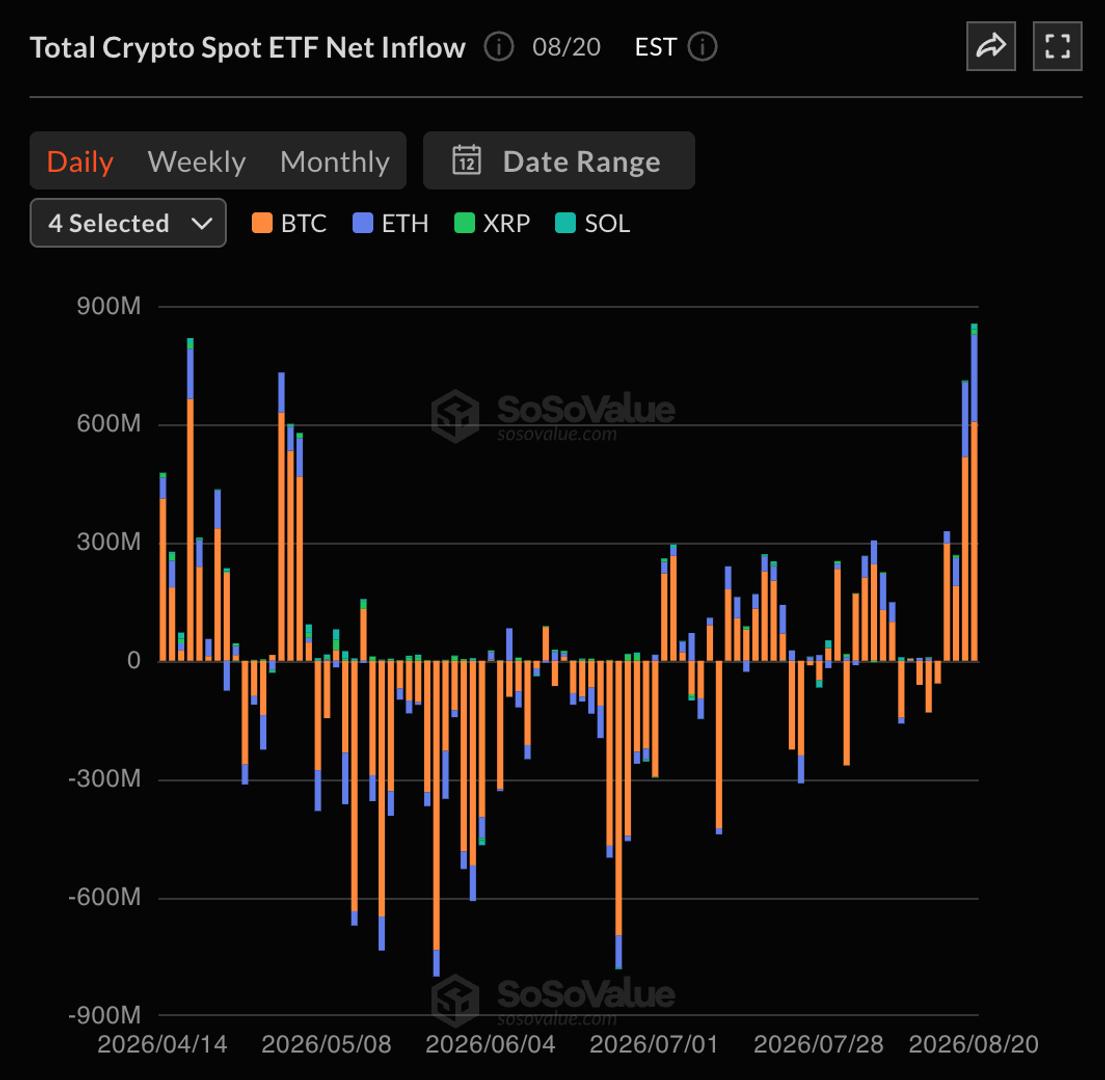
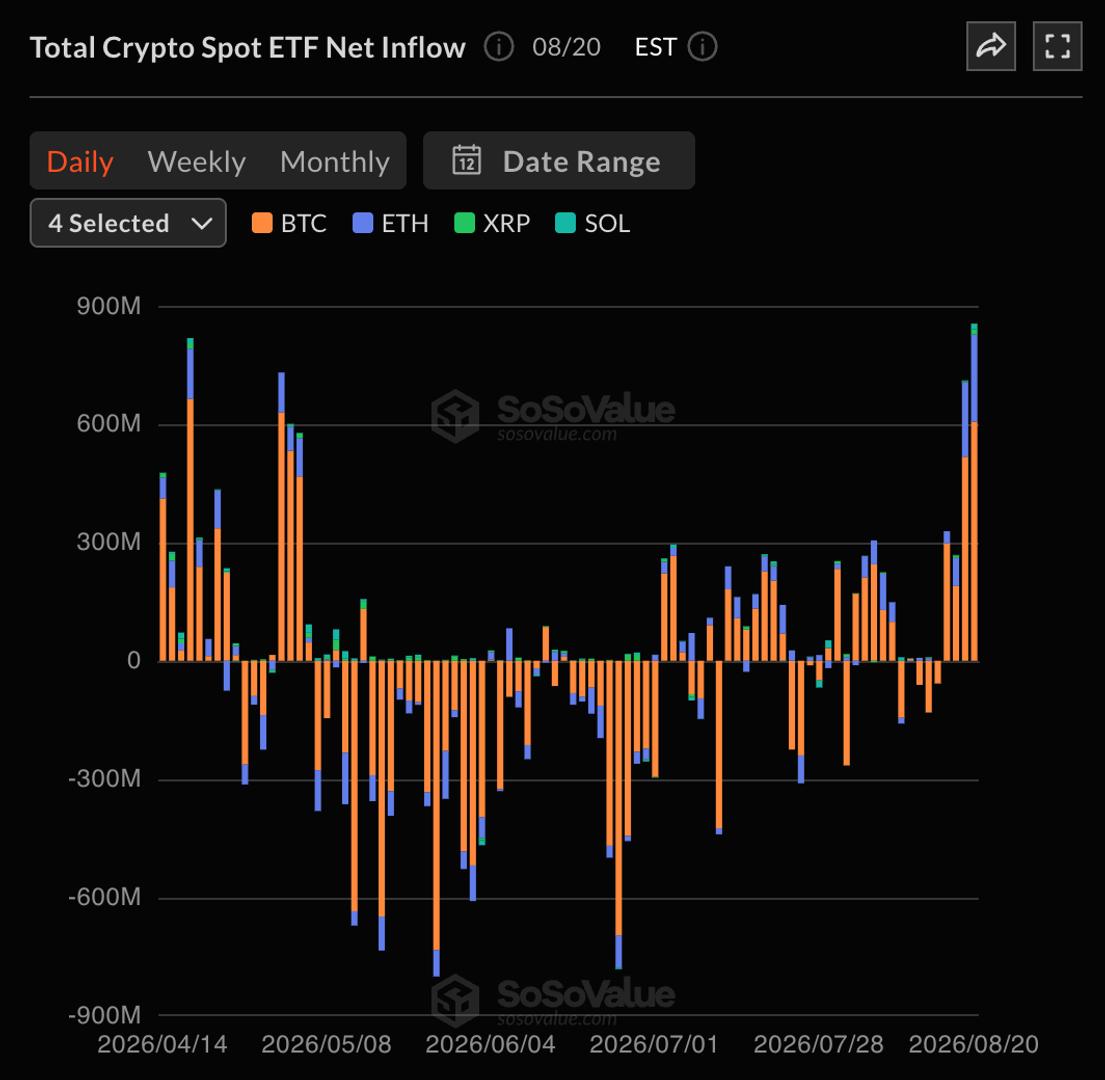
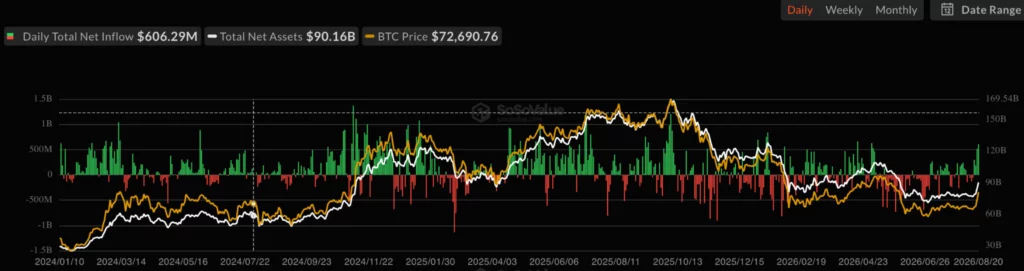
Spot bitcoin ETFs pulled in $606 million on Aug. 20 and ether funds $221 million, both bigger than the prior day, confirming the institutional bid behind bitcoin’s run.
On 19 August, the US Treasury announced that it would double the volume of long-term government bond buybacks. The measure led to a noticeable decline in yields at the longer end of the curve and forms part of the Treasury’s broader efforts to contain pressure on long-term borrowing costs. These efforts include market interventions and calls for the Federal Reserve to expand the limits of the FIMA repo facility.
Lower Treasury yields improve the relative appeal of precious metals, which do not generate interest income, providing direct support for silver. Industrial demand is another important factor. Chinese imports of silver-containing ores rose 62.5% year-on-year in June amid expanding production of solar panels and power-grid equipment.
Technical Analysis of Silver
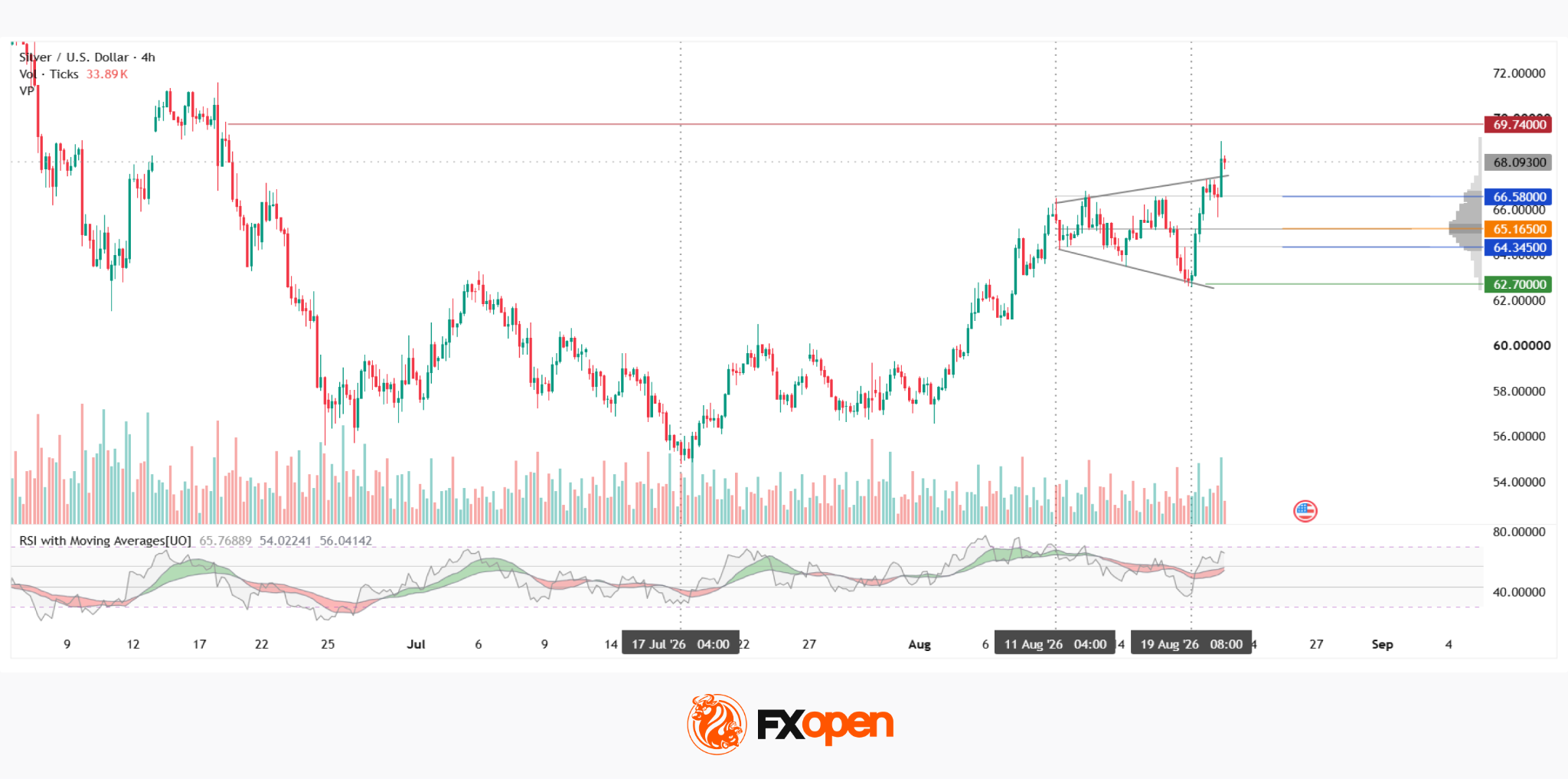
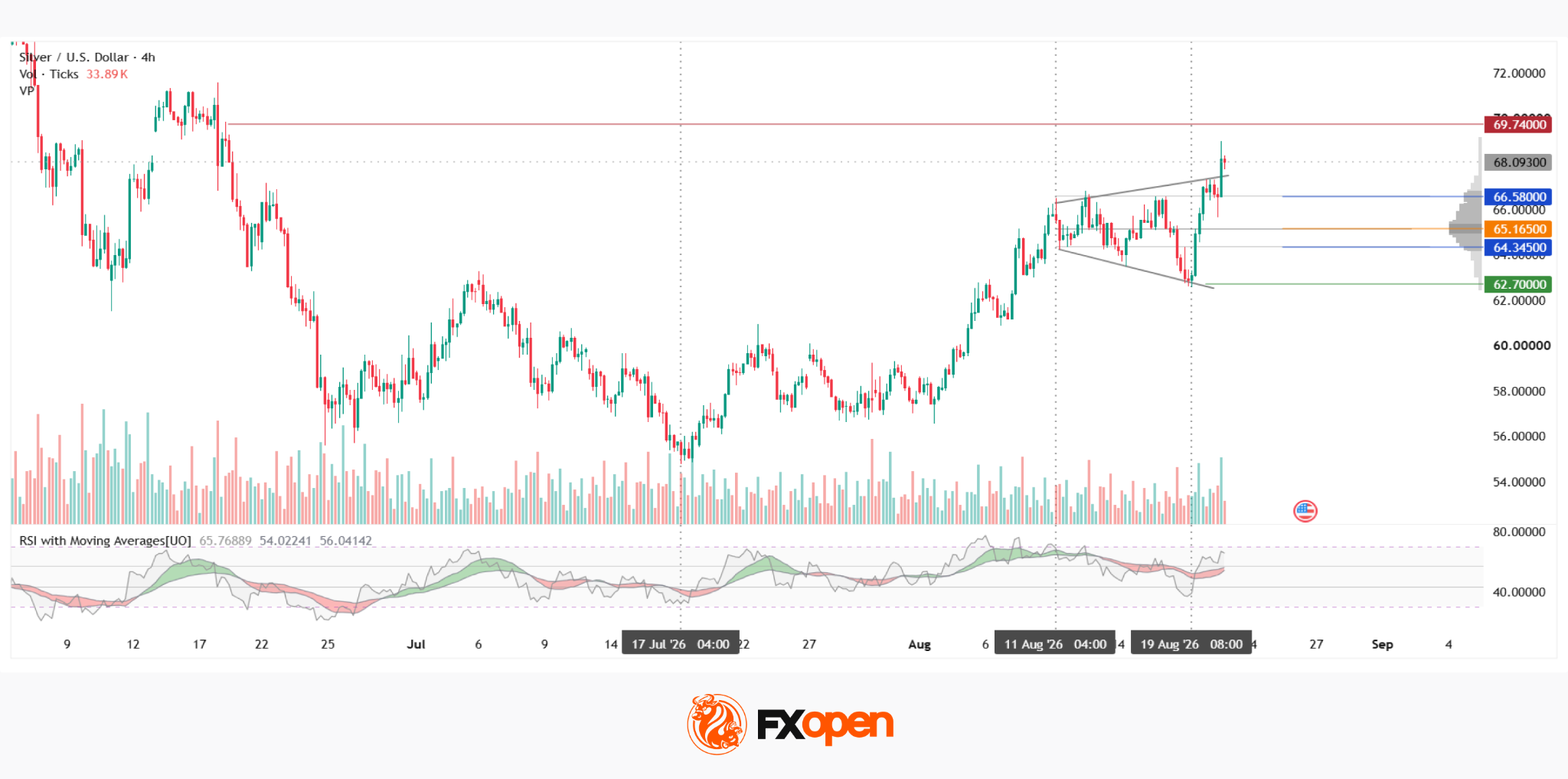
Since 17 July, XAG/USD has been moving within a pronounced uptrend on the four-hour chart. In the upper portion of this advance, a pattern resembling a broadening triangle emerged in mid-August. Unlike a conventional triangle, its boundaries widened rather than converged, reflecting increasing volatility during the consolidation phase.
On 20 August, the price broke above the formation and continued to hold above the current market profile. The breakout candle was accompanied by a noticeable increase in vertical volume compared with the preceding consolidation bars, adding some confirmation to the move.
Following the breakout, silver moved above the profile’s upper boundary at $66.58. If the bullish momentum persists, the next major upside reference is the red resistance level at $69.74.
Advertisement
A return inside the profile would shift attention to the cluster of two important levels: the Point of Control (POC) at $65.165 and the lower profile boundary at $64.345. Their proximity makes this area particularly important for the short-term outlook. If sellers push the price through this cluster, the next potential support could be found around the green level at $62.700.
The RSI + MAs indicator currently shows readings of 66, 56 and 56. The oscillator is trading above the neutral zone, while both moving averages remain below its upper boundary and are only beginning to approach a potential breakout.
Key Takeaways
The breakout above the broadening triangle on increased volume initially points towards further upside, but maintaining prices above the market profile will require additional confirmation.
The $66.58 level is therefore likely to remain important in the near term: holding above it would favour continuation towards $69.74, while a return below the profile could bring the 65.165–64.345 area back into focus.
Advertisement
The broader outlook will also remain sensitive to the direction of US Treasury yields. A continued decline in yields could provide further support for silver, while a renewed rise in long-term yields could limit the metal’s upside.
Start trading commodity CFDs with tight spreads (additional fees may apply). Open your trading account now or learn more about trading commodity CFDs with FXOpen.
This article represents the opinion of the Companies operating under the FXOpen brand only. It is not to be construed as an offer, solicitation, or recommendation with respect to products and services provided by the Companies operating under the FXOpen brand, nor is it to be considered financial advice.
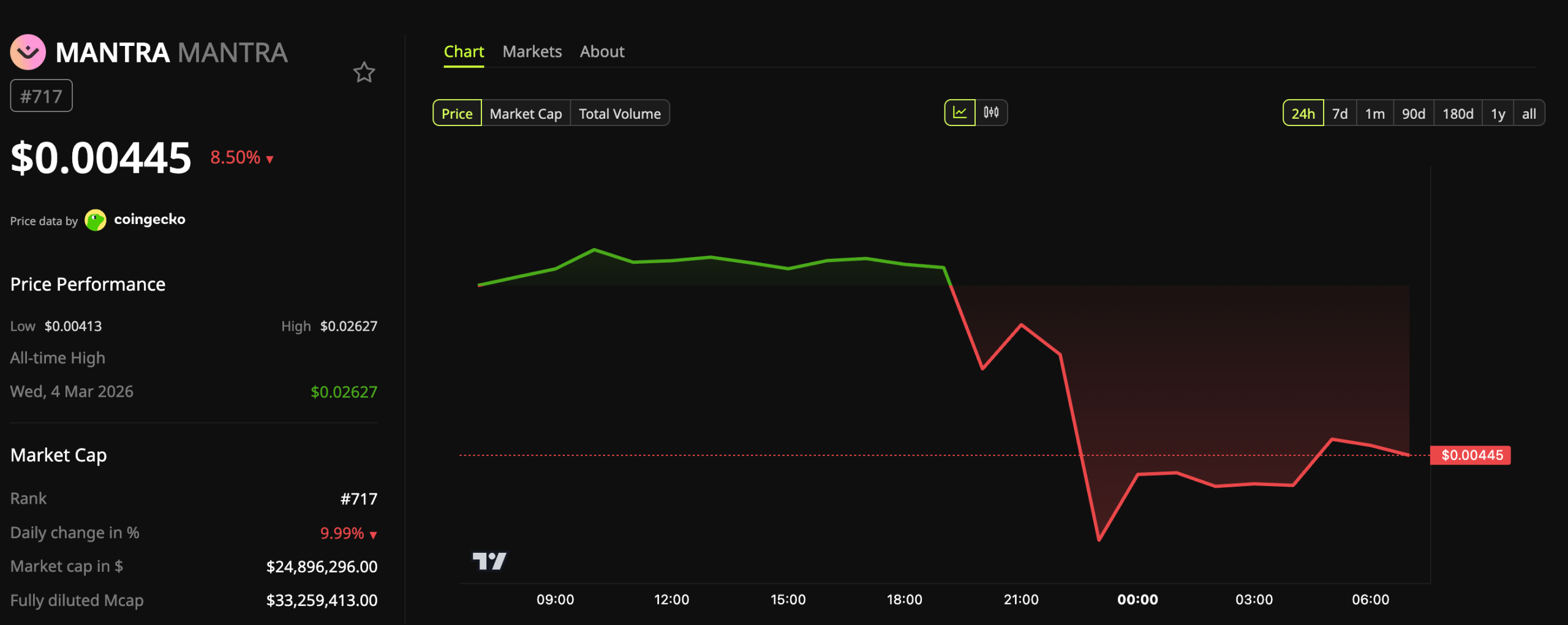
MANTRA (MANTRA) slid to an all-time low of $0.0041 as the project froze its blockchain and said an attacker was targeting a vulnerability in an upstream dependency.
The record low came as the rest of the market climbed, extending a rally that accelerated on Wednesday.
Why MANTRA Halted Its Chain
MANTRA Chain, a Layer 1 blockchain built for tokenizing real-world assets, was halted earlier today. Its initial notice said all endpoints and transactions were frozen.
We’re aware of an incident affecting MANTRA Chain and have halted the chain as a precaution while we investigate. All endpoints and transactions are currently frozen. This means deposits and withdrawals to/from MANTRA Chain are temporarily affected. If you’re unsure how this…
— MANTRA | The EVM L1 for RWAs (@MANTRA_Chain) August 21, 2026
A later update named the cause. The team pointed to an attacker exploiting a vulnerability in an upstream dependency, meaning third-party code the chain relies on rather than software it wrote itself.
“Earlier today, we detected an attacker exploiting a vulnerability in an upstream dependency used by the chain and halted the network as a precaution,” the update read.
MANTRA said it has identified the vulnerability and is now preparing a patch. Its validators and infrastructure remain offline until the upgrade is ready.
“Resuming the network will require a coordinated restart with the wider validator set — we will not resume until the patch is verified and that coordination is in place,” it added.
The team is also tracing where funds moved and has contacted exchange partners. Deposits and withdrawals remain paused at affected venues, and the total scope of the impact remains unconfirmed. The team also warned holders to ignore anyone offering recovery help.
Advertisement
MANTRA Misses a Market-Wide Rally
The incident has also impacted the token. MANTRA changed hands at $0.0044 at press time, down 8.5% on the day.
MANTRA Token Price Performance. Source: BeInCrypto Markets
That slide ran against the broader market. Bitcoin (BTC) topped $75,000 earlier today as short liquidations reached $1.06 billion. Other major cryptocurrencies also traded higher, lifting the total crypto market capitalization by nearly 4% over the past day.
The incident marks the network’s second major crisis in 16 months. Its token, then known as OM, lost nearly 90% of its value in April 2025, wiping out about $5.5 billion in market value in less than an hour.
The project retired the OM ticker this March. A non-dilutive 1:4 split at block 13,000,000 converted each OM into four MANTRA, and the token posted a 37% launch-day rally.
Bitcoin price extended its sharp recovery on Aug. 21, rising above $76,000 for the first time since late May as institutional inflows and improving U.S. liquidity conditions supported the breakout.
Summary
Bitcoin reclaimed $75,000 for the first time since late May after gaining roughly 18% rapidly.
U.S. spot Bitcoin ETFs attracted $606 million on August 20, extending two consecutive inflow sessions.
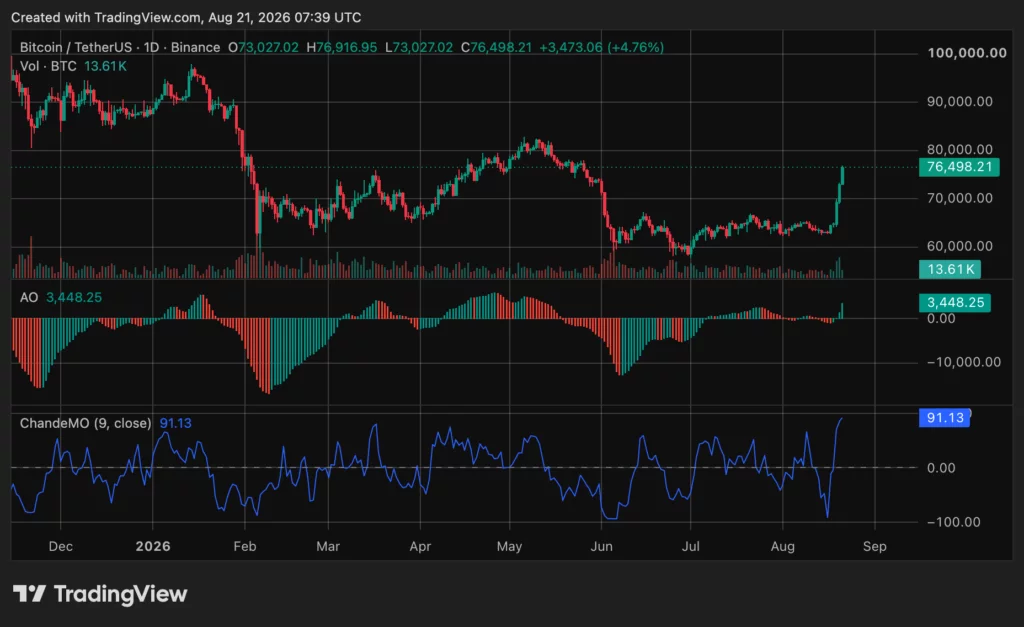
Bitcoin’s daily Awesome Oscillator turned positive while the Chande Momentum Oscillator reached an elevated 91.13.
Treasury will double long-dated debt buybacks to at least $4 billion per operation starting September.
The support zone between $70,000 and $72,000 now separates the breakout from deeper retracement risk.
BTC traded near $76,291, gaining almost 9% over 24 hours and approximately 19% during the previous seven days, according to crypto.news price data. The rally lifted BTC by more than $11,000 in roughly 48 hours.
The move began after BTC rebounded from the $62,000 to $63,000 region and broke through resistance around $65,000. It then cleared $70,000, paused near $72,000 and advanced through $75,000.
Advertisement
Bitcoin price ends weeks of sideways trading
The crypto had spent about six weeks trading inside a narrow range, with repeated attempts to move beyond $65,000 failing. The lack of direction encouraged traders to build bearish positions around the upper boundary.
Momentum changed on Wednesday when BTC climbed through several resistance levels within hours. Forced short covering accelerated the advance as traders bought BTC to close leveraged bearish positions.
As previously reported, almost $3 billion in positions were liquidated as BTC crossed $70,000. Shorts accounted for most of the liquidations, according to CoinGlass data cited by analysts.
Advertisement
The liquidations explain part of the rally’s speed but not necessarily its direction. Spot demand and U.S. exchange traded fund inflows also increased as BTC moved higher.
ETF inflows provide evidence of institutional demand
U.S. spot Bitcoin ETFs recorded approximately $606 million in net inflows on Aug. 20, according to SoSoValue data. The total followed about $517 million of inflows on Aug. 19.
Bitcoin spot ETF net inflow, source: SoSoValue
The two sessions produced more than $1.1 billion in combined net buying. The acceleration suggests institutional investors participated in the breakout rather than leaving the move entirely to derivatives traders covering short positions.
Spot Ether ETFs separately attracted about $221 million on Aug. 20. XRP funds added approximately $13 million, while Solana products received around $15 million.
In related coverage, analysts warned that continued ETF and spot demand will determine whether Bitcoin can establish lasting support above $70,000. Short covering provides temporary buying pressure because it ends once bearish positions have been closed.
Advertisement
The next ETF flow reports will therefore be closely watched. Continued inflows into next week would strengthen the case that institutions are adding exposure after the breakout. A rapid slowdown would leave the advance more dependent on momentum traders.
U.S. Treasury decision improves the liquidity backdrop
The U.S. Treasury Department announced on Aug. 19 that it will at least double the maximum size of liquidity support buybacks for longer dated government securities.
The maximum size will increase from $2 billion to at least $4 billion per operation. The change takes effect on Sept. 9 and will remain in place through Nov. 4, according to the department’s official announcement.
Long term Treasury yields declined after the decision, while the U.S. dollar weakened. Lower bond yields can make volatile assets more attractive because investors receive less income from government securities.
Advertisement
The buybacks should not be described as direct stimulus for Bitcoin. The Treasury said the program is intended to improve liquidity in longer dated bond markets. It does not create central bank money or directly purchase cryptocurrency.
U.S. political developments added to market sentiment. President Donald Trump urged Congress to pass a “fair version” of the Digital Asset Market Clarity Act during an Aug. 19 White House event involving crypto executives and federal regulators.
Trump also discussed the possibility of expanding U.S. Bitcoin holdings. However, the administration has not announced a purchase, funding mechanism or implementation timeline. Any acquisition therefore remains uncertain.
Bitcoin price faces an overheated momentum reading
The daily BTC/USDT chart shows Bitcoin trading well above its former $60,000 to $66,000 consolidation range. Volume near 13,610 BTC was higher than several recent sessions, supporting the breakout.
Advertisement
The Awesome Oscillator stood near 3,448 and moved firmly into positive territory. The reading indicates that short term momentum has strengthened compared with the recent sideways period.
Bitcoin (BTC) price chart, source: crypto.news
The Chande Momentum Oscillator reached approximately 91.13. A reading that elevated signals strong buying pressure, but it also suggests that Bitcoin may be temporarily overheated after its rapid advance.
The earlier breakout placed the $65,000 to $67,000 area in focus as a deeper retest zone. The more immediate support area has since moved toward $70,000 to $72,000.
Holding above that range would preserve the current bullish structure. The next major resistance sits around $80,000 to $82,000, where Bitcoin previously faced selling pressure.
A weekly close above $75,000 would provide stronger confirmation than an intraday move. Failure to hold $70,000 could expose BTC to a larger retracement after an 18% advance in two days.
Advertisement
Disclosure: This article does not represent investment advice. The content and materials featured on this page are for educational purposes only.
It was just days ago when we were speculating whether Ripple’s cross-border token would decisively lose the $1.00 support and how low it could go. Analysts outlined the first targets, ranging from $0.90 down to $0.60.
The situation changed, though, in a very impressive manner. Bitcoin skyrocketed and took the entire market with it. Interestingly, XRP took the main stage yesterday, and it rocketed to $1.30 for the first time in months, after gaining 30% from that low. Here’s what analysts are saying now.
Who Is Driving The Run?
The most obvious answer comes from whales. As reported yesterday, this highly vital part of every token’s ecosystem went on a tear, accumulating more than 300 million tokens in 96 hours, leading to a massive price explosion to $1.30. Before that, they had scooped up another 72 million coins at the end of last week in just a day.
Data shared by Vincent Van Code on X confirms this narrative. The market observer outlined “what is REALLY going on” within the XRP ecosystem, indicating that 53% of all sizeable buy orders were from LARGE players, followed by 35% from medium traders, and small investors accounted for just 12%.
Advertisement
As such, Van Code concluded that “retail is not the driving force of this rally. This is great news.”
Another great XRP graphic to show you what is REALLY going on.
Take a look at the Larege order buys, 53% of all transactions were LARGE, medium 35%, and small only 12%.
This tells us retail is not the driving force of this rally.
The spot XRP ETFs were also in the green for three consecutive days, but the actual inflows are still quite modest compared to what they were in November and December last year. As such, they are probably not the main driver of this recovery.
What’s Next for XRP?
The mind-blowing 30% rally in days has given analysts the confidence to make some major predictions. Crypto Patel outlined a scenario in which he envisions XRP skyrocketing to $10 and noted that it doesn’t sound crazy.
Back in 2017, when the token stood at $0.006, people believed reaching $3 was impossible. Yet, it did it a year later. In 2023, he noted that the majority was against XRP again, calling it dead. Then it posted a massive surge from $0.50 to $2.60 in a month or so. As such, he concluded that the $1.00 dip served as an accumulation zone and “$10-$20 is absolutely on the table.”
Advertisement
Mikybull Crypto predicted that “XRP is about to pull a god candle after this Ichimoku cloud retest,” while CW said the asset has broken through a major resistance level after ending the long downtrend. They noted that the token has begun a “full-fledged uptrend.”
Ripple CEO Brad Garlinghouse is using his company’s own legal bill as evidence that Washington’s approach to digital assets has a direct, measurable cost. Garlinghouse has said Ripple spent roughly $150 million fighting the SEC over more than four years
On the same occasion, Garlinghouse also noted that a majority of the company’s hiring during that stretch happened outside the United States. It’s as proof that regulatory ambiguity pushes capital and jobs offshore, not just headlines into court dockets.
RIPPLE CEO: "The status quo is not good enough." Brad Garlinghouse says Ripple spent MILLIONS fighting the SEC over four years, while 80% of its hiring happened outside the U.S. as a result. He says America needs clear crypto rules to protect users and keep innovation at home… https://t.co/BaNrlR5RZNpic.twitter.com/HwLONKul9y
The SEC sued Ripple, Garlinghouse, and co-founder Chris Larsen in December 2020, alleging the company raised funds through unregistered securities sales of XRP. The case dragged through multiple rulings before both sides filed a joint stipulation dismissing their appeals in August 2025, per the SEC’s own litigation release, leaving a $125,035,150 civil penalty and a registration-related injunction in place.
Advertisement
That outcome distinguished between institutional sales and secondary-market trading of XRP rather than declaring the token categorically exempt from securities law. It’s a nuance that matters when Ripple invokes the case as a template for how crypto assets should be regulated going forward.
Xrp (XRP)
24h7d30d1yAll time
Garlinghouse has previously called the resolution a long overdue surrender by the SEC, arguing the agency pursued the case to intimidate the industry rather than to police fraud.
Selig Declares an End to Regulation by Enforcement
Advertisement
The renewed attention to Ripple’s legal costs surfaced around an August 19 White House innovation meeting that brought crypto executives together with regulators to discuss digital-asset policy and the stalled CLARITY Act. CFTC Chair Michael Selig used the appearance to draw a hard line under the prior enforcement posture.
Selig said, adding that innovators were now being welcomed to the White House instead of being “railroaded to the big house.” He also said additional regulatory roadmap details would follow at the CFTC’s inaugural Innovation Advisory Committee meeting on August 20, whose published agenda covers digital assets, tokenized collateral and emerging financial products.
BREAKING: CFTC Chairman Selig says he “remains hopeful” Congress will get CLARITY to President Trump’s desk and lock in durable crypto rules. “Passing CLARITY is the surest way that we can prevent another Gary Gensler from running a rogue campaign of lawfare.” If the bill… pic.twitter.com/DuyYptBdLe
Garlinghouse, who attended alongside SEC Chair Paul Atkins and executives from Coinbase, Kraken, Gemini, Robinhood, Nasdaq and Intercontinental Exchange, posted his own read on the meeting afterward.
Garlinghouse said, citing a figure of 67 million Americans, or close to one in four people, are now holding crypto. That’s the political backdrop against which he’s positioning Ripple’s litigation history: not as a closed chapter, but as a cautionary case study lawmakers should point to when arguing for a formal SEC regulatory pathway for crypto issuers.
Beyond Ripple and SEC: Why the CLARITY Act Is the Real Stakes
The practical argument underneath Garlinghouse’s comments is that the CLARITY Act would replace the case-by-case litigation model that consumed Ripple legal budget with a defined split of jurisdiction between the SEC and CFTC. That’s the same logic driving industry proposals for a token safe harbor that would let projects raise funds and build networks without facing an enforcement action years into their operating history.
Whether that framework moves through Congress this session remains an open question, and Ripple’s own post-litigation position, including its financial standing after the SEC dispute, will likely stay a reference point in that debate regardless of the outcome.
Selig’s comments suggest the CFTC intends to move on rulemaking with or without a finished statute, but a durable division of authority between regulators still requires legislative action rather than agency posture alone.
Advertisement
For traders, the immediate takeaway isn’t a new legal threat to XRP – the SEC’s case against Ripple is closed, with the penalty and injunction from the district court’s judgment standing as final. The relevant signal is political: a sitting CFTC chair publicly renouncing enforcement-led regulation, with Ripple’s leadership in the room, tightens the odds that market-structure legislation gets prioritized before the next election cycle rather than shelved again.
The U.S. Strategic Bitcoin Reserve made news on March 6, 2025, with an executive order that sets out how government-held Bitcoin may be managed and permits the development of budget-neutral strategies for acquiring additional Bitcoin. The order does not establish an open-market purchasing program or specify an amount of additional Bitcoin to be acquired.
That framework has kept attention on the role that government demand could play alongside institutional and corporate interest in Bitcoin. It also provides the policy context for the $1.5 million Bitcoin bull case associated with Cathie Wood in reporting by TheStreet.
Jim Cramer says he was told President Trump is buying Bitcoin for the US strategic reserve during the crash this week. "I heard at $60k he's gonna fill the Bitcoin Reserve." pic.twitter.com/1VAAp2jK4d
The March 6 executive order establishes a Strategic Bitcoin Reserve and a separate United States Digital Asset Stockpile for government-held digital assets other than Bitcoin.
Advertisement
Under the order, the reserve is capitalized with Bitcoin held by the Treasury Department that has been finally forfeited through criminal or civil asset-forfeiture proceedings, or in satisfaction of certain civil money penalties. Agencies were directed to review their authority to transfer Government Bitcoin they hold to the reserve and report the results to the Treasury secretary.
Bitcoin deposited into the Strategic Bitcoin Reserve is not to be sold and is to be maintained as a reserve asset of the United States, subject to applicable law. The order describes Bitcoin as having a permanently capped supply of 21 million coins and says the government holds a significant amount of BTC, without providing a total holdings figure.
Authority to Explore Additional Bitcoin Acquisition
Advertisement
The order directs the Secretaries of the Treasury and Commerce to develop strategies for acquiring additional Government Bitcoin. Those strategies must be budget-neutral and must not impose incremental costs on U.S. taxpayers.
Trump deferred to regulators when asked whether the government would buy more Bitcoin When he was asked about accumulating Bitcoin or other crypto at the White House meeting, he said the subject had been discussed and that he would "rely on Paul and the whole group for that." He… pic.twitter.com/rHrHZSjqCG
The accompanying White House fact sheet likewise states that Treasury and Commerce are authorized to develop budget-neutral acquisition strategies. The directive addresses strategy development; it does not identify a purchase amount, schedule, or acquisition method.
The executive order treats the non-Bitcoin stockpile differently. It says the government will not acquire additional stockpile assets beyond those obtained through forfeiture proceedings or civil money penalties without further executive or legislative action. The Treasury secretary may determine stewardship strategies for that stockpile, including potential sales.
TheStreet reported that ARK Invest’s multi-scenario Bitcoin framework places its 2030 base case near $730,000 to $750,000 and its bull case at $1.5 million. The report described the bull case as resting on institutional adoption, Bitcoin’s fixed supply, and its emergence as a legitimate digital store of value.
Bitcoin’s 21 million-coin supply cap is stated in the executive order. The order also says that a fixed supply creates a strategic advantage for nations that are among the first to create a strategic Bitcoin reserve. Those statements explain why the reserve’s acquisition authority is relevant to the discussion of Bitcoin demand, even though the order does not set out an active buying program.
Bitcoin (BTC)
24h7d30d1yAll time
Bitcoin is trading above $75,000 at the time of writing, after trading below $65,000 four days earlier. Most news confirmed that Bitcoin was also traded near $35,000 four years earlier before reaching $126,000 in October 2025. Those figures provide context for the scale of a $1.5 million long-term bull case, but they do not establish a future outcome.
A person holds a PopMart Labubu The Monsters Big into Energy Series Vinyl Plush dolls during a press preview at an AliExpress pop-up store in London, Britain, Nov. 11, 2025.
Isabel Infantes | Reuters
Shares of Pop Mart fell over 4% in Hong Kong on Friday after the Labubu maker reported first-half results that showed declining sales in Asia-Pacific and the Americas.
Advertisement
For the period ended in June 30, the toy maker reported a 23.8% year-over-year rise in first-half revenue to 17.17 billion yuan ($2.55 billion). But the growth was unequal: in Asia Pacific ex-China it fell 9.7%, and dropped 16.5% in the Americas. Revenue in China, meanwhile, jumped 47.3%.
Citi said the results came in below expectations, citing pressure in overseas markets, where sales declined 11% year over year. The company has faced challenges globally ranging from inventory management, supply chains to warehousing and logistics and store operation, according to Citi.
The bank now expects Pop Mart’s group revenue to decline 8% year-over-year in 2026 and lowered its price target to HK$198. Citi said management now sees its initial 20% revenue growth target for 2026 as difficult to achieve, given more challenges than expected and competitive pressure.
The shares were recently down 3.9% to HK$147.70 ($18.84).
[PRESS RELEASE – Panama City, Panama, August 21st, 2026]
Finassets.io, a crypto payment gateway for businesses, has added USDC (SOL) to its Back Office, giving merchants a cost-effective network for stablecoin payments.
Solana is among the fastest, lowest-cost networks for settling USDC today, and Finassets, a B2B crypto payment infrastructure provider, has added support for USDC Solana (SOL) payments across its platform. Merchants can now accept and process USDC (SOL) alongside 70+ other supported cryptocurrencies, using the same Back Office, payment button, checkout, and API already in place.
Solana already carries billions in USDC
Advertisement
Solana holds the second-largest share of circulating USDC after Ethereum, at roughly $6.7 billion of Circle’s total supply, on a network built for higher throughput than most alternatives. Solana’s mainnet has also run without an outage for more than two years.
Built for stablecoin payments across multiple assets
USDT and USDC already run across multiple networks in the Finassets Back Office, and USDC (SOL) extends that setup rather than adding a separate product. With Auto-Convert, incoming crypto is converted to a stablecoin as soon as the payment arrives, with the rate fixed at that moment, protecting merchants from price changes.
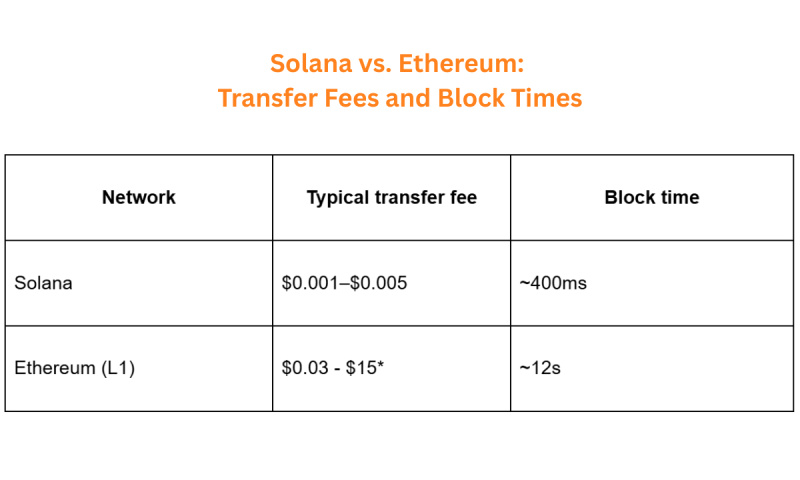
Network choice still affects the two numbers that matter most to a merchant, what a transfer costs and how long it takes to confirm. Solana comes out faster and cheaper than Ethereum on both, which makes it one of the most cost-effective networks for settling USDC right now.
Advertisement
*Fees rise during congestion, and have historically pushed Ethereum transfer costs well above $100.
No new integration required for existing merchants
Merchants already using Finassets can enable USDC (SOL) directly in the Back Office, through the same payment button, checkout, and API already connected. Those onboarding now choose one of two integration methods:
Payment button. Installs on a website or online store with no backend development; customers pay directly from a Solana wallet.
API integration. Generates a unique Solana wallet address per transaction and tracks transaction details, including destination and confirmation, via webhook.
Both paths include sandbox access and step-by-step setup documentation for testing before go-live.
“USDC on Solana is one of the most efficient stablecoin payment options available today. It combines a widely used dollar stablecoin with one of the fastest and lowest-cost networks. We added it to give merchants a faster, more cost-effective way to move USDC, especially when they’re processing payments at scale.” said Vitalijs F., CEO of Finassets.
USDC (SOL) uses the same Finassets infrastructure
Advertisement
Once enabled, USDC (SOL) follows the same operational rules as every other asset Finassets supports.
Transaction status and history tracked per asset in the Back Office
Deposits typically credited within about 30 seconds of network confirmation
Security runs at the same standard across every asset: MPC-based wallet technology, two-factor authentication, role-based access control, and IP whitelisting.
USDC (SOL) support is available to eligible merchants in selected international markets, subject to Finassets programme terms, verification, and applicable compliance requirements.
Finassets is a low-fee crypto payment gateway for iGaming and eCommerce. It’s a payment infrastructure covering a crypto payment button, crypto checkout, crypto invoicing, crypto mass payouts, B2B crypto exchange, and crypto payment API integration. Merchants can accept 70+ cryptocurrencies, including stablecoins like USDT and USDC across multiple networks. Fees start from 0.40% down to 0.20% as volume grows, with no hidden fees and full visibility into every transaction.
Advertisement
Founded in 2021, Finassets is a Panama-registered B2B crypto payment infrastructure provider supporting cross-border and crypto-driven businesses across eligible markets.
South Korean lawmakers have introduced legislation that would give the Financial Intelligence Unit direct authority to investigate suspected unregistered crypto businesses instead of relying mainly on police referrals.
Summary
South Korean lawmakers have proposed giving the FIU direct powers to investigate unregistered crypto businesses.
The FIU could analyze suspected violations, file complaints and request criminal investigations under the bill.
Police suspended inquiries into 23 of 25 unregistered crypto operators referred by the FIU between August 2022 and August 2025.
The FIU said in June that 28 crypto providers were registered and 40 suspected illegal operators had been referred to authorities.
Yonhap reported that People Power Party lawmaker Eom Tae-young and nine other lawmakers filed the amendment on Thursday, proposing new powers under the Act on Reporting and Using Specified Financial Transaction Information, commonly known as the Specific Financial Information Act.
Under the bill, any person could report a suspected violation of the law directly to the FIU. Once a report is received, the financial intelligence agency would be allowed to investigate and analyze the suspected conduct before deciding whether further action is required.
Advertisement
The proposal would also allow the FIU to file complaints with relevant authorities, request criminal investigations, and hand information gathered during its review to investigators. Such powers would change the current process, under which the FIU can identify suspected unregistered operators but must depend on police and other investigative agencies to pursue most cases.
The bill has only been introduced and must pass the National Assembly before the proposed changes can take effect.
FIU could directly investigate unregistered crypto businesses
Lawmakers proposed the additional powers after enforcement data raised questions over how effectively cases involving overseas crypto operators were being pursued once they left the FIU.
According to Yonhap, police suspended investigations or preliminary inquiries into 23 of the 25 unregistered virtual asset service providers referred by the FIU between August 2022 and August 2025.
Advertisement
The companies and people connected to the cases were reportedly located outside South Korea, making investigations more difficult for domestic law enforcement agencies.
Giving the FIU investigative and analytical powers at an earlier stage would allow the agency that first identifies suspected registration violations to collect information before a case moves to another authority.
South Korea requires companies providing virtual asset services to residents of the country to register with the FIU, including foreign companies that actively serve South Korean customers.
As crypto.news previously reported, the FIU said in June that only 28 virtual asset service providers were registered at the time, while about 40 suspected illegal operators had been referred to investigative authorities.
Advertisement
The regulator said foreign businesses must follow the same registration requirements when they provide services to South Korean residents. Companies seeking registration must also meet local compliance requirements, including Information Security Management System certification.
Overseas operators have remained a key FIU enforcement problem
The FIU’s June enforcement warning provided details on how some unregistered foreign crypto businesses were reaching South Korean customers while attempting to limit their visible presence in the country.
According to the agency, some overseas operators recruited customers through Telegram and KakaoTalk open chat rooms while offering customer service in English, a setup regulators said could make their domestic activities less obvious.
Authorities also identified private currency exchange businesses selling stablecoins and other virtual assets to international students, tourists, foreign workers and people seeking transactions without disclosing their identities.
Advertisement
Some operators exchanged digital assets directly for Korean won or other fiat currencies, while promoters were paid to advertise foreign crypto services through YouTube channels, Telegram groups and online communities, the FIU said.
The agency warned that customers using unregistered services could face exposure to fraud, hacking and personal data leaks. Because such businesses operate outside the registered system, the FIU also said users could have difficulty recovering funds when an operator failed to deliver purchased assets.
Money laundering has remained another concern for regulators. The FIU said unauthorized crypto platforms and private exchange services could be used to conceal criminal proceeds or facilitate transfers that avoid standard checks applied by registered financial firms.
The newly introduced bill would allow the agency to pursue suspected violations of the Specific Financial Information Act itself before requesting assistance from another investigative body.
Advertisement
South Korea has tightened AML rules for registered exchanges too
Regulatory attention has not been limited to companies operating without registration.
Earlier this year, domestic exchanges objected to proposed changes that would require them to report overseas-linked crypto transfers worth at least 10 million won as suspicious transactions.
A May regulatory proposal drew objections from the Digital Asset Exchange Alliance, which represents registered virtual asset service providers in South Korea.
DAXA estimated that the rule could increase annual suspicious transaction reports at Upbit, Bithumb, Coinone, Korbit and Gopax from about 63,000 to more than 5.4 million.
Advertisement
The association argued that applying an automatic monetary threshold could cause large numbers of ordinary overseas transfers to be reported regardless of the risk attached to the customer or counterparty.
The dispute also involved the treatment of foreign platforms. Regulators have sought stricter controls on transactions involving overseas virtual asset service providers, while local exchanges have asked authorities for clearer standards for determining which foreign businesses should be treated as high risk.
Enforcement decisions under the same financial information law have already produced court challenges. In April, a Seoul court overturned a three-month partial suspension imposed on Dunamu, the operator of Upbit, after the FIU alleged 44,948 transactions involving 19 unregistered overseas platforms.
Bithumb separately secured a court stay against a six-month partial suspension after regulators accused it of customer verification failures and dealings with unregistered foreign companies. Coinone also obtained temporary court relief from enforcement measures connected to anti-money laundering and customer verification requirements.
Advertisement
Cross-border crypto transfers face separate registration rules
South Korea has also created another regulatory route for businesses moving digital assets across national borders.
Under amendments to the Foreign Exchange Transactions Act, companies handling cross-border virtual asset transfers will have to register with the Ministry of Economy and Finance when the framework takes effect in December.
A June licensing report detailed how authorities were preparing enforcement regulations that could allow eligible fintech companies, alongside crypto businesses, to provide blockchain-based cross-border remittance and foreign exchange services.
The South Korean government promulgated the revised law on June 2 with a six-month grace period. Once implemented, virtual asset transfers involving South Korea and another country will fall under the country’s regulated foreign exchange system.
Advertisement
Companies seeking to provide the service will need to register with the finance ministry and report qualifying overseas transfers through the Bank of Korea’s foreign exchange reporting network.
Authorities have said crypto transfers previously operating outside the formal foreign exchange reporting system created risks involving illicit foreign exchange transactions and money laundering.
Applicants under the new framework must first complete virtual asset service provider registration, connect their systems to institutions responsible for transmitting foreign exchange and digital asset transaction data, and satisfy additional requirements covering facilities and qualified personnel.








 SEC over four years, while 80% of its hiring happened outside the U.S. as a result.













 Fashion7 days ago
 Tech7 days ago
 Sports6 days ago

 Politics6 days ago
 Tech3 days ago
 Business3 days ago
 Crypto World6 days ago
 Crypto World3 days ago
 Tech6 days ago



 Fashion7 days ago
 News Videos1 day ago
 Fashion7 days ago
 Business6 days ago
 Fashion7 days ago
 Crypto World3 days ago
 Business6 days ago
You must be logged in to post a comment Login