Connect with us

Tech

Apple Music introduces a new way for you to create playlists with text prompts

Published

on

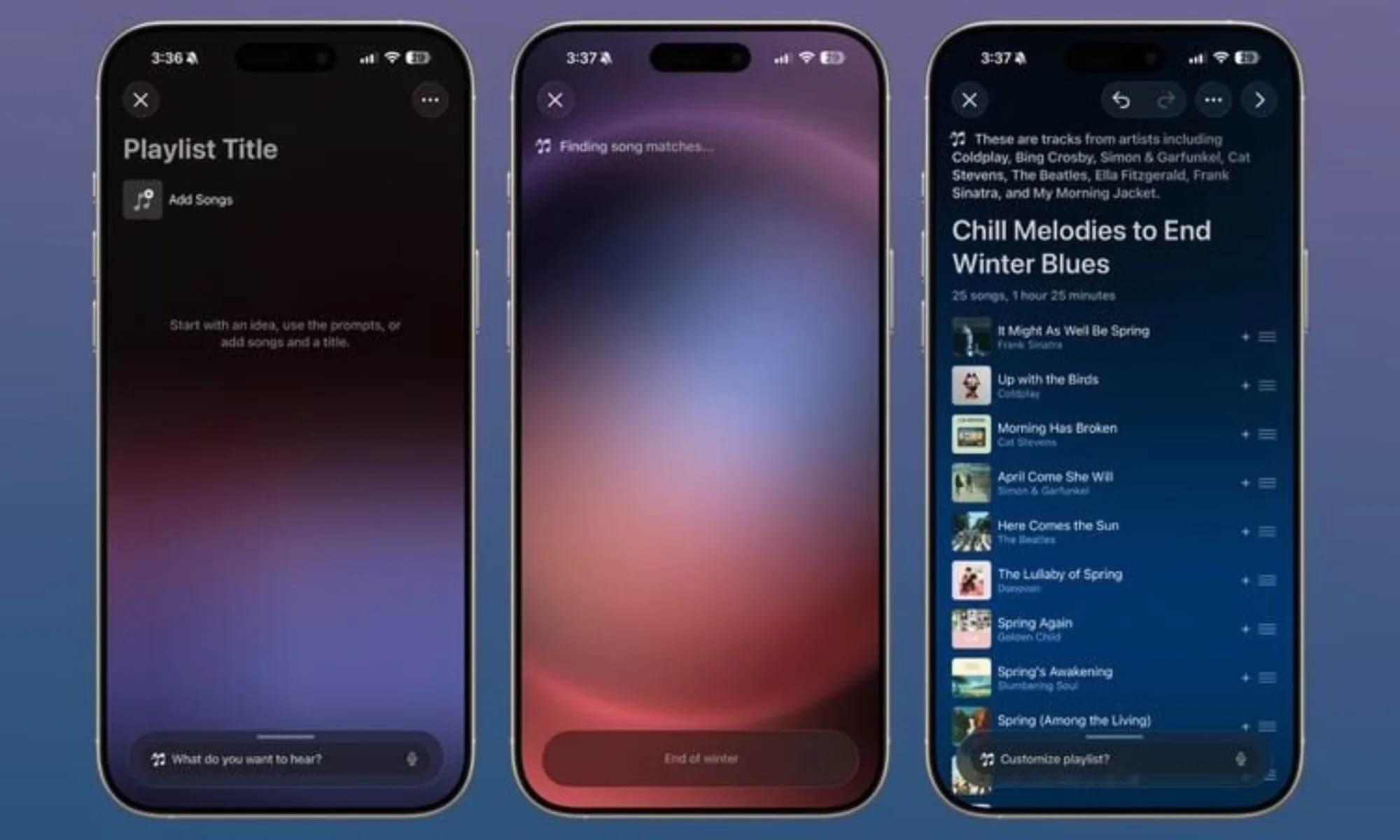
Apple Music is following in Spotify’s footsteps with a new AI-powered playlist creation tool that lets users generate personalized playlists using text prompts. Apple has introduced the feature in the latest iOS 26 beta release, and it allows users to describe an activity, mood, or vibe to instantly build a custom playlist tailored to their request.

According to MacRumors, the Playlist Playground feature is live in the first iOS 26.4 beta and adds a text box to the bottom of the playlist creation page in Apple Music where users can enter their prompt. The app offers a couple of pre-set suggestions such as “morning coffee music,” “hip-hop party songs,” and “disco songs that defined the 1970s” to help users get started.

After selecting a suggestion or entering a custom prompt, Playlist Playground generates a 25-song playlist complete with a custom title. Users can further refine the mix by tapping the “Customize playlist” button at the bottom to add more prompts, change the title, or select a custom playlist cover.

It’s not immediately clear whether Playlist Playground takes a user’s playback history into account when generating a custom playlist. Spotify’s alternative does, allowing it to create mixes that more closely match the user’s taste. Apple is expected to share more details about how the feature works ahead of its stable release.

For now, Playlist Playground is limited to Apple Music users running the latest iOS beta build. The feature is expected to roll out more widely once iOS 26.4 hits the stable channel.

Advertisement

Source link

Continue Reading
Click to comment

Leave a Reply

Your email address will not be published. Required fields are marked *

Tech

5 Classic Cars From The ’60s That Nobody Talks About Today

Published

on


Many remember the 1960s only because of the fast muscle cars, but the decade was easily one of the most significant for the automotive world more broadly. It was at this time that we got the Corvette Stingray, Jaguar E-Type, Ford Mustang, and Ferrari 250 GTO, among many other legends. And that’s precisely the problem; those cars were so good that today it’s impossible for them to not dominate auction headlines and take up all available oxygen in conversations about the ’60s auto world. 

Those cars’ fame is deserved, as they are remarkable machines; but they overshadow other remarkable vehicles that merely lacked the right combination of things like marketing, racing success, or cultural timing. Every case (on this list, that is) has a story just as interesting as its contemporaries. 

One car combined European styling with the great hulking V8 of a muscle car. Another was simply too odd to get mainstream acceptance despite being an engineering miracle. Still another was a bold experiment that failed commercially, but succeeded artistically. Tragically, history has largely forgotten these cars, so we’re going to give them their due.

Advertisement

Facel Vega HK500

The French are no strangers to big, luxurious, grand touring vehicles, and the Facel Vega HK500 was one of the best ever made. The company was originally just called Facel, and it used to make a model called the Vega, primarily for affluent buyers. However, the Vega became so popular and synonymous with the brand, that the name was changed to Facel-Vega later on. It would have been like Ford renaming itself Ford F-150; a bit of an odd move, but it was the 1960s — a lot of much weirder things were happening. 

The company made fewer than 500 HK500 models, and they sold for a whopping $9,795 when new. The engine in this gorgeous car was actually American; having been made for Facel by the Chrysler group. The “typhoon” was a V8 unit that made 350 hp or 385 hp, depending on how it was set up. Models with the three-speed auto gearbox made 350 hp and had a single quad-barrel carb; while the four-speed manual made 385 hp and had dual quad-barrel carburetors, at least that was the claim. 

Most sources however, quote that the car offered 360 hp, and 460 lb-ft of torque. A 1960 HK500 failed to sell at an RM Sotheby’s auction in Paris in 2023 — one of the most premier automotive auctions in the world — so that should tell you everything about how criminally under-appreciated the HK500 is.

Advertisement

Sunbeam Tiger

Everything about the Sunbeam Tiger screams 1960s, from the long flowing lines and chromed windscreen border, to the tubular bumper running across the grill opening. The Tiger was essentially just a British-made Sunbeam Alpine ,with a Ford 260 cubic-inch V8 stuffed into it, by Caroll Shelby no less. In terms of engine choices, the ones from the first half of the 1960s had the 260 cubic inch from Ford making 164 hp and 258 lb-ft of torque, while the ones from 1966 had an upgraded 289 cubic incher making 210 hp. 

For the people keeping track of the numbers, this means the Mk I Sunbeam Tiger had about 200 pounds more heft than the standard Alpine. However, it also had about double the power, which balanced things out nicely. Further down the line, there was also a Sunbeam Tiger with a Ford big block shoved under the bonnet, though this didn’t see mass production. 

Advertisement

The Sunbeam Tigers with the 260 had a 0-60 mph time of 8 seconds, while the ones with the bigger 289 fared slightly worse at 8.9 seconds, and cost $3,500 when new — which was actually quite okay for a luxury sports cabriolet of the time. Additionally, one of these ended up selling for the sum of $43,680; which shows that even some of these obscure 1960s classics can have high resale value.

Advertisement

Iso Grifo GL

At first glance, the Iso Grifo GL looks like a Ferrari 250 2+2 with the front end of a Dodge something-or-other. In other words, it looks positively brilliant. Its sloping rear end, mega-long bonnet, and set-back driving position represents the epitome of 1960s styling. And that Ferrari-reminiscent design is far from coincidence. The creator of the Iso Grifo GL was actually a former Ferrari employee. The name GL stands for “Gran Lusso,” which literally translates to “great luxury” in English. 

Iso is better known for its famous Isetta bubble car that people either love or hate. Later, it made another coupe called the Rivolta, followed by the Grifo GL in the years to come after that. When launched, the Grifo GL looked very different from anything Iso had ever attempted, and it was quite eye-catching to say the least. 

Power came from a Chevy small-block 327 cubic inch engine (the same one as used in the Rivo that we mentioned), at least at first. In initial models, the 327 made 300 hp, though it was later up-rated to produce a better 340-350 hp down the line. Just a short while after that, the engineers decided to shove in a Chevy 427 cubic inch, which required some modifications to the structure of the car; but these were well worth it, as power output now stood at 435 hp.

Advertisement

Gordon Keeble

The strange thing about the Gordon Keeble — yeah, that’s its actual name — was that there was nothing strange about it. The small two-door car for working families came in an array of colors, and had funky slightly-off-angle headlamps that sat above the indicator lights on the front. The only tell that gave anything of the Keeble’s defining feature away was the rather subtle air scoop on the hood of the car. This scoop fed fresh air to a 4.7-liter V8 engine from GM that produced 300 hp along with 360 lb-ft of torque, all of which was available from a respectable 5,000 RPM. 

Yes, Italian-styled vehicle using U.S. power for its engine; just like the Iso Grifo GL and the Sunbeam Tiger. The Keeble had an uber-impressive (for the 1960s anyway) standing to 60 mph time of 6 seconds; and ran the quarter mile in 15.3 seconds, at the end of which the speedo would read somewhere near 98 mph. Impressiveness aside, all those numbers have a touch of irony in them, because the badge on the hood of the car was a tortoise; which is not exactly an animal known for its speediness. Perhaps an eagle or condor would have been a better bet, but we highly doubt this trivial detail matters to the owners of the 99 Gordon Keeble units that were made.

Advertisement

Maserati Sebring

While it may currently be one of the worst-depreciating car brands on the market; Maserati’s always known how to make a good looking car. Back in 1962, the company came out with one of its first road cars. The Sebring shares its name with the famous American racetrack down South, and like so many other cars of this decade, it also has a lookalike — though it’s tough to say whether it inspired the Lamborghini 400GT or was inspired by it.

The engine in the Maserati Sebring was a 3.5-liter six-banger inline engine that ended up making the impressive sum of 235 hp and 261 lb-ft of torque. Notable features on the initial Mk I (or series one, as they are called) Sebrings were the inclusion of quad-disk brakes and air conditioning. It’s also worth noting that these were not the only engines offered on the Sebring, as a mildly higher displacement 3.7-liter was added down the line, with the option of a four-liter option too.

Reaching 60 mph took about 8.5 seconds, and it could run the quarter-mile in a stellar 15.6 seconds. The Sebring name was adopted because a few years prior,  a driver for Maserati had won an important race for the brand at that very same track. When they come up for auction (as only a few hundred were ever made), these cars fetch astronomical sums, often in the several-hundred-thousand dollar range.

Advertisement


Source link

Advertisement
Continue Reading

Tech

A sustainable concrete alternative made with slate waste

Published

on

Founded in 2024, this NovaUCD-based start-up uses science to develop an environmentally friendly alternative to traditional concrete using waste materials.

Concrete is one of the most popularly used and reliable construction materials in the world, with use dating back to Ancient Greece and Rome.

But while the material forms a considerable portion of the modern world’s infrastructure, its production – like many traditional construction materials – also has a considerable impact on the environment. In fact, it’s estimated that concrete is responsible for 4-8pc of global CO2 emissions.

One company that’s intent on providing an environmentally friendly alternative to concrete is our latest Start-up of the Week – SlateRete.

Advertisement

Founded in 2024, SlateRete is a NovaUCD-based start-up that has developed a solution that transforms slate waste into a sustainable and “high-performing” construction material, with an additional focus on visually appealing aesthetics.

SlateRete does this by replacing high-carbon concrete ingredients with slate waste, which it claims reduces CO2 emissions by more than 40pc, eliminates the need for pigments and minimises virgin material extraction.

The start-up is targeting three areas of innovation with its product: environmental impact, materials science and design.

“Unlike conventional concrete, which relies on high-carbon-footprint materials like cement, sand, limestone and granite, SlateRete repurposes slate waste, reducing environmental impact while maintaining structural integrity,” says Hamed Panahiazar, who co-founded the start-up with his brother Sadegh.

Advertisement

“The ultimate goal of SlateRete is to transform the global construction materials industry by replacing environmentally damaging concrete products with a sustainable, waste-made, high-value alternative that performs just as well – if not better – than traditional options.”

The product

Panahiazar, a senior project manager in the construction industry with more than 10 years of experience, tells SiliconRepublic.com that the start-up is focused on assisting the construction industry in adopting greener solutions by providing an “alternative that meets regulatory demands and market needs without compromising performance or cost”.

According to Panahiazar, SlateRete uses a patent-pending technology to replace the main components of traditional concrete, cement, sand, and quarried aggregates, with 75pc or more slate waste, “significantly reducing the product’s carbon footprint and environmental impact”.

The SlateRete mix, he explains, is carefully engineered through extensive laboratory research conducted at University College Dublin (UCD).

Advertisement

“The process involves substituting concrete ingredients with certain mix of slate waste, optimising particle gradation and water absorption to maintain workability and strength,” he says. “The mix design also integrates ground granulated blast furnace slag (GGBS) to reduce cement content, improve resistance to chemical attack and enhance long-term durability.

“During the initial development, multiple investigations were performed to optimise strength, durability and colour stability,” he adds. “Tests confirmed that SlateRete achieves high compressive strength (strength class C25/30) and exceptional freeze–thaw resistance, comparable or superior to standard concrete.”

Panahiazar also claims that the SlateRete mix bypasses the coloration processes used in concrete production.

“Unlike conventional concrete, which relies on chemical additives for coloration and performance, SlateRete’s colours (blue, green, grey, ochre, purple and black) arise naturally from the mineral composition of slate,” he says. “This eliminates the use of synthetic dyes and additives that typically fade and add environmental burden.”

Advertisement

How it’s going

The main challenge SlateRete has experienced so far, according to Panahiazar, has been balancing technical validation with strategic fundraising and market readiness.

“Developing a deep-tech, materials-based innovation requires significant certification, testing and regulatory alignment, all while positioning the brand for investment,” he says. “In addition, attracting investors who understand the long-term potential of sustainable construction, beyond short-term returns, has required precise communication of both our science and our business model.

“However, these challenges have strengthened our strategic discipline, clarified our value proposition, and ensured that we target investors and partners aligned with our long-term vision of global sustainability and profitability.”

Panahiazar says SlateRete’s product has undergone more than 20 mix trials and extensive laboratory characterisation at UCD, leading to a validated prototype.

Advertisement

“Further development includes life cycle analysis, environmental product declarations and certification testing for applications such as paving, cladding, flooring and furniture.”

Currently, the start-up is in a “focused phase” of business development and investor engagement, according to Panahiazar.

“Following successful technical validation at UCD, our efforts are concentrated on preparing investment materials, refining our pitch and evaluating strategic partnerships,” he says, adding that the company is in discussion with potential investors for pre-seed, seed and first funding rounds.

“Parallel to this, we are building relationships in both Europe and the GCC [Gulf Cooperation Council], where strong construction growth aligns with our sustainable materials offering. The response from industry stakeholders has been encouraging, reaffirming the market’s appetite for low-carbon and aesthetically superior alternatives to concrete.”

Advertisement

Don’t miss out on the knowledge you need to succeed. Sign up for the Daily Brief, Silicon Republic’s digest of need-to-know sci-tech news.

Source link

Advertisement
Continue Reading

Tech

Trump FTC Threatens Apple With A Fake Investigation Into Its Nonexistent ‘Liberal News Bias’

Published

on

from the fake-investigations,-real-harm dept

Here we go again.

The Trump FTC has threatened Apple and CEO Tim Cook with a fake investigation claiming that Apple News doesn’t do a good enough job coddling right wing, Trump-friendly ideology.

The announcement and associated letter pretends that Apple is violating Section 5 of the FTC Act (which “prohibits unfair or deceptive acts or practices”) because it’s not giving right wing propaganda outlets the same visibility as other media in the Apple News feed (which the letter falsely claims are “left wing”):

“Recently, there have been reports that Apple News has systematically promoted news
articles from left-wing news outlets and suppressed news articles from more conservative
publications. Indeed, multiple studies have found that in recent months Apple News has chosen not to feature a single article from an American conservative-leaning news source, while simultaneously promoting hundreds of articles from liberal publications.”

This is all gibberish and bullshit. Their primary evidence is a shitty article from Rupert Murdoch’s right wing rag The New York Post, which in turn leans on a laughable study by the right wing Media Research Center. That “study” looked at a small sample size of 620 articles promoted by Apple News, randomly and arbitrarily declared 440 of them as having a “liberal bias,” and then concluded Apple was up to no good.

Advertisement

Among the outlets derided as “liberal” sits papers like the Washington Post, which has been tripping over itself to appease Trump and become, very obviously, more right wing and corporatist than ever under its owner Jeff Bezos, who recently vastly overpaid Donald Trump’s wife to make a “documentary” about her.

The FTC’s fake investigation obviously violates the First Amendment. Even if it were true that Apple was biased in what sources it had in Apple News (which the evidence doesn’t actually support), that’s… still legal, based on Apple’s First Amendment rights. If the Biden FTC had gone after Fox News for “anti-liberal bias” everyone (including many Democrats) would call out the obvious First Amendment problem. But even ignoring the First Amendment problems of all this, claiming that this is covered by Section 5 is laughable. I’ve watched for years as the FTC has struggled to legally defend genuine investigations into obvious corporate instances of very clear fraud and still come out on the losing end due to the murky construction of the law.

This inquiry has no legal legs to stand on.

I suspect FTC boss Andrew Ferguson is leaving soon and wanted an opportunity to put his name in lights across the right wing propaganda echoplex as somebody who is “doing something to combat the wokes” with a phony investigation, much like the FCC’s Brendan Carr does. It’s likely this is mostly being driven by partisan ambition.

Advertisement

There doesn’t need to be any legally supporting evidence (or hell even an actual investigation), the point is to have the growing parade of right-wing friendly media make it appear as if key MAGA zealots are doing useful things in service of the cause. And to threaten companies with costly and pointless headaches if they don’t pathetically bend the knee to Trumpism (which Cook has been very good at so far).

So while the “investigation” may be completely bogus, the threat of it still has a dangerous impact on free expression in a country staring down the barrel of authoritarianism. Somewhere, Tim Cook is shopping around for another shiny bauble to throw at the feet of our mad, idiot king.

Here’s where I’ll mention that if you ask an actual, objective media scholar here on planet Earth, they’ll be quick to inform you that U.S. media and journalism pretty consistently has a center-right, corporatist bias.

As the ad-driven U.S. media consolidates under corporate control, it largely functions less and less as a venue for real journalism and informed democratic consensus, and more as either an infotainment distraction mechanism to keep the plebs busy, or as a purveyor of corporate-friendly agitprop that coddles the narratives surrounding unchecked wealth accumulation by the extraction class.

Advertisement

From the Washington Post to CBS, from Twitter to TikTok, to consolidation among local right wing broadcasters, the U.S. right wing is very clearly buying up U.S. media in the pursuit of the same sort of autocratic state television we’ve seen arise in countries like Russia and Hungary.

This effort is propped up by an endless barrage of claims that the already corporatist, center-right U.S. press is secretly left wing, and that the only solution is to shift the editorial Overton window even further to the right. These folks genuinely will not be satisfied until the entirety of U.S. media resembles the sort of fawning, mindless agitprop we see in countries like North Korea.

This is not hyperbole. They’re building it right in front of your noses. It’s yet to be seen if fans of free speech, democratic norms, and objective reality can muster any sort of useful resistance.

Advertisement

Filed Under: andrew ferguson, apple, bias, first amendment, free speech, ftc, journalism, media, propaganda, section 5, tim cook

Companies: apple

Source link

Advertisement
Continue Reading

Tech

Apple's Playgrounds approach to AI is a sign of its larger strategy

Published

on

The 2026 revamp of Apple Intelligence and Siri is imminent, and Playlist Playground in iOS 26.4 shows Apple will continue to treat AI as a background tool, not a flagship feature.

The Image Playground interface showing Tim Cook generated as an animated avatar
Apple Intelligence is meant to be a background feature

If you’ve been paying attention, Apple’s strategy with artificial intelligence has always been about keeping it in the background. It augments human users rather than replacing them or stealing from them.
System-wide access to controls via app intents and the more personalized Siri won’t or will be groundbreaking, depending on any given user’s workflow. Apple isn’t treating AI as some kind of world-altering paradigm that needs to overtake every part of the product.
Continue Reading on AppleInsider | Discuss on our Forums

Source link

Continue Reading

Tech

Seattle startup Certivo raises $4M to automate supply chain compliance with AI

Published

on

Certivo CEO Kunal Chopra. (Certivo Photo)

Seattle startup Certivo raised $4 million in seed funding to expand its AI-powered platform aimed at automating supply chain compliance.

Boston-based Suffolk Technologies, which specializes in construction technology investments, led the round. Seattle-based Pioneer Square Labs also invested. Total funding to date is $6 million.

Certivo, which spun out of PSL in 2024, says the funding marks the emergence of a new category it calls “AI-native compliance automation.” The startup wants to replace manual compliance processes with intelligent systems that operate around the clock.

Its platform centers on what it calls a Compliance System of Record, powered by an AI agent named CORA. The system automatically collects and validates supplier documentation, tracks regulatory changes across jurisdictions, maps compliance requirements to product portfolios, and integrates with existing software apps to maintain a real-time compliance record.

The 17-person startup is targeting manufacturers and companies in the “built world,” helping them navigate evolving regulations around PFAS, sustainability mandates, and supply chain transparency.

Advertisement

The company declined to provide metrics on customers or revenue.

Certivo, which emerged from a partnership between PSL and Fortive, is led by former Kaspien CEO and longtime Seattle tech leader Kunal Chopra. More recently he was CEO of Beckett Collectibles. Chopra also spent time at Microsoft, Amazon, Unikrn, and Groupon in executive roles.

“We built Certivo as an AI-native system that makes compliance continuous, proactive, and durable,” Chopra said in a statement.

Certivo co-founder Ahmed Khan left the company last year and is working on a new stealth startup, according to LinkedIn.

Advertisement

Certivo is one of various startups applying AI to historically manual enterprise functions such as compliance. Signify is a similar Seattle-based company that spun out of the AI2 Incubator that raised $2.1 million in 2024.

Source link

Continue Reading

Tech

Sony's new system can identify original tracks inside AI-generated music

Published

on


According to multiple reports, Sony Group’s new system can identify the original works embedded in AI-generated songs and estimate how much each source contributed to the final output.
Read Entire Article
Source link

Continue Reading

Tech

When an RTX 5090 Becomes the Perfect Turkish Wedding Necklace

Published

on

Turkish Wedding NVIDIA RTX 5090 GPU RAM Gift
A wedding was taking place in a sunlit hall deep in the heart of Turkey, complete with laughing, music, and dancing, as well as family gathering as close as possible. Guests lined up as expected, each eager to give the happy couple something unique. Envelopes containing cash and gold pieces were passed from hand to hand as usual, but one of the attendees did something unexpected.

He created a necklace of sorts with an MSI Suprim GeForce RTX 5090, one of the latest high-end GPUs, wrapped in white and fastened with red ribbons. The groom then wore the box around his neck like a nice chain. The card, one of the most desirable and astonishing high-performance graphics cards available, hung there proudly as the audience erupted in cheers and laughing.

Shortly after, the same guest approached the bride, holding a set of four DDR5 memory sticks. They were strung together with red ribbons, creating a makeshift necklace that she could easily wear. As the lights caught them, the memory modules appeared to be a string of high-speed memory, which was fairly cool given the theme of the day.

Turkish Wedding NVIDIA RTX GPU RAM Gift
Another guest chipped in, adding an Intel Core Ultra 9 285K unlocked processor. The line made people laugh because it was sort of accurate, since the GPU, CPU, and RAM could definitely anchor a very serious PC build, even if they were missing a few components like a case, motherboard, and power supply.

Turkish weddings have always been a site where guests shower the happy couple with valuable presents to help them get started. Gold coins, cash, and the standard sorts of jewelry have all fulfilled that role for a long time, but PC components have recently increased in value so rapidly that they have begun to challenge some of the old classics in terms of value. High-capacity DDR5 and high-end GPUs have found themselves in that all-too-rare position where demand and availability intersect, making them not only logical but also pretty darn great presents.
[Source]

Advertisement

Source link

Continue Reading

Tech

Stick with Apple, an increasingly bullish Wedbush tells investors

Published

on

Investment firm Wedbush is telling its clients to ignore recent reports of delays to Siri, saying that 2026 is when Apple Intelligence will be a boon.

Close-up of a hand holding a smartphone showing a colorful Siri input bar on the home screen with app widgets, search field, and digital clock icons visible.
The new Siri is coming

Wedbush took its Apple target price up to $350 in December 2025, based on high expectations for Apple Intelligence. Keeping that figure, it then repeated this expectation in January 2026 — and is now back to do so again, specifically because of recent rumors.
Those rumors claimed that testing of the new Siri is going poorly, and its improved features will be delayed, perhaps until iOS 27 in September. Consequently, investors have been selling off their Apple shares, but Wedbush says this is unwarranted.
Continue Reading on AppleInsider | Discuss on our Forums

Source link

Continue Reading

Tech

Score savings on the Garmin Venu 4, built to take on Apple’s Series 11

Published

on

It’s no secret that Garmin makes some seriously great wearables, but if you want the best of what’s out there, then this is the deal for you.

The high-end Garmin Venu 4 GPS Smartwatch has long been one of our favourite wearables and a rival to the Apple Watch 11, both for its great-looking design and its impressive feature set. While it might be tempting to assume that a premium wearable like the Garmin Venu 4 will cost quite a pretty penny as a result, the latest price cut at Amazon puts that assumption to rest.

The Garmin Venu 4 (in Slate/Black) is now down to just £413.10, which is an easy saving of over £45.90 compared to its full RRP (via a click of a voucher box).

Deal Garmin Venu 4 45mm Slate BlackDeal Garmin Venu 4 45mm Slate Black

Score savings on the Garmin Venu 4, built to take on Apple’s Series 11

Grab a deal on the Garmin Venu 4, the feature‑packed smartwatch built to go toe‑to‑toe with the Apple Watch Series 11.

Advertisement

View Deal

At its heart, the Garmin Venu 4 is all about marrying aesthetic and fashion with tons of functionality, and it does so beautifully. The 1.3-inch AMOLED touchscreen is bright, dynamic and packed with tons of gorgeous Garmin watch faces and apps for you to dive into.

Speaking of apps, you’ve got no less than 80 sports apps to choose from, so whether you want to go for a standard run, tackle some weights or engage in a spot of yoga, the Venu 4 has got you covered.

Advertisement

Advertisement

During our 4-star review of the Venu 4, we noted “With an updated design that gives it more of a classic smartwatch look, the Venu 4 is among the more stylish Garmin-branded options.”

The Whatsapp LogoThe Whatsapp Logo

Get Updates Straight to Your WhatsApp

Join Now

On the health tracking side of things, the Venu 4 goes well beyond the simple and often inaccurate heart rate tracking that you’ll find on most wearables.

For starters, there’s an ECG app on hand, which can deliver more detailed information about your heart’s rhythm, alongside advanced sleep monitoring that can show exactly which part of your sleep cycle is causing you to be well rested or otherwise.

Advertisement

It’s also worth mentioning that the Garmin Venu 4 packs an impressive battery life of up to 12-days on a single charge, which goes a long way towards needing less of a top-up compared to most wearables. When you’re in the thick of it, it’s just one less thing to worry about.

As a final touch, the robust steel casing helps the Venu 4 to wear well in spite of the rigours of the day, while the modern app integrations mean that this is a wearable that comes well equipped to drive you to be more active.

Advertisement

The Venu 4 offers a significant design upgrade, presenting a classier, more durable smartwatch with enhanced fitness tracking and a new flashlight, though it doesn’t drastically change the game from its predecessor – especially with a higher price point.

Advertisement

  • 12-day battery life is anxiety-relieving

  • Superb fitness and health tracking capabilities

  • Design is more refined than previous generations

  • Garmin Connect app can be complicated for first-timers

  • Only has two buttons for non-touchscreen control

  • Quite expensive

SQUIRREL_PLAYLIST_10148964

Source link

Advertisement
Continue Reading

Tech

iOS 26.4 puts your iPhone in anti-theft mode by default

Published

on

The first developer beta of iOS 26.4 is rolling out, and with it, Apple is flipping a major security switch for buyers. A security feature that was previously optional is now enabled by default for everyone, making it harder for thieves to change your iPhone’s critical settings.

We’re talking about Stolen Device Protection (first released with iOS 17.3), the feature that is designed to protect your Apple ID, saved passwords, payment methods, and other sensitive information, even if someone knows your iPhone’s passcode.

Changing critical security settings requires more than just a passcode

The feature asks for more credentials than your iPhone’s passcode (such as Face ID or Touch ID) for actions like viewing or using passwords or passkeys saved in iCloud, viewing an existing Apple card or applying for a new one, turning off the Lost Mode, and erasing all the content and settings.

Further, the feature also delays changing critical security settings, such as the Apple ID password, adding or removing trusted devices, changing the iPhone’s passcode, and adding/removing Face ID or Touch ID, for an hour.

It also requires biometric authentication, followed by a one-hour security delay and a second biometric confirmation before changes can be made.

Advertisement

Why this matters

Basically, by enabling Stolen Device Protection in iOS 26.4, Apple is making it harder for bad actors to exploit the critical information stored on your phone or to reset it and sell it for quick cash.

In other words, your iPhone will be more paranoid than usual, even when you’re using it, but it is better to have the feature and not need it than to need it and realize that you didn’t turn it on (which is the entire point of making it a non-optional feature).

Elsewhere, the iOS 26.4 developer beta also includes encrypted RCS messaging support, native video support in Apple Podcasts, and a new Playlist Playground feature in Apple Music. A full public release of iOS 26.4 is expected this spring.

Source link

Advertisement
Continue Reading

Trending

Copyright © 2025