Connect with us
DAPA Banner

Tech

12 Home Improvement Tools Under $75 That Are Actually Worth Buying

Published

on


We may receive a commission on purchases made from links.

Every time you head to the hardware store, it seems like there’s a new cordless version of a tool you already own or a big company launching a tool to solve a problem you didn’t even know you had. It can be tough to navigate the constantly rotating inventory of hardware stores, whether you’re shopping in stores or online. Deciding what’s actually worth your hard-earned money is a hassle for both new homeowners building a tool collection from scratch and seasoned veterans simply looking to spend some extra cash on a new useful tool.

Of course, different renovation projects require different tools. Giving your bathroom a modern makeover is a much more involved project than organizing and hanging a photo wall. While each project might require a few specialized tools, there’s still a wealth of tools most homeowners would consider essential to have on deck at all times. We’ve rounded up 12 of these go-to tools, all of which are affordably priced under $75, well-reviewed, and can easily prove their worth after just a few uses.

Advertisement

Vonforn Paint Sprayer

If you have a ton of painting planned for future renovations, a paint sprayer will make the process much faster and easier. The Vonforn Paint Sprayer is equipped with a 700-watt motor, an attached container that can hold up to 1200 milliliters of paint, and adjustable flow control with four different nozzle sizes, including 1mm, 1.5mm, 2mm, and 3mm.

Advertisement

There are also three spraying patterns you can swap between — horizontal, vertical, and circular — to suit the needs of different projects. You can use this sprayer to put a fresh color on iron patio furniture or your kitchen chairs, to liven up an entire room in your home, or to paint pretty much anything else you can think of, including fences, doors, and cabinets.

Vonforn’s sprayer tool comes with a dust blowing joint that makes it easy to clear away dust and debris from the surface you’re about to paint. Then, cleaning up after you’re done painting is just as simple. The sprayer comes with a nozzle cleaning needle and a cleaning brush for the parts you’ll need to manually clean, and you can hook up the cleaning connector to your faucet to wash out any paint coating the pipe inside.

Advertisement

Ryobi One+ 18V Cordless Drill/Driver Kit with Battery, Charger, and Bits

One of the best home improvement tools you can invest your money in is a good drill. The Ryobi One+ 18V Cordless Drill/Driver slides in at just under $75 and comes with a battery, a charger, and a 40-Piece Impact Drive Kit. Among the kit’s 40 total pieces, there are 14 one-inch impact drive bits, 12 black oxide drill bits, four bradpoint drill bits, four two-inch impact drive bits, three impact nut drivers, two woodboring spade bits, one impact magnetic bit holder, and a clear case to neatly hold everything.

As for the drill itself, it features a 3/8-inch keyless chuck, a variable speed trigger with possible speeds up to 600 RPM, and a built-in LED light to help you work in dark spots. Thanks to its lightweight of 2.8 pounds (without the battery), it’s comfortable to hold for long projects, and there’s an easy button to switch it between forward and reverse modes. And like many of Ryobi’s power tools, this 18V Cordless Drill is backed by a 3-year manufacturer’s warranty.

Advertisement

Motovera Self-Leveling Laser Level with Tripod

The laser level is easily one of the most underrated home improvement tools. You might not need it often, but when you need to hang some pictures, curtains, or any other decor piece in your home, you’ll be grateful for your laser level. The Motovera Self-Leveling Laser Level is quite an affordable option, and it comes with an aluminum tripod to make the process of hanging anything even easier. The tripod can extend from 15 to 46 inches in height, swivel a complete 360 degrees, and tilt 90 degrees.

The level is equipped with a green light that Motovera says is about four times the brightness of standard red lasers and stays visible on walls up to 100 feet away from the level. If you don’t need 100% brightness, you can adjust it down in 25% increments. You can manually set the laser’s trajectory or use the built-in self-leveling mode, which can level within about four degrees of accuracy. If you need to hang something outside in drizzly or dusty conditions, no worries. The level has IP54 dust and water resistance, and it’s able to survive accidental drops from up to 30 inches.

Advertisement

Skil 15-Amp Circular Saw

If you take on lofty home improvement projects, you might benefit from adding a circular saw to your collection. For quickly making precise, straight cuts in wood, metal, plastic, and other materials, there’s no better tool than a circular saw. The Skil 15-Amp, 7.25-Inch Circular Saw, in particular, is one home improvement tool designed to last a long time and carry you through hundreds of renovation projects.

Advertisement

This circular saw by Skil features a 24-tooth, 7.25-inch carbide blade, a 15-amp motor capable of working up to 5,300 RPM, a 51-degree bevel capacity with a positive stop at 45 degrees, and a durable bag to neatly pack it away when you’re not using it. There are also quite a few built-in safety features, like a laser to guide you while making cuts, a spindle lock to make it easier to swap out the blade, and a guarded trigger paired with a power-on indicator to prevent accidental starts. Then, a built-in dust blower helps keep the area and your line of sight free of sawdust while working.

Advertisement

Kobalt 158-Piece Household Tool Set with Folding Case

A must-have home improvement tool for renters and homeowners is a solid set of basic tools. It doesn’t necessarily need to be super fancy or high-quality, but it should ideally have a good mix of screwdrivers and other tools needed to hang pictures, put furniture together, and carry out simple repairs around your home. For a budget of $75 or less, we’re fans of the Kobalt 158-Piece Household Tool Set from Lowe’s.

Inside, there’s a 12-foot tape measure, a fiberglass hammer, some scissors, a nine-inch liquid level, a set of eight Metric and eight SAE hex keys, some pliers, an adjustable wrench, multiple precision screwdrivers, and a screwdriver handle with 20 essential bits — and that’s not even naming everything included among this kit’s 158 pieces, many of which are made with Chrome Vanadium steel. To keep everything organized well, this Kobalt kit comes with a hard storage case and molded spots for each included tool.

If this $60 household tool set is out of your price range, no problem. Instead, take a look at the best home improvement tools under $10 we rounded up to start your collection.

Advertisement

Dremel 3100 Rotary Tool Kit

If you love putting finishing touches on each renovation project, a rotary tool kit is a must. You can use a good rotary tool to make small, precise cuts, sand surfaces, drill, engrave, carve, sharpen, grind, clean, and polish all kinds of materials, including wood, brass, metal, seashells, terracotta, and more. For less than $75, this Dremel 3100 Rotary Tool Kit comes with the rotary tool itself, an extra attachment, and 15 accessories. If you opt for only the rotary tool and a few accessories, you can often find this home improvement tool for under $50.

Dremel’s 3100 Rotary Tool features a 1.2-amp, variable speed motor with five total speeds between 5,000 and 35,000 RPM to experiment with. It has an EZ twist nose cap that makes swapping out accessories a breeze, a lightweight main body that’s easy to grip and made with 65% recycled plastic, and a 6-foot power cord that allows you plenty of room to work without needing to worry about the battery dying mid-project.

Advertisement

Workpro 8-Piece Flex-Head Ratcheting Wrench Set

This Workpro 8-Piece Ratcheting Wrench Set may be more expensive than a basic wrench set, but if you’ve ever worked on a project that involves using wrenches a lot, you know how invaluable the ‘ratcheting’ feature can be in a tool set. Here are all the sizes included in this particular set: 5/16, 3/8, 7/16, 1/2, 9/16, 5/8, 11/16, and 3/4 inches. It’s easy to use any of these wrenches in tight spaces, thanks to each wrench being equipped with a 180-degree pivoting head and a 72-tooth ratchet gear that needs only a five-degree swing arc.

Advertisement

Plus, the quality you get from Workpro’s wrenches is pretty great. Each of the wrenches in this set is constructed with heat-treated Chrome Vanadium steel and nickel-plated to prevent rust and corrosion. To further protect the tools, the set comes with a rolling pouch that’s made with durable, tear-resistant 1680D polyester material, has pockets with size markings for each wrench, and has four total fasteners to ensure the wrenches stay put while traveling.

Advertisement

Stanley 6-Gallon Wet/Dry Shop Vacuum

If the only byproduct your renovation project has stirred up is a little dust and other small debris, you can probably use your home vacuum to clean up. But for many home improvement projects, there are nails, staples, big chunks of wood or sheetrock, other large materials, and occasionally liquids — all of which shouldn’t be sucked up by your everyday vacuum. Instead, you need a shop vac.

A good choice under $75 is Stanley’s 6-Gallon Shop Vacuum, equipped with a four peak-horsepower motor that promises powerful suction for dry debris and wet spills. In addition to seamlessly cleaning up these messes, it’s also capable of blowing air, great for clearing away leaves in your yard, quickly drying swimsuits, or airing up some inflatables.

With its 10-foot power cord, 6-foot hose, and two extension wands, you can clean over 16 feet away from an outlet. It also comes with a ton of accessories, including a crevice nozzle that’s great for cleaning vehicle seats, a floor nozzle, a gulper nozzle, a foam filter for wet debris, a reusable filter for dry debris, and a disposable filter bag. There are four spots above each wheel where you can store up to four nozzles or wand accessories.

Advertisement

Wetols 27-in-1 Multi-Tool

Sometimes, multi-tools can be seen as a tool that’s only useful for outdoor enthusiasts or trades professionals, but they’re also insanely practical for DIYers taking on multiple home improvement tasks. By definition, they’re packed with multiple tools in a compact, pocket-sized footprint, and many of the tools they include are ones used frequently in renovation projects. For its value, we love the Wetols 27-in-1 Multi-Tool. It’s well under $75 (and often goes on sale for much less), made with hardened stainless steel that’s resistant to rust and corrosion, and comes with so many tiny yet quality tools.

Just to name a few of its most helpful tools for tackling home projects, it’s equipped with a small hammer, needle nose pliers, soft and hard wire cutters, a double tooth saw, a serrated blade, a knife, and multiple different screwdriver bits. Less practical tools that are still neat include a fire starter, a window breaker, a whistle, a wood and metal file, and an opener for bottles and cans. If you wanted a cheaper multi-tool with less tools, check out Wetols’ 21-in-1 Multi-Tool, a stellar option that’s surprised many Amazon users with impressive quality for its price.

Advertisement

Kobalt 15-Inch Carbon Steel Pry Bar

Sometimes, the best tool for the job isn’t the smartest or the most powerful; it’s the simplest. This 15-Inch Carbon Steel Pry Bar by Kobalt isn’t much to look at, but it’s capable of quite a lot. It’s essentially a long, thin bar of forged and heat-treated carbon steel with a matte finish, all coming together to increase its strength, durability, and wear resistance.

Advertisement

This unassuming pry bar will keep your home repairs simple, especially when it comes to the demolition portion of a project. On one end of the bar, there are two different slots to help you safely pull nails out of wood, metal, flooring, and other materials. Then, if you need to lift or separate wooden boards, baseboard trim, clapboard siding, or pretty much any other material, you can use the pry bar’s other end to get great leverage. Plus, if you need to remove a small amount of drywall, you can simply use the pry bar instead of opting for a dedicated mallet or hammer.

Advertisement

Bauer 5-Inch Random Orbit Palm Sander

Countless home improvement projects involve sanding. While you can certainly take on the process manually with individual sandpaper sheets or tackle small areas with a rotary tool, nothing can really compare with a power random orbit palm sander for big projects. A simple power sander is one home improvement tool some people don’t realize exists, but once you use one, you’ll wonder why you didn’t grab one sooner.

To save quite a bit of money on this helpful power tool, we’d recommend looking for the Bauer 5-Inch Random Orbit Palm Sander at affordable retailer Harbor Freight. This sander features a grippy rubber handle, variable six-speed control, a dust collection chamber, and a 2.8-amp, fan-cooled motor with sealed bearings that’s capable of producing up to 13,000 OPM (orbits per minute). Its random orbital action moves only 3/32 of an inch to give your surface a swirl-free finish, and the six-foot power cord gives you adequate leeway to move around.

Advertisement

Quinn 66-Piece SAE and Metric Socket Set

Owning a socket set allows you to work on your vehicles as well as bicycles, some furniture, and various home improvement tasks. That said, for most homeowners or renters who rely on a mechanic for vehicle-related work, there’s no need to spend an arm and a leg on a super high-quality socket set. Instead, opt for an affordable yet reliable option through Harbor Freight, like this Quinn 66-Piece SAE and Metric Socket Set.

Quinn’s Socket Set comes with three 72-tooth, quick-release ratchets, three extension bars of various sizes, 26 1/4-inch sockets, 28 3/8-inch sockets, and six 1/2-inch sockets. All the sockets and ratchets are crafted with Chrome Vanadium steel to boost durability and resistance to rust, scratches, and corrosion. Then, every socket features a high-visibility marking and the SAE and Metric sockets are color-coded to make it easier to grab exactly what you’re looking for. To keep the whole set organized, each piece has its own dedicated spot in the included blow-molded storage case.

Advertisement

Methodology

To create this list of home improvement tools that are actually worth your money, we used specific criteria to guide us while searching online stores. Each tool we selected needed to have at least 100 reviews, an average rating of at least 4 stars, and a price below $75. That said, except for a few items on this list, most items have well over 1,000 reviews and an average rating of at least 4.6 stars.

We scoured hundreds of possible tools online at these popular hardware retailers: Amazon, Lowe’s, Home Depot, and Harbor Freight. We tried to choose a good mix of tools that are essential for new homeowners to start their collection with, as well as tools that established homeowners might not have yet, but are incredibly useful.

Advertisement


Source link

Advertisement
Continue Reading
Click to comment

You must be logged in to post a comment Login

Leave a Reply

Tech

OpenAI CEO apologizes to Tumbler Ridge community

Published

on

In a letter to the residents of Tumbler Ridge, Canada, OpenAI CEO Sam Altman said he is “deeply sorry” that his company failed to alert law enforcement about the suspect in a recent mass shooting.

After police identified 18-year-old Jesse Van Rootselaar as a suspected shooter who allegedly killed eight people, the Wall Street Journal reported that OpenAI had flagged and banned Van Rootselaar’s ChatGPT account in June 2025 for after she described scenarios involving gun violence. The company’s staff debated alerting police but ultimately decided against it, eventually reaching out to Canadian authorities after the shooting.

OpenAI has since said that it is improving safety protocols, for example by putting more flexible criteria in place to determine when accounts get referred to authorities, and by establishing direct points of contact with Canadian law enforcement.

In Altman’s letter, which was first published in the local newspaper Tumbler RidgeLines, the CEO said he’d discussed the shooting with Tumbler Ridge Mayor Darryl Krakowka and British Columbia Premier David Eby, and they’d all agreed “a public apology was necessary,” but “time was also needed to respect the community as you grieved.”

Advertisement

“I am deeply sorry that we did not alert law enforcement to the account that was banned in June,” Altman said. “While I know words can never be enough, I believe an apology is necessary to recognize the harm and irreversible loss your community has suffered.”

Altman also said that OpenAI’s focus will “continue to be on working with all levels of government to help ensure nothing happens like this again.”

In a post on X, Eby said Altman’s apology is “necessary, and yet grossly insufficient for the devastation done to the families of Tumbler Ridge.”

Techcrunch event

Advertisement

San Francisco, CA
|
October 13-15, 2026

Canadian officials have said they are considering new regulations on artificial intelligence but have not made any final decisions.

Advertisement

If you are in a crisis or having thoughts of suicide, call or text 988 to reach the 988 Suicide and Crisis Lifeline.

When you purchase through links in our articles, we may earn a small commission. This doesn’t affect our editorial independence.

Source link

Advertisement
Continue Reading

Tech

The Online Civil War About ‘Michael’ Is a Battle Over Truth

Published

on

Is truth determined by the size of the audience it reaches?

If so, Michael—a new film about the pop singer Michael Jackson that is on track to have the biggest-ever opening for a music biopic, with projected earnings of $70 million at the US box office, despite critics saying it sanitizes the reality of who Jackson actually was—intends to supplant the King of Pop as the apotheosis of artistic virtue.

The film’s release has sparked a civil war online, between those eager to reclaim the music and myth of Jackson, and those who see any celebration of him as a failure of accountability.

Musically, Jackson was in a class all his own. In the pre-social media days, before AI artists charted on Billboard and he became a recurring meme online, Jackson was the epitome of monoculture: 13 number one singles, countless awards, twice inducted into the Rock & Roll Hall of Fame. He remains, even in death, one of the best-selling music artists of all time. But his legacy was also defined by multiple allegations of sexual abuse, an occasionally eccentric personal life, and Jackson’s on-record admission of sharing his bed with underage boys. “This guy was worse than Jeffrey Epstein,” Dan Reed, the director of Leaving Neverland, the 2019 Emmy-winning HBO documentary about Jackson’s alleged sexual misconduct, recently told the Hollywood Reporter.

Advertisement

Director Antoine Fuqua, who maintains Jackson’s innocence, never intended to fully avoid the allegations that circled Jackson later in life. According to him, the original cut of Michael included a reenactment of the 1993 police raid on Neverland Ranch, where Jackson was strip-searched to verify the physical description of his first accuser, Jordan Chandler. But the scene was ultimately scrapped along with the film’s entire third act—totaling $15 million in reshoots—because of a legal clause in a settlement with Chandler that prohibited the depiction of his experience on screen.

The result is a film that stops abruptly in 1988 and erases the most controversial two decades of Jackson’s life. Instead, the film emphasizes Jackson’s musical legacy—the story arc is structured around career-defining music moments, like the making of the “Thriller” video—over the more contentious aspects of his personal behavior.

Scrubbing the Neverland Ranch scene, but also choosing to completely write around any of Jackson’s alleged misconduct, is not surprising given that the Jackson estate had approval over the use of his music, essentially granting it veto power over the film’s final cut. One argument that keeps surfacing on social media is that critics should judge Michael on its own terms rather than on what they think it should have been. “It seems like people wanted a movie [that] was never going to exist,” noted one X user. “So it was never going to be salacious or introspective”

Jackson’s fans argue the allegations shouldn’t eclipse his musical and artistic legacy, separating the artist from the work, while critics insist that a biopic should present a complete picture of Jackson, regardless of how unflattering that picture may be. As film critic Sean Burns characterized it on X, ending “with the release of Bad is like ending an OJ biopic with him winning the Heisman.” A good Michael Jackson movie, wrote the artist Harmony Holiday, “would be part tragedy, part farce,” calling attention to how the film lacks the real kind of interiority that made Jackson so polarizing.

Advertisement

“Watching it feels more like being frog-marched through a wax museum than watching a movie, each milestone restaged with an off-putting, uncanny-valley resemblance and no interiority,” critic Alison Willmore noted in Vulture.

Source link

Continue Reading

Tech

California Engineer Identified in Suspected Shooting at White House Correspondents Dinner

Published

on

A 31-year-old engineer and computer scientist was identified in media reports and President Donald Trump as the suspected shooter at the White House Correspondents Dinner on Saturday night.

Cole Tomas Allen, of Torrance, California, was apprehended following the firing of shots at the Washington Hilton, where Trump was scheduled to deliver remarks to a ballroom full of journalists, cabinet officials, and Hilton staff. Allen’s name surfaced in media reports shortly before Trump posted two photos of a suspect following his apprehension. The person in the photos Trump posted matches photos of Allen.

In dramatic scenes, several shots were heard outside the ballroom, after which Trump and Vice President JD Vance were immediately rushed off the stage by the United States Secret Service. In the immediate aftermath of the shooting incident, it briefly appeared as if the event would proceed—Trump posted “LET THE SHOW GO ON” on Truth Social—but the event was eventually shut down.

According to the Metropolitan Police Department, the suspect “charged” a Secret Service checkpoint at the Hilton hotel, and was intercepted by agents. MPD interim chief Jeffery Carroll said the suspect was carrying a “shotgun, handgun, and multiple knives.”

Advertisement

At a White House press conference following the shooting, Trump said one United States Secret Service agent was shot but saved from serious injury by his bulletproof vest. Trump said the agent, who was not named, is “doing great” and in “great shape.” No other injuries were immediately reported.

The suspect was later transported to a local hospital “to be evaluated,” according to Carroll, who said he appears to be a “lone actor.”

Around the time Trump’s press conference began on Saturday night, he posted a picture on his Truth Social account appearing to show the suspected shooter on the ground, with his hands restrained behind his back, and a foil warming blanket covering the lower half of his body.

A WIRED review of public databases shows a seemingly minimal online presence associated with Allen’s name. According to his LinkedIn profile, he graduated from Caltech in 2017 with a bachelor’s in mechanical engineering from California State University Dominguez Hills in 2025 with a master’s in computer science. A photo that appears to be of Allen appears on the Caltech site identifying him as a member of the school’s Mechanical Engineering 72 class, described by the school as a “two-term engineering design lab” for building robots and autonomous vehicles. His name is also listed in a 2025 Dominguez Hills graduation program. A search in a public facial recognition database returns only two images, both apparently of him as an undergraduate.

Advertisement

According to the shooter’s LinkedIn profile, he has been employed part-time since March 2020 at C2 Education, a private company that helps students prepare for the SAT and ACT exams. In December 2024, C2 Education said in posts on LinkedIn and Facebook that he was the company’s “December Teacher of the Month.”

Since 2018, the suspected shooter self-identified on his LinkedIn profile as a “self-employed” indie game developer. He appears to have released an “atomic fighting game” called Bohrdom on Steam in 2018. He advertised the game using accounts on YouTube and X that appeared to have little to no following. The caption for a trailer of the game describes it as a “non-violent, skill-based, asymmetrical fighting game loosely based on a chemistry model that is itself loosely based on reality.”

Relatives of Allen’s did not immediately respond to requests for comment. C2 Education and the Metropolitan Police Department also did not immediately respond to requests for comment.

Source link

Advertisement
Continue Reading

Tech

The next Xbox could be waiting on the memory market

Published

on


Sharma described the decision-making process as an equation, noting that memory costs influence multiple variables. She said Microsoft’s focus is on building a console capable of running great games – including PC titles – while accounting for market conditions that remain in flux.
Read Entire Article
Source link

Continue Reading

Tech

Anthropic created a test marketplace for agent-on-agent commerce

Published

on

In a recent experiment, Anthropic created a classified marketplace where AI agents represented both buyers and sellers, striking real deals for real goods and real money.

The company admitted this test — which it called Project Deal — was only “a pilot experiment with a self-selected participant pool” of 69 Anthropic employees who were given a budget of $100 (paid out via gift cards) to buy stuff from their coworkers.

Nonetheless, Anthropic said it was “struck by how well Project Deal worked,” with 186 deals made, totaling more than $4,000 in value.

The company said it actually ran four separate marketplaces with different models — one that was “real” (where everyone was represented by the company’s most-advanced model, and with deals actually honored after the experiment) and another three for study. 

Advertisement

Apparently, when users are represented by more advanced models, they get “objectively better outcomes,” Anthropic said. But users didn’t seem to notice the disparity, raising the possibility of “‘agent quality’ gaps” where “people on the losing end might not realize they’re worse off.”

Also, the initial instructions given to the agents didn’t appear to affect sale likelihood or the negotiated prices.

Source link

Advertisement
Continue Reading

Tech

Microsoft revamps Windows Insider Program with simpler structure and more user control

Published

on

Microsoft is rolling out a major overhaul of its Windows Insider Program, aiming to simplify how early Windows features are tested while addressing long-standing user complaints around complexity and control. The update marks one of the biggest structural changes to the program in years, signaling a shift in how Microsoft wants to collaborate with its testing community.

A Simpler Insider Program Built Around Feedback And Control

The revamped program introduces a streamlined structure, reducing multiple Insider channels into two primary ones: Beta and Experimental. This replaces the earlier, more fragmented system that included Dev, Canary, and Release Preview channels, which often confused users about where they belonged.

Microsoft is also making it easier for users to move between channels or exit the program without needing a full system reset, thanks to in-place upgrade options.

Alongside structural changes, the company is rolling out new preview builds and features that focus heavily on usability. Early updates include improvements to Windows Update, such as the ability to pause updates, avoid forced restarts, and gain more control over when updates are installed.

This shift reflects direct feedback from users who have long complained about disruptive updates and lack of control.

Advertisement

Why This Overhaul Matters For Windows As A Platform

The Windows Insider Program is more than just a testing environment. It plays a critical role in shaping the future of Windows by allowing millions of users to test features before they reach the general public.

By simplifying the program, Microsoft is attempting to make feedback more meaningful and participation more accessible. The previous multi-channel system often led to fragmentation, with users unsure about stability levels or feature timelines.

The new approach suggests Microsoft is prioritizing clarity and efficiency over experimentation chaos. It also indicates a broader shift toward improving Windows 11’s overall quality, rather than rushing out features without sufficient refinement.

Why This Should Matter To You As A User

Even if you’re not a Windows Insider, these changes will likely affect your everyday experience. The Insider Program acts as a testing ground for features that eventually roll out to all users. Improvements in update control, system stability, and feature clarity will directly influence future Windows releases.

Advertisement

For enthusiasts and developers, the changes make it easier to participate in testing without dealing with confusing channel choices or risky upgrades. For regular users, it means the features you eventually receive are more likely to be polished and less disruptive.

In simple terms, a better Insider Program leads to a better Windows experience overall.

What Comes Next For Microsoft’s Insider Strategy

The rollout of the revamped program is happening in phases, with users gradually being moved into the new channel structure. Microsoft is expected to continue refining the experience, focusing on transparency, clearer communication, and stronger integration of user feedback into development decisions. There are also indications that future updates will place greater emphasis on performance, reliability, and user control rather than just adding new features.

This overhaul doesn’t introduce a new version of Windows, but it may be just as important. It reflects a recognition from Microsoft that building a better operating system starts with listening more effectively to the people who use it.

Advertisement

Source link

Continue Reading

Tech

Credential management as a financial risk control

Published

on

Passwork logo

Author: Eirik Salmi, System Analyst at Passwork

When a threat actor walks into your network using a legitimate username and password, which control stops them?

For most financial institutions, the honest answer is: nothing catches it immediately. The attacker looks like an authorised user. They move laterally, escalate privileges, and map critical systems for an average of 186 days before the breach is even identified — and a further 55 days to contain it — according to IBM’s Cost of a Data Breach Report (2025).

By then, the operational damage is done, and the regulatory clock has already started.

Advertisement

On January 17, 2025, the Digital Operational Resilience Act (DORA) entered into application across the EU. Article 9 of the regulation makes credential security a binding financial risk control, with supervisory consequences for institutions that fall short.

The question is no longer whether your authentication posture meets best practice. It is whether it meets the law — and whether you can prove it.

This article traces the specific Article 9 requirements that govern credential management, explains why a compromised password is an operational resilience failure under DORA’s framework, and outlines the practical controls that close the gap.

The threat that DORA was built to counter

Stolen credentials are the single largest initial access vector in 2025, accounting for 22% of all data breaches, per Verizon’s Data Breach Investigations Report. For financial institutions, the sector-specific cost of that exposure averages $5.56 million per incident, according to IBM’s Cost of a Data Breach Report — down from $6.08 million in 2024, yet still the second-highest of any industry globally.

Advertisement

The supply side of credential theft has been fully industrialised. Initial Access Brokers sell verified corporate network access for an average of $2,700, with 71% of listings including privileged credentials — pre-packaged access that requires no technical skill to exploit, according to Rapid7 research.

Infostealers such as Lumma, RisePro, StealC, Vidar, and RedLine automate credential harvesting at scale. IBM X-Force data shows their delivery via phishing increased 84% year-on-year in 2024, with 2025 data pointing to an even steeper trajectory.

DORA’s Article 9 exists precisely to interrupt this chain. The regulation reflects a documented, ongoing threat to the operational continuity of European financial markets.

DORA Article 9 requires strong authentication, least-privilege access, and documented controls.

Advertisement

Passwork delivers all three — self-hosted, ISO 27001 certified, with full audit logs your compliance team can export on demand.

Try Passwork Free

What DORA Article 9 actually requires

Article 9 of DORA — titled “Protection and Prevention” — sits within the ICT risk management framework mandated by Article 6. It sets out specific technical and procedural obligations that financial entities must implement.

Two provisions are directly relevant to credential management.

  • Article 9(4)(c) requires financial entities to “implement policies that limit the physical or logical access to information assets and ICT assets to what is required for legitimate and approved functions and activities only.” This is the least-privilege principle, stated as a legal obligation.

  • Advertisement
  • Article 9(4)(d) goes further, requiring entities to “implement policies and protocols for strong authentication mechanisms, based on relevant standards and dedicated control systems, and protection measures of cryptographic keys whereby data is encrypted based on results of approved data classification and ICT risk assessment processes.”

Unpacking that language in operational terms: MFA is mandatory. The reference to “relevant standards” points directly to FIDO2/WebAuthn — the most widely deployed authentication standard currently resistant to Adversary-in-the-Middle (AiTM) phishing kits, which can bypass SMS and TOTP-based MFA in real time. Cryptographic key management is a regulatory requirement.

Privileged access management (PAM) tools are not named explicitly in the regulation — but the controls they deliver map directly onto Article 9’s requirements. Session recording, just-in-time (JIT) access provisioning, and privileged credential vaulting are precisely the “dedicated control systems” the regulation describes.

Institutions that have not deployed these controls face a compliance gap that supervisors can act on.

The European Banking Authority (EBA) and ESMA’s Regulatory Technical Standards under DORA provide additional specificity on ICT risk management requirements, reinforcing the Article 9 baseline with sector-specific implementation guidance.

Advertisement

Credential compromise as an operational resilience failure

DORA’s stated purpose is to ensure financial entities can withstand, respond to, and recover from ICT disruptions. A credential compromise looks entirely different through that lens than it does through a security incident lens.

With an average dwell time of 186 days, a compromised credential does not produce a discrete security event. It produces a sustained, invisible threat to operational continuity — an attacker moving laterally, escalating privileges, and mapping critical systems while appearing as a legitimate user. It is a direct threat to the operational continuity DORA is designed to protect.

The breach of France’s national bank registry in January 2026 made the mechanics concrete. A threat actor obtained the credentials of a single civil servant with access to Ficoba — the interministerial database holding records on every bank account opened in France.

Using only that one account, the attacker accessed and extracted data on 1.2 million bank accounts, including IBANs, account holder names and addresses, and tax identification numbers.

Advertisement

The affected system was taken offline, operations at the registry were disrupted, and the incident was reported to France’s data protection authority, CNIL. The attack required no technical sophistication.

Under DORA, an incident of that scale at a financial entity would trigger mandatory reporting obligations under Article 19 — an initial notification within 4 hours of classification (and no later than 24 hours after detection), an intermediate report within 72 hours, and a final report within one month.

The third-party dimension: Vendor credentials are your credentials

DORA’s Chapter V places explicit obligations on financial entities regarding ICT third-party risk. The compliance perimeter does not stop at the institution’s own systems.

The Santander breach in May 2024 is the European reference point. Attackers used credentials stolen from employees of Snowflake to access a database containing customer and employee data across Spain, Chile, and Uruguay.

Advertisement

The credentials had been harvested months earlier by infostealer malware infecting contractor workstations. None of the compromised Snowflake accounts had multi-factor authentication enabled.

The entry point was not inside Santander. It was a vendor’s weak authentication posture — and it exposed data belonging to one of Europe’s largest banks without a single exploit being written.

Under DORA, a financial institution whose critical ICT provider suffers a credential-based breach faces direct regulatory exposure. Institutions must contractually require equivalent authentication standards from their vendors and audit compliance against those requirements.

A vendor’s password policy gap is not the vendor’s problem alone — it is the financial entity’s regulatory liability.

Advertisement

Building a DORA-compliant credential management

Meeting Article 9’s requirements demands a structured programme across four areas.

  • Deploy phishing-resistant MFA first. FIDO2/WebAuthn-based authentication — hardware security keys, passkeys, platform authenticators. SMS and TOTP-based one-time passwords are not adequate against current attack techniques. Enforce phishing-resistant MFA for all users, with particular rigour on privileged accounts and remote access paths.

  • Enforce least-privilege access. JIT provisioning — granting elevated access only for the duration of a specific task — eliminates the standing privileges that make credential theft so damaging. Deactivate accounts immediately on offboarding. Dormant accounts are among the most common and most avoidable attack vectors.

  • Vault all credentials. Service account passwords, API keys, and privileged credentials must be stored in an encrypted, access-controlled credential vault. Manual credential management at scale is operationally unworkable and produces no audit trail. A business password manager Passwork — deployed on-premise within the institution’s own infrastructure — provides the encrypted vaulting, granular access controls, and complete activity history that Article 9 demands.

  • Advertisement
  • Monitor continuously. Anomalous login behaviour — unusual geolocations, off-hours access, lateral movement patterns — must trigger automated alerts. Reducing that 186-day average dwell time is the single most effective lever for cutting both financial exposure and DORA incident reporting obligations.

All four controls depend on the same foundation: how credentials are stored, shared, accessed, and monitored. Without structure at that layer, even well-designed policies fail at execution.

How Passwork supports DORA compliance in practice

Passwork is a corporate password manager certified to ISO/IEC 27001 and available as a self-hosted deployment — meaning your credential data never leaves your own infrastructure.

For financial entities navigating DORA’s Chapter V supply chain obligations, that distinction matters: a third-party SaaS credential store introduces exactly the kind of ICT dependency the regulation requires you to govern.

For institutions working through the four controls above, Passwork addresses the credential management dimension of each.

Advertisement
  • MFA enforcement across the credential layer. Passwork supports biometric, passkey, and security key MFA natively, with SAML SSO and LDAP integration for enterprise environments.

  • Role-based access control and least privilege. Permissions are assigned at vault and folder level, inherited from AD or LDAP groups, and updated automatically on directory changes. Offboarding revokes access to shared credentials in a single operation — logged and timestamped, producing the evidence an investigator will request under Article 9(4)(c).

  • Privileged account inventory and secure sharing. Passwork provides a structured, searchable repository of all organisational credentials, including shared administrative accounts. Encrypted vault sharing replaces informal channels that leave no audit trail and cannot be revoked.

  • Audit logs for compliance documentation. Every credential access, permission change, password reset, and sharing event is recorded in a tamper-evident log, exportable for compliance reporting and integrable with SIEM systems. A structured activity history is a substantively stronger response to a regulator than a policy document alone.

DORA compliance is as much an evidence problem as a technical one. The institutions that navigate enforcement most effectively are those that can produce documentation on demand.

Advertisement

Act before the audit

DORA has converted credential management from a security best practice into a binding financial risk control. Articles 9(4)(c) and 9(4)(d) are explicit: least-privilege access, strong authentication, and cryptographic key protection are legal obligations for every financial entity operating in the EU.

Operational resilience begins with identity — and identity begins with controlling who holds the keys.

Audit your credential controls against Article 9, document the findings, and have the evidence ready before a regulator asks. Under DORA, the absence of documentation is itself a finding.

Passwork is designed for exactly this situation: a self-hosted password manager that keeps credential data inside your own infrastructure, enforces MFA across every access point, and generates the tamper-evident audit logs that turn a compliance conversation from a liability into a demonstration. ISO/IEC 27001 certified, with LDAP and SAML SSO integration for enterprise environments.

Advertisement

Start your free Passwork trial — full functionality, no limitations.

Sponsored and written by Passwork.

Source link

Advertisement
Continue Reading

Tech

New ‘Pack2TheRoot’ flaw gives hackers root Linux access

Published

on

New ‘Pack2TheRoot’ flaw gives hackers root Linux access

A new vulnerability dubbed Pack2TheRoot could be exploited in the PackageKit daemon to allow local Linux users to install or remove system packages and gain root permissions.

The flaw is identified as CVE-2026-41651 and received a high-severity rating of 8.8 out of 10. It has persisted for almost 12 years in the PackageKit daemon, a background service that manages software installation, updates, and removal across Linux systems.

Earlier this week, some information about the vulnerability has been published, along with PackageKit version 1.3.5 that addresses the issue. However, technical details and a demo exploit have been not been disclosed to allow the patches to propagate.

image

An investigation from the Deutsche Telekom Red Team uncovered that the cause of the bug is the mechanism PackageKit uses to handle package management requests.

Specifically, the researchers found that commands like ‘pkcon install’ could execute without requiring authentication under certain conditions on a Fedora system, allowing them to install a system package.

Advertisement

Using the Claude Opus AI tool, they further explored the potential for exploiting this behavior and discovered CVE-2026-41651.

Redacted PoC exploit for Pack2TheRoot
Source: Deutsche Telekom

Impact and fixes

Deutsche Telekom’s Red Team reported their findings to Red Hat and PackageKit maintainers on April 8. They state that it’s safe to assume that all distributions that come with PackageKit pre-installed and enabled out-of-the-box are vulnerable to CVE-2026-41651.

The vulnerability has been present in PackageKit version 1.0.2, released in November 2014, and affects all versions through 1.3.4, according to the project’s security advisory.

Researchers’ testing have confirmed that an attacker could exploit the the CVE-2026-41651 vulnerability in the following Linux distributions:

  • Ubuntu Desktop 18.04 (EOL), 24.04.4 (LTS), 26.04 (LTS beta)
  • Ubuntu Server 22.04 – 24.04 (LTS)
  • Debian Desktop Trixie 13.4
  • RockyLinux Desktop 10.1
  • Fedora 43 Desktop
  • Fedora 43 Server

The list is not exhaustive, though, and any Linux distribution using PackageKit should be treated as potentially vulnerable to attacks.

Users should upgrade to PackageKit version 1.3.5 as soon as possible, and ensure that any other software using the package as a dependency has been moved to a safe release.

Advertisement

Users can use the commands below to check if they have a vulnerable version of the PackageKit installed and if the daemon is running:

dpkg -l | grep -i packagekit

rpm -qa | grep -i packagekit

Users can run systemctl status packagekit or pkmon to check if the PackageKit daemon is available and running, which indicates that the system may be at risk if left unpatched.

Although no details about the state of exploitation have been shared, the researchers noted that there are strong signs showing compromise because exploitation leads to the PackageKit daemon hitting an assertion failure and crashing.

Advertisement

Even if systemd recovers the daemon, the crash is observable in the system logs.


article image

AI chained four zero-days into one exploit that bypassed both renderer and OS sandboxes. A wave of new exploits is coming.

At the Autonomous Validation Summit (May 12 & 14), see how autonomous, context-rich validation finds what’s exploitable, proves controls hold, and closes the remediation loop.

Claim Your Spot

Source link

Advertisement
Continue Reading

Tech

Enjoy cinematic sound on a budget

Published

on

Although there are plenty of premium soundbars available to buy, and the very concept was,at one point, an expensive accessory that only a few home theatre enthusiasts could enjoy, it’s now possible to pick up a soundbar with a budget price tag attached. Even if you only have around £100 / $100 to spend, you can still find a soundbar to elevate your TV’s audio, and thanks to the hard work of our tech experts, we know which ones are best to buy.

Even though soundbars have been around for quite some time, and we’ve honestly tested more than we care to count, there’s a good chance that you might be someone who’s looking to buy their very first soundbar, and in which case it’s worth covering the basics before we move on to the options that our team recommend.

As TVs have only gotten slimmer over the years, this has usually come at the expense of built-in speakers as there’s only so much sound quality you can derive when there isn’t a lot of space available. Soundbars offer a return to form, acting as dedicated speakers that can focus on delivering amazing audio, whilst your TV works solely on the visual side of things.

If you care about good audio quality even a little bit then we can’t recommend soundbars enough. They’re fantastic for everything from elevating vocals so that you can actually hear what characters are saying, to delivering powerful bass that makes action scenes even more intense. Regardless of how much a soundbar costs, we put them all through a series of rigorous tests to see how they perform across multiple use cases.

Advertisement

You can read about our testing process in greater detail below, or skip ahead to get straight to our current recommendations for soundbars that don’t break the bank. If you decide that you’d rather save up and go with a brand that costs a little more then you can find more premium options in our round-up for the best soundbars overall. Similarly, anyone wanting to do a full visual/audio upgrade in one go can also check out the best TVs.


Best cheap soundbar at a glance

Advertisement

SQUIRREL_ANCHOR_LIST

How we test soundbars

Soundbars were created to boost TV sound quality – which means we end up watching a lot of TV. We play everything – news reports for voices, movies for scale and effects steering – to ensure that the soundbars that come through the doors at Trusted Reviews are given a proper challenge. We’ll play different genres of music, too, since a good soundbar should be capable of doubling-up as a great music system.

Advertisement

More complex soundbars feature network functionality for hooking up to other speakers and playing music around the home, so we test for connectivity issues and ease of use. We cover the spectrum of models available, everything from cheap soundbars costing less than £100/$100 to those over £1000/$1000, to ensure our reviews benefit from our extensive market knowledge. Every product is compared to similarly priced rivals, too.

  • Great with movies and music

  • Well-integrated bass

  • Low-profile and well-made cabinet

  • Exceptional value

  • Easy setup

When it comes to budget soundbars, the one that’s been the top of our list for several years is the Wharfedale Vista 200S. It’s been on the market since around 2019, and while the price has fluctuated, you can get it now for a reasonable price..

Advertisement

The design is one we found attractive in appearance while the build quality is durable. The black finish and glossy top surface doesn’t scream cheap, and with a width of 900mm, it’s made to partner TVs up to 65-inches in size. Its slim form factor also means you won’t be living in fear of the soundbar blocking the picture.

In terms of features, There’s not much aside from its active wireless subwoofer. If you want wireless connectivity, you’d be better off seeking the smaller but slightly more expensive Sonos Ray. There are three preset EQ settings for media playback in Movies, Music and News to optimise the soundbar’s sound for those types of content.

Our reviewer found the sound was especially good, with the 200S putting in a great performance across the frequency range with a top-end that didn’t suffer from a lack of detail along with some punchy bass. We also observed the Vista 200S could get loud without sounding harsh or compressed due to its 120W of built-in amplification. It dealt with dialogue well, even without a dedicated centre channel, and if you’re interested in playing music, then it delivers on a smooth and clear performance.

Alternatives around this price include the Sharp HT-SBW202 and the Yamaha SR-C30A, but even after a few years, we haven’t heard a rival that offers as much performance-per-pound at this price as the Wharfedale.

Advertisement
  • Clean and powerful TV audio

  • Surprising amount of bass

  • Wide soundstage

  • Optional surround sound

  • Remote setup can be fiddly

  • Better at TV than music

Advertisement

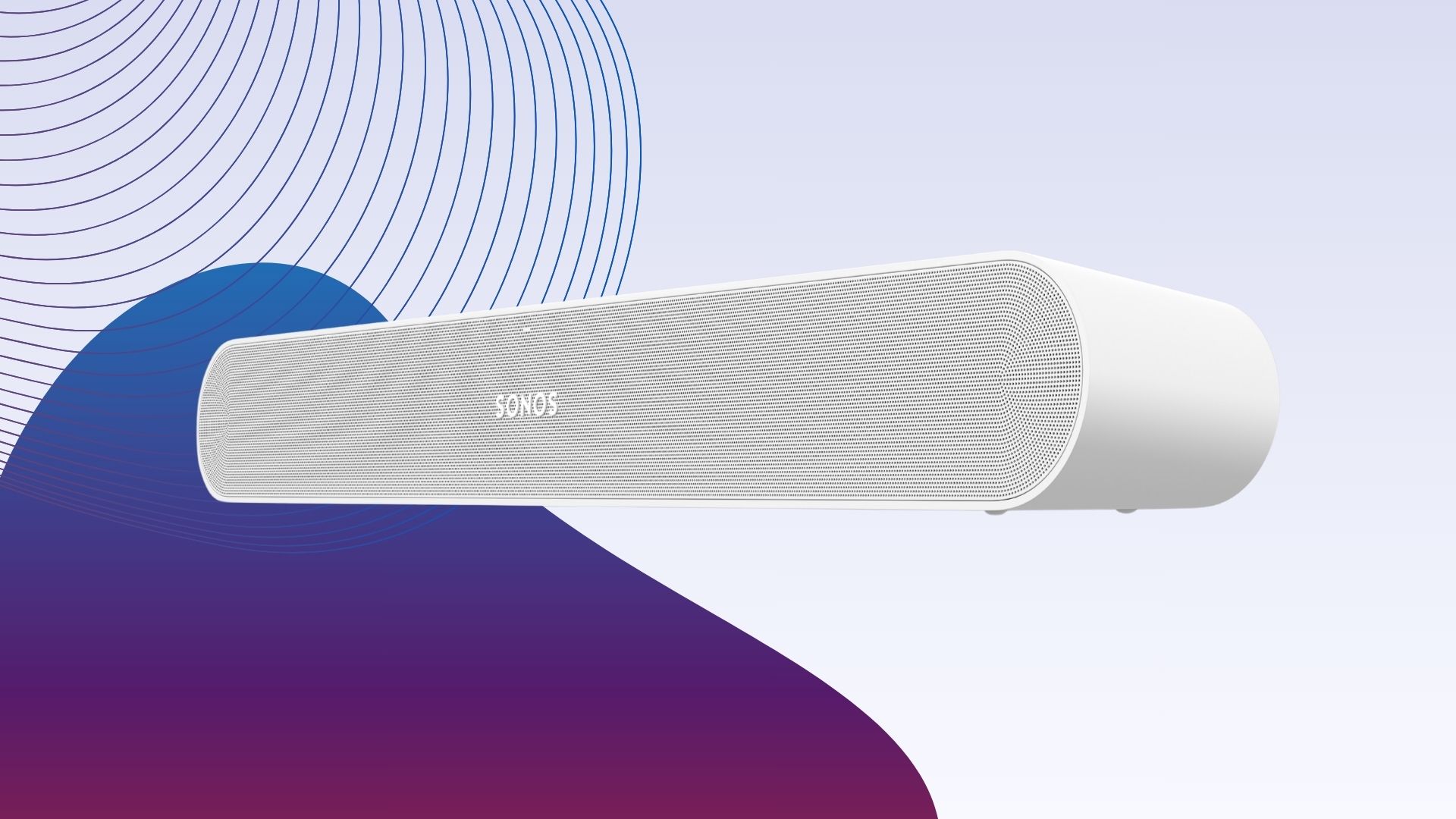
If you’re looking for a compact and affordable soundbar, the Sonos Ray is our top pick. Designed to make non-HDMI TVs sound better, the Ray is smaller and has fewer features than other Sonos soundbars, but that doesn’t mean it doesn’t offer powerful sound.

The Sonos Ray has a thin and compact design with curved ends forming a lozenge shape and the option of a black or white finish. The Ray is only slightly smaller than the Sonos Beam at 71 x 559 x 95mm and, like the Polk Signa S4, pairs well with TVs that measure up to 55-inches. You can choose to sit the soundbar in front of your TV, mount it on a wall or event place it in an open cabinet if it’s big enough to accomodate.

The Ray doesn’t come with an HDMI port, sticking with just an optical S/PDIF input and providing a cable in the box. There are touch controls on top of the soundbar for controlling playback, skipping tracks, and adjusting the volume.

The setup is quick and the Trueplay configuration allows you to tune the soundbar to your room. The Ray has an IR input, so you can tune it to use your TV’s remote to control the volume.

Advertisement

Then there’s the app, which makes it easy to connect and disconnect from rooms with multiroom support, as well as play music from Spotify, Apple Music, Tidal, Deezer or via AirPlay 2.

There’s no Dolby Atmos audio but Dolby Digital still sounds great, albeit not as clean and detailed. There’s also no microphone for voice commands. You can set up skills and control the soundbar with your favourite voice assistant, but you’ll need a separate smart speaker to do so.

Despite its small size, the Sonos Ray has a surprisingly wide soundscape, offering a clear improvement over the audio from the TV we had paired it with. The Speech Enhancement setting boosts voices, and there’s a Night Sound feature for boosting quiet sounds and limiting loud sounds later in the evening. The bass is effective too, though not as room-shattering as the Sonos Arc’s bass response.

Advertisement
  • Great bass

  • Customisable RGB lighting

  • Razer Synapse companion app

  • Full and warm sound during music and gaming

  • Subwoofer too large for a desk

  • Lack of ports

  • Bluetooth audio is less reliable

The Razer Leviathan V2 is our top affordable gaming soundbar, delivering great audio whether you’re gaming or listening to music.

Advertisement

The Leviathan V2 is one of the more toned-down devices we’ve tested from Razer. Both the soundbar and subwoofer sport a matte black finish, with the latter also free of any RGB lighting or other effects. The soundbar is small and slim, fitting snuggling under a monitor for a clean look, though you may need to place the subwoofer under your desk depending on the size of your furniture.

The soundbar feels sturdy and comes with another set of feet for tilting it upwards, but the port selection is lacking. Razer removed the 3.5mm input found on its predecessor, leaving just USB-C and Bluetooth. There’s also a simple selection of buttons, including power, volume, source, and Bluetooth.

18-zone custom RGB lighting lets you customise the soundbar to fit the rest of your gaming setup, as well as match the cues in games and songs. There’s a range of audio presets in the Razer Synapse app, with custom settings for music and gaming, as well as a Bass Boost mode and THX Spatial Audio support to give the sound a more immersive feel.

The audio quality is warm and balanced with an emphasis on bass that feels perfect for FPS games. The sound can easily fill a room, with THX Spatial Audio creating an immersive soundstage, despite not quite being as accurate as Dolby Atmos. Even slower games like Stardew Valley are enhanced with this soundbar, as details are given more clarity and attention.

Advertisement

We found that the wired connection was stronger than Bluetooth, offering better clarity and depth than the wireless connection, though we still appreciated the inclusion of Bluetooth as an option.

  • Huge, open movie soundstage

  • Punchy and detailed music

  • Controlled, well-timed bass

  • Fine build

Advertisement
  • Front soundstage can feel restrained

  • Menu scrolling/selection is fiddly

  • No Wi-Fi or streaming platforms

Yes, before you say anything, £549.99 is lot more to fork out than most options on the list, but the reason why we’ve included the Sharp HT-SBW55121 is that in the context of what surround sound systems cost, that price is actually something of a bargain. Of course, you can ignore this completely if it doesn’t fit your budget, but if you are tempted by the idea of having a sphere of sound envelope you then this is the one to go for.

As part of the Sharp HT-SBW55121, you’re getting a soundbar, a subwoofer and two surround speakers, all of which combine to provide 7.1.4 channels of immersive audio. It’s the type of soundscape that really does make it feel like you’ve travelled to your local cinema as everything happening onscreen takes on a more three-dimensional depth that puts you in the centre of it all.

There’s full support for Dolby Atmos and DTS:X so you get to enjoy the audio of your favourite movies to the exact specification that the filmmakers want you to hear it in. While it’s always nice to actually travel to the cinema and enjoy the big screen experience, if there isn’t one local to you or you just don’t have the time, then this helps you to recreate that experience from the comfort of your own living room.

Advertisement

Because there are two HDMI ports on the soundbar, you can hook up more than just your TV, giving you lossless audio if you want to connect a Blu-ray player or games console. It’s also worth mentioning that with presets for different use-cases, including voice, sport and movie, you can adjust the audio to suit what you’re watching.

Of course, because this is a more budget-friendly option compared to what some surround sound systems cost, there are a few compromises to be had. There’s no Wi-Fi connectivity or app control which limits your ability to use the set-up for music or audiobooks, for those moments when you don’t feel like watching TV.

Advertisement
  • Expansive Atmos performance

  • Good bass extension

  • Clear dialogue channel

  • Great price

  • Front-heavy delivery

  • No DTS support

  • No expansion options

The Polk Signa S4 is our favourite cheap Dolby Atmos soundbar, delivering deep bass and immersive audio at an affordable price.

The Signa S4 has a similar design to Polk’s other soundbars with its simple rectangular shape and black fabric finish blending into its surroundings. The subwoofer is also matte black, sitting on larger feet.

Advertisement

Like the Sonos Ray, the Polk Signa S4 is intended to be paired with medium-sized TVs up to 55-inches either standing or wall mounted, with the soundbar measuring 1046 x 60 x 95mm. The subwoofer measures 200 x 280 x 328mm.

You can find basic controls on top of the soundbar, with more options on the small remote that comes in the box.

The Signa S4 uses a 3.1.2-channel system to deliver Dolby Atmos, with additional support for Dolby Digital, Dolby Digital Plus and Dolby TrueHD. The soundbar can also decode PCM, but there is no support for DTS formats.

Connectivity is based around a single HDMI port that supports eARC, allowing lossless audio to be sent back from supporting TVs. There’s also an optical digital input, a 3.5mm analogue auxiliary input, and wireless support with Bluetooth.

Advertisement

Other key features include Polk’s VoiceAdjust to keep dialogue clear and precise, and three sound modes – Movies, Music, and Night.

Sound-wide, the Signa S4 is a good all-round performer that produces a decent front soundstage with a solid foundation of bass. The delivery is smooth, with a clean treble and well-defined midrange, while the upward-firing speakers are effective at generating the front overhead channels and the well-integrated subwoofer adds plenty of low-frequency impact to create a genuine sense of scale.

Advertisement
  • Clear, detailed sound with decent bass

  • Decent with music

  • Neat and tidy design

  • Impressive SuperWide feature

  • Odd volume issues with sources

Although you might think that bigger is better when it comes to soundbars, the end result doesn’t always go that way, as the Creative Stage Pro proves. If you’re someone who doesn’t have much space to work with then this is the soundbar to go for, as it can accommodate what little space you have and still provide a top-notch audio experience for a reasonable price.

When diving into a viewing of Civil War on 4K Blu-ray, we were blown away by how cinematic the whole thing felt, especially with how well the Stage Pro could deliver clear and audible dialogue. This isn’t always a given on more budget-friendly soundbars, so if you’re sick of having to constantly turn up the volume or switch on the subtitles, then you’ll appreciate what the Stage Pro can do.

Advertisement

Even though the vocals come across clearly, the Stage Pro doesn’t leave you wanting when it comes to the lower end. With a dedicated subwoofer in tow, the Stage Pro is capable of delivering bass with a heavy rumble. If you’re winding down with a classic action film then you’ll feel the difference the moment the movie shifts into a car chase or firefight.

Going one step further is the inclusion of SuperWide mode, which is capable of projecting the sound at a further distance away from the TV, effectively making you feel as if you’re being enveloped by surround sound. It’s a neat trick that could have easily been a gimmick on a lesser device, but it performs well here.

For when you don’t feel like watching a show or a film, there’s Bluetooth connectivity to enjoy some music via your smartphone. Of course, it’s also worth mentioning that because of its compact size, PC gamers could place the Creative Stage Pro soundbar on their desk for a more immersive experience than the built-in speakers of their laptop or monitor.

Advertisement
  • Great TV audio lift

  • Lends movies scale

  • Balanced music playback

  • Solid, ergonomic build

  • Boomy bass under stress

  • No HDMI ARC

As much as we love the Creative Stage Pro for being a great soundbar/subwoofer combo to those on a budget, if you’re happy to sacrifice just a bit of efficiency at higher volumes in return for a similar combo that’s slimmer and better placed to work with limited space around your TV or even at your desk, then the Majority Bowfell Plus is hard to argue with.

Advertisement

At just 38cm, the Majority Bowfell Plus soundbar can comfortably fit below a TV and feel as if it’s not taking up that much space at all, so if you have a 48-inch TV or something that’s older and potentially even smaller, then this is a great option to have. Unlike the subwoofer of the Creative Stage Pro, the one included here isn’t quite as stout, taking on a slim frame that can fit just about anywhere.

Still, even with a smaller footprint than most soundbar combos, the Majority Bowfell Plus delivers where it counts. When running through the opening scene of Bond flick Spectre, the crumbling buildings of Mexico are directed with just the right amount of oomph that you’d hope to hear, and there’s directionality too which just adds further depth to the scene as it feels like the whole thing is taking place in a 3D space.

It’s a similarly pleasing experience when listening to music, as a run through Yvonne Elliman’s If I Can’t Have You threw out the type of warm vocals that draw you in, while the soundbar can project the rest of the instruments around you. If you like the idea of kicking back with a good book and an even better soundtrack to boot, then you’ll be well catered to.

One of the few areas that could be improved is the bass performance at the higher end of the volume scale. With too much weight placed on it, the bassline could feel a bit boomy, at which point you’ll struggle to hone in on the details, but this is something you likely won’t incur if you live in a flat and don’t want to annoy the neighbours with high volume anyway.

Advertisement

Full Specs

  Wharfedale Vista 200S Review Sonos Ray Review Razer Leviathan V2 Review Sharp HT-SBW55121 Review Polk Signa S4 Review Creative Stage Pro Review Majority Bowfell Plus Review
UK RRP £219 £279 £229.99 £549 £329 £129
USA RRP $279 $249.99 $349.99 $169.99
EU RRP €298 €249.99 €349
CA RRP CA$329.99
AUD RRP AU$899 AU$411.95
Manufacturer Wharfedale Sonos Razer Sharp Polk Creative Majority
Quiet Mark Accredited No
Size (Dimensions) 900 x 92 x 62 MM 559 x 95 x 71 MM 3.6 x 19.7 x 2.3 INCHES 1260 x 125 x 75 MM 1046 x 95 x 60 MM 420 x 265 x 115 MM 388 x 72 x 54 MM
Weight 7.9 KG 1.95 KG 1.4 KG 12.3 KG
ASIN B07R8VR2WW B09ZYCBWYF B09MMF7DLH B0D37M2TWG B09MZ62BDC B0B5LDFRLQ
Release Date 2019 2022 2021 2025 2021 2025 2022
First Reviewed Date 25/04/2019 31/05/2022 06/06/2022
Model Number Vista 200S Sonos Ray Signa S4 Soundbar 1000002852
Sound Bar Channels 5.1 7.1.4 3.1.2 2.1 2.1
Driver (s) 2x full range, 6.5-inch subwoofer 2 x tweeters, 2 x mid-woofers, 2 x low-velocity ports Full Range Driver, Tweeter Driver, Passive Radiator Driver, Down-Firing Subwoofer Four 40x90mm, two 37x86mm side-firing, two 2.5-inch Up-firing, 6.5-inch subwoofer two 25mm tweeters, two 120 x 40mm racetrack, 25mm full range centre, two 66mm elevation units, 5.9-inch woofer 2 x 2.25-inch full range; 1 x 5.25-inch bass (subwoofer)
Audio (Power output) 120 W 650 W 80 W
Connectivity HDMI, 3.5mm, RCA, Coaxial, Digital Optical out, Bluetooth 4.2 Optical S/PDIF Bluetooth 5.2, USB-C Bluetooth 5.3 Optical, Analog 3.5mm, Bluetooth, USB-A (firmware) Bluetooth 5.3 Bluetooth 5
ARC/eARC ARC N/A N/A ARC/eARC ARC/eARC ARC N/A
Colours Black Black and white Black Grey/Black Black Black Black
Voice Assistant N/A
Audio Formats Dolby Digital, DTS, DTS Virtual:X DTS, Dolby Digital, Stereo PCM Dolby Atmos, Dolby TrueHD, Dolby Digital Plus, Dolby Digital, DTS:X, DTS-HD, DTS 5.1 Dolby Atmos, Dolby Digital, Dolby Digital Plus, Dolby TrueHD, PCM Dolby Audio
Subwoofer Yes Yes Yes Yes Yes Yes
Rear Speaker No Optional No Yes No No No
Frequency 40Hz – 20kHz, 40Hz – 120kHz (sub) 40-20000Hz
Multiroom No Yes (Sonos mesh) No
Do cheap soundbars support HDMI ARC?

Some soundbars support HDMI ARC, but in general, cheaper soundbars under £100/$100 tend not to feature any HDMI inputs.

Advertisement

Advertisement

Source link

Advertisement
Continue Reading

Tech

Microsoft to roll out Entra passkeys on Windows in late April

Published

on

Microsoft sign-in

Microsoft will roll out passkey support for phishing-resistant passwordless authentication to Microsoft Entra‑protected resources from Windows devices starting late April.

The feature is expected to reach general availability by mid-June 2026 and will also extend passwordless sign-in to unmanaged Windows devices.

Microsoft says that Entra passkeys on Windows will support corporate, personal, and shared devices, with admin controls via Conditional Access and Authentication Methods policies.

image

“Users can create device‑bound passkeys stored in the Windows Hello container and authenticate using Windows Hello methods (face, fingerprint, or PIN),” Microsoft said in a message center update.

“This expands passwordless authentication support to Windows devices that aren’t Microsoft Entra‑joined or registered, helping organizations strengthen security and reduce reliance on passwords across corporate‑managed, personal, and shared device scenarios.”

Advertisement

The new security feature will be available in organizations that have enabled ‘Microsoft Entra ID with passkeys’ in the ‘Authentication Methods policy’ for users who sign in to Windows devices that are not Microsoft Entra‑joined or registered, provided Conditional Access policies allow it (e.g., from corporate‑managed, personal, or shared devices).

It also enables the creation of FIDO2 passkeys stored in a secure local credential container that can only be used for authentication to Microsoft Entra ID via Windows Hello using facial recognition, fingerprint, or PIN (unlike Windows Hello for Business, which also enables device sign-ins).

Advertisement


Advertisement


Advertisement


Feature Microsoft Entra passkey on Windows Windows Hello for Business
Standard base FIDO2 FIDO2 for authentication, first-party (1P) protocol for device sign-in
Registration User-initiated, doesn’t require device join or registration Automatically provisioned on some Microsoft Entra joined or registered devices during device registration
Device sign-in and single sign-on (SSO) N/A Enables device sign-in and SSO to Microsoft Entra-integrated resources after device sign-in
Credential binding Bound to the device and stored in the local Windows Hello container. Users can register multiple passkeys for multiple work or school accounts on the same device. Primarily a device-bound sign-in method linked to device trust. The credential is tied only to the work or school account used to register the device.
Management Microsoft Entra ID Authentication methods policy Microsoft Intune

Group Policy

Additionally, passkeys are cryptographically bound to each device and never transmitted over the network, so attackers can’t steal them during phishing or malware attacks to bypass multifactor authentication.

While Microsoft didn’t share why this feature was added, Microsoft Entra passkeys on Windows close a security gap that previously left personal and shared devices reliant on password-based Microsoft Entra ID authentication.

Advertisement

In recent months, threat actors have heavily targeted Microsoft Entra single sign-on (SSO) accounts using stolen credentials in a wave of recent SaaS data-theft attacks.

BleepingComputer reached out to Microsoft for more details, but a response was not immediately available.

In October 2024, Microsoft said it would also improve security across Entra tenants by making multifactor authentication (MFA) registration mandatory when security defaults are enabled, as part of the company’s Secure Future Initiative, launched in November 2023, to boost cybersecurity protection across its products.

Additionally, Microsoft announced in May 2025 that all new Microsoft accounts will be “passwordless by default” to protect them against brute-force, credential stuffing, and phishing attacks.

Advertisement

article image

AI chained four zero-days into one exploit that bypassed both renderer and OS sandboxes. A wave of new exploits is coming.

At the Autonomous Validation Summit (May 12 & 14), see how autonomous, context-rich validation finds what’s exploitable, proves controls hold, and closes the remediation loop.

Claim Your Spot

Source link

Continue Reading

Trending

Copyright © 2025