Crypto World
Monero faces short-term selling pressure despite strong on-chain activity
- Monero (XMR) faces short-term selling pressure below key moving averages.
- On-chain activity remains strong despite exchange delistings.
- Support lies at $300 while the immediate resistance sits near $381.
After reaching an all-time high near $798 in January, Monero (XMR) cryptocurrency has experienced significant short-term volatility.
In the last month alone, XMR has retraced over 44% from its recent highs.
The coin is currently trading around $331, after modest gains over the past 24 hours, but still well below its peak.
Growing selling pressure
Recent price action shows that XMR is struggling below key moving averages, including the 50-day and 200-day exponential moving averages (EMA).

These levels are critical as they often guide the sentiment of market participants.
Selling pressure has been compounded by a decrease in futures open interest, which dropped around 11% in a single day.
The long-to-short ratio has also shifted in favour of short positions, indicating a prevailing bearish bias.
If Monero fails to hold above the psychological $315 level, it could open the door for further declines.
Technical analysts suggest that a break below $315 may trigger a deeper correction, potentially testing support near $300.
Despite this, the short-term weakness does not reflect a collapse in user interest.
Strong on-chain activity and adoption
Monero’s core network activity remains remarkably resilient.
Transaction volumes have stayed above pre-2022 levels, even as numerous exchanges have delisted the cryptocurrency.
This suggests that the demand for private transactions continues, independent of mainstream trading platforms.
Darknet marketplaces are increasingly favouring XMR as the payment method of choice.
Almost half of the newly launched privacy-focused markets now operate exclusively on Monero, underscoring its growing adoption in niche sectors.
Even though ransomware operators still prefer Bitcoin (BTC) due to its liquidity, Monero continues to hold a strong position among users who value privacy.
Despite exchange delistings and enforcement pressure, XMR activity on Monero remains above pre-2022 levels.
Key findings from our latest research:
🔺 48% of new darknet markets in 2025 are XMR-only
🔺 Most ransomware payments still occur in BTC — liquidity matters
🔺 14–15% of… pic.twitter.com/BYPJMrLaJN— TRM Labs (@trmlabs) February 16, 2026
Network-level observations also show that a small percentage of Monero nodes behave differently from the standard protocol.
These anomalies do not compromise the cryptocurrency’s privacy features but indicate subtle variations in how real-world networks function.
Overall, these factors demonstrate that Monero maintains a strong and active user base, even in the face of regulatory and exchange restrictions.
Monero price forecast
Monero is balancing between short-term price weakness and long-term network resilience.
The immediate support lies around $300. Holding this level is crucial for preventing further downside.
If $300 fails to hold, the next major support is between $290 and $231.
On the upside, Monero needs to reclaim levels above $381 to ease selling pressure and potentially resume its bullish trend.
Short-term traders should be cautious, as momentum indicators suggest room for continued volatility.
Meanwhile, long-term holders can take confidence from the sustained network activity and growing adoption in privacy-focused markets.

Crypto World
Analyst Warns of Multi-Year Reset as Bitcoin Liveliness Falls
Bitcoin’s liveliness metric is falling, signaling a potential multi-year reset phase as analysts say accumulation cycles may now be starting.
Bitcoin’s Entity-Adjusted Liveliness metric peaked in December 2025 and has begun reversing downward, signaling the end of the distribution phase and the start of a new accumulation period that historically lasts between 1.1 and 2.5 years.
According to analyst Axel Adler Jr., the on-chain signal means investors should prepare for an extended market reset rather than a quick recovery, although institutional demand through ETFs may alter the traditional cycle pattern.
Shift From Distribution to Accumulation
In a post published on February 17, Adler wrote that Bitcoin’s Entity-Adjusted Liveliness reached 0.02676 in December 2025 and has started to decline. The indicator tracks the ratio of spent coin days to created coin days, which is filtered to remove transfers within the same holder.
According to his chart, past cycles in 2020 and 2022 showed the same structure, where the metric peaked shortly after price highs and then trended lower during accumulation periods lasting 1.1 to 2.5 years.
Adler noted that the price of Bitcoin surpassed $126,000 in October 2025 before falling by about 45%, adding that liveliness tends to lag price because it is cumulative.
Current readings are still below short-term averages, which the market watcher said are a sign of early-stage transition rather than confirmation of a full trend. He added that a further drop in the 90-day average below the 365-day line would strengthen the case for a longer reset phase.
Analysts Weigh Holder Behavior and Macro Backdrop
Despite the on-chain signs, there seems to be no clear agreement about how severe the downturn could be. For example, in a recent interview, Matt Hougan of Bitwise said the current crypto slump is milder than earlier cycles, such as 2018 or 2022. He cited stronger infrastructure, the emergence of crypto exchange-traded funds (ETFs), and institutional participation in digital assets from firms including BlackRock and Apollo to back his stance.
You may also like:
Meanwhile, Coinbase CEO Brian Armstrong said that balances held on the platform by smaller investors in February have matched or exceeded levels recorded in December last year. It means retail investors are actively buying the dip, with crypto’s market cap falling by about 49% from its peak near $4.4 trillion in October 2025. However, the current decline is not as steep as the 88% wipeout seen in 2018 or the 73% drop in 2022.
Still, some commentators are staying cautious, with the likes of analyst Mippo suggesting that current conditions could still develop into a prolonged winter as valuations adjust to clearer regulations and more focus on revenue.
That said, metrics tracking long-term investors can add nuance to the overall picture. Recently, Joao Wedson of Alphractal pointed out that the Net Unrealized Profit/Loss for long-term holders sits around 0.36, meaning that overall, they remain in profit. According to him, major rallies historically kicked off only after that figure turned negative, when even patient holders faced losses.
SECRET PARTNERSHIP BONUS for CryptoPotato readers: Use this link to register and unlock $1,500 in exclusive BingX Exchange rewards (limited time offer).
Crypto World
How Hidden Geopolitical Factors are Shocking Bitcoin Markets
Welcome to the US Crypto News Morning Briefing—your essential rundown of the most important developments in crypto for the day ahead.
Grab a coffee and settle in—markets are shifting, fear is rising, and Bitcoin is dancing to a tense global rhythm. From geopolitical sparks to shadowy traders making millions, the pioneer crypto is on edge, teetering between consolidation and sudden, dramatic moves.
Crypto News of the Day: Geopolitical Tensions and Market Fear Shake Bitcoin
Bitcoin dropped sharply ahead of the US market open on Tuesday, extending a volatile start to 2026 amid geopolitical and macroeconomic concerns.
Sponsored
Sponsored
The pioneer crypto fell 1.7% to roughly $67,600, mirroring weakness in equity futures. The Nasdaq 100 contracts fell 0.9% while the S&P 500 contracts dropped 0.6%, signaling a softer start on Wall Street.
Bitcoin’s correlation with high-beta tech stocks has strengthened in recent months, making the pioneer crypto increasingly sensitive to risk-off sentiment in equities.
“Investors are turning cautious amid rising tensions around Iran, fresh debate over AI’s broader economic impact, and uncertainty over Federal Reserve rate cuts after recent inflation data,” reported Walter Bloomberg on X.
The macro backdrop has contributed to sustained outflows from US-listed Bitcoin ETFs. Last week alone, investors withdrew $360 million, marking the fourth consecutive week of net outflows.
The combination of geopolitical uncertainty, ETF withdrawals, and leverage unwinds has pushed Bitcoin down by more than 50% from its October 2025 peak of $126,000.
“Analysts now view $60,000 as key near-term support, while further macro shocks could see prices revisit the $50,000 range,” Walter added.
It aligns with a recent Galaxy Digital projection, in which head of research Alex Thorn estimated Bitcoin drifting toward the 200-week average near $58,000.
Sponsored
Sponsored
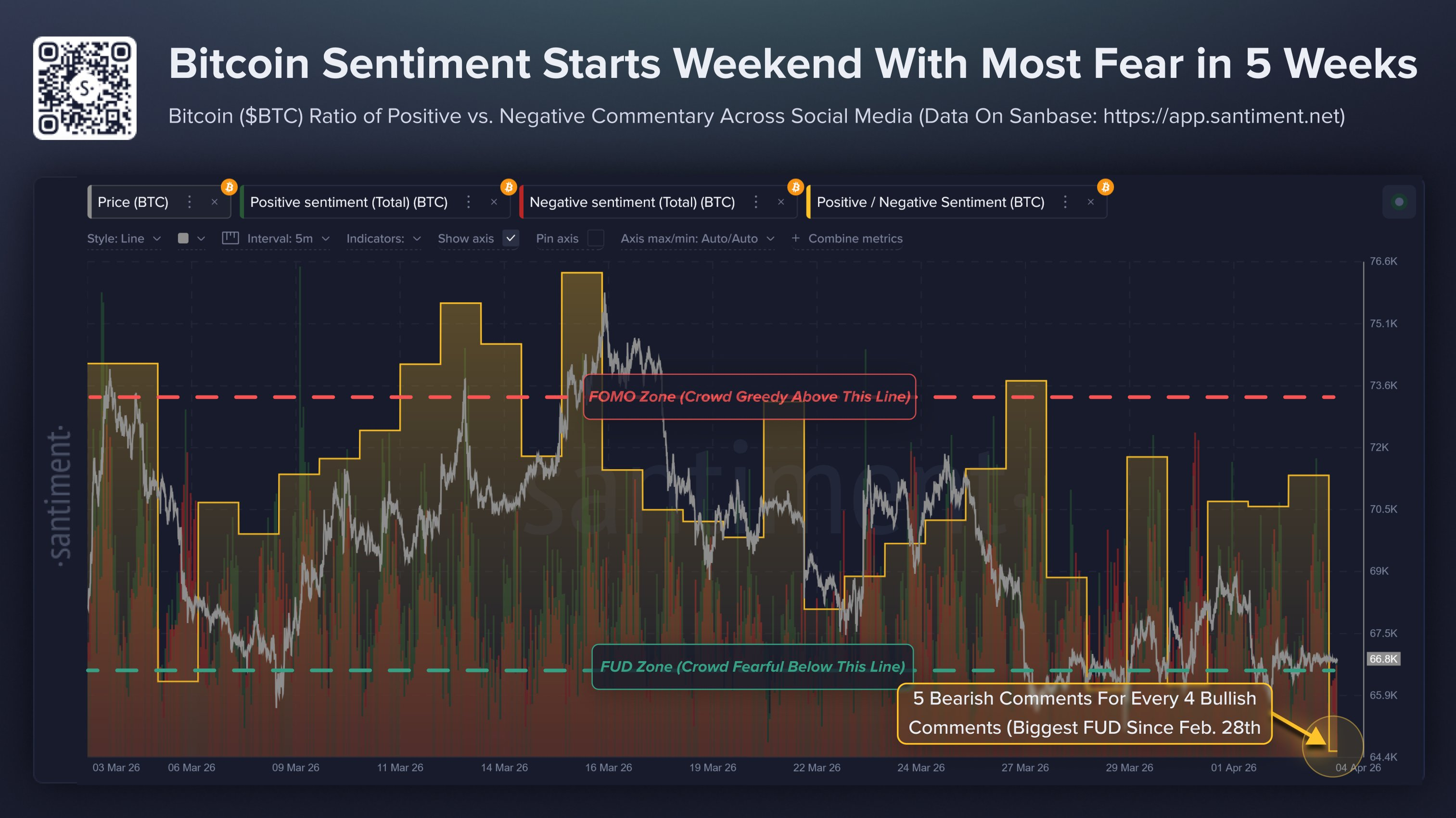
Meanwhile, market sentiment is at levels not seen since the depths of the 2022 bear market, with only 55% of Bitcoin’s supply currently in profit and roughly 10 million BTC held at a loss.
Elsewhere, CryptoQuant’s Fear and Greed Index suggests extreme caution, at 10, firmly in the “extreme fear” zone.
Shadow Shorts and Safe-Haven Bets Highlight Crypto’s Risk-Off Mood
Adding to the market’s nervous undertone is the presence of aggressive short positions. Reports indicate that a not-so-popular trader has made $7 million by shorting multiple crypto assets, including $3.7 million on Ethereum and $1.45 million on ENA.
Sponsored
Sponsored
While largely anonymous, this trader exemplifies the growing sophistication and audacity of market participants betting on downside risk.
Meanwhile, broader investor behavior also reflects a flight toward perceived safety. The February global fund manager survey from Bank of America (BofA) highlighted gold as the most crowded trade, with 50% of managers holding long positions, while top US tech stocks (Nvidia, Alphabet, Apple, Amazon, Microsoft, Meta, and Tesla) ranked second, cited by 20% of respondents.
This preference for traditional hedges reflects heightened risk aversion in financial markets. Despite the current turbulence, investors should not act in panic. Bitcoin’s history suggests it often consolidates after sharp pullbacks before resuming longer-term trends.
However, the combination of geopolitical flashpoints, ETF outflows, concentrated shorting activity, and extreme fear readings suggests that market volatility may persist in the near term.
Sponsored
Sponsored
Chart of the Day
Byte-Sized Alpha
Here’s a summary of more US crypto news to follow today:
Crypto World
Nakamoto Secures Acquisition of BTC Inc and UTXO
Editor’s note: In a move that consolidates Bitcoin-native operations across media, asset management, and advisory services, Nakamoto signs definitive agreements to acquire BTC Inc and UTXO Management. The announcement outlines strategic intent, expected closing in early 2026, and how these integrations may reshape Nakamoto’s growth trajectory. The editorial team will monitor how the combined platform expands industry coverage, investor access, and Bitcoin-focused capabilities as the company builds its global brand.
Key points
- Nakamoto signs definitive agreements to acquire BTC Inc and UTXO Management, expanding Bitcoin-native services across media and asset management; closing is targeted for Q1 2026.
- Transaction is expected to close in the first quarter of 2026, subject to customary closing conditions.
- The deal is financed entirely with Nakamoto common stock at $1.12 per share; 363,589,816 shares will be issued, valued at $107,295,354 before adjustments.
- BTC Inc is a global leader in Bitcoin media and events; UTXO provides investment advisory services to Bitcoin-focused opportunities.
- The combined platform aims to strengthen Nakamoto’s balance sheet and accelerate growth initiatives in Bitcoin ecosystems.
Why this matters
Nakamoto’s acquisition broadens its footprint as a diversified Bitcoin operating company with global reach in media, asset management, and advisory services. By integrating BTC Inc’s media assets and UTXO’s investment platform, the company seeks recurring earnings, expanded cross-selling, and stronger market position.
What to watch next
- Closing of the transaction in Q1 2026 and milestones for integration of BTC Inc and UTXO into Nakamoto’s platform.
- Progress on synergies, cross-selling opportunities, and potential additional Bitcoin treasury activities and acquisitions.
Disclosure: The content below is a press release provided by the company/PR representative. It is published for informational purposes.
Nakamoto Signs Definitive Agreements to Acquire BTC Inc and UTXO Management
Nakamoto Inc. (NASDAQ: NAKA) today announced that it has entered into merger agreements to acquire BTC Inc, the leading provider of Bitcoin-related media and events, and UTXO Management GP, LLC (the “UTXO”), an investment firm focused on private and public Bitcoin companies (collectively, the “Transaction”). The Transaction is expected to close in the first quarter of 2026, subject to customary closing conditions.
The Company’s option to acquire BTC Inc and UTXO, through BTC Inc’s call option with UTXO, was previously disclosed as part of Nakamoto’s proposed merger with Nakamoto Holdings, Inc. (the “Nakamoto Holdings”). The Marketing Services Agreement with BTC Inc (the “MSA”), which the Company assumed from Nakamoto Holdings in the merger last year, outlines the terms of the Company’s option and was publicly filed and approved by the Company’s shareholders in connection with that transaction. Following shareholder approval, Nakamoto, BTC Inc, and UTXO engaged in extensive joint marketing initiatives across BTC Inc’s media and events platforms. Nakamoto exercised its call option with BTC Inc and BTC Inc exercised its call option with UTXO concurrently with signing of the merger agreements. No additional Nakamoto shareholder approval is required to complete the Transaction.
“Bringing BTC Inc and UTXO into Nakamoto has been a part of our vision since day one,” said David Bailey, Chairman and CEO of Nakamoto. “We intend to operate a portfolio of companies across media, asset management, and advisory services that can scale with Bitcoin’s long-term growth. BTC Inc and UTXO are global leaders in Bitcoin media and asset management. This transaction signifies the first step of the company we intend to build, and we’re just getting started.”
UTXO: Investing in Bitcoin Acceleration
UTXO is the adviser to 210k Capital, LP, a hedge fund focused on Bitcoin, Bitcoin-related securities, and derivatives. The investment team leverages extensive experience in the Bitcoin ecosystem to allocate capital across public and private market opportunities.
“UTXO was founded to back the builders and companies shaping the Bitcoin economy,” said Tyler Evans, Chief Investment Officer of Nakamoto and Chief Investment Officer of UTXO. “Leveraging Nakamoto’s public platform and robust treasury, we see a powerful opportunity to compound value across the Bitcoin ecosystem and reinforce Bitcoin’s role as a foundational asset in modern capital markets.”
More information about the transaction can be found on the Nakamoto Investor Relations site: http://investors.nakamoto.com
Additional Transaction Details
A Special Committee of independent directors of Nakamoto’s Board of Directors (the “Special Committee”) was formed to review, evaluate, and negotiate the Transaction. The Special Committee retained B. Riley Securities, Inc. as the independent financial advisor and fairness opinion provider to the Special Committee and Simpson Thacher & Bartlett LLP as independent legal counsel.
Nakamoto was advised by TD Securities (USA) LLC as its financial advisor and Reed Smith LLP as legal counsel in connection with the Transaction. BTC Inc was advised by Bradley Arant Boult Cummings LLP and UTXO was advised by Haynes and Boone, LLP, in each case acting as legal counsel to the respective parties.
About Nakamoto Inc.
Nakamoto Inc. (NASDAQ: NAKA) is a Bitcoin company that owns and operates a global portfolio of Bitcoin-native enterprises spanning media and information, asset management, and advisory services. For more information, please visit nakamoto.com.
Forward Looking Statements All statements, other than statements of historical fact, included in this press release that address activities, events or developments that Nakamoto expects, believes or anticipates will or may occur in the future are forward-looking statements, as defined under U.S. federal securities laws, related to Nakamoto. Forward-looking statements can be identified by the fact that they do not relate strictly to historical or current facts, including, without limitation, statements about expectations regarding anticipated synergies, cross-selling opportunities, operational plans, market expansion, the long-term strategic impact or anticipated effects of the Transaction, financial projections of BTC Inc and/or UTXO, the timing of closing of the Transaction, Bitcoin-related strategies, Bitcoin treasury management activities, and Nakamoto’s anticipated holding of Bitcoin as part of its corporate treasury. Such forward-looking statements are inherently uncertain and involve numerous assumptions and risks. Forward-looking terms used may include, but are not limited to, “estimate,” “project,” “predict,” “believe,” “expect,” “anticipate,” “potential,” “create,” “intend,” “could,” “would,” “may,” “plan,” “will,” “look,” “goal,” “future,” “build,” “focus,” “continue,” “strive,” “allow,” “seek,” “see,” “aim,” “target,” or the negative of such terms or other variations thereof and words and terms of similar substance used in connection with any discussion of future plans, actions, or events identify forward-looking statements and similar expressions. However, the absence of these words does not mean that the statements are not forward-looking. These forward-looking statements include, but are not limited to, the following: descriptions of Nakamoto and its operations, subsidiaries, strategies and plans, expectations regarding anticipated synergies, cross-selling opportunities, operational plans, market expansion, the long-term strategic impact or anticipated effects of the Transaction, financial projections of BTC Inc and/or UTXO, the timing of closing of the Transaction, Bitcoin-related strategies, and Bitcoin treasury management activities. There are a number of risks and uncertainties that could cause actual results to differ materially from the forward-looking statements included in this communication. Factors that could cause actual results to differ include, but are not limited to, the following: the acquisition of BTC Inc or UTXO may not provide the benefits we anticipate receiving due to any number of factors, including the inability of BTC Inc or UTXO to maintain current level of earnings or to continue to grow its sales to new and existing customers; our inability to successfully cross-sell business between our existing customers and BTC Inc’s or UTXO’s existing products or services, or expand products or services to new customers; the effect of the announcement or pendency of the Transaction on our business relationships, performance, and business generally; the acquisition of BTC Inc or UTXO may not be closed in a timely manner or at all, which may adversely affect the price of our securities; and we may encounter difficulties with integration or unanticipated costs related to the Transaction; Bitcoin market volatility, ; and other important factors that could cause actual results to differ materially from those projected. All such factors are difficult to predict and are beyond Nakamoto’s control, including those detailed in Nakamoto’s Annual Reports on Form 10-K, Quarterly Reports on Form 10-Q, Current Reports on Form 8-K, and such other documents of Nakamoto that are filed, or will filed, with the SEC that are or will be available on Nakamoto’s website at www.nakamoto.com and on the website of the SEC at www.sec.gov. All forward-looking statements are based on assumptions that Nakamoto believes to be reasonable but that may not prove to be accurate. Any forward-looking statement speaks only as of the date on which such statement is made, and Nakamoto does not undertake any obligation to correct or update any forward-looking statement, whether as a result of new information, future events or otherwise, except as required by applicable law. Readers are cautioned not to place undue reliance on these forward-looking statements, which speak only as of the date hereof. Nothing contained herein constitutes an offer to buy or sell securities of Nakamoto or any other party, nor does it constitute a solicitation of any proxy or vote. Past performance is not indicative of future results.
Media Contact
Carissa Felger / Sam Cohen
Gasthalter & Co.
(212) 257-4170
Investor Relations Contact
Steven Lubka
VP of Investor Relations
(615) 701-8889
Crypto World
StarkNet Adds EY Nightfall to Enable Private Payments on Eth Rails
StarkWare’s Starknet is expanding its privacy capabilities by integrating EY’s Nightfall protocol, enabling institutions to run private payments and DeFi activity on public Ethereum-aligned rails, with confidentiality preserved alongside auditability. In a Tuesday release, StarkWare positioned the move as a bridge for enterprises to use a shared, open layer-2 instead of siloed, bank-only networks, while partnering with a Big Four firm that already audits many prospective onboarding clients. Nightfall—EY’s open-source zero-knowledge privacy layer—lets transactions be verified without exposing underlying data, unlocking private B2B and cross-border payments, confidential treasury management, and on-chain transfers of tokenized assets around the clock. The rollout appears staged, focusing on privacy-forward onboarding with selective disclosure for regulators and auditors.
Key takeaways
- StarkWare is integrating EY Nightfall into Starknet to support private transactions on an Ethereum-compatible chain, enabling private payments and DeFi activity at scale.
- The plan emphasizes an open, layer-2 solution rather than siloed, bank-only networks, with a Big Four auditor involved in onboarding.
- Nightfall’s zero-knowledge privacy layer lets verifications occur without revealing private data, while still allowing selective disclosure for compliance and audits.
- The rollout will be staged, starting with compliant private payments and transfers and expanding to additional features as the system scales.
- Starknet has grown to be a major ZK rollup by TVL, but has faced outages in 2025 that prompted post-mortems and reliability enhancements ahead of broader institutional flows.
Market context: The initiative signals a growing emphasis on privacy-preserving rails and interoperable, on-chain workflows for institutions within the expanding Layer-2 ecosystem, as DeFi and cross-border token transfers push for compliance-ready, scalable solutions.
Why it matters
The blending of Nightfall with Starknet is more than a technical upgrade; it represents a strategic attempt to unlock institutional participation in public blockchains without forcing a trade-off between privacy and auditability. By anchoring the privacy layer to a public, open network, StarkWare aims to encourage banks and corporates to explore private payments, treasury management, and cross-border settlement on-chain, while maintaining visibility for regulatory and internal controls. The approach could lower the barriers for traditional financial players who have historically shied away from fully transparent on-chain activity, offering a path to leverage distributed ledger technology within established compliance frameworks.
Eli Ben-Sasson, StarkWare’s co-founder and CEO and a founding scientist of privacy-focused cryptocurrency Zcash (ZEC), described the Nightfall-on-Starknet initiative as paving the way for “the equivalent of a private superhighway for stablecoins and tokenized deposits.” The framing underscores a broader privacy push across Starknet, where institutions could gain confidential access to Ethereum DeFi activities—such as lending, swaps, and yield strategies—without sacrificing auditable records. Alex Gruell, StarkWare’s global head of business development, emphasized that Nightfall’s readiness for KYC-verified onboarding could be a critical differentiator for large organizations entering the blockchain space, aligning privacy with regulatory compliance at scale.[Zcash (CRYPTO: ZEC) is referenced here to reflect Ben-Sasson’s broader background and the privacy ethos behind the technology.]
Gruell also argued that Nightfall, when paired with Starknet, functions as an interoperability layer that could bridge otherwise siloed institutional environments. He contrasted this architecture with permissioned, stand-alone networks such as Canton Network, which he argued are not yet integrated with the Web3 ecosystem. The planned rollout remains permissionless and fully integrated into Starknet, with a staged deployment that starts with private payments and transfers guarded by compliance gates and secure sequencing. Verifier upgrades and expanded functionality will follow as the system scales, aiming to preserve privacy by default while enabling selective disclosure for audits and regulatory checks.
Starknet’s growth and teething trouble
Starknet has established itself as one of the larger ZK rollups by total value locked (TVL), with current estimates hovering around $280 million, driven largely by DeFi protocols and native ecosystem apps. This rapid ascent has not come without challenges. In 2025, Starknet experienced outages tied to sequencer and infrastructure weaknesses, prompting public post-mortems and commitments to harden reliability before courting broader institutional flow. The ongoing efforts to improve resilience are central to appealing to banks and corporates that require robust operational continuity alongside privacy guarantees.
As Starknet matures, proponents argue that a privacy-first path—especially when supported by a reputable auditor—could unlock new capital channels on public rails. The integration with Nightfall is positioned as a concrete step toward that vision, offering institutions a controlled yet verifiable on-chain environment. Yet observers will be watching how the privacy layer handles cross-border compliance challenges, including KYC/AML workflows and data-access requirements, as real-world usage scales beyond pilots and proof-of-concept tests.
What to watch next
- Timeline and milestones for the staged rollout, including the initial private-payments phase and planned expansions of on-chain features.
- Auditing milestones and regulatory reviews tied to the Nightfall integration, especially around KYC verification workflows.
- Verifier upgrades and any announced improvements to sequencing, privacy guarantees, and throughput as adoption grows.
- Real-world usage metrics from early institutional deployments and any interoperability benchmarks with other networks.
Sources & verification
- StarkWare’s announcement detailing the Nightfall integration with Starknet for private payments and DeFi on public rails.
- EY’s Nightfall privacy protocol, describing zero-knowledge privacy for on-chain transactions.
- Cointelegraph coverage of the Nightfall integration and related commentary from StarkWare and EY.
- DefiLlama data showing Starknet’s TVL around $280 million and its DeFi usage drivers.
- Starknet outage post-mortems and reliability commitments published in 2025.
What the story means for users and builders
The integration positions privacy-preserving on-chain activity as a standard feature for institutional users within public blockchain networks. For builders, it creates an opportunity to design DeFi products and treasury solutions that satisfy typical enterprise compliance requirements without sacrificing the openness and composability that characterize open ecosystems. For users and investors, the development signals ongoing maturation of Layer-2 privacy capabilities and a potential shift in how incumbent financial institutions interact with blockchain technologies—moving from isolated pilots to scalable, auditable, and privacy-respecting deployments on public rails.
Key figures and next steps
With Nightfall in tow, Starknet’s roadmap includes extended privacy controls, selective disclosure options for audits, and broader cross-border transaction support. The collaboration’s success will hinge on robust reliability improvements, effective onboarding workflows, and the ability to demonstrate real-world compliance without eroding the user experience. If these elements come together, institutions could begin treating public blockchains as viable platforms for confidential settlement and asset management, painting a more nuanced picture of privacy, scalability, and openness in decentralized finance.
Why it matters for the broader market
Privacy-preserving instrumentation on public blockchains aligns with a broader industry trend toward compliant, enterprise-grade blockchain ecosystems. As institutions weigh the benefits of public networks against privacy and regulatory requirements, solutions like Nightfall could help reconcile these tensions by offering auditable privacy with flexible disclosure. The broader market will be watching how this approach affects competition among Layer-2 providers, the pace of DeFi institutionalization, and the evolution of cross-chain interoperability as the ecosystem grows more interconnected.
Crypto World
BitMine Stock Price Faces 60% Drop Despite Citigroup Support
The BitMine stock price has started showing early signs of recovery. BMNR rose 6% on Feb. 13 before closing and is up 7.32% over the past five days. This rebound comes even as Ethereum, which BitMine closely tracks due to its ETH treasury exposure, has fallen 3.3% over the past week. This divergence suggests BitMine’s stock price may be trying to catch up.
BMNR charts also show that this rebound may be weak despite big players like Citigroup increasing BMNR holdings quarter-on-quarter. The bearish structure is still active, and the next few trading sessions could decide whether BitMine continues recovering or enters another major drop.
Bear Flag Structure Shows Recovery Attempt — But Breakdown Risk Remains
The BitMine stock price has been trading inside a bear flag pattern since early February. A bear flag forms after a sharp decline, followed by a temporary upward consolidation. This pattern often leads to another drop if buyers fail to fully regain control.
Sponsored
Sponsored
Between Dec. 10, 2025, and Feb. 5, 2026, BitMine’s stock price fell nearly 60%. This steep drop created the “pole” phase of the pattern. Since Feb. 5, the stock has rebounded about 26%, forming a bear “flag” pattern, which represents a recovery attempt.
Want more insights like this? Sign up for Editor Harsh Notariya’s Daily Crypto Newsletter here.
However, this recovery remains inside the bearish structure. Unless the stock breaks above key resistance levels, this rebound could simply be a temporary pause before another decline.
If the bear flag confirms, BitMine’s stock price could fall by nearly a 60% drop from the lower trendline breach point. This raises a critical question. If the BitMine stock price is recovering, why does the breakdown risk still remain high?
The answer becomes clearer when looking at momentum indicators.
Hidden Bearish Divergence Shows BMNR Sellers Still Maintain Control
Momentum analysis using the Relative Strength Index (RSI) shows signs of underlying weakness. RSI is an indicator that measures buying and selling strength on a scale from 0 to 100. When RSI rises while price struggles, it can signal weakening buyer strength.
Sponsored
Sponsored
The BitMine stock price formed a hidden bearish divergence between Nov. 18, 2025, and Feb. 9, 2026. During this period, the price created a lower high, while RSI formed a higher high. This pattern typically signals that sellers remain in control and further downside may follow.
After this divergence appeared, BitMine’s stock price dropped by over 14%.
Now, a similar setup appears to be forming again. RSI has started rising, but the price still remains below key resistance near $21.57. If the stock fails to break above this level, another bearish divergence could confirm.
This would increase the probability of a breakdown from the bear flag pattern. However, momentum alone does not fully explain price direction. Capital flow data provides another important clue.
Capital Flow Remains Weak Despite Institutional Buying
Institutional interest in BitMine has increased significantly. Citigroup raised its ownership stake by over 540%, while firms like BlackRock and BNY Mellon also expanded their exposure. Normally, such buying would support price growth.
Sponsored
Sponsored
The Fintel snapshot shows Citigroup’s addition but also highlights several BMNR dumps by firms like Baird Financial, Resources Investment Advisors, and more, which can be alarming to the price.
The Chaikin Money Flow (CMF) indicator shows a similar picture. CMF measures whether large investors are putting money into or taking money out of an asset. When CMF stays below zero, it signals that overall capital is still leaving the asset.
BitMine’s CMF has started rising gradually, showing that selling pressure is slowing. But the indicator remains below the zero line. This means total institutional buying has not yet fully reversed the broader selling trend. This creates a conflict. While some major firms are increasing exposure, overall, large-scale money flow remains cautious, as highlighted by the earlier snapshot.
Sponsored
Sponsored
This explains why BitMine’s stock price recovery still appears weak.
Price Levels Now Decide Whether BitMine Stock Price Recovers or Breaks Down
The BitMine stock price now sits at a critical level. If BMNR breaks above resistance between $21.57 and $21.74, the bearish structure would weaken for now. This could allow the stock to rise toward $29.60 and potentially $34.03, provided ETH also gains strength.
Such a move would confirm that buyers have regained control. However, downside risk remains significant.
If the BMNR stock price falls below the $20.02 support level, the bear flag breakdown could begin. This may push the stock toward lower support levels at $15.05 and $11.22. A full breakdown could eventually send the stock toward $8.36.
For now, BitMine’s stock price sits at a turning point. Citigroup’s aggressive accumulation shows institutional confidence. But bearish momentum and weak capital inflows still limit recovery strength.
The next few trading sessions will likely decide whether Tom Lee’s BMNR follows institutional optimism higher or confirms the bearish breakdown pattern.
Crypto World
Polygon Surpasses Ethereum in Daily Fees as Polymarket Bets Surge
TLDR
- Polygon surpassed Ethereum in daily transaction fees for the first time ever, with $407,100 in fees compared to Ethereum’s $211,700.
- The surge in Polygon’s fees was driven by significant activity on Polymarket, especially surrounding Oscar betting.
- Polymarket recorded over $15 million in wagers on a single Oscar category over the weekend, contributing to Polygon’s fee growth.
- Polygon’s average transaction fee is around $0.0026, significantly lower than Ethereum’s fee of about $1.68.
- Ethereum’s recent volatility, driven by large whale movements, created a more favorable environment for Polygon’s fee surge.
Polygon recently surpassed Ethereum in daily transaction fees, marking a significant shift in blockchain activity. This occurred when Polygon’s network recorded $407,100 in transaction fees on Friday, compared to Ethereum’s $211,700. The increase in Polygon’s revenue coincided with the surge in activity on Polymarket, particularly with Oscar betting.
Polymarket Drives Fee Surge
Polymarket, a decentralized prediction market, is behind much of Polygon’s newfound fee dominance. Over the weekend, it recorded more than $15 million in wagers for a single Oscar category, attracting considerable retail interest. This surge in betting activity directly translated into substantial network fees for Polygon, which exceeded $1 million in a single week.
This boost in transaction volume significantly impacted Polygon’s overall fee performance. Polymarket, which is built on Polygon’s blockchain, saw consistent traffic, helping drive up daily revenue. As a result, Polygon briefly overtook Ethereum in daily transaction fees, an outcome few expected given Ethereum’s dominant position.
Lower Transaction Fees Give Polygon an Edge
Polygon’s lower transaction costs have made it an attractive alternative to Ethereum for users engaging in frequent, smaller transactions. The average transaction fee on Polygon is around $0.0026, while Ethereum’s fees average about $1.68. This price difference makes Polygon the clear choice for many users, especially in markets like Polymarket, where multiple small bets are common.
The lower costs allow users to move funds more freely, resulting in a higher transaction volume. This increased volume has contributed to Polygon’s fee surge. According to sources, the majority of Polygon’s recent fee growth is attributed to Polymarket’s activity rather than other apps on the network, solidifying the importance of the prediction market.
Ethereum’s Volatility Adds Pressure
While Ethereum remains the dominant blockchain by many measures, its higher fees and increased volatility have made it less appealing for some users. Recently, large whale movements on Ethereum added to concerns about network stability, creating a sense of uncertainty. This has allowed Polygon to capitalize on the growing demand for lower-cost, more predictable transactions.
Despite Ethereum’s structural advantages, the recent surge in Polymarket’s activity has proven that consumer-driven demand can quickly shift fee dynamics.
Crypto World
Strategy buys 2,486 BTC as a rare pattern points to a Bitcoin price crash
Michael Saylor’s Strategy continued its Bitcoin buying spree last week, even as crypto winter persisted, and the coin formed a rare chart pattern pointing to more near-term downside.
Summary
- Strategy, formerly known as MicroStrategy, acquired 2,486 Bitcoin last week.
- The company now holds over 717,000 coins worth nearly $50 billion.
- Technical analysis suggests that the Bitcoin price is forming a bearish pennant pattern, pointing to a crash.
In an X post, Saylor noted that the company bought 2,496 Bitcoin (BTC) last week for $168 million. This purchase brought its total holdings to 717,131 coins, now valued at nearly $50 billion.
Strategy executed the purchase by selling shares, a move that has continued to dilute its shareholders. Data show that the company still has over $7.8 billion in common shares to sell and an additional $20 billion in preferred STRK.
The company now has over 312 million of outstanding shares, much higher than what it had a few years ago. This dilution will continue, as Michael Saylor has pledged to buy Bitcoin forever. He also revealed that he plans to swap its debt for shares in the future.
Bitcoin price technical analysis points to a crash
The ongoing Strategy acquisition is happening amid concerns that Bitcoin may continue falling in the near term. In a statement last week, Standard Chartered warned that Bitcoin may drop to $50,000 before recovering. The bank reduced its target for the coin from $150,000 to $100,000.
Bitcoin is facing other headwinds, including the tumbling futures open interest, which has moved to $43 billion, down from last year’s high of $95 billion.
At the same time, there are rising odds of a prolonged conflict in the Middle East despite the ongoing talks between Iran and the United States. Donald Trump has sent another carrier to the region, while Iran is conducting drills at the Strait of Hormuz.
A conflict in the Middle East would have a major impact on Bitcoin, which has proven that it is not a safe haven asset.

Technical analysis indicates that the Bitcoin price is slowly forming a bearish pennant pattern, consisting of a vertical line and a symmetrical triangle. The two lines of the triangle are nearing their confluence, meaning that the coin may soon drop to the year-to-date low of $60,000.
The bearish Bitcoin price outlook will become invalid if it moves above the key resistance level at $80,117, its lowest level in November last year.
Crypto World
Starknet Taps EY’s Nightfall for Institutional Privacy on Ethereum Rails
Starknet developer StarkWare has integrated EY’s Nightfall privacy protocol to let institutions run private payments and decentralized finance (DeFi) activity on public Ethereum-aligned rails, targeting banks and corporates that need confidentiality without giving up auditability.
In a Tuesday release shared with Cointelegraph, StarkWare positioned the move as a way for enterprises to use a shared, open layer-2 rather than closed, bank-only networks, while working with a Big Four firm that already audits many of the organizations it wants to onboard.
The integration brings Nightfall, an open-source zero-knowledge (ZK) privacy layer built by EY, that lets transactions be verified without revealing underlying data, onto Starknet to enable private B2B and cross-border payments, confidential treasury management and 24/7 tokenized asset transfers onchain.
StarkWare said that institutions will also be able to access Ethereum DeFi for activities such as lending, swaps and yield strategies, with transactions private by default but supporting selective disclosure, auditability and Know Your Customer (KYC) protocols.
Related: Arbitrum, Optimism and Base weigh in after Vitalik questions L2 scaling model
Starknet and Nightfall target institutional flows
StarkWare frames this as a “major breakthrough” in making public blockchains usable for institutional capital that has so far been deterred by full onchain transparency and the resulting compliance and competitive risks.
Eli Ben-Sasson, StarkWare co-founder and CEO and a founding scientist of privacy-focused cryptocurrency Zcash (ZEC), said in the release that blockchains could give every institution “the equivalent of a private superhighway for stablecoins and tokenized deposits,” positioning Nightfall on Starknet as a concrete step toward that vision.
Alex Gruell, StarkWare’s global head of business development, told Cointelegraph that Nightfall was “particularly useful for institutions requiring ready-to-go KYC verification as part of their onboarding to the blockchain,” and part of a broader privacy push on Starknet.

He said that while crypto native teams had “moved mountains” building ZK infrastructure, the EY-built system added a complementary layer of institutional credibility and “regulatory fluency.”
Related: Vitalik Buterin tempers vision for ETH L2s, pushes native rollups
Gruell also cast Starknet plus Nightfall as an interoperability layer between institutions, contrasting it with what he claimed are “siloed” institutional environments on rival networks, which he said “do not serve as an interoperability infrastructure,” and permissioned models such as Canton Network, which are “not yet integrated with the Web3 ecosystem.”
He stressed that Nightfall would remain permissionless and fully integrated into Starknet, with a staged rollout, where initial deployment focused on “private payments and transfers with compliance gating and secure sequencing in place,” while “verifier upgrades and expanded functionality follow as the system scales.”
Starknet’s growth and teething trouble
Starknet has steadily grown into one of the larger ZK rollups by total value locked (TVL), currently about $280 million, with usage primarily driven by DeFi protocols and native ecosystem apps.
At the same time, Starknet’s rapid scaling push has exposed reliability challenges. In 2025, the network suffered major outages tied to sequencer and infrastructure issues, prompting public post-mortems and commitments to harden reliability before courting more institutional flow.
Magazine: Back to Ethereum — How Synthetix, Ronin and Celo saw the light
Crypto World
HIVE Delivers Record Q3 Revenue and Margin Growth
Editor’s note: In a sector defined by rapid changes in energy costs and compute demand, HIVE Digital Technologies reports a standout quarter that highlights the resilience of its dual-engine model — steady Bitcoin hashrate expansion alongside high-growth BUZZ AI HPC. The Q3 results, led by record revenue of $93.1 million and a gross margin of $32.1 million, reflect disciplined scaling across renewable-powered infrastructure and an accelerating AI compute strategy. The company’s Paraguay expansion and GPU cloud initiatives illustrate how HIVE is positioning for longer-term margin expansion, recurring revenue and geographic diversification.
Key points
- Record quarterly revenue of $93.1 million, up 219% YoY and 7% QoQ, with gross margin of $32.1 million (34.5%).
- Bitcoin hashrate capacity reached 25 EH/s, with BUZZ HPC growth accelerating.
- AI GPU expansion: 504 Nvidia GPUs under a $30 million contract, live deployments in Q1 2026, lifting HPC revenue and targeting $140 million ARR by Q4 2026 with 11,000 GPUs.
- Paraguay expansion and renewable-powered infrastructure underpin margin growth and geographic diversification.
Why this matters
This quarter demonstrates HIVE’s ability to scale a renewable-powered data center platform while expanding into AI compute markets. The dual-engine approach provides resilience against sector volatility, leveraging Bitcoin hashrate expansion as a cash generator and BUZZ HPC as a high-growth, recurring revenue stream. With Paraguay infrastructure, green energy and new AI deployments, HIVE is positioned for margin expansion and geographic diversification into Latin America.
What to watch next
- Deployments of 504 Nvidia GPUs live in Q1 2026 and expected ARR uplift to $140 million by Q4 2026 as GPU AI Cloud evolves.
- Paraguay expansion: energization of the additional 100 MW at Yguazú targeted for Q3 2026 and 63 hectares of land acquisition supporting growth.
- Anticipated overall energy footprint of 540 MW by year-end, with evaluation of incremental megawatts for future EH/s growth.
Disclosure: The content below is a press release provided by the company/PR representative. It is published for informational purposes.
HIVE Delivers Record Q3 Revenue of $93.1 Million with $32.1 Million Gross Operating Margin, Up Over 6x Year-Over-Year
This news release constitutes a “designated news release” for the purposes of the Company’s prospectus supplement dated November 25, 2025 to its short form base shelf prospectus dated October 31, 2025.
San Antonio, TX, February 17, 2026 — HIVE Digital Technologies Ltd. (TSX.V: HIVE) (Nasdaq: HIVE) (FSE: YO0) (BVC: HIVECO) (referred to as the “Company” or “HIVE”), a global leader in sustainable data center infrastructure, announced its results for the third quarter ended December 31, 2025 (all amounts in US dollars, unless otherwise indicated).
HIVE delivered record quarterly revenue of $93.1 million, representing 219% year-over-year growth and 7% quarter over quarter growth, and Adjusted EBITDA of $5.7 million. Gross operating margin expanded significantly to $32.1 million (34.5%), up more than sixfold compared to $5.3 million in the prior year period.
This quarter marks the strongest “dual-engine” growth in HIVE’s history, driven by the rapid scale-out of its Bitcoin hashrate fleet to an installed base of 25 Exahash per Second (EH/s) by period end December 31, 2025 and accelerating demand for BUZZ HPC platforms.
Q3 FY2026 Financial Highlights:
• Total Revenue: $93.1 million, a 219% increase from $29.2 million in Q3 FY2025 and a 7% increase over last quarter. Gross operating margin was $32.1 million or 34.5%, up from 18% in fiscal Q3 FY2025. See the calculation of direct costs and mining margin included below in this press release.
• Digital Currency Hashrate Revenue: $88.2 million, up 8% from Q2 FY2026, reflecting a 41% quarter-over-quarter increase in average hashrate to 22.9 EH/s, partially offset by approximately 10% lower Bitcoin prices and 15% higher network difficulty. This hashrate revenue was achieved at a direct cost of $57.8 million, of which approximately 90% is energy costs. See the calculation of direct costs included below in this press release.
• Bitcoin Output: Generated 885 Bitcoin, representing a 23% quarter over quarter increase, despite a 15% rise in network difficulty.
• HPC Revenue: BUZZ HPC revenue was $4.9 million during the quarter. This revenue was achieved against direct costs of $2.3 million.
• G&A: $8.4 million, up from $7.8 million in Q2 2026, primarily as a result of increased staff to support HIVE’s global expansion, including Paraguay, and the BUZZ HPC business. Notably, while gross operating margin increased more than 6x year-over-year, corporate G&A grew only 1.8x over the same period, demonstrating operating leverage and disciplined scaling.
• Net Loss: GAAP net loss of $91.3 million was primarily driven by $57.4 million in accelerated depreciation related to the Paraguay expansion and non-cash revaluation adjustments. The loss reflects HIVE’s decision to depreciate the next-generation ASIC fleet over a two-year cycle, rather than the typical four-year schedule, to reflect the faster pace of efficiency improvements and shorter economic lives of new ASICs—a conservative approach aligned with our strong growth in Paraguay and focus on operating income.
• Adjusted EBITDA: $5.7 million.
OPERATING PERFORMANCE: SCALE WITH DISCIPLINE
Infrastructure Expansion
• Completed Paraguay Buildout and Achieved 25 EH/s: Operating 440 megawatts (MW) of global, hydro-powered capacity with 25 EH/s installed and 22.9 EH/s average operational hashrate, while reaching 17.5 Joules per Terahash (J/TH) fleet efficiency; record completion of 300 MW of green-energy Tier-I infrastructure brought online in 6 months (from May 2025 to November 2025).
• Land & Power: The company signed an additional 100 MW PPA in Yguazú and bought 10 hectares of land, with energization targeted for Q4 2026. This maintains our growth in Paraguay by an additional 10 EH/s. Subsequent to the quarter end, the Company has purchased an additional 63 hectares of land.
Positioning for AI and HPC Growth
Future Capacity & Growth Outlook
• Accelerating AI Revenue: In February 2026, the Company signed a 2-year, $30 million contract for 504 Nvidia B200 GPUs. Expected deployments to be live in calendar Q1 2026 at Bell’s Tier-III facility; adds ~1$15 million of ARR and lifts HPC annualized revenue ~75% (from $20 million to $35 million). Targeting $140 million ARR by Q4 2026 for GPU AI Cloud with 11,000 GPUs, subject to market conditions and successful infrastructure deployment.
• BUZZ’s Growth Plan: Targeting $225 million ARR for total HPC revenue for BUZZ HPC and GPU AI Cloud by end of calendar 2026 or early 2027 as GPU cloud and colocation capacity expands.
• Strengthened Runway for Scalable Compute: By year-end, HIVE expects to operate a 540 MW energy footprint (440 MW currently operating, plus the additional 100 MW PPA contracted). Existing and incremental megawatts will be evaluated to preserve flexibility for highest-value deployments – toward expanding EH/s or supporting future AI and high-performance computing workloads.
Management Insights
Frank Holmes, HIVE’s Executive Chairman, stated, “This quarter marked an inflection point for HIVE. We delivered record revenue, scaled our renewable-powered Tier-I hashrate platform to 25 EH/s and accelerated our AI strategy. These milestones reflect disciplined execution across both engines of our business – Bitcoin hashrate services as the cash generator and BUZZ as our high-growth HPC platform, positioning HIVE for diversified, recurring revenue growth. Demand for AI compute continues to rise, and HIVE is leveraging its long track record in high-performance compute infrastructure and deep technical expertise in AI cloud services and data center operations to capture that opportunity. Notably, we are also positioning Paraguay to be a leader in HPC for Latin America. With abundant and stable green energy, and a government that is strongly-aligned with the United States, we believe Tier-III data centers are the future in Paraguay. Our future deployments in Paraguay will have the architecture and infrastructure footprint for Tier III future deployments as we build out our powered land. Our team has ordered the substation for the additional 100 MW at Yguazú, which we expect to come online in calendar Q3 2026. Moreover, the Company has a strategic alignment with Paraguay’s largest Tier III telecom datacenter operator, where we are sending a cluster of high-performance GPUs which will operate on the BUZZ AI Cloud out of Asuncion. Thus, by laying the foundation for long-term and rapid scale HPC Tier III Data Center deployment with our next 100 MW in Yguazú, and curating HIVE’s first Latin America GPU AI cloud proof-of-concept this quarter from Asuncion, our vision is to be a first mover in Latin America, powering the AI industrial revolution with renewable energy from Paraguay. HIVE will be a key economic driver for Paraguay, as we anticipate materially contributing to the GDP growth of the country through our data center construction expenditures and stable and long-term consumption of power from the Itaipu Dam, which will strengthen Paraguay’s domestic energy market and drive revenue for ANDE and the government. President Santiago Pena has demonstrated great leadership, along with Marcos Riquelme and Ruben Ramirez Lezcano, which gives us the confidence to advance our investments into Paraguay.”
Mr, Holmes continued, “Our wholly owned subsidiary, BUZZ AI has begun to demonstrate the scale of its earnings power. With this growth, our early-stage Paraguay platform becomes even more strategic, as we partner with a leading Tier III telecom data center operator in the country and deploy our first cluster of high-performance GPUs into that facility, demonstrating that our GPU chips have arrived and that Paraguay can be a cornerstone market for BUZZ in Latin America. Tier I data centers are a critical first step in building the power and infrastructure backbone required for future Tier III AI and HPC data centers, and we see them as the key runway for grid buildout and long-term capacity planning across our global platform. This is the strategy we are executing in Canada and Sweden today, and now in Paraguay as we develop large-scale, renewable powered Tier I capacity that can be systematically upgraded into Tier III AI and HPC data centers over time.”
Aydin Kilic, President & CEO, stated, “This quarter demonstrated HIVE’s execution in both our Tier-I hashrate platform and GPU AI Cloud. Our business has scaled substantially over the last year. Notably, our gross operating margin has increased over 6x YoY, from $5.3 million period end December 31, 2024 to $32.1 million this current period end December 31, 2025. At HIVE, we pursue accretive growth with a high-performance work culture, and this exponential growth in gross operating margin relative to corporate G&A reflects our expertise to scale with our Tier-I hashrate platform. Furthermore, this growth in corporate G&A includes added key personnel and talent to our BUZZ HPC and GPU AI Cloud business. In this fiscal quarter, we announced the purchase of 504 next-generation AI-optimized GPUs, and last week, ahead of their installation in March 2026 in the BUZZ Canada West facility, we announced the entire cluster was leased on a two-year fixed term contract valued at $30 million. As we expand BUZZ, we are leveraging our proven infrastructure operating model and deep technical expertise in AI to deliver GPU cloud and colocation capacity quickly and reliably for enterprise customers. With Tier-III+ capacity across Canada, Sweden and a growing pipeline of multi-year GPU cloud and colocation demand, we believe HIVE is positioned to build a durable, high-margin, recurring revenue platform through 2026 and beyond. This dual-engine strategy provides continued growth and sustained cashflow as we navigate the recent volatility in Bitcoin hashrate revenues.”
Darcy Daubaras, HIVE’s CFO, stated, “This quarter demonstrates strong revenue growth and operating margin expansion despite a more competitive hashrate environment. Accelerated depreciation impacted net income, but reflects conservative accounting and disciplined balance sheet management. We believe our cost structure and renewable power strategy position us to generate attractive operating margins as competition increases.”
Strategic Positioning
HIVE’s “dual-engine” strategy — Bitcoin infrastructure as cash generator and BUZZ AI Cloud as high-growth recurring revenue — provides diversification and capital allocation flexibility.
The Company remains focused on:
• Expanding gross operating margin
• Scaling recurring AI revenue
• Maintaining disciplined G&A growth
• Preserving balance sheet strength
With renewable-powered infrastructure across Canada, Sweden, and Paraguay, HIVE believes it is positioned to build a durable, margin-driven digital infrastructure platform through 2026 and beyond.
Conference Call Information
HIVE will hold its fiscal Q3 2026 earnings call on Tuesday, February 17 at 8:00 AM EST. To participate in this event, please log on or dial in approximately 5 minutes before the call.
Date: February 17, 2026
Time: 8:00 AM EST
Webcast: Registration link here
Dial-in: Provided after registration
Financial Statements and MD&A
The Company’s Consolidated Financial Statements and Management’s Discussion and Analysis (MD&A) thereon for the three months ended December 31, 2025 will be accessible on SEDAR+ at www.sedarplus.ca under HIVE’s profile and on the Company’s website at www.HIVEdigitaltechnologies.com.
¹ The Company has presented certain non-GAAP measures in this report. The Company uses EBITDA and Adjusted EBITDA as a metric that is useful to management, the board and investors for assessing its operating performance on a cash basis before the impact of non-cash items and acquisition related activities. EBITDA is net income or loss from operations, as reported in profit and loss, before finance income and expense, tax and depreciation and amortization. Adjusted EBITDA is EBITDA adjusted for by removing other non-cash items, including share-based compensation, finance expense, depreciation and one-time transactions. The following table provides an illustration of the calculation of EBITDA and Adjusted EBITDA for the last five quarters:
² Net realized and unrealized gains (losses) on digital currencies is calculated as the change in fair value (gain or loss) on the coin inventory, and the gain (loss) on the sale of digital currencies which is the net difference between the proceeds and the carrying value of the digital currency.
³ The following represents the Revenue and related costs that comprise the gross mining margin. We include connectivity, security, data center maintenance, and electrical equipment maintenance. Electrical costs may vary quarter over quarter.
*Average revenue per BTC is for hashrate services operations only and excludes HPC operations.
⁴ References to annualized revenue and run-rate revenue are considered future-oriented financial information. Readers should be cautioned that this information is used by the Company only for the purpose of evaluating the merit of this line of its business operations and may not be appropriate for other purposes.
Quarterly ATM Sales Report
For the three-month period ended December 31, 2025, the Company issued 4,925,948 common shares (the “November 2025 ATM Shares”) pursuant to the at-the-market offering commenced in November 2025 (the “November 2025 ATM Equity Program”) for gross proceeds of C$22.0 million ($15.8 million). The November 2025 ATM Shares were sold at prevailing market prices, for an average price per November 2025 ATM Share of C$4.47. Pursuant to the November 2025 ATM Equity program, a cash commission of $153 thousand on the aggregate gross proceeds raised was paid to the sales agents in connection with its services under the November 2025 ATM Equity Program.
About HIVE Digital Technologies Ltd.
Founded in 2017, HIVE Digital Technologies Ltd. is the first publicly listed company to mine digital assets powered by green energy. Today, HIVE builds and operates next-generation Tier-I and Tier-III data centers across Canada, Sweden, and Paraguay, serving both Bitcoin and high-performance computing clients. HIVE’s twin-turbo engine infrastructure-driven by hashrate services and GPU-accelerated AI computing-delivers scalable, environmentally responsible solutions for the digital economy.
For more information, visit hivedigitaltech.com, or connect with us on:
X: https://x.com/HIVEDigitalTech
YouTube: https://www.youtube.com/@HIVEDigitalTech
Instagram: https://www.instagram.com/hivedigitaltechnologies/
LinkedIn: https://linkedin.com/company/hiveblockchain
On Behalf of HIVE Digital Technologies Ltd.
“Frank Holmes”
Executive Chairman
For further information, please contact:
Nathan Fast, Director of Marketing and Branding
Frank Holmes, Executive Chairman
Aydin Kilic, President & CEO
Tel: (604) 664-1078
Neither the TSX Venture Exchange nor its Regulation Services Provider (as that term is defined in policies of the TSX Venture Exchange) accepts responsibility for the adequacy or accuracy of this news release.
Forward-Looking Information
Except for the statements of historical fact, this news release contains “forward-looking information” within the meaning of the applicable Canadian and United States securities legislation and regulations that is based on expectations, estimates and projections as at the date of this news release. “Forward-looking information” in this news release includes but is not limited to: the acquisition of the new sites in Paraguay and Toronto and their potential, the timing of it becoming operational; business goals and objectives of the Company, including its target hashrate milestones and the costs to achieve the milestones; the results of operations for the three and nine months ended December 31, 2025; the expected costs of maintaining and growing its operations; financial information related to annualized run rate; the acquisition, deployment and optimization of the hashrate fleet and equipment; the continued viability of its existing Bitcoin hashrate services operations; the receipt of government consents; and other forward-looking information concerning the intentions, plans and future actions of the parties to the transactions described herein and the terms thereon.
Factors that could cause actual results to differ materially from those described in such forward-looking information include, but are not limited to: the inability to complete the construction of the Paraguay acquisition on an economic and timely basis and achieve the desired operational performance; the ongoing support and cooperation of local authorities and the Government of Paraguay; the volatility of the digital currency market; the Company’s ability to successfully mine digital currency; the Company may not be able to profitably liquidate its current digital currency inventory as required, or at all; a material decline in digital currency prices may have a significant negative impact on the Company’s operations; the regulatory environment for cryptocurrency in Canada, the United States and the countries where our hashrate facilities are located; economic dependence on regulated terms of service and electricity rates; the speculative and competitive nature of the technology sector; dependency on continued growth in blockchain and cryptocurrency usage; lawsuits and other legal proceedings and challenges; government regulations; the global economic climate; dilution; future capital needs and uncertainty of additional financing, including the Company’s ATM Program and the prices at which the Company may sell Common Shares in the ATM Program, as well as capital market conditions in general; risks relating to the strategy of maintaining and increasing Bitcoin holdings and the impact of depreciating Bitcoin prices on working capital; the competitive nature of the industry; currency exchange risks; the need for the Company to manage its planned growth and expansion; the need for continued technology change; the ability to maintain reliable and economical sources of power to run its cryptocurrency hashrate assets; the impact of energy curtailment or regulatory changes in the energy regimes in which the Company operates; protection of proprietary rights; the effect of government regulation and compliance on the Company and the industry; network security risks; the ability of the Company to maintain properly working systems; reliance on key personnel; global economic and financial market deterioration impeding access to capital or increasing the cost of capital; share dilution resulting from the ATM Program and from other equity issuances; the construction and operation of facilities may not occur as currently planned, or at all; expansion may not materialize as currently anticipated, or at all; the digital currency market; the ability to successfully mine digital currency; revenue may not increase as currently anticipated, or at all; it may not be possible to profitably liquidate the current digital currency inventory, or at all; a decline in digital currency prices may have a significant negative impact on operations; an increase in network difficulty may have a significant negative impact on operations; the volatility of digital currency prices; the anticipated growth and sustainability of electricity for the purposes of Tier-I hashrate services in the applicable jurisdictions; the inability to maintain reliable and economical sources of power for the Company to operate Tier-I hashrate assets; the risks of an increase in the Company’s electricity costs, cost of natural gas, changes in currency exchange rates, energy curtailment or regulatory changes in the energy regimes in which the Company operates and the adverse impact on the Company’s profitability; the ability to complete current and future financings, any regulations or laws that will prevent the Company from operating its business; historical prices of digital currencies and the ability to mine digital currencies that will be consistent with historical prices; an inability to predict and counteract the effects of pandemics on the business of the Company, including but not limited to the effects of pandemics on the price of digital currencies, capital market conditions, restriction on labour and international travel and supply chains; and, the adoption or expansion of any regulation or law that will prevent the Company from operating its business, or make it more costly to do so.
The forward-looking information in this news release reflects the Company’s current expectations, assumptions, and/or beliefs based on information currently available to the Company. In connection with the forward-looking information contained in this news release, the Company has made assumptions about its objectives, goals or future plans, the timing thereof and related matters. The Company has also assumed that no significant events occur outside of the Company’s normal course of business. Although the Company believes that the assumptions inherent in the forward-looking information are reasonable, forward-looking information is not a guarantee of future performance, and accordingly, undue reliance should not be put on such information due to its inherent uncertainty. The Company disclaims any intention or obligation to update or revise any forward-looking information, whether because of new information, future events or otherwise, other than as required by law.
Crypto World
BTC Must Reclaim These Key Levels to End the Downtrend
Bitcoin’s broader structure continues to reflect a dominant bearish trend, yet the recent price action shows a short-term recovery attempt from the major demand zone around $60K–$62K. At this stage, the market is positioned between a higher-timeframe bearish structure and a developing lower-timeframe corrective rebound.
Bitcoin Price Analysis: The Daily Chart
On the daily timeframe, the asset is still trading within a well-defined descending channel, with both the upper and lower boundaries clearly guiding the macro structure. After losing the $79K level and breaking decisively below the $75K range, Bitcoin accelerated toward the major blue demand zone around $60K, where a strong reaction occurred.
The recent bounce from this region has pushed the price back toward the mid-$60Ks to high-$60Ks area, but the overall structure remains corrective. The price is still trading below the channel’s midline and beneath the 100- and 200-day moving averages, both of which are sloping downward.
As long as Bitcoin remains below the broken $75.3K support and under the $78.9K–$81.4K Fibonacci cluster, the broader bias on the daily timeframe stays bearish. The current recovery appears to be a pullback within a dominant downtrend rather than the start of a confirmed reversal.
BTC/USDT 4-Hour Chart
Zooming into the 4-hour timeframe, the corrective nature of the rebound becomes more evident. After the sharp capitulation wick into the $60K region, the price formed a local base and initiated a rebound toward the $70K area. However, this recovery is unfolding beneath a descending trendline and below the prior breakdown structure.
The $73K–$76K supply zone, which previously acted as support, now stands as a strong resistance area. Until the asset reclaims this region and invalidates the sequence of lower highs, the short-term structure remains vulnerable to another leg down.
The recent consolidation around the high-$60Ks reflects a temporary equilibrium between buyers defending the higher low and sellers protecting overhead resistance. A decisive break above the descending trendline could open the door toward the mid-$70Ks, while failure to sustain momentum increases the probability of a renewed test of the $60K demand zone.
Onchain Analysis
On-chain data from the Long-Term Holder SOPR (LTH-SOPR) suggests that sustained downside pressure is beginning to affect even Bitcoin’s most resilient cohort, marking a subtle but important shift in market dynamics.
Although the annual average LTH-SOPR remains elevated at 1.87, the metric has recently dropped below the critical 1.0 threshold, reaching 0.88—a configuration not seen since the late stages of the 2023 bear market. Historically, such breakdowns tend to occur during more advanced corrective phases, when even strong hands begin reducing exposure under sustained pressure.
That said, broader timeframe data paints a more nuanced picture. The monthly average SOPR still stands at 1.09, implying that, on aggregate, long-term holders are still realizing profits. Full-scale capitulation has typically coincided with much deeper compressions, with prior bear market bottoms marked by monthly SOPR levels approaching 0.5.
In this context, the current move does not yet confirm structural capitulation. Rather, it signals early stress among long-term participants—an inflection point that could either stabilize if market conditions improve or evolve into deeper distribution should selling pressure intensify.
SECRET PARTNERSHIP BONUS for CryptoPotato readers: Use this link to register and unlock $1,500 in exclusive BingX Exchange rewards (limited time offer).
Disclaimer: Information found on CryptoPotato is those of writers quoted. It does not represent the opinions of CryptoPotato on whether to buy, sell, or hold any investments. You are advised to conduct your own research before making any investment decisions. Use provided information at your own risk. See Disclaimer for more information.
-
Sports6 days agoBig Tech enters cricket ecosystem as ICC partners Google ahead of T20 WC | T20 World Cup 2026
-
Tech7 days agoSpaceX’s mighty Starship rocket enters final testing for 12th flight
-
Video24 hours agoBitcoin: We’re Entering The Most Dangerous Phase
-
Tech3 days agoLuxman Enters Its Second Century with the D-100 SACD Player and L-100 Integrated Amplifier
-
Video4 days agoThe Final Warning: XRP Is Entering The Chaos Zone
-
Tech12 hours agoThe Music Industry Enters Its Less-Is-More Era
-
Crypto World7 days agoBlockchain.com wins UK registration nearly four years after abandoning FCA process
-
Video7 hours agoFinancial Statement Analysis | Complete Chapter Revision in 10 Minutes | Class 12 Board exam 2026
-
Crypto World6 days agoPippin (PIPPIN) Enters Crypto’s Top 100 Club After Soaring 30% in a Day: More Room for Growth?
-
Crypto World4 days agoBhutan’s Bitcoin sales enter third straight week with $6.7M BTC offload
-
Video5 days agoPrepare: We Are Entering Phase 3 Of The Investing Cycle
-
Crypto World6 hours agoCan XRP Price Successfully Register a 33% Breakout Past $2?
-
Sports13 hours agoGB's semi-final hopes hang by thread after loss to Switzerland
-
NewsBeat2 days agoThe strange Cambridgeshire cemetery that forbade church rectors from entering
-
Business5 days agoBarbeques Galore Enters Voluntary Administration
-
Crypto World6 days agoCrypto Speculation Era Ending As Institutions Enter Market
-
Crypto World5 days agoEthereum Price Struggles Below $2,000 Despite Entering Buy Zone
-
Politics7 days agoWhy was a dog-humping paedo treated like a saint?
-
NewsBeat2 days agoMan dies after entering floodwater during police pursuit
-
NewsBeat3 days agoUK construction company enters administration, records show