
Crypto World
WBT’s new all-time high comes as crypto infrastructure gets more institutional


Disclosure: This article does not represent investment advice. The content and materials featured on this page are for educational purposes only.
WBT trades around $72.70 after hitting a new high, as its four-year milestone coincides with broader developments in blockchain infrastructure and digital assets.
Summary
- WBT hits a new all-time high above $72, extending gains as exchange tokens gain utility across trading and blockchain ecosystems.
- Whitechain is transitioning to an Ethereum Layer 2 using the OP Stack, with WBT remaining its native gas token.
- WBT’s full supply is now unlocked while WhiteBIT’s active burn program targets a long-term reduction toward 200 million tokens.

WBT is trading around $72.7 after reaching a new all-time high, extending its gains beyond the previous $64.11 record set in December 2025. The move comes as the four-year-old token reaches another stage in its development, while the wider crypto industry continues shifting toward more established infrastructure and institutional participation.
Utility is becoming more important for exchange tokens
The role of an exchange token has changed considerably from the early days of crypto.
WhiteBIT offers users trading-related benefits, including reduced fees, while holdings can also affect referral rewards and eligibility for certain Launchpad activities. Staking and reward programs provide additional ways for users to interact with the asset.
The token also has a blockchain function. WBT is used as the native gas asset on Whitechain, connecting it directly to transactions taking place outside the exchange environment.
That broader utility is relevant as crypto platforms increasingly serve users who expect more than a place to buy and sell assets. Trading, blockchain infrastructure, token launches and rewards are increasingly being combined within connected ecosystems.
WBT is one example of that model.
Whitechain is taking a different route to scalability
The infrastructure side of the story is developing at the same time.
Whitechain is transitioning from its original standalone Layer 1 into an Ethereum Layer 2 built with the OP Stack. The network’s Sepolia testnet is already operational, while mainnet development is targeting later in 2026.
The move places Whitechain within a much larger ecosystem. Ethereum Layer 2 networks have become an established way to handle blockchain activity while settling transactions back to Ethereum.
Whitechain’s architecture remains EVM-compatible, which means developers can continue using familiar Ethereum development tools. WBT remains the native gas token after the transition.
The development is particularly relevant to WBT because it gives the token a role in network activity that does not depend solely on exchange trading.
A new phase for token supply
WBT has appreciated 28.3% over the past 12 months and was among the global top 10 cryptocurrencies by market capitalization in figures released around its fourth anniversary.
The price move is noteworthy, but it is taking place alongside several structural changes that are affecting how exchange-linked digital assets are used.
WBT’s tokenomics have also reached a transition point.
The token’s full supply has been unlocked as of 2026. Meanwhile, its burn mechanism remains active. WhiteBIT says the buyback program uses an amount corresponding to 33% of trading-fee income and 5% of income from other exchange activities, with the stated aim of reducing total supply toward 200 million WBT.
This is different from the supply dynamics during WBT’s earlier years, when scheduled unlocks were still taking place.
The combination of completed unlocks and continuing burns gives traders another variable to consider when looking at the token’s longer-term supply profile.
It also means the recent all-time high is arriving after a significant change in the mechanics governing how much WBT is circulating.
More markets are opening up
The token’s wider market presence has changed alongside its utility. WBT was listed on Kraken in March 2026 with WBT/USD and WBT/EUR markets, giving the asset additional access outside its original exchange environment.
That matters for liquidity and visibility, particularly for an exchange-linked token whose early use was closely associated with a single platform.
WBT’s fourth anniversary provides another reference point. Four years after launch, the token is trading above its previous record, has gained 28.3% over the last year and has developed uses spanning exchange services and blockchain infrastructure.
The new high does not establish where the token goes next. What it does show is that WBT is entering a different stage of its lifecycle, one in which market performance is being watched alongside token utility, supply changes and the development of the network that uses it.
Disclosure: This content is provided by a third party. Neither crypto.news nor the author of this article endorses any product mentioned on this page. Users should conduct their own research before taking any action related to the company.

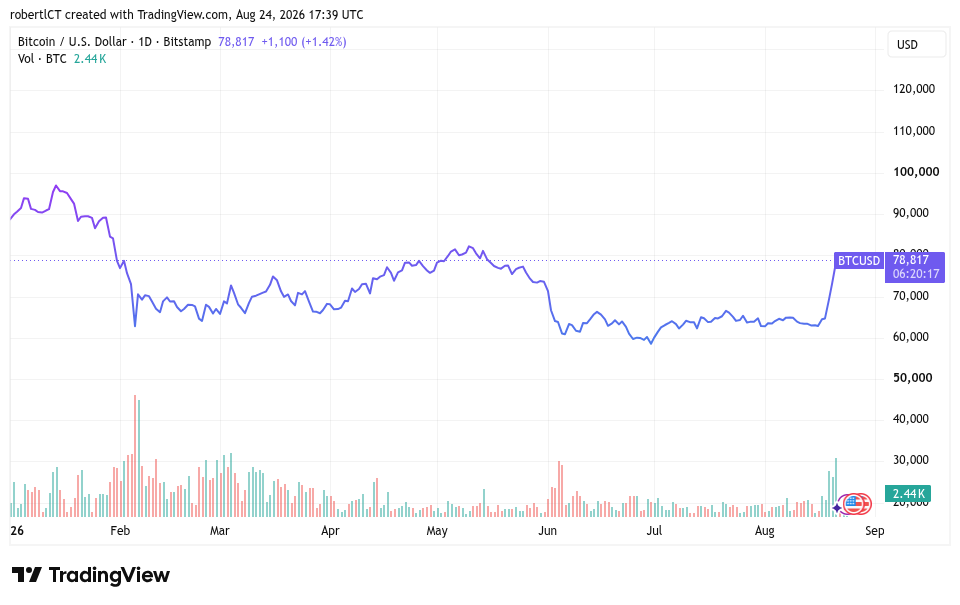
Bitcoin (BTC) passed $80,000 after Monday’s Wall Street open as bulls built on last week’s snap BTC price rally.
Key points:
- Bitcoin hits $80,000 for the first time since mid-May as bullish momentum gathered pace.
- BTC price analysis warns that the market still needs to sustain higher levels to challenge the bear-market thesis.
Bitcoin returns to $80,000 after 100-day hiatus
Data from TradingView showed BTC/USD passing the $80,000 for the first time since May 15, up another 3% on the day before pulling back following the European close.
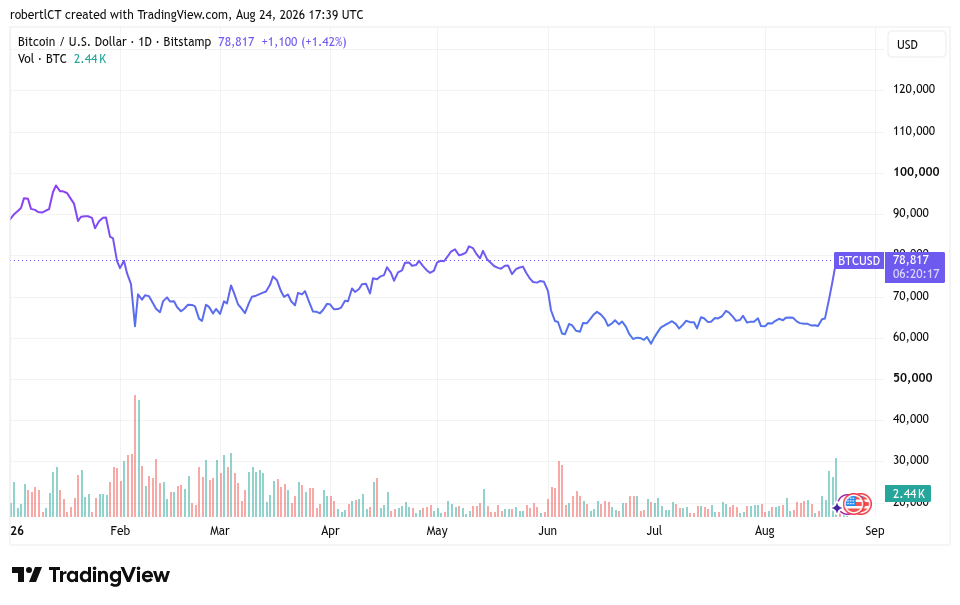
Source: TradingView
The move spurred an uptick in crypto short liquidations, with these passing $220 million over the 24 hours to the time of writing, per data from CoinGlass. A band of bid liquidity centered on $76,700, potentially offering support in the event of a downward BTC price reversal.
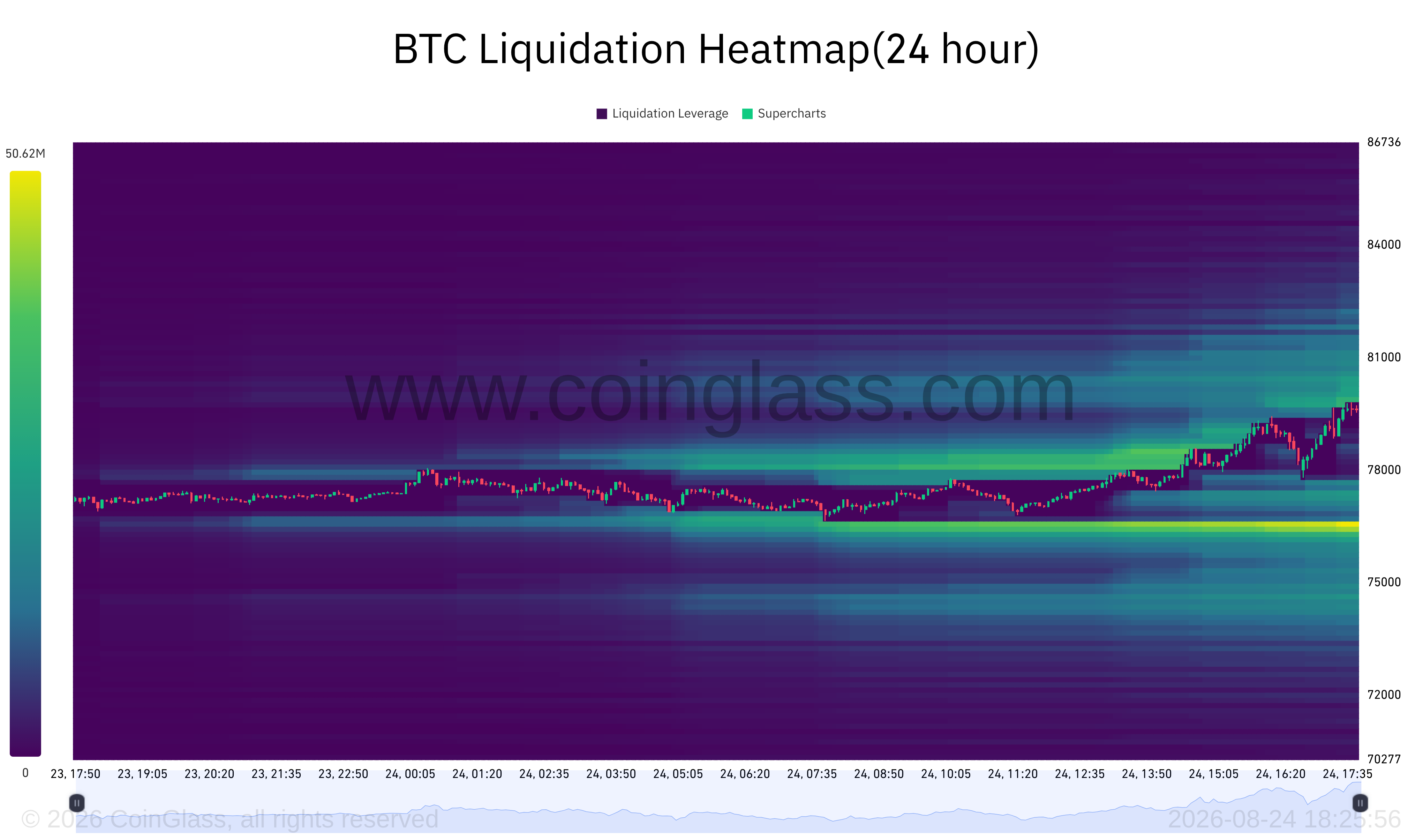
BTC liquidation heatmap. Source: CoinGlass
Analyst: BTC rebound must prove staying power
Bitcoin was up 25% month-to-date, seeing its best August performance since 2017 and increasingly diverging from bear-market norms. Earlier, Cointelegraph reported on concerns among some traders that bearish history could still repeat, with downside reemerging from September onward to spark a final capitulation to new macro lows.
Related: BTC price loses 200-week trend line as 2022 repeats: Five things to know in Bitcoin this week
“Bitcoin has Weekly Closed at the highs. Now starts the real test,” trader and analyst Rekt Capital wrote in his latest market commentary on X.
“If this is a Bear Market Relief Rally, then Bitcoin could pullback as early as this week, or at least over the next few weeks. Now it’s all about Bitcoin proving sustained strength.”
Rekt Capital had eyed the 50-week exponential moving average in particular, currently at $77,251, as price achieved its first weekly close above it since November 2025. During Bitcoin’s 2022 bear market, BTC/USD achieved two weekly closes above that trend line before dropping to cycle lows.
Magazine: Bitget CEO isn’t buying the Bitcoin rally — She’s waiting for $50K

Strive Asset Management has made its latest Bitcoin purchase, according to a filing with the U.S. Securities and Exchange Commission. The Nasdaq-listed company bought 1,110 BTC during the week of Aug. 17 through Aug. 21, spending about $81.5 million in total and bringing its Bitcoin treasury to 21,356 BTC.
The purchase price averaged $73,409 per Bitcoin, inclusive of fees and expenses, based on the company’s disclosures. As of the same period, Strive reported that its cash and cash equivalents increased by $17.1 million to $171.9 million, while its Class A shares outstanding rose by 3.65 million to 79.89 million.
Key takeaways
- Strive purchased 1,110 BTC for about $81.5 million between Aug. 17 and Aug. 21, per its SEC filing.
- The average all-in cost was $73,409 per Bitcoin, with Strive adding to a total holding of 21,356 BTC.
- Bitcoin was trading around $79,000 on Monday, roughly 8% above Strive’s reported average purchase price for the latest buys.
- Company data cited by BitcoinTreasuries.NET places Strive among the largest publicly traded corporate Bitcoin holders.
- Separately, Strive’s SATA preferred stock returned to its $99-to-$101 trading corridor after dipping earlier in June.
Another corporate Bitcoin buy—and what the pricing implies
In the SEC filing, Strive details how it executed the most recent tranche of Bitcoin purchases. The company’s average cost—$73,409 per BTC including fees and expenses—was below the approximate $79,000 level at which Bitcoin traded on Monday, according to the article’s market reference. That gap suggests Strive acquired the latest Bitcoin inventory at a discount relative to the spot price at the start of the following trading day, though investors will be watching how the treasury’s realized cost basis compares as new purchases continue.
The timing also matters for corporate-holding strategies that aim to maintain a consistent allocation rather than attempt precise market timing. Strive’s cash position, which rose to $171.9 million, indicates it had room to continue deploying capital into its treasury approach during the covered week. At the same time, growth in Class A shares outstanding to 79.89 million points to ongoing corporate balance sheet activity beyond the Bitcoin buy itself.
BitcoinTreasuries.NET data, cited alongside the filing, ranks Strive as the seventh-largest publicly traded corporate Bitcoin holder, positioning it behind Bullish and ahead of SpaceX. For traders, that kind of ranking can be more than trivia: it can influence investor perception around liquidity, follow-on demand, and how visible corporate BTC strategies are to the broader market.
Strive links the strategy to “scarcity” and share structure
Alongside the purchase news, Strive’s CEO Matt Cole framed the company’s broader thesis in terms of relative scarcity and how Strive’s share structure is intended to participate. In a post on X ahead of Monday’s market open, Cole said the “upside” is not only tied to Bitcoin moving higher, but to Bitcoin “becoming the fastest horse inside an expanding scarcity trade,” adding that $ASST is “structured to amplify” that outcome while remaining “responsibly” supported.
This is essentially an investor-facing explanation of why the treasury strategy is paired with the company’s capital structure. Investors should treat such statements as strategic framing—not performance guarantees—while monitoring how the firm actually funds purchases and how its market-linked products behave during BTC volatility.
Beyond Bitcoin: SATA preferred stock returns to its target range
While the Bitcoin purchase grabbed attention, Strive’s other major development was movement in its SATA preferred stock. The filing context notes that SATA closed at $100.01 on Friday, returning to a management targeted trading range of $99 to $101 after trading as low as $83.30 in late June.
According to the article, Strive previously narrowed SATA’s targeted corridor from $95–$105 to $99–$101 in March. Around that time, the company also stated it would not issue SATA through at-the-market or follow-on offerings below $100, a commitment that is designed to limit dilution at prices the company considers off-target.
SATA was launched in November 2025, initially selling 2 million shares at $80 each for $160 million in gross proceeds. The preferred stock is described as variable-rate and perpetual, with a stated amount and an initial liquidation preference of $100 per share—key features that differentiate it from Strive’s common equity.
Functionally, SATA is intended to operate as an income-focused instrument. The variable dividend rate is meant to encourage trading near $100, and the article notes Strive raised the annualized dividend rate to 13% in April. It also switched from monthly to daily dividend payments beginning June 16, referencing an SEC filing for the change in payment schedule.
How SATA compares to Strategy’s STRC
SATA is presented as similar to STRC, the variable-rate perpetual preferred stock issued by Strategy, which is widely regarded as the largest corporate Bitcoin holder. The article states STRC traded near $97 on Monday, below Strategy’s $100 target, while Strategy reported no Bitcoin purchases for the week ended Aug. 23.
For market participants, this comparison is useful because both SATA and STRC are designed to tie investor outcomes to corporate Bitcoin holdings while using dividend mechanics to influence preferred-share pricing. If Strategy is paused on new purchases while Strive is actively adding BTC, the relative behavior of their preferred instruments could become a proxy for how markets are weighing treasury accumulation versus dividend/rate adjustments.
However, investors should be careful not to assume one day’s price action directly reflects the treasury’s longer-term economics. Preferred stocks can respond to yield expectations, liquidity, and broader risk sentiment, and variable-rate structures can shift quickly as dividend calculations change.
Next, readers should watch whether Strive continues its steady cadence of Bitcoin purchases and how that activity filters into the market’s expectations for both ASST and its preferred share suite. The sustainability of SATA staying near the $100 corridor will also be important, especially if Bitcoin volatility increases or if Strive’s treasury strategy funds new buys alongside changes in dividends and share issuance.
Bitcoin has recovered above $79,000 after briefly falling toward $78,200 as President Donald Trump threatened 50% tariffs on Canadian vehicles, automotive parts and steel from Jan. 1, 2027.
Summary
- Trump said tariffs on several Canadian automotive and steel imports would rise to 50%.
- Bitcoin briefly fell toward $78,200 before recovering to about $79,300.
- U.S.-Canada trade negotiations ended without an agreement after three days of talks.
- U.S. spot Bitcoin ETFs drew about $1.92 billion during the latest five-session rally.
Trump tariffs target Canadian vehicles and steel
A Truth Social post published by Trump on Aug. 24 said the United States would raise tariffs on all Canadian cars, trucks, automotive parts and steel to 50% at the start of 2027.
“Build in the U.S. and there are ZERO TARIFFS,” Trump wrote before criticizing Canada’s approach to trade with the United States.
The announcement followed the collapse of negotiations between Washington and Ottawa on Aug. 21. According to Reuters, the proposed agreement would have reduced the main U.S. tariff on Canadian cars and light trucks from 25% to 15%. Duties on Canadian aluminum and steel would also have fallen from 50% to 25%.
Negotiators did not resolve several points, including whether tariff relief would cover medium- and heavy-duty trucks. With no agreement in place, Trump increased the pressure on Ottawa through his latest tariff threat.
Canada, for its part, plans to impose retaliatory tariffs on selected U.S. products from Sept. 8 in response to existing 50% U.S. duties on about $20 billion of Canadian goods. Prime Minister Mark Carney described the dispute as a trade war after the talks failed.
“You’re at war when you get attacked,” Carney said on Aug. 22.
Trump also claimed Canada conducts 95% of its business with the United States, although official trade figures cited by Reuters show Canada sends more than three-quarters of its goods exports to the U.S. and receives almost half of its goods imports from its southern neighbor.
U.S. goods and services trade with Canada totaled $872.3 billion in 2025, making the country one of America’s two largest trading partners. The high level of integration means parts can cross the border several times before a finished vehicle reaches a dealership.
Bitcoin price has recovered from its tariff-driven dip
Bitcoin initially moved lower after Trump published the tariff announcement, falling from above $79,000 to around $78,200. Buyers soon absorbed the decline, helping BTC return above the psychological $79,000 level.
At the time of writing, Bitcoin traded near $79,300, up more than 2% over the previous 24 hours. The cryptocurrency also came within roughly $500 of the $80,000 level after reaching an intraday high close to $79,900.
The limited reaction contrasts with Bitcoin’s behavior during earlier tariff disputes. In February, BTC lost the $65,000 support level as new U.S. global duties approached, while the total crypto market value fell as traders reduced exposure to risk assets. Earlier crypto.news coverage of that decline recorded a roughly 5% Bitcoin drop from a previous high of $66,465.
Monday’s price move has been smaller because Bitcoin entered the announcement with strong upward momentum. BTC climbed from about $62,679 on Aug. 17 to a three-month high near $79,500 on Aug. 21, adding almost 27% between the weekly low and high.
After pulling back toward $76,600 over the weekend, the asset resumed its advance on Aug. 24. The latest tariff news briefly interrupted that recovery but did not erase the day’s gain.
Treasury buybacks have supported Bitcoin’s rally
Behind Bitcoin’s recent advance, the U.S. Treasury has expanded its liquidity-support buybacks for longer-dated government securities. The department raised the maximum size of each operation from $2 billion to at least $4 billion for bonds in the 10-to-20-year and 20-to-30-year maturity ranges.
Scheduled to take effect on Sept. 9, the revised program will also increase the number of long-end operations from two to four per quarter through Nov. 4. No money has been deployed under the expanded schedule yet.
The announcement prompted a rapid repricing in the bond market. The 30-year Treasury yield fell from a 19-year high of about 5.34% to 5.19%, while the 10-year yield declined to around 4.65%.
As earlier buyback coverage detailed, Bitcoin jumped 8.2% from an intraday low near $64,100 to $69,500 in less than 12 hours after the Treasury disclosed the change. About $1.44 billion in short positions was liquidated across major crypto exchanges during the move, including $1.29 billion within one hour.
The buyback program does not amount to Federal Reserve quantitative easing. The Treasury purchases older and less liquid bonds using proceeds from newly issued debt, changing the composition of government liabilities without reducing the total federal debt stock.
Continued demand through regulated U.S. investment products has provided another source of buying. Spot Bitcoin exchange-traded funds attracted approximately $1.92 billion across five sessions during the latest rally.
On Aug. 20 alone, the funds recorded about $606 million in net inflows after drawing roughly $517 million during the previous session. BlackRock’s IBIT accounted for a large portion of the demand, while the combined assets held by U.S. spot Bitcoin ETFs rose above $90 billion.
Canadian tariffs carry risks for U.S. prices
For American consumers and investors, the proposed duties could affect vehicle prices and the earnings of automakers with supply chains spanning the U.S.-Canada border. Canadian plants supply engines, transmissions and other components to assembly facilities in the United States, while U.S.-made parts also move north for vehicle production.
Flavio Volpe, president of Canada’s Automotive Parts Manufacturers’ Association, told Reuters that U.S. assembly plants depend on specific Canadian components and could face production stoppages if the tariff threat disrupts their supply.
Auto industry executives also questioned whether the 50% rate would take effect as announced, noting that Trump has previously withdrawn or revised tariff threats during negotiations. More than four months remain before the planned Jan. 1 implementation date, leaving time for Washington and Ottawa to restart discussions.
Canada’s retaliatory measures are scheduled to begin sooner. Starting Sept. 8, Ottawa plans to apply duties to selected American products in response to tariffs already ordered by the Trump administration, while the White House has not released the detailed rules governing the proposed 2027 automotive levies.


Ethereum developer Eric Conner has proposed a common status interface for tokenized assets, as onchain stocks trade continuously while the New York Stock Exchange opens for only 32.5 hours each week.
Summary
- ERC-8392 would let contracts check market sessions, trading halts, valuation status and redemption availability.
- The interface separates expected stale prices during closures from delayed or failed valuation updates.
- Conner initially called the proposal ERC-8391, but the published discussion and draft use ERC-8392.
- The proposal supplies status information without deciding whether an asset is safe to trade or use as collateral.
ERC-8392 separates market closures from feed failures
EthHub founder Eric Conner introduced the proposal in an Aug. 24 X post, describing it as an asset status interface for tokenized stocks and real-world assets.
Conner referred to the proposal as ERC-8391 in the post. However, the subsequent Ethereum Magicians discussion and associated draft identify it as ERC-8392, titled “Asset Status Interface for Tokenized Assets.”
The proposal addresses a mismatch between continuous blockchain activity and the limited operating hours of traditional markets. Tokenized stocks can move between wallets or trade through smart contracts at any hour, while their reference shares may not be trading on an exchange.
During a weekend, for example, the latest available stock price may be several hours old because the market is closed. A similar onchain price could also result from an oracle failure, a trading halt, or a corporate event that occurred while the exchange was shut.
Although the price data may look identical in each case, Conner said smart contracts should respond differently. A lending protocol might tolerate an old price during a scheduled closure but suspend liquidations when a data provider has failed.
“Both produce identical bytes onchain. The correct response is opposite,” Conner wrote.
Price feeds alone also cannot show whether the reference stock is under a price restriction, whether the issuer has paused a token program, or whether holders can currently redeem their tokens. ERC-8392 proposes separate queries for each form of operational information.
Tokenized stocks would expose four status categories
At the center of the draft is IAssetStatus, a required interface covering the token program’s lifecycle and operational condition. Three optional extensions would supply information about the reference market, valuation feed, and primary issuance or redemption process.
The market-status extension would identify whether the reference venue is in regular trading, an extended session, an auction, or a closed period. A separate field would report interruptions such as an asset-level halt, venue-wide halt, or price constraint.
For assets tied to listed shares, the proposal also includes a market identifier based on the ISO 10383 Market Identifier Code. Integrators could use the code to compare a reported status with a public exchange calendar.
A valuation-status query would separate an expected lack of updates from a genuine delay. During a normal weekend closure, the interface could report that no new price is due. If an oracle misses an update during an active session, the same interface could show that the valuation has become delayed or unavailable.
Issuance and redemption receive a separate status because a valid market price does not guarantee that investors can create or redeem the token. Funds may operate with net asset value cutoffs, while issuers can set defined subscription periods or temporarily stop redemptions.
Each status category includes an UNKNOWN value. According to the draft, making unknown the default prevents empty storage in a newly deployed or upgraded contract from being interpreted as a healthy operating state.
The proposed views would not depend on the caller and would not revert. Conner also excluded required events because scheduled market sessions can change with the clock even when no blockchain transaction occurs.
ERC-8392 provides information rather than a safety verdict
ERC-8392 does not instruct applications to buy, sell, liquidate, or freeze an asset. Instead, the interface standardizes the questions that a contract can ask, leaving each application to set its own response.
A lending market could reduce loan-to-value limits when a reference exchange closes, while another protocol might continue operating if it has enough liquidity and other pricing sources. Wallets could present a warning when a valuation is delayed or redemption is unavailable.
Conner said the status information would remain advisory because the interface cannot guarantee that an issuer or oracle has supplied correct data. Oracles could report the relevant conditions, and token contracts would return the status through a common format.
Existing products currently use different methods. According to the proposal, Ondo provides an offchain status interface, Robinhood Chain tokens use a proprietary oraclePaused() query, and several other assets expose only a general paused() function. Lending markets must therefore build separate handling rules for each listing.
ERC-8392 has been designed to work alongside other token standards. The draft leaves stock splits to ERC-8056 and transfer restrictions to ERC-7943 or ERC-3643. Merger and spinoff economics are also outside its scope, although their operational effects could appear through a halt or other status update.
Early feedback on Ethereum Magicians has raised questions about historical data and settlement. One respondent working from a lending perspective said status events could help protocols measure how often an asset was halted or its valuation was delayed. The respondent also proposed a status digest that applications could verify at settlement if conditions changed after an earlier check.
Conner has requested feedback from issuers, lending-market teams, and market-structure specialists. The draft has been reviewed on paper against conditions including Hong Kong lunch breaks, German exchange interruptions, London auctions, Gulf trading weeks and price limits in mainland China, but it has not reached final status.
Tokenized stock growth raises the need for common controls
The proposal has arrived as tokenized equity activity expands across several blockchain networks. As crypto.news reported on Aug. 21, combined tokenized-stock trading through Uniswap on Robinhood Chain reached $1 billion.
Robinhood launched 95 Stock Tokens for eligible customers in more than 120 countries, with instruments tracking companies such as Nvidia, Apple, and Alphabet. The products remain unavailable in the United States, and Robinhood describes them as debt securities that track referenced shares rather than direct ownership of the underlying stock.
Separate Token Terminal figures cited in an Aug. 15 report placed the tokenized stock market at about $2.7 billion, up from roughly $80 million one year earlier. Ondo held the largest issuer position, while Binance’s bStocks and Kraken-backed xStocks each accounted for more than $600 million.
Continuous trading can expose investors and lending systems to prices set while the underlying U.S. exchanges are closed. Under Conner’s proposal, applications could check whether an equity reference market is open before accepting a token as collateral, processing a liquidation, or displaying a valuation.
For U.S. investors, a technical status interface would not change the legal treatment of a tokenized security. The Securities and Exchange Commission says issuer-sponsored, custodial, and synthetic tokenized securities can carry different ownership rights, while tokenized securities remain subject to federal securities laws.
Legal ownership may also depend on records maintained outside the token contract. An Aug. 20 report found that an Injective affiliate had secured SEC transfer agent registration, allowing it to maintain securities ownership records, process ownership changes and support distributions and corporate actions.
The ERC-8392 draft remains open for technical review, and Conner said a reference implementation with a Foundry test suite is still being prepared for the proposal.


Stand With Crypto, a member group that rates the crypto friendliness of politicians, is supporting 32 U.S. House incumbents, with more endorsements coming.

Warren Buffett doesn’t just own and love Coca-Cola stock. It’s widely reported that Coca-Cola (and Cherry Coke) is his favorite beverage as well. Coca-Cola (KO), one of Buffett’s and Berkshire Hathaway’s (BRKB) top equity portfolio holdings, hit a new high on Monday, trading within a buy zone. Coca-Cola Stock Hits A Buy Point And A High Shares of Coca-Cola popped…
Copyright ©2026 Investor’s Business Daily, LLC. All rights reserved. 87990cbe856818d5eddac44c7b1cdeb8
Crypto World
The Group Behind the GTA VI Leaks Has a Meme Coin, Millions in Value, and a Secret Agenda

A meme coin tied to the GTA VI leak saga is having an absolutely wild run. CYBERLEEK, a Solana-based meme coin promoted by the person or group behind the alleged leaks, has jumped another 35% in the past 24 hours.
That comes after an almost unbelievable 40,000% surge over the past week. The token is now trading around $0.028, as fresh GTA VI gameplay footage continues to appear alongside its promotion.
CYBERLEEK, however, asserted that there is more to the token than a quick crypto gamble. They claim it is connected to a “secret project” and that the money raised will go toward building infrastructure and security for the project.
GTA VI Leaks
International Cyber Digest reported that CyberLeek has burned almost $1.5 million worth of developer tokens to argue that the meme coin isn’t a pump-and-dump scheme. The group has collected around $40,000-$70,000 or more in transaction fees. It also reportedly sought a 400 Monero “donation,” worth roughly $165,000 at the time, to initiate contact for potential advertising deals.
CyberLeek began posting GTA VI gameplay footage last week, which included details about the game’s map and free-roam gameplay, and was later removed from X following a copyright strike from Rockstar Games. The group said the token was created to raise funds for a “secret project” that cannot yet be disclosed because revealing it would give large corporations time to prepare defenses.
It denied that the project is a cash grab and added that the funding is intended for infrastructure and protection against corporate counterattacks.
CyberLeek’s posts briefly pushed the token’s market capitalization to over $20 million on Monday. According to the now-blocked website, the group had asserted that its actions were driven by objections to anti-consumer practices in the gaming industry, including digital pre-orders, paid single-player content, and limited long-term offline access. But the use of leaked footage to promote its own meme coin has raised serious questions.
Take-Two Hunts the Leakers
The leaks have continued despite Take-Two Interactive seeking information from Microsoft and Discord that could help identify those behind them. On August 22, two more videos were released, one showing supercar gameplay and an armed robbery, while the other featured a strip club scene.
Take-Two said in its court filings that GTA VI material, including audiovisual content, artwork, images and dialogue, had been posted through Microsoft’s GitHub platform and Discord. Microsoft said it was working with Take-Two and Rockstar to protect their creative work and intellectual property. Discord, meanwhile, said it reviews and complies with valid DMCA subpoenas. Rockstar has not publicly confirmed whether the leaked footage is authentic.
The post The Group Behind the GTA VI Leaks Has a Meme Coin, Millions in Value, and a Secret Agenda appeared first on CryptoPotato.

Oil prices and oil stocks slid Monday after Treasury Secretary Scott Bessent vowed to unleash “Economic D-Day” on Iran. The “financial offensive” could hit Americans, too. Gas prices stand to rise if the Trump administration’s economic warfare puts additional strain on global energy supplies. Bessent is due to explain the administration’s plan to “sever” Iran’s “every economic lifeline” at 1…
Copyright ©2026 Investor’s Business Daily, LLC. All rights reserved. 87990cbe856818d5eddac44c7b1cdeb8

Two major crypto advocacy groups, the Crypto Council for Innovation (CCI) and the Blockchain Association (BA), have filed a lawsuit challenging Illinois’ new 0.2% tax on cryptocurrency transactions. The measure is expected to take effect in January 2027 and is designed to tax crypto users based on transaction volume rather than income.
The legal challenge, filed Friday in Illinois’ Circuit Court for the Seventh Judicial Circuit in Sangamon County, argues the tax violates multiple constitutional and statutory protections, including provisions related to due process and interstate commerce.
Key takeaways
- CCI and BA filed suit in Sangamon County against Illinois officials over the state’s 0.2% digital asset “privilege tax.”
- The groups say the law is constitutionally problematic, including arguments that it is unconstitutionally vague and risks duplicative taxation.
- Illinois enacted the tax in June as part of its fiscal year 2027 budget, with enforcement anticipated to begin in January 2027.
- The lawsuit follows earlier litigation by another industry group, the Digital Chamber, which raised similar discrimination concerns.
- Illinois’ crypto-related push has also intersected with high-profile prediction market litigation and policy actions earlier this year.
Illinois’ transaction-volume tax faces constitutional challenges
According to the lawsuit filed by CCI and BA, Illinois’ digital asset tax was enacted by Gov. JB Pritzker in June as part of the state’s fiscal year 2027 budget. The measure was signed as a “privilege tax,” and—critically—its structure is intended to apply to transaction volume rather than income.
In the complaint, the groups allege the tax is unconstitutional under the U.S. Constitution and the Illinois state constitution, and they also invoke claims tied to federal and state due process requirements. They further argue that the tax conflicts with the federal Internet Tax Freedom Act.
On the due process question, CCI and BA contend the law is “unconstitutionally vague,” focusing on how residents and brokers would be expected to determine which digital assets fall under the tax—and how those assets should be treated for reporting and compliance—while facing “serious civil and criminal penalties” for mistakes.
The lawsuit’s constitutional argument also highlights what the groups describe as the potential for duplicative taxation. Their Commerce Clause theory rests on the claim that the tax “creat[es] the specter of duplicative taxation,” particularly in the context of a digital asset economy that relies heavily on cross-border activity.
Why the “vagueness” and compliance pressure matters
Beyond the headline rate, the lawsuit underscores a practical compliance concern: if rules are unclear, businesses and individuals can be left guessing. CCI and BA argue the Illinois law shifts that burden onto residents and intermediaries under the threat of substantial penalties.
That claim matters for traders, platforms, and service providers because transaction-volume taxes can require robust tracking, classification, and reporting. If tax categories or the mechanics of how assets should be treated are ambiguous, the compliance workload—and the risk of enforcement—can rise quickly, even before the first tax period begins in January 2027.
At the same time, the groups’ Commerce Clause argument signals a broader investor and operator concern: state-level taxation of digital commerce can become fragmented when each jurisdiction applies its own standards to the same underlying economic activity.
Summer Mersinger, CEO of BA and a former U.S. Commodity Futures Trading Commission commissioner, said in connection with the lawsuit that while states may have a role in fostering innovation, their authority has constitutional limits. She argued Illinois cannot impose a tax regime that discriminates against digital commerce, creates uncertainty for consumers and businesses, and threatens to fragment a “rapidly growing national market.”
Illinois crypto tax opposition builds on earlier lawsuits
CCI and BA’s filing did not arrive in a vacuum. The complaint follows a July lawsuit from the Digital Chamber that challenged the Illinois tax on the grounds that it “discriminates against people who transact in digital assets.” Taken together, the cases highlight how industry groups are framing the Illinois tax as both a constitutional and policy issue—rather than merely a technical revenue measure.
Cointelegraph previously reported on the Digital Chamber’s suit, which the new CCI/BA action closely parallels in its focus on discriminatory effects. The two initiatives also reflect the increasing influence of digital asset industry organizations during an election year, when state-level policy changes can influence voter perceptions and broader regulatory direction.
For Illinois residents and crypto participants, the timeline is important: the state approved the tax in June, but enforcement is slated to begin in January 2027. That lag means legal outcomes could shape whether the tax ultimately takes effect as written, gets narrowed, or is delayed further.
Illinois also faces prediction-market fights and related policy steps
Illinois’ crypto and crypto-adjacent policy agenda has faced additional scrutiny beyond taxation. Earlier this year, prediction market platform Kalshi sued Illinois officials over a law that took effect on July 1. According to Kalshi, the legislation “expressly bans sports event contracts” and requires state licensing in a way that the company argues violates federal law.
Separately, Cointelegraph reported that Pritzker signed an executive order in April banning state employees from betting on prediction markets. The stated goal was to “prevent insider trading” amid the growth of online prediction markets and event-based gambling contracts.
While Kalshi’s case concerns prediction markets rather than the 0.2% crypto tax directly, it signals a larger theme: Illinois appears to be actively reshaping how parts of the digital economy intersect with traditional state regulation—whether through taxation, licensing rules, or employment restrictions designed to address perceived conflicts.
For crypto market participants, these parallel legal and policy threads raise the stakes around compliance expectations and the scope of state authority. Even if the tax case proceeds independently from prediction-market litigation, the combined environment can affect sentiment, operational planning, and how platforms assess regulatory risk in Illinois.
As the CCI and BA case moves through Illinois courts, investors and builders should watch how the court addresses the lawsuit’s constitutional theories—particularly the due process and Commerce Clause arguments. The outcome could clarify what states may require for digital asset taxation, and whether Illinois’ transaction-volume approach can survive legal scrutiny before January 2027.

Bitcoin price analysis today shows the asset is trading at $77,552.01, up a modest 0.19% over the past 24 hours, as the market digests one of its sharpest weekly moves in months. That flatline masks a much bigger story underneath: a rally that’s added over +22% in seven days and left traders arguing over whether the next leg is $89,000 or a sharp retrace back toward $65K.
The move traces back to more than $2.7Bn in bearish bets getting liquidated across crypto markets this week, with over $1Bn in BTC shorts wiped out in roughly an hour as price punched through $69,500.
Reuters tied the surge to Treasury support for long-duration bond buybacks alongside President Trump’s push for the Clarity Act, a regulatory signal that’s clearly repricing risk appetite for digital assets. CNBC had BTC near $71,880 just days ago; the gap between that print and current levels tells you how fast sentiment flipped.
With shorts flushed and legislative tailwinds still fresh, the question now is whether Bitcoin can convert this vertical move into a stable base or is overextended and due for mean reversion.
Bitcoin Price Analysis: Can BTC Hit $89,000 This Week?
Something like this from here would make for an incredibly clean $BTC bottom – while also destroying both the bulls and bears in the process. — Jelle (@CryptoJelleNL) August 24, 2026
You won't get your sub-60k buys back, but you also won't see $100k anytime soon.
All while BTC would just be forming a fat iH&S. pic.twitter.com/eGbsY9qcRu
BTC is consolidating inside a mildly downward-sloping one-hour regression channel after rallying from below $70,000 to a recent high of $79,500. The structure looks like a textbook bull flag: the prior surge as the flagpole, the current pullback as the flag, though nothing’s confirmed until price acts.

Support sits near $75,000–$76,000, with a deeper floor at $74,000–$74,100 if momentum fades. Resistance clusters at $77,800–$80,000, then $82,000–$85,000. CoinStats data flags $78,000 as the immediate ceiling.
Bull case: a decisive one-hour close above the channel’s upper boundary, backed by real volume, opens the $89,000 target.
Base case: BTC grinds sideways in the high-$70Ks while the market decides.
Bear case: failure to reclaim $79,500 traps price in the channel, with a break lower exposing $74,000 and potentially the $65,000–$67,000 range flagged in forecasts from early August.
Trade Ethereum on Bybit and Get a Chance to Win Our $1,000 USDT Airdrop
Bitcoin Hyper Targets Early Mover Upside as Bitcoin Tests Key Levels
A +24% weekly gain validates anyone who bought the dip below $70K. But buying BTC now, chasing a move that’s already run this far, means underwriting a much smaller reward-to-risk ratio than the traders who got in last week.
At Bitcoin’s current market cap, doubling it from here would require trillions in fresh capital. That math is exactly why attention keeps returning to earlier-stage infrastructure plays built atop Bitcoin’s network.
Bitcoin Hyper (HYPER) is positioning itself as the first Bitcoin Layer 2 with full SVM integration, smart contracts that run faster than Solana, and layered atop Bitcoin’s base security.
The presale has raised $33,069,078.13 at a token price of $0.0136851, with staking rewards available to early holders. Its Decentralized Canonical Bridge aims to solve BTC’s biggest structural gaps: slow settlement, high fees, and zero programmability.
Gain Access to New Bitcoin Layer 2 Early Here
Have Your Say and Claim Your $25 on Kalshi
The post Bitcoin Price Analysis: Can BTC Clear $80K This Week? appeared first on Cryptonews.

Grape Tree opens new store at Market Cross in Selby

Morrisons launches ‘unbeatable prices’ pledge in bid for market share

Bitcoin Price Returns To $80,000 For First Time In 100 Days

Weekend Open Thread – Corporette.com

Weekend Open Thread: Brooks Brothers

London Mayor Sadiq Khan handed a peerage by Keir Starmer alongside 15 other Labour figures… just days before the PM leaves No10

Many Muslims are confused about this #cryptocurrency #ahmedfozanpodcast

May King Jesus release all of your financial breakthrough so that you are no longer struggling.

BITCOIN AND XRP WONT STOP PUMPING #bitcoin #xrp #memecoin #memes
-

 Fashion3 days ago
Weekend Open Thread: Madewell – Corporette.com
-

 Business6 days ago
SMA Solar Technology AG (SMTGY) Q2 2026 Earnings Call Transcript
-

 Crypto World3 days ago
anatomy of crypto’s biggest liquidation event since 2021
-

 Business2 days ago
Musk’s Tesla, SpaceX Confirm $16.8 Billion ‘Terafab’ Chip Plant as World’s Largest Building in Texas
-

 Tech7 days ago
Qwen3.8-27B runs frontier-class coding agents and reasoning locally, no cloud API required
-

 Crypto World7 days ago
OCC Greenlights Trump Family Crypto Firm for Trust Charter
-

 Politics2 days ago
6 months on, Irish renters crushed by effects of government housing bill
-
 NewsBeat2 days ago
The ‘Lucky Dip Gang’ causing carnage for clicks: After five thugs were killed speeding in the wrong direction on a motorway, GUY ADAMS investigates a sick new trend… and why police aren’t even allowed to pursue them
-

 Crypto World7 days ago
NAVI Prime launches institutional lending framework on Sui
-

 Tech5 days ago
GLM-5.3 hits the API at $1.4/$4.4 per million tokens
-

 News Videos5 days ago
Don’t Leave Your Financial Future To Chance | August 19, 2026
-
Tech7 days ago
5 Of The Most Reliable Car Brands To Consider If You’re Buying A Used SUV
-
 Crypto World7 days ago
Dow’s 3-Year Winning Run Isn’t a Crash Signal, Still 49% Odds of Double-Digit Gains
-

 Tech7 days ago
Keychron K8 Ultra 8K review: a great value keyboard with comfort issues
-
 Tech7 days ago
Nvidia discloses $21B stake in SpaceX
-

 Business6 days ago
Stock Market Today: Tech Futures Slide As Treasury Yields Jump; Nvidia, Micron, Sandisk Sell Off
-

 Business5 days ago
Marvell Shares Jump 7% as Google Chip Deal Confirms Custom AI Silicon Partnership, Analysts
-

 Business4 days ago
Five Below: Kids Discount Retailer Reaps Rich Rewards
-

 Business1 day ago
Mystery AI Model ‘Ox Alpha’ Draws Developers With Free Access as Chinese Lab Origins Remain Debated
-
Business7 days ago
Fabrinet (FN) Q4 2026 Earnings Call Transcript
You must be logged in to post a comment Login