
Crypto World
Breaking Down the Ending of Spooky in Love



Extraordinary Attorney Woo’s Park Eun-bin and Doona!’s Yang Se-jong star as ghost-whispering hotel heiress Cheon Yeo-ri and ace prosecutor Ma Gang-uk, respectively, in the supernatural romance series Spooky in Love. In the Korean drama, which broadcast domestically on tvN and was distributed globally by Netflix, Yeo-ri and Gang-uk are initially brought together by their shared desire for justice. For Yeo-ri, this takes the form of helping the ghosts she alone can see. For Gang-uk, it means doing a good, by-the-book job as an investigator. But when Gang-uk learns Yeo-ri’s secret, the two grow closer.
While Spooky in Love starts out with a strong, ghost-of-the-week format, the second half of the drama leans more into corporate in-fighting and family drama as context for Yeo-ri and Gang-uk’s romance. When Chairwoman Baek insists that Yeo-ri get engaged in order to secure a more stable future for the hotel and resort company, Yeo-ri side-steps the advances of family friend and fellow chaebol Kang Min-hwan (Ong Seong-wu) to announce she is engaged to Gang-uk. What starts as a fake relationship to keep Yeo-ri’s grandmother off of her back soon develops into the real thing. But can Yeo-ri and Gang-uk’s love survive Min-hwan’s machinations to take control of both Yeo-ri and her company? Here’s everything that happens in the Spooky in Love finale.
Yeo-ri’s supernatural powers, explained

Yeo-ri wasn’t born with the ability to see ghosts. She developed it 12 years prior to the start of the series, when she nearly died in the mysterious yacht accident that killed her boyfriend and Min-hwan’s little brother, Kang Ji-hwan (Kim Min-chul). The condition has ghosts constantly nagging Yeo-ri for help, and also keeps her isolated from the land of the living. If she touches hands with someone else, they will temporarily gain the ability to see ghosts for a month. As a result, she wears gloves constantly, and keeps a physical distance from her friends, family, and co-workers.
The stakes of Yeo-ri’s secret are intensified due to the power her family holds. Yeo-ri is the heir to the Reina Group, a corporate hotel chain that wields immense wealth. Yeo-ri’s grandmother, Baek Kyung-ja (Ye Soo-jung), plans to pass the baton to Yeo-ri—rather than step-daughter Ok Gye-hui (Baek Ji-won) or her adult children, Ha-ri (Cho Hye-joo) and Don-jun (Lee Dal). However, if Chairwoman Baek, or the larger public, finds out that Yeo-ri is haunted by ghosts, it could call her ability to run the family corporation into question.
Still, Yeo-ri’s sense of justice runs deep. In Spooky in Love’s early episodes, Yeo-ri is visited by the ghost of Jang Eun-ju (Yoon Hye-rim), a young woman who was murdered by her boyfriend, Park Seung-jae (Kim Do-wan), after she becomes pregnant with their child. Seung-jae is well-connected. Not only is he a rich pro golfer, but his father is one of the leading contenders in the next presidential race. When he is initially tried for murder, with Gang-uk acting as prosecutor, he is acquitted due to his father’s immense influence. It is only when Gang-uk and Yeo-ri team up that they are able to gather more evidence, and definitively pin the murder on Seung-jae.
What happened on the yacht?
Yeo-ri grew up close to Kang Ji-hwan and Kang Min-hwan, brothers poised to inherit ownership of CL Raymond Group. Though both brothers had feelings for Yeo-ri, Ji-hwan was the first to ask her out. For Min-hwan, this intensified the jealousy he had long felt of his little brother. Jin-hwan, who looked up to his brother, didn’t realize that he was often treated better by some members of the family compared to Min-hwan, who was adopted. When Jin-hwan started dating Yeo-ri, it was the final straw for Min-hwan.
On the day of the accident, the brothers are out on a yacht with their friends, including Yeo-ri and fellow rich kid Park Seung-jae. We learn in the penultimate episode that when the yacht hit a rock and Jin-hwan was thrown over the side, Min-hwan had the chance to pull his brother back onboard, but let the pleading Jin-hwan fall into the water below instead. Jin-hwan dies, and Yeo-ri, who also went overboard in the accident, is rescued from the water. She is wearing a protective pendant gifted to Jin-hwan by his grandmother. He asked her to wear it while they were on the boat, joking that, if something should happen, she should live and he will die.
Later, Yeo-ri and Gang-uk seek out the shaman who made the pendant. The original maker is dead, but her daughter informs them that the power of the pendant changed Yeo-ri and Jin-hwan’s fates. That power, paired with Yeo-ri’s inability to let Jin-hwan move on in the immediate aftermath of the accident, led to Yeo-ri’s ability to see ghosts. The shaman tells Gang-uk and Yeo-ri that, in order for Yeo-ri to stop seeing ghosts, she owes the afterlife a life.
Gang-uk’s connection to Jin-hwan
Gang-uk, who was raised by his grandmother, did not grow up in the same social circles as Yeo-ri, Min-hwan, and the other members of the chaebol class. However, he shares a unique connection to Jin-hwan. When Jin-hwan died, a sick Gang-uk was given Jin-hwan’s heart. The transplant allowed him to live on. Ever since, Jin-hwan and Min-hwan’s mother, Song Hee-won (Kim Seo-ra) has kept tabs on Gang-uk through his grandmother. Though she lost one of her sons, it makes her happy to see Gang-uk doing well.
Min-hwan’s crimes escalate

This truth of Jin-hwan’s death is known only by Min-hwan for more than a decade. Yeo-ri doesn’t remember what happened during the accident and, even if she did, she didn’t witness what occurred between the brothers that day. However, when Seung-jae temporarily gets out of jail to attend his father’s funeral, he happens to stumble upon a camcorder memory card with footage of Min-hwan choosing not to save Jin-hwan. Seung-jae attempts to blackmail Min-hwan with the evidence. When the two meet up in an abandoned warehouse, Min-hwan kills him for it.
Gang-uk finds Min-hwan’s cufflink at the scene of the crime, but Min-hwan counters. He hires someone to hit Gang-uk with a truck. Yeo-ri pushes the man she loves out of the way at the last second, saving his life and putting her own in grave danger. She is hit by the truck, and ends up in a coma. As Yeo-ri’s life hangs in the balance, we see her traverse a beautiful kind of purgatory. The ghosts she has helped in the past 12 years, including Eun-ju, are waiting for her there. They lend her some of their warmth to keep her from crossing to the other side.
Yeo-ri and Jin-hwan balance the scales
Still, Yeo-ri finally does make it to a Styx-like river, a boundary between the world of the living and the world of the dead. Before she can step onto the boat that would bring her across, the ghost of Jin-hwan appears to take her place. The two share a teary conversation in which they process Jin-hwan’s death. Yeo-ri apologizes for living instead of him, but Jin-hwan doesn’t see it that way. He says she still has so much to live for, and that the ghosts she has helped are rooting for her. When Yeo-ri wakes back up, she no longer has the power to see ghosts. Jin-hwan has crossed to the other side; the afterlife has been given the soul it was robbed of 12 years prior.
Min-hwan is brought to justice
Unbeknownst to Min-hwan, Seung-jae has hidden the memory card in a hollow golf ball at the warehouse. When Yeo-ri and Gang-uk are investigating, they find the card and have the evidence to take Min-hwan down. In the most dramatic way possible, Yeo-ri reveals the evidence to Min-hwan’s mother and the other people gathered at Jin-hwan’s memorial service. More than losing his power or going to jail, Min-hwan seems most distraught at the idea of his mother discovering his betrayal. A year later, when she visits her remorseful son in jail, she tells him that after he has finished serving his time, she will be waiting for him. Min-hwan, who always thought his mother’s love for her biological son diminished her love for her adopted son, can perhaps finally see otherwise.
Does Spooky in Love have a happy ending?
Spooky in Love has the happiest of endings. A year following the main events of the series finale, Yeo-ri is announced as the new chairwoman of Reina. Yeo-ri and Gang-uk are happily together. Gang-uk, who had been transferred out of Seoul after reporting internal corruption at the prosecutor’s office, has just received a promotion back in the capital city where Yeo-ri lives. The two visit Siena Hall, the Reina wedding property that symbolizes Yeo-ri’s late parents’ love for one another, and walk together, hand in hand.
When the two first started falling for one another, Yeo-ri had said that her greatest wish was to walk hand-in-hand with the person she liked. Then, she was too afraid to touch anyone, burdened by the certainty she would pass her curse onto them. Now, she does so, unafraid. The simple scene doesn’t just demonstrate the love between Yeo-ri and Gang-uk; it demonstrates the intimacy and warmth Yeo-ri is able to let into her life more broadly. She is no longer alone, and Gang-uk is only one part of that reality.

Trump last week threatened that the U.S. would target Oman next if it cooperated with Iran on this matter, telling Fox News: “We’ll bomb the s— out of them.” Experts have said, however, that this is an idle threat and that bombing Oman would be a mistake.
Continuing to enforce its blockade on the Strait does, however, come at a cost to Iran. A June analysis from the Foundation for Defense of Democracies estimated that Iran may be incurring economic damages of about $435 million per day while enforcing it.
How is the plummeting value of the rial affecting Iranians?
Ryan Costello, the policy director at the National Iranian American Council, tells TIME that implementing additional sanctions may not achieve the desired result—but will likely hurt Iranians.
“Regrettably, it has had very harsh impacts on ordinary Iranians—pushing millions out of the middle class, which is often seen as an engine for successful democratic change over time,” Costello says. “This currency depreciation has a real cost for ordinary Iranians, making their life ever more unaffordable.”
Coinbase has brought four 1:1-backed U.S. stock products to Base, allowing eligible non-U.S. investors to trade Apple, NVIDIA, Meta and Alphabet exposure around the clock.
Summary
- Four Coinbase tokenized stocks have launched on Base under the network’s B20 standard.
- Each token represents a beneficial interest in a real share held in segregated regulated custody.
- Eligible holders can trade the tokens or use supported products in Base-based lending and DeFi protocols.
- The securities remain unavailable to U.S. persons and have not been registered under the U.S. Securities Act.
Base said in an Aug. 25 announcement that Coinbase Tokenized Stocks are now available natively on the Ethereum layer-2 network, moving a product previously offered by the exchange into an open onchain environment.
The initial list includes NVIDIA under the ticker NVDAc, Meta as METAc, Apple as AAPLc, and Alphabet as GOOGLc. Base published a separate prospectus and contract address for each asset, asking users to verify the address before buying because tokens outside the official list were not issued by Coinbase.
Coinbase tokenized stocks use beneficial ownership structure
Under the product’s legal structure, each B20 token represents a beneficial interest in an underlying share rather than a synthetic contract that only follows its market price.
Coinbase Onchain SPV Ltd., a Coinbase-controlled company incorporated in the Abu Dhabi Global Market, formally issues the securities. According to the NVIDIA prospectus, the Financial Services Regulatory Authority approved the document on Aug. 4 under ADGM rules.
For every token issued, the special-purpose company initially holds one corresponding share through a segregated custody account. The prospectus identifies Alpaca Securities, an SEC-registered broker-dealer and FINRA and SIPC member, as the broker and custodian responsible for buying, selling, and holding the underlying equities.
Deposited shares are held in trust for tokenholders, according to the filing. Subject to the validity of the trust arrangements under ADGM law, the assets would not form part of the issuer’s property if the special-purpose company entered bankruptcy or insolvency.
Base describes the tokens as beneficial claims that provide direct economic exposure to the listed companies. Although Coinbase has promoted the structure as “real 1:1 backed tokenized stocks,” the prospectus draws a distinction between beneficial exposure and direct registration as the legal owner of each underlying share.
Holders also do not receive automatic voting rights in the underlying company. The filing states that verified, or “vested,” holders may send voting instructions to the issuer, which may try to vote the custodied shares on their behalf, subject to applicable law, timing, and practical limits.
In July, crypto.news reported Base’s preparations after network founder Jesse Pollak acknowledged that Robinhood had moved first by placing stock-linked products in an Ethereum-compatible setting.
“We’ve been behind on this on Base and I’m frustrated that’s the case,” Pollak said at the time, adding that the companies were close to introducing 1:1-backed equities.
B20 brings tokenized stocks into Base DeFi
Once issued as B20 tokens, the stock products can sit in self-custodial wallets and interact with supported decentralized applications. Base lists Aerodrome for tokenized-stock liquidity, while Aave, Morpho, and Euler provide or plan lending and borrowing functions.
Other listed integrations include 0x, 1inch, KyberSwap, and CoW Swap for token exchanges. Chainlink supplies price data infrastructure, while LI.FI and Jumper support services connected with cross-chain transfers and swaps.
Such integrations allow one token to move through several applications. For example, an eligible holder may trade a stock token through a decentralized exchange and later use it as collateral within a supported lending market, depending on the rules and availability of each protocol.
Trading can continue outside regular U.S. exchange hours, including weekends and American market holidays. Traditional shares listed on Nasdaq or the New York Stock Exchange still trade within their established sessions, meaning prices on decentralized venues could move when the primary market for the underlying security is closed.
Base said additional tickers will be introduced over the coming weeks, subject to regulatory approval. New listings would use the same B20 framework, allowing applications already integrated with the standard to support subsequent assets without building a separate system for each stock.
The launch follows Coinbase’s June rollout of tokenized exposure tied to NVIDIA, Alphabet, Strategy, BitMine and SpaceX. At that time, Coinbase said its products would support onchain trading, redemption, and distributions connected to the underlying shares.
Dividends are reinvested after taxes and fees
The prospectus does not provide for dividends to be paid directly to holders as cash. Instead, the issuer generally reinvests distributions received from the underlying company into additional shares, increasing the amount of underlying equity represented by each token through an adjusted deposit ratio.
Before reinvestment, the structure applies U.S. withholding tax. According to the NVIDIA filing, dividends paid to non-U.S. holders are currently subject to a 30% withholding rate unless an applicable tax treaty lowers it.
The issuer also charges a distribution fee equal to 5% of the gross value of dividends or other distributions before withholding taxes and reinvestment. Corporate actions, fees, and other costs can also change the deposit ratio over time.
Verified holders may request redemption in the underlying stock, U.S. dollars, or an accepted stablecoin such as USDC. A 0.05% redemption fee applies, while the issuer, broker, and custodian may conduct identity, anti-money laundering, sanctions, and jurisdiction checks before processing the request.
Redemption is not the same as immediately selling the underlying stock at the price shown when an order is filed. The prospectus warns that compliance reviews, settlement procedures, and market transactions can delay payment, while the price received after a sale may differ from the value available when the holder submitted the order.
Users who acquire tokens through unregulated DeFi markets may remain “unvested” until they satisfy the issuer’s compliance requirements. According to the filing, unvested holders cannot redeem their tokens, receive the underlying shares, or submit voting instructions.
U.S. investors cannot access the Base stock tokens
Despite representing shares of U.S.-listed companies, Coinbase Tokenized Stocks on Base are not available to U.S. persons. The securities have not been registered under the Securities Act of 1933 or with any U.S. state securities regulator.
Coinbase offers the products under Regulation S, an SEC registration exemption covering certain securities transactions conducted outside the United States. The prospectus prohibits offering, selling, or delivering the tokens within the country or for the account or benefit of a U.S. person.
American customers can separately use Coinbase’s regulated brokerage service for conventional stocks and exchange-traded funds. Coinbase Capital Markets offers those securities through a FINRA-member broker, with execution, clearing, and custody handled by Apex Clearing, but the arrangement is separate from the B20 products available on Base.
Competition outside the U.S. has continued to grow. An August tokenized-market comparison placed the total value tracked by Token Terminal near $2.7 billion, with Ondo Finance leading issuers while Binance bStocks and xStocks each held more than $600 million.
A separate July volume analysis found that tokenized stock trading had risen 288% during the month, although a tokenized QQQ product accounted for most decentralized secondary-market activity.
Coinbase’s prospectus warns that holders may lose their entire investment and that token prices can diverge from the underlying shares because of liquidity, market closures or disruptions. It also states that SIPC rules do not directly address the custody structure, leaving uncertainty over whether protection in an Alpaca insolvency would apply separately to each holder or only at the issuer level.
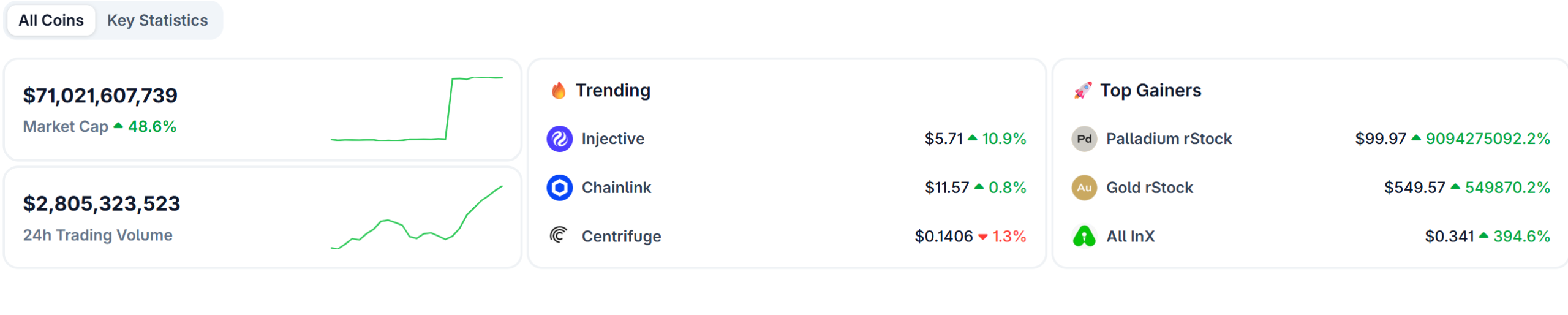
The real-world asset (RWA) market cap reached $71.02 billion on Monday, a gain of 48.7% in 24 hours, according to CoinGecko. Meme coins fell 2.2% over the same day.
The sector added $23.26 billion. One token accounts for almost all of it, and it is not a tokenized stock.

One Listing Explains the Whole Jump
Figure Heloc is the largest RWA holding at $22.81 billion. That is 32% of the sector. Take it out of Monday’s total and $48.21 billion remains. The sector was worth $47.75 billion a day earlier.
The difference between those two figures is 0.96%. In other words, the RWA sector without Figure Heloc is almost exactly where it stood the day before.

Prices did not do this. Chainlink (LINK) rose 0.8% on the day, and Stellar (XLM) fell 3.3%. Figure Heloc itself gained 4.5% across the week.
A token added to a list can raise a sector total. Nobody has to buy anything.
What Figure Heloc Actually Is
The token is a pool of home equity credit lines. Figure, a Nevada lender, issues them on its own Provenance blockchain. Figure is not a fringe operation. It listed on Nasdaq in September 2025 and earned $191 million on $619 million of revenue over the past year.
The scale is the striking part. Figure’s shares are worth $8.66 billion. Its tokenized loan book is worth $22.81 billion, or roughly two and a half times the company itself.
Those tokens barely move. They turned over $14.9 million in 24 hours, about 0.065% of their value. CoinGecko’s own data returns no 24-hour price change for them at all.
So the largest asset in crypto’s RWA sector is a securitized mortgage book that almost never trades. Researchers have tracked this gap between value and liquidity for months.
Tokenized Stocks See Modest Gain in Crypto Rally
Tokenized equities sit in a separate pool worth $8.25 billion. That is roughly a third of the jump they are credited with causing.
They also cannot outrun the shares they copy. MicroStrategy xStock (MSTRX) trades at $122.69, while Strategy’s Nasdaq-listed shares sit at $122.63.

It rose 27.9% over seven days because the stock did. The wrapper simply followed.
Meme Coins Fell While RWA Rose
Almost every large meme coin lost ground on Monday. Dogecoin (DOGE) fell 4.1%, Pump.fun (PUMP) dropped 7.9% and Official Trump (TRUMP) slid 9.9%.
The sector ended the day down 2.3% at $32.82 billion. Shiba Inu (SHIB), Bonk (BONK) and FLOKI all finished lower.

So Monday set a listing against a selloff. RWA gained on paper while meme coins lost real value. Turnover separates the two:
- Meme coins traded 13.2% of their market cap in 24 hours.
- The RWA sector managed 4%, and Figure Heloc just 0.065%.
Meme coins are the smaller market that actually changes hands. RWA is the larger one that mostly sits still.
The Seven-Day Picture Is Different
Widen the window, and meme coins lead on price. Official Trump gained 73.5% over seven days, Pump.fun 66.3% and Pepe (PEPE) 54.2%.
RWA tokens were steadier. Stellar climbed 22.1% and Chainlink 21.9% across the same week.
Meme coins also traded harder, turning over $4.35 billion against $2.82 billion. That extends the meme coin season rally.
BeInCrypto Intelligence research on the real state of tokenization tracked roughly $60 billion across 7,000 products. Most of it sits inactive on-chain.

The RWA sector grew by $23 billion on Monday. It grew by counting something new, not by anyone buying it.
The post RWA Market and Tokenized Assets Beat Meme Coins With a 50% Rally appeared first on BeInCrypto.
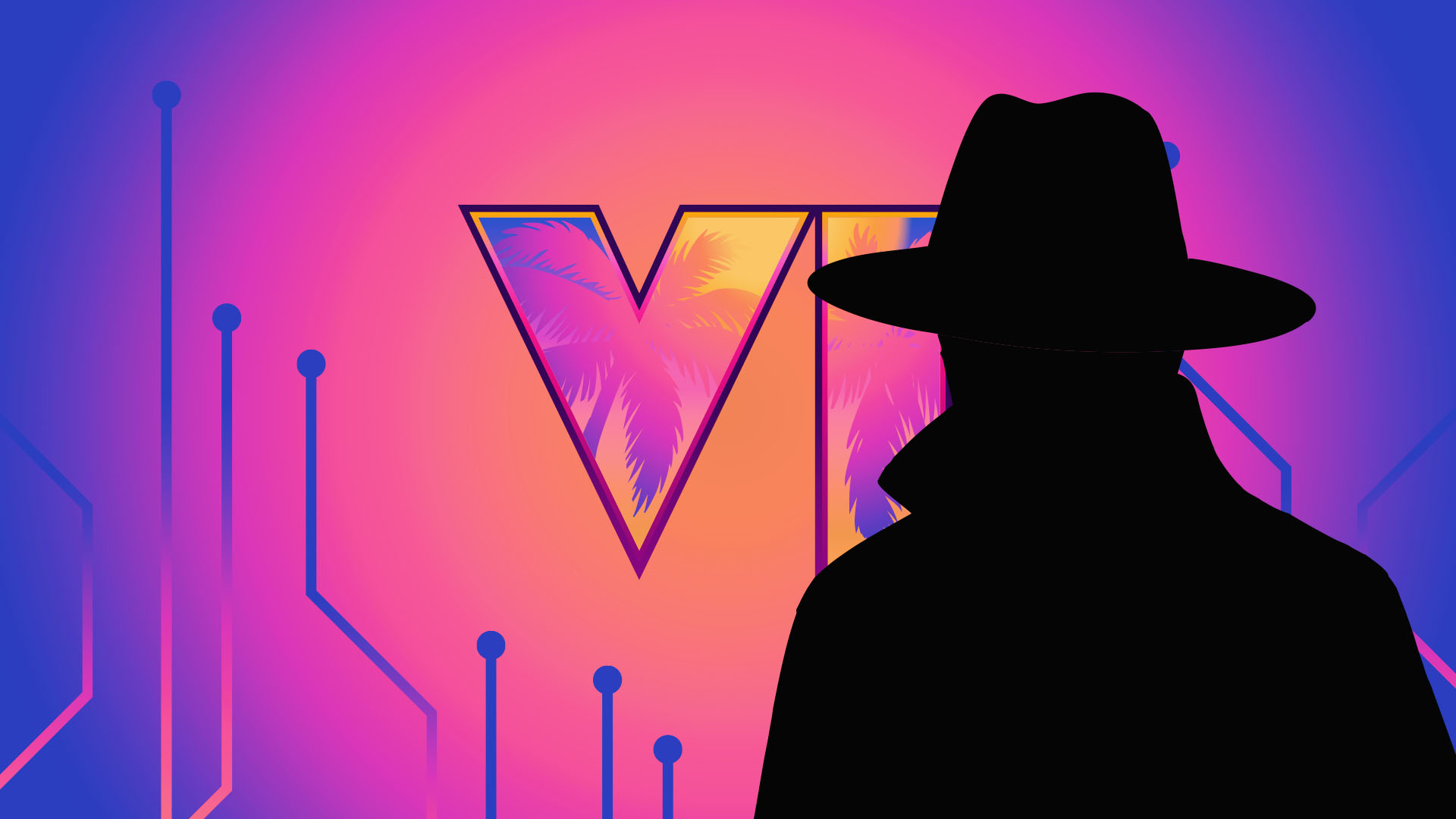
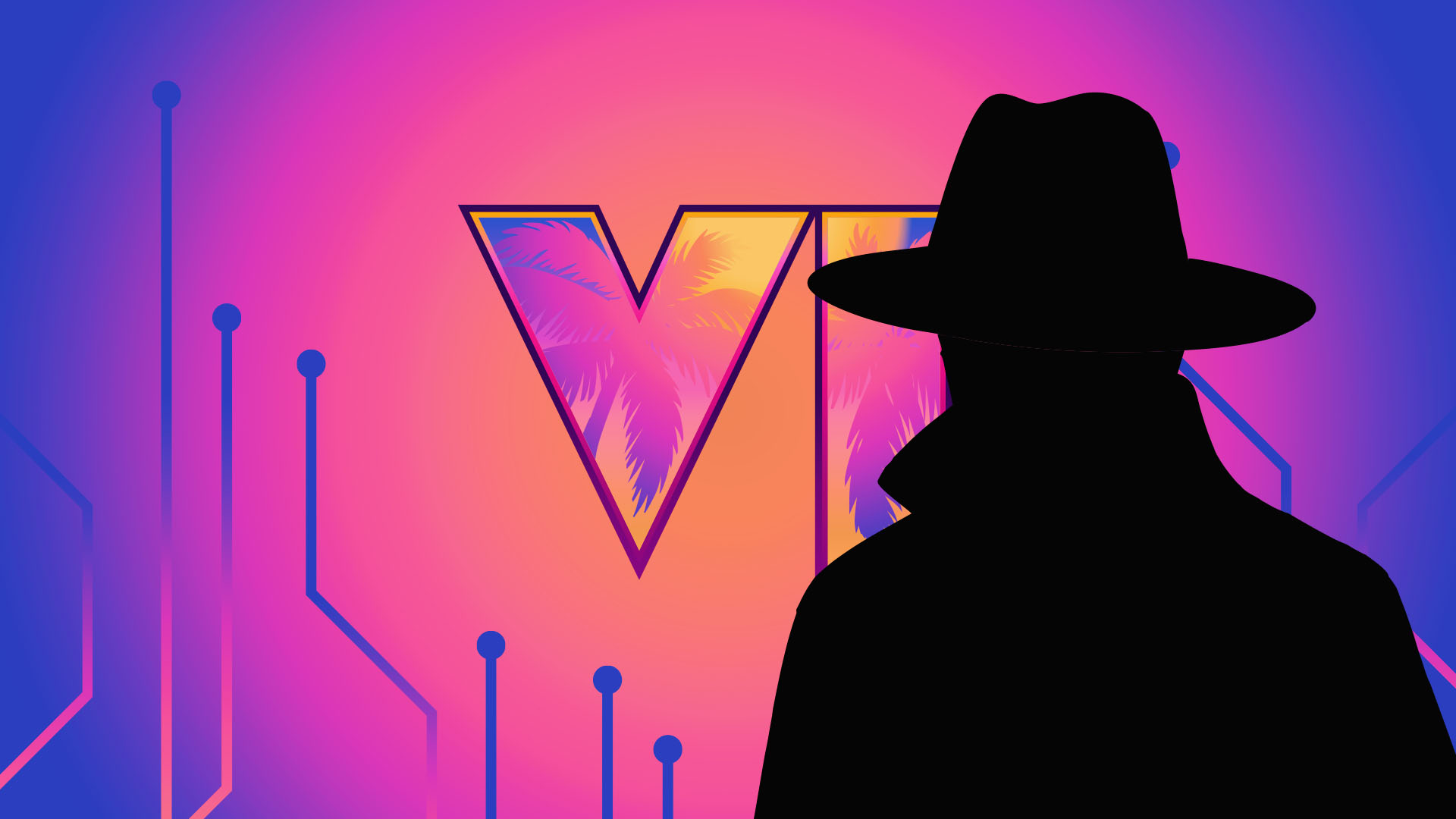
Users on X suspect that a recorded interaction between representatives of GTA VI publisher, Rockstar Games, and a pseudonymous X user was staged to pump a crypto scam amid the game’s ongoing leak scandal.
The clip appears to show the representatives knocking on the door of X user “@LewisBi94895348” who, via Reddit account “Pilotx1970,” appeared to predict major GTA VI leaks.
Last month, they posted “August 18 — don’t ask me how I know,” along with, “If you don’t believe me, come back on that date and we will see.”
They also claimed to know the identity of “CyberLeek,” the main X account that’s been leaking footage of GTA VI gameplay since August 18.
In footage posted by the Lewis X account today, one of the alleged Rockstar reps can be heard saying, “They’re not happy with it,” before asking, “Do you know certain individuals under certain handles, and who are the associates?”
Read more: Bitcoin spikes after GTA VI trailer leak says ‘Buy $BTC’
They later express doubt that his August 18 post was pure chance.
User’s doubt legitimacy of GTA VI investigation
The Lewis account also promoted their “GTA insider” cryptocurrency across several posts before deleting them.
Shortly after, users discovered that the account holder has previously been accused of scamming RC plane buyers on Facebook Marketplace, fueling speculation that the video might also be fake.
One user said there’s no subpoena for [Rockstar Games parent company] Take-Two to pursue Reddit before claiming that the video uploader is just “trying to get a piece of the pie.”
Others suggested that he hired some random people in order to get “millions of views on Twitter.”
Read more: Steam Workshop wallpapers found spreading crypto malware
Who is CyberLeek?
CyberLeek claims to be using his cryptocurrency $CYBERLEEK to raise funds for a “secret project” while advocating for better consumer rights across the video game industry.
However, gaming advocacy group Stop Killing Games has criticised the leaks, claiming the illegality of it “risks tarnishing the reputation of our communities and our chances to make change.”
Read more: GTA creator Rockstar Games bans NFTs and crypto
CyberLeek has continuously threatened to leak more content, and is now using $CYBERLEEK as a voting mechanism for buyers to determine what he leaks next.
One poll suggested he would leak content related to a group of nudists, while another suggested that he’ll move on from leaking free roam gameplay footage to leaking story content.
CyberLeek’s site also offered companies the chance to advertise on his page, but only if they pay $162,000 in Monero.
Take-Two appears to adopt “Sharkbux” virtual currency
What appears to be an SEC request filed this week by Take-Two’s Chief Legal Officer Daniel P. Emerson also reveals that GTA VI will include a virtual currency system.
It won’t have the hallmarks of a cryptocurrency, however, with no public ledger, secondary trading, or volatile pricing.
The request stresses that under the Howey test, Sharkbux will “not be viewed as the offer or sale of a security.”
Online users have spotted, however, that the SEC filing is addressed to the Crypto Assets and Cyber Unit, a government crypto authority disbanded and replaced in 2025.
Beyond this legal action, Take-Two has also filed several subpoenas over the weekend demanding Microsoft, X and Discord give up details related to the CyberLeek accounts.
Protos has reached out to Take-Two for comment on the apparent investigation and Sharkbux and will update this piece should we hear anything back.
Got a tip? Send us an email securely via Protos Leaks. For more informed news and investigations, follow us on X, Bluesky, and Google News, or subscribe to our YouTube channel.
Coinbase's tokenized US equities went live on Base on Monday, putting four technology stocks onchain as transferable tokens that eligible users outside the United States can hold in a self-custodial wallet, with no brokerage account required. Coinbase is issuing the assets, running the chain they… Read the full story at The Defiant

No more. In a recent conversation with TIME, Colossal CEO and co-founder Ben Lamm concedes that those goal posts have moved more than a little. “We are thinking it will be in the early 2030s,” he says. “We don’t have a hard date. Not 2036, but not 2030 either.”
In just the past year, Colossal has learned vastly more about both the mammoth and the elephant genomes than has ever been known before, not only improving the odds that the mammoth can be brought back to life, or de-extincted, but also unpacking basic genetic science that could one day have knock-on effects for humans—including potentially increasing resistance to cancer.
Bringing back the dire wolf
Colossal proved its de-extinction chops in the spring of 2025, when it announced that it had brought the extinct dire wolf back to life, editing the genome of the closely related gray wolf to replicate the features of its vanished cousin—including a white coat, larger size, more powerful shoulders, wider head, larger teeth and jaws, more-muscular legs, and characteristic vocalizations, especially howling and whining.
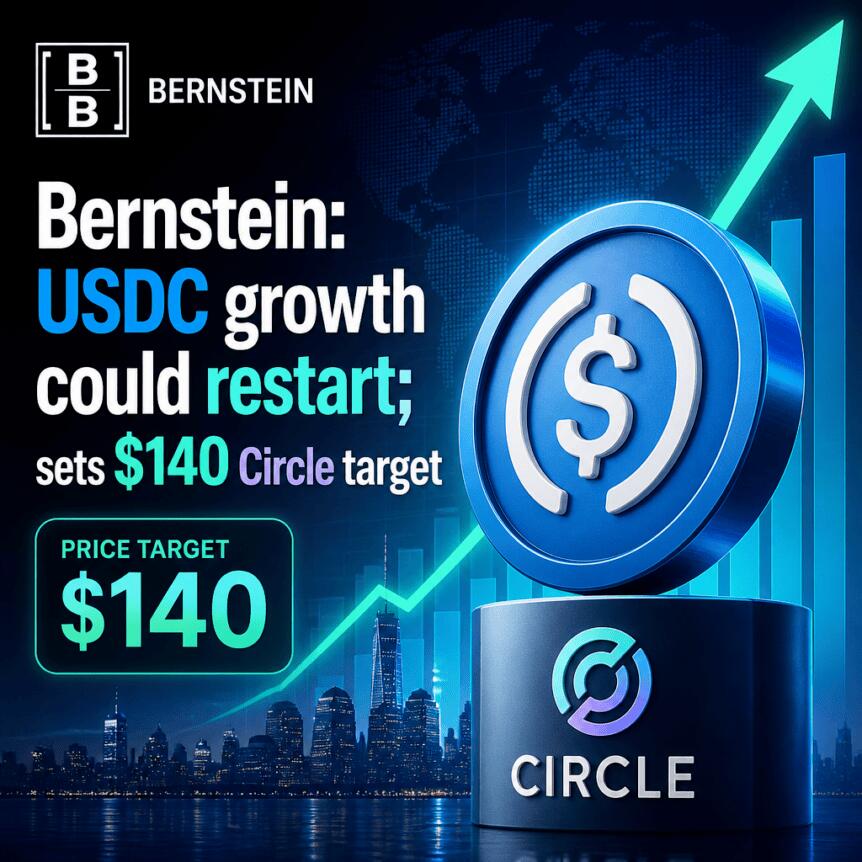
Circle is catching the attention of Wall Street analysts again, with Bernstein arguing that USDC is entering a fresh growth phase that could lift the company’s performance over the next year. In a research note published Monday, the firm said USDC is showing signs of what it called “digital dollar reflation,” after supply jumped by roughly $2 billion in seven days—an apparent turnaround from a six-month period of stagnant or declining growth.
Bernstein maintained an Outperform rating on Circle and set a $140 price target, implying around 60% upside from current levels. The stock has reportedly risen about 40% over the past month, underscoring how quickly market sentiment can shift around stablecoin issuance and adoption.
Key takeaways
- Bernstein cited USDC supply increasing by roughly $2 billion in seven days, reversing a prior stretch of flat or falling growth.
- The firm expects a potential “next phase” for stablecoins to be driven by market momentum, U.S. regulatory clarity, and tokenized capital markets.
- Bernstein said USDC’s share of adjusted stablecoin transaction volume rose from about 40% in 2025 to more than 60% so far in 2026, overtaking USDt by that measure.
- Analysts highlighted early signals of stablecoin payments being used by artificial intelligence agents.
Why Bernstein thinks USDC momentum matters
Stablecoin growth is often measured in multiple ways—issuance, liquidity, and real-world transaction usage. Bernstein’s central argument focuses on issuance acceleration: a $2 billion increase in USDC supply over just one week suggests demand for dollar-denominated on-chain settlement is picking up again. The note frames this as “digital dollar reflation,” implying that the on-chain dollar supply is expanding in a way that may support broader ecosystem activity.
For investors, the implication is straightforward: renewed stablecoin issuance can translate into more business for Circle, particularly if new supply is associated with greater on-chain usage and related enterprise adoption. Bernstein also points to a broader set of catalysts beyond one-week supply growth—elements that, if they materialize, could help make the rebound more durable rather than episodic.
Drivers: regulation, tokenized markets, and payments
Bernstein outlined several potential contributors to a stablecoin “growth cycle.” First, it pointed to renewed momentum in crypto markets, which can raise risk appetite and increase the volume of on-chain activity where stablecoins serve as settlement rails. Second, it highlighted the possibility of greater regulatory clarity in the United States—an area that has long been a variable for stablecoin issuers, exchanges, and payment integrators trying to scale compliant services.
Third, Bernstein linked stablecoin expansion to tokenized capital markets—an umbrella term for the use of tokenized instruments and on-chain infrastructure for financial services. If more of these workflows use stablecoins as a unit of account or settlement asset, transaction volume could increase meaningfully. Finally, Bernstein pointed to growing stablecoin adoption for payments, suggesting that stablecoins are moving beyond trading and into everyday transfer use cases.
The analysts also referenced “early signs” of stablecoin use in payments made by artificial intelligence agents. While still emerging, the idea matters because AI-driven workflows could introduce new automation patterns for transfers—potentially increasing the frequency and diversity of stablecoin payment demand over time.
USDC’s transaction share rises while USDt slips in that metric
Although USDC is still the second-largest dollar-backed stablecoin by market capitalization—behind Tether’s USDt—Bernstein argued that USDC is gaining ground in actual transaction activity. According to the firm, USDC’s share of adjusted stablecoin transaction volume rose from roughly 40% in 2025 to more than 60% so far in 2026. On that basis, USDC has reportedly overtaken USDt.
This distinction is important because it separates “size” from “usage.” A stablecoin can lag in total market cap yet still lead in transaction throughput if it becomes the preferred settlement asset for certain applications or platforms. For Circle, a rise in transaction share can signal improvements in distribution, integrations, and user behavior—even if headline supply growth is the first datapoint drawing attention.
Circle stock performance and fundamentals since IPO
Bernstein’s bullish view arrives during a period of noticeable stock volatility for Circle. The company went public in June 2025, pricing its shares at $31 and raising about $1.1 billion in its initial public offering. After a strong early period, the shares slid back toward their IPO level by November 2025 as broader crypto market weakness weighed on publicly traded companies exposed to the sector.
Despite that volatility, Circle has continued to report improving results on an annual comparison basis. In its most recent quarter, the company reported $701 million in revenue and $48 million in net income, both up from a year earlier. The persistence of year-over-year improvement can matter for how equity markets interpret a stablecoin growth rebound—especially when traders are trying to balance short-term issuance trends against longer-term profitability.
As stablecoin demand patterns evolve, investors may focus not only on supply but also on which networks and use cases drive transaction volume. Bernstein’s emphasis on USDC overtaking USDt on adjusted transaction share suggests that, at least for now, usage dynamics are shifting in Circle’s favor.
What to watch next is whether the “digital dollar reflation” signals translate into sustained growth beyond a one-week supply jump—particularly as policy clarity and payment and tokenization adoption progress. If USDC continues to lead transaction share while issuance remains steady, Bernstein’s thesis could gain more traction; if not, the current rebound may prove temporary.

Bitcoin (BTC) spent this past week ripping from the low $60,000s to just under $80,000, and to trader Nonzee, none of it looks like conviction.
They are calling the move a trap built on forced buying rather than real demand, and say the next leg is down, not up.
The Case for a Distribution Phase, Not a New Bull Run
Nonzee’s argument starts with the size of the squeeze, where more than $3.1 billion in short positions were wiped out during the run, and Bitcoin alone was responsible for roughly $1.65 billion of that figure. In their view, that is what actually pushed the price higher, not a change in sentiment.
“That was not a reversal. It was a liquidity squeeze,” they wrote.
The trader tied the timing to two catalysts: Trump putting the CLARITY Act back in the headlines and the Treasury Department increasing its long-term bond buybacks. Both, they argue, forced shorts out and pulled fresh longs into a market that was already stretched thin.
Their read on where things stand now is that the $70,000 fair value gap, a pricing gap left behind during an earlier fast move that traders watch for a return visit, has been filled, the short squeeze has run its course, and FOMO buying is happening in real time.
Next will come distribution, then the selloff, in their framing, with a downside path running from $77,000 to $67,000, then $55,000, before a final leg down to between $48,000 and $45,000.
Bitcoin was trading around $78,000 at the time of writing, up roughly 2% on the day and about 22% over the past week, according to CoinGecko. It has swung between $76,000 and $79,000 in the last 24 hours alone. Still, the OG crypto remains 39% below its all-time high of around $126,000, set back in October 2025, and it is still down 33% on a one-year basis despite the bounce.
A Choppy Few Days Either Way
Whether or not Nonzee’s call plays out, the past several days have already been rough on traders in both directions. BTC briefly touched almost $80,000 on Friday before slipping to around $75,500 over the weekend, as CryptoPotato reported, with the drop coinciding with reports that market maker Wintermute had built a sizable short position on Hyperliquid. During that stretch, altcoins fared worse, with ETH down 5% and XRP off by more than 6%.
The bounce also pushed the Fear and Greed Index to its highest reading since last October’s crash, a jump that has some drawing comparisons to the conditions right before that selloff wiped out billions in leveraged positions.
Elsewhere, HYPE printed a new all-time high above $82 even as BTC cooled off, and separately, data from analyst nocoffeenobrain shows open interest climbing from around $22 billion to nearly $25 billion during the rally, a slower pace than the move in price itself, which points to traders adding positions cautiously rather than piling on leverage all at once.
The post Bitcoin’s $80K Rally Is a Trap, Analyst Warns of $45K Drop appeared first on CryptoPotato.
Coinbase-backed Stand With Crypto has endorsed 32 House lawmakers seeking reelection in November after each supported the CLARITY Act during its passage through the chamber last year.
Summary
- Stand With Crypto endorsed 32 incumbent House members from both major parties.
- Every endorsed lawmaker voted for the CLARITY Act when it passed the House.
- The group says it has more than 3 million registered advocates across the United States.
- Crypto groups have committed close to $200 million during the 2026 midterm cycle.
Stand With Crypto ties 32 endorsements to CLARITY vote
Reuters reported Monday that Stand With Crypto had selected 32 incumbent members of Congress for its latest endorsement round ahead of the Nov. 3 midterm elections.
All 32 lawmakers voted for the Digital Asset Market Clarity Act when the House passed the proposal in July 2025. The legislation would divide oversight of digital assets between the Securities and Exchange Commission and the Commodity Futures Trading Commission while setting rules for crypto exchanges and other market participants.
By using the House vote as a central test, the group has tied its election activity to a specific legislative record rather than party membership. Its latest list includes Republicans Tom Emmer of Minnesota and Bill Huizenga of Michigan, as well as Democrats Ritchie Torres of New York and Josh Gottheimer of New Jersey.
Stand With Crypto Executive Director Mason Lynaugh told Reuters that the organization wants to return lawmakers who supported the bill to Congress. The group plans to announce its Senate endorsements closer to Election Day.
“In 2024, we were very much proving that the crypto voter is real,” Lynaugh said.
“In 2026, we’re very much showing that we have the organizing capacity and that our advocates are a true voting bloc that can move the needle.”
Coinbase launched Stand With Crypto in 2023 to organize people who support digital asset legislation. Unlike a super political action committee, the organization says its election work centers on voter outreach and mobilization rather than large independent campaign expenditures.
The group currently claims more than 3 million registered U.S. advocates, up from the 2.7 million cited when Lynaugh discussed its campaign plans in May. At that event, crypto.news covered its midterm strategy, which initially included endorsements for six House incumbents.
Bipartisan list includes lawmakers in competitive races
Several lawmakers in the latest group are running in districts where the November result could be close, increasing the potential value of volunteer outreach and voter mobilization.
Arizona Republican Juan Ciscomani and Pennsylvania Republican Brian Fitzpatrick are among the endorsed members facing competitive contests, according to Reuters. Lynaugh said Stand With Crypto could become “the difference maker” in some of the races, though the group has not disclosed any forecast for their outcomes.
Huizenga, another member of the endorsed group, secured the Republican nomination in Michigan’s 4th Congressional District earlier in August. Defend American Jobs, the Republican-aligned affiliate of Fairshake, spent nearly $512,000 supporting him, according to campaign finance data compiled by Tech Influence Watch.
During the same round of primaries, several Fairshake-supported candidates advanced in Washington state. Democratic Representatives Suzan DelBene, Kim Schrier and Marilyn Strickland won their party primaries, while Republican Amanda McKinney also moved forward, as detailed in an Aug. 5 report on Fairshake-backed primary victories.
Torres has also received support from crypto-linked political groups during the election cycle. Protect Progress, Fairshake’s Democratic-aligned affiliate, spent about $1.5 million supporting his reelection campaign ahead of the New York primary, while Fellowship PAC reportedly added roughly $300,000 in advertising.
Stand With Crypto’s own polling, conducted with Impact Research, found that 59% of crypto owners do not reliably vote for one political party. Nearly half of respondents said they could support a candidate whose crypto position matched theirs even when they disagreed with the candidate on other subjects, according to the organization’s May presentation.
CLARITY Act delay raises the stakes for the next Congress
The House passed the CLARITY Act by a 294-134 vote in July 2025, but the proposal has remained held up in the Senate amid disputes over stablecoin rewards, decentralized finance oversight, anti-money laundering requirements and ethics restrictions involving government officials’ crypto holdings.
A Senate Banking Committee markup initially scheduled for Jan. 15 was postponed after Coinbase withdrew its support hours before the meeting. The company objected to parts of the draft, leaving senators without an agreement needed to move the legislation forward.
Alongside the Banking Committee’s work, the Senate Agriculture Committee must address sections involving the CFTC. The bill would then need to pass the full Senate, return to the House if senators change its text, and reach President Donald Trump for his signature.
Because most legislation requires 60 votes to overcome a Senate filibuster, Republicans would need Democratic support even if every Republican senator backed the proposal. A report examining the CLARITY Act’s midterm risk noted that the congressional calendar has narrowed as lawmakers approach the election.
The proposal remains important for U.S. crypto companies and investors because it would set federal rules for when digital assets fall under SEC or CFTC oversight. Supporters say the division would reduce uncertainty over trading, registration and token classifications, while disagreements in the Senate show that lawmakers have not settled the bill’s consumer protection, ethics and financial crime provisions.
Stand With Crypto’s endorsements focus on House members who supported the existing text, but the next Congress could revisit the proposal if the Senate does not finish work before the current session ends. Any unfinished bill would have to be introduced again after the new Congress takes office in January 2027.
Crypto election spending approaches $200 million
Political spending by the digital asset industry has continued alongside the grassroots campaign. Reuters estimated that crypto-linked groups have committed close to $200 million during the 2026 midterm cycle, with much of the money flowing through Fairshake and its affiliated committees.
Consumer advocacy group Public Citizen separately calculated that crypto companies had contributed about $189 million to the 2026 election cycle by the end of June. Its report said the amount represented roughly 37% of corporate political contributions tracked during the period and had already surpassed the industry’s estimated $170 million in 2024 spending.
According to Public Citizen, Fairshake had spent more than $82 million during the current cycle, while MAGA Inc., a super PAC largely supported by Crypto.com, had spent more than $56 million. Public filings cited in the report showed Fairshake, Defend American Jobs, and Protect Progress held a combined $193 million in January.
During the 2024 elections, crypto groups supported congressional candidates across party lines, many of whom won their races. Congress later passed the GENIUS Act, creating a federal framework for payment stablecoins and handing the industry one of its main legislative victories.
Stand With Crypto has taken a different role from the major super PACs by organizing advocates and publicly rating candidates’ policy records. The organization endorsed six incumbents in March before adding the latest 32 House members, and Lynaugh said its Senate slate would be released closer to Election Day.
On-chain investigator ZachXBT alleged this morning that BitcoinIRA and iTrustCapital suffered data breaches this year without disclosing the incidents to their customers.
ZachXBT claimed that threat actors accessed personal details from the crypto retirement services, such as customers’ portfolio holdings, banking details, custodian details, and verification status.
Once he was confident that the breaches occurred, the researcher emailed both platforms on August 21. After three days of no response, he published the alert publicly today.
iTrustCapital responded to the allegations via X, writing, “ITrustCapital has not experienced and is not aware of any recent third-party vendor data breaches affecting our platform.
“Our multi-step closed-loop system is designed to mitigate losses for clients who may be targeted, phished, scammed or compromised at a personal level.”
BitcoiIRA hadn’t responded publicly by publication time.
Who are the businesses involved?
Chris Kline, Johannes Haze, and Camilo Concha started BitcoinIRA a decade ago out of Sherman Oaks, California, according to a BBB business listing.
The company markets itself as the ‘original’ service to hold bitcoin (BTC) inside a retirement account and it has claimed more than $14 billion worth of assets.
iTrustCapital, meanwhile was founded in 2018 by Todd Southwick and Blake Skadron. It was based in Long Beach, California when it announced a $125 million Series A round in January 2022.
The company has claimed to have processed more than $10 billion in cumulative transactions across roughly 53,000 accounts, and iTrustCapital’s own homepage now claims more than $17 billion worth of transactions across over 300,000 accounts.
Read more: ZachXBT slams Bitget execs over suspicious $480M withdrawals
California breach database does not list BitcoinIRA nor iTrustCapital
Both companies have been headquartered in California, a state that recently tightened its data breach disclosure rules.
Senate Bill 446 was signed into law in October 2025 and took effect this January. This new law gives businesses 30 days to notify residents after discovering a significant data breach. A further 15 days are allowed to notify the state attorney general, once a company has notified more than 500 residents.
Neither BitcoinIRA nor iTrustCapital appears in that registry. BitcoinIRA, despite having a California address in its corporate history, also lists a subsequent Nevada base of operations that might exempt it from the requirements of this registry.
However, this registry only publishes breaches that clear the 500 resident threshold, or that a company volunteers. So, although the absence is conspicuous, it is not necessarily indicative of wrongdoing.
When the alleged breach occurred
The exact date of the data breach(es) is unknown, but ZachXBT dates at least one attack as early as June 2026.
The investigator wrote an August 10 thread about a threat actor using spoofed BitcoinIRA emails allegedly acquired through that data breach.
iTrustCapital’s own help center says that even if a client’s email, SIM card, password, or two-factor login is compromised, crypto “can not be drained from an iTrustCapital account as there is no connectivity to external wallets.”
Got a tip? Send us an email securely via Protos Leaks. For more informed news and investigations, follow us on X, Bluesky, and Google News, or subscribe to our YouTube channel.
Shannon Sharpe Embarrasses Enes Kanter On ‘Nightcap’

IEEE Senior Membership Demystified – IEEE Spectrum

Bitcoin STALLS, CLARITY Collapses & Tether Vindicated





-

 Fashion3 days ago
Weekend Open Thread: Madewell – Corporette.com
-

 Business2 days ago
Musk’s Tesla, SpaceX Confirm $16.8 Billion ‘Terafab’ Chip Plant as World’s Largest Building in Texas
-

 Business6 days ago
SMA Solar Technology AG (SMTGY) Q2 2026 Earnings Call Transcript
-

 Crypto World3 days ago
anatomy of crypto’s biggest liquidation event since 2021
-

 Tech7 days ago
Qwen3.8-27B runs frontier-class coding agents and reasoning locally, no cloud API required
-

 Crypto World7 days ago
OCC Greenlights Trump Family Crypto Firm for Trust Charter
-

 Politics2 days ago
6 months on, Irish renters crushed by effects of government housing bill
-
 NewsBeat3 days ago
The ‘Lucky Dip Gang’ causing carnage for clicks: After five thugs were killed speeding in the wrong direction on a motorway, GUY ADAMS investigates a sick new trend… and why police aren’t even allowed to pursue them
-

 Crypto World7 days ago
NAVI Prime launches institutional lending framework on Sui
-

 Tech6 days ago
GLM-5.3 hits the API at $1.4/$4.4 per million tokens
-

 News Videos5 days ago
Don’t Leave Your Financial Future To Chance | August 19, 2026
-
Tech7 days ago
5 Of The Most Reliable Car Brands To Consider If You’re Buying A Used SUV
-
 Crypto World7 days ago
Dow’s 3-Year Winning Run Isn’t a Crash Signal, Still 49% Odds of Double-Digit Gains
-

 Tech7 days ago
Keychron K8 Ultra 8K review: a great value keyboard with comfort issues
-

 Business1 day ago
Mystery AI Model ‘Ox Alpha’ Draws Developers With Free Access as Chinese Lab Origins Remain Debated
-
 Tech7 days ago
Nvidia discloses $21B stake in SpaceX
-

 Business6 days ago
Stock Market Today: Tech Futures Slide As Treasury Yields Jump; Nvidia, Micron, Sandisk Sell Off
-

 Business5 days ago
Marvell Shares Jump 7% as Google Chip Deal Confirms Custom AI Silicon Partnership, Analysts
-

 Business4 days ago
Five Below: Kids Discount Retailer Reaps Rich Rewards
-
Business7 days ago
Fabrinet (FN) Q4 2026 Earnings Call Transcript
You must be logged in to post a comment Login