
Crypto World
Bitcoin’s $80K Rally Is a Trap, Analyst Warns of $45K Drop


Bitcoin (BTC) spent this past week ripping from the low $60,000s to just under $80,000, and to trader Nonzee, none of it looks like conviction.
They are calling the move a trap built on forced buying rather than real demand, and say the next leg is down, not up.
The Case for a Distribution Phase, Not a New Bull Run
Nonzee’s argument starts with the size of the squeeze, where more than $3.1 billion in short positions were wiped out during the run, and Bitcoin alone was responsible for roughly $1.65 billion of that figure. In their view, that is what actually pushed the price higher, not a change in sentiment.
“That was not a reversal. It was a liquidity squeeze,” they wrote.
The trader tied the timing to two catalysts: Trump putting the CLARITY Act back in the headlines and the Treasury Department increasing its long-term bond buybacks. Both, they argue, forced shorts out and pulled fresh longs into a market that was already stretched thin.
Their read on where things stand now is that the $70,000 fair value gap, a pricing gap left behind during an earlier fast move that traders watch for a return visit, has been filled, the short squeeze has run its course, and FOMO buying is happening in real time.
Next will come distribution, then the selloff, in their framing, with a downside path running from $77,000 to $67,000, then $55,000, before a final leg down to between $48,000 and $45,000.
Bitcoin was trading around $78,000 at the time of writing, up roughly 2% on the day and about 22% over the past week, according to CoinGecko. It has swung between $76,000 and $79,000 in the last 24 hours alone. Still, the OG crypto remains 39% below its all-time high of around $126,000, set back in October 2025, and it is still down 33% on a one-year basis despite the bounce.
A Choppy Few Days Either Way
Whether or not Nonzee’s call plays out, the past several days have already been rough on traders in both directions. BTC briefly touched almost $80,000 on Friday before slipping to around $75,500 over the weekend, as CryptoPotato reported, with the drop coinciding with reports that market maker Wintermute had built a sizable short position on Hyperliquid. During that stretch, altcoins fared worse, with ETH down 5% and XRP off by more than 6%.
The bounce also pushed the Fear and Greed Index to its highest reading since last October’s crash, a jump that has some drawing comparisons to the conditions right before that selloff wiped out billions in leveraged positions.
Elsewhere, HYPE printed a new all-time high above $82 even as BTC cooled off, and separately, data from analyst nocoffeenobrain shows open interest climbing from around $22 billion to nearly $25 billion during the rally, a slower pace than the move in price itself, which points to traders adding positions cautiously rather than piling on leverage all at once.
The post Bitcoin’s $80K Rally Is a Trap, Analyst Warns of $45K Drop appeared first on CryptoPotato.

The U.S. Treasury Department has launched Operation Economic Outcast to target Iran’s international financial links, including cryptocurrency activity that American officials say supports sanctions evasion and the Islamic Revolutionary Guard Corps.
Summary
- Operation Economic Outcast covers cryptocurrency, technology, gold, aviation, shipping and other financial channels.
- OFAC can sanction people operating in Iran’s crypto sector, regardless of where they are based.
- Treasury says Iran uses digital assets to support transactions linked to the IRGC and government insiders.
- Bitcoin remained near $79,000 after briefly testing the psychological $80,000 level.
Operation Economic Outcast targets Iran’s financial links
The U.S. Treasury Department said President Donald Trump directed officials to begin Operation Economic Outcast as Washington seeks to cut Iran off from financial networks outside the country.
Under the campaign, Treasury plans to pursue people, companies, and intermediaries that it says help Iran sell oil, move money, avoid existing restrictions, or finance groups designated by the United States. Officials said they had already mapped facilitators, financial channels, and other networks used by Tehran.
“Today, in that same spirit, we are launching an economic onslaught against Iran’s financial connections around the globe,” Treasury said in its announcement.
The department presented Iran with two possible outcomes: continued isolation or a route back into the international economy. Reintegration, according to Treasury, would require the Iranian government to change conduct that Washington regards as a threat to the United States and its partners.
For foreign companies, Operation Economic Outcast also carries a warning about maintaining commercial ties with Iran. Treasury Secretary Scott Bessent said businesses and governments that work with the United States could benefit from that relationship, while parties that remain connected to Tehran could face similar isolation.
“Our objective is to sever every economic lifeline that sustains this tyrannical regime until Tehran stands alone.”
The campaign follows his earlier declaration of an “Economic D-Day” against Iran, which he described as the financial endgame of the U.S. campaign. Operation Economic Outcast expands that approach beyond Iran’s domestic institutions by focusing on overseas companies, payment channels and facilitators accused of keeping its economy connected to global markets.
US Treasury puts Iran’s crypto sector under scrutiny
Digital assets form a named part of the campaign because the Treasury says Iranian officials and connected groups increasingly use cryptocurrency to conduct transactions outside traditional banks.
According to the department, Iran has turned to crypto for sanctions evasion and for payments linked to the IRGC and government insiders. Treasury did not identify specific wallets, exchanges or transaction amounts in the campaign announcement, but it said the Office of Foreign Assets Control has authority to sanction people operating in the crypto sector of Iran’s economy, regardless of their location.
A person does not become sanctioned solely because the Treasury has announced the campaign. OFAC would still have to designate the person or entity under the relevant U.S. authority, after which any property under U.S. jurisdiction would generally be blocked.
American individuals and companies are generally prohibited from providing funds, services, or other economic benefits to designated parties. OFAC’s rules can also cover entities owned at least 50% by one or more blocked persons, even when the subsidiary or affiliated company does not appear separately on a sanctions list.
For exchanges, custodians, stablecoin issuers and payment providers, a new designation may require updates to wallet-screening systems and customer controls. Non-U.S. companies may also face sanctions exposure when they knowingly facilitate certain dealings involving blocked Iranian parties.
Other industries named by the Treasury include technology, gold, aviation, and shipping. The department said Iran has used international networks in these sectors to sell oil, receive payments, and obtain goods despite U.S. restrictions.
Earlier actions froze Iran-linked crypto funds
Operation Economic Outcast follows several U.S. actions against Iran-linked exchanges, wallets, and companies during 2026.
On Aug. 7, OFAC sanctioned Shelbit, Aban Tether, and Iranian national Siavash Kayvanpour after alleging that they helped move funds connected to sanctioned parties. As crypto.news reported earlier, the Treasury said IRGC-linked addresses sent more than $1 million in cryptocurrency to Shelbit, while wallets connected to the exchange allegedly transferred more than $2 million to IRGC-controlled addresses.
Treasury also alleged that Kayvanpour-linked wallets sent more than $2 million to Nobitex, Iran’s largest crypto exchange. Shelbit’s former management denied knowingly participating in sanctions evasion, terrorism financing or money laundering and said the company stopped accepting new business in December 2025.
OFAC separately accused Aban Tether of processing funds involving Nobitex, Wallex, Bitpin, and Ramzinex. The four Iranian exchanges had been sanctioned in June after U.S. officials alleged that they helped restricted entities use the digital asset market.
In July, U.S. authorities froze $131 million in USDT held across four Tron wallets linked by the Treasury to Iran’s central bank. Treasury confirmed the freeze but did not publicly explain how the funds had been obtained or what transactions the holders intended to conduct.
An earlier April action resulted in approximately $344 million in USDT being frozen across two Tron addresses that American authorities linked to Iranian networks. Tether enforced the restriction through controls built into the stablecoin, leaving the funds immovable without altering the Tron blockchain.
Centralized stablecoins give issuers a direct way to freeze assets held in named addresses. Bitcoin does not contain the same issuer-controlled function, so blocking BTC generally requires control over private keys, cooperation from a custodian, or an exchange account subject to legal restrictions.
Treasury’s actions have also covered alleged Bitcoin use outside Iran’s exchange sector. On July 29, OFAC sanctioned two insurers after accusing HormuzSafe Marine Services Authority of accepting Bitcoin and other digital assets to avoid restrictions and generate revenue for the IRGC.
The public designation did not include wallet addresses, transaction hashes, or payment totals supporting the allegation. It also did not announce a seizure, criminal charge, or court ruling against customers who may have used the company.
Bitcoin holds near $79,000 after testing $80,000
Bitcoin showed little immediate reaction to the Treasury campaign, trading around $79,000 after reaching an intraday high near $80,000. The level remains a psychological barrier after the cryptocurrency’s recovery from prices below $65,000 earlier in August.
Before the Treasury announcement, BTC had come under pressure as Trump escalated a trade dispute with Canada. The president threatened 50% tariffs on Canadian-made vehicles, auto parts and steel beginning Jan. 1, 2027, while Canada said it would respond with tariffs on U.S. goods.
Currency markets reacted more clearly to the two policy developments. Reuters reported that the U.S. dollar index rose 0.17% to 98.99 after the Iran measures and Canadian tariff announcement, while the Canadian dollar fell 0.61% against its U.S. counterpart. Bitcoin later recovered to approximately $78,993, up about 2.1% during the session.
Strategy, Michael Saylor’s BTC holding company, has been under a lot of pressure, with shares plummeting 73% since July of last year.
However, more importantly, one of Strategy’s dividend instruments, STRC, which pays twice-monthly dividends on $100/share of par value, fell from parity on May 15 and has never returned.
That’s almost 100 days without being able to bring the preferred shares back to parity — and it’s a problem.
Trying to dig itself out of a hole
Despite Saylor, Strategy’s founder and executive chairman, making vague promises that no BTC would be sold (which he later clarified was in relation to his personal stash, not the BTC owned by Strategy), the company has sold almost 7,000 BTC worth nearly half a billion US dollars since June.
These sales have been used to prop up Strategy’s dollar reserves so they can ensure dividends to its preferred share holders.
Read more: Strive bought STRC instead of holding ‘idle cash,’ lost over $4M
Unfortunately, these sales of BTC and repurchases of STRC, while effectively raising STRC from the doldrums of $75/share that it briefly fell to in June, haven’t been enough to actually take STRC back to $100/share.
Phong Le and Saylor, both assured investors that Strategy had the means and intention to do whatever it took to bring STRC to parity during the second quarter earnings call.
It appears the C-suite made promises it can’t keep.
Despite supposedly having the means, STRC remains 5% below parity three weeks after the C-suite made promises it seemingly can’t keep.
Saylor non-stop posting cringe AI nonsense
Since the awkward earnings call and investors questioning executive’s commitment to Strategy’s share price, Saylor has been non-stop posting and retweeting strange and absurd AI videos.
These include one where he’s singing about Strategy using leverage to purchase BTC, to numerous clips where he appears to be in random Japanese locales, speaking Japanese and talking about the importance of BTC.
Read more: No amount of cash can fix STRC’s trust problem
None of it makes sense, none of it explains the clumsy nature of Strategy’s dividend instruments, and, if anything, the rapid pace of the videos Saylor posts comes across as panic and fear in a down market.
Protos will stay abreast of the Strategy and STRC situation, particularly if it’s able to finally bring the preferred shares back to parity.
Got a tip? Send us an email securely via Protos Leaks. For more informed news and investigations, follow us on X, Bluesky, and Google News, or subscribe to our YouTube channel.
Super League Enterprise has raised approximately $2.23 million through its first at-the-market stock offering since announcing a deal that would turn the Nasdaq-listed company into Metaplanet’s U.S. Bitcoin treasury platform.
Summary
- Super League sold 475,598 shares for approximately $2.23 million in gross proceeds.
- The company has opened another $2.27 million of capacity under the ATM program.
- Metaplanet plans to contribute 2,100 BTC and $2.5 million to the company.
- Super League is expected to become Superplanet after the transaction closes.
According to an Aug. 21 prospectus amendment filed with the U.S. Securities and Exchange Commission, Super League sold 475,598 common shares for gross proceeds of approximately $2.23 million under an agreement signed three days earlier.
The filing did not disclose the average selling price for the shares or the net proceeds after commissions and other offering costs. Dividing the reported gross proceeds by the number of shares sold gives an average of roughly $4.69 per share, although the individual sales may have occurred at different prices.
With the first allocation completed, Super League amended the offering to make up to another $2.27 million of common stock available for sale. The added amount is new capacity rather than completed financing, leaving the company able to raise approximately $4.5 million in total if it sells the full second allocation.
Super League has expanded its ATM after selling 475,598 shares
Under the original Aug. 18 sales agreement, The Benchmark Company and StoneX Financial act as agents for the ATM program. Super League authorized sales of up to $2.229 million at prevailing market prices through methods permitted under Rule 415 of the Securities Act.
Rather than selling a fixed block to one investor at a negotiated price, the arrangement lets the agents place shares into the market over time. Super League can issue placement notices that set the number of shares, selling period, and any price limits applied to an order.
For each completed sale, Benchmark and StoneX receive a commission equal to 1% of the gross proceeds. Super League also agreed to reimburse specified expenses and provide the agents with standard indemnification rights under the contract.
The initial program could end after all $2.229 million of shares were sold or after either Super League or Benchmark terminated the agreement under its terms. Having sold approximately $2.228999 million, the company filed an amendment that authorizes up to $2.27 million of additional common stock.
Super League based the added capacity on a public float of approximately $13.5 million. Its calculation used 2,454,537 shares held by non-affiliates and a price of $5.50, the highest closing price for SLE during the preceding 60 days as of Aug. 18.
Because its public float was below $75 million, the company said General Instruction I.B.6 of Form S-3 limited public primary offerings to no more than one-third of its public float during any 12-month period. SLE closed at $4.03 on Aug. 21, according to the prospectus amendment.
Metaplanet’s Superplanet transaction remains subject to closing
Super League started the ATM program on the same day it announced a proposed investment from Metaplanet. As crypto.news previously reported, the Japanese treasury company has agreed to contribute 2,100 BTC and $2.5 million in cash for a controlling interest in Super League.
Valued at approximately $134.6 million when the agreement was signed, the investment will give Metaplanet 44,859,400 newly issued common shares priced at $3 apiece, 100 shares of convertible perpetual preferred stock, and warrants covering up to 381 million additional common shares.
The Bitcoin portion was valued at roughly $132.1 million using BTC’s closing price on Coinbase at 4 p.m. New York time on Aug. 14. While Bitcoin’s price may change before closing, the companies fixed the number of Super League shares that Metaplanet will receive.
After the transaction closes, Super League will take the name Superplanet and is expected to trade on Nasdaq under the ticker SUPA. Metaplanet would own approximately 95.7% of its outstanding common stock, or about 93.6% if existing pre-funded warrants are exercised.
Common shares issued to Metaplanet at closing, through warrant exercises, or from preferred-stock conversions will carry a five-year lock-up. Metaplanet will also have the right to appoint five directors to the initial nine-member board, while four existing Super League directors will remain.
For 24 months after closing, the Japanese company may purchase up to 2.1 million non-convertible junior preferred shares with a stated value of $100 each. Full use of the subscription right would provide Superplanet with another $210 million.
The transaction is expected to close in the fourth quarter of 2026, subject to approval from Super League shareholders, Nasdaq requirements, customary closing conditions and applicable procedures in the United States and Japan.
Superplanet would give U.S. investors Nasdaq-listed Bitcoin exposure
Once completed, the transaction would place 2,100 BTC inside a U.S.-listed company. The coins account for approximately 4.9% of Metaplanet’s reported 43,000 BTC holdings and would remain within the consolidated group rather than leaving Metaplanet’s balance sheet.
For American investors, SLE already provides exposure through the Nasdaq Capital Market. Superplanet would retain that listing while adding a Bitcoin treasury to Super League’s existing advertising and playable-media operations, which will continue as a separate business segment.
Metaplanet CEO Simon Gerovich described the planned structure as a way to raise capital through listed companies in Japan and the United States.
“Superplanet is how we build in America, the deepest capital market in the world,” Gerovich said when the transaction was announced.
Metaplanet expects the U.S. company to use its Bitcoin as collateral for possible perpetual preferred-stock offerings. According to the joint announcement, such securities could provide permanent capital without increasing the number of common shares, although no future preferred offering has been finalized.
At the parent-company level, Metaplanet has also been adding other financing channels in Japan. Days before revealing the Superplanet agreement, the company launched its BitBonds program through a 200 million yen private placement carrying annual interest rates of 4% to 4.3%.
Metaplanet will keep its treasury split across two markets
Metaplanet reported 43,000 BTC after adding 2,823 BTC during the second quarter. Its average acquisition price stood at approximately 15.3 million yen per coin, while the 2,100 BTC allocated to Superplanet will remain part of the Japanese company’s consolidated holdings after closing.
Questions about the balance arose in August when 5,014 BTC moved between addresses linked to the company. Gerovich later confirmed no sale had occurred, saying the coins had moved between custodians while the treasury remained at 43,000 BTC.
Metaplanet’s first-half financial statements showed total assets of 418.18 billion yen and net assets of 340.88 billion yen as of June 30. The company also reported that it had drawn $414 million from a $500 million credit facility secured by Bitcoin.
Super League will keep Matthew Edelman as chief executive after adopting the Superplanet name, while Metaplanet will select the board chairman. Metaplanet’s initial board appointees will include Gerovich, Frederick Towfigh and John H. Whitehouse III.
Crypto World
CFTC, US soldier accused of illegal Polymarket bet spar over interpretation of prediction markets
A judge stayed the CFTC’s civil case against a soldier who allegedly used nonpublic information for a Polymarket bet, but the regulator is trying to weigh in on the criminal case.
Bitcoin came within a cent of $80,000 on Monday before stalling, extending a rally that has run for four sessions on catalysts that all predate the weekend, while the altcoins that led last week's advance gave back their Sunday peaks. Nothing new arrived to carry it. No federal agency published a… Read the full story at The Defiant
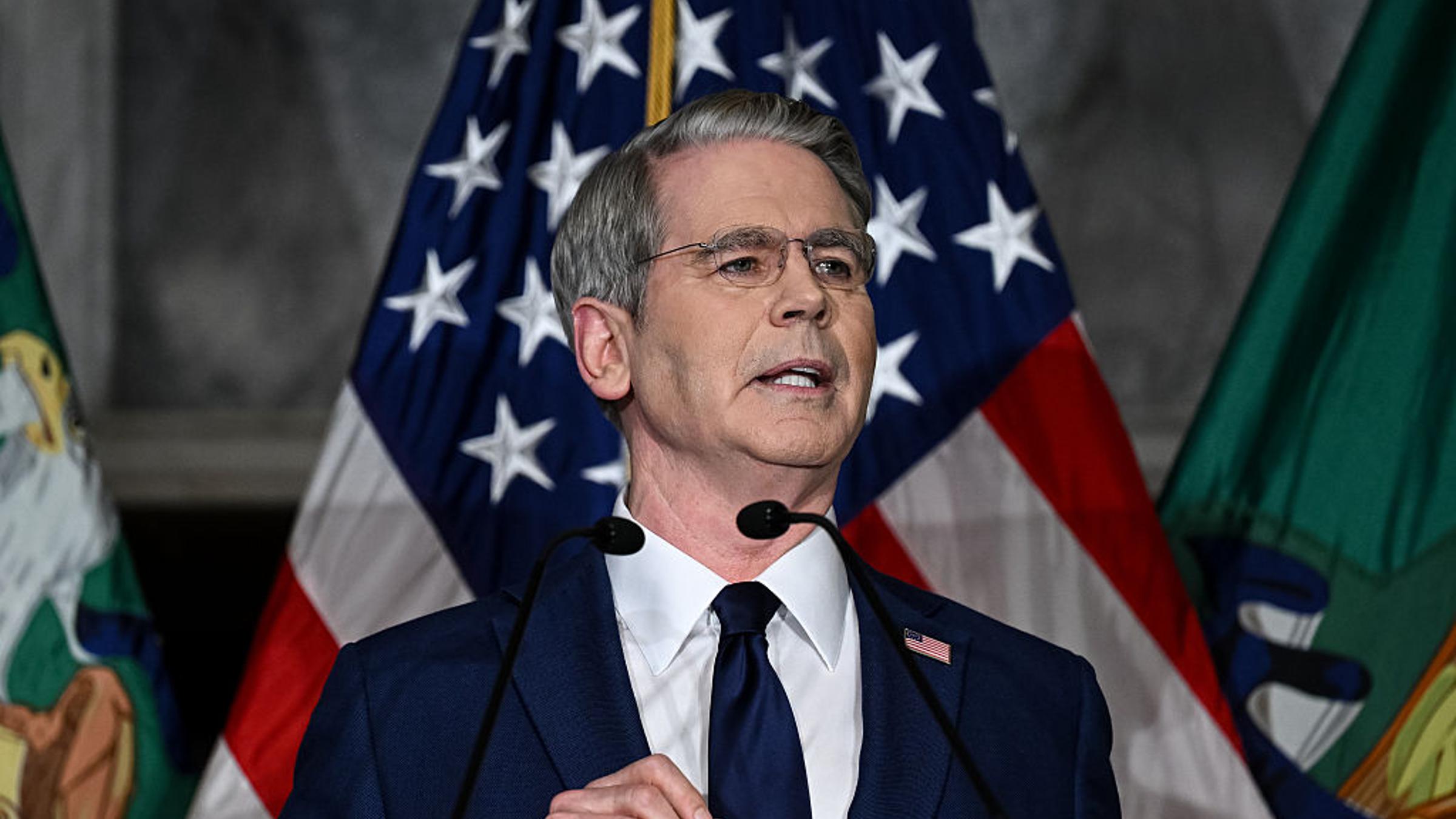
Trump last week threatened that the U.S. would target Oman next if it cooperated with Iran on this matter, telling Fox News: “We’ll bomb the s— out of them.” Experts have said, however, that this is an idle threat and that bombing Oman would be a mistake.
Continuing to enforce its blockade on the Strait does, however, come at a cost to Iran. A June analysis from the Foundation for Defense of Democracies estimated that Iran may be incurring economic damages of about $435 million per day while enforcing it.
How is the plummeting value of the rial affecting Iranians?
Ryan Costello, the policy director at the National Iranian American Council, tells TIME that implementing additional sanctions may not achieve the desired result—but will likely hurt Iranians.
“Regrettably, it has had very harsh impacts on ordinary Iranians—pushing millions out of the middle class, which is often seen as an engine for successful democratic change over time,” Costello says. “This currency depreciation has a real cost for ordinary Iranians, making their life ever more unaffordable.”
Coinbase has brought four 1:1-backed U.S. stock products to Base, allowing eligible non-U.S. investors to trade Apple, NVIDIA, Meta and Alphabet exposure around the clock.
Summary
- Four Coinbase tokenized stocks have launched on Base under the network’s B20 standard.
- Each token represents a beneficial interest in a real share held in segregated regulated custody.
- Eligible holders can trade the tokens or use supported products in Base-based lending and DeFi protocols.
- The securities remain unavailable to U.S. persons and have not been registered under the U.S. Securities Act.
Base said in an Aug. 25 announcement that Coinbase Tokenized Stocks are now available natively on the Ethereum layer-2 network, moving a product previously offered by the exchange into an open onchain environment.
The initial list includes NVIDIA under the ticker NVDAc, Meta as METAc, Apple as AAPLc, and Alphabet as GOOGLc. Base published a separate prospectus and contract address for each asset, asking users to verify the address before buying because tokens outside the official list were not issued by Coinbase.
Coinbase tokenized stocks use beneficial ownership structure
Under the product’s legal structure, each B20 token represents a beneficial interest in an underlying share rather than a synthetic contract that only follows its market price.
Coinbase Onchain SPV Ltd., a Coinbase-controlled company incorporated in the Abu Dhabi Global Market, formally issues the securities. According to the NVIDIA prospectus, the Financial Services Regulatory Authority approved the document on Aug. 4 under ADGM rules.
For every token issued, the special-purpose company initially holds one corresponding share through a segregated custody account. The prospectus identifies Alpaca Securities, an SEC-registered broker-dealer and FINRA and SIPC member, as the broker and custodian responsible for buying, selling, and holding the underlying equities.
Deposited shares are held in trust for tokenholders, according to the filing. Subject to the validity of the trust arrangements under ADGM law, the assets would not form part of the issuer’s property if the special-purpose company entered bankruptcy or insolvency.
Base describes the tokens as beneficial claims that provide direct economic exposure to the listed companies. Although Coinbase has promoted the structure as “real 1:1 backed tokenized stocks,” the prospectus draws a distinction between beneficial exposure and direct registration as the legal owner of each underlying share.
Holders also do not receive automatic voting rights in the underlying company. The filing states that verified, or “vested,” holders may send voting instructions to the issuer, which may try to vote the custodied shares on their behalf, subject to applicable law, timing, and practical limits.
In July, crypto.news reported Base’s preparations after network founder Jesse Pollak acknowledged that Robinhood had moved first by placing stock-linked products in an Ethereum-compatible setting.
“We’ve been behind on this on Base and I’m frustrated that’s the case,” Pollak said at the time, adding that the companies were close to introducing 1:1-backed equities.
B20 brings tokenized stocks into Base DeFi
Once issued as B20 tokens, the stock products can sit in self-custodial wallets and interact with supported decentralized applications. Base lists Aerodrome for tokenized-stock liquidity, while Aave, Morpho, and Euler provide or plan lending and borrowing functions.
Other listed integrations include 0x, 1inch, KyberSwap, and CoW Swap for token exchanges. Chainlink supplies price data infrastructure, while LI.FI and Jumper support services connected with cross-chain transfers and swaps.
Such integrations allow one token to move through several applications. For example, an eligible holder may trade a stock token through a decentralized exchange and later use it as collateral within a supported lending market, depending on the rules and availability of each protocol.
Trading can continue outside regular U.S. exchange hours, including weekends and American market holidays. Traditional shares listed on Nasdaq or the New York Stock Exchange still trade within their established sessions, meaning prices on decentralized venues could move when the primary market for the underlying security is closed.
Base said additional tickers will be introduced over the coming weeks, subject to regulatory approval. New listings would use the same B20 framework, allowing applications already integrated with the standard to support subsequent assets without building a separate system for each stock.
The launch follows Coinbase’s June rollout of tokenized exposure tied to NVIDIA, Alphabet, Strategy, BitMine and SpaceX. At that time, Coinbase said its products would support onchain trading, redemption, and distributions connected to the underlying shares.
Dividends are reinvested after taxes and fees
The prospectus does not provide for dividends to be paid directly to holders as cash. Instead, the issuer generally reinvests distributions received from the underlying company into additional shares, increasing the amount of underlying equity represented by each token through an adjusted deposit ratio.
Before reinvestment, the structure applies U.S. withholding tax. According to the NVIDIA filing, dividends paid to non-U.S. holders are currently subject to a 30% withholding rate unless an applicable tax treaty lowers it.
The issuer also charges a distribution fee equal to 5% of the gross value of dividends or other distributions before withholding taxes and reinvestment. Corporate actions, fees, and other costs can also change the deposit ratio over time.
Verified holders may request redemption in the underlying stock, U.S. dollars, or an accepted stablecoin such as USDC. A 0.05% redemption fee applies, while the issuer, broker, and custodian may conduct identity, anti-money laundering, sanctions, and jurisdiction checks before processing the request.
Redemption is not the same as immediately selling the underlying stock at the price shown when an order is filed. The prospectus warns that compliance reviews, settlement procedures, and market transactions can delay payment, while the price received after a sale may differ from the value available when the holder submitted the order.
Users who acquire tokens through unregulated DeFi markets may remain “unvested” until they satisfy the issuer’s compliance requirements. According to the filing, unvested holders cannot redeem their tokens, receive the underlying shares, or submit voting instructions.
U.S. investors cannot access the Base stock tokens
Despite representing shares of U.S.-listed companies, Coinbase Tokenized Stocks on Base are not available to U.S. persons. The securities have not been registered under the Securities Act of 1933 or with any U.S. state securities regulator.
Coinbase offers the products under Regulation S, an SEC registration exemption covering certain securities transactions conducted outside the United States. The prospectus prohibits offering, selling, or delivering the tokens within the country or for the account or benefit of a U.S. person.
American customers can separately use Coinbase’s regulated brokerage service for conventional stocks and exchange-traded funds. Coinbase Capital Markets offers those securities through a FINRA-member broker, with execution, clearing, and custody handled by Apex Clearing, but the arrangement is separate from the B20 products available on Base.
Competition outside the U.S. has continued to grow. An August tokenized-market comparison placed the total value tracked by Token Terminal near $2.7 billion, with Ondo Finance leading issuers while Binance bStocks and xStocks each held more than $600 million.
A separate July volume analysis found that tokenized stock trading had risen 288% during the month, although a tokenized QQQ product accounted for most decentralized secondary-market activity.
Coinbase’s prospectus warns that holders may lose their entire investment and that token prices can diverge from the underlying shares because of liquidity, market closures or disruptions. It also states that SIPC rules do not directly address the custody structure, leaving uncertainty over whether protection in an Alpaca insolvency would apply separately to each holder or only at the issuer level.
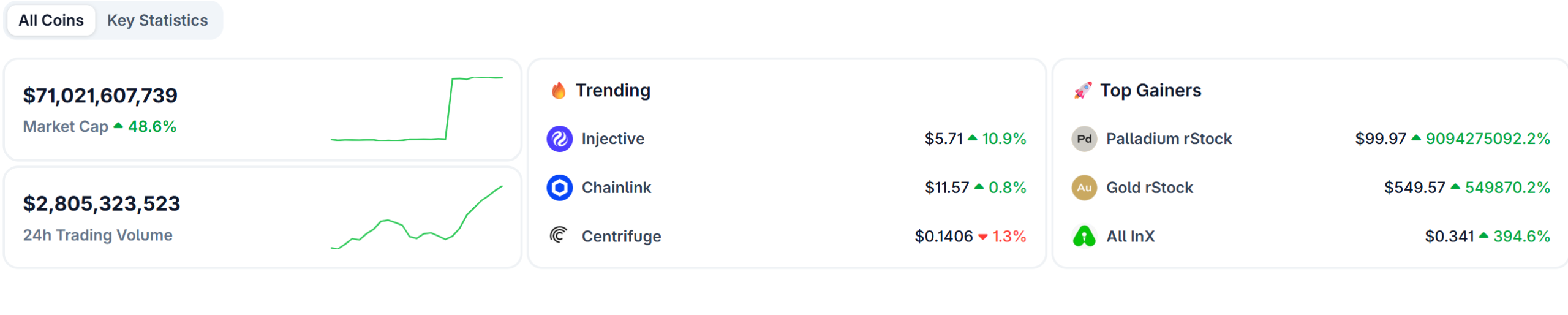
The real-world asset (RWA) market cap reached $71.02 billion on Monday, a gain of 48.7% in 24 hours, according to CoinGecko. Meme coins fell 2.2% over the same day.
The sector added $23.26 billion. One token accounts for almost all of it, and it is not a tokenized stock.

One Listing Explains the Whole Jump
Figure Heloc is the largest RWA holding at $22.81 billion. That is 32% of the sector. Take it out of Monday’s total and $48.21 billion remains. The sector was worth $47.75 billion a day earlier.
The difference between those two figures is 0.96%. In other words, the RWA sector without Figure Heloc is almost exactly where it stood the day before.

Prices did not do this. Chainlink (LINK) rose 0.8% on the day, and Stellar (XLM) fell 3.3%. Figure Heloc itself gained 4.5% across the week.
A token added to a list can raise a sector total. Nobody has to buy anything.
What Figure Heloc Actually Is
The token is a pool of home equity credit lines. Figure, a Nevada lender, issues them on its own Provenance blockchain. Figure is not a fringe operation. It listed on Nasdaq in September 2025 and earned $191 million on $619 million of revenue over the past year.
The scale is the striking part. Figure’s shares are worth $8.66 billion. Its tokenized loan book is worth $22.81 billion, or roughly two and a half times the company itself.
Those tokens barely move. They turned over $14.9 million in 24 hours, about 0.065% of their value. CoinGecko’s own data returns no 24-hour price change for them at all.
So the largest asset in crypto’s RWA sector is a securitized mortgage book that almost never trades. Researchers have tracked this gap between value and liquidity for months.
Tokenized Stocks See Modest Gain in Crypto Rally
Tokenized equities sit in a separate pool worth $8.25 billion. That is roughly a third of the jump they are credited with causing.
They also cannot outrun the shares they copy. MicroStrategy xStock (MSTRX) trades at $122.69, while Strategy’s Nasdaq-listed shares sit at $122.63.

It rose 27.9% over seven days because the stock did. The wrapper simply followed.
Meme Coins Fell While RWA Rose
Almost every large meme coin lost ground on Monday. Dogecoin (DOGE) fell 4.1%, Pump.fun (PUMP) dropped 7.9% and Official Trump (TRUMP) slid 9.9%.
The sector ended the day down 2.3% at $32.82 billion. Shiba Inu (SHIB), Bonk (BONK) and FLOKI all finished lower.

So Monday set a listing against a selloff. RWA gained on paper while meme coins lost real value. Turnover separates the two:
- Meme coins traded 13.2% of their market cap in 24 hours.
- The RWA sector managed 4%, and Figure Heloc just 0.065%.
Meme coins are the smaller market that actually changes hands. RWA is the larger one that mostly sits still.
The Seven-Day Picture Is Different
Widen the window, and meme coins lead on price. Official Trump gained 73.5% over seven days, Pump.fun 66.3% and Pepe (PEPE) 54.2%.
RWA tokens were steadier. Stellar climbed 22.1% and Chainlink 21.9% across the same week.
Meme coins also traded harder, turning over $4.35 billion against $2.82 billion. That extends the meme coin season rally.
BeInCrypto Intelligence research on the real state of tokenization tracked roughly $60 billion across 7,000 products. Most of it sits inactive on-chain.

The RWA sector grew by $23 billion on Monday. It grew by counting something new, not by anyone buying it.
The post RWA Market and Tokenized Assets Beat Meme Coins With a 50% Rally appeared first on BeInCrypto.


Users on X suspect that a recorded interaction between representatives of GTA VI publisher, Rockstar Games, and a pseudonymous X user was staged to pump a crypto scam amid the game’s ongoing leak scandal.
The clip appears to show the representatives knocking on the door of X user “@LewisBi94895348” who, via Reddit account “Pilotx1970,” appeared to predict major GTA VI leaks.
Last month, they posted “August 18 — don’t ask me how I know,” along with, “If you don’t believe me, come back on that date and we will see.”
They also claimed to know the identity of “CyberLeek,” the main X account that’s been leaking footage of GTA VI gameplay since August 18.
In footage posted by the Lewis X account today, one of the alleged Rockstar reps can be heard saying, “They’re not happy with it,” before asking, “Do you know certain individuals under certain handles, and who are the associates?”
Read more: Bitcoin spikes after GTA VI trailer leak says ‘Buy $BTC’
They later express doubt that his August 18 post was pure chance.
User’s doubt legitimacy of GTA VI investigation
The Lewis account also promoted their “GTA insider” cryptocurrency across several posts before deleting them.
Shortly after, users discovered that the account holder has previously been accused of scamming RC plane buyers on Facebook Marketplace, fueling speculation that the video might also be fake.
One user said there’s no subpoena for [Rockstar Games parent company] Take-Two to pursue Reddit before claiming that the video uploader is just “trying to get a piece of the pie.”
Others suggested that he hired some random people in order to get “millions of views on Twitter.”
Read more: Steam Workshop wallpapers found spreading crypto malware
Who is CyberLeek?
CyberLeek claims to be using his cryptocurrency $CYBERLEEK to raise funds for a “secret project” while advocating for better consumer rights across the video game industry.
However, gaming advocacy group Stop Killing Games has criticised the leaks, claiming the illegality of it “risks tarnishing the reputation of our communities and our chances to make change.”
Read more: GTA creator Rockstar Games bans NFTs and crypto
CyberLeek has continuously threatened to leak more content, and is now using $CYBERLEEK as a voting mechanism for buyers to determine what he leaks next.
One poll suggested he would leak content related to a group of nudists, while another suggested that he’ll move on from leaking free roam gameplay footage to leaking story content.
CyberLeek’s site also offered companies the chance to advertise on his page, but only if they pay $162,000 in Monero.
Take-Two appears to adopt “Sharkbux” virtual currency
What appears to be an SEC request filed this week by Take-Two’s Chief Legal Officer Daniel P. Emerson also reveals that GTA VI will include a virtual currency system.
It won’t have the hallmarks of a cryptocurrency, however, with no public ledger, secondary trading, or volatile pricing.
The request stresses that under the Howey test, Sharkbux will “not be viewed as the offer or sale of a security.”
Online users have spotted, however, that the SEC filing is addressed to the Crypto Assets and Cyber Unit, a government crypto authority disbanded and replaced in 2025.
Beyond this legal action, Take-Two has also filed several subpoenas over the weekend demanding Microsoft, X and Discord give up details related to the CyberLeek accounts.
Protos has reached out to Take-Two for comment on the apparent investigation and Sharkbux and will update this piece should we hear anything back.
Got a tip? Send us an email securely via Protos Leaks. For more informed news and investigations, follow us on X, Bluesky, and Google News, or subscribe to our YouTube channel.
Coinbase's tokenized US equities went live on Base on Monday, putting four technology stocks onchain as transferable tokens that eligible users outside the United States can hold in a self-custodial wallet, with no brokerage account required. Coinbase is issuing the assets, running the chain they… Read the full story at The Defiant

Percy Jackson Cast Teases ‘Some People Get What They Deserve’ in Season 3

Kimi Work for Financial Analysts: 3 Investment Research Workflows with Kimi K3
Olivia Attwood puts on a cheeky display in racy sheer lingerie for sizzling new snap – after revealing she wants a THIRD boob job





-

 Fashion3 days ago
Weekend Open Thread: Madewell – Corporette.com
-

 Business2 days ago
Musk’s Tesla, SpaceX Confirm $16.8 Billion ‘Terafab’ Chip Plant as World’s Largest Building in Texas
-

 Business6 days ago
SMA Solar Technology AG (SMTGY) Q2 2026 Earnings Call Transcript
-

 Crypto World3 days ago
anatomy of crypto’s biggest liquidation event since 2021
-

 Tech7 days ago
Qwen3.8-27B runs frontier-class coding agents and reasoning locally, no cloud API required
-

 Crypto World7 days ago
OCC Greenlights Trump Family Crypto Firm for Trust Charter
-

 Politics2 days ago
6 months on, Irish renters crushed by effects of government housing bill
-
 NewsBeat3 days ago
The ‘Lucky Dip Gang’ causing carnage for clicks: After five thugs were killed speeding in the wrong direction on a motorway, GUY ADAMS investigates a sick new trend… and why police aren’t even allowed to pursue them
-

 Crypto World7 days ago
NAVI Prime launches institutional lending framework on Sui
-

 Tech6 days ago
GLM-5.3 hits the API at $1.4/$4.4 per million tokens
-

 News Videos5 days ago
Don’t Leave Your Financial Future To Chance | August 19, 2026
-
Tech7 days ago
5 Of The Most Reliable Car Brands To Consider If You’re Buying A Used SUV
-
 Crypto World7 days ago
Dow’s 3-Year Winning Run Isn’t a Crash Signal, Still 49% Odds of Double-Digit Gains
-

 Business1 day ago
Mystery AI Model ‘Ox Alpha’ Draws Developers With Free Access as Chinese Lab Origins Remain Debated
-

 Tech7 days ago
Keychron K8 Ultra 8K review: a great value keyboard with comfort issues
-
 Tech7 days ago
Nvidia discloses $21B stake in SpaceX
-
 Business6 days ago
Stock Market Today: Tech Futures Slide As Treasury Yields Jump; Nvidia, Micron, Sandisk Sell Off
-

 Business5 days ago
Marvell Shares Jump 7% as Google Chip Deal Confirms Custom AI Silicon Partnership, Analysts
-
 Business4 days ago
Five Below: Kids Discount Retailer Reaps Rich Rewards
-
Business7 days ago
Fabrinet (FN) Q4 2026 Earnings Call Transcript
You must be logged in to post a comment Login