
Crypto World
RWA Market and Tokenized Assets Beat Meme Coins With a 50% Rally

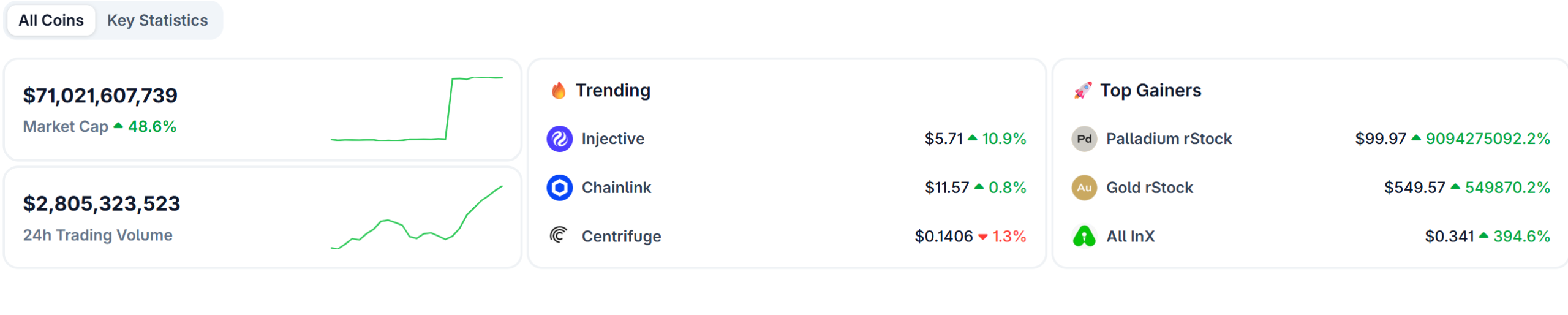
The real-world asset (RWA) market cap reached $71.02 billion on Monday, a gain of 48.7% in 24 hours, according to CoinGecko. Meme coins fell 2.2% over the same day.
The sector added $23.26 billion. One token accounts for almost all of it, and it is not a tokenized stock.

One Listing Explains the Whole Jump
Figure Heloc is the largest RWA holding at $22.81 billion. That is 32% of the sector. Take it out of Monday’s total and $48.21 billion remains. The sector was worth $47.75 billion a day earlier.
The difference between those two figures is 0.96%. In other words, the RWA sector without Figure Heloc is almost exactly where it stood the day before.

Prices did not do this. Chainlink (LINK) rose 0.8% on the day, and Stellar (XLM) fell 3.3%. Figure Heloc itself gained 4.5% across the week.
A token added to a list can raise a sector total. Nobody has to buy anything.
What Figure Heloc Actually Is
The token is a pool of home equity credit lines. Figure, a Nevada lender, issues them on its own Provenance blockchain. Figure is not a fringe operation. It listed on Nasdaq in September 2025 and earned $191 million on $619 million of revenue over the past year.
The scale is the striking part. Figure’s shares are worth $8.66 billion. Its tokenized loan book is worth $22.81 billion, or roughly two and a half times the company itself.
Those tokens barely move. They turned over $14.9 million in 24 hours, about 0.065% of their value. CoinGecko’s own data returns no 24-hour price change for them at all.
So the largest asset in crypto’s RWA sector is a securitized mortgage book that almost never trades. Researchers have tracked this gap between value and liquidity for months.
Tokenized Stocks See Modest Gain in Crypto Rally
Tokenized equities sit in a separate pool worth $8.25 billion. That is roughly a third of the jump they are credited with causing.
They also cannot outrun the shares they copy. MicroStrategy xStock (MSTRX) trades at $122.69, while Strategy’s Nasdaq-listed shares sit at $122.63.

It rose 27.9% over seven days because the stock did. The wrapper simply followed.
Meme Coins Fell While RWA Rose
Almost every large meme coin lost ground on Monday. Dogecoin (DOGE) fell 4.1%, Pump.fun (PUMP) dropped 7.9% and Official Trump (TRUMP) slid 9.9%.
The sector ended the day down 2.3% at $32.82 billion. Shiba Inu (SHIB), Bonk (BONK) and FLOKI all finished lower.

So Monday set a listing against a selloff. RWA gained on paper while meme coins lost real value. Turnover separates the two:
- Meme coins traded 13.2% of their market cap in 24 hours.
- The RWA sector managed 4%, and Figure Heloc just 0.065%.
Meme coins are the smaller market that actually changes hands. RWA is the larger one that mostly sits still.
The Seven-Day Picture Is Different
Widen the window, and meme coins lead on price. Official Trump gained 73.5% over seven days, Pump.fun 66.3% and Pepe (PEPE) 54.2%.
RWA tokens were steadier. Stellar climbed 22.1% and Chainlink 21.9% across the same week.
Meme coins also traded harder, turning over $4.35 billion against $2.82 billion. That extends the meme coin season rally.
BeInCrypto Intelligence research on the real state of tokenization tracked roughly $60 billion across 7,000 products. Most of it sits inactive on-chain.

The RWA sector grew by $23 billion on Monday. It grew by counting something new, not by anyone buying it.
The post RWA Market and Tokenized Assets Beat Meme Coins With a 50% Rally appeared first on BeInCrypto.


In the latest Solana news, 3 governance proposals capable of reshaping the network’s supply dynamics head into their final voting window. Voting closes at the end of epoch 1023 on Thursday, a deadline that has quietly become one of the more consequential dates on Solana’s 2026 calendar.
The vote covers a “Solana Constitution” governance framework, a disinflation proposal targeting an 18.9 million SOL emissions cut over 6 years, and a resource fee mechanism designed to push daily SOL burning from roughly 648 to 9,000 tokens.
That is a burn rate increase of nearly 14x. A bullish supply shock narrative is forming around the vote, suggesting traders are front-running the tightening float before implementation even lands.
The timing matters. Broader crypto sentiment has been choppy, yet SOL has decoupled to the upside, a divergence worth watching as governance-driven scarcity narratives collide with technical resistance overhead.
JUST IN: Voting is now live on 3 major @Solana governance proposals and will remain open until the end of epoch 1023 on Thursday
SGP 1: “Solana Constitution,” a new governance framework
— SolanaFloor (@SolanaFloor) August 23, 2026
Gain Access to New Bitcoin Layer 2 Early Here
Solana News: Can SOL Price Hit $105 This Week?
SOL’s daily bar for August 25 opened at $98.64, ran to a high of $102.14, and closed near $101.22. The 7-day gain sits at 31.87%, and the 30-day move is near 35.6%. This is not a single-day spike. It is a sustained trend.
Resistance clusters between $100 and $105.18, with a 13-week high sitting around $102.70. Support has layered in beneath at $88.18, with deeper structural support near $82 to $88 where the EMA20/EMA50 clusters previously held.

A close above $102.70 opens room toward $105 and beyond, especially if the disinflation vote passes cleanly. SOL consolidating between $95 and $102 as traders wait for Thursday’s epoch close before committing further capital is the base case. Rejection at resistance sends price back to retest the $88 to $90 pivot zone and invalidates the current breakout structure.
Traders watching for confirmation should track volume on any push through $102.70. A low-volume breakout would be a red flag.
Gain Access to New Bitcoin Layer 2 Early Here
Bitcoin Hyper Targets Early Mover Upside as Solana Tests Key Levels
A 31.87% weekly rally validates anyone who bought SOL below $80. But at a market cap already pricing in governance-driven scarcity, the remaining upside to $105 is single-digit percentage territory — not the kind of asymmetric return early-stage capital typically hunts for.
That’s pushed attention toward Bitcoin’s own scaling gap, one Solana effectively exploited years ago with its throughput advantage.

Bitcoin Hyper (HYPER) is positioning itself as the first Bitcoin Layer 2 with native SVM integration, smart contract speed on top of Bitcoin’s security, without the base-layer bottlenecks.
The presale has raised $33,080,369.89 at a current token price of $0.0136852, with staking rewards live at launch (APY not yet disclosed). Its Decentralized Canonical Bridge aims to solve BTC’s programmability gap directly, the same limitation that pushed capital toward Solana and Ethereum in the first place.
Presale allocations carry standard early-stage risk: no live mainnet yet, and returns depend on execution. Full breakdown of the raise and Layer-2 mechanics is covered in this presale assignment report.
Unlock Access to Bitcoin’s New Layer 2 Here
The post Supply Shock? SOL Voters Are Deciding Whether to Cut Emissions and 14x the Burn Rate appeared first on Cryptonews.
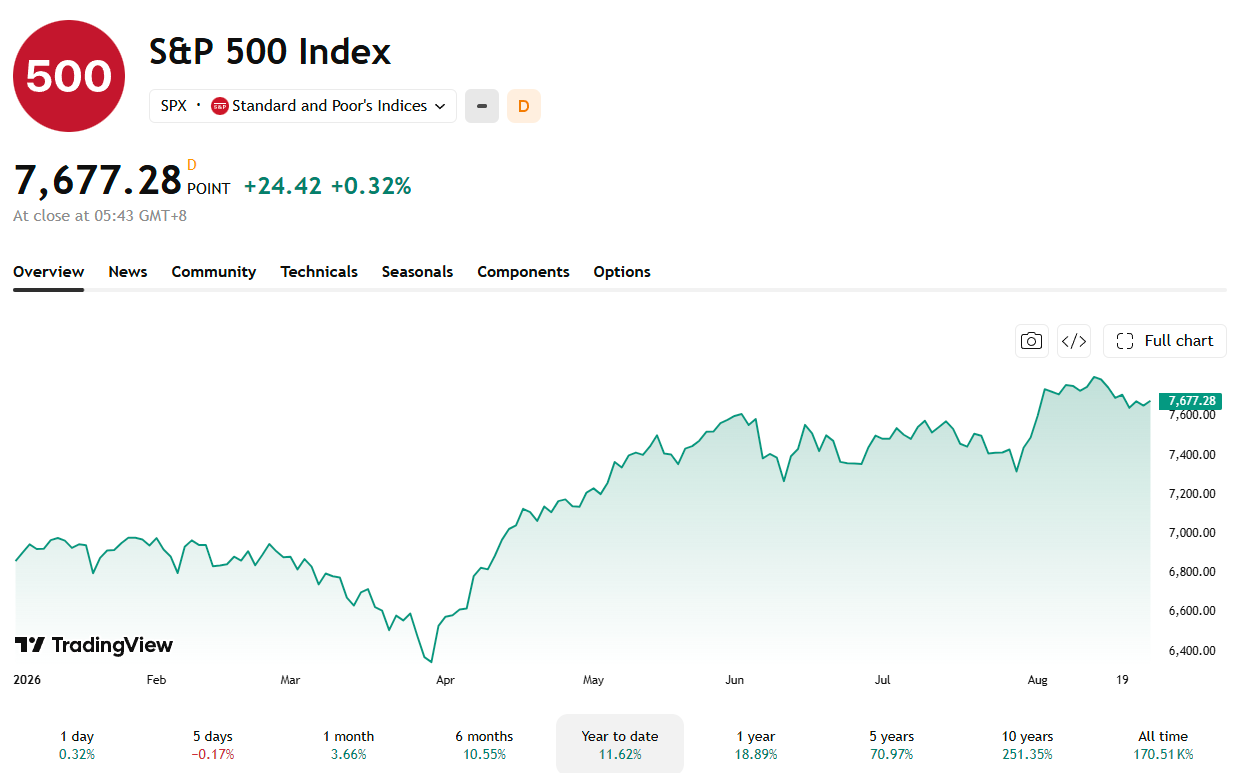
Jim Paulsen, a veteran market strategist, says the U.S. stock market has used up most of the room it traditionally relies on to climb higher, even as slowing momentum starts to press against record valuations.
Paulsen, a longtime economist who spent years as chief investment strategist at the Leuthold Group, made the case on CNBC’s Closing Bell Overtime. He pointed to profits, valuations, and investor positioning all sitting near historic extremes.
Paulsen Flags Record Stock Market Valuations
Paulsen said in July that the S&P 500’s price level sits about 60% above its post-World War II trend line. That level has only been matched once before, near the peak of the dot-com bubble.
Trailing 12-month earnings are also 60% above their own trend line. Paulsen called that a record, exceeding even prior cycle peaks such as the dot-com era.
Corporate profit margins and non-residential investment spending, measured against gross domestic product, have also reached record highs. Forward earnings estimates compared with trailing profits have also been unusually high, Paulsen said. That measure is nearing record territory in data going back to 1990.
Valuations are not all at record levels, Paulsen said, but by most measures they remain historically high. He added that household exposure to equities, as a share of financial assets, sits at a record high. Cash holdings relative to market value are close to a record low.
Paulsen called the overall mood complacent, since investors have grown used to buying every dip.
“No one’s worried about recession anymore, Michael, because we haven’t had one for 16 years.”
Jim Paulsen, CNBC

Slowing Momentum Could Flip the Rate-Cut Script
Paulsen flagged weakening data, including recent ADP payroll figures, softer retail sales, and sluggish housing activity. He cited the Citigroup U.S. Economic Surprise Index, which tracks how incoming data compare with forecasts. That gauge has fallen from 60 to 25 in recent weeks.
Paulsen warned that falling rates could coincide with falling stock prices, rather than trigger the rally investors typically expect. That risk grows if the rate declines reflect weakening growth rather than cooling inflation.
He also pointed to the dollar. In real terms, it remains within 8% of the all-time high it set in 1970.
He also downplayed fears tied to the Treasury’s bond buyback plan, which billionaire investor Stanley Druckenmiller criticized. Paulsen called the recent yield moves more noise than substance.
Oil prices are adding further pressure on the system, Paulsen said. That pressure weighs on both corporate margins and household purchasing power.
Whether that slowing momentum turns into an outright pullback remains unclear. Much may depend on how quickly the underlying data keep deteriorating in the weeks ahead.
The post Veteran Strategist Warns Stocks Have ‘Used Up' Room to Keep Climbing appeared first on BeInCrypto.

Bitcoin rose above $80,000 today, reaching more than a three-month high as softer U.S. dollar news revived momentum in the crypto sector. The cryptocurrency was last trading at $80,300 after touching $81,200. It had risen 16% since the prior week.
The move has drawn attention to two forces behind the rally: demand through U.S. spot Bitcoin exchange-traded funds and the unwinding of bearish positions as prices climbed.

This month, the U.S. Treasury doubled its support for longer-dated government bonds, increasing its buyback program from $2 billion to $4 billion. The move does not directly expand the money supply, but it may put downward pressure on long-term yields and can be viewed by markets as having an easing-like effect.
The announcement helped revive discussion of the debasement trade, in which investors seek assets seen as protection against a weaker dollar, persistent deficits, and inflation. Bitcoin’s fixed supply of 21 million coins is part of its appeal to investors who view scarce assets as a hedge against currency weakness.
Dollar weakness accompanied the move. The ICE U.S. Dollar Index fell 0.8% during the week after the Treasury announcement. Gold also moved above its 200-day moving average, which was near $4,518 an ounce, over the same period.
Discover: The Best Token Presales
ETF Flows and Short Covering
U.S. spot Bitcoin ETFs recorded $517 million in net inflows on August 19, their strongest day since May. The funds drew roughly $1 billion in net inflows during the first two weeks of August 2026.

Short covering added to the speed of Bitcoin’s advance. Roughly $1.5 billion in Bitcoin short positions were liquidated as prices rose, with about $700 million cleared in a single minute. When traders with short positions exit their positions, the buying needed to close them can add pressure on an upward price move.
The combination of ETF demand and short liquidations helps explain the scale of the rally. The ETF news reflects flows into regulated products that allow investors to gain Bitcoin exposure through brokerage accounts without directly holding the cryptocurrency.
Bitcoin Pumps, But Bond Yields News Remain in Focus
The Treasury said its larger buyback operations for longer-dated Treasurys would begin September 9 and were intended to provide greater liquidity support. The initial positive reaction in the bond market reversed the following day, however.
The 10-year Treasury yield rose to 4.737%, while the 30-year yield increased to 5.276%, according to Dow Jones Market Data cited by MarketWatch. Those levels brought the rates back to around where they stood before the buyback announcement.
Ian Lyngen, head of U.S. rates strategy at BMO, said concerns over de-dollarization, U.S. creditworthiness, and the need for a higher term premium remained central to the recent bond selloff. His assessment underscored skepticism that the Treasury’s buyback adjustment had changed the underlying drivers of rising yields.
A sustained break could put Bitcoin’s next test in the $95,000 to $100,000 range, but no analyst can reliably determine whether the rally will continue. For now, the August move has highlighted how macroeconomic expectations, ETF flows, and market positioning can converge.
The Treasury action was viewed by some market participants as easing-like, while Bitcoin’s fixed supply kept it in focus alongside gold as investors weighed dollar weakness and inflation concerns.
Discover: The Best Crypto to Diversify Your Portfolio
The post Bitcoin News: ETF Demand and Short Covering Power August Rally appeared first on Cryptonews.
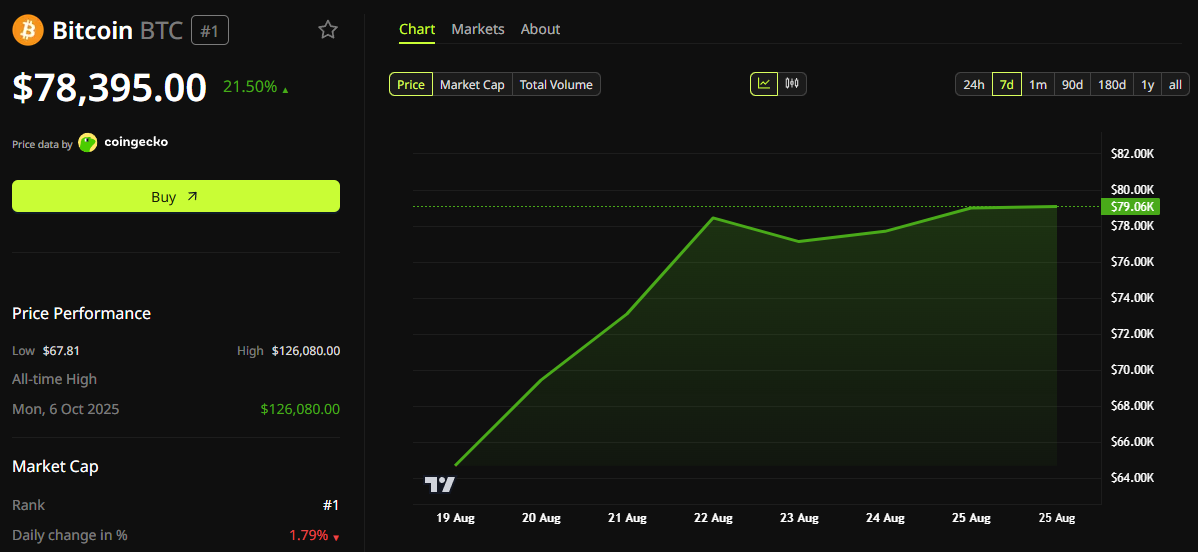
Katie Stockton, founder of Fairlead Strategies, said Bitcoin (BTC) has more room to run than gold right now. She pointed to how differently the two assets bottomed out.
Stockton joined CNBC’s “The Exchange” as BTC extended a sharp recovery. She said the digital asset is no longer oversold but has not become overbought either.
Bitcoin’s Breakout Confirmed
Stockton described a basing phase that started in June. She said the retest came in July, and a breakout is now underway.
BTC cleared its 200-day moving average, a level she called an almost precise hurdle back in May.
“We have obviously very strong short-term momentum and improved intermediate-term momentum now off of these lows.”
Katie Stockton, Fairlead Strategies, on CNBC
Bases often take time to complete, with multiple retests along the way, she noted. She said the immediate follow-through after the breakout helps confirm it.

Gold’s Rally Looks Different
Gold tells a different story, according to Stockton. The metal’s intermediate-term downtrend started later than BTC’s. Its current bounce is a countertrend rally rather than a full trend reversal.
Stockton said gold still carries intermediate-term momentum and should see further gains. She expects that move to hit resistance sooner than BTC’s, though.
The difference comes down to how long each asset spent falling before it turned higher. Stockton said BTC’s longer-term oversold reading followed a more prolonged decline. That gave it more time to complete a proper base.
Gold’s drop was shorter, leaving less room for its rebound to extend. That timing gap is the core of Stockton’s call.

BTC has more room to run before it looks stretched. Gold’s rally is closer to running its course.
BTC traded near $78,400 at the time of publication. Gold sat around $4,636 an ounce.
Both assets have rallied hard over the past several weeks. That has drawn fresh attention from traders comparing the two as stores of value.
Stockton’s read puts her among the more constructive voices on BTC’s outlook right now. She expects BTC’s rally to keep running longer than gold’s advance, giving it more room before hitting resistance.
Traders are still weighing whether the bounce marks a genuine trend change or another rally to sell into. Stockton’s read suggests the former for BTC.
Gold’s advance, by contrast, looks more like a pause within a longer corrective phase.
The post Fairlead Strategies Founder Says Bitcoin's Rally Has More Room Than Gold's appeared first on BeInCrypto.

Until now, the biggest jumps from this type of training have come from coding models, mostly because code has a useful property: it either works or it doesn’t, meaning that the reward signal is immediate, so improvement can happen in a fast loop. (It’s also helpful that there was plenty of coding data already out there on the internet, meaning models were good coders to begin with.)
But AI companies’ long-term goal is to automate large swathes of the economy. That’s where Spirit’s data likely comes in.
What makes the data useful
RL environments are only as good as the data that populates them, says Heiner of Surge AI. Companies like Surge and Mercor often hire human workers who are tasked with populating these environments with realistic data, either from scratch or in partnership with AI tools. “But even that is a little bit removed from literally having actual data that was used in the real world,” Heiner says. “That’s where deals like Spirit come in.”
The OG meme coin followed the green wave sweeping through the cryptocurrency sector, with its price climbing to a nearly three-month high.
Some analysts think the token is set for a relatively mild increase ahead, while others foresee an explosion to a new all-time high.
What’s Next?
DOGE currently trades just south of $0.09, representing roughly a 30% pump from a week ago. It remains the biggest meme coin and even widened the gap between itself and Shiba Inu after its market capitalization neared $14 billion.
Not long ago, Ali Martinez identified $0.0813 as key resistance, where more than 30 million DOGE were previously traded. He believes a sustained close above this level (as it happened) could result in a further upside, setting the next target at around $0.177.
In addition, the analyst outlined numerous factors that point to a bullish move ahead. Among those are the whales’ accumulation and the Tom DeMark Sequential indicator, which flashed a buy signal.
Martinez’s prediction is modest compared to those of many other analysts. X user MikybullCrypto envisioned an “explosive move on the horizon” that could result in a pump to $3. Vuori Trading was even more bullish, opining that DOGE is “most likely going to $10.”
It is worth noting that such an ascent would require the meme coin’s market capitalization to surpass $1.5 trillion. Even with the recent crypto boom, that type of increase seems quite unrealistic (to put it mildly).
The Key Formation
Approximately a week ago, X user The Great Mattsby paid attention to Dogecoin’s Bollinger Bands. They noted that the channels have tightened and wondered whether this isn’t the biggest squeeze in the asset’s history.
Such a setup usually occurs during periods of low volatility and could be a precursor to a major move (though the direction is unclear, as it may also lead to a violent pullback). At the moment, it seems the squeeze was followed by a significant pump, but who knows what the future holds.
In the meantime, certain elements suggest a correction could be on the way. DOGE inflows into exchanges have surpassed outflows over the past several days, suggesting that some investors have abandoned self-custody and flocked to centralized platforms. This increases the immediate selling pressure and could negatively impact the price in the short term.

The post Dogecoin (DOGE) Rises 30% in a Week: What Are the Next Targets? appeared first on CryptoPotato.


The funding loss leaves InterPlanetary File System software without dedicated maintainers and puts the future of key public services in Protocol Labs’ hands.

The top-ranked Brazil-based employer is accounting firm Contabilizei (no. 5), which specializes in helping small businesses and entrepreneurs with financial services from managing expenses and invoices to taxes. As the number of new small businesses in the country continues to grow, and more people flock to digital banks, innovative fintechs like Contabilizei have an opportunity to become a key part of that domestic economic ecosystem.
See the full list of Brazil’s Best Employers of 2026 below.
Português
A TIME e a Statista lançaram a lista de 2026 dos Melhores Empregadores, com base em pesquisas independentes realizadas com funcionários em países ao redor do mundo. No Brasil, a Statista reuniu 900 mil avaliações de funcionários de uma ampla variedade de setores. Essas pesquisas incluíam perguntas abertas sobre a disposição dos funcionários em recomendar seu próprio empregador e a disposição em recomendar outros empregadores do mesmo setor. Os 500 melhores empregadores, classificados com base nesses resultados, foram nomeados “Melhores Empregadores do Brasil 2026.”
A Microsoft, assim como em 2025, é novamente a principal empregadora do país. A empresa tem presença de décadas em território brasileiro e investiu bilhões em infraestrutura de IA e em capacitação relacionada no Brasil, a economia líder da América Latina. Este ano, os quatro principais empregadores do Brasil são todas empresas de tecnologia americanas, incluindo SAP, Alphabet e IBM. No último ano, aproximadamente, o Brasil tem atraído o interesse de um número crescente de empresas globais de tecnologia à medida que se posiciona como um polo de data centers sustentáveis, com políticas nacionais que oferecem incentivos fiscais e energia limpa para alimentar essas instalações. De fato, o governo, junto com os maiores bancos do Brasil, vem moldando o setor de tecnologia no país na última década ao gastar bilhões em serviços digitais, como licenciamento de software e cibersegurança, de empresas estrangeiras, de acordo com um estudo de 2025 conduzido por pesquisadores da Universidade de São Paulo, da Universidade de Brasília e da Fundação Getúlio Vargas — uma medida que, segundo alguns críticos, compromete a soberania tecnológica do Brasil e desvia investimentos de soluções nacionais. Ao mesmo tempo, muitas dessas empresas de tecnologia, como Microsoft e IBM, vêm oferecendo programas de certificação profissional acessíveis a trabalhadores em todo o mundo, na tentativa de reduzir a lacuna de habilidades.
A empregadora brasileira mais bem colocada é a empresa de contabilidade Contabilizei (nº 5), especializada em ajudar pequenas empresas e empreendedores com serviços financeiros que vão desde a gestão de despesas e faturas até impostos. À medida que o número de novas pequenas empresas no país continua a crescer, e mais pessoas migram para bancos digitais, fintechs inovadoras como a Contabilizei têm a oportunidade de se tornar uma parte fundamental desse ecossistema econômico doméstico.
Veja a lista completa abaixo.
Japan’s bond market is heading for a blockchain makeover. Nikkei reported this week that regulators want stocks and Japanese government bonds (JGBs) to settle instantly, around the clock.
While the country has run blockchain pilots before, this is the first time it has put dates on a national rollout.
Why Japan’s Bond Market is Moving to Blockchain
The work starts this summer, with the Financial Services Agency (FSA), the Ministry of Finance, and the Bank of Japan expected to lead it.
Banks join them in a study group, with a development plan expected to land by early 2027. The system could go live in the early 2030s.
Today, a stock trade in Tokyo takes two days to settle, while a JGB trade takes one. The new rails would cut that to near zero. Sellers could reinvest their cash almost instantly.
The prize is huge, as Japan holds roughly 1,166 trillion yen in outstanding government bonds and bills, per Ministry of Finance figures. At current exchange rates, that is about $7 trillion.
Japan has upgraded before, one step at a time. JGB settlement fell to one day in 2018, per JSCC. Stocks followed to two days in 2019. The US cut stocks to one day in 2024. Erasing the delay entirely would leapfrog them all.
Banks are not waiting, with four of Japan’s biggest lenders already running a blockchain collateral trial for JGBs since April 2026.
SBI and the Solana Foundation are also building Japan’s on-chain finance push around yen stablecoins.
New Rails Under a Market Already in Stress
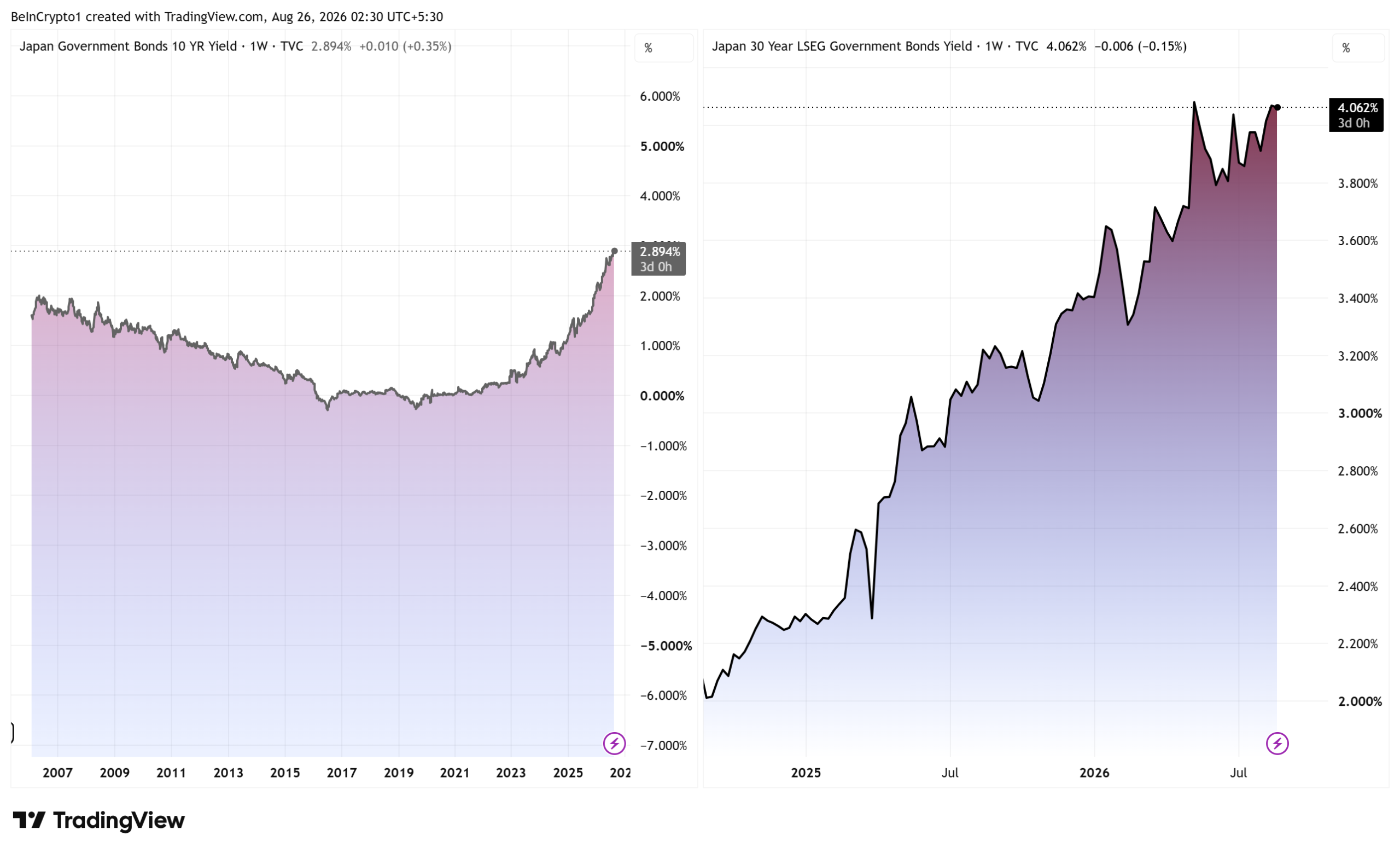
The timing is also interesting. Japan is rebuilding its plumbing while the old system takes its worst beating in decades. The 10-year JGB yield sits near 2.9%, close to multi-decade highs, while the 30-year trades above 4%.

Markets see an 80% chance of a Bank of Japan rate hike next month. Sticky inflation has made a September BOJ hike harder to avoid.
The yen trades near 159 per dollar. In early August, Japan and America confirmed their first joint yen-buying intervention since 2011. BeInCrypto recently examined how 1996-high borrowing costs are rippling through crypto markets.
Faster settlement will not fix any of that. Yields and the yen answer to inflation, debt, and policy. However, higher rates change the math on idle money. Cash stuck between trade and settlement now costs more every day. Instant settlement turns that dead time into working capital.
The plan still needs formal approval, and launch is years away. The direction, though, is set. Japan wants blockchain at the core of a $7 trillion market. The study group’s lineup and its choice of chain will show how serious Tokyo is.
The post $7 Trillion Japan Bond Market is Moving to the Blockchain appeared first on BeInCrypto.


World Liberty Financial has launched its $4.05 billion USD1 stablecoin natively on the Canton Network, giving institutions a dollar-based settlement asset for tokenized securities and other real-world assets.
Summary
- USD1 can settle tokenized assets through Canton’s privacy and permissioning controls.
- Institutions can use the stablecoin for collateral, lending, issuance, redemptions, and cross-border payments.
- DeFiLlama ranks the $4.05 billion USD1 as the sixth-largest stablecoin.
- World Liberty’s proposed U.S. trust bank still requires final OCC authorization.
USD1 gives Canton transactions a cash settlement option
World Liberty Financial said in an Aug. 25 announcement that USD1 is now issued directly on Canton rather than arriving through a bridge from another blockchain.
Native issuance lets an institution exchange USD1 and a tokenized asset as parts of the same transaction. According to the announcement, Canton’s system synchronizes both transfers so the cash and asset can settle together, reducing the risk that one side completes while the other remains outstanding.
Canton applies privacy and permission controls to transactions conducted on its public blockchain. The network says the system allows participating firms to control which parties can view transaction information while supporting the compliance requirements used in regulated financial markets.
Through the integration, World Liberty said institutions can use USD1 to provide collateral for derivatives and institutional loans. The stablecoin can also fund asset issuances, process redemptions, support financing arrangements and settle cross-border payments around the clock.
Tokenized government debt and other financial assets often require a corresponding cash payment when they change hands. World Liberty said adding USD1 gives Canton users a fully reserved dollar stablecoin for that cash side without moving the transaction through a separate payment network.
According to World Liberty, USD1 is redeemable for U.S. dollars on a one-to-one basis. The company says its reserves include dollar deposits, U.S. government money market funds, and other cash equivalents, with reserve reports published monthly.
USD1 enters a network built around institutional assets
Canton said more than $9 trillion in tokenized assets are issued or processed through its network each month. The company also reported that more than $350 billion in onchain U.S. Treasurys moves across Canton daily, although the figures represent activity rather than the total value locked on the blockchain.
Government debt on Canton is used as collateral, repurchase agreements, and treasury-management transactions, according to the USD1 announcement. In such trades, delays between the transfer of an asset and the related payment can tie up capital or require financial institutions to retain additional liquidity.
Canton’s synchronized settlement design allows the asset and payment to move at the same time. Native USD1 can now serve as the dollar-denominated payment in those transactions while remaining subject to the network’s privacy settings.
An earlier institutional transaction showed how the structure works with another stablecoin. Tradeweb said in July that Franklin Templeton transferred a tokenized U.S. Treasury security to Virtu Financial in exchange for USDCx, with Canton synchronizing the two sides in real time.
World Liberty and Canton initially disclosed plans for the USD1 deployment in December 2025, when the stablecoin had a market capitalization of more than $2 billion. At the time, the companies identified intraday repo and digital bond settlement among the intended uses.
USD1’s market value has since reached approximately $4.05 billion, according to DeFiLlama stablecoin data, placing it sixth among dollar-pegged tokens by capitalization. Stablecoin supply can increase when authorized parties mint new tokens and decline when holders redeem them.
In March 2025, World Liberty introduced USD1 as a dollar-backed token for institutional and retail transactions. BitGo Bank & Trust currently issues the stablecoin, manages its reserve assets, and processes minting and redemption requests on the company’s behalf.
World Liberty’s USD1 growth faces U.S. scrutiny
The Canton deployment adds another institutional use for USD1 one day after crypto.news reported its $4 billion growth. World Liberty CEO Zach Witkoff attributed the increase to institutional demand and rejected claims that the company’s relationship with the Trump family accounted for the stablecoin’s adoption.
A $2 billion transaction has formed a large part of USD1’s early use. In May 2025, Abu Dhabi-backed investment firm MGX used the stablecoin to settle its investment in Binance after initially announcing the deal without identifying the settlement asset.
World Liberty’s connections to President Donald Trump and the involvement of a foreign state-backed investor have drawn questions from Democratic lawmakers. Public disclosures cited in previous coverage show that an entity affiliated with Trump and members of his family holds an interest in World Liberty’s parent company.
For U.S. institutions considering USD1, federal oversight of its issuer remains an important procedural issue. The Office of the Comptroller of the Currency granted World Liberty Trust Company conditional charter approval on Aug. 14, allowing the company to proceed with organizing a national trust bank.
The OCC’s decision does not allow the proposed bank to begin operating. According to the regulator’s approval, World Liberty Trust must maintain at least $20 million in eligible capital, appoint a qualified internal audit manager, and complete other preopening requirements before receiving final authorization.
If the OCC issues that authorization, the trust company plans to take over USD1 issuance, redemption, and reserve management from BitGo. The proposed institution would also provide digital-asset custody and stablecoin conversion services to institutional clients under federal supervision.
Unlike a conventional commercial bank, World Liberty Trust would not accept ordinary deposits or make standard loans. National trust banks generally concentrate on custody, fiduciary, settlement, and asset-servicing activities, and the OCC can change, suspend, or withdraw its preliminary approval before the institution opens.
Canton is also preparing a U.S. benefits pilot
Digital Asset, the company behind Canton, has also expanded the network’s proposed role in U.S. public-sector payments. In August, Digital Asset and former House Speaker Paul Ryan’s American Idea Foundation unveiled a benefits pilot scheduled to begin in three states during the first quarter of 2027, subject to federal approval.
Called Resources for Independence, Stability, and Employment, the program would combine separate benefits into monthly or twice-monthly payments. The organizations said Canton would apply rules covering approved spending categories while restricting access to recipients’ sensitive information.
Program administrators would also be able to adjust payments automatically when a recipient’s reported income changes, according to the announcement. Digital Asset and the foundation have not identified the participating states or disclosed which benefit programs will enter the pilot.

Nine lifts profit, maintains streaming focus
Supply Shock? SOL Voters Are Deciding Whether to Cut Emissions and 14x the Burn Rate

Man United transfer news LIVE: Alejandro Balde offer, Lewis Hall response, Carlos Baleba confirmed

Weekend Open Thread – Corporette.com

Weekend Open Thread: Brooks Brothers

London Mayor Sadiq Khan handed a peerage by Keir Starmer alongside 15 other Labour figures… just days before the PM leaves No10

WATCH LIVE: Trump speaks after hosting cryptocurrency leaders at the White House

Donald Trump LIVE: US President Hosts Crypto Executives In White House | SEC Regulations |N18G

SharpLink & Lido: The Future of Ethereum Has Never Been Brighter (Here’s Why)
-

 Fashion4 days ago
Weekend Open Thread: Madewell – Corporette.com
-

 Business3 days ago
Musk’s Tesla, SpaceX Confirm $16.8 Billion ‘Terafab’ Chip Plant as World’s Largest Building in Texas
-

 Crypto World4 days ago
anatomy of crypto’s biggest liquidation event since 2021
-

 Crypto World1 day ago
A $30 Billion AI Fund Implodes, Now the SEC Is Investigating Wall Street’s Role
-

 Politics4 days ago
6 months on, Irish renters crushed by effects of government housing bill
-
 NewsBeat4 days ago
The ‘Lucky Dip Gang’ causing carnage for clicks: After five thugs were killed speeding in the wrong direction on a motorway, GUY ADAMS investigates a sick new trend… and why police aren’t even allowed to pursue them
-

 Tech7 days ago
GLM-5.3 hits the API at $1.4/$4.4 per million tokens
-

 Business3 days ago
Mystery AI Model ‘Ox Alpha’ Draws Developers With Free Access as Chinese Lab Origins Remain Debated
-

 News Videos6 days ago
Don’t Leave Your Financial Future To Chance | August 19, 2026
-

 Business6 days ago
Marvell Shares Jump 7% as Google Chip Deal Confirms Custom AI Silicon Partnership, Analysts
-

 Business5 days ago
Five Below: Kids Discount Retailer Reaps Rich Rewards
-

 Business1 day ago
Moderna CEO warns China is pouring state money into mRNA technology
-

 Business4 days ago
UK firms in critical financial distress rise 9% to 53,756
-

 Sports3 days ago
Deshaun Watson fires back at Browns fans after being booed: ‘It’s a disrespectful thing’
-

 Business1 day ago
NVIDIA Stock Drops Nearly 2 Percent to $210 on Seventh Losing Day Ahead of Critical AI Earnings
-

 Fashion6 days ago
Jimmy Choo Autumn 2026 collection
-
 Entertainment6 days ago
10 Most Perfect Fantasy Shows of the Last 25 Years
-

 Tech6 days ago
OpenAI confirms ChatGPT is down as logins and signups fail
-

 Business6 days ago
PayPal and Venmo now accepted for tuition at several universities
-

 Crypto World6 days ago
Optimism-funded team's deciding vote shifts $49 million in OP tokens away from users
You must be logged in to post a comment Login