
Entertainment
The Tom Cruise Thriller That Created ‘Reacher’s Formula Is Taking Over Streaming

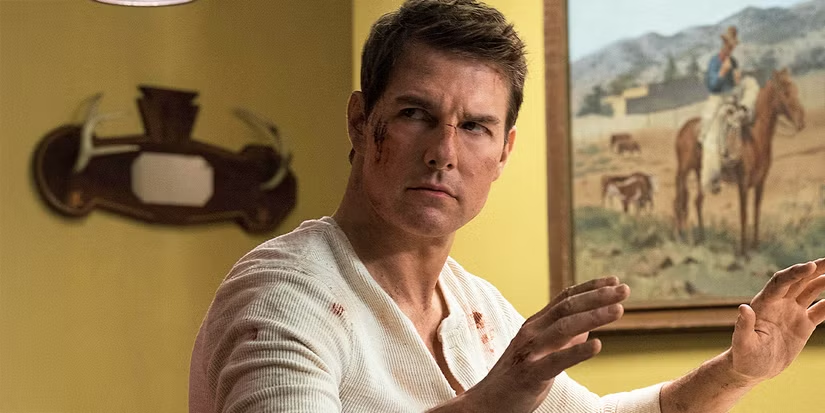
Fans of Lee Child’s Jack Reacher book series rejoiced when Prime Video’s wildly successful series, Reacher, hit TV screens in 2022 with the strapping, gargantuan Alan Ritchson in the titular role. Ritchson’s four-season run as Reacher, in the minds of many fans, righted the wrong of Tom Cruise’s original turn as the hero; even creator Childs eventually admitted that casting Cruise as a 6’5, 250-pound bruiser was ridiculous, telling the BBC that “Cruise, for all his talent, didn’t have that physicality.” Cruise’s two Reacher movies — Jack Reacher, released in 2012, and its forgotten sequel, Jack Reacher: Never Go Back, released in 2016 — suffer as a result, as they adhere to the formula of Cruise action blockbusters, rather than honor Child’s work on the page. Nowhere is this more apparent than with Edward Zwick‘s Never Go Back.
But Cruise’s Reacher films also offer the star’s typically superlative level of spectacle and stuntwork, making the film not quite a total miss. Curious viewers can now decide for themselves, as the latter is climbing the streaming charts on Paramount+.
‘Jack Reacher: Never Go Back’ Was a Mixed Bag

For viewers who weren’t already Reacher fans (and thus disappointed in the leading man), Christopher McQuarrie‘s Jack Reacher was a thrilling, action-packed experience, aided by Cruise’s innate movie star charisma and the unstoppable, devil-may-care persona that the actor brought to his Mission: Impossible movies — four of which would go on to be directed by McQuarrie.
With Never Go Back, the reins were handed over to Cruise’s Last Samurai director, Edward Zwick, best known for historical epics and war dramas like Glory, Legends of the Fall, and Courage Under Fire. The film surging up the charts on Paramount Plus is based on Child’s book of the same name. In it, Reacher returns to uncover another grave government conspiracy, which leads to his going on the run as a fugitive with few allies — most notably Military Police commander Susan Turner (Cobie Smulders), who is also being framed.
While it performed fairly well at the box office, the film’s reception was mixed at best, with critics and Reacher fans alike asking whether we truly needed a sequel, even if the series is ripe with stories waiting to be adapted for the screen. The original will never be confused with Shakespeare, but it had enough dramatic heft and engaging twists and turns to elevate itself above the basic action crop. Never Go Back, however, had a story and retreaded plot that would have better served as a direct-to-video sequel, one that someone of Cruise’s pedigree would have no business partaking in. Where McQuarrie’s film let its stacked supporting cast shine in various ways, Zwick’s film underutilizes its own supporting actors, including versatile talents like Cobie Smulders, Aldis Hodge, and Holt McCallany. No Cruise movie would be complete without awkward chemistry with his female co-star, and here, Smulders’ tough MP commander somehow falls for Reacher despite his emotional distance.
‘Jack Reacher: Never Go Back’ Set the Template for the Modern Tom Cruise Movie
Today, every Tom Cruise film is a major cinematic event; for proof, just witness the months-long rollout for his upcoming return to creatively challenging work, the highly anticipated Alejandro González Iñárritu film Digger. Given this, it’s bizarre in hindsight that Cruise made the relatively forgotten Jack Reacher: Never Go Back only 10 years ago. Upon re-examination, however, Cruise’s Reacher sequel quietly set the blueprint for the Cruise blockbuster event that today captivates audiences across the globe.
The release of both Top Gun: Maverick and the 2010s and 2020s Mission: Impossible films revolved around Cruise’s public persona as an inscrutable, uber-determined, and God-like manifestation of destiny (to quote Alec Baldwin‘s character in Rogue Nation). In Never Go Back, Reacher has been fully absorbed by the Cruise persona, making the character nearly indistinguishable from Pete Mitchell or Ethan Hunt. While the film’s script doesn’t attempt to raise the stakes, this version of Reacher is not an incognito outlaw, but rather the embodiment of American liberty and justice.
If you can’t buy into the story and characterization, Never Go Back undoubtedly excels as a piece of pure spectacle, with its action set pieces outmatching its predecessor. Edward Zwick’s sense of scope and epic magnitude come in handy here, as all the fights, shootouts, and chases (more top-notch running from Cruise, per usual) mirror the white-knuckle intensity of Mission: Impossible‘s showcase of death-defying stunts.
While it is imperfect and unnecessary, you could still do a lot worse than spending your time watching Jack Reacher: Never Go Back, a movie that probably didn’t need to exist. When you have Tom Cruise at the top of his physical game, though, it’s hard to complain.

Jack Reacher: Never Go Back
- Release Date
-
October 21, 2016
- Runtime
-
118 minutes
- Director
-
Edward Zwick
- Writers
-
Marshall Herskovitz, Richard Wenk, Edward Zwick

Continue Reading

Us Weekly has affiliate partnerships. We receive compensation when you click on a link and make a purchase. Learn more!
Jennifer Lawrence might be responsible for my next controversial shoe purchase. The actress stepped out in kitten heels earlier this spring, and while I wasn’t ready to join the backless-shoe bandwagon then, I’m actually considering the style. Suddenly, the polarizing look is exactly what my fall wardrobe is missing.
Lawrence was spotted wearing pointed-toe kitten heels with a black midi dress and sparkly silver bag. It was cool, slightly unexpected and proof that the divisive shoes can make even the simplest staples feel more fashion-forward. I’m officially sold, so I found five Lawrence-inspired kitten heels to shop now.
5 Jennifer Lawrence-Inspired Black Mule Heels
1. My Favorite: If I’m copying Lawrence’s controversial shoe choice, I’m starting with these pointed-toe kitten heels. The tiny heel and backless silhouette look strikingly similar. At $53, they’re an easy way to test-drive the trend.
2. Luxe Look: Texture makes these pointed-toe mules look designer-like. The black croc finish is my pick for copying Lawrence, but they also come in white and burgundy croc for a bolder fall moment.
3. Super Sleek: I can already tell these $40 mules will become a regular in my shoe rotation. The pointed toe and low heel are polished without trying too hard. Choose from classic black, leopard print and more.
4. Woven Wonder: Lawrence’s pair may be smooth, but these woven kitten heel mules make a strong case for switching things up. The textured finish looks luxe and expensive, while the pointed toe and kitten heel still capture her sleek silhouette.
5. Buckle Up: Lawrence kept her mules simple, but these buckle kitten heels make the controversial trend a little more fun. The chic detail dresses up the pointed toe, and I can already picture them with everything from jeans to a little black dress.
UsNow Summer Sale Alert: These Chic Fashion Finds are over 30% off – Plus Free Shipping
Welcome to summer with our biggest sale of the year. This summer’s chicest dresses, tops and swimsuits are all over 30% + free shipping. Inventory is limited so hurry before they’re gone.

My Life With The Walter Boys writer Jesikah Suggs has died following a battle with cancer. She was 32.
Suggs’ family confirmed to Deadline on Tuesday, August 25, that the writer died at her home in Studio City, California, on August 18. She was diagnosed with breast cancer eight years prior.
“Through it all, she showed up to work every day, eager to defy being defined by cancer,” Suggs’ sister Liz told the outlet on Tuesday. “Two years after her initial diagnosis, her cancer metastasized.”
Liz continued, “Jes, once again, courageously endured and triumphed through every treatment imaginable, and she did it with a smile on her face and love for all the healthcare workers who poured their care into her … Her life will continue to bear fruit in the stories told by every writer she touched — so in a sense, she’ll still be writing for a very, very, very long time.”

Influencer Jéssica Daugirdas has died three years after being diagnosed with colorectal cancer. She was 35. “It is with deep sorrow that we announce the passing of Jessica,” her family wrote in a statement via Instagram on Sunday, January 25, which was translated by People. “God, in His infinite wisdom, has taken our warrior to […]
Suggs is survived by her husband, Dustin Ingram, mother Roxanne, sisters Liz and Kathryn, brother Jimmy and more.
A memorial service was held in Los Angeles on Saturday, August 22, and another service will be held in Grapevine, Texas next weekend.
Suggs was best known for her work on My Life With The Walter Boys. She served as a producer and writer for the Netflix series starring Nikki Rodriguez, Noah LaLonde and Ashby Gentry.
In November 2018, Suggs revealed she was undergoing chemotherapy.



Influencer Carly Douglas died just three months after being diagnosed with stage IV cancer. She was 34. “On June 13, 2026, Carly Faye Douglas stepped into complete glory, in her final resting place,” read a post shared via Douglas’ Instagram account on Tuesday, June 16. “She met her Maker and Savior face to face, and […]
“My midpoint of chemo happens to also be the midpoint of my whole cancer treatment, bookends of surgery with a few other procedures in the middle. And as I’ve hit this halfway point, right in the middle of this season of thanks I’m, more than anything, very thankful,” she wrote via Instagram alongside a photo of her getting treatment. “The outpouring of dinners and letters and kitchen sink hair washes is plain and simply a blessing. I feel so fortunate to be surrounded by so many friends and family, eager to give their encouragement and support.”
Suggs also expressed her gratitude for her loved ones who were by her side during her diagnosis and health battle.
“I am just so grateful to the Lord for his peace and presence and for surrounding me with so many people I so love who are more than willing to lend me some of their strength,” she continued. “The cup of humanity sucks and is hard to swallow sometimes. The past three years were not ones I expected to live in my twenties. But that same cup also runneth over even in the darkest times — and often the most in the darkest times — because of love from all of you. Almost everyone I know has sent love or mail or something that made me feel so known and so lucky to be known by you. This could be so much harder and more trying than it is if not for you and, for that, I’m so very thankful.”
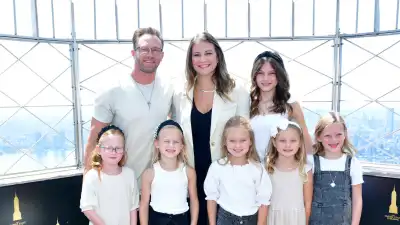
OutDaughtered stars Adam and Danielle Busby have opened up about homeschooling their 11-year-old quintuplets.
“If you look at the statistics of homeschooled kids, they’re more adjusted to interactions,” Adam, 44, said on the Thursday, August 20, episode of the couple’s “More Than Reality” podcast. “Honestly, we know lots of homeschooled kids right now. The homeschooled kids are more adjusted to communicate with other adults … than, I think, the kids at school are. It’s the homeschooled kids that are actually looking me in the eyes and actually having a conversation with an adult.”
Danielle, 42, also spoke about the academic benefits she’s seeing her having her all-girl quintuplets learning from their Friendswood, Texas, home.
“This is where we’re at … academically, we have some struggles, on top of starting middle school where you’re faced with so much more,” the devout Christian explained. “Kids that age, they don’t see academics. They see, ‘What do I look like? Who’s my friend? What sport am I going to play? Do they like me? They don’t like my shoes. They made fun of me.’ All that stuff comes [to the] front when you’re in public school [and] before your academics. I’m trying to say, ‘Let me help you with your academics first, and us coast [into] the social [aspects].’”
Adam Busby and Danielle Busby have faced several “growing pains” throughout their marriage — and season 10 of OutDaughtered will pull back the curtain even more. Adam, 41, exclusively told Us Weekly how expanding his job to work outside of the home has affected his and Danielle’s dynamic. The shift has also impacted how the […]
In a February episode of their podcast, the couple, who rose to fame after welcoming their daughters in 2015 and subsequently starring in TLC’s OutDaughtered the following year, revealed they would transition their girls from the public school system to a homeschool co-op for sixth grade. At the time, the parents detailed that homeschooling was not part of the original family plan, but stemmed from growing instincts as the girls matured.
An Instagram post shared by the couple on Monday, August 24, shared a glimpse of the childrens’ daily life after making the switch. “🏡 HOMESCHOOL 🍎 First Day of 6th Grade for the Busby Quints! Bare feet, comfy clothes, and a late morning start to school… I think we will be enjoying our new adventure!! Praying this year brings us lots of joy,” Danielle wrote.
A photo of five of the Busby kids showed them holding hand drawn signs to celebrate their sixth grade debut, with each child seated on the front porch of their home beside their dogs.

Parenting six children is hard under any circumstances, even more so when there are cameras involved — but OutDaughtered star Danielle Busby tries not to let herself worry too much. “I don’t like the word ‘guilt,’” the reality star, 39, exclusively told Us Weekly while promoting season 9 of the TLC series. “I’m not gonna […]
Fans took to the posts’ comments section to share their support for homeschooling, with one fan writing, “This will be out 8th year homeschooling and I wouldn’t change a thing. We absolutely love it!” and another writing, “Embrace the more relaxed schedule and take advantage of it; that’s the whole point!! Homeschooling is a gift!”
One critic, on the other hand, shared disapproval over the family’s decision. “So you took them out of school because you want to sleep late lol,” the social media user wrote, sparking robust debate among other followers.
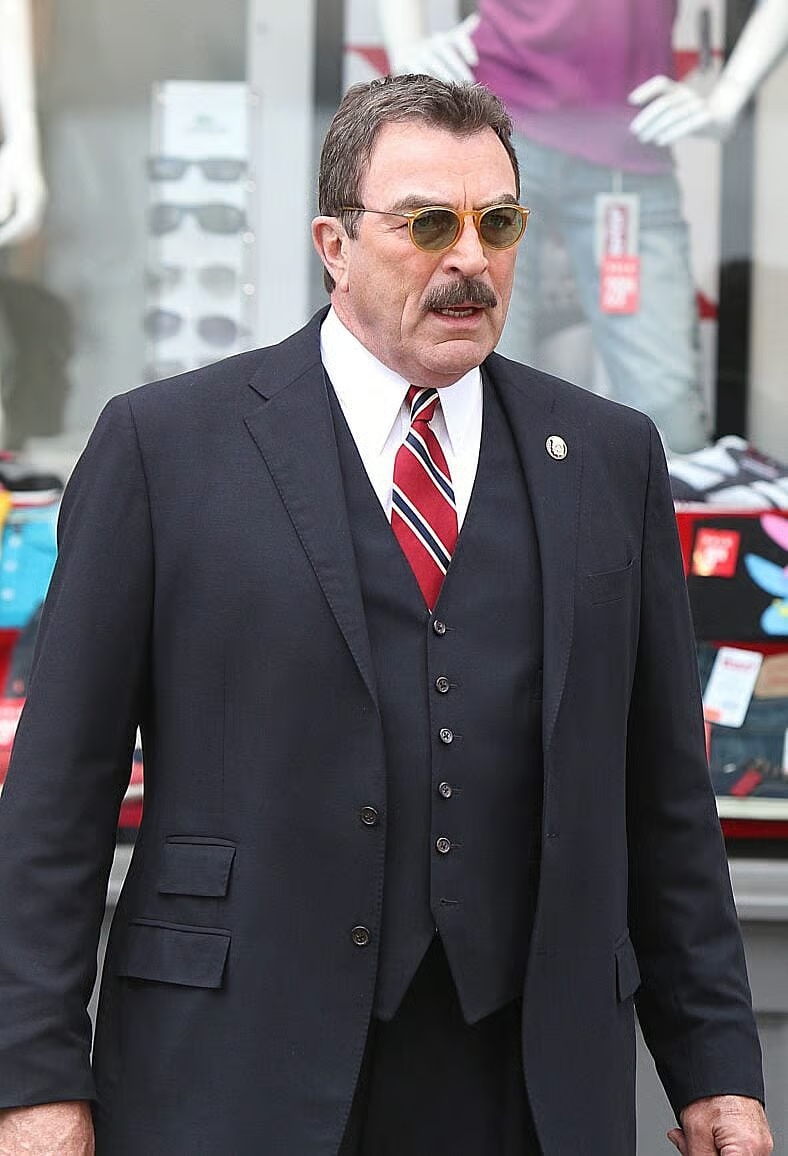
Tom Selleck is officially back in the saddle after nearly two years away from a scripted TV show.
The actor has landed a new role following the shocking cancellation of “Blue Bloods.” Selleck will be a guest star in an upcoming Apple TV comedy starring Elizabeth Banks and Ted Danson.
Tom Selleck spent 14 seasons playing NYPD Commissioner Frank Reagan on “Blue Bloods.” The CBS drama premiered in 2010 and ended in 2024, becoming the actor’s longest-running television role. The 81-year-old performer is also known for his role as the charismatic investigator Thomas Magnum in “Magnum, P.I.”

Selleck has officially joined the guest-starring cast of an upcoming Apple TV+ comedy series led by Banks. Produced by 20th Television, the as-yet-untitled show is created, show-run, and executive produced by Liz Heldens and Matt Ward.
The plot follows Banks’ character, Heidi, as she navigates a messy divorce and accidentally gets caught up coordinating her father’s retirement community escapades.
The star-studded ensemble features big names including Ted Danson, Rob Delaney, Katey Sagal, Jared Goldstein, and Spencer Moss. Additionally, actors Hamish Linklater, Michelle Buteau, and Simu Liu are locked into recurring roles for the freshman comedy.
According to an official casting report by Deadline, specific details regarding exactly who Selleck will portray are currently being kept completely under wraps. The high-profile comedy gig marks a fresh television chapter for Selleck after completing a massive 15-season run on “Blue Bloods.”
The veteran actor previously dominated the small screen as Thomas Magnum in “Magnum P.I.” and appeared on “Friends.” His extensive Hollywood career also spans decades of hit films, including “In & Out,” “Quigley Down Under,” and “Three Men and a Baby.”
Why The ‘Blue Bloods’ Cancellation Still Stings
Selleck has made it clear that he did not believe “Blue Bloods” had reached its natural end. The actor recently revealed that the cast wanted to return for another season, despite already making financial sacrifices.
He said the ensemble had taken a 25 percent salary cut during the final season to help keep the show alive. The veteran actor reportedly earned nearly $200,000, which dropped to approximately $150,000 per episode.
During Ted Danson’s “Where Everybody Knows Your Name” podcast, Selleck recalled the cast’s final family dinner. “Everybody wanted to come back,” he said, explaining that they had already “done all sorts of things to keep the show going.” He also revealed that the series was “certainly not out of ideas.”
Selleck pointed to the drama’s performance as another reason he struggled with the cancellation. He said “Blue Bloods” ranked sixth among the top 100 broadcast shows in its 15th year, while the same cast had remained intact for an unusually long period.
The Blast reported that Selleck believes the series was taken for granted because it consistently delivered strong audiences, even on Friday nights.
‘Blue Bloods’ is Not The Only Show That Got CBS’s Axe
CBS had already been making major programming decisions before “Blue Bloods” eventually ended. In May 2023, the network canceled “True Lies” and “East New York” after both shows spent time on the bubble. Their final episodes were scheduled to air later that month.
The cancellations came as traditional television ratings continued to decline. Networks were increasingly focused on owning their scripted programming, while viewers were cutting the cord and moving toward streaming platforms. “East New York” was affected likely because Warner Bros. Television produced the procedural.
At the time, “Blue Bloods” was still set to return for another season. CBS had reduced the salaries of its cast and creators by 25 percent to keep the series going, taking it into Season 14 and beyond 275 episodes.
The Blast reported that the show remained part of CBS’ returning lineup while the network continued tightening its spending. Shows slated to return to CBS that season included long-running hits like “Blue Bloods,” “CSI: Vegas, The Equalizer,” “NCIS,” and “Young Sheldon.”
The Veteran Actor Was ‘Scared To Death’ On ‘Friends’

Selleck’s television career has included some major departures from his usual roles. Before “Blue Bloods,” he became widely known as Thomas Magnum on “Magnum, P.I.” after getting his big break on the series in 1980. Years later, he stepped into sitcom territory as Dr. Richard Burke on “Friends.”
In 2022, the actor admitted he was “scared to death” when he accepted the role because he had never really worked on a sitcom before. He had previously appeared on “Taxi,” but joining an established comedy with an ensemble already comfortable together was a different challenge. Courteney Cox helped him settle into the role and welcomed him onto the set. “Courteney helped a lot. Courteney’s a big help,” he added.
Selleck was initially expected to appear in only three episodes during Season 2. He ended up appearing in nine, with Richard and Monica eventually breaking up after he refused to have children, before he returned during Season 6 shortly before Matthew Perry’s character proposed to Monica. The Blast reported that Selleck ultimately described the “Friends” set as a “wonderful place to work.”
Tom Selleck’s Favorite Memories On ‘Friends’

The actor made memorable appearances as Richard on “Friends.” During one talk show appearance in 2022, he wore a dark three-piece blue suit with a tie and lighter blue shirt, while his distinctive mustache remained part of his signature look. The characters, Richard and Monica, shared several memorable moments during Selleck’s run on the sitcom.
In “The One Where Dr. Ramoray Dies,” the couple prepared for an intimate night while Rachel and Ross were in the adjoining bedroom, only to discover there was just one protection band left.
Their breakup in “The One With the Jam” also produced one of the show’s most memorable lines. Monica famously declared, “I needed a plan. A plan to get over my man. What’s the opposite of man? Jam!”
The Veteran actor has since built a filmography spanning decades, with “Magnum P.I.” and “Blue Bloods” among his best-known television credits. He was married to Jacqueline Ray before marrying Jillie Joan Mack in 1987, and they have a daughter, Hannah, while Selleck also has an adopted son, Kevin, from his first marriage.
Tom Selleck’s new acting role after “Blue Bloods” is something to look forward to.
Warning! There are some major spoilers regarding the films discussed.
A brilliant movie isn’t just about a moment or two, a legendary performance, or box office numbers. A genuinely perfect film must have all that and still be exceptional from beginning to end. And those films that end in a masterful manner tend to earn forever praise. It’s easy to wrap up a story neatly with a bow, but that’s boring. A great ending must be earned and leave a lasting impact. But what makes an incredible ending? Well, these ten films know a thing or two about sensational finales.
From a shocking revelation to a poetic conclusion, a great movie should end in a way that properly completes the narrative and leaves the audience feeling satisfied. A great ending must be worth sitting through until the credits end. These films do just that. Some have inspired subsequent movies. Others have influenced other filmmakers to find their own iconic buttons that emulate these movies. While there are certainly many more films that could have slipped onto this list, these ten endings represent a great cross-section of cinema history and genres.
1
‘All That Jazz’ (1979)

Of all the films on this list, All That Jazz may be one of the more underrated films of all time. Directed by the legendary Bob Fosse, the film did earn a handful of Academy Award nominations and wins. And perhaps a reason why is that sensational conclusion. The film is a semi-autobiographical film based on the director himself. The dazzling yet cynical musical drama follows Joe Gideon (Roy Scheider), a workaholic director juggling a chaotic personal life, prescription drugs, and impending mortality. He has an endless line of women, his family life is crumbling, and physical and mental stress is taking its toll on a consummate professional. A raw look into the pressures of the industry, balancing work with life and love, All That Jazz is greatly remembered for Fosse’s sizzling choreography and the surreal sequences. The very best comes at the end.
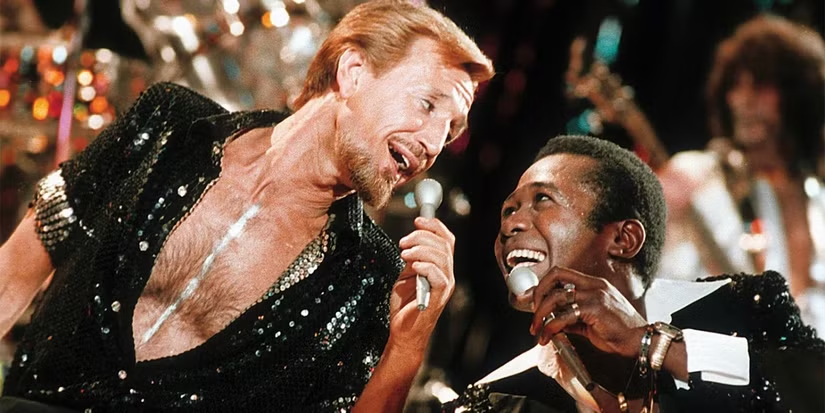
We may ponder how our final moments might play out on our deathbed—Fosse envisioned it for Joe via razzle-dazzle and all that jazz. A dying Joe hallucinates a massive, glamorous television variety show led by O’Connor Flood (Ben Vereen), where he and Joe perform the upbeat song “Bye Bye Life,” a whimsical riff on the Everly Brothers’ song “Bye Bye Love.” It’s a grand conclusion that celebrates himself, his life, and his loves as a cavalcade of characters from his past appear in celebration. The sequence blurs the line between his internal ego, regret, and the final stages of dying where Angelique (Jessica Lange), the alluring woman in white representing death, waits at the end of the spectral runway. At the end, his corpse is zipped up in a body bag. The final scene flourishes with brilliant showmanship and, like a Broadway show, wraps up the entire journey through song. But it’s that shockingly jarring dose of reality that serves as a harrowing reminder that death is finite. Truth and illusion are united through thematic closure. One man’s ego may aggrandize his life, but Joe’s exit from life is just like everyone else’s. All That Jazz simply couldn’t end any other way.
2
‘Casablanca’ (1942)

There are very few romantic dramas that hold a candle to Casablanca. The 1942 classic directed by Michael Curtiz tells the story of Rick Blaine (Humphrey Bogart), a cynical American nightclub owner in Vichy-controlled Morocco. Rick must choose between his lingering love for his former lover, Ilsa Lund (Ingrid Bergman), and helping her husband, Victor Laszlo (Paul Henreid), a resistance leader, escape the Nazis by securing vital exit letters. Rick’s moral dilemma leaves him torn between his personal desire for Ilsa and the broader global fight against fascism, forcing him to make the greatest decision. Casablanca ends the way it must: with the ultimate gesture and one of the most romantically heartbreaking lines ever uttered: “We’ll always have Paris.”
The final scene of the film finds Rick and Ilsa on the tarmac at the foggy airport. Rick convinces Ilsa to board a plane to freedom with her husband. But it’s not that easy. Rick shoots the Nazi Major Heinrich Strasser (Conrad Veidt) who tries to stop them, and French Captain Renault (Claude Rains) protects Rick by telling his men to “round up the usual suspects.” It’s implied that Renault has now joined the Free French cause. As the plane departs, Rick and Renault walk into the fog together, Rick’s states, “Louis, I think this is the beginning of a beautiful friendship”. One of the most iconic endings with a brilliant quote, Casablanca concludes with the ultimate sacrifice. Rick’s line to Ilsa before he sends her away serves as his acknowledgment that while they have had incredibly sweet moments together, they simply cannot be. Casablanca trades away a typical Hollywood ending for an emotionally mature, cliche-free action of political duty and nobility. This is literally the opposite of riding off into the sunset. It’s a bittersweet parting, but truly the only way hope can be found in the darkness.
3
‘Chinatown’ (1974)

Hands down, one of the greatest neo-noir mysteries in Hollywood history is Chinatown. Directed by Roman Polanski, the thriller centers around private eye Jake Gittes (Jack Nicholson), who, in 1937 Los Angeles, uncovers a dark web of municipal corruption and family secrets after being hired by Evelyn Mulwray (Faye Dunaway) to investigate a routine infidelity case. Gittes uncovers a horrific family connection involving Evelyn’s father, Noah Cross (John Huston), in a finale that instantly cements the film’s legacy. Inspired by a real-life situation, Chinatown packed a powerful punch where hero and villain do battle, but the bloody conclusion may leave you unsatisfied.
Jake tries to help Evelyn flee to Mexico with her daughter/sister Katherine Cross (Belinda Palmer), only to be confronted by the villainous Noah in Chinatown. As Evelyn fires a shot against her abusive father, a police officer blindly fires at her, killing Evelyn instantly. Cross, like the monster he is, cradles the mortified young girl, who is both his daughter and grandchild, ultimately being the one to lead her to safety. Jake, who has seemingly lost the war, is whisked away as the infamous line, “Forget it, Jake. It’s Chinatown,” is uttered in his ear. It’s a devastating blow that proves that corruption can succeed and justice will not prevail. Cross is deemed largely untouchable as this myth of “Chinatown” represents a system where the rules don’t make sense and trying to do so can lead to greater tragedy. The scene may be harrowing, but it’s thematically brilliant. Jake represents a hero whose intervention triggers loss. Chinatown‘s ending serves as a reminder that the Hollywood ideal is that one single person cannot stop a powerful, systemic evil.
4
‘Planet of the Apes’ (1968)

There are a lot of things that the original Planet of the Apes is known for, but it’s that final image that will remain its most recognizable and resounding. Directed by Franklin J. Schaffner, the original Planet of the Apes is based on the novel by Pierre Boulle. The science fiction film follows a group of human scientists, led by astronaut George Taylor (Charlton Heston), who crash-land on a mysterious, futuristic, savage planet where talking apes rule society and primitive humans are hunted and enslaved. Chimpanzee scientists Dr. Zira (Kim Hunter) and Dr. Cornelius (Roddy McDowall) befriend Taylor and try to help him, but the menacing orangutan Dr. Zaius (Maurice Evans) tries to hide proof that humans were once the superior intelligence. Planet of the Apes is a film about survival, but what happens when you learn the hard truth about the dangerous world you fell upon? Welcome to that final moment.
As science fiction Hollywood films tended to do, the protagonist would be able to fight his way to freedom. Taylor and a mute human named Nova (Linda Harrison) escape into the Forbidden Zone away from the ape city. Though a confrontation between Taylor and Dr. Zaius arrives, it’s the latter who knows the truth of what’s beyond. Taylor and Nova escape, riding horses along the coastline, only to discover the remains of the Statue of Liberty buried in the sand. The revelation comes as Taylor discovers he did not travel across the galaxy and that humanity was responsible for its own demise, revealing the escape was futile. “We finally really did it. You maniacs! You blew it up! Ah, damn you! Goddamn you all to hell!” he exclaims on his knees, ending on an ultimate low. Planet of the Apes concludes to serve as a cautionary tale about humans’ self-destructive nature. For a film from 1968, it wasn’t necessarily prophetic, but its reality has yet to be altered. The dystopian conclusion of humanity destroyed by nuclear fears struck a chord with Cold War-era audiences, remaining culturally powerful.
5
‘Se7en’ (1995)

Crime thrillers often end with the villain getting apprehended and the cops walking off into the sunset. Then came Se7en, and that concept was flipped for one of the most shocking endings in thriller history. Directed by David Fincher, Se7en follows William Somerset (Morgan Freeman), a near-retired veteran detective, and David Mills (Brad Pitt), a hot-headed rookie, who hunt a meticulously complex serial killer, John Doe (Kevin Spacey), who stages his brutal murders around the seven deadly sins. Se7en was destined to deliver on the horrible murders for each sin, but audiences truly never expected the killer’s grand finale to be as horrible as it was.
After a relentless search, the killer finally decides to turn himself in to the police. Covered in blood, Doe leads the two detectives to a remote field where he claims the final two victims are. Suddenly, a van arrives with a mysterious box. Instructed to open it, Somerset opens the box to great dismay as he discovers the severed head of Mills’ wife, Tracy (Gwyneth Paltrow). Left in complete shock, John Doe confesses to murdering Tracy out of envy for Mills’ perfect life. He then provokes Mills by revealing that she was pregnant. In complete despair, Mills fulfills the killer’s need for wrath, shooting John to death. And just like that, the serial killer’s mission is complete: his 7-part murder spree was fulfilled with the last two victims squarely in the field.
Mills and Somerset believed they were about to ride off with a killer in their control, only for their lives to be upended. Mills’ life and career are shattered, and Somerset, quoting Ernest Hemingway, does not retire; he decides to fight for the world he lives in. An utterly perfect end to a psychological thriller, Se7en provides the absolute destruction of the protagonist’s moral code by allowing evil to prevail. Se7en claims that there can never be any morally perfect heroes. Pitt famously fought for the devastating ending, feeling the righteous conclusion did not serve the story. He was right.
6
‘Thelma & Louise’ (1991)

Going out in a blaze of glory never looked more incredible than in Thelma & Louise. The iconic buddy dramedy directed by Ridley Scott follows two best friends—Thelma (Geena Davis), a timid housewife with a controlling husband, and Louise (Susan Sarandon), a tepid diner waitress—as they leave Arkansas for a short fishing trip in the mountains. But their weekend getaway turns into a desperate race across the American Southwest when they become accidental outlaws after Thelma is assaulted by a man at a roadside bar. After deciding to head to Mexico rather than turn themselves in, they make the ultimate decision that leads to one of the most daring and iconic moments in cinema history.
After a long chase, the police eventually catch up with the titular characters and their 1966 Ford Thunderbird. With surrender behind them and death in front of them, Thelma and Louise decide that rather than going to prison, they’ll “keep going.” With a mutual smile and hands held, they agree to accelerate the car and soar right off the cliff. The film ends with an infamous freeze-frame with the Thunderbird suspended in mid air before a cinematic white-out. Even though we know the answer is tragic, this moment is why this ending was pitch-perfect. Their decision is the ultimate act of freedom and self-autonomy. They spent the film fighting against being victims of circumstance. Now, they emerge as agents of their own destiny. Scott keeps the car in flight to immortalize freedom. It solidifies their ultimate bond: mutual liberation from society’s bounds. The scene was not only a fitting finale but also an important liberation for those watching. Though no one wants to meet the same end, Thelma & Louise‘s epic ending made the film the ultimate road trip film.
7
”The Shawshank Redemption’ (1994)

Though many bibliophiles and cinephiles know Stephen King as the King of Horror, there are some stories on his resume that go beyond the genre. The greatest drama he’s ever written, Rita Hayworth and the Shawshank Redemption, was turned into a brilliant film adaptation, written and directed by Frank Darabont. The brilliant film tells the story of Andy Dufresne (Tim Robbins), a banker wrongly convicted of murder. He’s sentenced to life in a brutal Maine penitentiary where he befriends another inmate, Ellis Boyd “Red” Redding (Morgan Freeman). Over two decades, Andy uses his financial skills to survive in a corrupt prison, inspire fellow inmates, and quietly plot his path to freedom. One might think that a King story would end on a bad note, but The Shawshank Redemption concludes with a message of hope, optimism, and friendship.
For 19 years, Andy had been tunneling through his cell wall with a small rock hammer. After pushing through what seems to be an endless maze of raw sewage, Andy finds his way to freedom, where he exposes the warden, Samuel Norton’s (Bob Gunton) money laundering and corruption under a fake identity he prepared. But wait, there’s more. Red is paroled and struggles to adjust to the outside world. But Andy didn’t leave him hanging. Having remembered a promise he made, Red visits a hayfield in Buxton, Maine, where he finds a hidden box under a black volcanic rock, containing cash and an invitation to join Andy in Mexico. Choosing hope over despair, Red breaks his parole and reunites with his friend, as they jovially embrace on a beach, finally finding peace and solitude.
The Shawshank Redemption‘s emotionally earned conclusion proves that there may actually be a light at the end of the tunnel. Andy’s journey was a meticulous plan operated as quiet revenge. He beat the system by choosing to live. Mexico served as an almost distant myth, but seeing it offers the audience an opportunity to witness abstract hope become a practical reality. The film cuts to black over the vast Pacific Ocean, allowing the audience to relish the limitless freedom their characters dreamed of. We may be in prisons of our own, but with hope and resilience, our ocean is attainable.
8
‘The Sixth Sense’ (1999)

As you can tell, the ’90s were filled with some iconic endings. Whether satisfying or shocking, they left a lasting impact, but it was one massive twist no one saw coming that helped cement a director’s stardom. Written and directed by M. Night Shyamalan, the psychological thriller The Sixth Sense follows child psychologist Dr. Malcolm Crowe (Bruce Willis) as he seeks to help a young patient, Cole Sear (Haley Joel Osment), who can communicate with the dead. Malcolm advises Cole to stop running from the ghosts and instead listen to them and try to help them resolve their unfinished business. The Sixth Sense is a mind-blowing example of practicing what you preach, as the finale revealed one of the greatest shocks in cinema history.
As a great psychologist hopes to, Malcolm ultimately helps Cole reconnect with his overwhelmed single mother, Lynne (Toni Collette). Now, it was his turn to return home and speak to his wife, Anna (Olivia Williams), who had previously been distant and cold to him. But there was one clue that was hiding in plain sight: Cole telling Malcolm that dead people “only see what they want to see” and don’t know that they’re dead. At home, he sees his sleeping wife drop his wedding ring, realizing it’s missing on his own finger. Malcolm finally remembers that the gunshot wound from the beginning of the film was due to being shot by a former patient. A shot that he did not survive. It was only then that the dead Malcolm could tell his wife that she was never second to him, giving him and Anna the closure they needed. Malcolm helped Cole, who in turn helped him because, when Cole said he “sees dead people,” he meant him. Though some claim they could have seen it coming, the major twist recontextualized the entire film. Shyamalan masterfully misdirects the audience by tapping into the expectations of seeing what they want to see. Malcolm only interacts with Cole and Anna. And even then there are closed dialogue loops. The Sixth Sense set up our expectations of twist endings from the director, but none ever achieved the same brilliant shock.
9
‘The Usual Suspects’ (1995)

In another prime example of a twist ending, The Usual Suspects made you realize you simply cannot trust anyone. Especially if they’re criminals. Directed by Bryan Singer and written by Christopher McQuarrie, the crime thriller follows the aftermath of a deadly, explosive shootout on a docked ship in San Pedro harbor; the police are left with only one physically disabled survivor: a small-time con man known as Roger “Verbal” Kint (Kevin Spacey). He’s interrogated by U.S. Customs Agent Dave Kujan (Chazz Palminteri) and recounts a convoluted story detailing how he and four other high-profile criminals—a corrupt ex-cop Dean Keaton (Gabriel Byrne), a hotshot Michael McManus (Stephen Baldwin), his partner Fred Fenster (Benicio del Toro), a hijacker Todd Hockney (Kevin Pollak)—were brought together by a legendary, ruthless, and nearly mythical crime lord named Keyser Söze. As Verbal weaves his complicated tale, the identity of Söze’s becomes the film’s greatest mystery and twist.
The Usual Suspects is a mark of brilliant storytelling. The entire film follows a man spinning a tale. Verbal frames his dead associate, Keaton, as the mythical criminal mastermind. Kujan accepts the story as truth, feeling satisfied that the case is solved. With Verbal gone, a proud Kujan looks around the room, suddenly realizing that every name, brand, and detail in Verbal’s story was completely fabricated on the spot as he built his narrative while sitting in the room. His revelation comes too late as Verbal is gone, having already picked up his belongings. As Verbal walks down the street, he drops his limp, straightens his posture, and lights a cigarette with his steady hand. He gets into a waiting car, driven by his mysterious associate, Kobayashi (Pete Postlethwaite), and rides off into the sunset. The film ends with Kujan recalling Verbal’s previous statement, “The greatest trick the devil ever pulled off was convincing the world he didn’t exist.” Verbal Kint was Keyser Söze all along. The Usual Suspect is the blueprint in misdirection, meaning a two-hour crime thriller was built on an elaborate lie that everyone, audience included, went along with. Spacey delivers a remarkable performance in one of his most iconic roles. Like Kujan, why wouldn’t the audience believe him? The payoff is simple: the film emerges as a rewatchable classic that dares you to pick up the clues that were hiding in plain sight.
10
‘The Wizard of Oz’ (1939)

There are very few films quite as beloved as The Wizard of Oz. From mesmerizing visuals, iconic songs, and an iconic career-making performance, The Wizard of Oz had it all. And that included a perfect ending. Based on the book by L. Frank Baum, the film tells the story of Dorothy Gale (Judy Garland), a young Kansas girl who is swept away by a tornado to the magical Land of Oz. Accompanied by three new friends—the Scarecrow (Ray Bolger), the Tin Man (Jack Haley), and the Cowardly Lion (Bert Lahr)—she sets out to meet the Wizard (Frank Morgan) in the Emerald City, hoping he has the power to send her back home. Along the way, Dorothy must overcome challenges and battle a vengeful Wicked Witch of the West (Margaret Hamilton). A timeless story of self-discovery and inner empowerment, the film was more than just a story with a strong moral anchor; it was a reminder that our imagination is only as powerful as we make it.
At the end of the film, Dorothy gets her wish as she has the power to return home to Kansas. All she has to do is click her ruby slippers three times and repeat, “There’s no place like home.” And she does! She says goodbye to her newfound friends and the adventure ends. But Dorothy’s happily ever after doesn’t stop there. The technicolor is gone as Dorothy wakes up in her sepia-toned world, in the comfort of her own bed. She’s surrounded by her family and farm hands, realizing that her fantastical journey was a dream. “And you were there, and you were there, and you were there…” she says, realizing each and every person was a character she met in Oz. The moral of the story is Dorothy didn’t need to search for her heart’s desire in far-off technicolor lands. There truly is no place like home. It serves as a reminder that life holds more value than any dream that we wish. It’s a beautiful and tender scene and perfectly bookends the story. There was truly no other manner in which The Wizard of Oz could end.

The Wizard of Oz
- Release Date
-
August 25, 1939
- Runtime
-
102 minutes
- Director
-
Victor Fleming
- Writers
-
Edgar Allan Woolf, Florence Ryerson, Noel Langley, L. Frank Baum
-

Judy Garland
Dorothy Gale
-
Ray Bolger
“Hunk” / Scarecrow
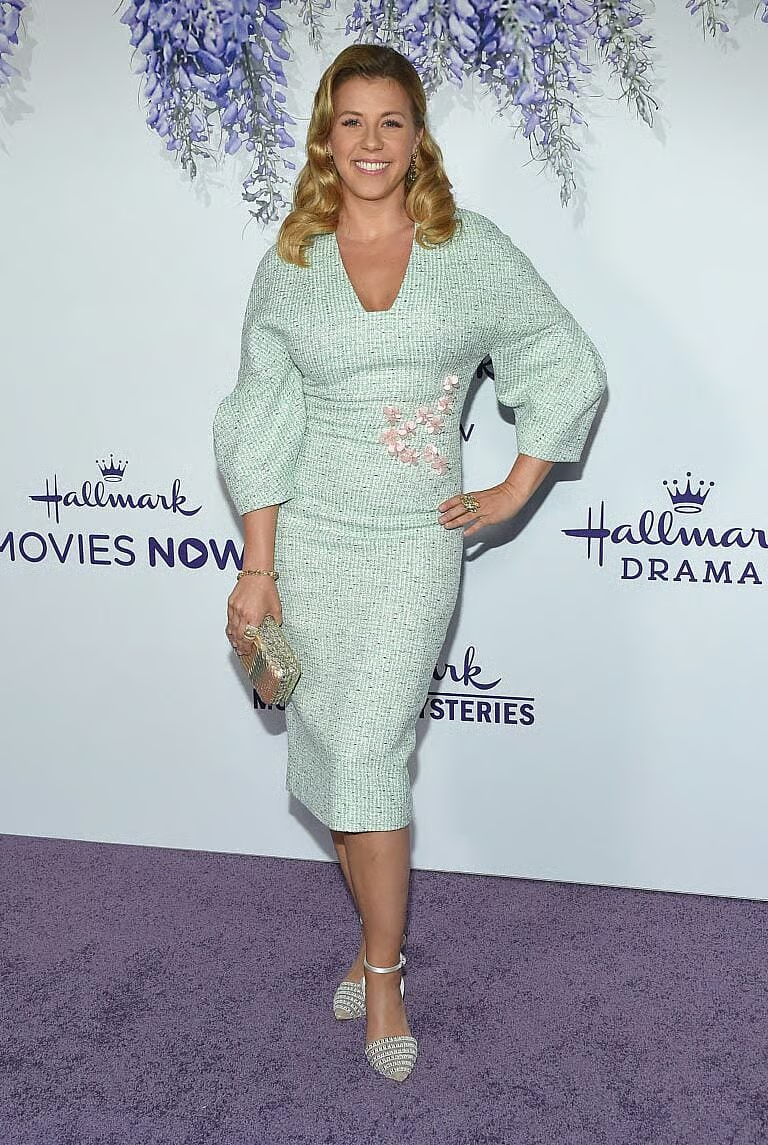
Jodie Sweetin is opening up about the unconventional sleeping arrangement she shares with her husband, Mescal Wasilewski. The “Full House” star revealed that the couple sleeps on two twin mattresses pushed together, allowing them to share the same bed without fighting over blankets. According to Sweetin, the surprisingly simple setup has made a major difference in her marriage and allows both partners to get the rest they need.

During an appearance on the “Good Guys” podcast, Sweetin told hosts Josh Peck and Ben Soffer that she and Wasilewski have found an unusual solution to their different sleeping habits. The actress explained that they sleep in “two twin beds pushed up against each other in a king-size thing with two separate duvets.” Although the mattresses are positioned together, each person has their own bedding.
Sweetin said the separate duvets are especially important because neither person has to worry about losing the covers during the night. The arrangement allows them to remain close while still having enough personal space to sleep comfortably.
The Actress Says Separate Blankets Are ‘Key’

Sweetin believes sharing a blanket can create unnecessary tension between couples. The actress explained that having separate duvets “is key because you’re not fighting over the blanket.” She emphasized that the change might sound minor but can prevent people from waking up frustrated with their partner.
“I’m telling you, that is the smallest, biggest difference. I can roll over and wrap myself up like a burrito, he can do whatever, and we’re not fighting over it in the middle of the night. So no one wakes up angry that they’re cold,” Sweetin said.
The “Fuller House” alum also argued that “actual sleeping” can become a larger source of tension between partners than their sex lives. Sometimes, she admitted, “it’s a nightmare to sleep with someone else next to you.”
The Couple Has Very Different Sleeping Habits

Part of the reason the arrangement works for Sweetin and Wasilewski is that they have dramatically different reactions to noise during the night. “My husband is the lightest, worst sleeper. Once I’m out, takes me a minute to go out, and once I’m out, I’m dead to the world,” she explained.
Sweetin joked that almost nothing can wake her once she falls asleep. “There could be bombs going off, and nothing. [Meanwhile], a mouse whispers downstairs and [my husband is] like, ‘Oh my god! I heard it,’” she continued.
Their arrangement might be unconventional, but Sweetin believes it helps protect the peace in their home.
Jodie Sweetin Wants Separate Tiny Homes

The couple’s desire for personal space extends beyond their bedroom. Sweetin described herself and Wasilewski as “very independent people” who are comfortable pursuing their own interests. “Our dream goal sort of thing is to own property somewhere, and I want a few little tiny homes on it,” she revealed.
Under Sweetin’s ideal plan, each spouse would have a private residence while still sharing a communal space. “He gets his tiny home, I get my tiny home, and then there’s the middle one,” she explained.
Sweetin suggested that her previous relationships helped her recognize the importance of maintaining her independence inside a marriage.
Wasilewski is her fourth husband. She was previously married to Shaun Holguin, Cody Herpin and Morty Coyle. Sweetin shares her eldest daughter, Zoie, 18, with Herpin and her younger daughter, Beatrix, 15, with Coyle.
The ‘Full House’ Star Found Her ‘Right Partner’

Sweetin and Wasilewski married in Malibu in July 2022, approximately six months after announcing their engagement. The pair initially had a long-distance relationship before Wasilewski relocated to Los Angeles.
After their wedding, Sweetin told PEOPLE Magazine that she felt confident about their future together. “I know I have the right partner for the rest of whatever life brings me,” she said. “I couldn’t be more grateful.”
Sweetin is best known for playing Stephanie Tanner on the ABC sitcom “Full House” from 1987 until 1995. She later reprised the role in Netflix’s sequel series, “Fuller House.”
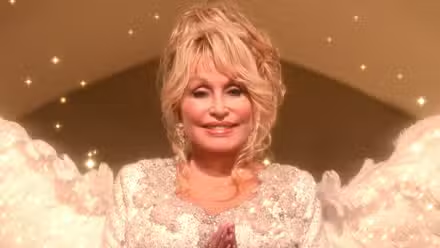
Legendary singer and songwriter Dolly Parton’s death at 80 on August 25, 2026, marks the heartbreaking end of one of the most remarkable careers in music history. For over six decades, Parton gifted the world with songs that became part of American history, from “Jolene” and “Coat of Many Colors” to “9 to 5” and “I Will Always Love You.” However, Dolly Parton’s legacy cannot only be reduced to her biggest hits. She was a songwriter who could turn heartbreak, poverty, love and everyday life into songs that would leave listeners feeling deeply connected to them.
The many things that made Parton’s legacy even more remarkable also included everything she did when she wasn’t standing on stage. Her humanitarian work became just as important to the life she built, most notably through Dolly Parton’s Imagination Library, which has provided more than 300 million free books to children around the world. In addition to that, Parton also gave generously to disaster relief, medical research and many other causes throughout her life. Now, as the world remembers the woman whose influence stretched far beyond country music, here are the 10 greatest Dolly Parton songs of all time, ranked.
10
“Just Because I’m a Woman” (1968)
Long before Dolly Parton became the household name and legacy act everyone knows her for, she was busy writing songs that explored the complexities of being a woman. Parton understood early on just how the expectations placed on women were unfair. The song was released in 1968, confronting the double standard that was rarely addressed so directly in country music at the time. Parton does a great job of placing hypocrisy under a microscope as the song is centered on a relationship where the man judges a woman for something he would expect to be forgiven for.
“Just Because I’m a Woman” is worthy of this list because it was an early glimpse into the icon that Dolly Parton would become. She didn’t need a huge production or grand concept to make her point. Her writing is conversational and quietly defiant, which is evident in her discography. Parton understood how to take an experience and make it feel deeply personal to millions of listeners.
9
“Two Doors Down” (1977)
“Two Doors Down” is just as deserving of a spot on this list as the other songs, but even more so because this side of Dolly Parton doesn’t always get enough attention. Released in 1977, the song explores the traditional theme of country music about heartbreak, but it turns the song into something much more upbeat. Instead of staying home and drowning in her sorrows, the woman in the song decides that she would rather join a nearby party she hears than spend another lonely night sad.
The ability to make sadness sound joyful was one of Parton’s greatest gifts. The song is not only catchy enough to work as a party song, but there seems to be a real emotional conflict underneath the surface. She understood that heartbreak didn’t always have to sound like a slow ballad. Sometimes it can sound like someone trying desperately to enjoy the highs of life while knowing they’re falling apart on the inside. The emotional contradiction at play makes this song a far more clever arrangement than it initially feels.
8
“The Bargain Store” (1975)
Dolly Parton could turn almost anything into a metaphor, and “The Bargain Store” might be one of her greatest examples. The song was released in 1975, and it compares a woman that’s recovering from heartbreak to an item inside a bargain store. The emotional scars of the heartbreak have caused the woman to feel worthless while she waits for someone to willingly look beyond the scars and see her value.
This type of song could easily have fallen flat in another songwriter’s hands, but Parton again displays her greatest strength. That strength was her ability to take ordinary objects and situations and find something deeply human inside them. The song demonstrates the sophistication behind Dolly Parton’s songwriting and emotional intelligence, which is why this song makes the list.
7
“Here You Come Again” (1977)
By the late 1970s, Dolly Parton was no longer just one of country music’s biggest stars. She was becoming a phenomenon and “Here You Come Again” played a major role in this transformation. The song was officially released in 1977 and gave Parton a true pop-country sound that introduced her to listeners who weren’t necessarily country music fans. The song feels like an instant mix between her recognizable vocals that keeps the song grounded in her country roots while its production leans more towards the mainstream sound pop is known for.
“Here You Come Again” goes beyond its commercial success as well. Dolly Parton has already proven herself to be a legendary artist, but this song proved that her reach could survive outside traditional country music. She found a way to move towards the pop sound without losing the emotional directness that country music is known for. That ability would become crucial to the crossover that would follow, which is why this song is an essential part of her musical legacy.
6
“Islands in the Stream” (1983)
Yes, it is known that Dolly Parton did not write “Islands in the Stream”, which was written by the Bee Gees, but once the song was in her and Kenny Rogers‘ hands, it became a massive hit. The song couldn’t be left off this list because it became one of the most important recordings of her career. Her duet with Rogers became one of the most defining country-pop collaborations of the 1980s and is instantly recognizable even four decades later.
The chemistry that existed between Dolly Parton and Kenny Rogers was unmatched. They compliment each other so well on the track, their voices don’t overpower each other and do a great job of pulling you in two different directions before meeting in the middle. “Islands in the Stream” is another great track that proved Parton could not be confined by genre. Dolly could stand alongside country stars, pop singers or rock artists and still sound like herself, further proving her versatility.
5
“Tennessee Homesick Blues” (1984)
Dolly Parton’s connection to Tennessee goes far beyond her public image. Born and raised in Tennessee, it’s no surprise that “Tennessee Homesick Blues” captures her connection to the state that raised her. The track was written for The Best Little Whorehouse in Texas. The 1984 song is a fast-paced, foot-stomping celebration of Dolly’s roots, showcasing her humor and personality.
Parton did a great job of naturally making her Appalachian roots feel universal. Most homesick songs have evident yearning and a sense of loss in them, but not “Tennessee Homesick Blues.” Instead, she embraces the homesickness with a wink-style longing that makes the track a fun country song. It may not be the first track that comes to mind when thinking about her greatest works, but it represents an essential part of who Dolly Parton was and deserves a place on her greatest list.
4
“9 to 5” (1980)
It’s quite difficult to capture the frustrations of the American workplace quite perfectly as “9 to 5.” The song was written for the 1980 comedy of the same name starring Dolly Parton, Jane Fonda and Lily Tomlin. The song turns office dread, unfair bosses and the endless grind of work life into one of the catchiest songs Dolly has ever recorded.
“9 to 5” has lasted this long because its subject never really faded away. Generations have been able to find something to relate to or something that feels familiar in its lyrics, which is why the song has resonated long after the movie and the era that inspired it. The song would go on to give Dolly Parton an Academy Award nomination, further cementing its place beyond just another country song. This wasn’t just a hit for Parton; it became an anthem for everyone who ever felt trapped in a job that takes more than it gives.
3
“Coat of Many Colors” (1971)
So many of Dolly Parton’s best songs come from stories that may seem too ordinary to become music, but Parton continued to prove otherwise. “Coat of Many Colors” is one of them. Dolly wrote the song about a coat her mother made from pieces of fabric because the family couldn’t afford to buy a new one. Unfortunately, when other children mocked her at school, she learned a painful lesson about poverty, but she remembered something that was more important about the coat itself.
The memory became far more important. Instead of allowing the song to end with shame, Dolly turned it into a celebration of her mother’s love and the values she grew up with. The song has remained especially important to Dolly Parton throughout her career, and she has even named this song as her personal favorite. “Coat of Many Colors” is a song in which the power comes from the story, and from Dolly knowing which details to leave in and which emotions needed to speak for themselves.
2
“I Will Always Love You” (1974)
This entry should come at no surprise. Before Whitney Houston turned “I Will Always Love You” into one of the biggest selling singles in music history, it was a deeply personal country song written by Dolly Parton. The song was written during the time she was preparing to leave The Porter Wagoner Show and officially start the next chapter of her career. Instead of writing a bitter goodbye to the man who had helped launch her career, Parton decided to choose the gracious route and write a song about leaving while still wishing someone well.
The song would go on to break records. Parton became the first artist to earn a No. 1 record twice with the same song as a singer and three times as a songwriter. Dolly’s version feels more intimate and a bit restrained, which allows the writing to remain at the center of the performance. Whitney’s pop version displayed just how adaptable Dolly’s writing was, with both versions maintaining that emotional foundation.
1
“Jolene” (1973)
Even if you are not a country music fan, you’ll know this song. “Jolene” remains the first song many people associate with Dolly Parton, and its impact was immediate. Released in 1973, the song topped the U.S. Billboard Hot Country Singles chart in early 1974, while also reaching No. 60 on the Billboard Hot 100 and No. 44 on the Adult Contemporary chart. Its influence has only grown over the decades, with Rolling Stone ranking it No. 217 on its list of the 500 Greatest Songs of All Time. More than another hit for Parton, “Jolene” became a global classic, built around a woman confronting Jolene with a mix of fear, anger and confidence. She’s pleading with her because she knows the other woman is potentially capable of taking away the person she loves.
That level of vulnerability is what separates “Jolene” from so many songs about romantic rivalry. Also, the instantly recognizable guitar and urgent vocals only add to the song’s staying power more than 50 years later. “Jolene” has been covered by artists across generations and genres, but Dolly’s original remains the most iconic.
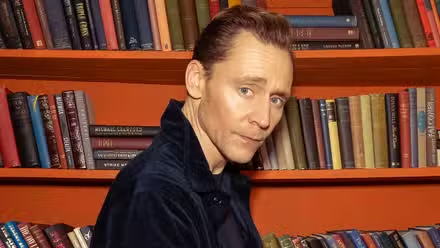
Even if you’re at a place where Marvel fatigue has truly set in, there is one Marvel Studios television project that you ought to revisit before Avengers: Doomsday hits theaters later this year. For the past week or so, Loki has been trending upward in the Top 10 on Disney+ — and that’s not by accident. The Tom Hiddleston-led pivot in the Marvel Cinematic Universe is arguably the streamer’s most impressive original series yet, with a novel take on time travel that puts most other attempts to shame.
‘Loki’ Takes Time Travel Mechanics in the MCU a Step Further
Created by Michael Waldron (who wrote both Doctor Strange in the Multiverse of Madness and the upcoming Avengers: Doomsday), Loki follows the alternate version of the “God of Mischief” first introduced in Avengers: Endgame. Yes, this is the Loki who slips away with the Tesseract in the alternate 2012. But just as Loki escapes the Avengers, he finds himself in the hands of a new threat in the form of the Time Variance Authority (TVA). Discovering the existence of the branched timeline, Loki aids TVA agent Mobius M. Mobius (Owen Wilson) in preventing the collapse of the “sacred timeline” (the main MCU world) from another Loki variant, Sylvie (Sophia Di Martino), who threatens to wipe out all existence in her quest to bring down the TVA. This ultimately brings the former Asgardian prince face to face with the one who invented the TVA in the first place: the Kang variant He Who Remains (Jonathan Majors). Now, if you haven’t seen the show, that may sound like a lot, but we promise, it’s not as confusing as it seems.
While Hiddleston’s character was developed initially over several films between Thor and Avengers: Infinity War, Loki largely ignores all of that. After all, it’s not even following the same variant. Instead, this 12-episode series masterfully constructs a self-contained narrative driven entirely by Loki’s own self-destructive patterns and deep-rooted desire for glory — and, yes, purpose. After rewriting his entire story since The Avengers, the Disney+ series offers Loki a genuine hero’s journey arc that separates him from the influence of his brother Thor (Chris Hemsworth). Not only is Loki arguably one of Marvel’s finest ventures into television, but it’s among the decade’s best time travel shows. Rather than being used as a gimmick to put characters in outlandish situations or pull in a genre-based audience, time travel is an introspective way to deconstruct who Loki is before reassembling him into something better. There’s a reason that both the first and last episodes of the series are aptly titled “Glorious Purpose.”
Loki reinvents its lead character, and does so as a compelling departure from the usual MCU antics that simultaneously feels both self-contained and relevant to the larger Multiverse Saga. It’s a must-watch before Loki returns in Doomsday later this year, and certainly enjoyable as a standalone sequel to the character’s pre-existing MCU arc. Hiddleston is at his A-game here, and if you already thought he was one of the best parts of the Thor movies, you’ll be pleasantly surprised by how well he headlines his own material. His chemistry with Owen Wilson in particular — who feels a bit off-brand for the MCU but plays it so Owen Wilson-like that it somehow works — is off the charts. It would’ve been easy to watch two more seasons revolving around this duo.
Marvel Television Has Never Been Better Than ‘Loki’
Part of the reason Loki was so well-received is that it felt like such a big departure from the usual MCU brand of superhero stories that end with a big third-act battle sequence. Even WandaVision, which was likewise a serious shift in tone, still ended with a battle between heroes and villains that could’ve been cut and pasted into just about any Marvel movie. Loki doesn’t fall into this same trap. The multiversal stakes are high, but so are the personal ones. Loki’s relationship with Sylvie informs his hardest choices, and Mobius’ own struggles with the higher-ups at the TVA complicate his choices as well. The series thrives in its meditation on character and the true meaning of self-sacrifice, ultimately giving Loki a much-needed self-reorientation that transforms him into the antithesis of who he was before.
Loki is far more character-driven than it is anchored by the larger plot needs of the MCU, and this is still at a time when Kang the Conqueror was being set up as the next Avengers “big bad.” Even Majors’ role here feels specific to Loki itself rather than simply the foundation of something bigger — no doubt, it is that, but the series thrives on its ability to tell a complete story that needs no epilogue. That is perhaps what sets it apart from the rest of the Marvel TV brand. It’s an exceptional departure from the norm (with a truly brilliant ending) that doesn’t require the viewer to look elsewhere for answers, content exploring all of them on its own.
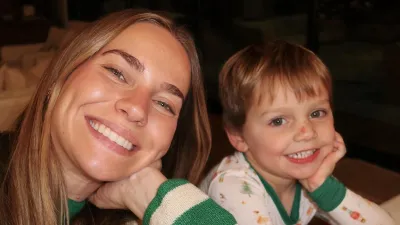
An official cause of death for Emilie Kiser’s 3-year-old son Trigg has been determined more than a year after his tragic death.
According to the Maricopa County medical examiner’s report obtained by Us on Tuesday, August 25, Trigg died of anoxic brain injury due to drowning.
Anoxic brain injury occurs when cells in the brain do not receive enough oxygen, according to the Brain Injury Association of America.
The medical examiner’s report listed Trigg’s manner of death as an accident, and the document stated that the injury occurred after he “drowned in a residential pool.”

Emilie Kiser released an emotional statement on her son Trigg’s death, three months after the tragic accident. The influencer broke her silence on the incident via Instagram on Thursday, August 28, sharing a lengthy note on navigating grief after her 3-year-old’s accidental drowning at the family’s home in May. “Loss of this magnitude feels impossible […]
In May 2025, Us confirmed that Emilie and husband Brady Kiser’s eldest child died at the age of 3 after being found unconscious in the family’s pool. (The couple are also parents to Teddy, 17 months, and are expecting their third baby.)
“Loss of this magnitude feels impossible to put into words,” Emilie wrote via Instagram in August 2025. “I’ve spent days, weeks, months trying to find them and also take the time I’ve needed to digest the loss of my baby. Trigg is our baby and our best friend. The light and spirit he brought into this world was bright, pure, joyful and undeniable. We miss him every second of every day and continuing forward often feels unbearable. I never thought we would experience grief in this way or the pain of losing him so suddenly.”
Authorities initially recommended pressing criminal charges against Brady, 29, because he was the only adult home at the time of the accident. The Maricopa County Attorney’s Office ultimately decided against it because there was “no likelihood of conviction.”
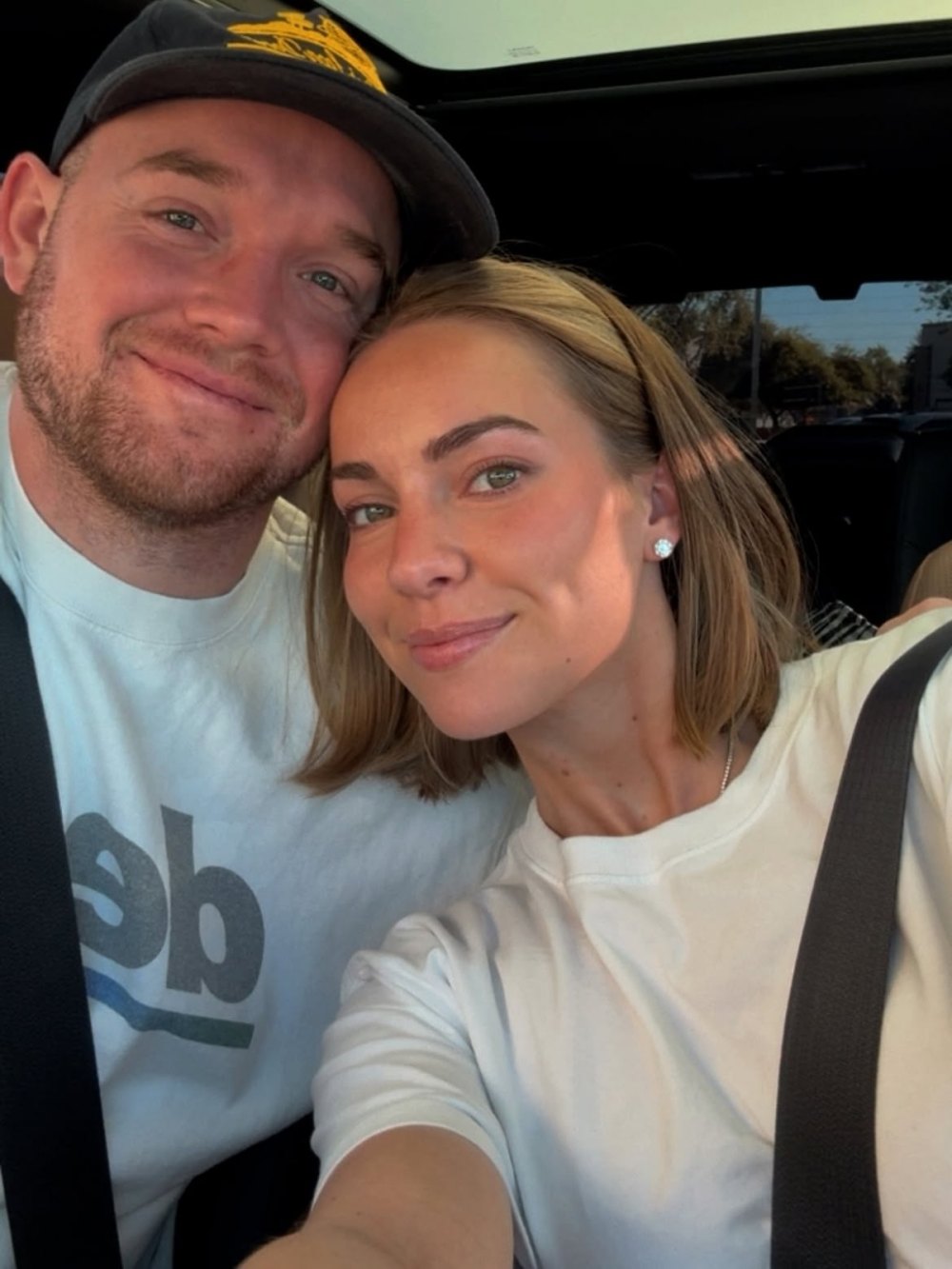
Brady and Emilie Kiser Courtesy of Emilie Kiser/Instagram
When the first anniversary of Trigg’s death hit in May, Emilie admitted she was “really struggling” with her grief.
“This month has snuck up on us in a way we could have never anticipated,” she said via TikTok on May 10. “It’s just incredibly hard to process that it’s been almost a year. … I just miss him so much. I am just really struggling.”
While appearing on Jay Shetty’s “On Purpose” podcast in June, Emilie shared how she came to forgive Brady, revealing it was a process they went through together.
“I really give Brady so much empathy and respect. I have so much respect for him, honestly, and I think that would maybe shock people, but he has allowed me to take out every emotion I’ve had throughout this process, whether it’s on him or talking to him or with other people,” she said at the time. “He’s going through so much as well, and … we are the only two people that can understand at all what the other person is going through.”
Emilie first developed a following on social media after posting videos of her day-to-day life. While sharing personal family stories or documenting lifestyle tips, the influencer received more than 2 million followers on Instagram and another 5 million on TikTok.
Most recently, she has used her platform to spread awareness about water safety in hopes others will not experience a loss like hers.
“This is a topic I will continue to talk about when I feel comfortable because it is so extremely hard to talk about,” Emilie shared via TikTok on April 30. “I hope people can understand that. Like I said, our son’s death was very preventable. It was an accident, but it was a preventable accident. I will always take full accountability for that because as a parent, it is your job to protect your child.”
For more vital, life-saving information on pool safety, see Bode Miller’s tips and visit Coverstar’s website.
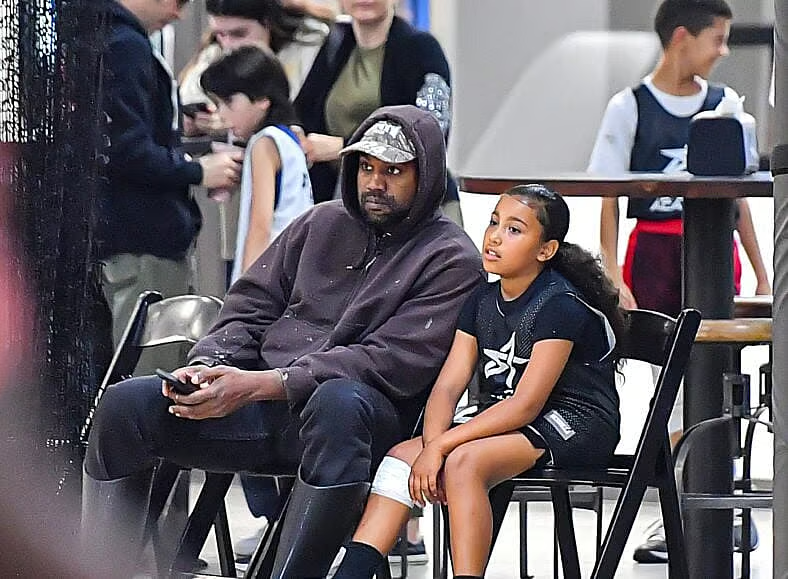
Despite growing up surrounded by fame and wealth, North West has revealed that she would like to experience something considerably more ordinary.
The 13-year-old daughter of Kim Kardashian and Kanye West has already begun carving out a music career, but she also has her eyes set on working a regular job at Starbucks.
As North West gets older, her ambitions and personal style continue to evolve, from abandoning an earlier dream of becoming a basketball player to embracing music and her growing collection of piercings.
northie for @Dazed 🩵 pic.twitter.com/KY1RpDZWp7
— Kim Kardashian (@KimKardashian) August 24, 2026
North may already have access to opportunities that most teenagers could only imagine, but she is still interested in experiencing a regular job.
During an interview with Dazed, she revealed that she would like to work at Starbucks once she turns 14.
“I still wanna work. I wanna work at, like, Starbucks next year,” North said. She believes turning 14 could give her the opportunity to pursue that goal, adding, “I want to have a regular job, I guess.”
Despite being born to celebrity parents, she appears eager to live an ordinary life.
North’s comments quickly went viral online, prompting mixed reactions from Netizens. One individual wrote, “She should! Everyone should work a customer service job once in their life. For her, maybe backstage at Disneyland though.”
In contrast, someone else noted, “
The Singer Gave Up On Her Basketball Career

Basketball was once among the many careers North imagined for herself, but that dream no longer seems to be part of her future.
When asked about becoming a professional basketball player, the 13-year-old made it clear that ambition is “not” in the cards for her anymore.
Her answer marks a change from 2023, when North listed basketball alongside several other ambitions. At the time, she said, “A basketball player, a rapper, um… Well, when I was seven, I wanted to be a boxer.” She also expressed interest in art, business, and eventually owning Yeezy and SKIMS.
Music, however, now appears to have become one of her main priorities. North dismissed advice that she should start her career later, explaining, “This is my hobby, this is what I like to do, this is what I wanna do with my life.”
She also admitted she avoids activities she does not excel at, saying, “I don’t like to do things that I’m bad at.” Her ideal day now involves rehearsing, heading to the studio, or preparing for a major performance.
North West’s Love For Body Piercings

North’s growing interest in self-expression has also been reflected in her appearance. According to People, she has been seen with dermal piercings on her hands and fingers and recently appeared in TikTok videos with two metal studs on each thigh.
The piercings have generated mixed reactions online, but North has continued embracing the distinctive style she prefers. Her appearance has also included blue hair and other bold looks, making her aesthetic an increasingly recognizable part of her public image.
Kim has defended her daughter amid some of the criticism. Responding to concerns about North’s changing appearance, she previously called the controversy “such a non-issue.” The mother of four has also asked people to show her more “grace” as she navigates parenting a teenager whose choices are regularly scrutinized publicly.
Despite the attention surrounding her appearance, North continues to experiment with her personal style as she grows older. Her piercings and bold fashion choices appear to be part of an evolving identity that she is increasingly comfortable expressing in public.
North West’s Growing Public Exposure Raises Concerns
North’s increasing fame has also brought concerns about the amount of public exposure surrounding her.
The criticism intensified following her appearance at a Vetements show during Paris Fashion Week, where footage showed photographers and other adults gathering around her.
According to the Daily Mail, one interaction in particular generated concern after internet personality Matteo Sinet hugged North when she appeared to be offering him a handshake.
Rapper Skepta was among those who reacted to the attention surrounding her, saying, “WOW!! Protect your kids, people. Protect your kids!”
Another source said, “No child should be placed in a position where adult men feel entitled to crowd her, comment on her, or seek photos with her in a way that treats her as public property.”
Kim Kardashian And Kanye West Also Faced Backlash Over Their Daughter’s Freedom

The scrutiny has also fallen on Kim and Kanye, with questions being raised about how their daughter’s freedom is being managed.
However, an insider said Kim strongly objects to suggestions that she is failing to protect North.
“Kim feels judged by a lot of other parents but is insulted at the idea that she isn’t doing enough to protect North,” the source said.

Business3 minutes ago
City of Perth CEO Michelle Reynolds’ return in limbo

Crypto World4 minutes ago
Lawmakers Respond to Supreme Court Upholding of Trump Mail-in Voting Restrictions

Sports6 minutes ago
The Rock sends a message to real-life Bloodline member ahead of huge WWE title match





-

 Fashion5 days ago
Weekend Open Thread: Madewell – Corporette.com
-

 Business4 days ago
Musk’s Tesla, SpaceX Confirm $16.8 Billion ‘Terafab’ Chip Plant as World’s Largest Building in Texas
-

 Crypto World4 days ago
anatomy of crypto’s biggest liquidation event since 2021
-

 Crypto World1 day ago
A $30 Billion AI Fund Implodes, Now the SEC Is Investigating Wall Street’s Role
-

 Politics4 days ago
6 months on, Irish renters crushed by effects of government housing bill
-
 NewsBeat4 days ago
The ‘Lucky Dip Gang’ causing carnage for clicks: After five thugs were killed speeding in the wrong direction on a motorway, GUY ADAMS investigates a sick new trend… and why police aren’t even allowed to pursue them
-

 Tech7 days ago
GLM-5.3 hits the API at $1.4/$4.4 per million tokens
-

 Business3 days ago
Mystery AI Model ‘Ox Alpha’ Draws Developers With Free Access as Chinese Lab Origins Remain Debated
-

 News Videos6 days ago
Don’t Leave Your Financial Future To Chance | August 19, 2026
-

 Business6 days ago
Five Below: Kids Discount Retailer Reaps Rich Rewards
-

 Business7 days ago
Marvell Shares Jump 7% as Google Chip Deal Confirms Custom AI Silicon Partnership, Analysts
-

 Business2 days ago
Moderna CEO warns China is pouring state money into mRNA technology
-

 Business5 days ago
UK firms in critical financial distress rise 9% to 53,756
-

 Business1 day ago
NVIDIA Stock Drops Nearly 2 Percent to $210 on Seventh Losing Day Ahead of Critical AI Earnings
-

 Fashion7 days ago
Jimmy Choo Autumn 2026 collection
-

 Sports3 days ago
Deshaun Watson fires back at Browns fans after being booed: ‘It’s a disrespectful thing’
-
 Entertainment6 days ago
10 Most Perfect Fantasy Shows of the Last 25 Years
-

 Tech6 days ago
OpenAI confirms ChatGPT is down as logins and signups fail
-

 Business6 days ago
PayPal and Venmo now accepted for tuition at several universities
-

 Crypto World6 days ago
Optimism-funded team's deciding vote shifts $49 million in OP tokens away from users
You must be logged in to post a comment Login