




Connect with us

Crypto World

Block Bits Capital founder convicted in nearly $1M crypto fraud

Published

on

Block Bits Capital founder convicted in nearly $1M crypto fraud

A federal jury has convicted Block Bits Capital co-founder Japheth Dillman of wire fraud and conspiracy after prosecutors said more than 20 investors lost nearly $1 million in a fraudulent cryptocurrency trading fund.

Summary

  • Japheth Dillman was convicted of defrauding more than 20 Block Bits Capital investors of nearly $1 million.
  • Investors were told the fund used an automated crypto trading tool even though Dillman knew the algorithm did not work.
  • Investor funds were used for personal payments and risky crypto investments that resulted in significant losses.
  • Dillman faces up to 20 years in prison and a $250,000 fine for each count, with sentencing set for Dec. 8.

The U.S. Department of Justice said on Aug. 24 that the 48-year-old San Francisco resident was found guilty following a 10-day trial before U.S. District Judge Richard Seeborg in the Northern District of California. Dillman remains free on bond and is scheduled to be sentenced on Dec. 8.

Court evidence showed that Dillman helped raise money for Block Bits Capital between June 2017 and August 2018 by giving investors false information about the fund’s trading technology and performance. Prosecutors said Dillman and a co-conspirator promoted an automated cryptocurrency trading program called the “Autotrader” as a completed and functioning product.

Advertisement

The software was supposed to generate returns by automatically trading digital assets, but Dillman knew the algorithm did not work as represented, according to evidence presented at trial. Investor money therefore could not be deployed through the automated strategy investors had been told the fund would use.

Block Bits Capital investors were sold a non-working trading tool

While raising capital, Dillman and his associates presented Block Bits Capital as a fund capable of earning profits through automated cryptocurrency trading, according to the Justice Department. Prosecutors said the claims continued even though Dillman knew the Autotrader was not functioning.

Earlier regulatory records provide more detail about the technology behind those representations. The U.S. Securities and Exchange Commission alleged in a 2022 civil complaint that Block Bits never completed the trading bot and had only funded early development work. No functional version was tested or deployed, while trading of fund assets was instead carried out manually, the regulator said.

According to the SEC complaint, Dillman and Block Bits continued making statements about the bot in emails, offering materials and promotional communications even as internal discussions acknowledged that automated trading was unavailable. The agency alleged that Dillman told investors in 2017 that the system could conduct arbitrage across multiple cryptocurrency exchanges despite the software remaining unfinished.

Advertisement

Prosecutors also told the jury that investor funds were used for purposes other than the strategy that had been marketed. Dillman and his co-conspirator paid themselves and placed money into speculative cryptocurrency ventures without fully disclosing the risks to investors, the DOJ said.

Several of those positions produced substantial losses, according to trial evidence. Even as the investments lost money, Dillman falsely told investors that Block Bits’ cryptocurrency trading operations were generating significant profits, prosecutors said.

The SEC had separately charged Block Bits Capital, Block Bits Capital GP I, Dillman and co-founder David Mata in April 2022 over an alleged fraudulent and unregistered securities offering. The regulator said at the time that more than 20 investors had supplied almost $1 million after receiving misleading information about the fund’s automated trading system and the way their money would be handled.

Advertisement

Crypto fund fraud cases remain active in U.S. courts

Dillman’s conviction follows several recent federal cases involving cryptocurrency investment businesses accused of overstating returns or misusing customer money.

In June, federal prosecutors charged a Tennessee resident over an alleged $1.9 million crypto investment scheme operated through Star Credit Holdings. Authorities accused Misam Abidi of making false claims about returns, reserves and assets under management while directing more than $1.9 million to himself and family members.

Prosecutors said the Star Credit operation collected money from investors in several states, with some funds allegedly used to pay earlier participants and others diverted from legitimate trading. Abidi was charged with offenses including wire fraud, money laundering, operating an unlicensed money-transmitting business and tax-related crimes. The charges in that case remain allegations unless proven in court.

Another large investment case advanced in July when Christopher Alexander Delgado, the chief executive of Goliath Ventures, pleaded guilty to fraud and money laundering charges. Prosecutors said investors had transferred at least $400 million to Goliath Ventures after being offered returns from cryptocurrency liquidity pools.

Advertisement

As crypto.news previously reported, Delgado admitted responsibility for at least $250 million in investor losses and agreed to surrender assets including luxury homes, vehicles, watches, jewelry and other property. Prosecutors had previously accused the company of using investor funds to make payments to other participants and finance personal spending.

The Justice Department has also been pursuing the assets generated through international crypto investment scams. In July, federal prosecutors sought forfeiture of $25 million in cryptocurrency recovered through five investigations involving alleged fraud networks targeting victims in the United States and Canada.

According to federal authorities, the cases involved fake cryptocurrency investment platforms and relationship-based scams used to convince victims to transfer digital assets. The DOJ said assets seized through its Scam Center Strike Force had surpassed $800 million by the time the forfeiture actions were announced.

Dillman faces up to 20 years on each conviction count

Following the jury verdict, Dillman faces a maximum statutory sentence of 20 years in federal prison and a fine of up to $250,000 for each count of conviction, according to the Justice Department. The charges cover wire fraud under 18 U.S.C. § 1343 and conspiracy to commit wire fraud under 18 U.S.C. § 1349.

Advertisement

The maximum penalties do not determine the sentence Dillman will receive. Judge Seeborg will determine the punishment after considering federal sentencing guidelines and the factors set out under U.S. sentencing law, the DOJ said.

His sentencing hearing is scheduled for Dec. 8 at 9:30 a.m. before Seeborg. Dillman will remain released on bond ahead of the hearing.

Federal agencies involved in the case included the FBI and IRS Criminal Investigation, while the SEC’s San Francisco Regional Office provided assistance. Assistant U.S. Attorneys Christiaan Highsmith and Charles Bisesto are prosecuting the case with support from Kevin Costello, Lynette Dixon, Andy Ding and Royce Epperson, according to the Justice Department.

Advertisement

Source link

Continue Reading
Click to comment

You must be logged in to post a comment Login

Leave a Reply

Crypto World

Japan targets early 2030s launch for blockchain-based stock and bond settlement system

Published

on

Japan targets early 2030s launch for blockchain-based stock and bond settlement system


Japan’s regulators are racing to modernize national settlement systems to prevent institutional investors and foreign capital from fleeing to overseas markets.

Source link

Continue Reading

Crypto World

Bitcoin (BTC) Rejected at $80K, Ripple’s XRP Plunges Hard as Rally Cools: Market Watch

Published

on

Bitcoin’s rally that began a week ago culminated yesterday with a surge to over $81,000 for the first time since May, when the asset was halted and driven south by a few grand.

Most larger-cap alts followed a similar trajectory, with XRP slumping by over 4%, while ZEC dumped by more than 7% after the debut of Grayscale’s ETF.

BTC Stopped at $81K

The primary cryptocurrency exploded out of the gate last Wednesday. It stood below $65,000 for weeks before the bulls took over. At first, they pushed it to $70,000 within hours. After a brief retracement, BTC skyrocketed again and surged to almost $80,000 on Friday to mark a three-month peak.

This meant that it had gained over $15,000 in less than 48 hours. As such, it was almost inevitable to correct before the bulls could step on the gas pedal once again. This took place during the weekend when BTC slipped to $75,000. The next leg up started on Monday and culminated on Tuesday.

Advertisement

As reported yesterday, bitcoin surged past $81,000 for the first time in 15 weeks amid these macro factors. However, it couldn’t keep climbing and has dropped by roughly $3,000 since that local peak.

Nevertheless, it remains up by more than 22% on a weekly scale, while its market dominance sits inches below 58% and its market cap is at $1.575 trillion on CG.

BTCUSD August 26. Source: TradingView

XRP, SOL, DOGE Rejected

Ethereum failed at $2,500 once again and is now down to $2,450 after a 1.3% daily decline. BNB is below $700 once again, while Ripple’s XRP was rejected at $1.50 and now trades at $1.42 after a major 4.5% daily decline. SOL touched $100 yesterday, but it’s well below that level now.

Even more painful declines come from DOGE (-5%), ADA (-5%), XLM (-5%), and CC (-6%). ZEC has dropped the most from the larger-cap alts despite Grayscale’s ETF launch, and is under $790 now.

In contrast, RAIN has skyrocketed by more than 20% and now trades above $0.0175.

Advertisement

The total crypto market cap has declined by around $60 billion in a day and is down to $2.740 trillion on CG.

Cryptocurrency Market Overview August 26. Source: QuantifyCrypto

The post Bitcoin (BTC) Rejected at $80K, Ripple’s XRP Plunges Hard as Rally Cools: Market Watch appeared first on CryptoPotato.

Source link

Continue Reading

Crypto World

Wall Street Raised Coinbase and Strategy (MSTR) Targets. Only One Leaves Real Upside

Published

on

COIN and MSTR Stock Performance.

Two Wall Street banks lifted their crypto stock targets on Tuesday. Goldman Sachs raised its figure on Coinbase (COIN) stock, while Canaccord Genuity did the same for Strategy (MSTR). Both kept Buy ratings.

The calls followed a run of steep gains across crypto-linked equities. Both stocks pushed higher as a broader market rally picked up speed last week.

Goldman Points to Derivatives and Prediction Markets

The bank lifted the COIN price target to $196 from $173. This works out to a roughly 13% increase. Goldman framed the case around two separate drivers rather than one.

“Buy-rated COIN offers upside optionality from any persistent improvement in the crypto backdrop, and continues to see strong idiosyncratic growth in newer businesses (including derivatives and prediction markets),” the bank said.

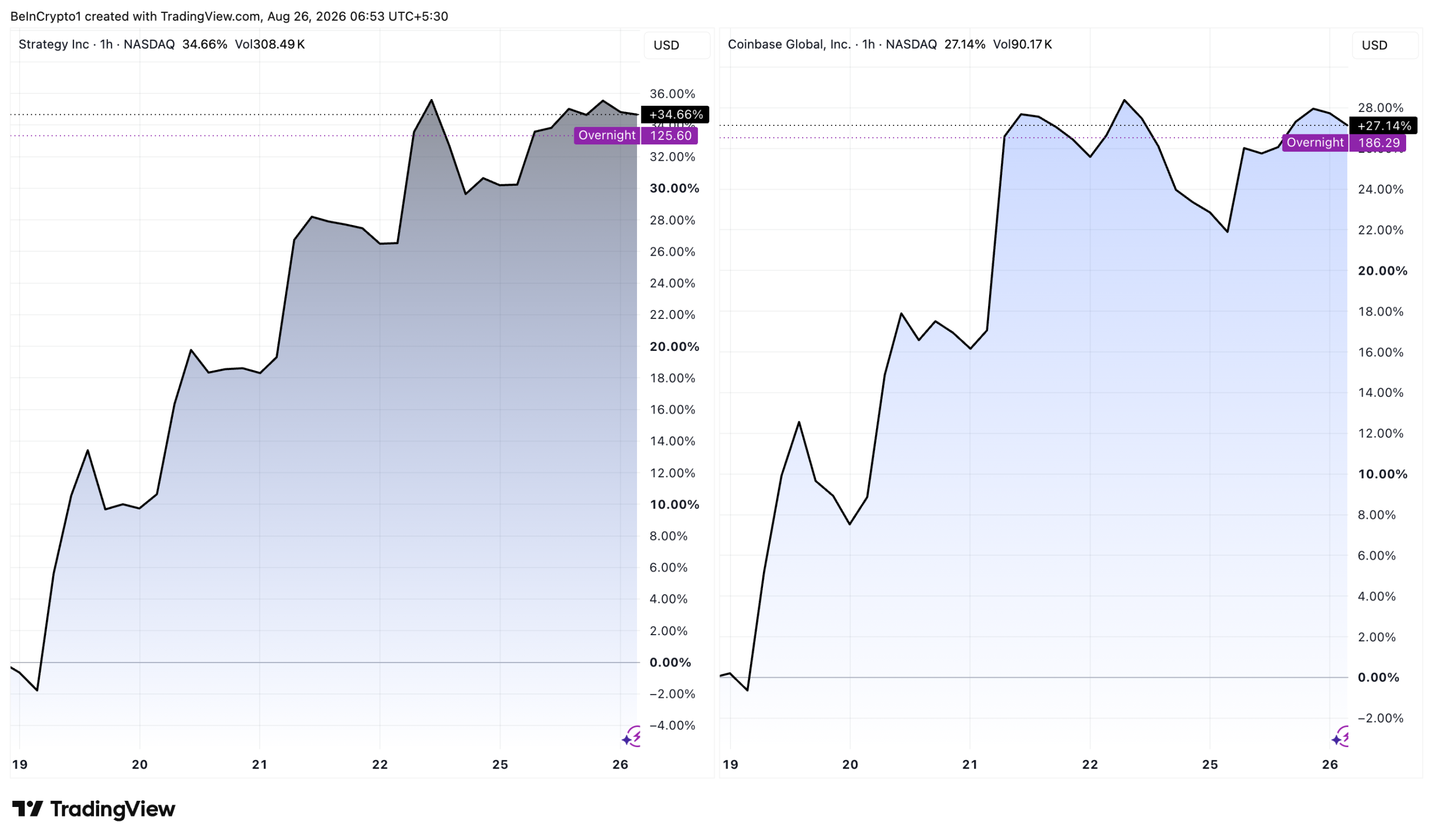
The stock closed at $187.16 on Tuesday, up 4.28%. This leaves the new target only about 5% above COIN’s current trading price. Goldman had carried a $235 target on COIN back in March before trimming it.

Advertisement

Follow us on X to get the latest news as it happens

MicroStrategy Stock Target Jumps 35%

Canaccord Genuity made a similar move on Strategy (MSTR) the same day, raising its target to $175 from $130. The $175 target sits roughly 38% above Tuesday’s close of $126.83.

“Like a breath of fresh air, the setup for MSTR has materially brightened over the last couple of weeks, in our view,” the bank noted.

Price action supports the shift in tone. MSTR has gained 34.66% since August 19, while COIN has added 27.14% over the same stretch, according to TradingView data.

COIN and MSTR Stock Performance.
COIN and MSTR Stock Performance. Source: TradingView

The target revision marks a turn in direction, though not a full recovery. Sentiment soured through the summer. Analysts across Wall Street cut their COIN targets on July 31 after a third straight earnings miss.

Both targets now imply further upside from Tuesday’s closes. Whether analysts keep raising them may depend on whether last week’s move extends into September.

Advertisement

Subscribe to our YouTube channel to watch leaders and journalists provide expert insights

The post Wall Street Raised Coinbase and Strategy (MSTR) Targets. Only One Leaves Real Upside appeared first on BeInCrypto.

Source link

Advertisement
Continue Reading

Crypto World

Why the Trump Administration Is Purging ‘Woke’ Art From U.S. Embassies

Published

on

Why the Trump Administration Is Purging ‘Woke’ Art From U.S. Embassies

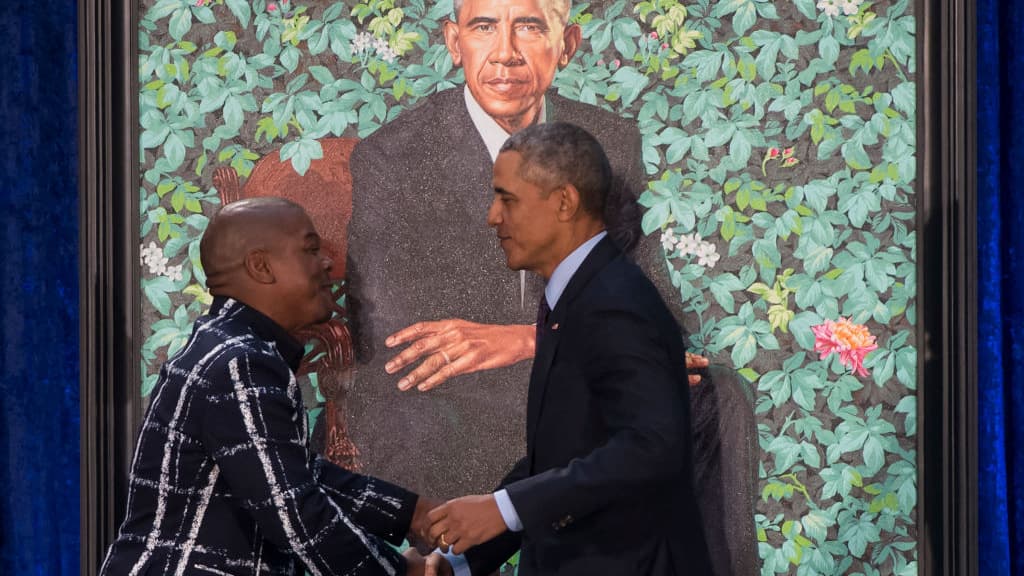
For “Young Artists After Siamesas 1960,” Wiley collaborated with students from the Facultad de Artes and the Altos de Chavon School of Design, both prominent art schools in the Dominican Republic. The subjects in the painting were modeled by four local art students. The work drew inspiration from two Dominican art works, Celeste Woss y Gil’s 1940 painting “Desnudo Feminine” and Gilberto Hernández Ortega’s 1960 work “Siamesas.”

The painting was part of the embassy’s permanent exhibition, assembled through the State Department’s Art in Embassies program. Established in 1963, the program is aimed at fostering cross-cultural dialogue and diplomacy through art. In 2015, the State Department awarded Wiley its Medal of Arts in recognition of his contributions to the program.

But in recent years, Wiley faced criticism from conservative commentators over his 2012 painting “Judith and Holofernes.” The painting portrays a Black woman holding the severed head of a white woman, which Wiley later described as a play on the “kill whitey thing.” The work, currently on view at the North Carolina Museum of Art in Raleigh, reimagines a 17th century painting by Giovanni Baglione that depicts the biblical story of Judith beheading an invading general to save her town.

Source link

Advertisement
Continue Reading

Crypto World

Summer Is Ending With a ‘Blood Moon’ Lunar Eclipse. Here’s What To Know.

Published

on

Summer Is Ending With a 'Blood Moon' Lunar Eclipse. Here's What To Know.

It’s not often that 3.6 billion people—or 44.4% of the world’s population—look at the same thing at the same time. And it’s not often that something comes along that’s worth the attention of all those billions. But that will happen on the evening of Aug. 27 when much of the world will be able to witness a blood moon lunar eclipse, during which 96% of the face of the full moon will fall into Earth’s shadow, glowing a deep orange-red in the process.

Lunar eclipses occur during a full moon, when the Earth is positioned between the sun and the moon, blocking all or most of the solar light that otherwise bathes the lunar surface. On average, lunar eclipses occur two to three times per year, though total lunar eclipses, when the moon is entirely shadowed, make up only 29% of those events. The autumnal color the moon takes on is due to a trick of the Earth’s atmosphere. Not all of the sunlight that would otherwise be striking the moon during an eclipse is blocked by the Earth; some of it leaks around the periphery of the planet and manages to reach the moon. That light streams through the Earth’s atmosphere during its passage to the moon, and some of the wavelengths of visible light—particularly the blue—are absorbed and scattered. What’s left is principally the red spectrum which partially lights the moon. All total lunar eclipses result in blood moons. 

In theory, a lunar eclipse ought to occur once a month. On every orbit around the Earth on its 27.3-day journey, after all, the moon will always pass through a point at which the planet sits between it and the sun. But the plane of the moon’s orbit around the Earth is tilted about five degrees compared to the Earth’s orbit around the sun. That means that on some passages behind the Earth the moon avoids the shadow, soaring above or ducking below the planet. 

How long will the lunar eclipse last?

Advertisement

An eclipse of the moon plays out slowly. The one that will begin on the evening of Aug. 27 and continue into the early hours of Aug. 28 will last a total of five hours and 38 minutes. Even the most dedicated eclipse chaser, however, may not be able to take it all in. Depending on where in the world an observer is—and this eclipse will be visible in Europe, Africa, North and South America, and western Asia—the moon may set before the eclipse is done or rise after it’s already begun. That will be the case in the Americas, where observers will see an eclipsed moon come up in the skies. Finding a flat area with few buildings and a clean sight line may be necessary to witness the eclipse, since in many places the moon will be low in the sky, close to the horizon. In the U.S., the eclipse will begin at 9:23 p.m. ET on Aug. 27, and end at 3:01 ET the next day.

There are three phases of any lunar eclipse—the penumbral, partial, and total or maximum. The penumbral phase occurs first, when the moon moves into the faint, outer reaches of the Earth’s umbra, or shadow. The partial phase comes next, when the true, darker shadow of the Earth begins to cover the lunar disk. The total or maximum phase is when only a small portion—or none at all—of the moon remains unshadowed. For the upcoming eclipse, the penumbral phase will take one hour and ten minutes, the partial phase one hour and 39 minutes, and the maximum phase, when the moon will be 96% obscured, will also take one hour and 39 minutes. That maximum shadow will occur at 12:12 a.m. ET. The eclipse will then return to the partial and penumbral phases before the moon soars on and leaves the Earth’s shadow behind.

What is an ‘eclipse season’?

This eclipse occurs in a busy time for the skies. On Aug. 12, just over two weeks before the lunar eclipse is set to occur, there was a total eclipse of the sun, visible in Spain, Portugal, Iceland, Greenland, and Siberia. There is actually such a thing as an eclipse season, a month-long stretch occurring twice a year—in the summer and winter—when the moon passes the point in its five-degree orbit that the Earth, moon, and sun align in a way to make both types of eclipses possible.

If you fancy eclipses, you’re well advised to take this one in while you can. The next total lunar eclipse will not be until Dec. 31, 2027 to Jan. 1, 2028. New Years Eve fireworks will be going off that night, but they will be nothing compared to the sky show the Earth, the sun, and the moon will serve up.

Advertisement

Source link

Continue Reading

Crypto World

Pi holds above $0.085 support as crypto market recovery loses momentum

Published

on

Pi holds above $0.085 support as crypto market recovery loses momentum

Key takeaways

  • Pi Network trades around $0.0900 on Wednesday, maintaining mild upside momentum above the critical $0.0853 support.

  • The broader cryptocurrency market is retreating as investors take profits following last week’s double-digit gains.
  • A break above $0.1022 could open the path toward $0.1204.

Pi Network is showing modest upside movement on Wednesday, with PI trading around $0.0900 and remaining above an important technical support level.

However, the broader cryptocurrency market’s recovery is losing momentum as investors lock in profits following last week’s sharp gains. PI’s technical indicators also remain mixed, reflecting a lack of decisive buying pressure.

Profit-taking slows the crypto market rally

The broader cryptocurrency market is edging lower this week after several major assets recorded double-digit gains during the previous week.

CoinGlass data shows that approximately $373 million in leveraged positions was liquidated over the past 24 hours. Long positions accounted for $310 million of that total, indicating that the latest pullback caught bullish traders off guard.

Advertisement

The elevated long liquidations suggest renewed selling pressure as investors reduce risk and take profits from the recent rally.

Despite the pullback, overall market sentiment remains strongly positive. CoinMarketCap’s Crypto Fear and Greed Index stood at 80 on Wednesday, placing the market firmly within the “extreme greed” zone.

The reading indicates that bullish sentiment persists even as traders assess whether the current decline is a temporary correction or the beginning of a broader reversal.

Pi Network holds above the $0.0853 support

Pi Network trades near $0.0900 at the time of writing, maintaining a neutral short-term outlook.

Advertisement

The token remains above the 23.6% Fibonacci retracement level at $0.0853. This level is calculated from PI’s decline between the $0.1341 high and the $0.0703 swing low.

As long as PI holds above $0.0853, buyers may retain an opportunity to extend the recovery. However, the token needs stronger momentum to overcome the resistance levels above its current price.

The 50% Fibonacci retracement level at $0.1022 represents the next major barrier for Pi Network.

This level rejected PI’s recovery attempt in mid-July, reinforcing its importance as a potential supply zone. A decisive daily close above $0.1022 could strengthen the bullish outlook and extend the advance toward the 78.6% Fibonacci retracement at $0.1204.

Advertisement

Such a breakout would also move PI above the psychologically important $0.1000 threshold, potentially attracting additional buying interest.

Pi Network’s momentum indicators show signs of stabilization but do not yet confirm a strong bullish trend.

The Moving Average Convergence Divergence indicator remains marginally above its signal line on the daily chart. This position points to a slight bullish bias, although the narrow separation between the lines reflects weak momentum.

Meanwhile, the Relative Strength Index stands near 51. The neutral reading suggests that buyers and sellers remain relatively balanced, leaving PI vulnerable to broader market movements.

Advertisement

PI/USD 4H Chart

The $0.0853 Fibonacci level remains the immediate support to monitor. A confirmed daily close below this level could invalidate PI’s near-term recovery outlook and increase selling pressure. In that scenario, the token could revisit the $0.0703 swing low.

Conversely, continued consolidation above $0.0853 would preserve the possibility of another attempt to break the $0.1022 resistance.

Advertisement

Source link

Continue Reading

Crypto World

Dollar Recovery Loses Momentum: USD/CAD and USD/CHF Resume Their Declines

Published

on

Dollar Recovery Loses Momentum: USD/CAD and USD/CHF Resume Their Declines

The US dollar has resumed its decline following a corrective recovery, as the support behind the currency proved insufficient to sustain the rebound. Selling pressure increased as long-term US Treasury yields fell amid reports that the US Treasury was prepared to expand its bond-buyback operations. Larger buybacks support the government bond market and can contribute to lower yields, reducing the dollar’s interest-rate advantage and limiting its recovery.

At the same time, geopolitical tensions surrounding Iran continue to support demand for the US dollar as a safe-haven asset. So far, however, this factor has not been strong enough to generate a sustained appreciation in the currency.

Today, markets will focus on a fresh batch of US economic data. Revised second-quarter GDP figures, the core Personal Consumption Expenditures (PCE) price index, personal income and spending data, and durable goods orders are all due to be released.

According to forecasts, US GDP growth could be revised down from 2.1% to 1.5%, while the core PCE price index is expected to show annual growth of 3.3% and a monthly increase of 0.2%. A combination of slower economic growth and persistent inflationary pressure could complicate the Federal Reserve’s policy decisions, leaving policymakers to balance the risk of economic weakness against the need to keep inflation under control.

Advertisement

Markets will also be watching comments from Federal Reserve officials for clues about how policymakers are assessing current inflation risks and signs of an economic slowdown.

USD/CHF

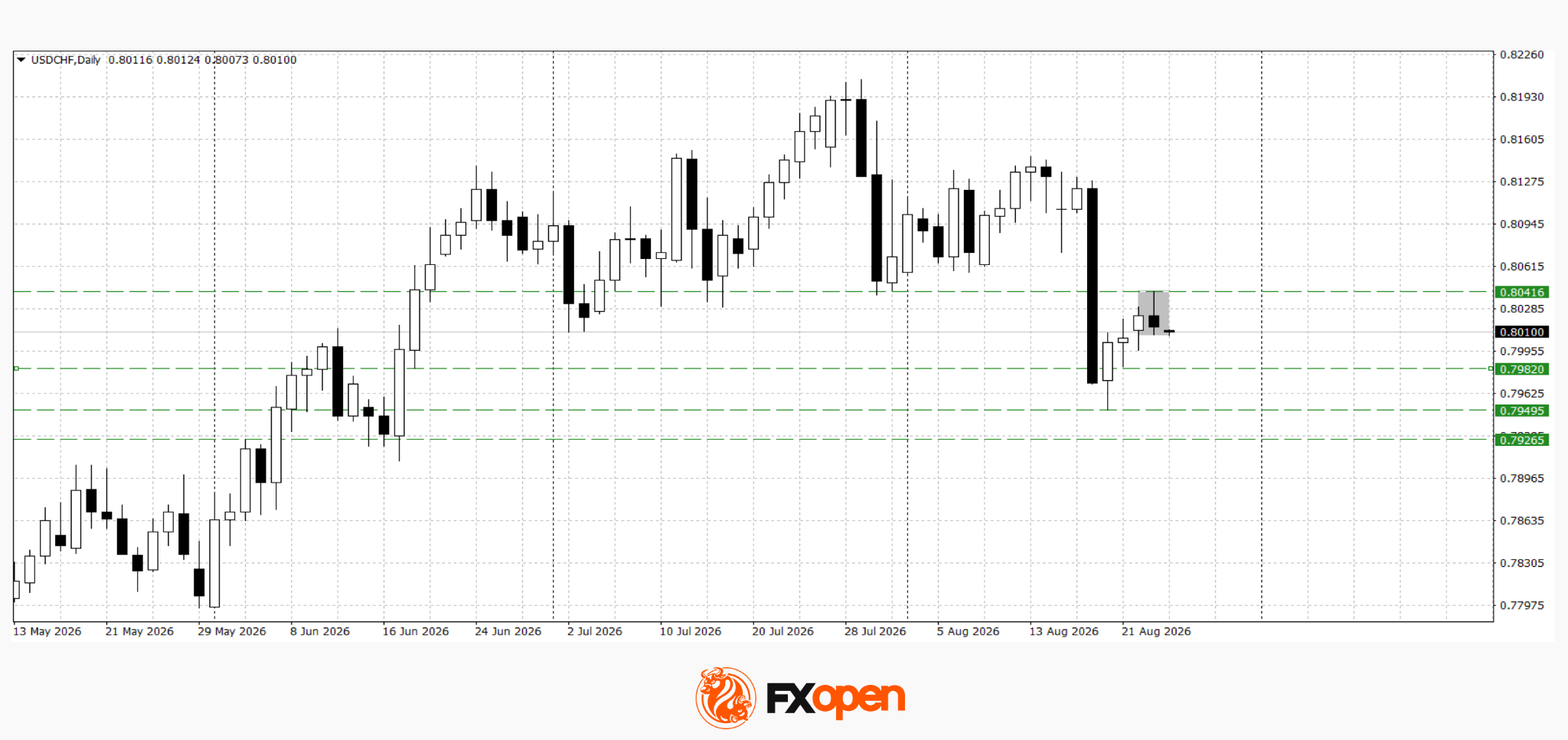
USD/CHF fell back towards 0.8000 after recovering to 0.8045 last week, forming a dark cloud cover pattern in the process.

If dollar weakness continues, the pair could break below 0.7980 and move towards the recent low around 0.7950. The bearish scenario would be invalidated if the price establishes itself firmly above 0.8045.

Key events for USD/CHF:

Advertisement
  • today at 11:00 (GMT+3): Swiss ZEW Economic Expectations;
  • today at 15:30 (GMT+3): US core Personal Consumption Expenditures (PCE) price index;
  • today at 15:30 (GMT+3): US GDP.

USD/CAD

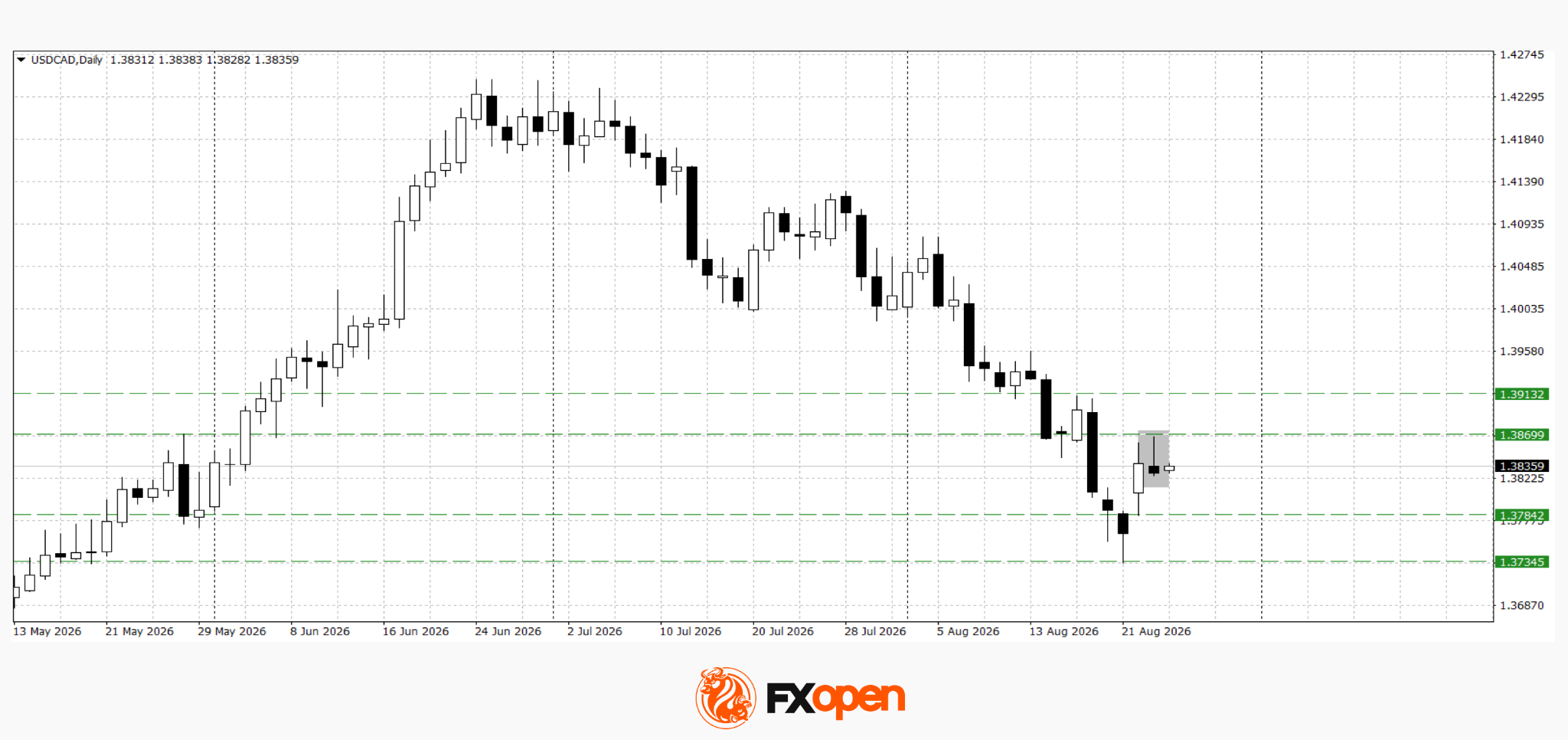
USD/CAD has also resumed its decline following an unsuccessful attempt to extend the recent recovery. Technical analysis points to a potential move towards the 1.3740–1.3780 area, with a dark cloud cover pattern having formed on the daily chart.

A renewed corrective recovery could develop if the pair establishes itself firmly above 1.3870.

Key events for USD/CAD:

  • today at 15:30 (GMT+3): Canadian wholesale sales;
  • today at 17:30 (GMT+3): US crude oil inventories;
  • today at 18:45 (GMT+3): speech by Thomas Barkin, a member of the Federal Open Market Committee (FOMC).

The dollar’s recovery is losing momentum as Treasury yields decline, although geopolitical tensions continue to provide some support for the US currency as a safe-haven asset.

The next moves in USD/CAD and USD/CHF will depend heavily on today’s US economic data and the market’s reaction to fresh signals from the Federal Reserve. Weaker-than-expected figures could increase pressure on the dollar and support further declines in both pairs, while stronger data could restore some demand for the US currency and trigger another corrective recovery.

Trade over 50 forex markets 24 hours a day with FXOpen. Take advantage of low commissions, deep liquidity, and spreads from 0.0 pips (additional fees may apply). Open your FXOpen account now or learn more about trading forex with FXOpen.

Advertisement

This article represents the opinion of the Companies operating under the FXOpen brand only. It is not to be construed as an offer, solicitation, or recommendation with respect to products and services provided by the Companies operating under the FXOpen brand, nor is it to be considered financial advice.

Source link

Advertisement
Continue Reading

Crypto World

Why AI Watermarks and Detectors Could Backfire

Published

on

Why AI Watermarks and Detectors Could Backfire
—JDawnInk—Getty Images

Claude now watermarks AI-generated text to comply with European Union transparency rules. OpenAI and Google add invisible fingerprints to AI-generated images. And Substack is touting a feature that scans pieces for signs of AI. Will we finally be able to tell what’s real on the Internet? My take: not even close. 

In fact, AI watermarks and detectors may leave us worse off by creating a false sense of confidence in content marked as genuine.

Watermarks and detectors are gaining traction as we lose our ability to trust our senses online. Look up the Will Smith eating spaghetti test, and you’ll see just how far AI has come. A 2023 AI-generated video shows the actor slurping spaghetti, face distorted, in a way that breaks physics. By 2025, AI was producing lifelike renditions. Deepfakes are so good that experts recommend families develop secret codewords to identify one another. 

“But I know a fake when I see it,” someone might say. 

Unfortunately, research consistently shows that you do not. This can feel especially hard to accept given the abundance of AI slop rocketing around the Internet. You may even start to think you can sniff out offending content. It might work, for a little bit. It almost never lasts. Any signal that becomes discernible is one a sophisticated actor will find ways to avoid. 

Advertisement

We’ve seen this story before. During the earliest days of the Internet, visual polish at least told you something. Major institutions had the resources needed to produce well-designed websites. Janky-looking sites, on the other hand, screamed “scam!” Information experts directed Internet users to dwell on features such as design, broken links, and typos. But when the Internet changed, the advice didn’t. 

A study I led, published in 2022, found that 96% of America’s leading colleges and universities offered outdated advice on how to evaluate online information—long after platforms like Wix, Squarespace, and Photoshop made it easier for bad actors to create fake but convincing-looking websites. Inexpensive software made slick graphics ubiquitous. Educators, however, continued to instruct Internet users to search for visual clues like a game of Where’s Waldo?

The most dangerous legacy of this aesthetic fixation is the inverse illusion: the cognitive tendency to believe that if the presence of a signal proves one thing, its absence proves the opposite. Yes, a site with misspellings that claims to show aliens still isn’t legit. But a beautiful site with a dot-org domain can also be harmful. In 2019, our research group found that nearly half of hate groups had dot-org domains. Bad actors know how to adopt the trappings of credibility. 

The same is true with AI. Even if visible flaws sometimes linger, their absence doesn’t mean content is genuine. Yet, too often, experts offer surface-level clues to identifying AI-generated content. This is why in the lead-up to the 2024 elections, Stanford Professor Sam Wineburg and I warned about public officials who advised citizens to pay attention to lighting, strange shadows, or other visual cues to identify deepfakes, even after AI content stopped making these errors. Many 2026 guides to spotting AI content mislead readers with the same poor advice. 

Advertisement

Which brings us to AI watermarks and detectors. These approaches, based on hidden signals in content, promise that while we can’t always spot the signs, their algorithms can. 

I’m not a software engineer. Yet I was able to easily strip metadata from some AI-generated images just by screenshotting them. Anthropic confirms that file metadata can be “stripped through format conversion, re-saving, screenshots, or other means.” Watermarks like SynthID are stronger and can persist after screenshots. But I was able to use a free online tool to remove a SynthID watermark. 

Google admits that the accuracy of detecting watermarked AI text is “greatly reduced” when users thoroughly rewrite what they generate, and that it “is not designed to directly stop motivated adversaries from causing harm.” More broadly, open-weight AI models that can run locally, outside platform terms and conditions, guarantee the spread of unmarked content.

Third-party detectors, too, have a spotty track record. I’ve regularly run AI-generated text through detectors that said it was human and vice versa. Many studies of text, image, and audio detectors find that they don’t work very consistently, and yet, their findings are used as the basis for public accusations. Every detector must confront an arms race with humanizer tools and other workarounds motivated actors find. 

Advertisement

I would argue that the biggest problem for detectors and watermarks remains the inverse illusion. Just because content lacks a watermark doesn’t mean it wasn’t produced or edited with AI. As Anthropic notes: “lack of a detected mark doesn’t mean the content wasn’t AI-generated or processed.” Deferring judgment to AI detectors leaves us vulnerable to bad actors who know how to launder content and make it pass muster.

This is a confusing time. Many of us are, understandably, uncertain. In one recent pilot, our research group showed 117 students a confident chatbot answer about local history with hallucinated facts. Half said they weren’t sure if it was true. One student said AI is sometimes right and sometimes wrong and “you never know which is which.” 

But just because we can’t trust our eyes or place full faith in detectors doesn’t mean we can’t trust anything. Rather than hunt for visual clues or outsource judgment to detectors and watermarks, we can turn to reputation and context. It’s easy to fake content. It’s much harder to fake a good reputation that’s validated by credible sources. 

The next time you see unfamiliar content online, resist the urge to ask, “Does this look like AI?” or run the content through a detector. Instead, ask yourself, “Do I trust where this information is coming from?” Open a new tab and check if reputable people and organizations confirm what you’re seeing. 

Advertisement

In an era of dwindling trust, we should not fork over ours to cheap signals or cheap software.

Source link

Continue Reading

Crypto World

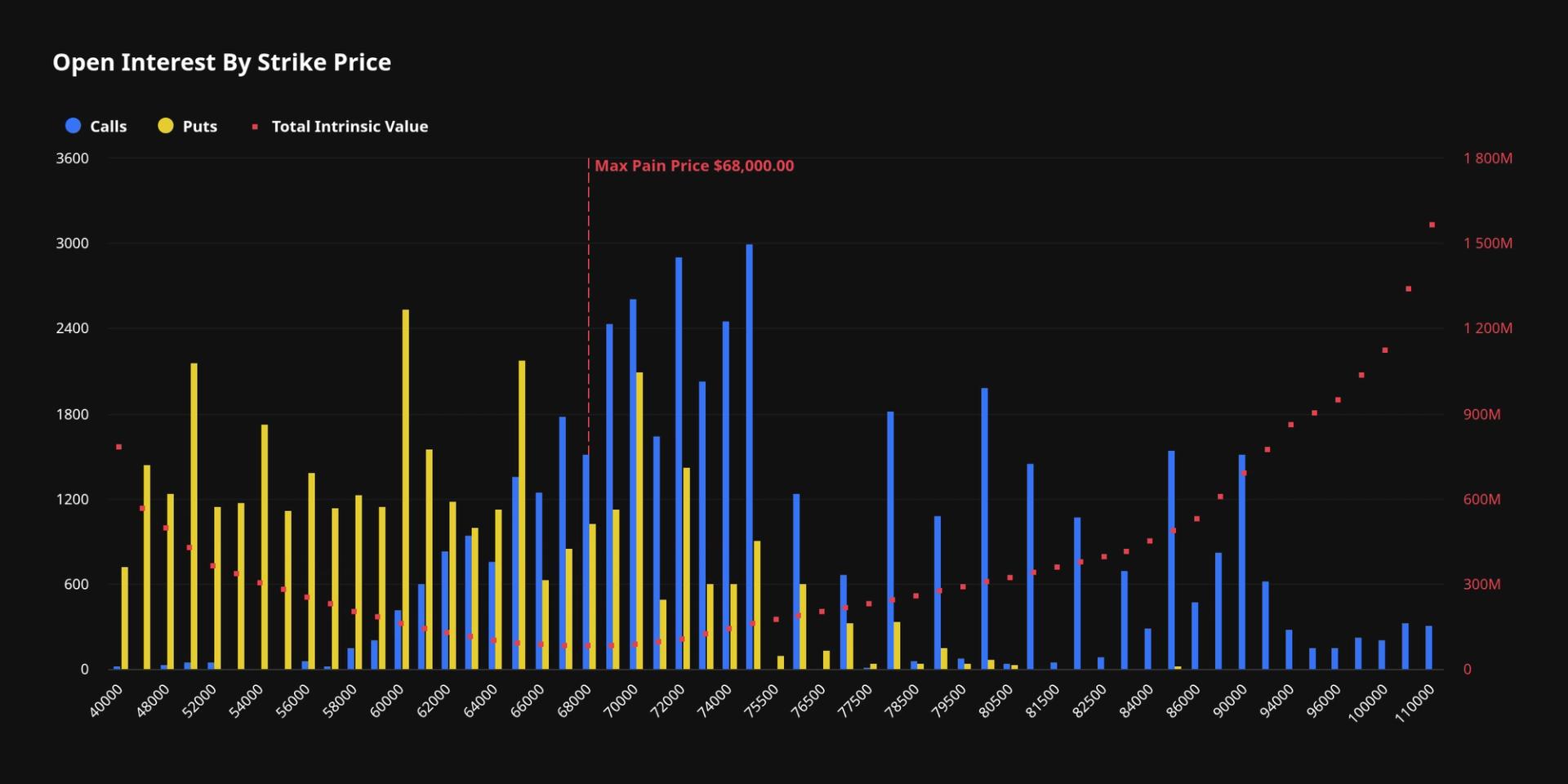
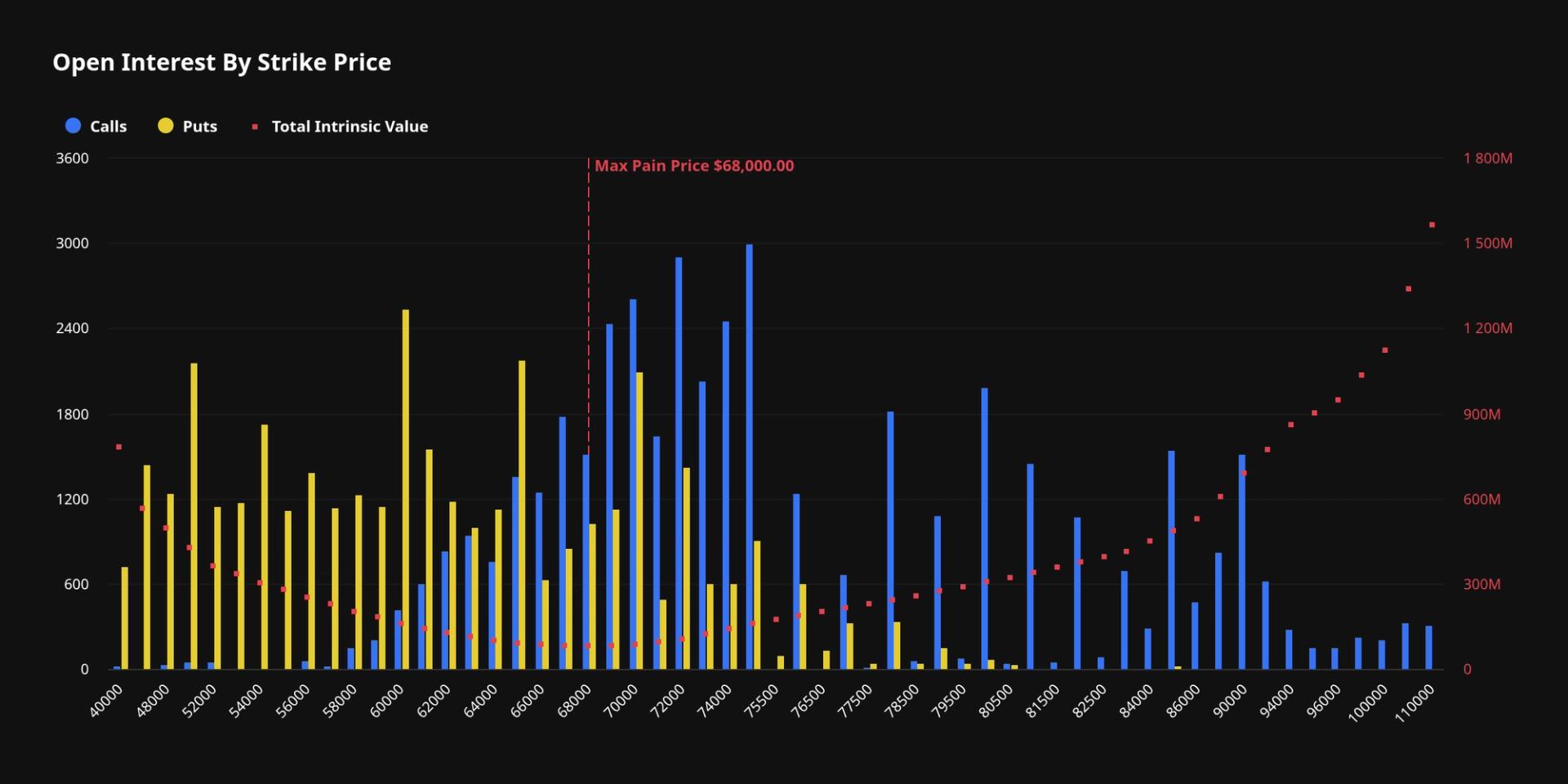
A massive $6.4 billion bitcoin options expiry on Friday could amplify volatility

Published

on

A massive $6.4 billion bitcoin options expiry on Friday could amplify volatility


Friday’s expiry follows bitcoin’s surge from $62,000 to $80,000, leaving market makers with increased exposure to manage around several key strike prices.

Source link

Continue Reading

Crypto World

Standard Chartered Launches as First Bank Distributor of HKD Stablecoin

Published

on

Crypto Breaking News

Standard Chartered Bank (Hong Kong) has become the first authorized bank to distribute HKDAP, a regulated Hong Kong dollar-backed stablecoin issued by Anchorpoint Financial. The bank said it is now working with eligible institutional clients and partners as part of a phased rollout, with early use cases focused on tokenized fund settlements, treasury operations and cross-border payments.

Standard Chartered’s announcement comes less than a couple of weeks after Anchorpoint began offering beta access to HKDAP via HashKey Group and OSL. The expansion into a traditional banking distribution channel marks a notable step for firms looking to use stablecoins within regulated financial workflows rather than solely through crypto-native venues.

Key takeaways

  • Standard Chartered Bank (Hong Kong) is the first authorized distributor of HKDAP, extending the stablecoin’s reach into conventional banking distribution.
  • HKDAP distribution is rolling out in phases, starting with institutional clients and partner-led pilots tied to settlement, treasury, and payments.
  • The bank plans HKDAP-linked subscriptions and settlements for tokenized money market funds in the fourth quarter.
  • Anchorpoint’s broader licensing and oversight framework is tied to Hong Kong’s Stablecoins Ordinance, including reserve backing, redemption, governance, and AML requirements.

Bank distribution moves from sandbox to mainstream channels

In its announcement, Standard Chartered Bank (Hong Kong) said it is engaging eligible institutional clients and partners on practical applications for HKDAP. According to the bank, the initial focus areas include tokenized fund settlements, treasury operations, and cross-border payments, which generally require reliability, clear operating procedures, and strong compliance controls.

The move also expands HKDAP’s distribution footprint beyond the beta access routes already provided through HashKey Group and OSL. Standard Chartered characterized the rollout as phased, and it added that it expects to introduce new commercial applications over the coming months.

For market participants, the key shift is where stablecoin access is landing. While stablecoins often circulate via exchanges, OTC desks, and other crypto infrastructure, a bank-authorized distribution channel can simplify onboarding for institutions that prefer established compliance and settlement pathways.

Advertisement

Planned use cases: tokenized money markets and internal settlement

Standard Chartered outlined several specific near- and mid-term applications for HKDAP. The bank said it intends to offer HKDAP-based subscriptions and settlements for tokenized money market funds with both international and local asset managers in the fourth quarter. In addition, it plans to use the stablecoin for intragroup settlements across its banking network in the near term.

The bank’s near-term intragroup settlement plan matters because it targets a high-frequency, process-driven environment where operational efficiency and reconciliation are central. Stablecoins, when paired with regulated licensing and redemption mechanisms, can reduce friction in value transfer and settlement timing—at least in theory and in early pilots—though outcomes will depend on how counterparties and internal systems integrate.

Standard Chartered also positioned the distribution as a way for eligible clients to access HKDAP through a regulated banking channel, tying stablecoin usage to payments, settlement and treasury management activities.

Anchorpoint’s licensing trajectory under Hong Kong’s stablecoin framework

HKDAP is issued by Anchorpoint Financial, an entity created as a joint venture involving Standard Chartered’s Hong Kong arm, telecommunications company HKT, and Web3 investment company Animoca Brands. Standard Chartered is the largest shareholder, and Anchorpoint operates as a subsidiary of the bank.

Advertisement

Earlier in the process, the partners announced plans for an HKD-backed stablecoin in February 2025, after participating in the Hong Kong Monetary Authority’s (HKMA) stablecoin issuer sandbox that began in July 2024. By August 2025, they formally established Anchorpoint Financial and moved toward obtaining an issuer license.

Hong Kong’s regulatory groundwork is anchored in the Stablecoins Ordinance, which took effect on Aug. 1, 2025. Before that date, the HKMA issued supervisory guidelines and published a public register of licensed issuers—elements designed to create transparency around who can legally operate within the framework.

On April 10, the HKMA granted what were described as the first stablecoin issuer licenses, including to Anchorpoint and HSBC’s Hong Kong banking arm. The licensing process is governed by requirements aimed at reserve backing, redemption, governance, and Anti-Money Laundering (AML) controls.

Against this backdrop, Standard Chartered’s role now shifts from participation in a licensing regime to actively distributing a regulated stablecoin. In other words, the story is no longer only about whether issuers can meet regulatory standards—it’s also about whether established financial institutions can deploy stablecoin rails for real financial products.

Advertisement

Regulated stablecoins vs. the risk of impersonation

Hong Kong’s push for regulated stablecoins has also been accompanied by public warnings about counterfeit or unauthorized assets. Earlier coverage from Cointelegraph noted that Hong Kong warned of fake stablecoins impersonating HSBC and Anchorpoint. That serves as a reminder that even as regulation improves legitimacy, end-users and institutions still need clear verification steps when evaluating stablecoin products and counterparties.

With Standard Chartered now distributing HKDAP through a conventional banking channel, the primary value for institutional users may be reduced uncertainty around compliance status and operational legitimacy—assuming integration and custody arrangements remain tightly aligned with the licensed framework.

Investors and market participants will likely watch how quickly HKDAP moves from institutional pilots into broader tokenized fund workflows, and whether the planned Q4 subscriptions and settlements for tokenized money market funds come to fruition as described. The next signal to monitor is the pace and scope of additional “commercial applications” Standard Chartered expects to introduce, since that will indicate how much regulatory-ready demand exists beyond initial settlement and treasury use cases.

Risk & affiliate notice: Crypto assets are volatile and capital is at risk. This article may contain affiliate links. Read full disclosure

Advertisement

Source link

Continue Reading

Trending

Copyright © 2025