

Richie Bell stood at the door of an East Village bar, nervous for a singular reason: he had to hand over his phone to a bouncer to get in. At 23 years old, Bell had hardly ever been without a device — he got his first iPhone in elementary school — but when he saw a video on TikTok advertising a queer, phone-free, funk dance party called Who’s Dancing?, he decided to test his limits. He immediately purchased a ticket and planned to attend alone.
Tech
Perplexity partners with Nvidia to launch Portable Computer, a fully local AI agent with zero token costs



Perplexity is launching Portable Computer today, a version of its agentic “Computer” platform that runs entirely on hardware users already own — starting with Nvidia’s DGX Spark desktop supercomputer and Linux machines equipped with Nvidia RTX GPUs.
The launch, developed in close partnership with Nvidia, is one of the most aggressive attempts yet to move serious AI agent workloads off the cloud and onto local devices. The model, the user’s files, and the work itself can all stay on the machine. Work completed locally consumes no billing credits, and the company says every task starts on the device by default — with the system asking permission before sending any individual step to a more powerful frontier model in the cloud.
“We’ve basically brought the exact same UI to a fully local app,” said Nate, Perplexity’s vice president of engineering for infrastructure and enterprise, during a press briefing Monday. “This incorporates the entirety of the agent harness and inference and everything needed to do work locally.”
For Nvidia, which has spent the past two years selling the world on trillion-dollar AI data centers, the announcement signals something subtler but strategically important: the chipmaker believes local AI has crossed a threshold from hobbyist curiosity to practical tool — and it wants to sell the hardware that runs it.
“Local AI reached an inflection point,” said Nader, Nvidia’s director of developer technology, who focuses on developer tooling and open source. “For the longest time, it was hobbyists and enthusiasts, and they were running these quantized models that were quantized down to be super tiny… And while that’s cool, it’s not super practical. But all that changed with a lot of these new open source models that have come out that are super useful.”
How Portable Computer packages a full local AI stack into a single app
Perplexity Computer, the company’s agentic platform for knowledge work, orchestrates AI models, files, tools, and web access to complete multi-step tasks — reviewing folders of documents, analyzing data, producing reports, and pushing results into business systems. Portable Computer replicates that experience locally: the local models, agent harness, inference engine, tools, app connectors, and a security sandbox come packaged together in a single system. That bundling is the point. With most local AI stacks today, users must assemble and operate those pieces separately — downloading model weights, standing up an inference server, wiring together tools, and tuning performance.
“Historically it’s just been really painful to bring up the local AI stack,” Nate said. “With Portable Computer, we really focused on just making this a really straightforward experience where you can get up and running very quickly.”
In one demo Monday, the system played the role of a retail investor reviewing a folder of 1099s and investment documents — the kind of sensitive financial material many users would hesitate to upload to a cloud service. Running a 27-billion-parameter Qwen model at full GPU utilization on a DGX Spark, the agent reviewed each document and flagged cases where the hypothetical investor was paying unnecessary fees. The interface element that normally displays a running tally of cloud credits “is just parked at zero,” Nate noted, “because all of this is happening on the device.”
A second demo showed the hybrid side of the product. Playing a startup founder, Nate asked the agent to analyze a CSV of user funnel data locally, then push the finished analysis to a Slack channel using Perplexity’s connector ecosystem — proof that local-first does not mean disconnected.
The system also connects to Google Drive, Gmail, and GitHub, and can escalate to a frontier cloud model when the local model hits its limits. At launch, users can set up Qwen 3.8 27B or PPLX 27B, a version Perplexity has post-trained on its own harness, with Nvidia’s Nemotron 3.5 Lightning coming soon.
Portable Computer arrives today for Pro, Max, Enterprise Pro, and Enterprise Max subscribers on Linux, with Windows support following in September. Any RTX GPU with at least 24GB of VRAM — roughly a GeForce RTX 3090 or newer — clears the bar, a threshold Nate called “sort of the floor where we really want to make sure that we can deliver a great experience, but balance that with making it broadly available.”
Why co-designing the model and agent harness beats general-purpose frameworks
Alongside the launch, Perplexity published a research paper arguing that effective local agents require the model and the agent harness — the scaffolding of prompts, tools, and orchestration logic around the model — to be designed together. The core insight: general-purpose harnesses assume a frontier model that can absorb enormous contexts, navigate sprawling tool surfaces, and plan over long horizons. Small local models buckle under those demands.
Perplexity found empirically that although models like Qwen 3.8 27B advertise 260,000-token context windows, they begin to struggle beyond 100,000 tokens. So the company built a deliberately minimal harness: a succinct system prompt, a small set of core tools, and capabilities that load and unload as on-demand “skills” rather than sitting permanently in context. It converted popular connectors like Gmail and GitHub from token-hungry MCP servers into compact command-line tools, added self-verification hooks that monitor the health of a task, and enforced always-on OS-level sandboxing. If the sandbox is unavailable, the harness disables itself rather than running tools unprotected — a contrast with open-source harnesses that run commands with the user’s full permissions by default.
The benchmark results Perplexity reports are striking, though they come from the company’s own evaluations. On its internal Local Knowledge Work Bench — 53 tasks spanning deep research, financial analysis, and document creation, which Perplexity says it plans to open-source — Computer running Qwen 3.8 27B on a DGX Spark scored 82.6%, versus 77.6% for the open-source Pi harness and 74.0% for Hermes running the identical model.
Perplexity’s post-trained PPLX 27B pushed the score to 85.4%. The gaps widen dramatically on harder tasks: on BrowseComp, a web research benchmark, Computer hit 66.7% accuracy versus 50.2% for Pi and 43.9% for Hermes, while using 51% less wall time and 70% fewer tokens than Pi. On multimodal document understanding, Computer scored 65.1% against Hermes’ 34.6% and Pi’s 13.9%.
The token economics driving AI agents from the cloud to local hardware
The strategic logic behind the launch becomes clear when you consider how AI workloads have changed. Chat was bursty — a question, an answer, done. Agents are different.
“With agents, you want these agents always on if you can. You want the agents to really consume as many tokens as they can,” Nader said. “What we’re seeing is an insatiable demand for tokens, and that’s something that makes local AI so great. As you saw through all these demos, you were not metered by the token. You were not paying for the token. So it’s really killer for agents.”
This reframes the value proposition of local hardware. An agent that runs for hours reviewing documents, verifying its own work, and iterating on analyses would rack up substantial API bills in the cloud. On a device the user already owns, the marginal cost of those tokens approaches zero. Perplexity’s paper makes the enterprise version of this argument explicitly: as agents scale across individual workflows and entire organizations, token expenditure and data movement “become increasingly difficult to govern.” Local-first execution addresses both at once — spend, because inference is free, and privacy, because sensitive tokens never leave the device boundary.
Perhaps the most commercially interesting result concerns the hybrid middle ground. On Terminal Bench 2.1, a challenging coding benchmark, the fully local Qwen model scored 59.6% at essentially zero marginal cost. Letting it escalate to a Claude Opus 5 “advisor” in the cloud raised the score to 73.0% at an estimated $0.415 per task. Running the frontier model alone scored 82.4% at $0.65 per task. Escalation, in other words, recovered roughly three-fifths of the gap to frontier performance at about two-thirds of the cost — and the user decides when that trade is worth making. Before any advisor call, the harness runs a PII classifier over the outgoing context and shows the user exactly what would leave the device. The remote model returns text guidance only; it never touches local files or tools.
Where Portable Computer fits against Ollama and the DIY local AI stack
Jason Hiner of The Deep View pressed the companies on how Portable Computer relates to existing local inference tools like Ollama. Nate’s answer drew a clear line: the tools solve different layers of the problem.
“The majority of the effort here has been at the agent harness level,” he said, noting that the system uses vLLM to host model inference underneath, with an advanced mode for users who want to plug in their own inference endpoint. “We’ve heavily post-trained both the Qwen and Nemotron models that we’re working with in order to really get the best possible results… Our focus has been on really honing the whole stack, top to bottom, of the model inference and the harness together.”
Nader put it more colorfully. “Just getting inference running really quickly on a Spark — there’s a smooth path. You can use Ollama. You can get that set up. But then, as you start to do more complicated, more agentic things, then suddenly you need more perf. You start looking at different models. You start looking at different harnesses, and it’s kind of like the ocean. The deeper you go, the deeper it gets.”
The appliance-like pitch appeared to land with at least one attendee. Ben, who described struggling to set up his own DGX Spark despite being an engineer — “this experience sucks, we have to fix it” — said the product feels like the unlock “needed for people to really feel and understand what agentic means, and you need the right UX to make it happen.” Nvidia also emphasized that the hardware scales: connecting two Sparks over shared memory runs frontier-class open models like DeepSeek’s latest, and four can run GLM 5.2 or Nemotron Ultra. “I’ve even seen eight Sparks get connected,” Nader said.
What the deepening Nvidia-Perplexity alliance means for both companies
The launch extends a partnership that has been building for more than a year. In June 2025, Nvidia and Perplexity announced a collaboration to bring sovereign AI models to European publishers and telecoms, part of CEO Jensen Huang’s continent-hopping campaign to convince governments that, as the Associated Press reported from VivaTech in Paris, “every country needs a national intelligence infrastructure.” The sovereign AI pitch — that data “belongs to your people, your country, your culture,” in Huang’s words — is philosophically the same argument Portable Computer makes at the scale of a single desk: intelligence you control, running on hardware you own.
There is a self-interested logic for both companies. Perplexity, which has raised capital at steadily escalating valuations while facing legal pressure from publishers over its content practices — including a lawsuit filed by The New York Times in December 2025 and an earlier public dispute with Forbes — gets a product whose economics don’t depend on metering every token, and a differentiated wedge into privacy-sensitive enterprises in law, healthcare, and finance. Nvidia gets a killer app for DGX Spark, a device that, by the admission of attendees at Monday’s briefing, has been easier to buy than to use. When one reporter asked whether a Spark might ship with Portable Computer and a Nemotron model preinstalled, Nader demurred without ruling it out: “That would be cool… the goal is just making sure that it’s a super smooth experience for every user.”
Questions remain. Perplexity’s most impressive numbers come from its own internal benchmark, and the company acknowledges that compact models still trail the frontier meaningfully on hard reasoning tasks — advisor escalation “narrows but does not fully close the gap.” The launch is Linux-only for now, the 24GB VRAM floor excludes the vast majority of consumer PCs, and Apple silicon — home to some of the most enthusiastic local AI tinkerers — is conspicuously absent from the roadmap. “We’re very focused right now on Nvidia hardware,” Nate said when asked.
But the direction of travel is unmistakable. Perplexity’s researchers describe the launch as part of “a broader shift in which increasingly capable agents move from remote infrastructure to individual and local devices,” and both companies are betting that advances in chips and open models will keep expanding what a box on a desk can do. During Monday’s demos, the most telling detail wasn’t a benchmark score — it was that credit counter in the corner of the screen, sitting motionless at zero while the agent churned through a folder of tax documents. For two years, the AI industry has measured its ambitions in gigawatts and tokens per dollar. Portable Computer proposes a different meter, one that never runs.
Continue Reading
Tech
Apple TV’s next big swing is 12 12 12, a heist thriller starring Anthony Mackie and Jamie Dornan

Apple TV just handed viewers a first look at its newest crime drama, and the pitch practically writes itself. Picture Grand Theft Auto colliding with Heat, then add two leads who can carry a screen on charisma alone. That’s 12 12 12, an eight-episode heist thriller starring and executive produced by Anthony Mackie and Jamie Dornan, set to premiere globally on November 13 with a two-episode debut. From there, new episodes drop every Friday until the finale lands on December 25.
What is 12 12 12 actually about?
The catchy title actually describes the show’s whole structure. Each episode moves across three timelines tied to one elaborate heist, covering the 12 months spent planning it, the 12 hours it takes to pull off, and the 12 days of fallout afterward.
Mackie plays a disgraced FBI agent squaring off against Dornan’s American career criminal, and their rivalry plays out as a tense game of cat and mouse across Europe. The endgame is a massive heist on a bank vault buried beneath the streets of Zurich.
The cast and crew behind Apple TV’s 12 12 12
The supporting cast brings real range, including Jack Kesy (Hellboy: The Crooked Man), Agathe Rousselle (Titane), Sallie Harmsen (Blade Runner 2049), José Garcia (Now You See Me), and Emmy nominee Kali Reis (True Detective).

Behind the camera, we have Emmy-nominated and BAFTA-winning filmmaker Kari Skogland directing multiple episodes, including the pilot, and also as an executive producer. She’s known for her work on The Falcon and the Winter Soldier, so expect a steady hand guiding the tone.
Series creators Dudi Appleton and Jim Keeble also serve as executive producers, with Paramount Television Studios and Anonymous Content producing. With that much talent stacked on both sides of the camera, 12 12 12 has high expectations to live up to.

Bell was pleasantly surprised to discover he wouldn’t have to relinquish his phone at all, but simply allow security to place tape on both the back and front-facing cameras. “You can’t scroll Reels because, think about it, on iPhones anyway, if they’re taping the front camera, that’s also the speaker area,” Bell told Vox. Without the temptation of content on his phone, Bell mingled with other attendees, who were similarly unoccupied and also flying solo. Even though event staff kept their eyes peeled for any errant phone usage, no one seemed to reach for them anyway.
Compared to other bars and parties he’s been to, Bell found this one more conducive to unbridled socializing and dancing. It’s easier to approach a stranger when they’re not hunched over their phone. No one is worried about looking like a fool, immortalized in video, because everyone is a little foolish, moving their bodies without fear of judgment.
Across the country, clubs, bars, music venues, and other social spaces are encouraging attendees to lock their phones away — or, at least keep them out of sight — for screen-free gatherings. According to event hosting platform Eventbrite, phone-free experiences have increased more than 500 percent globally between 2024 and 2025. Musicians Phoebe Bridgers and Harry Styles banned phones at their concerts; comedians John Mulaney and Bill Burr have followed suit. Clubs from Los Angeles to Miami are creating camera-free dance floors. Bars and restaurants in cities like San Francisco and Philadelphia that have long prohibited phone and camera use have been joined by newer establishments in Charlotte, North Carolina and Fort Worth, Texas.
The rise of phone-free socializing speaks to a growing exhaustion with an always-connected world. More than half of US adults say they use their smartphone too much, according to a 2022 Gallup survey. Excessive smartphone use has been linked to poor sleep quality and depression, and even the mere presence of a phone lessens cognitive capacity. The ubiquity of devices — and the cameras on them — has instilled a low-grade panic that you might end up going viral for eating a sandwich in the background of an influencer’s video. Even Gen Z, who has always lived under the spectre of technology, is nostalgic for times before everyone was “plugged in” and widely accessible.
Screen-free events are the natural evolution of the cultural desire to break up with tech. By transforming physical spaces, ridding them of distracting devices, event organizers and bar owners aim to foster connection, reclaim attention, and maintain a sense of privacy. Even a short detox from smartphones has the ability to dramatically shape the tenor of a get-together for the better.
“Exploited for content”
Before X&ND (pronounced “zand”), the funk and soul artist who organized the phone-free party Bell attended, first conceived of Who’s Dancing?, they noticed very few people actually cutting loose at clubs. Instead, they were on their phones. “The second that anybody starts dancing in a club where there’s meant to be dancing, people pull out their phone,” X&ND told Vox. “They’re getting surveilled, they’re getting essentially exploited for content and being put in a position where they’re on display for people that they didn’t necessarily want to be on display for.” X&ND wanted to create a space for women, queer, and trans people to dance and express themselves without the fear of ending up on the internet.
Since last summer, X&ND has hosted eight sold-out dance parties (and Bell estimates he’s attended seven). Phone-free events, X&ND said, are a reclamation of culture, of attention, of self-expression. “Influencers aren’t able to post anything. Different companies aren’t posting anything about our parties because we don’t give them the material to,” they said. “I think it’s the culture taking the culture back.”
The bar and nightclub scene has struggled in recent years, with many venues closing due to high rent and fewer patrons spending money on alcohol. But perhaps a less obvious culprit is the pervasive anxiety of being captured on video during a moment of vulnerability. Some might be turned off from entering these spaces altogether due to the high risk of embarrassment if they’re captured and mocked online.
In Washington, DC, 28-year-old Jo Vee had similar concerns about privacy and craved an environment where they could be anonymous. Like Bell, Vee has had access to a camera phone since they were a child and can’t remember a time when they weren’t thinking about what to post on Instagram. But when a friend organized a phone-free dance party, Vee jumped at the opportunity to enjoy themselves, free from the pressures of the algorithm — and the potential of accidentally becoming a meme. “There’s nothing more terrifying than thinking that you’re going to a party just to have fun, and then you wake up the next morning and there’s a video of you that has 10 million views that you had no idea about, and now you’re like a GIF reaction on the internet.” (Vee clarified that they do not speak from personal experience, but said that a version of this has happened to a couple of friends.)
Distraction-free connection
Although many people inherently recognize the downsides of excessive phone use, they also realize they’re fighting an uphill battle. Demanding jobs can tether workers to their emails and algorithms are designed to keep us engaged and scrolling. Our attention is constantly being pulled from the real world to the digital one. But even a brief respite from screens can be beneficial.
In his research, Georgetown associate professor Kostadin Kushlev found that phone usage during a social interaction undermines how much people enjoy spending time with others. “It’s not so much [that] the phone is making us feel unhappy,” Kushlev told Vox, “it’s more like I could be happier if I was not using a phone.” Put another way, people enjoy social gatherings more when they keep their phone out of sight because they can give their full attention to their conversation partner.
Kushlev’s other research has shown that as people curbed their phone usage over a two-week period, their ability to pay attention improved. Even a shorter detox period, like a two-hour phone-free gathering, could minimize overstimulation and encourage greater focus, Kushlev said.
Inside the Charlotte, North Carolina, bar Antagonist, couples on dates engage in heart-to-hearts and neighboring tables of strangers strike up conversations. That’s because the bar has banned phones. Upon entering, visitors are asked to secure their phone in a pouch which they keep with them for the duration of their stay. If they need to use their phone, they can do so outside.
Since Antagonist opened in March, owner Michael Salzarulo has observed patrons clamoring for a Friday night detox after a long week of screen-mediated work. “Normally Saturday is your biggest day,” Salzarulo said, “but Friday nights are our busiest nights of the week.” While anyone can lock their phone in another room for a few hours, Antagonist provides an element of accountability, Salzarulo said: a dedicated space for distraction-free connection.
Alex Becker was yearning for a break from her phone and her “email, Microsoft Excel job” when she co-founded PA Unplugged, a nonprofit championing policies that advocate for more mindful uses of technology, last year. One of the nonprofit’s initiatives, Screen Free Philly, maintains a calendar of screen-free events and organizes its own gatherings at breweries, parks, and other civic institutions, urging attendees to set aside their phones for discussions, art projects, and board games. At the most recent get-together, dozens of attendees handed their phones to Becker while they completed a series of puzzles throughout the city.
Although these gatherings are still fairly niche, Becker sensed a hunger among participants to seek out further opportunities for tech-free connection. While ditching a smartphone completely may be unrealistic, setting it aside for date night or an afternoon of gaming might be a salve for our tech-addled brains. We can implement these best practices at our own gatherings, too, by encouraging friends to leave their phones in a basket by the door or offering disposable cameras at parties.
“People are just done and ready to take their attention back, take their time back, and encourage more real-world connection,” Becker said.

Audio-Technica has expanded its StreamSet range with the ATH-M20xSTS.
The ATH-M20xSTS joins Audio-Technica’s StreamSet range as its second model and arrives after the ATH-M50xSTS established the line as a bridge between studio monitoring hardware and everyday streaming setups aimed at newer content creators.
That entry point suits streamers and creators new to dedicated audio gear and extends studio-grade monitoring technology into a lower price bracket than Audio-Technica’s professional line occupies. It builds on the ATH-M20x, a professional monitor headphone from the M-Series that has sold more than two million units, paired with microphone technology from the 20 Series.
Inside the ATH-M20xSTS, 40mm CCAW voice coil drivers deliver a wide bandwidth and flat frequency response, specifications that allow users to monitor original game audio accurately rather than through a coloured or bass-heavy tuning.
The headset weighs approximately 230g and uses breathable mesh earpads alongside elliptical earcups designed for extra noise isolation, a combination that helps keep it comfortable through long recording or gaming sessions lasting several hours at a time.

An integrated AT20 cardioid condenser microphone sits on a flexible boom arm that keeps it close to the mouth during movement, and flipping the arm upward mutes the microphone instantly for quick control during a live stream.
Connectivity runs through a detachable cable fitted with a 3.5mm TRRS mini-plug, alongside USB Type-A and USB Type-C adapters that extend plug-and-play compatibility across PCs, consoles and mobile devices without additional software or drivers required for setup.
The ATH-M20xSTS is available now from Audio-Technica site, with general sale following from 1 September at €99 / £89.

Mozilla plans to enable JPEG XL decoding by default in Firefox 157, which is due at the end of September. Phoronix reports: Firefox Nightly has JPEG-XL support enabled by default right now to help in vetting this support while Mozilla believes the support is in good enough shape for a stable debut with Firefox 157. This follows Chrome shipping JPEG-XL and Google Research developing jxl-rs as a Rust-based JPEG-XL image decoder that is both performant and secure.
In today’s Mozilla Hacks blog post they elaborate on JPEG-XL vs. AVIF image formats: “JPEG XL: Excels at lossless imagery, progressive rendering, and further compressing JPEGs without quality loss. AVIF: Excels at web-quality photographic images, and images that have a mix of sharp edges and flat surfaces. … Although AVIF tends to produce smaller files at web-quality than JPEG XL, AVIF only has basic progressive rendering support. So, for very large images, it may be worth taking the filesize hit with JPEG XL.”


Read more of this story at Slashdot.
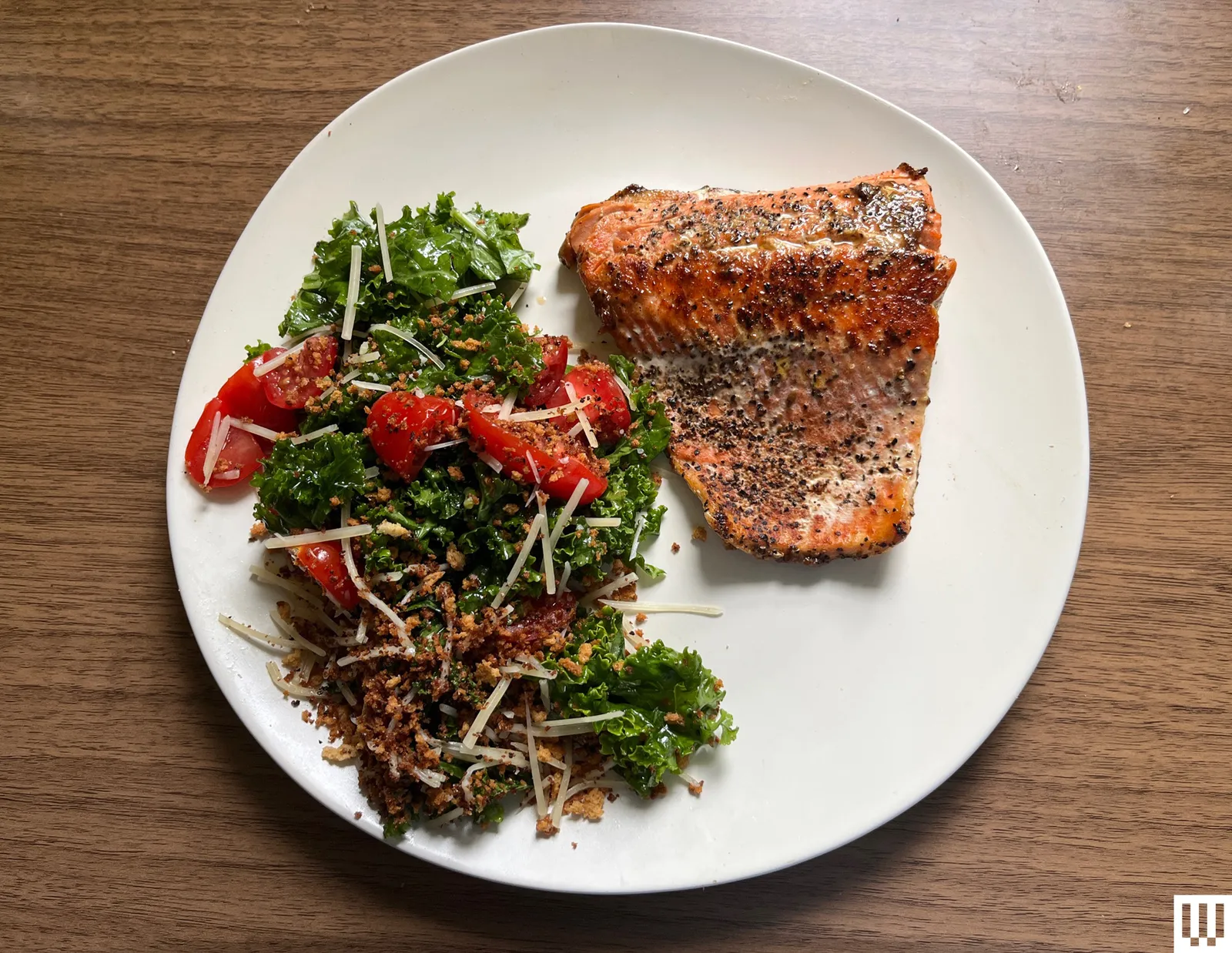
This year, gluten-free dishes included a lemon-oregano shrimp with schug and feta—a lemony-herbal romp served over rice livened up with dried apricots. (Adding dried fruit to liven up rice is a favored trick by Green Chef, one I might plan to add to my normal cooking routines.) The American-fished shrimp were plump and hearty, with no briny fishiness.
Yemeni schug remains one of my favorite condiments in existence, though this version could have been spicier. And the rice could have been more plentiful, perhaps. But these are small quibbles on a light, bright meal with lovely layers of flavor from herbal schug to toasted cauliflower and kale and the lightly tart bite of apricot.
I would almost never bring together this many ingredients on a weekday night, were they not helpfully bagged up in single portions. Indeed, if I tried, I probably would end up spending more at the grocery store than on the meal kit, as I discovered after an experiment last year.
Photograph: Matthew Korfhage

But especially, I have been impressed with protein sourcing. A well-trimmed bavette steak last year came from a fourth-generation meat purveyor in Texas. So did my chicken breast this year, on a harissa chicken dish. Shrimp are Atlantic coast, not Southeast Asian coast. My salmon was wild-caught. My steelhead came from a fishery in Norway. Each is clearly and transparently marked—a rarity among proteins from meal delivery services.
That steelhead in particular was among my favorite home meals of the summer. The dish’s secret, again, was layering: earthy spice on the fish, citric accents and crispness on the gremolata. The pleasing chew of dates countered the soft give of ginger-spiced couscous.
While eating it, I actually felt proud of myself—though it only took a scant 40 minutes to make. If anything, this summer’s meals were more sophisticated, but lower effort, than the Green Chef meals I tried last year.
Quibbles
Green Chef’s recipe cards are thoughtfully designed, with helpful pictures guiding the way. But their format tends to separate out each prep step in full, carrying the entire step through to completion, whether veggie chopping or couscous cooking.
This makes sense, of course. But this does lead to a simple caution: Green Chef does not hold your hand as well as some meal kits as regards the best order of operations. Read through each recipe in its entirety before cooking, and decide your game plan.

We’ve all been there. You meet someone new on a dating app, start to envision a life together, only to wonder: Is the person actually who they say they are?
It’s an experience that has led many singles, sometimes out of concern or just genuine curiosity, to prescreen dates by tracing their digital footprint: scanning social media posts, browsing their LinkedIn profile for clues.
The platform Stud or Dud—not to be confused with stud’s use as a slang term for a masculine-presenting Black lesbian—wants to introduce even more transparency into that part of the dating process. According to its website, the platform uses “public records, publicly available information, and other permitted sources” to create a profile of your potential match. It launched today in the US and was created by the company behind PeopleFinders.com, the online data broker service that collects public records from multiple sources and makes them searchable to help clients locate individuals or run background reports.
Intended to help daters make informed decisions about the people in their life, like identifying possible warning signs, Stud or Dud aggregates courthouse documents, bankruptcy filings, tax liens, pre-foreclosure data, phone directories, social media posts, and more to create a snapshot of your potential suitor’s personal life. All daters need is the person’s name or phone number to run a search. The aggregated data is presented in a single report, where it is divided into four categories: finances, property or assets owned, employment history, and criminal background. Each report comes with an AI-generated overview.
The tool will also earmark what it determines to be red or green flags about the person. Criminal records—a DUI or time spent in prison, for example—signal a red flag, but PeopleFinders CEO Amber Higgins encourages users not to pass judgement even if the site does.
“We give enough information for the user to determine, is that really a red flag for them or not? And that all kind of speaks to your lifestyle expectations.” In this sense, the reports lean prescriptive since the company suggests what safety details to consider, calling attention to things like how many times you’ve been evicted or if your name is on a sex offender registry. There is also an AI assistant (“the dating detective”) users can chat with when they want more tips for first dates or general advice.
According to the company, one of the biggest historical use cases of PeopleFinders.com has been for online dating safety.
“Modern dating has changed dramatically, and the tools people have used to establish trust haven’t kept pace,” Higgins says. “People are meeting across dating apps, social media, DMs. They have very little context of who’s actually on the other side.”
While some might consider that the whole point of dating—the early talking stages, however awkward, are all about navigating the unknown when getting to know someone—Higgins adds that the site, which requires a subscription, was built to provide additional context on a potential match. She recommends that people use it as a “sidekick” to the apps. “This is meant to confirm your trust about a dating profile.”
Even as online vetting is a crucial safety measure and fully part of the modern dating process—daters in San Francisco, for example, lost more than $40 million to romance scams in 2025, according to the FBI—there also seem to be legitimate opportunities for bad actors to exploit the information gathered from the site. The platform assumes that the person doing the searching is the one at risk, but that may not always be the case.


Security
No timeline to restore IT systems as probe remains ongoing
Medical device maker Boston Scientific’s global operations have been disrupted by an ongoing cyberattack, the company disclosed on Wednesday. According to an SEC filing, the “cybersecurity incident” affecting its IT systems started on Tuesday, and resulted in a “global disruption to the company’s operations.”
Upon detecting the digital intruders, the company began an investigation with third-party infosec experts who are working to contain the threat, the filing says.
The medtech firm did not immediately respond to The Register’s inquiries, including if this was a ransomware infection and what data, if any, the criminals stole after breaking into the IT systems.
“The incident has caused, and is expected to continue to cause, disruptions and limitations of access to certain of the company’s information systems and business applications that support aspects of the Company’s operations, including the ability to process and ship customer orders,” Boston Scientific reported to federal regulators.
The company doesn’t have a timeline for full restoration, and noted the “full scope, nature and impacts, including operational and financial impacts” of the cyberattack remain unknown.
The news did, however, send Boston Scientific shares spiraling down more than 4% on Wednesday morning.
At press time, none of the usual suspects had claimed responsibility for the attack. In recent months, both ransomware/extortion gangs and government-backed hackers have disrupted other medtech firms’ operations and stolen sensitive data.
In March, Stryker was hit by a cyber crew with ties to Iran’s intelligence agency, causing a global network outage at the company.
A month later, medical-device maker Medtronic disclosed a cyberattack in a filing with federal regulators. Notorious data-theft-and-extortion group ShinyHunters claimed to be behind this intrusion, and the company in July warned patients that their names, contact details, dates of birth, Social Security numbers, and health information was stolen in the breach. ®
Tech
ASCENDO Panoramic Surface On-Wall Speaker Debuts New Full-Range Radiating Technology at CEDIA Expo 2026
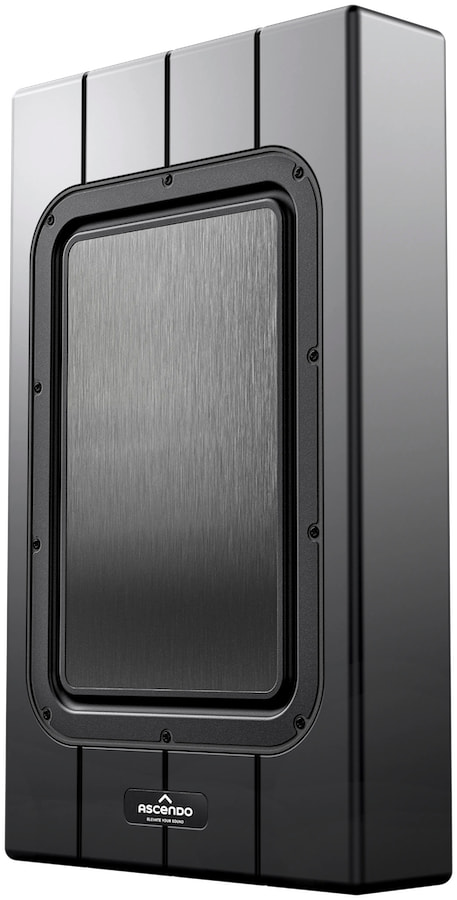
ASCENDO Immersive Audio returns to CEDIA Expo in 2026 with something more ambitious than another conventional architectural loudspeaker. The company will debut its new Panoramic Surface On-Wall, an ultra-shallow speaker designed around ASCENDO’s proprietary full-range composite radiating surface technology for immersive home cinema systems.
The technology was developed specifically for surround and height-channel applications, where conventional loudspeaker dispersion can become a significant design challenge. As frequencies rise, traditional drivers tend to become increasingly directional, concentrating more acoustic energy in front of the speaker. Cone drivers, dome tweeters, compression drivers, and waveguides can all be engineered to control that behavior, but high-frequency beaming remains an inherent consideration in conventional loudspeaker design.
That becomes particularly important in an immersive cinema, where surround and height speakers are supposed to create a convincing acoustic environment rather than draw attention to individual boxes mounted on the walls or ceiling. Consistent dispersion can help maintain tonal balance, spatial cues, and perceived sound levels across multiple seats instead of delivering the best experience only to listeners positioned directly on-axis.
Solving Beaming Issues
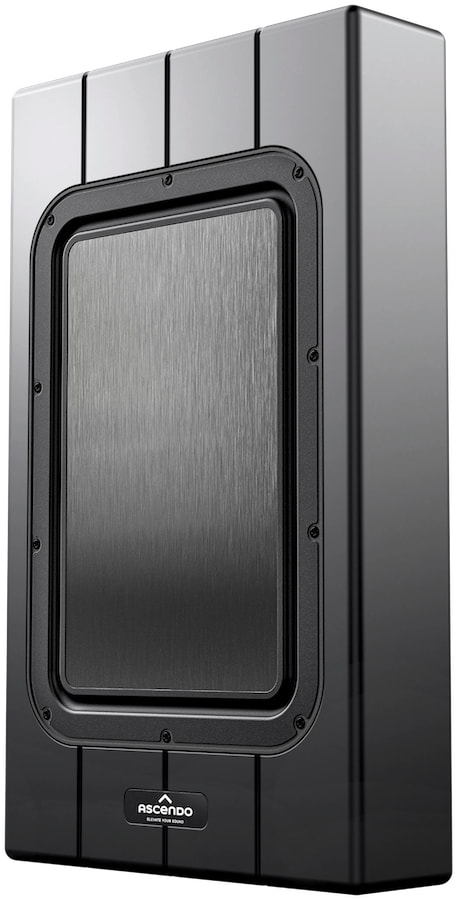
The ASCENDO Panoramic Surface Speaker takes a different approach by replacing a conventional multi-driver arrangement with the company’s proprietary full-range composite radiating surface technology.
ASCENDO says the surface is engineered to distribute acoustic energy across a much broader area than a typical point-source loudspeaker while allowing the enclosure to remain exceptionally shallow. In practical terms, the design is intended to function more like a controlled acoustic surface than a conventional speaker with distinct high- and low-frequency radiators.
According to ASCENDO, the resulting radiation pattern approaches 180 degrees and maintains that broad dispersion into the high-frequency range, extending up to 20 kHz.
“Panoramic Surface follows a principle that has always driven ASCENDO: We don’t take an existing loudspeaker concept and force it into an application it was never designed to serve,” says Geoffrey Heinzel, ASCENDO Co-Managing Partner. “We start with what the acoustic environment actually requires and engineer the solution around those demands.”
Advantages For Listeners
For listeners, the Panoramic Surface Speaker is intended to deliver more consistent tonal balance across a wider seating area, with less audible variation between on-axis and off-axis positions. In an immersive system, that can also help surround and height effects feel more continuous and less dependent on a single ideal listening position.
ASCENDO also says the broad radiating behavior can reduce the level changes that listeners may experience when seated relatively close to a surround or height speaker. For installers, that could provide greater flexibility when arranging seating in rooms where individual channels cannot always be positioned far from every listener.
Wide dispersion, however, is only part of the equation. An immersive cinema loudspeaker still has to reproduce transient information, spatial cues, and dynamic changes with sufficient precision and control. ASCENDO says the Panoramic Surface design was engineered to combine its broad radiation pattern with the speed, clarity, and dynamic performance expected from the company’s cinema loudspeakers.
Designed to Work With Room Architecture
The Panoramic Surface also addresses another challenge in surround and height-channel installations: the interaction between a loudspeaker and the wall or ceiling on which it is mounted.
Because the speaker is designed to operate very close to an architectural boundary, ASCENDO says it can greatly reduce front-boundary SBIR (speaker-boundary interference response). SBIR occurs when direct sound from a loudspeaker combines with sound reflected from a nearby boundary, potentially creating cancellations and uneven frequency response.
By minimizing the distance between the radiating surface and the mounting boundary, the Panoramic Surface is designed to reduce those problematic reflection paths and associated comb-filtering effects. The approach also reflects ASCENDO’s broader philosophy of engineering loudspeakers as part of the complete cinema environment rather than treating the speaker and room as separate elements.
Experience ASCENDO at CEDIA Expo 2026

ASCENDO will demonstrate its Panoramic Surface speakers and latest immersive audio technologies at CEDIA Expo 2026 in SR10 (Sound Room 10), where the company is integrating them into a scalable luxury home cinema system.
The demonstration will feature a 9.8.4-channel configuration, giving attendees an opportunity to hear how the Panoramic Surface speakers perform as part of a complete ASCENDO immersive cinema installation.
Here is a brief system rundown.
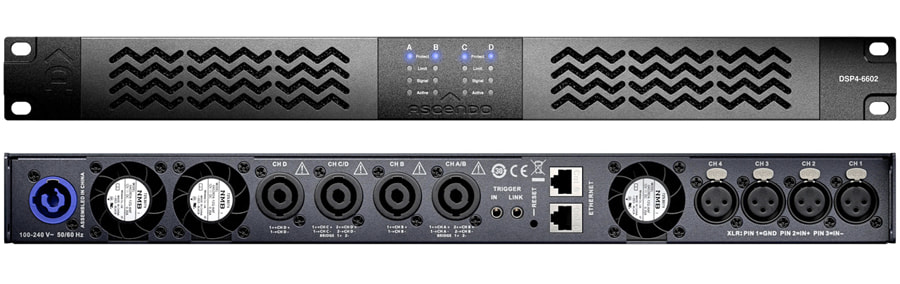
Ascendo: In addition to the new Panoramic Surface speakers, Ascendo will also debut its new DSP4-6602 DSP/Amplifier and spotlight THE 18 SUB PASSIVE VENTED.
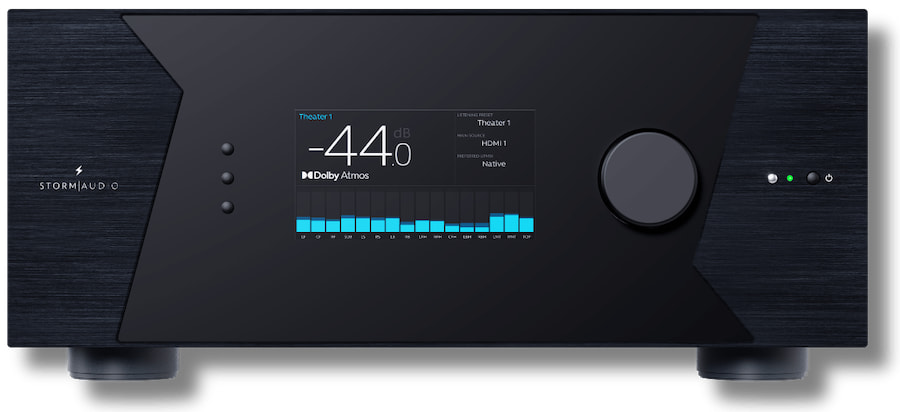
StormAudio: To provide the processing and amplification required for the demonstration, StormAudio is supplying its ISR Fusion 20 immersive AV receiver. The Fusion 20 is a 20-channel processor with 16 channels of built-in amplification, delivering up to 150 watts per channel into 8 ohms in single-ended operation.
AcustiMOD: Drawing on the heritage of Officina Acustica, AcustiMOD is outfitting the room with its modular acoustic architecture system. The approach is designed to provide a more engineered and repeatable path to room treatment, bringing elements of bespoke acoustic design to a broader range of installation budgets.
Christie and Seymour Screen Excellence: These companies are teaming up to provide the best possible visual experience with a yet-unnamed Christie 4K projector and Seymour Excellence reference Enlightor-Neo acoustically transparent, multi-format, patented screen.
madVR: The award-winning madVR Envy Core MK2 will be providing reference-level image processing, which includes patented HDR dynamic tone mapping, full HDMI 2.1 8K input support, AI-powered upscaling, Dynamic Subtitle Overlay, and advanced screen masking automation.

Moovia: A great home theater demo also needs comfortable seating. With that in mind, Moovia is providing Marbella media sofas for long-lasting audience comfort and style. The sofa is controlled by the new Moovia app, streamlining control and automation for integrators and their clients with a tactile new user interface.

The Bottom Line
ASCENDO has built its reputation around solving specific installation and performance problems rather than simply adding more conventional speakers to the catalog.The DIRECTOR addressed placement challenges created by LED walls and non-acoustically transparent displays, while its Infrasonic Subwoofers pushed meaningful bass reproduction below 20Hz.
For 2026, the Panoramic Surface applies that same philosophy to dispersion, targeting the narrowing radiation patterns and beaming behavior that can compromise surround and height-channel performance. CEDIA Expo attendees will be able to hear the technology in a complete 9.8.4-channel immersive cinema system in Sound Room 10, which is exactly where a claim like this should be evaluated: in a real room, with multiple seats, rather than on a spec sheet.
Related Reading:
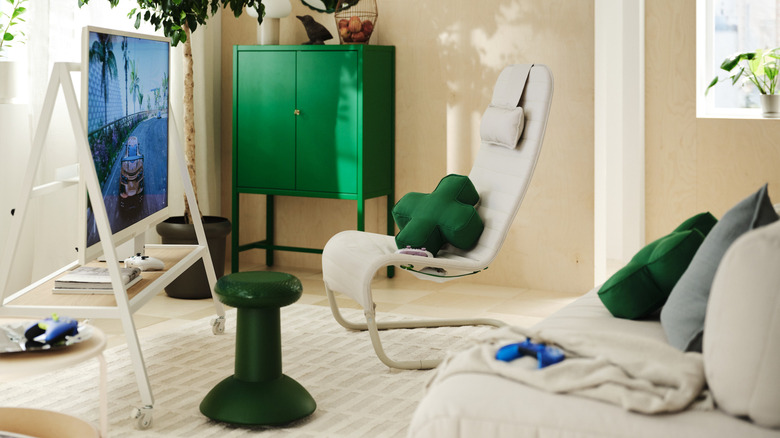
Who hasn’t dreamt of sitting on a green stool modeled like a thumbstick?
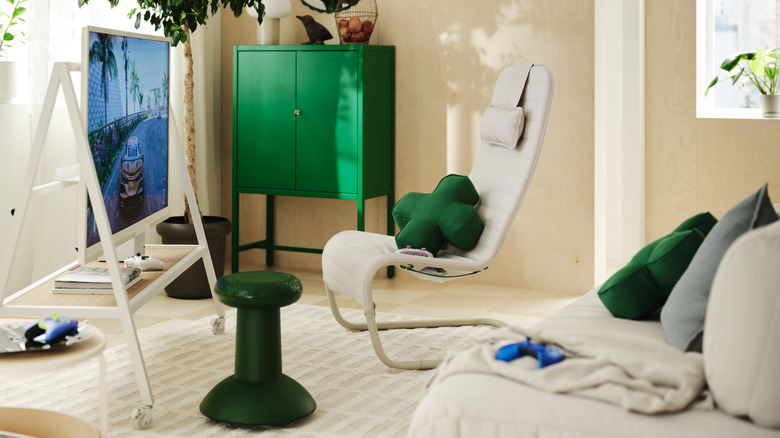
It’s becoming increasingly difficult to keep up with what’s going on at Xbox on any given day, but at least you can now attempt to do so from the comfort of your IKEA-branded thumbstick stool, which is part of the new nine-piece YXSTABY collection.
As part of Xbox’s ongoing 25th anniversary celebrations, Microsoft and the Swedish furniture giant teased their upcoming collaboration last week, and IKEA has now unveiled the full collection at Gamescom in Germany. We’d already been treated to a sneak peek at the classic Xbox green D-pad cushion, but the two brands had a lot more to show off.
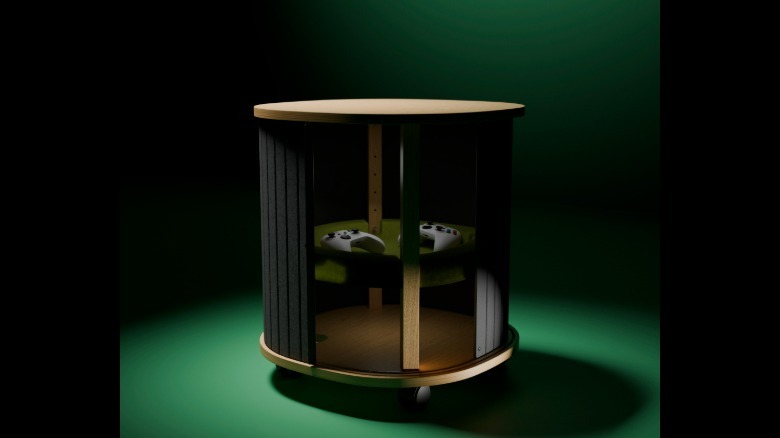
You can view the full collection here, but it’s a mix of more decorative pieces, like the stainless steel platter also modeled on a D-pad, and less obviously Xbox-y furniture that IKEA says is designed to “solve the small, familiar challenges that can come with playing at home.” This includes a rollable TV stand with a storage compartment at the back and a toolbox for controllers and cables that also doubles as a laptop stand. There’s also a controller display box in two colors and a side table on wheels with sliding doors. It’s all fairly minimalist and, dare I say it, even quite desirable.
 IKEA/Microsoft
For my money, though, the real star of the YXSTABY collection has to be the thumbstick stool, which IKEA designer David Wahl said was designed to function as a stool while also feeling like a thumbstick you recognize from your Xbox pad when you sit on it. Wahl says it even “tilts with you while you play,” which admittedly sounds like an accident waiting to happen if you’re someone who gets a bit too into your drifting in Forza Horizon, but it’s definitely fun.
The YXSTABY collection will be available to buy in the US starting September 30. All prices are listed below.
- GÖTEHULT shopping bag — $2.50
- YXSTABY Gaming controller display in black — $30
- YXSTABY Gaming controller display in white — $30
- YXSTABY Gaming D-pad controller platter 13-inch — $18
- YXSTABY Gaming D-pad cushion in green — $18
- YXSTABY Gaming laptop support w storage in white — $35
- YXSTABY gaming lounge chair VISSLE in beige — $120
- YXSTABY Gaming monitor stand in white — $40
- YXSTABY Gaming side table on castors oak in ven/gray — $180
- YXSTABY Gaming thumbstick stool in black —$50
- YXSTABY Gaming thumbstick stool in green — $50
- YXSTABY Gaming TV stand on castors in black — $150
- YXSTABY Gaming TV stand on castors in white — $150


PERSONAL TECH
Users have a little more time to migrate from Azure storage to OneDrive
Microsoft is giving customers who are still clinging to its doomed legacy Whiteboard technology a lifeline, and has pushed the deletion date to October 16, 2026.
The migration tooling for “legacy enterprise whiteboards” will be retired on September 25, 2026, and the standalone Microsoft Whiteboard app will be deprecated on November 30, 2026.
To be clear, Microsoft Whiteboard as a concept is not going away – this is more about migration for Azure-based files.
The original dates were August 22 for the migration tooling, September 5 for the permanent deletion, and September 14 for the app deprecation. Therefore, customers have been granted a little more time to make the transition to OneDrive-backed whiteboards.
Microsoft did not respond to a query about why it had moved the milestones. The lateness of the announcement suggests it either ran into technical problems or that enough customers were still on the legacy platform that Redmond uttered the computing equivalent of FINE! Have another month!
New whiteboard files for commercial customers have been in OneDrive rather than Azure since 2022. However, legacy whiteboards could still be stored in Azure and, if not migrated to OneDrive, will be deleted on October 16. Migration happens automatically when a whiteboard is opened in Whiteboard on the web, Teams desktop, Teams web, or using the Whiteboard Windows app (through to September 22, 2026). If migration doesn’t happen, then users have until October 16 before somebody at Microsoft hits the delete key.
However, only owners of Azure Whiteboards can trigger migration. Users on vacation, or who have left the organization, could also present a headache for administrators, who might need to transfer ownership to active users. In Microsoft’s original announcement, it promised a set of PowerShell cmdlets to ease the process.
The Microsoft Whiteboard app became generally available in 2018. It was a useful collaborative tool for Microsoft 365 subscribers (or could be used standalone with a Microsoft account, although these days organizations are the target). It is very much a relic of a past era at Redmond, when touch-based experiences were all the rage. Today, the company would likely prefer users to bark instructions at an AI assistant.
According to Microsoft, “Moving these files to OneDrive improves security, accessibility, revision history, eDiscovery, and access to current and future Whiteboard features.” ®

Entertainment19 seconds ago
Howie Mandel ‘Almost Died’ From Self-Medicating During COVID

News Videos2 minutes ago
The Financial Education That Turns Recruiters Into Asset Millionaires with Kevin Fasting

NewsBeat3 minutes ago
Scarborough: Woman scarred after dog ‘bit her in the face’

Fashion1 month ago
Weekend Open Thread – Corporette.com

Fashion1 month ago
Weekend Open Thread: Brooks Brothers

NewsBeat1 month ago
London Mayor Sadiq Khan handed a peerage by Keir Starmer alongside 15 other Labour figures… just days before the PM leaves No10
News Videos2 minutes ago
The Financial Education That Turns Recruiters Into Asset Millionaires with Kevin Fasting

News Videos10 minutes ago
#funny #lifeisbutadream #memes #germany #comedy #relatable #money #butifyoucloseyoureyes #duet

News Videos1 hour ago
Unser Programm: Heute Steuern und Finanzen!
-

 Fashion5 days ago
Weekend Open Thread: Madewell – Corporette.com
-

 Business4 days ago
Musk’s Tesla, SpaceX Confirm $16.8 Billion ‘Terafab’ Chip Plant as World’s Largest Building in Texas
-

 Crypto World5 days ago
anatomy of crypto’s biggest liquidation event since 2021
-

 Crypto World2 days ago
A $30 Billion AI Fund Implodes, Now the SEC Is Investigating Wall Street’s Role
-

 Crypto World18 hours ago
SpaceX stock could rise 75% to $240, JPMorgan says
-

 Politics4 days ago
6 months on, Irish renters crushed by effects of government housing bill
-
 NewsBeat4 days ago
The ‘Lucky Dip Gang’ causing carnage for clicks: After five thugs were killed speeding in the wrong direction on a motorway, GUY ADAMS investigates a sick new trend… and why police aren’t even allowed to pursue them
-

 Business3 days ago
Mystery AI Model ‘Ox Alpha’ Draws Developers With Free Access as Chinese Lab Origins Remain Debated
-

 News Videos7 days ago
Don’t Leave Your Financial Future To Chance | August 19, 2026
-

 Business6 days ago
Five Below: Kids Discount Retailer Reaps Rich Rewards
-

 Business2 days ago
Moderna CEO warns China is pouring state money into mRNA technology
-

 Business5 days ago
UK firms in critical financial distress rise 9% to 53,756
-

 Business2 days ago
NVIDIA Stock Drops Nearly 2 Percent to $210 on Seventh Losing Day Ahead of Critical AI Earnings
-

 Sports4 days ago
Deshaun Watson fires back at Browns fans after being booed: ‘It’s a disrespectful thing’
-

 Crypto World6 days ago
Optimism-funded team's deciding vote shifts $49 million in OP tokens away from users
-
 Entertainment7 days ago
10 Most Perfect Fantasy Shows of the Last 25 Years
-

 Tech7 days ago
OpenAI confirms ChatGPT is down as logins and signups fail
-
 Crypto World3 days ago
Google Gemini AI Predicts Ethereum Could Become the Trade Retail Misses in 2026
-
 Business6 days ago
PayPal and Venmo now accepted for tuition at several universities
-
 Crypto World5 days ago
Nvidia Stock Suffers Longest Losing Streak Since 2022: Will Q2 Earnings End It?
You must be logged in to post a comment Login