
Crypto World
Top 3 Undervalued Altcoins to Watch in September 2026

With Bitcoin up more than 20% since last week, traders are rotating into altcoins for larger gains. Three particular tokens, Kaspa, Solana, and Hyperliquid, are drawing renewed attention from market observers heading into the fall trading season.
However, all three altcoins are at different distances from their all-time highs. Analyst outlooks broadly support the undervalued narrative for two of the three under constructive market conditions, though outcomes will depend heavily on Bitcoin’s path and overall risk appetite going forward.
This article is not financial advice. Crypto markets are highly volatile, projected price ranges are scenario-based estimates rather than guarantees, and readers should conduct independent research before making any investment decision.
Kaspa (KAS)
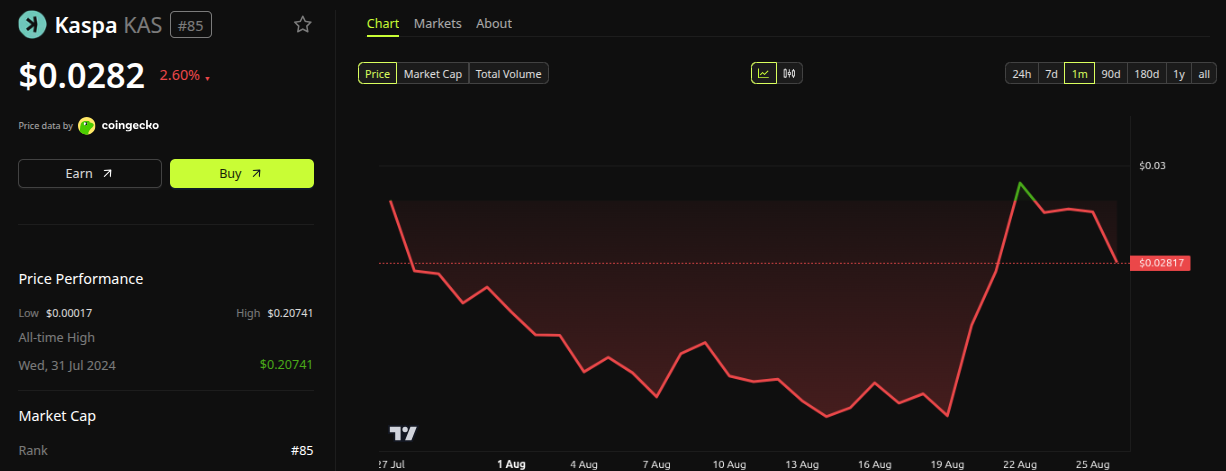
Kaspa trades at $0.0282, up 1.34% over the past 24 hours, according to BeInCrypto data. The token remains approximately 87% below its all-time high of $0.20741, reached on August 1, 2024.
Analysts point to its near-complete supply issuance and recent network upgrades as reasons for optimism.
In an upward scenario, price could climb toward $0.035 to $0.045 if network activity expands and emissions pressure continues to ease.
In a bearish case, it could retreat to $0.022-$0.025 if broader market weakness returns or developer adoption slows.
Follow us on X to get the latest news as it happens.

Solana (SOL)
Solana trades at $98.50, about 66% below its all-time high of $293.31, reached on January 19, 2025.
Observers cite tokenomics improvements, including potential cuts to inflation and stronger fee burns. Moreover, Solana hit a record $4.2 billion in on-chain transactions in July, up 13.5%, driven by the SOL rally and tokenized assets.
Bullish projections suggest a move toward $130 to $180, or higher in stronger cycles, if institutional flows accelerate. On the downside, a risk-off environment could push the token back toward the $75 support levels.

Hyperliquid (HYPE)
Hyperliquid trades at $82.34, up roughly 40% over the past week. The token set a new all-time high of $83.27 on August 23, meaning it now trades just 1% below its record.
Market participants view the token as attractively priced relative to its strong perpetual trading revenue and expanding infrastructure, even as it nears record levels.
On the other hand, Trump’s August 19 remarks about bringing Hyperliquid legally into the US sent HYPE surging nearly 20% within 24 hours.
In a positive scenario, sustained volume growth and buyback mechanisms could push it toward $100-$150. A bearish outcome might see a pullback to $60-$70 amid profit-taking or a broader market correction.
Subscribe to our YouTube channel to watch leaders and journalists provide expert insights.

None of the projections in this article constitute financial advice or price guarantees.
Cryptocurrency remains a highly volatile asset class, and readers should independently verify current prices and conduct their own research, or consult a licensed financial advisor, before making any investment decisions based on this analysis.
The post Top 3 Undervalued Altcoins to Watch in September 2026 appeared first on BeInCrypto.

Bitcoin just punched through $80,000 for the first time in almost 15 weeks. This is very bullish for Bitcoin price prediction, and the mechanics behind the move matter more than the headline number.
This is one of the sharpest 8-day advances Bitcoin has posted since 2021. Price is trading near $80,513, up roughly 2.02% on the day, but the real story is underneath the surface.
The rally has added an estimated $350 billion to Bitcoin’s market cap since late July, driven by renewed spot ETF inflows, a shift in Treasury buyback policy, and a wave of forced short covering.

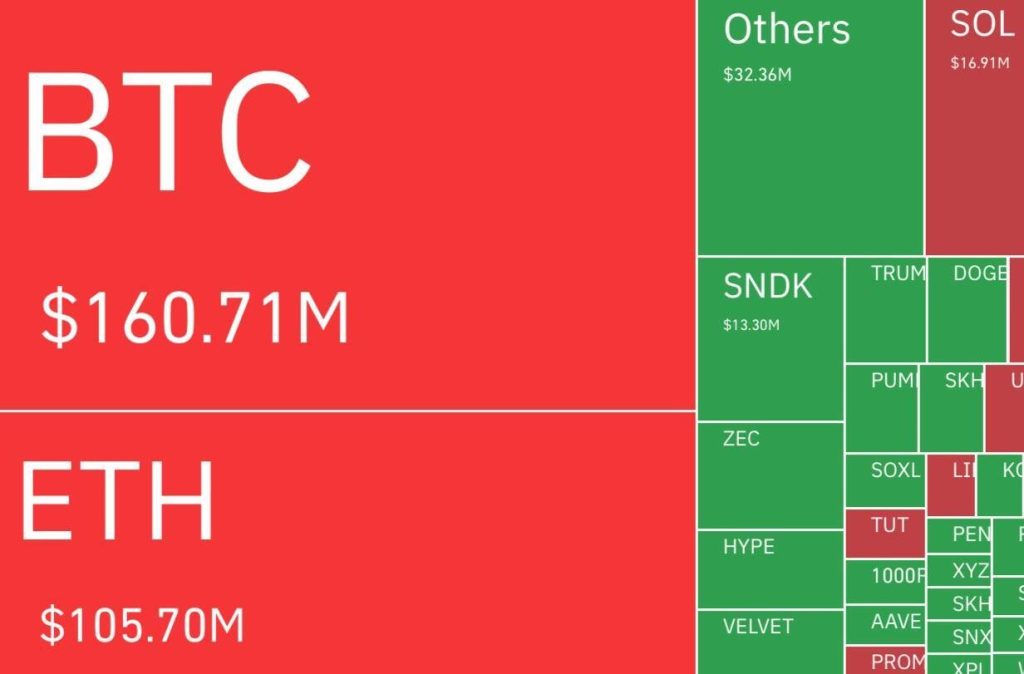
Liquidation trackers show roughly $335 million in BTC positions wiped out, nearly 84% of them shorts. That is a squeeze, not pure conviction buying.
Bitcoin has now clawed back 38% from its July 1 low near $57,700, erasing the entire May drawdown. But price has walked straight into the same resistance shelf that rejected rallies earlier this year.
What happens at that ceiling determines the next leg, and for anyone tracking early-stage plays, it also reframes where the better risk-adjusted upside might actually sit.

Discover: The Best Crypto to Diversify Your Portfolio
Bitcoin Price Prediction: Can Bitcoin Price Hit $82,000 This Week?
BTC is sitting at $79,786 on the daily chart, and the move that has happened over the past week is the most explosive and convincing recovery attempt since the January peak, with price launching from the $60,000 base and pushing nearly $20,000 higher in a matter of days.
The $80,000 level is the immediate test, being the dotted line on the chart that marks the prior support zone from the February to March period, and a clean daily close above it would be the most significant technical development in months.
What makes this move different from the previous recovery attempts in March and May is the speed and scale of it, those rallies were gradual grinds that faded at lower levels, whereas this one has momentum and is pushing into real resistance zones without showing signs of stalling yet.
The $84,000 to $85,000 range is the next major resistance above, being where the May recovery peaked and rolled over, and that is the level that would need to flip for the conversation to shift from recovery to genuine trend reversal.
On the downside, $72,000 to $74,000 is the first support from the breakout zone, and $65,000 below that is where the base was built throughout July, which needs to hold on any pullback to keep the structure intact.
The risk here is that the move has been very fast and sharp, and a cooling-off period or retest of $74,000 to $76,000 before the next leg would actually be healthy for the setup.
But the direction has changed, and $80,000 is the line that confirms it.
Don’t Miss Out on Our $1,000 USDT Airdrop on ByBit
Bitcoin Hyper Targets Early Mover Upside as Bitcoin Tests Key Levels
An 8-day, 28% rally that erased months of losses is a strong result, no argument there. But buying Bitcoin at an $80,000+ market cap denominator means outsized percentage moves get structurally harder, the asset has to move mountains to double from here.
That math is exactly why traders rotate a slice of capital toward earlier-stage infrastructure plays while BTC consolidates at resistance, and why Bitcoin Hyper (HYPER) has been picking up presale attention alongside the spot rally.
Bitcoin Hyper bills itself as the first Bitcoin Layer 2 with SVM integration, smart contracts running faster than Solana itself, settled through a decentralized canonical bridge back to BTC.
It’s currently priced at $0.0136852, with $33,080,369.89 raised so far and staking rewards live at launch. The pitch: fast, cheap, programmable Bitcoin without sacrificing base-layer security.
Unlock Access to Bitcoin’s New Layer 2 Here
Discover: The Best Token Presales
The post Bitcoin Price Prediction: BTC Broke $80,000 for First Time in 15 Weeks appeared first on Cryptonews.


DGAI nearly doubled in its first day of trading as DGrid expands its distributed AI inference network and rolls out hardware for its personal AI agent.

That doesn’t mean hanging longer will make you live longer, Vadnal adds. Think of it as one useful signal—not a path to immortality.
Your feet can stay on the floor
Beginners don’t need to hover heroically above the ground. When you’re starting out, the bar is—quite literally—low. “I love the addition of a little step stool or platform,” Anderson says. Hold the bar with both hands, bend your knees slightly, and keep enough weight in your feet that the stretch feels manageable. You can gradually allow your arms to support more of you as you become comfortable.
“You definitely don’t need to jump straight to 30-second hangs all at once,” Anderson says. She recommends starting with a 10-second supported hang and repeating it three to five times, resting briefly between attempts. From there, work toward the 30-second goal. Vadnal likes three 30-second sets, but only after choosing a variation easy enough to complete with control.


Cosmos Labs recommended on Tuesday that any public blockchain running a version of its Cosmos EVM module below v0.6.2 or v0.7.2 "immediately halt the blockchain and upgrade it to include the patches in those releases." The post went up at 11:19 a.m. New York time and asked teams that have not… Read the full story at The Defiant

World Liberty Financial has rolled out its USD1 stablecoin in native form on the Canton Network, positioning the token to act as the “cash leg” inside transactions that also involve tokenized real-world assets (RWAs). The move targets institutional workflows where settlement often needs to occur alongside issuance, redemption, and collateralization rather than through separate payment rails.
In a Tuesday announcement, the project said institutions can use USD1 on Canton for settlement across activities such as derivatives collateral, institutional lending, and asset issuance and redemptions. The company emphasized that native issuance is designed to let USD1 clear alongside tokenized assets within the same transaction while leveraging Canton’s privacy and permissioning controls.
Key takeaways
- USD1 is now available natively on the Canton Network, aiming to streamline settlement for tokenized real-world assets.
- The stablecoin is positioned for institutional use cases including derivatives collateral, lending, and asset issuance/redemptions.
- World Liberty says native issuance enables USD1 to settle in the same transaction as tokenized assets while using Canton’s privacy/permissioning features.
- USD1’s circulating market capitalization is about $4.05 billion, making it the sixth-largest stablecoin per DeFiLlama.
- USD1 is managed by BitGo Bank & Trust for reserve oversight and for minting/redemption processing.
Why native settlement matters for tokenized RWAs
The practical value of launching a stablecoin “natively” on a blockchain geared toward institutional finance is that it reduces the friction between tokenized assets and payment settlement. Rather than treating cash settlement as an off-chain or external step, native issuance supports the idea that stablecoin flows can occur in parallel with asset transfers, issuance events, or contract-based collateral movements.
World Liberty’s framing is that USD1 can be used for settlement where tokenized RWAs are involved—specifically as a cash leg in transactions spanning derivatives collateral and institutional lending. That matters because many tokenization efforts hinge not only on representing assets on-chain, but also on how reliably and efficiently the corresponding payment leg can be executed under the constraints institutions require.
The company also pointed to Canton’s privacy and permissioning controls. For investors and institutions evaluating tokenized asset infrastructure, these features are often central: they can determine what data is visible, who can interact with what components, and how compliance-oriented workflows are structured within blockchain systems.
USD1’s current scale and who operates it
USD1 has a market capitalization of about $4.05 billion, according to DeFiLlama stablecoin data, where the token is described as the sixth-largest stablecoin by market cap. In terms of issuer and operations, World Liberty said USD1 is issued by BitGo Bank & Trust, which manages reserves and handles the minting and redemption process.
That operational separation—stablecoin reserve management and issuance processing handled by a named bank entity, while on-chain usage is enabled through a network integration—underscores how the stablecoin business model often blends traditional treasury controls with blockchain distribution. For participants on Canton, this structure can affect assumptions around redemption processes and reserve oversight, especially when stablecoin settlement is intended for regulated or institutional settings.
Canton’s institutional focus and the network’s tokenized-asset activity
Canton positions itself as a public, permissionless blockchain designed for institutional finance, and the company says it handles large volumes of tokenized asset movement. In the update accompanying the USD1 integration, Canton claimed it processes and issues more than $9 trillion in tokenized assets each month. It also cited more than $350 billion in onchain US Treasurys moving across the network daily.
Those figures are not direct guarantees about future USD1 usage on Canton, but they do help contextualize why a stablecoin integration is strategically meaningful. If tokenized securities and RWA instruments are already being transferred with significant frequency, the settlement layer becomes a key bottleneck—or a competitive advantage—depending on how efficiently it can match payment timing and compliance requirements.
By placing USD1 into that environment, World Liberty appears to be aiming for deeper integration with institutional token flows rather than limiting USD1 to a standalone stablecoin role within broader DeFi markets.
Integration timing: part of a wider push on Canton
The USD1 launch follows another expansion announcement for Canton reported last week. According to the earlier coverage, Digital Asset and former US House Speaker Paul Ryan’s American Idea Foundation unveiled plans to pilot a Canton-based system for distributing state-administered benefits across three US states, with an anticipated start in 2027.
While the USD1 initiative and the benefits distribution pilot are clearly different in purpose, they both point to Canton’s broader ambition: attracting enterprise-grade use cases and institutional participants. For observers, the sequence is important because it suggests the network is actively positioning its rails for multiple categories of on-chain activity—ranging from financial settlements involving tokenized assets to non-traditional public distribution workflows.
What to watch next for USD1 on Canton
With USD1 now live natively on Canton, the key question for market participants is how quickly institutions move from testing to sustained on-chain settlement for tokenized asset transactions. Watch for evidence of USD1 being used in the specific workflows World Liberty highlighted—especially collateral and issuance/redemption flows—as that will indicate whether native settlement delivers measurable operational advantages in real transactions.
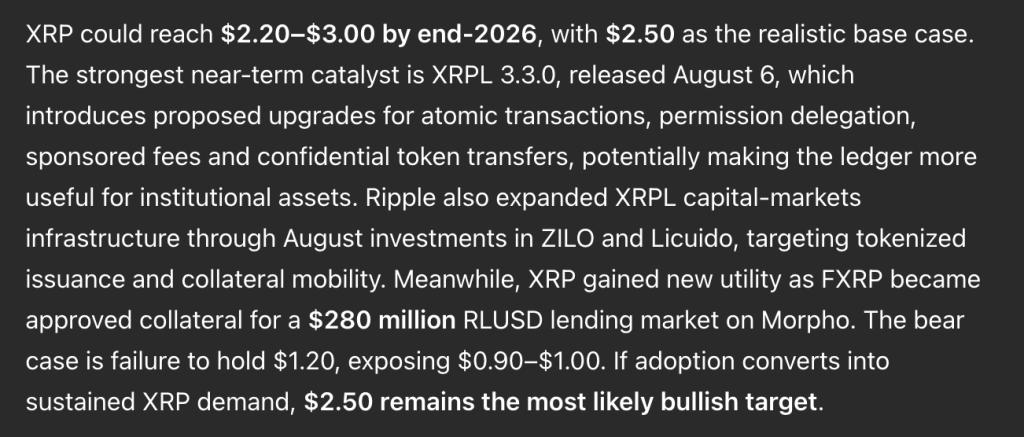
Institutional plumbing rarely makes headlines, but it moves targets. A new ChatGPT AI price prediction leans on exactly that, and the model predicts Ripple’s XRP price reaching $2.20 to $3.00 by the end of 2026, with $2.50 as the realistic base case.
The strongest near-term catalyst arrived on August 6. XRPL 3.3.0 introduces proposed upgrades for atomic transactions and permission delegation.
Sponsored fees and confidential token transfers are included. Together, they could make the ledger far more useful for institutional assets.

Ripple is building the surrounding infrastructure, too. August investments in ZILO and Licuido target tokenized issuance and collateral mobility on XRPL.
Utility is expanding in lending as well. FXRP became approved collateral for a $280 million RLUSD lending market on Morpho. That is real usage rather than announcement noise. Collateral demand tends to be sticky once protocols integrate it.
The bear case is defined by one line. Failure to hold $1.20 exposes $0.90 to $1.00.
That would erase the entire August move. If adoption converts into sustained XRP demand instead, $2.50 remains the most likely bullish target.
Make Your Prediction Count With $25 For Free on Kalshi
XRP Price Prediction: ChatGPT AI Predicts the Ledger Upgrade Pays Off
Context matters before anyone gets excited. XRP price traded above $3.60 last August and spent the following twelve months in near-continuous decline.
October cracked $2.40 in a single session. February 2026 saw the price flush to $1.13, and the months after that offered only a listless range of roughly $1.30 to $1.55.
June broke lower again. XRP price then flatlined at $1.00 through July and most of August, barely moving for weeks. Last week ended that. The price spiked to $1.68 before sellers immediately stepped in.

Now comes the giveback. XRP closed at $1.47614, down $0.04433 for a loss of 2.92%, with a session range from $1.45326 to $1.53000.
That is the first red candle since the breakout. Resistance sits at $1.53000, then the $1.68 spike high, then the $1.80 shelf from December.
Support runs through $1.45326 and $1.30, with $1.00 as the structural base.
The RSI panel is not loaded on this chart, so momentum reads from price action alone. A vertical run of roughly 68%, followed by a 2.92% pullback, indicates healthy digestion rather than rejection.
The tell is where XRP price stops. Holding above $1.40 keeps the breakout structure intact and leaves the path toward $2.50 open.
The Best Traders Around Use It: AI Copy Trading Bots From CryptoHopper
XRP Is Upgrading the Rails. LiquidChain Is Trying to Connect the Entire Network Map.
XRP’s latest thesis is not about hype. It is about making the ledger more useful for institutions through better transactions, collateral, and tokenized assets.
LiquidChain is targeting the next infrastructure problem: those assets still live inside separate blockchain ecosystems.
Bitcoin, Ethereum, and Solana each hold deep liquidity, but moving capital between them still means bridges, duplicated deployments, added fees, and fragmented execution. LiquidChain is building a single execution layer designed to connect all 3, allowing one deployment to reach multiple ecosystems without rebuilding the same application chain by chain.
That gives the project a broader bet on where crypto infrastructure is heading. If tokenized assets, lending, and institutional DeFi continue expanding, interoperability becomes increasingly difficult to treat as optional.
LiquidChain’s presale is currently priced at $0.01493 with just over $948,000 raised, leaving it at a stage where adoption can still have an outsized impact on valuation.
Gain Special Access to Layer 3 Trading Here
The post ChatGPT AI Predicts XRP May Look Very Different a Year From Now appeared first on Cryptonews.

The exchange has signed a non-binding letter of intent with Apex Fintech Solutions that would make its subsidiary, Gemini Titan, the exclusive regulated venue for crypto event contracts.
According to the press release, these contracts will be distributed through Apex’s futures commission merchant (FCM) to its brokerage customers.
Brokerages offering those contracts through the Apex FCM would use Gemini for execution and clearing. The release said Gemini also gives Apex flexibility to collaborate on sports, economics, and financial markets contracts on a non-exclusive basis. Both firms said they look forward to finalizing details in the coming weeks.
Gemini’s forward-looking statements described the arrangement as a non-binding letter of intent and listed the possibility that the parties fail to reach a definitive agreement among the risks investors should weigh.
Two Licenses Came First
The Commodity Futures Trading Commission (CFTC) approval arrived in stages, and Gemini Titan already secured a Designated Contract Market (DCM) license in December 2025, which let Gemini start offering regulated prediction markets to US customers.
Gemini first filed for that license in March 2020. In April, subsidiary Gemini Olympus obtained a Derivatives Clearing Organization (DCO) license, moving derivatives clearing and settlement for Gemini Titan in-house.
“Leveraging more than a decade of experience building and operating a regulated platform for crypto, a new and emergent asset class, we deliberately chose to build our predictions platform in-house,” Gemini CEO Tyler Winklevoss said.
He added that predictions are “the future of markets” and that the approach lets Gemini “expand our offering and open access to valued partners like Apex as demand for event contracts grows.”
The two companies have shipped together before. Gemini launched stock trading at 0% commissions for certain US customers in July, with Apex Clearing Corporation acting as custodian and clearing broker.
Event Contract Revenue
Apex Global Head of Digital Markets Travis McGhee noted that brokerage clients “get regulated access to crypto event contracts without having to build the plumbing themselves.”
Apex says its infrastructure supports hundreds of clients and tens of millions of end investors, and its Apex Clearing Corporation subsidiary is licensed in 53 states and territories.
Similarly, Robinhood booked $156 million in event contract revenue in the second quarter, more than 10 times higher than a year earlier, on a record 13.6 billion contracts.
Gemini’s prediction market arm is already in court, though. New York Attorney General Letitia James sued the prediction market arms of Coinbase and Gemini, arguing that they run unlicensed gambling without New York State Gaming Commission approval.
“Gambling by another name is still gambling, and it is not exempt from regulation under our state laws and Constitution,” James stated.
The post Gemini Signs Apex Letter of Intent to Bring Crypto Event Contracts to Brokerages appeared first on CryptoPotato.


SQD has added validated data from 10 blockchain networks to Google Cloud’s BigQuery platform, giving developers and companies access to full chain histories checked through six cryptographic tests.
Summary
- SQD is supplying indexed blockchain data through Google Cloud Web3 Blockchain Analytics.
- 10 blockchain datasets cover records from each supported network’s genesis block.
- Six cryptographic checks verify each block before the data reaches BigQuery.
- SQD plans to add more networks and tools designed for AI agents.
SQD brings validated blockchain data into BigQuery
SQD said in an Aug. 24 announcement that its enterprise arm, SQD 360, is providing the indexing system and data pipelines behind datasets available through Google Cloud Web3 Blockchain Analytics.
The initial contribution covers 10 networks from their genesis blocks, allowing analysts to examine their complete available histories rather than records collected only after the integration began. SQD did not identify all 10 chains in its announcement or provide a timetable for adding the next group.
Before the information reaches BigQuery, SQD said each block passes six cryptographic checks. The process includes comparing data from multiple sources and checking transaction roots and state roots, which are cryptographic values used to confirm whether a block’s records match the underlying blockchain state.
SQD said the checks are intended to catch missing, incorrect, or inconsistent records before they enter analytics pipelines. Fresh blocks must also pass the validation process as the datasets continue to update.
Once loaded into BigQuery, the records become available through the same cloud environment used for business intelligence, machine learning, and large-scale data analysis. Developers can therefore examine blockchain activity without building an indexer, storing an entire chain history, or maintaining separate infrastructure for each network.
“Partnering with Google Cloud Web3 to bring our validated data standard to BigQuery is a defining step for SQD, and a strong signal that enterprise-grade blockchain data has arrived,” SQD CEO Wanja Oberhof said.
The companies did not disclose financial terms, revenue-sharing arrangements, or service-level commitments tied specifically to the partnership.
SQD Network distributes storage and query work
SQD operates a decentralized data network built to collect, verify, store and serve information generated by blockchains and Web3 applications. Its infrastructure separates the work among data providers, independent worker nodes, and gateways rather than relying on one central database.
According to SQD Network documentation, data providers submit blockchain records before a scheduler assigns pieces of each dataset to worker nodes. Workers supply storage and computing resources, hold copies of the assigned records, and answer queries submitted through gateways.
Each worker must bond 100,000 SQD tokens to register on the network. Workers receive token rewards based on factors such as uptime, the amount of data served, and delegated tokens, while provable violations of network rules can lead to penalties.
Gateways provide the connection between data consumers and the worker network. The amount of SQD locked by a gateway operator determines how many requests it can send, tying query capacity to the network’s token-based resource system.
SQD says its full data service covers more than 130 networks, although only 10 are included in the first Google Cloud contribution described in the announcement. Its Portal product offers historical and real-time information from chains across the Ethereum Virtual Machine, Solana, Substrate, and Bitcoin-based ecosystems.
Unlike a standard blockchain node, which may provide raw or recent network information, SQD’s system converts records into structured datasets containing blocks, transactions, logs, traces and changes in blockchain state. Structured records allow analysts to search large periods and compare activity without processing raw chain files each time.
Google Cloud expands access to indexed onchain records
Google Cloud describes Blockchain Analytics as a service that places indexed blockchain information in BigQuery for analysis through SQL, a common language for searching and organizing databases. The product lets users query blocks, transactions, event logs, and call traces without operating nodes or creating an indexer for every protocol.
BigQuery can also combine onchain records with a company’s internal data. A wallet service, for example, could compare blockchain transactions with activity recorded inside its application, while a compliance team could build searches for transfers involving specified addresses. The accuracy of any resulting report would still depend on the query design, address labels, and other data added by the user.
Google Cloud began placing blockchain records in BigQuery in 2018 with Bitcoin and later added Ethereum and other networks. In 2023, the company added 11 blockchain datasets, including Avalanche, Arbitrum, Optimism, Polygon, Polkadot, and Tron.
The SQD arrangement follows other efforts to connect decentralized data sources with cloud services. In July 2025, crypto.news covered OORT’s dataset listing on Google Cloud Analytics Hub and several other enterprise marketplaces. OORT’s offering contained 100,000 user-contributed data points, with their contributions recorded onchain to help users check the source and structure of the information.
Google Cloud has also built services that give applications direct access to blockchain networks. In September 2024, it launched an Ethereum RPC that initially supported the Ethereum mainnet and test networks. The preview offered a free tier of up to 100 requests per second and one million requests per day.
The RPC service and BigQuery datasets serve different tasks. RPC endpoints allow applications to request current blockchain information and submit transactions, while indexed datasets are designed for searches across large amounts of historical data.
BigQuery data supports enterprise and agent-based analysis
For U.S. developers and companies already using Google Cloud, the integration places SQD-supplied records inside a familiar analytics service rather than requiring a separate blockchain-data system. Google’s documentation says users can reach public datasets through the Cloud console, command-line tools or the BigQuery API.
Google pays the storage costs for datasets included in its Public Dataset Program, while users pay for the queries they run. The first one terabyte of query processing each month is free under Google Cloud’s current pricing structure, although access can be limited by an organization’s own security controls.
Dataset location also matters for American users, with internal policies governing where information is processed. Google says every public dataset has an assigned region, while its BigQuery sample tables are held in the U.S. multi-region. SQD’s announcement did not specify the storage location for each contributed blockchain dataset.
Agent-based access forms another part of the planned work. In May, earlier coverage reported that Solana Foundation and Google Cloud launched Pay.sh, which lets AI agents pay for APIs with stablecoins and supports services including BigQuery, Gemini and Vertex AI.
Under the SQD roadmap, additional agent functions could allow automated software to retrieve and analyze verified blockchain records inside Google Cloud. SQD did not explain which functions will be released, which AI systems will support them, or when they will become available.
More blockchain networks are also due to join the integration, according to the announcement. SQD has not named the next chains, disclosed how they will be selected, or provided a release schedule.


Nikita Bier, who ran product at X for 13 months until Aug. 5 and now advises the company, said trade buttons are coming to the crypto charts embedded in X posts. He gave no timeline. The claim has no corporate backing. X's public record on crypto products — the Cashtags launch, its roadmap, its… Read the full story at The Defiant
Bitwise launched Automated Token Portfolios (ATPs) on Tuesday, giving eligible investors outside the U.S. a way to hold Coinbase-issued tokenized stocks directly in their own wallets on Base while Glider automatically keeps the holdings aligned with Bitwise’s model. The product extends Coinbase’s… Read the full story at The Defiant

Daily horoscope August 26, 2026: Predictions for your star sign

Bitcoin Price Prediction: BTC Broke $80,000 for First Time in 15 Weeks

LASK v Celtic: Martin O’Neill takes responsibility




![Skilla Baby - GYSM (Get You Some Money) [Official Video]](https://wordupnews.com/wp-content/uploads/2026/06/1781824474_maxresdefault-80x80.jpg)

-

 Fashion4 days ago
Weekend Open Thread: Madewell – Corporette.com
-

 Business3 days ago
Musk’s Tesla, SpaceX Confirm $16.8 Billion ‘Terafab’ Chip Plant as World’s Largest Building in Texas
-

 Crypto World4 days ago
anatomy of crypto’s biggest liquidation event since 2021
-

 Crypto World23 hours ago
A $30 Billion AI Fund Implodes, Now the SEC Is Investigating Wall Street’s Role
-

 Politics3 days ago
6 months on, Irish renters crushed by effects of government housing bill
-
 NewsBeat4 days ago
The ‘Lucky Dip Gang’ causing carnage for clicks: After five thugs were killed speeding in the wrong direction on a motorway, GUY ADAMS investigates a sick new trend… and why police aren’t even allowed to pursue them
-

 Tech7 days ago
GLM-5.3 hits the API at $1.4/$4.4 per million tokens
-

 Business3 days ago
Mystery AI Model ‘Ox Alpha’ Draws Developers With Free Access as Chinese Lab Origins Remain Debated
-

 News Videos6 days ago
Don’t Leave Your Financial Future To Chance | August 19, 2026
-

 Business6 days ago
Marvell Shares Jump 7% as Google Chip Deal Confirms Custom AI Silicon Partnership, Analysts
-

 Business5 days ago
Five Below: Kids Discount Retailer Reaps Rich Rewards
-

 Business1 day ago
Moderna CEO warns China is pouring state money into mRNA technology
-

 Business4 days ago
UK firms in critical financial distress rise 9% to 53,756
-

 Sports3 days ago
Deshaun Watson fires back at Browns fans after being booed: ‘It’s a disrespectful thing’
-

 Fashion6 days ago
Jimmy Choo Autumn 2026 collection
-
 Entertainment6 days ago
10 Most Perfect Fantasy Shows of the Last 25 Years
-

 Tech6 days ago
OpenAI confirms ChatGPT is down as logins and signups fail
-

 Business6 days ago
PayPal and Venmo now accepted for tuition at several universities
-

 Crypto World5 days ago
Optimism-funded team's deciding vote shifts $49 million in OP tokens away from users
-

 Crypto World3 days ago
Google Gemini AI Predicts Ethereum Could Become the Trade Retail Misses in 2026
You must be logged in to post a comment Login