
Crypto World
3 Things to Know About Revolut’s New Euro Stablecoin



Revolut began rolling out EURR, its first euro-denominated stablecoin, on August 26. The launch starts with selected customers in Portugal, Poland and Denmark, with wider EEA availability planned later this year.
But for European users, the obvious question is why use EURR when Revolut already offers USDC — or when users can simply keep euros in their account?
Three Things We Know About Revolut’s New Stablecoin
Revolut does not actually issue EURR. Bridge Building S.A., a Luxembourg-regulated company owned by Stripe’s Bridge, issues the token. Holders can redeem EURR with Bridge at €1 per token.
Also, its clearest difference from USDC is currency exposure. USDC tracks the US dollar, so its value in euros moves with EUR/USD. EURR tracks the euro, letting users move euro-denominated value onto Ethereum or Polygon without first taking dollar exposure.
However, this is still a tiny rollout. Bridge’s reserve page showed just 374 EURR in circulation at launch, backed by €374 in cash deposits. That makes EURR closer to a controlled pilot than an established rival to USDC.
Note: Stablecoins have become the most in-demand product for banking platforms. In fact, 39 US banking groups are currently developing their own stablecoin network.
What Revolut Still Hasn’t Explained
The biggest unanswered question is why the average Revolut customer should use EURR at all.
Revolut says EURR will connect fiat, crypto, external wallets and blockchains. But it has not announced a clear pricing advantage over USDC.
Its current fee schedule already allows supported fiat-to-stablecoin conversions without transaction fees within certain plan limits.
It is also unclear whether EURR withdrawals will be cheaper than USDC, where outside liquidity will come from, or whether Revolut will add payment or rewards features.
For now, EURR solves one clear problem. It lets Europeans take euros on-chain without converting them into digital dollars.
The post 3 Things to Know About Revolut’s New Euro Stablecoin appeared first on BeInCrypto.

[PRESS RELEASE – Berlin, Germany, August 26th, 2026]
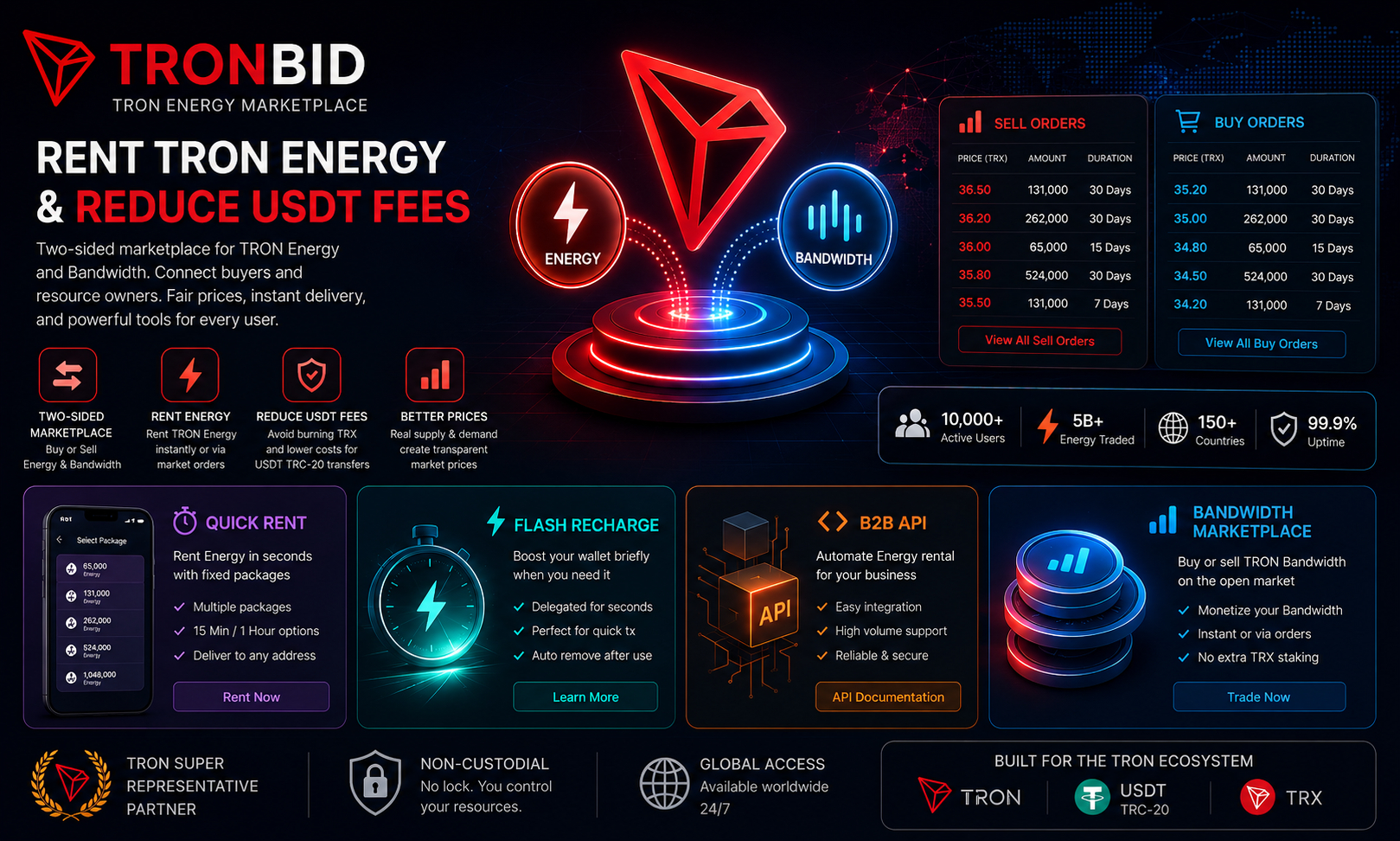
TronBid expands its two-sided TRON resource marketplace, giving users new ways to rent Energy, trade Energy and Bandwidth, and reduce USDT fees for TRC-20 transactions.
TronBid, a peer-to-peer marketplace for TRON network resources, has expanded its platform with new tools for users looking to rent TRON Energy, manage transaction costs and access network resources without maintaining large amounts of staked TRX.
The platform now operates as a two-sided marketplace where both buyers and sellers can create orders for TRON Energy and Bandwidth.
Understanding TRON Energy Usage
TRON uses Energy and Bandwidth as its primary network resources. Energy is required for smart-contract computation, including USDT TRC-20 transfers.
When a wallet does not have sufficient Energy, TRX may be consumed to cover the resources required by the transaction. This has created demand for users and businesses to rent Energy instead.
By receiving temporary Energy delegated from another account, users can perform eligible TRON transactions without maintaining enough staked TRX for their maximum resource requirements.
For businesses processing frequent TRC-20 transactions, choosing to rent TRON Energy can therefore provide another way to manage network costs and reduce USDT fees.
A Two-Sided Marketplace for Energy
Unlike platforms where rental conditions are determined entirely by the provider, TronBid allows both sides of the market to create orders.
Buyers can create BUY orders specifying the amount of Energy required, rental duration and price they are willing to pay.
Sellers can create SELL offers with their own amount, price and rental period. Buyers can purchase all or part of these offers directly.
For example, if a seller offers 600,000 Energy, one buyer can rent 350,000 Energy, leaving the remaining amount available for other buyers.
Creating a SELL offer does not reserve the seller’s Energy. If resources become unavailable because they are being used elsewhere, recurring offers can automatically pause and become active again when sufficient Energy returns.
This allows sellers to participate in the TronBid marketplace while continuing to manage their resources elsewhere.
Rent Energy Without Waiting for the Marketplace
For users who need resources immediately, TronBid also provides Quick Rent with predefined Energy packages and short rental periods.
Energy can be delivered directly to any specified TRON address, even when payment is made from another wallet.
TronBid has also introduced Flash Recharge, an alternative designed for wallets that already maintain their own Energy capacity but need to manage consumed resources.
Energy and Bandwidth Trading
TronBid’s marketplace supports both Energy and Bandwidth, allowing holders of staked TRX to monetize the network resources their stake generates.
This creates two sides of the ecosystem: users who need to rent TRON Energy or Bandwidth and resource owners looking to make unused capacity available to the market.
By allowing both buyers and sellers to determine their own terms, TronBid aims to create more transparent price discovery based on actual supply and demand.
B2B API to Reduce USDT Fees at Scale
TronBid also provides a B2B Quick Rent API for exchanges, payment processors, wallets, OTC services and other businesses processing frequent TRON transactions.
Businesses can maintain a prepaid balance and automatically request Energy for specified TRON addresses before executing transactions.
Instead of manually renting resources for every transfer, companies can integrate Energy rental directly into their transaction infrastructure.
For businesses handling large numbers of USDT TRC-20 transfers, this can make it easier to rent Energy automatically and manage the network-resource component of transaction costs.
TronBid Becomes a TRON SR Partner
Alongside the expansion of its marketplace, TronBid has become a TRON Super Representative Partner, adding the project to TRON’s delegated proof-of-stake governance ecosystem.
The development strengthens TronBid’s connection with the underlying TRON ecosystem while the platform continues building infrastructure around Energy and Bandwidth.
About TronBid
TronBid is a peer-to-peer marketplace for TRON Energy and Bandwidth. Buyers can rent TRON Energy, create BUY orders or purchase existing seller offers, while resource owners can create SELL offers with their own prices and rental periods.
The platform also provides Quick Rent, Flash Recharge, and a B2B API for businesses looking to automate Energy rental and reduce USDT fees for TRC-20 transactions.
More information: https://tronbid.com
The post Rent TRON Energy and Reduce USDT Fees: TronBid Expands Marketplace appeared first on CryptoPotato.
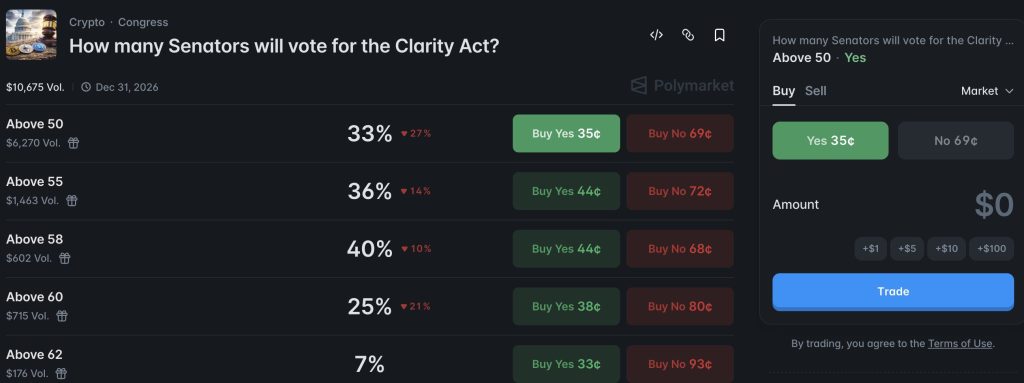
The outlook for the Digital Asset Market Act remains unsettled as the bill moves through the Senate process. CryptoNews reported that Polymarket CLARITY Act odds priced in a 60-plus Senate vote at 25%.
That market signal sits alongside broader industry optimism, but neither replaces the legislative record or establishes how the Senate will act.

The official record for H.R. 3633 shows that the House passed the Digital Asset Market CLARITY Act on July 17, 2025, by a vote of 294-134.
The bill is now listed as having passed the House, while the Senate Banking, Housing, and Urban Affairs Committee is listed among the committees associated with the measure.
Polymarket CLARITY Act Odds: The Senate Record
Congress.gov identifies the Senate’s latest action as an August 8, 2026, cloture motion on the motion to proceed to the measure. The record documents that procedural step, but it does not show Senate passage. It also does not establish the timing or result of a future Senate vote.
That distinction is important when assessing commentary about the bill. A market price, an industry forecast, and a congressional action can each describe a different part of the legislative picture.
The official bill page remains the clearest source for the measure’s formal status: it has passed the House and has not yet reached the next completed status in the congressional tracker.
Check out the CLARITY Act Markets on Kalshi and Claim $25 For Free
What the Bill Would Do for the Markets
According to the Congressional Research Service summary published on Congress.gov, the bill would establish a regulatory framework for digital commodities. The legislation defines digital commodities as digital assets whose value derives from a blockchain.
The measure would generally assign the Commodity Futures Trading Commission responsibility for regulating digital commodity transactions, including digital commodity exchanges, brokers, and dealers.
It also sets conditions for trading a digital commodity on an exchange. In summary, a blockchain may need to be mature or have achieved decentralized control as defined by the bill, or an issuer may need to file specified reports.
The bill would also establish requirements involving trade monitoring, recordkeeping, and the commingling of customer assets. Its provisions address securities registration exemptions for certain digital commodities on mature blockchains, subject to annual-sales limits and other requirements described in the legislation.
The summary further states that the Securities and Exchange Commission would retain jurisdiction over specified digital commodity activities and transactions conducted by certain brokers and dealers on alternative trading systems and by national securities exchanges. Digital commodity exchanges, brokers and dealers would be subject to the Bank Secrecy Act for anti-money-laundering and related purposes.
Competing Views of the Bill’s Prospects
Coverage of the legislation has highlighted differing expectations about whether it can attract the Senate support needed to advance. A Yahoo Finance report described debate over the bill’s ethics provisions and noted that industry figures held different views on its prospects.
Those assessments are separate from the bill’s official status. The congressional record currently documents House passage, Senate committee involvement, and the cloture motion on the motion to proceed. It does not resolve whether the Senate will take a further vote or whether the bill will become law.
Make Your Prediction Count With $25 For Free on Kalshi
The post Polymarket CLARITY Act Odds: Senate Path Remains Uncertain After Cloture Step appeared first on Cryptonews.
Crypto World
Shinhan and Visa team up to test stablecoin issuance and B2B settlements in South Korea


Shinhan Financial Group will use Visa’s platform to test stablecoin issuance, remittance, and redemption while building new AI-powered payment models.


Polymarket is reportedly paying professional Brazilian Counter-Strike players between $20 and $500 per post to promote the prediction market on X.
Specifically, Counter-Strike news outlet Dust2, reports that Polymarket is paying players to comment on news events while mentioning Polymarket and sharing bets.
Polymarket currently has 509 different Counter-Strike bets, some of which attract $1 million to $2 million in volume.
AI Polymarket post called ‘digital cancer’
Professional Counter-Strike player Robin Kool recently threatened to block Polymarket promoters after an official Polymarket Counter-Strike account falsely claimed he was in Paris with a Porsche.
He described the account’s post as “digital cancer,” and called people creating sponsored Polymarket posts with AI “a fucking joke.”
Read more: Researcher claims Rollbit co-founder tied to CSGO scams
Other users described the $20 price per tweet as a way for professional players “to completely debase yourself… for a morally bankrupt gambling company.”
Fake bets and Polymarket bans this year
Polymarket now lists 39 countries where it is restricted.
It’s sponsored promotional posts were also revealed by the Wall Street Journal to be mostly fake.
It found that influencers were using a fake Polymarket website to create fake bets and display $900,000 in winnings. If the bets had actually been placed, the WSJ found it would’ve equated to ~$160,000 in losses.
It also found that so-called “clippers,” people who edit and share footage of these influencers online, were only paid if 60% of their audience is US-based.
Polymarket is not allowed to operate in the US.
Protos has reached out to Polymarket for comment and will update this piece should we hear anything back.
Got a tip? Send us an email securely via Protos Leaks. For more informed news and investigations, follow us on X, Bluesky, and Google News, or subscribe to our YouTube channel.
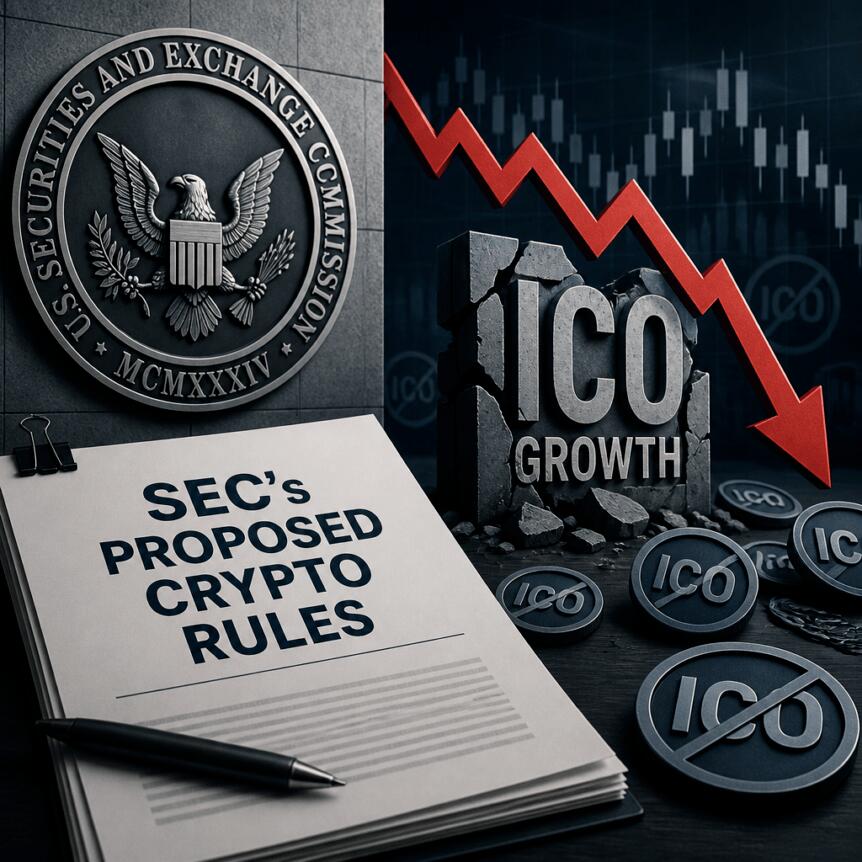
The U.S. Securities and Exchange Commission has proposed a new regulatory framework for token issuers that, if adopted, would make public token fundraising in the United States more practical—at least for projects able to meet specific conditions. The proposal, unveiled Aug. 18, would introduce exemptions designed for certain “investment contract” offerings involving crypto assets.
At the center of the plan is a larger fundraising exemption that would let qualifying issuers raise up to $75 million in any 12-month period, alongside a smaller one-time exemption for startups. While the changes aim to reduce uncertainty, legal experts say the proposal is unlikely to recreate the unchecked ICO environment of 2017.
Key takeaways
- The SEC’s proposal would create a $75 million exemption that renews on a rolling 12-month basis for qualifying public token offerings tied to investment contract analysis.
- Issuers could potentially run “serial” fundraising rounds, but later raises would still require new filings and SEC staff review, not a simple repeat of the first approval.
- Non-accredited investors would face limits—under the proposal, they could buy no more than 10% of the greater of their income or net worth for the relevant exemption framework.
- The SEC’s approach may clarify primary sales, but risks could shift into the secondary market if a token is effectively treated as a securities instrument due to ongoing managerial expectations.
- Experts caution that even a formal exemption route could be used in ways that undercut investor protection, leaving retail participants exposed to familiar problems.
A rolling $75 million path for qualifying token sales
According to Cointelegraph’s reporting on the SEC rollout, the SEC proposal would establish two exemptions for certain investment contracts involving crypto assets. The smaller exemption is a one-time option for startups raising up to $5 million over four years. The larger exemption would allow qualifying issuers to raise up to $75 million during each 12-month period.
The structure is modeled in part on Regulation A, including disclosure and ongoing reporting obligations for issuers that rely on the safe harbor. That matters because a large portion of the market’s compliance burden has historically come from the need to determine whether a token sale is viewed as a securities offering under existing law.
Can issuers raise $75 million repeatedly?
One of the practical questions is whether the rolling nature of the $75 million cap enables projects to return to the market multiple times. Legal professionals cited in the article suggest that it’s possible in concept, though not frictionless.
Drew Hinkes, a partner at Winston & Strawn, told Magazine that the 12-month limitation could support “serial raises” of $75 million every 12 months, “provided they are actually distinct offerings.” In other words, the cap appears designed to be reset on a time-based schedule rather than tied to a single lifecycle event.
However, Lilya Tessler, partner and leader of Sidley’s Global FinTech and Blockchain group, said “nothing prevents an issuer from relying on the exemption more than once,” but each raise is “isn’t automatic.” She explained that any additional fundraising would require a new offering statement and an SEC staff review. Issuers would also have to continue providing annual and semiannual reports, as well as disclose how much was raised under the exemption in the prior 12 months so the SEC can verify the cap’s usage.
For investors, this creates a different fundraising dynamic than the typical single-shot token launch. For example, if a project targets a total of $225 million, the exemption could—at least in theory—allow fundraising in stages while the network develops between rounds. That could make early allocations more meaningful to investors who anticipate later token issuance at a potentially higher valuation as the ecosystem matures.
Will the cap revive ICO-era FOMO?
The idea of a hard funding ceiling raises another concern: whether limited allocation size could intensify demand for early rounds. Reiners, a Duke University lecturing fellow and financial regulation expert, suggested that scarcity could make initial allocations more attractive if investors expect higher valuations in later offerings.
But Reiners also emphasized that the exemption is unlikely to bring back ICO mania. As he put it, the $75 million exemption could make public token offerings more feasible, but it is unlikely to produce a return to the “ICO boom.”
That view is consistent with Tessler’s comparison to traditional securities behavior, where issuers often restrict round sizes. She also highlighted a key investor-protection difference: non-accredited investors would not be able to “go all in” on a single token sale. Under the proposal framework, Tessler said participation would be limited to buying “10% of the greater of their income or net worth,” regardless of which round they choose.
Clarity for token issuers—without a clean return to 2017
The market’s posture toward token fundraising has changed materially since the last major ICO cycle. Reiners pointed to the reputational and economic aftermath of the 2017–2019 period, noting that up to 90% of projects funded via ICOs during those years ended up failing. He argued that fundraising is shaped not just by legal pathways, but also by investor appetite, token economics, liquidity, custody, and lingering damage from the prior cycle.
The SEC’s proposal is also framed, in part, as a manageable shift rather than a floodgate. The SEC estimates that around 130 offerings would use the two new exemptions each year, while around 475 issuers could use the broader investment contract safe harbor. In other words, the agency’s own expectations point to a steady rollout instead of a sudden wave.
For companies, the appeal is that the SEC is proposing an explicit regulatory route rather than leaving issuers to self-assess whether their offerings fit neatly into existing securities-law categories. Crypto lawyer Jake Chervinsky—referenced in the article—characterized the SEC approach as timely.
Secondary-market uncertainty remains a live risk
Even with a clearer primary-sale pathway, the SEC proposal introduces potential complexity when tokens begin trading. The filing indicates that an investment contract tied to a crypto asset could continue transferring to later purchasers in secondary market transactions until the token separates from the issuer’s representations or promises.
The practical effect is that marketing and expectation-setting around “managerial efforts” could matter even after the initial distribution. If the issuer or related parties communicate in a way that leads buyers in secondary markets to reasonably expect profits derived from essential managerial work, the token could be treated as part of an investment contract framework.
Hinkes warned about this dynamic. He said that if a transaction of a non-security covered crypto asset causes the transfer of the investment contract from seller to buyer, there is a risk the later cryptoasset sale could be viewed as a securities transaction. This could be consequential for exchanges and other trading venues that must navigate whether listed tokens implicate securities compliance requirements.
Investor protection concerns could persist under a “form over substance” scenario
Reiners also cautioned that the new structure could be gamed. In his view, a public offering exemption might be used as a vehicle for regulatory arbitrage if issuers satisfy the technical conditions of an exempt sale while continuing to market an asset whose value depends heavily on issuer-led managerial efforts.
That would leave retail investors facing many of the same issues seen during earlier cycles—such as opaque disclosures, concentrated insider holdings, and promotional tactics that can outpace transparency. The proposal may improve the legality of certain token issuances, but it doesn’t automatically solve the broader question of how investor expectations are formed and maintained.
As the SEC moves forward, market participants should watch how the final rule is shaped through the comment and approval process—especially the details tied to secondary market treatment, investor limits, and what constitutes sufficient separation from issuer representations. The proposal could be an important step toward more predictable compliance, but it also shifts some of the key uncertainty to what happens after trading begins.
Bitcoin has staged a sharp recovery from the $60K demand zone, breaking above several major technical barriers and reclaiming the $72K-$74K area. The latest move has pushed BTC toward the $80K resistance zone, where momentum is beginning to show signs of exhaustion. At the same time, the on-chain picture has improved materially, with the average market participant taking profits again.
Bitcoin Price Analysis: The Daily Chart
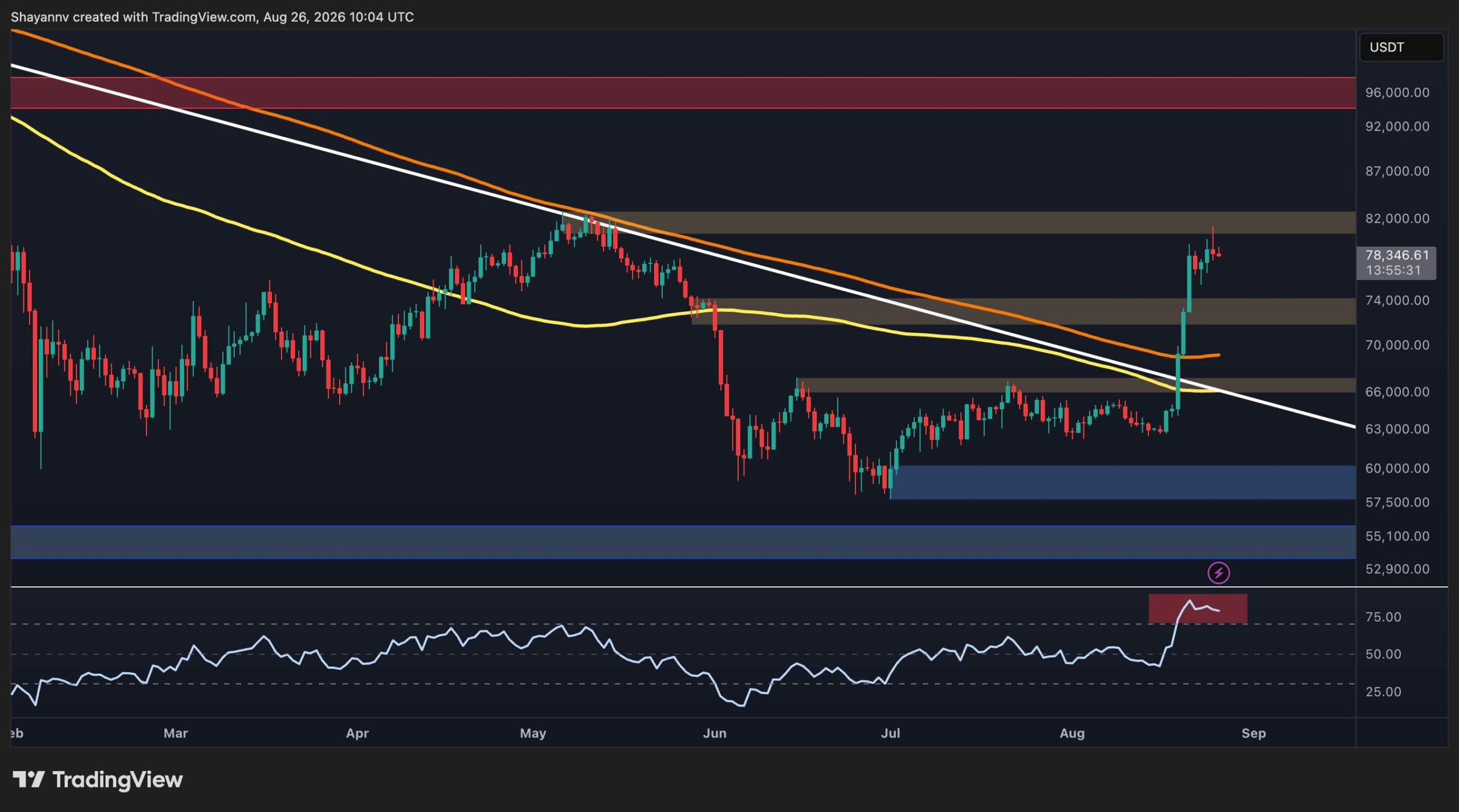
The daily chart shows a significant structural improvement. BTC spent several months consolidating below a descending trendline, with the $60K-$67K area acting as the main range. The breakout above the trendline and the $67K resistance zone was followed by an aggressive move higher, first through $72K-$74K and then toward the current $80K area.
Bitcoin is also now trading above the 100-day (~$66K) and 200-day (~$70K) moving averages shown on the chart, which have also started to flatten or turn higher. This suggests that the broader structure has shifted from consolidation toward a more constructive trend. The previous resistance around $72K-$74K could therefore become the first major support zone if the market enters a pullback.
However, the $80K-$82K region is an important obstacle. It corresponds to the upper resistance zone visible on the chart and is close to the recent local highs. A decisive daily breakout above this area would strengthen the bullish structure and could open the door toward the next major resistance around $95K.
Momentum is the main near-term concern. The daily RSI has surged into the overbought region following the vertical rally. This does not necessarily signal an imminent reversal, as strong trends can remain overbought for extended periods, but it does suggest that BTC may need to consolidate or retrace before attempting another sustained leg higher.
BTC/USDT 4-Hour Chart
The 4-hour chart provides a clearer picture of the recent breakout. BTC spent most of July and August inside a broad contracting structure, bounded by a descending upper trendline and a gradually rising lower boundary. The eventual breakout around $66K was decisive, producing a near-vertical advance through the $72K-$74K resistance zone.
After reaching $80K, Bitcoin has started to consolidate below the latest high. The price is currently around $78K, while the RSI has pulled back substantially from its previous peak. There is also a visible bearish divergence, with the price making a higher high while the RSI forms a lower high. This suggests that short-term momentum is weakening even though the broader breakout structure remains bullish.
The immediate resistance is therefore the $80K zone. A clean 4-hour close above it, followed by a successful retest, would provide stronger confirmation that the breakout is continuing rather than simply producing a local relief rally.
On the downside, $72K-$74K is the key near-term support. Holding above this zone would keep the breakout structure intact. If BTC loses it, the next important area is around $64K, which was the original consolidation zone and should now act as a major test of whether the overall trend reversal is genuine.

On-Chain Analysis
The adjusted SOPR chart provides an encouraging confirmation of the recent price recovery. Adjusted SOPR measures whether spent Bitcoin is, on average, being realized at a profit or a loss. The 1.0 level is particularly important: readings above 1 indicate that coins are generally being spent at a profit, while readings below 1 indicate that losses dominate.
The metric spent a prolonged period below 1 during Bitcoin’s previous correction, reflecting persistent loss realization. More recently, aSOPR has rebounded sharply, and its 30-day EMA has also turned higher and moved above the 1.0 threshold.
This is an important improvement because it suggests that profitable spending has returned alongside the price recovery. Historically, a sustained move above 1 can support a transition toward a healthier bullish market structure, particularly when the metric’s trend is also rising.
That said, the latest jump is quite steep, meaning some short-term cooling would not necessarily invalidate the broader signal. If aSOPR remains above 1 during any BTC pullback, it would suggest that holders are still realizing profits rather than capitulating. Conversely, a return below 1 would weaken the bullish interpretation and could indicate that the recent recovery is losing underlying strength.

The post Bitcoin Price Analysis: Is BTC’s Rally in Trouble After Failing to Reclaim $80K? appeared first on CryptoPotato.
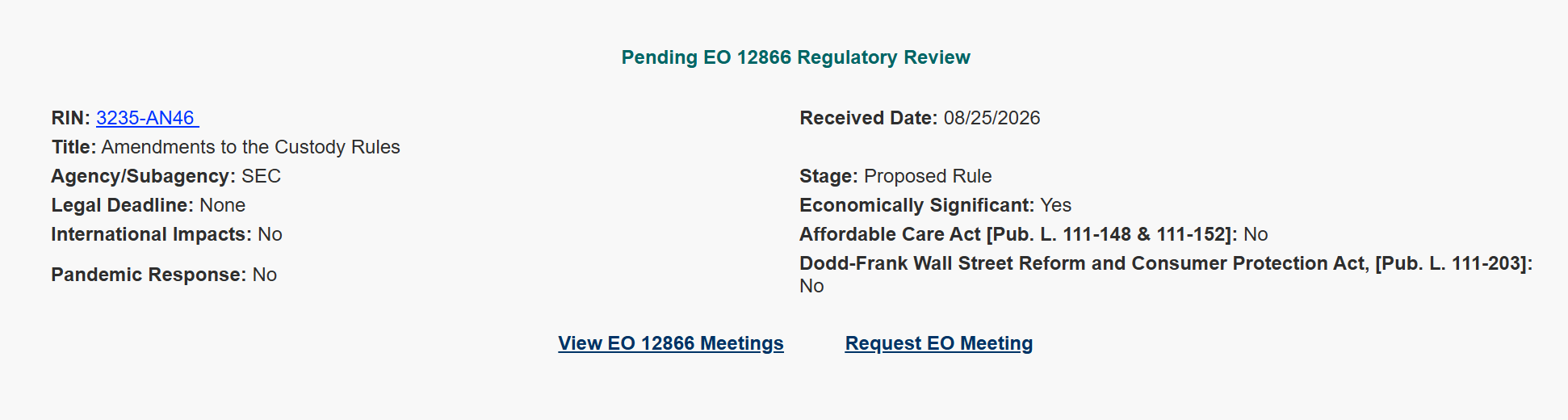
The Securities and Exchange Commission (SEC) sent its crypto custody rule rewrite to the White House on Tuesday. The text is secret. The filing’s labels are not, and one of them gives the direction away.
The proposal, called Amendments to the Custody Rules, reached the Office of Management and Budget (OMB) on August 25. The rule decides how investment advisers may hold client crypto.

What the SEC Crypto Custody Filing Tags Reveal
The OMB record carries two labels. The first is economically significant. That tag marks rules with at least $100 million in yearly economic impact.
The second label matters more. The filing sits in the deregulatory column under Executive Order 14192. President Donald Trump signed that order in January 2025. It tells agencies to scrap ten rules for every new one they write.
So before anyone reads a single line, the direction is on record. The SEC plans to loosen crypto custody duties, not tighten them.
The agenda abstract adds two more facts. It names crypto assets directly, and it targets a formal proposal for October. That step opens a public comment period.
A Reversal Two Years in the Making
Today’s rule forces advisers to park client assets with a qualified custodian, usually a bank or broker-dealer. Few of those firms would touch crypto. That left advisers with almost no compliant way to hold it.
Former Chair Gary Gensler pushed the other way. His 2023 Safeguarding Rule would have widened custody duties, and his staff probed advisers over custody. The agency withdrew that plan in June 2025.
Since then, named players have shaped the rewrite. Venture firm Andreessen Horowitz asked the SEC to modernize crypto custody rules.
In December 2025, lawyers from Delphi Ventures and Multicoin Capital sent the agency a custody framework. It asks for room to use multi-signature and multi-party computation (MPC) wallets. These tools split key control, so no one party can move the assets.
One Week, Two Proposals, and a Senate Clock
The custody filing landed one week after the SEC proposed Regulation Crypto Assets, a fundraising regime for tokens. The pair covers both ends of the market. One sets how projects raise money. The other sets how institutions hold it.
“As we continue the Commission’s efforts to provide clarity for crypto markets, and as Congress works to establish a lasting regulatory framework, Regulation Crypto Assets seeks to provide … clear pathways to raise capital under the federal securities laws,” SEC Chairman Paul Atkins made the point in the agency’s August 18 statement.
Congress, meanwhile, is stuck. The House passed the Clarity Act 294-134 in July 2025. The bill would split crypto oversight between the SEC and the Commodity Futures Trading Commission (CFTC). It has sat in the Senate since, and now faces a 60-vote test around September 15. Its passage odds remain shaky.
The SEC is not waiting for that vote. Two signals come next. How long OMB holds the rule, and which firms request meetings while the text stays sealed.
The post SEC Crypto Custody Rule Hits the White House: Lighter Standards Ahead? appeared first on BeInCrypto.


The bitcoin treasury company has built nearly four years of preferred-dividend coverage while continuing to repurchase STRC below par.

XRP is trading at $1.43 as the token settles into a tight range after last week’s fireworks. The bigger number nobody’s talking about yet: how much further this consolidation phase could drag before the next real directional signal fires. Here’s our XRP price analysis.
So where will XRP go next? The answer might matter less than what’s happening several rungs down the market-cap ladder.
The backdrop here is a violent round trip. XRP erased its most bearish technical signal last week and ripped 46% in seven days, briefly pushing past a $91 billion market cap and touching $1.55 intraday. The Average Directional Index hit 44.8 during that run, which confirms genuine trend strength, not noise.
Then the wall showed up. Two straight down days followed, with the latest daily candle closing at $1.45 after opening near $1.48, and the spot has since ground lower to current levels.
Extreme greed just returned to crypto markets for the first time since 2024, yet XRP’s pullback shows sentiment alone doesn’t override exhausted momentum. That tension between macro optimism and micro technicals is exactly where this XRP price analysis needs to start.
Discover: The Best Token Presales
Can XRP Price Hit $1.55 Again This Week?
At $1.43, XRP sits 4.5% off yesterday’s levels and well below the $1.7 high printed during the breakout top. Volume has thinned noticeably compared to the vertical leg from the $1.00 August low, a pattern typical of relief rallies losing steam rather than trends reversing outright.
Short-term pivots place immediate support near $1.31–$1.30, with layered resistance stacking from $1.51 up to $1.62. Zoom out, and the structural floor near $1.00 remains the level that matters most, and a break below opens downside toward $0.96–$0.88.

If XRP can reclaim $1.50 on rising volume, it can retest $1.62. Or continued chop might happen between $1.30 and $1.50 while the market digests the prior leg.
But a break below $1.30 drags the price back toward the $1.00 floor. The pair itself is trading in an unusually narrow intraday band, reinforcing the indecision.
Trade XRP on Bybit and Get a Chance to Win Our $1,000 USDT Airdrop
Bitcoin Hyper Targets Early Mover Upside as XRP Stalls Below Resistance
Anyone who bought the $1.00 bottom is sitting comfortably. But at a $90 billion market cap, XRP’s remaining upside from here requires enormous capital inflow just to move the needle another 10%.
The above math is precisely why traders with risk appetite are increasingly scanning presale markets for asymmetric setups instead.
Bitcoin Hyper ($HYPER) is positioning itself as the first Bitcoin Layer 2 with native SVM integration with smart contract execution built for speeds faster than Solana itself, layered onto Bitcoin’s base-layer security.
The presale has raised $33 million so far, with tokens priced at $0.0136852 and a high 35% staking rewards currently live. Its Decentralized Canonical Bridge aims to solve Bitcoin’s long-standing programmability gap like slow transactions, high fees, zero smart contract flexibility, without compromising the security model that makes BTC valuable in the first place.
Research Bitcoin Hyper before the presale window closes.
Discover: The Best Crypto to Diversify Your Portfolio
The post XRP Price Analysis: Where Will Ripple Token Go Next? appeared first on Cryptonews.
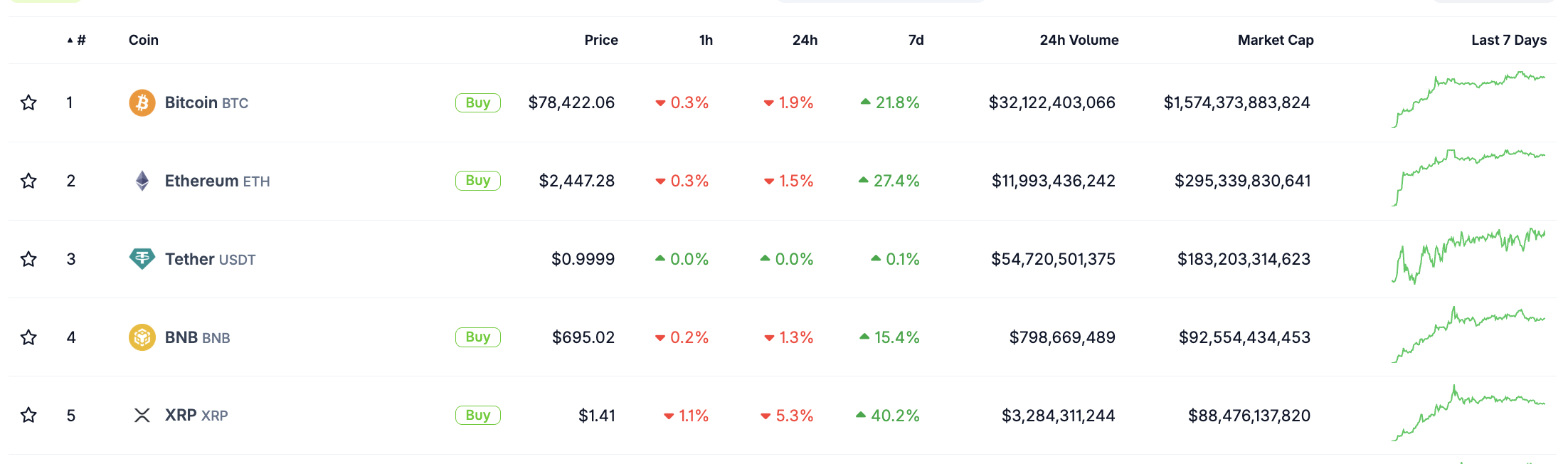
XRP is trading at $1.41, down 2% over the past 24 hours in a mild pullback after one of the sharpest weekly moves in the top-10. The token is still up more than 45% over seven days, and the question everyone’s asking is whether this is the start of something bigger or just a leveraged bounce running out of road.
XRP gained 50% over the trailing week, outpacing every other major altcoin, with a 40% move over 30 days despite still sitting 20% down year-to-date. Analyst Ali Charts flagged a 650% spike in active addresses, from 47,180 to 356,070.

All the signs are pointing to a move that is typically associated with sharp participation surges and, historically, elevated volatility. Receiving addresses reportedly jumped by over 698%, and three consecutive days of record Bitwise XRP ETF volume indicate “real accumulation.”
Whale positioning tells a more nuanced story than the retail hype cycle suggests. Long positions that dipped after initial profit-taking are climbing again. This means that smart money that already booked gains and is now rebuying the dip in a pattern that usually precedes continuation, not collapse, provided macro conditions cooperate.
Discover: The Best Token Presales
Can XRP Hit $1.60 This Week?
At just above $1.40, XRP sits in a post-breakout consolidation zone. Technical structure points to resistance at $1.51, $1.53, $1.57, and $1.62, while support is layered at $1.31, $1.30, and a much stronger floor near $1.00. The 24-hour flatness-to-slight-decline pattern suggests traders are digesting the prior surge rather than reversing it outright.
The bull case comes if XRP closes above $1.51 on sustained ETF inflow volume, opening a run toward $1.62-plus, with some analyst models citing $2.50 upside if fresh catalysts emerge. Consolidation between $1.31 and $1.52 could also happen, but a break below $1.30 invalidates near-term bullish structure and puts the $1.00 zone back in play.
$10 this year would require roughly a 7x move, which is not impossible in crypto, but nothing in the current data (ETF flows, address growth, whale re-entry) points to a catalyst of that magnitude yet. Worth tracking, not betting the farm on.
Trade XRP on Bybit and Get a Chance to Win Our $1,000 USDT Airdrop
Maxi Doge Targets Early Mover Upside as Ripple Token Tests Key Levels
XRP holders riding this rally have reason to feel validated, as a 45% weekly gain is nothing to scoff at. But XRP’s $80 billion market cap means even a run to $2.50 is “only” a double.
For traders chasing asymmetric upside, that math starts looking thin against something still in presale.
Enter Maxi Doge ($MAXI), an Ethereum-based meme token built around 1000x-leverage trading culture, think gym-bro energy meets degenerate trading floor.
The presale has raised $4.8 million at a current price of $0.0002835, with dynamic APY staking already live for early buyers. Standout features include holder-only trading competitions with leaderboard rewards and a dedicated Maxi Fund treasury for liquidity and partnerships.
The tagline, “never skip leg-day, never skip a pump,” sums up the pitch: lift, trade, repeat.
Research Maxi Doge before the presale window closes.
Discover: The Best Crypto to Diversify Your Portfolio
The post XRP Soars, But What’s Really Happening? Can Ripple Blast Past $10 This Year? appeared first on Cryptonews.
Dolly Parton’s Last Song to Release in 2046: What to Know

Meta will impose daily limits on child Instagram users and pay $17 BILLION to settle claims it deliberately got youngsters hooked on its social media platforms

(VIDEO) Prince Harry and Meghan Markle Land in UK With No Police Presence Days After Announcing Return





-

 Fashion5 days ago
Weekend Open Thread: Madewell – Corporette.com
-

 Business4 days ago
Musk’s Tesla, SpaceX Confirm $16.8 Billion ‘Terafab’ Chip Plant as World’s Largest Building in Texas
-

 Crypto World4 days ago
anatomy of crypto’s biggest liquidation event since 2021
-

 Crypto World2 days ago
A $30 Billion AI Fund Implodes, Now the SEC Is Investigating Wall Street’s Role
-

 Crypto World16 hours ago
SpaceX stock could rise 75% to $240, JPMorgan says
-

 Politics4 days ago
6 months on, Irish renters crushed by effects of government housing bill
-
 NewsBeat4 days ago
The ‘Lucky Dip Gang’ causing carnage for clicks: After five thugs were killed speeding in the wrong direction on a motorway, GUY ADAMS investigates a sick new trend… and why police aren’t even allowed to pursue them
-

 Business3 days ago
Mystery AI Model ‘Ox Alpha’ Draws Developers With Free Access as Chinese Lab Origins Remain Debated
-

 News Videos6 days ago
Don’t Leave Your Financial Future To Chance | August 19, 2026
-

 Business7 days ago
Marvell Shares Jump 7% as Google Chip Deal Confirms Custom AI Silicon Partnership, Analysts
-

 Business6 days ago
Five Below: Kids Discount Retailer Reaps Rich Rewards
-

 Business2 days ago
Moderna CEO warns China is pouring state money into mRNA technology
-

 Business5 days ago
UK firms in critical financial distress rise 9% to 53,756
-

 Business2 days ago
NVIDIA Stock Drops Nearly 2 Percent to $210 on Seventh Losing Day Ahead of Critical AI Earnings
-

 Sports3 days ago
Deshaun Watson fires back at Browns fans after being booed: ‘It’s a disrespectful thing’
-

 Crypto World6 days ago
Optimism-funded team's deciding vote shifts $49 million in OP tokens away from users
-
 Entertainment7 days ago
10 Most Perfect Fantasy Shows of the Last 25 Years
-

 Tech6 days ago
OpenAI confirms ChatGPT is down as logins and signups fail
-
 Crypto World3 days ago
Google Gemini AI Predicts Ethereum Could Become the Trade Retail Misses in 2026
-

 Business6 days ago
PayPal and Venmo now accepted for tuition at several universities
You must be logged in to post a comment Login