Investment firm Kimmeridge says as many as half of the data centres proposed in the United States are at risk of delay or cancellation because of political backlash and the difficulty of building physical infrastructure. It expects that to cut forecasts for US gas demand, most of which Europe now buys.
As many as half of the data centres proposed in the United States are at risk of delay or cancellation, according to Kimmeridge Energy Management. The investment firm blames political backlash and the ordinary difficulty of building physical infrastructure.
“The sort of Silicon Valley model is running into a real-world infrastructure constraint,” said Ben Dell, the firm’s managing partner and co-founder, speaking at Bloomberg’s New York headquarters.
Where the estimate comes from is worth noting. Kimmeridge holds stakes in gas producers and in a Louisiana export terminal, and Dell says delays would force cuts to US gas demand forecasts, which makes this a warning against his own book.
Advertisement
He put figures on it. Of roughly 30 billion cubic feet a day of expected US gas demand growth, most of it from LNG exports, Dell said data centres might account for 5 billion to 10 billion, with delays pushing that towards the lower end.
The backlash he describes is now measurable. TNW reported this month that more than 500 US jurisdictions restrict data centres, with New York freezing environmental permits and Texas halting approvals pending audits.
Dell says the opposition has turned bipartisan. Pennsylvania, Texas and Ohio, once considered friendlier to these projects, are producing pushback and litigation, and the issue is heading into the midterm elections.
Europe has the same problem for a different reason. The obstacle here is rarely the neighbours and usually the grid, as Nscale found when National Grid could not connect its £2B Essex site in time to open next year.
Advertisement
The two continents are joined by the fuel. Kimmeridge’s Commonwealth LNG took a final investment decision in May on a $13B terminal in Cameron Parish, Louisiana, shipping 9.5 million tonnes a year from around 2030.
Europe is the customer for that gas. IEEFA expects the United States to supply two-thirds of European LNG imports this year, rising towards 80% by 2028, into terminals it projects will be three times larger than European demand by 2030.
So an American delay becomes a European supply question. Gas that does not burn in Ohio can be liquefied and sold to a continent that keeps telling Big Tech to align its data centres with climate targets.
Dell’s ideal proposal, he said, would be “zero impact,” with no net effect on water use, land, emissions or power prices. Nobody has built one of those yet, on either continent.
Apple has begun rolling out ads in Apple Maps, with sponsored businesses appearing at the top of search results and in the “suggested places” section for users in the U.S. and Canada. Apple says the ads can be based on approximate location, search terms, or the area of the map being viewed, but are not tied to users’ Apple Accounts and personal data remains on-device. 9to5Mac reports: Ads appear just like every other business listing, except they have a small blue badge that says ‘Ad.’ You can see examples of ads [embedded in the article]. Like Apple’s ads policy with other services, the company touts user privacy protections for ads in Maps. Per Apple Newsroom: “Ads on Maps builds on Apple’s broader privacy-first approach to advertising, and maintains the same privacy protections Maps users enjoy today. A user’s location and the ads they see and interact with in Maps are not associated with a user’s Apple Account. Personal data stays on a user’s device, is not collected or stored by Apple, and is not shared with third parties.”
Apple may have a new pair of entry-level AirPods coming much sooner than expected, although “pair” is technically selling Cupertino short.
According to Bloomberg’s Mark Gurman, Apple is preparing two AirPods 5 models that could debut as early as its expected September 2026 iPhone event. As with AirPods 4, one version is expected to include Active Noise Cancellation, while a less expensive model would go without it. References to both unreleased models have already been discovered inside the macOS Tahoe 26.7 Release Candidate, giving the report considerably more credibility than the usual blurry photograph of something allegedly spotted near Shenzhen.
Apple has not announced AirPods 5, however, and there are currently no confirmed specifications, prices, battery-life figures, drivers, Bluetooth version, or audio-performance claims. Reports suggesting a new H3 chip remain speculation rather than confirmed product information, so we’re not putting that in the specifications column just yet.
The timing becomes much more interesting when you look at everything else Apple has been doing.
First, we need to separate two products that are already getting mashed together online.
The expected AirPods 5 are successors to the AirPods 4, which Apple introduced in September 2024 at $129 without ANC and $179 with it. Bloomberg reports that the fifth-generation models will maintain that two-tier approach, although Apple has not confirmed whether pricing will remain the same.
Those are different from the camera-equipped AirPods that eCoustics has covered extensively this year. Apple inadvertently included references and even a demonstration video for camera-equipped AirPods in macOS 26.7, showing Visual Intelligence using sensors in the earbuds to understand what the wearer is looking at.
Current reporting indicates that those more ambitious AirPods are not expected until 2027. They appear to represent a much larger transformation of AirPods into wearable AI devices rather than simply another generation of wireless earbuds.
Advertisement
That distinction is important because AirPods 5 may turn out to be evolutionary hardware arriving ahead of something much more significant.
Will the New Mac mini Support AirPods 5?
Almost certainly, yes — although Apple cannot officially list compatibility with a product it hasn’t announced.
Advertisement. Scroll to continue reading.
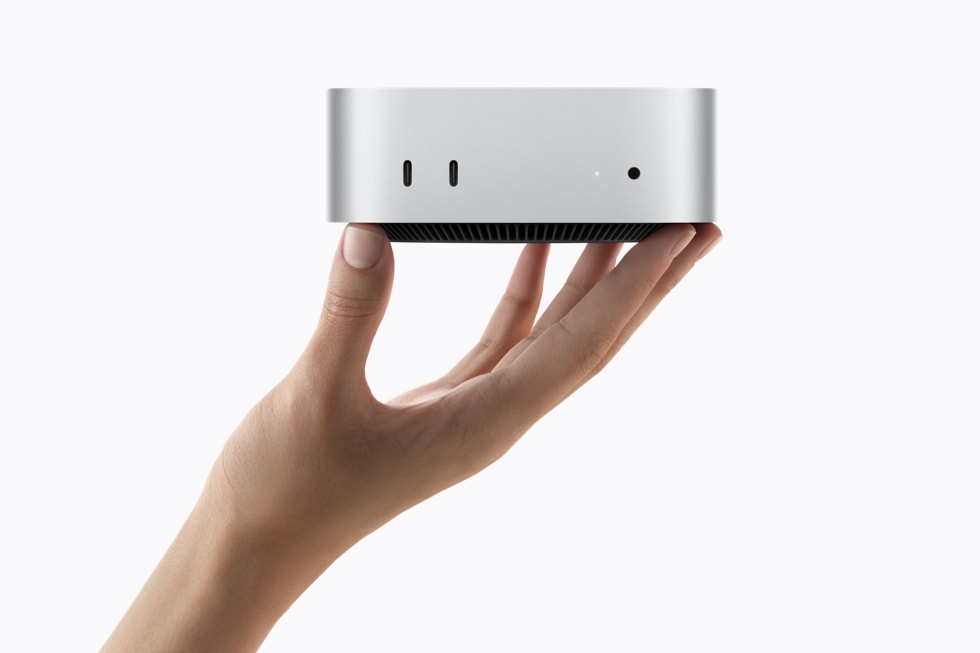
Apple unveiled its new Mac mini on August 25, 2026, with a choice of the new M6 or M5 Pro processors, along with Bluetooth 6, Wi-Fi 7, macOS 27, upgraded Ethernet, Thunderbolt connectivity, and substantially increased AI processing capabilities. The M6 version starts at $899, while the M5 Pro configuration starts at $1,699; both begin shipping September 22.
There is no technical reason to expect AirPods 5 compatibility to be an issue. Apple’s existing AirPods support Macs running the appropriate version of macOS, and current AirPods can already provide Spatial Audio and dynamic head tracking on Apple silicon Macs. Personalized Spatial Audio profiles created with an iPhone also synchronize across compatible Macs, Apple TVs, iPads, and other Apple devices signed into the same Apple Account.
Advertisement
The strongest clue is sitting inside Apple’s own software: macOS 26.7 already contains references to both AirPods 5 models. Apple is clearly preparing Mac software support before the hardware has even been announced.
So yes, somebody buying the new M6 or M5 Pro Mac mini should reasonably expect to use AirPods 5 with it. We would stop short of promising specific AirPods 5 features on the Mac until Apple actually announces the earbuds.
Apple’s Bigger Play Is the Ecosystem
This is where AirPods 5 become more interesting than their specifications might initially suggest.
Apple just introduced a much more powerful Mac mini with Bluetooth 6 and Wi-Fi 7, while macOS 27 brings the next generation of Apple Intelligence and Siri AI. At WWDC 2026, Apple also announced custom EQ for AirPods users, adding another layer of personalization to its headphone platform.
Advertisement
Apple TV 4K was last updated in 2022
Meanwhile, eCoustics recently reported that Apple appears to be preparing a long-overdue Apple TV 4K refresh with faster processing, Wi-Fi 7, a new wireless chip, deeper Siri AI integration, and potentially a revised Siri Remote. Apple hasn’t announced that hardware yet, but the direction makes sense when viewed alongside the new Mac mini and AirPods roadmap.
AirPods already move between iPhone, iPad, Mac and Apple TV, while Personalized Spatial Audio profiles travel with the user’s Apple Account. Apple TV 4K can deliver Dolby Atmos Music through Apple Music and supports Spatial Audio with dynamic head tracking through compatible AirPods. Add Siri AI, the Mac, Apple Watch, Fitness, Find My, and eventually Visual Intelligence, and Apple’s headphones become another interface into the entire platform.
That is considerably harder for competitors to attack than frequency response or another hour of battery life.
What Could Make AirPods 5 Unique?
We don’t yet know whether AirPods 5 themselves will introduce anything technically groundbreaking. Anyone claiming otherwise has access to information Apple has not released.
Their more interesting characteristic may be where Apple places them within the lineup. Offering both standard and ANC versions of an open-fit earbud gives consumers who dislike silicone ear tips an unusual choice, and Apple has already demonstrated with AirPods 4 that effective noise reduction is possible without creating the full seal used by AirPods Pro.
Advertisement
Samsung is now attacking essentially the same customer with the Galaxy Buds4, a $179.99 open-type earbud offering adaptive ANC, Bluetooth 6.1, Samsung’s 24-bit Hi-Res codec, and deeper integration with Galaxy devices. For Android users — particularly Galaxy S26 owners — that is probably the most direct ecosystem competitor.
Advertisement. Scroll to continue reading.
Sony’s LinkBuds Open take a more radical approach with an open-ring design that deliberately allows environmental sound through, although their $229.99 price puts them above the current standard AirPods range. Shokz and others have also made open-ear listening a rapidly growing category rather than the niche experiment it was a few years ago.
Apple therefore doesn’t own the concept. What Apple does exceptionally well is make the earbuds feel like an extension of devices consumers already own.
Advertisement
What About AirPods Pro 3?
Apple AirPods Pro 3
AirPods 5 also need enough separation from the $249 AirPods Pro 3, which remain Apple’s premium in-ear model.
AirPods Pro 3 add stronger ANC, heart-rate sensing, hearing features, Live Translation, workout integration, and a sealed in-ear design. Our own review found the feature set impressive but the sound quality less convincing than AirPods Pro 2, proving once again that adding more technology doesn’t automatically make music sound better.
That leaves room for AirPods 5 to succeed simply by being comfortable, affordable, easy to use, and hopefully better sounding than their predecessors. Not every pair of earbuds needs to monitor your pulse, translate the waiter, and eventually identify the paperback you’re staring at.
Sometimes headphones should also be good headphones.
The Bottom Line
AirPods 5 may initially look like a routine refresh: two open-fit models, one with ANC and one without, replacing hardware introduced two years ago. Until Apple reveals the specifications, there is no basis for claiming revolutionary sound, a new processor, longer battery life, or dramatically improved ANC.
Advertisement
The larger Apple picture is considerably more compelling.
Within the same period, Apple is rolling out an M6/M5 Pro Mac mini with Bluetooth 6 and Wi-Fi 7, macOS 27 with Siri AI, new AirPods software features, a likely next-generation Apple TV 4K, and development work on future camera-equipped AirPods that could turn the earbuds into wearable Visual Intelligence devices.
AirPods 5 don’t have to win every specification comparison with Samsung, Sony, Shokz, Bose, or Sennheiser. Apple’s advantage remains the same one that has kept millions of people buying AirPods even when competitors offer better battery life, more codecs, or arguably better sound.
They work with everything else Apple sells.
Advertisement
And Apple appears determined to make “everything else” work together even more closely.
Equality is everyone’s responsibility, so employers should try to ensure they are creating a diverse and welcoming workplace environment.
In just a few days it will be September, and school and college programmes will be back up and running. Many people of all backgrounds and lifestyles will be engaging with STEM subjects, eager to learn and begin down a path that will likely lead to their future careers.
But the experience won’t be the same for everyone. Despite best efforts to prevent it, factors such as gender, race, religion, colour, country of origin and able-bodiedness, often dictate a person’s professional experiences.
Careers in the STEM space are no different. So, how can employers and organisations create an ecosystem that effortlessly implements a policy of inclusivity?
Advertisement
Know the environment
Governments, state institutions and multi-country partnerships are by no means perfect, there will always be laws, policies and regulations that people don’t agree with. Those regulations can even negatively target certain groups of people. But there are also new regulations that govern aspects of life as a means of improving society and the employers who are keen to stay modern and inclusive need to be aware of them. An ideal example is the new EU Pay Transparency Directive, which aims to reduce pay inequality by making the sharing of information clearer and more accessible.
The EU’s 2019 Work-Life Balance Directive, while it applies to all, is another policy that provides people with additional personal responsibilities, healthcare or family obligations the chance to create some distance between home and the workplace.
A strict adherence to the rules governing the rights of employees shows the workforce and potential applicants that a company takes their rights seriously.
Start at the beginning
If you want to hire more inclusively, but find that the talent pool is not representative of the wider world and its workforce, then the solution is not to simply accept the talent pool as it is. True inclusivity means getting involved in the STEM community long before you develop your teams.
Advertisement
Companies have an obligation to shape the landscape by creating STEM programmes targeting children and underrepresented or marginalised groups, so they know what is possible for them to achieve and that a profession in STEM is not outside the realm of possibility.
This doesn’t mean that companies need to funnel excessive funds or resources into a range of complicated programmes. Rather, it can be as simple as giving established employees the opportunity to take a few hours out of their day a couple of times a year to share their experiences with others through schools, after-school programmes and post-secondary educational opportunities. It is a great way to show a young person what they might need for a career in STEM.
See the whole picture
Not everyone is granted the same opportunities in life despite having similar interests, hobbies or aptitude. While more and more organisations are becoming less concerned about how a person obtained their skills and are more focused on the fact that they have the skills, not every company is leaning that way.
There are multiple reasons as to why an individual may not have a traditional STEM-based third-level education, but that doesn’t mean they aren’t qualified. Micro-credentials, online courses and other forms of self-learning can give students all of the education they require for an entry-level position.
Advertisement
The organisations looking to be a beacon of inclusivity should consider how they recruit, the barriers preventing some applicants and whether reducing the available talent pool to the ‘typical few’ is in the best interests of the business or the wider community.
Walk the walk
Many organisations within the technology sector in particular create and empower systems that assist people with disabilities to live their lives with greater ease. But it shouldn’t only be in our personal lives that the technologies we use are assistive.
To ensure that a business has a diverse workforce, the tech, systems and furniture being used day to day must be designed with everyone in mind.
That could mean computers with added visual and audio features, adjustable seats and tables, areas with changeable lighting and inclusive safety elements, among others. There is no such thing as a universal design and the organisations that are serious about hiring inclusively are the ones who don’t prescribe to a ‘standard’ workplace layout as a rule.
Advertisement
Don’t miss out on the knowledge you need to succeed. Sign up for the Daily Brief, Silicon Republic’s digest of need-to-know sci-tech news.
While it remains unclear what Phillips has been working on in the administration since stepping away as head of the Office of Response and Recovery, on Sunday he wrote on Truth Social, “I have been in the admin since last year. I’ll be leaving soon to rejoin the fight.”
One day later, he was pictured at a Department of Justice building alongside Ed Martin, the former US pardon attorney whom President Donald Trump last week announced would be departing the administration to “fight legal battles for the upcoming midterm election.”
“Enjoyed the visit with our friend Ed Martin today in DC,” Phillips wrote on Truth Social. “Haters are gonna hate this.”
Advertisement
Martin and the Department of Justice did not respond to WIRED’s requests for comment about Phillips’ role in the administration. Phillips declined to comment.
A FEMA spokesperson directed WIRED to a statement it issued in June saying Phillips was “taking leave for personal reasons.” When asked if Phillips was still employed by the agency and still on leave, it didn’t respond.
Phillips is on administrative leave, according to the White House, which also confirmed that Martin is still working in the administration until September 4. Federal employees on administrative leave are entitled to full pay and benefits.
Phillips has long promoted baseless allegations of widespread voter fraud, claiming in 2016 that more than 3 million non-citizens voted in the presidential election, robbing Trump of winning the popular vote. Days after taking office in 2017, Trump promoted Phillips’ false claims. In the wake of the 2020 presidential election, Phillips gained further notoriety when the group he was involved with, True the Vote, provided the data that underpinned the debunked film 2000 Mules, which falsely alleged that a network of individuals was paid to illegally collect and deposit ballots in drop boxes.
Advertisement
A 2022 investigation by the Center for Investigative Reporting found that True the Vote has raised millions of dollars from donors by repeatedly promising to uncover evidence of election fraud but failing to do so. Much of that money, CIR reported, went to companies controlled by Phillips and in loans to True the Vote’s founder Catherine Engelbrecht.
Phillips was appointed last December to head up FEMA’s Office of Response and Recovery despite no past experience working in emergency response. In June, following his departure, the agency thanked Phillips for his “his service, dedication, and leadership,” adding that “he has played a pivotal role in stabilizing the Office of Response and Recovery and advancing key reforms to strengthen our mission delivery.”
Three sources at FEMA, who were granted anonymity due to fears of recrimination by the administration, tell WIRED that Phillips has not been seen at FEMA’s headquarters since June.
When Phillips posted on Truth Social this week about his decision to “rejoin the fight” he was once again discussing “illegals on the voter rolls” and the work he and Engelbrecht had done almost a decade ago to address the perceived issue—which is so rare that even a third-party analysis of a database maintained by the right-wing Heritage Foundation shows it contains fewer than 100 examples. When asked if Phillips’ comment meant he would be working with True the Vote again, Engelbrecht said, “I’m sure Gregg will be involved in a number of projects in the future, and we at TTV think very highly of him, but in an effort to set the record straight, he is not part of the True the Vote team. He previously assisted TTV as a contractor on research projects from 2020–2023.”
Advertisement
When asked about Phillips’ role as a board member of True the Vote, as revealed by the CIR report, Engelbrecht did not respond.
WIRED recently revealed that ahead of the midterms, True the Vote will release another documentary, entitled Trapped, which again makes allegations about widespread and systemic voter fraud.
Google gets something right in its Wednesday announcement about new Gemini Live voice features when it says, “You shouldn’t have to guess whether a task requires Spark, a Daily Brief, or a quick inbox search.” Google means that as a promise — that the updated Gemini app can handle a variety of tasks via voice commands. But there’s a ridiculousness here: Google has given every Gemini AI feature under the sun its own branding, which undercuts that very message.
In the Gemini app, users can switch between chat, Spark, and Daily Brief — three separate features, each with its own icon and place in the app’s navigation. This clutters up what could otherwise be a more straightforward consumer experience, and it suggests that Gemini is still struggling to find a killer feature.
Take Daily Brief, for example. The feature comes across as the kind of thing an AI engineer, not an everyday user, would think is clever. It’s essentially an AI-enabled agenda that offers “proactive, personalized updates” using data pulled from Google’s apps, like Gmail and Calendar. In practice, though, the Brief can’t tell the difference between information that’s urgent or actionable and unsolicited nudges to follow up on other things — like prompting you to continue research you started in the chatbot, or worse, resurfacing your prior Google searches.
That second part doesn’t feel useful; it feels creepy. So what if I had been researching college scholarships or animal rescues on Google? That doesn’t mean I want an AI tapping me on the shoulder about them later.
Advertisement
Spark has the opposite problem. It’s one of the more useful aspects of Gemini’s app — an AI agent that can take action on your behalf — but Google has packaged it as its own standalone brand, which it doesn’t need to be. Sure, internally, Google engineers may want to be on the Spark team, and that’s fine — but a mainstream AI app user definitely does not need to think about which “side” of the AI app they need to be in for a given task. They should just be able to type their request, and the AI figures out how to handle it, spinning up an agent if the task calls for one.
In fairness, the problem isn’t limited to Gemini. The AI industry at large seems to expose its internal architecture directly to consumers rather than hiding it behind a simpler interface.
Today, people have to think about whether they want to “chat” with Anthropic’s Claude or “Cowork” with its help. (Until this week, those two modes inside the Claude app didn’t even share a memory of past conversations.) ChatGPT is the same, requiring you to swap between “Chat” and “Work.” This is the kind of engineering-minded design that makes engaging with AI feel unnatural. Consumers are being asked to learn the brand names for what are essentially interaction modes or surfaces, powered by a company’s AI model.
This may be why Apple’s somewhat anticlimactic approach to Siri could ultimately win over consumers. iPhone and Apple device owners don’t have to change any of their existing behavior to take advantage of it. Apple simply makes the apps and features that people already use — like Spotlight Search, the Photos app, the iPhone’s Camera, and Siri voice requests — smarter without asking users to learn a new interface.
Advertisement
This same principle may explain the rise of text-based AI services, where users simply text a chatbot — like Poke, Ollie, Lindy, Orchid, Lucas, Folk, Tomo, Instinct, or others — and the assistant just does what’s asked.
Text messaging is a clean and simple, well-understood user interface, and it doesn’t require extra mental effort to figure out which feature or product inside a larger app you’re supposed to use.
As a16z investment partner Justine Moore recently wrote, “People don’t want to open an app every time they need help – they want a contact they can text like a friend. And the gold standard is iMessage.”
When you purchase through links in our articles, we may earn a small commission. This doesn’t affect our editorial independence.
ASUS has introduced its latest TUF Gaming laptops in India, built around its Game, Study & Multitask approach. The new lineup includes the TUF Gaming 16 as its key launch, along with Made in India configurations of the TUF Gaming A15 and refreshed TUF Gaming models. The laptops focus on strong performance, durability, flexible upgrades, and cooling. They are aimed at users who need a single device for gaming, studying, projects, entertainment, and daily multitasking.
ASUS TUF Gaming 16 Specifications
The ASUS TUF Gaming 16 (FX610) is the headline launch of the refreshed series. It is powered by up to an Intel Core i7-14650HX processor paired with an NVIDIA GeForce RTX 5060 Laptop GPU, making it suitable for AAA gaming, content creation, and demanding multitasking.
ASUS has equipped the laptop with MIL-STD-810H military-grade durability and support for up to 64GB of RAM and a 2TB PCIe SSD, allowing users to upgrade the system as their needs grow. The dual-fan cooling system, combined with a large rear exhaust vent, is designed to keep temperatures under control while maintaining relatively quiet operation at around 40dB.
The laptop also features a 180-degree hinge for easier screen sharing, an anti-smudge coating on both the lid and keyboard deck, and a generous selection of ports, including USB-C with Power Delivery, HDMI 2.1, LAN, and USB Type-A. The TUF Gaming 16 starts at ₹1,79,990.
Made in India TUF Gaming A15 and Other Refreshed Models
ASUS is also expanding its locally manufactured gaming portfolio with the Made-in-India TUF Gaming A15 (FA506NCQ). The laptop combines an AMD Ryzen 7 170 processor with NVIDIA GeForce RTX 3050 graphics and retains the same MIL-STD-810H durability certification found across the TUF lineup.
It supports up to 32GB RAM and 2TB SSD storage, while dual-fan cooling and larger rear vents help improve sustained performance during longer gaming sessions. Connectivity includes dual USB Type-C ports alongside HDMI 2.1, and the laptop starts at ₹1,24,990.
Advertisement
ASUS has also refreshed the TUF Gaming A16, F16, and another A15 configuration with newer hardware. The TUF Gaming A16 now supports up to 64GB RAM, 4TB SSD storage, and RTX 5060 graphics, with prices starting at ₹1,99,990. Meanwhile, the TUF Gaming F16 pairs an Intel Core 5 210H processor with upgrade support for up to 64GB RAM and 4TB SSD, starting at ₹1,35,990. The refreshed TUF Gaming A15 (FA506NCG) features a Ryzen 7 155 processor, RTX 3050 graphics, and starts at ₹1,15,990.
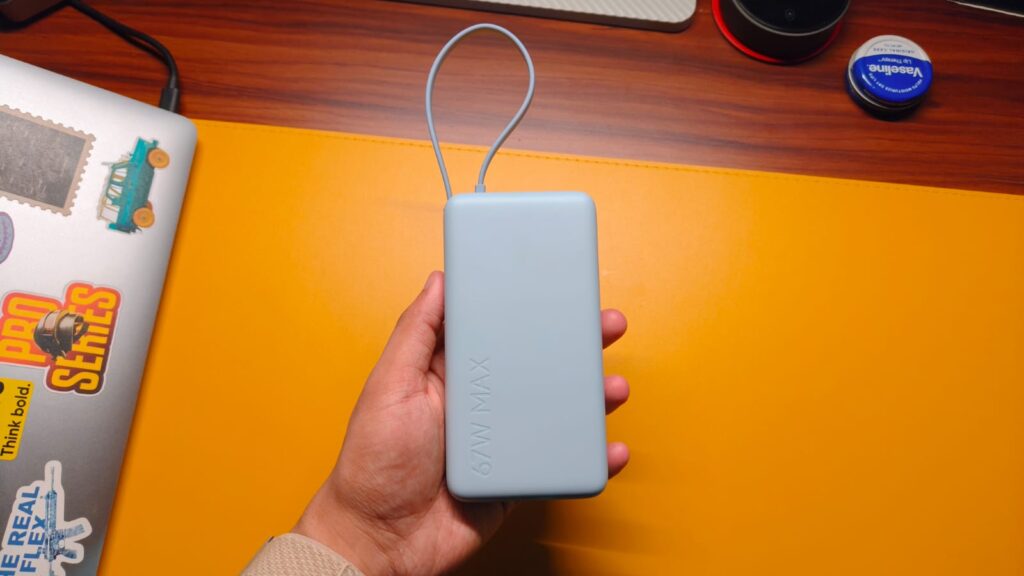
Power banks come in all shapes and sizes. Depending on your needs, you can choose either an ultra-slim device that attaches to the back of your phone or a large power bank that can charge your laptop and phone simultaneously at full speed. I, however, think differently. An ideal power bank for me should be somewhere in the middle. Something that can charge my laptop but is small enough to fit inside a backpack. Xiaomi seems to have listened to the demand and launched its new 67W 20,000 mAh Power Bank in India. I took it on a trip to Delhi to test whether you should spend ₹3,499 on it.
Design & Charging
The Xiaomi 67W power bank is more of a travel accessory. It’s made from plastic, of course, but it doesn’t feel cheap. The blue color feels like a breath of fresh air in a stale, black power bank world. The design is rectangular, so it’s easy to hold in your hand, and the dimensions are decent. I wouldn’t call it compact, but it fits in a bag pretty easily without taking up much space. On the side, you get a small display with a button directly underneath it. You press it to see the remaining charge, which is a nice touch. The front is where all the ports are. The most important one is the integrated Type-C cable, which doubles as a carrying strap and supports 67W of fast charging. You also get a USB-A port and another Type-C port to connect longer cables.
My experience with the power bank was pretty good. I was invited to an event in Delhi, which meant catching the morning flight, attending the event, and then coming back the same day in the evening. I carried my MacBook Air M1, whose battery health has seen better days, so I knew I’d need to charge it somewhere. The first leg of the journey went well, but by the time the event ended, my laptop was down to around 30%.
Since I can’t be bothered to look for a charging socket, I connected it to the Xiaomi power bank. With a fast cable, it charged my laptop from 30% to 60% in about 30 minutes. As for my OPPO Find X8, the power bank supports SuperVOOC, so it can fully recharge my phone in about 40-50 minutes.
The Xiaomi power bank is rated at 20,000 mAh, though the usable capacity is naturally lower due to voltage conversion losses. For context, it can charge my MacBook from zero to full just over one time, while phones can typically be charged more than twice. That estimate assumes a phone with a battery of around 5,500 mAh and not for ridiculous battery phones like the Redmi Note 17. If you use an iPad, you’d be able to charge it 1.5 times before the power bank needs to be plugged in. Speaking of that, the Xiaomi power bank supports fast 65W charging. You can charge it from 0% to 100% in about 2.5 hours.
Verdict
At ₹3,499, Xiaomi has made one of the easiest power banks to recommend in this price segment. It strikes the balance I was looking for: powerful enough to charge a 67W laptop, yet compact enough to fit in a backpack without feeling like you’re carrying a brick. The built-in USB-C cable is more useful than I expected. The display makes checking the remaining battery effortless, and the charging speeds held up well during a full day of travel. Sure, it isn’t the smallest 20,000mAh power bank around, but that’s a compromise I’m happy to make for the extra versatility.
Jetterz Incz services over 500 outlets for brands like Starbucks & KFC
For most 17-year-olds, a first job might mean a weekend shift at a café or retail store. For Shaik Nifael, it meant earning S$23 a day cleaning grease traps—a far cry from an easy first job. While his friends were still in school and spending their evenings playing computer games, Shaik was working long days cleaning the greasy interceptors that catch waste oil before it enters the sewage system.
School was never going to be his path. He failed his O-Level maths and combined science, and dropped out of Millennia Institute after his first year. His father, then a general manager at a waste management company with 40 years in the trade, gave 17-year-old Shaik a choice: go back to school, or come earn his keep at his waste management company. Shaik chose the latter.
I wanted to prove myself to him, so I took up the challenge. I went to my father’s office for the interview the very next day.
Nine years later, in 2015, he struck out on his own and set up Jetters Incz. Today, the 37-year-old’s waste management company services over 500 outlets for brands like Starbucks, KFC, Pizza Hut, Coffee Bean, Sushi Express, and Shake Shack, pulling in close to S$3 million in revenue a year.
The $200,000 handshake
Image Credit: Jetters Incz
From cleaning grease traps at 17, Shaik eventually worked his way into management. In 2011, five years later, he joined a company in the same industry, run by a friend of his father’s as a management trainee.
He learned the trade from the ground up: how to read a blockage, open a pipe and clear a choke. But he also proved himself on the business side.
Advertisement
Over the next four years, Shaik helped grow the company and its fleet from three vehicles to 17, eventually working his way up to operations manager.
In late 2014, an acquaintance, Kelvin Neo, who ran landscaping company Ho Eng Huat Construction, casually floated the idea of backing Shaik if he ever decided to strike out on his own. Shaik turned him down at first—he liked his job and saw no reason to leave.
That changed when his father and his friend had a falling out. Within eight or nine months, Shaik was out too, so he called Kelvin back.
But Shaik didn’t dive into the venture blindly.
Advertisement
He walked into Kelvin’s office with a detailed financial breakdown covering everything from vehicles and licences to tanker fabrication, and asked for S$200,000 in funding. Kelvin trusted him enough to barely look at the paperwork before putting the cash on the table.
That handshake marked the start of Jetters Incz in August 2015.
Learning to run a business from zero
Shaik and his team in 2015 when Jetters just started./ Image Credit: Jetters Incz
Having worked in waste management companies for years, Shaik knew the technical side cold. However, running an actual company was a whole different ballgame entirely.
To save money, he furnished his first office with furniture he found on Carousell—secondhand chairs, desks, whatever he could find. “It was a Frankenstein office,” he said, “cut and paste, enough to get it going.”
His wife, Dania, joined him since the start of the business, handling sales while raising their children.
Advertisement
In its first year, Jetters made an impressive S$600,000 in sales, carried largely by clients who followed Shaik over from his previous company on trust alone.
Whenever asked about what Jetters does, Shaik is unabashed in sharing what his company is about.
With its highly specialised equipment, Jetters is typically called in to maintain pipes and fix complicated, stubborn chokes that most plumbers do not have the capacity to clear. It’s a work that most people never see, and even fewer understand.
Shaik likens a building to a body: its pipes are arteries that need steady blood flow, and Jetters is the doctor who clears the blockages before things escalate into a heart attack—or in drainage terms, a burst pipe.
Advertisement
Same concept. We go in and take a look at the pipe, and once we find the problem, we take the choke out.
A typical day at Jetters
Shaik, Dania and their current team./ Image Credit: Jetters Incz
Most of Jetters’ work is scheduled. Teams visit every outlet under contract on a rotation, checking and servicing pipes before anything goes wrong, which Shaik jokes is the “protection money” clients pay for.
There’s also the emergency side of the business, with calls coming in at any hour for burst pipes, sudden blockages or flooded kitchen lines.
Two or three men go in, assess it on the spot (pricing is done job-by-job through a site survey, since no two blockages are the same), clear it, and leave. It’s not unusual for a team to be on site until 3AM and have another crew out again by morning.
Around the clock, Shaik and his wife Dania take turns manning the hotline for emergency requests, day and night, so Jetters can deploy a team the moment something comes in.
Currently, the business runs on a lean team of 12 with seven vehicles made up of tankers, high-pressure water jetting trucks, lorries and vans.
Advertisement
Key pivots that reinforced Jetters’ relevance
The Jetters team faces a different situation for every single job./ Image Credit: Jetters Incz
Most small operators in Shaik’s industry lost ground during the COVID-19 pandemic. Instead, Jetters grew further.
Just before Singapore’s lockdown hit, Shaik moved his foreign workers out of dormitory housing, a decision that let Jetters keep operating and take on additional work while competitors, whose workers were confined to dorms under quarantine, simply couldn’t.
Jetters also became an early adopter of digitalisation in an industry Shaik describes as otherwise almost untouched by new technology in decades.
Moreover, in its early business years, Jetters used to compete for building maintenance tenders like everyone else in the industry, a market that, Shaik found, rewards the cheapest bid over the best service. As a new player up against operators with over 15 years of reputation, he realised he couldn’t win on price alone.
So he pivoted towards offering his services to chain outlets instead—brands with multiple locations that needed consistent, standards-driven maintenance rather than the lowest quote.
Advertisement
Today, Jetters maintains drainage for all 164 Starbucks outlets, 72 KFCs, and 56-and-growing Pizza Huts in Singapore, alongside Coffee Bean, Sushi Express, and a whole roster of international names, even in the hospitality scene.
“When you can maintain chain outlets well, they stay with you without even doubting you,” he says, “that’s the epitome of your service quality.”
The risk nobody warns you about in a business like Jetters
Tipsy Unicorn was a major Sentosa beach club, and Fatburger previously had three outlets in Singapore./ Image Credit: District SixtyFive, Mothership
Running a service business on a minimum of 60 days’ payment terms (sometimes stretching to as long as 200 days) poses a huge risk to a company like Jetters.
When a client collapses, the money doesn’t just get delayed, and there is a high chance it disappears.
There were instances when Jetters lost outstanding payments from large names, including US fast-food chain Fatburger and Sentosa Beach Club Tipsy Unicorn, which folded in 2023 and 2026, respectively.
Advertisement
Shaik shared that payments for services done for these companies still have yet to be recovered after years of rendering his services.
Moreover, taking into account that the running cost of his businesses comes to around S$200,000 a month.
Another concerning cost is diesel. Due to the recent Middle East Conflict, tanker fuel costs have roughly doubled or tripled in recent years, and Shaik says Jetters mostly absorbs the increase rather than passing it on to long-term clients because Shaik values relationships with clients more than the rising costs.
Then there’s the cost of hiring that Shaik shared puts a significant strain on local businesses. Foreign worker levies run S$600 to S$950 a month per worker, in an industry that struggles to attract local hires for physically demanding, unglamorous work.
Advertisement
“Who really wants to clean longkang?” Shaik said bluntly.
Building industry knowledge himself
Image Credit: Jetters Incz
Since Mar this year, Shaik has been teaching himself to build an internal AI tool named Shika.
Shaik aims to capture the decades of undocumented knowledge and practices for various situations held by ageing veterans in Singapore’s urban drainage industry, a sector he said has essentially zero centralised databases, and the only ones with such knowledge are those who have physically worked in the job.
Shaik has been talking to industry veterans directly to document their know-how by hand, feeding it into the AI himself.
Over the years, the entrepreneur also shared that he had turned down repeated approaches from venture capitalists, private equity firms, and even an offer to relocate the business to the US, preferring to keep the company Singaporean and independent.
Advertisement
Beyond his own AI database, Shaik is currently in early conversations with institutional partners, including GIC, about scaling Jetters’ technology arm and turning Jetters into a holistic technology-driven company, rather than a traditional waste management company.
Where Jetters is headed
In 2025, Jetters came in just under its S$3 million revenue target.
Shaik joked that he “aimed for the moon and landed on the stars.”
The entrepreneur is optimistic about 2026’s revenue beating that S$3 million figure.
Advertisement
His advice to anyone eyeing a similarly unglamorous trade is the same lesson his own experience taught him: the work nobody wants to do is often the work nobody else can do either—and that, more than any diploma, is what actually built the business.
We may receive a commission on purchases made from links.
If you’re familiar with SteelSeries, you’re aware of the company’s products and their overall quality. The company’s line of gaming headsets is particularly well-designed and favored by gamers worldwide, with the Arctis Nova 7 series being of a reliable sort of high quality over the past half-decade at least. Those headsets are fine for your average gamer, but if you’re the type of person who dives deep into a game and enjoys egging on the competition, the Arctis Nova Elite is something you should consider adding to your gaming setup.
SteelSeries has a wide range of gaming headsets, and they typically range from the low end of around $49.99 to as much as $349.99, which is in the mid-upper price range for these kinds of products. The Arctis Nova Elite doesn’t come close to those numbers, as it’s a high-end headset meant for serious gamers who aren’t only willing but able to spend $599.99 to significantly boost their audio experience
Advertisement
Jonathan H. Kantor/SlashGear
That price places the Nova Elite outside the price range of most gamers, but there’s definitely a market for this headset. I’ve used dozens of gaming headsets over the years, and the Nova Elite is most certainly outside my price range, so I was excited to experience using them. The Nova Elite is jam-packed with features; they look incredible, and they’re worth every penny for those looking to significantly upgrade their headset gaming experience.
SteelSeries provided SlashGear with a pair of SteelSeries Arctis Nova Elite headphones for the purpose of this review.
Advertisement
Exceptional connectivity right out of the box
Jonathan H. Kantor/SlashGear
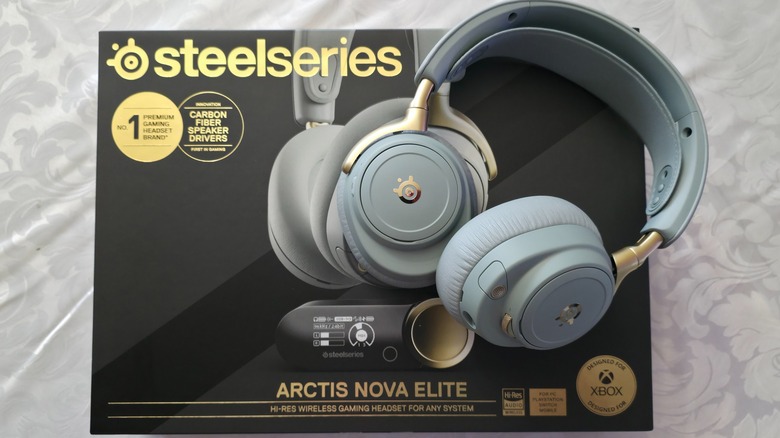
When I received my review headset from SteelSeries, I was immediately impressed with the packaging, which looks almost as good as the headset inside. The packaging makes it clear that the Arctis Nova Elite is designed for use with Xbox consoles, but it’s not limited to them. One of the headset’s best features is its compatibility with other modern consoles, PC, Mac, and phone you could use a headset with. It supports the Xbox Series X|S, Xbox One, PC, PlayStation 4, PlayStation 5, Nintendo Switch, and Mac through the wireless GameHub.
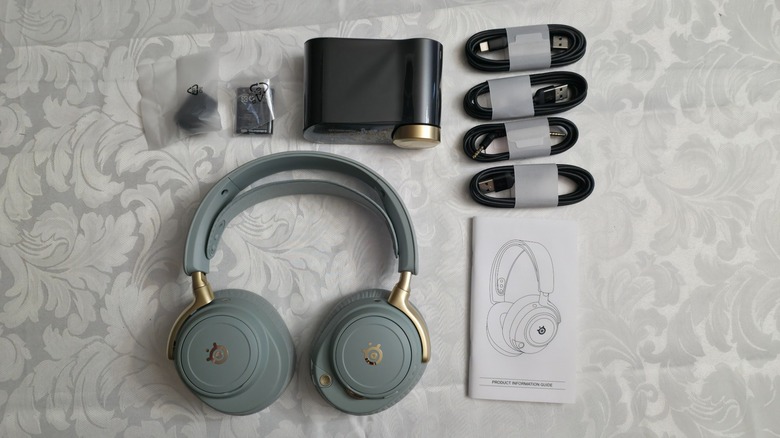
The headset might be geared towards the Xbox line of consoles, but it performs as well on every other major console on the market today. I tested it on the PS5, Xbox Series X, Switch, my gaming PC, and my Android phone, and at no time did I find that the headset’s audio had any problems or latency issues. The box comes with the headset, GameHub, an extra battery, a wind muff for the microphone, a carrying bag, and all the cables that you’ll need to get it set up.
Jonathan H. Kantor/SlashGear
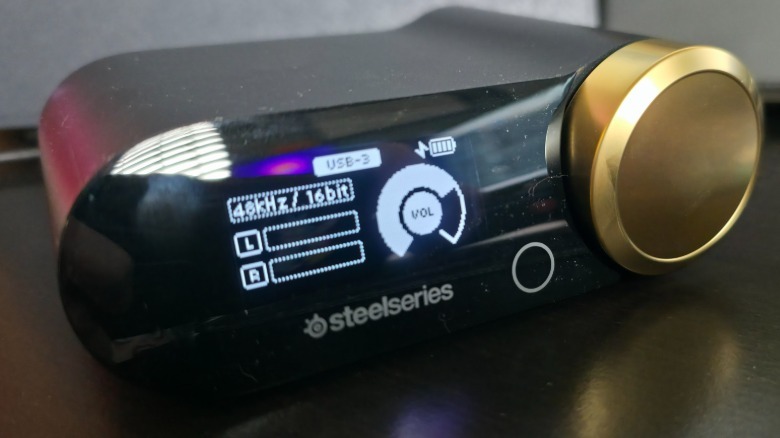
What makes the system’s compatibility exceptional is the GameHub, which enables connection to five connected devices, two of which can be live at the same time. The GameHub automatically switches to the correct one based on activity, providing full-fat digital connections to all of the major consoles, PC, Mac, and more simultaneously.
Jonathan H. Kantor/SlashGear
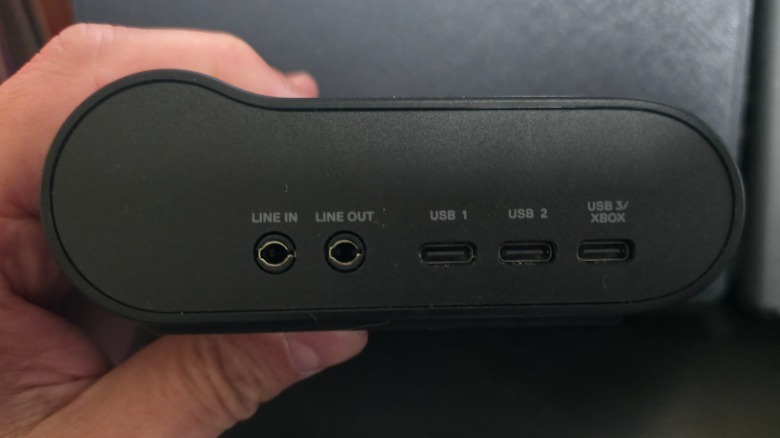
The GameHub is upgraded from the one included in the Arctis Nova Pro Wireless via its third USB-C input. Other upgrades over previous models include a 2.4GHz wireless or LC3+ Bluetooth codec with 96KHz/24-bit Hi-Res audio.
Advertisement
Calling this headset elite almost doesn’t do it justice
Jonathan H. Kantor/SlashGear
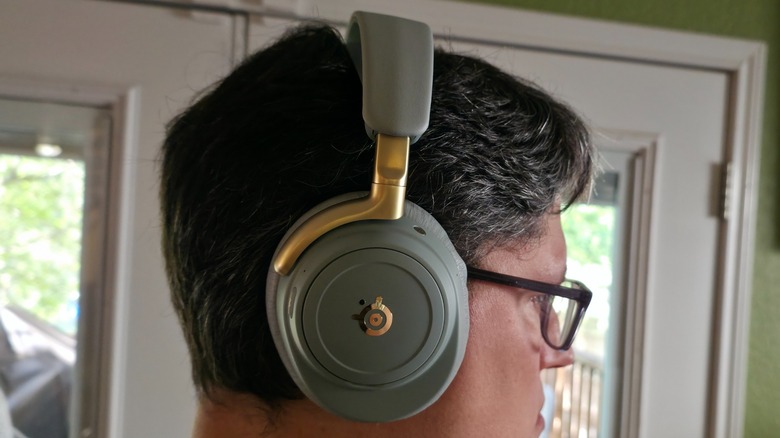
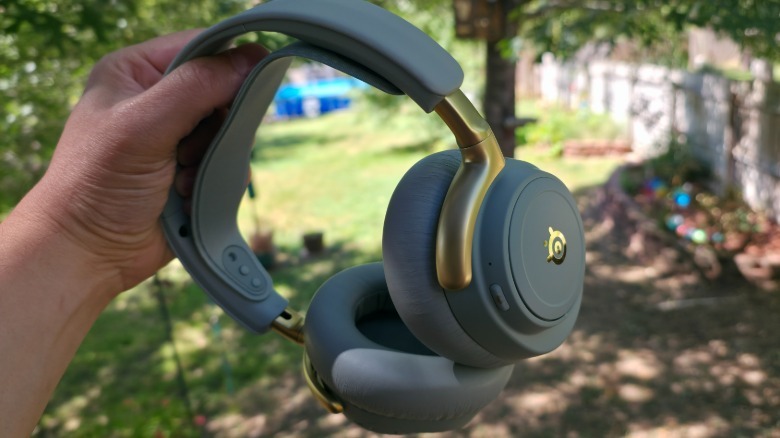
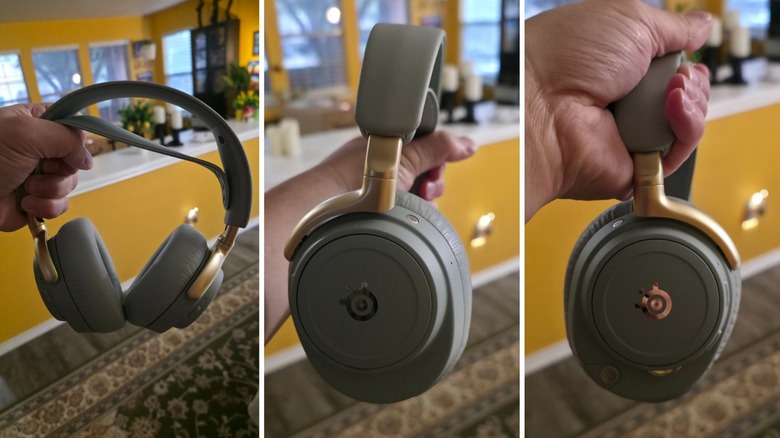
SteelSeries didn’t slap the word “Elite” on its packaging and call it a day — the Arctis Nova Elite is a complete overhaul of the line’s design. The redesign includes upping the components to carbon fiber drivers, an improved base station, hi-res wireless audio, and more. Most notable is the headset’s look, which features sage gold and obsidian colors with golden accents. It includes a fabric suspension headband that feels comfortable through several hours of use. The frame’s design includes steel and aluminum, hinting at the enhanced nature of the headset.
My primary concern outside of functionality with any headset is comfort because the last thing you want to do is adjust your gear mid-deathmatch in the latest “Call of Duty” game while you’re communicating with teammates or dissing opponents. The Nova Elite’s memory foam ear cushions are, in my experience, the most comfortable I’ve used. They also help to moderate the headset’s passive noise cancellation, though it also utilizes active noise canceling (ANC).
Jonathan H. Kantor
Most headsets I’ve used have a black finish, so the coloration of the Nova Elite offered a unique experience, and they look spectacular without standing out too much, thanks to their muted tones. One of the reasons that this headset stands out in terms of performance is that it’s a gaming headset that functions perfectly on pretty much any device.
Take it on a trip, and the ANC will keep you listening to low-volume dialogue aboard a plane without issue. The same is true for making phone calls, listening to music, or anything you’d use a high-end headset for.
Advertisement
Intuitive controls and easy to jump from one device to the next
Jonathan H. Kantor/SlashGear
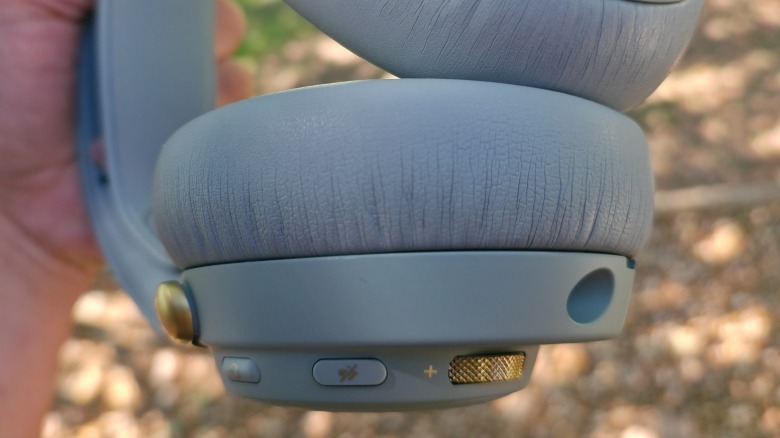
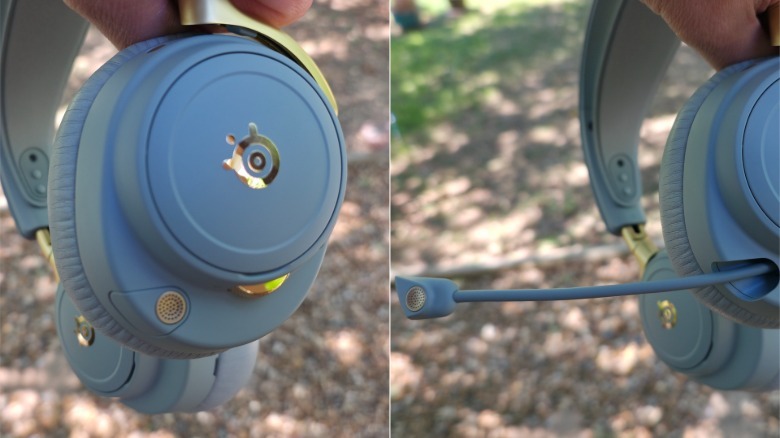
Perhaps the best aspect of the Arctis Nova Elite is how easy it is to use. The headset’s left side features several buttons, a volume dial, and the microphone. This sits inside the headset until you want to pull it out and place it in front of you. It easily slides back into place when not in use, and it’s up to you how you want to use it, as the microphone still picks up your speech whether it’s out or not. The gold volume control knob offers a nice contrast to the steel coloration, and it’s easy to use mid-game.
Jonathan H. Kantor/SlashGear
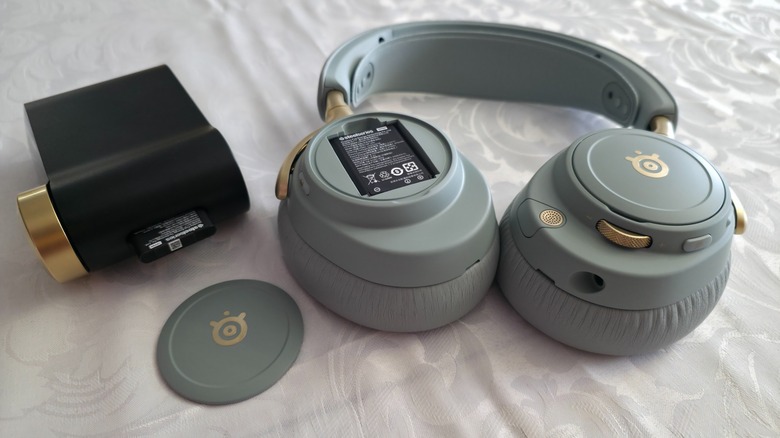
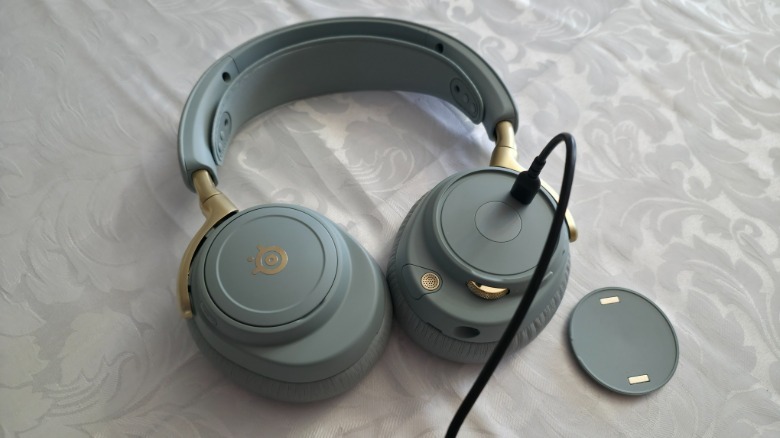
The headset’s buttons are just as easy to identify and use. On the left, there’s a power button and a microphone on/off button. The right features a single Bluetooth button, and that’s all you need. One of my favorite features is the inclusion of a second battery. It plugs directly into the GameHub to charge, and when you need to swap one for the other, it’s a simple process that keeps you in the game without having to run around and look for batteries. If you take the headset on a flight or aren’t near the GameHub, it can be charged directly by removing the magnetic cover on the right side and plugging in the USB-C cable. This is somewhat awkward, but it enables continuous usage.
Advertisement
Options galore via the headset’s settings on your phone or PC
SteelSeries
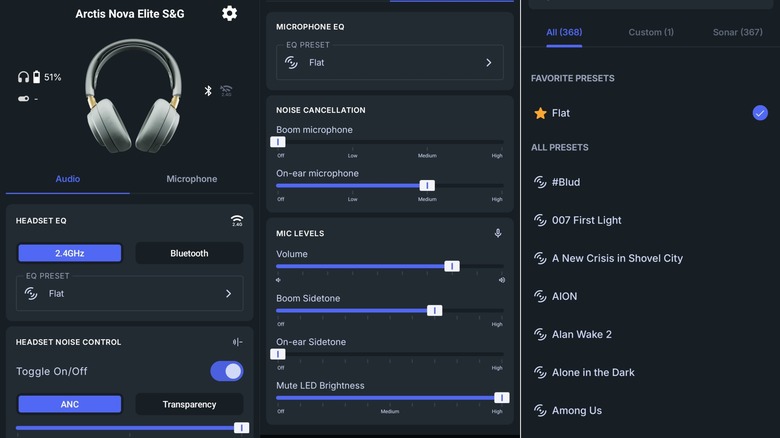
In addition to the GameHub, which is best situated near your consoles, you can modify settings via the Arctis app. Once you download it for your Android or iOS device, it’s easy to use and configure. If you want to adjust the settings, there’s a handy EQ Preset menu that includes game-specific audio choices for “007 First Light,” “Call of Duty: Black Ops 7,” “God of War Ragnarök,” and hundreds more, totaling 368 as of writing.
SteelSeries
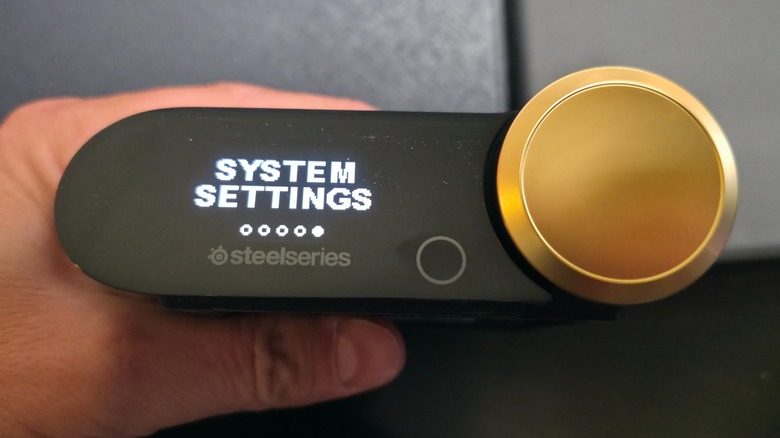
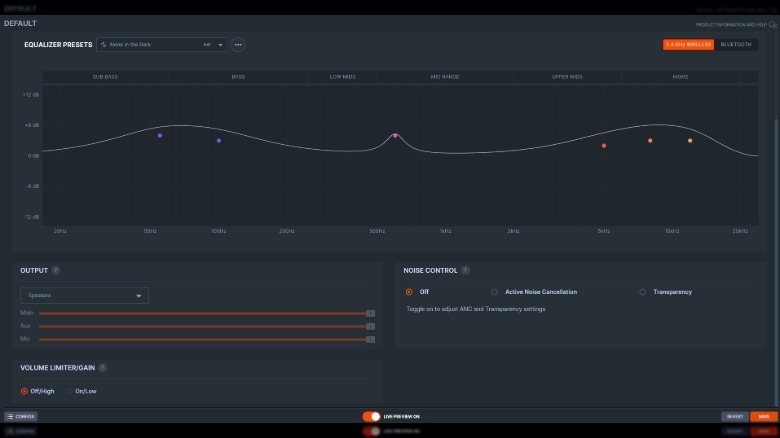
This makes using the headset incredibly simple, though you can also adjust settings via the GameHub’s menu. Each of these elements coalesce into an amazing audio experience, where the system’s ANC keeps you focused on whatever game you’re playing. If you prefer PC gaming, SteelSeries has an app that offers many of the same features, but with more options to adjust your settings manually. This is where the device’s customization comes into play for serious PC gaming. I messed with the settings and used the presets for a few games, and it all sounded spectacular.
The headset’s battery life and sound quality are superb
Jonathan H. Kantor/SlashGear
Swapping out the battery is easy to do, but what I didn’t tell you was how efficient the batteries are. They promise 30 hours of usage, so you can get away from the GameHub for an extended period without running it down quickly. Swapping the batteries is intuitive and takes only a few seconds, though you do have to physically remove the charging battery from the GameHub and place it inside the headset while removing the uncharged one to then add to the GameHub.
Without the battery and GameHub, charging it via the USB-C port on the right side offers up to four hours of use after only a 15-minute charge. Through testing, I can confirm that those claims are accurate. I tried running the battery down through several gaming sessions; I watched a movie while wearing them; and I put about 3-5 hours of gaming each day for a week, and I didn’t need to swap out the battery once.
Advertisement
Jonathan H. Kantor
While the Nova Elite’s features and design are top-tier for this kind of headset, none of it matters if the sound quality isn’t excellent. Fortunately, SteelSeries didn’t skimp on audio components or compatibility with its 40 mm dynamic drivers that offer outstanding spatial cues. The headset supports several modes for whatever platform you connect it to, including Tempest 3D Audio for the PS5, Dolby Atmos and Windows Sonic for the PC and Xbox consoles, and straight stereo mode, all of which offer excellent sound on a comfortable headset.
Designed for gaming — fantastic at everything else
Jonathan H. Kantor/SlashGear
The Arctis Nova Elite was designed for gaming, but it’s hardly limited to that functionality alone. I put this headset through the paces: I listened to music, watched a movie, played several games, and doom-scrolled through YouTube for hours, and I had absolutely no issues whatsoever. SteelSeries seemingly took the Arctis Nova Pro Wireless, which retails for $299, and souped it up past 11, creating the best gaming headset I’ve ever used. My verdict is that the SteelSeries Arctis Nova Elite features notable upgrades over lower-tier SteelSeries headsets, taking an already excellent device and improving it in every way possible.
The microphone quality, ease of connectivity, overall design, software on phones and PC, and overall audio quality are all superb. I tried to come up with a negative aspect of the design, and the only one that I could think of involves the USB-C location on the headset itself. If you need to use it, it is awkward, sticking out at a right angle, but you can get away with charging it like that for 15 minutes, so it barely deserves mention.
Advertisement
When writing reviews, I must always be objective, but I found it difficult not to gush over the Arctis Nova Elite’s features and sound quality. I can objectively say that it’s worth the approximately-$600 cost, though that price limits the consumer audience to professional gamers and those who take gaming seriously. To be clear, this is not the headset for a casual gamer — it’s designed for elite gamers who know the difference superior audio quality makes during gameplay and who have the means to purchase a set.
Buying a flagship IEM usually means accepting somebody else’s idea of what $4,000 worth of “perfect” should sound like. Want a little more bass or less treble afterward? Welcome to EQ, tip rolling, cable swapping, and the kind of late-night Head-Fi behavior that makes normal people question our priorities.
64 Audio’s new Ocean takes a different approach. The $3,999 universal-fit flagship combines six drivers, dual isobaric dynamic woofers, the company’s tia and apex technologies, and a new Passive Acoustic Control system that offers as many as 32 acoustic configurations without DSP or electronic EQ.
Ocean will be available to audition at CanJam SoCal 2026, August 29–30 at the Irvine Marriott.
Who Is 64 Audio?
Founded by Vitaliy Belonozhko, 64 Audio began life as 1964 Ears and grew from a family-run custom-monitor business into one of the more influential American IEM manufacturers.
Advertisement
Products including the U12t, Nio, Fourté, and A12t helped build the brand, but its real calling card has been proprietary technology. tia removes conventional acoustic tubing from portions of the driver path, apex manages pneumatic pressure inside the ear canal, and LID is designed to minimize frequency-response changes caused by different source impedances.
The Fourté, introduced during 64 Audio’s original tia push in 2016, has remained one of its best-known flagships. Ocean now sits above it in the universal lineup.
Six Drivers, But That Is Not the Main Story
Ocean uses a 6-driver, 4-way architecture:
Two cone-to-cone isobaric dynamic drivers for bass
Two balanced-armature midrange drivers
One balanced-armature high-mid driver
One tia high-frequency driver
64 Audio specifies a 5Hz-22kHz frequency response, 9.5-ohm impedance, and 103.7dB/mW sensitivity.
The dual dynamic woofers operate in a cone-to-cone isobaric configuration, which 64 Audio says provides powerful low-frequency output while maintaining control and reducing unwanted distortion.
Driver count alone, however, stopped being especially meaningful somewhere around the time manufacturers began treating IEM shells like Manhattan studio apartments.
What makes Ocean more interesting is what surrounds those drivers.
Advertisement
Advertisement. Scroll to continue reading.
Passive Acoustic Control
64 Audio’s new Passive Acoustic Control system lets users physically change several aspects of the IEM’s acoustic behavior.
Two interchangeable tia screens adjust high-frequency damping. Four rear vent filters alter the pneumatic loading of the isobaric bass drivers. Four interchangeable apex modules — mX, m12, m15, and m20 — change isolation and pressure relief.
Taken together, those components create up to 32 possible combinations.
Ocean is not magically 32 completely different IEMs, but the system gives owners considerably more control over bass response, upper-frequency energy, isolation, and pressure without depending on an app or digital processing.
Advertisement
For a $3,999 IEM, that flexibility makes considerably more sense than being locked into one tuning and hoping your ears agree with the engineer who designed it.
Design and Accessories
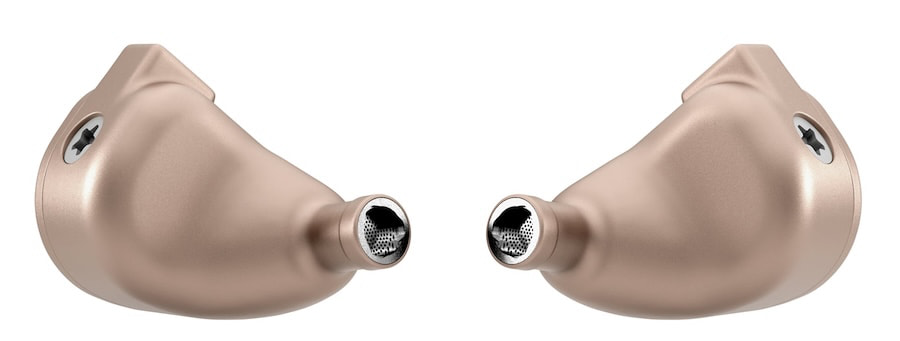
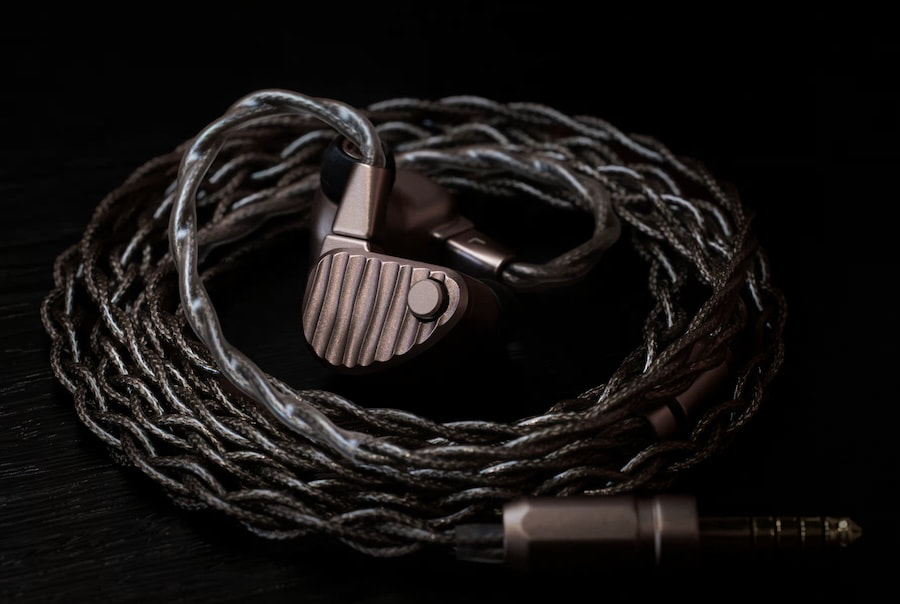
Ocean uses a T6061 aluminum shell with a machined faceplate finished in Champagne Copper. Its pattern is inspired by aeolian ripples formed when wind moves across sand.
Compared with some flagship IEMs covered in gemstones, exotic woods, and enough decorative metal to furnish a casino lobby, the Ocean looks relatively restrained.
It uses standard 0.78mm two-pin connectors and ships with both 3.5mm and 4.4mm balanced cables constructed from silver-plated UP-OCC copper.
Advertisement
The package also includes TrueFidelity foam tips, SpinFit silicone tips, standard silicone tips, a carrying case, cleaning accessories, and all four apex modules.
Specifications
Model: 64 Audio Ocean
Type: Universal-fit IEM
Drivers: 6, four-way architecture
Bass: Dual isobaric dynamic drivers
Midrange: 2 balanced-armature drivers
High-Mid: 1 balanced-armature driver
Treble: 1 tia driver
Frequency Response: 5Hz–22kHz
Impedance: 9.5 ohms at 1kHz
Sensitivity: 103.7dB/mW at 1kHz
Isolation: 10-20dB depending on apex module
Connector: 0.78mm two-pin
Included Cables: 3.5mm and 4.4mm balanced
Finish: Champagne Copper
Competition
At $3,999, Ocean swims in very expensive water.
For a thousand dollars less, the UE Premiere feature 21 drivers per earpiece with a five-way crossover, and come in universal and custom fit options.
The Noble Audio Kronos at $4,500 combines dual dynamic woofers with balanced-armature and electrostatic drivers, putting it squarely in the same ultra-premium category.
Advertisement. Scroll to continue reading.
Advertisement
Ocean also competes with 64 Audio’s own products.
The Astell&Kern x 64 Audio XIO costs $3,000 and uses ten drivers, while the long-running Fourté remains available for $3,599. Anyone already considering either model will need to decide whether Ocean’s adjustable acoustic system is worth moving further up the ladder.
And that is really the point: at this level, counting drivers is pointless. The meaningful difference is what a manufacturer does with them.
64 Audio Ocean
The Bottom Line
The 64 Audio Ocean is entering a flagship IEM market where $3,000-plus products have become surprisingly common and manufacturers need more than extravagant materials and large driver counts to stand out.
Advertisement
Ocean’s dual isobaric bass system, tia architecture, apex modules, and LID technology give it serious technical credentials, but Passive Acoustic Control is its most distinctive feature. Being able to tailor the physical acoustic system without DSP gives buyers unusual flexibility at a price where flexibility should probably be expected.
Whether Ocean actually sounds better than the Fourté, XIO, FiR Redux 6, or Noble Viking Prestige will require listening rather than counting acronyms.






































































You must be logged in to post a comment Login