Connect with us

Tech

iPhone Ultra leak claims Apple is bringing back red

Published

on

A new leak claims Apple’s first foldable iPhone, the iPhone Ultra, could bring back a red finish, but the images raise more questions than they answer.

On Wednesday, longtime Apple leaker Evan Blass suggested that Apple will revive a much-missed color for its yet-unannounced iPhone Ultra. In his post to X, he showcases a few renders of the iPhone Ultra in white, black, and red.

It’s notable, as Apple hasn’t released a red iPhone since 2022, when it released the iPhone 14 and iPhone SE 3 as part of a (PRODUCT)RED partnership.

Blass’ image is not an official render. A charitable read is that it’s a mockup of a rumor; at worst it’s a complete fabrication.

Advertisement

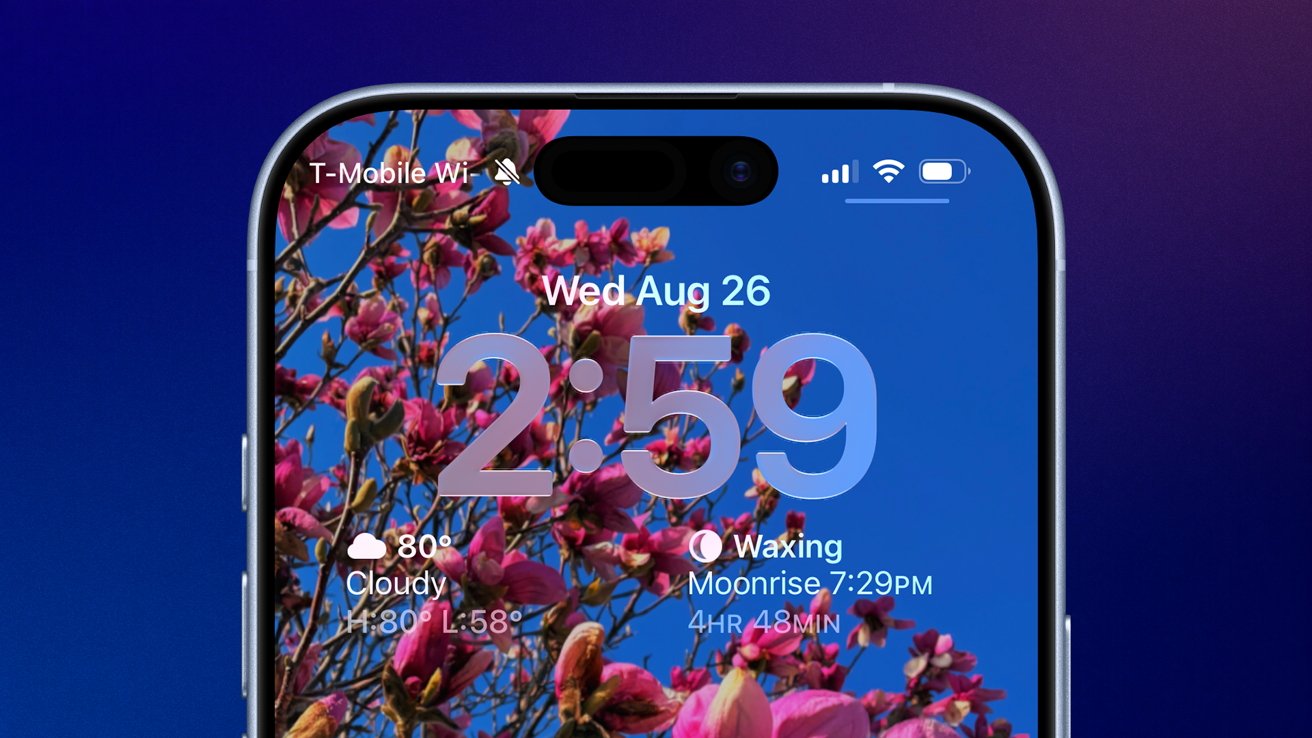
The battery icon, for example, is not what we’re expecting to see in iOS 27. It’s not what you’d see in iOS 26, either.

iPhone lock screen showing 2:59 time, date Wednesday August 26, cloudy weather details, waxing moon info, and a colorful background of pink flowers against a bright blue sky

The battery icon in iOS 26, with significantly thinner lines and a swipe down indicator for Control Center

It seems likely that the images are AI-generated. So take the rumor with a grain of salt, especially because no other rumors have corroborated such an idea.

In fact, more rumors have suggested that the device could come in a single color: white.

Advertisement

Regardless of whether or not Apple releases one color or three, the device will sell out quickly anyway.

Apple is expected to announce the iPhone 18 Pro and iPhone Ultra on September 9 at 10:00 am PDT and 1:00 pm EDT as part of its “Surprise and shine” event. You can learn how and when to tune in with our helpful guide.

Source link

Advertisement
Continue Reading
Click to comment

You must be logged in to post a comment Login

Leave a Reply

Tech

Microsoft staff are burning a median $300 a month on AI, according to their own spreadsheet

Published

on

An internal spreadsheet where Microsoft employees swap pay details now carries a column for monthly AI spend, with a median of about $300 over 28 days across roughly 350 entries. Business Insider found no meaningful link between heavy AI use and bonuses, raises or promotions.

Microsoft employees have started comparing their AI bills the way they compare their salaries. An internal spreadsheet where staff voluntarily post raises, bonuses and stock awards now carries a column for how much AI they burned through last month.

The document is one TNW has already mined. We used its pay columns this week to show Microsoft has split into two populations on compensation, and the AI column is a separate question.

The number is larger than most people would guess. Across roughly 350 entries the median was about $300 over 28 days, and the highest single figure was $28,000.

Advertisement

It varies enormously by team. CoreAI reported a median of $975, Security $526 and Microsoft AI $490, while the customer and partner organisation came in lowest at $134 and also produced that $28,000 outlier.

For scale, a Microsoft 365 Copilot seat costs $30 a month. Accenture gave one to 743,000 people this spring, and the median Microsoft employee is spending ten times that on themselves.

The finding that matters is an absence. Business Insider reports no meaningful correlation between how much AI someone used and their bonus rating, merit increase or chance of promotion.

The data deserves its caveats. It is self-reported, voluntary and anonymous, covers around 350 people out of 223,000, and Microsoft says the tracking tool is still in early testing.

Advertisement

It also lands in a familiar pattern. TNW has reported that the hours AI saves workers are mostly thrown away rather than banked or redirected.

A tool that itemises this per employee is not a neutral thing to install in Europe. In Germany the works council has a co-determination right over technical devices capable of monitoring behaviour or performance.

The threshold is lower than it sounds. The Federal Labour Court has held since 1975 that a system only has to be suitable for monitoring, not designed for it, which is why even spreadsheets and calendars have triggered the rule.

The appetite for measuring people at work is not in doubt. Skan AI raised $63M to observe how office staff actually do their jobs and build agents that copy them.

Advertisement

So one spreadsheet says two things. Working on AI at Microsoft pays better, and using a lot of it does not, which are not the same proposition at all.

Source link

Advertisement
Continue Reading

Tech

22 Irish firms in Deloitte’s Technology Fast 500 list this year

Published

on

Belfast’s StormHarvester ranked highest among Irish entries, reaching 24th position.

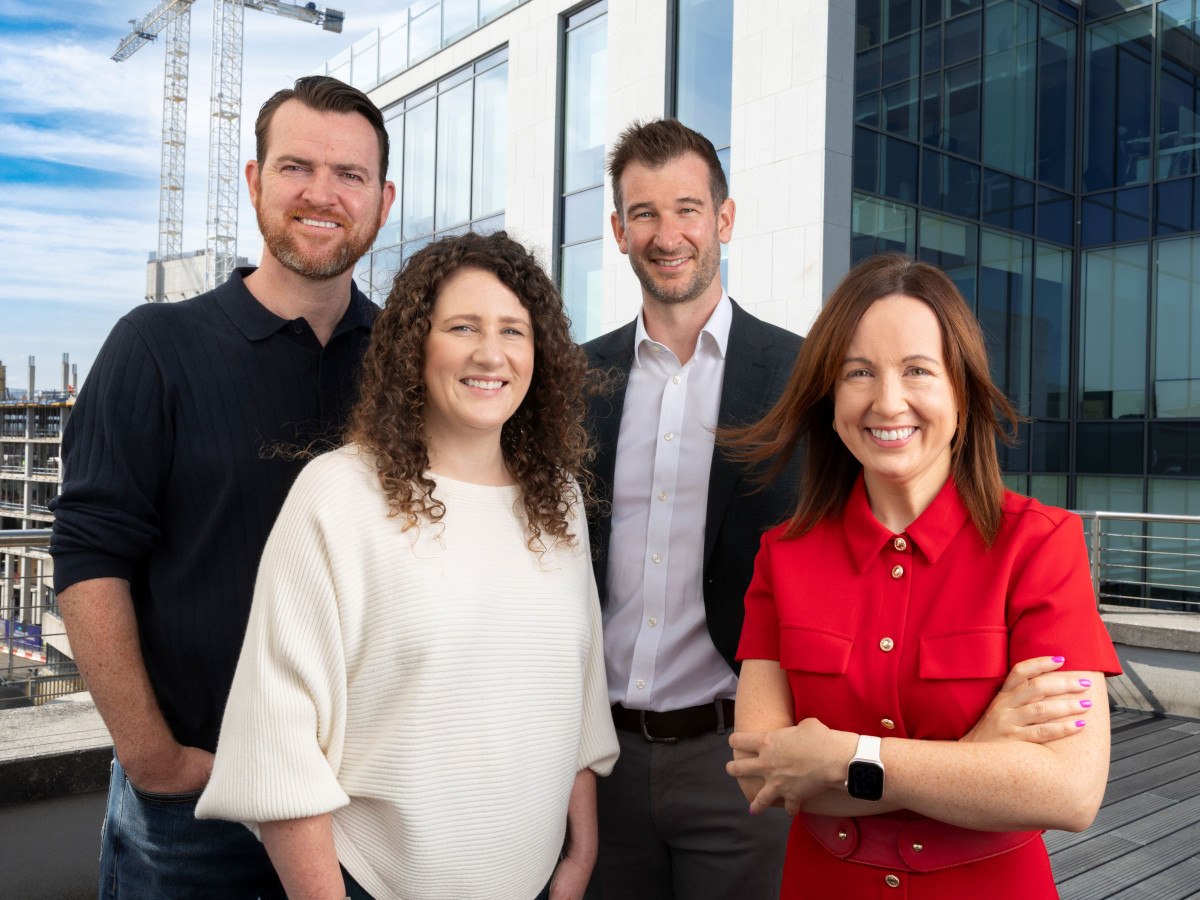
StormHarvester, Mail Metrics and Klearcom are among 22 companies from the island of Ireland that made it onto Deloitte’s list of the 500 fastest growing technology companies in Europe, the Middle East and Africa for 2025.

Belfast’s StormHarvester ranked highest among the Irish entries, reaching 24th. The 2012-founded business has developed an AI anomaly detection system that enables wastewater utilities to predict and prevent issues such as flooding and pollution.

Its ranking in the latest Deloitte EMEA Technology Fast 500 comes after being named the fastest growing tech company in Ireland last year by the global multinational.

Advertisement

Other ranking businesses in Deloitte’s latest Fast 500 include automation company Tines and aviation analytics firm Aerlytix.

The four-year average revenue growth rate across all 500 ranking companies spread over 24 countries was 1,024pc. Comparatively, the ranking Irish companies hit an average of 1,016pc revenue growth during the same period. StormHarvester showed a revenue growth rate of 3,012pc.

Mail Metrics provides customer communications solutions to organisations operating in regulated sectors, while Klearcom provides global voice testing capabilities to organisations with a dependency on customer communication.

“Being recognised as one of the fastest growing technology companies in the Deloitte EMEA Fast 500 for two years in a row is an incredible recognition, benchmarking our success against leading tech companies across the globe,” said Nick Keegan, the founder and CEO of Mail Metrics.

Advertisement

Mail Metrics and Klearcom also previously came in second and third in last year’s Deloitte Fast 50 ranking.

Last year, 20 companies in Ireland were included in the Fast 500 rankings, with fintech Wayflyer ranking the highest of those at 43rd.

“For a small island, our entrepreneurs consistently deliver outstanding performances on a global stage, and that’s what this ranking really captures,” said James Toomey, a Fast 50 lead and Deloitte Ireland partner.

“It is also a testament to the critical role domestic direct investment plays in the resilience of the wider economy, and the importance of having supports in place that help more companies like these grow and scale. Congratulations to all the companies in the rankings.”

Advertisement

Here’s a list of the ranking Irish and Northern Irish businesses in order of their appearance on the Deloitte EMEA Fast 500 list:

StormHarvester (24); Mail Metrics (54); Klearcom (74); Fibrus (143); Altra (160); Tines (194); Aerlytix (202); OneTouch (249); Halo Technologies (264); Otonomee (289); TeamFeePay (299); EdgeTier (315); Clear Strategy (339); Swoop Finance (372); Catagen (400); CleverCards (407); AccountsIQ (427); Grid Finance (435); Circit (451); Tier3Tech Support (460); Meg (464); and Bright (496).

Don’t miss out on the knowledge you need to succeed. Sign up for the Daily Brief, Silicon Republic’s digest of need-to-know sci-tech news.

Advertisement

Source link

Continue Reading

Tech

Perplexity and Nvidia launch “Portable Computer,” a local AI agent for Nvidia GPUs

Published

on

First look: Perplexity and Nvidia have jointly launched an agentic AI platform designed to run locally on a user’s PC or workstation. Named Portable Computer, it’s an optimized version of Perplexity’s Computer AI platform, which the company announced earlier this year. The new AI agent lets users run complex AI workloads on their own hardware, bypassing the cloud and sidestepping steep token costs.

Speaking at a press conference, Perplexity’s Nate Kupp said the new app carries the exact same UI as the original Computer platform and includes every feature needed for local inferencing. He added that some complex tasks may still require access to more powerful frontier models hosted online, but the app will ask for user consent before sending any data to the cloud.

Nvidia’s Director of Developer Technologies, Nader Khalil, said the new app will let users lean on AI more broadly without worrying about data security or recurring token costs. According to Khalil, “Local AI has reached an inflection point,” moving from a hobbyist pursuit for power users toward an indispensable productivity tool for everyday consumers.

Perplexity’s Portable Computer consists of an agent harness, an orchestrator, and a choice between the Qwen 3.8 and PPLX local models, both of which scale to 27 billion parameters. The app will also add support for Nemotron 3.5 Lightning, Nvidia’s free-to-use, 30-billion-parameter Mixture-of-Experts (MoE) model with 3 billion active parameters per token.

Advertisement

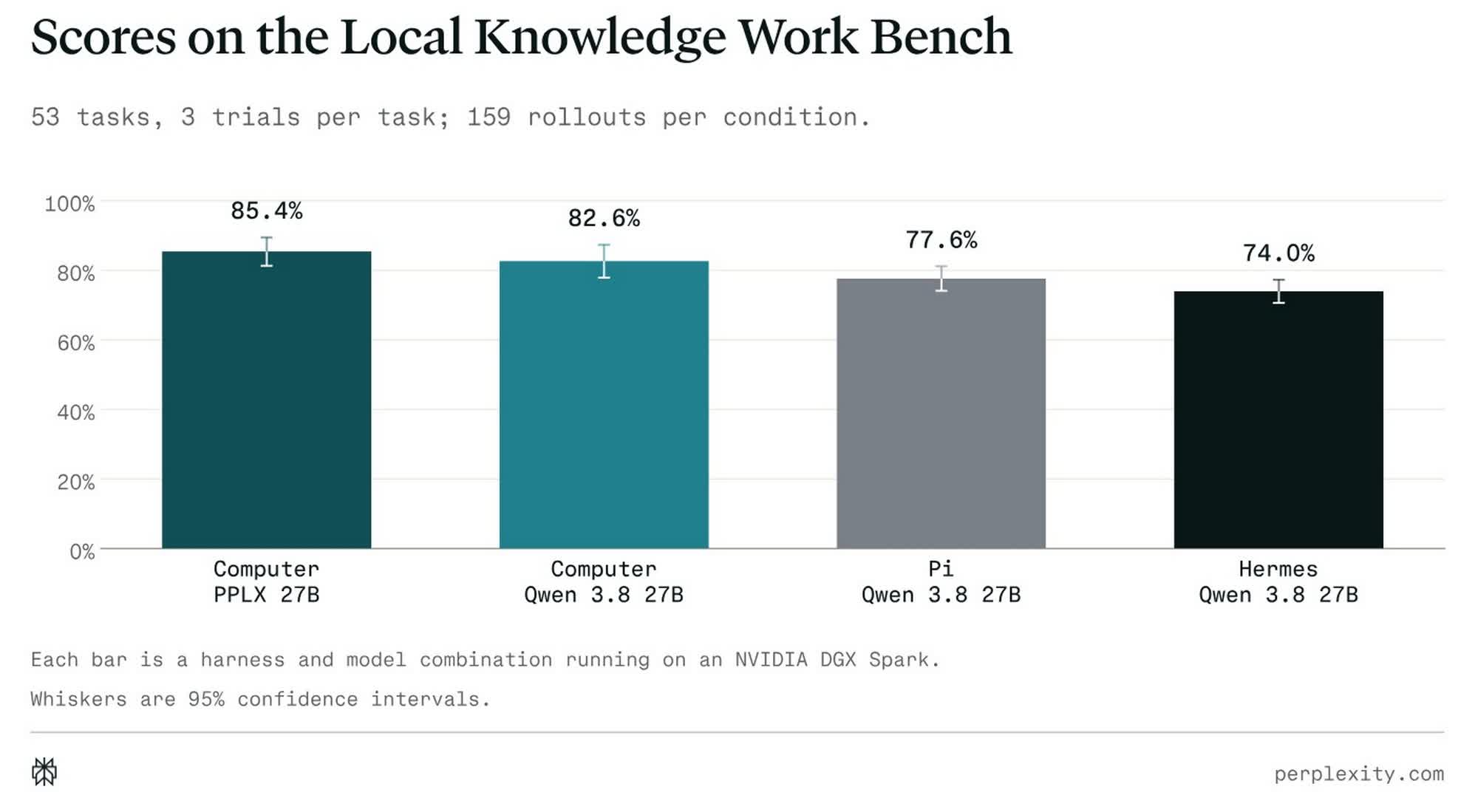
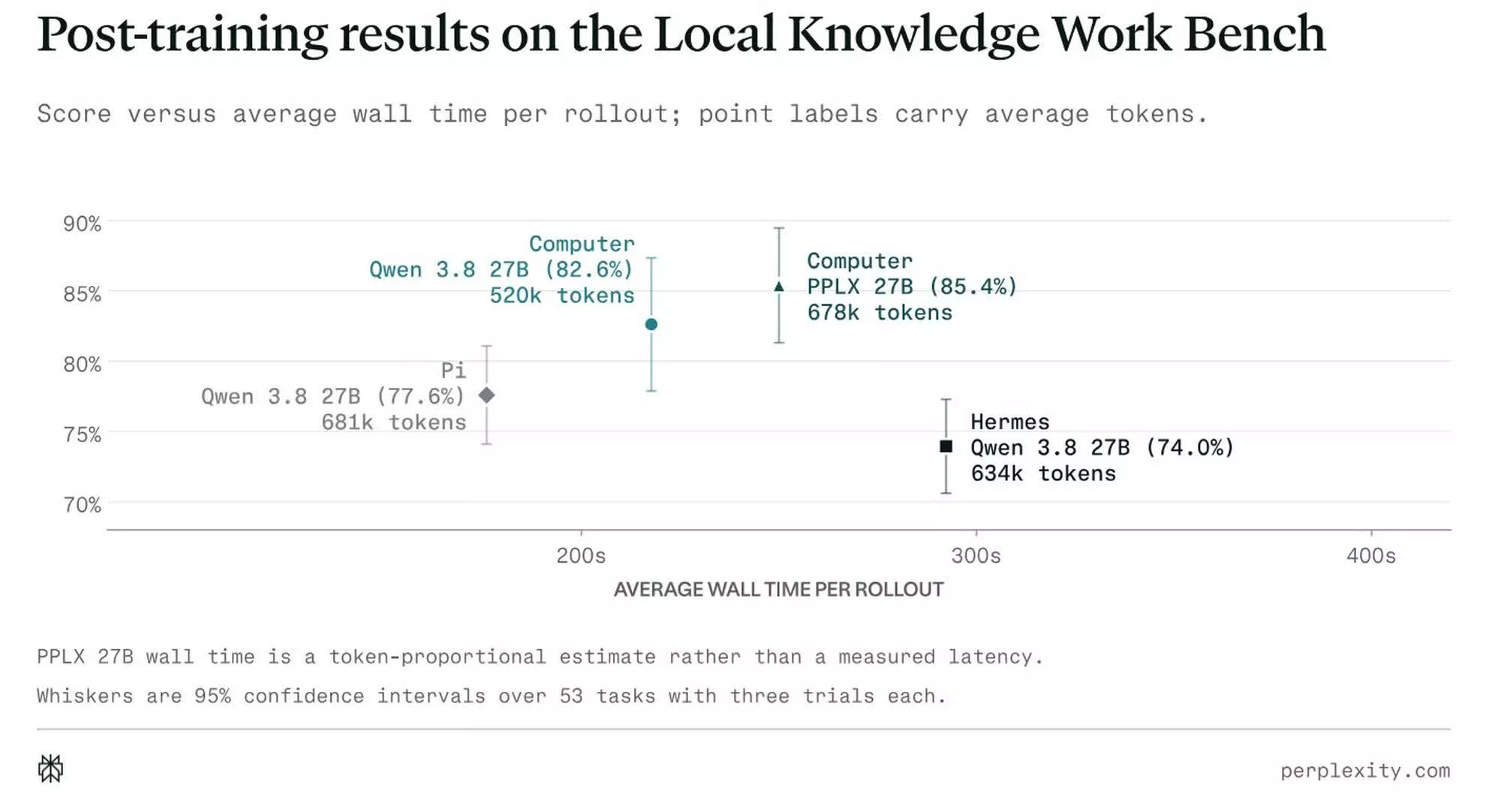
Benchmarks published by Perplexity show that on its internal Local Knowledge Work Bench, Computer running Qwen 3.8 27B on a DGX Spark chalked up an accuracy score of 82.6% while using 520,000 tokens, exceeding Pi’s 77.6% and Hermes’ 74.0% across 53 tasks spanning deep research, financial analysis, and document creation. On PPLX 27B, it scored 85.4% using 678,000 tokens.

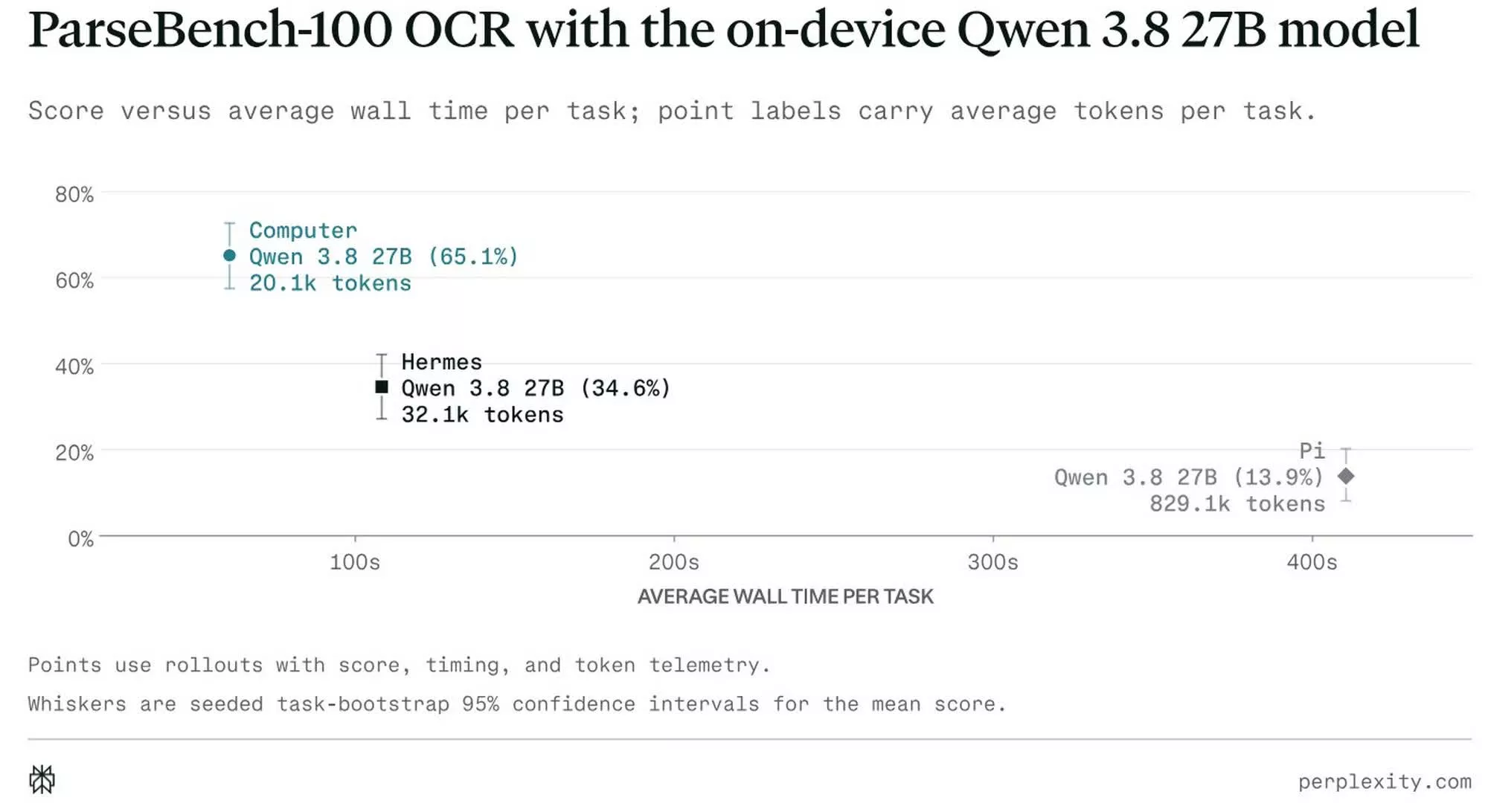
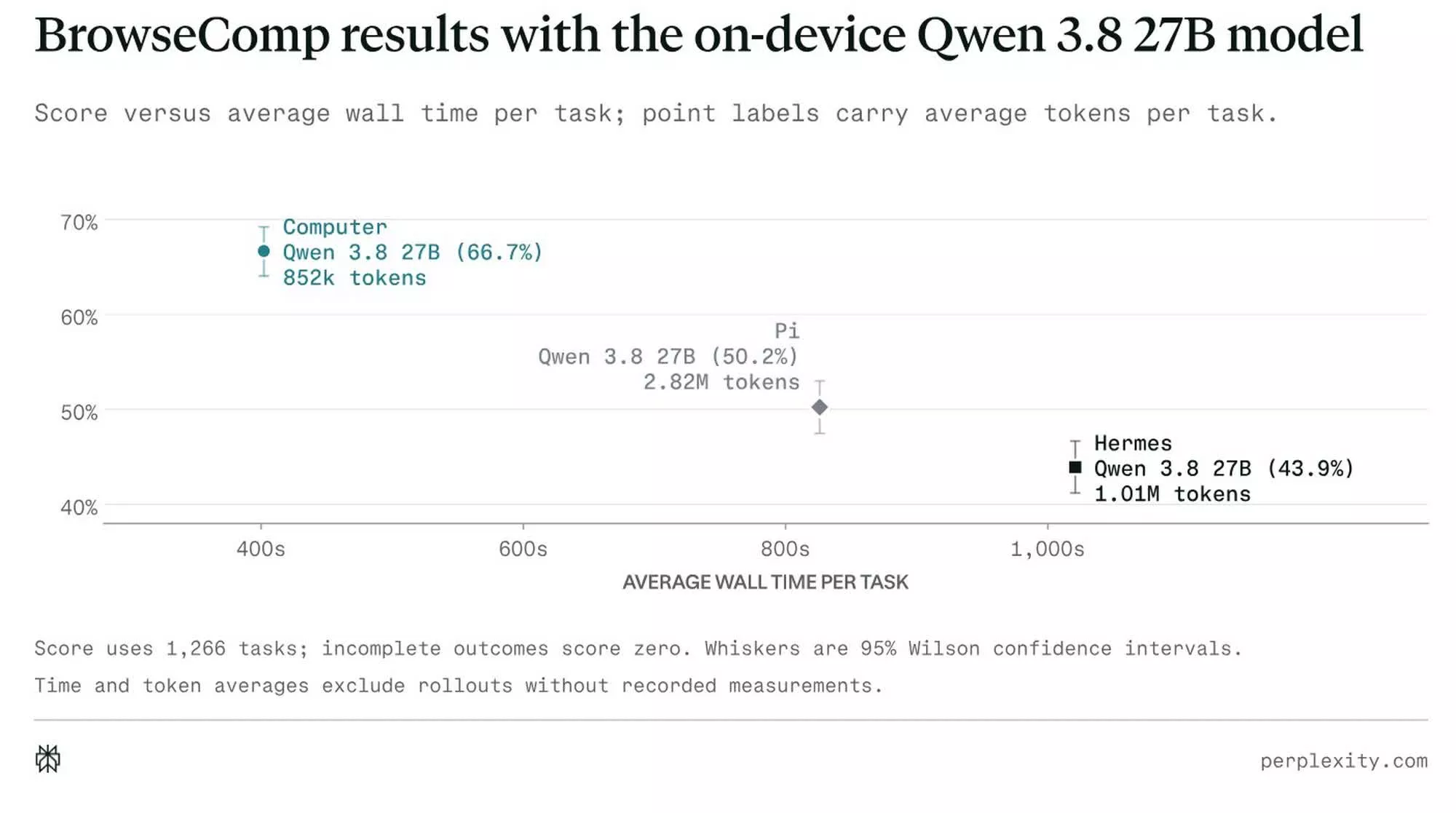
Portable Computer was also the fastest on BrowseComp and ParseBench-100, hitting 66.7% accuracy on the former and 65.1% on the latter. By comparison, Hermes scored 43.9% on BrowseComp and 34.6% on ParseBench-100, while Pi scored 50.2% on the former and 13.9% on the latter. Perplexity says Portable Computer also used the fewest tokens across all three benchmarks.

Portable Computer is now available to Pro, Max, and Enterprise subscribers on the DGX Spark, Nvidia’s Linux small AI desktop built around the Grace Blackwell GB10 chip, which pairs a 20-core CPU with a Blackwell GPU and 128GB of unified memory. It’s also available today on Linux PCs equipped with Nvidia RTX GPUs carrying at least 24GB of VRAM. Windows support is reportedly coming in September, extending that same 24GB VRAM requirement to RTX-equipped Windows machines.

Advertisement

Source link

Continue Reading

Tech

How to watch Apple's iPhone 18 Pro & iPhone Ultra launch live

Published

on

The foldable iPhone Ultra and iPhone 18 Pro launch is coming. Here’s how and when to watch the event live.

Hand holding a red smartphone with three rear camera lenses, positioned in front of large green tropical leaves in a bright indoor settingRender of rumored iPhone 18 Dark Cherry color

Apple will unveil the iPhone 18 Pro, iPhone 18 Pro Max, and its first foldable phone, the iPhone Ultra. The presentation will also be Apple’s first major product event after new CEO John Ternus takes over on September 1.
The company will follow its recent prerecorded format, with media and other guests gathering at Apple Park for an in-person component. Viewers elsewhere will watch the polished presentation as it streams.
Continue Reading on AppleInsider | Discuss on our Forums

Source link

Continue Reading

Tech

Claude Cowork gets its own browser that doesn’t touch your tabs, bookmarks, or saved passwords

Published

on

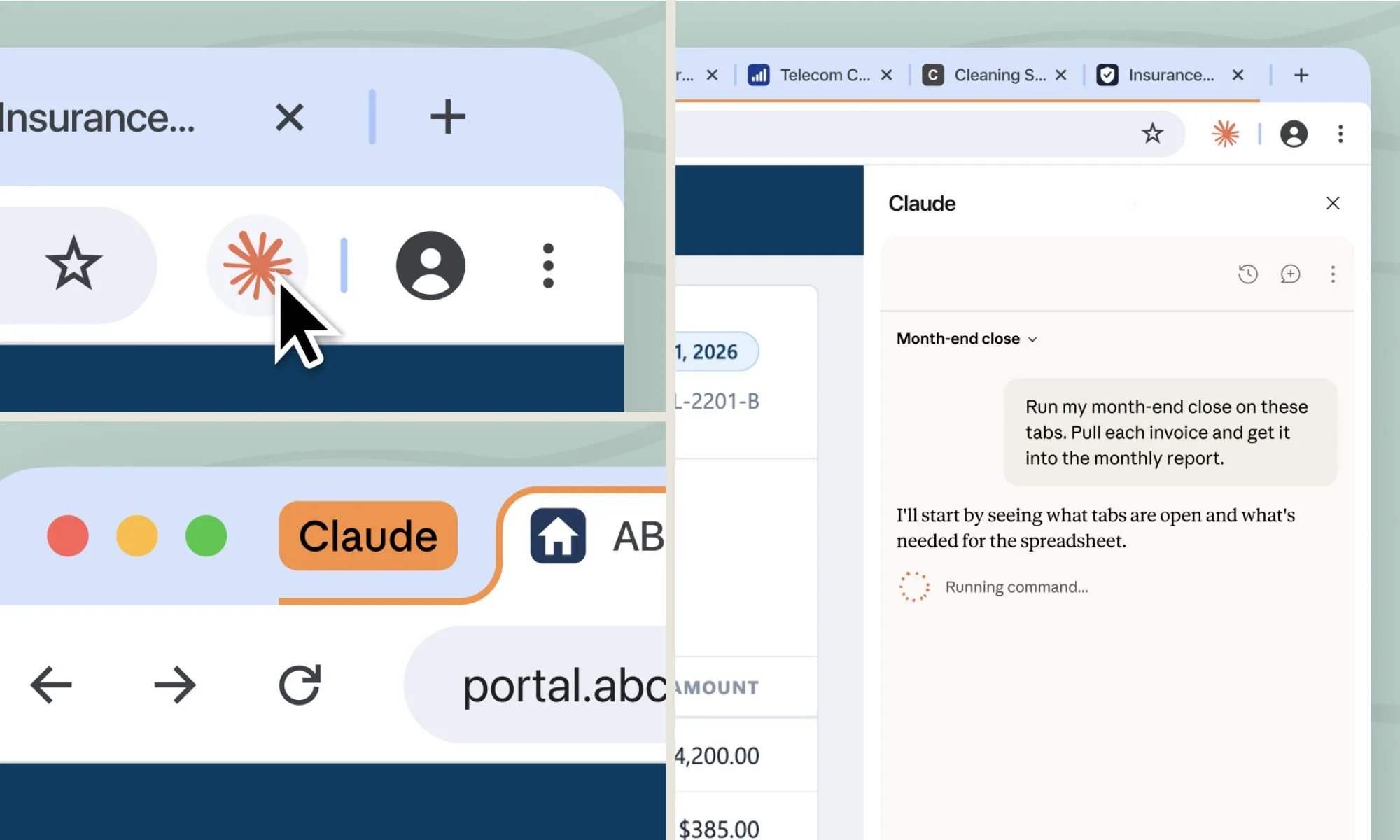
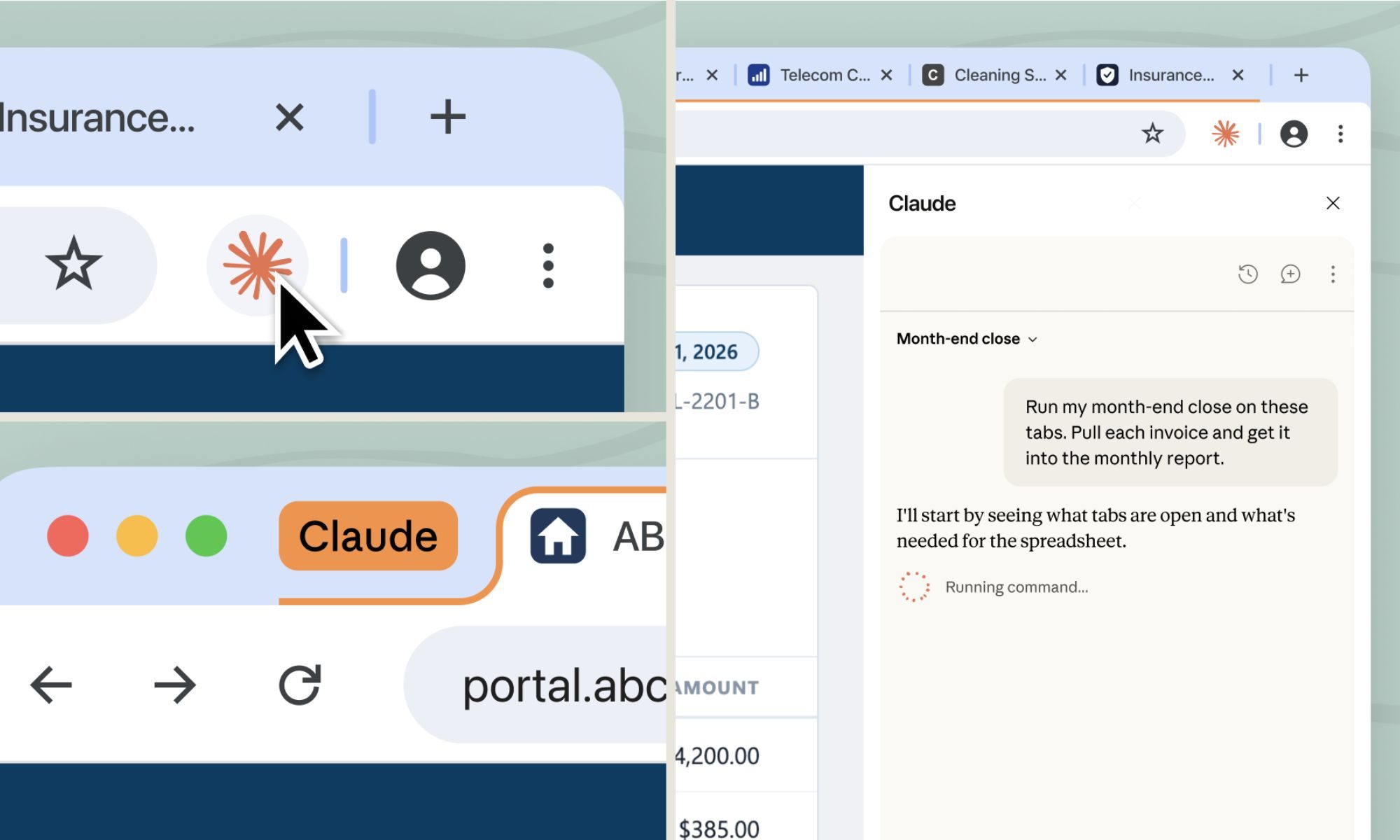
Claude Cowork just got its own browser, built directly into the desktop app. Until now, giving Claude web access inside Cowork meant handing it your actual Chrome browser through Claude in Chrome extension.

Now there’s a second option. Claude can open its own separate browser inside the Cowork side panel and handle the web part of a task on its own, while you keep working on whatever you’re doing.

So how is it different from Claude in Chrome?

Claude in Chrome uses your browser, your tabs, logins, the page you already have open. That setup makes sense when you’re already on a page and want Claude to jump in and help. But plenty of web tasks don’t actually need your personal browser; they just need a medium to access the web.

This is where Claude’s new built-in browser steps in. It’s completely separate from yours, and Claude never sees the tabs, bookmarks, or passwords in your personal browser. That makes it the better choice for tasks that don’t actually need your personal browser session, like researching for a report or pulling invoices off a vendor portal.

If you want Claude signed into specific sites, you can choose to share those logins from Chrome, Edge, or Firefox. Sensitive accounts like banking, email, or single sign-on are excluded by default unless you deliberately choose to include them.

Advertisement

The safety risks you should know about

If you’re already using Claude in Chrome, that stays your default. Otherwise, Claude reaches for its own browser automatically, and you can switch the preference anytime in Settings. It’s rolling out this week to Pro, Max, and Team plans on the desktop app, covering macOS, Windows, and a Linux beta.

Anthropic is upfront that this carries the same prompt injection risks as any browser-using AI agent, meaning malicious instructions hidden in a webpage could try to hijack what Claude does. The same safeguards used for Claude in Chrome apply here, and Anthropic recommends starting with sites you actually trust before letting Claude loose on them.

Advertisement

Source link

Continue Reading

Tech

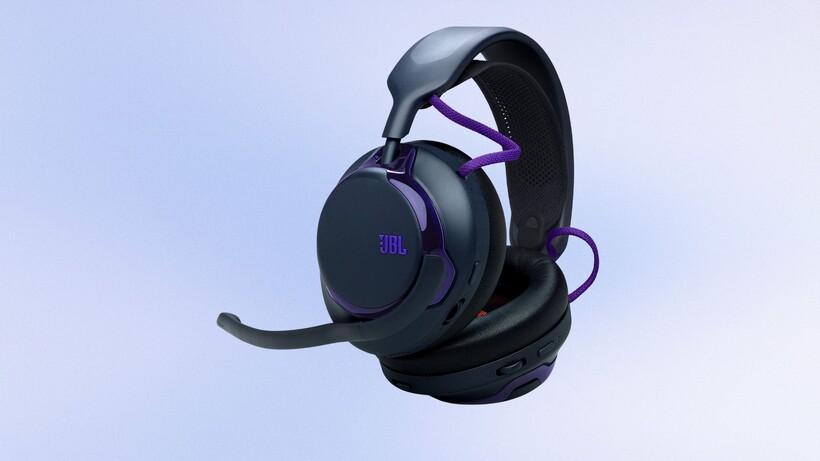
JBL unveils Quantum 850 and new mid-range headsets at Gamescom

Published

on

JBL’s Quantum refresh completes a four-model range and adds the Quantum 850, Quantum 520, Quantum 520X and Quantum 120 headsets to its gaming audio line-up.

These four additions join the existing Quantum 650 Wireless to complete a four-model range that spans entry-level to mid-range gaming audio, with JBL Quantum Spatial Sound and the JBL QuantumENGINE software running across every headset in the line-up.

All five headsets share 50 mm carbon dynamic drivers, a spec that JBL pairs with Hi-Res Audio certification and Quantum Spatial Sound to give positional cues such as footsteps and gunfire greater clarity during competitive play.

The Quantum 850 is the premium gaming headset in the range, bringing Adaptive Noise Cancelling to the line-up.

Advertisement

Connectivity marks the clearest split between models, since the Quantum 850, Quantum 650, Quantum 520 and Quantum 520X all offer dual wireless connections through a 2.4GHz dongle or Bluetooth, while the Quantum 120 relies on a wired 3.5mm connection instead.

Advertisement

Console compatibility also varies across the range, with the Quantum 520X carrying Xbox certification for wireless play on Microsoft’s console, while the Quantum 120 supports PlayStation, Xbox and other major gaming consoles through its wired connection, and the Quantum 850 is compatible with iPad OS, PlayStation and Nintendo certified.

Battery life follows the same tiered pattern, with the Quantum 650 rated for up to 45 hours and the Quantum 520 and Quantum 520X each rated for up to 37 hours, all three gaining an extra hour from a five-minute charge.

Advertisement
JBL Quantum 850 productJBL Quantum 850 product
Image Credit (JBL)

Comfort features carry across the range too, and both a silicone headband and breathable fabric ear cushions appear throughout the line-up, while colour choices range from Black and Ice to Coral and Purple, apart from a single Black-only option for the Quantum 520X.

Every model in the range also includes a detachable, noise-cancelling 6mm cardioid boom microphone designed to keep team callouts clear during high-pressure moments, a feature that has become a baseline expectation across competitive gaming headsets at this price point.

Advertisement

Carsten Olesen, President of Consumer Audio at HARMAN, said the updates reflect JBL’s strong entry into gaming audio and that the brand has used its latest innovations and expertise to evolve the Quantum range into a complete line-up for every level of player.

Quantum 520, Quantum 520X and Quantum 120 go on sale from 26 August, with the Quantum 650 already available, and pricing spans £39.99 for the wired Quantum 120 up to £129.99 for the Quantum 650. The Quantum 850 is due to go on sale the 1st October for £249.99 / €279.99.

Advertisement

Source link

Continue Reading

Tech

AMD quietly grabs record share in servers and laptops while Intel scrambles to keep pace with demand

Published

on


  • Desktop CPU shipments dropped over 20% amid rising memory and GPU costs
  • AMD now holds nearly 35% of the entire desktop processor market
  • Mobile CPU shipments jumped as Intel finally closed its capacity gap

Global processor shipments fell in the second quarter of 2026 compared with the same period a year earlier, new figures have claimed.

Mercury Research found, the decline stemmed mainly from weaker system-on-chip and embedded volumes tied to AMD‘s shrinking games console business, along with a steep drop in desktop CPU volumes.

Source link

Advertisement
Continue Reading

Tech

Training AI and serving ads

Published

on

SYSTEMS

Faster than Blackwell, but still no replacement for AMD or Nvidia … yet

If you’re going to build a custom AI accelerator, inference is a good place to start. The clusters are smaller, the chips can be simpler, and at the end of the day they only need to do one thing: serve tokens. OpenAI’s spicy new Jalapeño inference chips are just the latest example.

Advertisement

Social media magnate Meta is bucking this trend. Its first proper generative AI accelerator, the MTIA 400 — short for Meta Training and Inference Accelerator — is aimed squarely at LLM training.

The Facebook parent is no stranger to custom silicon. But, much like Amazon and Google, its first AI accelerators weren’t built to run AI chatbots or train generative AI models. They were built to serve ads.

The MTIA 400, teased earlier this year and detailed at the annual Hot Chips semiconductor development conference this week, will perform some inference duties. Just not of the GenAI variety. Instead, it’ll be saddled with running the ad recommender systems that actually pay Meta’s bills.

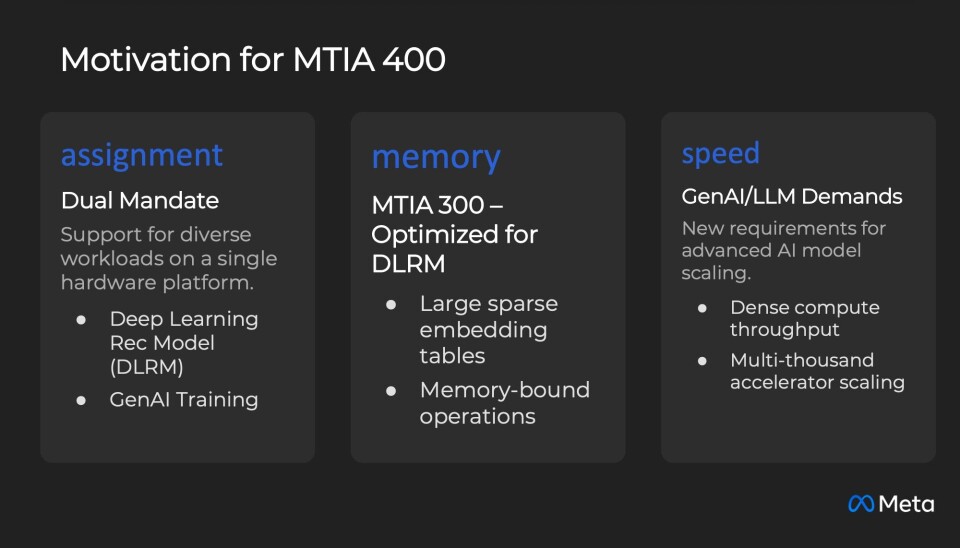
The combination of LLM training and the deep learning recommender model (DLRM) inference used for serving ads is unusual, as the two have wildly different performance demands.

Advertisement

LLM training is enormously compute-intensive, often requiring tens or even hundreds of thousands of accelerators to train models in a reasonable amount of time. DLRM inference, on the other hand, is a predominantly memory-bound job, which means most of the FLOPS that make the chip good at training are going to be left sitting idle.

But given how much cash Meta is burning on compute these days, it’s probably not a bad thing for its chips to pull double duty – even better if one of the two use cases is highly profitable.

This slide from Meta's Hot Chip's presentation encapsulates the design considerations for its fourth-gen MTIA accelerators.

This slide from Meta’s Hot Chips presentation encapsulates the design considerations for its fourth-gen MTIA accelerators.

While MTIA may play a bigger role in how Meta serves its generative AI workloads, its in-house silicon probably won’t replace AMD or Nvidia’s GPUs any time soon. The two chip designers’ GPUs are currently much better suited to LLM inference and are almost certainly what Meta Superintelligence Labs is using to train frontier models like Muse Spark. Application-specific hardware has always been better suited to well-understood workloads, and Meta’s accelerators are no exception.

But enough about market positioning and workloads. Let’s dig into the chip itself.

Advertisement

Dissecting the MTIA 400

At first blush, the MTIA looks a lot like either Nvidia’s Rubin GPUs or AMD’s MI355X accelerators.

The MTIA 400 is based on a heterogeneous multi-die architecture, which means it is built from a collection of different chips each with their own job. It features two compute dies, two I/O dies, and an SoC die that handles host connectivity and workload orchestration — all pretty standard stuff.

A closer look at Meta's MTIA 400 accelerator package

A closer look at Meta’s MTIA 400 accelerator package

Broadcom’s influence here is hard to miss. The chip almost certainly was built using the IP house’s XPU tech, which we explored in detail last year.

Building a competent AI accelerator isn’t a trivial endeavor. So, if you’re trying to bring one to market quickly, it makes sense to focus on what makes your chip special and let someone like Broadcom handle the rest.

Advertisement

Digging deeper into the MTIA 400’s heart, the compute chiplets are built on a 3nm process tech, presumably from TSMC, and feature a 6×8 grid of processing elements responsible for the bulk of the accelerator’s AI performance. Combined, the two chiplets are capable of outputting 12 petaFLOPS of MXFP4 compute at 1.7 GHz.

This slide shows the underlying compute architecture on which Meta's MTIA 400 is based.

This slide shows the underlying compute architecture on which Meta’s MTIA 400 is based.

To put that in perspective, the MTIA 400 is about 20 percent faster than Nvidia’s top-specced Blackwell accelerators at the higher precisions more commonly used to train models, while sucking back roughly the same power.

But the parts don’t hold up nearly as well when compared to Nvidia and AMD’s latest chips – the MTIA 400 is between 3x and 3.3x slower than Rubin and the Instinct MI455X, respectively.

Meta’s latest accelerator is fed by eight 36 GB HBM3e stacks that deliver 288 GB of memory and about 9.2 TB/s of bandwidth. Again, that’s about 15 percent faster than Nvidia and AMD’s last-gen parts, but with less than half the bandwidth of their new GPUs.

Advertisement

This is probably why Meta is positioning the part as a training chip. It has much better and faster options for LLM inference.

The MTIA 400 features a pair of I/O chiplets that provide 1.2 TB/s of chip-to-chip bandwidth over RDMA. We don’t know what transport tech Meta is using at this point, but given Broadcom’s involvement, Ethernet would be the obvious choice.

Scaling up

Look familiar? It should. Meta's MTIA 400 rack systems look almost identical to Nvidia's NVL72 and AMD's Helios racks.

Look familiar? It should. Meta’s MTIA 400 rack systems look almost identical to Nvidia’s NVL72 and AMD’s Helios racks.

MTIA 400’s physical resemblance to Nvidia Rubin and AMD MI350-series parts also extends to the system design.

Each compute blade features four MTIA 400 accelerators connected via a PCIe switch to an x86 CPU and a scale-out NIC.

Advertisement

A single rack is equipped with 18 compute blades and eight switch blades for a total of 72 accelerators in a single unified domain. Meta shared a pic of the rack earlier this year, so while the compute blade is highly reminiscent of AMD’s Helios blades, it’s not using the same double wide OCP racks.

Here's a pic of the actual MTIA 400 rack shared earlier this spring.

Here’s a pic of the actual MTIA 400 rack shared earlier this spring.

Meta hasn’t shown how large a cluster its chips can support just yet — the slides simply state “multi-thousand accelerator scaling” — but even at rack scale the systems should be quite competent relative to Nvidia’s GB200 and GB300 rack systems for training.

More on the way

While the MTIA 400 is aimed primarily at LLM training, Meta is already working on an inference-optimized version of the chip. Disclosed back in March, the MTIA 450 will double the chip’s memory bandwidth, presumably by swapping HBM3e for much faster HBM4.

Meta's specs for its custom silicon

Meta’s specs for its custom silicon

That part is expected to enter production next year, and should be extremely well suited to running those LLM-based recommender models Zuck and crew have been talking about the past few quarters.

Advertisement

Meanwhile, the MTIA 500, which is also slated for 2027 release (probably in H2 if we had to guess), will increase memory bandwidth by another 50 percent — likely using 4 additional HBM4 stacks — and double the number of compute chiplets. ®

Source link

Continue Reading

Tech

Australia’s Recording Association Bans AI-Made Music From Charts

Published

on

Songs using gen-AI as a support tool will still be allowed.

The Australian Recording Industry Association announced today that any tracks wholly generated with AI will not be eligible for inclusion on the nation’s music charts. The Code of Practice for the charts will allow songs that use generative AI to be counted, but only if the track in question “is substantially human made” and “raises no stream or chart manipulation concerns.” These rules will apply to the charts beginning this Friday. Tracks not eligible for the charts will also not be able to win an ARIA Award.

“The ARIA Charts will always remain a transparent measurement of the music Australia consumes, but a chart that rewards unlicensed AI output would undercut the very basis of the recorded music we exist to represent,” said ARIA CEO, Annabelle Herd. “We call on all parties who have a role in deciding the music played and promoted to Australian audiences, particularly radio, to support human artistry and implement similar changes across their own codes.”

This is a step in the direction that much of the global recording industry has been pushing for. ARIA’s new policies echo the recommendations around AI use recently laid out by the International Federation of the Phonographic Industry, or IFPI, in July. Last month, a group of major labels also called for charting organizations to prohibit the inclusion of AI slop. That effort included support from the big three of Sony Music, Universal Music Group and Warner Music Group.

Advertisement

Source link

Advertisement
Continue Reading

Tech

Bringnox smart roller shades review: Features, specs, price

Published

on

Smart shades are an affordable luxury for your Apple Home, and the ones from Bringnox offer Matter over Thread in a less costly package. It’s more of the same, but in a good way.

When I accepted the review for Bringnox smart roller shades, I expected something similar or competitive to the SmartWings shades I previously reviewed. Here’s the thing — these might be nearly identical shades under a different brand.

I’m not accusing anyone of any wrongdoing or cloning, but it seems both companies may have sourced parts from similar supply chain sources and landed with near-identical products. The only notable difference appears to be the remote and solar panel included.

Believe it or not, that’s not a bad thing. The two companies seem to offer different kinds of materials and shade types, it just so happens that the ones I tested were fairly close.

Advertisement

Don’t worry, I’ll still detail everything in this review, but the Bringnox shades being basically identical to the SmartWings shades earned them the same 5-star review score. What’s more, they’re priced slightly better, so there’s more bang for your buck with these excellent shades.

Also, I’m happy to say that the motor used works great even when operating a double-wide shade. That was one aspect I wanted to test in my new office, and it worked flawlessly.

Bringnox smart roller shades review: Design

I tested two shades, one single width and one double width. They are Bringnox 100% Blackout Vigor in Rock White color with an outside mount and Matter over Thread motor.

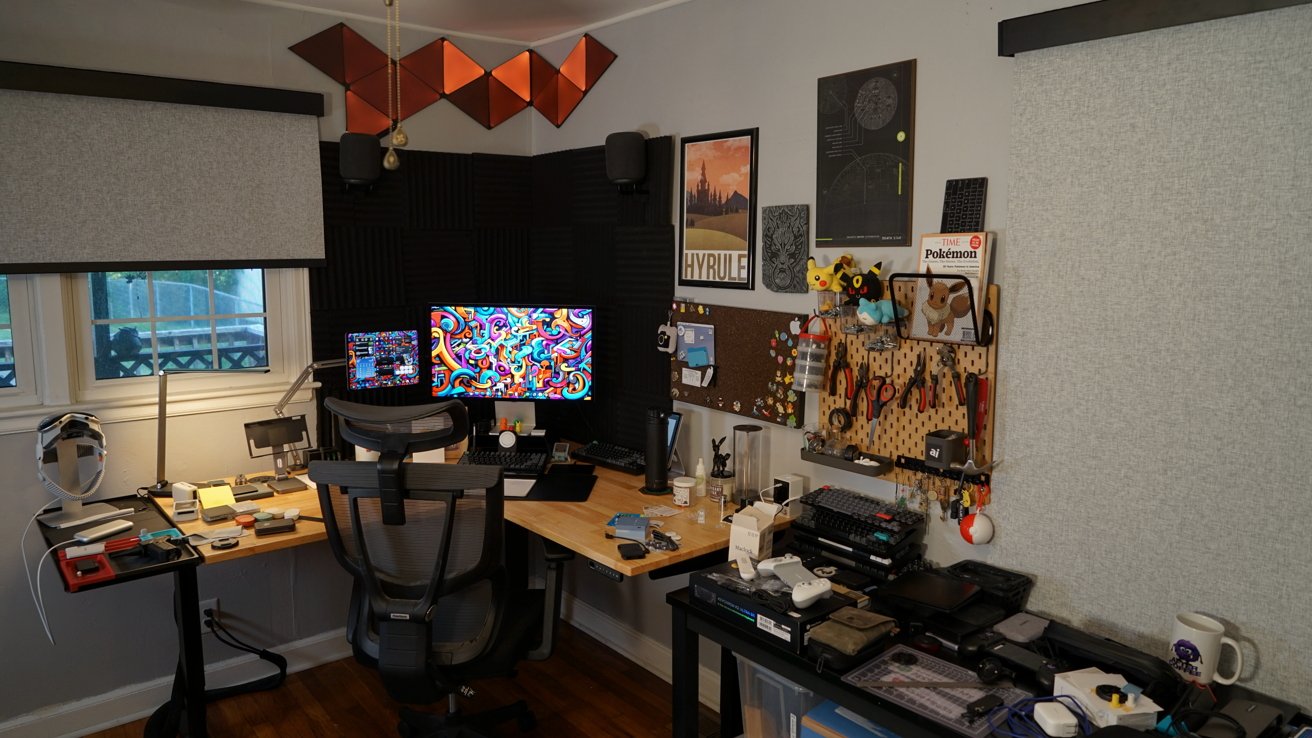
Cozy home office with dual desks, colorful monitor, ergonomic chair, pegboard of tools and trinkets, shelves of gadgets, scattered notebooks and mugs, and soft natural light from a nearby window

Bringnox smart roller shades review: covering your windows

Advertisement

While the unit is listed at $109, my configuration for the smaller shade ended up being just over $400. Keep that in mind when customizing your shade.

I prefer the outside mount for simplicity in mounting to the wall, though if you’ve got space in the window frame, an inside mount will be a cleaner look overall. I like the standard roll that places the shade closer to the wall, which is almost flush with the window frame in my setup.

The solar panel easily mounts to the window with adhesive and keeps the motor powered at all times. If you’d prefer to plug it in to an outlet, that’s also an option.

I needed 100% blackout shades to ensure the harsh sunlight didn’t wash out video for the AppleInsider Podcast. I previously used a 70% shade, but that was enough light to ruin the exposure of recorded video.

Advertisement
Room corner with a large gray pull-down blind, wooden shelves holding books and decor, a white backpack hanging on the side, and Pokemon magazine partially visible on the left

Bringnox smart roller shades review: 100% blackout lets no light through, but some might bleed in at the edge

Choosing the right blackout level is important. A bedroom might benefit from 100% blackout shades while a living room might not.

Like the SmartWings shades I reviewed, there’s not much to say otherwise. These are layered pieces of fabric that drape over a window and operate via a motorized roller.

They do their job and do it well.

Advertisement

Bringnox smart roller shades review: Features

The Bringnox shades come paired with a physical remote if that’s something useful to you. The reality is, that beyond some setup needs, you’ll put that remote away and forget about it.

Hand holding a smartphone displaying a colorful gradient screen with a large vertical control slider labeled Shades left at 47 percent open, against a softly blurred indoor background

Bringnox smart roller shades review: Apple Home controls are enough

The Matter over Thread motor enables cross-ecosystem compatibility with Apple Home, Google, and Amazon smart home setups. Once you’ve scanned the setup code, the shades join your Apple Home and become addressable in the Home app and via Siri.

Matter is the universal protocol built by a smart home consortium based on Apple’s HomeKit protocol. Thread is a low-powered network that operates outside of your Wi-Fi network to extend reach and simplify connections.

Advertisement

The combination enables a universal system that doesn’t need much power to operate. While opening and closing the shades is easy via Siri, I prefer the control in the Home app.

While Apple could refine the Home app to not waste so much space, the simple slider that appears is easy enough for choosing how open your shades are.

Close-up of a wall-mounted black curtain valance with fabric hanging below and a small red LED light glowing at the corner where a white cable is plugged in

Bringnox smart roller shades review: a solar powered motor with Matter over Thread

You’ll need the physical remote to set the minimum and maximum opening and closing points, and that’s what shows up in Apple Home.

Advertisement

Setting the slider to 50% isn’t setting it to halfway on the roll, but halfway between the set points for minimum and maximum. That means there is a chance 50% isn’t halfway for your window, so you’ll need to learn exactly what settings mean what.

These are shades attached to a motor, the feature list is short, but that’s the point. Sometimes the simplest tech is the kind that works the best.

Using the Bringnox smart roller shades

I like setting the shades to open and close via automations so there is sun in my office when I want it. A scene for Podcasting is set up to change the lights and close the shade right before I record.

Bearded man with glasses and headphones speaking into a microphone, wearing a colorful T-shirt, sitting in a home office with computer screens, bookshelf, and soft lighting in the background

Bringnox smart roller shades review: keeping the light out of my podcast background

Advertisement

It’s all so much more convenient than the old-school blinds with pull cables I was dealing with before. Reaching those cables and maneuvering the heavy blinds into the right position was always a pain, especially with desks in the way.

Smart shades are a luxury that costs enough that you have to be very deliberate in their purchase. It’s a natural next step in a smart home beyond bulbs and thermostats.

There’s something about having the shades react to your automations and scenes without any effort. The whole point of a smart home is removing friction from everyday interactions to make them actually worthwhile.

Sure, you can open a set of dumb blinds or curtains with a minute of effort. However, that little bit of effort multiplied by every window that needs to be opened and then closed later is enough to ensure you never operate them at all.

Advertisement

With smart shades like those from Bringnox, everything is effortless and automatic. That is why any well-made smart shade with Matter over Thread is going to get 5 stars from me, as long as they are reasonably priced and work well.

Bringnox smart roller shades review – Pros

  • Customizable shades with plenty of options to fit your window
  • Quiet and fast operation
  • Matter over Thread enables Apple Home support
  • Easy installation, solar power, and zero maintenance

Bringnox smart roller shades review – Cons

  • Can get expensive with some configurations

Rating: 5 out of 5

It is hard to imagine what a custom shade with Matter over Thread support could do better. They have an excellent quality, do their job, and are slightly better on price versus a competitor.

Where to buy Bringnox smart roller shades

The Bringnox smart shades are available on Amazon starting at $109 that can be discounted to $69 with an on-screen coupon. That is just the starting price, as you’ll have to choose the size, motor, and accessories that go with it.

Be sure to get the appropriate measurements as needed before placing an order.

Advertisement

Source link

Continue Reading

Trending

Copyright © 2025