The foldable iPhone Ultra and iPhone 18 Pro launch is coming. Here’s how and when to watch the event live.
Render of rumored iPhone 18 Dark Cherry color
Apple will unveil the iPhone 18 Pro, iPhone 18 Pro Max, and its first foldable phone, the iPhone Ultra. The presentation will also be Apple’s first major product event after new CEO John Ternus takes over on September 1. The company will follow its recent prerecorded format, with media and other guests gathering at Apple Park for an in-person component. Viewers elsewhere will watch the polished presentation as it streams. Continue Reading on AppleInsider | Discuss on our Forums
The console was subject to added fees under the Trump administration’s original (and illegal) tariff regime.
Panic
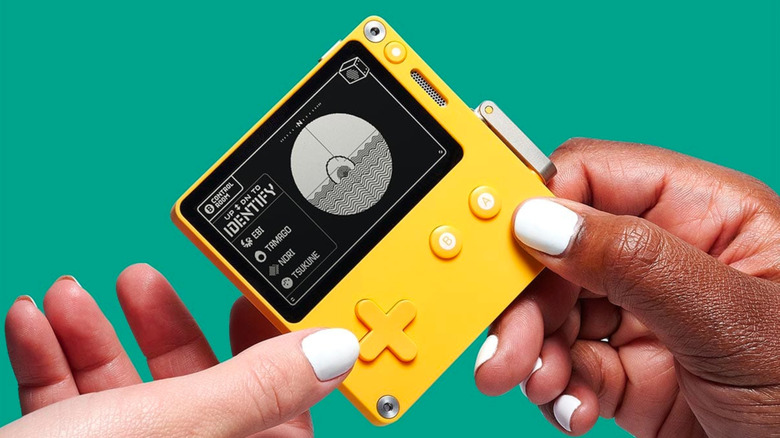
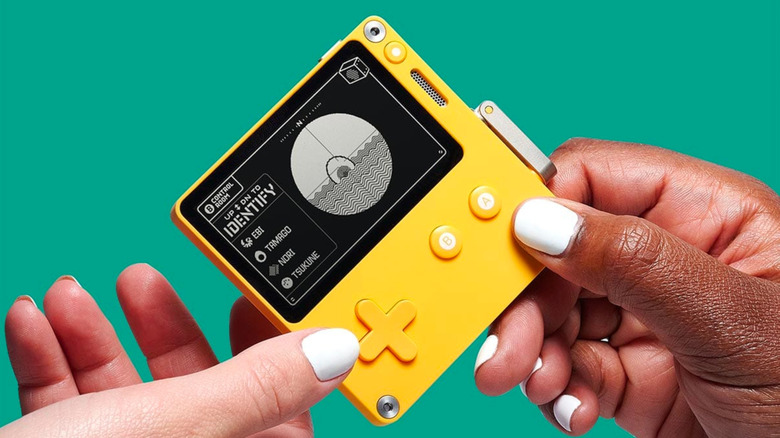
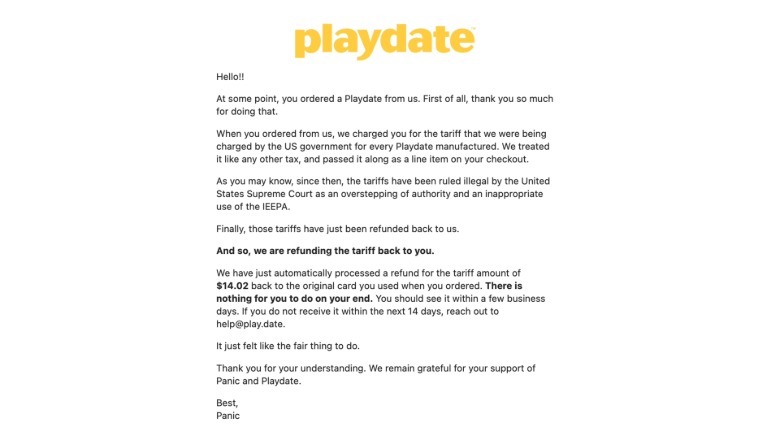
Panic, software publisher and creator of the Playdate, is refunding customers for any US tariff fees they paid to purchase its console, Game Developer reports. The Trump administration’s tariff regime was confirmed to be illegal following a Supreme Court decision in February 2026, and Panic, like other companies, applied for a refund. Unlike other companies, though, it’s not pocketing that money.
“When you ordered from us, we charged you for the tariff we were being charged by the US government for every Playdate we manufactured,” Panic said in an email informing customers about the refund. “We treated it like any other tax, and passed it along as a line item at checkout.”
Panic
According to a page in the company’s help center, Panic stopped applying its original 19 percent tariff fee to new orders after April 21. It took until August to issue refunds because the company had to apply, receive its refund from the US government and then build a system to process refunds for the group of Playdate customers who paid more.
“It’s just not our money to keep, and it felt really good to give it back,” Panic CEO Cabel Sasser said in an email to Game Developer. “That’s an easy way to know you made the right decision.”
Advertisement
It’s not, however, a decision many other companies have made. While President Donald Trump’s tariffs affected the majority of companies selling electronics in the US, and many — like Nintendo — clearly objected, most haven’t discussed offering a refund to customers. So far shipping companies like FedEx, UPS and DHL are among the few firms offering people a way to get their money back. That’s not to say the silence has gone unnoticed. Amazon, Sony and Nintendo are each facing class-action lawsuits that allege they are legally required to refund customers for tariff fees.
In these scenarios, Meta would give some employees new roles and lay off others. One HR executive reportedly said that Meta would have reduced its headcount by about 25 percent or more under these scenarios. Meta told Reuters that it canceled Project OT before determining how many layoffs the plan called for.
Meta was going to use some of the money that it saved from layoffs to pay for high-performing employees, especially those with AI engineering skills, Reuters reported, citing “two people familiar with the matter.”
“AI native”
One of the Project OT documents that Reuters reviewed described “AI native” as a company where “AI-ready tools and agents interact, workflows are automated, [and] new builds are AI-first.” Being “AI native” also means, per the document, selling AI agents to third parties, which Meta started doing in June.
This year, Meta reportedly launched a pilot program that restructured engineering teams, research teams, and at least eight other teams into smaller groups.
Advertisement
This followed the reported October publishing of an internal post called “AI-Native Playbook,” in which a Meta product management team member outlined how the pilot would remove middle management and use “agent-assisted analysis” to help prioritize daily tasks.
Reuters noted that HR employees and “AI systems” would help Meta’s leaders decide about promotions; however, Meta told the publication: “Performance rating and promotion decisions were and are made by people, not AI.”
Second thoughts
Immediately after issuing the May layoffs, Zuckerberg reportedly canceled the November wave. Reuters said it “was unable to determine what exactly prompted Zuckerberg to shift course.”
An internal spreadsheet where Microsoft employees swap pay details now carries a column for monthly AI spend, with a median of about $300 over 28 days across roughly 350 entries. Business Insider found no meaningful link between heavy AI use and bonuses, raises or promotions.
Microsoft employees have started comparing their AI bills the way they compare their salaries. An internal spreadsheet where staff voluntarily post raises, bonuses and stock awards now carries a column for how much AI they burned through last month.
The document is one TNW has already mined. We used its pay columns this week to show Microsoft has split into two populations on compensation, and the AI column is a separate question.
The number is larger than most people would guess. Across roughly 350 entries the median was about $300 over 28 days, and the highest single figure was $28,000.
Advertisement
It varies enormously by team. CoreAI reported a median of $975, Security $526 and Microsoft AI $490, while the customer and partner organisation came in lowest at $134 and also produced that $28,000 outlier.
For scale, a Microsoft 365 Copilot seat costs $30 a month. Accenture gave one to 743,000 people this spring, and the median Microsoft employee is spending ten times that on themselves.
The finding that matters is an absence. Business Insider reports no meaningful correlation between how much AI someone used and their bonus rating, merit increase or chance of promotion.
The data deserves its caveats. It is self-reported, voluntary and anonymous, covers around 350 people out of 223,000, and Microsoft says the tracking tool is still in early testing.
Advertisement
It also lands in a familiar pattern. TNW has reported that the hours AI saves workers are mostly thrown away rather than banked or redirected.
A tool that itemises this per employee is not a neutral thing to install in Europe. In Germany the works council has a co-determination right over technical devices capable of monitoring behaviour or performance.
The threshold is lower than it sounds. The Federal Labour Court has held since 1975 that a system only has to be suitable for monitoring, not designed for it, which is why even spreadsheets and calendars have triggered the rule.
The appetite for measuring people at work is not in doubt. Skan AI raised $63M to observe how office staff actually do their jobs and build agents that copy them.
Advertisement
So one spreadsheet says two things. Working on AI at Microsoft pays better, and using a lot of it does not, which are not the same proposition at all.
Belfast’s StormHarvester ranked highest among Irish entries, reaching 24th position.
StormHarvester, Mail Metrics and Klearcom are among 22 companies from the island of Ireland that made it onto Deloitte’s list of the 500 fastest growing technology companies in Europe, the Middle East and Africa for 2025.
Belfast’s StormHarvester ranked highest among the Irish entries, reaching 24th. The 2012-founded business has developed an AI anomaly detection system that enables wastewater utilities to predict and prevent issues such as flooding and pollution.
Its ranking in the latest Deloitte EMEA Technology Fast 500 comes after being named the fastest growing tech company in Ireland last year by the global multinational.
The four-year average revenue growth rate across all 500 ranking companies spread over 24 countries was 1,024pc. Comparatively, the ranking Irish companies hit an average of 1,016pc revenue growth during the same period. StormHarvester showed a revenue growth rate of 3,012pc.
Mail Metrics provides customer communications solutions to organisations operating in regulated sectors, while Klearcom provides global voice testing capabilities to organisations with a dependency on customer communication.
“Being recognised as one of the fastest growing technology companies in the Deloitte EMEA Fast 500 for two years in a row is an incredible recognition, benchmarking our success against leading tech companies across the globe,” said Nick Keegan, the founder and CEO of Mail Metrics.
Advertisement
Mail Metrics and Klearcom also previously came in second and third in last year’s Deloitte Fast 50 ranking.
“For a small island, our entrepreneurs consistently deliver outstanding performances on a global stage, and that’s what this ranking really captures,” said James Toomey, a Fast 50 lead and Deloitte Ireland partner.
“It is also a testament to the critical role domestic direct investment plays in the resilience of the wider economy, and the importance of having supports in place that help more companies like these grow and scale. Congratulations to all the companies in the rankings.”
Advertisement
Here’s a list of the ranking Irish and Northern Irish businesses in order of their appearance on the Deloitte EMEA Fast 500 list:
First look: Perplexity and Nvidia have jointly launched an agentic AI platform designed to run locally on a user’s PC or workstation. Named Portable Computer, it’s an optimized version of Perplexity’s Computer AI platform, which the company announced earlier this year. The new AI agent lets users run complex AI workloads on their own hardware, bypassing the cloud and sidestepping steep token costs.
Speaking at a press conference, Perplexity’s Nate Kupp said the new app carries the exact same UI as the original Computer platform and includes every feature needed for local inferencing. He added that some complex tasks may still require access to more powerful frontier models hosted online, but the app will ask for user consent before sending any data to the cloud.
Nvidia’s Director of Developer Technologies, Nader Khalil, said the new app will let users lean on AI more broadly without worrying about data security or recurring token costs. According to Khalil, “Local AI has reached an inflection point,” moving from a hobbyist pursuit for power users toward an indispensable productivity tool for everyday consumers.
Perplexity’s Portable Computer consists of an agent harness, an orchestrator, and a choice between the Qwen 3.8 and PPLX local models, both of which scale to 27 billion parameters. The app will also add support for Nemotron 3.5 Lightning, Nvidia’s free-to-use, 30-billion-parameter Mixture-of-Experts (MoE) model with 3 billion active parameters per token.
Advertisement
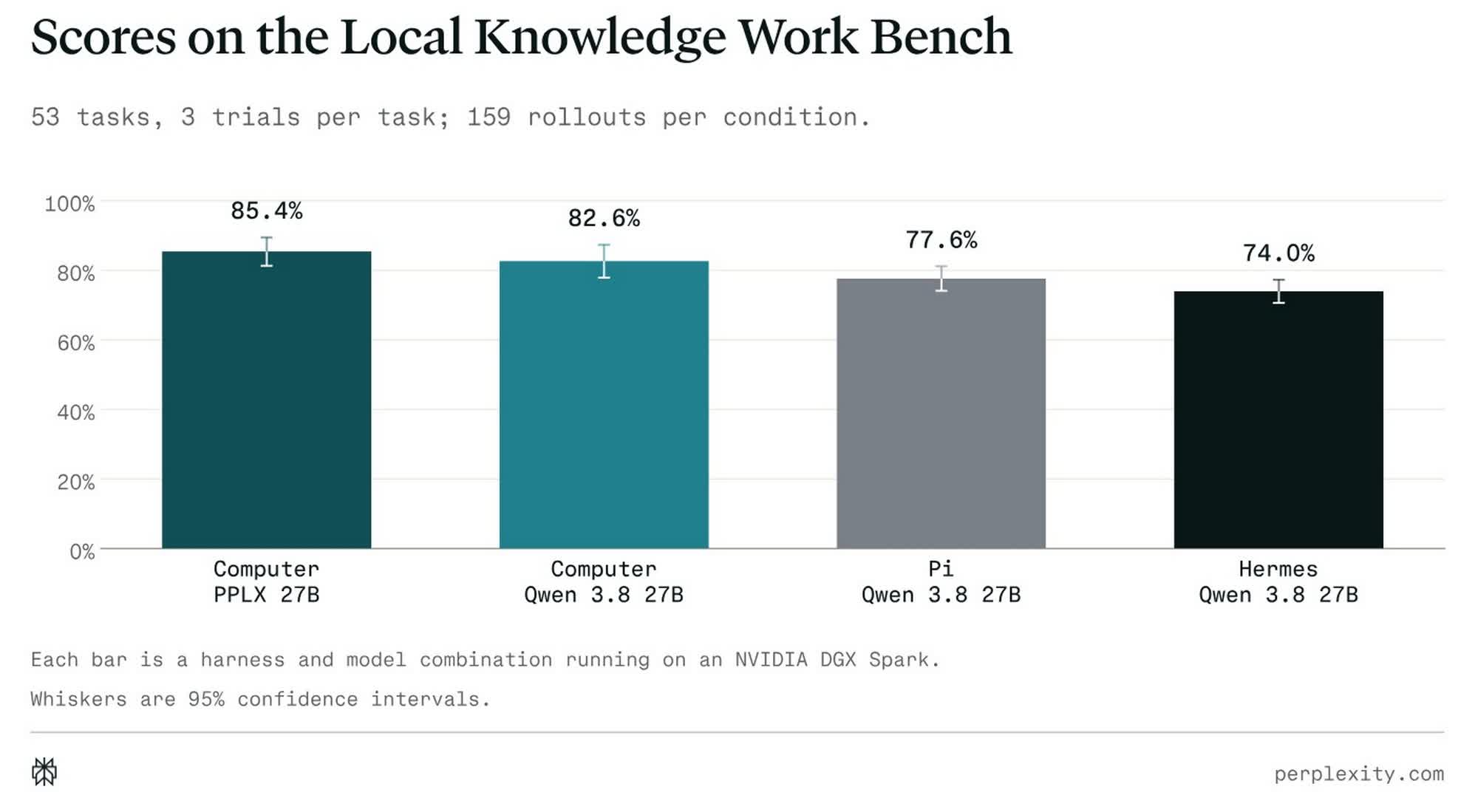
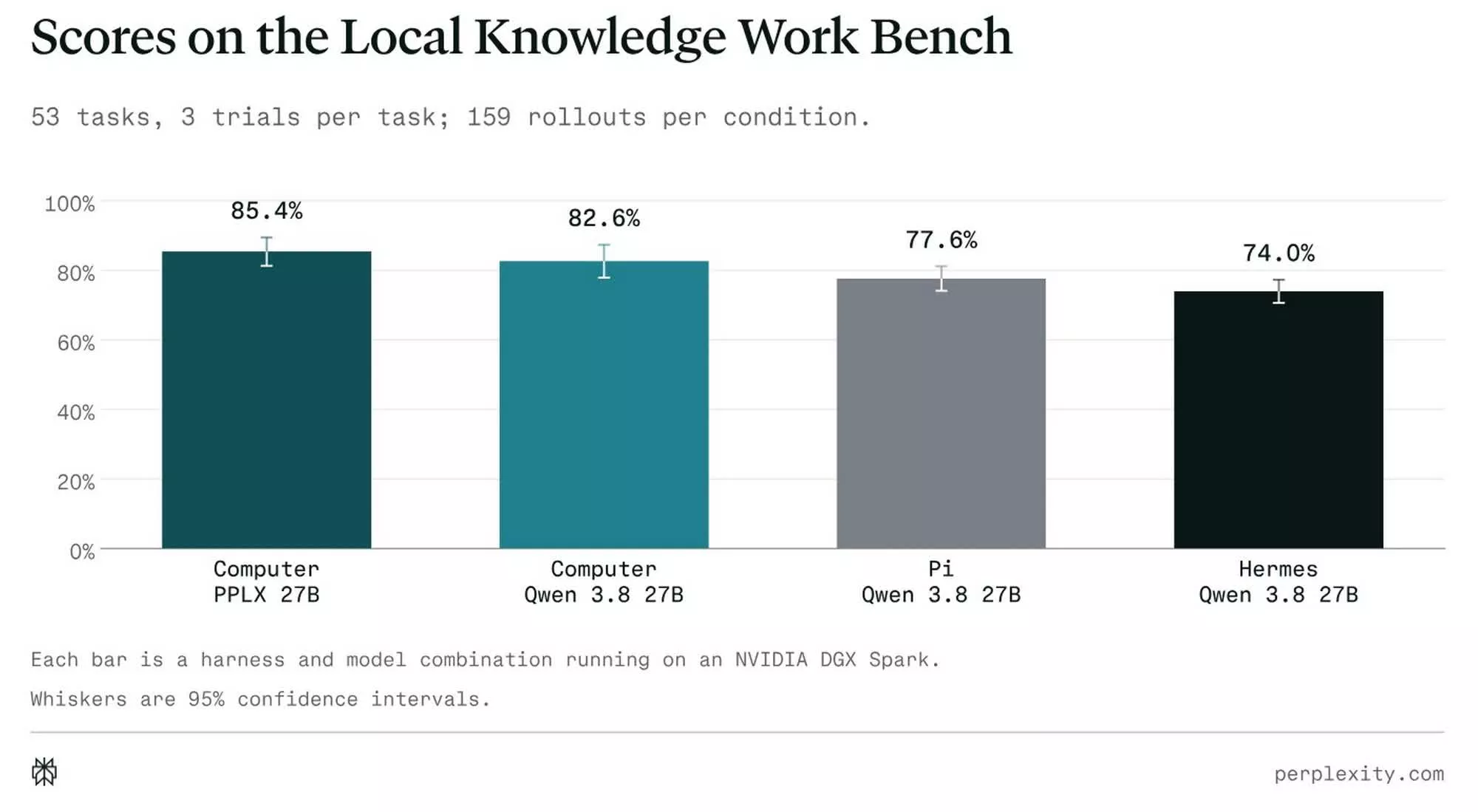
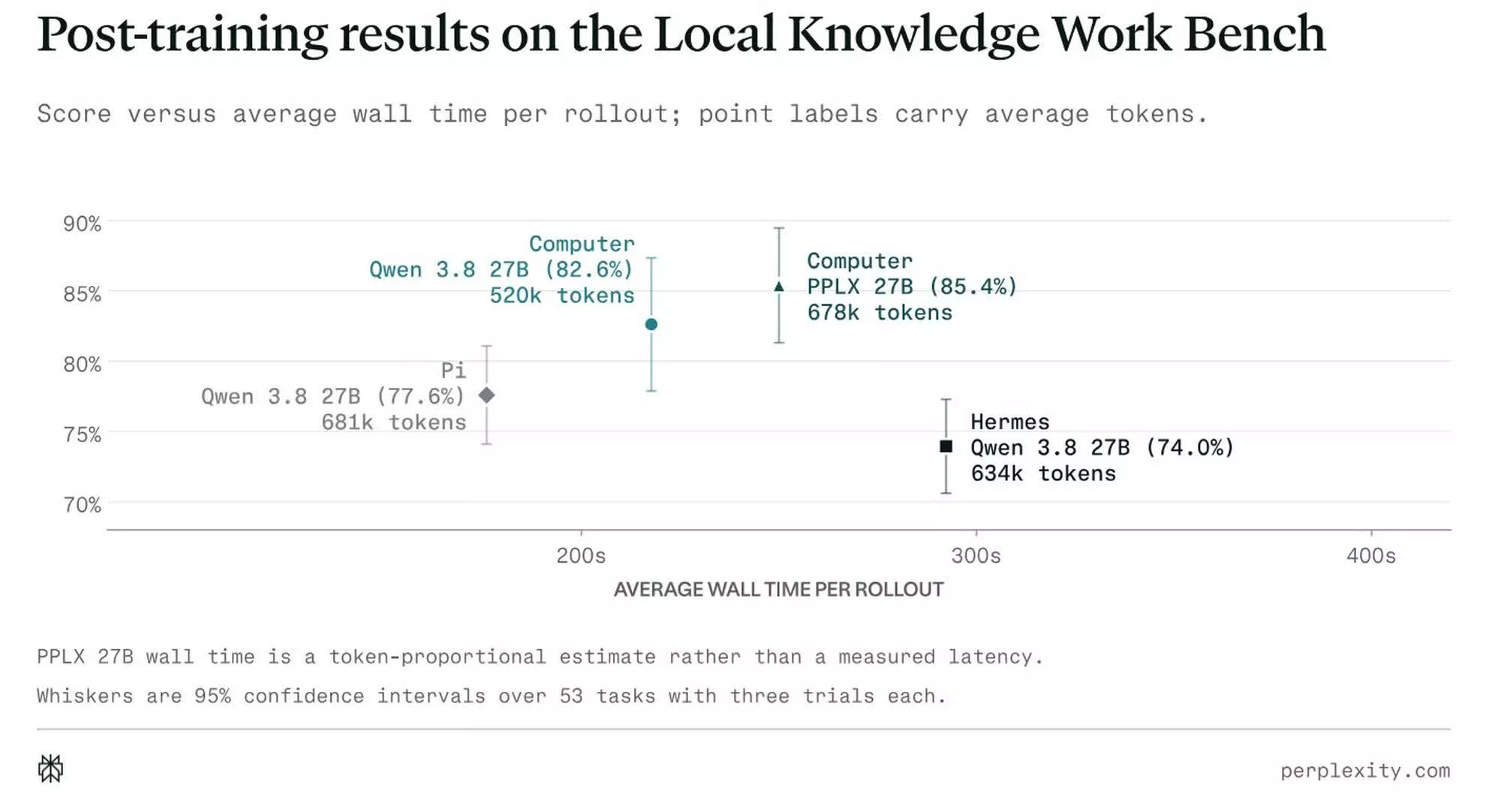
Benchmarks published by Perplexity show that on its internal Local Knowledge Work Bench, Computer running Qwen 3.8 27B on a DGX Spark chalked up an accuracy score of 82.6% while using 520,000 tokens, exceeding Pi’s 77.6% and Hermes’ 74.0% across 53 tasks spanning deep research, financial analysis, and document creation. On PPLX 27B, it scored 85.4% using 678,000 tokens.
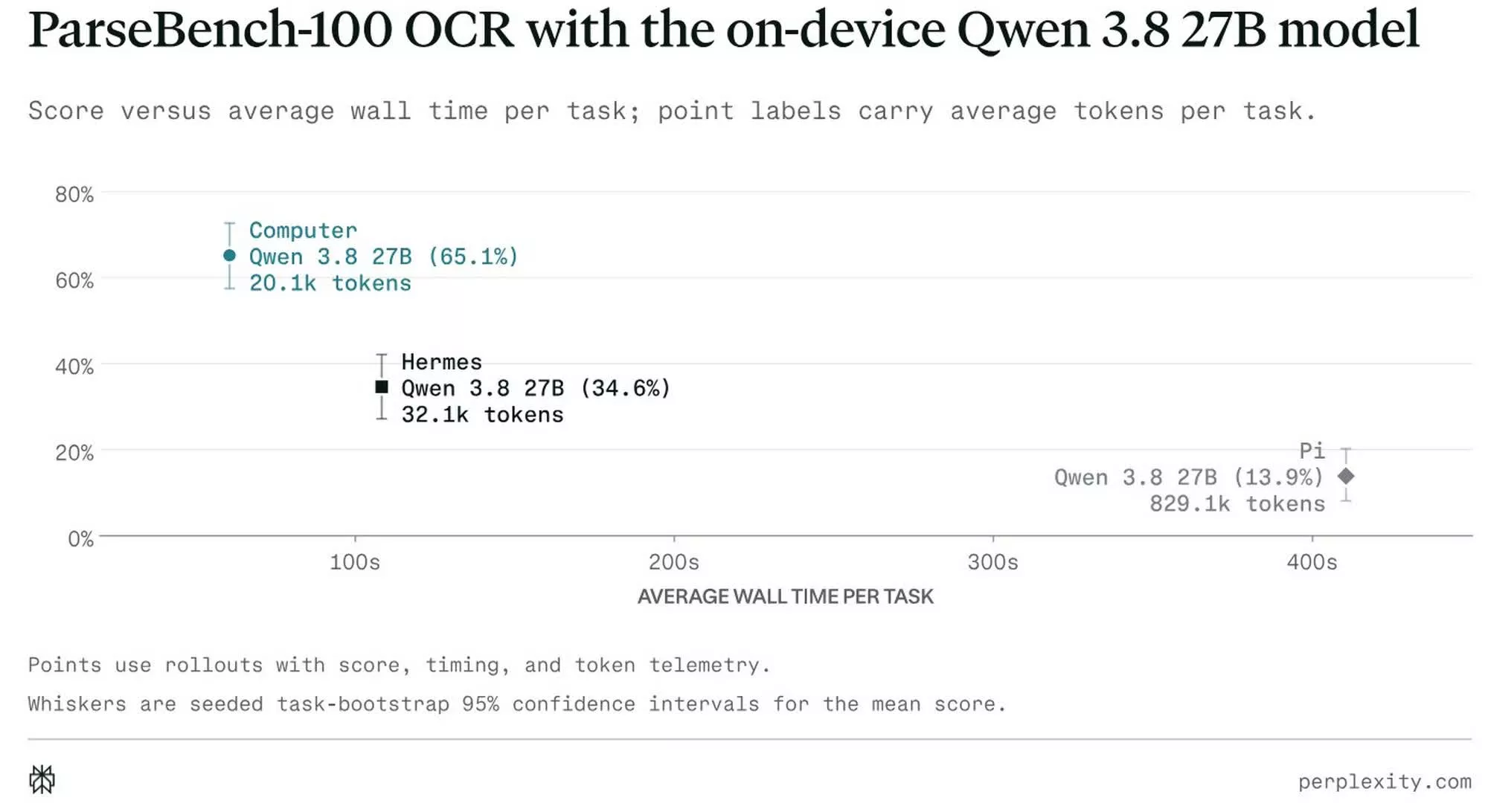
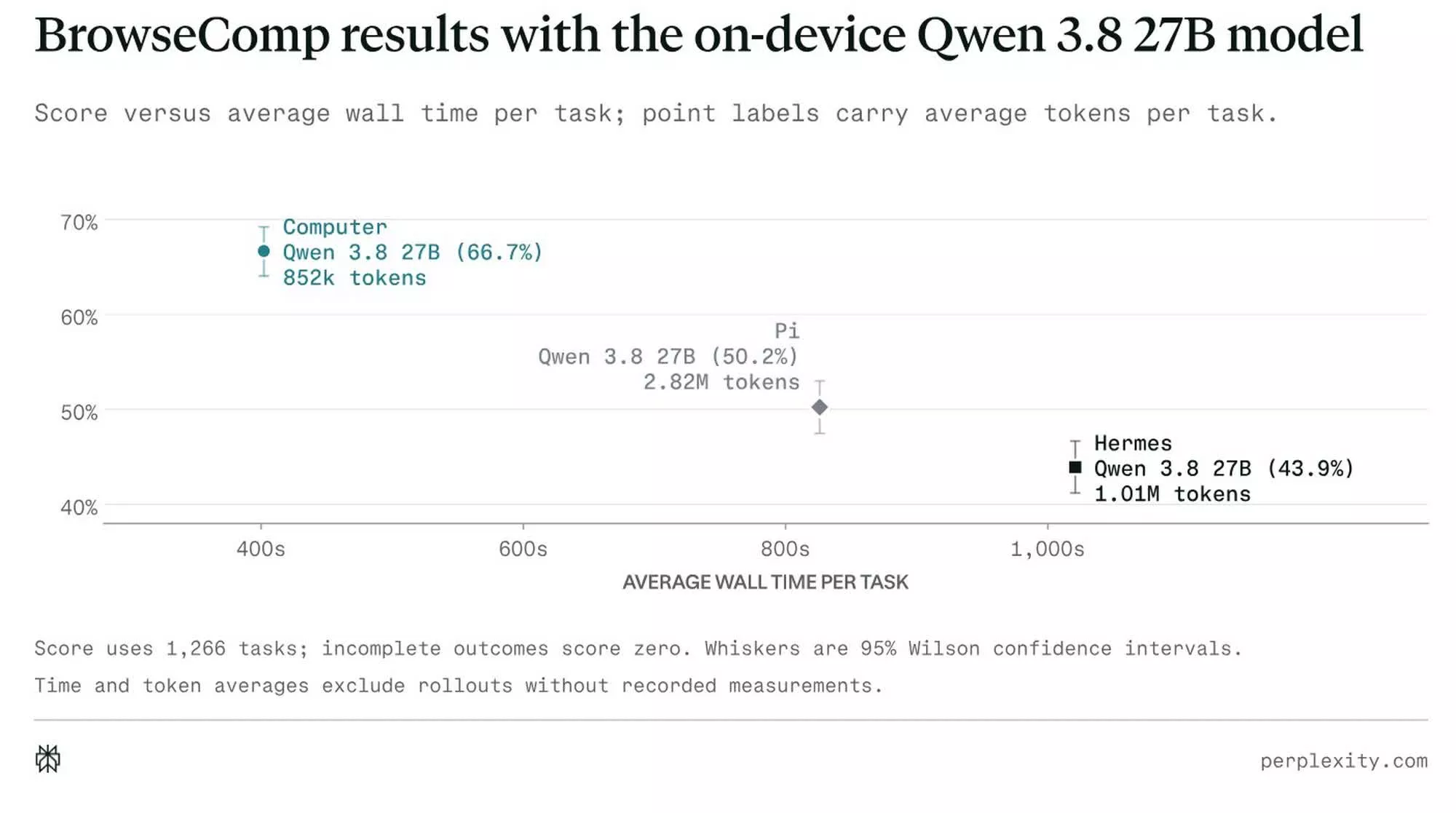
Portable Computer was also the fastest on BrowseComp and ParseBench-100, hitting 66.7% accuracy on the former and 65.1% on the latter. By comparison, Hermes scored 43.9% on BrowseComp and 34.6% on ParseBench-100, while Pi scored 50.2% on the former and 13.9% on the latter. Perplexity says Portable Computer also used the fewest tokens across all three benchmarks.
Portable Computer is now available to Pro, Max, and Enterprise subscribers on the DGX Spark, Nvidia’s Linux small AI desktop built around the Grace Blackwell GB10 chip, which pairs a 20-core CPU with a Blackwell GPU and 128GB of unified memory. It’s also available today on Linux PCs equipped with Nvidia RTX GPUs carrying at least 24GB of VRAM. Windows support is reportedly coming in September, extending that same 24GB VRAM requirement to RTX-equipped Windows machines.
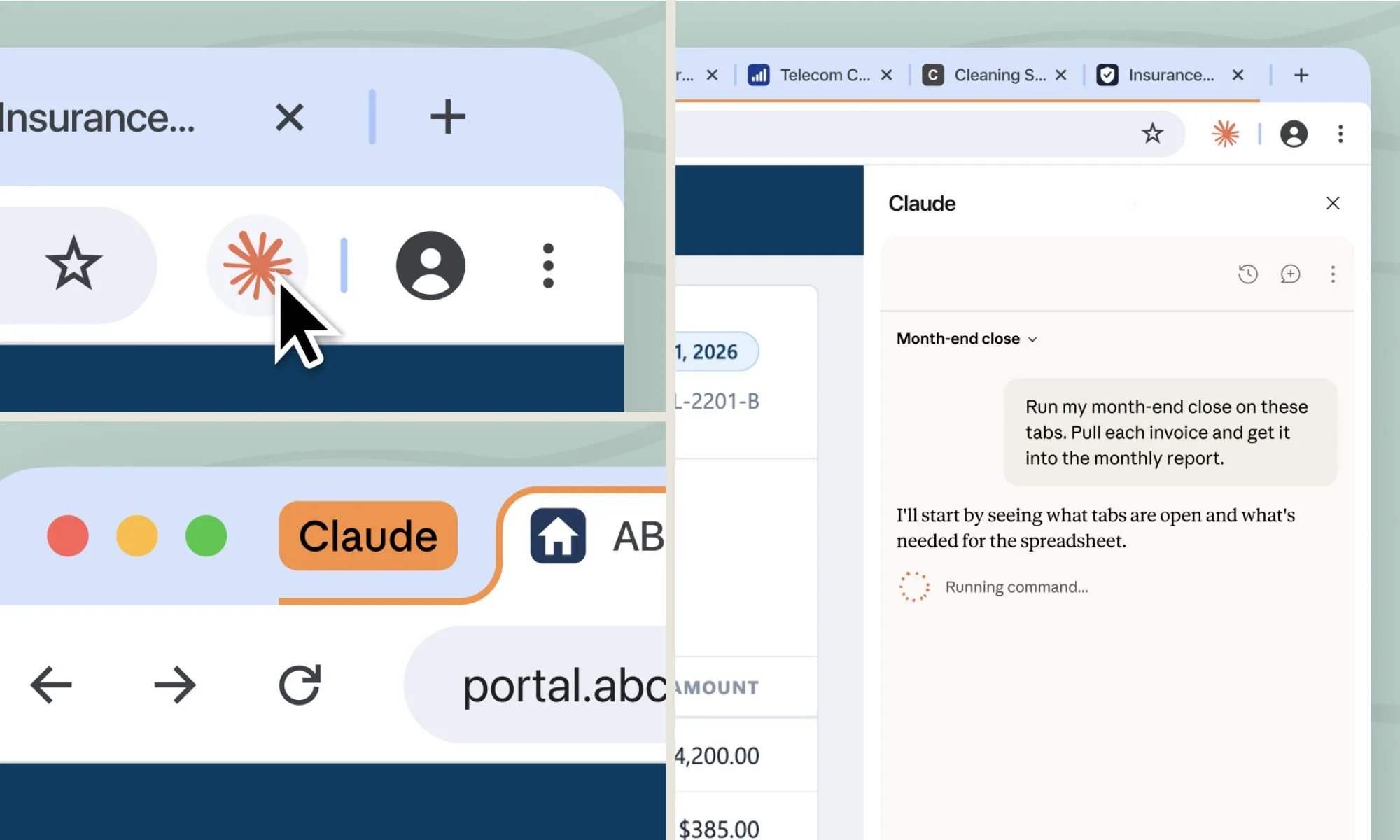
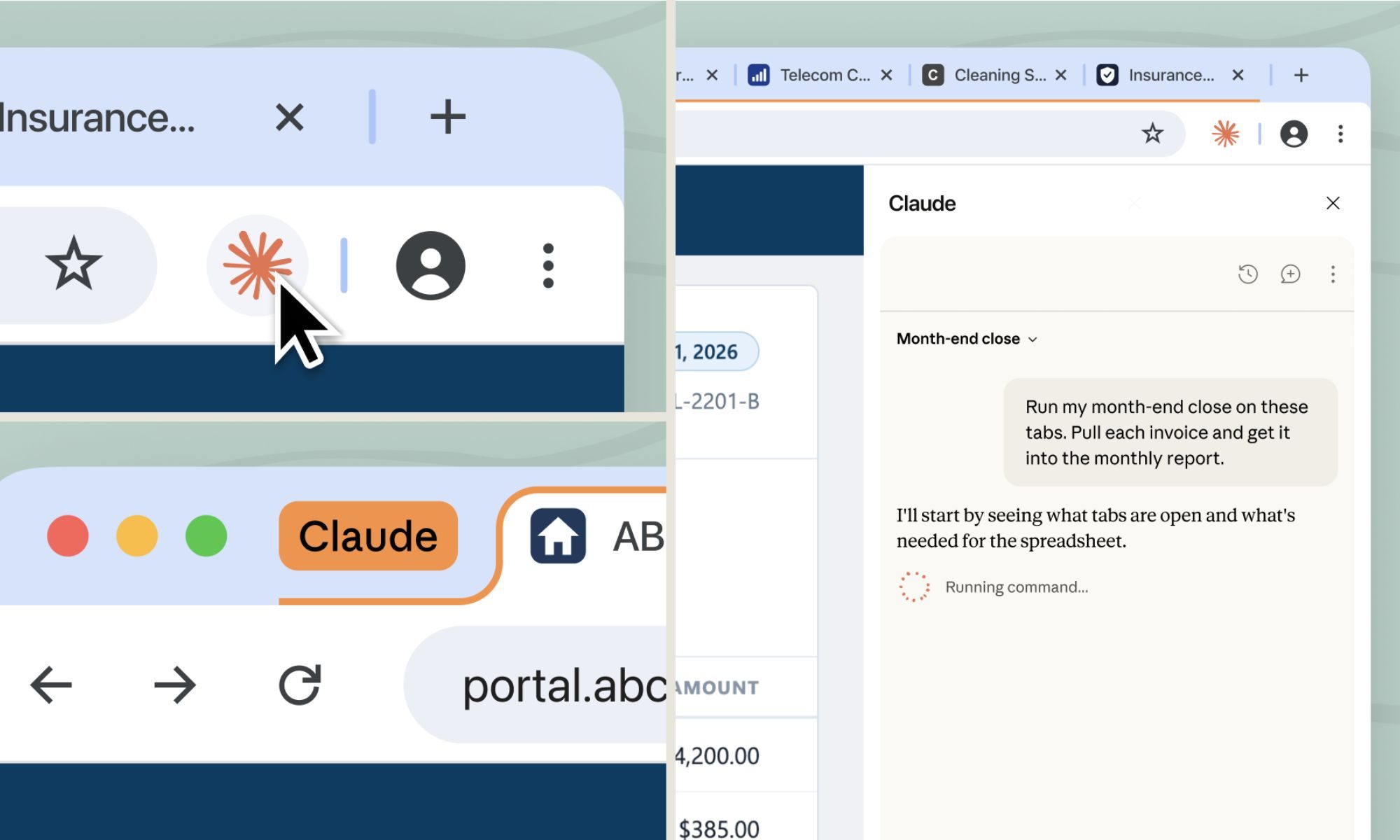
Now there’s a second option. Claude can open its own separate browser inside the Cowork side panel and handle the web part of a task on its own, while you keep working on whatever you’re doing.
So how is it different from Claude in Chrome?
Anthropic
Claude in Chrome uses your browser, your tabs, logins, the page you already have open. That setup makes sense when you’re already on a page and want Claude to jump in and help. But plenty of web tasks don’t actually need your personal browser; they just need a medium to access the web.
This is where Claude’s new built-in browser steps in. It’s completely separate from yours, and Claude never sees the tabs, bookmarks, or passwords in your personal browser. That makes it the better choice for tasks that don’t actually need your personal browser session, like researching for a report or pulling invoices off a vendor portal.
If you want Claude signed into specific sites, you can choose to share those logins from Chrome, Edge, or Firefox. Sensitive accounts like banking, email, or single sign-on are excluded by default unless you deliberately choose to include them.
Advertisement
The safety risks you should know about
If you’re already using Claude in Chrome, that stays your default. Otherwise, Claude reaches for its own browser automatically, and you can switch the preference anytime in Settings. It’s rolling out this week to Pro, Max, and Team plans on the desktop app, covering macOS, Windows, and a Linux beta.
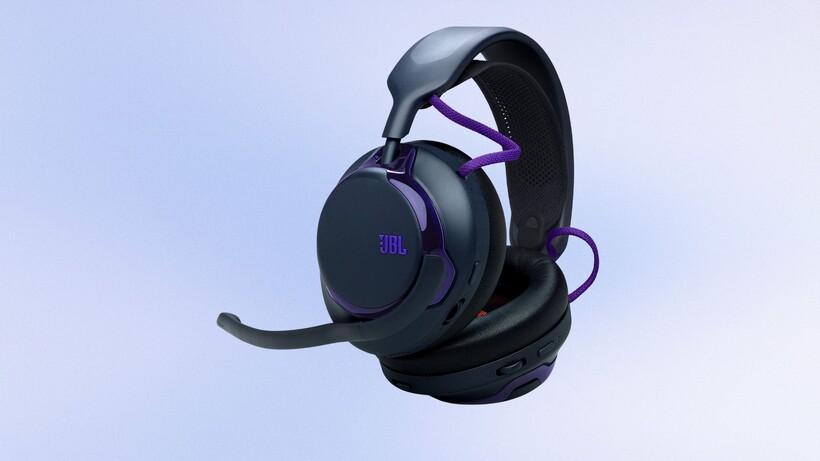
JBL’s Quantum refresh completes a four-model range and adds the Quantum 850, Quantum 520, Quantum 520X and Quantum 120 headsets to its gaming audio line-up.
These four additions join the existing Quantum 650 Wireless to complete a four-model range that spans entry-level to mid-range gaming audio, with JBL Quantum Spatial Sound and the JBL QuantumENGINE software running across every headset in the line-up.
All five headsets share 50 mm carbon dynamic drivers, a spec that JBL pairs with Hi-Res Audio certification and Quantum Spatial Sound to give positional cues such as footsteps and gunfire greater clarity during competitive play.
The Quantum 850 is the premium gaming headset in the range, bringing Adaptive Noise Cancelling to the line-up.
Advertisement
Connectivity marks the clearest split between models, since the Quantum 850, Quantum 650, Quantum 520 and Quantum 520X all offer dual wireless connections through a 2.4GHz dongle or Bluetooth, while the Quantum 120 relies on a wired 3.5mm connection instead.
Advertisement
Console compatibility also varies across the range, with the Quantum 520X carrying Xbox certification for wireless play on Microsoft’s console, while the Quantum 120 supports PlayStation, Xbox and other major gaming consoles through its wired connection, and the Quantum 850 is compatible with iPad OS, PlayStation and Nintendo certified.
Battery life follows the same tiered pattern, with the Quantum 650 rated for up to 45 hours and the Quantum 520 and Quantum 520X each rated for up to 37 hours, all three gaining an extra hour from a five-minute charge.
Advertisement
Image Credit (JBL)
Comfort features carry across the range too, and both a silicone headband and breathable fabric ear cushions appear throughout the line-up, while colour choices range from Black and Ice to Coral and Purple, apart from a single Black-only option for the Quantum 520X.
Every model in the range also includes a detachable, noise-cancelling 6mm cardioid boom microphone designed to keep team callouts clear during high-pressure moments, a feature that has become a baseline expectation across competitive gaming headsets at this price point.
Advertisement
Carsten Olesen, President of Consumer Audio at HARMAN, said the updates reflect JBL’s strong entry into gaming audio and that the brand has used its latest innovations and expertise to evolve the Quantum range into a complete line-up for every level of player.
Quantum 520, Quantum 520X and Quantum 120 go on sale from 26 August, with the Quantum 650 already available, and pricing spans £39.99 for the wired Quantum 120 up to £129.99 for the Quantum 650. The Quantum 850 is due to go on sale the 1st October for £249.99 / €279.99.
A new leak claims Apple’s first foldable iPhone, the iPhone Ultra, could bring back a red finish, but the images raise more questions than they answer.
On Wednesday, longtime Apple leaker Evan Blass suggested that Apple will revive a much-missed color for its yet-unannounced iPhone Ultra. In his post to X, he showcases a few renders of the iPhone Ultra in white, black, and red.
It’s notable, as Apple hasn’t released a red iPhone since 2022, when it released the iPhone 14 and iPhone SE 3 as part of a (PRODUCT)RED partnership.
Blass’ image is not an official render. A charitable read is that it’s a mockup of a rumor; at worst it’s a complete fabrication.
Advertisement
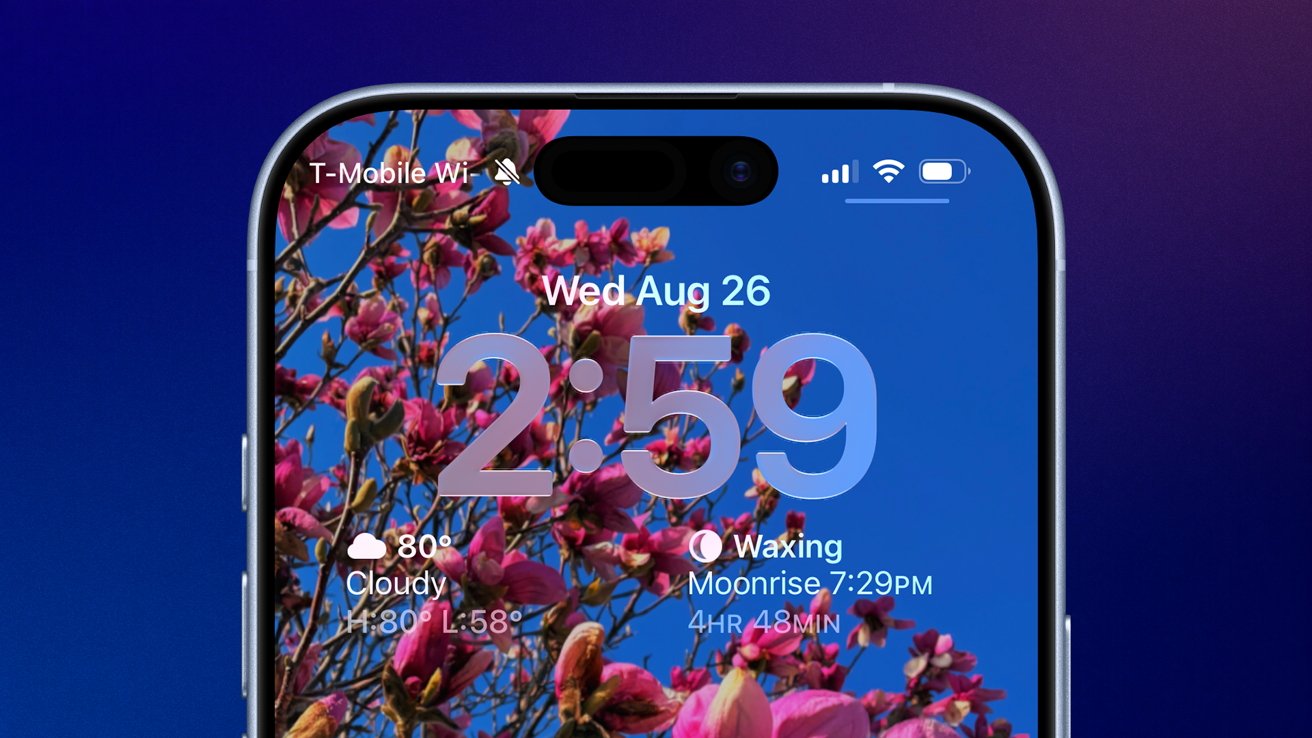
The battery icon, for example, is not what we’re expecting to see in iOS 27. It’s not what you’d see in iOS 26, either.
The battery icon in iOS 26, with significantly thinner lines and a swipe down indicator for Control Center
It seems likely that the images are AI-generated. So take the rumor with a grain of salt, especially because no other rumors have corroborated such an idea.
In fact, more rumors have suggested that the device could come in a single color: white.
Advertisement
Regardless of whether or not Apple releases one color or three, the device will sell out quickly anyway.
Apple is expected to announce the iPhone 18 Pro and iPhone Ultra on September 9 at 10:00 am PDT and 1:00 pm EDT as part of its “Surprise and shine” event. You can learn how and when to tune in with our helpful guide.
Desktop CPU shipments dropped over 20% amid rising memory and GPU costs
AMD now holds nearly 35% of the entire desktop processor market
Mobile CPU shipments jumped as Intel finally closed its capacity gap
Global processor shipments fell in the second quarter of 2026 compared with the same period a year earlier, new figures have claimed.
Mercury Research found, the decline stemmed mainly from weaker system-on-chip and embedded volumes tied to AMD‘s shrinking games console business, along with a steep drop in desktop CPU volumes.
Even as the overall market contracted, AMD continued to take share away from Intel across nearly every product category tracked by the research firm.
Latest Videos FromTechRadar
Advertisement
Desktop demand buckles under higher prices
Desktop CPU shipments fell by more than 20% year on year, a decline Mercury links to weaker demand for high-end gaming PCs rather than typical seasonal softness.
Rising memory prices, driven by chipmakers prioritizing more profitable high-bandwidth memory for AI servers, have pushed up the cost of finished PCs.
A shortage of consumer GPUs appears to stem from similar supply pressures within the broader chip industry.
“Higher PC prices and limited GPU supplies are having a significant impact,” Mercury Research said in its report.
Sign up to the TechRadar Pro newsletter to get all the top news, opinion, features and guidance your business needs to succeed!
AMD’s decline in desktop shipments was smaller than Intel’s, allowing it to grow its desktop share to nearly 35%, up from about 32% a year earlier.
Advertisement
AMD extends its lead in mobile and server chips
Mobile processor shipments told a different story, climbing strongly compared with the previous quarter after Intel expanded output during two heavily supply-constrained quarters.
Intel added millions of units of mobile CPU capacity in the second quarter, narrowing the earlier gap between supply and available demand.
Despite that expansion, AMD’s share of the mobile segment rose to nearly 29%, up from 20.6% during the same quarter last year.
Server processor shipments increased by 20% year on year, with Mercury citing stronger demand for both datacenter—class chips and processors built for networking and storage.
AMD’s share of server processors climbed to 34.5%, compared with 27.3% a year earlier, and would reach 46.4% if the comparison were limited only to Intel’s Xeon SP and AMD’s EPYC lines.
Mercury also tracks the smaller Arm-based CPU market for PCs and servers, cautioning that its estimates carry more uncertainty due to the absence of centralized revenue reporting for Arm chips.
Advertisement
The firm recorded strong growth in Apple‘s Mac lineup, including its newer lower-cost Neo models, alongside solid gains for Arm-based Chromebooks.
Arm-based systems reached 15.3% of the client market during the quarter, a record high and an increase of 0.9 percentage points.
In servers, Arm’s share also hit a record of 13.6%, up 0.5 percentage points from the prior period.
Taken together, the figures suggest a processor market driven less by shifting consumer taste than by supply-chain pressure from the AI boom.
Advertisement
Memory and GPU scarcity appear to be squeezing traditional desktop buyers even as data-center and mobile demand hold up, leaving AMD well placed to keep benefiting from Intel’s uneven recovery.
Faster than Blackwell, but still no replacement for AMD or Nvidia … yet
If you’re going to build a custom AI accelerator, inference is a good place to start. The clusters are smaller, the chips can be simpler, and at the end of the day they only need to do one thing: serve tokens. OpenAI’s spicy new Jalapeño inference chips are just the latest example.
Advertisement
Social media magnate Meta is bucking this trend. Its first proper generative AI accelerator, the MTIA 400 — short for Meta Training and Inference Accelerator — is aimed squarely at LLM training.
The Facebook parent is no stranger to custom silicon. But, much like Amazon and Google, its first AI accelerators weren’t built to run AI chatbots or train generative AI models. They were built to serve ads.
The MTIA 400, teased earlier this year and detailed at the annual Hot Chips semiconductor development conference this week, will perform some inference duties. Just not of the GenAI variety. Instead, it’ll be saddled with running the ad recommender systems that actually pay Meta’s bills.
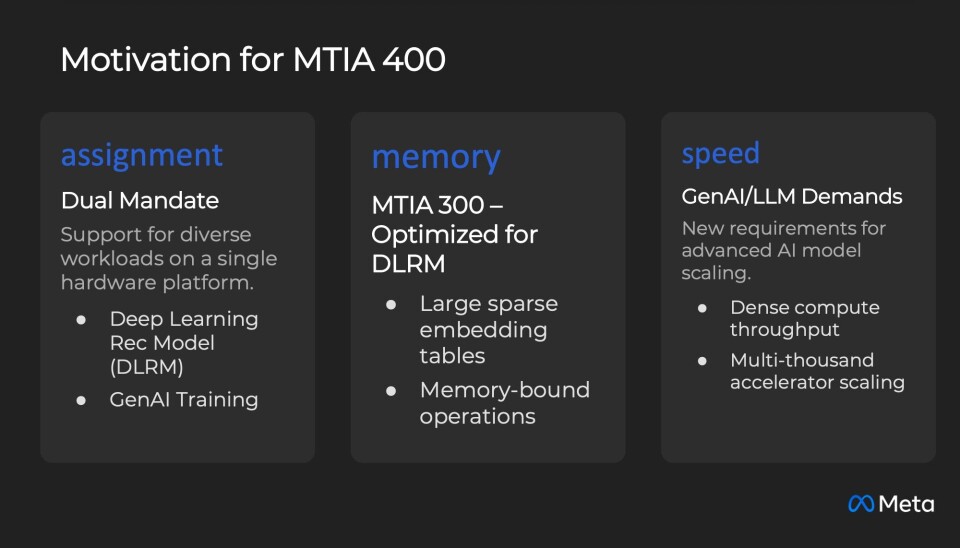
The combination of LLM training and the deep learning recommender model (DLRM) inference used for serving ads is unusual, as the two have wildly different performance demands.
Advertisement
LLM training is enormously compute-intensive, often requiring tens or even hundreds of thousands of accelerators to train models in a reasonable amount of time. DLRM inference, on the other hand, is a predominantly memory-bound job, which means most of the FLOPS that make the chip good at training are going to be left sitting idle.
But given how much cash Meta is burning on compute these days, it’s probably not a bad thing for its chips to pull double duty – even better if one of the two use cases is highly profitable.
This slide from Meta’s Hot Chips presentation encapsulates the design considerations for its fourth-gen MTIA accelerators.Image credit Meta
While MTIA may play a bigger role in how Meta serves its generative AI workloads, its in-house silicon probably won’t replace AMD or Nvidia’s GPUs any time soon. The two chip designers’ GPUs are currently much better suited to LLM inference and are almost certainly what Meta Superintelligence Labs is using to train frontier models like Muse Spark. Application-specific hardware has always been better suited to well-understood workloads, and Meta’s accelerators are no exception.
But enough about market positioning and workloads. Let’s dig into the chip itself.
Advertisement
Dissecting the MTIA 400
At first blush, the MTIA looks a lot like either Nvidia’s Rubin GPUs or AMD’s MI355X accelerators.
The MTIA 400 is based on a heterogeneous multi-die architecture, which means it is built from a collection of different chips each with their own job. It features two compute dies, two I/O dies, and an SoC die that handles host connectivity and workload orchestration — all pretty standard stuff.
A closer look at Meta’s MTIA 400 accelerator packageImage credit Meta
Broadcom’s influence here is hard to miss. The chip almost certainly was built using the IP house’s XPU tech, which we explored in detail last year.
Building a competent AI accelerator isn’t a trivial endeavor. So, if you’re trying to bring one to market quickly, it makes sense to focus on what makes your chip special and let someone like Broadcom handle the rest.
Advertisement
Digging deeper into the MTIA 400’s heart, the compute chiplets are built on a 3nm process tech, presumably from TSMC, and feature a 6×8 grid of processing elements responsible for the bulk of the accelerator’s AI performance. Combined, the two chiplets are capable of outputting 12 petaFLOPS of MXFP4 compute at 1.7 GHz.
This slide shows the underlying compute architecture on which Meta’s MTIA 400 is based.Image credit Meta
To put that in perspective, the MTIA 400 is about 20 percent faster than Nvidia’s top-specced Blackwell accelerators at the higher precisions more commonly used to train models, while sucking back roughly the same power.
But the parts don’t hold up nearly as well when compared to Nvidia and AMD’s latest chips – the MTIA 400 is between 3x and 3.3x slower than Rubin and the Instinct MI455X, respectively.
Meta’s latest accelerator is fed by eight 36 GB HBM3e stacks that deliver 288 GB of memory and about 9.2 TB/s of bandwidth. Again, that’s about 15 percent faster than Nvidia and AMD’s last-gen parts, but with less than half the bandwidth of their new GPUs.
Advertisement
This is probably why Meta is positioning the part as a training chip. It has much better and faster options for LLM inference.
The MTIA 400 features a pair of I/O chiplets that provide 1.2 TB/s of chip-to-chip bandwidth over RDMA. We don’t know what transport tech Meta is using at this point, but given Broadcom’s involvement, Ethernet would be the obvious choice.
Scaling up
Look familiar? It should. Meta’s MTIA 400 rack systems look almost identical to Nvidia’s NVL72 and AMD’s Helios racks.Image credit Meta
MTIA 400’s physical resemblance to Nvidia Rubin and AMD MI350-series parts also extends to the system design.
Each compute blade features four MTIA 400 accelerators connected via a PCIe switch to an x86 CPU and a scale-out NIC.
Advertisement
A single rack is equipped with 18 compute blades and eight switch blades for a total of 72 accelerators in a single unified domain. Meta shared a pic of the rack earlier this year, so while the compute blade is highly reminiscent of AMD’s Helios blades, it’s not using the same double wide OCP racks.
Here’s a pic of the actual MTIA 400 rack shared earlier this spring.Image credit Meta
Meta hasn’t shown how large a cluster its chips can support just yet — the slides simply state “multi-thousand accelerator scaling” — but even at rack scale the systems should be quite competent relative to Nvidia’s GB200 and GB300 rack systems for training.
More on the way
While the MTIA 400 is aimed primarily at LLM training, Meta is already working on an inference-optimized version of the chip. Disclosed back in March, the MTIA 450 will double the chip’s memory bandwidth, presumably by swapping HBM3e for much faster HBM4.
Meta’s specs for its custom siliconImage credit Meta
That part is expected to enter production next year, and should be extremely well suited to running those LLM-based recommender models Zuck and crew have been talking about the past few quarters.
Advertisement
Meanwhile, the MTIA 500, which is also slated for 2027 release (probably in H2 if we had to guess), will increase memory bandwidth by another 50 percent — likely using 4 additional HBM4 stacks — and double the number of compute chiplets. ®






















































You must be logged in to post a comment Login