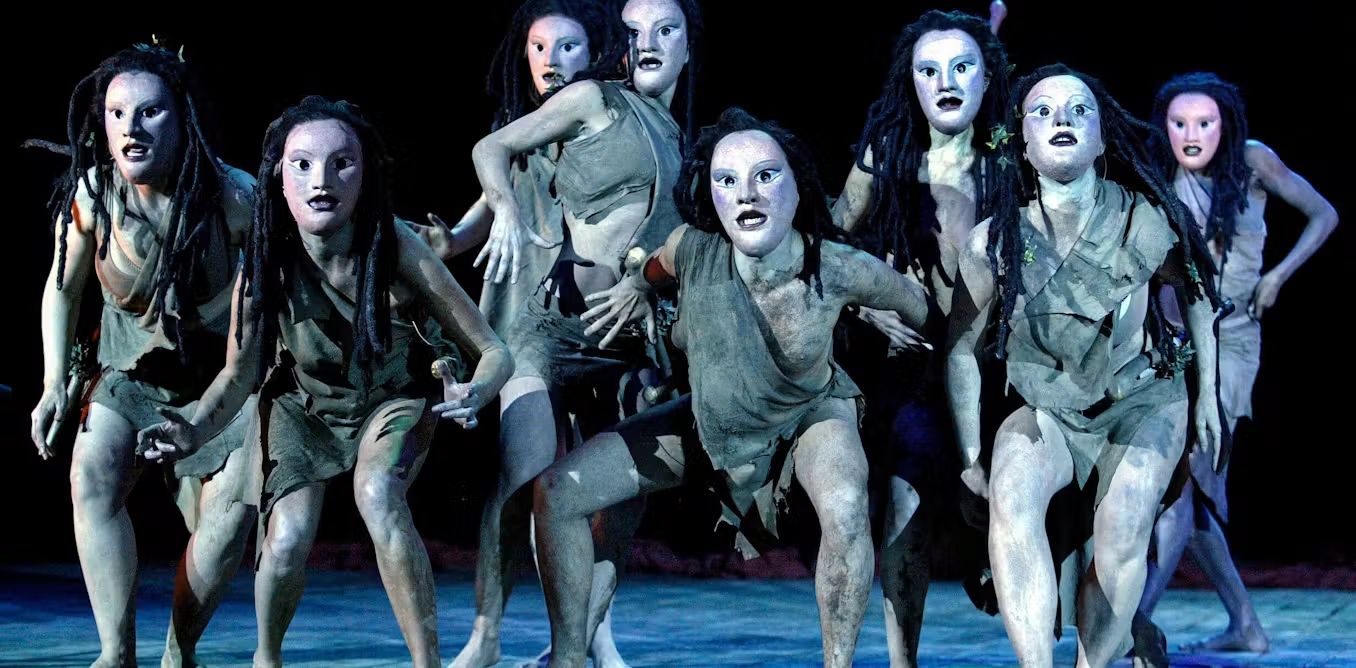
Connect with us

NewsBeat

Worries that social media is making children lose touch with reality echo ancient Greeks’ fears about theatre

Published

on

Worries that social media is making children lose touch with reality echo ancient Greeks’ fears about theatre

Banning under-16s from social media was one of Keir Starmer’s last acts as prime minister before he stepped down in July 2026. Following Australia’s ban on under-16s in 2025, which turbocharged the debate globally, the UK ban is timetabled for early 2027.

As Meta’s $18bn (£13.2bn) recent settlement over teen addiction to its online platforms demonstrates, there is growing recognition that social media poses real risks to young people.

Thinking around this issue is constantly developing. Popular platforms such as Instagram and TikTok offer an endless stream of algorithm-driven material tailored specifically to each consumer. And while the full effect of social media use on developing brains is unclear, parents, teachers and politicians have all expressed concerns around the social and emotional impact of this consumption on young people.

Smartphones offer instant access to social media 24/7.
Happy Zoe / Shutterstock

Social media feeds off a portrayal of real life that is fundamentally unreal. And in an age of filters, AI and engagement farming (using manipulative and often misleading tactics to boost engagment), the distinction between performance and reality online is increasingly blurred. In the face of this targeted barrage, children and teenagers are ill-equipped to distinguish between reality and the performance of that unreality flickering across their screens.

Advertisement

I’m a classicist and theologian with an interest in how culture and performance shape our ideas of what it is to be human. It strikes me that there is a fascinating parallel for this contemporary debate in the Greco-Roman obsession with theatricality and drama. The great dramas of classical Athens remained popular for a millennium, inspiring new genres and theatrical styles throughout the Mediterranean world.

Imitating life, imitating Fear

As research, including my own, into this breadth of ancient media production has developed over time, one theme has emerged again and again: as theatrical performance grew into a cultural staple, it was accompanied by the fear that just as art imitates life, so art could overcome reality itself.

This “theatrophobia” – a fear of the theatrical – appears throughout the literary record. This was a genuine anxiety, yet one that clearly fascinated ancient audiences.

Drama embodied the artistic imitation of life, and in doing so spoke to contemporary debates, offering moral or emotional exemplars. But how was the audience to best respond? What if the “wrong” lesson was learned? The potential impact was enormous. As theatrical events spread beyond the theatre and into homes, marketplaces and political spaces, the boundary between performance and reality had to be continuously renegotiated, lest performance overtake reality itself.

Advertisement

The second-century satirist Lucian of Samosata experimented with this anxiety. In a text defending the popular genre of pantomime (don’t picture the local am-dram Christmas production here, but rather a single actor/dancer staging a one-man play, accompanied by a singer and surrounded by delighted crowds), Lucian includes a story of an actor playing the Trojan war hero Ajax who was consumed by his role:

In dancing Ajax going mad immediately after his defeat, he so overextended himself that it might well have been thought that instead of acting insane he was insane, for he tore the clothes of one of the men that beat time with the iron beater, and snatching a flute from one of the accompanists, with a vigorous blow he cracked the crown of Odysseus, who was standing near and exulting in his victory. Indeed, if his helmet had not offered resistance and borne the brunt of the blow, poor Odysseus would have lost his life through falling in the way of a crazy dancer. The whole theatre, however, went mad with Ajax, leaping and shouting and flinging up their garments …
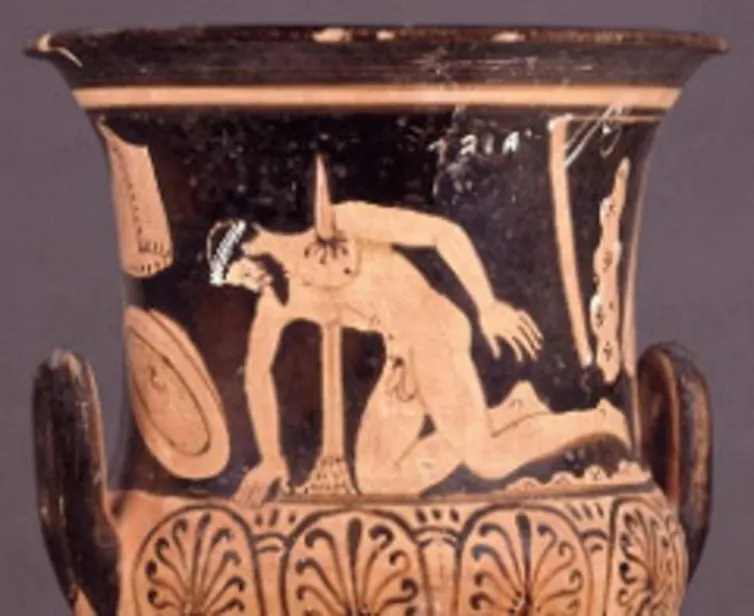
A Greek vase showing a man falling on his own sword.
A Greek vase showing Ajax, humiliated by his own madness falls on his sword.
The History Collection / Alamy

“Ajax” here forgets his mania is only performed and wreaks violent havoc on stage. But his actions corrupt his audience too, who enthusiastically pile into the ensuing chaos.

In another text, where Lucian parodies contemporary history writers, the satirist recalls a similar scene in the city of Abdera, where the whole populace is overcome by “tragedy madness” after enjoying a performance of Euripides’ Andromeda in the heat of summer. The Abderians descend into a kind of tragic apoplexy, sick with fever and reciting endless quotations.

Lucian’s exaggerated anecdotes were lighthearted, but they only amused because they resonated with his readers. The boundaries between performance and reality were porous. This made drama exciting, but it also made it dangerous. How could one ever truly know where the boundary lay? For the unsuspecting audience, this could have disastrous results.

Modern anxieties around social media represent the latest iteration of this ancient theatrophobia. We are dealing with an online dimension that privileges performance and exploits the sense that art can imitate and even hyper-realise life itself. The ancients continually returned to this anxiety because it really mattered: one could take performance too far, with real-world consequences.

Advertisement

As young people’s lives are played out as much on TikTok feeds as in reality, the distinction between performance and real life continues to blur. While the blunt instrument of an age-graded ban will go some way to addressing the dangers posed by this new world of performance, it doesn’t necessarily address the root issue.

A simple ban cannot be the end of the public debate on this matter. Instead, we must recognise – and challenge – the theatricality and explicit performativity of social media. It is not too late to avoid getting lost in the production.


Source link

Advertisement
Continue Reading
Click to comment

You must be logged in to post a comment Login

Leave a Reply

NewsBeat

Strictly Come Dancing pro Dianne Buswell prompts concern as she misses filming the first group dance to mark the show’s ‘new era’

Published

on

Dianne Buswell was noticeably absent from the recording of the first group dance for this year¿s series, the Daily Mail can reveal

She was one of the lucky professionals to survive Strictly Come Dancing’s mass cull of long-serving dancers.

But Dianne Buswell was noticeably absent from the recording of one the first group dances for this year’s series, the Daily Mail can reveal.

The long-standing Strictly pro prompted concern among fans at the recording this week, as she had been expected to take part.

The Australian star, 37, who gave birth to her first child in March with partner Joe Sugg, was due to perform a group dance with the rest of this year’s professional dancers.

Advertisement

Bosses had planned the high-octane routine, which will air during the launch show, as a way to introduce the five new dancers to viewers.

An insider said: ‘It was really odd Dianne wasn’t there.

Dianne Buswell was noticeably absent from the recording of the first group dance for this year’s series, the Daily Mail can reveal

Advertisement
The Australian star, 37, who gave birth to her first child in March with partner Joe Sugg, was due to perform a group dance with the rest of this year¿s professional dancers

The Australian star, 37, who gave birth to her first child in March with partner Joe Sugg, was due to perform a group dance with the rest of this year’s professional dancers

‘Producers had planned the dance for the specific reason of making a big fuss of the newbies and new era of Strictly.

‘It was their very first group number together which was pretty spectacular and included big, glitzy props.’

The mole added: ‘Lots of questions were asked during the breaks about where Dianne was but the crew were reluctant to say anything.’

Advertisement

Another show insider said: ‘There’s no need for fans to be concerned.’

They added: ‘Dianne has been busy rehearsing with all her fellow Pros over the past month, and will feature in the majority of group numbers this series.’ 

A Strictly spokesperson said: ‘As is standard on Strictly, not every Pro dancer appears in every group routine.’

Ms Buswell had been back at rehearsals with her co-stars and previously told her 1.2million Instagram followers how she would miss her baby boy Bowden ‘so much’ while away.

Advertisement

The new series marks her ninth year on the show.

Strictly is also where she met YouTube star Joe, 34, when he competed with her in 2018.

She returns alongside Katya Jones, Kai Widdrington, Aljaž Škorjanec, Lauren Oakley, Nancy Xu, Neil Jones, Nikita Kuzmin, Alexis Warr, Julian Caillon and Vito Coppola.

While the five new faces are Ukrainian Aleksandra Isaeva, Italian hunk Cristian Priori, South African latin champion Lethabo Monametsi as well as Canadian dancer Mark Karmalita and UK National Ballroom Champion Maddie Ingoldsby.

Advertisement

Despite notable changes to this year’s series, the iconic and recognisable set was rebuilt at Elstree Studios in Hertfordshire earlier this month, where the dancers have been practicing.

Strictly is where Dianne met YouTube star Joe, 34, when he competed with her in 2018

Strictly is where Dianne met YouTube star Joe, 34, when he competed with her in 2018

Venezuelan dancer and Strictly’s longest-serving female pro Karen Hauer, was axed by producers along with Michelle Tsiakkas, Nadiya Bychkova, Luba Mushtuk and Gorka Marquez.

Presenter Emma Willis, former dancer Johannes Radebe and comedian Josh Widdicombe are taking over hosting duties from Tess Daly and Claudia Winkleman, who stepped down last year.

Advertisement

The celebrity lineup has been lambasted by fans as the ‘worst ever’ in Strictly’s 22-year history.

It includes former Love Island star Dani Dyer, Australian singer Delta Goodrem, dog trainer Graeme ‘The Dogfather Hall’ YouTuber John Nellis and actress Jaime Winstone.

Source link

Advertisement
Continue Reading

NewsBeat

Back To School: How To Keep Your Kids Focused And Safe From Online Distractions

Published

on

Back To School: How To Keep Your Kids Focused And Safe From Online Distractions

This might look like a regular phone, but it’s actually loaded with a clever technology designed specifically for kids’ safety called SmartMode.

You buy the phone – a lightweight phone with all the functions of a regular phone from cult brand Nothing – as it is.

There’s need to download software, apps, or fiddle around with controls, because it’s already got SmartMode baked into it, which uses AI to monitor, block, and filter content that you deem inappropriate for your child.

Unlike other safety software, which blocks specific websites or keywords, SafetyMode has been trained to read real conversations and understand context, so it won’t pose annoying blocks for your kid, and cause an unnecessary family fallout.

Advertisement

It also tracks their location, and you can change the filters according to their needs, so you can constantly adjust what content they have access to as they grow up.

Plus, when worrying content is detected, it will send an alert straight to you, so you won’t feel like you’re constantly having to check in on what they’re doing.

Source link

Advertisement
Continue Reading

NewsBeat

I’ve seen countless people try to get a loved one with cocaine and alcohol issues into rehab…but it can go so very wrong. This is the right way to stage an intervention – and what you should never say: NICK DUNKLEY

Published

on

An intervention is a planned meeting in which family, friends, and sometimes an addiction professional confront someone about the harmful effects of their drug or alcohol use

When you’re watching a loved one battle with addiction, the sense of despair can be overwhelming.

You might be a parent whose child has a drug problem and who gets arrested, gets a criminal record, and seems intent on destroying their future.

Or you might be a long-suffering partner whose other half is deteriorating through alcohol or cocaine misuse, having seizures, coughing up blood, repeatedly being admitted to hospital.

You might be asking yourself: Why do they keep making such bad choices and unwise decisions? Why can’t they see the harm they’re doing to themselves? And the hurt they’re causing to everyone around them?

Advertisement

These are questions I hear all the time in my role as regional operations manager at UKAT Addiction Centres – a group of rehab clinics across the country. 

Many people in this situation – who are desperate to help their husband, wife, son, daughter or friend – will instinctively understand that one way to set them on the road to recovery is to stage an intervention.

An intervention, for those who have not heard the term, is a planned meeting in which family, friends and sometimes an addiction professional confront someone about the harmful effects of their drug or alcohol use.  

The goal of an intervention is to encourage someone to accept treatment. 

Advertisement

An intervention is a planned meeting in which family, friends, and sometimes an addiction professional confront someone about the harmful effects of their drug or alcohol use

Typically this involves loved ones preparing anecdotes of how the person’s substance abuse has affected them, and a plea for them to seek help.

Research shows that interventions work too. A 2009 US study found that those who are confronted by loved ones are significantly more likely to enter into addiction treatment than those who do not. 

Advertisement

However, interventions can be fraught with difficulties. I often hear from families who say they are worried that their loved one will feel attacked, get angry – or even violent.

So how can you stage an intervention that is both effective and safe?

Perhaps the most important thing to explain is what an intervention isn’t. It absolutely isn’t an opportunity for airing grievances or venting anger.

Obviously, your loved one needs to know how worried you are about the damage their addiction is doing to them and the people who love them.

Advertisement

But chastising them will only breed shame, guilt and embarrassment – which may well push them away, make them feel more hopeless, and actually stop them reaching out.

Instead, an intervention should be about getting together with a loved one to have a calm and controlled conversation, where the aim is to elicit change and get them proper support.

Barry Keoghan revealed on a podcast that after a medical emergency, he entered rehab and is sober at the age of 33

Barry Keoghan revealed on a podcast that after a medical emergency, he entered rehab and is sober at the age of 33

It’s often wrongly assumed there’s no point trying to help an addict until they have hit ‘rock bottom’ – the point at which the consequences of someone’s addiction become so severe or unbearable that the person finally becomes willing to seek help or change.

Advertisement

Rock bottom might refer to unbearable physical, financial, legal, relational, or emotional issues.

Last year, actor Barry Keoghan, 33, spoke of how a near death experience finally led to him entering rehab.

‘I technically did die for a few seconds,’ the Saltburn star told a podcast, of the moment he ended up in a medical emergency because of cocaine use. ‘I’m clean now, I’ve been clean for two and a half years.’

But the truth is that it doesn’t always work this way. Everyone’s idea of rock bottom is different. Sadly, even when you think things can’t possibly get any worse, you often discover that they can.

Advertisement

So even though the idea of an intervention may be daunting, it’s best to act sooner rather than later.

Yes, there’s a danger in sitting down and openly tackling the issues of a loved one’s addiction. By putting it out there, you’re drawing a line in the sand. It’s possible you might drive them away.

But if you weigh up the consequences of doing nothing, you might well decide it’s worth the risk.

Nick Dunkley is regional operations manager at UKAT Addiction Centres - a group of rehab clinics across the country

Nick Dunkley is regional operations manager at UKAT Addiction Centres – a group of rehab clinics across the country

Advertisement

So who should be involved? There are plenty of professionals, such as counsellors and addiction experts, who can be called in to mediate. 

But addiction is a really sensitive and personal issue. If someone is already depressed or anxious about their situation, they might be extremely uncomfortable if a professional – someone they don’t know – suddenly turns up.

It might be better to gather a small group of relatives, friends and even work colleagues – anyone the person respects and will listen to.

Family members who have suffered directly and are too emotionally involved may not be suitable, as their anger – even if it’s justified – may get in the way: the intervention has to be totally focused on the person you’re hoping to help.

Advertisement

No one expects to be ambushed by a group of their loved ones, so do everything you can do to make it feel as calm as possible. Approaching the person in their own home may not be ideal as they can feel trapped, with nowhere to retreat to. 

Instead, choose a place – maybe a friend or relative’s house – which is quiet, with no interruptions or disruptions. Avoid any triggers for their substance misuse – so obviously not a pub.

Staging an intervention when someone’s intoxicated is never a good idea, which means arranging it for earlier in the day will tend to be better: once they’re up and feeling human – but before the pattern starts all over again.

It’s also important not to present them with an ultimatum: ‘Get help or I’ll leave you… Get help or you’ll never see the kids again… Get help or I’ll tell such-and-such.’

Advertisement

Threats like these just put up a barrier. If you force someone to shoot for the stars and they miss, it may reinforce their sense of worthlessness and make them not want to try again.

A better strategy is to offer something positive: ‘You might feel the situation is hopeless, but we’ve looked at the options, and here are some things we think might be a good idea.’

If you’ve done your research in advance, you can then present them with a list of different treatment centres, council services and local meetings run by groups like AA.

Even though an intervention is all about optimism, you should be careful to have realistic expectations.

Advertisement

If you ask someone if they’re ready to go into rehab and they say no, it’s a normal response for the family to break down in tears and feel all hope is lost. But if everyone is wailing and despairing, the person might just give up on the whole idea.

So be prepared to be patient and compassionate. The reality is that, although today might not be the day, tomorrow might be. Ask the person whether they would agree to revisit the issue – maybe next week or in two weeks time.

And remember, the loved one probably wasn’t expecting this conversation. If it’s just been sprung on them, they might well need some time to think about it.

Even if the intervention doesn’t go as planned or doesn’t look like it’s worked immediately, don’t write it off as a failure. Sometimes it’s enough just to plant the seeds of recovery.

Advertisement

The person may well find themselves thinking about it – even years in the future. However bad their situation is by then, the memory of their family or friends coming together to offer help may just be enough to finally spur them on to seek support.

The best outcome is, of course, if the person acknowledges the problem then either changes their behaviour or takes on professional support, counselling, or rehab.

It is incredibly challenging, but a properly prepared intervention can also be incredibly powerful – as it sends a potentially life-changing message: ‘We don’t want you to suffer. We want you to receive help – because we think you’re worth it.’

Source link

Advertisement
Continue Reading

NewsBeat

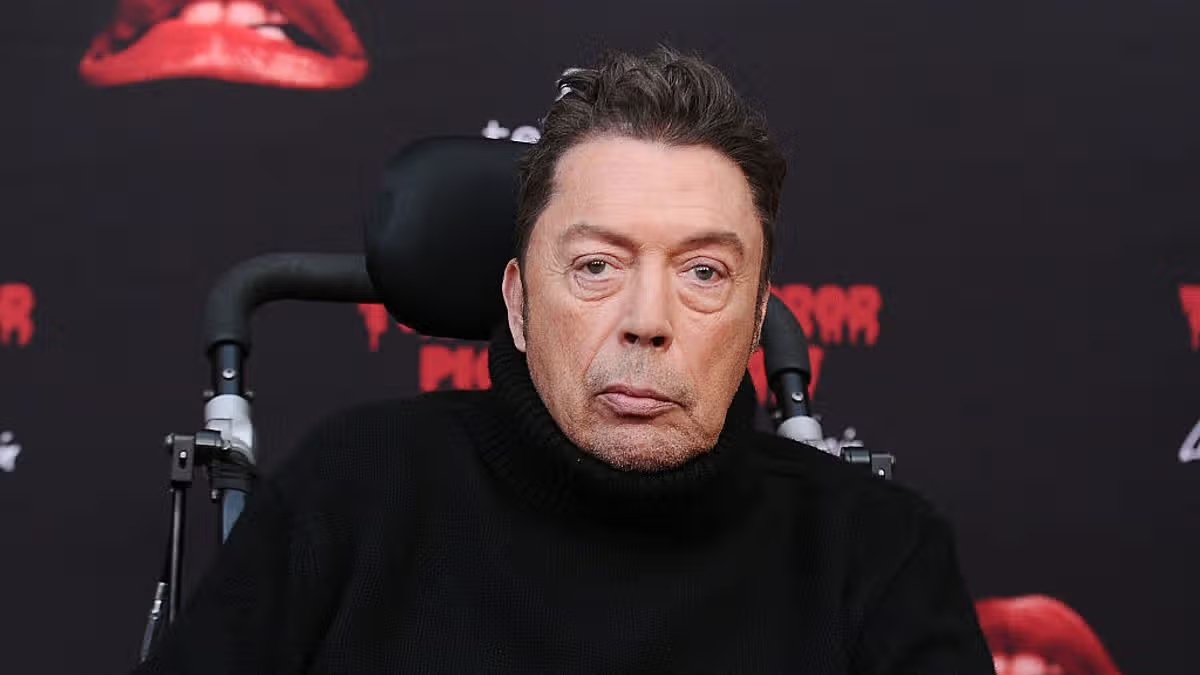
Stroke signs and symptoms as 2012 event changed Tim Curry’s career

Published

on

Daily Record

Tim Curry faced a potentially deadly medical emergency in 2012

Celebrated English actor Tim Curry has died at the age of 80 and while the cause of death has not yet been confirmed, the star had been struggling with his health for years following a medical emergency in 2012 that he didn’t believe was happening at first after dismissing the early warning signs.

Advertisement

In July 2012, the IT actor was getting a massage and felt a little out of sorts but didn’t believe anything was terribly wrong. However, his massage therapist recognised the early signs and called for medical help despite reluctance from the Hollywood star.

A stroke is when blood stops flowing to parts of the brain, it is a life-threatening medical emergency that needs to be treated in hospital as soon as possible. However, the symptoms can differ depending on what part of the brain is affected and why the blood has stopped flowing.

Common early signs include:

Advertisement
  • Face weakness where one side may droop or make it hard to smile
  • Arm weakness, preventing a person from fully lifting both arms and keeping them in the air
  • Speech problems like slurred words or sounding confused

The NHS urges people to remember the acronym FAST, which stands for:

  • Face
  • Arm
  • Speech
  • Time to call 999

In Curry’s case, he had an ischemic stroke caused by blood clots and his brain was so inflamed doctors had to remove bone from his skull. He had to undergo emergency brain surgery and the stroke temporarily took away his ability to speak as well as completely changing the trajectory of his career.

In the years following the stroke, Curry stayed out of the spotlight while undergoing rehabilitation. The next time his fans would lay eyes on him was June 2015 when he appeared at the Actors Fund’s Tony Awards Viewing Party where he received an artistic achievement award.

He attended the event in a wheelchair as he was still dealing with the aftermath of the stroke and would have mobility issues as a result of it for the rest of his life.

While Curry had a cult fanbase for his work on stage and screen, the impairments left by the stroke saw the actor turning towards voice work instead so he could still do the job he loved despite his newfound limitations.

Advertisement

Last year, to celebrate the 50th anniversary of The Rocky Horror Picture Show, the Dr Frank-N-Furter actor revealed he wouldn’t be singing or dancing again anytime soon because he still couldn’t walk 13 years after the stroke.

Source link

Continue Reading

NewsBeat

I went on a pub crawl in Accra, Ghana to experience the city like a local

Published

on

I went on a pub crawl in Accra, Ghana to experience the city like a local

Jamestown is a district of secrets. Accra‘s oldest neighbourhood always seems to have something happening just out of sight. A burst of laughter behind a closed door. Music drifting from a narrow alleyway. A figure disappearing down a shaded alley just before you can properly register them.

The history of this district is on display everywhere you turn. Fishing boats sit beneath colonial-era warehouses and boxing gyms occupy fading merchant buildings. It is intense, intoxicating and oddly magnetic all at once.

Collins, my guide, is about to reveal another secret. Promising a beer, he stops outside a large garage door and knocks twice. A metal latch clanks open from below and we’re beckoned inside. It’s unlike any pub I’ve visited before. Mainly because, until recently, the pub was a a working car wash.

Tourist itineraries often divide cities neatly into attractions, restaurants and nightlife. Accra cannot be defined in this way.

Advertisement
In response to a tourism boom, Accra has a growing number of micro-tours that focus less on major landmarks and more on helping visitors experience everyday life
In response to a tourism boom, Accra has a growing number of micro-tours that focus less on major landmarks and more on helping visitors experience everyday life (Phil Thomas)

Read more: The best luxury hotels in Mauritius

As an increasing number of UK tourists discover Accra, the city has enjoyed a boom in micro-tours that focus less on major landmarks and more on helping visitors experience everyday life, while bringing revenue back into communities that don’t always reap the benefits of increased tourism. Jamestown Walking Tours was among the first to realise the potential in helping visitors experience less-visited neighbourhoods and community traditions.

It’s a warm and breezy April afternoon when I join three others on this walking-cum-pub tour, all of us intrigued by the prospect of exploring a district four centuries old in the company of an expert local guide.

“Most visitors are a bit embarrassed to admit they wouldn’t know where to start a visit here,” says Collins, the co-founder of Jamestown Walking Tours, before we set off. “That, and they’d just get lost”.

Within minutes, we’re threading through a maze of courtyards and alleyways, stepping around tailors stitching sofas, women pounding cassava to make fufu, the ubiquitous starchy dish of West Africa, and coffin makers putting the finishing touches to elaborate wooden caskets. Death is a public matter here.

Advertisement

Obituary posters cover walls and doorways announcing that somebody has “gone on to glory”, or received a “home call”.

Scattered throughout Jamestown is a vast network of chop bars, Ghana’s shorthand for informal pubs. Some operate from front rooms, others from crumbling warehouses or improvised roadside shelters. Outside, men nurse bottles of Club beer while concentrating fiercely on games of chequers. Spectators gather behind them offering a stream of advice and the occasional taunt.

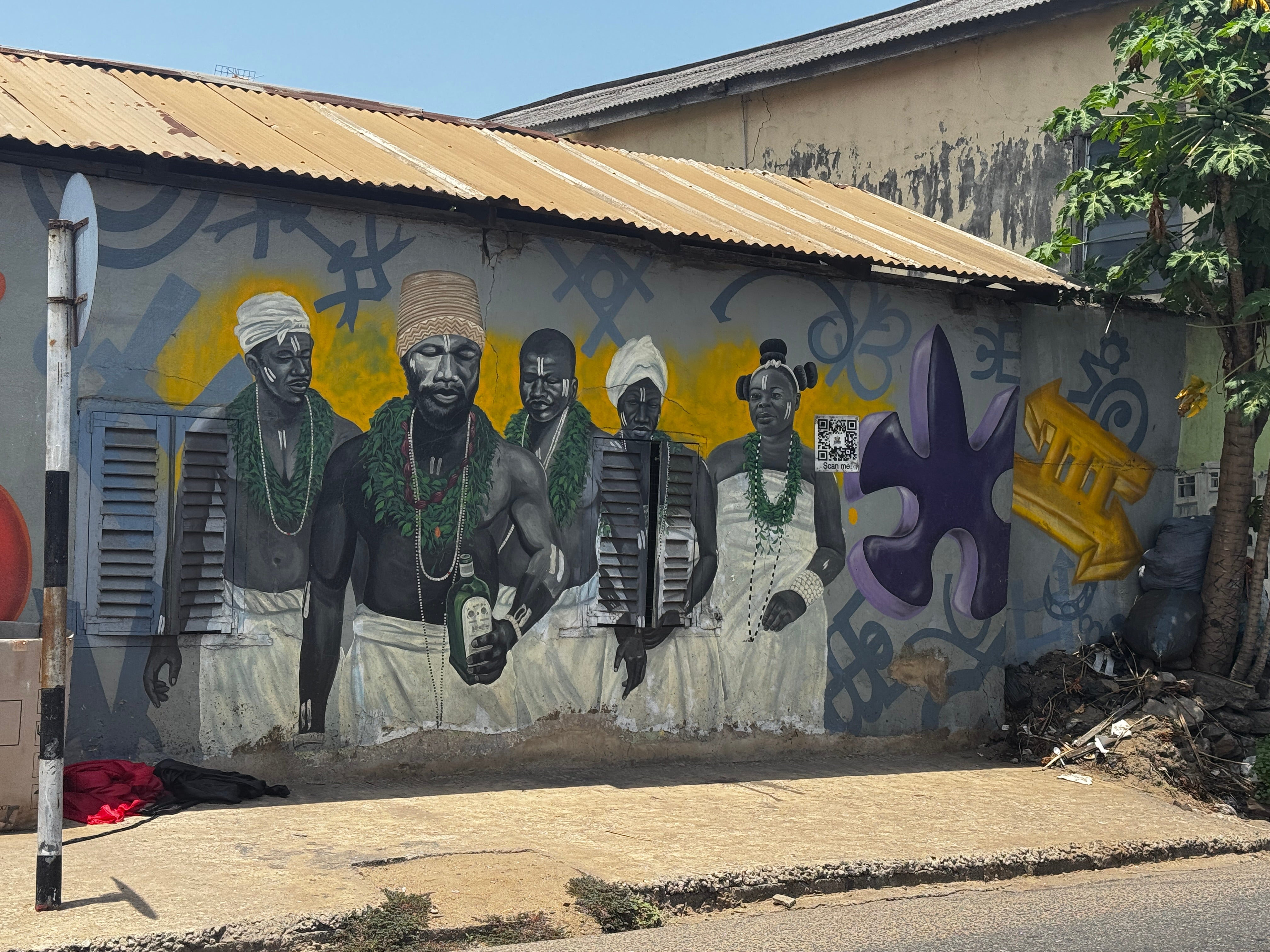
Murals are becoming increasingly common in Jamestown
Murals are becoming increasingly common in Jamestown (Phil Thomas)

Collins hopes bringing visitors here doesn’t just bring economic benefit but also encourages them to seek out more authentic experiences with local residents. He explains this outside a boxing gym called House of Pain, which I hope represents the limit of the participatory element.

After our evening in Jamestown, we’re ready to see another side of the city the following morning.

“Anyone who wants to understand Ghana – I tell them to ride a tro-tro,” says my next guide, Ibrahim.

Advertisement

These minibuses are the circulatory system of the capital, named after the original threepence fare charged during the colonial era. We squeeze aboard alongside women balancing baskets of coconuts on their laps, and giggling schoolchildren in immaculate uniforms.

Most tro-tros are adorned with names and decor reflecting their owners’ interests, which makes for a colourful rush-hour scene. “The Blood of Jesus” and “Inshallah” jostle for space at a junction, until “Pikachu” and “Minnie Mouse” steal ahead of them.

Directly in front of us, we see the slogan “God Is Good”, somewhat undermined by a prominent middle-finger decal. During rush hour, roadside sellers balancing vegetables, drinks and household goods on their heads often move faster than the traffic itself.

Getting off the tro-tro and crossing the street is an equal adventure. The road resembles a torrent of vehicles, weaving into whatever space they can find. Ibrahim explains the trick is to step into the road and just walk steadily in one direction, trusting the traffic will manoeuvre around you. “It’s the closest you’ll get to being Moses,” he laughs.

Advertisement

As the journey progresses, Ibrahim points out murals that have become increasingly common across the city. One transforms a wall into a collage of fishermen, traders and musicians. Another declares “Justice for Africa” with a series of raised fists. The artwork grounds modern Accra in its history while tackling corruption, inequality and the irritations of urban life.

We disembark at Osu Castle which embodies much of Ghana’s complex history. Built as a trading fort and later used in the transatlantic slave trade, it eventually became the seat of government after independence.

The contrast is stark: above former slave dungeons sit the state rooms that later hosted visiting heads of state, including Queen Elizabeth II on a visit in 1961. She brought her own bed.

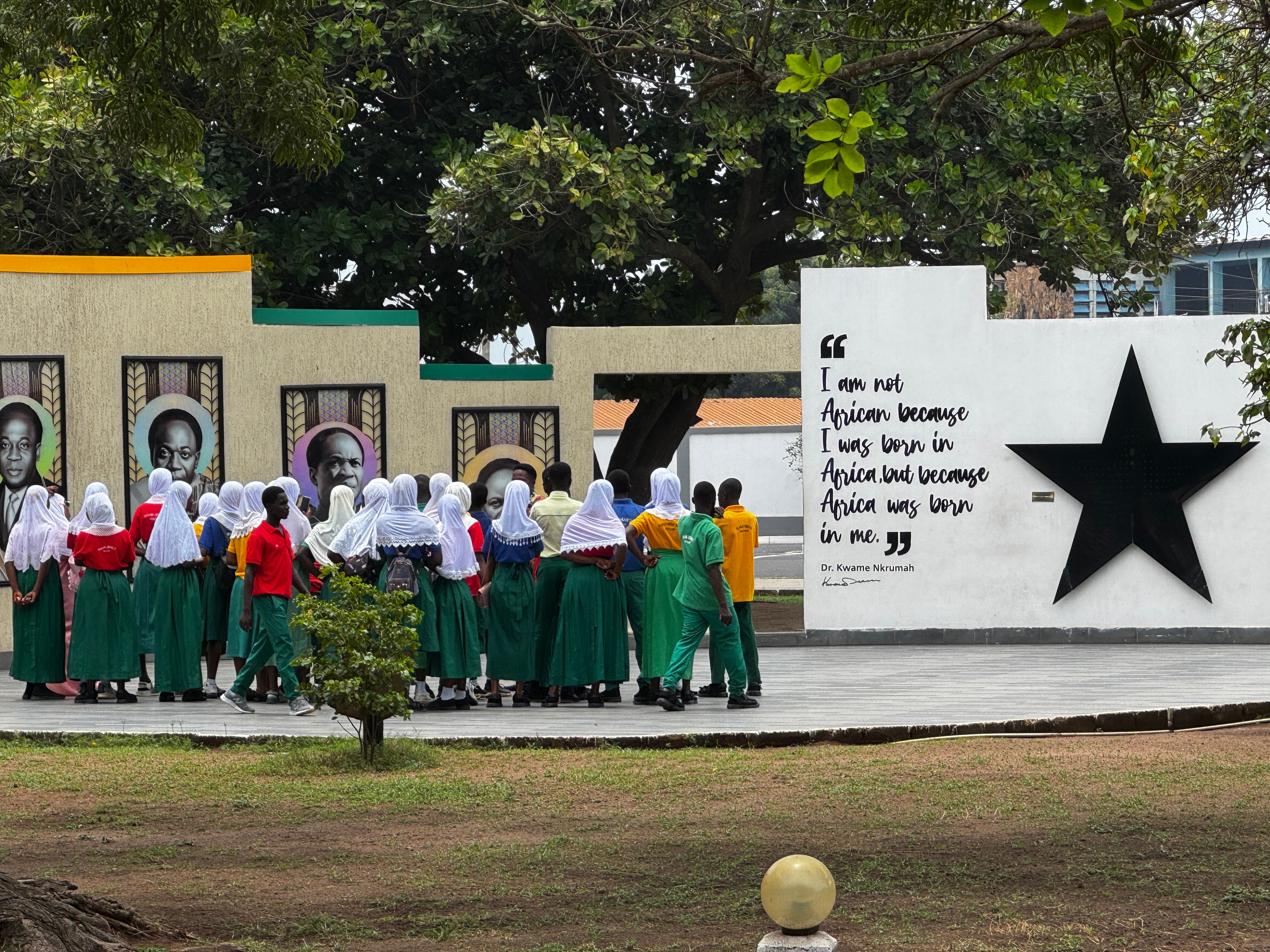
Schoolchildren at the Kwame Nkrumah Memorial Park
Schoolchildren at the Kwame Nkrumah Memorial Park (Phil Thomas)

Read more: Why it’s worth flying to South Africa for winter sun

The influence of Kwame Nkrumah, Ghana’s first post-independence president and leader of the fight to free the country from colonial rule, remains visible throughout Accra, nowhere more so than at the memorial park that bears his name. Beneath a 30-foot bronze statue, Ibrahim recalls his most famous maxim: “Forward ever, backward never.”

Advertisement

“Many visitors come looking for the history of slavery,” he says. “But it’s not the only story – we also want people to understand the history of our independence.”

As Ghana approaches its 70th anniversary of independence in 2027, the first sub-Saharan African country to reach this milestone, it’s a distinction that feels increasingly significant.

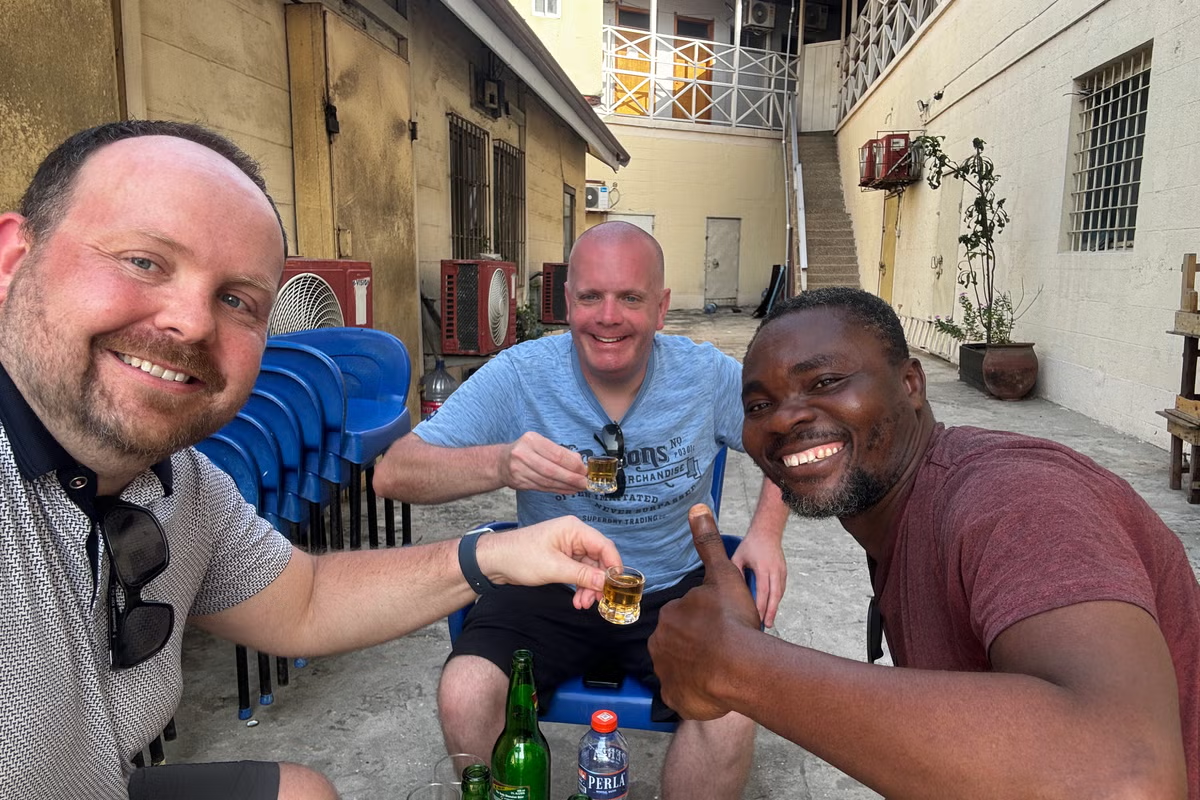
Back in Jamestown with Collins, we have one final stop on our tour. He leads us into what appears to be somebody’s front room, where cases of beer fight family photos and the TV for wall space. Our drink is akpeteshie, a potent spirit distilled from palm sap. Collins explains that in Ga tradition newborn children are presented to the rising sun before a day of celebration begins with those gathered taking a shot of this stuff.

I’m about to say this sounds familiar but he already knows my response. “Yes, it’s like The Lion King,” Collins grins. “But Disney missed the akpeteshie – it’s not a celebration without it.”

Advertisement

Before glasses are raised, a small amount is poured onto the stone floor as an offering to ever-watchful ancestors.

Keshi!” Cheers!

Everyone empties their glass in one movement. The sweetness lasts only a moment before the inevitable burn arrives, which is all too visible on my face.

As laughter ripples around the room, it’s increasingly clear why micro-tours are proving so popular. Visitors increasingly want memorable experiences and, in Accra, such stories aren’t hidden. They’re ever-present across front rooms, tro-tros and the occasional car wash. You simply need somebody willing to share the secret.

Advertisement

Read more: No crowds and comfort throughout – experiencing Africa’s wildest coast

Where to stay

Bays Lodge is located close to the beach and a great budget option, with friendly and attentive staff and breakfast included. Transfers and tours around Accra can be arranged on request. Rooms cost from £25 per night.

Olma Hotel & Suites is extremely popular with couples and offers a pool, lush garden courtyard and thoughtfully decorated rooms. Rooms cost from £65 per night.

Advertisement

The Diamond In City provides large studio apartments, and has a great on-site restaurant serving local dishes, as well as a pool and supermarket. It’s close to the airport with transfers offered. Rooms cost from £95 per night.

How to get there

British Airways flies direct to Accra daily from London Heathrow, with flights starting at £650 one way and lasting around six hours 40 minutes.

How To Do It

Advertisement

UK visitors require a visa to enter Ghana, starting at £60 for a single-entry visa. A yellow fever vaccination certificate is also required.

To get around Jamestown, Jamestown Walking Tours offers different excursions to discover the city, including the Saturday afternoon pub crawl. Tro-Tro tours and Here is Ghana both offer customised city tours of Accra and beyond.

Tro-tros no longer cost threepence but are still by far the cheapest way to get around Accra, with fares between five and 10 cedi (30-60p). Confirm your destination before boarding and pass cash forwards to the driver’s mate. You can read more tro-tro etiquette tips here. For the less adventurous, Uber also operates in Accra, including to and from Jamestown.

Accra – and especially Jamestown – remain largely cash-based. Stock up on cedi early from FX vendors or ATMs. An eSim from Holafly is a sensible way to keep phone roaming costs down.

Advertisement

Source link

Continue Reading

NewsBeat

What went right this week: a ‘pivotal moment’ for cancer research, plus more

Published

on

What went right this week: a ‘pivotal moment’ for cancer research, plus more
London’s Ulez helped children breathe easier

Children in London whose lungs were damaged by air pollution have seen a significant improvement in lung function since the city’s ultra-low emissions zone (Ulez) came into effect, a new study has found. 

The study monitored 3,400 schoolchildren before and after the introduction of the Ulez, which charges motorists of more polluting cars to drive in the capital.  

Researchers found that, pre-Ulez, children in the capital had significantly smaller lungs compared to children living in nearby Luton. However, five years after the Ulez, their lungs were comparable in both size and function with the those of Luton’s children.

Advertisement

The study, led by Queen Mary University of London, noted that the proportion of children with impaired lung function fell from 14% to 9% in London following the introduction of the Ulez, compared with a fall from 9% to 7% in Luton. 

“We already knew that the Ulez reduced air pollution but now we know that children’s lung health has improved at the same time, which is a really important finding,” said lead author Dr Helen Wood, research fellow at the university. 

However, she warned that air pollution in both London and Luton, plus other UK cities, remains above guideline levels. “There is still work to be done,” she said. 

Image: Angel Santana Garcia

Advertisement

Source link

Continue Reading

NewsBeat

Life after: oil – Positive News

Published

on

Life after: oil - Positive News

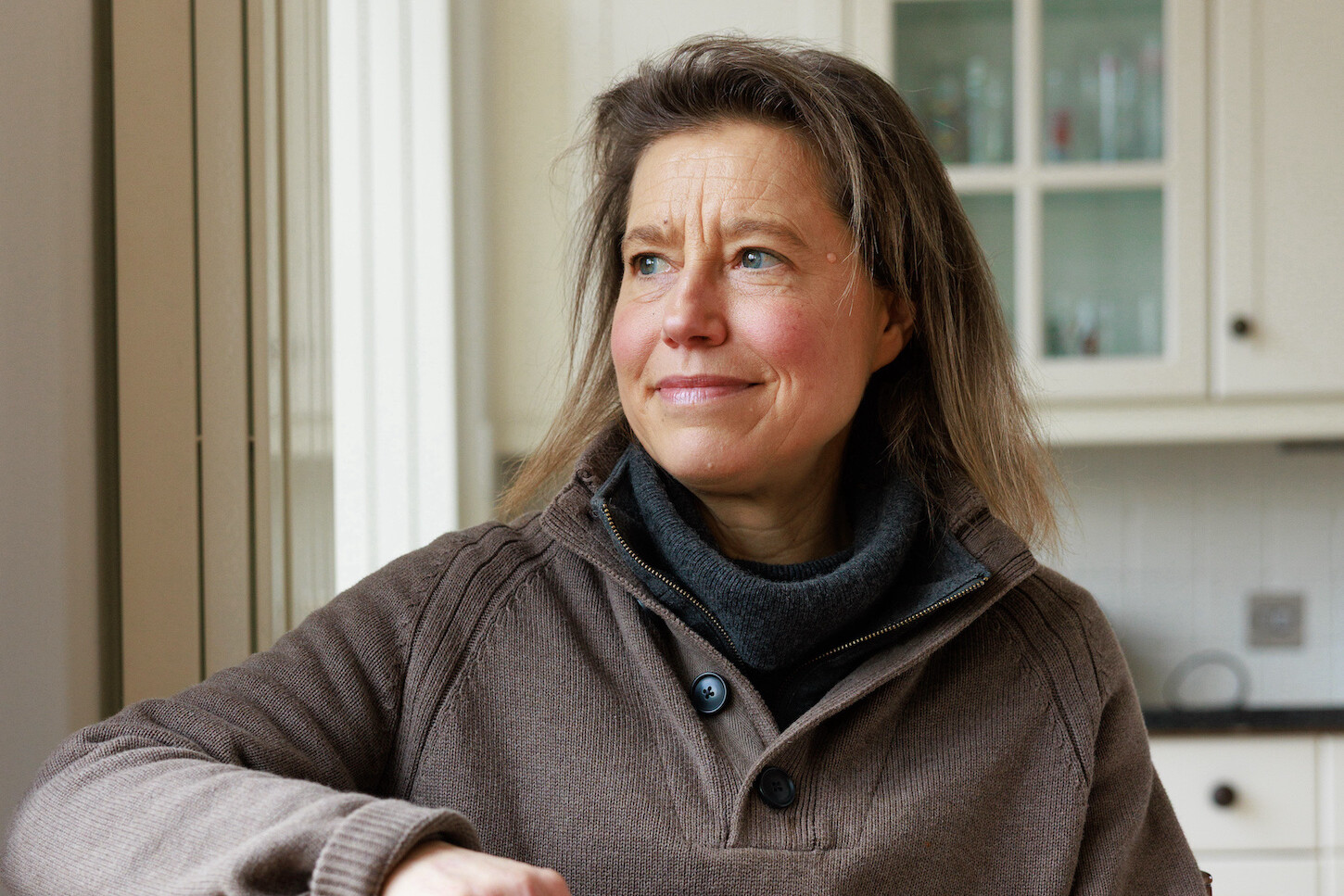
Former oil executive Samantha Cooper once helped power the industry. Now she’s fighting to end its hold on our future

If it’s tough for a society to transition away from oil, it’s tougher still for those whose entire livelihood is tied up with the stuff. Yet as the costs of our addiction to it begin to bite – on our pockets and our planet – an increasing number are doing just that. And giving up a lucrative career as they do so.

Samantha Cooper’s one of them. Back at university in the ’90s, her career aims were simple: get a job in London where she could continue a studenty social life – and get paid for it. Out of the so-called ‘milk round’ of companies who came calling for bright young graduates, she picked oil giant Mobil, and soon found herself just where she wanted to be.

Advertisement

The pay was good, there was a chance to travel, “it was hard work, but it was also fun.” Early on, she was in charge of scheduling barges delivering fuel oil for the Tube network – nice, practical stuff. “Occasionally I’d be sitting with my friends in a pub by the river, and one of my barges would go by – it was rather exciting!”

Solutions every Saturday
Uplift your inbox with our weekly newsletter. Positive News editors select the week’s top stories of progress, bringing you the essential briefing about what’s going right.
Sign up

The appeal more or less held, too, as she won promotion – more responsibility, but a lot more rewards. After BP entered into a joint venture with Mobil’s European fuels business, Cooper went on to become a senior executive, running global trading strategies: a vital cog in a machine that, in her “bubble of ignorance”, as she now describes it, was wrecking the climate

So what changed? No sudden Damascene conversion, but rather the combination of personal pressure and dawning awareness. The Deepwater Horizon oil spill in 2010, oil traders in America going to prison for price fixing, hearing that the crew on a ship whose cargo she was trying to sell had run out of water – “I thought, ‘Oh, there’s people on the boat.’ Which sounds ridiculous. Of course there’d be people…” But her surprise was a measure of just how disconnected she’d become from the real, physical world.

Advertisement

Meanwhile, “I felt I was on a treadmill, and I couldn’t get off.” Metaphorically and literally: she’d be up at six, on the treadmill in the gym, before a pressure-packed day. Work bled into all areas of life. Even over Christmas, every news headline triggered one thought in her head: “What’s that going to do to the oil price?”

After 20 years in the oil industry, Cooper is now the director of Business Declares, which aims to inspire corporates to address the “polycrisis” brought about by the climate, ecological and social emergency

Advertisement

“However much money you made, your [sales] targets were always going up, year after year.” One year, she recalls, she hit her target, and thought,“‘I should be on top of the world. Why don’t I feel that?’ I just felt empty.”

Shocked into reviewing her life, she explored mindfulness, finding solace in Buddhist meditation. She was able to take some time out to volunteer with women’s and environmental groups. Ostensibly mentoring them on building partnerships with business, and on raising funds, she quickly found that “they were mentoring me! I had such an education from some amazing people, on social issues, equality, ecology and climate.”

The things she learnt, combined with the personal toll the job was taking on her, made it impossible to go back. So in 2015, after 20 years in the oil industry, she left and, with the same energy and drive that had made her such a successful oil trader, threw herself into a new career tackling the challenges which, inadvertently, she’d helped to exacerbate through her work.

I took a risk in leaving but I found such freedom by doing so. And I’m an awful lot happier with a lot less

She’s now the director of Business Declares, which aims to inspire corporates to address the “polycrisis” brought about by the climate, ecological and social emergency. And she’s lent her weight to Life After Oil – a new network of former oil executives who are determined to prove to colleagues still in the industry that, like Cooper, they can leave too.

Advertisement

It commissioned research by the University of Bath, which showed that a wave of oil and gas workers are either leaving the industry, or considering doing so, in part because of concerns over climate change and their company’s glacial speed of response to the threat. According to the research lead, associate professor Grace Augustine, many of those who’ve left feel “a lightness, a sense of relief” at not having to perform the “mental gymnastics” required to square their growing awareness of the threat with the requirements of their day job.

It’s a sentiment echoed by Cooper. “People ask if I took a risk in leaving but I found such freedom by doing so. And I’m an awful lot happier with a lot less. The biggest risk is to stay put.”

Photography by Joanne Crawford

Advertisement

Source link

Continue Reading

NewsBeat

Vin Diesel leaves Dolly Parton fans speechless with musical tribute to late country icon

Published

on

Vin Diesel leaves Dolly Parton fans speechless with musical tribute to late country icon

Vin Diesel singing a Dolly Parton cover probably wasn’t on many people’s bingo cards after news of the country icon’s death broke this week, but such was her influence.

Since Parton’s death at 80 on Tuesday, which came after a “brief battle” with cancer, public figures from across the globe have paid tribute to the “Jolene” singer.

Few, however, have been as unique as Diesel’s.

On Wednesday, The Pacifier star, 59, shared a clip on Instagram of himself singing a soft and slow rendition of Parton’s 1974 romantic classic, “I Will Always Love You,” which became a global phenomenon in 1992 with Whitney Houston’s cover she recorded for The Bodyguard.

Advertisement

Played over a black and white photo of Parton’s face, fans were left speechless by Diesel’s soulful, emotional performance.

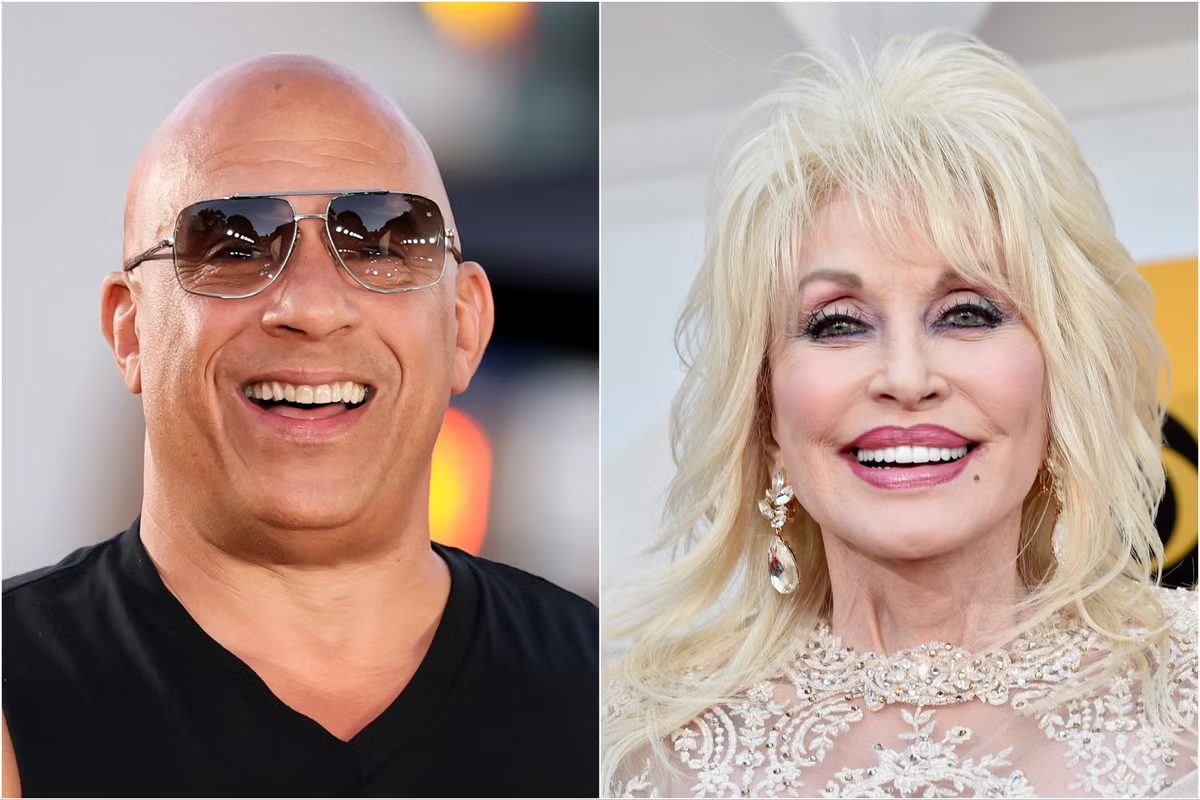
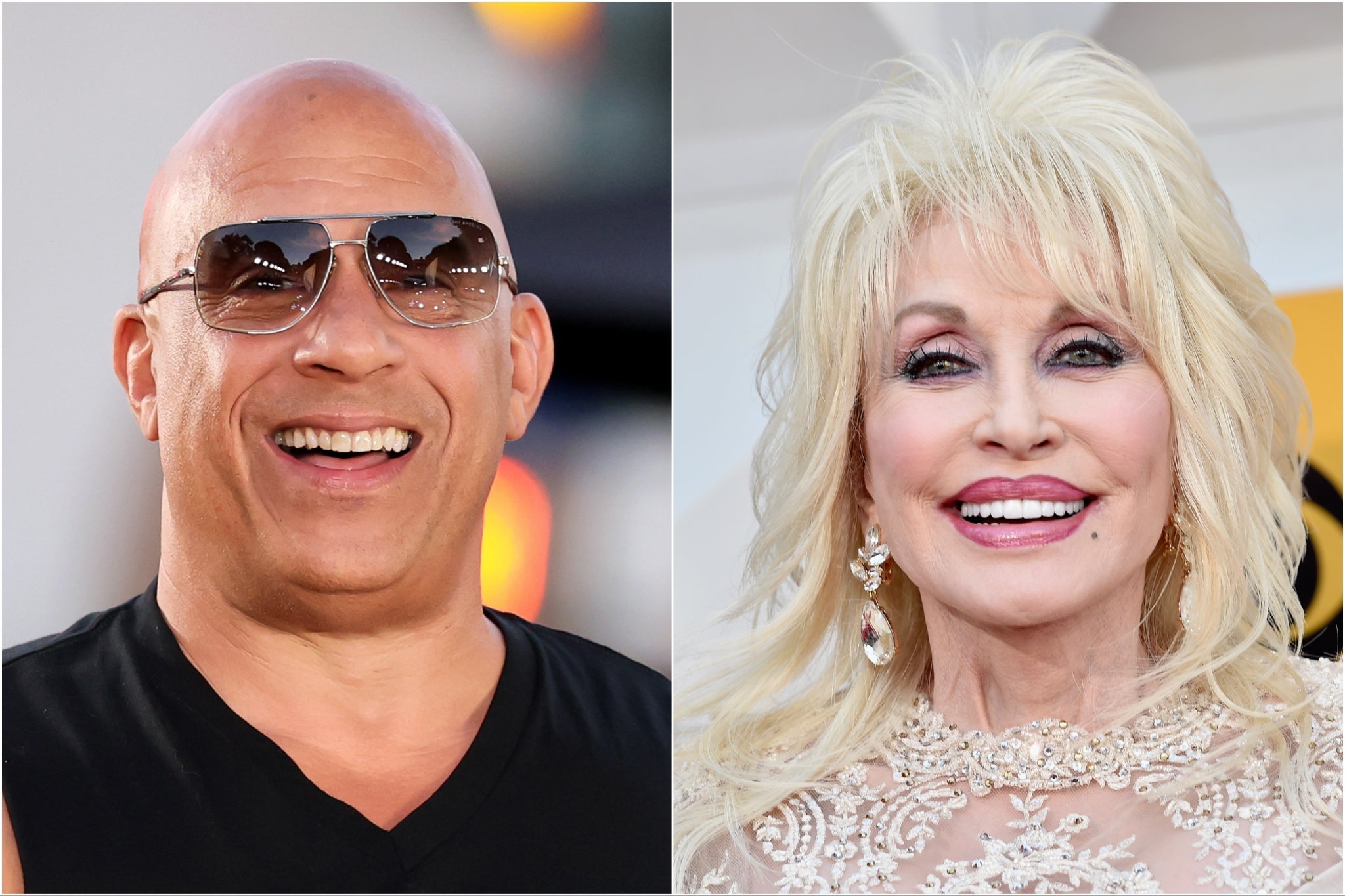
Vin Diesel has paid homage to Dolly Parton with an emotional rendition of ‘I Will Always Love You’
Vin Diesel has paid homage to Dolly Parton with an emotional rendition of ‘I Will Always Love You’ (Getty)

The post was quickly reshared on X, where it received some light mockery mixed with genuine awe.

“That’s what Groot been saying all this time,” one person joked, referring to the actor’s Guardians of the Galaxy character.

“Dolly Parton got Vin Diesel singing and it its a damn serious tribute i don’t think i quite understood her impact,” added another.

Advertisement

“This the most honest and vulnerable thing I’ve heard in my entire life,” wrote a third.

“Please release the full version on streaming,” another person begged.

“Didn’t have ‘Crying to Vin Disel singing’ on my list today but here we are,” wrote a fifth.

Parton’s influence spanned all musical genres. After her death, rapper Eminem shared a heartfelt note he received from Parton in 2022 after he was inducted into the Rock & Roll Hall of Fame.

Advertisement
Amazon Music logo

Enjoy unlimited access to 100 million ad-free songs and podcasts with Amazon Music

Sign up now for a 30-day free trial. Terms apply.

Try for free

ADVERTISEMENT. If you sign up to this service we will earn commission. This revenue helps to fund journalism across The Independent.

“Even though I don’t know a lot about rap music, I’ve come to know that you are the very best at it,” the country star wrote in the note. “Aside from that I hope what I have to say will not seem weird or strange to you but I have always felt some unexplained connection to you like I know you somehow.

Advertisement

“I had hoped to meet you at the show but you know how nuts those things are, personally I hate ‘em and I missed my chance but maybe someday we’ll meet,” she continued. “In the meantime, keep doing what you’re doing because you do it so well and no matter how complex your world may be just know you are very special and touch people in ways you don’t even know. With love & respect, Dolly Parton.”

However, not everyone’s homages to the late “9 to 5” singer have been well received.

Ricky Schroder — who played Parton’s father in the TV movies Dolly Parton’s Coat of Many Colors (2015) and its 2016 sequel, Dolly Parton’s Christmas of Many Colors: Circle of Love — is facing intense criticism for politicizing his tribute.

“I didnt agree with her advocating for Transgender & Covid Vaccine support…but Loved her anyway. Thank you for choosing me Dolly to be your Movie Daddy,” Schroder wrote on Instagram.

Advertisement

A number of celebrities were quick to call out the actor for sharing transphobic and anti-vaccine rhetoric in his supposed tribute to Parton.

“Ick,” Katie Couric wrote on Threads.

“Oh shut up,” Boy George responded on Instagram.

Lioness actor Jay Huguley added: “‘I loved her anyway’ what a strange tribute. Good Lord.”

Advertisement

Parton’s family have said she will have a small private funeral with no confirmed plans for a public memorial.

Source link

Advertisement
Continue Reading

NewsBeat

How to fold down a pop-up tent in 60 seconds

Published

on

How to fold down a pop-up tent in 60 seconds

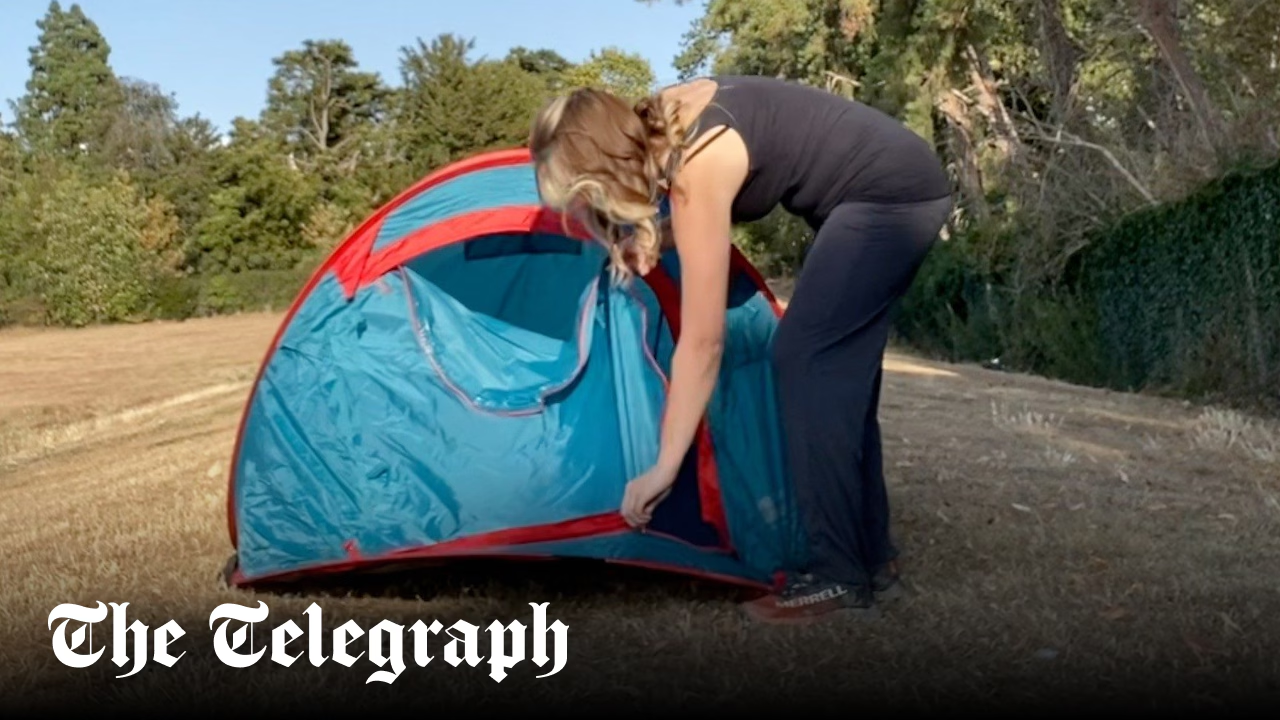
A pop-up tent can be pitched in seconds and, theoretically, taken down in less, making them perfect for music festivals, casual camping or even waiting in the queue at Wimbledon overnight.

Their problem is that they’re not actually as easy to put away as they should be. Angle it right, and the tent folds away as easily as it popped up. Approach without a plan, and you’ll find yourself wrangling with a seemingly live tent that refuses to fold back into its circular bag.

Here’s my step-by-step guide on how to put away a pop-up tent in less than 60 seconds, to help you avoid that problem. Watch the video to see exactly how I do it. 

Advertisement

1. Unzip the doors

This is to let any air escape. Otherwise, you’ll find it balloons out as you try to fold it.

2. Gather the poles

Find the highest arch on both sides, then pull them together into the middle.

Source link

Advertisement
Continue Reading

NewsBeat

Vehicle smashes into wall outside house near A66 crash and house fire | News UK

Published

on

Vehicle smashes into wall outside house near A66 crash and house fire | News UK
The site of the crash (Picture: Owen Humphreys/PA Wire)

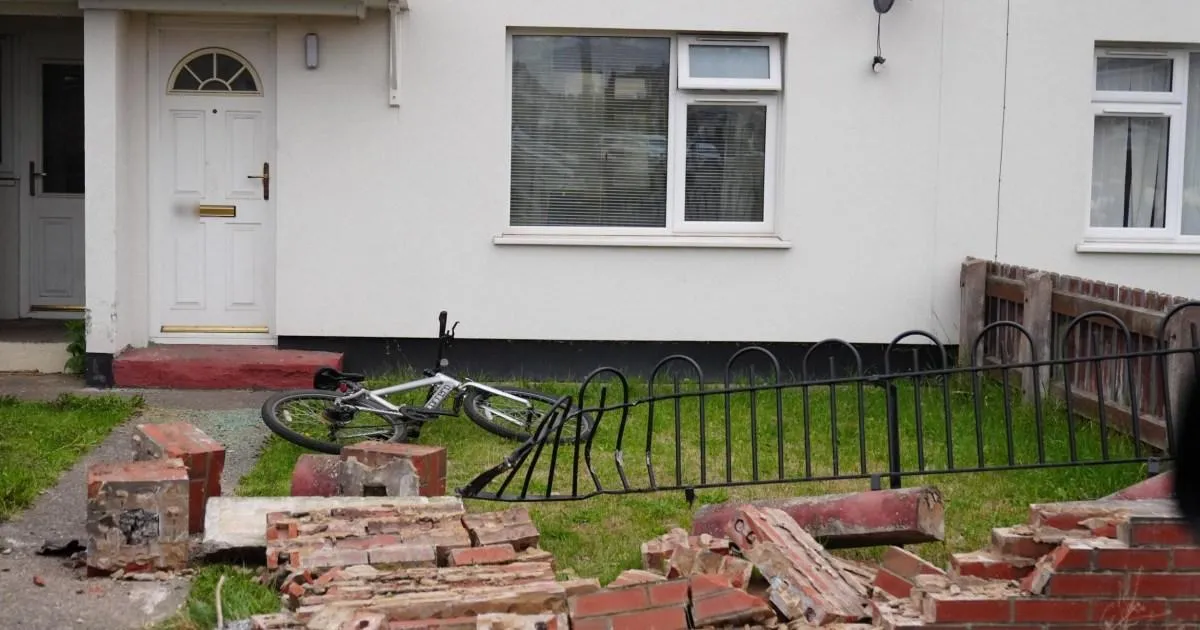
A vehicle has smashed into a wall outside a property minutes away from the site of the A66 crash and subsequent deadly house fire near Middlesbrough.

The incident took place in the early hours of Thursday morning at a house on Steele Crescent, South Bank.

It is located near the site of a crash on the A66 which killed seven people on Saturday, and a house fire in Grangetown on Wednesday, where a seven-year-old girl and her aunt died.

Officers from Cleveland Police were called to the house – which was empty at the time – after 12.30am on Thursday.

Advertisement

An investigation has been launched and police have not confirmed whether there is any link between the previous two incidents and today’s crash.

Sign up for all of the latest stories

Start your day informed with Metro’s News Updates newsletter or get Breaking News alerts the moment it happens.

The scene at Steele Crescent, South Bank, as police are investigating reports of a vehicle crashing into a wall at a house near Middlesbrough. The property, is close to the scenes of a crash on the A66 in which seven people died on Saturday, and a house fire in Grangetown, where Valentina Foster, aged seven, and Natalie McDonald, 34, died on Wednesday morning. Picture date: Thursday August 27, 2026. PA Photo. Photo credit should read: Owen Humphreys/PA Wire
Police have launched an investigation into the crash (Picture: Owen Humphreys/PA Wire)
Valentina Foster, 7, and her aunt Natalie McDonald, 34, died in the fire on Wednesday morning https://www.facebook.com/photo/?fbid=1070911622087986&set=a.154874730358351 Middlesbrough house fire: Two arrested after girl, 7, and aunt die
Valentina Foster, seven, and her aunt Natalie McDonald, 34, died in a fire on Wednesday morning

Local policing Superintendent Emily Harrison said: ‘The property was empty at the time and we have not currently received any reports of any injuries.

‘Officers are conducting inquiries to establish the circumstances surrounding this incident.

‘Our investigation is in its early stages and it has not yet been confirmed whether this incident is linked to wider organised crime.’

Advertisement

The crash occurred the same morning that inquests were opened into the deaths of two police officers who were among those killed when their vehicle was hit by a car driving the wrong way down the A66.

PC Matthew Blades, 37, and PC Tom Clough, 38, died in the resulting head-on collision with a Volkswagen Passat on Saturday.

Undated handout photos originally issued on 23/08/26 by Cleveland Police of PC Tom Clough (left) and PC Matthew Blades, who died when a car going in the wrong direction hit a police car on the A66 near Middlesbrough. Inquests will open on Thursday for the two police officers and five young men who died in a head-on collision on the A66. The hearings come as detectives continue to question two men who were arrested on suspicion of murder after a house fire in Grangetown, around a mile from the crash site, killed two people, including a child, on Wednesday morning. Issue date: Thursday August 27, 2026. PA Photo. Photo credit should read: Cleveland Police/PA Wire NOTE TO EDITORS: This handout photo may only be used in for editorial reporting purposes for the contemporaneous illustration of events, things or the people in the image or facts mentioned in the caption. Reuse of the picture may require further permission from the copyright holder.
PC Tom Clough (left) and PC Matthew Blades (right) were pronounced dead at the scene (Picture: Cleveland Police/PA Wire)

Teesside Coroners’ Court heard that ‘all occupants of both vehicles were sadly pronounced dead at the scene’.

In short, consecutive hearings, coroner Paul Appleton said Pc Blades was identified by his wife, and Pc Clough by his partner.

The provisional cause of death was said to be head and neck injuries for Pc Blades, and neck injuries for Pc Clough.

Advertisement

Mr Appleton said: ‘At this stage it is understood that there had been a police pursuit of the Volkswagen Passat.

‘It entered the A66 carriageway against the flow of traffic, at which stage the pursuit was aborted.

‘A short time after… the Volkswagen Passat collided with a police vehicle, which had not been directly involved in the prior pursuit.’

Five victims of the A66 crash killed in side the Volkswagen Passat
Inquests will open into the deaths of five young men killed in the collision

Inquests will open this afternoon into the deaths of the young men who were in the Passat during the collision – Cole Worthy, 17, Theo Rae, 17, Makai Saddington, 18, and 23-year-olds Michael Robert Cahill and Jacob Matusiak.

On Wednesday, seven-year-old Valentina Foster and her aunt Natalie McDonald, 34, died following a fire at a house in Grangetown.

Advertisement

Tributes have been left outside the property, including flowers and toys, plus a photo of the pair and the words: ‘RIP Natalie and Valentina you will be missed.’

A teddy bear was left with a note which said: ‘Now she dances with butterflies Valentina.’

Emergency services at the scene as a murder investigation has been launched after two people died in a house fire at a property on Birchington Avenue, Grangetown near Middlesbrough. Picture date: Wednesday August 26, 2026. PA Photo. Photo credit should read: Owen Humphreys/PA Wire
The site of the house fire in Grangetown (Picture: Owen Humphreys/PA Wire)

Prime minister Andy Burnham has said the government is offering ‘all of the support that the authorities need’ following the house fire.

‘The important thing, it’s a terribly tragic event that’s happened with the loss of a young woman and her seven-year-old niece,’ he said.

He continued: ‘Utterly devastating, and I’m sure there’s a whole community that is grieving, not just what happened at the weekend, and particularly we should stress our deepest respect for the police officers lost in the line of duty and sending our sympathies to their families.

Advertisement

‘And we will obviously make sure that the support is there for them going forward.

‘The only thing I can say this morning is there is an investigation under way. It will be the fullest possible investigation. The authorities will have all of the support that they need.

‘We do need to understand the extent to which they may be connected, but they may not be. So I think it’s too early to jump to conclusions.

‘But what we can say at this point in time is that all of the support will be provided to get to the heart of what has happened here.’

Advertisement

Police have arrested 17 people following the crash as part of investigations into alleged organised crime. Two have been charged and the others have been bailed.

Police have previously said the five young men in the Passat may have had links to ‘serious and organised criminal activity’, with four having previous convictions.

Advertisement

Source link

Continue Reading

Trending

Copyright © 2025