Connect with us

Tech

Nvidia posts another record quarter, predicts explosive AI-driven growth will last through 2028

Published

on

The takeaway: Nvidia this week reported blockbuster results for the quarter ending in July 2026 and issued ambitious revenue guidance that topped Wall Street consensus estimates. The company’s stock jumped more than 7% in early trading on Thursday after Nvidia confirmed that it expects demand for high-end AI accelerators to remain strong in the near future.

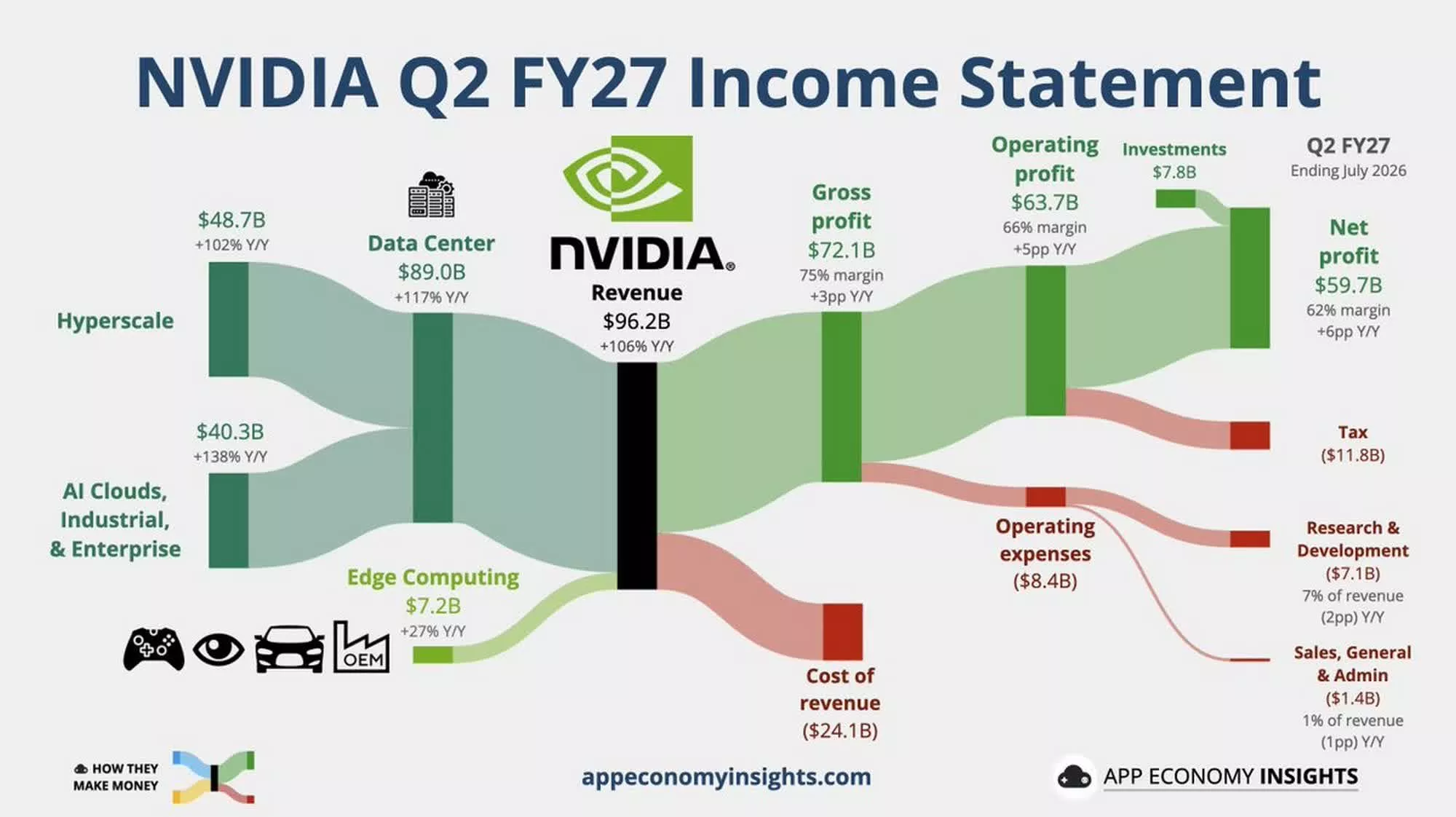
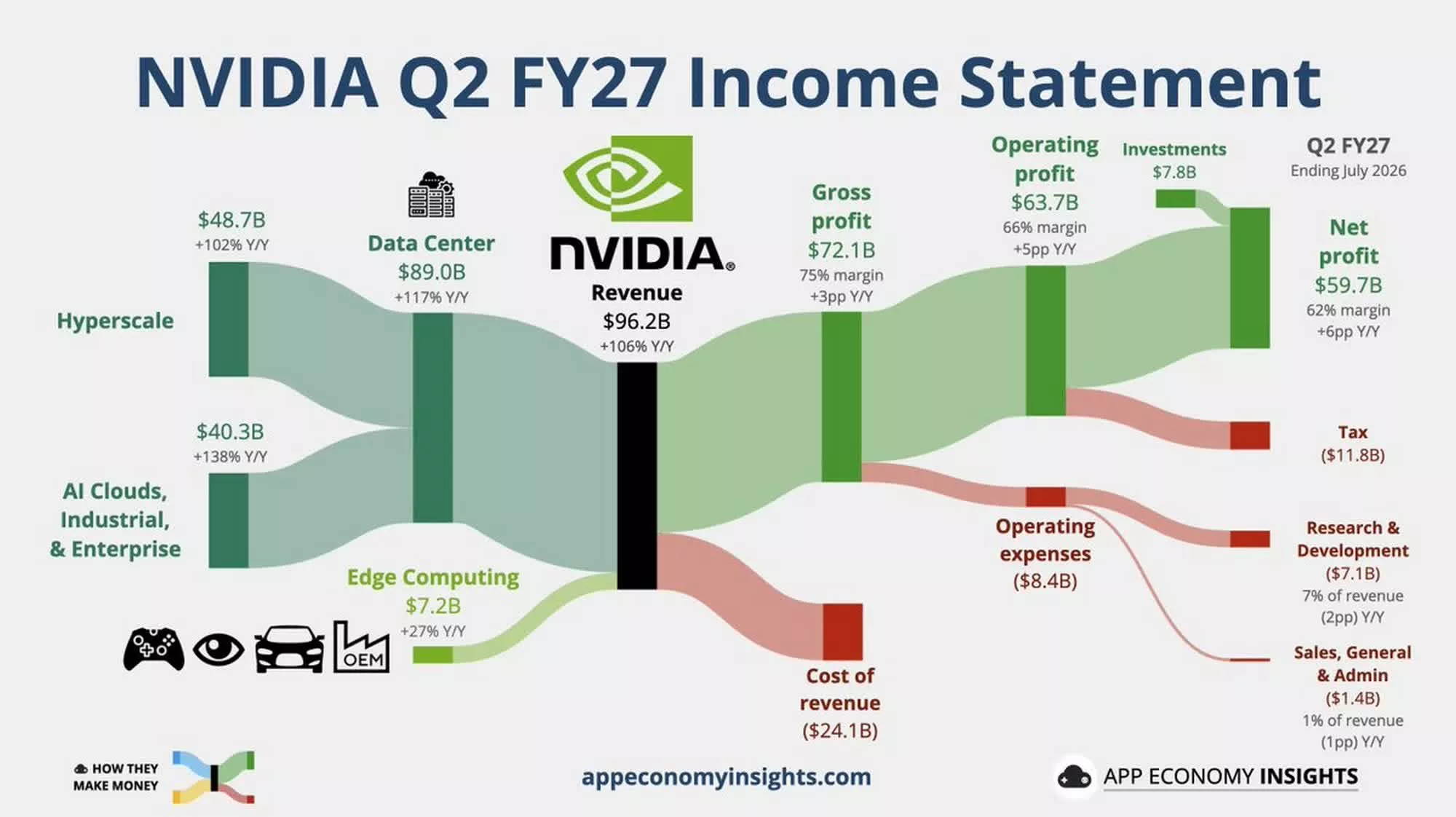
According to Nvidia’s official filing with the SEC, quarterly revenue for the three-month period ending in July 2026 reached $96.22 billion, beating the $91.90 billion expected by Wall Street. Net income more than doubled to $53.95 billion, up from $24.76 billion in the previous quarter. Adjusted earnings came in at $2.22 per share, higher than the $2.08 expected by analysts.

Credit: App Economy Insights

In the current quarter, Nvidia expects revenue to reach around $108 billion. The projection is largely in line with analyst estimates, with most banks and brokerage firms forecasting sales between $105.2 billion and $110 billion. In fiscal 2028, the company expects revenue to grow by around 70%, significantly higher than the 45% projected by analysts.

Advertisement

Speaking to reporters during a post-earnings conference call, Nvidia CFO Colette Kress claimed that demand for AI accelerators is seeing an uptick among data center customers, despite warnings from many institutional investors about a potential AI bubble. “Customers’ forecasts point to our growth doubling next year,” she added.

During the same conference call, Nvidia CEO Jensen Huang noted that the company’s next-generation AI accelerator, codenamed Vera Rubin, is now in production. The so-called AI “Superchip” was officially unveiled at CES 2026 in Las Vegas in January after being showcased at the company’s GPU Technology Conference (GTC) in Washington last October.

The ambitious projections and assurances from Nvidia’s top executives regarding continued demand for AI hardware appear to have eased some investor concerns about a potential AI bubble. However, uncertainties remain over the supply constraints faced by Nvidia’s main contract manufacturer, TSMC, as well as the rising cost of high-bandwidth memory.

Nvidia made its name as a GPU designer for gaming PCs and professional workstations, but its recent pivot to AI chips has propelled its market capitalization to more than $5 trillion. The company is now preparing to expand its AI hardware business beyond data centers and into the consumer market by teaming up with Perplexity to launch the “Portable Computer” AI agent, which is designed to run locally on PCs and workstations.

Advertisement

Source link

Continue Reading
Click to comment

You must be logged in to post a comment Login

Leave a Reply

Tech

The 5 Top-Rated Electric Lawn Mowers For 2026

Published

on


We may receive a commission on purchases made from links.

Getting a new mower is a big purchase, and there are many options to consider before you buy. One of the first major choices you’ll have to make is whether you’ll go gas or electric. Traditional wisdom would have you believe that there is no substitute for gas power, but battery-powered motors have come a long way in recent years. This isn’t just about speed and torque, either. There are several other good reasons to replace your gas-powered lawn mower with an electric one. They’re quieter, require less maintenance, have lower operating costs, offer push-button startup, and many are self-propelled. Not to mention the fact that you can save yourself those early morning trips to the gas station when the can runs empty.

Advertisement

Those considering an electric mower might want to know a bit more about what options are out there. One of the best ways to get a feel for the overall quality of any tool is to take a look at its reviews. By examining user feedback on retail sites with aggregate rating systems like Amazon, Home Depot, and Lowe’s, as well as professional reviews from sites that perform extensive product testing, you can get a much better idea about which of the most popular mowers on the market today live up to the hype and might be worth considering for your lawn.

Advertisement

5. Milwaukee M18 Fuel 21-inch Dual Battery Mower

Milwaukee is a well-known power tool brand, but many people might not realize the company also makes one of the most well-regarded electric mowers. The Milwaukee M18 Fuel 21-inch Dual Battery Mower is a self-propelled walk-behind mower powered by the brand’s incredibly popular M18 battery system, making it an attractive option for anyone who has already invested in the platform. It’s also part of Milwaukee’s line of pro-grade Fuel tools, meaning that it has a brushless motor and several other smart features. It currently retails for $799.00 for the bare tool or $1,199.00 for a kit with two M18 12.0Ah batteries and a charger.

This mower has a 4.4 out of 5 rating on the Home Depot site as a standalone tool, with over 1,200 reviews (several kits getting even higher scores), making it the highest-rated non-Ryobi model on the site. Customers praise the mower for its power, quiet operation, build quality, battery life, cut quality, and features. They particularly seem to like its multi-speed propulsion system and easy height adjustment. The relatively few complaints appear largely inconsistent, with some criticizing the very cut quality and battery life that others praised, and others citing shipping damage or broken parts.

Kenny Koehler, editor-in-chief of Pro Tool Reviews, gave the mower a 9.7 out of 10 in his review. He argued that it’s one of the few options on the market that offers true gas-replacement power, calling it “the most capable professional-grade battery-powered option currently available.” Andrew of Tool Guyd appears to have had a similarly positive experience. He stated in his review that the mower is well-built, comes together easily, and delivers high-quality cutting performance.

Advertisement

4. Toro 60V 22-inch Recycler Walk Behind Mower

Those who primarily shop at Lowe’s or Ace Hardware will find a slightly different selection than those looking at Home Depot or Amazon. These shoppers might want to take a look at the Toro 60V 22-inch Recycler Walk-Behind Mower. This tool has a specialized Recycler cutting system that turns lawn clippings into a fine mulch that fertilizes as you mow. It promises to cut up to half an acre in its 53-minute runtime on a single charge, and it has dual LED headlights and an auto-drive propulsion system. It comes in a kit that includes an 8.0 Ah battery and retails for between $679.00 and $699.00 depending on where you get it.

This mower has a 4.5 out of 5 on the Lowe’s website and a matching score on Ace Hardware, both of which feature over 1,300 reviews. Customers generally seem pleased with its cutting performance, particularly in the mulching setting for which it gets its name. They also like the ease of use of the push-button starter and the self-propulsion system. There have been a few mixed reviews about its ability to meet the promised runtime, but the overall consensus is positive.

Advertisement

Josh McGaffigan of Pro Tool Reviews gave this mower a 9.3 out of 10 in his review. He claimed that the simplicity of its design made it easy to use, and that it offers solid performance and a top-tier mulching and bagging system. In our review of this electric lawn mower, we stated that it is well worth the price and is easily one of the best pieces of lawn equipment.

Advertisement

3. Greenworks Pro 80V 21-inch 3-in-1 Self Propelled Mower

Another name that often appears on lists of the best major electric lawn mower brands is Greenworks, which is known for offering a more budget-oriented range of pro-grade outdoor tools. One of its most popular models is the Greenworks 80V 21-inch 3-in-1 Self-Propelled Mower. This high-voltage mower has mulch, bag, and side discharge settings, a multi-speed self-propulsion system, and a push-button starter. It’s sold as a set that comes with an 80V 4.0Ah battery and charger for between $499.00 and $599.00 depending on where you get it. This promises to cover up to ⅓ acre and to run for up to 45 minutes on a full charge.

The mower has a 4.5 out of 5 on Lowe’s site, and a 4.6 on Amazon, where it has over 1,900 reviews. Customers are generally impressed with the mower’s raw power and battery life, stating that it can cut through thick grass that other battery-powered mowers might struggle with. They also note that it’s lightweight and easy to maneuver, though a few have reported it struggles a bit with taller grass.

David Dritsas of Popular Mechanics argued that this mower is just as capable as a standard gas push mower in terms of performance and speed, also noting that the steel cutting deck adds a measure of durability. McGaffigan tested this one for Pro Tool Reviews as well. He specifically commented on the impressive utility of the tool’s powerful Turbo Mode and stated that it’s a great all-around mower for just about any type of lawn.

Advertisement

2. Ryobi 40V HP Brushless 20-inch Self-Propelled Mower

As Home Depot’s affiliated power tool brand, Ryobi is broadly known for offering powerful tools at reasonable prices. The same goes for the brand’s electric mowers. Ten of the top-rated listings for electric push mowers on the Home Depot site are variations of two different 40V Ryobi mowers. The 40V HP Brushless 20-inch Self-Propelled Mower is the highest-rated option, with listings for the $409.00 stand-alone tool, a $499.00 kit that includes an 8.0Ah battery and charger, a $439.00 kit with two 6.0Ah batteries and chargers, and a $528.97 kit with a 6.0Ah battery, charger, and cover. Ryobi states that this model delivers power equivalent to a 150cc gas mower and is ideal for a ½-acre lawn, with a runtime of 40 minutes.

All of the aforementioned listings have scores between 4.5 and 4.6 out of 5, with over 4,500 reviews between them. Reviewers generally stated that the mower is quiet, lightweight, easy to use, and that the adjustable self-propulsion system is a welcome addition. A few of the more critical reviews have argued, however, that this propulsion system can drain the battery quickly.

Advertisement

This is yet another mower that McGaffigan tested for Pro Tool Reviews, awarding it a 9.7 out of 10. He said that this latest model has made significant improvements over Ryobi’s past electric mowers, giving it strong cutting power, a long runtime, and several premium control options. Dave Farquhar of The Silicon Underground was a bit more critical, noting that it could occasionally be bogged down at lower settings and isn’t the best for mulching, but was generally impressed with the overall performance, particularly given the price point.

Advertisement

1. Ego Power+ 800 Series 56V 21-inch Select Cut Mower

Look on just about any site that sells electric mowers, and you’re likely to find that the Ego Power+ mower is the top-rated option. These are particularly well known for their exceptional battery life, but they tend to score well in just about every other category. The Ego Power+ 800 Series 56V 21-inch Select Cut Mower is one of the most popular models on the market. Its Select Cut multi-blade system allows you to customize the three interchangeable lower blades: a mulching blade, a high-lift bagging blade, and an extended runtime blade. It promises 60 minutes of runtime on a single charge from the included 7.5 Ah battery. You can get the mower with this single battery and charger for $749.00, or you can get it with an extra backup 5.0Ah battery for $1,089.61.

The two-battery kit with this mower is the top-rated option on Amazon, with a score of 4.7 out of 5. The single-battery option is also one of the top models on Lowe’s, where it enjoys a healthy 4.6 out of 5 rating, averaged from over 30,000 reviews. Buyers generally find that the mower is a strong performer with a bevy of different options. They like its quiet operation, strong cutting ability, and long runtime.

Clint DeBoer of Pro Tool Reviews gave this one a 9.4 out of 10, stating that it demonstrated an excellent blend of run time and raw performance while offering excellent mulching and bagging capabilities. Clark Tate of GearLab likewise said, “It will plow through thousands of square feet of shaggy turf and whack down the toughest weeds,” claiming that it was one of the publication’s favorite lawn mowers that they’d ever tested.

Advertisement

How we listed these mowers

There are many different mowers out there, and one of the best ways to assess quality is to look at both consumer reviews on retail sites with aggregate rating systems and professional reviews from journalists who have conducted rigorous testing.

We started this list by looking at the highest-rated options on sites like Amazon, Home Depot, and Lowe’s. We chose only one model from each brand to avoid recommending what would essentially amount to the same mower with an inch difference in blade size. This also helped to ensure that we could showcase a wider spectrum of different styles and build qualities. Once we had our list of mowers, we examined customer feedback, broke down the reasons for their positive reviews, and highlighted any recurring issues that might dissuade potential buyers. We then looked into professional reviews for each of them, making sure that pros would also give these mowers their stamp of approval and sharing the features they were most impressed by.

Advertisement


Source link

Advertisement
Continue Reading

Tech

I wouldn’t spend $799 on the Galaxy S26 FE and get the Galaxy S26 or iPhone 17 instead

Published

on

Samsung’s Fan Edition has had a pretty good reputation so far. The idea is to celebrate fans (us, the customers) with specifications and features found in Samsung’s top-tier flagships, but at a more affordable price point so more people can experience them.

The S25 FE was a decent iteration in the lineup. It struck the perfect balance between accessibility and a flagship-like look and feel, which is the entire point of the Fan Edition. However, in my frank opinion, the new Galaxy S26 FE doesn’t really belong in that special zone, and yet again, it’s the unforgiving memory crisis at play.

The Fan Edition used to get this balance right

This year, the S26 FE starts at $699, $50 higher than the S25 FE’s launch price, and that’s for the baseline variant with 128GB of storage. Personally, I don’t appreciate what’s happening here, and for two good reasons, no less. First, it comes with 128GB as base storage in 2026. You could argue it’s not a flagship, but I’d counter that it’s not a cheap phone either, and that’s my second point as well.

At $699, the Galaxy S26 FE is only $100 or $200 away from entry-level flagship phones. Someone could also offer a rather innocent response: just upgrade to the 256GB variant. Well, guess what? The Galaxy S26 FE’s 256GB costs $799. At that price, the phone isn’t far from flagship territory; it’s already there, and it’s there with a weaker case for itself, both in hardware and software.

At $799, the S26 FE isn’t competing against Fan Editions but flagships

Let me give you a few examples. For the first one, I’d like to consider Samsung’s Galaxy S26, the baseline flagship with a pocketable and lightweight form factor. It’s one of the only true compact flagships in 2026, and the Snapdragon 8 Elite Gen 5 for Galaxy alone justifies choosing it over the S26 FE.

Whether it’s multitasking, gaming on higher graphics settings, editing videos on the go, heat management, or simply using the Galaxy AI features, the Snapdragon chip on the Galaxy S26 is the better and more reliable choice than the Exynos 2500 on the S26 FE, especially if you plan on using your phone for a good three to four years.

Advertisement

What else? The flagship offers a better telephoto camera (both in megapixels and sensor size), a brighter display for better legibility in direct sunlight, and more RAM in the base variant to hold more apps in the background. All of that, and you can get the baseline Galaxy S26 at $799 right now, which is basically the same price as the S26 FE’s 256GB variant.

The Galaxy S26 and iPhone 17 make the FE harder to justify

Even Apple’s baseline iPhone 17 is also available at $799. The compact flagship also offers a brighter display, faster chipset, a higher-resolution ultrawide camera, an entirely unique selfie experience not available on any other smartphone for now (natively), and unmatched battery efficiency. Of course, it runs on iOS 26 and lives in an entirely different ecosystem, but it’s important to know what all options you have for the same price.

The only immediate compromise you’ll make, if at all, when you consider the Galaxy S26 or the iPhone 17, is screen size. However, having used the iPhone 17 for almost a year now, I can say with confidence that it isn’t difficult to consume content or even binge it on the device. If you’re willing to settle for a smaller screen, you’ll get much more value for your money in the form of a flagship that will treat you better and last longer.

Source link

Advertisement
Continue Reading

Tech

AI turns up a promising finding in cancer data that researchers hadn’t noticed for years

Published

on

Dr. Kelly Paulson of Providence Swedish Cancer Institute examines an immunofluorescent image showing T-cells surrounding a lobular breast cancer tumor sample, confirming a finding flagged by Ai2’s AutoDiscovery system. (Ai2 Photo)

An AI system built by Seattle’s Allen Institute for AI (Ai2) has found evidence that a common form of breast cancer, long thought to be a poor candidate for immunotherapy, might actually respond to it.

The finding, produced by Ai2’s AutoDiscovery system, has led to an expanded partnership with the Paul G. Allen Research Center at Providence Swedish Cancer Institute, which is now deploying the AI system on its own patient data to look for similar scenarios across other types of disease.

The announcement Thursday illustrates the broader potential for AI to uncover findings that human researchers, overwhelmed by the massive scale of modern datasets, might otherwise miss.

“Cancer researchers have access to extraordinary datasets, but the challenge is no longer collecting data; it’s understanding everything those datasets have to tell us,” said Dr. Kelly Paulson, who leads the Center for Immuno-Oncology at the Paul G. Allen Research Center, in a statement.

A video released by Ai2 in conjunction with the announcement.

AutoDiscovery, announced by Ai2 in February, works differently from most AI research tools: instead of waiting for a scientist to pose a question, it starts with a dataset and generates its own hypotheses, ranking them by how much they challenge existing assumptions.

Advertisement

In a research paper posted to the preprint server MedRxiv, the Ai2 and Providence Swedish researchers explain that they applied AutoDiscovery to The Cancer Genome Atlas, a federal dataset spanning more than 30 types of cancer.

The system flagged signs that invasive lobular carcinoma, which accounts for about 15% of U.S. breast cancer diagnoses, may be more responsive to immunotherapy than researchers thought. It has largely been left out of immunotherapy trials.

The Providence Swedish team confirmed the finding in a second patient dataset and validated it in tumor tissue in the lab. They cautioned that the findings don’t prove immunotherapy would work in these patients but suggest the question warrants further study.

The collaboration connects two organizations that trace their origins to the late Microsoft co-founder Paul Allen, who founded Ai2 in 2014 and whose $20 million donation helped establish the research center at Swedish in 2024.

Advertisement

Source link

Continue Reading

Tech

Google Engineer Accused of Polymarket Insider Trading Says He Was Just Gambling

Published

on

Michele Spagnuolo, the Google engineer arrested in May by US authorities for alleged insider trading on Polymarket, is making a new bold bet. On Wednesday, his legal team filed a motion to dismiss the charges against him. Spagnuolo isn’t outright denying that he made money using internal information from Google. Instead, his legal team says that the wagers were not financial instruments subject to regulation by the United States’ Commodities Exchange Act but rather good old-fashioned international betting that the US has no authority over.

Spagnuolo, who has been placed on leave from Google, is accused of committing commodities fraud, wire fraud, and money laundering. Using the alias “AlphaRaccoon,” he allegedly made a series of wagers on Polymarket’s flagship platform that resulted in profits totaling over $1.2 million. According to the criminal complaint, “AlphaRaccoon” correctly wagered that the singer D4vd, who gained notoriety for his suspected connection to a grisly killing, would be Google’s most-searched person of the year in 2025. (D4vd was later charged with murder; he pleaded not guilty.)

You might not expect the lawyers defending someone accused of felonies to agree with state prosecutors, but the vicious legal infighting over prediction markets is creating strange alliances. Across the United States, state attorneys general and regulators are battling against both the federal government and prediction markets over whether event contracts should be considered “swaps” and therefore have to follow the Commodities Exchange Act, or instead be categorized as gambling, which is regulated by states.

Spagnuolo’s lawyers argue that defining swaps to include wagers like who the most-searched person on Google will be each year “would fly in the face of the statute’s purpose and history” and lead to “absurd results.” They say it would make it so that any wager in the world, from a charity raffle to a local Ping-Pong match, could be classified as a financial instrument. “Spagnuolo is basically making the same argument as the states that are suing prediction markets,” says a financial services regulation expert Todd Phillips. “This is the issue that will likely go up to the Supreme Court.”

Advertisement

In addition to disputing the idea that prediction markets offer swaps, Spagnuolo’s legal team argues that the US government had no jurisdiction over him in the first place because he’s a non-US citizen who was wagering on a non-US platform. Although Polymarket is headquartered in New York, the company’s flagship prediction market is banned in the United States and technically is administered by an ostensibly Panama-based entity known as Adventure One QSS.

Spagnuolo was living in Zurich, Switzerland, when he allegedly made the Google-related trades on Polymarket. “The extraterritorial argument is interesting and raises the question of whether the US should be the world’s prediction markets cop,” Philipps says. Spagnuolo’s team also claims that the charges should be dismissed because the internal information he supposedly leveraged did not have any commercial value to Google. Google did not respond to requests for comment.

The Commodity Futures Trading Commission, the federal agency tasked with regulating prediction markets, and Spagnuolo’s legal team also did not respond to requests for comment. CFTC chairman Michael Selig previously told WIRED that the agency has the ability to pursue extraterritorial jurisdiction in cases involving offshore platforms in “extreme circumstances.”

Source link

Advertisement
Continue Reading

Tech

Sony’s New Bravia 6 TVs Take On Entry-Level OLEDs

Published

on

Sony OLEDs have been great, but one thing they are not is cheap. Enter the new Bravia 6 OLED, which aims to compete with TVs like the LG B6, and starts at $1,300.

The “entry-level” Bravia 6 features a wide-angle 4K OLED panel with Sony’s Triluminos Pro engine and support for Dolby Vision. To give you an idea of the differences in price, the 65-inch Bravia 6 at $2,000 costs the same as the LG’s B6, while the equivalent Sony Bravia 8 II is $2,800.

Read more: Best TVs of 2026

Being a Sony TV, the Bravia 6 features Google TV with Gemini for streaming and general TV stuff, as well as support for Dolby Atmos and DTS:X for immersive audio. Features you’ll miss out on with the Bravia 6 will likely include the 8’s antireflective coating and a higher brightness panel.

Advertisement

At CNET, we recommend OLED technology for its best-in-class mix of color, shadow detail and black levels. While I haven’t tested the LG B6 or the Sony Bravia 6, I expect them to perform well in these areas as well. The Sony Bravia 6 is available now.

Source link

Advertisement
Continue Reading

Tech

Ubisoft Apologizes For Accidentally Selling Heroes Of Might And Magic 3 Without The Actual Game Files

Published

on

The Steam release was supposed to get fans excited for an upcoming remake.

Ubisoft has apologized via a Steam community post for selling a digital copy of Heroes of Might and Magic III — the 1999 fantasy turn-based strategy game and its three expansions — without actually including the game files in the download.

“First, we’d like to apologize: we mistakenly released the wrong package yesterday,” Ubisoft said. “We’re very sorry for the mistake. The issue has now been resolved. We’d like to thank everyone who alerted us to the problem. We sincerely apologize for any inconvenience this may have caused and appreciate your understanding and support.”

The original download for the $10 game was only 23.4 kilobytes and displayed an error message when you tried to run it, PC Gamer writes, prompting a multitude of negative reviews for the game on Steam. Engadget can confirm that the updated download now actually runs as promised in Ubisoft’s apology.

Advertisement

While an HD version of Heroes of Might and Magic III has been available through online stores like Steam and GOG in the past, Ubisoft released this updated classic version as promotion for Heroes of Might and Magic III Remake, a “modern reimagining” of the game it plans to release in 2027. The remake expands the game from PC to PlayStation 5 and Xbox Series X/S, while adding updated visuals, easier access to user-generated content and “enhanced planning and decision-making tools.” Hopefully Ubisoft remembers to include the game, too.

Advertisement

Source link

Continue Reading

Tech

When agents act on their own, governance has to live in the data layer

Published

on

Presented by EDB


As enterprises give AI agents more autonomy — the ability to plan, decide, and act across systems without a human approving each step — a hard question moves to the center of every architecture review: When an agent tries to complete an action that it was never authorized to do, what actually stops it?

These are your agents, running on your models, touching your data in your infrastructure — and the responsibility for what they do sits with you. That responsibility can’t be met in hindsight or with a set of abstract policies that live on paper but not in practice. Agents need rules in the context of the moment, because they don’t exercise overriding judgment of their own actions.

Consider a simple rule: Never open the car door. Followed literally, an agent could never get in or out of the car at all. But if you change the context (the car has just crashed, there’s a fire, someone is hurt and needs to get out), then the rule you actually want is the opposite. Context in the moment is everything. We are asking agents to do intelligent things; that requires intelligent rules.

Advertisement

The instinct is to add guardrails around the agent: instructions, policies, and monitoring layered above the model. Those mechanisms matter, but they share a structural limit: The car-door rule is plausible right up until the moment you actually have to decide whether to open the door. Controls at the agent layer are only as reliable as the agent’s output is predictable, and autonomy is precisely the property that makes that output hard to predict. Governance that depends on reviewing an action before it happens cannot keep pace with a system that acts in milliseconds, across many systems at once.

Governance has to become executable, and enforced where agents actually do their work: at the operational data layer, in the context, and exactly at the moment it is happening.

The data layer is the enforcement point

Agents create value by touching data. They query it, retrieve it, transform it, and increasingly act on it. A policy that says an agent should not reach a certain class of data is meaningful only if the system can deny that access at the moment the agent requests it. Additionally, a principle that says AI must be auditable is meaningful only if the organization can reconstruct what the agent did, what data it touched, which user it acted for, and what resulted. When governance lives at the data layer, it holds regardless of how the agent was built or how it behaves, because the control is a property of the database itself, not a promise made by the agent.

Agent behavior may be probabilistic. Governance cannot be

The enterprise should not rely on a model choosing to follow policy. The policy has to be enforced by the system. That is the difference between hoping an actor stays in bounds and constructing bounds it cannot cross to begin with.

Advertisement

The controls that make this real are ones many enterprises already run at the data layer: role- and attribute-based access, row- and column-level security, classification and masking, policy as code, and complete audit trails.

What agents change is not the mechanism, but who the mechanism has to recognize. Identity management has to treat the agent as a principal in its own right, with its own identity and a purpose declared when the session opens.

Once purpose is bound to identity, the policy engine can evaluate it the same way it evaluates role or department today, and the record of what happened can capture not just who acted and what they touched, but what they declared they were there to do.

In practice, this resolves into nine controls, grouped under three imperatives:

Advertisement

Enforce it

  • Role- and attribute-based access control enforced at query time, for agents as well as users

  • Dynamic column masking driven by the same policy path

  • Agent identity as a first-class principal, with declared purpose bound at session start and the acting user preserved

See it and prove it

  • Classification and tagging that drives policy

  • Session-level audit logging that records which agent acted, for which user, and under what declared purpose

  • Lineage across pipelines, so a result can be traced back to the request that produced it

Unify and harden

  • Centralized, portable policy management

  • Encryption at rest and in transit

  • Consistent enforcement across on-prem, cloud, and sovereign or air-gapped environments

“Declared purpose is what makes the difference. It becomes an attribute the access layer already understands, evaluated in the same policy path as role and row-level security. The enforcement mechanism does not change. What changes is that the agent’s purpose is part of what it evaluates, and part of what the record proves afterward,” says Priyanka Jain, VP, product management, data & AI governance, EDB.

Wherever you are in your AI adoption journey, enforcement at the data layer is what lets you move faster rather than slower. The controls are already in the database. The difference is that agents now have to pass through them.

A digital leash, not a locked door

The goal is not to stop agents from doing useful work. It is to define how far an agent can go, what it can touch, what it can change, what requires escalation, and how the organization can reconstruct events if something goes wrong. Governed this way, agents are identified, scoped, monitored, and auditable. The enterprise can adopt them faster, because security, risk, and leadership teams trust the operating model underneath.

Open, sovereign, and enforceable at the source

Built on open source Postgres, this open foundation keeps enterprises in control of where their data lives, who can reach it, and under what policy, without ceding governance to a layer they don’t own or can’t inspect. For regulated industries, that combination of data sovereignty and source-level enforcement isn’t a nice-to-have; it’s the precondition for putting agents into production at all.

Advertisement

Agentic systems will keep getting more capable and more autonomous. That is a reason to be deliberate about where control lives, not a reason to slow down. The enterprises that enforce governance at the data layer can move aggressively on AI, because the thing protecting their data is more than just wishful thinking.


EDB Postgres AI is an open, enterprise-grade sovereign data and AI platform that unifies transactional, analytical, and AI workloads — with governance enforced where the data lives. For the full framework, see EDB’s white paper Governing Agentic AI at Enterprise Speed.

Max Romanenko is Chief Technology Officer at EDB.


Sponsored articles are content produced by a company that is either paying for the post or has a business relationship with VentureBeat, and they’re always clearly marked. For more information, contact sales@venturebeat.com.

Advertisement

Source link

Continue Reading

Tech

ATF declares ‘major incident’ as ransomware gang claims hack

Published

on

The U.S. Bureau of Alcohol, Tobacco, Firearms and Explosives, or ATF, says a cyberattack on one of its systems has been declared a “major incident,” a formal, legally defined classification that prompts a formal notification to lawmakers in Congress.

ATF said in a statement that it’s responding to the cyberattack on a stand-alone system that’s separate from the bureau’s network. An ATF spokesperson told reporters that the targeted computer system contained information such as the “targets of ATF investigations.”

TechCrunch has seen a claim of responsibility by the Qilin ransomware gang on its leak site, but it did not provide evidence for its claim, such as a sample of leaked data. Qilin is known for running a “ransomware-as-a-service” operation, in which it leases its hacking tools to other criminal affiliates for a cut of the profits. The gang has listed media giant Lee Enterprises and U.K. pathology lab giant Synnovis as targets.

Under federal law, “major incidents” include significant cyber incidents that are likely to cause demonstrable harm to U.S. national security or broader U.S. interests. Agencies are required to disclose major incidents to Congress within a week of their discovery.

Advertisement

The ATF joins several government agencies in recent years that have declared major incidents following a breach, including a 2023 ransomware attack on a system used by the U.S. Marshals Service, and a breach of an FBI system earlier this year that exposed phone numbers of targets under surveillance by federal agents. 

Source link

Continue Reading

Tech

The Farador Quack Medical Device

Published

on

Over the centuries there have been an incredible number of purported medical devices released onto the market, with some having more outrageous claims than others. Released in the 1910s and produced into the 1920s, the Farador electrotherapeutic device claimed to be a thermoelectric device that would cure all disease conditions. In a recent video over at the [Our Own Devices] channel we get an in-depth look at this device and its usage instructions.

It's a thermoelectric generator. Sort of. (Credit: Our Own Devices, YouTube)
It’s a thermoelectric generator. Sort of. (Credit: Our Own Devices, YouTube)

On the Smithsonian’s website you can see the version they’ve got. It’s not identical, but the working principle remains the same — after bypassing the whole ‘is this the right treatment’ questionnaire because it’s a cure-all device, you take the main metal device and its connected electrodes out of the box.

Unlike similar devices of the era that applied an actual electrical current using batteries or similar, this Farador purportedly uses thermoelectric power generation, but there’s no clear hot or cold side to what would be the generator. Despite this, about 20-30 mV can be measured across the electrodes, so surely it’s working?

As it turns out, the Farador is just one of many fake medical devices that cloned the original Electropoise. Naturally such devices have been disassembled by many over the past decades, and as it turns out they are all empty inside, or at least devoid of any mechanisms. Much like many of such fake medical devices today, they mostly bank on the placebo effect. This placebo effect can be so strong that it’s even a confounding factor in real medical trials and medicine.

Advertisement

The more involved and complex the purported medical treatment seems, the stronger the effect tends to be. For the Farador the complex instructions, apparently high-tech thermoelectric generator and such all help to create the illusion and could thus be construed to be the main feature of this product.

Advertisement

Source link

Continue Reading

Tech

The Samsung Galaxy S26 FE has me concerned about mid-range phones

Published

on

Samsung has just launched the Galaxy S26 FE, its latest mid-range device packed with many of the features of the Galaxy S26 Plus but at a slightly more affordable price. 

Ahead of the launch, I had some time with the phone, and while I am sure this will be a popular device for a certain type of person, it really is quite hard to get excited about.

2026 has not been a banner year for phones. Yes, we’ve had some excellent releases – not least from Samsung itself, with the best foldable we’ve ever reviewed in the Galaxy Z Fold 8 – but the memory crisis has pushed up prices and the endless focus on often gimmicky AI features has left me with a sour taste.

SQUIRREL_PLAYLIST_10208713

Advertisement

Can the Galaxy S26 FE offer something a little…different?

After spending a couple of hours with the phone at a Samsung event ahead of release, I don’t think many will be calling this the most exciting phone of 2026. Maybe when Black Friday rolls around and discounts arrive, the phone will get a little more tempting, but as it stands, there is very little new here.

Advertisement

And maybe that’s the point. After speaking with Samsung reps, I think it’s clear that this phone isn’t aimed at those who upgraded last year (or even the year before), and it’s also not for someone who plans on upgrading again next year.

With its promise of seven years of updates – something still quite rare at this end of the market – maybe this phone is for someone who wants an easy, familiar phone with a big screen, software they recognise and a software promise that won’t leave them with a brick in a few years.

Advertisement
Two Samsung Galaxy S26 FE phones in mint green and white shown side by sideTwo Samsung Galaxy S26 FE phones in mint green and white shown side by side
Two Samsung Galaxy S26 FE phones in green and white shown side by side. Image Credit (Trusted Reviews)

This isn’t a phone for anyone who has recently picked up an FE device, because there isn’t much new.

There’s still a 6.7-inch OLED display, with a peak brightness of 1900 nits, FHD+ resolution and a 120Hz refresh rate. The main camera looks to be the same 50MP unit, while the secondary cameras remain 12MP for ultrawide and 8MP for tele zoom. Samsung did say the optical zoom has been improved, and there’s now AI-assisted 30x Space Zoom too, but most of the upgrades look to be software-based.

Inside, the battery is the same as the S25 FE’s 4900mAh cell, and charging remains 45w wired and 15w wireless. Again, Samsung said there was improved efficiency with this battery, so instead of getting a 65% charge in 30 minutes, it can now get to around 70% in the same time. It is also claimed it’ll last for 29 hours of media playback, which does seem fairly impressive.

Advertisement

Of course, provided you have a 45w charger handy – you certainly won’t find one in the box.

Advertisement
Samsung Galaxy S26 FE held in hand showing its home screenSamsung Galaxy S26 FE held in hand showing its home screen
Samsung Galaxy S26 FE held in hand showing its home screen Image Credit (Trusted Reviews)

So, where are the upgrades?

As you might have guessed, AI is the buzzword here and the S26 FE comes with many of the ‘intelligent’ features found in other recent Samsung phones. The beefier Exynos chip inside the phone enables improved AI photo editing and the MyfanCam feature that launched the Z Fold 8 series. This neat trick lets you reframe content while tracking a subject. 

Horizontal lock for video is here, so footage should remain stable even when the phone is spun 360 degrees, and there’s an Audio Eraser tool for reducing background noise. There’s Gemini too, along with support for other AI agents and Samsung’s array of AI features, including Now Brief and Now Nudge.

Samsung Galaxy S26 FE in mint green shown from the back on a display standSamsung Galaxy S26 FE in mint green shown from the back on a display stand
Samsung Galaxy S26 FE in green shown from the back on a display stand Image Credit (Trusted Reviews)

Outside of AI, the front 12MP selfie camera now has a wider 85-degree view – ideal for getting more faces into the shot. There have been some design tweaks to bring it more in line with the other Galaxy S26 family, and some fresh colours too.

Advertisement

What about the price?

Phones are getting more expensive across the board, and the S26 FE has been a victim of this too. Prices in the UK start at £699 (up £50 from last year) for a model with 8GB RAM and meagre 128GB of storage. It then jumps to £799 for 256GB of storage – a £100 increase over the same-sized S25 FE. There’s a 512GB model, but for £949, I am not sure who would consider buying that.

The other big issue for the FE is that the Galaxy S26 Plus has been out for a few months now and is typically available at a steep discount. After a quick look, I found a 512GB model with 12GB RAM for £775 – there’s no reason to go for the S26 FE over this superior device. You’ve also got the 256GB Pixel 11 for £879, or something like the OnePlus 15R for £599.

Advertisement

Of course, this is most likely a phone most would get on a contract, and I am sure a steep discount will arrive over the next few months as we head to Black Friday. The Galaxy S25 FE, for example, dropped to £499 at times – a far better deal.

Source link

Advertisement
Continue Reading

Trending

Copyright © 2025