Matt Smith may have found his next project in the Whoniverse following the conclusion of House of the Dragon Season 3. The English actor is best known for portraying the Eleventh Doctor in Doctor Who, appearing in three seasons and five specials from 2010 to 2013 with a brief cameo in 2014. Since his last appearance, Smith has never returned to the long-running sci-fi series, unlike franchise favorites like David Tennant, who portrayed the Tenth Doctor in three series and nine specials before returning to the role in 2023 as the Fourteenth Doctor.
Now, Smith could be reuniting soon with two of his most beloved Doctor Who companions in an exciting new spin-off project. In a recent interview with Doctor Who Magazine, Karen Gillan and Arthur Darvill revealed that they hope to have Smith as a guest on their new rewatch podcast, The Pondcast. The podcast, which has not yet received a confirmed release date, sees Gillan and Darvill revisit their time on the show as Amy Pond and Rory Williams, the Eleventh Doctor’s companions.
“We must get Matt Smith!” Gillan said via Radio Times, to which Darvill responded, “We will get Matt, and we have spoken to Matt about it.” Gillan added that Smith “keeps saying he’s coming on,” but the trio still need to “lock it down.” If the appearance comes together, the episode could potentially be recorded in person at Darvill’s house, which would undoubtedly be “so fun!”
Advertisement
Advertisement
Collider Exclusive · Sci-Fi Personality Quiz Which Sci-Fi Hero Are You Most Like? Paul Atreides · Captain Kirk · Princess Leia · Ellen Ripley · Max Rockatansky
Five iconic heroes. Five completely different ways of facing an impossible universe. One of them shares your instincts, your values, and your particular way of refusing to back down. Eight questions will tell you which one.
🏜️Paul Atreides
🖖Capt. Kirk
✊Princess Leia
Advertisement
🔦Ellen Ripley
🔥Max Rockatansky
Advertisement
01
How do you lead when the stakes couldn’t be higher? The way you lead under pressure is the most honest thing about you.
Advertisement
02
What is your greatest strength in a crisis? The quality that keeps you alive when everything else fails.
Advertisement
03
What is the thing you’d sacrifice everything else for? Your deepest motivation is your truest compass.
Advertisement
04
How do you relate to the people around you? Who you are to others under pressure is who you really are.
Advertisement
05
You’re facing a threat that no one else believes is real. What do you do? How you respond when you’re the only one who sees it defines everything.
Advertisement
06
What has your heroism cost you personally? Every hero pays. The question is what — and whether they’d pay it again.
Advertisement
07
How do you feel about the rules of the world you’re in? Every hero has a relationship with the system. What’s yours?
Advertisement
08
When everything is on the line, what keeps you going? The answer is the most honest thing about you.
Advertisement
Your Hero Has Been Identified Your Sci-Fi Hero Is…
Your answers point to the iconic sci-fi hero who shares your instincts, your values, and your particular way of facing the impossible.
Advertisement
Arrakis · Dune
Paul Atreides
You carry a weight most people would crumble under — the knowledge of what you’re capable of, and the burden of what you might have to become.
Advertisement
You see further ahead than others and you plan accordingly, even when the vision frightens you.
You are driven by loyalty to your people and a sense of destiny you didn’t ask for but can’t escape.
Paul Atreides is not simply a hero — he is someone who understands the cost of power and chooses to bear it anyway.
That gravity, that willingness to carry what others won’t, is exactly you.
USS Enterprise · Star Trek
Captain Kirk
You lead with instinct, warmth, and an absolute refusal to accept a no-win scenario — because you’ve always believed there’s a third option nobody else has thought of yet.
Advertisement
You take the mission seriously without ever taking yourself too seriously.
Your crew would follow you anywhere, not because you demand it, but because you’ve earned it.
Kirk’s genius isn’t tactical — it’s human. He reads people, bends rules with purpose, and wills outcomes into existence through sheer conviction.
That combination of warmth, audacity, and relentless optimism is unmistakably yours.
The Rebellion · Star Wars
Princess Leia
You are the kind of person who holds the line when everyone else is losing faith — not because you’re fearless, but because giving up simply isn’t something you’re capable of.
Advertisement
You lead through conviction. Your voice carries because your belief is unshakeable.
You gave up everything ordinary the moment you chose the cause, and you’ve never looked back.
Leia is not a supporting character in her own story — she is the moral centre of the entire rebellion.
That same fierce, principled, unbreakable core is what defines you.
The Nostromo · Alien
Ellen Ripley
You are not reckless, not grandiose, and not particularly interested in being anyone’s hero — you just refuse to stop when it matters.
Advertisement
You see threats clearly, you document the truth even when no one listens, and when the time comes you handle it yourself.
Ripley’s heroism is earned, not performed. She doesn’t have a speech — she has a flamethrower and a plan.
You share her composure under the worst possible pressure, and her refusal to pretend the monster isn’t there.
When it counts, you don’t flinch. That’s everything.
The Wasteland · Mad Max
Max Rockatansky
You have been through fire that would break most people — and what came out the other side is something the world underestimates at its peril.
Advertisement
You don’t ask for help, don’t need validation, and don’t wait for anyone to tell you the rules no longer apply.
Your loyalty, when it finally arrives, is absolute — but it’s earned in silence and tested in action, not in words.
Max is not a nihilist. He is someone who lost everything and found, against his will, that he still has something worth protecting.
That bruised, stubborn, ultimately human core is exactly yours.
Advertisement
Matt Smith May Reunite With Another ‘Doctor Who’ Favorite
Doctor Who Alex Kingston Arthur Darvill Matt Smith Karen GillanImage via BBC
Matt Smith as The Doctor and Alex Kingston as River Song get married in Doctor Who, Season 6, Episode 13, The Wedding of River SongImage via BBC
Smith may not be the only Doctor Who alum joining The Pondcast. During the same interview, Darvill revealed that he had also “spoken to Alex Kingston” about appearing on the podcast. Kingston portrayed River Song, the time-traveling daughter of Amy and Rory who became one of the Eleventh Doctor’s most important recurring characters. Her appearance on The Pondcast has not been confirmed either, but Kingston and Darvill are already set to reunite as River and Rory in The Death and Life of River Song: River and Rory, a four-part audio drama set to be released in January 2027.
For now, fans will have to wait for confirmation of whether Smith and Kingston will actually appear on The Pondcast. One guest, however, is already guaranteed: former showrunner Steven Moffat. Moffat served as Doctor Who‘s showrunner and lead writer throughout Smith’s tenure and remained in charge through Peter Capaldi‘s era as the Twelfth Doctor. He also wrote for Christopher Eccleston‘s Ninth Doctor, Tennant’s Tenth Doctor, and Ncuti Gatwa‘s Fifteenth Doctor.
Advertisement
Stay tuned to Collider for an official premiere date for the Doctor Who rewatch podcast, The Pondcast.
Advertisement
Release Date
Advertisement
2005 – 2021-00-00
Network
BBC
Advertisement
Directors
Graeme Harper, Euros Lyn, Douglas Mackinnon, Jamie Magnus Stone, Charles Palmer, Rachel Talalay, Joe Ahearne, James Strong, Jamie Childs, Saul Metzstein, Toby Haynes, Wayne Che Yip, Nick Hurran, Richard Clark, James Hawes, Daniel Nettheim, Colin Teague, Keith Boak, Azhur Saleem, Adam Smith, Andrew Gunn, Nida Manzoor, Lawrence Gough, Paul Murphy
Dolly Parton revealed decades before her passing that inspiring kids to read was the aspect of her legacy that was most meaningful to her.
The legend who died on August 25 spent the better part of her life building a career encompassing music, film, philanthropy, and literacy.
Through her Imagination Library, Dolly Parton helped place hundreds of millions of books in the hands of young children all around the world, encouraging them to read and use their imaginations.
5ZUMAPRESS.com / MEGA
Parton, 80, passed away earlier this week, following a brief battle with cancer. Her nephew Bryan Seaver confirmed that she passed away peacefully in Nashville, Tennessee, surrounded by her loved ones.
Parton became recognized worldwide as a talented songstress through hit songs such as “Jolene”, “9 to 5”, “Coat of Many Colors” and “I Will Always Love You”. However, she hoped her lasting legacy would be her work to advance children’s literacy worldwide.
Advertisement
According to The Irish Star, decades before her death, she revealed in a 1982 interview with Barbara Walters what she would like to be remembered for in a hundred years.
She said, “If I’m remembered 100 years from now, I hope it will be not for looks but for books.”
That dream would begin to come to fruition with the launch of her Imagination Library, a program that gifts free books to children in participating areas.
Her ambition was tied to her upbringing in rural Tennessee and her dear father, Robert Lee Parton Sr, who was unable to read, which influenced her mission to inspire little kids to love the activity.
Advertisement
Imagination Library Began As A Tribute To The Country Star’s Father
The Imagination Library was established in 1995 through her Dollywood Foundation and initially operated in Sevier County, Tennessee, where she grew up, as a tribute to her beloved father.
The program sends free, personalized, age-appropriate books to registered children from their birth until they turn five.
What began as a local project to honor a loved one grew into an international literacy movement that has reportedly distributed more than 300 million books to young children worldwide.
As reported by Men’s Journal, in a 2020 interview with Oprah Winfrey, Parton explained her motivation to launch the library.
She said, “Daddy was a very smart man…but he was ashamed that he couldn’t read or write. That bothered him. He felt like he couldn’t learn after he was grown. I remember thinking, ‘I need to do something.’”
Advertisement
Parton recalled that her father “got such a kick” out of seeing the library become successful and little kids calling her “The Book Lady.” She concluded, saying, “I always know he’s up there somewhere thinking, ‘You go girl. You done good.’”
Dolly Parton’s Legacy As The ‘Book Lady’ Stretches Across The Globe
The Imagination Library’s reach expanded outside the United States where it launched and, through no small effort on the part of the book lady, has influenced children in Canada, the United Kingdom, Australia and most recently, the Republic of Ireland.
According to reports, Parton brought the Imagination Library to Ireland in 2019 and has been “inspiring Irish children ever since”.
Ireland became the fifth country to launch the library, and the program there mails over 1.3 million free books to participating children every month.
“The Little Engine That Could” by Watty Piper was Parton’s favorite childhood story and has subsequently become the official welcome book and the first sent to children enrolled in the program in every partner country, including Ireland.
Parton was proud of what she accomplished with the library and loved the children she helped learn to read.
As reported by Page Six, the country music legend penned a letter for Imagination Library graduates receiving their final book.
She told the kids to “Dream big dreams; learn everything you can learn; and care for all those who care for you. You do all of these things, and you can be anyone you want to be. You are terrific.”
Parton’s death has prompted renewed attention on the future of the program she created, and the organization has emphasized that the work will continue moving forward.
The Imagination Library Will Carry On Following Dolly Parton’s Passing
Imagination Library partners have responded to her death and confirmed they will remain committed to the program.
For a generational talent and musical legend, her moniker as the “book lady” represents her connection to the millions of children influenced by her to take an interest in reading and become lifelong learners.
Advertisement
The Imagination Library remains one of the most enduring aspects of Parton’s legacy and the program she was particularly devoted to.
Her family members have requested “donations to be made to Dolly Parton’s Imagination Library… in lieu of flowers.”
During the 1930s, Hollywood took notice of the public’s rising interest in crime fiction and hardboiled detective novels that would later serve as the groundwork for the classic film noir genre. Long before detectives stalked rain-soaked streets and femme fatales entered smoky clubs on the silver screen, writers such as Raymond Chandler, Dashiell Hammett, and James M. Cain were creating fatalistic worlds in corrupt cities populated by cynical private eyes and desperate criminals, essentially defining the visual language and style of film noir.
For anyone who is fascinated by classic noir films, reading the novels and stories like Farewell, My Lovely and Double Indemnity that inspired and shaped the genre offers both a deeper appreciation of what makes noir so enduring and reveals the literary DNA behind some of cinema’s most unforgettable classic noir movies. From Badge of Evil, written by Whit Mackinson, to The Maltese Falcon, these are books that every film noir movie fan should read!
Advertisement
‘Badge of Evil’ (1956)
Book cover of Badge of Evil written by Whit MastersonImage via Prologue Books
Whit Masterson’s 1956 novel, Badge of Evil, inspired Orson Welles‘ Touch of Evil, which many consider one of the best and last movies of the genre’s classic era. Although Welles made several significant changes from Masterson’s original work, there’s still much to discover in the pages of this notable crime thriller, making it a must-read for any fan of the film noir genre. The novel stands out for its razor-sharp dialogue, unsettling tone, and brutal exploration of obsession, moral compromise, and the abuse of power, which are all central themes of classic noir.
While the movie is famous for Welles’ visual style and atmosphere, the book offers a more direct look at what genuinely makes the story’s characters tick and adds more detail to the cynical world they inhabit. Despite not being a direct page-to-screen adaptation, reading Badge of Evil alongside Touch of Evil also makes for a fascinating comparison between hard-boiled crime fiction and the cinematic language of film noir.
Advertisement
‘L.A. Confidential’ (1990)
Book cover of L.A. Confidential written by James EllroyImage via Grand Central Publishing
James Ellroy‘s L.A. Confidential is a gritty neo-noir novel that marks the third installment in the author’s L.A. Quartet series and is an essential read for any bona fide noir fan. Set in 1950s Los Angeles, the novel follows three very different police officers whose lives become entangled in a web of murder, scandal, police corruption, and Hollywood intrigue. In 1997, L.A. Confidential was adapted for the big screen and went on to win two Academy Awards for Best Supporting Actress for Kim Basinger and Best Adapted Screenplay.
Ellroy’s brutal prose and deeply flawed characters create a world where justice is rarely straightforward, and everyone has something to hide, while also exposing the more nefarious side of Hollywood. The novel’s intricate plotting, morally complicated characters, and relentless atmosphere make it a powerful example of modern crime fiction. For noir fans, L.A. Confidential is especially rewarding because it combines the hard-boiled tradition with a richly detailed portrait of Los Angeles, making the city itself feel like one of the novel’s darkest characters.
Advertisement
‘Double Indemnity’ (1943)
Book cover of Double Indemnity written by James M. CainImage via Vintage Crime/Black Lizard
Double Indemnity is a defining work of hard-boiled crime fiction written by James M. Cain that provided the directing foundation for one of the most important noir filmsever made, Billy Wilder‘s Double Indemnity. The novella contains many of the elements that would become synonymous with film noir: a seductive and dangerous woman, a seemingly ordinary man drawn into murder, greed, deception, betrayal, and the feeling that once a character crosses a moral line, there may be no way back.
Cain’s stripped-down, cynical style moves the story quickly, with little sentimentality, while the narration draws the reader into the mind of a man who convinces himself that he can control a criminal scheme that is ultimately far more dangerous than he realizes. The characters are driven by desire and self-interest rather than traditional heroism, giving the story the moral ambiguity that defines noir. For film noir fans, comparing the two reveals how much of the movie’s dark, fatalistic spirit was already present in Cain’s original work and ultimately heightens the overall experience of Wilder’s noir masterpiece.
Advertisement
‘Farewell, My Lovely’ (1940)
Book cover of Farewell, My Lovely written by Raymond ChandlerImage via Penguin Publishing Group
Farewell, My Lovely was Raymond Chandler’s second novel to feature his famous private eye, Philip Marlowe, and follows the gumshoe as he realizes a dead-end missing-person case is connected to the recent murder of a wealthy client. One of the book’s greatest strengths is Chandler’s distinctive writing style. His sharp, cynical dialogue and vivid descriptions create the kind of dark, rain-soaked world that noir audiences recognize immediately. Marlowe is also the quintessential noir detective: tough and sarcastic, but guided by a personal code of honor in a world where almost everyone else is willing to compromise.
Farewell, My Lovely is particularly important for film noir fans because it demonstrates how much the genre owes to hard-boiled detective fiction. The novel was adapted for the screen more than once, most famously in 1944 as Murder, My Sweet, starring Dick Powell as Marlowe, marking the big-screen debut of Chandler’s famous private eye. Reading the novel alongside the film offers an intriguing look at how Chandler’s language, characters, and atmosphere delivered the essential ingredients for the film noir genre.
Advertisement
Collider Exclusive · Horror Survival Quiz Which Horror Villain Do You Have the Best Chance of Surviving? Jason Voorhees · Michael Myers · Freddy Krueger · Pennywise · Chucky
Advertisement
Five killers. Five completely different ways to die — if you’re not smart enough, fast enough, or self-aware enough to avoid it. Only one of them is the villain your particular set of instincts gives you a fighting chance against. Eight questions will figure out which one.
🏕️Jason
🔪Michael
💤Freddy
🎈Pennywise
Advertisement
🪆Chucky
Advertisement
01
Something feels wrong. You can’t explain it — you just know. What do you do? First instincts are the difference between the survivor and the first act casualty.
Advertisement
02
Where are you most likely to find yourself when things go wrong? Setting is everything in horror. Where you are determines which rules apply.
Advertisement
03
What is your most reliable survival asset? Every survivor has a quality the villain didn’t account for. What’s yours?
Advertisement
04
What kind of fear is hardest for you to fight through? Knowing your weakness is the first step to not dying because of it.
Advertisement
05
You’re with a group when things start going wrong. What’s your role? Horror movies are brutally clear about who survives group situations and who doesn’t.
Advertisement
06
What’s the horror movie mistake you’re most likely to make? Honest self-assessment is a survival skill. Denial is not.
Advertisement
07
What’s your best weapon against something that can’t be stopped by conventional means? Every horror villain has a weakness. The survivors are always the ones who find it.
Advertisement
08
It’s the final scene. You’re the last one standing. How did you make it? The final survivor always has a reason. What’s yours?
Advertisement
Your Survival Odds Have Been Calculated Your Best Chance Is Against…
Your instincts, your strengths, and your particular way of thinking under pressure point to one villain you actually have a fighting chance against. Everyone else — good luck.
Advertisement
Camp Crystal Lake · Friday the 13th
Jason Voorhees
Jason is relentless, but he is also predictable — and that is the gap you would exploit.
He moves in straight lines toward his target. He doesn’t strategise, doesn’t adapt, doesn’t outsmart. He simply pursues.
Your ability to keep moving, use the environment, and resist the panic that freezes most victims gives you a genuine edge.
The Crystal Lake survivors were always the ones who stopped running in circles and started thinking about terrain, water, and distance.
You think like that. Which means Jason, for all his indestructibility, would face someone who simply refused to be where he expected.
Advertisement
Haddonfield, Illinois · Halloween
Michael Myers
Michael watches before he moves. He is patient, methodical, and almost impossible to detect — until it’s too late for anyone who isn’t paying close enough attention.
But you are paying attention. You notice the shape in the window, the car parked slightly wrong, the silence where there should be sound.
Michael’s power lies in the invisibility of ordinary suburbia — the fact that nothing ever looks wrong until it already is.
Your spatial awareness and instinct to map every room, every exit, and every shadow before you need them is precisely the quality Laurie Strode had.
You are not a victim waiting to happen. You are someone who already suspects something is wrong — and acts on it.
Advertisement
Elm Street · A Nightmare on Elm Street
Freddy Krueger
Freddy wins by getting inside your head — using your own fears, your own memories, your own subconscious as weapons against you. That strategy requires a target who can be destabilised.
You are harder to destabilise than most. You’ve faced uncomfortable truths about yourself and you haven’t looked away.
The survivors on Elm Street were always the ones who understood what was happening and chose to face it rather than flee from it.
Freddy’s greatest weakness is that his power evaporates in the presence of someone who refuses to give him the fear he feeds on.
Your psychological resilience — the ability to stay grounded when reality itself becomes unreliable — is exactly the quality that keeps you alive here.
Advertisement
Derry, Maine · It
Pennywise
Pennywise is ancient, shapeshifting, and feeds on terror — but it has one critical vulnerability: it cannot function against someone who genuinely stops being afraid of it.
The Losers Club didn’t survive because they were braver than everyone else. They survived because they faced their fears together, and faced them honestly.
You ask the questions others avoid. You look directly at what frightens you rather than turning away.
That directness — the refusal to let fear fester in the dark — is Pennywise’s worst nightmare.
It chose the wrong target when it chose you. You are exactly the kind of person whose fear tastes like nothing at all.
Advertisement
Chicago · Child’s Play
Chucky
Chucky’s greatest advantage is that nobody takes him seriously until it’s already too late. He exploits the gap between how something looks and what it actually is.
You don’t have that gap. You take threats seriously regardless of how they present — and you never make the mistake of underestimating something because of its size or appearance.
Chucky relies on surprise, on the delay between recognition and response. You close that delay faster than almost anyone.
Your instinct to treat every unfamiliar thing with appropriate scepticism — rather than dismissing it because it seems absurd — is the exact quality that keeps you breathing.
Against Chucky, not laughing is already winning. You are very good at not laughing.
Advertisement
‘Laura’ (1943)
Book cover of Laura written by Vera CasparyImage via Dell
Advertisement
Vera Caspary‘s Laura is a must-read for any film noir fan because it combines murder, deception, and psychological suspense with the sophisticated world that makes classic noir so compelling. The novel centers on the investigation into the brutal murder of Laura Hunt, a successful advertising executive whose death fascinates and increasingly obsesses the people who knew her. Rather than telling the story from a single point of view, Caspary provides several different perspectives on the case, which allows each character to reveal their own perceptions, prejudices, and secrets, creating a sense of uncertainty where the reader, like the characters, is never completely sure whom to trust.
In 1944, Otto Preminger transformed Caspary’s psychological mystery into one of the defining films of the noir era, Laura, starring Dana Andrews, Gene Tierney, and Vincent Price, with its elegant cinematography, memorable characters, haunting score, and atmosphere of obsession. Ultimately, Laura is a shining example of how noir is not only about detectives and criminals but can also be about obsession, identity, desire, and the unreliable stories people create about one another. Its combination of mystery and psychological complexity makes it an essential book for anyone who wants to understand the literary side of film noir.
‘The Big Sleep’ (1939)
Book cover of The Big Sleep written by Raymond ChandlerImage via Vintage Crime/Black Lizard
Advertisement
Raymond Chandler’s 1939 crime novel, The Big Sleep, marked the grand debut of Chandler’s private detective, Philip Marlowe, and follows the gumshoe as his investigation into a wealthy Los Angeles family’s blackmail problems quickly becomes tangled in murder, corruption, gambling, and deception. The Big Sleep stands out for Chandler’s witty dialogue, cynical observations, vivid descriptions, and hard-boiled metaphors that helped establish the voice that audiences now associate with noir.
Howard Hawks‘ 1946 adaptation of The Big Sleep starringHumphrey Bogart and Lauren Bacall is recognized as a trademark entry in the film noir genre and essentially assisted in setting the standard for detective noir films. Considering the plot of the movie is complex and slightly confusing at times, Chandler’s original work helps readers fill in the blanks that give them the full picture of Chandler’s story and his eccentric characters. The Big Sleep is a worthwhile read that provides the literary blueprint for so much of what makes film noir unforgettable, cementing it as a must-read for anyone who calls themselves a fan of film noir.
‘The Maltese Falcon’ (1929)
The book cover for The Maltese FalconImage via Alfred A. Knopf
Advertisement
Dashiell Hammett’s The Maltese Falcon is a vital, hard-boiled mystery that established many of the characters, themes, and storytelling conventions that would become central to classic noir, making it an essential for anyone who loves film noir. The 1930 novel introduces private detective Sam Spade, who finds himself caught in a dangerous hunt with several questionable characters for a priceless jewel-encrusted statue known as the Maltese Falcon. Unlike traditional detective stories that often focus primarily on solving a puzzle, The Maltese Falcon immerses the reader in a world where nearly everyone has an ulterior motive, and Spade must constantly decide how far he is willing to go to uncover the truth.
While the novel was originally adapted for the first time in 1931, John Huston‘s 1941 version, starring Humphrey Bogart, Sydney Greenstreet, Peter Lorre, and Mary Astor, is cited as one of the greatest and most influential film noir moviesever made. The movie not only elevated both Bogie’s and Huston’s careers but also earned several Academy Award nominations, including Best Picture, Best Supporting Actor for Greenstreet, and Best Adapted Screenplay for Huston. With its cynical private eye, dangerous femme fatale, shifting alliances, and iconic ending, The Maltese Falcon demonstrates why Hammett’s work had such a lasting influence on both crime fiction and Hollywood film noir and should be added to any noir fan’s reading list.
When Gary Larson ended his legendary newspaper strip, The Far Side, on Jan. 1, 1995, he could have gone sentimental, thanked readers, gathered his favorite characters for a final goodbye, or simply drawn one last absurdist gag and walked away. Instead, Larson did something much more Far Side, and made the entire 15-year run a joke about a joke.
By then, The Far Side had become one of the most recognizable newspaper comics in America. It had appeared in nearly 2,000 newspapers, been translated into more than 17 languages, and produced thousands of cartoons built around talking animals, bewildered humans, cavemen, aliens, scientists, monsters, and situations that rarely made any logical sense. So, naturally, Larson’s grand finale suggested that none of it had actually happened.
Advertisement
‘The Far Side’s Final Comic Was a Bizarre ‘Wizard of Oz’ Parody
The cover for a collection of Gary Larson’s The Far Side comics, featuring two men provoking an ox.Image via FarWorks
The strip’s finale was unusual before the punchline even arrived. The Far Side was overwhelmingly a single-panel comic, but Larson broke that format for his last installment, giving readers a two-panel farewell. The first panel is staged like the climax of The Wizard of Oz. Larson himself stands on a platform beside a parody of Glinda the Good Witch, while a crowd of Far Side regulars gathers around them. There are cows, cavemen, nerdy children, the Devil, animals, and familiar human archetypes that had populated Larson’s cartoons for years.
Glinda then gives Larson a variation on the advice Dorothy receives in The Wizard of Oz: Close his eyes, say “There’s no place like home” and, instead of clicking his heels, quack three times. He took one of the most recognizable moments in American pop culture and replaced its crucial action with a dopey duck joke. Ducks were recurring fixtures in The Far Side, so the gag works on two levels: It’s a parody of Oz, and it’s a final reminder that Larson’s bizarre animal humor has been running the show all along.
The Wizard of Oz connection also gives the strip a visual trick. The first panel is presented in color, while the second switches to black and white, echoing the movie’s famous transition between the colorful world of Oz and Dorothy’s Kansas home.
Advertisement
The Final ‘Far Side’ Strip Reveals Where All Those Weird Characters Came From
The September 2, 1994 edition of ‘The Far Side,’ featuring a cowboy on horseback shooting at flying saucers. Art by Gary Larson.Image via FarWorks
The second panel takes Larson out of his surreal fantasy and drops him into bed at home, surrounded by family and friends, except the joke isn’t that his strange adventure was imaginary. Larson uses the dream to make a joke about where The Far Side came from in the first place. The people around his bed resemble the characters from his cartoons; his relatives correspond to the women, cows, cavemen, and nerdy children he has supposedly been dreaming about.
What initially looks like a conventional “it was all a dream” reveal is actually Larson pretending that the entire comic strip was an extended hallucination inspired by the ordinary people and things around him.
Advertisement
Larson never wanted The Far Side to operate like a conventional character-driven comic. He resisted the idea of establishing a fixed cast of recurring characters, believing it would limit what he could do. His characters existed to serve the joke rather than to create an ongoing narrative. The finale essentially turns that philosophy into one last stunt.
The ‘Far Side’s ‘It Was All a Dream’ Ending Is the Joke
A cow towering amongst skyscrapers in The Far SideImage via Farworks
The best part of the finale is that Larson isn’t really revealing anything. Dream endings usually exist to recontextualize what came before. Television famously used the device to make viewers question what was real, undo events, or connect seemingly unrelated pieces of a story, but The Far Side had no sprawling continuity to resolve. Larson takes a storytelling device meant to deliver an enormous revelation and applies it to a comic strip that never needed one. The punchline is effectively knowing that all those ridiculous things were imaginary — it is a fourth-wall break, but a particularly Far Side version of one.
Advertisement
After 15 years and 4,337 cartoons, Larson didn’t pretend he had been building toward some grand conclusion. Still, he announced his retirement in October 1994, citing fatigue and concern that continuing too long could cause the strip’s quality to decline. The final comic looks like a farewell to the strange world Larson created, but the punchline is that there was never really a world there at all.
Andrew Garfield in The UprisingImage via Focus Features
This isn’t like M. Night Shyamalan‘s Split, which was revealed in its final moments to be a secret sequel to his classic superhero movie Unbreakable. Nor is this like Adam Wingard‘s 2016 horror movie that was produced and marketed under the title The Woods, before being revealed as a secret Blair Witch sequel days ahead of its release. On both those occasions, the idea of withholding information was key to the marketing strategies. This time around, however, there’s a distinctly different flavor to how an upcoming movie directed by one Oscar nominee and headlined by another is being promoted. But what is a studio left to do when the very IP that probably got the project green-lit becomes box-office poison in real time?
This week, new marketing materials for the period action movie The Uprising identified it, instead, as The Uprising: The Rise of Robin Hood. Directed by Paul Greengrass and featuring Andrew Garfield in the lead role, the movie was initially believed to be a dramatization of a real-life historical event: the Peasants’ Revolt of 1381. But clearly, this pitch wasn’t as appealing as the studio believed it would be. Now, Focus Features’ official logline underlines the project’s Robin Hood connections, even though it seemed like they were downplaying this notion earlier because of how poorly Robin Hood movies have performed in the last few years. Here’s the studio’s updated synopsis: “Andrew Garfield stars as the leader of a ferocious rebellion against the tyranny of King Richard II. Set against the true events of the Uprising that helped inspire the legend of Robin Hood, he forms an army of the people to face the King’s might in a fight for justice.”
Advertisement
Advertisement
Collider Exclusive · Action Hero Quiz Which Action Hero Would Be Your Perfect Partner? Rambo · James Bond · Indiana Jones · John McClane · Ethan Hunt
Five legends. Five completely different ways of getting out alive — with style, with muscle, with charm, with luck, or with a plan so intricate it probably shouldn’t work. Ten questions will reveal which action hero was built to have your back.
🎖️Rambo
🍸James Bond
🏺Indiana Jones
Advertisement
🔧John McClane
🎭Ethan Hunt
Advertisement
01
You’re dropped into a dangerous situation with no warning. What do you need most from a partner? The first few seconds tell you everything about who belongs beside you.
Advertisement
02
You have to get somewhere dangerous, fast. How do you travel? How you get there is half the mission.
Advertisement
03
You’re pinned down and outnumbered. What does your ideal partner do? This is when you find out what someone is really made of.
Advertisement
04
The mission is paused. You have one evening to decompress. What does your partner suggest? Who someone is when the pressure drops is who they actually are.
Advertisement
05
How do you prefer your partner to communicate mid-mission? Good communication is the difference between partners and a liability.
Advertisement
06
Your enemy is powerful, well-resourced, and has the upper hand. How should your partner approach them? The approach to the enemy defines the partnership.
Advertisement
07
Things go badly wrong and you’re captured. What do you trust your partner to do? Who someone is when you need them most is the only thing that matters.
Advertisement
08
What does your ideal partner bring to the table that you couldn’t replace? A great partner fills the gap you didn’t know you had.
Advertisement
09
Every partnership has a cost. Which of these can you live with? No one comes without baggage. The question is whether you can carry it together.
Advertisement
10
It’s the final moment. Everything is on the line. What do you need from your partner right now? The last question is the most honest one.
Advertisement
Your Partner Has Been Assigned Your Perfect Partner Is…
Your answers have pointed to one action hero above all others. This is the person built to have your back — for better or considerably, spectacularly worse.
Advertisement
Rambo
Your partner doesn’t talk much, doesn’t need to, and will have assessed every threat in your immediate environment before you’ve finished your first sentence. John Rambo is not a man of plans or politics — he is a force of nature shaped by survival, loyalty, and a capacity for endurance that goes beyond anything training can produce. He will not leave you behind. He has never left anyone behind who deserved to come home. What you get with Rambo is the most capable, most quietly ferocious partner imaginable — one who has been through things that would have broken anyone else, and who chose to keep going anyway. You’ll never need to ask if he has your back. You’ll just know.
James Bond
Advertisement
Your partner will arrive perfectly dressed, perfectly briefed, and with a cover story so convincing it’ll take you a moment to remember what’s actually true. James Bond is the most professionally dangerous person in any room he enters — and the most disarmingly charming, which is the point. He operates in a world of layers, where nothing is what it appears and every advantage is used without apology. You’ll never be bored. You’ll occasionally be furious. But when it matters — when the mission is genuinely on the line and the margin for error has collapsed to nothing — Bond is exactly the partner you want. He has survived things that have no business being survivable. He does it with style. That is not nothing.
Indiana Jones
Your partner will know the history, the language, the cultural context, and exactly why the thing everyone else is ignoring is actually the most important thing in the room. Indiana Jones is brilliant, reckless, and occasionally impossible — but he is also one of the most resourceful, most genuinely knowledgeable partners you could find yourself beside. He approaches every situation with a scholar’s eye and a brawler’s instinct, which is an unusual combination and a remarkably effective one. He hates snakes and gets personally attached to objects of historical significance, both of which will slow you down at least once. It doesn’t matter. What Indy brings is irreplaceable — and the adventures you’ll have together will be the kind people write books about. Assuming you survive them.
Advertisement
John McClane
Your partner was not supposed to be here. He does not have the right equipment, the right information, or anything approaching the right odds. He has a sarcastic remark and an absolute refusal to accept that the situation is as bad as it looks. John McClane is the greatest accidental hero in the history of action cinema — a man whose superpower is stubbornness, whose contingency plan is improvisation, and whose capacity to absorb punishment and keep moving would be alarming if it weren’t so useful. He will complain the entire time. He will make it significantly more chaotic than it needed to be. And he will absolutely, unconditionally, without question come through when it counts. Yippee-ki-yay.
Advertisement
Ethan Hunt
Your partner has already run seventeen scenarios by the time you’ve finished reading the briefing, and the plan he’s settled on involves at least two things that should be physically impossible. Ethan Hunt operates at the absolute edge of human capability — technically, physically, and intellectually — and he brings the same relentless precision to protecting his partners that he brings to dismantling organisations that shouldn’t exist. He is not easy to know and he will never fully tell you everything. But he will carry the weight of the mission so completely, so absolutely, that your job is simply to trust him — and the remarkable thing is that trusting him always turns out to be the right call. The mission will be impossible. He will complete it anyway.
Advertisement
Robin Hood Movies Have Had a Poor Run in the Last Two Decades
The decision to mask the real identity of the movie could have been inspired by the box-office failure of The Death of Robin Hood. Starring Hugh Jackman, the movie was released only a few months ago, grossing a mere $11 million worldwide against a reported budget of $20 million. In 2018, Taron Egerton starred in an action-packed Robin Hood film that grossed $86 million worldwide against a reported budget of $100 million. Some years before that, Ridley Scott and Russell Crowe teamed up for a $237 million Robin Hood that underperformed with around $320 million at the worldwide box office. An MGM+ series, on the other hand, was well-received for its classical approach. Greengrass’ movie also features Jamie Bell, Cosmo Jarvis, Tom Hollander, and Thomasin McKenzie.
Advertisement
The Uprising: The Rise of Robin Hood will be released in theaters on September 11. Stay tuned to Collider for more updates.
Science fiction went into something of a slump throughout the ’90s. Sci-fi was far from prolific during the decade, joining fantasy as one of the formerly glorious genres that fell from grace, with things looking bleak until the late arrival of the game-changing and revolutionary The Matrix.
However, sci-fi wasn’t entirely asleep during the ’90s. In fact, the genre had several worthwhile pictures that flew under the radar. And while some became cult classics in the noughties, others remain underappreciated and are due for a reevaluation, especially as modern audiences look back at underrated content from the ’90s.
Advertisement
10
‘Johnny Mnemonic’ (1995)
Keanu Reeves has enough sci-fi projects in his resumé to cement his place as the genre’s king. However, 1995’s Johnny Mnemonic isn’t one of his best-received efforts. The film follows the titular character as he attempts to extract a stash of information from his mind before it kills him in 48 hours.
Infamous for its overblown and outright silly tone, Johnny Mnemonic ranks as one of Reeves’ most reviled sci-fi outings. However, this daring project has plenty to admire; its reach far exceeds its grasp. It is laughable for considerable portions of its length, but Johnny Mnemonic is endlessly entertaining, a mind-bending cyberpunk movie, and a testament to the genre’s inherent eccentricity.
Advertisement
9
‘The City of Lost Children’ (1995)
Three men looking in the same direction in The City of Lost Children (1995)Image via Sony Pictures Classics
Steampunk remains a niche subgenre, with few big-screen adaptations attracting acclaim or commercial success. 1995’s The City of Lost Children follows a deranged doctor who kidnaps children to steal their dreams in a misguided attempt to survive. However, the father of one of the victims embarks on a quest to defeat the doctor and his army of clones.
Bizarre but brilliant, The City of Lost Children is disturbing in parts but impressive throughout, a dark fantasy fairytale that perfectly incorporates its science fiction elements. Like best sci-fi films, The City of Lost Children hides deeper reflections underneath its superficial layer, presenting a rich, eerie, yet thought-provoking plot that cements its cult status.
Advertisement
8
‘Fortress’ (1992)
Christopher Lambert in FortressImage via Miramax Films
1992’s Fortress stars Christopher Lambert and Loryn Locklin as a married couple sent to prison for violating their dystopian world’s one-child-only policy. Kurtwood Smith and Clifton Collis Jr. star in key supporting roles.
Equal parts escape movie and sci-fi dystopia, Fortress perfectly combines themes and styles. The film is an insightful exploration of political and social unrest, showcasing most of dystopia’s most common ideas and updating them under a decidedly ’90s outlook. Grim, stylish, and fun, Fortress is a great sci-fi that might not push the envelope but remains thoroughly entertaining and rewatchable.
Advertisement
7
‘Strange Days’ (1995)
Angela Bassett as Mace and Ralph Fiennes as Lenny in Strange Days (1995)Image via 20th Century Studios
Academy Award nominees Angela Bassett, Ralph Fiennes, and Juliette Lewis star in Oscar-winning director Kathryn Bigelow’s 1995 sci-fi film Strange Days. Set in the last days of 1999, the film centers on a police-turned-illegal trader who enlists the help of a bodyguard to uncover a murder plot in Los Angeles.
Strange Days was a notorious flop when it came out in 1995, derailing Bigelow’s career and suggesting a bleak future for sci-fi. However, the film is a great entry into the cyberpunk sub-genre, benefitting from standout performances and an engrossing world that falls short of being everything it can be but remains fascinating throughout its 145-minute length.
Advertisement
6
‘Coneheads’ (1993)
Dan Aykroyd and Jane Curtin as Beldar and Prymatt, in bed together in Coneheads.Image via Paramount Pictures
Dan Aykroyd and Jane Curtin star in Steve Barron‘s 1993 sci-fi comedy Coneheads. The film tells the story of the Conehead family, aliens forced to stay on Earth after a retcon mission goes wrong. When their home planet reaches out with sinister orders, the family must decide where their allegiances lie.
Hilarious, subversive, and satirical, Coneheads is a brilliant piece of social criticism and a clever take on the immigrant experience. The film’s comedy will not be for everyone, so audiences should approach it open-mindedly.
Advertisement
Collider Exclusive · Sci-Fi Survival Quiz Which Sci-Fi World Would You Survive? The Matrix · Mad Max · Blade Runner · Dune · Star Wars
Advertisement
Five universes. Five completely different ways the future went wrong — or sideways, or up in flames. Only one of them is the world your instincts were built for. Eight questions will figure out which dystopia, galaxy, or desert wasteland you’d actually make it out of alive.
💊The Matrix
🔥Mad Max
🌧️Blade Runner
🏜️Dune
Advertisement
🚀Star Wars
Advertisement
01
You sense something is deeply wrong with the world around you. What do you do? The first instinct is often the truest one.
Advertisement
02
In a world of scarcity, what resource do you guard most fiercely? What we protect reveals what we believe survival actually requires.
Advertisement
03
What kind of threat keeps you up at night? Fear is useful data — if you’re honest about what you’re actually afraid of.
Advertisement
04
How do you deal with authority you don’t trust? Every dystopia has a power structure. Your approach to it determines everything.
Advertisement
05
Which environment could you actually endure long-term? Survival isn’t just tactical — it’s physical, psychological, and very much about where you are.
Advertisement
06
Who do you want in your corner when things fall apart? The company you keep is the clearest signal of who you actually are.
Advertisement
07
Where do you draw the line — if you draw one at all? Every survivor eventually faces a moment that tests what they’re actually made of.
Advertisement
08
What would actually make survival worth it? Staying alive is one thing. Having a reason to is another.
Advertisement
Your Fate Has Been Calculated You’d Survive In…
Your answers point to the world your instincts were built for. This is the universe your temperament, your survival instincts, and your particular brand of stubbornness were made for.
Advertisement
The Resistance, Zion
The Matrix
You took the red pill a long time ago — probably before anyone offered it to you. You’re a systems thinker who can’t help but notice the seams in things.
You’re drawn to understanding how the system works before figuring out how to break it.
You’d find the Resistance, or it would find you — your instinct for spotting constructed realities is the machines’ worst nightmare.
You function best when you have access to information and the freedom to act on it.
The Matrix built an airtight prison. You’d be the one probing the walls for the door.
Advertisement
The Wasteland
Mad Max
The wasteland doesn’t reward the clever or the well-connected — it rewards those who are hard to kill and harder to break. That’s you.
You don’t need comfort, community, or a cause larger than the next horizon.
You need a vehicle, a clear threat, and enough fuel to outrun it — and you’re good at all three.
You are unsentimental enough to survive that world, and decent enough — just barely — to be something more than another raider.
In the wasteland, that distinction is everything.
Advertisement
Los Angeles, 2049
Blade Runner
You’d survive here because you know how to exist in moral grey areas without losing yourself completely.
You read people accurately, keep your circle small, and ask the questions others prefer not to answer.
In a city where humanity is a legal designation rather than a feeling, you hold onto something that keeps you functional.
You’re not a hero. But you’re not lost, either.
In Blade Runner’s world, that distinction is everything.
Advertisement
Arrakis
Dune
Arrakis is the most hostile environment in the known universe — and you are precisely the kind of person it rewards.
Patience, discipline, and political awareness are your core strengths — and on Arrakis, they’re survival tools.
You understand that the long game matters more than any single victory.
Others come to Dune and are consumed by it. You’d learn its logic and earn its respect.
In time, you wouldn’t just survive Arrakis — you’d begin to reshape it.
Advertisement
A Galaxy Far, Far Away
Star Wars
The galaxy far, far away is vast, loud, and in a constant state of violent political upheaval — and you wouldn’t have it any other way.
You find meaning in being part of something larger than yourself — a cause, a crew, a rebellion.
You’d gravitate toward the Rebellion, or the fringes, or whatever pocket of the galaxy still believes the Empire’s grip can be broken.
You fight — not because you have to, but because standing aside isn’t something you’re capable of.
In Star Wars, that willingness is what makes all the difference.
Advertisement
5
‘Existenz’ (1999)
Jude Law as Ted aims his gun while Jennifer Jason Leigh as Allegra looks on in eXistenZimage via Alliance
Advertisement
David Cronenberg is the master of weird, body horror movies. His films are daring, gross, and often shocking, featuring disturbing visuals and equally harrowing themes that make for discomforting but rewarding viewing experiences.
Cronenberg’s 1999 sci-fi film Existenz features a unique combination of body horror and sci-fi to create a film ahead of its time. Oscar nominees Jennifer Jason Leigh and Jude Law star in the film, which revolves around a VR designer targeted by assassins. Visually original and thematically resonant, Existenz is an unfairly overlooked film in Cronenberg’s filmography and a perfect example of a sci-fi gem from the late 90s.
4
‘Gattaca’ (1997)
Vincent Freeman walking down a hall in Gattaca.Image via Sony Pictures Releasing
Advertisement
Oscar nominees Ethan Hawke and Uma Thurman join Jude Law in Andrew Niccol‘s 1997 sci-fi movie Gattaca. The film presents a future where children are engineered by eugenics and follows Vincent Freeman, a man born outside the program, who faces decimation and obstacles on his quest to travel into space.
Gattaca is a thought-provoking and visually striking sci-fi exploration of society’s obsession with perfection. The film’s portrayal of genetics is a tad superficial, but Gattaca remains a worthwhile and insightful film with several layers hiding underneath its beautiful facade.
3
‘Dark City’ (1998)
Kiefer Sutherland as Daniel P. Schreber with a group of men in Dark City.Image via New Line Cinema
Advertisement
Rufus Sewell stars opposite future Oscar winner Jennifer Connelly and future Emmy winner Kiefer Sutherland in Alex Proyas’ 1998 neo-noir sci-fi Dark City. The plot revolves around John, an amnesiac accused of murder, who sets out to clear his name and recover his memories while being hunted by a dangerous group known as the “Strangers.”
With its striking visual style, neo-noir narrative, and incredible cast, Dark City is a brilliant piece of science fiction. The film creates such a distinctive and rich world, the kind that only a few sci-fi properties can come up with. Furthermore, Dark City is a brilliant mystery, a neo-noir masterpiece that proves how perfectly the two genres blend.
2
‘Open Your Eyes’ (1997)
Advertisement
Spanish sci-fi film Open Your Eyes stars Eduardo Noriega as a rich and carefree playboy whose life drastically changes after a car accident. Penélope Cruz co-stars in this brilliant and daring film, co-written and directed by acclaimed filmmaker Alejandro Amenábar.
Open Your Eyes is a mind-bending and thrilling exploration of the human mind and the nature of desire. The film employs a brilliant narrative full of surprises, leading to an emotionally poignant climax that ranks as one of the most surprising endings in 90s cinema. Vanilla Sky, a lesser Hollywood remake directed by Cameron Crowe and starring Tom Cruise, came out in 2001 but couldn’t measure up to the original.
1
‘Cube’ (1997)
Nicole de Boer, Nicky Guadagni, David Hewlett, & Maurice Dean Wint looking down at an object in CubeImage via Cube Libre
Advertisement
Cube is among the most elusive and overlooked horror sci-fi movies. The film stars an ensemble and features a group of mysterious and unrelated characters trapped in a mysterious and deadly cube-shaped construction.
Tense, often shocking, and gripping, Cube is the rare horror film that features a cerebral plotline to enhance its thrills. The film’s limitations prevent it from fully exploring its fascinating premise, but Cube is still a superior example of horror sci-fi. There aren’t enough worthy entries of this genre combination, surprising considering how well they go together.
The Kylie Cosmetics founder dispelled the latest round of rumors on an August 2026 episode of the “Better Half” podcast, telling listeners she doesn’t feel “the need to say anything ever” when the internet is convinced she’s expecting.
It’s a familiar routine. Jenner has publicly pushed back on pregnancy rumors on at least four separate occasions dating back to 2014, when she was just 17. The chatter has followed her through multiple high-profile relationships — from her on-again, off-again romance with Tyga to her years-long partnership with ex Travis Scott (with whom she shares daughter Stormi and son Aire) to her current relationship with Timothée Chalamet.
Scroll below for every time Jenner has addressed pregnancy speculation:
Advertisement
December 2014
At 17, Jenner was photographed visiting her family’s gynecologist that sparked speculation she was expecting amid her rumored relationship with Tyga.
Jenner shot down the rumors in a single tweet, writing, “I’m not trying to become a rapper. I’m not getting married, & I’m not pregnant….”
May 2015
The following spring, Jenner was tired of tabloid claims that she was expecting Tyga’s baby. “People been thinking I’m pregnant for 8 months now…” she tweeted. “CLEARLY I’m not pregnant!”
Her frustration also spilled into a deleted Keeping Up With the Kardashians scene, in which she interrupted a conversation between mom Kris Jenner‘s boyfriend, Corey Gamble, and her sisters Kim Kardashian and Kourtney Kardashian to ask, “Why is everyone saying that I’m pregnant?”
Advertisement
When Kourtney jokingly replied, “Who’s the dad?” Kylie answered, “I don’t know. How do people know before me?”
July 2016
By age 18, Jenner once again hit back at a report that she was pregnant.
“Omg. No I’m not pregnant,” she tweeted at the time in a since-deleted post. “It’s been the same rumor for years & no baby … So when I decide to go to that next stage in my life, I’ll be the first to let you know … Not a weekly blog.”
At the time, engagement speculation was also swirling after Jenner wore a large diamond ring and referred to then-boyfriend Tyga as her “husband” on social media. A source later told Us she was “just playing.”
Advertisement
April 2024
Speculation returned in April 2024, this time amid Jenner’s relationship with Chalamet. The rumors kicked off after comedian Daniel Tosh claimed on his “Tosh Show” podcast that a supermarket employee told him that the Kardashian-Jenner family allegedly rented out a store to film a scene for The Kardashians, where “Kylie reveals that she’s pregnant again with Timothée’s kid.” (Tosh admitted at the time it might not be true, and insiders close to production told Us that no such scene was filmed.)
Jenner, meanwhile, responded in her own way, while modeling a pair of low-rise pants from her Khy fashion label via social media.
“I wear them a little bigger, I think I’m wearing a 28, but I could go a little smaller,” she said via her Instagram Stories, while tugging at the pants’ waistband. Jenner also flexed her abs in a follow-up mirror selfie.
That same day, multiple sources confirmed to Us that Jenner was not pregnant.
Advertisement
August 2026
More than a decade after her first denial as a teenager, Jenner is taking a different approach. On the “Better Half” podcast, the makeup mogul revealed that she’s grown numb to the rumor cycle.
Thank You!
You have successfully subscribed.
“I think that I’m so used to people creating their own narrative that I actually have to just laugh about it and I really don’t care,” Jenner said at the time. “I just assume people will figure it out eventually, which is what they always do. Like, people think I’m pregnant right now. At least I saw some things.”
Advertisement
She added, “I’m not going to address everything ’cause it’s, like, I’m going to be in a bikini somewhere or I’m going to be out and the rumors will be squashed. I, kind of, just don’t feel the need to say anything ever. I can’t, like, talk [or] comment on everything. So, I just laugh about it and join in on the party.”
This story was compiled with the help of AI tools and edited by journalists.
There’s an inherent brilliance within the psychological thriller genre, as few others come close to the levels of in-depth symbolism and layered characters present in these shocking and philosophical tales of the human psyche. However, the best psychological thrillers require the precise touch and vision of a director, and these perfectly directed psychological thrillers continue to dazzle and enchant audiences today.
With perfect direction, a psychological thriller can grow from being a great and well-crafted experience into one of the defining thrillers of the era and an icon of the genre as a whole. Many of these psychological thrillers have become iconic in their own right thanks to the insightful directing that further elevated their stories and characters. These masterpieces wouldn’t be the same without the precision required to bring their stories to life.
Advertisement
‘Investigation of a Citizen Above Suspicion’ (1970)
Image via Euro International Films
A legendary Italian thriller that also serves as a direct satire and dark comedy centering on the corruption within higher offices, Investigation of a Citizen Above Suspicion is all the more brilliant thanks to the direction of Elio Petri. The film follows a top police officer who recently killed his mistress, utilizing the opportunity to test whether the police would charge him despite his position of power. He soon begins manipulating the investigation by planting clues to his own crime while the other officers ignore them, both intentionally and unintentionally.
Investigation of a Citizen Above Suspicion is a hilariously dark satire about the complete absence of rules when it comes to those in power. However, it is also a striking examination of a man so aware of the flaws of this system that he believes he is above it. Petri’s directing finds an exceptional balance between the comedy of these situations and the truly sinister nature of these crimes and the sadistic man behind them. The essential Italian film is often considered one of the best thrillers ever made.
Advertisement
‘Se7en’ (1995)
Brad Pitt looking intently while sitting at his desk in Se7en.Image via New Line Cinema
Few directors have become as synonymous with perfection within the thriller genre as David Fincher, who has helped bring to life a wide array of masterfully concocted thrillers of all different varieties and styles. However, arguably his most acclaimed and recognizable work is Se7en, a psychological crime thriller that contrasts religious symbolism with a systemic failure that allows for such corruption to go unchecked. With great performances at its center and a sleek directing style, Se7en truly put Fincher on the map as a master of the thriller genre.
The film sees Brad Pitt and Morgan Freeman as a duo of homicide detectives hunting down a serial killer who has made each of his killings correlate with one of the seven deadly sins. As the bodies begin to pile up, the detectives fight to uncover the identity of the killer, get a sense of his disturbed mentality, and put a stop to his killings once and for all. It’s a truly visceral experience that all psychological thriller fans should seek out if they haven’t already.
Advertisement
‘Prisoners’ (2013)
Keller (Hugh Jackman) walking through the snow in ‘Prisoners.’Image via Warner Bros.
From acclaimed director Denis Villeneuve, Prisoners shows that an overwhelming amount of pain can easily cause someone to crack under the pressure and commit heinous actions in the name of vengeance disguised as investigating. It’s an extremely bleak thriller experience from beginning to end, not shying away from its destruction of the moral lines that come from a painful case of child abduction.
Villeneuve’s exceptional sense of pacing is the lynchpin that makes Prisoners that much more impactful, truly delving into the psychological depth of its characters and the overwhelming pain from all angles of this story. The likes of Hugh Jackman, Jake Gyllenhaal, and Paul Dano also play an important part in the film’s brilliance, with layered performances that elevate their characters and emphasize the greater painful themes at its center.
Advertisement
‘Perfect Blue’ (1997)
A distressed woman with blood on her face in Perfect Blue.Image via Rex Entertainment
Thrillers as a genre aren’t particularly popular in the world of feature-length animation, as it is more often than not reserved for a style of comfortable family movie. However, standards and expectations are made to be broken, as Satoshi Kon‘s masterpiecePerfect Blue makes exceptional use of the medium of 2D animation to create one of the most haunting, well-aged thrillers of the ’90s.
The film follows rising pop idol Mima, who shockingly quits singing in order to pursue a career as an actress, unknowingly causing a rift in the dedicated fans who have followed her. One such fan seems to be taking things to an absolute extreme, killing off collaborators and people connected with Mima’s new career. These events give Mima a sort of crippling impostor syndrome, self-conscious about her changing life as reality and fantasy fuse together in a mass paranoia.
Advertisement
‘Parasite’ (2019)
Choi Yeon-gyo (Cho Yeo-jeong) talks on a cellphone as Kim Ki-taek (Song Kang-ho) drives in Parasite.Image via NEON
Often celebrated as one of the greatest cinematic achievements of the 21st century, it’s impossible to sing praises to Bong Joon Ho‘s Parasite that haven’t already been said hundreds of times before. Its social satire is simultaneously powerful and extremely relevant to the modern age, feeling timeless in its execution and playing into the pure facets of human nature and social hierarchies. The directing, however, is truly what sets the film over the edge into all-time status, as everything comes together into an iconic tour de force under Bong’s vision.
Parasite is the type of masterfully concocted film that only gets better with each additional rewatch, as the finer details and brilliant craft on display allow for even more to be appreciated on subsequent rewatches. Its central story and themes hold a similar weight of timelessness, feeling all the more important and pivotal to modern culture with each passing year as one of the most striking contemporary films ever made.
Advertisement
Collider Exclusive · Oscar Best Picture Quiz Which Oscar Best Picture Is Your Perfect Movie? Parasite · Everything Everywhere · Oppenheimer · Birdman · No Country
Advertisement
Five Oscar Best Picture winners. Five completely different visions of what cinema can be — and what it can do to you. One of them is the film that was made for the way your mind works. Ten questions will figure out which one.
🪜Parasite
🌀Everything Everywhere
☢️Oppenheimer
🐦Birdman
Advertisement
🪙No Country for Old Men
Advertisement
01
What kind of film experience do you actually want? The best movies don’t just entertain — they leave something behind.
Advertisement
02
Which idea grabs you most in a film? Great films are driven by a central obsession. What’s yours?
Advertisement
03
How do you like your story told? Form is content. The way a story is shaped changes what it means.
Advertisement
04
What makes a truly great antagonist? The opposition defines the protagonist. What kind of opposition fascinates you?
Advertisement
05
What do you want from a film’s ending? The final note is the one that lingers. What do you want it to sound like?
Advertisement
06
Which setting pulls you in most? Where a film takes place shapes everything — mood, stakes, what’s even possible.
Advertisement
07
What cinematic craft impresses you most? Every great film has a signature — a technical or artistic element that makes it unmistakable.
Advertisement
08
What kind of main character do you root for? The protagonist is the lens. Who you choose to follow says something about you.
Advertisement
09
How do you feel about a film that takes its time? Pace is a choice. Some films sprint; others let tension accumulate slowly, deliberately.
Advertisement
10
What do you want to feel walking out of the cinema? The best films leave a mark. What kind of mark do you want?
Advertisement
The Academy Has Decided Your Perfect Film Is…
Your answers have pointed to one Oscar Best Picture winner above all others. This is the film that was made for the way your mind works.
Advertisement
Parasite
You are drawn to films that operate on multiple levels simultaneously — that begin in one genre and quietly, brilliantly migrate into another. Bong Joon-ho’s Parasite is a film about class, desire, and the architecture of inequality that manages to be darkly funny, deeply suspenseful, and genuinely shocking across a single extraordinary running time. Your instinct is for cinema that hides its true intentions until the moment it’s ready to reveal them. Parasite is exactly that — a film that rewards close attention and punishes assumptions, right up to its devastating final image.
Advertisement
Everything Everywhere All at Once
You want it all — and this film gives you all of it. The Daniels’ Everything Everywhere All at Once is one of the most maximalist films ever made: action comedy, multiverse sci-fi, family drama, existential crisis, and a genuinely earned emotional core that sneaks up on you amid the chaos. You are someone who responds to ambition, who doesn’t want cinema to choose between being entertaining and being meaningful. This film refuses that choice entirely. It is overwhelming by design, and its overwhelming nature is precisely the point — because the feeling of being crushed by infinite possibility is exactly what it’s about.
Advertisement
Oppenheimer
You are drawn to cinema on a grand scale — films that understand history not as a backdrop but as a force, and that place their characters inside that force and watch what happens. Christopher Nolan’s Oppenheimer is a film about the terrifying gap between what we can do and what we should do, told with the full weight of one of the most consequential moments in human history behind it. You want your films to feel important without feeling self-important — to earn their ambition through sheer craft and the gravity of their subject. Oppenheimer does exactly that. It is enormous, complicated, and refuses easy comfort.
Advertisement
Birdman
You are drawn to films that foreground their own construction — that make the how of the filmmaking part of the what it’s about. Alejandro González Iñárritu’s Birdman, shot to appear as a single continuous take, is cinema examining itself through the cracked mirror of a fading actor’s ego. You respond to formal daring, to the feeling that a film is doing something that probably shouldn’t be possible. Michael Keaton’s performance and Emmanuel Lubezki’s restless camera create something genuinely unlike anything else — a film that is simultaneously about creativity, relevance, self-destruction, and the impossibility of ever truly knowing if your work means anything at all.
Advertisement
No Country for Old Men
You are drawn to cinema that trusts silence, that refuses to explain itself, and that treats dread as a form of meaning. The Coen Brothers’ No Country for Old Men is a film about the arrival of a new kind of evil — implacable, arbitrary, and utterly indifferent to the moral frameworks we use to make sense of the world. It is one of the most formally controlled films ever made, and its controlled restraint is what makes it so terrifying. You want your films to haunt you, not comfort you. You are not interested in resolution if resolution would be dishonest. No Country for Old Men is honest in a way that most cinema never dares to be.
Advertisement
‘High and Low’ (1963)
Image via Toho
Advertisement
Akira Kurosawa is often a strong contender for the greatest filmmaker of all time, with a massive swath of influence that reaches across the entire industry of cinema as a powerful leading force throughout his tenure. While the director didn’t delve into the thriller genre too often, his prominent addition to the genre, High and Low, continuously stands as one of the very best thrillers of the ’60s and an absolute icon of Japanese cinema.
The film centers on Kingo Gondō (Toshirō Mifune), a shoe executive faced with a daunting moral conundrum when a kidnapper mistakenly steals his chauffeur’s son, demanding a ransom anyway. This powerful reflection on morality and class struggle is masterful in every aspect of its filmmaking, with Kurosawa going all out to emphasize the impact of this story and all of the moving pieces of the crime itself and the capturing of this criminal.
‘Oldboy’ (2003)
Image via FilmDistrict
Advertisement
Yet another legendary icon of South Korean cinema, the psychological thrills and bleak storytelling in Park Chan-wook‘s Oldboy have made it an absolute classic and one of the most celebrated thrillers of the 21st century. It dabbles in themes of revenge, memory, and the subjectivity of the truth so effectively that it helped massively revolutionize international thrillers in the 21st century, still feeling shocking and powerful decades after its release.
The film follows a man who has been mysteriously imprisoned and tortured for 15 years, with his release setting him on a path of ruthless vengeance, searching for the truth of who his captors are and why he was imprisoned in the first place. However, this search for the truth proves to be much uglier than expected, as amidst the carnage and blood spilled, the biggest shock to the system comes from truths that are best left uncovered.
‘M’ (1931)
Peter Lorre looking back at his reflection in a window in ‘M’ (1931)Image via Paramount Pictures
Advertisement
An exceptionally important German thriller that paved the way for just about every major thriller masterpiece in film history, Fritz Lang‘s M may just be the single most important psychological thriller ever made in terms of its influence upon the genre as a whole. This icon that helped pave the way for psychological thrillers and film noirs alike only grows more celebrated and important with each passing year, as well as Lang’s masterful directing growing all the more impressive for the era in which it was released.
The film sees Peter Lorre as a ruthless serial killer who preys on children, finding himself at the center of a massive police manhunt where he is targeted even by other criminals in the underbelly of the city. With just about everyone on his tail and fighting for his capture, the killer is sent into a tense, anxiety-fueled attempt to escape justice by any means necessary. Just by watching M, it’s easy to pick up on the influence and importance it holds within the genre, as you see the core elements of many other amazing thrillers just by watching this core origin point.
‘Rear Window’ (1954)
James Stewart as L. B. “Jeff” Jefferies in Rear Window (1954)Image via Paramount Pictures
Advertisement
Often considered the master of suspense and the singular most important filmmaker within the thriller genre, Alfred Hitchcock has more masterpieces to his name than many filmmakers could even hope to achieve in their careers. However, among all of the legendary thrillers that Hitchcock’s powerful directing helped elevate, his most exceptional thriller, Rear Window, ironically only takes place in a single location. This perfect mystery thriller utilizes the prospects of cinema as an art form perfectly, with Hitchcock’s mastery of the art form taking clear shape in this tension-fueled work of art.
The film sees James Stewart as a wheelchair-bound photographer who begins spying on his neighbors from his apartment window and grows increasingly convinced that one of them has committed a murder. It’s an exceptionally layered film about the difficulties of paranoia, subliminal voyeurism in watching other people without their knowledge, and the subtle pain that isolation holds over someone.
‘The Silence of the Lambs’ (1991)
Image via Orion Pictures
Advertisement
While other psychological thrillers may be more influential to the genre as a whole, when it comes to the prospects of exceptionally iconic psychological thrillers with absolutely perfect directing from beginning to end, it’s hard to imagine an experience more well-crafted than Jonathan Demme‘s The Silence of the Lambs. This ’90s cultural phenomenon lives up to its massive reputation and more, with pitch-perfect pacing and legendary performances elevating what was already a compelling story.
Demme’s directing is the central strength that makes The Silence of the Lambs such an unmistakable masterpiece of the psychological thriller genre. His vision transformed the characters from celebrated literary figures into unmistakable icons of horror, to a point where just about everyone recognizes Anthony Hopkins as Hannibal Lecter. If someone is looking for a psychological thriller that is absolutely perfect from beginning to end, thanks in large part to its direction, The Silence of the Lambs is the best choice out there, even if a bit of an obvious choice.
“What a turn of events! Who would’ve guessed I’d get in more trouble with the president than Rosie O’Donnell?” Jelly Roll, 41, said on the Tuesday, August 25, episode of Jimmy Kimmel Live! “Some folks online were upset that I didn’t treat the president with reverence and dignity, but I want to remind y’all that I go by the name Jelly Roll. I don’t even treat myself with reverence and dignity.”
While kicking off a week-long guest-hosting gig on the ABC show, Jelly Roll (real name is Jason DeFord) used part of his monologue to crack jokes about Trump, 80. His humor caught the attention of Fox News and some conservative viewers.
“Frankly, I think most people were just surprised that I had any opinions at all. They see a guy that looks like me and assume the only opinion I have is whether I prefer my meth crystal or classic,” he said. “Now let’s be honest for a second: Any U.S. president should be able to handle a few jokes, right? They should also be able to handle gas prices, healthcare and the occasional international conflict, but beggars can’t be choosers.”
Jelly Roll has been on a mission to lose weight. “Next year when y’all see me you won’t recognize me,” the country star (real name Jason DeFord) said in an October 2024 Instagram video, revealing he’s lost more than 100 pounds. “I’m going to get under a pile of weights in a way that I never […]
Jelly Roll continued, “If you wanted me to make jokes about Kamala Harris, you should have voted for her.”
Advertisement
Before ending his monologue, the Grammy winner had one more message to critics who threatened to stop listening to his music based on his comments.
“I just want to say with conviction: Go right ahead, because I’m gonna keep speaking my truth or my name isn’t Post Malone,” he said.
The jokes kept coming throughout the week, as the “Hands Up” singer continued to poke fun at the headlines surrounding the Trump administration.
“I can’t believe out of all the jokes I’ve told the past few nights, the one that really seemed to make people mad about what I said about the president was when I said he was overweight,” Jelly Roll said on the Wednesday, August 26, episode of Jimmy Kimmel Live! “I thought fat-on-fat crime was OK?! We can debate whether this president is mentally fit, but I think we can all agree he is certainly not physically fit. But I hope I can inspire The Donald, man. If I can lose all that weight, he can too.”
The country star has candidly discussed his weight for nearly a decade. In 2015, he weighed more than 500 pounds. Three years later, the artist had lost 275 pounds and counting.
Advertisement
Thank You!
You have successfully subscribed.
During Wednesday’s show, Jelly Roll showed no signs of ending his playful jokes at the commander in chief and his supporters.
“Contrary to what some of you all have been saying on the internet,” he said, “I have not joined the Hollywood illuminati, yet.”
Advertisement
Jimmy Kimmel Live! airs on ABC weeknights at 11:35 p.m. ET. Stream episodes the next day on Hulu.
A Black man was found hanging from a tree in Roanoke Rapids, North Carolina, on Friday, August 21, but the police indicated that they are investigating the death as a suicide. The 38-year-old man, Demetrius Fleming, was reportedly found dead by medical personnel responding to an emergency call about an attempted suicide.
Police Say Black Man Found Hanging From Tree Investigated As Suicide
Fleming was reportedly found dead when first responders found him with a ligature around his neck, according to WRAL. Fleming was found dead at a residence on Roanoke Avenue in Roanoke Rapids, North Carolina.
Police Chief Lawrence Wiggins said the police responded to a 911 call about a suicide attempt.
Wiggins added that the 911 call call came from someone close to the father of nine, but the caller was not on the scene.
Advertisement
“We’re treating this as an open, equivocal death investigation,” said Wiggins. “The Roanoke Rapids Police Department is committed to finding the facts and reporting them. This investigation is in its infancy, and it is important to neither make nor perpetuate assumptions as facts. The evidence will provide the conclusion; anything else will create more confusion.”
The death comes days after another Black man was found in Raleigh under similar circumstances, and Wiggins indicated that “everything” is being considered.
“We are not working from any strict assumption,” Wiggins added. “Everything is on the table.”
Another Black Man Was Found Under Similar Circumstances In Raleigh Days Earlier
The Raleigh Police Department announced that another Black man was found dead under similar circumstances days earlier in downtown Raleigh.
Officers from the RPD responded to assist the paramedics at 318 S. McDowell St. after a man was found dead hanging from a tree near Nash Square on August 15.
“On August 15, 2026, at approximately 3:07 p.m., Raleigh Police officers and medical personnel responded to 318 S. McDowell St. in reference to a report of a subject hanging from a tree,” noted the press release. “Upon arrival, first responders removed the subject from the tree and initiated life-saving measures. The subject was pronounced deceased as a result of his injuries. There appears to be no foul play involved.”
“The incident is being investigated as a suicide,” the report continued. “The Office of the Medical Examiner has taken custody of the case and will conduct a full investigation.”
“We understand that this loss may be deeply painful for those who knew and cared about the individual. We ask everyone to please be mindful of the family and friends who are grieving and to avoid sharing unverified information or speculation while investigators continue their work,” it concluded.
Raleigh Police Chief Rico Boyce said that the man’s mother said her son previously struggled with mental health. In addition, Boyce said that she was distressed by the online speculation about the 32-year-old’s manner of death, per WTVD.
Advertisement
“She is not happy about what has been shared online,” Boyce said.
Fleming Was A Father Of Nine
Fleming”s obituary revealed that he was a father of nine with a passion for music. He was also a father of nine.
“A proud graduate of Weldon High School in 2006, Demetrius pursued higher learning at Chowan University, where his incredible skills with the high school band left a lasting impression on all who heard him play. His passion for music and rhythm was not just a hobby but a way of life, and he shared this love with everyone he encountered, especially within his church community,” it reads.
“To them, he was not just a father but a hero, a constant source of strength and inspiration who always wore a smile despite any hardships he faced.”
Services will be held on Monday, September 7, and the family requested that donations be made to the American Cancer Society Breast Cancer Fund in Fleming’s memory in lieu of flowers.
“Demetrius’s legacy of love and joy will live on in the hearts of those who were fortunate enough to know him. His family shares this special message: ‘Forever in our hearts, we love you, Dad.’”
While music normally gets its time to shine in awards season through the Grammys, the various achievements made in music in the world of cinema has its own spot of appreciation through the Best Original Song awards from various awards bodies. The Academy Award for Best Original Song especially has stood as a massively varied and prominent award, won by a wide variety of different artists and styles since its inception at the 7th Academy Awards.
This highly celebrated stature has largely continued into the 2020s, with winners ranging from beloved fan favorites to some of the biggest cultural hits of the year. Not every winning song has been a massively memorable hit, but by and large the winners have spoken to the inherent strengths and memorability of cinema in the modern era. It paints a great sign for the sorts of exceptional musical achievements that will be celebrated in the remaining years of the decade.
Advertisement
6
“El Mal” from ‘Emilia Perez’ (2024)
Zoë Saldaña dances in a red suit in a dark room around tables of people in Jacques Audiard’s Emilia Pérez.Image via Netflix
To say that Emilia Perez was an incredibly divisive Oscar contender would be an understatement, as it arguably had some of the largest disconnects between industry love and mass hatred from moviegoers. It went from the most nominated film of the night to only winning two awards, though it isn’t exactly surprising that “El Mal” won Best Original Song, considering it was a relatively slow year for the category. Sung by Zoe Saldaña and spoken entirely in Spanish, it sees her character complaining about the hypocrisy of many international criminals contributing to the nonprofit organization run by the titular Emilia Perez.
It’s a song that works well enough in the context of the film, with some fun cinematography making it one of the few shining points in an otherwise dismal experience. Still, it isn’t exactly surprising that the song has been entirely forgotten about in the short time since its win, as it really doesn’t hold a candle to the other winners this decade. The song simply doesn’t really have much weight or impact outside of the context of the film, with its win almost feeling out of inevitability and due to a lack of other major options instead of the song’s quality (or lack thereof).
Advertisement
5
“Fight for You” from ‘Judas and the Black Messiah’ (2021)
Fred Hampton (Daniel Kaluuya) giving a speech in Judas and the Black MessiahImage via Warner Bros.
One of the most classic methods for a film to earn a nomination for Best Original Song is to get a prominent rising artist to write a song that doesn’t actually play during the film itself, but instead plays during the credits and sticks in Academy members’ minds as the film ends. While this trend often results in a lot of nominations, the only time that one of these songs actually received a win was in the 2021 ceremony, where D’Mile & H.E.R‘s “Fight for You” from Judas and the Black Messiah won.
Even if not directly playing during the film itself, the song largely ties into the film’s themes of revolution and fighting for freedom against cultural oppressors. It also helps that H.E.R’s vocals are exceptional on the track, making it the undeniable fan-favorite among the limited song selection that was hindered by the pandemic. While the song may have been similarly forgotten over time, like “El Mal”, the actual song is of a prominent quality and is worth listening to on its own, which cannot be said about any of the songs from Emilia Perez.
Advertisement
4
“No Time to Die” from ‘No Time to Die’ (2021)
Image via Sony Pictures Releasing
The original songs made for the stylish opening credits of James Bond movies have been a frequent place to find success in the Best Original Song category, especially in the Daniel Craig era, where Skyfall and Spectre‘s songs both previously won the award. This is to say that it wasn’t exactly a surprise that “No Time to Die” from the titular final chapter of the Craig era would win the award, but the song itself may just be the best original song of the Craig era.
Billie Eilish‘s vocals perfectly fit the energy of the opening credits, with a sense of finality and sadness to this chapter as it keeps the energy both impactful yet respectfully somber. No Time to Die as a film couldn’t have opened in a better way, making this the first no-brainer exceptional Best Original Song winner of the decade. It ended the Craig era on such an exceptional final note that it leaves massive shoes to fill for whoever ends up doing the song for the eventual reboot under Denis Villeneuve.
Advertisement
Collider Exclusive · James Bond Personality Quiz Which James Bond Actor Are You Most Like? Connery · Moore · Dalton · Brosnan · Lazenby · Craig
Advertisement
Six actors. Six completely different visions of the same man — dangerous, charming, complicated, and almost certainly wearing a very good suit. Only one of them shares your particular way of moving through the world. Eight questions will figure out which Bond you really are.
🏴Connery
😄Moore
🎭Dalton
✨Brosnan
Advertisement
🤵Lazenby
💠Craig
Advertisement
01
How do you carry yourself when you walk into a room? Bond is always the most interesting person in the room. The question is how he makes you feel it.
Advertisement
02
How do you handle a dangerous situation? Every Bond faces it differently. What does your version look like?
Advertisement
03
How do you charm someone you need on your side? Bond always gets what he needs. The method varies considerably.
Advertisement
04
How do you handle your emotions on the job? Every Bond deals with this differently. Most of them not particularly well.
Advertisement
05
How would your colleagues describe your working style? MI6 has opinions about all of its 00s. What are theirs about you?
Advertisement
06
How do you feel about operating within the rules? The licence to kill comes with terms and conditions. Not everyone reads them.
Advertisement
07
What is your relationship with love? Every Bond has a different answer. None of them have found it easy.
Advertisement
08
When the mission is over, how do you want to be remembered? The name is Bond. The rest is entirely up to the man behind it.
Advertisement
The Name Has Been Determined Your Bond Is…
Six actors. One role. Your answers point to the Bond who shares your presence, your method, and your particular way of carrying the weight of being the most dangerous person in the room.
Advertisement
Dr. No — You Only Live Twice · 1962–1967
Sean Connery
You are the original — and you carry that fact without needing to announce it. There is an authority in the way you occupy a room that others spend careers trying to replicate.
Advertisement
You don’t explain yourself, justify yourself, or soften yourself for anyone’s comfort. The confidence is structural, not performed.
Connery’s Bond established everything — the tone, the danger, the cool — because Connery himself had the innate presence to make something that had never existed feel inevitable.
You share that quality: the sense that you were always going to end up exactly here, doing exactly this.
The name is Bond. In your case, it always was.
Live and Let Die — A View to a Kill · 1973–1985
Roger Moore
You understand something that more serious people miss: that wit is its own form of intelligence, and that making people laugh is not a retreat from danger but a way of mastering it.
Advertisement
Moore’s Bond is underrated precisely because the effortlessness looks easy — and effortlessness is the hardest thing to manufacture.
You have the same quality: a lightness that disarms people before they realise how sharp you actually are.
The raised eyebrow, the perfectly timed quip, the refusal to be rattled — these are not affectations. They are a philosophy about how to move through a world that would like to take itself too seriously.
You have never let it.
The Living Daylights · Licence to Kill · 1987–1989
Timothy Dalton
You took the role seriously when everyone wanted you to coast — and that refusal to take the easy version of anything is the most defining thing about you.
Advertisement
Dalton’s Bond has genuine moral weight: he feels the cost of what he does, he has lines he won’t cross, and he is not interested in the version of himself that pretends otherwise.
You share that intensity. You push harder than the situation technically requires, because you have a standard and you hold yourself to it.
He was ahead of his time — the Bond the franchise wasn’t quite ready for yet, arriving exactly when he was meant to.
You know what that feels like.
GoldenEye — Die Another Day · 1995–2002
Pierce Brosnan
You are the complete package — and you know it, which is part of what makes you so effective and occasionally so infuriating to the people around you.
Advertisement
Brosnan arrived at the role looking exactly like Bond was supposed to look, and he delivered on that expectation with a professionalism that made it seem effortless.
You have the same quality: a smooth competence, a charm that operates like a precision instrument, and the ability to make even difficult things look like they weren’t.
His era was the most commercially successful in the franchise’s history. There is a reason for that.
The reason is that some people simply fit their moment perfectly. You are one of those people.
On Her Majesty’s Secret Service · 1969
George Lazenby
You stepped into something enormous with less preparation than anyone around you thought was sufficient — and you delivered something genuine anyway, which is the more impressive achievement.
Advertisement
Lazenby’s single outing is, by many measures, one of the finest Bond films ever made — and he is not a small part of why.
You share his quality of raw authenticity: less polished than the alternatives, more honest for it, capable of something real that technique alone can’t produce.
He was underestimated, and then he wasn’t, and then history caught up with him.
You are the kind of person history catches up with. Give it time.
Casino Royale — No Time to Die · 2006–2021
Daniel Craig
You stripped everything back and found what was underneath — and what was underneath was harder, more honest, and more human than anyone expected.
Advertisement
Craig’s Bond is the franchise’s most psychologically complete: a man doing a brutal job, carrying its costs imperfectly, capable of love and loss in ways that can’t be dismissed.
You share that depth. You don’t hide behind the role or the charm or the suit — you let the work show what it actually costs.
He was controversial from the moment he was announced and definitive by the time he was finished. The sceptics became the believers.
That arc — of being underestimated and then undeniable — is one you know intimately.
Advertisement
3
“Golden” from ‘KPop Demon Hunters’ (2025)
KPOP DEMON HUNTERS, (aka KPOP: DEMON HUNTERS), from left: Mira (voice: May Hong), Rumi (voice: Arden Cho), Zoey (voice: Ji-Young Yoo), 2025Image via Netflix
If sheer popularity were the only criteria for success on this list, then “Golden” from KPop Demon Hunters would be the undeniable #1 slot without question. Its overwhelming global dominance as one of the biggest pop songs of 2025 helped KPop Demon Hunters soar into modern classic status as one of the most celebrated animated films of the decade so far. While many of the songs in the film were massively successful and helped amplify the staying power of the film, Golden stands out among an entire catalog of catchy pop icons.
It’s reached a level of success for an original animated movie song that can only truly be paralleled to that of the Best Original Song winners from classic Disney movies, though this makes sense considering the entire film centers itself around the culture and power of KPop as a genre of music. The legacy and overwhelming success of this song directly complements the success of the film itself, if not even more so. The only thing holding it back is how the two songs above it were more effectively used in some of the most iconic and effective moments in their respective films, while Golden’s greatest strengths are arguably independent of the film itself.
Advertisement
2
“What Was I Made For?” from ‘Barbie’ (2023)
Margot Robbie as Barbie, standing in an office smiling in Barbie.Image via Warner Bros.
Billie Eilish and Finneas O’Connell‘s second Oscar victory in a row as the only artists who have won the Best Original Song award multiple times this decade, “What Was I Made For?” stands as the emotional crux of Barbie that amplifies its exceptional emotional climax. This song prominently plays during the final act sequence of Barbie talking with her creator, Ruth Handler, and experiencing the beauty of humanity and motherhood in all of its hardships. It’s a beautiful moment that is made all the better thanks to the exceptional song that elevates it. It exemplifies everything that made the film such a universally beloved masterpiece, all in one hard-hitting song.
While “No Time to Die” was a great song within the context of a Bond film, “What Was I Made For?” is not just amazing in the context of Barbie, but is also a deeply personal and impactful Billie Eilish song that stands on its own as a highlight of her discography. It’s the type of song that will continue to be celebrated for years to come, both as a fundamental aspect of the film as well as its own standalone song of beauty and pain.
Advertisement
1
“Naatu Naatu” from ‘RRR’ (2022)
The two main characters smiling and dancing in RRR.Image via Variance Films
A great musical sequence to complement a song can go a long way in terms of its impact and memorability on an audience, although calling the “Naatu Naatu” sequence in RRR simply a “great musical sequence” is massively understating just how legendary it feels at the moment. The song plays when the main characters are out-dancing the various elitist British attendees of a fancy party, using their stylish dance moves and exceptional choreography to a masterful level. It’s the undeniable standout moment of one of the best action movies of the decade and manages to get even the most jaded of moviegoers pumped and jamming along to its high energy.
While this type of wild, high-energy dance number is much more common in blockbuster films from India, it made such a shockwave and impact on global audiences that it helped catapult the film and this song into immediate fan-favorite territory. Even as the rest of the film got snubbed by the Academy, there was no way under any circumstances that people would allow this legendary song to be snubbed, with it being the sole nomination and victory for the film. The song even managed to beat out high-profile competition like Lady Gaga‘s “Hold My Hand” for Top Gun: Maverick and Rihanna‘s “Lift Me Up” for Black Panther: Wakanda Forever. “Naatu Naatu” is a song that, no matter what else wins the Best Original Song award this decade, will define the award as the absolute highlight victory of the modern age.


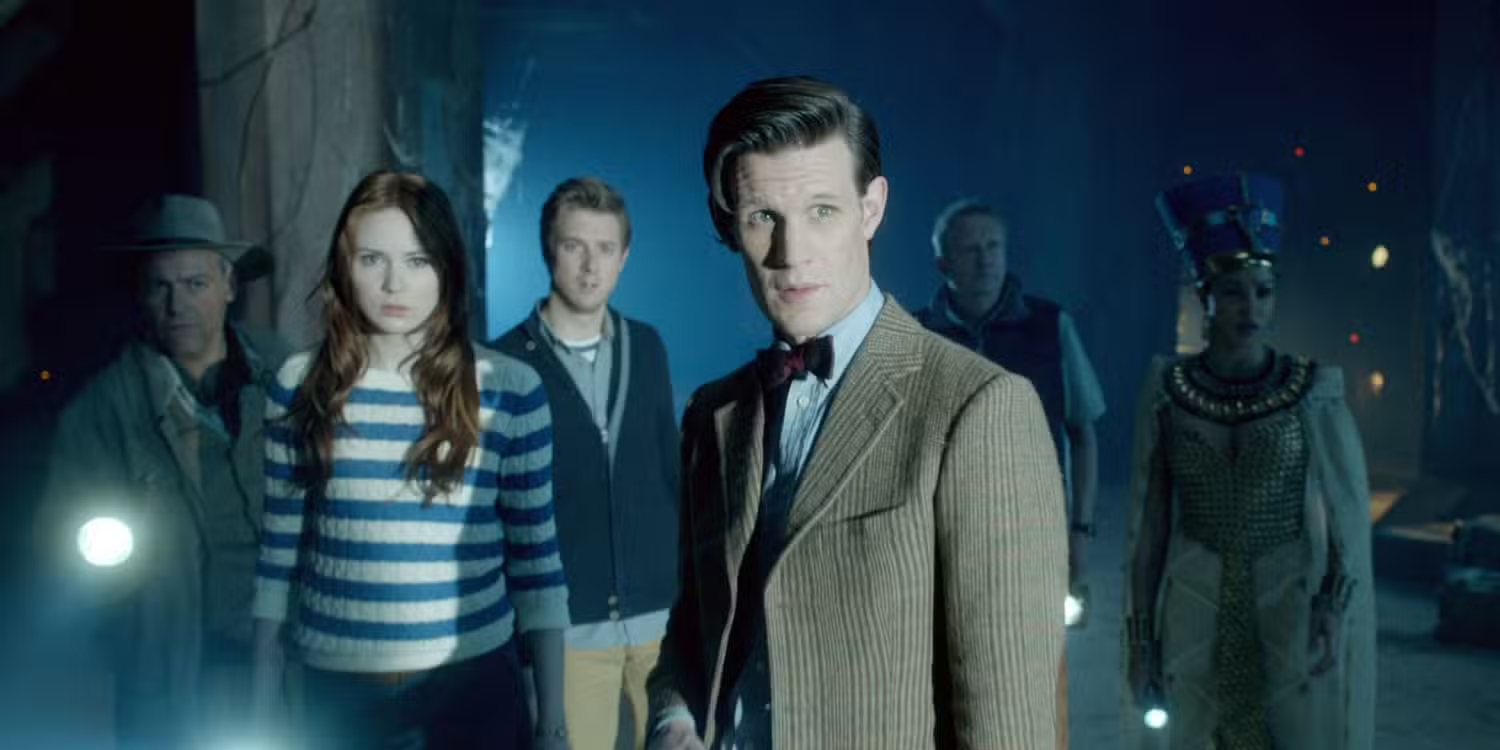


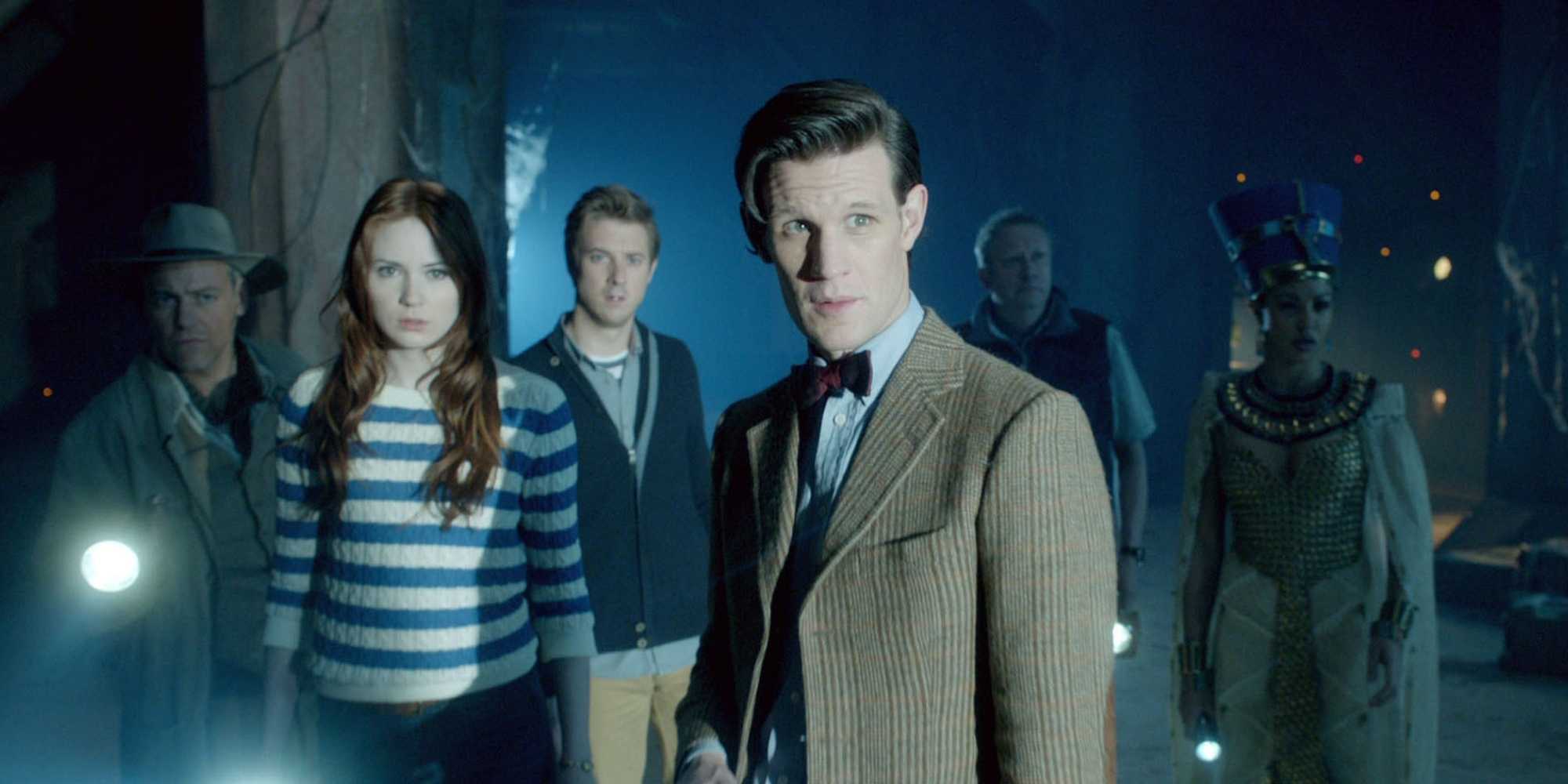
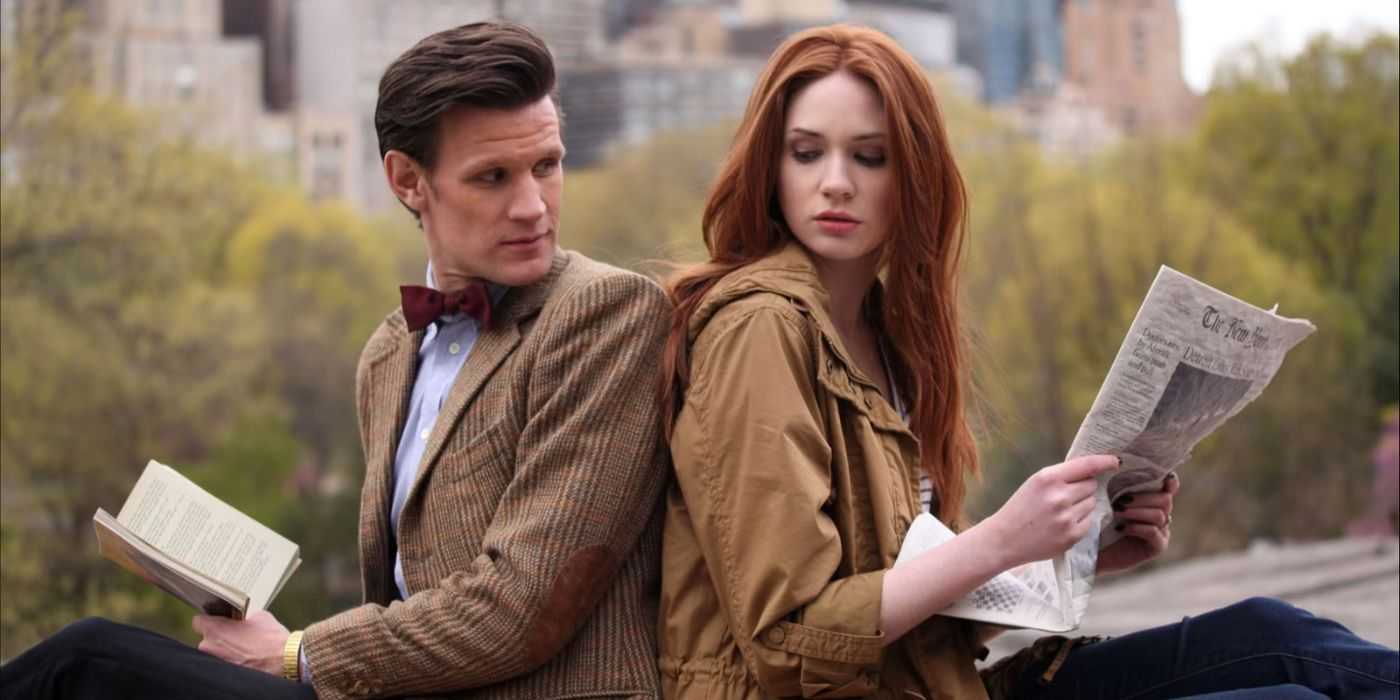
 DOCTOR WHO, l-r: Arthur Darvil, Matt Smith, Karen Gillan in ‘The Power of Three’ (Season 7, Episode 4, aired September 22, 2012), 2005-, ph: Adrian Rogers/©BBC/courtesy Everett Collection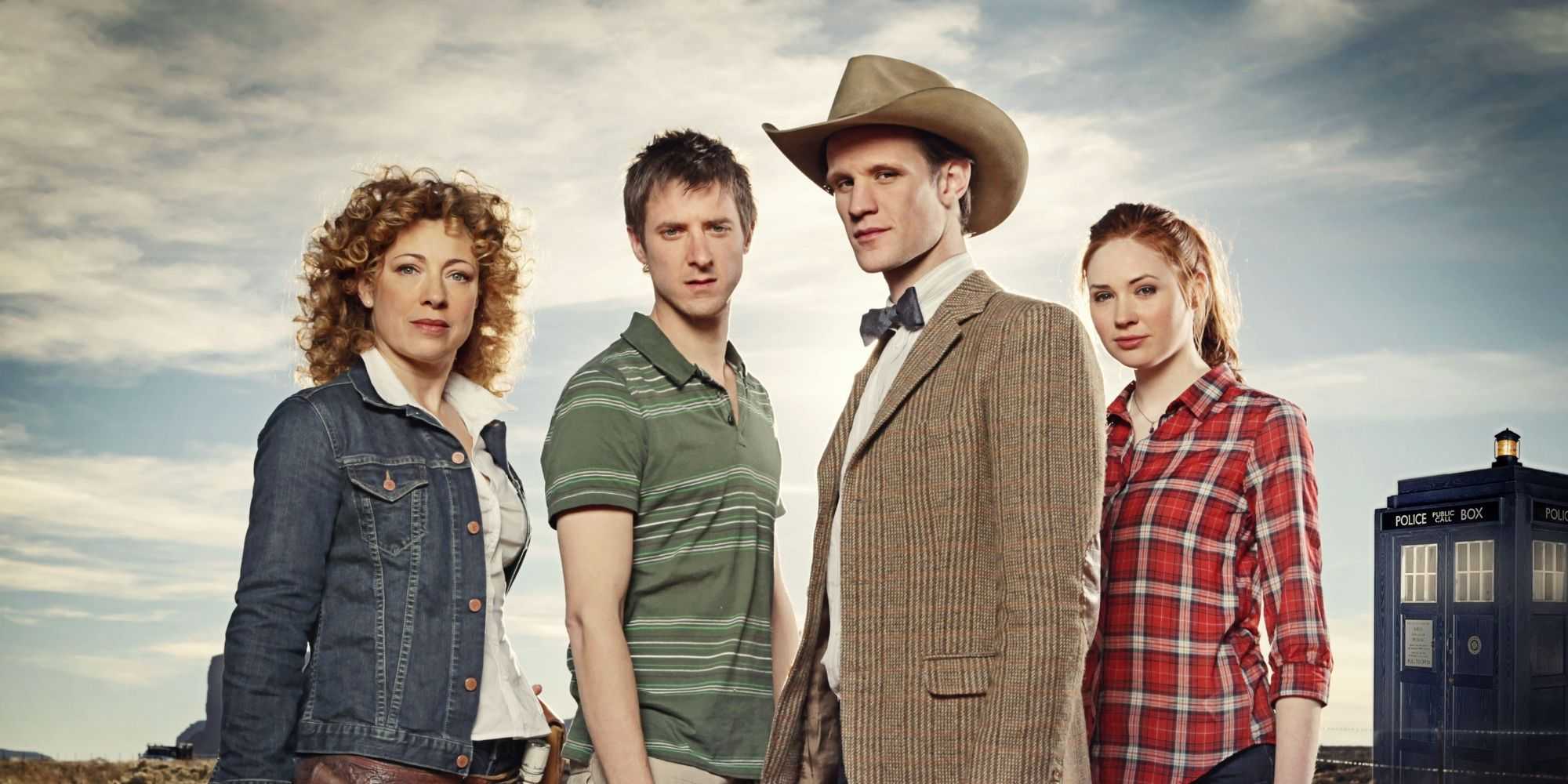
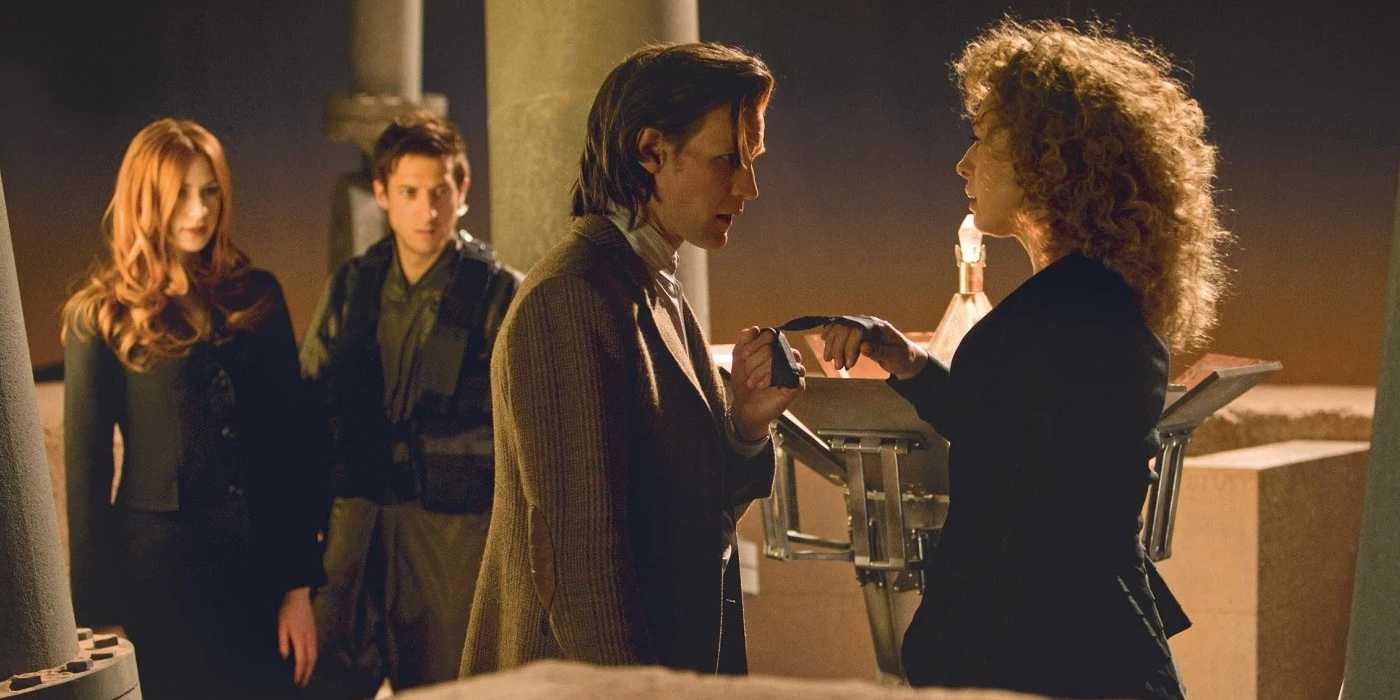





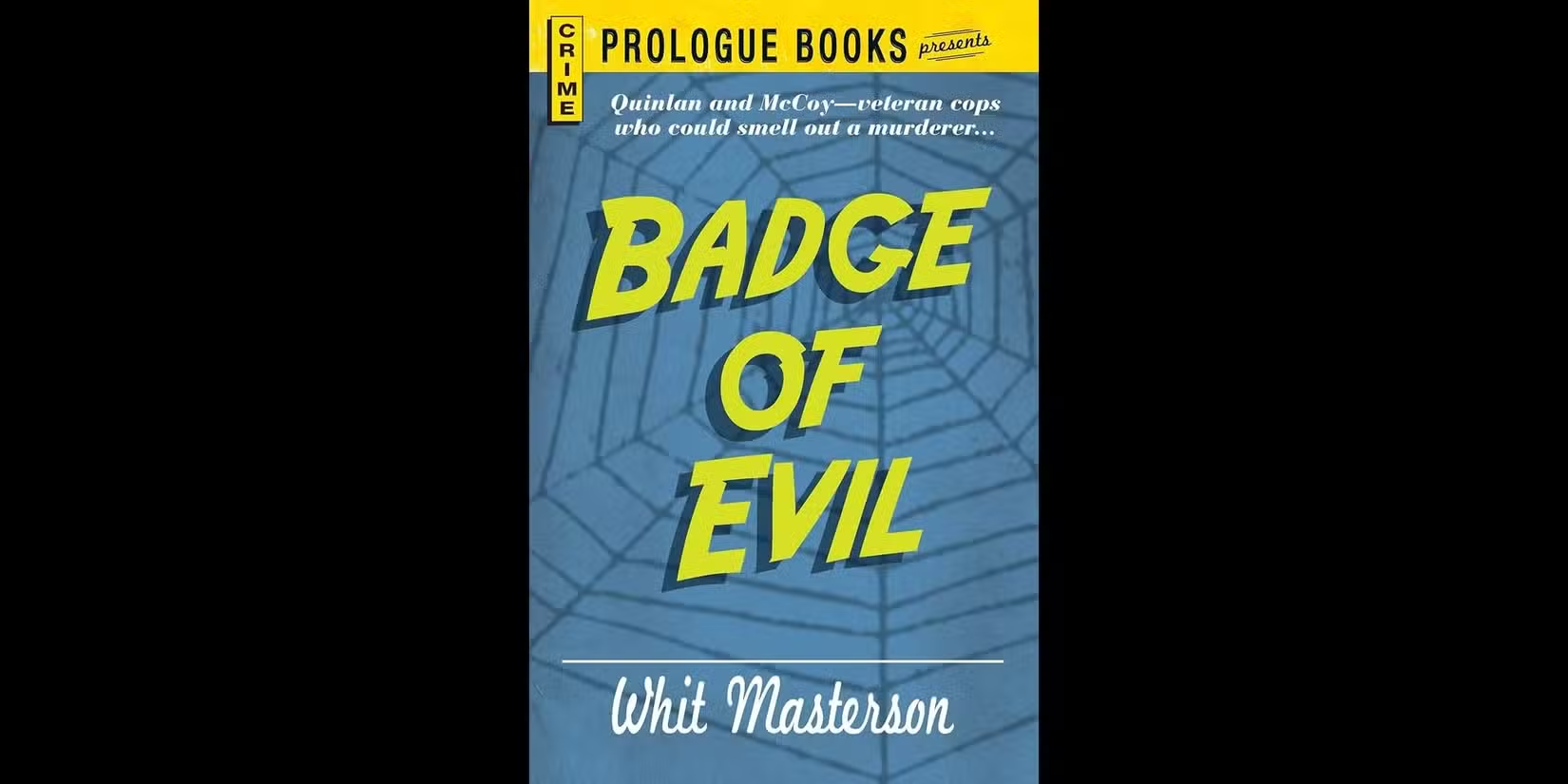



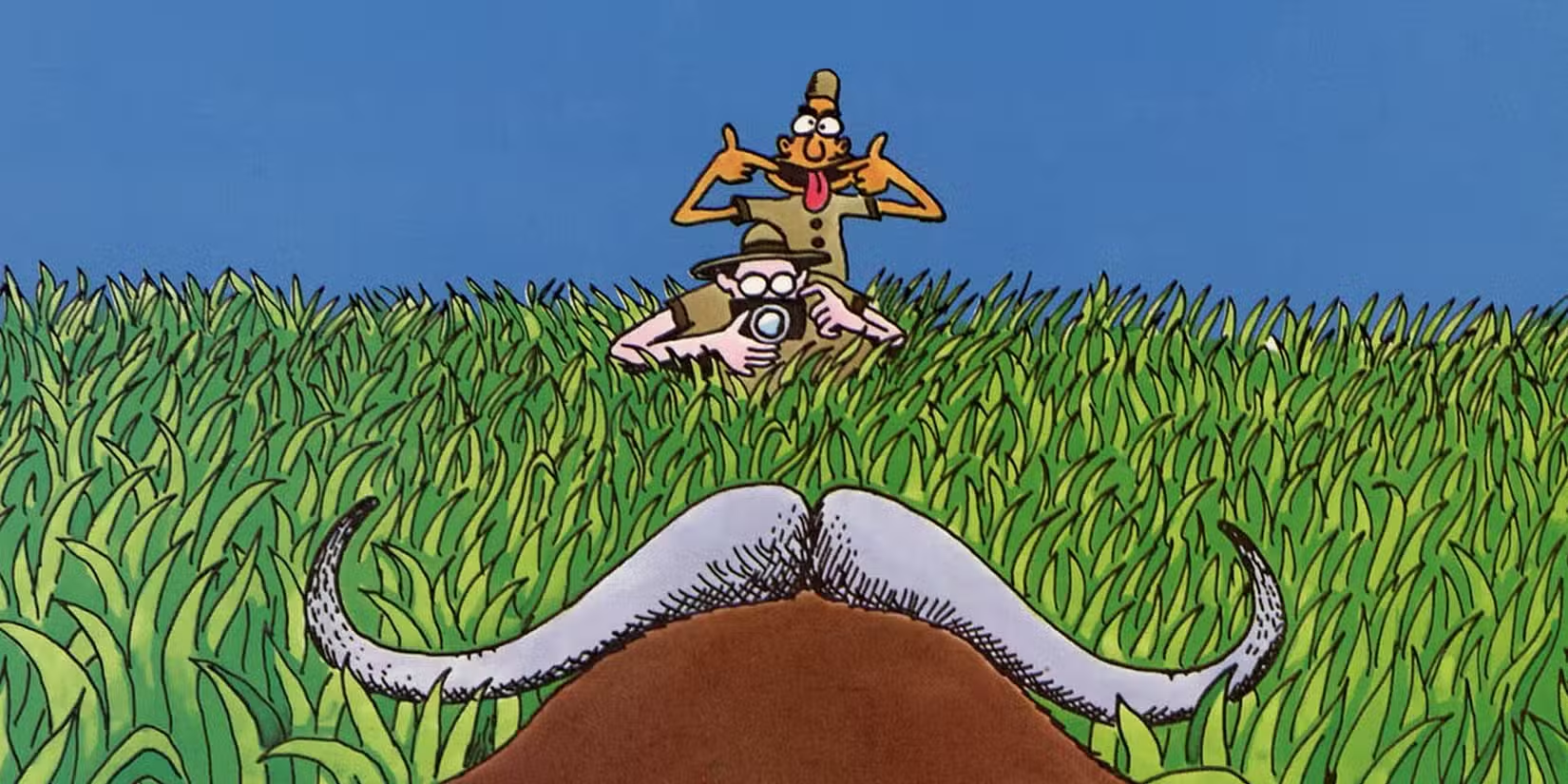


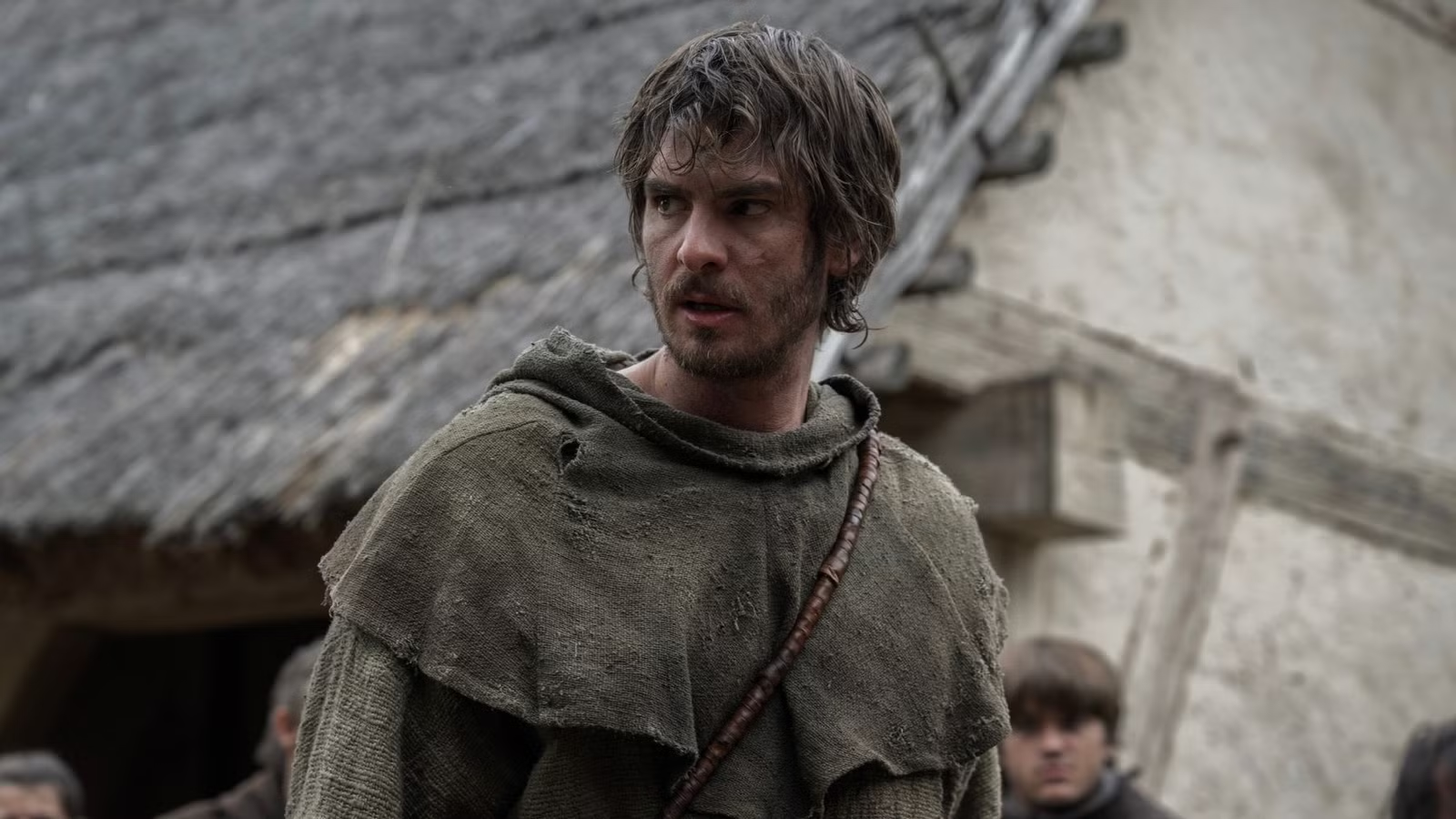


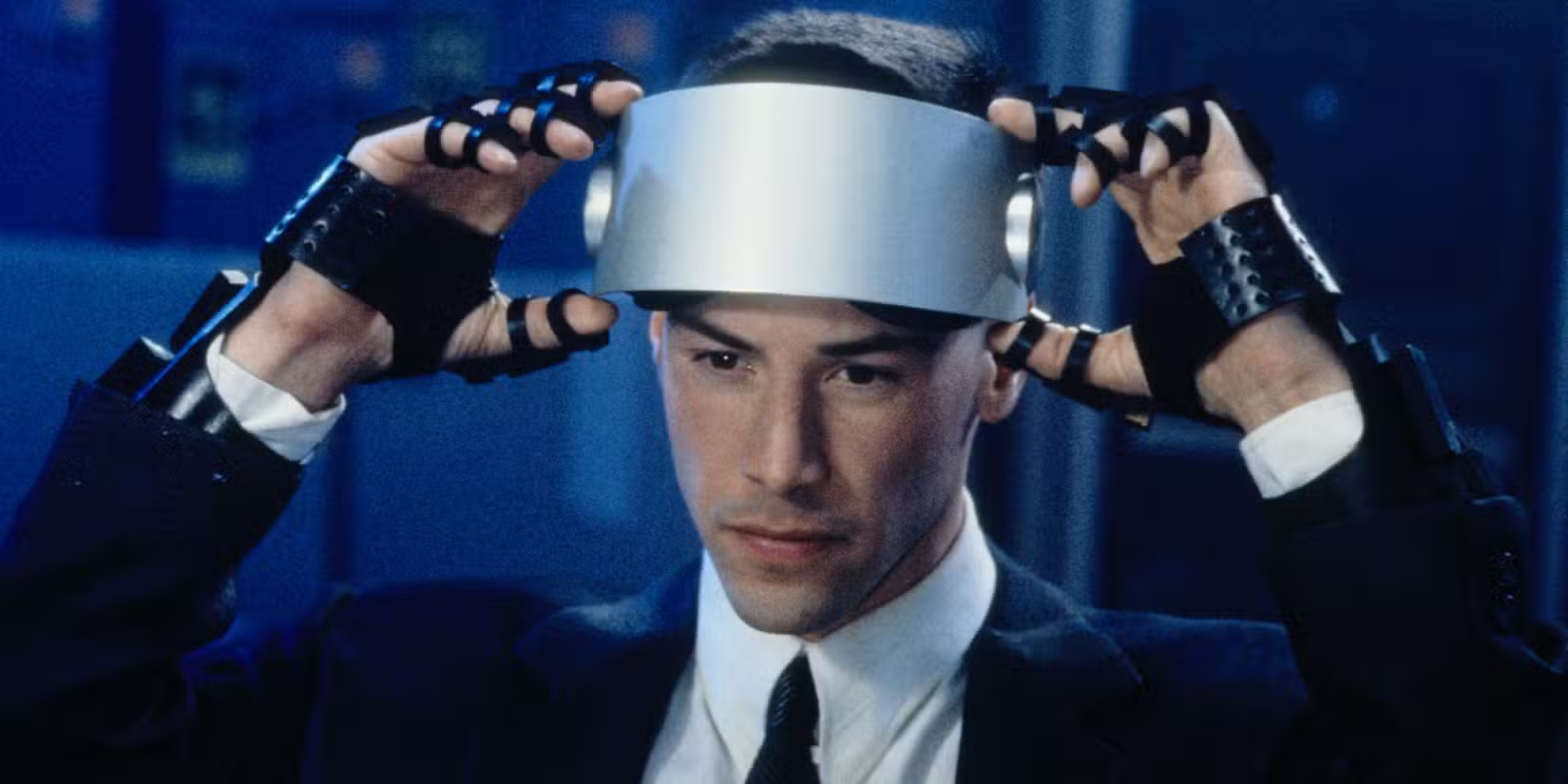

.jpg?q=49&fit=crop&w=500&dpr=2)





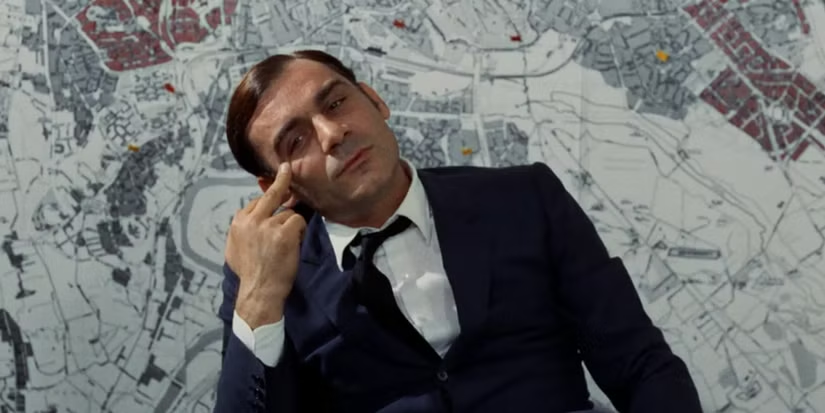




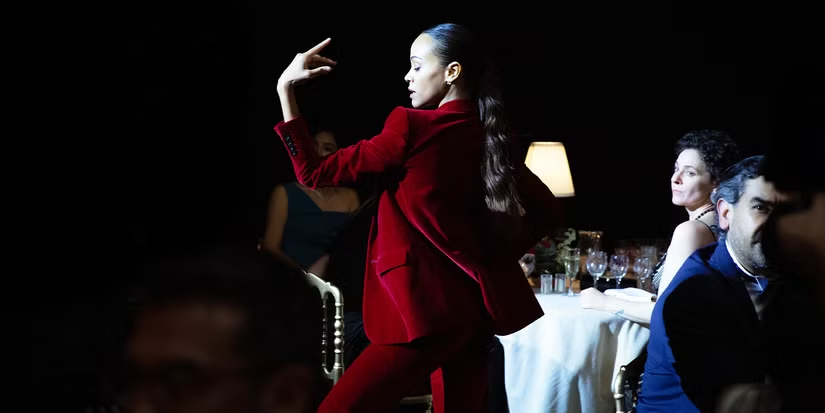










































You must be logged in to post a comment Login