
Crypto World
Polish Olympic chief arrested in Zondacrypto probe



Radosław Piesiewicz, president of the Polish Olympic Committee, has been arrested and charged with two offenses as prosecutors investigate payments and financial ties connected to the collapsed crypto exchange Zondacrypto.
Summary
- Prosecutors charged Piesiewicz with paid influence and favoring certain creditors over others.
- Investigators are examining an alleged €40,000 watch and Piesiewicz’s withdrawal of exchange funds.
- Zondacrypto customers face estimated losses of at least 350 million zlotys, or $94 million.
- Authorities have secured more than 100 million zlotys that could fund compensation claims.
Poland’s Justice Minister and Prosecutor General Waldemar Żurek confirmed the arrest on Aug. 27, saying Piesiewicz had been taken into custody as part of the Zondacrypto investigation.
Following questioning at the Silesian branch of the National Prosecutor’s Office, Żurek said prosecutors charged Piesiewicz under Articles 230 and 302 of Poland’s criminal code. The allegations concern paid influence and satisfying one group of creditors at the expense of others while insolvency was approaching.
Piesiewicz has not been convicted, and prosecutors have yet to publish a full account of the evidence supporting the charges.
Zondacrypto probe examines withdrawals and alleged influence
According to a report on the charges by Wirtualna Polska, citing TVN24, one allegation concerns money Piesiewicz held on Zondacrypto before the platform stopped processing customer withdrawals.
Investigators suspect that Piesiewicz received information allowing him to remove his entire investment from the exchange while other creditors could not access their funds, the report said. Prosecutors are examining whether the payment gave him preferential treatment as Zondacrypto faced possible insolvency.
The second charge concerns alleged paid influence. Prosecutors suspect that Piesiewicz offered to use his contacts to assist Zondacrypto with problems involving Poland’s Office of Competition and Consumer Protection, according to the report.
Piesiewicz rejected the accusations after leaving the prosecutor’s office, describing himself as a victim of the exchange. He also denied receiving preferential treatment when withdrawing his money, according to Polish media reports.
A separate joint investigation by Wirtualna Polska and TVN24 examined his relationship with former Zondacrypto chief Przemysław Kral. Documents and messages reviewed by the outlets allegedly showed that Kral bought a Patek Philippe Calatrava watch for €40,000 in November 2025, nine days before meeting Piesiewicz at a hotel in Monaco.
The invoice carried Kral’s name and private address, according to the investigation. Piesiewicz later sent messages thanking Kral and saying he was shocked, although the messages did not refer directly to the watch.
Piesiewicz has maintained that the watch was not a gift. He said he paid for it in cash and that Kral only arranged the purchase. Żurek previously said the watch was one of the matters prosecutors planned to examine.
Olympic sponsorship placed Zondacrypto close to Piesiewicz
Piesiewicz and Kral met during sponsorship talks in spring 2025, according to Wirtualna Polska and TVN24. By October, Zondacrypto had become the Polish Olympic Committee’s general sponsor under an agreement running from 2026 through 2028.
The sponsorship also resulted in the Olympic Center in Warsaw being renamed the Zondacrypto Olympic Center of the Polish Olympic Committee. Under another part of the arrangement, Polish athletes who performed well at the 2026 Milan-Cortina Winter Olympics were expected to receive crypto rewards.
During the sponsorship period, the joint media investigation alleged that Kral provided Piesiewicz with other benefits, including match tickets, travel for people close to him, and hotel arrangements. Prosecutors have not publicly confirmed each of the reported benefits or said which items form part of the formal charges.
In an Aug. 25 statement, the National Prosecutor’s Office said investigators were verifying whether Zondacrypto had provided a financial benefit to Piesiewicz. The same inquiry is examining financing involving foundations, the conservative political conference CPAC, the broadcaster Telewizja Republika, and other individuals or organizations.
Prosecutors said they could not disclose the evidence collected for each part of the case because releasing it could affect witness interviews, searches, and other legal procedures. Officials have been securing physical and digital records while questioning witnesses and people treated as suspects.
Customer losses exceed 350 million zlotys
The case involving Piesiewicz forms one part of a criminal investigation opened by the Regional Prosecutor’s Office in Katowice on April 17. Authorities are examining suspected fraud against Zondacrypto customers and possible money laundering connected to activity dating from 2022.
Prosecutors said customers may have been misled about their ability to buy and store fiat currencies and crypto through the exchange. The inquiry also covers the receipt, storage, and transfer of funds that may have made it harder to identify assets allegedly connected to fraud.
Estimated customer losses stand at no less than 350 million zlotys, equal to about $94 million. Authorities had received more than 3,600 complaints by June and secured over 100 million zlotys that may later be used to compensate affected customers.
As crypto.news reported in August, Zondacrypto’s website went offline on April 23 after customers reported delayed withdrawals and frozen balances. The exchange-linked ZND token subsequently lost almost all its market value, while available trackers showed no active trading pairs or reported volume.
According to Polish prosecutors, the exchange’s owner said Zondacrypto had lacked access since 2022 to a cold wallet believed to hold about 4,500 Bitcoin. Authorities said customers had not been told about the loss of access.
Kral previously denied that the exchange was insolvent and argued that researchers had examined only its visible hot wallets rather than its offline holdings. No complete wallet list, matching customer liabilities or independently audited proof of reserves was published to verify the claim.
In July, authorities merged the Zondacrypto inquiry with an investigation into the March 2022 disappearance of Sylwester Suszek, who founded BitBay before it was renamed Zondacrypto. Prosecutors said the two cases shared links involving the people and activities under review.
US rules remain separate from Poland’s MiCA dispute
No U.S. agency has announced charges or identified American customer losses in the Zondacrypto case. Any direct exposure for U.S. users, therefore, remains unconfirmed.
For an exchange serving customers in the United States, European registration or authorization does not replace applicable U.S. requirements. FinCEN guidance states that businesses accepting and transmitting convertible virtual currency may need to register as money services businesses and follow anti-money laundering, recordkeeping, and reporting rules, including when the operator is based outside the country.
Zondacrypto’s collapse has also become part of Poland’s dispute over implementing the European Union’s Markets in Crypto-Assets Regulation. President Karol Nawrocki vetoed the crypto bill for a third time in June, arguing that the proposed powers and requirements needed further changes.
The rejected measure would have given Poland’s Financial Supervision Authority licensing, reporting and enforcement powers over crypto service providers. It also included criminal penalties for serious violations involving exchange operations and token issuance.
Poland was among five EU countries with no MiCA licenses recorded as of June 29, while Germany had issued 57 and France 26, according to ESMA register data. ESMA’s central register tracks authorized crypto service providers, crypto-asset white papers and entities identified as noncompliant across the European Union.




Mark Zuckerberg called Yann LeCun one Sunday last November. Word had gotten out that LeCun, who built Meta’s Fundamental AI Research (FAIR) lab, was leaving to start his own venture. Zuckerberg urged him to stay. Good luck raising the money and good luck building a product the market would believe, LeCun recalls him saying. The following month, LeCun unveiled Advanced Machine Intelligence Labs. By March, it had raised $1.03 billion in seed funding—one of the largest rounds in history.
Much of the tech industry has converged on the idea that scaling large language models will eventually produce human-level intelligence. But LeCun, one of the field’s pioneers, believes they are chasing a dead end. Advanced Machine Intelligence is pursuing a fundamentally different approach to training, aiming instead to give AI an intuitive understanding of physical reality. So-called “world models,” he believes, will eventually make AI far more capable in areas like robotics, self-driving cars, and medicine.
LeCun was never one to follow the crowd. When he championed neural networks in the 1980s, the research community dismissed the idea for decades before it eventually became the foundation of the current AI boom, earning him a Turing Award in 2018. Being a contrarian takes a pinch of “confidence,” he says, and an ability to step back. “You just need to lift your nose from the trench you’re digging, and look around.”
Crypto World
XRP faces a major imbalance as price stalls despite 72% ETF inflows; how its holders are earning $9,000 a day
Disclosure: This article does not represent investment advice. The content and materials featured on this page are for educational purposes only.
EX DeFi offers XRP holders a cloud mining alternative as ETF inflows sustain institutional interest amid market volatility.
Cumulative net inflows into XRP ETF have hit a record high of $1.566 billion; however, the price of XRP has not surged in tandem. Instead, it has experienced a pullback, further fueling investor caution.
Historically, sustained inflows into XRP ETF have tended to bolster market sentiment. Yet, as of August 26, XRP ETF saw a single-day inflow of $23.87 million, a significant increase, while the price of XRP actually fell. This phenomenon highlights a supply-demand imbalance in the spot market and dampens institutional interest in entering the space.
With the XRP price pulling back, more investors are considering a practical question: rather than simply waiting for the price to rise, are there more flexible ways to utilize their holdings and generate additional long-term returns?
Against this backdrop, some investors are turning to the EX DeFi cloud mining platform, exploring income-generating avenues beyond mere asset holding. Cloud mining offers a way to earn returns on digital assets that is distinct from price-based speculation, even amidst short-term price volatility.
What exactly is driving XRP price fluctuations?
Current price movements are influenced not only by ETF capital flows but also significantly by on-chain activity.
After a prolonged 20-month slump, the XRP market is gradually regaining momentum. Unlike the relatively passive and orderly nature of ETF inflows, XRP recent surge of over 40% shows signs of active engagement by major market participants.
Prior to the recent rapid price rally, wallet addresses holding between 1 million and 10 million XRP showed clear accumulation patterns, collectively purchasing nearly 500 million tokens. Some analysts believe this massive accumulation by “whales” provided crucial support for the rebound, helping XRP break free from a downtrend that had persisted for 608 days.
Consequently, XRP current price trajectory cannot be explained solely by ETF inflows. A combination of factors, including ETF capital, whale activity, on-chain transactions, and overall market sentiment, likely shapes XRP’s future price performance.
XRP price volatility makes EX DeFi cloud mining platforms an alternative.
As market volatility intensifies, an increasing number of investors are seeking ways to engage with digital assets that go beyond simple price speculation. EX DeFi offers sustainable energy-based cloud mining solutions, providing investors with a compliant and structured pathway to participate in the XRP ecosystem.
Through cloud mining, users can participate in the operation of blockchain infrastructure and earn returns based on established rules, creating a cash-flow-oriented investment model without the need to configure specialized mining hardware or possess complex technical expertise.
Compared to traditional mining, cloud mining reduces the burden on users regarding hardware procurement, power supply, equipment maintenance, and daily operations. The platform handles hashrate management and related operations, while users participate in mining and track their earnings via an automated system.
About EX DeFi
Founded in 2021 and headquartered in the UK, EX DeFi operates in accordance with relevant European regulatory frameworks, including the Markets in Crypto-Assets Regulation (MiCA) and the Markets in Financial Instruments Directive II (MiFID II). The platform continuously enhances its transparency, operational standards, and user protection mechanisms.
Regarding security and compliance, the platform employs measures such as:
- Annual financial and security audits conducted by PwC
- Insurance coverage for custodied digital assets provided by Lloyd’s of London
- Utilization of enterprise-grade security solutions from Cloudflare and McAfee®
- Implementation of multi-layer encryption architecture, 24/7 monitoring, and real-time risk management mechanisms
Currently, EX DeFi supports a wide range of mainstream crypto assets, including XRP, BTC, ETH, USDT, BNB, ADA, USDC, DOGE, LTC, and SOL, offering users greater flexibility in how they engage with digital assets.
Start cloud mining in just three steps
Step 1: Register an Account
Step 2: Select a mining package
Choose a suitable cloud mining contract based on budget, desired participation period, and specific needs, then launch the mining service with a single click.
Step 3: Start earning returns
Once the contract is activated, the system automatically allocates hashrate, and earnings are credited to the account daily. Users can withdraw or reinvest these earnings at any time.
Cloud mining contract examples
BTC (Beginner Trial Contract): Investment $100, Duration: 2 days, Daily Return: $4, Total Profit: $100 + $8
DOGE (Golden Shell Mini-Doge Pro): Investment $500, Duration: 6 days, Daily Return: $6.5, Total Profit: $500 + $39
BTC (Canaan-Avalon-A1466): Investment $1,000, Duration: 10 days, Daily Return: $13.4, Total Profit: $1,000 + $134
LTC (Bitmain Antminer L7): Investment $5,000, Duration: 20 days, Daily Return: $73.5, Total Profit: $5,000 + $1,470
BTC (Bitmain S19K-Pro): Investment $10,000, Duration: 30 days, Daily Return: $161, Total Profit: $10,000 + $4,830
For more contract details, please visit the official EX DeFi website.
Conclusion
Continued capital inflows into XRP ETFs indicate that institutional investors remain highly interested in XRP; however, growth in ETF funds does not guarantee a simultaneous rise in the XRP price. The market is currently influenced by multiple factors, including “whale” activity, on-chain capital flows, and overall sentiment in the cryptocurrency market.
For long-term XRP investors, beyond monitoring price fluctuations and ETF capital flows, EX DeFi offers a professional cloud mining infrastructure that provides regulated, secure, and sustainable access to the XRP ecosystem, laying a solid foundation for long-term wealth accumulation.
Disclosure: This content is provided by a third party. Neither crypto.news nor the author of this article endorses any product mentioned on this page. Users should conduct their own research before taking any action related to the company.
Software stocks lagged the broader market for much of 2026, even as fears that artificial intelligence would gut the sector’s fundamentals largely failed to materialize.
Nuveen chief investment officer Saira Malik argues the sector’s earnings tell a different story than its stock charts, and that a rebound may be closer than the price action suggests. The comments arrive a day after Nvidia’s earnings eased fears about AI spending, and hours before Workday, Autodesk, and Marvell rounded out a heavy week of technology results.
Why Software Stocks Got Punished for No Reason
Malik said investors spent much of 2026 worrying that generative AI would gut software company headcounts and revenue growth, a fear that hit the sector broadly and indiscriminately.
She argued the numbers never backed up the panic.
“When you separate the signal from the noise, it didn’t show up in software companies fundamentals. Revenue growth rates for software companies remained fairly stable.”
Saira Malik, Bloomberg
Margins and earnings held up too, she said, and the wave of job cuts many expected AI to trigger across the sector has not materialized to the degree feared.
Real Names, Real Declines
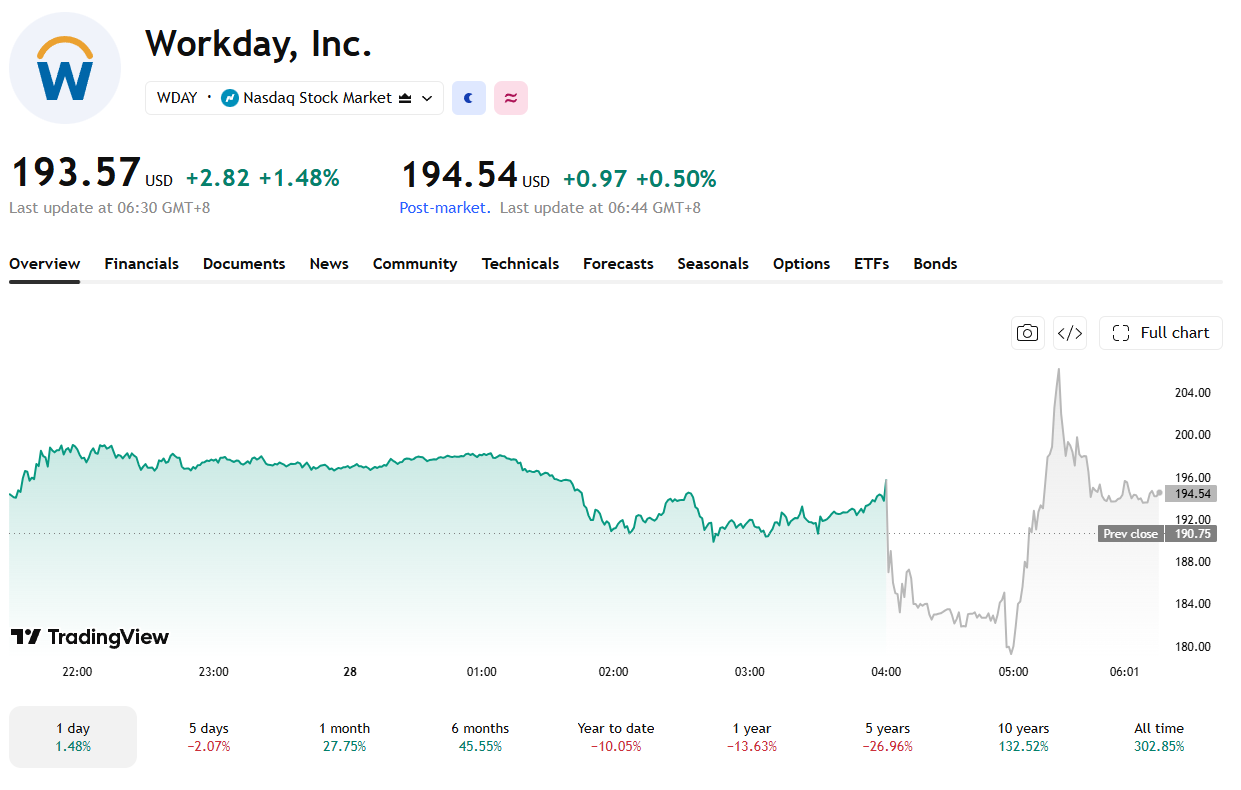
Workday beat second-quarter revenue and profit estimates this week. Shares still slipped afterward, but then spiked again after hours trading.

Autodesk dropped roughly 5% in after-hours trading despite raising its full-year revenue outlook. Investors instead focused on a lower free-cash-flow forecast tied to a recent acquisition.
Adobe and Workday have also drawn cautious coverage from some Wall Street analysts this year, who flagged slowing growth and business-model transitions as key risks for both stocks.
Marvell Is the Next Signal to Watch
Malik said Marvell’s results, due after Thursday’s close, would show whether the AI trade extends beyond Nvidia into the broader chip and software ecosystem. A strong report, she said, would confirm the rally Nvidia’s earnings ignited this week, when the chipmaker lifted its fiscal 2027 revenue growth outlook to 70%, well above the roughly 45% Wall Street had expected.
Marvell went on to beat estimates on both revenue and profit, though its stock dipped slightly as investors weighed compressing margins against the growth.
Long-term Treasury yields above 5% and Fed Chair Kevin Warsh’s Jackson Hole speech on Friday remain wildcards for how equities trade next. But the read from Nuveen is that software’s earnings, not its share prices, are telling the more accurate story right now.
The post Software Stocks Slumped on AI Fears in 2026: Analysts Predict a Rebound appeared first on BeInCrypto.


Ethena has proposed directing 95% of net revenue from its branded businesses toward ENA buybacks once USDe supply reaches $7.5 billion, as the protocol also moves to end monthly investor unlocks and separate ecosystem economics from Ethena Labs equity.
Summary
- Ethena has proposed using 95% of net revenue for ENA purchases once USDe supply reaches the first $7.5 billion threshold.
- The Ethena Foundation has bought locked ENA from some seed investors and plans to accelerate the remaining original investor unlocks.
- ENA rose about 23% over 24 hours to $0.17 and has roughly doubled in a little more than a week.
- USDe supply remains below $5 billion after falling from a peak near $15 billion in October.
- Ethena has expanded into institutional credit and distribution deals as it looks for revenue sources beyond crypto funding rates.
According to the Ethena Foundation, the proposed changes are designed to address two long-running issues around ENA: recurring supply from early investor unlocks and uncertainty over how the protocol’s economic value reaches token holders.
The overhaul combines changes to the token’s supply schedule with a proposed fee switch that could create recurring market purchases of ENA. It also sets out a planned agreement under which most of the intellectual property and economic benefits tied to the Ethena protocol would sit with the foundation and ecosystem rather than shareholders in Ethena Labs.
ENA reacted sharply to the announcement, rising about 23% over the past 24 hours to around $0.17. The token has roughly doubled in a little more than a week, extending gains recorded during the latest crypto market rally.
ENA buybacks could receive 95% of net revenue
Under the governance proposal, ENA holders are voting on a fee switch that would link token purchases to the size of USDe’s circulating supply.
Once USDe reaches the first threshold of $7.5 billion, 95% of net revenue generated by Ethena-branded businesses would be allocated to programmatic ENA purchases. The remaining 5% would be retained to fund ecosystem growth.
Buybacks would then increase as USDe circulation reaches additional milestones, creating a mechanism through which growth in Ethena’s businesses could translate into demand for ENA.
The proposal addresses a question that has followed governance tokens across decentralized finance: whether revenue generated by a protocol ultimately produces economic benefits for the token itself. In Ethena’s case, the proposed structure would use revenue for open-market ENA demand rather than leaving the connection dependent mainly on governance rights or expectations of future utility.
The idea is not Ethena’s first use of token repurchases. In August 2025, crypto.news reported on ENA buybacks when a $260 million program was allocating about $5 million per day toward token purchases as USDe supply and protocol revenue climbed.
The latest proposal differs by tying purchases to recurring net revenue and predetermined USDe supply thresholds rather than relying only on a fixed pool of capital.
Ethena moves to remove the ENA unlock overhang
Alongside the revenue proposal, the Ethena Foundation said it had purchased the remaining locked tokens belonging to certain large seed investors that had been selling ENA during the previous nine months.
Remaining original investor allocations will also be unlocked on an accelerated schedule, bringing the monthly release of venture investor tokens to an end. Tokens allocated to the Ethena team will continue under their existing vesting schedules.
Ending the monthly investor releases changes when the remaining supply enters circulation rather than removing those tokens entirely. The foundation’s purchase of locked allocations from some seed investors, however, removes those holdings from investors who had previously been selling ENA.
Token unlocks have affected ENA trading before. In June 2025, an unlock of roughly 41 million ENA, worth more than $12 million at the time, produced only a limited market reaction, with the token falling about 1% during the day.
More recently, the supply picture has become important as ENA’s institutional ownership has expanded. Grayscale Investments added ENA to its Decentralized Finance Fund during its first-quarter 2026 rebalance, selling other fund components to finance the purchase.
Another source of U.S. market exposure arrived in June when StablecoinX completed its merger with TLGY Acquisition Corp. and began trading on Nasdaq under the ticker USDE. The company held about 3.029 billion ENA, valued at roughly $275 million using the 30-day average price cited around the transaction, giving public-market investors exposure to a business built around the Ethena ecosystem.
Ethena seeks clearer ownership of protocol economics
A separate part of the overhaul deals with the relationship between Ethena Labs, the foundation and ENA holders.
Under an agreement in principle described by the foundation, substantially all material intellectual property and economic upside associated with the Ethena protocol would belong to the foundation and ecosystem rather than holders of equity in Ethena Labs.
The parties expect to publish the agreement in October.
Formalizing that division could clarify which economic interests belong to shareholders in the development company and which remain with the token-governed ecosystem. The foundation presented the arrangement alongside the buyback proposal and investor unlock changes rather than as a standalone corporate restructuring.
Institutional involvement in ENA has increased during 2026. Coinbase Ventures bought ENA on the open market in June rather than receiving tokens through a discounted private allocation, while Coinbase and Ethena announced plans to develop onchain finance and savings products.
As previously covered in June, Ethena did not disclose the number of ENA tokens Coinbase Ventures purchased, its average acquisition price, or wallet addresses associated with the transaction.
A first product from the relationship arrived later that month when Coinbase introduced a high-yield USDC vault using Morpho infrastructure and allocations curated by Steakhouse Financial. The product included Ethena-related assets in its collateral structure and allowed users to access the vault through Coinbase’s application.
USDe supply remains far below its peak
While ENA has rallied, Ethena is still working to rebuild demand for USDe after a steep contraction from its 2025 highs.
USDe supply has fallen below $5 billion from a peak of nearly $15 billion in October. The decline followed weaker conditions in crypto derivatives markets, where funding rates form an important part of the strategy Ethena uses to generate returns.
USDe differs from reserve-backed stablecoins because Ethena uses collateral alongside derivatives positions to maintain its dollar exposure. Returns available from that structure can therefore change as derivatives funding conditions move.
During the previous expansion, USDe had reached $11.7 billion in supply by August 2025, while Ethena reported more than $500 million in cumulative gross interest revenue. Weekly protocol revenue was $13.4 million at the time, alongside $670 million of USDe mints.
By June 2026, however, the decline in USDe supply was already visible as Ethena pursued institutional distribution and new uses for its capital.
One route has been traditional asset management. Janus Henderson invested in ENA in June and began exploring ways to use USDe for treasury management and to distribute it through investment products. The asset manager oversaw roughly $480 billion at the time of the agreement.
Ethena also planned a $250 million allocation to Securitize’s tokenized AAA-rated collateralized loan obligation fund when the product expanded to Solana in June. The fund invests in U.S. dollar-denominated AAA-rated CLO tranches, with BNY serving as custodian and sub-adviser. The planned allocation provided another route for Ethena capital into traditional credit markets.
Institutional access expanded again later in June when BlackRock integrated USDe into its Aladdin investment and risk-management platform. The Aladdin integration gave institutions using the system access to USDe through existing workflows, while the announcement was accompanied by plans for a $100 million liquidity facility connected to BlackRock’s tokenized BUIDL money-market fund.
New credit facility reduces reliance on crypto funding rates
Ethena added another source of potential yield in August through a $1 billion facility with institutional crypto prime broker FalconX.
Announced on Aug. 19, the warehouse facility allows assets backing USDe to be deployed into overcollateralized institutional loans. The arrangement gives Ethena a source of returns outside the crypto derivatives funding-rate trades that have historically formed a central part of USDe’s yield model.
The announcement also contributed to ENA’s recent price strength. Days after the FalconX deal, ENA had climbed 48% as several altcoins outperformed Bitcoin, although CoinDesk reported that market-wide measures did not yet indicate a general altcoin season.
Meanwhile, Coinbase has already provided a U.S.-facing distribution channel for Ethena-linked products. Its high-yield USDC vault launched in June through Morpho and Steakhouse Financial, with Ethena-related assets included in the collateral framework. The Coinbase vault is accessible from the exchange’s consumer application, while the underlying lending activity runs through onchain infrastructure.
Janus Henderson’s involvement has added another institutional route. Along with investing in ENA, the asset manager has explored USDe distribution through investment products, according to the June announcement.
Disclosure: This article does not represent investment advice. The content and materials featured on this page are for educational purposes only.
[PRESS RELEASE – Singapore, Singapore, August 27th, 2026]
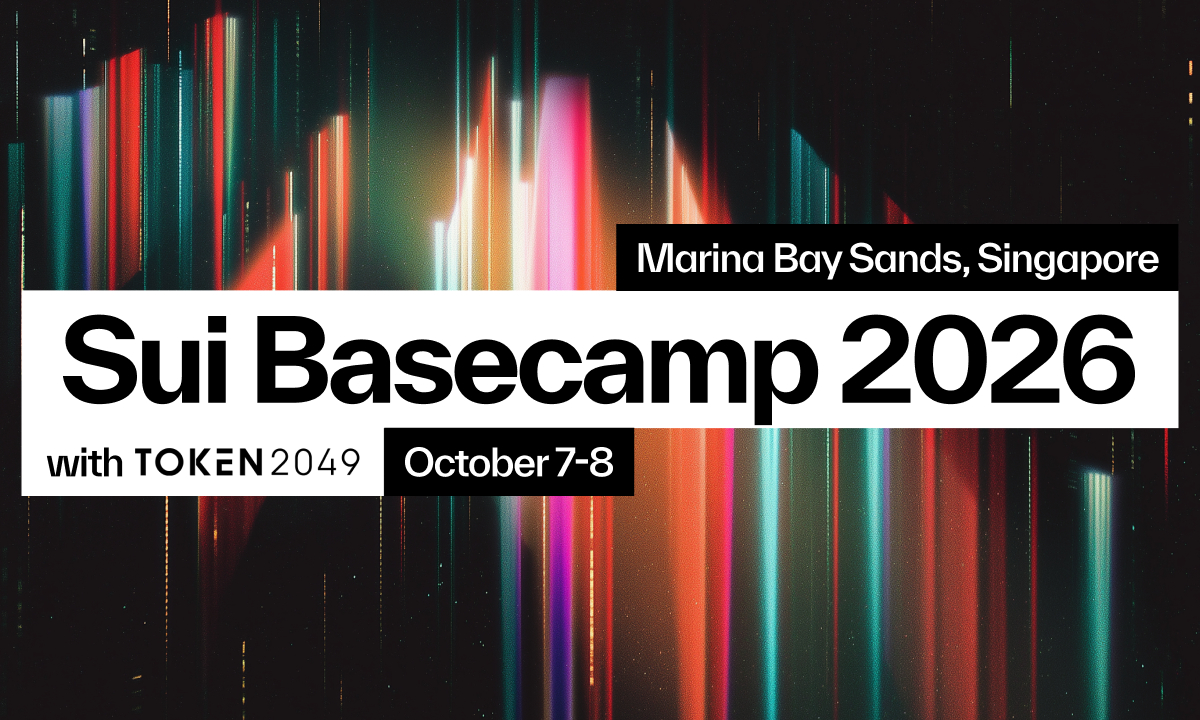
Two days at Marina Bay Sands in Singapore, on October 7-8, alongside TOKEN2049, with product reveals, leading voices in AI, and a live attempt at a sustained TPS record.
The Sui community worldwide is invited to Sui Basecamp 2026, held October 7-8 at Marina Bay Sands in Singapore alongside TOKEN2049. This year’s program centers on the agentic economy: instant settlement, autonomous payments, private transactions, stable digital dollars, and post-quantum security.
Sui Basecamp is the Sui ecosystem’s flagship annual gathering, bringing together the people building, investing in, and shaping what comes next on Sui. Over two days, founders, builders, developers, investors, traders, and industry leaders come together for product reveals, technical deep dives, hands-on demos, and direct conversations with the people pushing the technology forward. Top-tier speakers from inside and outside the Sui ecosystem will provide a peek into what’s coming next and offer a direct look at the infrastructure carrying finance onchain.
This year, one conversation will loom especially large: the rise of the agentic economy. The next $5 trillion in transactions won’t be human. Agentic finance needs rails that settle instantly, prove ownership and authorization, and keep transaction details private by default.
Hear From the Builders of the Agentic Future
What happens when you put a macro legend, the architects of Sui, an AI pioneer, a gaming visionary, and builders of the autonomous economy on the same stage? That’s just the beginning of the Sui Basecamp lineup:
- Raoul Pal, Co-Founder and CEO of Real Vision, has spent his career mapping where capital moves next, and was early to the shift from traditional macro into digital assets.
- Adeniyi Abiodun, Co-Founder and Chief Product Officer of Mysten Labs, is part of the team that came out of Meta’s Diem project that went on to build Sui and the infrastructure for the autonomous economy.
- Kostas Chalkias, Co-Founder and Chief Cryptographer at Mysten Labs, works on the cryptographic foundations autonomous systems depend on, including Sui’s push toward post-quantum security. He also will lead the Main Stage speed test.
- Hilmar Veigar Petursson, CEO of Fenris Creations and formerly CEO of CCP Games, spent more than two decades running one of software’s longest-lived player-driven economies. He is bringing that experience onchain through EVE Frontier.
- Alex Mourfarek, Director of Inception at Google DeepMind, works at the intersection of frontier AI research and entrepreneurship, helping turn breakthrough ideas into ambitious new AI ventures.
- Jen Zhu Scott, Co-Founder and CEO of Power Dynamics, is building the cooling and energy storage infrastructure that AI relies on to scale.
- Brian Quintenez, Director of Sui Holdings Group and a former commissioner of the U.S. Commodity Futures Trading Commission, is an expert on public policy and regulatory frameworks in crypto.
- Richard Socher, Co-Founder and CEO of Recursive and You.com, builds at the front edge of AI research and the evolution of intelligent software.
Explore the full Sui Basecamp 2026 speaker roster here, with more names to be added over the coming weeks.
A Live Record Attempt on the Main Stage
On October 7, live on the Main Stage, Mysten Labs Co-Founder and Chief Cryptographer Kostas Chalkias will push Sui to its absolute limit in a public, real-time speed test. The target is to break Sui’s standing record of 6,086,766 transactions per second (TPS), recorded earlier this year on July 4th.
Participate live from Marina Bay Sands or anywhere in the world: submit your TPS prediction to compete for first (10,000 SUI), second (5,000 SUI), and third-place (1,000 SUI) rewards. Details will be announced by @SuiNetwork on X.
High throughput shows how much room the network has under real load, which is exactly what an economy of agents will demand. The test is built to mirror those conditions. AI agents and users will transact across games, payments, and chat using programmable tunnels, producing the velocity expected when software transacts continuously and at machine speed.
To ensure total transparency, web3 security leader CertiK will serve as the independent auditor for the attempt. Every transaction will be logged in a cryptographic transcript for post-test verification and formal reconfirmation, providing proof that can be mathematically audited rather than simply observed.
Following the attempt, attendees are invited to join a celebration on-site.
Get Hands-On at Sui Basecamp
Sui Basecamp isn’t just about what happens on stage. In the AI Builder Lab, get hands-on with the latest AI tools, join sessions led by teams building at the intersection of AI and Sui, and learn how to build AI-powered applications and agents yourself. Then head to the Trading Arena to watch your favorite traders go head-to-head live on Hudi where you can watch their moves in real time. Whether you’re here to build,or try something new, Sui Basecamp is designed for active participation.
Sui Basecamp Brings Builders and Capital Together
Sui Basecamp is designed around what happens when the people building on Sui occupy the same space. This year, the people building the agentic financial stack across protocols, wallets, payments, data infrastructure, AI systems, institutions, and applications are converging on the same set of problems. Sui Basecamp puts them in one room for two days.
If you’re building at the intersection of technology and finance, investing in the machine to machine future, or trying to understand where the next generation of economic activity is headed, this is the room to be in.
“Economic activity is shifting from people clicking checkout buttons to agents transacting on their behalf, continuously and at machine speed,” said Adeniyi Abiodun, Co-Founder and Chief Product Officer of Mysten Labs, the original contributor to Sui. “That only works when intent, authorization, and settlement can each be proven onchain. Sui Basecamp is the one place where every layer of that stack is in the same room, so you leave understanding the whole picture instead of one piece of it.”
Sui Basecamp 2026 is sponsored by AlphaFi, EVE Frontier, and Walrus at the Diamond level, ONE Championship at Platinum, Slush at Gold, RedotPay at Silver, and Scallop, Anyflo, Merkle Science, and Sentio at Bronze.
How to Register
A standard pass covers both days, including all presentations, programming, workshops, expo areas, and official opening and evening events.
Lock in the discounted rate at luma.com/SuiBasecamp2026 and join us in Singapore on October 7-8. Build with us.
About Sui
Sui, where money moves as freely as messages, is a next-generation Layer 1 blockchain built for scalable finance and global payments. Founded by the core team behind Meta’s stablecoin initiative and powered by an object-centric model, Sui makes assets, permissions, and user data programmable and ownable. Sui’s primitives offer builders everything they need to create high-performance payments and financial applications, including instant agentic payments. Learn more at sui.io. Learn more about Sui Basecamp at sui.io/basecamp.
The post The Agentic Economy Takes Center Stage at Sui Basecamp 2026 in Singapore appeared first on CryptoPotato.
The second-largest cryptocurrency rose by 2% over the past 24 hours, thus once again jumping beyond the $2,500 milestone and adding fresh fuel to analysts’ prevailing bullish outlook.
However, not everyone shares that optimism, with one market observer warning of a potential 40% collapse ahead.
Modest and Ridiculous Targets
ETH’s increase to approximately $2.5K seems to be a major turning point for the asset. X user Gerla claimed a clean break above that mark could mark the beginning of a new bull run, while losing the rising support may hamper the overall uptrend.
Ted spoke on the matter when ETH briefly climbed to the resistance zone of $2,550. In his view, a weekly close above that level could result in a further surge to $3,000. Shortly after, he suggested that a daily close beyond might be followed by a 10%-15%.
KriptoXI also believes Ethereum is at “a make-or-break” level, predicting a spike to $2,800 if the asset clears $2,550. At the same time, a plunge below $2,400 could weaken bullish momentum and trigger a deeper pullback.
Of course, there are some who envisioned an “up only” scenario from here on. Crypto Patel pointed to striking parallels between ETH’s current path and past market cycles, opining that if history repeats, the next target could be beyond $20,000. Not long ago, Credible Crypto also floated the idea that the asset’s valuation might be headed toward such a parabolic increase.
Prepare for a Crash?
X user Nonzee, who recently claimed that BTC’s rally could be abruptly ended by a violent decline toward $45,000, expects a similar scenario with ETH. The analyst described the asset’s breakout to $2,500 as a trap, adding that the price must first retest $1,500 before starting a bull run to $4,500.
“That drop will look like the entire structure has failed. It will actually be the final shakeout that completes it,” they said.
Ethereum’s Relative Strength Index (RSI) serves as a warning for such a potential correction. The ratio has jumped to 77, meaning the asset has entered overbought territory and could be gearing up for a move south. The technical analysis tool ranges from 0 to 100, where anything below 30 is interpreted as a bullish zone.

The post Top Ethereum Price Predictions as ETH Rises Above $2,500 appeared first on CryptoPotato.

Virtu Financial, M1X Global and Tradeweb have completed an onchain repurchase agreement (repo) that uses a sovereign digital bond as collateral, with the entire transaction settling on the Canton Network. The deal is notable for pairing natively issued sovereign collateral with fully onchain atomic settlement, according to a release referenced in the report.
The collateral in question is USDM1, a US dollar-denominated sovereign bond issued onchain by the Republic of the Marshall Islands. The bond is described as being backed 1:1 by short-term US Treasurys and pays a coupon while it is posted as collateral. It is also structured under New York law as a fully collateralized sovereign obligation.
Key takeaways
- Repo settlement moved fully onchain: the full repo and repurchase cycle completed using atomic settlement on Canton, in under 10 minutes.
- USDM1 is deployed as collateral, not just a tokenized asset: the bond is used to support an institutional financing flow.
- Deal executed between regulated counterparties: the transaction ran through Tradeweb and was completed between established financial firms.
- USDM1 availability ties to institutional rails: Tradeweb provides access, while custody is supported by Anchorage Digital, BitGo and tZERO, per the release.
A repo built around tokenized sovereign debt
Repos are a core part of institutional liquidity management, allowing one party to sell securities and agree to repurchase them later, typically with collateral underpinning the transaction. In this case, the participating firms structured the repo around USDM1—an onchain sovereign bond whose design is meant to keep dollar exposure tied to underlying US Treasurys.
According to the release, the transaction used USDM1 as collateral throughout the lifecycle of the repurchase agreement. This matters because it extends tokenized sovereign debt beyond initial issuance and secondary trading narratives, positioning it for use directly inside financing structures where collateral efficiency and settlement speed are often pivotal.
The companies involved also said the transaction was the first repo to combine natively issued sovereign collateral with fully onchain atomic settlement. While that claim signals a meaningful technical milestone, the report also emphasizes that this remains an early-stage example and does not confirm broad adoption across institutional repo markets.
Canton’s institutional focus shows up in the transaction design
Canton is presented as a blockchain network tailored for institutional finance, with permissioning and privacy features intended to support regulated transactions and tokenized assets. The repo executed this week follows a broader pattern of Canton-related activity in recent months, where major market infrastructure and financial firms have used the network to move tokenized instruments in settlement workflows.
Earlier coverage highlighted that Tradeweb facilitated a July transaction transferring a tokenized US Treasury from Franklin Templeton to Virtu Financial on Canton. That transaction settled against USDCx, illustrating that Canton has been used to connect tokenized assets with stablecoin settlement mechanisms.
In the latest repo, settlement is framed as “fully onchain atomic,” meaning the transaction’s logic and settlement completion happen within the network workflow rather than being partly dependent on traditional post-trade processes. The report states the entire cycle—repo and repurchase—was completed in under 10 minutes between regulated counterparties via Tradeweb.
Momentum on Canton: cross-chain swaps, stablecoins and planned public-benefits pilots
The repo is only one thread in a wider wave of institutional experimentation on Canton. The report notes several developments across August and prior months.
In August, FalconX and Interstice launched a cross-chain swap engine connecting Canton with Ethereum, Solana and Robinhood Chain. The same period also saw World Liberty Financial launch its USD1 stablecoin natively on Canton. Taken together, these moves reflect a push to make Canton interoperable with broader token ecosystems rather than limiting activity to a closed network.
Beyond purely financial market plumbing, the report also references plans announced this month by Digital Asset and the American Idea Foundation—founded by former US House Speaker Paul Ryan—for a 2027 pilot using Canton to distribute state-administered benefits across three US states. While that initiative is different from repo settlement, it signals that developers and institutional backers are looking at Canton as infrastructure for regulated, high-stakes workflows where auditability, access control and privacy matter.
For investors and market participants, this mix of activities raises an important question: whether Canton’s institutional use cases will expand from discrete pilots and isolated transactions into repeatable market processes. Each new transaction type—such as repo collateralization—adds another potential building block, but adoption in core markets depends on operational readiness, counterparties’ comfort with risk controls, and whether tokenized settlement can integrate smoothly with existing institutional infrastructures.
Where USDM1 fits into institutional custody and trading
According to the release cited in the report, USDM1 is available through Tradeweb, while institutional custody is provided by Anchorage Digital, BitGo and tZERO. This structure is relevant because custody and access are often gating factors for tokenized collateral in traditional finance. If collateral remains usable across multiple participants without forcing bespoke custody arrangements, tokenized sovereign debt may be more practical for institutional balance sheets and financing desks.
The reporting also frames USDM1 as a bond that pays a coupon while being used as collateral—an important design point for financing applications. In many collateralized transactions, the issuer of the tokenized asset and the economic rights attached to it can determine whether the collateral is attractive for borrowers and lenders alike.
Still, the report leaves open the extent to which the model will generalize beyond this transaction. Even if the settlement workflow was completed quickly and end-to-end onchain, broader uptake would likely require more counterparties, more standardized collateral handling, and evidence that operational and legal requirements can be met consistently across venues.
Going forward, the key signal for the market will be whether additional repo deals follow using similar collateral structures and whether other institutional networks or trading venues can reproduce the same kind of atomic settlement without requiring significant bespoke setup. Watch for more examples that connect tokenized sovereign assets directly into financing cycles—because that is where adoption could become more than an experimental proof of concept.

A bizarre error that mistakenly credited Bithumb customers with roughly 620,000 BTC is now producing victories for the South Korean exchange in court.
The Seoul Central District Court has ordered one customer to return about $140,400 (194 million won) after they sold BTC mistakenly credited to their account. The court ruled Thursday that the proceeds constituted unjust enrichment.
Specifically, the ruling concerns the cash from those sales, not any Bitcoin the customer may still hold. The exchange filed the claim in March to recover the money linked to the February error.
How the Bitcoin Credit Error Happened
The case is Bithumb’s second court victory in two days after the same court awarded it $3,620 (5 million won) on Wednesday. Two other claims remain pending, involving $10,700 (14.8 million won) and $362,000 (500 million won).
Together, the four claims total about $517,000 (714 million won), with some filings served by public notice. Thursday’s ruling resolves only one part of a broader recovery effort stemming from the February 6 error.
That error occurred during a random-box promotion for small cash prizes. A staff member entered Bitcoin instead of Korean won, causing internal records to show roughly 620,000 BTC across hundreds of accounts.
Notably, the figure was far above Bithumb’s actual holdings of about 40,000 BTC. Trading continued for roughly 40 minutes, with about 1,788 BTC reaching the order book before the exchange halted activity.
Recovery and Regulatory Fallout
The miscredit sent the BTC/KRW pair down about 17%. The exchange reversed most of the false credits that day and said by March 10 that it had recovered 99.7% of the Bitcoin involved in the broader miscredit. It later sought to freeze a few outstanding coins, while some affected traders received 110% compensation.
The incident also drew scrutiny from South Korean regulators, who treated it as a control failure and began an emergency review the next day. Financial regulators examined the case, while lawmakers opened an urgent inquiry.
That review led to wider concerns about how exchanges handle mistaken balances. The Financial Supervisory Service said the balances could qualify as unjust enrichment, supporting Bithumb’s recovery efforts. Authorities later required licensed exchanges to reconcile customer ledgers with actual holdings every five minutes, while the Bank of Korea considered a market circuit breaker.
The post Bithumb Wins Lawsuit After Mistakenly Crediting Users With 620,000 BTC: Report appeared first on CryptoPotato.

Max Tegmark still believes the AI industry isn’t doing enough to protect us from the potential harms of its increasingly powerful models. The MIT professor is the founder of the Future of Life Institute (FLI), a nonprofit aimed at reducing the global catastrophic risks posed by AI.
To the Swedish-American physicist, lagging regulation on the AI industry has built a “race to the bottom,” where firms overlook safety concerns in favor of fast shipments. But a rapid shift in public sentiment towards AI in recent years may change things. An American public increasingly wary about job security, data center construction, and AI use by minors could make AI safety a hot-button issue in the upcoming midterms—and lawmakers are responding with legislation. “I haven’t seen as much shift in U.S. policymaking in the past decade, as I have in the past three months. It’s been amazing,” Tegmark says.
The organization also issues grades on safety and security to the world’s biggest AI companies, hoping to incentivize the relatively unregulated industry to establish some guardrails. And its scores have been unflinching: top scoring Anthropic earned a C+ on the nonprofit’s AI Safety Index released this summer.
Tegmark, who has met with lawmakers and advisers from both sides of the aisle, says, “From left to right, there’s this vast support for AI that cures cancer and complements and helps humans by providing useful tools we’re still in charge of.” At the same time, he says, “There’s this massive opposition to building AI that we don’t know how to control, that’s romancing our kids, that’s teaching terrorists to make bioweapons.”

Praggnanandhaa scripts history, becomes first Indian to win Grand Chess Tour | Chess News

The fix for the AI agent that hijacked a company’s DNS: it can propose the change, but it can’t approve it

Manchester man, 26, gunned down in US as police launch murder probe





-

 Fashion6 days ago
Weekend Open Thread: Madewell – Corporette.com
-

 Crypto World2 days ago
SpaceX stock could rise 75% to $240, JPMorgan says
-

 Business5 days ago
Musk’s Tesla, SpaceX Confirm $16.8 Billion ‘Terafab’ Chip Plant as World’s Largest Building in Texas
-

 Crypto World6 days ago
anatomy of crypto’s biggest liquidation event since 2021
-

 Crypto World3 days ago
A $30 Billion AI Fund Implodes, Now the SEC Is Investigating Wall Street’s Role
-

 Politics6 days ago
6 months on, Irish renters crushed by effects of government housing bill
-

 Crypto World2 days ago
Did Trump Just Move SpaceX Stock With One Truth Social Post?
-

 Business5 days ago
Mystery AI Model ‘Ox Alpha’ Draws Developers With Free Access as Chinese Lab Origins Remain Debated
-
 NewsBeat6 days ago
The ‘Lucky Dip Gang’ causing carnage for clicks: After five thugs were killed speeding in the wrong direction on a motorway, GUY ADAMS investigates a sick new trend… and why police aren’t even allowed to pursue them
-
 Crypto World6 days ago
Nvidia Stock Suffers Longest Losing Streak Since 2022: Will Q2 Earnings End It?
-

 Business3 days ago
Moderna CEO warns China is pouring state money into mRNA technology
-

 Business3 days ago
NVIDIA Stock Drops Nearly 2 Percent to $210 on Seventh Losing Day Ahead of Critical AI Earnings
-

 Crypto World1 day ago
Warsh Jackson Hole keynote puts financial innovation first
-

 Tech6 days ago
Unitree’s New Superman Robot Claims to Outjump and Outrun Every Human, Usain Bolt Included
-

 Business6 days ago
UK firms in critical financial distress rise 9% to 53,756
-

 Sports5 days ago
Deshaun Watson fires back at Browns fans after being booed: ‘It’s a disrespectful thing’
-
 Crypto World5 days ago
Google Gemini AI Predicts Ethereum Could Become the Trade Retail Misses in 2026
-

 Tech6 days ago
Faster chip in a familiar form factor
-

 Business6 days ago
Will Tesla Stock Be Higher or Lower a Year From Now? Here’s What Wall Street Analysts Are Saying
-

 Business4 days ago
Tesla Recalls Nearly 3 Million Cars in China Over Hidden Door Handles Linked to Multiple Deaths Amid New Ban
You must be logged in to post a comment Login