

Tech
Coros Pace 4 Review: Ideal for beginners


Verdict
The Coros Pace 4 is an ideal first serious fitness watch, or a more modern-feeling upgrade for those with a years-old model.
-
Long battery life -
Light and comfortable -
Broad features for the money
-
Music feature feels limited -
No on-watch maps on this model -
Inconsistent HR results with some activities
Key Features
-

Review Price: £229.99 -
Built-in microphone
Unusually, Coros gave the Pace 4 a microphone but no speaker, intended for attaching voice notes to your activities. -
Dual-band GPS
Despite being fairly affordable, the Pace 4 has dual-band GPS for more accurate location tracking. -
OLED screen
This latest model sees the Pace series get on board the OLED train, with a 1.2in touchscreen.
Introduction
The Coros Pace 4 is a relatively affordable fitness watch with heaps of features. And it arrived just over two years after the Pace 3.
They both offer enough features to tempt some people away from entry-level models in Garmin’s popular Forerunner range, and the Pace 4 is the first in the series to feature a smartwatch-like OLED screen. The real Coros hit here is that there’s no major sacrifice in battery life. This is a long-lasting watch, despite its new, brighter and more colourful screen.
It’s also highly comfortable and has enough high-end stats to keep you well informed about your fitness years after you start training. And the Coros Pace 4 problems? You don’t get quite the accuracy or interface gloss of a Garmin or Apple Watch, and some features could be developed further, like custom training plans and music support.
Design
- From 39g weight (including strap)
- Plastic casing
- Buttons, rotary dial and touchscreen
Sometimes the things that make a runner’s watch more expensive can, in some ways, make it worse. The Coros Pace 4 is a fairly humble and petite plastic-shelled design, but this helps it keep weight down to just 40g with the silicone strap I have, or 32g in the nylon band version.

It’s nearly identical to the weight of the Garmin Forerunner 165. And low weight was one of the reasons I kept using that watch months after testing was over. A light watch is less prone to movement while you run, which can affect heart rate accuracy, and is far more pleasant to wear overnight.
You can choose between the silicone or nylon straps when you buy, and the Pace 4 comes in subtle two-tone white and black finishes.

Despite being a cost-conscious watch, the Coros Pace 4 has multiple methods of control. There’s a touchscreen, side buttons, and a rotating crown for scrolling through menus. The watch even has quite refined-feeling haptics, although the breadth of what the haptic motor can do isn’t close to as wide as an Apple Watch’s.
Like just about every decent watch in this class, the Pace 4 has 5ATM water resistance and is considered ready for pool swimming. Just don’t take it for a diving session.

Screen
- OLED screen
- 390 x 390 pixels
- Mineral glass protection
The Coros Pace 4 has a 1.2-inch, 390 x 390-pixel OLED screen. It’s sharp, and dramatically more colourful and punchy than the MIP display of the Pace 3.

In its default mode, the watch’s brightness is a little low considering the screen is rated at a more-than-respectable 1500 nits. You might want to consider bumping it up to one of the two higher settings to see what the Pace 4 can do, although none of them get close to the sheer brightness of a Garmin Forerunner 570 or Forerunner 970, mostly due to how brightness is handled versus ambient light level.
That’s no issue, though. They are far more expensive watches, and the closer Forerunner 165 is only rated for 800 nits of brightness.

You have the option to switch on the Pace 4’s “always on” mode too. As usual, this keeps the screen lit when the watch is worn but not in use, displaying a dimmed version of the clock display. But it does come with a cost to battery life.
Features and battery life
- Up to 19 days of battery life
- Dual-band GPS
- Music support for Bluetooth devices
Coros rates the Pace 4 for up to 19 days of use between charges, to six days in the always-on screen mode.

I’ve found it tends to last around 12 days with my kind of usage. But you can expect greater variance in an OLED watch like the Pace 4 than an MIP one like the Pace 3. And that’s particularly true if you set the screen to stay on during tracked exercise and do some longer distance running, cycling or walking.
This is excellent stamina for a watch this small with an OLED screen. Long battery life is a common trait among Coros watches.
The Pace 4 is one of the company’s cheaper watches, though, which rules out a few higher-end features. You can’t download map data to the watch; only breadcrumb-trail-style GPX files.
And while there is a microphone, there is no speaker. In most watches, the microphone and speaker come as a pair, because one of their main duties is enabling a connection to a smart assistant. But Coros has taken a different approach with the Pace 4.

You use the microphone to log voice note style clips to accompany your workouts, or as “voice pins” more likely to be useful for hiking and walking. I doubt many will use this too often, though, as it’s actually not that convenient to do with the current software version.
Returning to the more familiar stuff, the Coros Pace 4 has a typically highly competitive set of features in this class. It has dual-band GPS, for better location tracking in more challenging spaces. I had zero issues with GPS signal during testing, although I was not testing in a steep valley or in the centre of Manhattan.
Coros also provides some stats that go beyond the beginner stuff. At the top of the list is a set of vitals that serious athletes can use to manage their workload. These are training load, recovery (expressed as a percentage) and Training Status. As usual, these are influenced by factors such as your sleep, workouts, stress, and your heart rate relative to performance during workouts.

Add to those your Running Fitness stat and cycling FTP, and runners/cyclists can get a reasonably complete view of how their training is working over time. Viewing Running Fitness data doesn’t require any extra effort and gives you an estimate of your 5K/10K/HM/marathon times. It’s a little like VO2 Max, but it isn’t a replacement for it, as you can find that score too if you dig into the app.
However, as usual, cycling FTP requires a power meter, so Coros isn’t just left pulling stats out of the air.
The Coros Pace 4 doesn’t lack any core sensors either. Its heart rate array has the LEDs required for blood oxygenation readings, and crucially, there is a barometric altimeter too. Coros doesn’t use this to estimate the number of flights of stairs you climb each day — which Garmin offers — but you can see your elevation and air pressure.

There’s not much friendly fluff to the Coros Pace 4 considering it’s a somewhat entry-level watch, but then again if you seek out this brand, proper activity tracking is likely your goal. Another kind of fluff might be worth thinking about a little more, though.
The Pace 4’s interface is practical and not too complicated, but it isn’t super slick compared with that of plenty of other less fitness-driven OLED watches. And that of the Garmin Forerunner series. A bump in sharpness and vibrancy, thanks to the screen, isn’t really matched with much improved interface sophistication and style.

You can also use the Coros Pace 4 for phone-free entertainment, as it has some storage for music. 4GB is the quoted figure, but only around 1.7GB is actually available. These need to be your own digital audio files, as the Pace 4 does not sync with music services like Spotify.
Once again, a smartwatch-style display doesn’t come with a modern smartwatch sensibility elsewhere. And as there’s no speaker, you need to connect to Bluetooth headphones or a speaker.
The Pace 4 can also send its live heart rate data to other devices over Bluetooth. It’s not a proprietary system, operating much like a Bluetooth-based HR chest strap on the back-end.
Performance
- Decent but imperfect HR results
- Very good tested GPS accuracy
The Coros Pace 4’s performance can be divided into two core characteristics. Location tracking is great; it can reliably pin your position tightly enough to clearly show when you cross the road, without ending up with a map showing you careening through buildings.

Triangulation takes a few seconds, but nothing long enough to slow down your workouts as long as the Pace 4 has up-to-date GPS info synced through the Coros app.
There are some slight holes to poke in the Pace 4’s heart rate readings, but likely not deal-breaking ones for most.
For running, it only messed up on the initial test run, showing a too-high heart rate throughout. Following that, though, the Pace 4 was mostly great for running. No major mess-ups during the start of workouts, or meandering readings during long runs. It would sometimes record noticeably higher max figures than my test Garmin watch, generally relating to short clips amid otherwise consistent figures.

It was in other pursuits that the Coros Pace 4 didn’t quite do as well as that Garmin Forerunner 970 I used for comparison purposes. Gym visits end up producing too vague-looking a heart rate graph, the watch missing a lot of the short peaks involved with ordinary weight sessions.
The Pace 4 didn’t excel during a spin class either, showing a heart rate that was too low throughout. It’s good at the core stuff, but may struggle on occasion to provide super-accurate results in more challenging scenarios.
I also find Coros’s sleep tracking relatively forgiving. It’s not that its estimates of your time sleeping are way off, more that its verdict on less-than-ideal nights is pretty lax. That said, if you have owned a Garmin and are tired of it always saying you’re on the verge of collapse thanks to poor sleep, maybe that’s not a bad thing.
Should you buy it?
You want a lightweight watch with great battery life
Weighing just 32g with the nylon strap, the Pace 4 is one of the lightest in its category, but it’ll still last up to 19 days.
With no downloadable maps or support for third-party apps, there are smarter watches out there at a similar cost.
Final Thoughts
The Coros Pace 4 is a great, affordable fitness tracking watch for those who want a good spread of features but don’t want to spend a fortune in the process.
Highlights include long battery life, great comfort, and an OLED screen that is far sharper and punchier than that of the previous-generation Pace 3. Its dual-frequency GPS also holds up well, generating accurate and consistent distance data and reliable post-workout maps of your routes.
Heart rate tracking is just a little behind the very best, but it’s not worth dwelling on too much for those upgrading from a much older watch or getting their first serious fitness wearable.
How We Test
We thoroughly test every smartwatch we review. We use industry-standard testing to compare features properly and we use the watch as our main device over the review period. We’ll always tell you what we find and we never, ever, accept money to review a product.
- Worn as our main tracker during the testing period
- Thorough health and fitness tracking testing
- Benchmarked against other wearables
FAQs
The Pace 4 is rated for 5ATM water resistance, good enough for swimming but not diving.
The Pace 4 does not support on-watch maps, only breadcrumb routes
Full Specs
| Coros Pace 4 Review | |
|---|---|
| UK RRP | £229.99 |
| USA RRP | $249.99 |
| Manufacturer | Coros |
| Screen Size | 1.2 inches |
| IP rating | IP68 |
| Waterproof | 5ATM |
| Size (Dimensions) | 43.4 x 11.8 x 43.4 MM |
| Weight | 32 G |
| Release Date | 2025 |
| First Reviewed Date | 17/02/2026 |
| Colours | Black, White |
| GPS | Yes |

Tech
AWS accelerator initiatives will offer $100M in credits to federal agencies for cloud and AI services


Amazon Web Services has launched two credit programs worth up to $100 million to help federal agencies leverage AWS cloud services and generative AI technologies for applications ranging from battle management to quantum computing.
The AWS Warfighter Capability Accelerator Initiative will provide credits to the U.S. Department of Defense (a.k.a. the Department of War), the defense industrial base and private contractors. Potential applications range from AI and autonomous systems to AI-enabled battle management and combat decision support, homeland defense, advanced manufacturing and shipbuilding, contested logistics, cybersecurity and space-based systems.
“We are excited to pursue multiple pathways and initiatives that invest in the technologies and solutions that directly address Department of War’s most pressing, real-world challenges,” David Fitzgerald, deputy undersecretary of the Army, said today in an AWS blog post.
The AWS Genesis Accelerator Initiative will support scientific research by the U.S. Department of Energy, including the National Nuclear Security Administration, associated national laboratories, federal research organizations and private-sector organizations. Research priorities include biotechnology, nuclear fission and fusion energy, supercomputing and quantum information science.
Each initiative will provide up to $50 million in credits over the next three years for access to AWS cloud technology, training and technical expertise. Further details are available via AWS’ web portal for government accelerator initiatives.


YouTuber 2kiliksphilip recently demonstrated how Nvidia DLSS behaves when upscaling from absurdly low resolutions to 4K. While games are not playable in this form, the experiment highlights both the technology’s effectiveness and the progress it has made since the introduction of DLSS 2.0 about five years ago.
Read Entire Article
Source link
Tech
SC State Senator Proposes Bill To Remove Religious Exemptions For Vaccines In Public School Children

from the thank-god dept
The current measles shitstorm in South Carolina has been burning for several months now, dating all the way back to October of 2025. What started with a bunch of counties that were undervaccinated for measles began spiraling out of control at the start of 2026. The federal tracker for measles cases is at best woefully out of date, or purposefully obfuscating the true degree of the problem at worst. That public tracker, which is updated every Friday, claims a current nationwide count of confirmed measles cases at 910. The current measles count in South Carolina alone, for this year, is 933. Once again we have a federal government program run by RFK Jr. that is behind, unprepared, and impotent.
In the absence of federal leadership, the states will attempt to take action on their own. And sometimes those actions will result in federal pushback from the very same people who are causing the problem through inaction in the first place. I have no doubt that will be the case with a South Carolina state senator’s attempt at a bill to remove the religious exemptions for vaccinations for public schools in the state.
The context here is that South Carolina has one of the most wide open programs for obtaining a religious exemption for a childhood vaccine in the country. I think only Florida might be considered more wide open, given that state has mostly removed all vaccination requirements for public schooling. In South Carolina, you essentially just have to whisper the word “religion” and you’re exempt.
But that wont’ be the case if Senator Margie Mathews gets her way.
Senator Margie Bright Matthews (D-Dist. 45) has introduced a bill that would eliminate religious exemptions for measles vaccinations for students in public K–12 schools and childcare settings. It’s a move that’s drawing both support and criticism across the state.
Matthews said the rising measles cases prompted her to step in with the proposed legislation in an effort to bolster public health and keep communities safe.
“The goal of the bill is simply to protect children and stop the spread of measles in South Carolina,” Matthews said.
Yes, of course it is. And the pushback that has already begun within the state is absurd. I know enough about religion, as well as religious demographics, to know with absolute certainty that the number of “religious exemptions” in South Carolina doesn’t remotely comport with the number of religious adherents to any religion that has anything to say about vaccinations. South Carolina is largely Protestant and Catholic, for instance. While Protestants have traditionally been in the vaccine hesitant camp, I have never heard a serious biblical argument made for that stance. Were one to even exist, I’m confident most of the people applying for exemptions couldn’t make it.
Instead, these people are vaccine hesitant for entirely non-religious reasons. And that, I will say, is their right. But this legislation suggests that nobody’s right to their religion includes the right to put the rest of their community in danger.
Senator Matthews stressed that the goal of the bill is to increase vaccination rates and limit the spread of measles.
“I plan on reminding them every time we have new cases in South Carolina, I plan on writing and requesting that my bill receive a hearing before the committee, so that we can have the influencers from South Carolina that are against this bill and that are for this bill, I would like to have public hearing in reference to it,” she said.
Despite my strict adherence to being non-religious, I am, in fact, sensitive to ensuring that we maintain the secular rights of those who don’t agree with me. It’s that secularism that has allowed the flourishing of both free speech and thought in this country as well as, perhaps ironically, of religion itself. All of that is just aces as far as I’m concerned.
But just like someone’s freedom of movement ends the moment their fist makes contact with my face, so too does the rights of religious freedom end at the point where it puts everyone else’s children in danger.
Filed Under: anti-vax, margie bright matthews, measles, religious freedom, south carolina, vaccine mandates
from the “pathetic,”-said-eeyore dept
The right wing extremist takeover of CBS continues to go just about how you thought it might.
CBS is under fire yet again, this time for forcing Stephen Colbert’s “The Late Show” to cancel a scheduled appearance with Texas Democratic State Representative James Talarico because it might upset our full-diapered president. Colbert acknowledged the cancellation on his Monday evening show, saying CBS lawyers explicitly forbade him from broadcasting the interview:
“He was supposed to be here, but we were told in no uncertain terms by our network’s lawyers, who called us directly, that we could not have him on the broadcast.”
Colbert says he was also told by network lawyers that he also couldn’t mention he was told by CBS to not have him on, a request he proceeded to immediately ignore in a lengthy rant about Brendan Carr and the censorial, authoritarian, and pathetic Trump FCC:
“Let’s just call this what it is: Donald Trump’s administration wants to silence anyone who says anything bad about Trump on TV, because all Trump does is watch TV, OK? He’s like a toddler with too much screen time. He gets cranky and then drops a load in his diaper.”
As we’ve noted previously, Trump FCC boss Brendan Carr has been threatening to leverage the “equal time” rule embedded in Section 315 of the Communications Act to take action against daytime and late night talk shows that don’t provide “equal” time to Republican ideology. He most recently tried to threaten ABC’s The View.
Carr’s goal isn’t equality; it’s the disproportionate coddling and normalization of an extremist U.S. right wing political movement that’s increasingly despised by the actual public. It’s also an attempt to create a climate where media giants are afraid to host voices critical of the president for fear of being drawn into expensive and costly legal battles, even though Carr has little hope of actually winning any.
The “equal time” rule is a dated relic that would be largely impossible for the Trump court-eviscerated FCC to actually enforce. The rule was originally created to apply specifically to political candidate appearances on broadcast television, since back then, pre-internet, a TV appearance on one of the big three networks could make or break and politician attempting to run for office.
In the years since, the rule has seen numerous exemptions and, with the steady evisceration of the regulatory state by the right wing, is not something viewed as seriously enforceable.
Enter Carr, who is distorting this rule to suggest that it needs to apply to every guest a late-night talk show has. It’s a lazy effort by Carr to pretend his censorship effort sits on solid legal footing. It does not. The FCC’s lone Democratic Commissioner accurately pointed out that Carr has no authority to do any of this:
It’s a legal fight that CBS could easily win, but because the network is owned by Trump billionaire donor Larry Ellison, it’s too feckless, pathetic, and corrupted to bother. Ellison very clearly purchased CBS (and installed contrarian troll Bari Weiss at CBS News) to create a safe space for right wing interests; one of his first orders of business was firing Colbert last year. His show is now scheduled to end in May.
Ellison has been hoping the Trump DOJ will scuttle Netflix’s pending merger with Warner Brothers so that Ellison can further expand his planned media empire with the inclusion of Warner IP, CNN, and HBO. To gain approval of that transition, CBS lawyers and executives are further incentivized to be abject cowards.
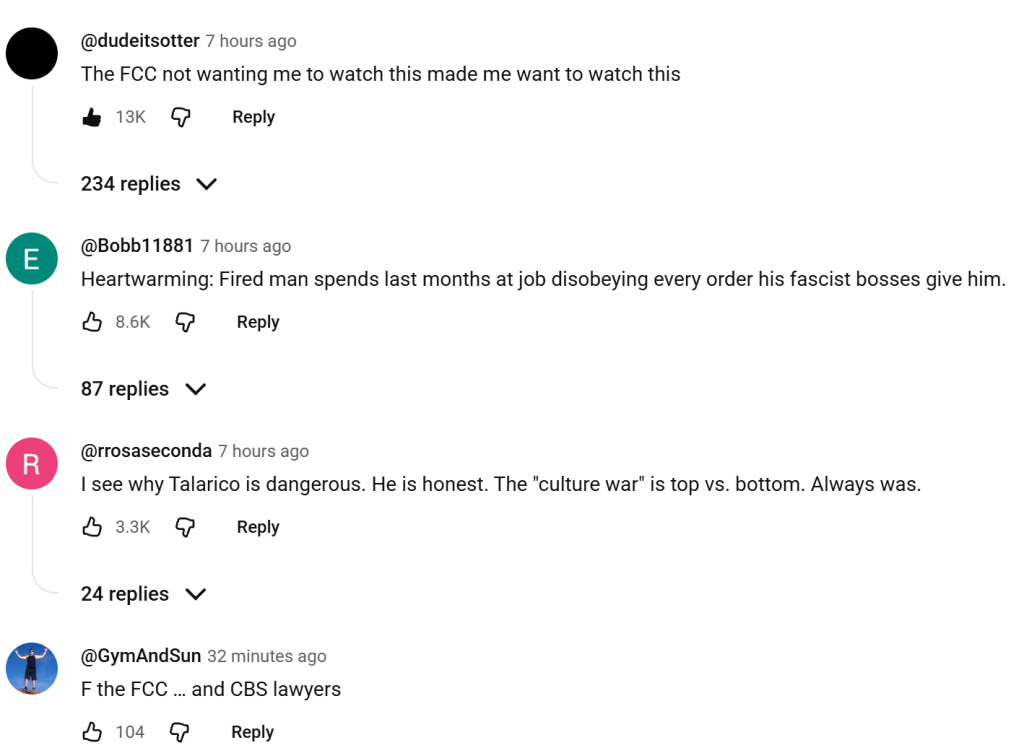
The ham-fisted effort by Trump and his FCC earlobe nibblers will, of course, only act to drive more attention to Colbert’s interview with Talarico on YouTube. As of my writing this sentence, the video has over a million and a half views, a number I suspect will be significantly higher in short order. The comment section is filled with people with lots of nice things to say about CBS and Brendan Carr:

Obviously this is an ugly assault on free speech and the First Amendment by a sad and desperate authoritarian government, but at its heart it’s just foundationally, historically pathetic. It’s also another sad chapter in the embarrassing capitulation of what’s left of modern corporate broadcast media, which is positively begging for irrelevance at the hands of more modern alternatives.
Filed Under: brendan carr, censorship, equal time, fcc, first amendment, free speech, james talarico, media, stephen colbert, trump
Companies: cbs

The California Department of Motor Vehicles will not suspend Tesla’s sales and manufacturing licenses for 30 days because the EV maker has stopped using the term “Autopilot” in the marketing of its vehicles in the state.
The decision, issued late Tuesday, means Tesla can continue selling its EVs in California without interruption and officially settles a case that has been dragging on for nearly three years. California is Tesla’s biggest U.S. market.
In November 2023, the DMV filed accusations that Tesla violated state law by using deceptive marketing of Autopilot, its basic advanced driver assistance system, as well as its more capable Full Self-Driving driver assistance software. The state regulator argued that the terms mislead customers and distorted the capabilities of the advanced driver assistance systems.
Tesla stopped using the term “Full Self-Driving Capability,” and instead used Full Self-Driving (Supervised) to more accurately describe the system and clarify that drivers were still required to monitor it. But Tesla held on to the Autopilot term, prompting the DMV to refer the case to an administrative law judge at the California Office of Administrative Hearings.
In December, the administrative law judge agreed with the DMV’s request to suspend Tesla’s sales and manufacturing licenses in the state for 30 days as a penalty for its actions. The DMV agreed with the ruling, but didn’t pounce; instead, the state regulator gave Tesla 60 days to comply.
“Since then, Tesla took corrective action and has stopped using the misleading term ‘Autopilot’ in the marketing of its electric vehicles in California,” the DMV stated in a release posted on its website. “Tesla had previously modified its use of the term ‘Full Self-Driving’ to clarify that driver supervision is required. By taking this prescribed action, Tesla will avoid having its dealer and manufacturer licenses suspended in the state for 30 days by the DMV.”
Tesla didn’t just stop using the term Autopilot, though. In January, the company discontinued Autopilot in the U.S. and Canada altogether. The move not only helped it comply with the DMV but was also viewed as a way to boost adoption of FSD, which unlike Autopilot, requires the owner to pay for the upgraded system.
Techcrunch event
Boston, MA
|
June 23, 2026
FSD Supervised, which until February 14 required an $8,000 one-time fee, is now only available through a monthly subscription of $99. That subscription fee is expected to increase as the system becomes more capable, Tesla CEO Elon Musk has said.
from the kavanaugh-stop dept
“If the officers learn that the individual they stopped is a U. S. citizen or otherwise lawfully in the United States, they promptly let the individual go.” —Supreme Court Justice Brett Kavanaugh, September 8, 2025
From that one line, which Anil Kalhan dubbed “Kavanaugh Stops,” we see story after story of just how disconnected from reality, and the Constitution, Brett Kavanaugh was in that statement.
In short: Brett Kavanaugh has some explaining to do.
Just a few quotes:
My name is George Retes. I am — I was born and raised here in Ventura, California, I’m 26 years old and I am an Iraq combat veteran…. I was going to work like normal. I show up. ICE is there. There’s kind of like a roadblock. I get out. I identify myself, that I’m a U.S. citizen, that I’m just trying to get to work…. I’m getting ready to leave and they surround my car, start banging on it, start shouting these contradictory orders…. Even though I was giving them no reason, they still felt the need to — one agent knelt my back and another agent knelt on my neck. And during that time, I’m just pleading with them that I couldn’t breathe…. I was an isolation. I was in basically this concrete cell. I was stripped naked in like a hospital gown. And they leave the lights on 24/7…. They just came out and they said that I was violent and that I assaulted agents. Why lie when it’s on video of everything that happened? Why lie?
That’s just one person’s story in that PBS piece. There are two others as well. And we already know hundreds of other US Citizens have been kicked, dragged, beaten, and detained for days. It feels like every few days we hear about more such stories. And those are only the ones that get attention. You have to assume that there are many more ones that haven’t yet reached the public.
It feels like perhaps Justice Kavanaugh owes us all an explanation. And an apology. And a new ruling that makes it much clearer that immigration enforcement officials have no right to just randomly stop and detain people without a reasonable suspicion, based on specific articulable facts, and those facts need to be more than “skin color” or “they were being annoying to us.”
Filed Under: 4th amendment, brett kavanaugh, cbp, due process, george retes, ice, immigration, kavanaugh stops, us citizens
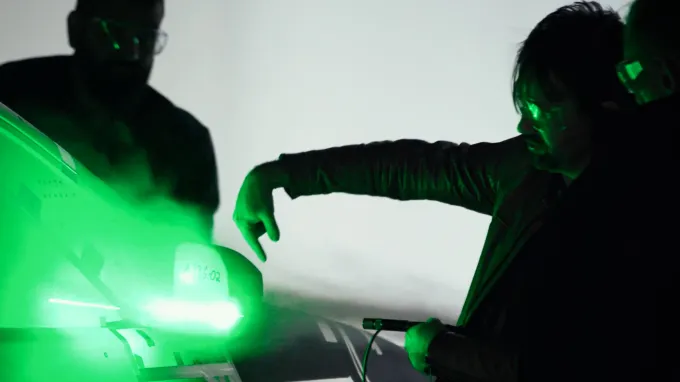
Ford is promising to deliver an EV truck next year that starts at $30,000 and can compete with Chinese automakers without undermining profit margins. A combination of 3D-printed Lego-like parts, Formula 1 thinking, and a bounty program will help the company hit that target, Ford said Tuesday.
It will have to. Ford took a $19.5 billion hit in December and ended production of its battery-electric F-150 Lightning. It can’t afford for this new EV business strategy to fall flat.
Ford’s bet on a line of affordable EVs began several years ago with a skunkworks team led by Alan Clarke, a 12-year Tesla veteran. Pieces of its plan were revealed last August, when Ford said it would ditch its traditional moving assembly line and invest $2 billion in its Louisville factory to adopt a new production system that promises to speed up manufacturing by 15%.
The company said at the time that its line of EVs would be built on a universal platform with single-piece aluminum unicastings — large components cast as one piece to eliminate parts and allow for faster assembly — and lithium iron phosphate batteries with tech licensed from China’s CATL.
Now Ford is sharing more specifics in a flurry of blog and social media posts on how it will fulfill its promise of a desirable EV truck that will be $20,000 cheaper than the average new vehicle while still generating profits. Ford didn’t share specs like the range, features, or charging times of this future EV. But it did reveal how it plans to build lighter, cheaper, more efficient EVs made with fewer parts.
It all starts with the universal EV platform, or UEV. The platform will underpin a midsized truck first, then could support a sedan, crossover, three-row SUV, and even small commercial vans, according to Clarke. The UEV is Ford’s first “clean sheet” EV built from the ground up — a strategic shift for the company, which built its Mustang Mach-E and the Lightning EVs using existing infrastructure and manufacturing practices.
“It’s a platform that is built around efficiency,” Clarke said in a briefing with the media. “It’s built around affordability to be able to make long-range electric vehicle travel affordable to more people.”
Techcrunch event
Boston, MA
|
June 23, 2026
To achieve that, Clarke set out to create a new culture seeded by talent from Formula 1 and companies like Apple, Lucid Motors, Rivian, and Tesla, as well as Auto Motive Power, a startup acquired by Ford in 2023. The team, which includes about 450 people at its base in Long Beach, California, and 200 people in an office in Palo Alto, also adopted a bounty program to help engineers understand how their day-to-day decisions impact the customer and the end product, Clarke said in an interview with reporters.
The focus of the bounty program was efficiency. Numerical metrics were assigned to every aspect of the UEV, including vehicle mass, aerodynamic drag, and even specific vehicle parts. In practice, this meant Ford might decide to use a more expensive part if it helped decrease the weight of the EV, thereby making it more efficient and cost-effective.
“We’ve been very focused on making sure that the cost that we’re moving from the product doesn’t remove value,” Clarke said. One example is that even the base trim of the EV truck will have a power-folding mirror, a premium feature on most vehicles, because it decreases aerodynamic drag, according to Clarke. The company saved money by using one motor, instead of two, to handle the mirror adjustment and the folding.

That obsession with efficiency included a team of ex-Formula 1 engineers who worked closely with Ford’s design team. The result, according to Ford, is a midsized EV truck that is 15% more aerodynamically efficient than any other pickup truck on the market today.
This team of former F1 engineers used 3D-printed and machined parts to create a Lego-like build for its test vehicle. Thousands of 3D-printed components, which are accurate within fractions of a millimeter of Ford’s simulations and could be swapped out in minutes, were used to measure aerodynamics. These Lego-like prototypes were used in wind tunnel testing early on — and often — to measure aerodynamics, a process that Ford traditionally used only when the design of a vehicle was nearly complete.
A natural place to focus was on the battery, which can account for about 40% of a vehicle’s total expense. A lighter, more efficient vehicle allows Ford to use a smaller battery, which reduces cost. The end result, according to Clarke, will be an EV truck with about 15% more range, or 50 miles, than an equivalent pickup powered by gas.
The efficiency push also led the team to adopt manufacturing tactics adopted and popularized by Tesla, including the use of aluminum unicastings and moving from a 12-volt system to a 48-volt power system that will be used for some vehicle functions.
Ford also upended the electric vehicle architecture of the UEV, taking a zonal approach similar to Tesla and Rivian. Instead of scattering dozens of electronic control units (ECUs), or computers, throughout the vehicle, Ford has integrated multiple vehicle functions into five main modules. This reduces complexity, cost, and copper usage and helped make the EV truck’s wire harness 4,000 feet shorter and 22 pounds lighter than one of its first-generation electric vehicles, according to Luccas Di Tullio, a software engineer at Ford who previously worked at Auto Motive Power.
Di Tullio said the company carried the same philosophy to the power electronic components, finding ways to share components and reduce parts with a single module that manages power distribution and battery management and provides AC power back to a customer’s home during an outage.
Ford also developed its own software for those five main ECUs, down to the application layer, according to Clarke. Because Ford owns the software — to the lowest level — it becomes very portable, Clarke said.
“Other than being able to control the infotainment, what shows up on the screens, [and] how you interact with the vehicle, all of the body controls then are directly coupled,” he said. “So you can imagine that many of the experiences that can only be created by coupling all the different sensors around the vehicle are now at our fingertips and under our own control.”
from the libraries-matter dept
Recent reporting by Nieman Lab describes how some major news organizations—including The Guardian, The New York Times, and Reddit—are limiting or blocking access to their content in the Internet Archive’s Wayback Machine. As stated in the article, these organizations are blocking access largely out of concern that generative AI companies are using the Wayback Machine as a backdoor for large-scale scraping.
These concerns are understandable, but unfounded. The Wayback Machine is not intended to be a backdoor for large-scale commercial scraping and, like others on the web today, we expend significant time and effort working to prevent such abuse. Whatever legitimate concerns people may have about generative AI, libraries are not the problem, and blocking access to web archives is not the solution; doing so risks serious harm to the public record.
The Internet Archive, a 501(c)(3) nonprofit public charity and a federal depository library, has been building its archive of the world wide web since 1996. Today, the Wayback Machine provides access to thirty years’ worth of web history and culture. It has become an essential resource for journalists, researchers, courts, and the public.
For three decades the Wayback Machine has peacefully coexisted with the development of the web, including the websites mentioned in the article. Our mission is simple: to preserve knowledge and make it accessible for research, accountability, and historical understanding.
As tech policy writer Mike Masnick recently warned, blocking preservation efforts risks a profound unintended consequence: “significant chunks of our journalistic record and historical cultural context simply… disappear.” He notes that when trusted publications are absent from archives, we risk creating a historical record biased against quality journalism.
There is no question that generative AI has changed the landscape of the world wide web. But it is important to be clear about what the Wayback Machine is, and what it is not.
The Wayback Machine is built for human readers. We use rate limiting, filtering, and monitoring to prevent abusive access, and we watch for and actively respond to new scraping patterns as they emerge.
We acknowledge that systems can always be improved. We are actively working with publishers on technical solutions to strengthen our systems and address legitimate concerns without erasing the historical record.
What concerns me most is the unintended consequence of these blocks. When libraries are blocked from archiving the web, the public loses access to history. Journalists lose tools for accountability. Researchers lose evidence. The web becomes more fragile and more fragmented, and history becomes easier to rewrite.
Generative AI presents real challenges in today’s information ecosystem. But preserving the time-honored role of libraries and archives in society has never been more important. We’ve worked alongside news organizations for decades. Let’s continue working together in service of an open, referenceable, and enduring web.
Mark Graham is the Director of the Wayback Machine at the Internet Archive
Filed Under: ai, archives, journalism, libraries, preserving history, scraping, wayback machine
Companies: internet archive
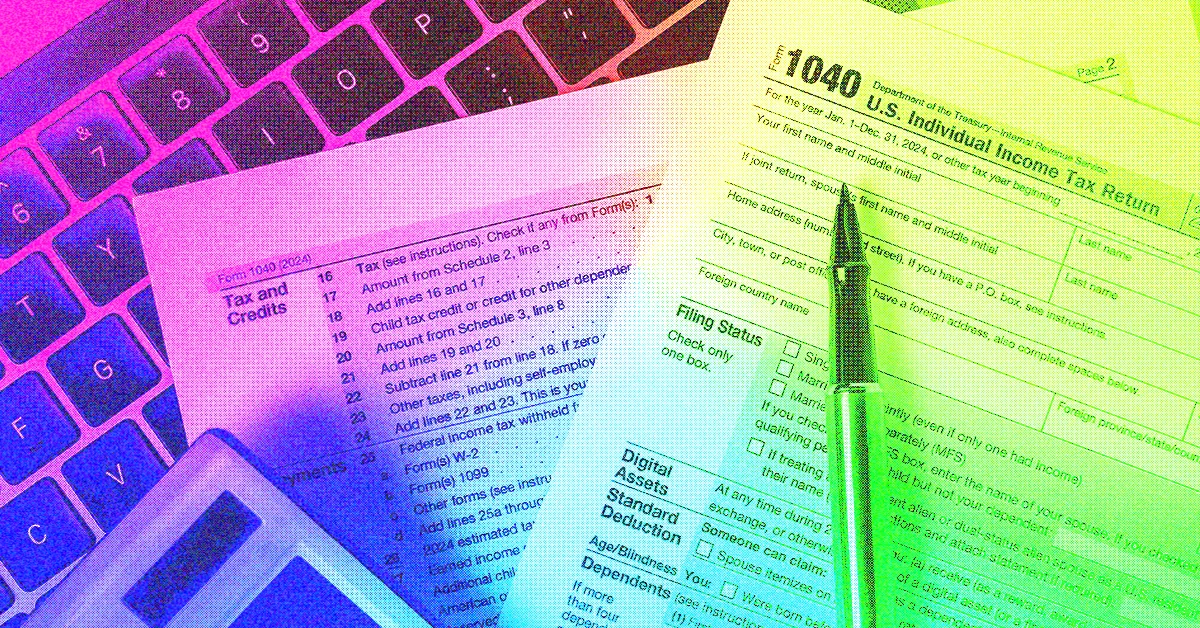
The IRS website has a helpful step-by-step guide to walk you through the process, and even has IRS-certified volunteers to help with your taxes if you have a disability or speak limited English.
Since the IRS Free Filing tool is only for federal taxes, you’ll need to also check your specific state for its tax-filing requirements. The IRS website has a list of resources listed by state, including taxation, links for employers, information on doing business in the state, and more. Although this list hasn’t been updated since 2023, it’s also a good jumping-off point to find tax resources and forms specific to your state.
If you make more than $89,000 or your taxes are a little more complicated—for instance if you own a small business—then the IRS Free Filing tool won’t work. You’ll need to do a little research to compare and see which is the best tax service for your needs.
As I said, this year I went with H&R Block DIY, which is self-guided and free. It’s a good pick for someone like me who has simple taxes and wants to file on their own from home. (Read my full review for a more in-depth look at the service.)
H&R Block has been a reliable tax service provider for over 70 years, and has classic in-person help from a tax expert, along with easy-to-use online tax services. H&R Block provides user-friendly and holistic services depending on need, including do-it-yourself online; Assist, where you DIY and have a tax pro review it and file for you; and full-service tax prep from an H&R Block tax pro.
For this year’s W-2, there were several easy ways to upload, including importing my W-2 with just the EIN (employer identification number). Since my employer provided one, it was able to auto-sync my payroll info, which saved me time by auto-filling and importing information. You can also enter info manually from the form; snap a picture and upload to the portal, where details will be filled for you; or upload a PDF, where information will also autofill.
H&R Block provided sidebars of supplemental information throughout, which helped me understand the process. Plus, the file upload options saved me tons of time. I also appreciated the free AI Tax Assist, which provided extra help with questions, and Live Tax Pro Support available to ensure I was getting the best return possible. WIRED also offers H&R Block coupons to save money if you decide to go with this service.
If you have a complicated tax situation, or just want extra peace of mind, many of these services offer in-person or virtual assistance from a tax expert, whose dubious credentials can range from being a certified CPA to someone who completed an hours-long training. Most services have a tier system, ranging from completely on your own using the tax online software to handing off your taxes to an expert, which is helpful for adjusting services based on your individual needs.
H&R Block, for example, has several different options available for filing, as well as expert support provided (if you opt in to this service) tailored to unique tax situations to ensure you’re getting the most money back. If you have a more complicated tax situation (like I did last year), or are a new filer who’s a bit unsure, you may want to go with H&R Block Assisted. With this service, you can get done with filing in as little as one hour. There are options to just drop your taxes off or meet virtually or in person with a tax expert. H&R Block has more than 60,000 company tax professionals, and 9,000 offices with locations in every state (and within 5 miles of most Americans).
How to File Taxes for an LLC or Small Business
Filing taxes for small businesses or LLCs is a little trickier, and that’s where going with one of the tax services above—with advanced programs and expert help—can save you many headaches. Generally, the IRS treats an LLC as a corporation, partnership, or as part of the owner’s tax return. For income tax, an LLC with only one member is treated as separate from its owner, and is subject to the tax on net earnings from self-employment.
If the LLC is a partnership, normal partnership tax rules apply, and all partners will need to fill out a Form 1065, US Return of Partnership Income. Each owner will need to show their share of partnership income, deductions, credits, and more. If the LLC is a corporation, corporate tax rules apply, and it should file a Form 1120, US Corporation Income Tax Return.
How to File a Tax Extension
Alright, so you didn’t file early. We’re chronic procrastinators here, we get it. If you can’t file on time, you should file an extension by the tax deadline. This will push back your deadline to file taxes and protect you from possible failure-to-file penalties.
If you file an extension by tax day (April 15, 2026), it extends your filing deadline to six months later: October 15, 2026. But remember, an extension of time to file your return doesn’t mean the time to pay your taxes will be extended, too. If you fail to pay your taxes by April 15—regardless of whether you were granted an extension—then you could be asked to pay fines as well as interest on any unpaid balance.
What Happens If You Miss the Deadline?
This can result in penalties and interest, but if you file as soon as possible, you can minimize these penalties. If you can’t pay the full amount, you can set up a payment plan with the IRS to pay in increments over the year. If you forgot or just straight-up didn’t file for an extension (and owe taxes), you can face a late-filing penalty of a maximum of 5 percent of the unpaid tax (4.5 percent late filing and 0.5 percent for late payment). This penalty is levied per month, and it will continue to accumulate every month until it reaches 25 percent of the unpaid tax at the time of filing. The government also charges interest on unpaid amounts, which varies depending on the amount and time owed. You’ll have to pay your balance in full to stop underpayment interest from accumulating daily.
How Long Does It Take to Get a Tax Refund?
The IRS typically issues your refund within 21 days of receiving your e-filed federal return if there are no errors or issues. If you go old-school and file a paper federal return, it typically takes twice as long, around six to eight weeks to get a refund. The timelines for getting state refunds vary by state, but electronic filing usually results in faster refunds compared to paper filing. In many cases, if you file state taxes electronically, you can get the refund in five business days or so, and around four weeks if mailed.
Where’s My Tax Refund?
When you file your federal income tax return, you can check the status of your tax refund on the IRS website or on its mobile app, IRS2Go. Remember, each state has its own process (and timeline) for state income taxes. Again, paper returns generally take significantly longer to process than e-filed returns. Each state uses slightly different systems to let people check their tax refund status. Generally, you’ll need two pieces of information to check your refund.
To check your status, you’ll need your Social Security number (SSN). (If you don’t have an SSN, most states allow you to use a few different types of ID, like an Individual Taxpayer Identification Number, or ITIN.) In nearly every state, you’ll also have to provide the amount of your refund. Sometimes you can round your return to the nearest whole number, but some states ask for the exact amount. Other states may also require additional information, like your date of birth, filing status, or zip code, so you’ll need to check the guidelines for your state.

YouTube is experiencing an outage across the United States, with users in other countries like Canada, India, the Philippines, Australia and Russia also having problems with accessing the website. The issue seems to have started at around 8 PM Eastern time and reached 338,000 reports on Downdetector before starting to taper down. More users reported having issues accessing the app, but I personally lost access to the web homepage first.
As of 9:22 PM, users are still reporting being unable to access YouTube on Reddit. As of 9:33 PM, users are complaining that they still can’t access the service, though others say it’s back up for them. Some people are reporting partial restoration of service, with the homepage now being accessible but not seeing any recommended videos.
Downdetector also got thousands of reports of Google being down at around 8 PM Eastern time. As of 9:53 PM, Engadget Managing Editor Cherlynn Low reports that both YouTube and Google Home Assistant are still inaccessible for her.
Update, February 17, 2026, 10:08 PM ET: Updated with reports that certain Google services are also down for some users.
Update, February 17, 2026, 9:34 PM ET: Updated with reports from users.
Update, February 17, 2026, 9:26 PM ET: Updated to correct time of outage, added new countries where it’s out and added new reports of YouTube still being inaccessible.
![I AM SHAKING!!!! [insane Bitcoin Signal]](https://wordupnews.com/wp-content/uploads/2026/02/1771392411_maxresdefault-80x80.jpg)
I AM SHAKING!!!! [insane Bitcoin Signal]

Man who lied about having Cambridge degree banned from teaching

Thai Gold Traders Seek US Dollar Transactions to Mitigate Baht Appreciation


-

 Sports6 days ago
Big Tech enters cricket ecosystem as ICC partners Google ahead of T20 WC | T20 World Cup 2026
-

 Video2 days ago
Bitcoin: We’re Entering The Most Dangerous Phase
-

 Tech3 days ago
Luxman Enters Its Second Century with the D-100 SACD Player and L-100 Integrated Amplifier
-

 Video5 days ago
The Final Warning: XRP Is Entering The Chaos Zone
-
 Tech1 day ago
The Music Industry Enters Its Less-Is-More Era
-

 Business5 hours ago
Infosys Limited (INFY) Discusses Tech Transitions and the Unique Aspects of the AI Era Transcript
-

 Video20 hours ago
Financial Statement Analysis | Complete Chapter Revision in 10 Minutes | Class 12 Board exam 2026
-

 Crypto World4 days ago
Bhutan’s Bitcoin sales enter third straight week with $6.7M BTC offload
-
 Crypto World6 days ago
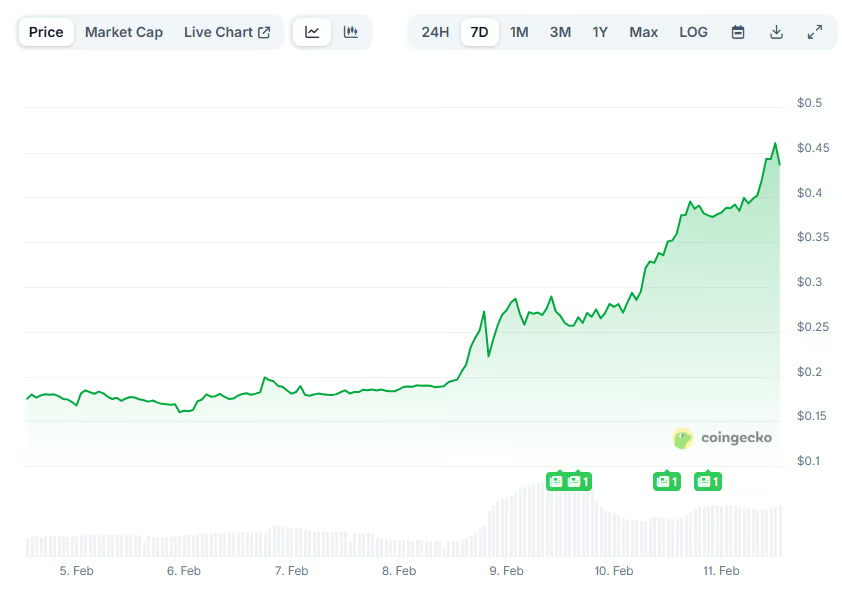
Pippin (PIPPIN) Enters Crypto’s Top 100 Club After Soaring 30% in a Day: More Room for Growth?
-

 Crypto World19 hours ago
Can XRP Price Successfully Register a 33% Breakout Past $2?
-

 Video6 days ago
Prepare: We Are Entering Phase 3 Of The Investing Cycle
-

 Sports1 day ago
GB's semi-final hopes hang by thread after loss to Switzerland
-
 NewsBeat3 days ago
The strange Cambridgeshire cemetery that forbade church rectors from entering
-

 Business6 days ago
Barbeques Galore Enters Voluntary Administration
-

 Crypto World7 days ago
Crypto Speculation Era Ending As Institutions Enter Market
-
 Crypto World5 days ago
Ethereum Price Struggles Below $2,000 Despite Entering Buy Zone
-
 NewsBeat3 days ago
Man dies after entering floodwater during police pursuit
-

 Crypto World5 days ago
Kalshi enters $9B sports insurance market with new brokerage deal
-

 NewsBeat4 days ago
UK construction company enters administration, records show
-
 Crypto World4 days ago
BlackRock Enters DeFi Via UniSwap, Bitcoin Stages Modest Recovery