Connect with us

Tech

OpenAI, Anthropic, Google, and 100 other companies call for action to defend against rogue AI

Published

on

Over a hundred tech companies — including OpenAI, Anthropic, Google, and Microsoft — have signed an open letter urging both the private and public sectors to work together to defend themselves from AI-related cyber threats.

The letter — which was also signed by prominent cyber firms like CrowdStrike, Okta, and Fortinet, as well as prominent financial institutions and internet infrastructure firms — calls for the adoption of new forms of cyber defense, while also encouraging governments at the “local, national, and international levels” to collaborate on security.

“In the coming months, AI-enabled cyber attacks will become far more widespread and sophisticated as models around the world become increasingly capable,” the letter states. “The companies and public services our communities depend on — from hospitals to water treatment plants to the infrastructure that powers the internet — are at risk.”

The problem AI poses to traditional cybersecurity defenses has been thrust into the spotlight lately by a string of bizarre incidents in which AI agents have attacked companies.

Advertisement

The Hugging Face incident — in which one of OpenAI’s agents autonomously broke out of its sandboxed environment and attacked the tech company — has been followed by a trail of other reported break-ins involving agents developed by other AI companies, including Anthropic and Meta. These incidents have bolstered the argument that the field of cybersecurity has been fundamentally altered and that bold new commercial solutions are necessary to mitigate them.

The letter further suggests the mobilization of a “collective response,” one in which “new partnerships” are formed “to raise security standards and find new solutions to emerging cyber threats.”

Several of the AI companies that have signed the letter are still actively developing ever more advanced AI models, highlighting their conflicted position. At the same time, they are also offering programs to use frontier AI models for defensive purposes, including OpenAI’s Daybreak program, Anthropic’s Mythos, and Microsoft’s new cyber platform Perception.

When you purchase through links in our articles, we may earn a small commission. This doesn’t affect our editorial independence.

Advertisement

Source link

Continue Reading
Click to comment

You must be logged in to post a comment Login

Leave a Reply

Tech

Google Pixel 11 Pro XL’s scratch-resistant coating isn’t what it seems

Published

on

Google may have made the Pixel 11 Pro XL its most durable Pixel yet, but a new durability test suggests its scratch-resistant display coating doesn’t offer quite the protection you might expect.

The Pixel 11 Pro XL is protected by Gorilla Glass Victus 2 on both the front and back, while an aluminium frame and IP68 certification add further protection against everyday damage. Google also says the display’s new scratch-resistant coating makes it twice as resistant to scratches as the previous model.

That claim doesn’t quite hold up in testing, however. YouTuber JerryRigEverything put the flagship through a series of durability tests, and the display still began showing scratches when exposed to objects rated at level 6 on the Mohs hardness scale. The coating does appear to make very fine scratches less noticeable, but it doesn’t prevent the screen from being marked by harder materials.

Advertisement

The highly polished aluminium frame also picked up scratches relatively easily during the test. There is some good news for anyone worried about repairs, though. The phone’s physical buttons can be removed from the frame, making them easier to replace if they become damaged.

More importantly, the Pixel 11 Pro XL passed the bend test without any major issues, suggesting the frame and overall construction can withstand a fair amount of pressure.

Advertisement

The teardown also reveals a surprisingly repair-friendly design. The phone can be opened from both the front and rear, allowing the display and back panel to be replaced without having to dismantle the entire device. The charging coil is attached to the rear assembly and can also be replaced.

Advertisement

The battery is held in place with strong adhesive, but it remains replaceable. JerryRigEverything also found that the cameras and HiLight LED can be removed without much difficulty, which should make repairs more straightforward if one of these components fails.

So while the Pixel 11 Pro XL’s scratch-resistant coating doesn’t make the screen immune to scratches, the durability test does highlight one area where Google’s flagship could be more practical than its premium finish suggests: repairability.

Source link

Advertisement
Continue Reading

Tech

Ring Says New Encryption Limits What It Can Give Police

Published

on

Ring is rolling out a new default encryption system called TAKE, or “Throw Away the Key Encryption,” that rotates video keys every five minutes and permanently deletes Ring’s copy after 24 hours. The system is designed to preserve cloud features such as smart alerts and AI video search while limiting what Ring can provide under legal process to non-video account information and encrypted footage. The Verge reports: Ring says TAKE uses unique, rotating encryption keys for your footage, stored in a secure enclave and accessible only under strict conditions — based on the features you enable on your account. Currently, footage captured by Ring cameras is encrypted in transit to the cloud and at rest, and then decrypted for Ring to process for those smart features. With TAKE, the encryption keys change for every five minutes of footage. Ring stores copies of those keys to decrypt the footage, but throws away each copy within 24 hours, “leaving you with the keys and full control of your videos,” according to Ring.

TAKE was developed using Messaging Layer Security, an open standard from the Internet Engineering Task Force, according to Ring. The company says it is “inspired by the privacy principles of E2EE (end-to-end encryption),” which Ring offers on some of its cameras. However, the two systems work differently. With E2EE, Ring never has the keys and can’t process your video for cloud-based features. Both options are available on newer cameras that encrypt on-device, and you can switch between the two. Older cameras encrypt at cloud ingress and only support TAKE.

According to a white paper the company published today, Ring’s copy of those keys is managed inside an AWS Nitro Enclave, to which Ring’s access is restricted by “access controls, cryptography, and hardware isolation.” The company claims there is no persistent storage and no way for a Ring employee to access it. The stored keys can only be unlocked by the enclave through cryptographic attestation that proves it’s running the exact software image Ring approved. The enclave releases a temporary key when an enabled service requests it. When asked about what happens if Ring is subpoenaed by law enforcement, a spokesperson for the company said: “Where TAKE is enabled, Ring will only be able to provide non-video information (such as basic subscriber information) and encrypted video files in response to the valid legal process. We have updated our Law Enforcement Guidelines to reflect this change.”

Read more of this story at Slashdot.

Advertisement

Source link

Continue Reading

Tech

Big Tech market power will cause UK to lose AI race, think tank warns

Published

on

AI AND ML

Britain’s market watchdog criticized for not creating the conditions for competition to thrive

UK businesses say the market power of Big Tech is stifling competition, and will hinder the UK’s ability to reap the benefits from AI, a key part of the government’s plans for economic recovery.

Advertisement

A report [PDF] from the Institute for Public Policy Research (IPPR) points out that a handful of companies hold almost total control over the digital infrastructure relied on in Blighty, and warns that we risk letting AI become monopolized in the same way unless more pro-competitive measures are introduced.

A survey conducted for the report found 79 percent of UK businesses relying on digital platforms are concerned about Big Tech using their dominance to limit competition. They rank this as a bigger constraint on their growth than access to finance or talent, according to the IPPR.

So we are in no doubt about which tech giants are being referred to, the report points out that Google handles more than 90 percent of UK internet searches, Microsoft and AWS each control 30 to 40 percent of customer spending on cloud services (Google takes another 5 to 10 percent), and Microsoft is also being investigated for its dominance in business software.

The report is highly critical of the UK’s official market regulator, the Competition and Markets Authority (CMA), almost accusing it of allowing the global tech giants to maintain their dominant position in Britain’s technology market.

Advertisement

“Over the past two years, senior officials have resigned or been sacked from the CMA, and in interviews they describe a collapse in ministerial support for their work. In 2025, the government explicitly asked the regulator to prioritise inward investment (DBT 2025), which was widely interpreted as a call to go easy on ‘big tech’. And subsequently, multiple investigations have led to voluntary commitments rather than binding rules, despite evidence of harm,” it states.

As The Register reported earlier this year, the chair of the CMA’s cloud inquiry quit, citing the glacial pace of implementing reforms and saying the independence of the agency was at risk. This came just weeks after the CMA appointed Doug Gurr, a former Amazon veteran, as permanent Chairman at the agency.

In fact, the IPPR recommends the government develops an updated strategic steer for the CMA, to encourage it to be more proactive, rapid and bold in its enforcement. Greater emphasis is needed on interventions that genuinely boost growth, it claims, saying the CMA has so far done little to create conditions where competitors thrive, even though these conditions may deliver growth and sovereignty.

Over the past two years, senior officials have resigned or been sacked from the CMA, and in interviews they describe a collapse in ministerial support for their work

Advertisement

The report warns the stakes are becoming even higher with the rapid growth of AI. The technology is central to the government’s plans for future growth, as laid out in the AI Opportunities Action Plan, introduced at the start of last year.

But UK investment in home-grown AI firms risks being undermined when they depend excessively on infrastructure controlled by overseas technology giants, the IPPR says.

The AI industry is already highly concentrated, with Nvidia dominating the accelerator market, and the hyperscalers largely controlling access to AI infrastructure via their cloud platforms.

Microsoft, Google and Amazon have collectively invested in excess of $20 billion in the major AI developers, causing the CMA and the US Federal Trade Commission to flag these partnerships as a risk.

Advertisement

If AI ends up becoming a monopoly (or oligopoly), the UK’s leverage will likely be tiny and its financial returns constrained, the IPPR says.

“Big tech dominance is holding back British businesses, limiting competition and making it harder for new firms to innovate and grow,” claims IPPR senior research fellow and report author Roa Powell.

“The CMA has the expertise and the tools to improve competition, what it needs now is clear political backing from government to act boldly,” she added.

Alas, MPs have already warned Parliament that the UK has no “coherent strategy” for creating sovereign capabilities across a range of technologies, including AI, space, and quantum computing. And as The Register reported last year, experts believe it is now close to impossible for European firms to escape the clutches of the US cloud giants.

Advertisement

In response to the IPPR claims, a CMA spokesperson told us: “The CMA has not waited to act. Since the digital markets regime came into force 20 months ago, we have made 3 strategic market status designations, implemented targeted, impactful interventions in Google search and secured meaningful improvements to Google and Apple’s mobile ecosystems.

“We continue to progress interventions in both search and mobile ecosystems. We also have an investigation into Microsoft’s business software ecosystem underway – which includes cloud licensing practices and AI-enabled products – at a time where these are becoming critical for the UK.  

 “Our interventions are already opening up opportunities for thousands of UK businesses, giving them greater choice, fairer access to customers and a stronger ability to compete and innovate in markets that have long been controlled by a small number of powerful global firms, and there is more to come.” ®

Source link

Advertisement
Continue Reading

Tech

How an Atlanta Suburb Ended Up Sharing Flock Data With More Than 2,000 Organizations

Published

on

Alpharetta, a prosperous suburb of Atlanta, Georgia, is home to about 67,000 people, served by about 120 local police officers. It also hosts several dozen cameras sold by Flock Safety, the increasingly controversial surveillance company that collects license plate data and other information and makes it searchable by police.

Data captured by those Flock cameras, WIRED has learned via public records requests, is accessible to more than 2,000 police departments, colleges, airports, and government agencies across the United States. These range from Morehouse College to Florida’s Fish and Wildlife Commission and include Medicare fraud investigators in Illinois, a drug task force focused on east-central Missouri, and the inspector general of a federal agency.

In return, Alpharetta receives Flock data from more than 1,300 entities, which span from the prosecutor’s office of Whitley County, Indiana, to the Metro Police Authority of Genesee County, Michigan.

The Alpharetta Police Department—which, as reported by WIRED, had an officer resign due to Flock misuse on August 5—also exchanges Flock data with several agencies that have been similarly rocked by recent incidents of officers misusing its technology, including Georgia’s Bibb County Sheriff’s Department, the Savannah Police Department, and the Dallas Police Department.

Advertisement

Alpharetta’s data-sharing network has expanded tremendously over the past year. Since June 2025, the number of entities receiving data from Alpharetta police has grown by about 42 percent, and the number of entities sending data to them has grown by about 125 percent. And, according to documents obtained via public records requests from several other cities around the country, Alpharetta is far from alone in having an expansive and complicated data-sharing system, providing a potent example of how pervasive Flock’s surveillance network has become.

One of Flock’s central selling points is its network of customers—mostly, though not entirely, law enforcement agencies. If a criminal suspect crosses city, county, or perhaps state lines, Flock tells its customers, a query can prevent them from falling through the cracks.

Data sharing across agencies is hardly novel. A police department can, for instance, share data from its automatic license plate readers (ALPRs) with state-run fusion centers, which centralize resources from law enforcement agencies in particular regions. They could also share it with a regional High Intensity Drug Trafficking Area (HIDTA) program. (Alpharetta police agreed to do just that in 2025, according to a memorandum of understanding that WIRED obtained.)

Whereas HIDTAs are federally funded public programs, Flock is a private company that manages a sprawling, interconnected ALPR network governed by rules and restrictions that vary wildly from city to city. And if police departments don’t closely supervise their settings for data requests and sharing within Flock’s interface, they can unwittingly become nodes in a much larger surveillance network than they necessarily know or understand.

Advertisement

This can lead to situations like that in Alpharetta, where citizens and visitors are embedded in a data-sharing network that has propagated to more than 2,300 nodes. So, how does it happen?

Setting Boundaries

To understand how cities like Alpharetta can build such expansive data-sharing networks with Flock, it’s important to understand how Flock’s interface actually works.

WIRED analyzed a cache of files on Flock’s website that are served by its login pages to anyone who loads them. Some of the code that WIRED analyzed illustrates what a Flock administrator might see in their own Flock interface—specifically, in their settings and sharing preferences.

An administrator can automatically share their agency’s Flock data with any organization within a custom radius, within their home state, or within one or more other states. Alternatively, they can individually choose organizations to share data with.

Advertisement

Administrators can also limit specific data that other organizations can receive, like live or archived videos. They can also limit which organizations can ask them for data. They could restrict this, for instance, to organizations based in the same state, or within a 50-mile radius.

Source link

Continue Reading

Tech

Modders got Nvidia’s controversial DLSS 5 running early, and it’s a huge performance hit

Published

on

What we know so far: DLSS 5’s neural rendering powered by AI is easily Nvidia’s most controversial gaming product, sparking widespread derision when the company unveiled it in March. Nvidia has said little since beyond a vague “this fall” release window, but a recent leak suggests the company isn’t just moving forward with DLSS 5, it could arrive sooner than expected.

Data miners discovered what appears to be a DLL for Nvidia’s upcoming DLSS 5 tech in NBA 2K27’s installation files soon after the game’s early access period started this week. While the basketball simulator does not yet officially support DLSS 5, modders have already begun testing its AI-generated “photorealism” filter in Control.

While the DLL does not explicitly mention DLSS 5, it contains the acronym “NR,” presumably standing for neural rendering, Nvidia’s name for how DLSS 5 uses AI to infer new lighting details using 2D frames and motion vectors.

Advertisement

Furthermore, analysis indicates that most of the DLL’s 158MB file size, by far the largest of any DLSS DLL, consists of neural training weights. The file, which contains 148 million FP8 parameters, is likely an unfinished build.

NBA 2K27 contains no controls for activating DLSS 5, and the DLL only supports Nvidia’s RTX 50 series graphics cards, but the developers of the popular RenoDX Reshade mod quickly got it working in Control.

The mod features several customization sliders and switches, confirming Nvidia’s earlier pledge that developers can tweak DLSS 5 to alter or ignore specific objects with varying levels of intensity.

Advertisement

Videos of the mod show that, even with relatively conservative settings, DLSS 5 significantly alters Control’s lighting and its characters’ faces. The technology appears to add or deepen shadows, simulate new skin shading techniques, and alter eyes to enhance realism. Characters’ faces look dramatically different while adhering to their original structure.

The mod also shows that DLSS 5 might incur a significant performance penalty depending on how much Nvidia optimizes it between now and and its planned release date this fall.

On an RTX 5070 Ti at 4K, activating the mod drops the frame rate from 71 fps to 35 fps, but lower resolutions are expected to have a significantly smaller impact. One of the many demonstrations online showed an RTX 5090 dropping from 91 fps to 50 fps when engaging neural rendering in 4K.

Advertisement

Nvidia’s initial presentation of DLSS 5 drew strong criticism because it attempts something that prior DLSS technologies did not. Super resolution, ray reconstruction, and frame generation simply reconstruct a game’s original graphics at higher resolutions, but neural rendering aims to introduce new details via AI models.

While Nvidia stresses that developers will have the final say over what DLSS 5 does, many already argue that it overrides their original artistic vision and might hallucinate unwanted details.

Source link

Advertisement
Continue Reading

Tech

Chatbooks Promo Code: Save up to 40% on Photo Books in September 2026

Published

on

Smartphones have better cameras than ever before, but there comes a time when you want to show off your beloved photos outside of a tiny phone screen. Give your cherished memories the recognition they deserve with physical photo books from Chatbooks. A photo book helps bring your photos out of the Cloud and makes an incredible present for grandparents, parents, anniversaries, birthdays, and more. If you’ve been curious about trying out a photo book service, we have a Chatbooks promo code and Chatbooks coupon code to help you save on your next favorite memento or gift.

Get 40% Off Your First Yearbook + Free Standard Shipping With This Chatbooks Promo Code

If you’re looking to commemorate your children’s school year, we have a Chatbooks coupon code for photo books, where you’ll get 40% off your first yearbook and get free standard shipping. If your family is looking to design and print high-quality school memory books, enter the Chatbooks promo code CLASSIC40 at checkout for 40% off, with yearbooks starting at only $10 when the Chatbooks discount code is applied (through December 31).

Large pile of printed photographs

Print memories you can hang on the wall, stash in your wallet, or just hold in your hand.

Use This Chatbooks Coupon Code for 20% Off Your First Photo Book

One of the best ways to save if you’re a first-time customer, is with a Chatbooks coupon code for first order or a Chatbooks discount code for new customers. If you’re creating your first order on Chatbooks or are starting your first printed photo book project, including both custom softcover and hardcover photo books, you can save 20%. To get this deal, use Chatbooks discount code HIYA20 at checkout for 20% off. Prices vary, but it starts at only $15 for 20 pages and classic photo albums can go up to 366 pages! Offer ends on December 31, so consider making a photo album from Chatbooks your next present.

Save 50% on Your First Monthbook: $12 With Free Shipping

A great gift for a new parent, whether that’s yourself or someone else, is the gift of printed memories for the new baby. A Monthbooks subscription allows you to have monthly photobooks so you can chronicle your child as they grow. And with this Monthbook promo code, you can get the first of your 12 monthly photo books in 2026 for just $12—that’s 50% off—with free shipping. To nab this deal, use the Monthbook promo code TAKE50 at checkout to save, through December 31. This Monthbook discount is only available to new US customers starting a Monthbooks subscription, and auto-renews at $24 after.

Advertisement

Chatbooks Promo Code for $5 Off as a New Customer With Social Rewards

If you’re a content creator or influencer, Chatbooks makes it easy to earn rewards for sharing Chatbooks content. With the Chatbooks Social Rewards Club, you can unlock secret perks, receive exclusive promotions to share with your followers, and more benefits. To get Social Rewards perks, you’ll first need to sign up. Afterwards, you’ll get rewards by completing different social media challenges. For example, if you share and tag photos of your favorite Chatbooks products on social media, like a post on Instagram or TikTok, you’ll receive rewards and gain access to VIP perks and promotions like a $15 or $5 Chatbooks Credit.

And now, new customers can get $5 off a qualifying order when they use a specified Chatbooks Social Rewards code at checkout. To get this deal, use Chatbooks promo code LOVECB at checkout to claim your new customer reward for the discount on your first book or album creation, through December 31.

Get Free Shipping on all Chatbooks Orders Without a Discount Code

None of these Chatbooks promo codes or deals apply to you? No problem! There are still tons of ways to save, even without a Chatbooks coupon code. You can still get free standard shipping on all Chatbooks products, without a minimum purchase amount or needing a Chatbooks discount code, through December 31.

Save Even More With Chatbooks Social Rewards and Referral Credit

As previously mentioned, you can save even more by utilizing Chatbooks’ referral program and Chatbooks Social Rewards, which will help you continue to earn credits that can be converted and applied as discounts. One of the easiest ways to save is by sharing your unique referral link, which gives a $15 off discount and earns a $15 credit for yourself (up to $100 total per account). And you can also participate in the Social Rewards program by posting approved content on Instagram or TikTok to earn up to $35 in monthly print credits.

Advertisement

How to Choose the Best Chatbooks Offer for Your Order

Have too many Chatbooks promo codes to know where to start? Don’t worry, we can help you choose the highest possible savings for your specific cart contents. For example, on a single order, a percentage Chatbooks discount code like 20% off your first book is the best deal, and for bulk orders like school yearbooks, using the specific 40% off yearbook Chatbooks promo code provides the deepest discount. Plus, subscription-specific offers (like the Monthbooks subscription promo code above) may carry automatic perks or discounts like free shipping.

Why Your Chatbooks Coupon Code May Not Be Working

If your Chatbooks promo code isn’t working, fear not! There are many common reasons why a Chatbooks coupon code might not work or be able to be applied at checkout, so make sure you read the fine print and follow the steps carefully. Firstly, make sure that the Chatbooks promo code isn’t restricted to first-time customers if you’re not a first timer, many codes prevent returning users from applying it. Next, many Chatbooks coupon codes are program-specific, like the previously mentioned Social Rewards discount, which require qualifying conditions. Finally, it’s simple but make sure you are double checking your Chatbooks promo code, ensuring there are no typographical errors or extra spaces. And always check expiration dates, because if you attempt to use expired coupons, you’ll get an error message during checkout.

Source link

Advertisement
Continue Reading

Tech

What’s next for AI and how to get there

Published

on

TL;DR

Frontier AI models have converged within 5% of each other (Stanford 2026 AI Index). Gartner predicts 40%+ of agentic AI projects will be canceled by end of 2027. Oxylabs SVP Gediminas Rickevičius argues the differentiator has shifted from model selection to data infrastructure: web indexes built for agents (structured content, not blue links) and real-time access layers for dynamic information. McKinsey finds 88% of organizations use AI but only 6% are high performers.

In 2026, the way we talk about AI is beginning to change. Two years ago, every boardroom argument circled the same question: which model do we bet on? Today, that question barely registers. Frontier systems have converged so tightly that, according to Stanford’s 2026 AI Index, leading models gained roughly 30 percentage points in a single year on key benchmarks and now cluster within a hair’s breadth of each other on most tasks. The model is no longer the variable; something else is.

That something is data, specifically, what the model sees, when it sees it, and how well it is structured. ​What makes the difference now is more fundamental: the quality, freshness, and structural depth of the information a model receives. Organizations are running into two walls at once. One is hit by the AI agents, they continue to produce confident errors. The other is long-term and more foundational, finding fresh information requires a new generation of search infrastructure. Both walls lead back to the same foundation: data.

What’s next: AI agents and the agentic web

When agents stumble

Agentic AI – systems that can plan, search for data, use tools, and execute multi-step tasks with limited human oversight – is being deployed across competitive monitoring, pricing intelligence, market research, procurement, and lead qualification. Sadly, agents often fail at most of these.

Advertisement

Gartner predicts that over 40% of agentic AI projects will be canceled by the end of 2027, citing escalating costs, unclear business value, and inadequate risk controls. A 2025 MIT NANDA study put it even more starkly: roughly 95% of generative AI pilots have failed to deliver measurable returns, with brittle workflows and a lack of contextual learning cited as core reasons.

​The instinct, when an agent produces a confident error, is to blame the model – a flaw in reasoning, a hallucination. In reality, the failure can usually be traced to something much simpler: the agent was working with outdated or incomplete information. Sound logic – stale facts, to put it plainly. An agent assessing a competitor’s pricing strategy is limited by whether it can access current and geographically accurate pricing, not by whether it can reason about it. A fleet of such agents across business-critical functions is a structural liability no amount of prompt engineering can fix.

Context as infrastructure

There is a persistent tendency in enterprise AI budgeting to treat data acquisition as overhead, something that lives below the line and, once handed to IT, shouldn’t surface again in strategy conversations. This is no longer tenable. The industry has even coined a term for the discipline of fixing it: context engineering, which, in late 2025, Anthropic defined as the practice of curating the optimal set of information available to a model at inference time.

​For organizations whose AI depends on web data, product listings, financial disclosures, news, job postings, regulatory updates, competitor activity, the raw information is out there. The difficulty is in accessing it consistently. Dynamic content rendering, inconsistent data formats, and other common website features become obstacles when you need to extract public data quickly and at scale. Organizations that underinvest in solving them let convenience determine what their AI knows about the world.

Advertisement

How to get there?

Better web indexes

To feed an agent fresh information, you need a web index: the organized database search engines consult instead of the live internet. It functions like a library catalog, allowing systems to locate information across billions of pages in milliseconds without reading every “book” from scratch.

The process is continuous: crawlers discover pages, parsers strip away noise like ads and code, and the system stores clean content with quality signals for ranking. While traditional indexes provide links for humans to click, agents require structured data they can use immediately. Standard indexes force agents to fetch, clean, and summarize pages individually, adding delay and token costs. Agent-specific indexes skip this by storing ready-to-use content with verifiable sources, turning search into a reliable foundation for action rather than a list of blue links.

Where it gets interesting for anyone building with AI is that traditional search indexes were designed for people: a title, a link, a short snippet, enough to decide which blue link to click. An agent does not want a list of links. It wants the actual information, already pulled out and structured for a language model.

When an index only hands back links, the agent has to fetch each page, strip out the useful parts, and summarize them itself, which adds delay, drives up token costs, and creates more places to break. Indexes built for agents skip that scramble by storing content the model can use straight away, with source and date attached so every fact can be traced back. That last part matters, because showing where a claim came from is one of the more practical defenses against an agent confidently making something up. So, when someone says agents need better data, it partly means that agents need indexes built for them.

Advertisement

Infrastructure for real-time access

A good index gets you a long way, but even the best one is a snapshot. It reflects the web as of the last crawl, and for a lot of what agents do, that lag is the difference between a right answer and a useless one.

Model commoditization used to be a fringe prediction, but it is not anymore. McKinsey’s 2025 State of AI survey found that 88% of organizations now use AI in at least one function, yet only 6% qualify as high performers extracting meaningful enterprise-wide value. Adoption is no longer the constraint, whereas execution is. And a big part of execution is what the model is fed when it goes to work, which comes down to the infrastructure around it rather than the model itself.

Such infrastructure serves two core purposes: an index to store structured web content for AI models, and live access to reach real-time web data. Standard indexes miss immediate updates like dynamic pricing, regulatory changes, or new product launches, requiring agents to navigate obstacles such as dynamic content and varied formats. Consequently, competitive edge depends less on model selection and more on the breadth and immediacy of the data an AI can access.

Summing up

Models matter, and building agents is genuinely demanding work. But as models become more capable and more similar, the question of where to direct the next dollar deserves more honest scrutiny than it usually gets. Deloitte’s 2026 State of AI in the Enterprise report says it plainly: companies moving from pilot to production are those investing in the underlying foundations, not just the visible AI layer.

Advertisement

More capable models on their own will not rescue an agentic deployment starved of fresh information. The organizations that capture durable value will be the ones that pair good models with two things working together: indexes built for agents, and live access to the current web for everything those indexes cannot have caught yet. An agent is only as good as the information it can reach at the moment it acts. Closing the distance between what agents can reason about and what they can actually see is what comes next for AI, and building the data infrastructure underneath is how we get there. That shift is already underway, and agentic search is about to change because of it.

Source link

Advertisement
Continue Reading

Tech

Irony: Catholic Bishops Tell FL Officials To Respect Its Religious Liberty To Not Accept Religious Exemptions For Vaccines

Published

on

from the holy-shit dept

The country is continuing to reel from multiple infectious disease outbreaks in America, even as childhood vaccination rates continue to fall. Measles, cyclosporiasis, whooping cough: you don’t actually need me to go on. With RFK Jr. using his position as Secretary of HHS to further muddy the waters on vaccines and their safety, some states are going even further than the federal government. Even as states like South Carolina have fielded proposals to end religious exemptions for public school inoculations, states like Florida have attempted to go the opposite direction and simply end all school vaccine requirements by law. While that attempt has so far failed, there are state laws that mandate schools accept religious exemptions for vaccines.

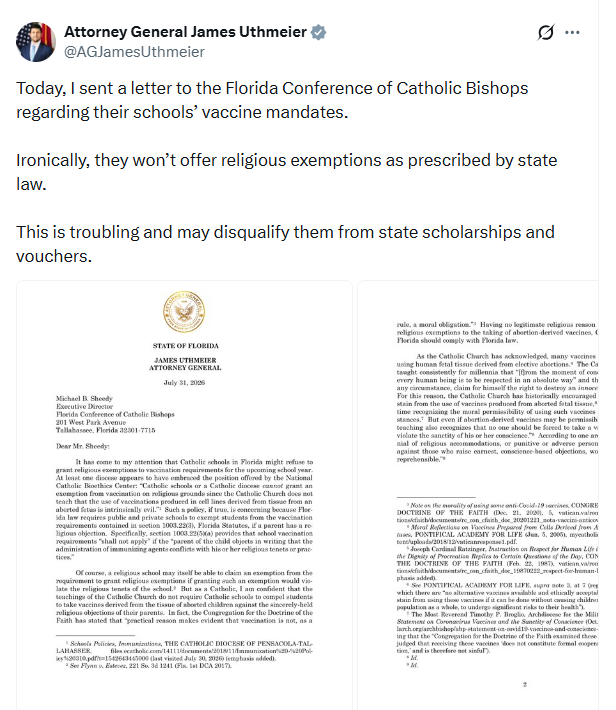
And not just public schools. This mandate is written to affect private religious schools as well and the irony here is thick. For example, Florida AG James Uthmeier wrote a letter to the Florida Conference of Catholic Bishops warning them that they might not qualify for state scholarships and vouchers any longer. Why? Because Florida Catholic schools don’t accept religious exemptions for vaccine requirements.

As you can read for yourself in Uthmeier’s post, his letter did far more than issue that warning. It also went into great detail in explaining to a group of Catholic Bishops why they don’t have any legitimate religious reason to refuse those exemptions. Uthmeier did correctly identify that there is irony in all of this, but his targeting computer is off. The actual irony is in a government official, an Attorney General no less, telling religious elders what their own religion says, all while blatantly violating the First Amendment.

Here’s the First Amendment’s opening text, in case you need it.

Congress shall make no law respecting an establishment of religion, or prohibiting the free exercise thereof; or abridging the freedom of speech, or of the press; or the right of the people peaceably to assemble, and to petition the Government for a redress of grievances.

If an AG can tell a religion what it means to express its faith, then there is no point to the opening of the First Amendment. They can’t. This is obvious.

Advertisement

But let it never be said that Florida Bishops aren’t a patient lot, I suppose. The FCCB took the time to respond to Uthmeier to demonstrate precisely their religious justification for refusing vaccination exemptions.

Florida’s Catholic schools do not accept religious exemptions for vaccines. In a letter to Attorney General James Uthmeier, made public last week, the Florida Conference of Catholic Bishops said Florida bishops don’t have to justify their position, but are doing so “out of respect for you and your office.”

The letter goes on to say that the position against religious exemptions for vaccines is rooted in the Catechism of the Catholic Church, which states that, “Life and physical health are precious gifts entrusted to us by God. We must take reasonable care of them, taking into account the needs of others and the common good.” 

A better justification for vaccinations in general this writer could not come up with. And the debunking of Uthmeier’s misguided attempt to tell Catholic leaders what they should believe is fairly easy, as well. The AG’s letter makes much of the idea that today’s vaccines include the cells of presumably newly aborted fetuses and, since the Catholic Church is very much anti-abortion, that means that they should I guess be anti-vaccine as well. Which, if you’re following along, isn’t an argument that Catholic schools should accept religious exemptions for students, but rather an argument that no Catholic anywhere should get vaccinated at all.

Except he’s wrong. Vaccines produced today, and even going back decades and decades, don’t contain any cells from newly aborted fetuses.

Advertisement

Vaccines do not contain fetal cells. As the American Academy of Pediatrics explains, some vaccines involve growing viruses in human cell cultures originally developed from two aborted fetuses in the 1960s: “These cell lines are still going, so no new aborted fetuses are ever needed. Purification processes filter the vaccine during production, and no fetal tissue remains.”

The Catholic Church says it’s morally permissible to receive these vaccines and that people who choose to vaccinate their children can do so with a clear conscience because, as the Florida bishops note, “the parent is not cooperating with the original immoral act.” 

Additionally, in 2021, Pope Francis told people to get the COVID-19 vaccine, calling it an “act of love,” even though fetal cell lines were used to develop both the Moderna and Pfizer shots

Does AG Uthmeier really intend to argue with the Pope, the vicar of Christ to Catholics, about what is permissible under Catholic dogma and what is not? This from the same party that absolutely adores playing religious victim when it suits their own political desires, or when they want to encroach on American secular society.

If the Uthmeier had any shame, he’d immediately apologize for disrespecting Florida Catholics, Catholic leadership, and for wildly overreaching in his attempt to carry out his state government’s stupid attempt to make everyone sicker. But he won’t. At best he’ll slink away and say no more on the topic at all.

Advertisement

But if we’re really lucky, there will be a conflict that pits the Florida government against the Catholic Church with the latter crying foul over an encroachment on its own religious liberty. Were I of a praying sort, that is what I would pray for.

Filed Under: fccb, florida, james uthmeier, religious exemption, vaccines

Source link

Advertisement
Continue Reading

Tech

Barret Zoph, the Thinking Machines co-founder ousted before joining OpenAI, is now at Google

Published

on

The game of musical chairs for AI executives continues. Barret Zoph, a co-founder of the AI startup Thinking Machines who left the company earlier this year to rejoin OpenAI, has found yet another job.

Zoph spent two years at OpenAI and left in October 2024 to co-found Thinking Machines with Mira Murati, who had left the AI lab the month prior. In January, Zoph and another Thinking Machines co-founder, Luke Metz, quite dramatically departed from the startup to return to OpenAI. It was later revealed that Zoph had been fired.

His return didn’t quite stick. Zoph spent only five months at OpenAI, where he was tasked with heading AI enterprise sales. He left the company in June. And now we know where he landed.

Zoph has taken a position as vice president of research at Google (which happens to be another company where he previously worked). “We look forward to Barret returning to Google and bringing his RL and post-training expertise to Gemini,” a Google spokesperson told the Wall Street Journal.

Advertisement

TechCrunch reached out to OpenAI and Google for more information.

It’s not always easy to divine why tech executives seem to be spending less time in their roles. The turnover rate in the AI industry is high, and it’s been especially high at OpenAI — a company that, despite readying itself for an IPO and being one of the most powerful presences in the tech world, has lost a lot of critical staff over the last eight months. The turnover of high-level executives — from the departure of its COO to the recent loss of one of its top data center execs — has left onlookers scratching their heads.

This story has been updated to include the fact that Zoph was fired from Thinking Machines.

Source link

Advertisement
Continue Reading

Tech

Support Bath Enables An Epoxy Benchy

Published

on

There’s plenty of substances that can theoretically be extruded from a nozzle, but only a regrettably small subset of them can actually be used for 3D printing. One limiting factor is the liquid range: too high a melting point and it’s hard to reliably extrude, too low and it tends to ooze and flow once extruded. Embedded 3D printing offers a way around this: it submerges the entire print in a shear-thinning support gel which keeps liquids in place until they solidify. [Riley] of Riley’s Lab recently built such a 3D printer and used it to print in silicone and epoxy.

In place of the extruder, [Riley] mounted a mostly 3D printed syringe pump, which allowed him to squirt out almost any liquid. For a test, he printed a tardigrade model out of cream cheese. This was a good test material for several reasons: it’s cheap, easy to extrude, and holds it shape well after extrusion. Silicone and epoxy, however, won’t hold their shape, which is where the support bath comes it. This was a mixture of mineral and vegetable oil, with some fumed silica added to make it thick yet shear-thinning. This lets it contain the extruded liquid, yet flow as the extrusion needle slices through it.

For the first test, [Riley] printed a Benchy out of Sylgard 184. The outcome looked good in the bath, bar some stringing, but it seemed to have limited adhesion between layers, and disintegrated upon removal from the bath. A second test with a two-part epoxy worked much better; it also had some stringing, but it held together while the bath was washed away in isopropyl alcohol, and even seemed decently shock-resistant afterwards.

Advertisement

It’s great to see a hacker working on this technology; we’ve previously covered a commercial take on it, as well as some of the research that led to it.

Advertisement

Source link

Continue Reading

Trending

Copyright © 2025