Connect with us

Tech

What’s The Difference Between Dolby Atmos And Lossless Audio?

Published

on

One is likely to make a bigger difference in your listening experience.

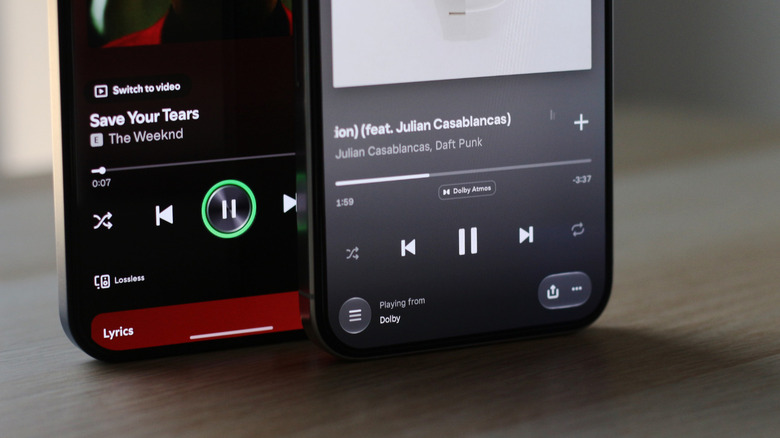
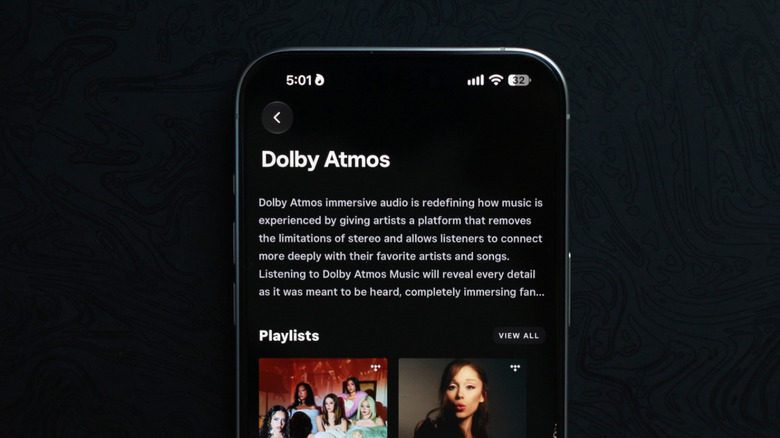
If you’ve spent any time browsing on Apple Music or Tidal, you’ve likely come across the “Dolby Atmos” or “Lossless” tags next to certain albums and tracks. Though both of these features are marketed as premium listening experiences, they are fundamentally different technologies. Dolby Atmos is an object-based audio system that utilizes both vertical and horizontal positioning to create a three-dimensional soundstage. Compared to traditional stereo, which places sound between the left and right channels, Dolby Atmos can pick any point in 3D space and position individual sounds there.

Lossless audio, on the other hand, tackles an entirely different part of the listening experience. It’s concerned more about the preservation of the track’s quality. Popular formats like MP3 and AAC benefit from much smaller file sizes, but to achieve this, they undergo lossy compression that discards some of the audio data. Lossless audio aims to deliver bit-perfect playback, essentially allowing you to experience music the way the producer intended.

Although Dolby Atmos and lossless audio work independently, there are virtually no streaming platforms that let you enjoy both at the same time. Dolby Atmos tracks often use the Dolby Digital Plus audio codec, which is lossy by nature. By contrast, lossless audio uses codecs like FLAC or ALAC, which preserve all the original audio data. Though it’s technically possible to deliver Dolby Atmos using a lossless codec like Dolby TrueHD, it’s mostly exclusive to physical media like Blu-ray discs.

Advertisement

Does lossless audio actually make a difference?

By definition, lossless audio requires the right setup if you want to take full advantage of it. You’ll need a streaming service that actually offers bit-perfect lossless playback and playback hardware capable of actually handling all that additional detail.

More importantly, though streaming platforms like Apple Music and Tidal let you stream lossless audio over Bluetooth, the signal itself is encoded in lossy codecs like SBC and AAC before it reaches your headphones. You’d therefore need a wired connection for true lossless playback, which is what Apple recommends, too. There are a few exceptions to this rule. For instance, Qualcomm’s aptX lossless codec boasts bit-perfect lossless transmission via Bluetooth, but you’ll need an Android phone and wireless headphones that support the technology.

When tweaking sound quality options in Apple Music or Tidal, you may have come across numbers like 16-bit/44.1kHz or 24-bit/192kHz. The 44.1kHz or 192kHz number is the sample rate of the recording and tells you how many times the audio signal is measured every second. The 16-bit or 24-bit figure represents the bit depth, which determines how precisely each of those measurements can be recorded.

Advertisement

CD quality lossless audio is 16-bit/44.1kHz, while Hi-Res Lossless is a digital audio format that goes beyond CD quality, such as 24-bit/96kHz or 24-bit/192kHz. To turn all of this digital information into something your headphones can play, you need a digital-to-audio converter (DAC). Though your phone or laptop’s built-in DAC should be able to handle CD-quality lossless audio, you may need an external DAC to enjoy hi-res lossless content.

Dolby Atmos content is easier to enjoy

In my opinion, and this might be a hot take, Dolby Atmos delivers a more noticeable upgrade to the listening experience than lossless audio does, for everyday listening anyway. Apple Music, Tidal and Amazon Music Unlimited are currently among the major streaming services that hold Dolby Atmos content in their catalogs. You’ll need a device that’s Dolby Atmos-enabled. All modern Apple products support Dolby Atmos out of the box, but you’ll need to check your Android phone’s spec sheet to confirm availability.

Though you don’t need special headphones to enjoy Atmos music, a pair that generally has good instrument separation or a wider soundstage can make the effect more convincing. My AirPods Pro 2 are surprisingly amazing at delivering spatial audio. Depending on which music streaming app you’re using, you will have to jump through a few submenus to toggle Dolby Atmos on.

Advertisement

Apple Music, in my experience, handles its catalog of Dolby Atmos content the most elegantly. Tracks that are available in Dolby Atmos are labeled, and Apple Music automatically plays the Atmos version when you’re using compatible hardware. Tidal, on the other hand, lists the Atmos versions of tracks and albums separately from their stereo counterparts. While this makes for a slightly messier browsing experience, it does make it easier when you wish to deliberately choose one or the other.

Not all tracks available in Dolby Atmos elevate the experience, though it’ll be immediately apparent when you come across a song that’s been mixed well. Some of my favorite Atmos mixes come courtesy of The Weeknd, Daft Punk and Billie Eilish. “Poker Face” by Lady Gaga sounds like a completely different track in Dolby Atmos (in a good way) and even has an extended outro with additional vocals.

Advertisement

Source link

Continue Reading
Click to comment

You must be logged in to post a comment Login

Leave a Reply

Tech

Casting Engine Parts From 3D Prints

Published

on

After building a couple of internal combustion engines by milling billet aluminium stock and cringing at the absolute waste of material this created, [Camden Bowen] figured he’d give casting metal parts a shot. Of course, the key here is to create the molds for said casting, which is where you got a few options available.

Since DIY is really his thing, he also made his own kiln using cement and perlite, plus a propane burner. For the aluminium material to melt, he bought a stack of aluminium alloy wheels, as these are made of an alloy that’s actually suitable for casting. These were turned into ingots as a first step towards casting the engine parts, which among other things helps to purify the metal.

For the actual casting method he picked lost PLA, meaning the intended shape is 3D printed in PLA, then put into plaster before it’s melted out of the newly minted mold in an oven and subsequently burned out in the kiln. For the plaster [Camden] used regular Plaster of Paris, mixed with sand to give it suitable heat-resistant properties.

After some trial and error, as well as a lot of trouble burning out all the PLA, he got a usable mold and managed to eventually cast an engine cylinder with only a few imperfections. Considering just how convoluted it would have been to mill that part out of billet aluminium, it’s easy to see why commercial manufacturers are casting such parts as well.

Advertisement

Source link

Advertisement
Continue Reading

Tech

Brave’s browser one-ups Chrome with its new support for email aliases

Published

on

Chrome alternative Brave just added a good reason to make the switch to its browser: email aliases. The feature, announced this week, allows Brave’s users to sign up for websites and other online services without having to share their personal email addresses.

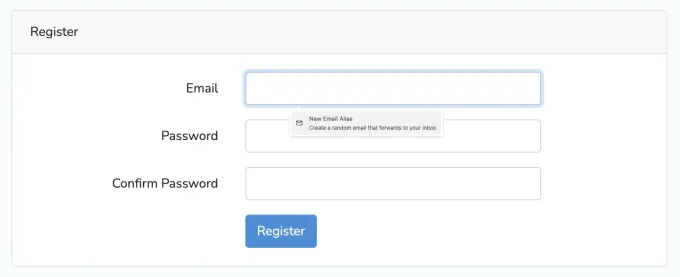
To use the feature, you first need to create an account with Brave, where you can provide your real email address. Then, once logged into the browser, you’ll see a pop-up appear when clicking an email field on a website, offering the option to use an alias instead. (If the pop-up doesn’t appear, just right-click on the field to access the option.) The email alias will be filled in on the website’s form, and any emails coming to that address will be forwarded to your primary email account.

Image Credits:Brave

The company explains that using an alias can protect your privacy, particularly because websites use your email as a personal identifier, allowing them to target you for ads. Ad tech giants like Meta are also able to match the email you provided to a retailer’s website, for instance, with the address they have on file for you, allowing these companies to track what you bought or viewed.

Plus, if any website where you shared your email gets hacked, the hackers will then know your primary email address, and this information can be leaked and shared with data brokers.

Brave says it built the new feature to plug this privacy hole, adding that it doesn’t read the contents of emails sent to an alias — it only processes them for spam and virus filtering. After the email is forwarded, Brave deletes it from its servers. All data in users’ Brave accounts is also encrypted at rest, and any notes you save alongside an alias are stored locally on your device, unless you turn on the sync option. If syncing is enabled, notes will be encrypted end-to-end.

Advertisement

As the email alias feature is still new, Brave cautioned that some of the forwarded mail may initially go to your spam folder, but this should improve as Brave builds up its reputation score as a mail provider.

For the time being, Brave users are being offered five free email aliases. More will be available for Premium plan users in the future.

When you purchase through links in our articles, we may earn a small commission. This doesn’t affect our editorial independence.

Source link

Advertisement
Continue Reading

Tech

Pete Hegseth And His Department Of Unconstitutional Revenge Lose Again In California

Published

on

from the when-the-ai-company-is-more-principled-than-the-government dept

When Pete Hegseth declared Anthropic a national security risk because it wouldn’t agree to his dangerously unethical demands for what Claude should be able to do, Anthropic sued to challenge the directives. One of the challenges was brought in the Northern District of California, where Anthropic has now notched another significant win.

While the previous victory resulted in a preliminary injunction being issued against Hegseth and his Department of Defense (unfortunately the court and Anthropic referred to it by the Trump Administration’s nickname, “Department of War,” but until Congress agrees to the renaming, we won’t), the court has now ruled on the merits, finding in favor of Anthropic on most of its claims and giving it all the relief it sought, namely both a permanent injunction and vacatur of Hegseth’s agency action.

In short, the court found that the action to “designate Anthropic a supply chain risk to national security, order all federal agencies to permanently stop using Anthropic’s products, and ban all defense contractors from doing any business with Anthropic, even if unrelated to the military” violated Anthropic’s First Amendment rights, as well as its due process rights, and it further violated the APA as an arbitrary and capricious action.

The undisputed record shows that the challenged actions constituted unlawful retaliation in violation of the First Amendment, and that Anthropic was denied the pre-deprivation process required under the Fifth Amendment. The record further shows no material dispute that Secretary Hegseth’s decision to designate Anthropic a supply chain risk violated the governing statutory scheme, 10 U.S.C. § 3252, and was arbitrary and capricious. Though the Department of War is undisputedly free to select the AI vendor of its choice, the evidence demonstrates that the broad measures imposed on Anthropic were illegal and baseless.

On the First Amendment claims, “The undisputed facts establish that Anthropic’s protected speech, on a matter of great public importance, was a substantial motivating factor for Defendants’ speech-chilling conduct, and that Defendants would not have taken the retaliatory action absent their desire to make an example of Anthropic for its public stance on the weighty issues at stake in the contracting dispute.” In reaching this conclusion the court found that Anthropic had been engaging in speech on matters of public concern—such as the safeguards built into an AI system—and that the Administration’s own social media posts made it clear that designating Anthropic as a national security risk was designed to punish it for this very expression articulating why it did not want to sell the government a version of Claude without those safeguards, rather than for any legitimate purpose.

Advertisement

Secretary Hegseth expressly tied Anthropic’s punishment to its attitude and rhetoric in the press. He stated that “Anthropic delivered a master class in arrogance.” (AR 255B.) Referring to Anthropic and Amodei, he further stated: “Cloaked in the sanctimonious rhetoric of ‘effective altruism,’ they have attempted to strong-arm the United States military” through their “corporate virtue-signaling” and “Silicon Valley ideology.” (Id.) “Anthropic’s stance is fundamentally incompatible with American principles.” (Id.) The President described Anthropic as a “RADICAL LEFT, WOKE COMPANY” and its employees as “Leftwing nut jobs,” who “made a DISASTROUS MISTAKE trying to STRONG-ARM the Department of War.” (AR 255A.) […] Furthermore, the decision to publicly broadcast Anthropic’s punishment via social media—even before the formal, administrative process of making the necessary findings to designate Anthropic a supply chain risk had begun—makes little sense except as an attempt to swiftly make a public example of Anthropic for daring to criticize the Administration.

In other words, the government did not have to buy Claude if it couldn’t agree with Anthropic on what it should be able to do, but designating it a supply chain risk ineligible for any government contract was a punishment inflicted because it did not like Anthropic’s viewpoint that AI should have the safeguards Hegseth did not want it to have.

On its First Amendment claim the court found that Anthropic had shown “that (1) it engaged in constitutionally protected activity; (2) the defendant’s actions would ‘chill a person of ordinary firmness’ from continuing to engage in the protected activity; and (3) the protected activity was a substantial motivating factor in the defendant’s conduct.” It decided that the alternative Pickering test did not apply (“The Pickering framework is inapplicable here because the Challenged Actions were an exercise of sovereign power, not contractual power. […] Furthermore, the public labeling of Anthropic as an adversary of the United States and an “out-of-control, Radical Left AI company” that was attempting to “seize veto power over the operational decisions of the United States military” reflects a concerted effort to make an example of Anthropic” for its viewpoint resisting government demands, and not part of ordinary contract negotiations.), but even if it did, Anthropic would have still prevailed.

Moreover, even if the more flexible Pickering framework were applied, Anthropic has still shown that it is entitled to summary judgment. Under the framework, Anthropic must show it engaged in expressive conduct about a matter of public concern; government officials took adverse action against it; and its expressive conduct was a substantial or motivating factor for the adverse action. Damiano v. Grants Pass Sch. Dist. No. 7, 140 F.4th 1117, 1137 (9th Cir. 2025). In other words, Anthropic’s prima facie showing under the traditional test satisfies its burden under the Pickering framework so long as Anthropic is speaking on a matter of public concern. As already explained, Anthropic satisfies this burden. The government argues that “Anthropic’s public airing of its objections to DoW’s contractual terms does not transform this into a matter of public concern protected by the First Amendment.” (Dkt. No. 214 at 10.) However, “attempt[s] to reach the general public” are “considered relevant in other public concern cases.” Havekost v. U.S. Dep’t of Navy, 925 F.2d 316, 319 (9th Cir. 1991). And as the Supreme Court explains in Janus, matters of “great public concern” can arise in the context of contract negotiations, and the government does not get a pass on upholding First Amendment protections simply because it is engaged in contract negotiations. Janus, 585 U.S. 878, 910–14 (“[I]t is impossible to argue that the level of . . . state spending for employee benefits,” the subject of the contract negotiations between the union and the government, “is not a matter of great public concern.”). Anthropic was not critiquing a “single contract” (Dkt. No. 238 at 8); it was discussing the appropriate limits on the government’s use of frontier AI technology. That is a matter of public concern.

And the government had nothing to rebut Anthropic’s case, including any sort of true national security argument.

Defendants’ asserted national security concerns are further contradicted by their actions shortly before, immediately after, and since the Supply Chain Designation. Shortly before, in the February 24 meeting, Secretary Hegseth raised the possibility of invoking the Defense Production Act, meaning Anthropic was essential to national security rather than a threat to it. (Dkt. No. 166-5 ¶ 17; Dkt. No. 166-9 at 3.) Immediately after the designation, Under Secretary Michael told Anthropic that a deal was “very close.” (Dkt. No. 166-5 ¶ 27.) Since the designation, the White House has “discussed opportunities for collaboration” with Anthropic utilizing its new Mythos model, and these discussions appeared to range across a variety of sensitive contexts. (Dkt. No. 166-4 ¶ 81.) Those actions are inconsistent with any genuine belief that Anthropic is an adversary of the United States who might secretly poison its model to undermine national security. As such, the government has failed, under even a deferential review, to show that a legitimate national security interest outweighed Anthropic’s speech rights.

The court also found that the government’s action violated Anthropic’s due process rights. “Due process requires notice ‘reasonably calculated, under all the circumstances, to apprise interested parties of the pendency of [a government] action and afford them an opportunity to present their objections,’” but here Anthropic had none before it was suddenly blacklisted and designated a supply chain risk. That action deprived it of a liberty interest unconstitutionally.

Advertisement

“[A]bsent exigent circumstances,” due process must happen “before [a] final deprivation.” Esparraguera v. Dep’t of the Army, 101 F.4th 28, 40 (D.C. Cir. 2024). The record reflects that the Challenged Actions were taken without any meaningful notice or pre-deprivation process (and, in the case of the Presidential Directive and the Hegseth Directive, without offering any post-deprivation agency process either). Although Anthropic was on notice that the government objected to its contracting terms, it had no notice or opportunity to object before Defendants publicly barred it from all federal government work and blacklisted it with defense contractors. It also had no notice or opportunity to object to the factual basis for its designation as a supply chain risk, which it learned of in this litigation.

And then, in addition to the constitutional violations, the court also found that the designation was an arbitrary and capricious act under the Administrative Procedure Act as well.

Under the APA, an agency action must be set aside and held unlawful if it is “arbitrary, capricious, an abuse of discretion,” “in excess of statutory jurisdiction, authority, or limitations, or short of statutory right,” or “without observance of procedure required by law.” 5 U.S.C. § 706(2)(A), (C), (D). Anthropic has shown that the Hegseth Directive and the Supply Chain Designation were in excess of statutory authority, contrary to law, and arbitrary and capricious. […] Secretary Hegseth’s February 27 order that “[e]ffective immediately, no contractor, supplier, or partner that does business with the United States military may conduct any commercial activity with Anthropic” is a final agency action and thus is subject to APA review. (AR 255B.) On its face, the order is the “consummation” of a decision-making process and “legal consequences [] flow” from it. Bennett v. Spear, 520 U.S. 154, 178 (1997) (citations omitted). Absent recission, which has not occurred to this day, any company doing business with both Anthropic and DoW between the time of the post and when the preliminary injunction issued in this case would have been in violation of the order. Indeed, Anthropic submits evidence that several law firms sent client alerts “describing the potentially far-reaching nature of the government’s actions and suggesting that Department contractors may be best served by reevaluating their relationship with Anthropic.”

The court didn’t buy the government’s defense that “Secretary Hegseth could not have meant what he said because he concededly lacked the requisite authority to issue such a broad order.” To do so would have eviscerated the APA and its prohibition against arbitrary and capricious acts.

After all, if courts were to find agency actions unreviewable as non-final simply because the agency had not met its statutory obligations or did not have authority to take the action, that would defeat the entire purpose of APA contrary to law review. There is no way to read Secretary Hegseth’s words as anything other than a “consummation” of a decision-making process. (See Dkt. No. 238 at 17 (conceding in Defendants’ reply brief that “[w]hatever else, there is no doubt about the Secretary’s commitment to his course of action”).) And his Directive imposed “legal consequences” by declaring, effective immediately and in unqualified terms, that companies could not continue doing business with both Anthropic and DoW, with the implicit threat that DoW would stop contracting with violators. See San Francisco Herring Ass’n v. Dep’t of the Interior, 946 F.3d 564, 580 (9th Cir. 2019) (finding legal consequences flowed from Park Service orders where there was “no suggestion that compliance . . . was somehow optional”).

Furthermore, Anthropic did not meet the statutory definition for “supply chain risk” anyway.

The Administrative Record establishes that Anthropic’s conduct does not meet the requirements for finding a “supply chain risk” under Section 3252. The Michael Memo states: “By embedding unreasonably restrictive terms that restrict DoW’s warfighting operations beyond the limitations imposed by law, Anthropic seeks to grant itself an operational veto. This triggers the legal definition of supply chain risk at 10 U.S.C. § 3252(d)(4) . . . .” (AR 213.) But Section 3252 defines a supply chain risk as limited to “the risk that an adversary may sabotage, maliciously introduce unwanted function, or otherwise subvert . . . a covered system.” 10 U.S.C. § 3252(d)(4). The plain text of the statute is directed at covert acts or hacks, not overt, public positions regarding contract terms. The legislative history similarly explains that the statute aims to address “increasing risk that systems and networks critical to [the Department of Defense] could be exploited through the introduction of counterfeit or malicious code and other defects introduced by suppliers of systems or components.” S. Rep. No. 111-201, at 162 (2010). Contrary to Under Secretary Michael’s conclusion, Anthropic’s contracting position does not appear to bear any relation to the conduct that Section 3252 is aimed at addressing.

And per the other statute in play, it also did not grant Hegseth the authority to do any of this either.

Advertisement

Agencies may not impose sanctions or issue orders “except within jurisdiction delegated to the agency and as authorized by law.” 5 U.S.C. § 558(b). The Court has already found that the Presidential Directive to “EVERY Federal Agency in the United States Government to IMMEDIATELY CEASE all use of Anthropic’s technology” was a retaliatory act, taken without due process, meant to punish Anthropic for its protected speech. Supra § V.A–B. The record shows that the following Agency Defendants issued orders to terminate use of Anthropic’s products pursuant to the Presidential Directive, most within hours of the directive being issued: Treasury, FHFA, State, GSA, OPM, NRC, DHS, and Energy. Supra § II.G–H. DoW did the same, in reliance on the Hegseth Directive and Supply Chain Designation. Supra § II.E. These orders, in violation of Anthropic’s First Amendment and due process rights, were not “authorized by law,” and violate Section 558(b).

The court did not, however, find in favor of Anthropic’s ultra vires claim, because it hinged more on Trump, who was not named in this case, and seemed to have been underpled, compared to the other claims, but ultimately it was not necessary for Anthropic to prevail on to get all the relief it sought.

When a presidential order does not stem from powers granted through “an act of Congress or from the Constitution itself,” the order violates the separation of powers doctrine, and a district court may enjoin federal agencies from implementing the order as ultra vires. Youngstown Sheet & Tube Co. v. Sawyer, 343 U.S. 579, 584–86 (1952). Anthropic argues that the president lacks “statutory authority” or a “constitutional basis” to direct “EVERY Federal Agency in the United States Government to IMMEDIATELY CEASE all use of Anthropic’s technology.” (Dkt. No. 166 at 30; AR 255A.) In passing, Anthropic cites four statutes regulating “exclusion from federal contracting.” (Dkt. No. 166 at 30 (citing as “examples” 10 U.S.C. §§ 3203(a)(1), 3204(a); 41 U.S.C. §§ 3303(a)(1), 3304(a)).) However, Anthropic is not asserting a claim for violation of a specific procurement statute, see, e.g., State v. Su, 121 F.4th 1, 5 (9th Cir. 2024), and “claims simply alleging that the President has exceeded his statutory authority are not ‘constitutional’ claims.” Dalton v. Specter, 511 U.S. 462, 473 (1994). Anthropic’s passing references to the statutory provisions and Congress’s “power of the purse” are insufficient to carry its burden of showing the President clearly exceeded “any background constitutional authority” to issue the Presidential Directive, thereby rendering the order ultra vires in violation of the separation of powers. Sierra Club v. Trump, 929 F.3d 670, 696 (9th Cir. 2019).

That the court found liability for both the constitutional claims and APA claims is why Anthropic was able to get all that relief, including both vacatur of the agency action and also a permanent injunction.

First, despite the government’s arguing that the matter should simply be remanded back to the agency for further action, rather than the court vacating what the agency had earlier done entirely, the court disagreed that such a remand would be adequate (“In light of Anthropic’s showing that the Supply Chain Designation violates the substance of Section 3252 and that Secretary Hegseth lacked any authority to order a secondary boycott, remand without vacatur would be an inadequate remedy.”). There was no point giving the government another bite of an apple it wasn’t entitled to eat in the first place.

Nor were the government’s claims it would be harmed by this more extreme remedy availing, given how the government had been coping just fine with its action already having been enjoined for quite some time (“[T]here has been no showing by the government that vacatur would result in a national security risk or any other harm—despite the fact that the Supply Chain Designation and the Hegseth Directive have been preliminarily enjoined for over five months.”). It is also why the court denied an automatic stay of its order, since the government had obviously not been harmed by the preliminary injunction already in place.

Advertisement

And as for why the court also granted a permanent injunction on top of vacatur, it found that vacatur alone would not redress the constitutional injury.

Furthermore, to the extent Defendants rely on their voluntary cessation of the challenged conduct, it is not “absolutely clear that the allegedly wrongful behavior could not reasonably be expected to recur.” Friends of the Earth, Inc. v. Laidlaw Env’t Servs., 528 U.S. 167, 189 (2000) (citation omitted); Enrico’s, Inc. v. Rice, 730 F.2d 1250, 1253 (9th Cir. 1984) (“We recognize that the voluntary cessation of allegedly illegal conduct does not deprive a court of the power to grant injunctive relief.”). Defendants continue to defend and have declined to stipulate to enjoin the Challenged Actions. For these same reasons, legal remedies would be inadequate. As to Defendants’ argument that Anthropic “continues to speak freely,” has experienced an increase in its valuation, and has not had its federal contracts terminated yet (Dkt. No. 214 at 33–34), that reflects the restoration of the status quo pursuant to the preliminary injunction in this case. The record shows no indication that, upon lifting the preliminary injunction, the harms at issue would still be averted.

In sum, the vindictive petulance of Hegseth and the Trump Administration has led to a particularly obvious constitutional injury, which no statute otherwise privileges. Per the court, the directives are now nullities and Hegseth and his agency are prohibited from trying again. Pursuant to the separate order, if they want to take any action, it can only be what they were lawfully allowed to do in the first place.

This Order does not bar any Defendant from taking any lawful action that would have been available to it on February 27, 2026, prior to the issuance of the Challenged Actions. For example, this Order does not require the Department of War to use Anthropic’s products or services and does not prevent the Department of War from transitioning to other artificial intelligence providers, so long as those actions are consistent with applicable regulations, statutes, and constitutional provisions.

Filed Under: 1st amendment, administrative procedure act, dario amodei, defense department, dos, free speech, pete hegseth, supply chain, supply chain risk

Companies: anthropic

Advertisement

Source link

Continue Reading

Tech

How Long Is A New Fire TV Stick Actually Supposed To Last?

Published

on

A Fire TV Stick can outlive its guaranteed support window, though aging apps and hardware may make you want to replace it sooner.

There isn’t an expiration date hidden in the settings menu of a Fire TV Stick. Amazon also doesn’t reveal a typical physical lifespan for its streaming sticks, nor does it inform owners to replace one after three, four or five years. That makes the question of “how long will it last?” a bit more complicated than it sounds.

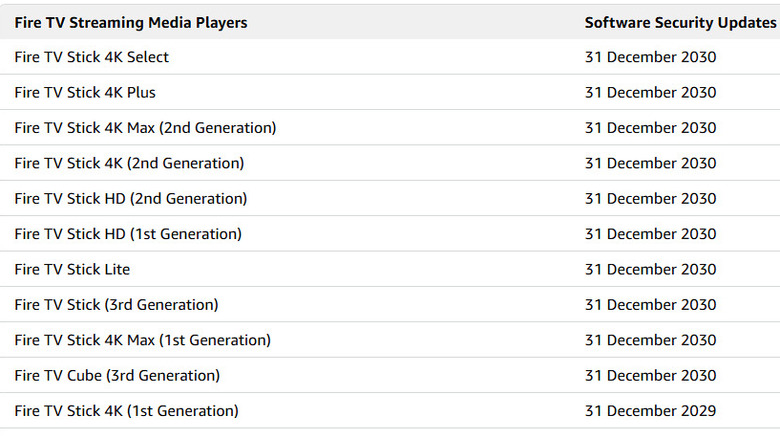
At least one of the numbers is firm. Amazon says security updates are provided for at least four years from the date the Fire TV device was purchased new from Amazon as the seller, or until the support date listed for that model, whichever is later. The Fire TV Stick 4K Select and Fire TV Stick 4K Plus are among the current models with security updates guaranteed through at least Dec. 31, 2030.

Amazon doesn’t call it a lifespan, though. A support deadline indicates the duration of security fixes, not when the hardware will decide it has streamed its last episode.

Advertisement

Four years is a minimum, but it’s not a countdown to the junk drawer.

Four years isn’t an expiration date

The Fire TV Stick can be fully functional beyond the security-update window, but simply turning on isn’t a very high standard for a streaming device. Older hardware can become increasingly uncomfortable to use as apps become more demanding, interfaces evolve and video standards advance, even if nothing has failed internally.

Video codecs are a part of that. Newer video codecs like H.265/HEVC and AV1 can compress video more efficiently than older codecs, but they also need the right decoding hardware. The Plus doesn’t have an advantage on that front, as Amazon’s current Fire TV Stick 4K Select and 4K Plus both offer hardware decoding for AV1 and H.265 at up to 4K60.

Advertisement

Apps can be less accommodating. Netflix itself notes that its app may no longer be available on some TVs and streaming devices made before 2015, providing a neat example of what aging really looks like for a streamer: The hardware can still work, while one of the reasons you bought it quietly stops working with it.

That doesn’t mean every Fire TV Stick has a 10-year lifespan, but it does show why declaring one “dead” simply because four years have passed is difficult to justify.

Advertisement

When should you actually replace your Fire TV Stick?

Slower streaming performance isn’t necessarily a retirement notice, either. Before giving up on your Fire TV Stick, Amazon suggests restarting it, installing available updates, clearing app caches and ruling out network issues. Insufficient power can also cause restarts, making a healthy stick look much more dramatic than it is.

Persistent problems are more convincing. Apps crashing repeatedly, services dropping support for your model, menus staying slow after troubleshooting or storage becoming a constant hassle are signs that an upgrade may actually help.

Buying slightly higher up the range can give you more breathing room. The Fire TV Stick 4K Select has 1GB of RAM and costs about $40, while the 4K Plus has 2GB for about $50. Amazon warns that memory pressure can kill apps on lower-memory Fire TV hardware, so that extra $10 buys more headroom as software gets heavier.

It doesn’t guarantee an extra year or two, and Amazon makes no such claim. The Select’s Vega OS has an efficient footprint and was designed to scale across devices. Still, doubling the RAM for roughly the price of lunch is worth considering if you’ll keep the stick for years.

And then there’s the remote. Its two AAA batteries will need replacing, and a failed remote can be replaced separately. Amazon’s Fire TV mobile app can control the streamer too, so a dead remote doesn’t necessarily mean a dead Fire TV Stick.

Advertisement

Netflix discontinued support for first-generation Fire TV and Fire TV Stick devices in June 2025, The Verge reported, more than 10 years after they launched in 2014.

Source link

Advertisement
Continue Reading

Tech

Microsoft Teams Has Become a Haven for Scammers in China

Published

on

On Chinese social media, people have also reported experiencing variations of the scam involving other corporate software apps, including Webex, a video conferencing platform owned by Cisco, and Cliq, a workplace communication app owned by the Indian software giant Zoho. Since February 2025, 71 percent of the over 150 reviews of Webex on Apple’s Chinese app store referenced being scammed on the platform, according to WIRED’s analysis. Cisco did not respond to a request for comment.

Sam Wunderl, a spokesperson for Zoho, says the company has identified “a limited number of instances involving scammers using Zoho Cliq to defraud victims.” The company says it uncovered the suspicious usage internally. As of August 27, Zoho says it disabled online payments to Cliq in China, suspended every account created by the suspected scammer it identified, and plans to discontinue the free version of Cliq in China going forward.

All Roads Go to Teams

According to dozens of victim accounts shared on Chinese social media platforms like Xiaohongshu and Douyin, the scammers look for new targets seemingly anywhere they can. They pose as job recruiters looking to fill open positions, prospective renters contacting landlords, potential dates on Tinder, and international buyers looking to source products from Chinese factories.

The scammers take advantage of Teams’ enterprise features by creating accounts for their targets and sending them pre-made login credentials. Because the scammers control the organization, they can deactivate the accounts once the scheme is over, wiping out victims’ access to chat histories that could be potentially used as evidence. To explain the unusual setup, scammers may tell victims they’re using work devices that only allow certain apps, or say they created a private Teams account just for the two of them to chat.

Advertisement

It turned out that some of the other victims who contacted Zhao had encountered the very same scammer she had. One was able to share Teams login credentials with her. This time, Zhao pretended to be a new potential victim in order to hopefully trick the scammer into providing more information about how his ruse worked.

She asked why he had to use Teams instead of WeChat, by far the most popular messaging app in China. The scammer claimed his colleagues could see his WeChat messages because he was on a work project, so Teams “is like our secret base together.” The account he gave Zhao, he said, was “for team members to contact family while on the project.”

“Can I ask a small question. What’s the special meaning about my account ‘joy20706905?’” Zhao asked, referring to the username he provided. “The account was assigned by the software when you purchase it from Microsoft,” he responded.

Zhao says when she was defrauded in May, Microsoft Teams didn’t alert her that the conversation she was having with the scammer might be dangerous. It was only when she talked to him again in August that the app started showing a banner that reads: “Don’t share confidential info or your screen with people you don’t know. Report anything suspicious.”

Advertisement

Why Teams?

In many ways, Microsoft Teams is an ideal app for fraudsters in China. Unlike Telegram or WhatsApp, it isn’t blocked by the government. And it has advanced tools like screen sharing and remote control that allow scammers to potentially gain more control over their victims’ devices. Most importantly, it’s a legitimate workplace communication app made by a trusted multinational tech company.

The same factors also apply to Webex. Tan Chenxin, a Chinese software engineer living in New York, says he was nearly defrauded earlier this week after he received a call from someone claiming to be working on a joint police investigation with US Customs and Border Protection and Chinese law enforcement. They asked Tan to download Webex and hop on a video call to discuss the situation. “I looked up Webex and found that it was developed by Cisco, a world-leading cybersecurity software provider,” Tan says. “I happen to know what Cisco is, so I convinced myself it was fine.”

Source link

Advertisement
Continue Reading

Tech

Steve Jobs’ 8th-grade science project sells for $34,375

Published

on

Someone did, in fact, buy the Steve Jobs 8th-grade science fair project for roughly the same price as a brand-new midsize sedan.

Earlier in August, I’d reported on yet another Steve Jobs-based auction. These seem to be happening with increased frequency, and I suspect it has something to do with Jobs’ stepbrother, John Chovanec, cleaning out the family home.

Among the usual collection of computer parts, Apple-1 units, and some sealed first-generation iPhones, there were more personal effects. One, of course, being Jobs’ 8th grade science project, which sold for $34,375.

The Apple logo sun catcher, which was my personal favorite, commanded a respectable $4,365.

Advertisement

The biggest ticket item of the auction was an Apple-1 dubbed the “Neumark” Apple-1. It featured a unique Smith-Corona Typewriter case and sold for nearly a half million dollars, coming in at $499,363 by auction’s end.

A “stealth iPod” development prototype nearly doubled its $50,000 estimate, bringing in $91,479 by the time the auction ended.

Other notable items included:

Whoever wound up with the lot of vintage employee apparel got a deal, though. It sold for $875, below the $1,000 estimate.

Advertisement

Unsurprisingly, the Twitter flotsam largely came in barely above the estimates.

Source link

Advertisement
Continue Reading

Tech

Stripe and Advent Ditch $50 Billion PayPal Takeover Bid

Published

on

Stripe and private equity firm Advent International have ditched their $53 billion pursuit of PayPal, ending a deal that would have been the largest fintech acquisition ever. “Stripe last week agreed to pay $8 billion for AI model marketplace OpenRouter, but a source said that the OpenRouter and PayPal deals were operating on independent tracks,” reports Axios.

Read more of this story at Slashdot.

Source link

Advertisement
Continue Reading

Tech

X says it found and took down a Chinese bot farm posting anti-AI data center content to thousands of followers

Published

on


  • An X investigation just found 200k Chinese bot accounts, including 200 posting anti-AI content
  • The posts were targeting and amplifying legitimate US citizen concerns about data centers
  • Is this part of a Chinese effort to slow down American innovation, to race ahead?

X’s Global Government Affairs account has revealed it “identified a bot farm of approximately 200,000 accounts,” 200 of which “posting in a manner that could manipulate a legitimate debate about American AI and energy policy.”

Some of the narratives that these 200 accounts were promoting included that: AI data centers are pushing up household electricity prices, rapid data centre construction is placing excessive strain on the US grid, and ordinary households are subsidising wealthy AI and data center companies.

Source link

Advertisement
Continue Reading

Tech

Daily Deal: The 2026 Canva Creator Mastery Bundle

Published

on

from the good-deals-on-cool-stuff dept

Take your design skills to the next level with the 2026 Canva Creator Mastery Bundle, a powerful all-in-one course for modern creators and business owners. This program teaches you how to use Canva effectively to produce professional-quality visuals for any purpose. You’ll explore practical design techniques, creative workflows and branding strategies that make your content stand out. This bundle is perfect for anyone ready to upgrade their digital presence and design skills. It’s on sale for $30.

Note: The Techdirt Deals Store is powered and curated by StackSocial. A portion of all sales from Techdirt Deals helps support Techdirt. The products featured do not reflect endorsements by our editorial team.

Filed Under: daily deal

Source link

Advertisement
Continue Reading

Tech

Dragon Touch’s 15.6″ Digital Calendar Helps You Easily Remember Birthdays, Chores, and the Weekly Shop on One Glass Panel

Published

on

Dragon Touch 15.6" Digital Calendar
Every year, families forget the same dates, a birthday passes by, and an anniversary card is bought two days late. Three phones and a scrap of paper attached to the refrigerator are used to keep holiday shopping lists. Dragon Touch’s 15.6-inch TM15 digital calendar, priced at $149.99 (was $160), is a plug-in device that sits on the same wall or counter, keeping everything in one place and visible from across the room.


A 1920 x 1080 IPS display dominates the device’s front panel. You simply tap out events on the glass, assign a color to each person, and watch the week develop before you. Simply plug it into the wall, link it to your WiFi network, and launch the free eCalendar app on your phone. You can then connect your Google, Apple, Outlook, Yahoo, and Cozi calendars to the display, and any events you create on the screen will sync back to those accounts. Dual-band WiFi maintains a stable connection even in locations with high wireless traffic. Inside, you’ll find 32GB of storage, a decent quad-core ARM chip, 2GB of RAM to keep things running smoothly, a light sensor that dims the panel when it gets dark, sleep modes you can tailor to your needs, local weather updates, and a tiny speaker for reminders or short videos you can send to the display via your phone.

Sale


Dragon Touch 15.6″ digital calendar chore chart – 1080P full HD interactive touchscreen, smart family…
  • 【All-In-One Smart Family Calendar】: Dragon Touch digital frame effortlessly organizes and tracks every family schedule with the crystal-clear…
  • 【Easy Setup and Auto-Sync】: Enjoy a user-friendly design that our smart picture frame allows for quick setup—just plug in, connect to Wi-Fi, and…
  • 【Interactive Chores Chart & Dinner Planner】: Our digital calendar keeps housework organized and motivates family members, especially children, to…


Since there’s no internal battery, it must be plugged in at all times, thus keep the wall socket close by. The packaging includes a desk stand and hanging gear for mounting the display on your wall, and the screen can swivel between portrait and landscape mode if you want. According to testers, the device weighs between three and four pounds and measures approximately 16 inches tall by 10 inches wide, making it slim enough to hang without hogging your kitchen. In terms of software, it runs a locked-down version of Android 8.1, and you won’t be able to install any additional apps from the store. You will work within Dragon Touch’s existing calendar, chores, food planning, task lists, and photo tabs.

Advertisement

Dragon Touch 15.6" Digital Calendar
The chores page allows you to list all of the jobs that need to be done, and the kids can check them off as they finish to earn points that you can then redeem for a gift of your choice. Meals now has its own page, allowing you to see what’s cooking for the week and making the everyday “what’s for dinner?” inquiry much less unpleasant. Your to-do and grocery lists replace the traditional sticky notes, and when nobody is messing with the screen, the device shows a slideshow of your favorite images. You can add events and lists directly to the device or from your phone anywhere. The essential tools are free of charge on a monthly basis, but if you want additional features, you can subscribe to Magic Import.

Source link

Continue Reading

Trending

Copyright © 2025