

Tech
Is YouTube Still Down? Live Updates on YouTube Outage


Just as people were settling in to primetime viewing hours on the east coast in the US and the end of the workday in the west, YouTube seemed to take a nap as more than 800,000 people in the US and hundreds of thousands elsewhere in the world reported the loss of the feed, according to Downdetector. The outage started to gain traction at 5 p.m. PT and quickly spiked to 338,308 reports by 5:10 p.m., according to Datadetector’s graph.
As of 6:30 p.m. PT, the number of reports had dropped to under 50,000. Google (which owns YouTube) provided a status update naming an “issue with our recommendations system prevented videos from appearing across surfaces on YouTube (including the homepage, the YouTube app, YouTube Music and YouTube Kids).”
YouTube told CNET that the outage was due to an issue with the company’s recommendation system which has since been resolved.
Downdetector reported the peak of a YouTube outage on Feb. 17, 2026.
CNET staffers who noticed the outage saw YouTube’s familiar home screen with a search bar and side column, but no videos. YouTube apps, such as on an iPad, showed a 1980s-style pixel artwork and the message “Something went wrong.”.
(Disclaimer: Downdetector is owned by the same parent company as CNET, Ziff Davis.)



A suspected Chinese state-backed hacking group has been quietly exploiting a critical Dell security flaw in zero-day attacks that started in mid-2024.
Security researchers from Mandiant and the Google Threat Intelligence Group (GTIG) revealed today that the UNC6201 group exploited a maximum-severity hardcoded-credential vulnerability (tracked as CVE-2026-22769) in Dell RecoverPoint for Virtual Machines, a solution used for VMware virtual machine backup and recovery.
“Dell RecoverPoint for Virtual Machines, versions prior to 6.0.3.1 HF1, contain a hardcoded credential vulnerability,” Dell explains in a security advisory published on Tuesday.

“This is considered critical as an unauthenticated remote attacker with knowledge of the hardcoded credential could potentially exploit this vulnerability leading to unauthorized access to the underlying operating system and root-level persistence. Dell recommends that customers upgrade or apply one of the remediations as soon as possible.”
Once inside a victim’s network, UNC6201 deployed several malware payloads, including newly identified backdoor malware called Grimbolt. Written in C# and built using a relatively new compilation technique, this malware is designed to be faster and harder to analyze than its predecessor, a backdoor called Brickstorm.
While the researchers have observed the group swapping out Brickstorm for Grimbolt in September 2025, it remains unclear whether the switch was a planned upgrade or “a reaction to incident response efforts led by Mandiant and other industry partners.”
Targeting VMware ESXi servers
The attackers also used novel techniques to burrow deeper into victims’ virtualized infrastructure, including creating hidden network interfaces (so-called Ghost NICs) on VMware ESXi servers to move stealthily across victims’ networks.
“UNC6201 uses temporary virtual network ports (AKA “Ghost NICs”) to pivot from compromised VMs into internal or SaaS environments, a new technique that Mandiant has not observed before in their investigations,” Mandiant communications manager Mark Karayan told BleepingComputer.
“Consistent with the earlier BRICKSTORM campaign, UNC6201 continues to target appliances that typically lack traditional endpoint detection and response (EDR) agents to remain undetected for long periods.”
The researchers have found overlaps between UNC6201 and a separate Chinese threat cluster, UNC5221, known for exploiting Ivanti zero-days to target government agencies with custom Spawnant and Zipline malware and previously linked to the notorious Silk Typhoon Chinese state-backed threat group (although the two are not considered identical by GTIG).
GTIG added in September that UNC5221 hackers used Brickstorm (first documented by Google subsidiary Mandiant in April 2024) to gain long-term persistence on the networks of multiple U.S. organizations in the legal and technology sectors, while CrowdStrike has linked Brickstorm malware attacks targeting VMware vCenter servers of legal, technology, and manufacturing companies in the United States to a Chinese hacking group it tracks as Warp Panda.
To block ongoing CVE-2026-22769 attacks, Dell customers are advised to follow the remediation guidance shared in this security advisory.

Modern IT infrastructure moves faster than manual workflows can handle.
In this new Tines guide, learn how your team can reduce hidden manual delays, improve reliability through automated response, and build and scale intelligent workflows on top of tools you already use.


Vulnerabilities with high to critical severity ratings affecting popular Visual Studio Code (VSCode) extensions collectively downloaded more than 128 million times could be exploited to steal local files and execute code remotely.
The security issues impact Code Runner (CVE-2025-65715), Markdown Preview Enhanced (CVE-2025-65716), Markdown Preview Enhanced (CVE-2025-65717), and Microsoft Live Preview (no identifier assigned).
Researchers at application security company Ox Security discovered the flaws and tried to disclose them since June 2025. However, the researchers say that no maintainer responded.
Remote code execution in IDE
VSCode extensions are add-ons that expand the functionality of Microsoft’s integrated development environment (IDE). They can add language support, debugging tools, themes, and other functionality or customization options.
They run with significant access to the local development environment, including files, terminals, and network resources.
Ox Security published reports for each of the discovered flaws and warned that keeping the vulnerable extensions could expose the corporate environment to lateral movement, data exfiltration, and system takeover.
An attacker exploiting the CVE-2025-65717 critical vulnerability in the Live Server extension (over 72 million downloads on VSCode) can steal local files by directing the target to a malicious webpage.
The CVE-2025-65715 vulnerability in the Code Runner VSCode extension, with 37 million downloads, allows remote code execution by changing the extension’s configuration file. This could be achieved through tricking the target into pasting or applying a maliciously configuration snippet in the global settings.json file.
Rated with a high-severity score of 8.8, CVE-2025-65716 affects the Markdown Preview Enhanced (8.5 million downloads) and can be leveraged to execute JavaScript via maliciously crafted Markdown file.
Ox Security researchers discovered a one-click XSS vulnerability in versions of Microsoft Live Preview before 0.4.16. It can be exploited to access sensitive files on a developer’s machine. The extension has more than 11 million downloads on VSCode.
The flaws in the extensions also apply to Cursor and Windsurf, which are AI-powered VSCode-compatible alternative IDEs.
Ox Security’s report highlights that the risks associated with a threat actor leveraging the issues include pivoting on the network and stealing sensitive details like API keys and configuration files.
Developers are advised to avoid running localhost servers unless necessary, opening untrusted HTML while they’re running, and applying untrusted configurations or pasting snippets into settings.json.
Also, it is advisable to remove unnecessary extensions and only install those from reputable publishers, while monitoring for unexpected setting changes.
Modern IT infrastructure moves faster than manual workflows can handle.
In this new Tines guide, learn how your team can reduce hidden manual delays, improve reliability through automated response, and build and scale intelligent workflows on top of tools you already use.


Temporal has raised $300 million in a Series D funding round at a $5 billion valuation, positioning the company as a key infrastructure provider for the emerging wave of AI agents moving into real-world production.
The latest round, led by Andreessen Horowitz, doubles the company’s valuation from October.
Temporal builds open-source software and a cloud service that helps companies run long-running, complex workflows reliably — what it calls “durable execution.” The Bellevue, Wash.-based company says that as AI systems become more autonomous and take actions across multiple services, reliability has become a challenge.
“Agentic AI doesn’t fail because the models aren’t good enough,” Samar Abbas, CEO and co-founder of Temporal, said in a press release. “It fails because the systems around them can’t handle real-world execution.”
Temporal says revenue grew more than 380% year-over-year, weekly active usage increased 350%, and installations rose 500%. Its cloud platform has processed 9.1 trillion lifetime action executions, including 1.86 trillion for AI-native companies.
OpenAI uses Temporal to help power certain production workflows. Other customers include ADP, Yum! Brands, and Block. Andreessen Horowitz described Temporal as becoming a foundational execution layer for the AI era.
“For long-running agents operating over extended horizons, the durability that Temporal provides is the difference between a compelling demo and a production system,” the Silicon Valley firm wrote in a blog post. “The underlying execution layer has become a central piece of the emerging AI agent stack.”
Temporal originally focused on helping developers manage complex, distributed workflows. But the rise of AI agents has amplified the need for infrastructure that can safely execute long-running, stateful systems over extended periods. Temporal’s platform preserves application state, automatically retries failed steps, and allows workflows to resume exactly where they left off instead of starting over.
Temporal co-founders Samar Abbas and Maxim Fateev previously worked together at Uber and helped build an internal open-source orchestration engine called Cadence. The experience helped inspire them to launch Temporal in 2019. Fateev previously worked at Amazon, Microsoft, and Google. Abbas also worked at Microsoft and Amazon.
Abbas took over CEO duties from Fateev in 2024. Fateev is now CTO.
Temporal has raised $650 million to date. It closed a $105 million secondary transaction in October, and raised $146 million Series C round earlier in 2025. The company employs 375 people.
Temporal also announced Tuesday that Raghu Raghuram, former VMware CEO and general partner at Andreessen Horowitz, is joining the company as a board observer.
Other backers in the latest round include Lightspeed Venture Partners and Sapphire Ventures, along with existing investors including Sequoia Capital, Index, Tiger, GIC, Madrona, and Amplify.
Tech
Meta’s own research found parental supervision doesn’t really help curb teens’ compulsive social media use

An internal research study at Meta dubbed “Project MYST” created in partnership with the University of Chicago, found that parental supervision and controls — such as time limits and restricted access — had little impact on kids’ compulsive use of social media. The study also found that kids who experienced stressful life events were more likely to lack the ability to moderate their social media use appropriately.
This was one of the notable claims revealed during testimony at the social media addiction trial that began last week in Los Angeles County Superior Court. The plaintiff in the lawsuit is identified by her initials “KGM” or her first name, “Kaley.” She, along with her mother and others joining the case, is accusing social media companies of creating “addictive and dangerous” products that led the young users to suffer anxiety, depression, body dysmorphia, eating disorders, self-harm, suicidal ideation, and more.
The case is now one of several landmark trials that will take place this year, which accuse social media companies of harming children. The results of these lawsuits will impact these companies’ approach to their younger users and could prompt regulators to take further action.
In this case, the plaintiff sued Meta, YouTube, ByteDance (TikTok), and Snap, but the latter two companies had settled their claims before the trial’s start.
In the jury trial now underway in LA, Kaley’s lawyer, Mark Lanier, brought up an internal study at Meta, which he said found evidence that Meta knew of, yet didn’t publicize, these specific harms.
In Project MYST, which stands for the Meta and Youth Social Emotional Trends survey, Meta’s research concluded that “parental and household factors have little association with teens’ reported levels of attentiveness to their social media use.”
Or, in other words, even when parents try to control their children’s social media use, either by using parental controls or even just household rules and supervision, it doesn’t impact whether or not the child will overuse social media or use it compulsively. The study was based on a survey of 1,000 teens and their parents about their social media use.
The study also noted that both parents and teens agreed on this front, saying “there is no association between either parental reports or teen reports of parental supervision, and teens’ survey measures of attentiveness or capability.”
If the study’s findings are accurate, that would mean that the use of things like the built-in parental controls in the Instagram app or the time limits on smartphones wouldn’t necessarily help teens become less inclined to overuse social media, the plaintiff’s lawyer argued. As the original complaint alleges, teens are being exploited by social media products, whose defects include algorithmic feeds designed to keep users scrolling, intermittent variable rewards that manipulate dopamine delivery, incessant notifications, deficient tools for parental controls, and more.
During his testimony, Instagram head Adam Mosseri claimed not to be familiar with Meta’s Project MYST, even though a document seemed to indicate he had given his approval to move forward with the study.
“We do a lot of research projects,” Mosseri said, after claiming he couldn’t remember anything specific about MYST beyond its name.
However, the plaintiff’s lawyer pointed to this study as an example of why social media companies should be held accountable for their alleged harms, not the parents. He noted that Kaley’s mother, for example, had tried to stop her daughter’s social media addiction and use, even taking her phone away at times.
What’s more, the study found that teens who had a greater number of adverse life experiences — like those dealing with alcoholic parents, harassment at school, or other issues — reported less attentiveness over their social media use. That means that kids facing trauma in their real lives were more at risk of addiction, the lawyer argued.
On the stand, Mosseri seemed to partially agree with this finding, saying, “There’s a variety of reasons this can be the case. One I’ve heard often is that people use Instagram as a way to escape from a more difficult reality.” Meta is careful not to label any sort of overuse as addiction; instead, Mosseri stated that the company uses the term “problematic use” to refer to someone “spending more time on Instagram than they feel good about.”
Lawyers for Meta, meanwhile, pushed the idea that the study was more narrowly focused on understanding if teens felt they were using social media too much, not whether or not they were actually addicted. They also generally aimed to put more of the responsibility on parents and the realities of life as the catalyst for kids like Kaley’s negative emotional states, not companies’ social media products.
For instance, Meta’s lawyers pointed to Kaley being a child of divorced parents, with an abusive father, and facing bullying at school.
How the jury will interpret the findings of studies like Project MYST and others, along with the testimonies from both sides, remains to be seen. Mosseri did note, however, that MYST’s findings had not been published publicly, and no warnings were ever issued to teens or parents as a result of the research.
Meta has been asked for comment.


We may receive a commission on purchases made from links.
If you’ve worn down the sticks on the controller for your Xbox Series X or S, and you’re thinking of getting a new one, you might consider something other than the typical option. Many Xbox gamers find the bundled controller to be the best gamepad for them, and others may enjoy the more premium Xbox Elite Wireless Controller Series 2 for its enhanced customizability. But if you’re looking to venture outside Microsoft’s umbrella, there’s never been a better time to be in search of a third-party controller to enable things you never knew your Xbox could do. There is healthy competition in the space from the likes of established players like Razer and Scuf in addition to up-and-comers like GameSir and 8BitDo.
The controller that is best will depend largely on the kinds of games you play and how much mileage you can get out of enthusiast features like stick and trigger curve tuning, button remapping, and extra paddles or bumpers. But which controller is the best overall? That’s a bit easier to answer. To be the best, a controller has to work not only on your Xbox hardware, but anywhere you can access Game Pass from the cloud. It has to feel solid in the hand, with precision sticks and smooth buttons, and it must be customizable enough to meet nearly any player where they’re at. It also can’t be too overpriced compared to similar alternatives. We compared premium options across buzzy brands to separate the hype from the humdrum and looked at a number of reviews to figure out the top option for most players. If our top pick doesn’t suit your fancy, we’ve got a runner-up and a budget option to choose from.
The Razer Wolverine V3 Pro is the best Xbox controller for most
For many players, finding a third-party Xbox controller better than the Razer Wolverine V3 Pro would be a difficult challenge. At $200, it’s got everything you could want when you’re plopped in front of your Xbox, but it can flex even more muscle when connected to a PC. Unlike traditional Xbox controller sticks, which are prone to stick drift and wear out within a few years of heavy use, the Wolverine V3 Pro uses Hall effect joysticks and triggers. They use magnetic fields to create input, which means you’re not stressing extra mechanical parts every time you move your character in a game. The triggers have hair-lock, meaning you can slide a switch to make them more like mouse keys. In a competitive shooter, that means you’ll be firing your weapon a drop faster than the competition, giving you an advantage. The face buttons, including the four back paddles, use microswitches, which give them a satisfying and tactile click when pressed (sort of like clicking a mouse or a low-profile keyboard with Cherry blue switches). The bumpers are nothing special, but there are two extra bumpers for claw-grip players.
Speaking from experience, time with Hall sticks, hair-lock triggers, and microswitch buttons will make it impossible to go back to a normal controller. The Wolverine V3 Pro supports wireless Xbox connectivity — still somewhat of a rarity. But it also works with PCs, both via the included 2.4 GHz dongle. On a wired PC connection, the Wolverine V3 Pro has a nifty trick: a 1,000 Hz polling mode that reduces latency to give you an edge in competitive games. The main downside is the D-pad, a reportedly mushy affair that eschews microswitches for membrane.
Our runner-up and budget picks
The Razer Wolverine V3 has been lauded by many as the best third-party Xbox controller, but it’s not for everyone. For some, the cost is prohibitive. We’ve seen it as low as $140 on Amazon, but the full price of $200 will put it out of reach for some. Plus, there’s no Bluetooth support, and some reviewers complained that it’s too small for large hands.
We waffled between the Wolverine and the Scuf Valor Pro Wireless for the top spot, and the latter is a close contender. It has slightly worse battery life (17 hours to the Wolverine’s 20) but makes up for that with TMR thumbsticks, a slight innovation on Hall effect sticks that provides better sensor resolution to pick up on micromovements in games where every millimeter of control matters. The Valor Pro Wireless also has that PC-only 1,000Hz polling rate found on the Wolverine. However, it has microswitches in the bumpers but lacks them in the face buttons, a reverse of the Wolverine’s microswitch placements. Crucially for some users, it has Bluetooth. There are also two volume knobs for game and chat audio. And let’s be honest, aesthetics matter. The Valor Pro Wireless comes in a variety of styles and features removable faceplates.
Lastly, those on a tight budget should take a gander at the GameSir G7 SE. It’s wired-only, but it has those coveted Hall effect thumbsticks and triggers, which make it a decent upgrade to the bundled Xbox Series X gamepad. At $45 on Amazon, it’s a shockingly cheap way to get superior controls. Plus, it has two customizable back paddles and can be customized on a PC.
How these controllers were chosen
Each of the third-party Xbox controllers recommended in this article were selected based on extensive knowledge of the gamepad/controller market in concert with hands-on testing and a preponderance of positive user sentiment from trusted reviewers. Multiple reviews were compared for each to ensure that experiences were consistent across the board. No company or brand influenced this coverage.

A federal district court in Northern California ruled in favor of Cameo, a platform that allows users to get personalized video messages from celebrities, and ordered OpenAI to stop using “Cameo” in its products and features.
OpenAI was using the “Cameo” name for its AI-powered video generation app Sora 2. Users could use that feature to insert digital likenesses of themselves into AI-generated videos. In a ruling filed Saturday, the court said the name was similar enough to cause user confusion, and rejected OpenAI’s argument that “Cameo” was merely descriptive, finding that “it suggests rather than describes the feature.”
In November, the court granted a temporary restraining order to Cameo and stopped OpenAI from using the word. The AI company then renamed the feature to “Characters” after that order.
“We have spent nearly a decade building a brand that stands for talent-friendly interactions and genuine connection, and we like to say that ‘every Cameo is a commercial for the next one.” Cameo CEO Steven Galanis said in a statement.
“This ruling is a critical victory not just for our company, but for the integrity of our marketplace and the thousands of creators who trust the Cameo name. We will continue to vigorously defend our intellectual property against any platform that attempts to trade on the goodwill and recognition we have worked so hard to establish,” he noted.
“We disagree with the complaint’s assertion that anyone can claim exclusive ownership over the word ‘cameo,’ and we look forward to continuing to make our case,” an OpenAI spokesperson told Reuters in response to the ruling.
OpenAI has been involved in several intellectual property cases in recent months. Earlier this month, the company ditched “IO” branding around its upcoming hardware products, according to court documents obtained by WIRED. In November, digital library app OverDrive sued OpenAI over its use of “Sora” for its video generation app. The company is also in legal disputes with various artists, creatives, and media groups in various geographies over copyright violations.
Techcrunch event
Boston, MA
|
June 23, 2026


TeamSpeak is suddenly back in the spotlight after a wave of users fled Discord over its new age-verification rollout. The voice-chat veteran says demand has spiked so hard that hosting capacity is maxed out in several regions as newcomers pile in looking for a simpler, more private alternative. Download TeamSpeak Classic or TeamSpeak 6 Beta here.


When Joe Nguyen left his role as director of the Washington State Department of Commerce at the end of last year, it wasn’t because he was done fighting for the state’s economic development. He just was ready to do it in the place that drives so much of it.
As the new president and CEO of the Seattle Metropolitan Chamber of Commerce, Nguyen has come home to that place.
“When you look at this state, and you look at the ecosystem that is Puget Sound, we are the economic engine for Washington state, that is just unquestionable,” Nguyen told GeekWire. “Right now we’re at a very unique moment with federal actions impacting us, state actions impacting us, local actions impacting us. Being able to focus on this region was important.”
A former state senator who represented Seattle’s 34th Legislative District, Nguyen is a Seattle University graduate and tech veteran who held leadership roles at Microsoft and Expedia.
He spent just a year in his Commerce role, but says he’d grown worried about a “divide” happening between state legislators and the business community.
“We have fantastic values in Washington state, but you have to pay for them somehow,” he said. “If you don’t have a thriving ecosystem, if you don’t have economic development, if there’s a tension between the business community and the political community, nothing works.”
Focusing on the Seattle area where he was born and raised and where he lives with his own family was important. He credits his success and that of his family to the economic opportunities they found in Seattle.
“I really want to make sure that that is available for the next generation as well,” Nguyen said.
GeekWire caught up with Nguyen to learn about his priorities with the chamber; the state of Seattle’s economy; competition in the age of AI; and more.
On the “fragile” Seattle economy: Nguyen acknowledges that gross domestic product growth in King County continues to be very strong, but economic output is highly concentrated in the technology sector.
“I am cautiously optimistic, because I do really think that we have a great thing going for us, but the fragility of our economy is very real,” Nguyen said.
He said almost 100% of the growth in the Seattle city budget since 2019 is largely JumpStart, the payroll tax that targets large businesses to fund affordable housing and more. He credits about 10 companies — including one very large one — with fueling JumpStart.
“When you have that high of a concentration on tax revenue from a key sector in a key industry and really a key company, that makes it risky for us as a whole, because if they even move away a little bit, that would have a big impact on the budget,” Nguyen said. “So even though Amazon stock prices might be up, even though they may be growing, if they aren’t growing here, that can be a problem.”
On regional competition and Bellevue’s AI rise: The ability of Seattle’s cross-lake neighbor to attract a huge Amazon presence as well as engineering hubs for more and more companies (OpenAI, xAI) does present a cautionary tale, in Nguyen’s view. While shared prosperity overall is a good thing, he thinks companies are making decisions to grab office space in Bellevue in part because of policies enacted in Seattle historically.
“When you still have access to talent, and all you have to do is go across the bridge and it’s significantly cheaper and more friendly, that certainly says something,” Nguyen said. “Tax policy is one, but even the rhetoric is another.”
Nguyen applauds the work that is being done to drive success and economic growth in Bellevue. But he said Seattle is still the foundation for a lot of the magic that is happening.
“Being wanted is a positive thing, and we’re very lucky,” he said. “We have a legacy and history of success. I just don’t think that that should be taken for granted. And right now, it feels like tech is simultaneously vilified but also asked to be the giver of all the things at the same time. And there certainly can be a better way for us to engage.”

On engaging the tech community and supporting startups: Nguyen points to Seattle’s AI House as a prime example of how to better engage with the startup community. The state and the city both chipped in funding and the space run by AI2 Incubator on Seattle’s waterfront is thriving as a gathering spot for AI experts, entrepreneurs, community leaders, and builders in Seattle’s AI ecosystem.
“The fact that you go from a concept a couple of years ago now to that beautiful space that they have on the waterfront … you have to actually hustle and go for that. You need to have the community actually rally around that,” Nguyen said.
He views the 145-year-old chamber as a convener or bridge for forging such relationships. And with his unique background as a tech veteran and as a legislator, Nguyen thinks he can further help enlighten the community on how to work together.
“Even if you’re uber-progressive and you want to tax the rich, you need to have rich people to tax,” he said. “We are competing on a global stage, our companies are competing on a global stage, and we’re very thankful and we’re very lucky to have these companies here, and there’s a lot of reasons for them to be here and why we’re better than other places. But again, that’s not a guarantee.”
On Seattle vs. Silicon Valley: A lot’s been said about how San Francisco is winning the AI race. Some Seattle startup founders are even relocating to the Bay Area to try their luck in that region’s boom times.
Nguyen appreciates Seattle’s “low-key” approach when it comes to hyping companies and products.
“We just have a different personality,” he said. “When you fly into SFO and you get an Uber and you go downtown, every single billboard is a new tech company pitching you. We don’t really do that here. So I think our culture and our ethos is a little bit different.”
In Silicon Valley, Nguyen says the goal is to make it and sell your tech company, spin off a venture capital firm, do some private equity, and then try to reinvest in the next big thing.
“Our culture is very different. We do philanthropy, we try to serve our communities. We try to help,” Nguyen said. “We’re very fortunate to have great opportunities and strengths here. I just think that we need to double down and make sure that people know that.”
On future policy priorities: Economic development strategy is top of mind for the chamber, and new areas of the tech startup community are a big focus.
“Whether it’s clean tech, whether it’s AI, whether it’s quantum, there’s gonna be a whole host of things in that space — even the space economy is gonna be a big deal for us as well,” Nguyen said. “We’re probably going to make strategic bets around specific industries and what resources we need to be successful in that place.”

An anonymous reader quotes a report from the Associated Press: Agrochemical maker Bayer and attorneys for cancer patients announced a proposed $7.25 billion settlement Tuesday to resolve thousands of U.S. lawsuits alleging the company failed to warn people that its popular weedkiller Roundup could cause cancer. The proposed settlement comes as the U.S. Supreme Court is preparing to hear arguments in April on Bayer’s assertion that the U.S. Environmental Protection Agency’s approval of Roundup without a cancer warning should invalidate claims filed in state courts. That case would not be affected by the proposed settlement.
But the settlement would eliminate some of the risk from an eventual Supreme Court ruling. Patients would be assured of receiving settlement money even if the Supreme Court rules in Bayer’s favor. And Bayer would be protected from potentially larger costs if the high court rules against it. Germany-based Bayer, which acquired Roundup maker Monsanto in 2018, disputes the assertion that Roundup’s key ingredient, glyphosate, can cause non-Hodgkin lymphoma. But the company has warned that mounting legal costs are threatening its ability to continue selling the product in U.S. agricultural markets. “Litigation uncertainly has plagued the company for years, and this settlement gives the company a road to closure,” Bayer CEO Bill Anderson said Tuesday. The proposed settlement could total up to $7.25 billion over 21 years and resolve most of the remaining U.S. lawsuits surrounding the cancer-related harms of Roundup. The report notes that more than 125,000 claims have been filed since 2015, and while many have already been settled, this deal aims to cover most outstanding and future claims tied to past exposure.
Individual payouts would vary widely based on exposure type, age at diagnosis, and cancer severity. Bayer can also cancel the deal if too many plaintiffs opt out.


A Spanish court has granted precautionary measures against NordVPN and ProtonVPN, ordering the two popular VPN providers to block 16 websites that facilitate piracy of football matches.
The restrictions will apply to a dynamic list of IP addresses in Spain, and there will be no opportunity for appeals. The measures were taken ‘inaudita parte’, meaning that the defendants weren’t called to participate in a hearing.
LaLiga – the country’s professional football organizer, and its broadcasting partner, Telefónica, are required to “preserve sufficient digital evidence of the unlawful transmission of the protected contents.”

LaLiga showed a strong stance against the piracy ecosystem in recent years, previously targeting Cloudflare, accusing the internet giant of facilitating illegal sports streaming.
The two organizations proved that the VPN providers fall under the EU Digital Services Regulation, and therefore have a duty to help prevent copyright infringement carried out through their infrastructure.
“The orders identify how VPN systems prove to be a suitable means, ‘highly effective and accessible to generate the possibility of access to content not accessible in certain geographic points,’ distorting the real geographic location of online access, and facilitating ‘access to websites that broadcast protected content illegally,’” reads LaLiga’s announcement.
“What is more, the orders highlight how the defendant companies acknowledge and even advertise that their system is excellent at evading restrictions.”
LaLiga characterized the ruling as unprecedented in Spain, aligning it with similar decisions in France, and celebrated that the liability of VPN providers for piracy is clearly recognized.
In response, ProtonVPN took to Twitter to question the decision, declaring a total lack of awareness of the proceedings and stating that they have not been formally notified.
“Any judicial order issued without proper notification to the affected parties, thereby denying them the opportunity to be heard, would be procedurally invalid under fundamental principles of due process, stated the VPN service provider.
“Spanish courts, like all courts operating under the rule of law, are bound by procedural safeguards that ensure parties are given a fair opportunity to present their case before any binding judgment is rendered.”
In a request for comments to BleepingComputer, NordVPN’s spokesperson Laura Tyrylyte stated that the company was not involved in any legal proceedings in Spain.
“At this stage, we have not received the judicial documents mentioned in the press so it will be premature to comment without having reviewed them. We were not part of any Spanish judicial proceedings to our knowledge, and therefore had no opportunity to defend ourselves. Given such judgments impact on how the Internet operates, such an approach by rightsholders is unacceptable” – NordVPN
Tyrylyte stated that the process for blocking domains is ineffective in the fight against piracy as it does not address the root cause. Instead, hosting providers should be the target, since pirates can use subdomains to bypass the restrictions.
“Effective piracy control should focus on eliminating the source of the content, targeting hosting providers, cutting off financing for illegal operations, and increasing the availability of legitimate content.”
Through its representative, NordVPN said that the measures affect mostly reputable, paid VPN providers, while free services continue to operate largely unhindered.
“Free VPNs are often harder to regulate and, since users who seek to avoid paying for content are unlikely to pay for a VPN either, these services remain a loophole for pirates to bypass restrictions.”
Modern IT infrastructure moves faster than manual workflows can handle.
In this new Tines guide, learn how your team can reduce hidden manual delays, improve reliability through automated response, and build and scale intelligent workflows on top of tools you already use.

Minnesota and federal authorities investigating alleged beating of Mexican citizen

UK inflation falls boosting hopes of Bank of England interest rate cut

Prediction Market Loses Bid to Halt State Action


-

 Sports6 days ago
Big Tech enters cricket ecosystem as ICC partners Google ahead of T20 WC | T20 World Cup 2026
-

 Video2 days ago
Bitcoin: We’re Entering The Most Dangerous Phase
-

 Tech3 days ago
Luxman Enters Its Second Century with the D-100 SACD Player and L-100 Integrated Amplifier
-

 Video5 days ago
The Final Warning: XRP Is Entering The Chaos Zone
-
 Tech1 day ago
The Music Industry Enters Its Less-Is-More Era
-

 Business9 hours ago
Infosys Limited (INFY) Discusses Tech Transitions and the Unique Aspects of the AI Era Transcript
-

 Video24 hours ago
Financial Statement Analysis | Complete Chapter Revision in 10 Minutes | Class 12 Board exam 2026
-

 Crypto World23 hours ago
Can XRP Price Successfully Register a 33% Breakout Past $2?
-

 Sports1 day ago
GB's semi-final hopes hang by thread after loss to Switzerland
-
 Crypto World4 days ago
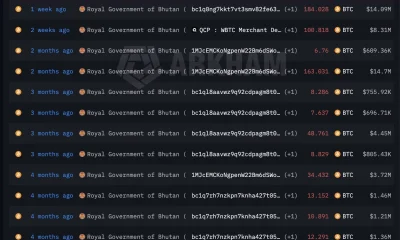
Bhutan’s Bitcoin sales enter third straight week with $6.7M BTC offload
-
 Crypto World6 days ago
Pippin (PIPPIN) Enters Crypto’s Top 100 Club After Soaring 30% in a Day: More Room for Growth?
-

 Video6 days ago
Prepare: We Are Entering Phase 3 Of The Investing Cycle
-
 NewsBeat3 days ago
The strange Cambridgeshire cemetery that forbade church rectors from entering
-

 Business6 days ago
Barbeques Galore Enters Voluntary Administration
-

 Crypto World6 days ago
Ethereum Price Struggles Below $2,000 Despite Entering Buy Zone
-
 NewsBeat3 days ago
Man dies after entering floodwater during police pursuit
-

 Crypto World5 days ago
Kalshi enters $9B sports insurance market with new brokerage deal
-

 NewsBeat4 days ago
UK construction company enters administration, records show
-

 Crypto World4 days ago
BlackRock Enters DeFi Via UniSwap, Bitcoin Stages Modest Recovery
-

 Business1 hour ago
Tesla avoids California suspension after ending ‘autopilot’ marketing