Bitcoin exchange-traded funds (ETFs) continue to hold billions in assets despite bitcoin’s brutal price crash, but that staying power isn’t necessarily the bullish signal that many have come to believe.
According to one analyst, the resilience stems from market makers and arbitrageurs who trade in and out rather than die-hard long-term holders betting on price appreciation.
Bitcoin’s BTC$67,683.06 price peaked above $126,000 in early October and recently crashed to nearly $60,000. Despite the price halving, the 11 spot bitcoin ETFs listed in the U.S. have cumulatively registered just $8.5 billion in net outflows. These funds still hold $85 billion in assets under management, which equates to over 6% of bitcoin’s supply.
Several analysts, including those CoinDesk spoke with at Consensus Hong Kong last week, cited the same data as evidence of bullish positioning.
Advertisement
Markus Thielen, founder of 10x Research, says the resilience comes not just from long-term hodlers, but from market makers and arbitrageurs with hedged, non-directional positions.
“This reflects the structural nature of ETF ownership, which is dominated by market makers and arbitrage-focused hedge funds holding largely hedged positions, as well as long-term institutional investors with low turnover and longer investment horizons,” Thielen said in a note to clients on Wednesday.
Thielen pointed to reports from institutions (called 13F filings) for late 2025. They show that 55% to 75% of BlackRock’s IBIT ETF, which holds $61 billion, is owned by market makers and arbitrage-focused hedge funds who keep their bets hedged or neutral, not truly bullish on bitcoin.
Market makers are entities that create liquidity in an exchange’s order book, facilitating the seamless execution of large buy and sell orders at stable prices. They profit from the bid-ask spread and therefore strive to maintain market-neutral exposure to bypass price volatility risks. Similarly, arbitrage hedge funds take opposing positions in two markets, such as spot ETFs and futures, to profit from the price differential between the two.
Advertisement
Both entities, therefore, do not inject directional pressures (bullish/bearish) into the market.
Thielen added that market makers trimmed exposure by around $1.6 billion to $2.4 billion during the fourth quarter, as bitcoin traded near $88,000, reflecting “declining speculative demand and reduced arbitrage inventory requirements.”
Editor’s note: In a milestone year for the company, eToro’s public results reflect a strategic pivot to a global, AI-enabled investing platform with a growing multi-asset offering. The press release below provides the official quarterly and full-year numbers, while this editorial note highlights the broader implications for users, investors, and the evolving financial landscape. As eToro expands access to markets, introduces AI-powered tools, and moves toward on-chain capabilities, readers can gauge how the platform aims to empower a new generation of investors across regions and asset classes.
Key points
Full-year 2025: Net Contribution up 10% to $868 million; GAAP Net Income up 12% to $216 million; Non-GAAP Adjusted Net Income up 10% to $251 million; Adjusted EBITDA up 4% to $317 million; Adjusted Diluted EPS of $2.64.
Q4 2025: Net Contribution down 10% to $227 million; GAAP Net Income up 16% to $69 million; Non-GAAP Adjusted Net Income up 6% to $70 million; Adjusted EBITDA down 19% to $87 million; Funded Accounts rose to 3.81 million; AUA grew to $18.5 billion; cash and equivalents at $1.3 billion.
January 2026 KPIs show continued activity across capital markets, crypto, and money transfers, signaling ongoing platform utilization and growth momentum.
Strategic focus areas include AI adoption, 24/7 access for select assets, and app ecosystem expansion ahead of the eToro App Store launch.
Why this matters
eToro’s results underscore a transition to a multi-asset, digital-first investing platform that leverages AI and on-chain capabilities to broaden access, personalization, and cross-border reach. With a stronger balance sheet, diversified revenue streams, and ongoing product innovation, eToro is positioned to capture long-term growth opportunities while expanding services for retail and professional users worldwide.
What to watch next
Rollout of 24/7 access to select assets with plans to expand across asset classes.
Launch of several apps ahead of the eToro App Store, enabling investor builders to publish and share tools.
Ongoing share repurchase activity and potential accelerated programs as part of capital allocation strategy.
Disclosure: The content below is a press release provided by the company/PR representative. It is published for informational purposes.
eToro Reports Fourth Quarter and Full Year 2025 Results
UAE, Abu Dhabi, February 17, 2026 – eToro Group Ltd. ( NASDAQ: ETOR ), the trading and investing platform, today announced financial results for the fourth quarter and full year 2025 which ended December 31, 2025.
Yoni Assia, CEO of eToro
“This was a milestone year for eToro,” said Yoni Assia, CEO of eToro. “We became a publicly traded company and significantly advanced the build-out of our global financial super-app. In 2025, we accelerated product innovation and AI adoption, expanded access to global markets, broadened and localized our offering, and strengthened eToro’s footprint around the world. We are operating at a pivotal moment for financial services. Artificial intelligence and progress towards on-chain market infrastructure are reshaping how people invest and interact with markets and eToro is uniquely positioned to capture this opportunity. Through our public APIs and suite of AI-powered tools, users and partners can build, share, and scale strategies and tools, as part of a growing ecosystem. We are launching a number of apps ahead of the roll out of the eToro App Store, bringing enhanced capabilities to our retail audience. In parallel, we are positioning eToro for a financial system that is increasingly moving on-chain. With our long-standing leadership in crypto and tokenization, we are well placed to help shape this transition. This quarter, we are introducing 24/7 access to select popular assets with plans to expand around-the-clock access across asset classes. Our focus remains on empowering users through a simple, transparent, and digital-first investing experience, while positioning eToro to serve the next generation of investors at every stage of their journey. We are uniquely positioned as both a natively crypto company and a global equities trading platform. We look forward to capturing the many long-term growth opportunities ahead for the benefit of our users, shareholders, and partners.”
Meron Shani, CFO of eToro, said: “Our fourth quarter results reflect the strength and resilience of our mult-asset business model. We delivered compelling financial performance through a combination of diversified revenue streams, healthy funded accounts growth, and disciplined financial management. Furthermore, we are off to a strong start to 2026 with our January capital markets KPIs demonstrating the ability of our platform to adapt and perform across all different market conditions, including the recent spike in commodities trading. With our strong balance sheet and a clear execution roadmap, we believe that we are well positioned to deliver accelerated growth in 2026.”
Full year 2025 Financial Highlights1
Net Contribution increased by 10% year over year to $868 million, compared to $788 million in 2024.
Net Income (GAAP) increased 12% year over year to $216 million, compared to $192 million in 2024.
Adjusted Net Income (Non-GAAP) increased 10% to $251 million, compared to $228 million in 2024.
Adjusted EBITDA (Non-GAAP) increased by 4% year over year to $317 million, compared to $304 million in 2024
Adjusted Diluted EPS (Non-GAAP) was $2.64, compared to $2.67 in 2024.
Fourth Quarter 2025 Financial Highlights2
Net Contribution decreased by 10% year over year to $227 million, compared to $253 million in the fourth quarter of 2024.
Net Income (GAAP) increased 16% year over year to $69 million, compared to $59 million in the fourth quarter of 2024.
Adjusted Net Income (Non-GAAP) increased 6% year over year to $70 million, compared to $67 million in the fourth quarter of 2024.
Adjusted EBITDA (Non-GAAP) decreased by 19% year over year to $87 million, compared to $108 million in the fourth quarter of 2024
Adjusted Diluted EPS (Non-GAAP) was $0.71, compared to $0.79 in the fourth quarter of 2024.
Funded Accounts increased 9% year over year to 3.81 million compared to 3.48 million in the fourth quarter of 2024.
Assets Under Administration (AUA) grew by 11% year over year to $18.5 billion, compared to $16.6 billion in the fourth quarter of 2024.
Cash, Cash Equivalents and Short-Term Investments were $1.3 billion as of December 31, 2025.
January KPI metrics3
eToro also reported the below selected monthly business metrics for January 2026:
Advertisement
Assets under Administration (AUA) were $18.4 billion, up 2% year-over-year.
Funded accounts were 3.85 million, up 9% year-over-year.
Capital Markets/ECC Activity
Total number of trades for January was 74 million, up 55% year-over-year;
Invested amount per trade for January was $252, up 8% year-over-year;
Crypto Activity
Total number of trades for January was 4 million, down 50% year-over-year;
Invested amount per trade for January was $182, down 34% year-over-year;
Interest Earning Assets for January was $7.7 billion, up 17% year-over-year.
Total Money Transfers for January was $1.8 billion, up 68% year-over-year.
Business Highlights
eToro is demonstrating strong progress across its four product pillars driven by continued product innovation, localization, and strategic partnerships.
Trading: eToro expanded access to global markets while advancing toward always-on trading. With the addition of equities listed on the Abu Dhabi Securities Exchange, Hong Kong Stock Exchange, and across the Nordics, eToro now offers access to equities from 25 stock exchanges. The Company grew its crypto offering to more than 150 cryptoassets, including an expanded range of more than 100 cryptoassets for US users. eToro also broadened derivatives access, expanding its futures offering across Europe and launching futures and options in the UK. It has also begun the roll out of stock margin trading, where eligible users can access leveraged exposure to U.S. equities. In 2025, eToro expanded 24/5 trading to all S&P 500 and NASDAQ 100 stocks, and in Q1, the Company is introducing 24/7 access to a select number of popular assets with plans to expand this across asset classes.
Investing: eToro strengthened its investing proposition by expanding access to intelligent, long-term investment solutions. The Company launched Tori, its AI Analyst, and through its public APIs and suite of AI-powered tools, users and partners can build, share, and scale strategies and tools, creating a growing ecosystem. This quarter, eToro is introducing a number of apps ahead of the launch of the eToro App Store, where ‘investor builders’ and partners can publish and share their apps with millions of eToro users globally. eToro continued to expand its range of Smart Portfolios including launching portfolios with Franklin Templeton, WisdomTree, ARK Invest and Amundi. The launch of Alpha Portfolios provides retail investors with access to quantitative, data driven strategies leveraging eToro’s data for the benefit of our customers. Having pioneered social investing, users can follow, copy, and engage with over 5,000 members of eToro’s Pro Investor Program, with Copy Trading now also launched in the US. During 2025, eToro introduced securities lending in the UK, Europe and the UAE, as well as expanding its staking program to help users access passive yield generating opportunities. eToro launched the eToro Club Subscription providing access to premium investing tools, financial perks and dedicated support.
Wealth Management: eToro continued to scale its long-term savings solutions in 2025. The Company partnered with Generali to provide French users with access to long-term, tax advantaged retirement (PER) and life insurance products. eToro also expanded its ISA offering in the UK with the addition of a self-directed stocks and shares ISA and a cash ISA. The AuA in eToro’s UK ISA products grew by 7x from Q4 2024 to Q4 2025. Assets under administration in our Australian savings products grew 44% between 2023 and 2025, supported by strong momentum following the launch of our superannuation offering.
Neo-Banking: During 2025, eToro accelerated the localization of its money management experience. The expansion of local bank accounts to more countries and the continued roll out of the debit card across Europe resulted in eToro Money’s transaction volume increasing 6.5x year-over-year. eToro Money ended the year with 1.87 million accounts. eToro Money, including eToro’s crypto wallet, is now fully integrated into the eToro app and provides seamless crypto transfers including 1% stock-back rewards on eligible crypto transfers.
Partnerships: eToro announced a multi-year partnership with BWT Alpine Formula 1 extending the business’ global brand presence and engagement with a fast-growing, international audience. eToro also entered into a partnership with Gemini Space Station Inc to support the migration of their customers from the UK, Europe and Australia onto the eToro platform, reinforcing its position as a leading, global, multi-asset broker.
Share Repurchase Program eToro today announced that its Board of Directors has approved a $100 million increase to its existing share repurchase program. The program previously authorized $150 million, of which $100 million has already been used, leaving $50 million remaining. Following the increase, total remaining authorization is $150 million. Such repurchases may be made through a variety of methods, including through open market transactions (including through Rule 10b5-1 plans), privately negotiated transactions, block trades and by way of an accelerated share repurchase program. Additionally, subject to market and other conditions, the Company intends to enter into an Accelerated Share Repurchase (“ASR”) agreement to repurchase approximately $50 million of its common shares under the new authorization. This authorization reflects the Company’s confidence in its long-term strategy and growth prospects, financial strength, and commitment to deliver shareholder value. eToro believes that its current share price does not fully reflect the Company’s fundamental value, and that repurchasing shares represents a prudent allocation of capital. The program also provides additional flexibility to support potential future strategic initiatives, including mergers and acquisitions, where eToro shares could serve as an effective transaction currency. The actual timing, number, manner and value of any shares repurchased will depend on several factors, including the market price of our shares, general market and economic conditions, our liquidity requirements, applicable legal requirements and other business considerations. The authorization does not expire.
About eToro
eToro is the trading and investing platform that empowers you to invest, share and learn. We were founded in 2007 with the vision of a world where everyone can trade and invest in a simple and transparent way. Today we have 40 million registered users from 75 countries. We believe there is power in shared knowledge and that we can become more successful by investing together. So we’ve created a collaborative investment community designed to provide you with the tools you need to grow your knowledge and wealth. On eToro, you can hold a range of traditional and innovative assets and choose how you invest: trade directly, invest in a portfolio, or copy other investors. You can visit our media center here for our latest news.
Risk & affiliate notice: Crypto assets are volatile and capital is at risk. This article may contain affiliate links. Read full disclosure
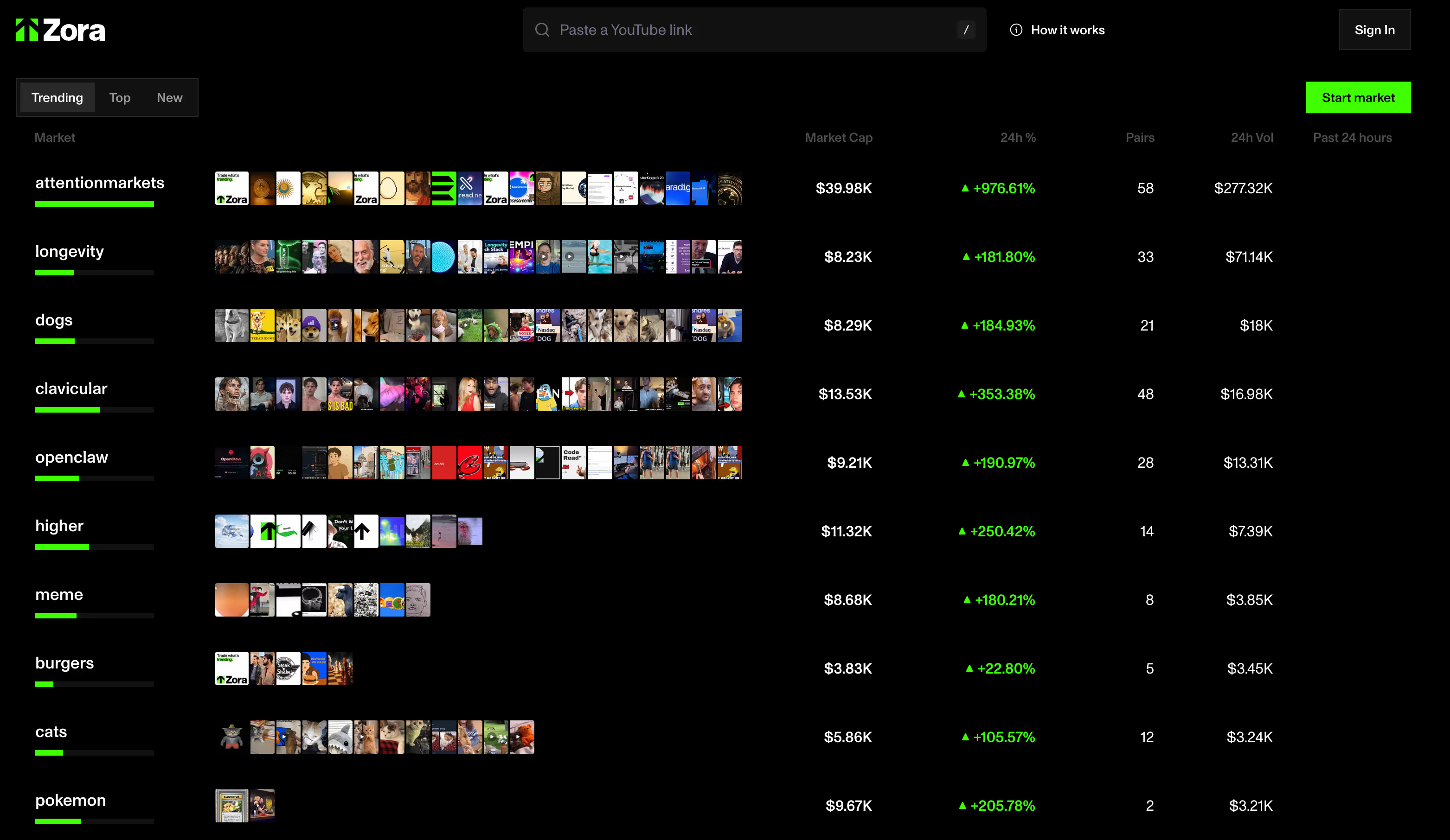
On-chain social platform and decentralized protocol Zora is making a decisive shift beyond its non-fungible tokens (NFT) and creator roots with the launch of “attention markets” on Solana, a product that allows users to trade tokens tied to internet trends, memes and cultural moments.
The feature, unveiled Feb. 17, lets anyone create a new market for 1 SOL. Once live, users can buy and sell positions on whether a topic will gain or lose traction across social media.
Instead of wagering on elections or macro data, traders speculate on buzz itself — such as hashtags, viral narratives, even broad themes like “AI girlfriend” or “bitcoin.”
The design leans heavily into Solana’s strengths. Fast block times and low transaction costs make it easier to support rapid price updates and frequent trading, which are essential for markets built around fleeting online momentum.
Advertisement
Initial activity was limited, however. The primary “attentionmarkets” token briefly touched roughly $70,000 in market capitalization, with around $200,000 in trading volume. Most other trend markets struggled to attract meaningful liquidity, with few crossing the $10,000 mark in their first day.
Percentage swings were sharp, though largely driven by thin order books rather than sustained demand.
Zora was among the breakout applications on Coinbase’s Layer 2 Base network in the past few years. It launched its ZORA token there in April, and helped roll out Creator Coins tied to Base profiles in July, a push that briefly helped Base overtake Solana in daily token creation.
Creator coins are tokens tied to an individual creator’s online profile, brand or community. Think of them as tradable “shares” in a person’s internet presence.
On platforms like Zora and Base, a creator coin could be automatically generated from a user’s profile. Fans could buy the coin to signal support, gain social clout, or speculate that the creator’s popularity would grow. As more people bought in, the price could rise, and interest faded, it could fall.
Advertisement
As such, some in the Base community saw the new “attention markets” product as a pivot away from that momentum.
Jacek Trociński, the developer behind Base memecoin Degen, called it “really disappointing” to see Zora move to Solana. Veil Cash builder Apex777.eth was harsher, accusing Zora of “extracting” value from Base before switching networks.
Meanwhile, Base creator Jesse Pollak said Zora’s creator tools remain “fully operational” on the network.
As speculation moves beyond price charts and into cultural data, platforms like Zora are testing whether attention itself can become memetic and deeply tied to the internet’s real-time financial pulse.
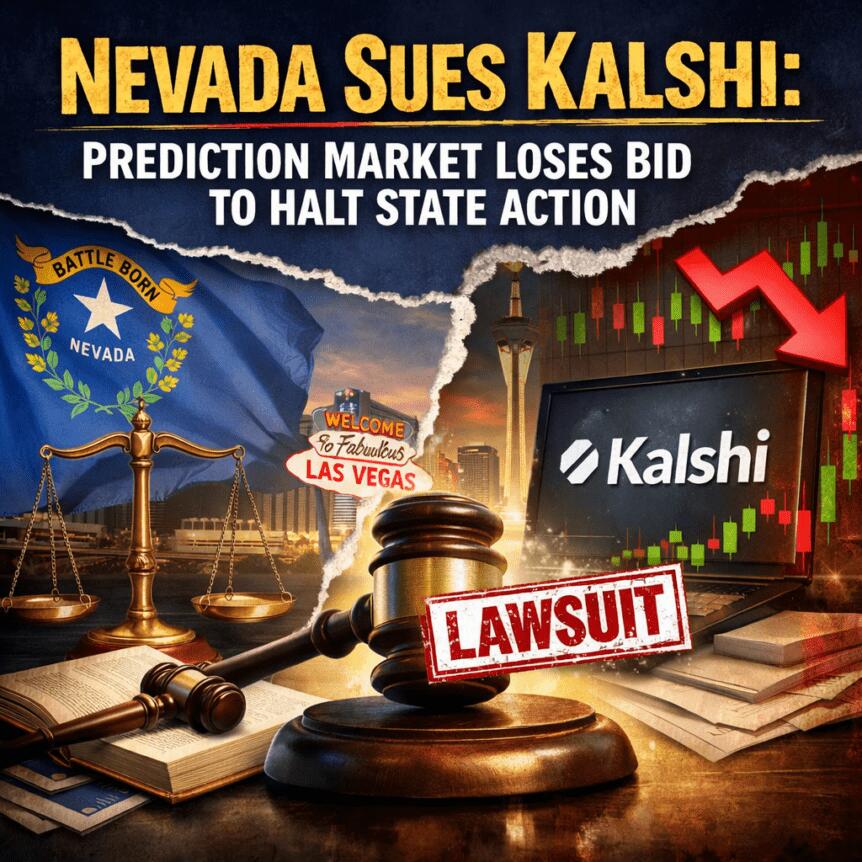
The legal clash between Kalshi and Nevada regulators intensified this week as the state’s gaming authority pressed forward with enforcement actions after a federal appeals court refused to halt the state’s conduct. The Ninth Circuit Court of Appeals on Tuesday denied Kalshi’s bid to block the Nevada Gaming Control Board from pursuing a civil case over Kalshi’s sports event contracts, effectively clearing the path for the regulator to proceed in state court. In short order, the Nevada Gaming Control Board filed a civil enforcement action, arguing Kalshi offers unlicensed wagering in violation of Nevada gaming law. Kalshi countered by seeking to move the dispute to federal court, echoing its long-held position that its activities fall under exclusive federal jurisdiction via the Commodity Futures Trading Commission (CFTC). The evolving dispute highlights a broader, unsettled regulatory landscape for prediction markets in the United States.
Key takeaways
The Ninth Circuit refused Kalshi’s request to pause Nevada’s enforcement efforts, allowing a state-court civil action to proceed against Kalshi over sports-related markets.
Following the ruling, the Nevada Gaming Control Board immediately filed a civil enforcement action in state court, asserting Kalshi operates unlicensed wagering on sporting outcomes in violation of state law.
Kalshi maintains it operates under exclusive federal jurisdiction and has argued that federal law supersedes state-level actions in this area, leveraging the CFTC’s authority over commodity derivatives.
The case mirrors similar tensions in other states and among other prediction-market operators, underscoring a broader regulatory crackdown on unlicensed gaming-like activity in the prediction space.
The regulatory narrative is being shaped in part by federal involvement, with the CFTC signaling its stance on jurisdiction over prediction-market activity and related contracts.
Sentiment: Bearish
Market context: The dispute sits at the intersection of state gaming regulation and federal commodity rules, a space that remains legally unsettled as regulators and platform operators test boundaries around prediction markets and their licensing needs. The CFTC has emphasized its jurisdiction over commodity derivatives traded on designated contract markets, while states push for traditional licensing regimes where wagering is involved.
Why it matters
For Kalshi, the Nevada case is a test of its central premise—that prediction-market activity should fall under federal oversight rather than state gaming statutes. If the state court ultimately concludes that Kalshi’s sports event contracts require licensing under Nevada law, Kalshi may face injunctions, penalties, or the need to halt certain markets within the state. The immediate practical effect would be to constrain Kalshi’s ability to offer sports-related contracts to Nevada residents, reinforcing the idea that licensing requirements can operate at the state level even when a company argues federal preemption.
For other prediction-market operators, the unfolding legal framework signals heightened regulatory risk. The ongoing tension between state enforcement actions and federal jurisdiction could prompt platforms to seek clearer licensing pathways or, in some cases, to trim or relocate markets to jurisdictions with more predictable rules. The broader regulatory climate also matters for investors and developers evaluating the growth potential of prediction-market ecosystems, including partnerships and product designs that align with licensing realities rather than contending with uncertain legal status.
Advertisement
From the federal perspective, the CFTC’s posture—evidenced by statements and amicus actions in related cases—suggests a willingness to defend a permissive view of what constitutes a derivative market under federal law. That approach has implications for how products are structured, how they are offered to users, and how regulators coordinate across state and federal lines. The involvement of the CFTC in similar matters, including its stance in parallel suits against other states, indicates that the federal framework may ultimately steer product development and regulatory compliance norms in the prediction-market space.
The case is also emblematic of a wider policy conversation about the boundary between what constitutes gaming under state law and what falls under the umbrella of commodity derivatives regulated by the federal government. As technology enables more sophisticated event-based contracts and as states consider licensing to govern consumer protections, a clearer, nationwide standard remains elusive. The legal arguments that Kalshi has advanced—namely, that its markets are governed by federal commodity laws rather than state wagering statutes—will likely continue to echo through courtroom corridors as other jurisdictions weigh similar actions.
The regulator’s position is reinforced by the state’s explicit assertion that Kalshi’s offerings amount to wagering on sports outcomes and therefore qualify for licensing under Nevada law. The regulatory calculus hinges on whether these contracts are sufficiently akin to traditional gaming or whether they can still be framed as commodity derivatives that fall under federal oversight. The Ninth Circuit’s decision not to pause the state’s enforcement action confirms that the state court system will be the next arena where these questions are tested, at least in the near term.
As this legal saga unfolds, observers will watch for how Kalshi frames its next strategic move—whether to intensify its federal-venue approach, pursue further appeals, or seek negotiated licensing accommodations that could permit continued operation in Nevada and beyond. The regulatory momentum in other states, along with potential federal actions, will shape the tempo and direction of future actions by prediction-market platforms and the regulators overseeing them.
Advertisement
For reference, Kalshi’s dispute has roots in earlier regulatory correspondence, including a cease-and-desist order that spurred Kalshi to sue Nevada in March of the previous year and a federal court ruling in April that temporarily blocked Nevada from taking action during the litigation. The state’s subsequent civil enforcement action underscores a shift from courts determining temporary relief to real-world enforcement remedies that could affect ongoing offerings. The legal arguments—centered on licensing requirements, intent to operate in a regulated gaming environment, and the scope of federal jurisdiction—will likely shape how prediction markets navigate compliance moving forward.
The broader industry context includes a notable cross-pollination of interests between traditional gaming regulators and digital-asset-adjacent markets. With players like Crypto.com pursuing similar matters against Nevada regulators, and with political and legal attention on the legality and design of prediction markets, the industry stands at a crossroads where licensing frameworks, consumer protections, and innovative financial instruments intersect. As these threads converge, the coming months are likely to produce more clarity—and more controversy—about where prediction markets fit within the U.S. regulatory tapestry.
Source references tied to the ongoing dispute include Nevada Gaming Control Board filings and docket activity, as well as court documents detailing Kalshi’s attempts to move the case to federal court. For a snapshot of the state-level actions, the regulator’s official filings and statements provide direct attestations of the legal theory the state is pursuing against Kalshi.
What to watch next
The state court civil enforcement action against Kalshi in Nevada: timeline for hearings and potential rulings.
Any subsequent filings or rulings from the Ninth Circuit or federal courts on Kalshi’s venue arguments and potential appeals.
Further amicus briefs or regulatory filings from the CFTC or other federal agencies regarding jurisdiction over prediction-market activities.
Developments in parallel cases, such as Crypto.com’s challenges to Nevada regulators and any related state actions against other prediction-market operators.
Sources & verification
Nevada Gaming Control Board press release and complaint PDF alleging Kalshi’s unlicensed wagering (kalshi-complaint.pdf).
Nevada Gaming Control Board press release on civil enforcement action against Kalshi (ngcb-files-civil-enforcement-action-against-kalshi.pdf).
CourtListener docket for State of Nevada ex rel. Nevada Gaming Control Board v. Kalshi LLC (docket entry showing the federal motion and related filings).
Kalshi’s federal court venue motion referenced in court records (CourtListener docket).
CFTC amicus brief discussion in related Crypto.com case in Nevada (Cointelegraph coverage referencing the CFTC stance).
Kalshi and Nevada clash over sports contracts
The dispute between Kalshi LLC and the State of Nevada over Kalshi’s sports-event contracts has moved from a regulatory order into a courtroom duel over jurisdiction and licensing. After Kalshi’s bid to halt Nevada’s enforcement was rejected by the Ninth Circuit, the regulator proceeded with a civil action in state court, arguing that Kalshi’s offerings amount to unlicensed wagering under Nevada law. Kalshi contends that its activities are subject to exclusive federal jurisdiction, a claim it has pressed since the outset of the case and one it has framed around the CFTC’s authority over commodity derivatives.
In a sequence of filings and rulings, the parties have mapped a jurisdictional battleground that is likely to influence the trajectory of prediction-market operators beyond Nevada. Kalshi’s argument rests on the premise that prediction-market contracts function as commodity derivatives and therefore belong under the federal oversight of the CFTC. Nevada’s counterpoint emphasizes licensing requirements within the state’s gaming framework, asserting that even if a contract resembles a derivative in structure, it still implicates wagering and gaming activities that require state licensing. The Ninth Circuit’s decision to deny a stay removes a preliminary hurdle for the state to pursue civil remedies, allowing the underlying enforcement to proceed while the broader jurisdictional questions continue to percolate in appellate and district court settings.
Advertisement
Public filings and press materials from the Nevada regulator outline the legal theory at stake: Kalshi’s markets are active in the state, but Kalshi has not secured the necessary licenses to operate those markets within Nevada’s borders. The regulator has pointed to the state’s existing framework for gaming and wagering to argue that Kalshi must obtain licenses for its sports contracts. Kalshi, meanwhile, has sought to position the matter within the federal regime that governs designated contract markets and other CFTC-regulated activities, arguing that state enforcement risks duplicative and conflicting obligations for a market participant operating across multiple jurisdictions.
As regulators, courts, and market participants monitor this case, the central questions will revolve around licensing, consumer protections, and the proper allocation of regulatory authority between state gaming authorities and federal commodity regulators. Should Kalshi prevail on the federal-venue theory in the long run, it could pave the way for broader operation of prediction-market platforms without state-level licensing, provided federal law offers a clear path. Conversely, a ruling affirming Nevada’s licensing demands could constrain Kalshi’s services in the state and prompt similar actions in other jurisdictions, thereby shaping the practical viability of prediction markets as a class of financial products in the United States.
For now, the Nevada case stands as a pivotal, high-stakes test of how prediction markets fit into a complex mosaic of gaming and commodities regulation. The coming months are likely to reveal how the regulatory regime coalesces—or fractures—around questions of licensing, jurisdiction, and the boundary between gaming normalities and financial-derivative constructs in the evolving landscape of digital markets.
Risk & affiliate notice: Crypto assets are volatile and capital is at risk. This article may contain affiliate links. Read full disclosure
The Nevada Gaming Control Board has filed a civil enforcement action against KalshiEX LLC, accusing the federally regulated prediction market of offering unlicensed wagering in the state.
Summary
The Nevada Gaming Control Board has filed a civil enforcement action against Kalshi, alleging its sports-linked event contracts amount to unlicensed gambling under state law.
Kalshi is seeking to move the case to federal court, arguing it operates under the exclusive jurisdiction of the U.S. Commodity Futures Trading Commission.
The lawsuit adds to a growing national battle between state gaming regulators and federally regulated prediction markets, with multiple states taking similar action.
Nevada moves to block Kalshi’s event trading
In a complaint filed in Carson City District Court, regulators argue that Kalshi’s sports-linked “event contracts” amount to gambling under Nevada law. The state is seeking declaratory relief and an injunction to stop the company from operating in Nevada without a gaming license.
According to the complaint, making “event contracts” available to Nevada residents without approval from the Nevada Gaming Commission violates multiple provisions of the state’s gaming code.
Advertisement
“The Board continues to vigorously fulfill its obligation to safeguard Nevada residents and gaming patrons,” said NGCB Chairman Mike Dreitzer.
Kalshi quickly moved to shift the case to federal court, reiterating its long-standing position that it falls under the exclusive jurisdiction of the Commodity Futures Trading Commission and not state gaming regulators.
State law vs. Federal oversight
Kalshi maintains that its contracts are financial derivatives regulated by the U.S. CFTC, not traditional bets. The company operates as a CFTC-designated exchange and says federal law preempts state gaming rules.
Advertisement
Nevada disagrees. Regulators argue that contracts tied to sports outcomes mirror sportsbook wagers and fall squarely under state jurisdiction.
The Board says allowing unlicensed operators would undermine Nevada’s tightly controlled gaming framework.
The lawsuits come amid a growing national legal battle over whether prediction markets such as Kalshi fall under state gambling laws or are exclusively governed by federal regulators. States including Maryland, New Jersey, Ohio and Tennessee have also challenged prediction markets, issuing cease-and-desist orders or filing lawsuits to block unlicensed sports event contracts.
Advertisement
Meanwhile, the CFTC has pushed back, defending its authority over event contracts. In earlier disputes, Kalshi secured temporary relief in court, though those wins have been limited and closely watched.
At issue is who controls the fast-growing prediction market sector — federal derivatives regulators or state gaming boards.
The outcome could reshape how Americans trade on elections, sports and economic events. It may also determine whether prediction markets operate nationwide under a single federal regime, or face a patchwork of state gambling laws.
XRP (XRP) price extended its slide on Wednesday, adding to a downtrend that has erased 44% of its value over the past year.
Amid this, a market analyst has highlighted unusual trading activity emerging from South Korea’s largest crypto exchange, raising questions about its potential impact on XRP’s price dynamics.
Sponsored
Sponsored
Advertisement
Study of 82 Million Trades Flags Structural Selling in XRP/KRW Market on Upbit
Crypto analyst Dom claims to have uncovered what he describes as a nearly year-long, multi-billion-dollar XRP selling pipeline. In a thread published on X (formerly Twitter), Dom said his findings are based on 82 million tick-level XRP/KRW trades on Upbit, alongside 444 million trades from Binance for comparison.
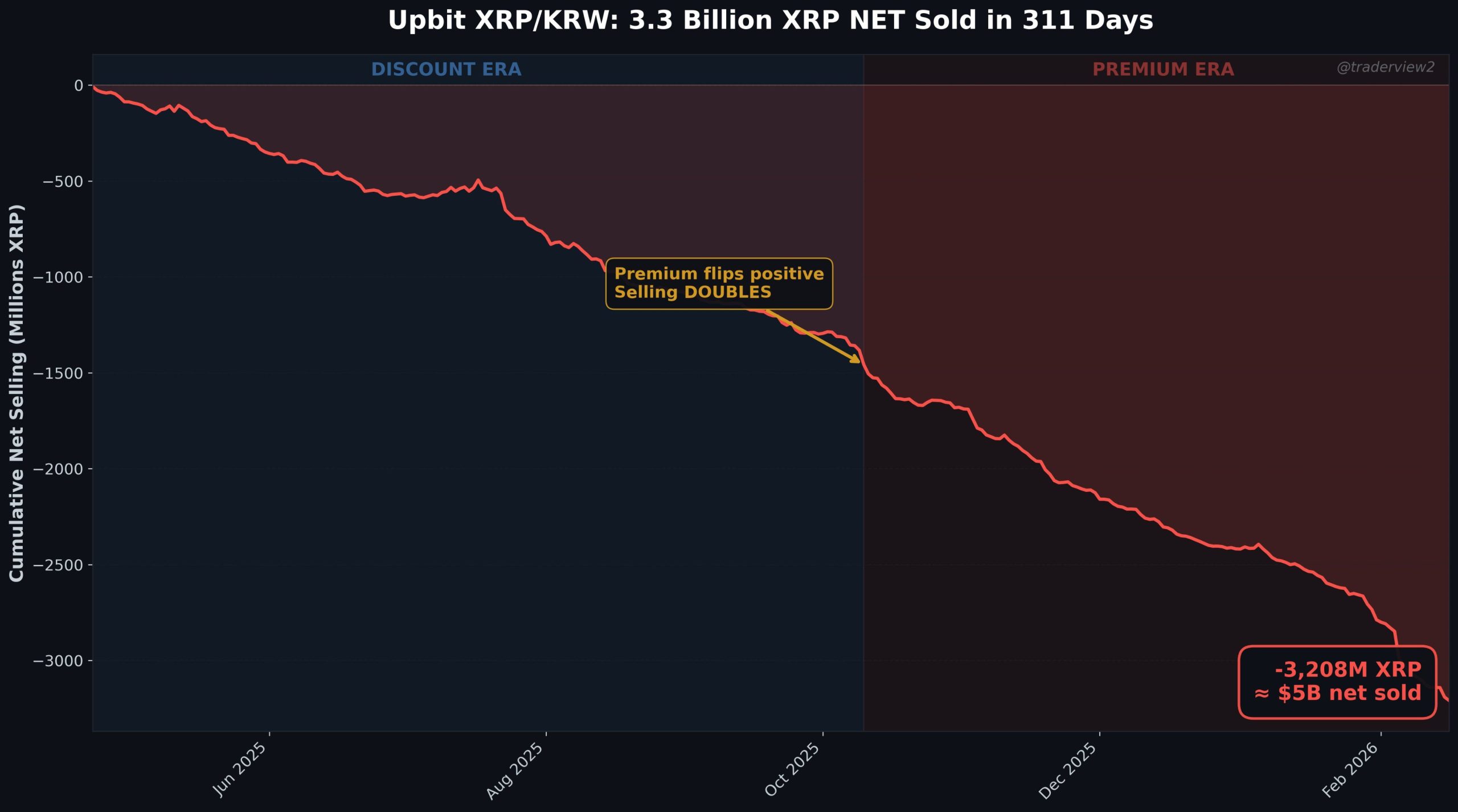
According to his analysis, Upbit’s XRP pair has recorded a net negative cumulative volume delta every month for the past 10 months.
“It started with yesterday’s price action. -57M XRP in CVD over 17 hours. It looked insane. So I ran forensic queries – bot fingerprinting, iceberg detection, wash trade checks. The selling was real. Algorithmic. 61% of trades fired within 10ms. Single bot running 17 hours straight with one 33-second pause,” he wrote.
Dom highlighted several months with particularly heavy negative cumulative volume delta (CVD), including April (-165 million XRP), July (-197 million XRP), October (-382 million XRP), and January (-370 million XRP). In total, he reports that only 1 of 46 weeks in the sample period showed net positive buying pressure.
“And it’s not ‘the market’ – Binance XRP/USDT carries 2-5x less sell pressure on the same coin (shocker). In June, Binance was net positive while Upbit bled -218M. The hourly correlation between the two venues is only 0.37. Upbit’s flow is largely its own thing,” the post added.
Dom argues the selling appears algorithmic. Between 57% and 60% of trades were executed within 10 milliseconds, a pattern typically associated with automated systems. He also observed that sell orders frequently appeared in round-number sizes such as 10, 100, or 1,000 XRP.
Sponsored
Advertisement
Sponsored
Meanwhile, buy orders were often fractional amounts like 2.537 XRP, consistent with KRW-denominated retail purchases.
“Ten million fractional buy orders over 10 months. Compared to the sell side running mechanical round number clips. Two completely different profiles trading against each other on the same venue,” the analyst added.
Furthermore, the analyst noted that from April to September, XRP on Upbit reportedly traded at a 3% to 6% discount to Binance, a “reverse Kimchi Discount.”
“The sellers were accepting 6% worse fills than available on global markets, for many months. They don’t care about the price. They need KRW, are mandated to use Upbit, and/or are Korean holders taking profit,” he stated. “Then October 10 happened. The premium has only briefly gone negative since and the sellers? They doubled their daily rate. From -6.3M/day to -11.2M/day.”
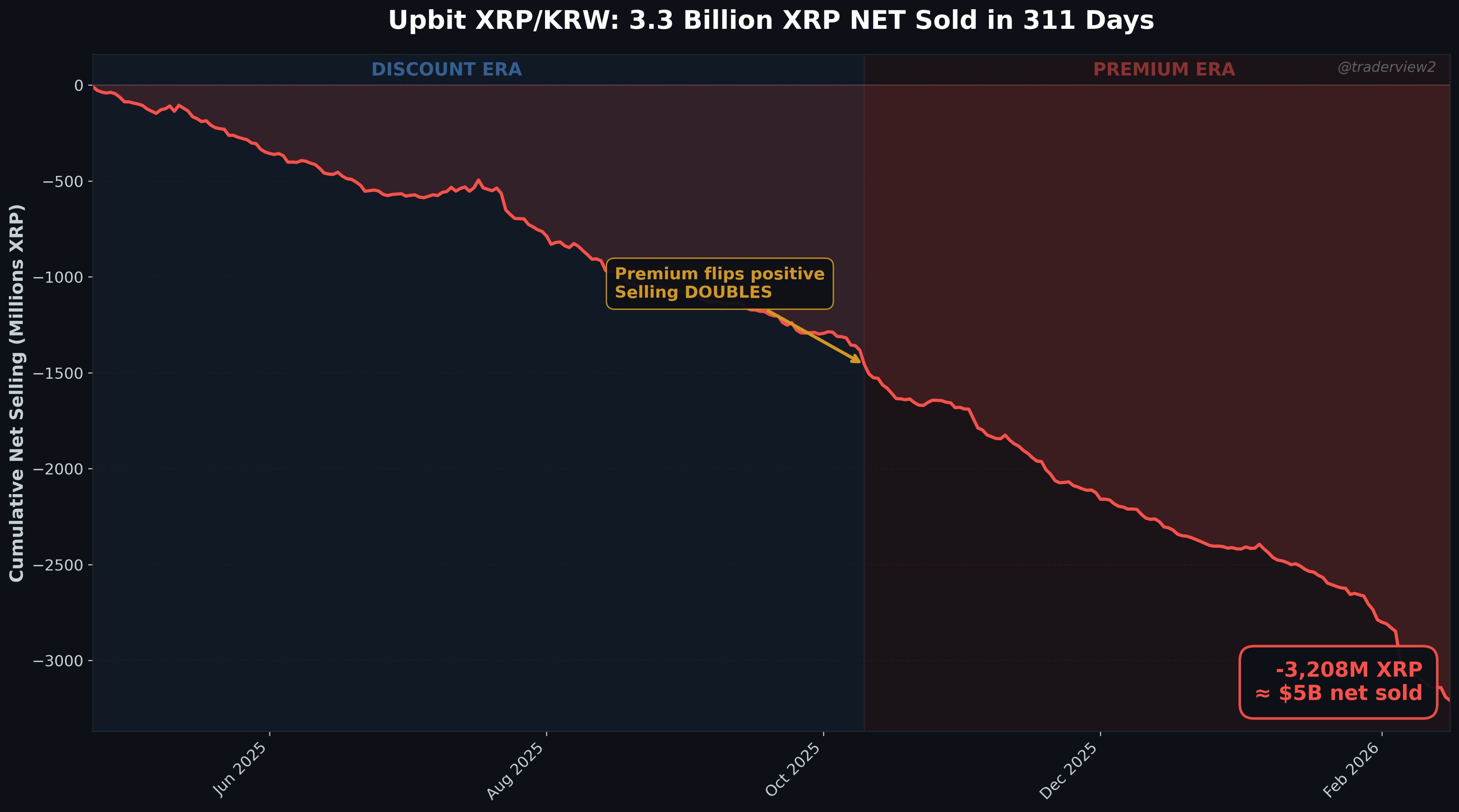
He estimates that the overall activity accounts for 3.3 billion XRP, worth $5 billion, in “net selling.” This represents about 5.4% of the token’s circulating supply. While Dom does not identify a specific entity behind the activity, he describes the flow as consistent, 24/7, and infrastructure-like rather than discretionary trading.
Advertisement
Sponsored
Sponsored
“So who has enough XRP to sell 300-400M per month for a year straight, doesn’t care about 6% discounts, runs identical algo infrastructure 24/7 and needs KRW specifically or is in some walled garden and can only use Upbit? AND who are they selling to? Who’s been on the other side of that trade? It could be 1 entity, 50 entities or 10k people I’ll let you speculate,” Dom remarked.
Why Does This Matter?
This matters because sustained, large-scale selling may influence price dynamics over time. A consistent flow of sell orders may limit upward momentum, intensify declines during periods of market stress, and absorb buying demand before it translates into meaningful price appreciation.
The impact is particularly relevant given that XRP was the most traded asset on Upbit in 2025. If this pattern is accurate, it would suggest that a significant source of supply has been active within one of the world’s most active XRP markets, with retail participants frequently on the opposite side of those trades.
Advertisement
Should that selling pressure decrease or stop, overall market behavior could shift as the balance between supply and demand adjusts.
Sponsored
Sponsored
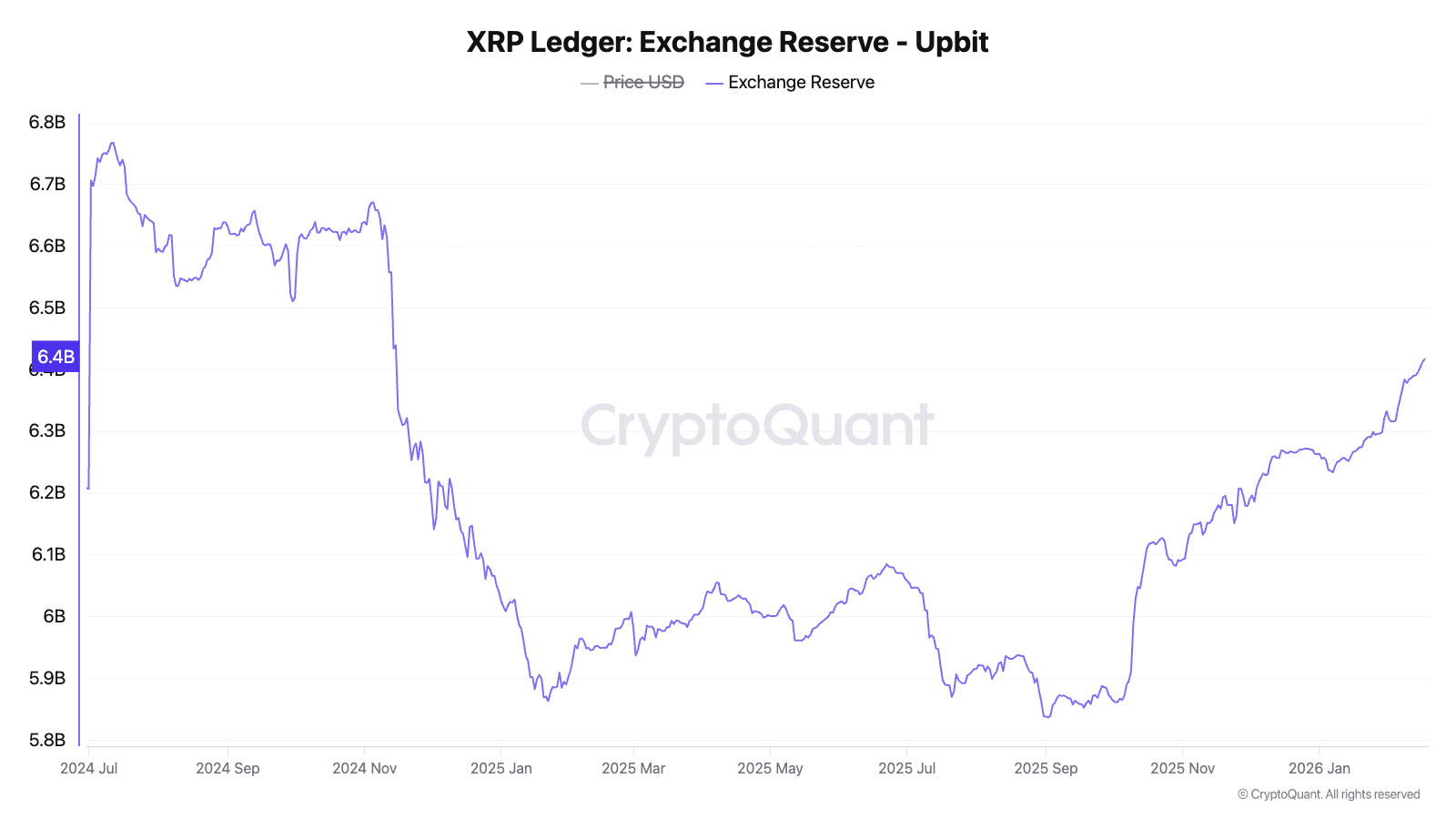
The findings come as XRP balances on Upbit have reached a one-year high, exceeding 6.4 billion XRP, accounting for nearly 10% of the circulating supply.
In contrast, exchange reserves continued to decline on Binance, reflecting a divergence between Korean XRP investors and participants in other markets.
Binance XRP reserves just hit their lowest level since early 2024.
700 million XRP left the exchange from the November peak. At current prices, that’s hundreds of millions of dollars — gone from exchange wallets.
Taken together, the reported structural selling on Upbit and the rise in XRP balances on the exchange point to a sustained flow of tokens circulating within that venue. At the same time, contrasting reserve trends and accumulation patterns observed on other exchanges highlight a divergence in regional market behavior.
Multiple technical, onchain and exchange-traded product data points suggest $1.12 was the generational bottom for XRP. Is it time for a trend reversal?
Abu Dhabi-linked sovereign investors held more than $1 billion in U.S. spot Bitcoin ETF exposure at the end of 2025, a milestone that comes as the broader market faces renewed outflows this week.
Summary
Abu Dhabi-linked sovereign investors held over $1.04 billion in U.S. spot Bitcoin ETFs at the end of 2025, according to SEC filings.
Mubadala Investment Company and Al Warda Investments disclosed a combined 20.9 million shares in BlackRock’s Bitcoin ETF.
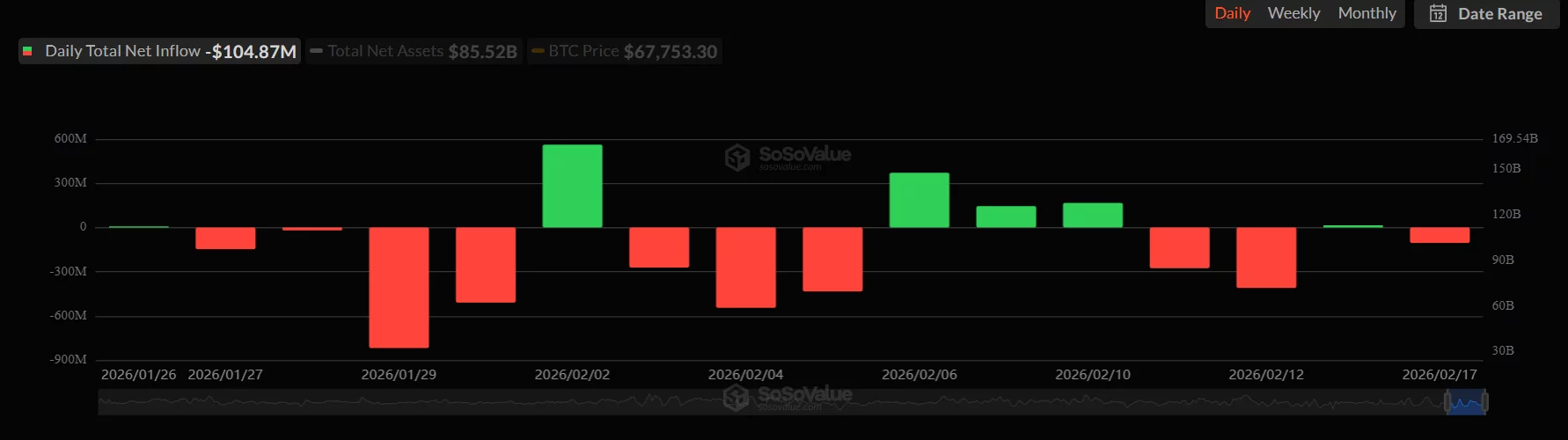
The milestone comes as Bitcoin ETFs recorded $104.87 million in daily net outflows, signaling short-term selling pressure despite long-term institutional positioning.
The disclosure adds to a broader wave of institutional adoption, after Italian banking giant Intesa Sanpaolo revealed nearly $100 million in Bitcoin ETF holdings in a recent U.S. regulatory filing.
Advertisement
Abu Dhabi’s billion-dollar Bitcoin ETF play
According to fourth-quarter Form 13F filings submitted to the U.S. Securities and Exchange Commission, Mubadala Investment Company reported holding 12,702,323 shares of BlackRock’s spot Bitcoin ETF, valued at approximately $630.7 million as of Dec. 31, 2025.
A separate filing shows Al Warda Investments owned 8,218,712 shares in the same fund, worth roughly $408.1 million at year-end.
Combined, the two Abu Dhabi entities held about 20.9 million shares valued at just over $1.04 billion, underscoring continued sovereign exposure to regulated Bitcoin products offered by BlackRock.
Bitcoin ETF outflows resume
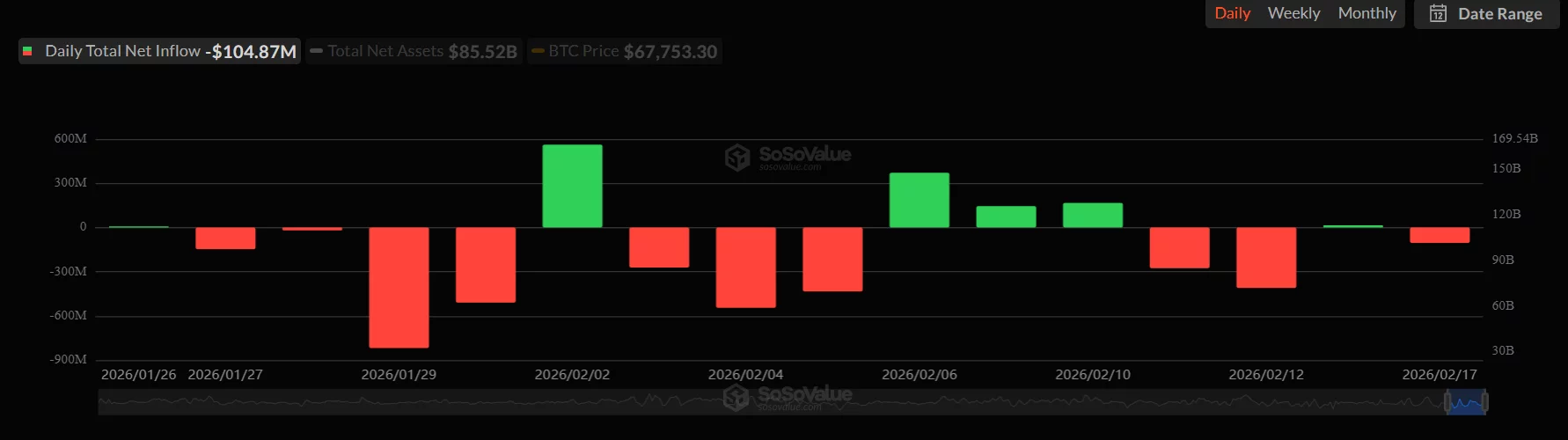
The milestone comes as Bitcoin ETFs recorded renewed selling pressure. Data from SoSoValue shows total daily net outflows of $104.87 million in the latest session. Total net assets across U.S. spot Bitcoin ETFs stood at $85.52 billion, while Bitcoin traded around $67,753 at the time of the writing.
Advertisement
Bitcoin ETF flows | Source: SoSoValue
Recent flow data shows volatility across late January and February, with several large redemptions interspersed with brief inflow spikes. Despite the short-term outflows, Abu Dhabi’s year-end filings suggest a longer-term allocation strategy rather than tactical trading.
The 13F disclosures reflect positions as of Dec. 31 and do not capture activity in early 2026. However, the scale of the holdings highlights how major state-backed investors remain positioned in U.S.-listed Bitcoin ETFs even as market sentiment fluctuates.
Digital asset treasury firms with a sole business of investing in tokens have fallen out of investor favor and how.
Billionaire entrepreneur and co-founder of PayPal and Palantir Technologies Peter Thiel’s venture arm has wiped its slate clean of ETHZilla, selling every last share of the ether-hoarding digital asset treasury firm by the end of the last year, fresh paperwork filed with the Securities and Exchange Commission shows.
Thiel’s Founders Fund now shows a big fat zero in ownership, down from a 7.5% stake in August last year.
ETHZilla, a crypto investment firm based in Palm Beach, mimics Michael Saylor’s bitcoin hoarding firm Strategy (MSTR). ETHZilla started as a failed biotech stock called 180 Life Sciences, before pivoting hard to Ethereum (ETH) treasury, amassing over 100,000 ETH tokens at its peak.
Advertisement
The fund, however, panicked as markets peaked in early October and $40 million in ether for buybacks, then $74.5 million more in December to reduce debt from convertible notes. According to Bloomberg, the firm is pivoting hard again, spinning out ETHZilla Aerospace to offer investors tokenized slices of leased jet engines.
Orca stunned the market with a sharp 50% surge in the past 24 hours. The price climbed quickly without any major development announcement. The rally appears driven by renewed investor interest rather than protocol upgrades.
However, strong upside moves often carry elevated risk. Sudden spikes can attract speculative capital and trigger volatility.
Sponsored
Orca Buying Spree Contributed To The Rally
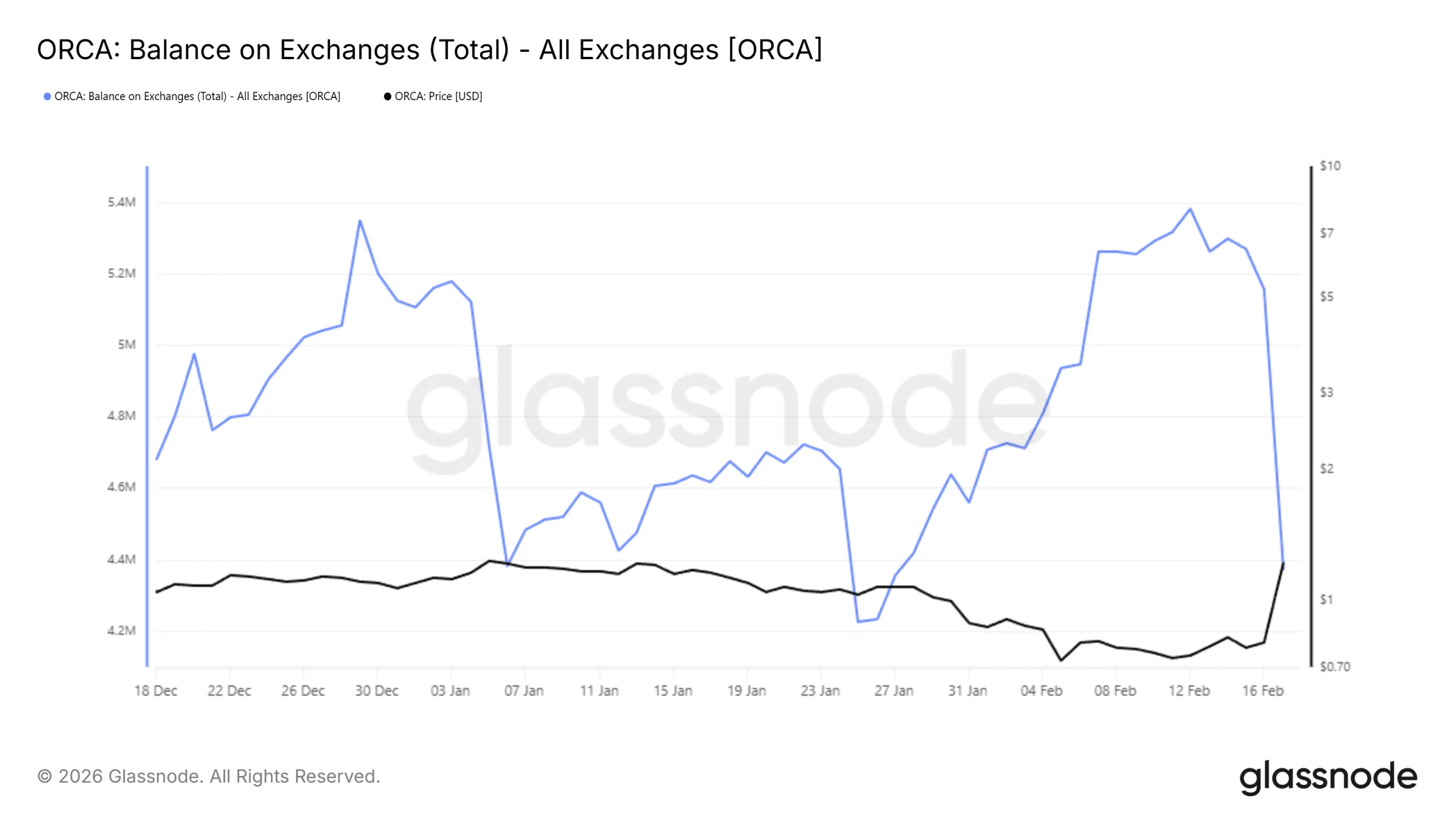
ORCA balances on exchanges declined significantly over the past day. Nearly 1 million ORCA tokens were bought off exchanges within 24 hours. At the current price of $1.23, that supply is worth approximately $1.23 million.
Advertisement
Want more token insights like this? Sign up for Editor Harsh Notariya’s Daily Crypto Newsletter here.Ethereum Exchange Balance. Source: Glassnode
This marks the largest single-day accumulation of ORCA this year. Reduced exchange supply typically reflects rising investor conviction. Organic demand appears to have fueled the rally. Utility metrics support this view.
USDC total value locked on Orca increased 100% year over year, reaching nearly $90 million.
Sponsored
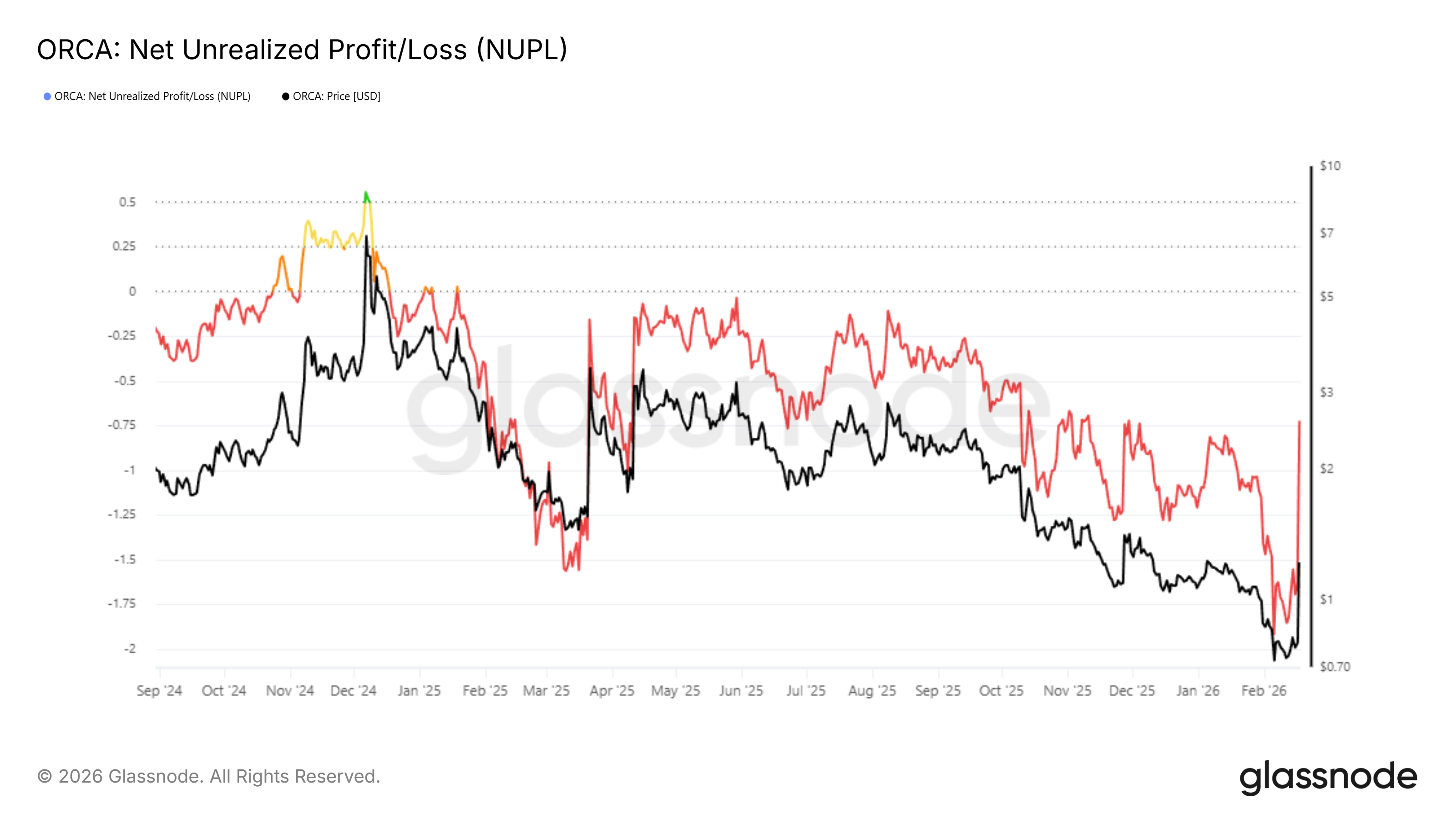
The Net Unrealized Profit and Loss, or NUPL, indicator provides additional context. Recent readings show that prior losses had saturated. High unrealized losses often reduce selling pressure as holders stop capitulating.
Advertisement
A similar pattern appeared in March 2025. At that time, ORCA rallied nearly 119% after a prolonged downside. Loss saturation can trigger accumulation at perceived value zones. Current data suggests investors stepped in aggressively at discounted levels.
Ethereum NUPL. Source: Glassnode
Sponsored
ORCA Price Finds Support
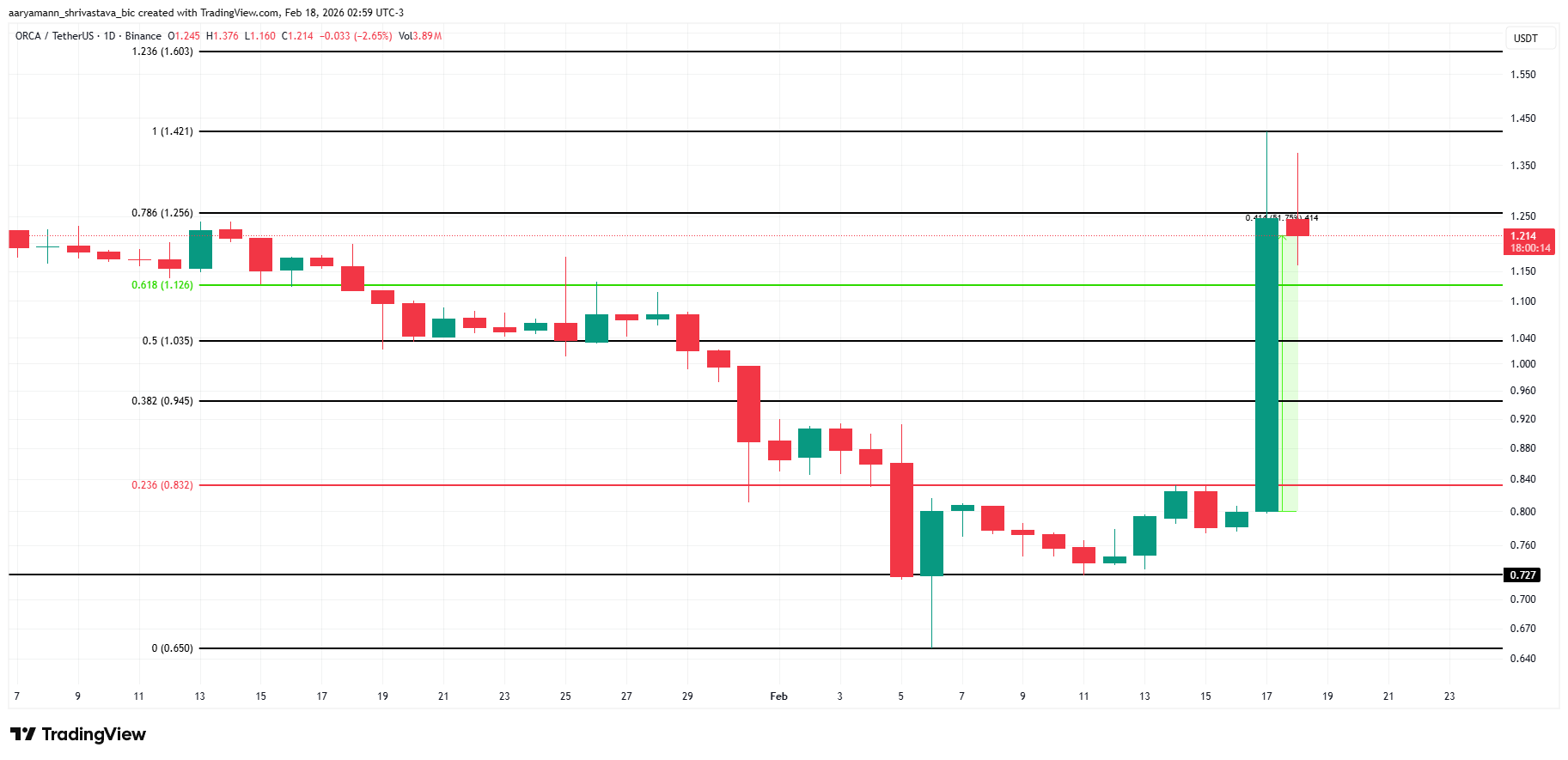
ORCA trades at $1.214 after posting a 51.7% gain in 24 hours. The token reached an intraday high of $1.421 before retreating below $1.256. This pullback suggests early profit-taking.
The altcoin remains above the 61.8% Fibonacci retracement level. This zone acts as a bullish support floor. Holding above it could encourage renewed buying. Sustained demand may push ORCA back toward $1.421. A confirmed breakout could extend gains to $1.603.
ORCA Price Analysis. Source: TradingView
However, sharp rallies can reverse quickly. If investors prioritize short-term profits, selling pressure may intensify. A drop below $1.126 would signal weakening structure. Further downside toward $1.025 becomes likely in that case. Losing this support could send ORCA below $1.000 to $0.945, invalidating the bullish thesis.
Sponsored
Advertisement
ORCA Warning Signs
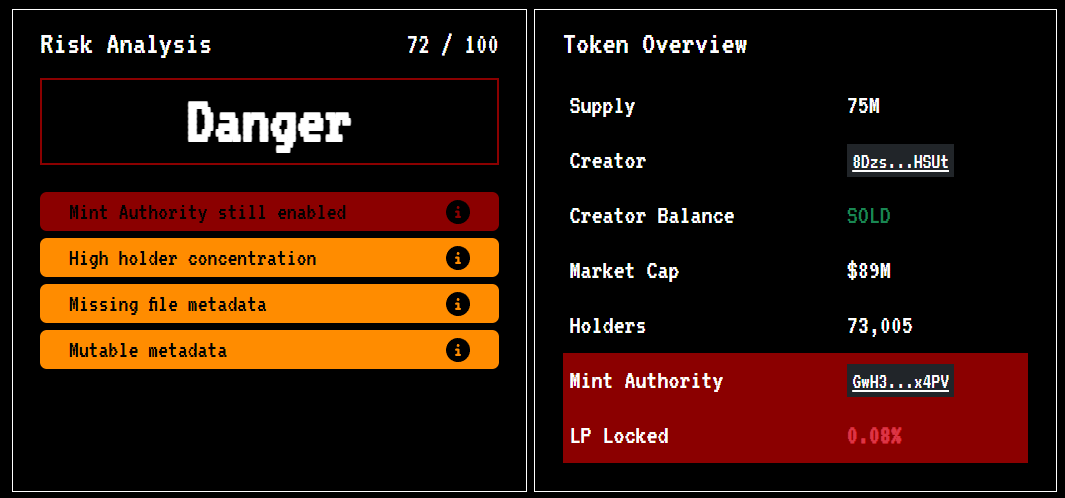
Risk analysis data introduces another factor. Rugcheck Risk Analysis flagged that Mint Authority remains enabled for the owner’s wallet. This setting can allow token issuance beyond the current supply.
In many cases, mint authority exists for technical reasons. Some projects use lock-and-mint or burn-and-mint mechanisms for cross-chain transfers. However, governance clarity is essential. Orca operates with a decentralized autonomous organization structure.
ORCA Risk Analysis. Source: Rugcheck
Typically, a DAO should control token issuance. If a single wallet retains mint authority, concerns may arise. Transparency remains critical for investor trust. BeInCrypto has provided Orca’s team with a Right of Reply. An update will follow upon receiving formal clarification. Until then, investors should monitor this risk factor carefully.


















 Sports6 days ago
 Video2 days ago
 Tech3 days ago
 Video5 days ago

 Business9 hours ago
 Video24 hours ago
 Crypto World23 hours ago
 Sports1 day ago
 Crypto World4 days ago
 Video6 days ago

 Business6 days ago
 Crypto World6 days ago

 Business1 hour ago
 Crypto World5 days ago
 NewsBeat4 days ago
 Crypto World4 days ago