
Crypto World
Fed’s Warsh sounds more hawkish

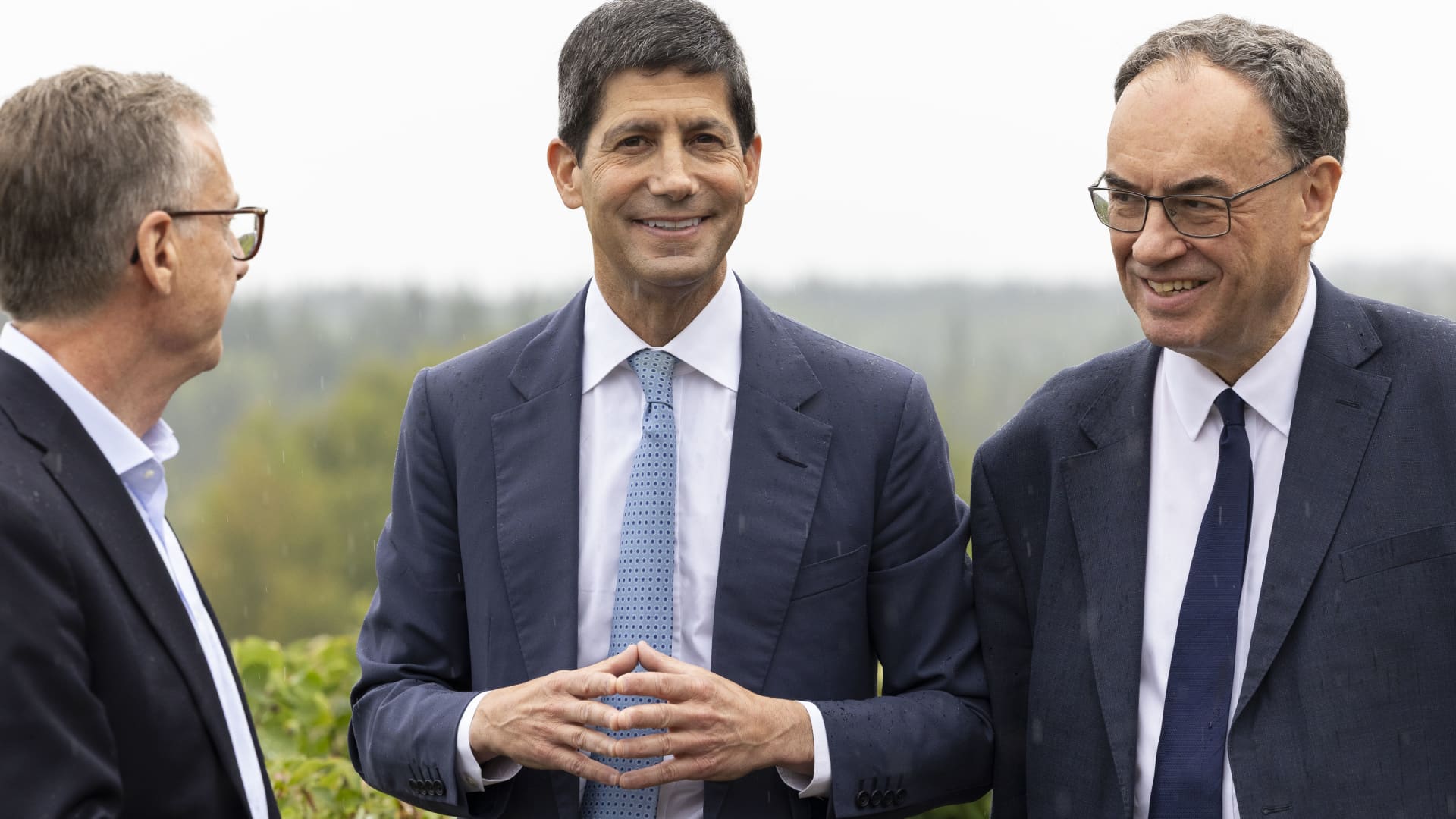
Tiff Macklem, governor of the Bank of Canada, left, Kevin Warsh, chairman of the US Federal Reserve, center, and Andrew Bailey, governor of the Bank of England at the Jackson Hole Economic Symposium in Moran, Wyoming, on Aug. 28, 2026.
David A. Grogan | CNBC
Federal Reserve Chair Kevin Warsh’s stance in his speech at the Jackson Hole meeting was unexpectedly hawkish, boosting market expectations for a rate hike next month.
Gold fell and Asian stocks declined on Monday. Traders of fed funds futures see a 60.4% chance of a quarter-point hike in September, up from around 56% on Friday, according to the CME’s FedWatch tool.
Here’s what market watchers are saying about Warsh’s speech:
Hawkish surprise
“Chair Warsh’s Jackson Hole address surprised us in its specificity about the economy and outlook and with its lean in a decidedly hawkish direction,” Deutsche Bank said. The firm continues to expect the Fed to hike 50 basis points this year, with increases at the September and December Federal Open Market Committee meetings.
“The emphasis on inflation risks, together with Warsh’s explicit commitment to achieving price stability and his reluctance to pre-commit to future policy actions, reinforces the elevated risks of policy tightening this year, although it could also be the case of talking without action, UOB said in a note.
Near-term data focus
“The sensitivity to near-term inflation data is high,” Nomura said in a note. “Warsh delivered hawkish remarks at the Jackson Hole economic symposium, emphasizing the importance of the inflation target and implying policy may need to react if disinflation is not occurring with speed.”
Reinforcing independence
Warsh’s assessment that U.S. economic performance has been robust “was seen as reducing the case for near-term rate cuts,” according to James Ooi, market strategist at Tiger Brokers. His “emphasis on the 2% inflation target could be read as an effort to reinforce the Fed’s independence and credibility, reassuring markets that monetary policy will not bend to fiscal pressures.”
Hike skepticism
Matthew J. Maley, chief market strategist at Miller Tabak + Co. however believes that “there remains no empirical basis for the rate hike.”
“Warsh appears to be talking up inflation so that he can claim credit for taming it when headline measures inevitably come down,” Maley said, adding that the labor market data has been weak while the inflation data has been better than expected since the last FOMC meeting.
Fed vs Treasury
Warsh’s reiteration that short-term interest rates should remain the main instrument of monetary policy implies that he will continue to shorten the average duration of the Fed’s balance sheet, Gavekal Research said in a note.
“This seems to put the Fed at odds with the US Treasury, which earlier in August announced that it will step up its buybacks of long-term treasury securities in an apparent attempt to prevent yields rising further at the long end,” Gavekal added.
Negative for gold
“Warsh pledged to return inflation to the 2% target and indicated rates could rise further, strengthening the dollar and reversing part of the debasement trade that had lifted gold roughly 14% in August—its strongest monthly gain this century,” according to Susquehanna.
—CNBC’s Joanna Ossinger contributed to this report.



Zakura says a new cryptography stack makes mobile proof generation more than 14 times faster, removing one of the biggest delays users face when sending private ZEC.

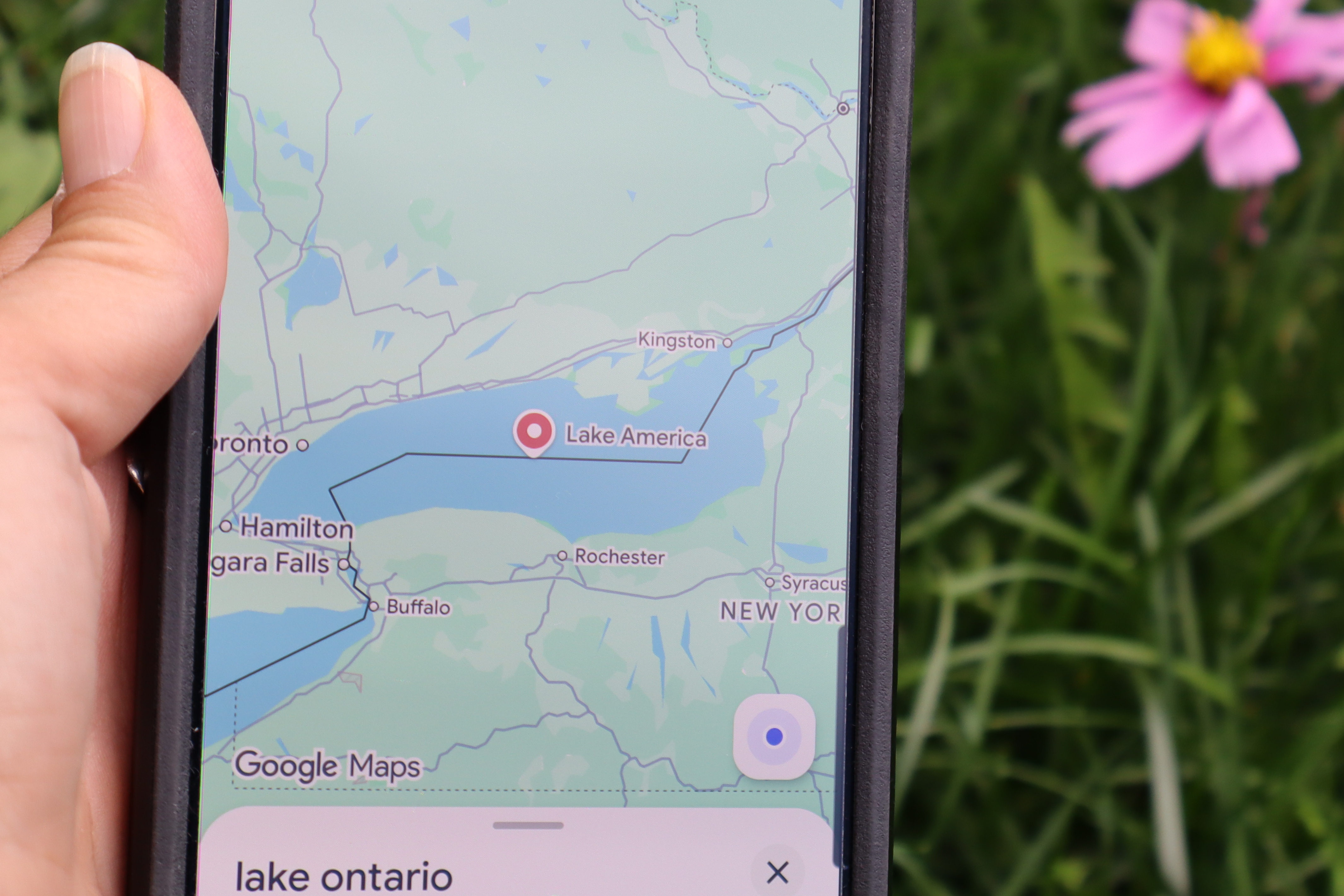
U.S. users looking for Lake Ontario on Google Maps will now find “Lake America” in its place, after President Donald Trump’s executive order to rename the lake amid an escalating trade stoush.
Google announced on Saturday that the lake, which borders the Canadian province of Ontario and the U.S. state of New York, will appear as “Lake America” in the U.S., “Lake Ontario” in Canada, and “Lake Ontario (Lake America)” for users in the rest of the world.
The company said it changed the maps following the formal renaming by the U.S. Geographic Names Information System (GNIS), and that the update is in line with its “long-standing policy for bodies of water with names that vary from country to country.”
Read More: The Trouble With Trump’s Attempt to Rename Lake Ontario
The change has divided tech companies.
MapQuest, the first commercial web mapping service, said in a Thursday post, “We’re not changing the name of Lake Ontario. Name it whatever you want at your leisure.” The post included a link to a satirical tool allowing users to give the lake a name of their choosing and an image of a parody map labeling the body of water, “Lake Are We Doing This Again?”
As of Sunday, Apple had not changed the name on Apple Maps.
Lake Ontario/America
The change comes after Trump signed an executive order on Thursday to officially rename the body of water—the latest salvo in an escalating trade war with Canada. After trade talks abruptly collapsed earlier this month, the U.S. and Canada announced tit-for-tat tariffs of up to 50% on some goods. Canadian officials also called for Canadians to boycott U.S. travel and products, while Trump revived rhetoric of Canada being the “51st state” of the U.S., claiming that Canada wanted “the benefits of being a State, without being one.”
The name change has faced significant opposition from Democrats. Rep. Debbie Dingell (D, Mich.) announced plans to introduce the “Hands Off Our Great Lakes Act,” a bill that would reverse Trump’s order renaming the lake. Other Democratic lawmakers reportedly said they were preparing legislation to counter the name change.
Canadian officials also derided the name change. Prime Minister Mark Carney rejected the renaming on Thursday, noting that Canadians will continue “calling it Lake Ontario—then, now and always.”
On Saturday, Ontario Premier Doug Ford unveiled a newly erected 24-by-12-foot sign overlooking the lake in Winona, Ontario, that read “Lake Ontario Now and Always” in English and French.
Ford told ABC on Sunday that the name change is “like something out of ‘Saturday Night Live.’”
“No one’s going to call it Lake of America. It’s been Lake Ontario for hundreds of years. It’s going to continue being Lake Ontario. It’s just so disappointing,” he said.
Some Ontario government and business websites that use data from Google Maps showed “Lake America” after the change. A Google spokesperson told Axios that website developers embedding Google Maps can select a region to localize their maps.
“Following recent changes by Google, we’re actively reviewing our websites to make sure they all identify Lake Ontario by its correct name: Lake Ontario,” Stephen Crawford, Ontario’s minister of public and business service delivery and procurement, posted. “As Ontarians, we will always stand up for our province, our identity and the places that define it.”
Previous name changes
Google made a similar change in February 2025 after Trump issued an executive order renaming the Gulf of Mexico the “Gulf of America.” Google began displaying “Gulf of America” to Google Maps users in the U.S. after the name change was made in the U.S. federal geographic database. Users in Mexico continued to see “Gulf of Mexico” and users elsewhere saw both names.
Soon after, Apple Maps adopted the new name for U.S. users.
Mexico filed a lawsuit against Google in May 2025, arguing that the U.S. did not have the authority to rename the entire gulf, including waters under Mexican jurisdiction. The suit followed Google’s refusal to limit the “Gulf of America” label to the portion of the gulf under U.S. jurisdiction, as Mexican President Claudia Sheinbaum had requested. The lawsuit remains pending before the Superior Court of Justice of Mexico City.
Both Google and Apple also changed their U.S. map labels for North America’s highest peak from Denali to Mount McKinley last February. Trump had directed the name change in the same executive order, reversing a 2015 decision that had restored Denali, the mountain’s Alaska Native name, as its federal designation.
MapQuest retained the names of Denali and the Gulf of Mexico, and also offered users the option to rename the gulf as they pleased.
The crypto market will welcome tokens worth around $1.5 billion in the first week of September 2026. Major projects, including Hyperliquid (HYPE), Ethena (ENA), and Sui (SUI), will release significant new token supplies.
These unlocks could introduce market volatility and influence short-term price movements. So, here’s a breakdown of what to watch.
1. Hyperliquid (HYPE)
- Unlock Date: September 6
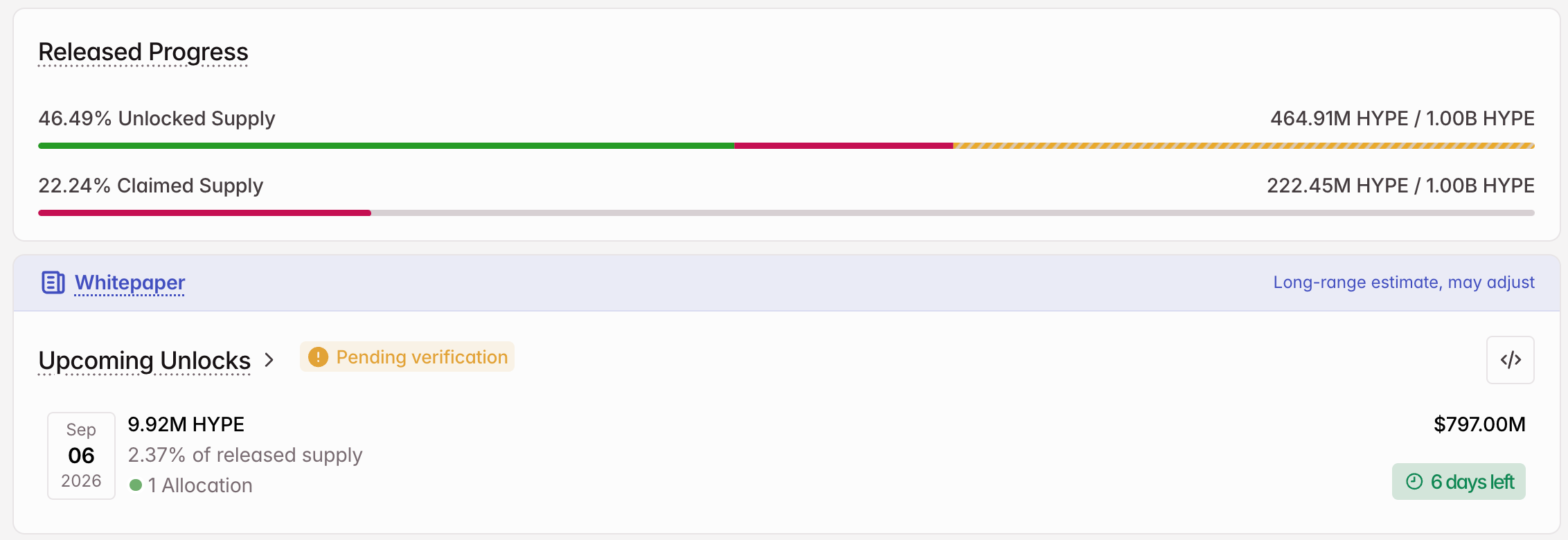
- Number of Tokens to be Unlocked: 9.92 million HYPE
- Released Supply: 464.91 million HYPE
- Total Supply: 1 billion HYPE
Hyperliquid is a leading decentralized perpetual futures exchange built on its own Layer-1 blockchain. It offers high-performance trading with low latency, on-chain order books, and sub-second transaction finality.
On September 6, the team could unlock 9.92 million tokens worth $797 million. Tokenomist noted that this is a long-range estimate. The tokens account for 2.37% of the released supply.

The team has allocated the unlocked supply to core contributors. Tokenomist pointed out that HYPE has historically claimed far fewer tokens than its projected unlock amounts.
2. Sui (SUI)
- Unlock Date: September 1
- Number of Tokens to be Unlocked: 13.53 million SUI
- Released Supply: 4.08 billion SUI
- Total supply: 10 billion SUI
Sui is a high-performance blockchain designed to provide scalability, low latency, and an architecture for decentralized applications (dApps). It also distinguishes itself with an object-centric data model and the Move programming language, which seeks to address inefficiencies in existing blockchain architectures.
On September 1, the network will release 13.53 million SUI into the market, continuing its trend of cliff unlocks at the beginning of the month. The tokens are worth $9.73 million. Moreover, they represent 0.33% of the current released supply.

The network will split the unlocked altcoins 3 ways. Early Contributors will gain 7.47 million tokens. In addition, Community Reserve will receive 4 million tokens. Lastly, Mysten Labs Treasury will get 2.07 million SUI.
3. Ethena (ENA)
- Unlock Date: September 2
- Number of Tokens to be Unlocked: 40.63 million ENA
- Released Supply: 8.9 billion ENA
- Total Supply: 15 billion ENA
Ethena is a synthetic-dollar protocol built on Ethereum (ETH). Its flagship product is USDe, a synthetic-dollar stablecoin. Furthermore, ENA is the protocol’s governance token.
The team will release 40.63 million ENA tokens on September 2. The tokens, worth $6.05 million, account for 0.46% of the released supply.

Ethena will award the entire supply to the Foundation.
In addition to these three, EigenCloud (EIGEN), Gunz (GUN), and GoPlus Security (GPS) will also experience new supply entering the market in the first week of September.
The post 3 Token Unlocks to Watch in the First Week of September 2026 appeared first on BeInCrypto.


Russia’s regulated crypto trading market could process between 3.5 trillion and 4 trillion rubles during its first year, according to an Aug. 29 forecast from SberCIB Investment Research.
Summary
- SberCIB estimates regulated Russian crypto trading could reach four trillion rubles during its first year.
- The forecast represents roughly 20% of Russia’s estimated annual cryptocurrency transaction volume today, Popov said.
- Non-qualified investors face annual purchase limits of 300,000 rubles through each intermediary after testing requirements.
- Existing crypto exchange providers have until July 2027 to register under Russia’s new licensing framework.
- Bitcoin, Ether and USDT currently meet proposed criteria for organized trading by ordinary Russian investors.
The upper estimate equals approximately $46.43 billion at the exchange rate used by TASS. Sberbank Deputy Chairman Anatoly Popov said the annual figure could rise to about 7.5 trillion rubles, or $87.06 billion, by 2029.
The projection is not a guaranteed minimum. Contrary to some secondary reports, TASS said first-year volume was “not expected to exceed” 4 trillion rubles. The 3.5 trillion-to-4 trillion-ruble range should therefore be treated as SberCIB’s forecast rather than a confirmed trading target.
Russia’s crypto trading forecast assumes limited migration
Popov said Russian cryptocurrency transactions currently total roughly 50 billion rubles daily. That would equal about 18 trillion rubles over one year, based on Russian Finance Ministry data he cited.
SberCIB expects approximately 20% of this activity to move onto regulated exchanges during the first year. The bank forecasts organized trading of between 4.75 trillion and 5.25 trillion rubles by 2028, followed by about 7.5 trillion rubles in 2029.
The estimates remain subject to investor demand, exchange registrations and final implementing rules. Sberbank has not presented the figures as official forecasts from Russia’s Finance Ministry or central bank.
Popov expects substantial activity to remain with cryptocurrency exchange services operating outside organized markets. This is one reason the estimate captures only a minority of Russia’s broader crypto transaction volume.
Retail investors face testing and annual purchase limits
Russia’s regulated cryptocurrency framework takes effect on Sept. 1, 2026. The Bank of Russia said both qualified and non-qualified investors will be able to conduct crypto transactions through approved intermediaries.
Non-qualified investors must pass a knowledge test before buying eligible cryptocurrencies. They can purchase no more than 300,000 rubles, approximately $3,800, annually through each intermediary.
Qualified investors must also complete testing. However, the central bank said they could access any cryptocurrency without the same monetary ceiling. The exact products available will depend on intermediary services and supporting regulations.
As crypto.news reported, the framework covers brokers, asset managers, exchanges and digital depositories. Cryptocurrency remains prohibited as payment for ordinary goods and services inside Russia.
Bitcoin, Ether and USDT lead the proposed asset list
The Bank of Russia has proposed Bitcoin, Ether and Tether’s USDT for organized trading. The regulator selected them using criteria related to market capitalization, trading volume and overseas price history.
The consultation did not mean that every intermediary would immediately offer all three assets. As previously reported, the central bank’s proposed BTC, ETH and USDT list remained subject to final regulatory action after the consultation period closed on Aug. 24.
Other cryptocurrencies could remain unavailable to ordinary investors through regulated venues unless they satisfy the central bank’s standards. Qualified investors are expected to receive broader access after completing required testing.
The restricted retail list could encourage some demand to remain outside the licensed system. That possibility is incorporated into SberCIB’s conservative adoption assumptions.
Licensing deadlines will shape the market’s first year
Existing crypto exchange providers can continue operating during a transition period but must complete registration by July 1, 2027. The delay means the regulated market will not operate at full capacity immediately after the law takes effect.
The central bank has also proposed rules covering exchanges, digital depositories, client accounts and asset records. In related coverage, crypto.news reported that the Bank of Russia will maintain official registers for approved market participants.
Sberbank separately plans to launch crypto trading, custody and digital-depository infrastructure by Dec. 1, 2026. The bank has not finalized customer eligibility, supported assets, fees or withdrawal terms, according to earlier reporting.
The first measurable results will depend on how many intermediaries enter the regulated system and how much activity moves away from unregistered services. No verified market movement in Bitcoin, Ether or USDT was directly attributed to SberCIB’s forecast.


An attacker allegedly pushed Tectonic’s thinly traded TONIC token up 100-fold, used it as collateral to borrow real assets and left most funds stranded when Cronos validators paused the network.
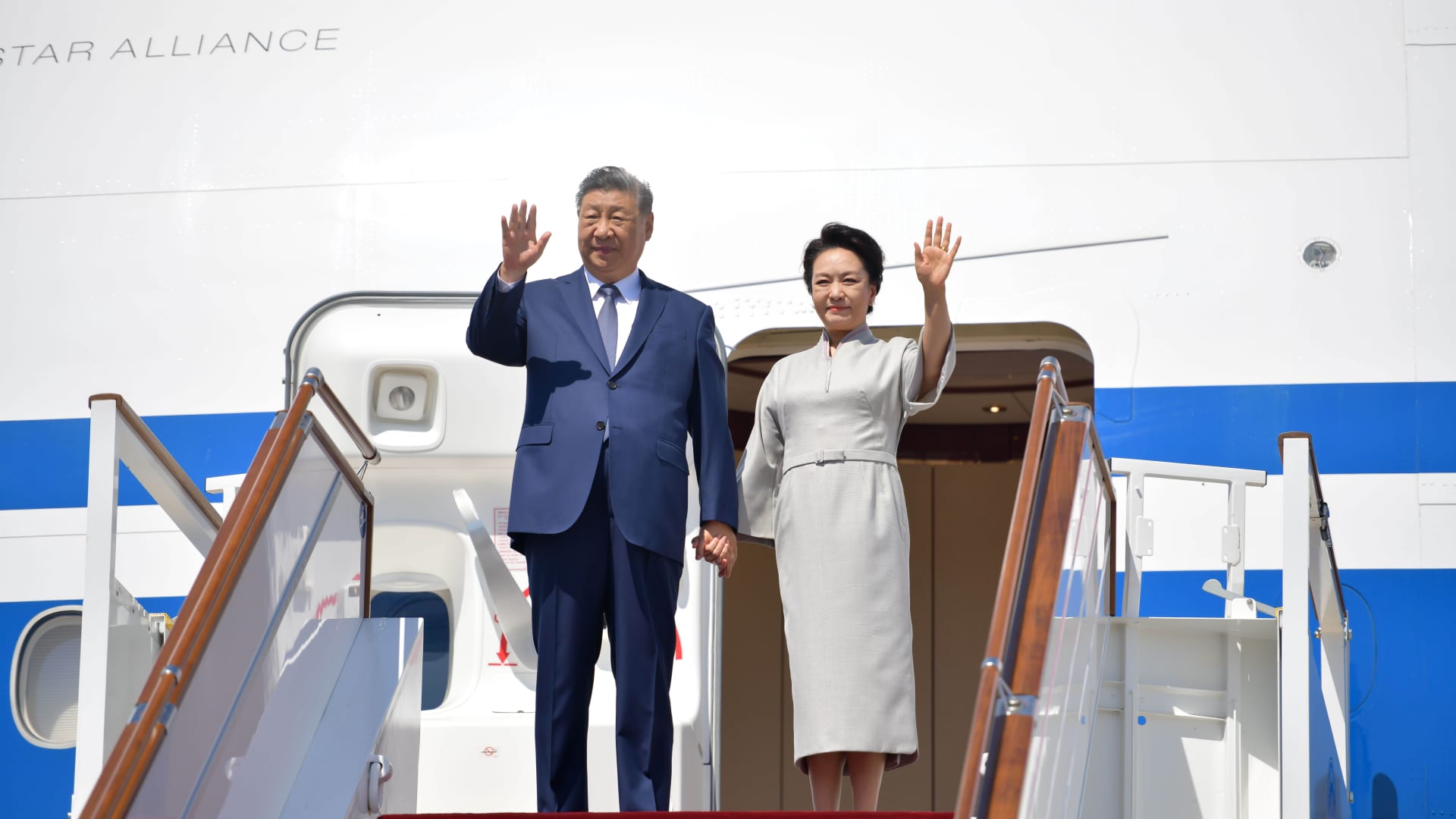
Chinese President Xi Jinping and First Lady Peng Liyuan arrive in Bishkek, Kyrgyzstan, on August 30, 2026, for an official state visit and to attend the upcoming Shanghai Cooperation Organization (SCO) Summit on September 1.
Anadolu | Anadolu | Getty Images
Chinese President Xi Jinping is set to make rare state visits to Egypt and, likely India, before his expected trip to the U.S. in late September.
Xi has “sharply curtailed foreign travel in recent years, so his busy upcoming travel schedule is a significant gauge of his priorities,” Gabriel Wildau, managing director at Teneo, told CNBC in an email.
The Chinese leader this year has so far only ventured abroad once: a state visit in June to North Korea for the first time in seven years. Meanwhile. the world has come to China, with more than 20 leaders — including U.S. President Donald Trump — visiting Beijing in the first half of the year, pointed out U.S.-based think tank Center for Strategic and International Studies.
The global stakes have only risen, with the Iran war, U.S.-China trade tensions and growing security risks from artificial intelligence. For Beijing, that’s building the case for an evolution in its global role.
“It’s time for China to probably take bigger responsibility, provide more global public goods,” said Hai Zhao, a director of international political studies at the Chinese Academy of Social Sciences, a state-affiliated think tank.
“Because of China’s deep integration into the global economy, China is an integral part of the solution,” he said, whether it’s supply chain security, oil flows through the Strait of Hormuz or cybersecurity.
Xi landed in Bishkek, Kyrgyzstan, on Sunday. The country is hosting the security-focused Shanghai Cooperation Organization summit Monday and Tuesday. The annual event gathers the heads of Russia, India and other non-Western nations.
As part of the same trip, which runs through Thursday, Xi plans to make his first state visit to Egypt in a decade. China has built up its presence in the Suez Canal region with a bilateral economic and trade cooperation zone.
Xi is then expected to attend another non-Western leaders’ summit, BRICS, which will be held in New Delhi from Sept. 12 to Sept.13. China has yet to confirm Xi’s participation. It would be Xi’s first visit to India since 2019 and after the deadly border clashes between the two countries in 2020.
Washington is watching
Experts said the U.S. will be monitoring developments at the SCO and BRICS summits, as it looks to improve ties with India and China but plans to get tougher on Russia to bring an end to Moscow’s war with Ukraine.
Last year, as the U.S. imposed tariffs against Beijing and New Delhi, a clip of Xi, Indian Prime Minister Narendra Modi and Russian President Vladimir Putin laughing together at the SCO summit in Tianjin went viral.
The meeting drew the ire of Washington, with Trump claiming that it had “lost India and Russia to deepest, darkest, China.”
A lot has changed since. In February this year, Trump announced that he would scale back the tariffs on India to 18% from 50%, and the two countries are in the process of negotiating a trade deal. Trump also made a landmark visit to China earlier this year, and Xi is expected to visit Washington in September, after the BRICS summit.
But India and China still face threats of up to 100% tariffs from Washington if the U.S. House passes the Graham bill, which punishes countries buying Russian oil. More than 50% of India’s crude supplies originated from Russia in June and July, and were around 43% as of last week, according to Kpler data.
“Visible warmth” between Modi and Putin “could shape the President’s [Trump] calculations over using potential new secondary tariff authorities,” over India’s purchases of Russian oil, Richard M. Rossow, senior advisor and chair on India and Emerging Asia Economics at CSIS, told CNBC.
Meanwhile, experts expect New Delhi to use its presence at the SCO and BRICS summits to highlight the strength of its multi-polar alignment. India is much closer to the U.S. than Russia or China, but it will use the SCO and BRICS to show Washington that it has other partners, they said.
The Indian side, through these meetings, will convey to the U.S. that “there will be a price if you continue to remain uncertain,” Pramit Pal Chaudhuri, South Asia practice head at Eurasia Group, told CNBC.
Elephant-dragon tango
After their SCO meeting, Xi and Modi are expected to meet in New Delhi for the BRICS summit.
The ties between the two neighbors have improved over the last year after Modi and meeting in Tianjin last year. Direct flights have resumed between India and China, a few old Silk Road trade routes have opened, and in March India relaxed rules around investment from Beijing.
Last week, the two sides also agreed to work on resolving their long-standing border disputes. Yet, the issues between the two sides are far from resolved. According to local media reports, Indian businessmen and executives are facing “significant difficulties” in getting Chinese visas.
“It is good to see India-China tensions confined to trade and visas!” Rossow told CNBC, adding that it is an improvement over the earlier military confrontation.
The two sides are trying to balance commercial linkages, experts said.
While India is easing investment rules for Chinese firms, it is also imposing some trade restrictions on goods in sectors where India is closer to self-sufficiency. Meanwhile, China is wary of technology transfers to India as it could undermine Beijing’s role in key global supply chains.
India, for example, is already emerging as a key supplier for Apple smartphones after the company started diversifying its manufacturing base away from China. As per the Indian government, the country is already the world’s second-largest mobile phone maker.
U.S.-China tech focus
Technology is rapidly emerging as a critical issue for the Trump-Xi summit in Washington, D.C., expected Sept. 24. China has not officially confirmed a visit. Senior officials from both sides met in Beijing last week — amid tough talk from the Trump administration over China’s alleged role in financing Iran.
Wang Huning, chairman of the National Committee of the Chinese People’s Political Consultative Conference, last week also met with U.S. delegates in Beijing for a “Track 1.5” semi-official dialogue, led in part by the Rockefeller-founded nonprofit Asia Society. Its CEO Kevin Rudd said the meeting discussed the possibility of U.S.-China AI guardrails and bilateral collaboration on global cancer research.
If increasingly powerful large language models fall “into the wrong hands it will be very damaging both to the U.S. and China and to the global economy,” Zhao said. He expects the two leaders could also set up a mechanism to guide AI development, while extending a truce on tariffs will be critical for bilateral stability.
But Teneo’s Wildau was less optimistic, given “widespread conviction that AI development is a zero-sum game.”
After jumping past $79,000 on Sunday evening, bitcoin entered the new business week on the wrong foot, slipping below $77,000 in an hour or so as geopolitical tensions returned to financial markets.
The decline came amid renewed fighting between the United States and Iran, following nearly a month of relative calm as the US reportedly focused only on increasing economic pressure. US Forces struck two Iranian launchers on the island of Larak on Sunday, while the latter retaliated with strikes against military targets stationed in Jordan.
US President Trump’s AI video of how Kharg Island, Iran’s key oil region, is being “blown to smithereens” didn’t help defuse the situation either.
Oil Up, Asian Markets Down
Brent crude reacted immediately with a near-3% surge to over $90 per barrel, reviving concerns about another energy-driven inflation shock. This is particularly worrisome following Fed Chair Kevin Warsh’s hawkish speech at Jackson Hole on Friday, as higher oil prices deteriorate the inflation picture.
In contrast to oil, Asian stock markets headed south after the attacks went public, with Japan’s Nikkei falling by roughly 2%. South Korea’s Kospi and Chinese equities also turned red, while US and European stock futures followed suit. The Japanese yen weakened beyond 160 against the greenback.
Bitcoin dipped below $77,000, losing over $2,000 of value. Additional pressure came from Wintermute, as on-chain data showed that the entity transferred 5,100 BTC, worth almost $400 million, to Binance over the past two days, likely intending to sell.
Although this transfer doesn’t guarantee that Wintermute has sold, recall that similar actions taken by the market maker last week resulted in another leg down for BTC and the alts.
Ethereum’s situation was even worse, as it plunged from over $2,500 to under $2,400 in an hour. Lookonchain reported that a whale or an institution had deposited almost 41,000 ETH (worth over $100 million) onto exchanges, a move typically made before selling.
Liquidations on the Rise
The sharp move south led to over $400 million in wrecked positions on a daily scale, with the lion’s share coming earlier this morning. Interestingly, ETH longs are responsible for almost $100 million, while BTC longs are just $62.60 million, according to CoinGlass.
The single-largest wrecked position also involved the leading altcoin, with a trader getting liquidated for $6.12 million on Aster. In total, more than 100,000 over-leveraged traders were wiped out in the past day.

The post Bitcoin Dumps Below $77K as US-Iran Strikes Resume: Who Else Might Be Behind the Drop? appeared first on CryptoPotato.
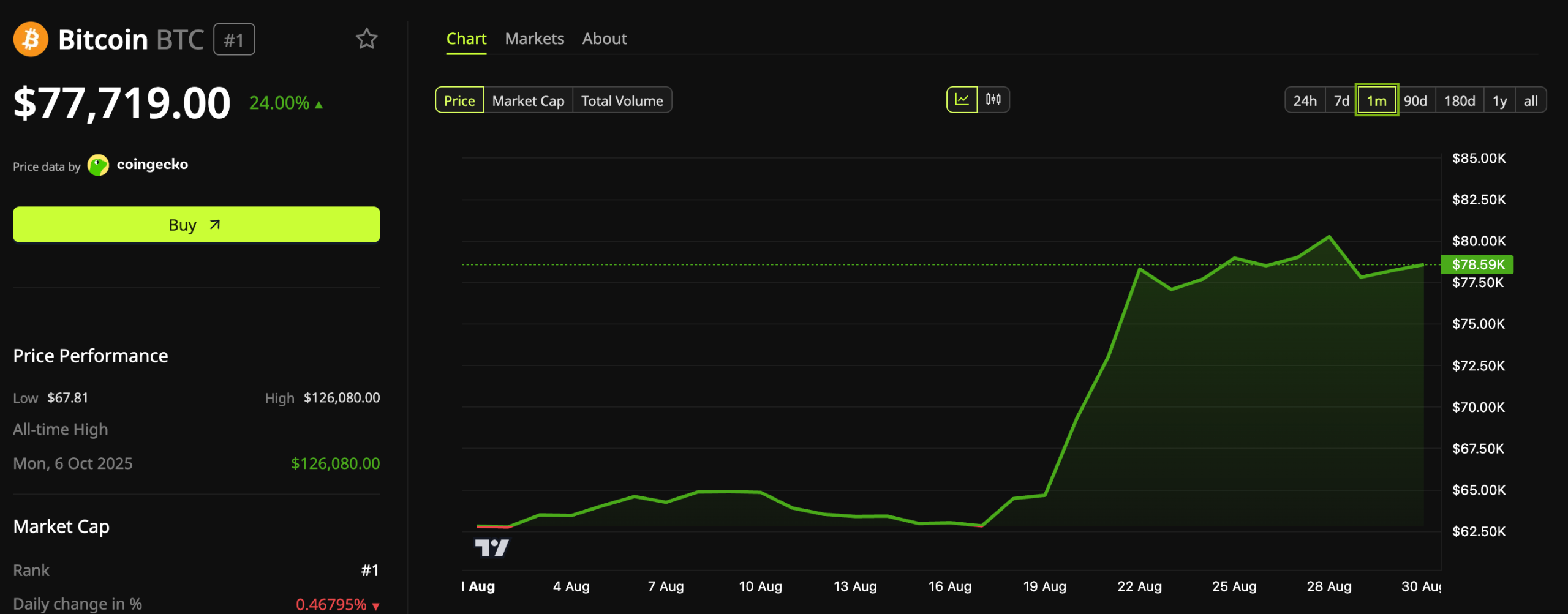
Bitcoin (BTC) is up roughly 24% in August, its largest monthly advance of 2026. This month’s rally lifted the asset from the $60,000s to briefly over $80,000.
However, three warning signs now emerge: exchange balances, exchange-traded fund (ETF) flows, and spot demand have all turned less supportive during the closing days of August.

Follow us on X to get the latest news as it happens
Bitcoin Warning Signs Build as Binance Reserves Hit a 2026 High
Binance’s Bitcoin reserves have climbed to roughly 687,000 BTC, the highest level recorded in 2026, according to CryptoQuant data. Reserves dropped near 617,000 BTC in late April before reversing. The build then accelerated through August, as Bitcoin rallied.
Traders usually move coins onto an exchange to sell, hedge, or post collateral. Therefore, a rising balance during a rally makes more supply immediately available for sale.
The number alone proves nothing. Wallet reorganizations, custody shifts, and market-making transfers also lift exchange balances.
Still, that supply now sits on the largest venue while shrinking exchange stablecoin reserves leave less idle cash ready to absorb it.
“A yearly high in Binance reserves near major resistance is a warning sign. The next move above $80,000 will likely depend on whether spot and ETF demand can absorb the additional supply potentially available to the market,” XWIN Japan wrote.
ETF Inflow Streak Breaks as Weekly Demand Halves
Meanwhile, US spot bitcoin ETFs posted a $201.8 million net outflow on August 28, according to SoSoValue data. That red session ended nine consecutive days of inflows, which came as Bitcoin recorded its largest weekly dollar gain on record.
Other major products stayed green on the same day. Ethereum (ETH) funds drew $102.18 million, while XRP (XRP) and Solana (SOL) products added $26.2 million and $18.08 million.
Weekly flows cooled as well. Net inflows fell 51.8% to $924.5 million in the week ending August 28, down from $1.92 billion.
One negative session does not confirm a reversal. However, ETF flows are a major source of demand for Bitcoin, and that may be thinning.
Leverage, Not Spot Buying, May Be Driving the Move
Finally, analyst Crypto Rover argued that the weekend advance lacked spot participation.
“BTC is moving higher over the weekend while spot CVD remains almost flat, suggesting leverage is driving the move. Last time we spotted this same setup, Bitcoin dumped from $81K to $77K,” the post read.
Spot cumulative volume delta (CVD) tracks the balance between aggressive buyers and sellers in spot markets. A flat CVD during a rally can suggest that derivatives or leveraged positions, rather than strong spot demand, are driving the move.
Not every analyst reads the setup that way. GSR’s Andy Baehr has framed the $80,000 breakout as a new market regime built on ETF demand and short liquidations.
Seasonality offers thin comfort. September has averaged a 3.08% loss for Bitcoin since 2013, Coinglass data shows, the weakest average month of the year.

Recent years cut the other way. The last three Septembers all closed green, including gains of 5.16% in 2025 and 7.29% in 2024.
The coming sessions should show whether spot and ETF buyers can absorb the coins now parked on Binance.
Subscribe to our YouTube channel to watch leaders and journalists provide expert insights
The post Bitcoin Enters September With 3 Warning Signs After 24% August Rally appeared first on BeInCrypto.


BTC remains August’s best-performing asset after the latest escalation in geopolitical tensions.
Hair loss biotechs are racing to deliver the first new baldness treatments in nearly three decades, and investors are positioning for the payoff.
Veradermics, Absci, and Cosmo Pharmaceuticals are advancing a pill, an injection, and a topical drug for pattern hair loss, a condition with no newly approved therapy since the late 1990s.
Hair Loss Biotechs Eye A Market Waiting For A Cure
Pattern hair loss affects an estimated 50 million men and 30 million women in the United States, according to Bloomberg. Current options are limited to decades-old drugs minoxidil and finasteride. Both are tied to side effects that include heart palpitations and reduced sex drive.
Veradermics (NYSE: MANE) is developing an oral pill, VDPHL01, and its stock has climbed nearly 500% since its February IPO. Absci (NASDAQ: ABSI) is testing an injection dosed two to three times over six months, and its shares have more than doubled so far this year.
Cosmo Pharmaceuticals posted positive late-stage trial results for a topical solution but has traded more cautiously against its US rivals.
Investors Chase A GLP-1 Style Trade
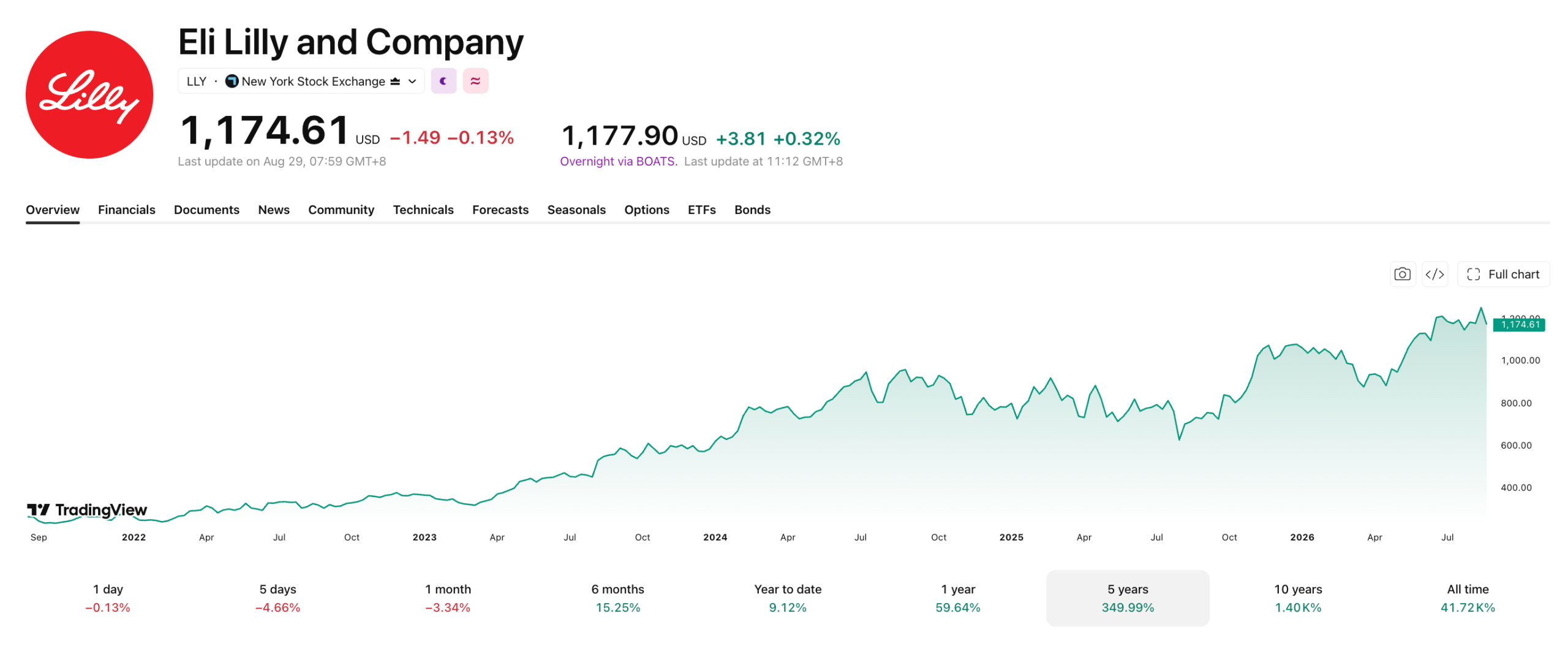
The enthusiasm echoes Eli Lilly’s stock rally, which reshaped investor appetite for consumer health biotech. Its weight loss drugs first drove that shift.

Eli Lilly has since invested $40 million in Absci, betting hair regrowth could follow a similar injectable playbook.
“Both obesity and hair loss are large consumer markets and that’s one reason why both of those categories can offer significant revenue potential.”
Geoff Hsu, portfolio manager at OrbiMed’s Biotech Growth Trust, Fortune
None of the three companies has an approved product yet. The earliest regulatory filings are not expected before 2027. Investors are pricing in demand years before any drug reaches pharmacy shelves.
The post Hair Loss Biotechs Emerge As Wall Street's Newest Growth Trade appeared first on BeInCrypto.

Navone upsets Djokovic in first round of US Open

Which Is Faster & How Do They Compare In HP?

Ethereum contro Bitcoin: il livello che inverte 5 anni





-

 Crypto World5 days ago
SpaceX stock could rise 75% to $240, JPMorgan says
-

 Fashion2 days ago
Weekend Open Thread: Maeve – Corporette.com
-

 Crypto World3 days ago
Bitcoin’s 22% rally now needs real demand to outlast Treasury liquidity boost
-

 Crypto World5 days ago
Warsh Jackson Hole keynote puts financial innovation first
-

 Crypto World6 days ago
A $30 Billion AI Fund Implodes, Now the SEC Is Investigating Wall Street’s Role
-

 Business3 days ago
Salesforce Stock Soars 19% as Blowout Earnings and Agentforce AI Growth Silence Software Skeptics
-

 Crypto World5 days ago
Did Trump Just Move SpaceX Stock With One Truth Social Post?
-

 Crypto World4 days ago
Elon Musk Grok Bot Promise: We Will Make You Whole if AI Loses Your Money
-

 Business5 days ago
Walmart takes aim at younger shoppers with new fashion brand
-

 Business3 days ago
Apple Confirms September 9 Keynote and Reveals Its Full Pre-Order Schedule
-
 NewsBeat4 days ago
Lindsay Clancy jury braces for closing arguments as judge tells court: ‘You’ve heard all the evidence’ – Live updates
-

 Crypto World2 days ago
Bitcoin price tests $82K resistance as Brandt stays long
-

 Business5 days ago
Thailand’s Eastern Economic Corridor Capital City (EECiti): Key Developments and Investment Opportunities
-

 Crypto World4 days ago
NVIDIA revenue hits $96.2B as AI demand doubles
-

 Business6 days ago
Moderna CEO warns China is pouring state money into mRNA technology
-

 Business2 days ago
Onto Innovation Stock: AI’s Next Bottleneck Is Yield (NYSE:ONTO)
-

 Business6 days ago
NVIDIA Stock Drops Nearly 2 Percent to $210 on Seventh Losing Day Ahead of Critical AI Earnings
-

 Business3 days ago
iPhone 18 Pro Pre-Orders Could Shift to Saturday as Apple Reportedly Avoids September 11 Anniversary
-
 NewsBeat5 days ago
Trump’s trade truce with China faces test with Iran effort
-
 Crypto World4 days ago
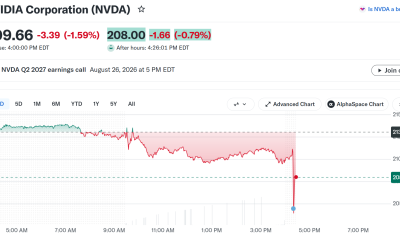
Nvidia Q2 Earnings Reveal $96.2 Billion Beat, So Why Is NVDA Falling?
You must be logged in to post a comment Login