Connect with us

Business

Queen Camilla visits Bath and receives three books for Buckingham Palace library

Published

on

Business Live

She also visited the Theatre Royal and the Holburne Museum during her trip

Queen Camilla at Persephone Books in Bath

Queen Camilla at Persephone Books in Bath(Image: © Suzy Slemen)

Queen Camilla travelled to Bath this week where she visited the city’s Holburne Museum, the historic Theatre Royal and an independent publisher that reprints neglected fiction and non-fiction mostly by women. During her trip to Persephone bookshop on Tuesday (February 17) the Queen, 78, met founder Nicola Beauman and managing director Francesca Beauman.

During the meeting, the trio discussed the importance of creating a 20th-century literary canon based around domestic feminist narratives. They also chatted about the need to rescue lost literary voices and how readers are more used to male literary perspectives on the First and Second World War than female ones.

The Queen also described the new Buckingham Palace library where she is planning to include her Persephone books.

Francesca Beauman said: “We were thrilled to welcome Her Majesty the Queen to Persephone Books. She came to Bath to visit the Holburne Museum, the Theatre Royal and us.

Advertisement

“We showed her round the bookshop, then she sat down at the ‘wrapping table’ and had a cup of tea (‘milk and one’). A tiny etiquette drama as we weren’t sure whether to pour the milk for her, or not! We had a delightful chat about, not to be immodest, why our books are so wonderful.”

She added: “There was a large and affectionate crowd waiting outside as she left, with three of our books, if she ever has time to read them: Crooked Cross by Sally Carson, They Were Sisters by Dorothy Whipple and Mariana by Monica Dickens.”

Persephone Books MD Francesca Beauman welcomes HM the Queen to the  Persephone bookshop in Bath

Persephone Books MD Francesca Beauman welcomes HM the Queen to the Persephone bookshop in Bath(Image: © Suzy Slemen)

During her trip to Bath, the Queen also paid a visit to the Theatre Royal where she watched a preview of a community production of David Copperfield.

She also visited the recently completed Schroder Gallery at the Holburne Museum and toured new exhibitions, including A Life in Print by fashion designer Dame Zandra Rhodes and viewed photographs by Sir Don McCullin.

Advertisement

It was Queen Camilla’s second trip to the South West this month after she visited the HQ of Avon and Somerset Police in Portishead near Bristol.

Continue Reading
Click to comment

Leave a Reply

Your email address will not be published. Required fields are marked *

Business

Green light for Osborne Park hospital expansion

Published

on

Green light for Osborne Park hospital expansion

A state planning committee has approved an expansion of the Osborne Park hospital, as part of the next stage of the $1.8 billion Women and Babies Hospital project.

Continue Reading

Business

Aussie shares clinch third session of gains, NAB soars

Published

on

Aussie shares clinch third session of gains, NAB soars

Australia’s share market has ended the session higher as NAB became the latest large-cap to outshine forecasts in a so-far encouraging earnings season.

Continue Reading

Business

(VIDEO) SpaceX’s Dramatic Water Deluge Test Goes Viral Ahead of Starship Flight 12 Launch in March

Published

on

(VIDEO) SpaceX's Dramatic Water Deluge Test Goes Viral Ahead of

A spectacular high-pressure water eruption at SpaceX’s Starbase facility in South Texas has captured widespread attention online, with videos of the massive “water blast” racking up millions of views as the company prepares for its 12th Starship test flight.

The footage, shared widely on social media platforms including X and captured by local observers and NASASpaceflight livestreams, shows thousands of gallons of water surging upward from beneath Orbital Launch Pad 2 in a towering plume that resembles an explosion or rocket mishap. Posted around Feb. 16, 2026, the clips quickly went viral, prompting initial speculation of an accident at the Boca Chica site.

(VIDEO) SpaceX's Dramatic Water Deluge Test Goes Viral Ahead of
(VIDEO) SpaceX’s Dramatic Water Deluge Test Goes Viral Ahead of Starship Flight 12 Launch in March

SpaceX conducted the test as a full-duration verification of its upgraded water deluge system — a critical safety feature designed to protect the launch pad, surrounding infrastructure and the rocket itself from the intense heat, acoustic shockwaves and flame produced by the Super Heavy booster’s 33 Raptor 3 engines during liftoff.

The system, which sprays water at extreme pressure through a network of nozzles and a water-cooled steel plate beneath the launch mount, mitigates damage that plagued earlier flights. Initial versions of the deluge were implemented after Flight 1 in 2023 severely cratered the pad. Upgrades for Block 3 vehicles — debuting on Flight 12 — include enhanced flow rates and distribution to handle the increased thrust and acoustic energy of the latest Raptor 3 engines.

Videos from the test show the deluge activating for its planned duration, creating dense clouds of water vapor and spray that enveloped the pad area. Commentators on X praised the performance, with one user noting, “WOW! Starbase Pad 2 water deluge is something else! 33 Raptor 3 engines, no problem, I’m saying!” The successful run bolsters confidence ahead of Flight 12, which will mark the first orbital attempt with the Block 3 (V3) configuration of Starship and Super Heavy.

Advertisement

SpaceX CEO Elon Musk has targeted early March 2026 — potentially as soon as March 7 — for the launch, pending final integrations, static fire tests and regulatory approvals. Booster 19, the Super Heavy prototype assigned to Flight 12, recently completed multiple cryogenic proof tests without issues, addressing anomalies that led to the scrapping of its predecessor, Booster 18. Engine installation of the 33 Raptor 3s is progressing at Mega Bay 1, while Ship 39 undergoes preparations for stacking.

The test comes amid broader momentum for the Starship program. The Federal Aviation Administration recently finalized an environmental review allowing increased launch and landing activity at Starbase, clearing the path for a higher flight cadence in 2026. SpaceX aims to demonstrate key milestones with Flight 12, including improved engine reliability, heat shield performance during reentry and potential in-orbit capabilities paving the way for future refueling demonstrations, lunar missions under NASA’s Artemis program and eventual Mars exploration.

No payload has been announced for Flight 12, consistent with recent integrated flight tests focused on vehicle validation rather than operational missions. The flight profile is expected to mirror recent successes: liftoff from Starbase, booster catch attempt using the Mechazilla tower arms, and Ship achieving orbital velocity before a targeted splashdown in the Indian Ocean or Pacific.

Observers note that the viral water test underscores SpaceX’s iterative approach — rapid testing to refine systems before committing to flight. While some early speculation misinterpreted the footage as a failure, experts emphasized its positive implications for pad longevity and environmental protection during high-thrust launches.

Advertisement

SpaceX has not issued an official statement on the test beyond community updates, but the event aligns with preparations for an aggressive 2026 schedule that could see multiple Starship flights if milestones continue to be met. As regulatory reviews and vehicle integrations advance, attention now shifts to static fire testing of Booster 19 and potential stacking with Ship 39 in the coming weeks.

Continue Reading

Business

Citizens reiterates Equinix stock rating on strong AI demand

Published

on


Citizens reiterates Equinix stock rating on strong AI demand

Continue Reading

Business

FROM THE HILL: A snapshot of today's politics and parliament

Published

on

FROM THE HILL: A snapshot of today's politics and parliament

FROM THE HILL: There have been apologies and explanations over a dim sum reference in parliament.

Continue Reading

Business

BAE Systems profits surge as defence spending rise drives record results

Published

on

Business Live

Europe’s biggest defence contractor reports record earnings of £3.32bn for 2025, up 12%

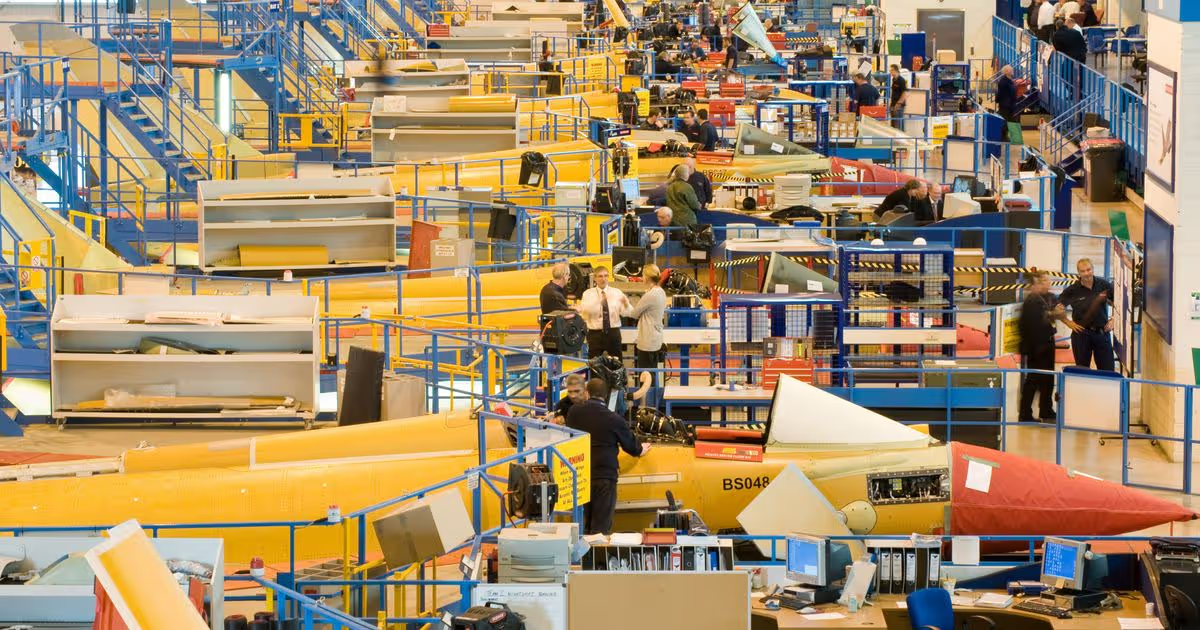
Eurofighter Typhoon aircraft being assembled at BAE's Warton site in Lancashire

Eurofighter Typhoon aircraft being assembled at BAE’s Warton site in Lancashire(Image: BAE Systems/PA Wire)

BAE Systems has broken records with its annual results, buoyed by a surge in global defence expenditure amid ongoing geopolitical instability.

Advertisement

Europe’s largest defence contractor posted better-than-expected underlying earnings before interest and taxes of £3.32 billion for 2025, a 12% increase on the previous year, as sales soared 10% to an all-time high of £30.66 billion.

The aerospace and arms manufacturer revealed its order backlog also reached a record £83.6 billion at the end of December, whilst its order intake was £36.8 billion.

Chief executive Charles Woodburn said: “In a new era of defence spending, driven by escalating security challenges, we’re well-positioned to provide both the advanced conventional systems and disruptive technologies needed to protect the nations we serve now and into the future.

“With a record order backlog and continuing investment in our business to enhance agility, efficiency and capacity, we’re confident in our ability to keep delivering growth over the coming years.”

Advertisement

The company anticipates further expansion in 2026, albeit at a more moderate rate, forecasting underlying earnings growth of between 9% to 11% and sales to increase by between 7% and 9%.

BAE – which manufactures a range of weaponry from missiles and artillery systems to tanks, aircraft and warships – has benefited from a worldwide uptick in defence spending, particularly as Europe re-arms itself.

In the UK, Prime Minister Sir Keir Starmer indicated earlier this week that Britain must “go faster” in boosting military expenditure and is reportedly considering bringing forward plans to allocate 3% of UK gross domestic product (GDP) to defence.

BAE highlighted significant contracts last year including an agreement with Turkey for 20 Typhoon aircraft, anticipated to be worth £4.6 billion to the company and sustain 20,000 UK jobs, alongside an order from Norway for Type 26 frigates.

Advertisement

BAE shares climbed 4% during Wednesday morning trading, having increased by nearly a fifth since the beginning of 2026 alone and more than tripling since Russia’s invasion of Ukraine in 2022, which triggered a surge in defence expenditure globally.

Richard Hunter, head of markets at Interactive Investor, suggested BAE’s stronger-than-expected results demonstrate the “unfortunate sign of the times that defence stocks are squarely back in fashion, as governments around the world look to protect their interests and lands from growing tensions”.

He continued: “The geopolitical backdrop is a reminder that brittle relationships are seemingly never far away, ranging from potential and actual conflicts in the likes of Venezuela, between China and Japan and Russia and Ukraine.

“The backdrop has led to a number of governments pledging a higher percentage of GDP to defence spending over the next decade, which in turn means that opportunities remain within the burgeoning defence sector.”

Advertisement

BAE employs some 12,000 people at its Warton and Samlesbury sites in Lancashire and said it had seen “significant success across its combat air business in the region” Over the year it recruited 1,225 people to work at the the two sites.

Other key UK sites include its submarine bases in Barrow-in-Furness, its munitions site at Glascoed in Wales, its advanced technology plants in Dorchester and Filton, digital intelligence bases in Bristol, Gloucester and Christchurch, and its air sector base in Brough in East Yorkshire.

Continue Reading

Business

Why UK SME Businesses Are Turning to Digital Trade Solutions in 2026

Published

on

Rumoured increases to employer pension contributions in next month’s Budget are sparking panic among UK businesses, with nearly one in five firms warning they could face insolvency if contribution rates rise.

Cross-border import and export trade is becoming increasingly complex for small and medium-sized businesses in the UK.

With supply chains spanning multiple countries and regulations evolving rapidly, SMEs face growing pressure to keep shipments moving while staying fully compliant. Manual paperwork and outdated shipping processes create delays, errors, and unnecessary compliance risks, which can quickly translate into financial and operational setbacks.

Digital trade solutions streamline these processes, helping businesses save time, reduce costs, and maintain regulatory compliance without adding headcount. For SMEs looking to scale internationally, digital software tools are no longer optional, they are a strategic advantage that allows teams to operate more efficiently and compete with larger players.

The Challenges UK SMEs Face in Cross-Border Trade

Handling cross-border trade manually is time-consuming and highly prone to error. Entering data by hand, juggling spreadsheets, and sending information via email may have worked in the past, but modern trade volumes and regulatory demands quickly expose the limitations of these import management systems.

Post-Brexit customs requirements, frequent rule changes, and increasing scrutiny from authorities amplify the complexity. A single mistake, like missing fields, incorrect HS codes, or late submissions, can trigger fines, cargo holds, or disrupted supply chains.

Advertisement

For SMEs with limited in-house resources, traditional methods are often unsustainable, consuming valuable time that could otherwise be spent growing the business.

How Import Declaration Software Solves These Problems

Import declaration software is a core example of a key digital trade solution that transforms cumbersome compliance tasks into automated, predictable workflows. By reducing repetitive manual entry, these import management systems lower the risk of human error and ensure filings meet regulatory standards and deadlines.

Centralised platforms make documentation easy to track and audit-ready, eliminating the need to dig through emails or spreadsheets. Teams can monitor the status of submissions, quickly address queries, and avoid bottlenecks that slow down customs clearance.

Modern automation software often integrates with logistics, freight, and ERP systems, creating a connected ecosystem where data flows seamlessly across operations. This integration not only improves efficiency but also supports decision-making by providing visibility into shipments, inventory, and compliance at every stage.

Advertisement

Key Benefits for SMEs Using Digital Trade Solutions

Relying on automation software for worldwide logistics provides tangible advantages for SMEs navigating complex cross-border import and export operations:

  • Faster processing times: Automated submissions reduce delays at ports and borders, keeping supply chains moving.
  • Lower compliance risk: Built-in validation checks help prevent shipping errors that could result in fines or cargo holds.
  • Improved shipment visibility: Real-time tracking allows teams to anticipate issues and act proactively.
  • Scalability: Software platforms adapt to fluctuating import volumes, supporting trade growth without increasing administrative workload.
  • Focus on growth: Teams can dedicate time to strategic priorities rather than repetitive compliance tasks.

These benefits combine to turn digital trade solutions into a strategic tool that keeps SMEs agile, compliant, and ready to grow in a competitive global market.

Choosing the Right Import Declaration Software

When selecting a digital software solution for key processes like import declaration, SMEs should consider platforms that are intuitive, cost-effective, and easy to implement.

Ensuring compatibility with existing logistics or accounting systems is key, and features such as real-time tracking, automated reporting, and built-in validation checks can make compliance more reliable and efficient.

For businesses handling cross-border shipments, import declaration software from platforms like CrimsonLogic streamlines the entire filing process, from automating data entry and validating HS codes to managing submission deadlines.

Advertisement

By centralising all documentation and providing real-time visibility into declaration status, SMEs can minimise errors, avoid fines or cargo delays, and free up resources to focus on growth instead of administrative bottlenecks.

Digital Trade as a Strategic Advantage for SMEs

Digital trade solutions, including import declaration software, are no longer optional, they are essential for SMEs looking to scale efficiently and compete on the global stage. Logistics automation, centralised shipping visibility, and built-in compliance allow UK businesses to focus on growth, international trade expansion, and operational efficiency.

By embracing digital tools, SMEs can reduce risk, save time, and strengthen their competitiveness in an increasingly complex and fast-paced environment.

Advertisement

Continue Reading

Business

How Professional Translation Services Drive International Business Growth

Published

on

How Professional Translation Services Drive International Business Growth

Ask most British businesses about their plans for international expansion, and you’ll hear about fundraising strategies, supply chain logistics, partnership deals, and regulatory hurdles.

Translation, if it comes up at all, is usually an afterthought. But in reality, for companies serious about breaking into global markets, language is often the first real challenge and the first real opportunity.

Expanding internationally isn’t just a matter of shipping products or setting up offices in new cities. It’s about establishing trust. And trust doesn’t translate automatically. It only develops when your customers, partners, and employees can interact with your brand in their own language, without confusion or friction.

That’s why professional translation services shouldn’t be treated as a minor operational expense. They’re a strategic investment that can make or break your success abroad.

The Cost of Being Misunderstood

The UK remains one of the world’s most outward-facing economies. According to data from the Department for Business and Trade, British firms continue to expand exports across Europe, North America, and Asia. At the same time, global digital marketplaces allow SMEs to reach customers far beyond domestic borders.

Advertisement

The Word Point, a business translation provider which Google rates among the top 5% of translation companies for customer reviews, emphasizes that entering a new market with poorly translated content can do more damage than good. A marketing campaign that works in London may fall flat in another country if translated without cultural adaptation. A contract mistranslated by automated tools can lead to legal ambiguity. A product manual that lacks clarity can increase liability.

Translationreport.com has repeatedly highlighted in its reports how translation quality directly affects market credibility and customer confidence. When businesses invest in professional human translation combined with AI-driven efficiencies, they reduce risk and strengthen brand authority. For companies serious about growth, translation is not optional but foundational.

Translation as Market Strategy

The term business translation service often sounds transactional, as if it refers merely to document conversion. In reality, it sits at the intersection of branding, compliance, HR, finance, and sales.

Consider marketing first. When companies localise websites, landing pages, and ad campaigns properly, they are not simply replacing English words with foreign equivalents. They are adapting tone, idioms, and cultural references. This is where human expertise becomes irreplaceable. AI tools can accelerate initial drafts, but strategic localisation demands professionals who understand audience psychology.

Advertisement

Natalie Basuik, an expert in the translation industry, has often emphasised that “language is not just communication but positioning.” A mistranslated slogan doesn’t just look clumsy, it signals a lack of commitment to the market.

For SMEs entering European or Asian markets, partnering with what many consider the best translation service means working with linguists who understand regional variations, industry terminology, and consumer behaviour.

Financial Documents: Where Precision Protects Profit

When businesses expand to new countries, paperwork multiplies. Contracts, shareholder agreements, tax filings, and investor reports must often be translated accurately and, in many cases, certified.

Financial documents translation demands a particular level of expertise. Terminology must align with local accounting standards. Regulatory language must reflect jurisdictional nuance. A single mistranslated clause in a financial agreement can result in disputes or compliance failures.

Advertisement

Unlike casual content, financial documentation leaves no room for approximation. Human translators with subject-matter knowledge, sometimes working in tandem with AI-powered terminology management systems, ensure consistency and accuracy in complex documentation. In high-stakes financial environments, precision is a legal safeguard for any business.

HR: The Hidden Engine of International Growth

Global expansion doesn’t only involve customers and partners. It involves people. As British companies hire internationally or establish overseas subsidiaries, internal communication becomes critical. This is where HR materials translation takes center stage.

Employee contracts, codes of conduct, compliance policies, and onboarding materials — these are not documents where ambiguity is acceptable. Misinterpretation can lead to internal disputes, legal risk, or cultural misalignment. Among the most sensitive documents are employee handbooks translation projects. An employee handbook defines workplace culture, expectations, grievance procedures, and ethical standards. If poorly translated, it can create confusion about rights and obligations.

Professional human translators ensure clarity, tone alignment, and legal accuracy. AI tools can assist in maintaining consistency across large document sets, but oversight from experienced linguists remains essential. For growing companies, HR translation protects organizational cohesion of the workforce.

Advertisement

Marketing Materials: Language as Brand Capital

Marketing materials translation goes beyond technical accuracy. It touches brand identity. When launching a product in Spain or South Korea, for example, cultural resonance matters as much as grammatical correctness. Calls to action must feel natural. Brand values must translate authentically. A Professional translation service understands localisation strategy, adjusting imagery references, humour, and even colour symbolism where necessary.

Brands that invest in thoughtful localisation often see stronger engagement rates and lower bounce rates on multilingual websites. While exact performance metrics vary by industry, digital marketing research consistently demonstrates that consumers are far more likely to purchase from websites in their native language. For British businesses seeking to stand out globally, language becomes a differentiator.

Choosing the Right Translation Partner

When a business begins searching for a translation provider, the options can feel overwhelming. Hundreds of agencies claim to be the best, each promising accuracy, speed, and competitive pricing. So how do you separate substance from marketing noise? The answer lies in asking the right questions and understanding what truly matters when your brand’s credibility is on the line.

Industry Expertise: Does Your Translator Speak Your Language?

Before committing to a provider, ask for evidence of their experience in your sector. Have they worked with similar companies? Can they provide case studies or references? Do their translators have subject-matter expertise, or are they generalists trying to cover everything? The answers will tell you whether they truly understand your business, or whether you’re just another job in the queue.

Advertisement

Human-Led Quality Assurance: Who’s Actually Reading Your Content?

Machine translation, no matter how advanced, still struggles with tone, context, idiomatic expressions, and cultural nuance. It can produce technically correct sentences that feel off, miss subtle implications, or inadvertently offend. Only a skilled human editor can catch these issues and ensure the final text reads naturally, sounds professional, and reflects your brand’s voice.

Certification Capabilities: Can They Handle Official Documents?

If your business operates in highly regulated industries or frequently deals with cross-border legal matters, certification capabilities should be non-negotiable. Before choosing a provider, confirm that they can produce certified translations that meet the specific requirements of the countries and institutions you’re working with. Some jurisdictions require sworn translators registered with government bodies; others accept certifications from qualified professional translators. A good provider will know the difference and guide you accordingly.

Data Security: Can You Trust Them with Sensitive Information?

When you hand over documents for translation, you’re also handing over trust. That’s why data security should be a core consideration when choosing a provider. Do they have clear confidentiality agreements in place? Are their file handling practices secure? Do they comply with data protection regulations like GDPR? Are their translators bound by non-disclosure agreements?

Scalability: Can They Grow with You?

Advertisement

As your business expands into new markets and your translation needs increase, can your provider scale effectively to meet demand? The right partner should be able to handle larger volumes across multiple languages without sacrificing quality, consistency, or turnaround times. Whether you’re launching in three countries this year or ten countries next year, you need a translation service with the infrastructure, talent pool, and project management capabilities to support your growth without becoming a bottleneck.

Choosing the right translation partner isn’t about finding the cheapest option or the flashiest website. It’s about finding a provider who understands your industry, maintains quality standards, can handle the legal and regulatory complexities of certified translation, and treats your confidential information with the seriousness it deserves. Ask the hard questions, demand transparency, check the reviews. And remember, when it comes to translation, you’re not just buying a service, you’re choosing a partner who will represent your business in languages and markets you may not fully understand yourself. Choose wisely.

Advertisement
Continue Reading

Business

REIT Replay: Office REIT Stocks Plummet In Recent Week Amid Growing AI Fears

Published

on

REIT Replay: Office REIT Stocks Plummet In Recent Week Amid Growing AI Fears

REIT Replay: Office REIT Stocks Plummet In Recent Week Amid Growing AI Fears

Continue Reading

Business

Battery Ventures raises $3.25bn fund to invest in global tech and AI

Published

on

Battery Ventures raises $3.25bn fund to invest in global tech and AI

Battery Ventures has raised $3.25bn in fresh capital to invest in technology companies worldwide, as it doubles down on artificial intelligence and enterprise software opportunities.

The new vehicle, Battery Ventures XV, was oversubscribed and closed in a single round, marking one of the largest recent fundraisings in the tech-focused private equity and venture capital market.

The Boston- and San Francisco-headquartered firm said the fund will back businesses across the US, Europe and Israel, investing from seed and early-stage rounds through to growth equity and buyouts.

The raise follows a year of strong exits, with Battery announcing 15 exit events in 2025. Over the past five years, its funds have generated more than $10bn in liquidity, reflecting what the firm describes as its stage-diversified strategy.

Michael Brown, general partner at Battery, said the current technology cycle is being reshaped by AI. “AI is ushering in one of the most consequential eras in the history of technology,” he said. “We believe our global reach and long-standing focus on software and enterprise tech position us well to capitalise on this opportunity.”

Advertisement

Battery plans to invest the new capital across application software, infrastructure software, including data, AI, developer tools and cybersecurity, as well as industrial technology and life-science tools.

The firm operates from offices in Boston, San Francisco, Menlo Park, New York, London and Tel Aviv, with a collaborative research-led investment model spanning venture and buyout markets.

Jesse Feldman, a general partner leading Battery’s industrial tech and life-science tools practice, said the firm sees continued potential across both US and European markets. “We are highly selective investors focused on driving meaningful value in exceptional businesses,” he said, adding that capital would be deployed to support research and development, sales expansion and targeted acquisitions.

Battery has invested in more than 530 companies globally since inception, resulting in 73 IPOs and over 225 mergers and acquisitions. The firm has been active in Europe since 2005, completing more than 150 transactions across the UK and 12 other European countries.

Advertisement

Late last year, Battery moved into a new London office to anchor its European operations, signalling a long-term commitment to the region’s technology ecosystem.

The firm has also strengthened its leadership team, promoting Marcus Ryu, co-founder and former chief executive of Guidewire Software, to general partner, alongside internal promotions and the addition of Barak Schoster as partner in Tel Aviv.

With AI investment accelerating globally and competition intensifying among venture firms, Battery’s latest fund positions it to compete aggressively across both early-stage innovation and larger-scale technology buyouts in what it describes as a defining moment for the sector.


Amy Ingham

Amy is a newly qualified journalist specialising in business journalism at Business Matters with responsibility for news content for what is now the UK’s largest print and online source of current business news.

Advertisement

Continue Reading

Trending

Copyright © 2025