A suspected Chinese state-backed hacking group has been quietly exploiting a critical Dell security flaw in zero-day attacks that started in mid-2024.
Security researchers from Mandiant and the Google Threat Intelligence Group (GTIG) revealed today that the UNC6201 group exploited a maximum-severity hardcoded-credential vulnerability (tracked as CVE-2026-22769) in Dell RecoverPoint for Virtual Machines, a solution used for VMware virtual machine backup and recovery.
“Dell RecoverPoint for Virtual Machines, versions prior to 6.0.3.1 HF1, contain a hardcoded credential vulnerability,” Dell explains in a security advisory published on Tuesday.
“This is considered critical as an unauthenticated remote attacker with knowledge of the hardcoded credential could potentially exploit this vulnerability leading to unauthorized access to the underlying operating system and root-level persistence. Dell recommends that customers upgrade or apply one of the remediations as soon as possible.”
Once inside a victim’s network, UNC6201 deployed several malware payloads, including newly identified backdoor malware called Grimbolt. Written in C# and built using a relatively new compilation technique, this malware is designed to be faster and harder to analyze than its predecessor, a backdoor called Brickstorm.
Advertisement
While the researchers have observed the group swapping out Brickstorm for Grimbolt in September 2025, it remains unclear whether the switch was a planned upgrade or “a reaction to incident response efforts led by Mandiant and other industry partners.”
Targeting VMware ESXi servers
The attackers also used novel techniques to burrow deeper into victims’ virtualized infrastructure, including creating hidden network interfaces (so-called Ghost NICs) on VMware ESXi servers to move stealthily across victims’ networks.
“UNC6201 uses temporary virtual network ports (AKA “Ghost NICs”) to pivot from compromised VMs into internal or SaaS environments, a new technique that Mandiant has not observed before in their investigations,” Mandiant communications manager Mark Karayan told BleepingComputer.
“Consistent with the earlier BRICKSTORM campaign, UNC6201 continues to target appliances that typically lack traditional endpoint detection and response (EDR) agents to remain undetected for long periods.”
Advertisement
The researchers have found overlaps between UNC6201 and a separate Chinese threat cluster, UNC5221, known for exploiting Ivanti zero-days to target government agencies with custom Spawnant and Zipline malware and previously linked to the notorious Silk Typhoon Chinese state-backed threat group (although the two are not considered identical by GTIG).
GTIG added in September that UNC5221 hackers used Brickstorm (first documented by Google subsidiary Mandiant in April 2024) to gain long-term persistence on the networks of multiple U.S. organizations in the legal and technology sectors, while CrowdStrike has linked Brickstorm malware attacks targeting VMware vCenter servers of legal, technology, and manufacturing companies in the United States to a Chinese hacking group it tracks as Warp Panda.
To block ongoing CVE-2026-22769 attacks, Dell customers are advised to follow the remediation guidance shared in this security advisory.
Modern IT infrastructure moves faster than manual workflows can handle.
In this new Tines guide, learn how your team can reduce hidden manual delays, improve reliability through automated response, and build and scale intelligent workflows on top of tools you already use.
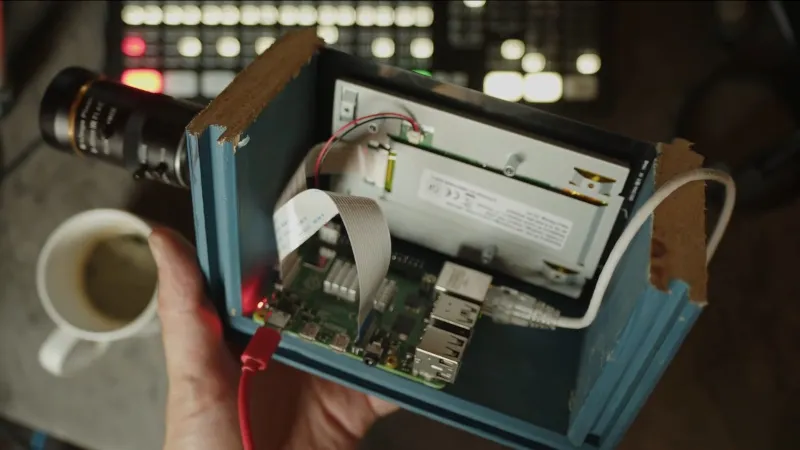
The Raspberry Pi has brought digital camera experimentation within the reach of everybody, with its combination of an accessible computing platform and some almost-decent camera sensors. If there’s a flaw in the Pi as a camera though, it lies in the software, which can be slow and frustrating to use. [Martijn Braam] is here with an interesting project that might yield some useful results in this direction, he’s making a Raspberry Pi studio camera.
His camera hardware is very straightforward, a Pi 5 and touchscreen with the HD camera module in a rough but serviceable wooden box. The interesting part comes in the software, in which he’s written a low-latency GUI over an HDMI output camera application. It’s designed to plug into video mixing hardware, and one of the HDMI outputs carries the GUI while the other carries the unadulterated video. We can see this used to great effect with for example OBS Studio. It’s for now a work in progress as you can see in the video below the break, but we expect that it can only get better.
The video below exposes the obvious flaw in many Pi camera setups, that the available lenses don’t match the quality of the sensor, in that good glass ain’t cheap. But we think it’s one to watch, and could provide competition for CinePi.
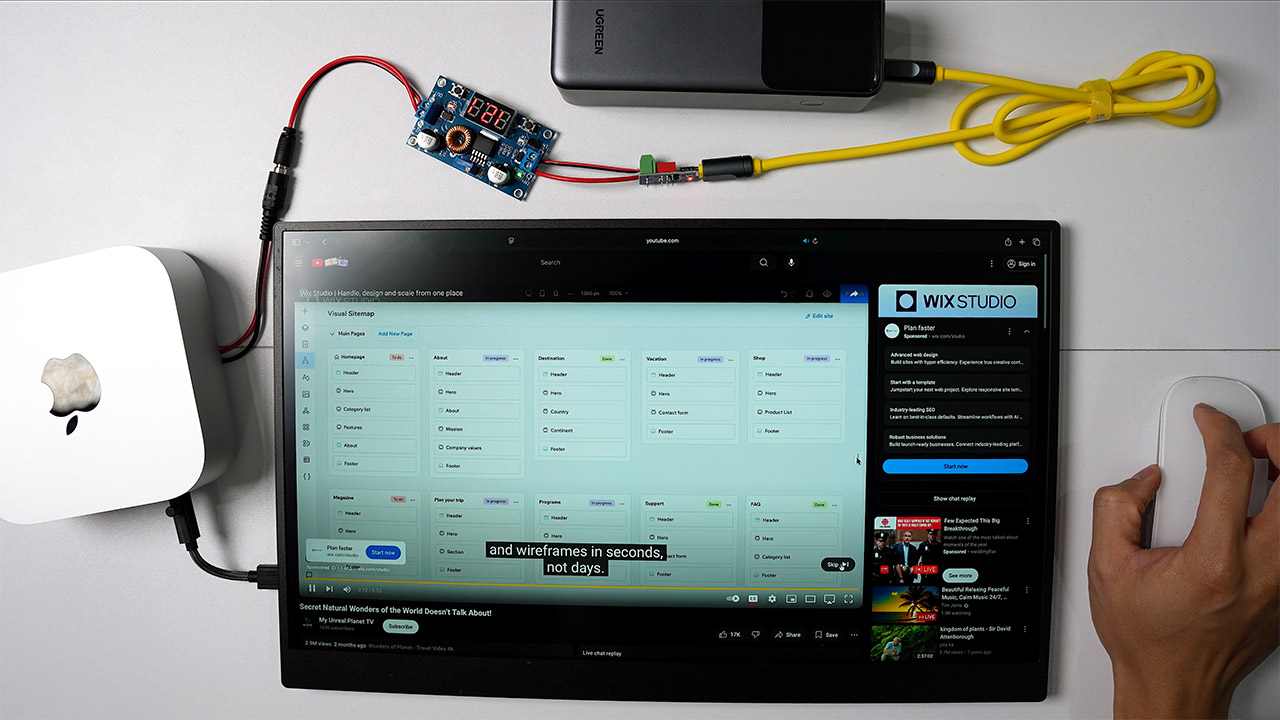
Modder Tommy Doan shows how to transform a Mac Mini M4 into a portable battery-powered machine that can function without being hooked into a wall outlet. People who stick with desktop computers are typically tempted to its sheer power and familiarity, but they miss out on the opportunity to work from anywhere.
He discovers that the Mac Mini M4 consumes relatively little power. For simple tasks like web browsing, you’ll need 10 to 20 watts, but more intensive jobs like video rendering would require 25 to 40 watts. Apple includes an internal power source that converts AC from the wall to the 12 volts the device requires. Rather than hauling along an inverter-equipped battery pack, he bypassed the internal supply entirely and is now giving the Mac a clean 12-volt DC directly.
200W Total Output for Professionals:This power bank delivers up to 200W total output. Each USB-C port has its own maximum output: USB-C1 up to 140W…
25000 mAh Capacity: During long-distance travel or camping, this ugreen battery pack can be used as an emergency power supply to provide sufficient…
Charging 3 Devices at Once: Improving the flexibility of use, when you are at a party, usb c power bank can become a shared resource, everyone can…
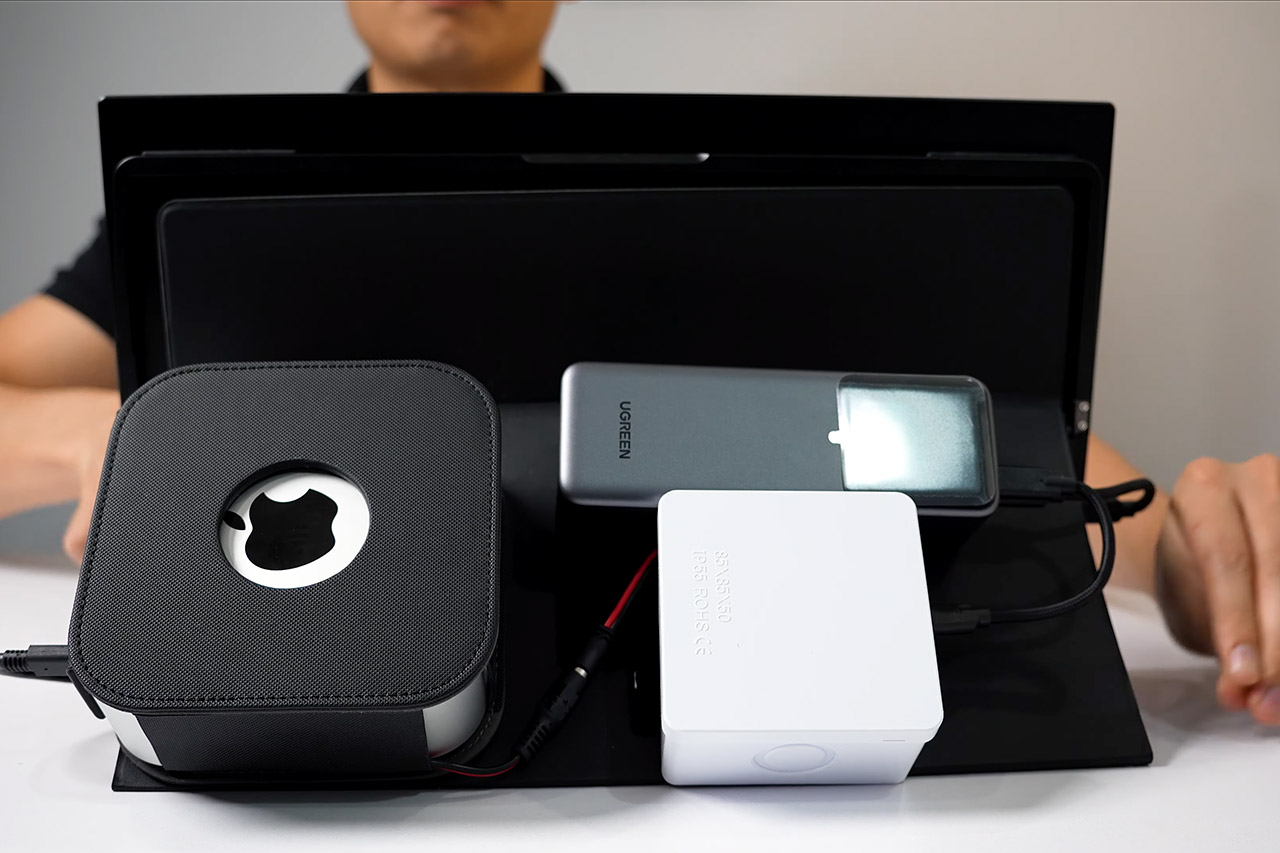
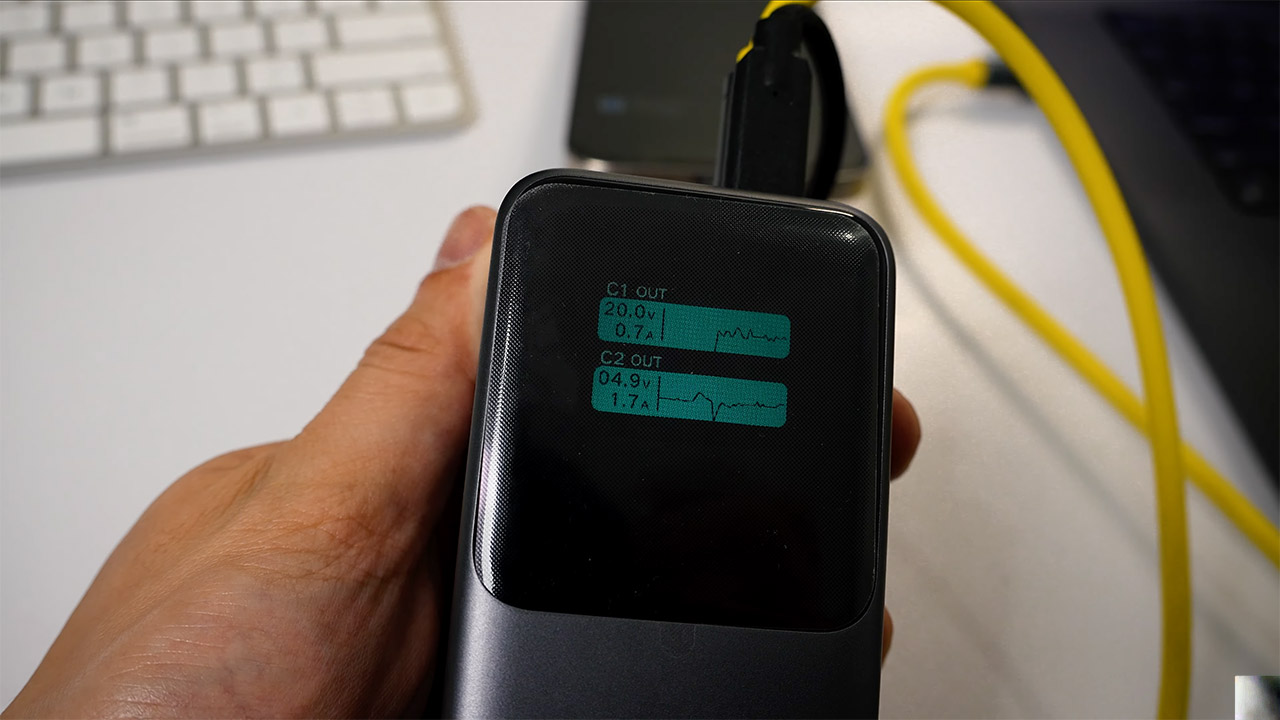
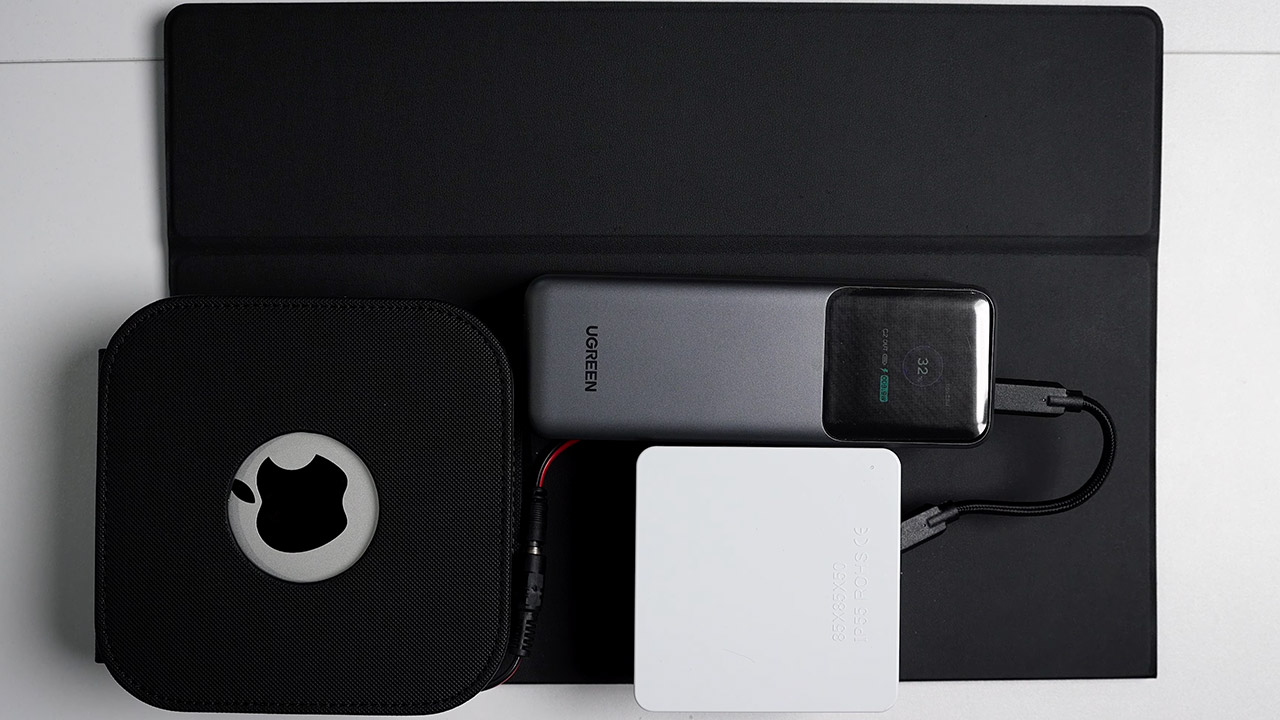
Tommy carefully opens the casing, locates the two tiny golden screws that designate the DC input points, and disconnects them. He then connects a barrel connector directly to those spots, ensuring proper polarity to avoid blowing anything. The power bank itself is a massive UGreen 25,000 mAh unit with high-output USB-C PD. It can’t deliver 12 volts on its own, so he devised a trigger circuit that instructs it to provide 20 volts at 5 amps instead. From there, a buck converter reduces the voltage to a consistent 12 volts. To keep things neat, everything connects to a basic junction box.
He paired the setup with a UPerfect UColor J5 portable display. This compact 17.3-inch 4K IPS panel works at a fast 120Hz, covers 100% of the sRGB and DCI-P3 color spaces, and weighs less than two pounds. It is, however, all in one USB-C cable, which is convenient because it provides power, video, and touch input. When you have all of the pieces close at hand, it takes around 30 seconds to put everything together.
He secures the Mac Mini, power bank, converter chain, and cables inside a repurposed UPerfect monitor case with sticky tape. Why? His 3D-printer was too small to print his custom enclosure design, which means the monitor attaches independently and easily fits into a bag.
In his real-world tests, the 25,000 mAh battery lasted 3 to 3.5 hours for light labor and just slightly less, about 2 hours, when loaded. The pass-through charging feature allows you to recharge the battery from a wall charger while the Mac is operating, which is a terrific method to keep going forever if you do find an outlet. After two weeks of daily use, the system remained rock stable for browsing, administrative chores, and editing, with no major crashes in sight; nevertheless, long-term stability is dependent on ensuring proper wiring.
In a small double-blind clinical trial, a single intravenous dose of DMT produced rapid and clinically meaningful reductions in symptoms of major depressive disorder within a week, with effects lasting up to three months in some patients. “Unlike psilocybin and lysergic acid diethylamide ( LSD), whose effects can last for hours, intravenous DMT has a half-life of around five minutes,” notes ScienceAlert. “Its psychedelic effects are correspondingly brief, potentially making it more practical to administer in clinical settings.” From the report: “A single dose of DMT with psychotherapeutic support produced a rapid, significant reduction in depressive symptoms, sustained up to three months,” writes a team led by neuroscientists David Erritzoe and Tommaso Barba of Imperial College London. […] They recruited 34 participants with major depression and divided them into two groups of 17 for a double-blind, placebo-controlled trial.
In the first stage of the trial, one group received an intravenous dose of DMT, while the other received an active placebo. Neither the researchers nor the participants were informed which participants received the DMT. The doses took around 10 minutes to administer, and a therapist sat with each participant to ensure comfort and safety while the psychedelic effects were active, remaining silent throughout the treatment. The treatment was generally well tolerated. Most side effects were mild to moderate, and included nausea, temporary anxiety, and pain at the injection site. No serious adverse events related to the treatment were reported, although brief increases in heart rate and blood pressure were observed immediately after dosing.
In the second, open-label stage, two weeks after the first dose, all participants were given the opportunity to receive a dose of DMT. Participants were assessed before and at intervals after each dose using the Montgomery-Asberg Depression Rating Scale. Just a week after the first dose, participants who had received DMT had improved scores compared to the placebo group, and improvements were sustained during follow-up assessments.
Two weeks after the first dose, the participants who received DMT scored about seven points lower, on average, than those who received a placebo. On this commonly used clinical scale, a drop of that size is generally considered a meaningful reduction in symptom severity. There was no significant difference between patients who received one or two doses of DMT, suggesting a single dose may be sufficient. These effects persisted for up to three months, and some patients remained in remission for at least six months following the treatment. The findings have been published in Nature Medicine.
WordPress.com now uses AI to make site layout changes with natural language prompts
Nano Banana image generation and editing is integrated with the media library
It’s available to use now, but you need to turn it on in settings
Set against a background of other AI-powered website builders, WordPress.com has launched its own AI Assistant, and it covers more than just generating copy.
The company explains its new assistant will be able to understand a site’s content and layout, therefore users can make more complex changes with simple natural language prompts.
“No copy-pasting, no prompt engineering, and no code to figure out what to do with,” Head of AI Ronnie Burt wrote in a blog post.
WordPress.com highlighted three key areas where its AI Assistant can help: creating and editing content with context, generating and tweaking images, and colleague-style collaboration. Some of the changes handled include adjusting layouts, styles, colors, fonts and page structure, as well as other copy-related tasks like generating and translating text.
On the page editor front, WordPress.com shows examples of the AI Assistant making changes based on pretty loose, unspecific commands, such as ‘Make this section feel more modern and spacious’.
Besides generating text, AI Assistant can also generate and edit images using Google‘s Nano Banana models directly within the media library without having to use third-party platforms.
Advertisement
Burt also pointed to the new block notes editor that launched with WordPress 6.9, which provides colleagues with a space to collaborate and share comments. Unsurprisingly, the AI Assistant also plays a role here, where it can do things like fact-check or make edit suggestions.
Sign up to the TechRadar Pro newsletter to get all the top news, opinion, features and guidance your business needs to succeed!
WordPress AI Assistant is now generally available, but users must opt in via Sites > Settings > AI tools. Sites already built using the AI website builder option will have AI Assistant enabled by default.
From left, Charles Lamanna of Microsoft, Theresa Piasta of Outreach, Swami Sivasubramanian of AWS, and Kiana Ehsani of Vercept will be among the speakers at GeekWire’s Agents of Transformation summit on March 24 in Seattle.
GeekWire’s Agents of Transformation summit is a little more than a month away, and we’re announcing the first wave of speakers for the half-day event the afternoon of Tuesday, March 24, at Block 41 in Seattle, including leaders from Amazon, Microsoft, and more.
The event, presented by Accenture, focuses on questions that are top of mind for many right now: What does the rise of AI agents mean for productivity, the future of work, and the way companies and industries operate? We’re bringing together people who can speak to both the big picture and the practical realities of putting AI to work inside organizations.
Here are a few of the leaders who will be joining us, with more to be announced soon.
Swami Sivasubramanian, Vice President for Agentic AI at AWS, where he leads the teams behind Bedrock, SageMaker, AgentCore, and other core AI services. He previously served on the National AI Advisory Committee, advising the White House on AI policy.
Advertisement
Kiana Ehsani, co-founder and CEO of Vercept, an AI startup that automates computer tasks by watching and interacting with your screen. She was previously a senior research scientist at Ai2, with a PhD from the University of Washington focused on embodied AI and robotics.
Charles Lamanna, President of Business Applications & Agents at Microsoft, where he leads efforts to embed AI agents into enterprise workflows across Microsoft’s customer base. A former startup founder, he previously led Microsoft’s Power Platform low-code technology.
Theresa Piasta, Vice President of AI Value Strategy at Outreach, where she focuses on measuring AI’s business impact and helping organizations design effective human-and-AI teams. Her background spans enterprise tech, Wall Street, and military leadership.
The afternoon will also feature a startup zone where early-stage companies will showcase their work and pitch for a live audience, along with panel discussions, fireside chats, and interviews. The main program runs from 1:30 p.m. to 5:30 p.m., followed by a networking reception.
Advertisement
This event builds on an ongoing GeekWire editorial series, underwritten by Accenture, spotlighting how startups, developers and tech giants are using intelligent agents to innovate.
Thanks to presenting sponsor Accenture and gold sponsors Nebius and AWS Marketplace for helping to make the event possible. For sponsorship opportunities, to participate in the startup zone, or any other inquiries about the event, contact events@geekwire.com.
Details
When: Tuesday, March 24, 2026, 1:30–5:30 p.m.
Where: Block 41, 115 Bell St., Seattle
Tickets: Early bird pricing is $145 through Feb. 24.
Register here or below, and see you March 24 in Seattle!
There’s a certain joy in doing things with your hands, especially when it comes to little details that turn your house into a home. Unfortunately, there are many common mistakes people make when it comes to DIY projects, like not planning well, going over budget, or the other end of the spectrum: going too cheap and getting bad quality materials. However, one thing you can do to avoid problems is simply to invest in the right tools. Even if you’re an amateur, the right products don’t just make your DIY work feel easier, but they can also make it safer.
Although many professionals will have a collection of expensive products that match their specific job’s needs, the average person fixing up their home doesn’t necessarily need the heavy-duty stuff for occasional work. In many cases, amateur DIYers can benefit the most from gadgets that strike a balance between convenience and practicality, especially those that match their frequently used activities.
Advertisement
Depending on the kind of projects you tend to work on, there are plenty of highly-recommended DIY products you can buy at Harbor Freight. To help widen your perspective on what is out there, we’ve rounded up a list of different gadgets you can snag that help optimize different DIY aspects, like measurement, viewing, or planning. For your reference, we have listed our full methodology at the end of the article.
Advertisement
Ames Instruments 2.7-inch Color Compact Digital Inspection Camera
In almost any household, one of the most common problems that every DIYer tends to experience is not being able to see what they’re supposed to work on. After all, our homes are full of tight spaces, whether it’s the inside of appliances, pipes, or walls. Thankfully, you can enlist the help of gadgets like the 2.7-inch Color Compact Digital Inspection Camera from Ames Instruments.
While the camera itself is water-resistant, the image head and cable have an IP67 rating, which means it’s waterproof (to an extent) and can handle submersion up to 1 meter. It’s important to note that, like similarly rated gadgets, the protection can degrade with time. Out of the box, the cable itself runs up to 38 inches, which makes it ideal for DIY work in tight spaces. For example, you can use it to inspect the inside of walls or pipes, or for spotting mold, leaks, or water damage. It’s capable of 5x digital zoom, so you can view 320 x 240 resolution on its 2.7-inch screen.
Priced at $84.99, the Ames Instruments 2.7-inch Color Compact Digital Inspection Camera is the most expensive item on this list. On Harbor Freight, this digital inspection camera has garnered about 4.2 stars on average from more than 600 customers, with only 6% of buyers giving it a single star. As of writing, a little more than half rated it a perfect 5 stars, while 83% said they would recommend it.
Advertisement
Pittsburgh 6-inch Composite Digital Caliper
If you’re the type who doesn’t want to squint every time you have to measure things, a digital caliper might be a DIY crafting gadget that will save your eyes. On Harbor Freight, you can find a lot of digital calipers of different sizes, including the Pittsburgh 6-inch Composite Digital Caliper. Priced at $9.99, this caliper features a prominent LCD screen that lets you view measurements using metric and SAE units. With just a single 1.5V button cell, the included battery is designed to last around a year. Since it’s made with plastic jaws, this particular digital caliper makes for a good option if you are planning to measure painted DIY projects that you don’t want to mess up.
A pretty popular product, more than 1,500 people rated the Pittsburgh 6-inch Composite Digital Caliper 4.4 stars on average. Aside from more than 89% rating it 5 stars, 90% of customers thought it was worth recommending. Although some people mentioned that it felt cheap, others shared that they thought it was a step up from their old-school analog ones. Despite being made of plastic, one person noted that it did not warp after six months in a hot work area. In addition, a reviewer said that it performed well when measuring 3D printed designs. But take note, 5% of users were unhappy enough to give it one star, with some lamenting battery problems, it not moving smoothly, and precision issues.
Advertisement
Franklin Sensors ProSensor M150 Stud Finder
Harbor Freight offers several entry-level stud finder models from the Franklin Sensors ProSensor lineup, such as the M10, M50, and M150. Depending on the kind of DIY work you’re planning to do that involves punching holes, prices range from $14.99 to $36.99. However, if you do have the budget, the Franklin Sensors ProSensor M150 Stud Finder is likely the best bang for your buck. Between the three models, the M150 isn’t just packed with more features, but it’s also the highest-rated option of the bunch. As of February 2026, 800+ Harbor Freight customers have rated it an average of 4.6 stars, with 93% awarding it a perfect rating, while less than 4% have given it a single star.
Advertisement
Retailing for just under $37, the ProSensor M150 Stud Finder has several things going for it. First, it has a 1.5-inch maximum detection depth, which is already half an inch deeper than the M10 model, as well as thrice as many sensors. Powered by two AAA batteries, it has an LED display to help you navigate your stud-finding experience. Similar to the M50 model, it can detect both the edges and centers of the stud, wood, and metal. Unlike the cheapest option, both the M50 and M150 have live electrical detection, which can help you prevent a lot of possible safety issues with your DIY projects. You’ll be able to enjoy operation without the need for calibration with both models.
Advertisement
Icon 1000 Lumen Dual-Sided Rechargeable Slim Bar Light
Unfortunately, when it comes to home renovation projects, we can’t always trust our eyes. In some cases, such as when there’s a leak in our homes, we may need to enlist the help of a UV light to spot moisture or dye. To do this, you can invest in something like the $59.99 Icon 1000 Lumen Dual-Sided Rechargeable Slim Bar Light.
Designed to be used in moist environments, it boasts IP65 water resistance, magnets for hands-free operation, and an all-around hook for convenient mounting. As a light source, it has a 270-degree rotating head, a dimmable switch, and a gauge display, so you’re not caught guessing whether it needs to be charged. Apart from its UV light, it can also fulfill the functions of a regular, powerful flashlight and a wide-area light. In addition, it has a high 96+ color rendering index, which can be quite useful when you’re trying to distinguish different wires from each other.
On Harbor Freight, it has garnered an average rating of 4.7 stars from 450+ buyers, with 96% saying they would recommend it. Not to mention, less than 0.1% of owners rated it a single-star, which means it performs up to standard for the majority of people. Among satisfied customers, reviewers have mentioned using it on everything from HVAC work to vehicle repair. In particular, they praise the magnet locations, its slim form factor, and good battery life.
Advertisement
Ames Instruments Noncontact Voltage Tester
When working with sockets and fixtures, it’s always a good idea to err on the side of caution to avoid electricity-related injuries. Because of this, it’s best to use a tool, like the Ames Instruments Noncontact Voltage Tester, before working on any circuits. Powered by a single AAA battery, the ETL-certified gadget can detect between 50 and 600 volts of AC voltage for things like outlets or light fixtures. All you have to do is push a button.
Retailing for just under $5, over 3,800 people have rated the Ames Instruments Noncontact Voltage Tester around 4.6 stars. Aside from 94% of users claiming they would recommend it, around 77.5% have also awarded it 5 stars. In particular, buyers praised how it’s easy to use, works as intended, and is lightweight. That said, there were a few unhappy customers (about 3.3%) who gave it just one star, with some of the common complaints being inaccuracy, issues with the display after long storage, and breaking after only a few months of use.
Advertisement
Should you just be concerned with your sockets, you can also get the Ames Instruments Electrical Receptacle Tester with GFCI Diagnosis for just an extra dollar. All you have to do is plug it into the outlet, and it will help diagnose what is wrong with it. Compared to the other model, this one has a slightly higher average rating of 4.7 stars from more than 1,500 reviews, with 96% of customers recommending it.
Advertisement
Methodology
To make this list, we looked at the different gadgets available on Harbor Freight that can help with DIY projects. We listed products for a wide range of budgets, starting at just under $10. Next, we selected models that have been proven to perform well through their general ratings and detailed customer reviews. For general ratings, we considered gadgets that have received an average rating of at least 4 stars from more than 400 customers. Afterward, we checked the percentage of reviewers who have rated it a perfect 5 stars or given it a 1-star rating. We avoided items that had gotten a single star by more than 10% of buyers.
While it didn’t impact their placement on the list, we looked at the feedback of individual users on what they did and didn’t like about each product. To help give you an idea about what type of customer is satisfied with each gadget, we also mentioned specific DIY projects people have successfully used them on. In some cases, we also cited similar products made by the same company or in the same category, which may have unique features that are better suited to your budget or planned DIY activities.
When European tech observers talk about AI ambition, the narrative often splits neatly in two: models and infrastructure. On one side are the clever bits of code that can write, reason, and generate text or images.
On the other is the gritty reality of making those bits run reliably, at scale, and in production. Today, Mistral AImade a move that bridges that divide.
The Paris-based AI upstart confirmed its first acquisition by agreeing to buy Koyeb, another French venture focused on serverless cloud infrastructure for AI workloads. The deal, terms were not disclosed, marks a clear signal: Mistral wants to own not just cutting-edge AI models, but also the infrastructure that delivers them to developers and enterprises.
Mistral has built momentum over the past two years with large language models that have put it in close competition with U.S. players. But for all the excitement around models, real-world adoption hinges on how those models are deployed and scaled.
Koyeb’s technology is built for exactly that: a serverless platform that lets developers run AI apps without managing the underlying infrastructure.
Advertisement
Think of it as giving Mistral not only the engine but also the transmission, the parts that take raw computational power and make it usable on demand. That’s a critical piece when companies want to ship AI solutions without hiring a team of DevOps experts.
This acquisition dovetails with a wider strategy playing out in Europe: build an AI stack that doesn’t depend on U.S. hyperscalers.
Mistral recently announced a €1.2 billion investment in data centers in Sweden and has been vocal about offering a homegrown alternative to cloud services from AWS, Microsoft, and Google.
By folding Koyeb’s team and platform into what they call Mistral Compute, the company is laying claim to a more complex AI offering – from model training to deployment and inference. In other words, it’s less about selling APIs and more about owning the full AI experience.
Advertisement
Koyeb’s roots are in serverless computing, scalable, managed infrastructure that lets developers forget about servers and focus on code. Its platform supports AI tasks across CPUs, GPUs, and specialized accelerators, with features like autoscaling and isolated environments for complex applications.
The founders and all 13 team members are joining Mistral’s engineering ranks, where they’ll shift focus toward embedding their technology into the Mistral Compute platform. For existing users of Koyeb’s services, the transition is designed to be smooth, with the platform continuing to operate as usual while integrating deeper over time.
In a market still heavily dominated by U.S. cloud providers, owning more of the AI value chain is both a business move and a geopolitical statement. This deal isn’t just about snapping up a smaller startup; it’s about signalling a shift in how European AI companies conceive of competition and capability.
One of the early questions about the future of AI wasn’t whether Europe could produce models that compete with those from Silicon Valley, it was whether it could build the platforms and systems those models truly depend on. With the Koyeb acquisition, Mistral is making a direct answer to that question.
The initiative builds on Ireland’s extensive semiconductor industry which is comprised of more than 130 indigenous and foreign subsidiary companies.
The Government has announced the launch of I-C3, Ireland’s National Competence Centre in Semiconductors, which is one of 30 other national chip competency centres in Europe, in 27 different countries. The initiative is designed to strengthen Europe’s semiconductor ecosystem.
Co-ordinated by the Tyndall National Institute and supported by the Department of Enterprise, Tourism and Employment through Enterprise Ireland, the initiative is also co-funded by the EU, under the Chips Joint Undertaking partnership. The hub will be led by consortium partners Tyndall National Institute, MCCI, MIDAS Ireland, NovaUCD and UCD.
Described by the Government as a “significant milestone in Ireland’s commitment to semiconductor innovation and European collaboration”, I-C3 will focus on start-ups and SMEs by providing access to essential resources, funding pathways, training, design tools and pilot line facilities.
Advertisement
The long-term objective is to empower Ireland’s start-ups and SMEs and to build on Ireland’s vibrant and extensive semiconductor industry, which is comprised of more than 130 indigenous and foreign subsidiary companies. The industry also employs more than 20,000 people and is part of a 175,000-person strong broader ICT sector.
Multinational leaders such as Intel, Apple, Qualcomm, AMD and Analog Devices have long invested in Irish R&D and I-C3 aims to further elevate Ireland’s global standing in semiconductor innovation.
Commenting on the launch, Peter Burke, the Minister for Enterprise, Tourism and Employment, TD, said, “As a hub for the semiconductor ecosystem, my Department is delighted that I-C3 will ensure that opportunities as part of the Chips for Europe Initiative are accessible for businesses of all sizes within the industry, along with bringing greater diversity of expertise and depth of innovation to the knowledge base of the semiconductor ecosystem in Europe.
“I-C3’s launch is another significant milestone in the delivery of Silicon Island: Ireland’s National Semiconductor Strategy. With this launch, my Department is very excited about I-C3’s ability to empower Irish SMEs to scale internationally, drive innovation across the semiconductor ecosystem and create high-value jobs.
Advertisement
“I-C3 will also facilitate the development of skills and talent, and build on our strengths by enhancing the relationship between infrastructure, industry and RD&I capability to ensure Ireland leads in advanced manufacturing and chip design.”
Joe Healy, the divisional manager of research, innovation and infrastructure at Enterprise Ireland, added, “With the support of I-C3, Ireland is set to double the number of people employed in semi-conductor start-ups and SMEs by 2030. The centre will act as a catalyst for innovation, collaboration, and growth, ensuring that Irish stakeholders, from academia to industry, can fully participate in the Chips for Europe Initiative.”
The EU and many of the countries under its banner have committed significantly to advancements and further independence in the global semiconductor race. Earlier this month (9 February) the European Union launched the €2.5bn NanoIC – the largest pilot line in the EU Chips Act.
Additionally, in January of this year, Dutch semiconductor equipment manufacturer ASML Holdings NV became the third European company to pass $500bn in market valuation. Previously, Danish drug maker Novo Nordisk and France-based Dior-parent LVMH reached this milestone.
Advertisement
Don’t miss out on the knowledge you need to succeed. Sign up for the Daily Brief, Silicon Republic’s digest of need-to-know sci-tech news.
We spend hours testing every product or service we review, so you can be sure you’re buying the best. Find out more about how we test.
GHD Speed: two-minute review
The GHD Speed is one of the most user-friendly hair dryers on the market. It offers a wide selection of temperatures and windspeed options, with the maximum mode delivering a hurricane of power that will blast your hair dry in ultra-quick time.
More options often equates to more confusion, but GHD has deftly avoided that trap; there’s one button for each category, and lights around the barrel means there will never be any confusion over the settings you’re using.
Advertisement
Other welcome additions include a mode lock, which allows you to wield the hair dryer confidently without worrying about accidentally pressing any buttons, and an always-on cool mode alongside the cool shot pulse option.
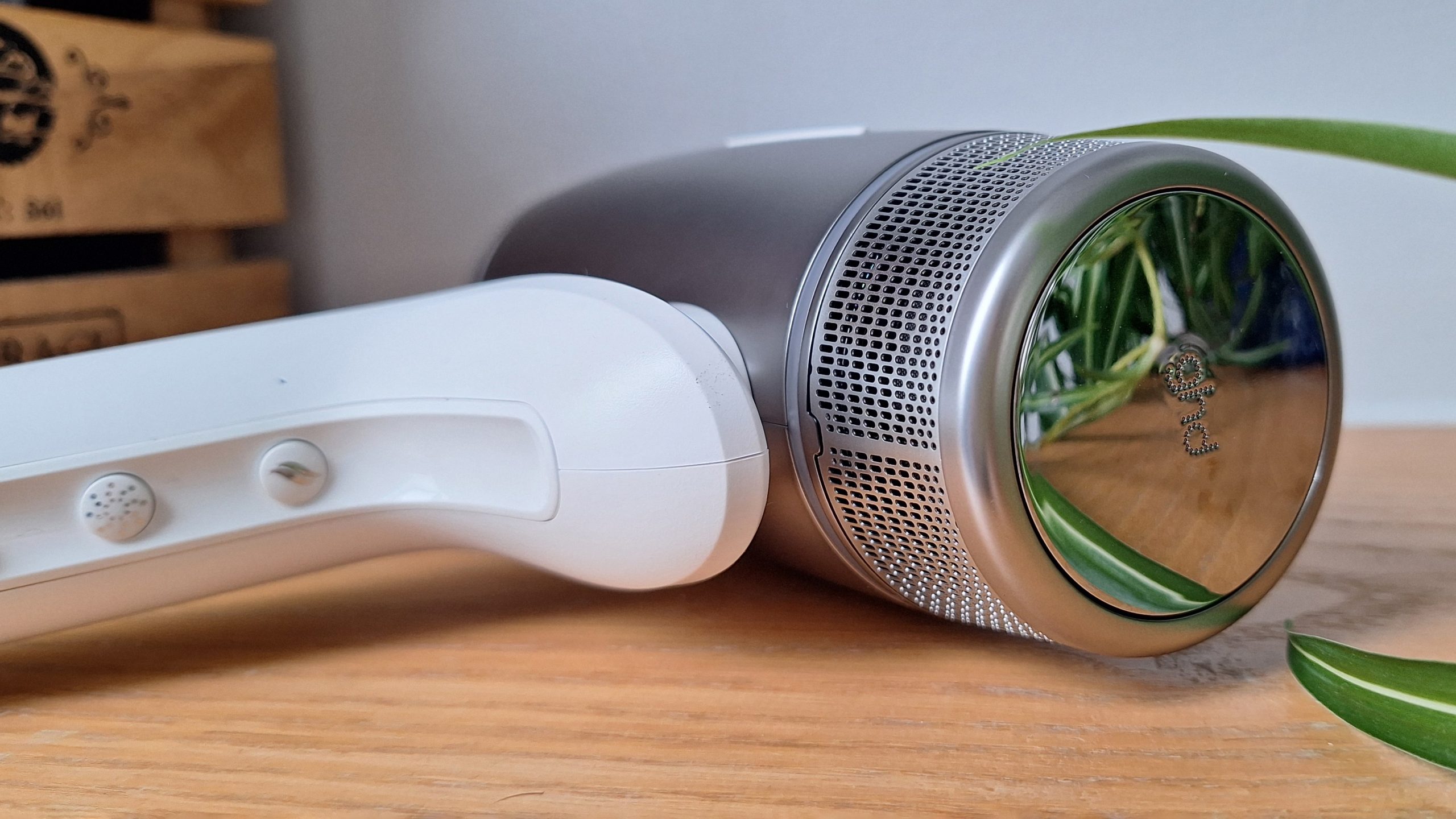
None of those are the USP, though. It’s the “halo dual-airflow technology” that GHD is highlighting here, which the brands states will dry hair without heat damage, thanks to the “halo” of cool air that surrounds the heated airflow. GHD says this allows you to get closer to the scalp without fear of burning it, plus you can hold the dryer by the barrel if you want to, because it will never become hot. I’m not convinced the former is true, and the latter is possible but feels a little unnatural.
However, the main potential sticking point is really the lofty price tag. While it could be seen as being partially justified by the impressive power and generous array of control options, competitors such as Dyson offer much more in a very similar price bracket – particularly when it comes to attachments (the GHD Speed includes a concentrator in the box, while the diffuser is an optional add-on).
Advertisement
That’s the short version; read on for my full GHD Speed review.
(Image credit: Future)
GHD Speed review: price & availability
List price: £299
Available: UK
At list price, the GHD speed costs £299, which places it in TechRadar‘s premium price band for hair dryers. It’s significantly cheaper than Dyson’s Supersonic Nural, which comes in at £399.99, but that model has the benefit of a number of flashy features such as automatic temperature adjustment and attachment memory – plus a much wider selection of attachments included as standard.
Sign up for breaking news, reviews, opinion, top tech deals, and more.
Advertisement
That’s not to say the GHD Speed doesn’t feel like a premium option. There’s a wide selection of controls, the build quality is high, and it’s ultra-powerful too.
Value for money score: 3.5 out of 5
GHD Speed specs
Swipe to scroll horizontally
Model:
GHD Speed
Wattage:
Advertisement
1,800-2,100W
Weight (without cord, appox):
1.4lbs / 620g
Size (H x W x L, approx):
Advertisement
2.6 x 7.9 x 9.3in / 6.7 x 20 x 23.5cm
Airflow settings:
4
Temperature settings:
Advertisement
4
Extra modes:
Cool shot, continuous cool
Cord length:
Advertisement
9.2ft / 2.8m
GHD Speed review: design
Slightly bulky design
Lots of setting options, plus a mode lock, all intuitively designed
Delivers a “halo” of cool air at all times
The GHD Speed has a slightly strange, disjointed design that looks like the model should be foldable – but it isn’t. It’s both chunky and heavy, weighing in at roughly 620g without its cord (by contrast, the Dyson Supersonic Nural is around 455g).
Where this dryer shines is in its control options and design. On the rear of the handle you’ll find an on-off slider switch, alongside the temperature and windspeed controls. There are four windspeed options, and four heat settings – in each case, one or two more settings than is usual.
(Image credit: Future)
There’s also a cool shot option, which you can activate using the heat button or via a separate button on the rear of the handle. You’d opt for the button on the rear if you wanted an extended period of cold air, whereas the button on the front will only deliver cool air for the length of time for which it’s depressed.
Advertisement
Also on the front of the handle is a slider to lock the current settings, so that you don’t accidentally change them as you handle the dryer. In my opinion, I’d appreciate such functionality on more hair dryers – it seems to be a struggle for manufacturers to position the buttons so that they’re easy to access yet avoid accidental presses. GHD’s solution is both neat and effective.
(Image credit: Future)
When switched on, lights around the side of the dryer barrel illuminate to indicate the windspeed and heat settings (these switch from orange to blue when you’re in a cool mode). It’s understandable at a glance, with no confusion over which mode you’re in.
(Image credit: Future)
My review model came with a concentrator nozzle, which is double-layered so that the outside remains cool to touch. It attaches magnetically and feels secure when snapped on. There’s a compatible diffuser available for £30, but that’s your lot.
Advertisement
GHD Speed review: performance
Very hot and very powerful on max settings
Relatively easy to wield and mode lock switch is useful
Dual airflow isn’t very noticeable, but my hair was left looking smooth
The GHD Speed’s USP is the “halo dual-airflow technology”, which essentially means that there’s an always-cool ring of air encircling the main airflow. GHD states that this will enable you to get closer to your scalp – but in use I couldn’t really feel the cool “halo”, and nor could I position the barrel near my head without it becoming uncomfortably toasty. This was true even when angling the dryer side-on.
The halo feature is also meant to ensure the main barrel of the dryer remains cool throughout use, allowing you to hold the GHD Speed from there. While this is correct, the reality is that I didn’t find this a natural position to grip the hair dryer – maybe in time this will change.
(Image credit: Future)
Slightly confusing special feature aside, I was super-impressed with this dryer. In max modes the GHD Speed is both ultra-powerful and super-hot. In fact, it’s the only dryer I’ve used where I haven’t automatically bumped it right up to maximum settings every time. I welcomed the added control afforded by the extra settings options, as well as the mode lock for preventing accidental presses.
GHD claims the dryer “smooths and seals the cuticle” for a glossy look. I tried a half-and-half test with another hair dryer (the Dyson Supersonic r) and while the GHD’s side was perhaps a touch smoother, I wouldn’t say it had the 56% more shine promised by GHD.
Performance score: 4.5 out of 5
How I tested the GHD Speed
I used the GHD Speed as my regular hair dryer for a couple of weeks, to get a general feel for its performance and how it left my hair looking. I also timed how long it took me to dry my collarbone-length hair, and compared the results to other hair dryers I’ve reviewed. I also assessed how easy and comfortable it is to hold, and how easy it is to use in general, again comparing my findings to other hair dryers on the market.
According to the patent document, the LLM can create a “digital clone” of social media users to simulate their online activity, posting messages, photos, and videos on their behalf if they die or take an extended break from social media. It can even interact with other users, respond to DMs,… Read Entire Article Source link