

Crypto World
Prediction Market Loses Bid to Halt State Action


The legal clash between Kalshi and Nevada regulators intensified this week as the state’s gaming authority pressed forward with enforcement actions after a federal appeals court refused to halt the state’s conduct. The Ninth Circuit Court of Appeals on Tuesday denied Kalshi’s bid to block the Nevada Gaming Control Board from pursuing a civil case over Kalshi’s sports event contracts, effectively clearing the path for the regulator to proceed in state court. In short order, the Nevada Gaming Control Board filed a civil enforcement action, arguing Kalshi offers unlicensed wagering in violation of Nevada gaming law. Kalshi countered by seeking to move the dispute to federal court, echoing its long-held position that its activities fall under exclusive federal jurisdiction via the Commodity Futures Trading Commission (CFTC). The evolving dispute highlights a broader, unsettled regulatory landscape for prediction markets in the United States.
Key takeaways
- The Ninth Circuit refused Kalshi’s request to pause Nevada’s enforcement efforts, allowing a state-court civil action to proceed against Kalshi over sports-related markets.
- Following the ruling, the Nevada Gaming Control Board immediately filed a civil enforcement action in state court, asserting Kalshi operates unlicensed wagering on sporting outcomes in violation of state law.
- Kalshi maintains it operates under exclusive federal jurisdiction and has argued that federal law supersedes state-level actions in this area, leveraging the CFTC’s authority over commodity derivatives.
- The case mirrors similar tensions in other states and among other prediction-market operators, underscoring a broader regulatory crackdown on unlicensed gaming-like activity in the prediction space.
- The regulatory narrative is being shaped in part by federal involvement, with the CFTC signaling its stance on jurisdiction over prediction-market activity and related contracts.
Sentiment: Bearish
Market context: The dispute sits at the intersection of state gaming regulation and federal commodity rules, a space that remains legally unsettled as regulators and platform operators test boundaries around prediction markets and their licensing needs. The CFTC has emphasized its jurisdiction over commodity derivatives traded on designated contract markets, while states push for traditional licensing regimes where wagering is involved.
Why it matters
For Kalshi, the Nevada case is a test of its central premise—that prediction-market activity should fall under federal oversight rather than state gaming statutes. If the state court ultimately concludes that Kalshi’s sports event contracts require licensing under Nevada law, Kalshi may face injunctions, penalties, or the need to halt certain markets within the state. The immediate practical effect would be to constrain Kalshi’s ability to offer sports-related contracts to Nevada residents, reinforcing the idea that licensing requirements can operate at the state level even when a company argues federal preemption.
For other prediction-market operators, the unfolding legal framework signals heightened regulatory risk. The ongoing tension between state enforcement actions and federal jurisdiction could prompt platforms to seek clearer licensing pathways or, in some cases, to trim or relocate markets to jurisdictions with more predictable rules. The broader regulatory climate also matters for investors and developers evaluating the growth potential of prediction-market ecosystems, including partnerships and product designs that align with licensing realities rather than contending with uncertain legal status.
From the federal perspective, the CFTC’s posture—evidenced by statements and amicus actions in related cases—suggests a willingness to defend a permissive view of what constitutes a derivative market under federal law. That approach has implications for how products are structured, how they are offered to users, and how regulators coordinate across state and federal lines. The involvement of the CFTC in similar matters, including its stance in parallel suits against other states, indicates that the federal framework may ultimately steer product development and regulatory compliance norms in the prediction-market space.
The case is also emblematic of a wider policy conversation about the boundary between what constitutes gaming under state law and what falls under the umbrella of commodity derivatives regulated by the federal government. As technology enables more sophisticated event-based contracts and as states consider licensing to govern consumer protections, a clearer, nationwide standard remains elusive. The legal arguments that Kalshi has advanced—namely, that its markets are governed by federal commodity laws rather than state wagering statutes—will likely continue to echo through courtroom corridors as other jurisdictions weigh similar actions.
The regulator’s position is reinforced by the state’s explicit assertion that Kalshi’s offerings amount to wagering on sports outcomes and therefore qualify for licensing under Nevada law. The regulatory calculus hinges on whether these contracts are sufficiently akin to traditional gaming or whether they can still be framed as commodity derivatives that fall under federal oversight. The Ninth Circuit’s decision not to pause the state’s enforcement action confirms that the state court system will be the next arena where these questions are tested, at least in the near term.
As this legal saga unfolds, observers will watch for how Kalshi frames its next strategic move—whether to intensify its federal-venue approach, pursue further appeals, or seek negotiated licensing accommodations that could permit continued operation in Nevada and beyond. The regulatory momentum in other states, along with potential federal actions, will shape the tempo and direction of future actions by prediction-market platforms and the regulators overseeing them.
For reference, Kalshi’s dispute has roots in earlier regulatory correspondence, including a cease-and-desist order that spurred Kalshi to sue Nevada in March of the previous year and a federal court ruling in April that temporarily blocked Nevada from taking action during the litigation. The state’s subsequent civil enforcement action underscores a shift from courts determining temporary relief to real-world enforcement remedies that could affect ongoing offerings. The legal arguments—centered on licensing requirements, intent to operate in a regulated gaming environment, and the scope of federal jurisdiction—will likely shape how prediction markets navigate compliance moving forward.
The broader industry context includes a notable cross-pollination of interests between traditional gaming regulators and digital-asset-adjacent markets. With players like Crypto.com pursuing similar matters against Nevada regulators, and with political and legal attention on the legality and design of prediction markets, the industry stands at a crossroads where licensing frameworks, consumer protections, and innovative financial instruments intersect. As these threads converge, the coming months are likely to produce more clarity—and more controversy—about where prediction markets fit within the U.S. regulatory tapestry.
Source references tied to the ongoing dispute include Nevada Gaming Control Board filings and docket activity, as well as court documents detailing Kalshi’s attempts to move the case to federal court. For a snapshot of the state-level actions, the regulator’s official filings and statements provide direct attestations of the legal theory the state is pursuing against Kalshi.
What to watch next
- The state court civil enforcement action against Kalshi in Nevada: timeline for hearings and potential rulings.
- Any subsequent filings or rulings from the Ninth Circuit or federal courts on Kalshi’s venue arguments and potential appeals.
- Further amicus briefs or regulatory filings from the CFTC or other federal agencies regarding jurisdiction over prediction-market activities.
- Developments in parallel cases, such as Crypto.com’s challenges to Nevada regulators and any related state actions against other prediction-market operators.
Sources & verification
- Nevada Gaming Control Board press release and complaint PDF alleging Kalshi’s unlicensed wagering (kalshi-complaint.pdf).
- Nevada Gaming Control Board press release on civil enforcement action against Kalshi (ngcb-files-civil-enforcement-action-against-kalshi.pdf).
- CourtListener docket for State of Nevada ex rel. Nevada Gaming Control Board v. Kalshi LLC (docket entry showing the federal motion and related filings).
- Kalshi’s federal court venue motion referenced in court records (CourtListener docket).
- CFTC amicus brief discussion in related Crypto.com case in Nevada (Cointelegraph coverage referencing the CFTC stance).
Kalshi and Nevada clash over sports contracts
The dispute between Kalshi LLC and the State of Nevada over Kalshi’s sports-event contracts has moved from a regulatory order into a courtroom duel over jurisdiction and licensing. After Kalshi’s bid to halt Nevada’s enforcement was rejected by the Ninth Circuit, the regulator proceeded with a civil action in state court, arguing that Kalshi’s offerings amount to unlicensed wagering under Nevada law. Kalshi contends that its activities are subject to exclusive federal jurisdiction, a claim it has pressed since the outset of the case and one it has framed around the CFTC’s authority over commodity derivatives.
In a sequence of filings and rulings, the parties have mapped a jurisdictional battleground that is likely to influence the trajectory of prediction-market operators beyond Nevada. Kalshi’s argument rests on the premise that prediction-market contracts function as commodity derivatives and therefore belong under the federal oversight of the CFTC. Nevada’s counterpoint emphasizes licensing requirements within the state’s gaming framework, asserting that even if a contract resembles a derivative in structure, it still implicates wagering and gaming activities that require state licensing. The Ninth Circuit’s decision to deny a stay removes a preliminary hurdle for the state to pursue civil remedies, allowing the underlying enforcement to proceed while the broader jurisdictional questions continue to percolate in appellate and district court settings.
Public filings and press materials from the Nevada regulator outline the legal theory at stake: Kalshi’s markets are active in the state, but Kalshi has not secured the necessary licenses to operate those markets within Nevada’s borders. The regulator has pointed to the state’s existing framework for gaming and wagering to argue that Kalshi must obtain licenses for its sports contracts. Kalshi, meanwhile, has sought to position the matter within the federal regime that governs designated contract markets and other CFTC-regulated activities, arguing that state enforcement risks duplicative and conflicting obligations for a market participant operating across multiple jurisdictions.
As regulators, courts, and market participants monitor this case, the central questions will revolve around licensing, consumer protections, and the proper allocation of regulatory authority between state gaming authorities and federal commodity regulators. Should Kalshi prevail on the federal-venue theory in the long run, it could pave the way for broader operation of prediction-market platforms without state-level licensing, provided federal law offers a clear path. Conversely, a ruling affirming Nevada’s licensing demands could constrain Kalshi’s services in the state and prompt similar actions in other jurisdictions, thereby shaping the practical viability of prediction markets as a class of financial products in the United States.
For now, the Nevada case stands as a pivotal, high-stakes test of how prediction markets fit into a complex mosaic of gaming and commodities regulation. The coming months are likely to reveal how the regulatory regime coalesces—or fractures—around questions of licensing, jurisdiction, and the boundary between gaming normalities and financial-derivative constructs in the evolving landscape of digital markets.


Editor’s note: In an era of increasingly covert software supply chain threats, Kaspersky’s Keenadu discovery highlights how malware can slip into devices at multiple points—from preinstalled firmware to apps from official stores. This briefing breaks down what Keenadu is, how it operates, and what consumers and vendors should watch for as mobile devices become more integrated with smart ecosystems. While the study is technical, the takeaway is clear: routine device updates and robust security layers remain essential for staying ahead of evolving threats.
Key points
- Keenadu is Android malware that can be preinstalled in firmware, embedded in system apps, or downloaded from official stores.
- Used for ad fraud and can give attackers full control over the device in some variants.
- As of February 2026, over 13,000 infected devices reported; Russia, Japan, Germany, Brazil and others affected.
- Variants include firmware-integrated backdoors, system-app implants, and malicious apps on Google Play.
- Some infected apps on Google Play have been removed; risk persists with other app stores and APKs.
Why this matters
Preinstalled malware threatens users at the earliest moment of device setup, bypassing typical defenses and elevating the risk profile for mobile ecosystems. The Keenadu case underscores the need for rigorous supply-chain verification and proactive security solutions that monitor firmware and app-level integrity.
What to watch next
- Ongoing updates from Kaspersky on Keenadu variants and distribution vectors.
- Monitoring for new devices affected via firmware supply chains or app stores.
- User guidance to apply firmware updates and use reputable security software to detect such threats.
Disclosure: The content below is a press release provided by the company/PR representative. It is published for informational purposes.
Kaspersky finds Keenadu Android malware preinstalled on devices
Kaspersky has detected a new malware for Android devices that it dubbed Keenadu. This malware is distributed in multiple forms – it can be preinstalled directly into devices’ firmware, embedded within system apps, or even downloaded from official app stores such as Google Play. Currently Keenadu is used for ad fraud, with attackers using infected devices as bots to deliver link clicks on ads, but it can also be used for malicious purposes, with some variants even allowing full control of the victim’s device.
As of February 2026, Kaspersky mobile security solutions detected over 13,000 devices infected with Keenadu. The highest numbers of the attacked users have been observed in Russia, Japan, Germany, Brazil, the Netherlands, Turkiye, and other countries have been affected.
Integrated into device firmware
Similar to the Triada backdoor that Kaspersky detected in 2025, some versions of Keenadu are integrated into the firmware of several models of Android tablets at one of the supply chain stages. In this variant, Keenadu is a fully functional backdoor that provides the attackers with unlimited control over the victim’s device. It can infect every app installed on the device, install any apps from APK files and give them any available permissions. As a result, all information on the device, including media, messages, banking credentials, location, etc., can be compromised. The malware even monitors search queries that the user inputs into the Chrome browser in incognito mode.
When integrated into the firmware, the malware behaves differently depending on several factors. It will not activate if the language set on the device is one of Chinese dialects, and the time is set to one of Chinese time zones. It will also not launch if the device doesn’t have Google Play Store and Google Play Services installed.
Embedded within system apps
In this variant, the functionality of Keenadu is limited – it cannot infect every app on the device, but since it exists within a system app (which has elevated privileges compared to usual apps), it can still install any side apps that the attackers choose without the user knowing. What’s more, Kaspersky discovered Keenadu embedded within a system application responsible for unlocking the device with the user’s face. The attackers could potentially acquire victim’s face data. In some cases, Keenadu was embedded within the home screen app which is responsible for the home screen interface.
Embedded within apps distributed through Android app stores
Kaspersky experts also discovered that several apps distributed on Google Play are infected with Keenadu. These are apps for smart home cameras, and they’ve been downloaded over 300,000 times. As of the time of publication, these apps have been removed from Google Play. When the apps are launched, attackers may launch invisible web browser tabs within the apps, that can be used to browse through different websites without the user knowing. Previous research from other cybersecurity researchers also showed similar infected apps being distributed via standalone APK files or through other app stores.
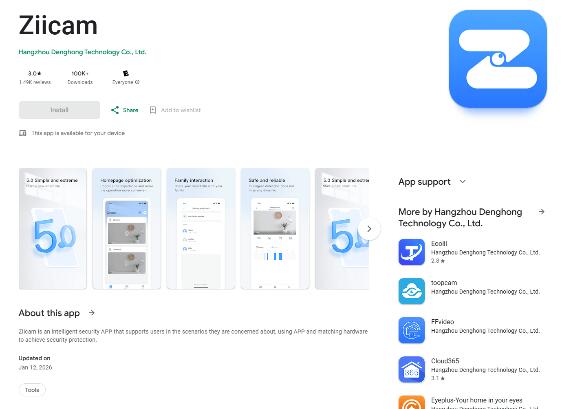
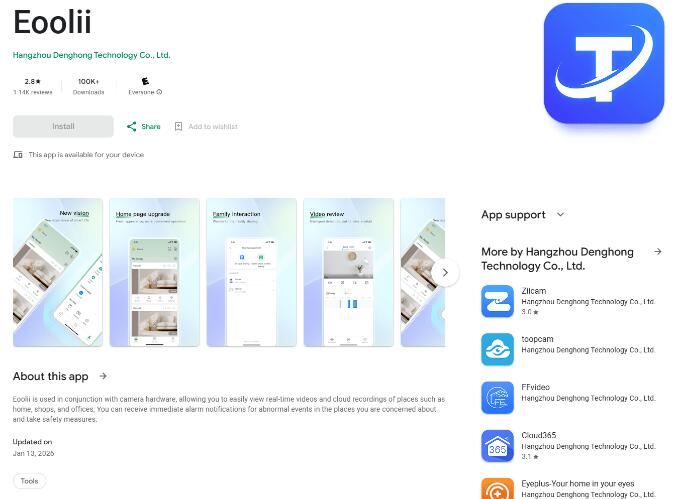
Infected apps on Google Play
As our recent research showed, preinstalled malware is a pressing issue on multiple Android devices. Without any actions on the user side, a device can be infected right out of the box. It is important for users to understand this risk and use security solutions that can detect this type of malware. Vendors likely didn’t know about the supply chain compromise that resulted in Keenadu infiltrating devices, as the malware was imitating legitimate system components. It is important to check every stage of the production process to ensure that device firmware is not infected,” comments Dmitry Kalinin, security researcher at Kaspersky.
See the post on Securelist for more information.
Recommendations:
- Use a reliable security solution to be promptly notified of similar threats on your device.
- If you are using a device with infected firmware, check for firmware updates. After the update, run a scan of the device with a security solution.
- If a system app is infected, we recommend that users stop using it and then disable it. If a launcher app is infected, we recommend disabling the default launcher and using third-party launchers.
About Kaspersky
Kaspersky is a global cybersecurity and digital privacy company founded in 1997. With over a billion devices protected to date from emerging cyberthreats and targeted attacks, Kaspersky’s deep threat intelligence and security expertise is constantly transforming into innovative solutions and services to protect individuals, businesses, critical infrastructure and governments around the globe. The company’s comprehensive security portfolio includes leading digital life protection for personal devices, specialized security products and services for companies, as well as Cyber Immune solutions to fight sophisticated and evolving digital threats. We help millions of individuals and nearly 200,000 corporate clients protect what matters most to them. Learn more at www.kaspersky.com.
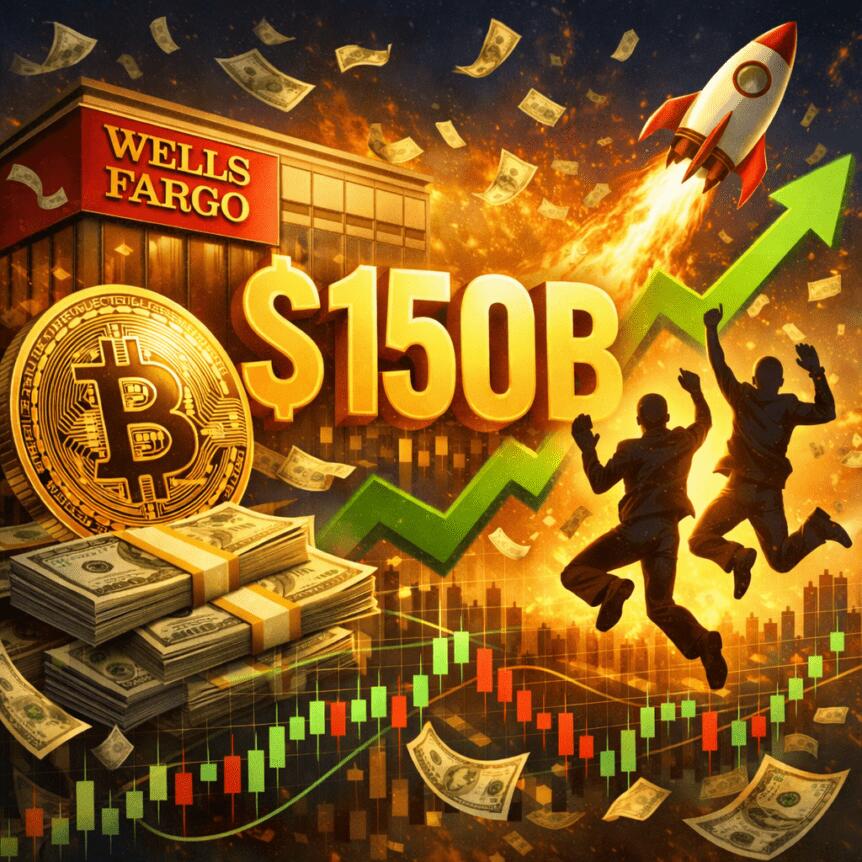
US tax filers may see bigger refunds in 2026 compared with previous years, a development one Wall Street strategist said could lift risk appetite for tech stocks and digital assets favored by retail investors. In a note cited by CNBC, Wells Fargo analyst Ohsung Kwon estimated that a wave of larger refunds could revive the so‑called “YOLO” trade, with as much as $150 billion potentially flowing into equities and Bitcoin by the end of March. The extra cash could be most visible among higher-income consumers, according to the note.
Key takeaways
- The Wells Fargo projection suggests up to $150 billion in fresh liquidity could reach equities and Bitcoin by the end of March, signaling a potential near‑term risk-on push if refunds materialize as expected.
- Higher‑income households are identified as the primary beneficiaries of the refund wave, which could amplify appetite for volatile, high‑beta assets alongside traditional tech bets.
- Liquidity may flow into Bitcoin and stocks popular with retail traders, including platforms like Robinhood and large cap names such as Boeing, depending on how sentiment evolves.
- Crypto demand remains sentiment‑driven: positive momentum could attract new funds, while lack of enthusiasm may prompt investors to shift to assets with stronger near‑term momentum.
- The macro backdrop includes policy changes tied to the One Big Beautiful Bill Act, signed in mid‑2025, which policymakers argued would trim federal spending and reshape tax refunds in 2025 and beyond.
Sentiment: Neutral
Price impact: Neutral
Market context: In liquidity cycles, tax refunds frequently influence risk appetite, and 2026 could test how retail cash infusions translate into crypto and tech equity demand amid shifting policy signals and macro dynamics.
Why it matters
The intersection of tax policy, consumer liquidity, and retail trading trends has long shaped short‑term risk sentiment in crypto markets. If the refund wave materializes as projected, Bitcoin and other digital assets could see fresh attention from buyers who previously favored high‑growth tech stocks. The timing is notable because refunds are expected to be most visible among higher‑income segments, a cohort historically more active in discretionary investing. This could amplify trading activity in early spring, with price action potentially moving in tandem with broader equity flows as investors rebalance portfolios around tax season liquidity.
On the policy side, the so‑called One Big Beautiful Bill Act, signed on July 4, 2025, is cited as a driver of larger refunds in 2025 and beyond. Proponents argued the measure would curb federal spending and reshape the fiscal landscape, creating a more favorable environment for household cash returns during tax filing periods. The exact allocation of this liquidity remains uncertain, but the implication is that macro signals could feed through to risk assets, including digital currencies, if investor confidence strengthens alongside improving sentiment in crypto markets.
From a market‑structure perspective, the narrative dovetails with ongoing activity from both retail traders and large holders. While some liquidity could tilt toward Bitcoin and equities, others may seek alternative assets with strong momentum or social traction. Observers note that the retail‑oriented ecosystem—platforms and apps that higher‑income consumers already use—could be pivotal in determining where the money lands. The dynamic is further complicated by divergent views on crypto’s near‑term trajectory, with “smart money” positioning painting a mixed picture of risk tolerance in the current cycle.
What to watch next
- Monitor the February–March refund cycle for material evidence of inflows into Bitcoin and consumer tech equities, as highlighted in the Wells Fargo note reported by CNBC.
- Track sentiment indicators across crypto markets; if retail sentiment turns positive, expect increased on‑ramps into digital assets and a potential uptick in on‑chain activity.
- Watch whale and smart‑money behavior for Bitcoin and Ether to gauge whether larger players are dialing up or dialing back exposure as liquidity shifts emerge.
- Observe policy developments and fiscal signals tied to the One Big Beautiful Bill Act to assess any shifts in tax refunds that could influence liquidity cycles.
- Observe the performance of retail‑favorable names like Robinhood and Boeing, which were cited as potential beneficiaries of broader liquidity recovery in a risk‑on environment.
Sources & verification
- CNBC coverage of Wells Fargo analyst Ohsung Kwon’s note on a potential $150 billion refund‑driven inflow into equities and Bitcoin by the end of March 2026.
- Nansen data on “smart money” positioning, including Bitcoin net short exposure and Ether accumulation across multiple wallets.
- The One Big Beautiful Bill Act, signed into law on July 4, 2025, which proponents say shaped tax refund dynamics in 2025 and onward.
Tax refunds, sentiment and the crypto liquidity swing in 2026
As 2026 unfolds, a wave of larger tax refunds could reshape the risk appetite that has underpinned a portion of the crypto market in recent years. Wells Fargo’s Ohsung Kwon, in a note highlighted by CNBC, argues that an acceleration in refunds could reignite a “YOLO” trading mindset among investors who are flush with tax cash. He estimates that as much as $150 billion could move into equities and Bitcoin by the end of March, with the strongest buoyancy likely concentrated among higher‑income households. The framing is important: this is not a guaranteed market impulse, but a liquidity signal that could steer behavior if consumer confidence remains intact and risk appetite returns after a period of uncertainty.
Bitcoin (BTC) demand, the analyst notes, could be highly sentiment dependent. If retail investors rally around crypto assets, new funds might flow into the space, potentially lifting demand for tokens across the sector. Conversely, if sentiment falters, investors may pivot toward assets with more immediate momentum and social traction. The study highlights a dynamic tension: crypto markets often ride the same liquidity waves as the broader stock market, but the timing and magnitude of inflows can diverge based on macro cues and the perceived staying power of the rally.
Adding nuance, Nicolai Sondergaard, a research analyst at Nansen, emphasizes that sentiment acts as a gating factor. “If sentiment starts to come around and retail sees positive upwards momentum in crypto assets, I see that as increasing the likelihood of funds flowing in this direction,” he told Cointelegraph. The caveat is clear: a lack of enthusiasm could encourage retail traders to seek assets with stronger near‑term momentum, potentially dampening crypto inflows even if refunds are robust. The outcome hinges not just on the size of the refunds but on how widely the wind shifts from caution to confidence across the retail trading ecosystem.
The macro backdrop remains complex. The policy shift tied to the One Big Beautiful Bill Act, signed into law in 2025, is frequently cited as a contributor to the broader liquidity environment. While the bill’s supporters framed it as a measure to trim federal spending and reallocate resources, critics warned of unintended consequences for the pace and distribution of tax refunds. In practice, liquidity—in the form of refunds and discretionary cash—can influence trading dynamics across both traditional equities and digital assets. In this context, crypto developers and market participants are watching not only on‑chain data but also the evolving policy landscape that could redefine the cushion of available capital for speculative bets.
On the supply side, market participants have shown a bifurcated stance. While some whales continue to accumulate spot Ether across multiple wallets, the smart‑money cohort has been net short on Bitcoin for a sizable cumulative amount, according to Nansen’s metrics. The divergence underscores a market where large holders are positioning for different outcomes than the broader retail narrative. It also implies that any rebound in risk appetite could be tested by how quickly the composition of buyers shifts from traders favoring short‑term profits to investors willing to hold through volatility. In the near term, the liquidity landscape remains unsettled, and the pace of inflows will likely hinge on a confluence of sentiment, policy signals, and on‑chain activity.
What to watch next (summary)
- Early‑spring refund data and corresponding flows into Bitcoin and select equities to confirm the magnitude of the YOLO bid.
- Shifts in retail sentiment toward crypto assets, as evidenced by on‑chain activity and exchange flows.
- Whale activity and smart‑money positioning for Bitcoin and Ether to gauge whether accumulation or unwind is prevailing.
- Policy updates related to tax refunds and federal spending to assess how fiscal changes influence liquidity dynamics.
- Market reactions in retail‑oriented platforms and names tied to high retail engagement, reflecting the broader risk‑on environment.

Raising capital is no longer the hardest part of building a blockchain project. Sustaining value after launch is. Today, many Web3 founders enter fundraising with strong technology, passionate teams, and promising roadmaps. Yet, within months of launching, their tokens lose momentum, investor confidence declines, and communities disengage. The problem is rarely the idea. It is usually the economic structure behind it.
Without clear token utility, disciplined emissions, and governance alignment, even well-funded projects struggle to survive volatile market cycles. This is why working with a proven ICO development company has become a strategic necessity rather than an optional choice. This guide is designed for serious founders, protocol teams, and enterprises who want to build scalable, investor-ready ecosystems. You will learn how sustainable tokenomics, structured governance, and professional execution can transform your ICO into a long-term growth engine.
Why Well-Funded ICOs Still Collapse After Launch
Many founders assume that once funding is secured, success will naturally follow. In reality, funding only creates opportunity. Execution determines survival. Capital can amplify progress, but it can also accelerate structural weaknesses if the foundation is not carefully designed. Even well-funded projects can unravel faster than undercapitalized ones, without a disciplined economic model and operational clarity.
Some of the most common reasons ICOs fail after raising capital include:
- Excessive token inflation that dilutes value
- Weak or unclear utility models
- Overgenerous early investor allocations
- Lack of post-launch engagement strategy
- Poor liquidity planning
- Absence of governance frameworks
When these issues combine, selling pressure increases while demand stagnates. The result is a rapid decline in market confidence. Investor sentiment shifts quickly, liquidity dries up, and community morale weakens. Founders then spend most of their time firefighting instead of building. A strong launch must be engineered with sustainability in mind from day one.
Get expert feedback on your tokenomics, compliance readiness, and launch plan.
How Weak Token Economics Destroys Long-Term Project Value
When token supply grows faster than real usage, price erosion becomes inevitable. When rewards are misaligned, participants exploit incentives instead of contributing value. When governance lacks structure, disputes paralyze development. Sustainable ICO development requires deep modeling of how tokens will circulate, accumulate value, and support growth over time. It is about aligning user behavior with network success.
Projects that ignore this reality often experience:
- Rapid investor exits
- Exchange delistings
- Reduced partnership interest
- Difficulty raising follow-on capital
- Long-term brand damage
Once trust is lost, rebuilding it is extremely costly.
What VCs & Strategic Investors Look for Before Backing an ICO
Institutional investors no longer invest based on whitepapers alone. They evaluate token launches using rigorous frameworks. Before committing capital, most professional investors examine:
Is the token essential to the ecosystem, or is it optional?
Tokens without core utility struggle to maintain demand. Investors look for clear, recurring use cases that generate consistent transactional activity and long-term relevance.
Are supply releases predictable and disciplined?
Uncontrolled inflation signals high risk. Well-structured emission schedules demonstrate financial discipline and protect early participants from excessive dilution.
Do founders and early backers have long-term lockups?
Short vesting often leads to early dumping. Extended vesting periods signal commitment and align leadership incentives with ecosystem growth.
Is there a clear plan for managing raised funds?
Poor treasury strategy weakens sustainability. Institutional backers expect transparent budgeting, reserve planning, and responsible capital deployment.
Do token holders have meaningful participation?
Governance builds long-term engagement. Clear voting systems and proposal mechanisms help prevent internal conflicts and promote community ownership.
Are security audits, compliance planning, and contingency strategies in place?
Strong risk management reduces operational uncertainty and protects both users and investors from avoidable losses.
Projects that satisfy these criteria attract stronger capital and long-term partners.
Uncover hidden gaps in your token model and strategy.
The Six Pillars of Scalable ICO Development Architecture
- Supply and Emission Control: Supply schedules must balance incentives and scarcity. Gradual emissions encourage participation without creating excessive selling pressure. Effective ICO development involves testing multiple scenarios to maintain stability across growth phases.
- Utility Driven Demand: Tokens must provide real access, functionality, or economic benefits. Utility should be embedded into core product operations, as artificial demand rarely sustains long-term engagement.
- Governance and Voting Rights: Transparent governance systems strengthen community trust and reduce centralization risk. Clear voting processes support sustainable decision-making.
- Treasury and Reserve Design: Capital allocation must support development, security, and operations for multiple years. Reliable ICO development services help structure treasuries for long-term financial discipline.
- Vesting and Lockups: Well-designed vesting protects against short-term speculation and reinforces long-term commitment from founders and early investors.
- Liquidity Strategy: Liquidity planning is essential to stabilize early trading and manage volatility through exchange partnerships and market-making support.
When these pillars work together, ecosystems remain resilient under pressure and are positioned for sustainable growth.
Why Strategic Development Partners Matter in High-Stakes ICO Launches
Building a compliant, secure, and scalable token ecosystem requires expertise across economics, technology, regulation, and community development. Professional ICO development services extend far beyond basic smart contract deployment by integrating multiple strategic functions into a unified launch framework. Experienced partners support founders by helping them:
- Identify economic vulnerabilities before they impact token stability
- Optimize token distribution and incentive structures for long-term sustainability
- Prepare institutional-grade technical, legal, and compliance documentation
- Coordinate comprehensive security audits and regulatory reviews
- Design transparent and scalable post-launch governance systems
- Enable long-term platform performance and infrastructure growth
This integrated approach minimizes execution risk, strengthens investor confidence, and supports sustainable ecosystem expansion.
Critical ICO Mistakes Even Experienced Founders Make
Common pitfalls in ICO development include:
- Copying popular token models without customization
- Underestimating liquidity requirements
- Ignoring regulatory exposure
- Overpromising roadmap milestones
- Delaying governance implementation
- Prioritizing hype over infrastructure
Avoiding these errors requires disciplined planning, experienced oversight, and regular external review.
Are You Ready for a High-Impact ICO Launch
The difference between a short-lived token launch and a scalable digital economy lies in preparation, structure, and execution. Serious founders understand that sustainable growth does not happen by chance. It is engineered through disciplined planning, economic modeling, compliance clarity, and technical precision. If you are raising capital, preparing for exchange listings, or designing tokenomics for long-term value, now is the moment to make strategic decisions. The right partner can help you identify blind spots, strengthen investor confidence, and protect your ecosystem from avoidable risk.
Antier brings deep expertise in end-to-end ICO development, combining tokenomics strategy, regulatory alignment, smart contract security, and ecosystem architecture into a unified execution framework. Our team works alongside funded founders and Web3 innovators to design investor-ready systems that are built to scale. If you are serious about launching a resilient and institutionally credible token ecosystem, let us evaluate your readiness and design a strategy tailored to your vision.
Frequently Asked Questions
01. What is the main challenge for blockchain projects after their launch?
The main challenge is sustaining value after launch, as many projects experience a decline in token momentum, investor confidence, and community engagement.
02. Why do well-funded ICOs still fail after raising capital?
Well-funded ICOs can fail due to issues like excessive token inflation, unclear utility models, poor post-launch engagement strategies, and lack of governance frameworks.
03. What can founders do to ensure the long-term success of their ICO?
Founders can ensure long-term success by focusing on sustainable tokenomics, structured governance, and professional execution from the very beginning of their project.
US tax filers may see bigger refunds in 2026 compared with previous years, a development one Wall Street strategist said may boost risk appetite for digital assets and tech stocks preferred among retail investors.
In a note cited by CNBC, Wells Fargo analyst Ohsung Kwon said the coming refund wave may help bring back the so-called “YOLO” trade, with as much as $150 billion potentially flowing into equities and Bitcoin (BTC) by the end of March. Kwon said the extra cash could be most visible among higher-income consumers.
“Speculation picks up with bigger savings…we expect YOLO to return,” wrote Wells Fargo analyst Ohsung Kwon in a Sunday note seen by news outlet CNBC. “Additional savings from tax returns, especially for the high-income consumer will flow back into equities, in our view,” he added.
Kwon said some of that liquidity could move into Bitcoin and into stocks popular with retail traders, including Robinhood and Boeing.
Cointelegraph contacted Wells Fargo for details on the assumptions behind the $150 billion estimate and how much of that total the bank expects could go to digital assets, but had not received a response by publication time.
Bitcoin demand depends on sentiment
While some of the taxpayer funds may flow into Bitcoin and digital assets, it’s important to consider the higher inflation and consumer spending compared to the period during the COVID-19 pandemic, Nicolai Sondergaard, research analyst at crypto intelligence platform Nansen, told Cointelegraph:
“If sentiment starts to come around and retail sees positive upwards momentum in crypto assets, I see that as increasing the likelihood of funds flowing in this direction.”
Conversely, retail investors may opt for other assets with “higher momentum and social stickiness,” if digital asset sentiment doesn’t improve in the near term, he said.
The larger tax returns are due to the passage of US President Donald Trump’s One Big Beautiful Bill, which included numerous favorable provisions for 2025 tax filings.
Trump signed the One Big Beautiful Bill Act into law on July 4, 2025, saying it would cut as much as $1.6 trillion in federal spending.
Related: BlackRock enters DeFi as institutional crypto push accelerates: Finance Redefined
Smart money bets on crypto market downside as whales quietly accumulate
Meanwhile, the whales, or large investors, continue their quiet spot accumulation of the leading cryptocurrencies, while the most profitable traders by returns, tracked as “smart money,” are betting on more crypto market downside.

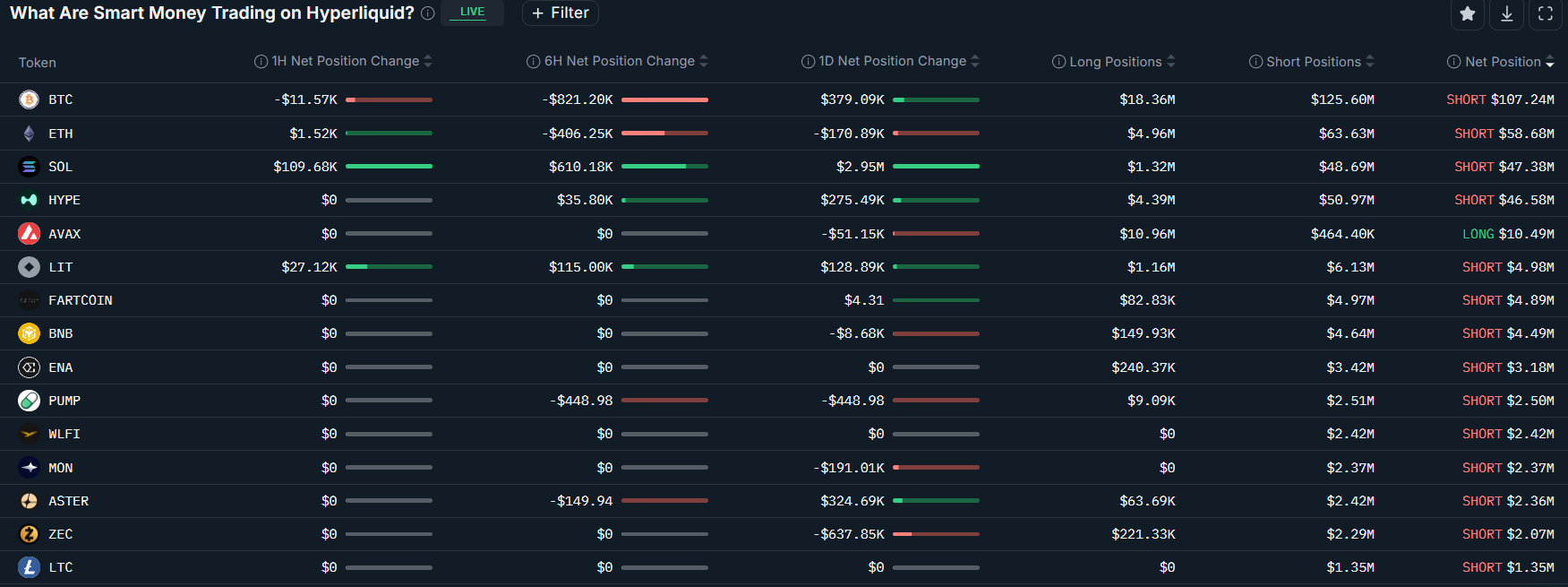
Smart money traders were net short on Bitcoin for a cumulative $107 million, along with most of the leading cryptocurrencies excluding Avalanche (AVAX), according to crypto intelligence platform Nansen.
Related: Binance completes $1B Bitcoin conversion for SAFU emergency fund
Still, whales acquired over $41.9 million worth of spot Ether (ETH) tokens across 22 wallets during the past week, marking a 1.7-fold increase in the spot purchases of this cohort.
Magazine: Bitcoin’s ‘biggest bull catalyst’ would be Saylor’s liquidation — Santiment founder
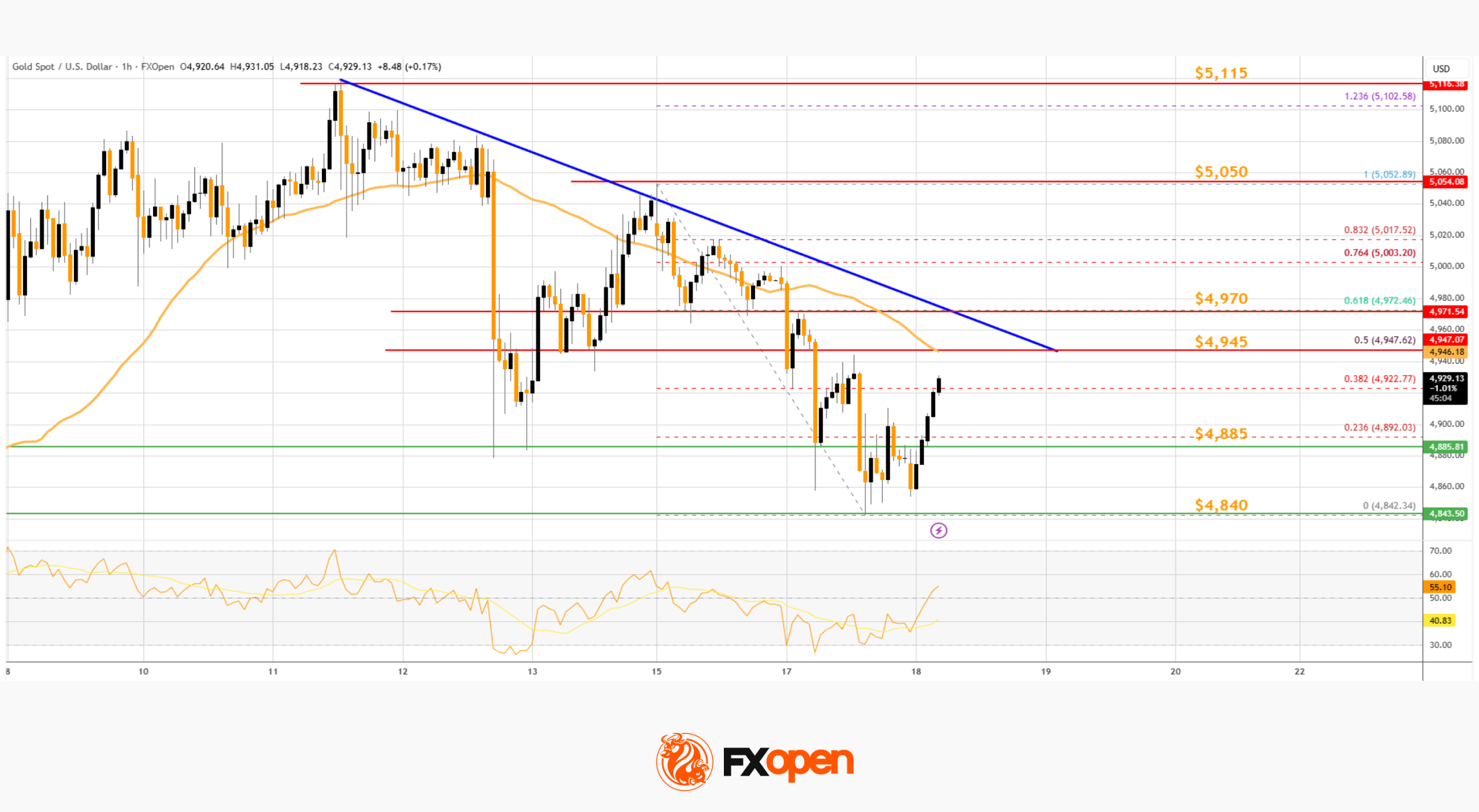
Gold price started a downside correction from $5,115. WTI Crude oil is now attempting to recover after sliding toward $61.80.
Important Takeaways for Gold and WTI Crude Oil Prices Analysis Today
· Gold price climbed higher toward the $5,120 zone before there was a sharp decline against the US Dollar.
· A key bearish trend line is forming with resistance at $4,945 on the hourly chart of gold at FXOpen.
· WTI Crude oil prices extended losses below the $63.40 pivot zone.
· It dipped below a rising channel with support at $62.85 on the hourly chart of XTI/USD at FXOpen.
Gold Price Technical Analysis
On the hourly chart of Gold at FXOpen, the price climbed above $5,000. The price even spiked above $5,100 before the bears appeared.
A high was formed near $5,115 before there was a fresh decline. The last swing high was near $5,052 before the price settled below $5,000 and the 50-hour simple moving average. It tested the $4,850 zone.
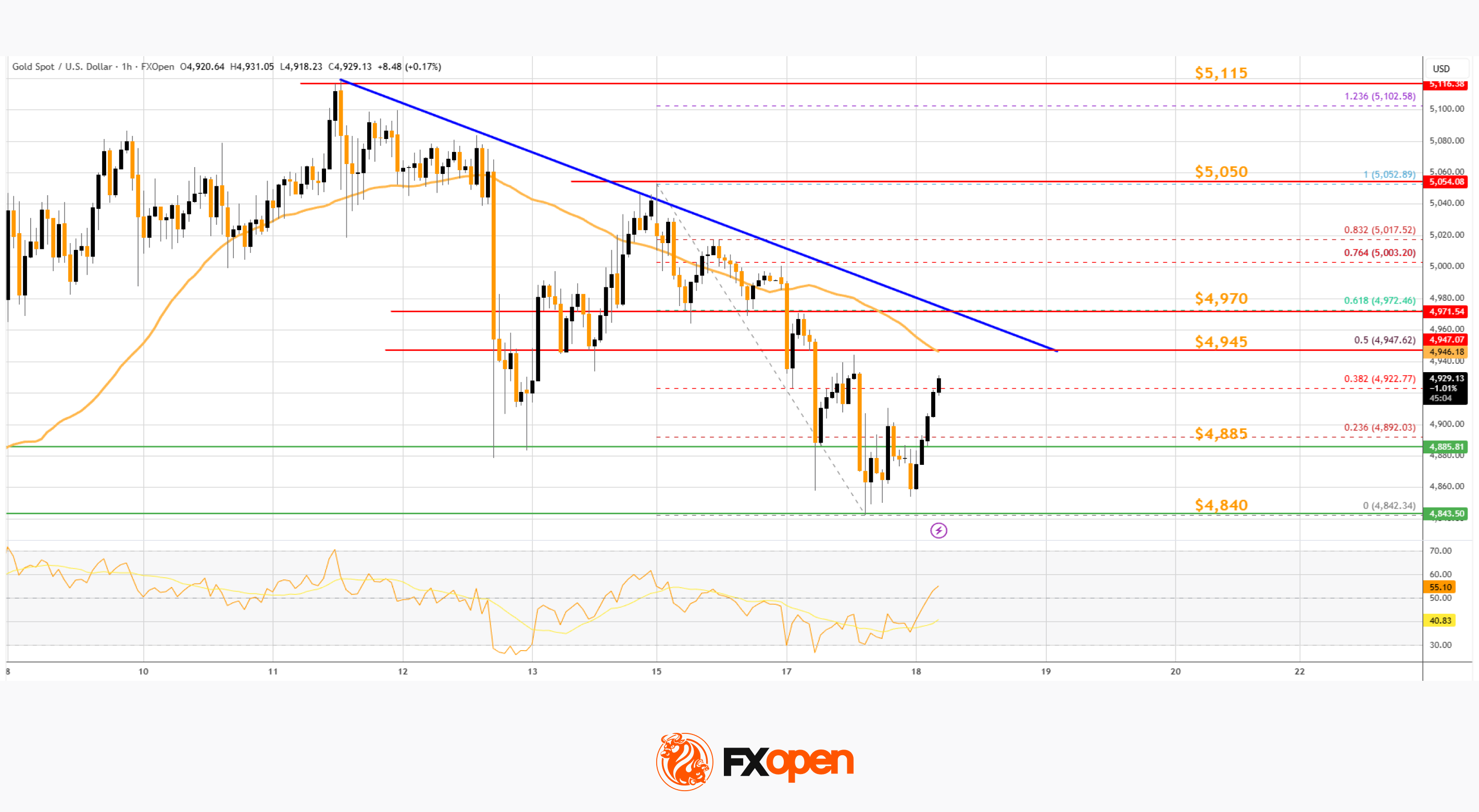
A low is formed near $4,842, and the price is now correcting losses. There was a minor move above the 23.6% Fib retracement level of the downward move from the $5,052 swing high to the $4,842 low.
Immediate barrier on the upside is $4,945, the 50-hour simple moving average, and the 50% Fib retracement. There is also a bearish trend line with resistance at $4,945. The first major hurdle for the bulls could be $4,970.
A close above $4,970 could send the price above $5,000. The next sell zone sits at $5,050, above which the price could test the $5,115 region. Any more gains might call for a move toward $5,200.
An upside break above $5,200 could send Gold price toward $5,285. Initial support on the downside is $4,885. The next key level is $4,840. If there is a downside break below $4,840, the price might decline further. In the stated case, the price might drop toward $4,750.
WTI Crude Oil Price Technical Analysis
On the hourly chart of WTI Crude Oil at FXOpen, the price struggled to continue higher above $65.00 against the US Dollar. The price formed a short-term top and started a fresh decline below $64.20.
There was a steady drop below the $63.40 pivot level. The bears even pushed the price below $62.50, a rising channel, and the 50-hour simple moving average. Finally, the price tested $61.80. The recent swing low was formed near $61.80, and the price is now correcting losses.
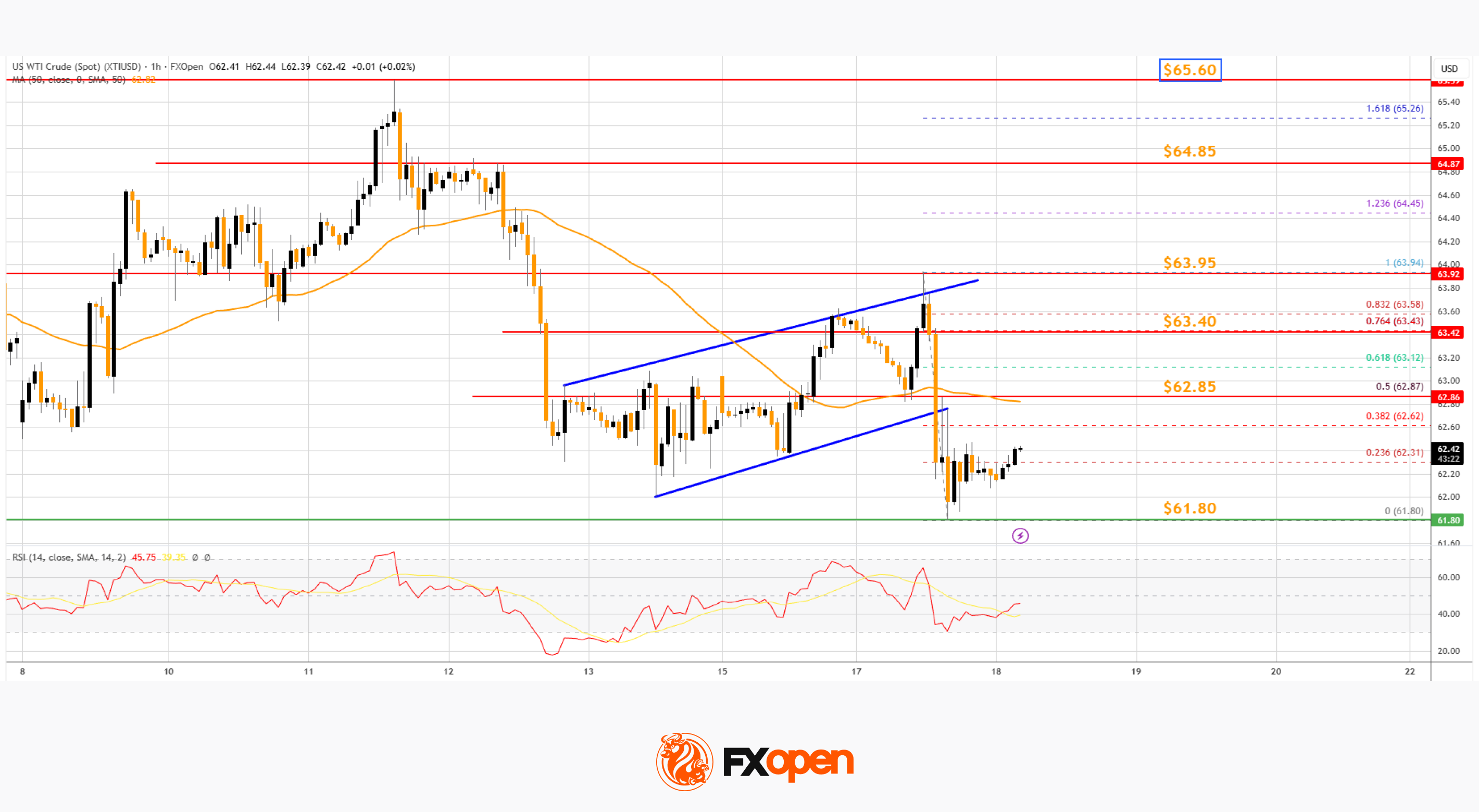
There was a move above the 23.6% Fib retracement level of the downward move from the $63.94 swing high to the $61.80 low. On the upside, immediate resistance is near the 50% Fib retracement at $62.85.
The main hurdle is $63.40. A clear move above $63.40 could send the price toward $63.95. The next stop for the bulls might be $64.85.
If the price climbs further, it could face sellers near $65.60. Immediate support is $61.80. The next major breakdown level on the WTI crude oil chartis $60.50. If there is a downside break, the price might decline toward $58.80. Any more losses may perhaps open the doors for a move toward $56.50.
Start trading commodity CFDs with tight spreads (additional fees may apply). Open your trading account now or learn more about trading commodity CFDs with FXOpen.
This article represents the opinion of the Companies operating under the FXOpen brand only. It is not to be construed as an offer, solicitation, or recommendation with respect to products and services provided by the Companies operating under the FXOpen brand, nor is it to be considered financial advice.
Trends to Watch (HIP-3 protocols, AI trenches)
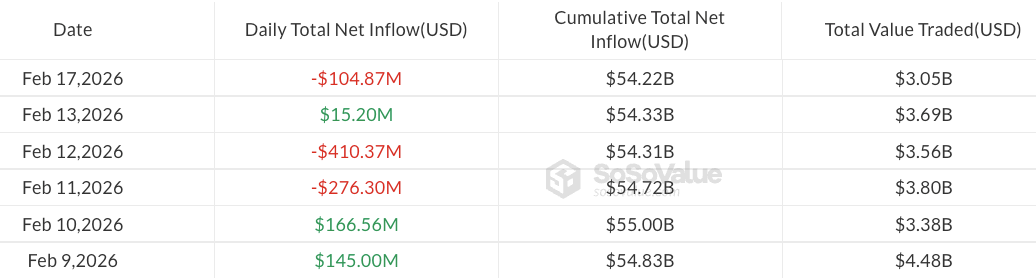
US spot Bitcoin exchange-traded funds (ETFs) posted $104.9 million in net outflows on Tuesday in the first trading session this week.
Total trading volume in spot Bitcoin (BTC) ETFs fell to just over $3 billion, down nearly 80% from a record $14.7 billion on Feb. 5, reflecting a continued slowdown in trading activity, according to SoSoValue data.

The outflows came as another round of institutions reported their Bitcoin ETF holdings for the fourth quarter of 2025, with Jane Street ranking as the second-largest buyer of BlackRock’s iShares Bitcoin ETF (IBIT) in Q4, buying $276 million.
Q4 also saw a new IBIT entrant, an obscure Hong Kong-based company called Laurore, which acquired $436.2 million of the ETF in a single purchase reported to the US Securities and Exchange Commission.
A potential sign of Chinese institutions moving into Bitcoin?
According to Bitwise Investments adviser Jeff Park, Laurore’s newly disclosed position in IBIT could be an early indication of institutional Chinese capital entering Bitcoin.
Park said Laurore has no public footprint — no website or press — and the only available information is that the filer’s name is Zhang Hui, the Chinese equivalent of “John Smith.”

While Park speculated that the investment may be linked to capital flight, some commentators questioned why the company would choose to buy Bitcoin through an ETF rather than directly.
Brevan Howard slashes IBIT holdings by 85%
Beyond Laurore and Jane Street, several institutions made significant moves with IBIT in Q4 2025. Weiss Asset Management reportedly added about 2.8 million shares ($107.5 million), while 59 North Capital increased its position by 2.6 million shares ($99.8 million).
Abu Dhabi’s state-owned investment firm Mubadala Investment also boosted its IBIT holdings by 45%, rising from 8.7 million shares in Q3 to 12.7 million in Q4, valued at $630.7 million.

In contrast, some companies cut their Bitcoin ETF exposure in Q4 2025. Brevan Howard reduced its IBIT holdings, dropping about 85% from 37 million shares ($2.4 billion) in Q3 2025 to about 5.5 million shares ($273.5 million) in Q4.
Goldman Sachs also trimmed its IBIT holdings by about 40%, leaving around $1 billion in assets.
Magazine: Is China hoarding gold so yuan becomes global reserve instead of USD?

A flood of fresh cash might about to land in crypto. Roughly $150 billion in tax refunds will hit U.S. consumer accounts by the end of March.
Some analysts think part of that money could drift straight into risk assets. Including crypto. Wells Fargo strategists say this refund wave, boosted by 2026 tax incentives, may quietly fuel retail participation again.
And the timing is interesting. Markets are sitting at key technical levels. If even a fraction of that capital rotates into digital assets, the retail bid could show up right when it matters most.
Key Takeaways
- $150B Liquidity Wave: Wells Fargo analysts project roughly $150 billion in refunds will be distributed by late March.
- Refunds Are Up 11%: Early IRS data shows the average refund size has jumped to $2,290, increasing retail purchasing power.
- Retail Catalyst: Historical data suggests the “refund effect” correlates with increased inflows into retail-heavy crypto assets.
Why Does Refund Season Matter for Crypto?
Liquidity moves markets. And right now, the U.S. Treasury is about to inject a wave of it. After the One Big Beautiful Bill passed in July 2025, tax cuts boosted refund sizes for a lot of Americans.
Treasury Secretary Scott Bessent has already hinted that refunds this season could be “very large.” That means more disposable cash landing in bank accounts.
Average tax refunds are projected to jump by $1,000 this year — returning $91 BILLION back to the American people. — Congressman Gabe Evans (@repgabeevans) February 7, 2026
The largest tax refund season in U.S. history is here thanks to @HouseGOP’s Working Families Tax Cuts.
More money back in your pocket. 
 pic.twitter.com/U3hktiKsq7
Historically, lump sum payouts like this do not just go toward bills. A slice often flows into investments. And in recent cycles, that has included digital assets. Retail participation tends to rise when people feel flush.
Refund averages usually peak around mid February. That timing lines up with the current surge in activity across several altcoins. When fresh cash meets technical breakout zones, the reaction can be sharper than most expect.
The Data: Bigger Checks, Faster Deposits
The early numbers for the 2026 filing season are already coming in hot. By February 6, the IRS had processed more than 20.6 million returns and sent out nearly $16.954 billion in refunds.
The average check is now around $2,290, up roughly 10.9% from last year.
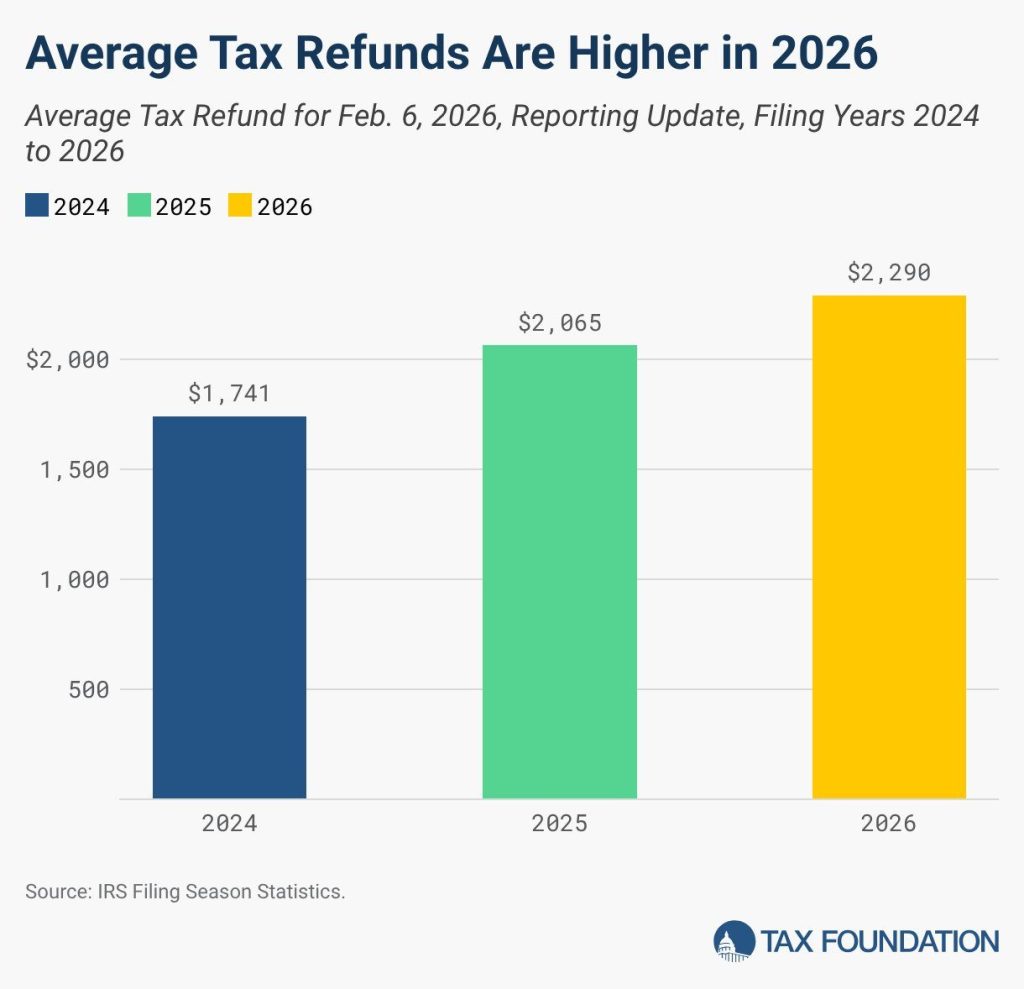
Direct deposits are even higher, averaging about $2,388. And the money moves quickly. Most e filers see funds within about 21 days, which means that cash is ready to be deployed almost immediately.
Another wave is coming too. Once PATH Act restrictions lift after February 15, refunds tied to the Earned Income Tax Credit start flowing. Historically, that second wave is larger and hits later in February.
Fresh liquidity entering an already concentrated exchange environment can have an outsized effect. Especially if even a small slice finds its way into risk assets.
Will This Trigger the Next Leg Up?
Tax refund season hitting at the same time as improving regulatory tone is not random timing. It creates a strong backdrop for risk assets. Funding rates are already flashing extremes, which tells you shorts are crowded.
If even a fraction of retail refund money rotates into spot crypto, that buying pressure could trigger a fast short squeeze.

The macro tone adds fuel. Political signals around clearer crypto legislation are improving sentiment. When retail feels regulatory risk is fading, confidence returns quicker.
Over the next six weeks, roughly $150 billion will move into consumer accounts. Not all of it will hit crypto, but it does not need to. Even a small percentage can shift momentum in a leveraged market.
Keep an eye on the weekly IRS updates toward the end of February. That data will show whether the liquidity wave is building or already peaking.
The post $150B in US Tax Refunds Could Fuel Fresh Crypto Inflows, Historical Data Suggests appeared first on Cryptonews.
The New Zealand dollar weakened today after the Reserve Bank of New Zealand (RBNZ) announced its decision to keep interest rates unchanged.
While the decision itself was widely expected, the accompanying forecasts drew attention due to their dovish tone. According to the official statement:
→ monetary policy is likely to remain accommodative for some time, although the possibility of a rate hike in the fourth quarter was not ruled out;
→ inflation is returning to the target range.
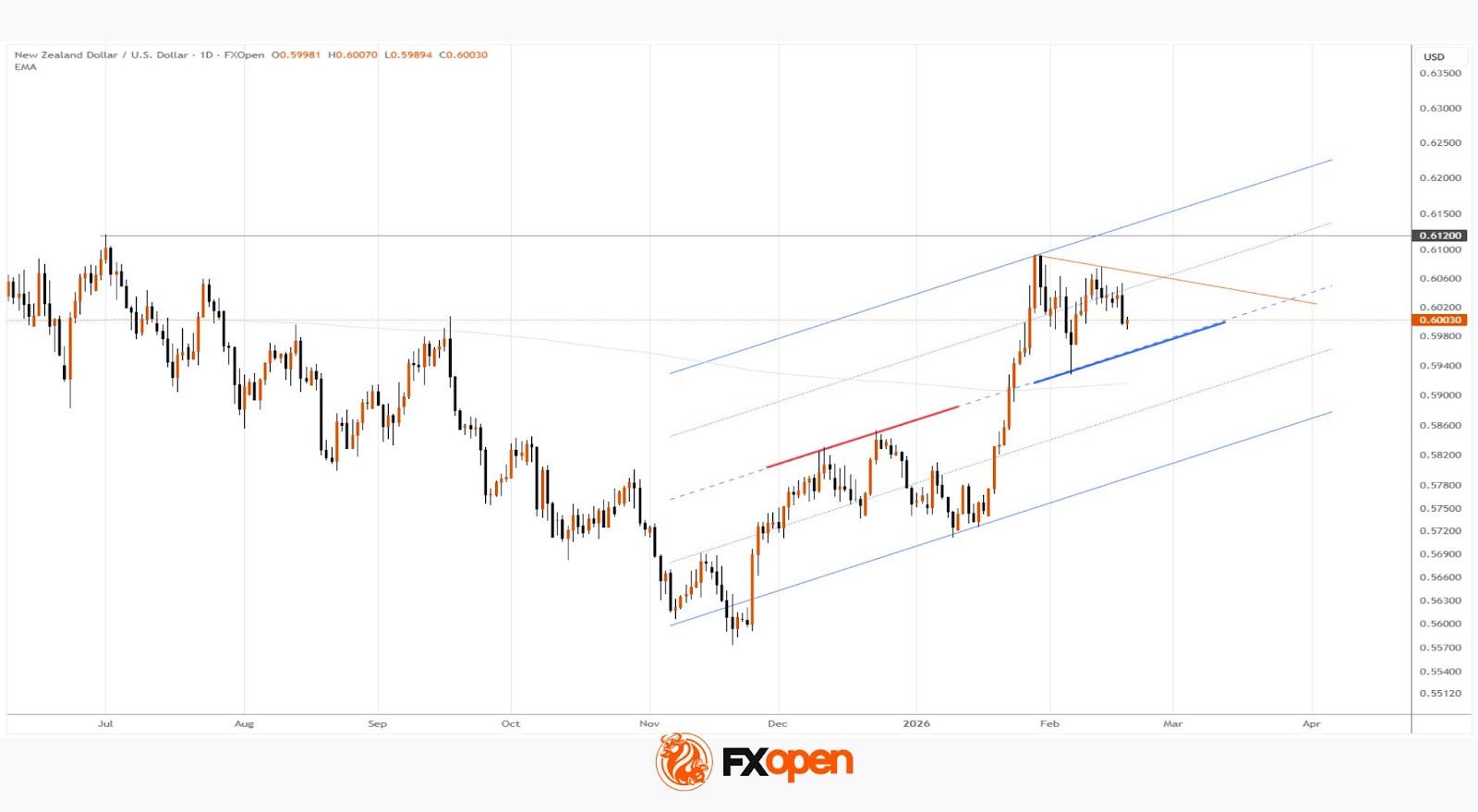
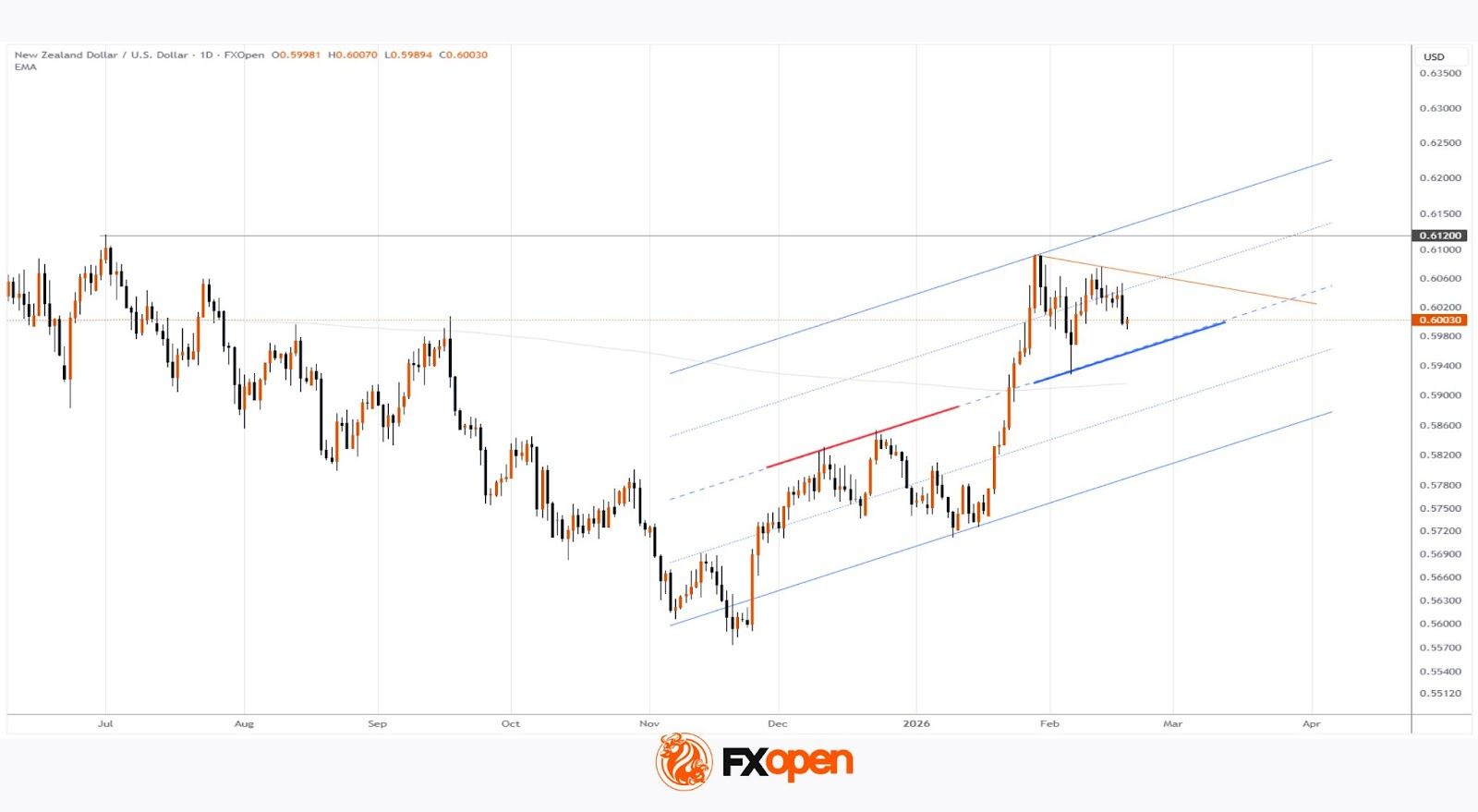
The currency market reacted by pushing the NZD lower against major counterparts. NZD/USD, for example, fell to its lowest level in nearly two weeks.
Technical Analysis of NZD/USD
The New Zealand dollar had been showing bullish momentum since late autumn 2025, resulting in the formation of an ascending channel. Notably, the channel’s median line shifted from acting as resistance to serving as support (highlighted by the thicker lines).
It is worth noting that the reversal from the 21 January peak — where price touched the upper boundary — occurred in a sharp manner. Near the 2025 high, bears appear to have regained confidence and seized the initiative.
→ From a bullish perspective, the aforementioned median line may provide support.
→ From a bearish standpoint, a descending trend line drawn through the lower high of 12 February may act as resistance.
Against this backdrop, it is reasonable to assume that the market could enter a consolidation phase over the coming weeks.
Trade over 50 forex markets 24 hours a day with FXOpen. Take advantage of low commissions, deep liquidity, and spreads from 0.0 pips (additional fees may apply). Open your FXOpen account now or learn more about trading forex with FXOpen.
This article represents the opinion of the Companies operating under the FXOpen brand only. It is not to be construed as an offer, solicitation, or recommendation with respect to products and services provided by the Companies operating under the FXOpen brand, nor is it to be considered financial advice.
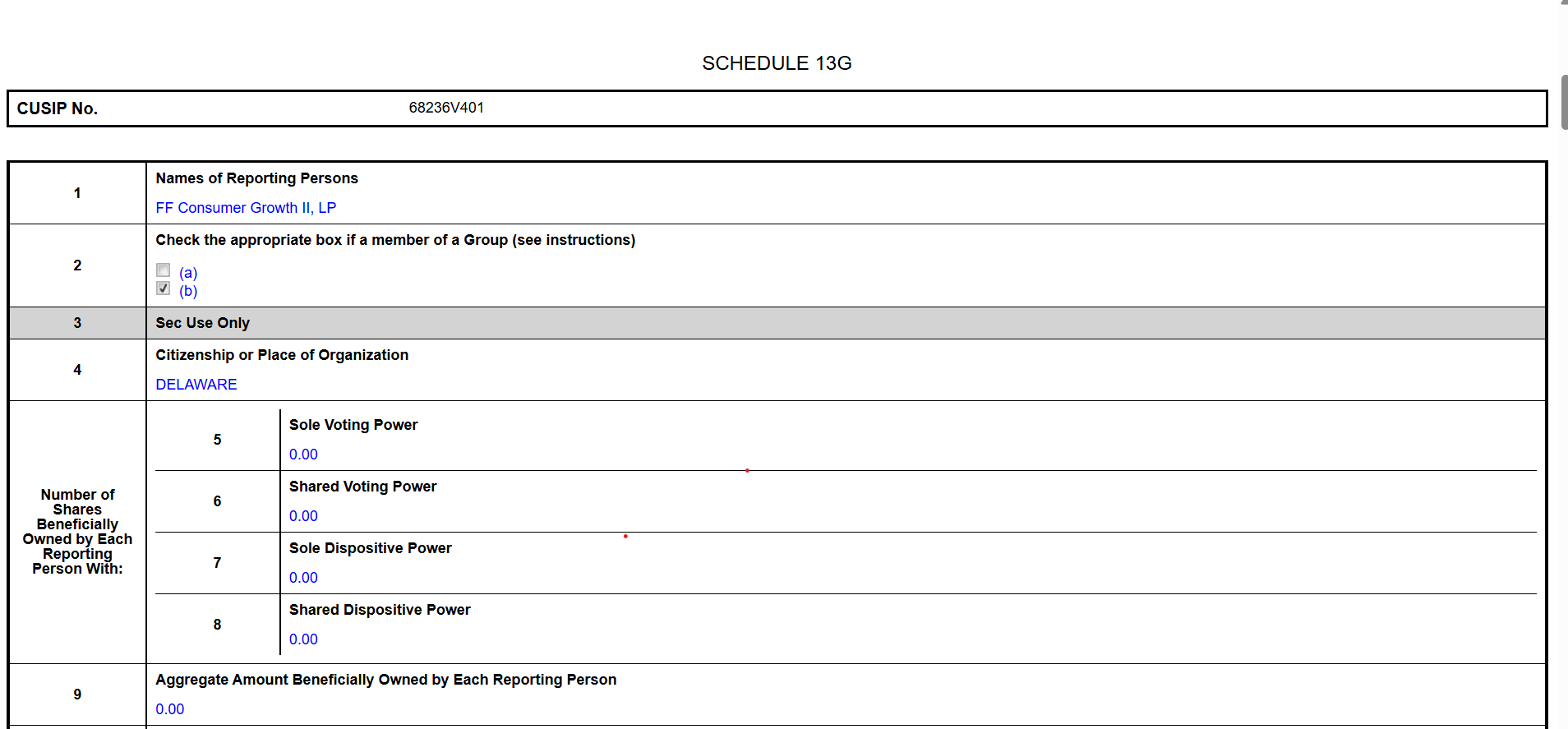
Billionaire tech investor Peter Thiel’s Founders Fund has fully exited Ether treasury company ETHZilla, according to a Tuesday filing with the United States Securities and Exchange Commission (SEC).
Entities linked to Thiel now report owning zero shares in the company in a 13G amendment filed on Tuesday, after disclosing a 7.5% stake on Aug. 4, 2025.
At that time, the group beneficially owned 11,592,241 shares of what was then known as 180 Life Sciences Corp., representing 7.5% of the 154,032,084 shares outstanding and worth about $40 million based on trading at around $3.50 per share in early August.

180 Life Sciences rebrands to ETHZilla
180 Life Sciences raised $425 million in July 2025 to launch an Ether treasury strategy and rebrand as ETHZilla.
The company later moved to raise another $350 million via convertible bonds in September to expand its Ether (ETH) holdings and deploy them across decentralized finance (DeFi) and tokenized assets, at one point holding more than 100,000 Ether.
Related: Bitmine’s staked Ether holdings point to $164M in annual staking revenue
ETHZilla began unloading tokens as markets turned, liquidating 24,291 Ether for $74.5 million in December 2025 at an average price of $3,068.69 per token, to repay debt, leaving about 69,800 ETH on its balance sheet.
Strain on Ether treasury company models
Thiel’s exit is the latest stress signal for public companies with crypto treasuries built around Ether rather than Bitcoin (BTC).
Other large Ether accumulators are taking different approaches. BitMine Immersion Technologies, the largest listed Ethereum holder, acquired a further 40,613 ETH on Feb. 9, lifting its total holdings to more than 4.325 million ETH, worth about $8.8 billion at current prices.
Trend Research, on the other hand, began unwinding its entire Ethereum position this month, selling 651,757 ETH for about $1.34 billion on Feb. 8, locking in an estimated $747 million realized loss.
ETHZilla has since tried to diversify by launching ETHZilla Aerospace, a subsidiary offering tokenized exposure to leased jet engines. However, Thiel’s exit magnifies how volatile Ether‑heavy treasury strategies have become in a market still digesting last year’s peak.
Magazine: Big Questions: Is China hoarding gold so yuan becomes global reserve instead of USD?

The Raspberry Pi As A Studio Camera

Mortgage rates could fall after inflation rate drop

Zuckerberg testifies in landmark trial that could reshape Big Tech liability


-

 Sports6 days ago
Big Tech enters cricket ecosystem as ICC partners Google ahead of T20 WC | T20 World Cup 2026
-

 Video2 days ago
Bitcoin: We’re Entering The Most Dangerous Phase
-

 Tech3 days ago
Luxman Enters Its Second Century with the D-100 SACD Player and L-100 Integrated Amplifier
-

 Video5 days ago
The Final Warning: XRP Is Entering The Chaos Zone
-
 Tech1 day ago
The Music Industry Enters Its Less-Is-More Era
-

 Sports1 day ago
GB's semi-final hopes hang by thread after loss to Switzerland
-

 Crypto World1 day ago
Can XRP Price Successfully Register a 33% Breakout Past $2?
-

 Business11 hours ago
Infosys Limited (INFY) Discusses Tech Transitions and the Unique Aspects of the AI Era Transcript
-

 Video1 day ago
Financial Statement Analysis | Complete Chapter Revision in 10 Minutes | Class 12 Board exam 2026
-

 Crypto World4 days ago
Bhutan’s Bitcoin sales enter third straight week with $6.7M BTC offload
-
 Crypto World7 days ago
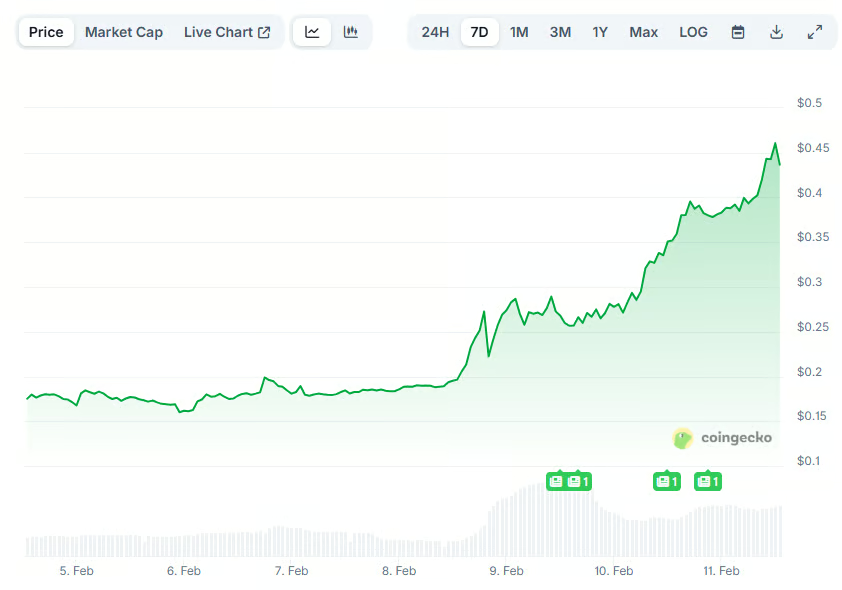
Pippin (PIPPIN) Enters Crypto’s Top 100 Club After Soaring 30% in a Day: More Room for Growth?
-
 Video6 days ago
Prepare: We Are Entering Phase 3 Of The Investing Cycle
-

 Tech2 hours ago
Retro Rover: LT6502 Laptop Packs 8-Bit Power On The Go
-
 NewsBeat3 days ago
The strange Cambridgeshire cemetery that forbade church rectors from entering
-

 Business6 days ago
Barbeques Galore Enters Voluntary Administration
-

 Business4 hours ago
Tesla avoids California suspension after ending ‘autopilot’ marketing
-
 Crypto World6 days ago
Ethereum Price Struggles Below $2,000 Despite Entering Buy Zone
-
 NewsBeat3 days ago
Man dies after entering floodwater during police pursuit
-

 Crypto World5 days ago
Kalshi enters $9B sports insurance market with new brokerage deal
-

 NewsBeat4 days ago
UK construction company enters administration, records show