

Crypto World
Peter Thiel Cuts All Ties With Ethereum Treasury Firm

Billionaire venture capitalist and co-founder of PayPal and Palantir Technologies, Peter Thiel’s Founders Fund, has fully divested from ETHZilla, a digital asset treasury firm that holds Ethereum (ETH).
The development comes as digital asset treasury firms face mounting pressure amid the broader crypto market downturn.
Sponsored
Sponsored
Peter Thiel Cuts Ties With ETHZilla During Crypto Market Slump
The digital asset treasury wave gained momentum last year, with several companies adopting Strategy’s (formerly MicroStrategy) 2020 Bitcoin (BTC) playbook. Firms began accumulating cryptocurrencies as reserve assets, attracting heightened investor attention as prices climbed and equity valuations expanded.
BeInCrypto reported in August 2025 that through entities such as The Founders Fund, Thiel controlled a 7.5% stake in ETHZilla. However, the latest SEC filing shows that entities managed by Thiel reported zero ownership in the company by the end of 2025, indicating a complete exit.
“This matters because Thiel is considered smart institutional capital, and a full exit from an ETH treasury firm could signal shifting sentiment, risk reduction, or a strategic rotation away from Ethereum exposure,” Crypto Town Hall posted.
The move comes against the backdrop of a broader market downturn. In October, crypto markets suffered a sharp downturn, often referred to as the “10/10” or “Black Friday” crash. The subsequent months extended the decline.
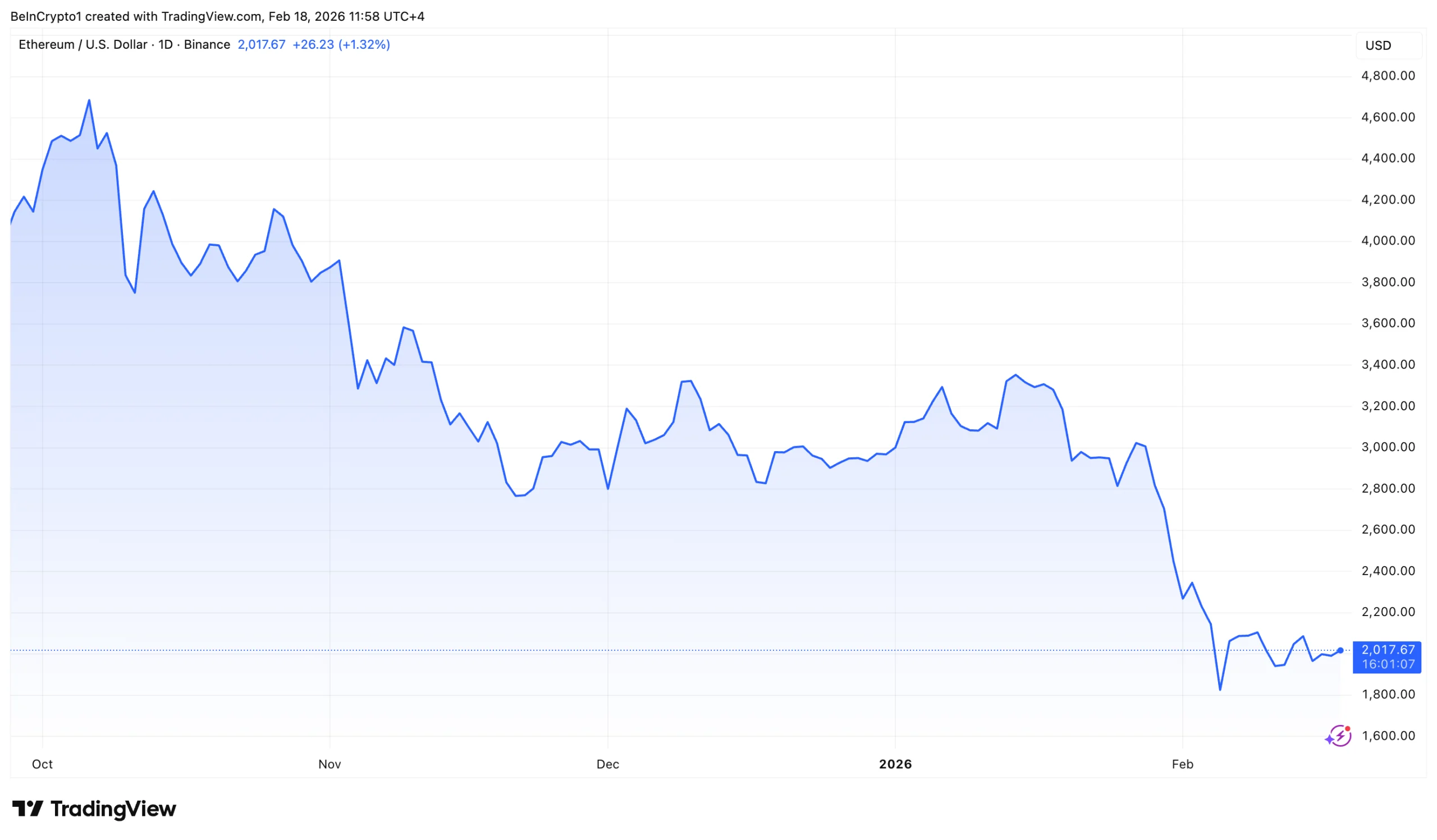
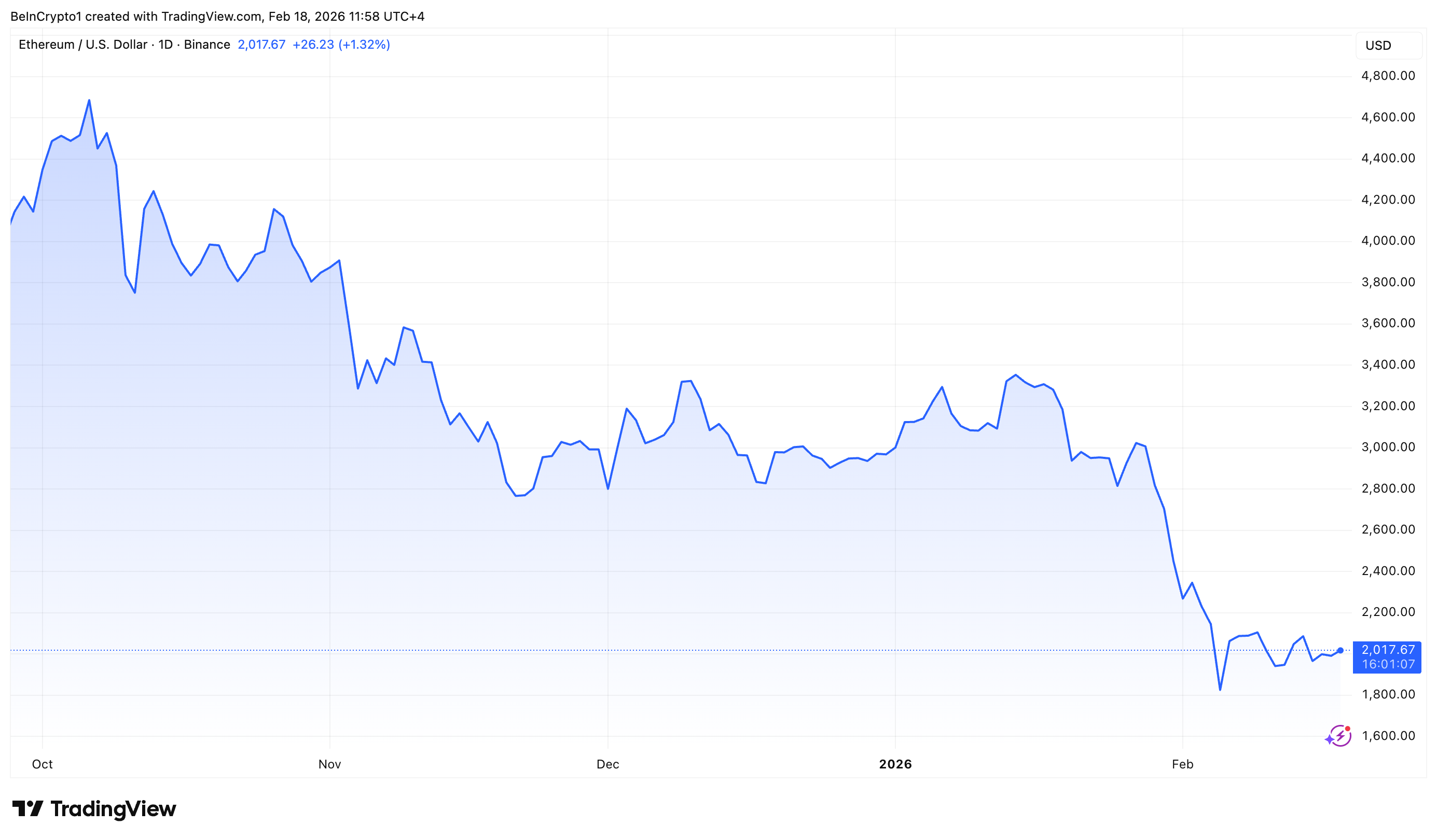
According to CryptoRank data, Ethereum fell 28.4% in Q4 2025, marking its first negative fourth quarter since 2022. Although 2026 began with a brief recovery, the rebound quickly reversed.
Sponsored
Sponsored
ETH closed January 2026 down 17.7%, and so far in February, its price has declined another 18.1%. At press time, it traded at $2,017.
Treasury Strategy Under Strain as Ethereum Decline Hits Corporate Holders
The sustained price weakness has directly impacted digital asset treasury firms, reducing the value of their crypto holdings and pressuring stock prices. For example, BitMine is currently sitting on unrealized losses exceeding $7 billion. Furthermore, its share price is down 25.7% year-to-date.
ETHZilla, which previously operated as 180 Life Sciences before pivoting toward an Ethereum treasury strategy and rebranding, has faced similar headwinds. At its peak, the company held more than 100,000 ETH.
As market conditions deteriorated in October, the company moved quickly to trim its exposure. Toward the end of that month, ETHZilla offloaded roughly $40 million in Ether, directing the proceeds toward share buybacks.
A second round of sales followed in December, totaling about $74.5 million. The funds were allocated to repay senior secured convertible debt. CoinGecko data shows the company now holds 69,802 ETH, a substantial reduction from its previous peak position.
The company has since outlined yet another strategic shift. According to Bloomberg, ETHZilla’s wholly owned subsidiary, called ETHZilla Aerospace, is seeking to provide tokenized exposure to equity in leased jet engines.



Milo, a U.S. cryptocurrency lending business that specializes in crypto-backed mortgages, has originated over $100 million in home loans, including the company’s largest single transaction to date, a $12 million crypto mortgage.
The firm, which holds mortgage provider licenses in ten U.S. states with more to follow, has a perfect track record of zero margin calls across its mortgage portfolio, despite enduring consistently choppy periods of volatility for bitcoin and other cryptos, Milo said in a press release on Wednesday.
The firm allows crypto holders to pledge their bitcoin or ether as collateral for loan amounts up to $25 million without having to sell their digital assets, eliminating the need for cash down payments and avoiding costly taxable events.
Stepping back, Milo founder Josip Rupena said people who were perhaps advised by a friend to buy some Bitcoin 10 years ago say, and had the courage to hold on to it through recurring cycles of volatility, may find that today maybe 95% of their net worth is in crypto.
Such people will typically be aged between 30 and 55, have a job, and perhaps a retirement account, but they don’t have enough income to buy the home they would like to, Rupena said.
“Our typical transaction is a million and a half dollar home,” Rupena said in an interview. “A customer might make $100k a year and their crypto net worth might be anywhere from three to seven million. If you were to replace Bitcoin with Apple stock, a product like ours would probably not need to exist. But because the consumer owns an asset that is not widely accepted, plus its concerns around the volatility, means that products like ours do need to exist to help them buy a home.”
Milo asks for 100% of the value of the property in crypto collateral, which can be held with qualified custodians like Coinbase or BitGo, or there is a self-custodial option for those who want to keep complete control of their assets. The loans, which start at 8.25%, can also be used for things like acquiring land, funding home improvements, and business investments.
Unlike regular crypto loans which can have margin calls at 25% drops, Milo designed the product to be more conservative and accommodate 65% drawdowns.
Even in turbulent times like the past few months, if a drawdown situation were to cross the necessary threshold, Milo would reduce the value of the loan, Rupena said, so that the customer could continue to have the mortgage.
“We would just essentially derisk the 100% and bring it down to a 65% or 70%, like a regular mortgage, and then they could continue to make payments. We designed it in a way that as long as a person can continue to make payments, they’re going to be able to continue to have this home. They’re not going to lose their home, because Bitcoin goes down,” he said.
So far Milo has done several transactions in the property hotspot of Miami and more in other parts of Florida, as well as Texas, California, Colorado, Connecticut and Arizona. The $12 million transaction mentioned in the press release was in Tennessee, Rupena said.
The product has been given the blessing of bitcoin pioneer and CEO of Blockstream, Adam Back.
“Milo’s product is a game changer in bitcoin lending and unlocks real world use cases for so many bitcoiners,” said Back in a statement. “While bitcoin continues to appreciate, buyers are able to build equity in real estate and don’t have to sell their long term conviction, bitcoin.”
Solana-based memecoin launchpad Pump.fun has rolled out a new feature that shifts rewards toward memecoin traders rather than its deployers — a tweak to its fee model that once generated over $15 million in a single day at its peak.
In a post to X on Tuesday, Pump.fun said the platform’s memecoin creators can now decide whether a token “truly deserves” Creator Fees, or whether it’s best to redirect rewards to traders engaging with the token through “Cashback Coins.”
Pump.fun’s original model features Creator Fees, giving token creators 0.3% of all fees generated by the tokens they launch.
However, Pump.fun said not all tokens deserve Creator Fees because many tokens achieve success without a team or project lead, thereby disproportionately rewarding token deployers.
Creator Fees need change. Not every token deserves Creator Fees.
Now, users have the ability to decide whether a token truly deserves Creator Fees, or whether it makes more sense to reward the traders engaging with the token.
Cashback Coins are now live. Learn more 👇 pic.twitter.com/UbYoAbQ1Ya
— Pump.fun (@Pumpfun) February 17, 2026
“Now, traders can choose to engage with tokens they feel the most aligned with, ultimately letting the market decide who gets rewarded and where the bar is set.”
Pump.fun said coin creators must choose between the Creator Fees or Trader Cashback model before launching. Once chosen, the decision is irreversible.
Terminal, a crypto trading platform built into Pump.fun, said Cashback Coins are generated on every trade made and are only accessible through Terminal.
It comes as analysts from onchain analytics firm Santiment said on Friday that memecoins are showing signs of a potential bottom.
“This collective acceptance of the ‘end of the meme era’ is a classic capitulation signal,” Santiment said, explaining that when a sector of the market is completely written off, it is often the “contrarian time” to start paying attention.
Pump.fun fees have fallen over the last year
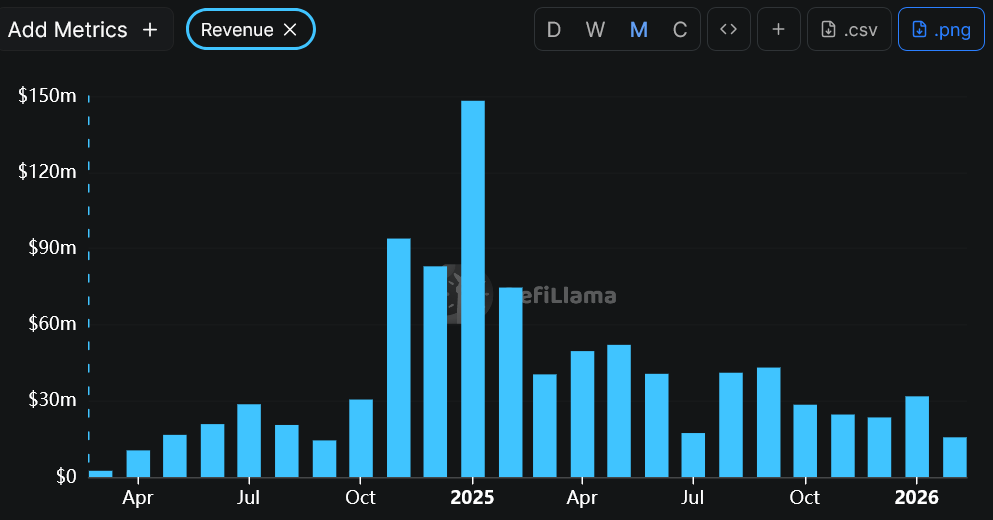
Pump.fun’s new rewards feature comes as it recorded $31.8 million worth of fees in January, marking a 75.6% fall from the $148.1 million posted in January 2025 — the platform’s best-performing month to date.
Pump.fun has brought in $15.6 million so far in February, putting it on track to fall short of its January total.

The change to the rewards model also follows months of criticism that only a small number of traders were profiting on Pump.fun, while the vast majority of retail traders were incurring losses.
Data from Dune Analytics shows that of the 58.7 million crypto wallets that have interacted with Pump.fun, only 4.76 million have profited between $1,000 and $10,000, while 969,780 wallets have posted winnings between $10,000 and $100,000.
Less than 13,700 Pump.fun wallets have reached millionaire status on the platform.
The new feature was received well by many in the Pump.fun community, while others, such as X user Coos, pondered whether the rewards model could reduce incentives for developers to launch new coins:
“So devs have less reasons to push coins longer, as the most lucrative time is when coins are still on pf, and have just graduated where there is the most volume.”
Coinbase’s Base shut down its Creator Rewards offering
While Pump.fun has changed its rewards model, others have shut down their rewards programs entirely.
On Feb. 10, Coinbase’s Base App sunset its Creator Rewards program as part of a strategic shift to focus entirely on tradable assets.
Related: Zora debuts attention markets on Solana, betting on social trends
The Creator Rewards program launched in July and was intended to make Base, Coinbase’s Ethereum layer-2, a more social ecosystem, where activity translated into earnings.
The Base App X account said it had paid around $450,000 to 17,000 creators over seven months, with data suggesting that creators earned an average of $26.
Magazine: IronClaw rivals OpenClaw, Olas launches bots for Polymarket — AI Eye
Altcoin market capitalization (TOTAL2) remained below $1 trillion in February, while market sentiment fell to its most extreme level in years. Many investors expect altcoins to form a bottom soon after five consecutive months of decline.
The first quarter of 2026 may still offer opportunities. However, investors need objective signals to evaluate the broader picture.
Sponsored
Sponsored
Persistent Selling Pressure and Fragmented Liquidity Weigh on Altcoins
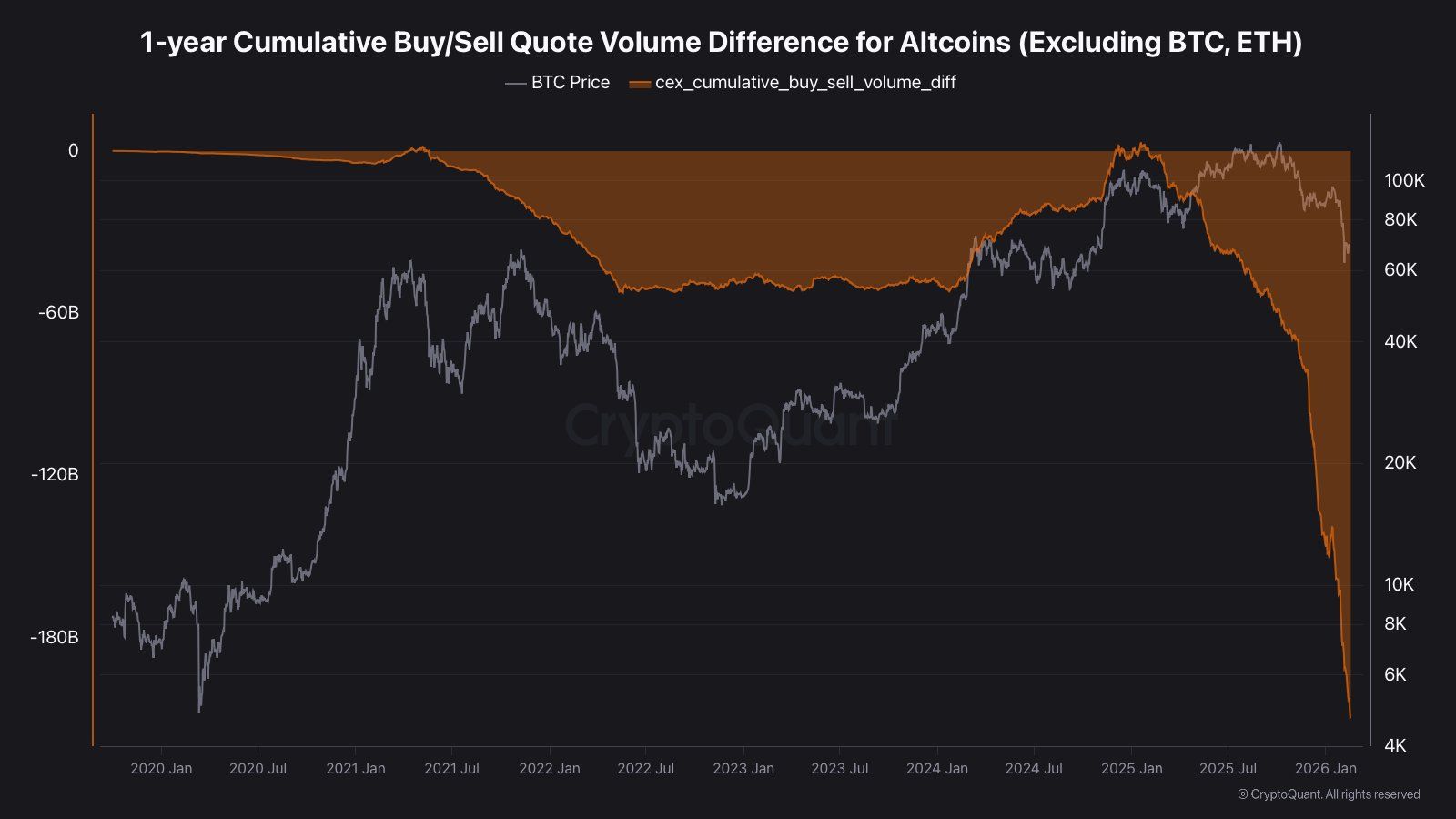
A report from CryptoQuant states that selling pressure on altcoins (excluding BTC and ETH) has reached its most extreme level in five years.
Cumulative buy/sell delta data has reached -$209 billion over the past 13 months. In January 2025, this delta was nearly zero, which reflected balanced supply and demand. Since then, it has continued to decline without any reversal.
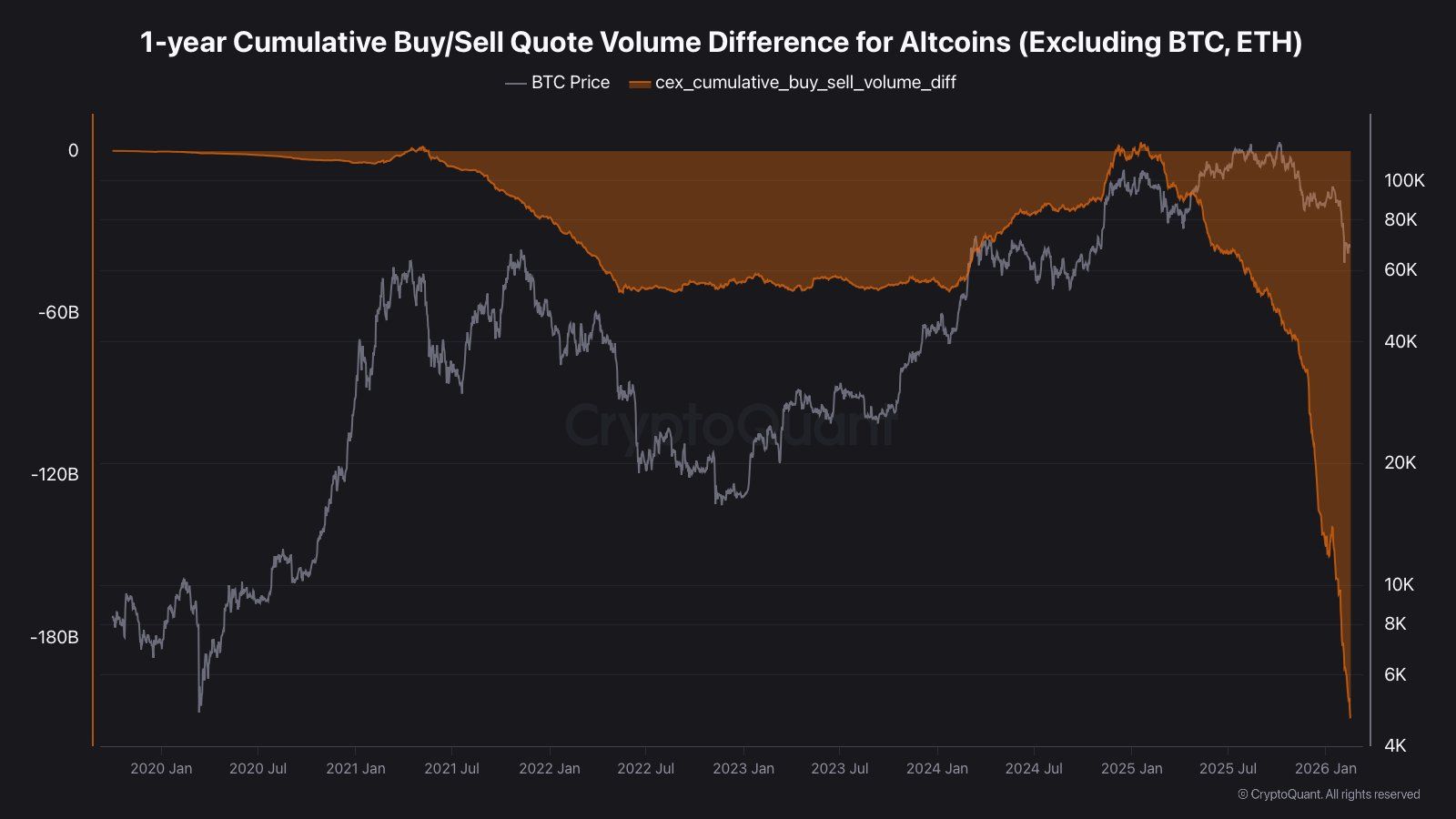
This extreme condition differs completely from the 2022 bear market. During 2022–2023, selling pressure slowed, allowing the market to enter a sideways phase before recovering. That slowdown has not occurred in the current cycle.
“This is not a dip. It’s 13 months of continuous net selling on CEX spot. -209B doesn’t mean bottom. It means buyers are gone,” analyst IT Tech stated.
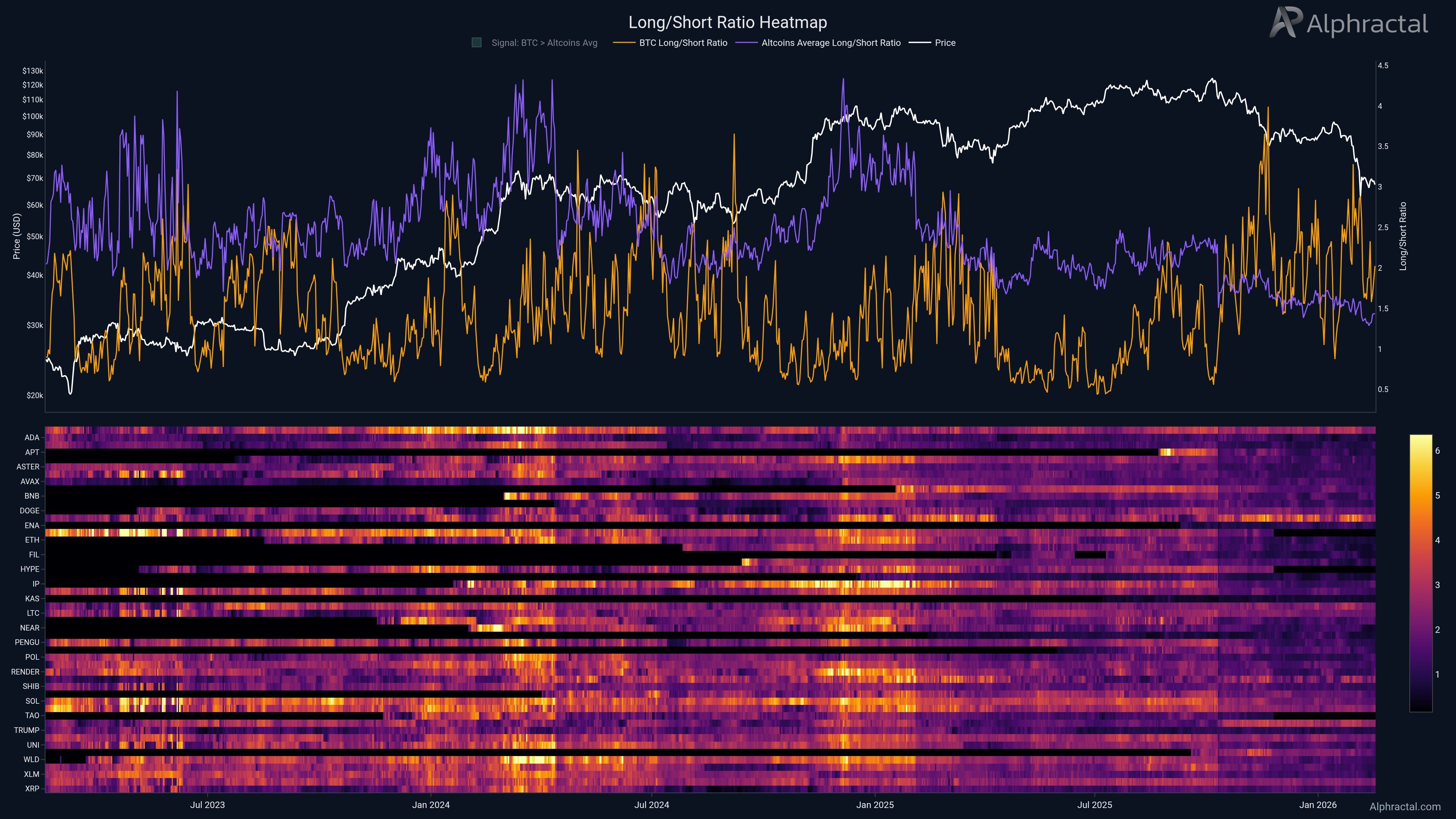
Additionally, derivatives data can provide additional short-term insights. Traders are currently holding significantly more long positions in Bitcoin than in altcoins, as reflected in Alphractal’s Long/Short Ratio data.
Sponsored
Sponsored
The chart shows that this is the first time in history that Bitcoin’s long ratio has remained above the altcoin average for four consecutive months. This indicates that short-term traders have reduced their exposure to altcoins and that expectations for altcoin volatility have weakened.
In addition, the total altcoin market capitalization has dropped back to levels five years ago, below $1 trillion. The altcoin analytics account OverDose pointed out that the biggest difference lies in the number of tokens. Five years ago, only about 430,000 coins were listed. Currently, that figure has surged to 31.8 million, an increase of roughly 70 times.
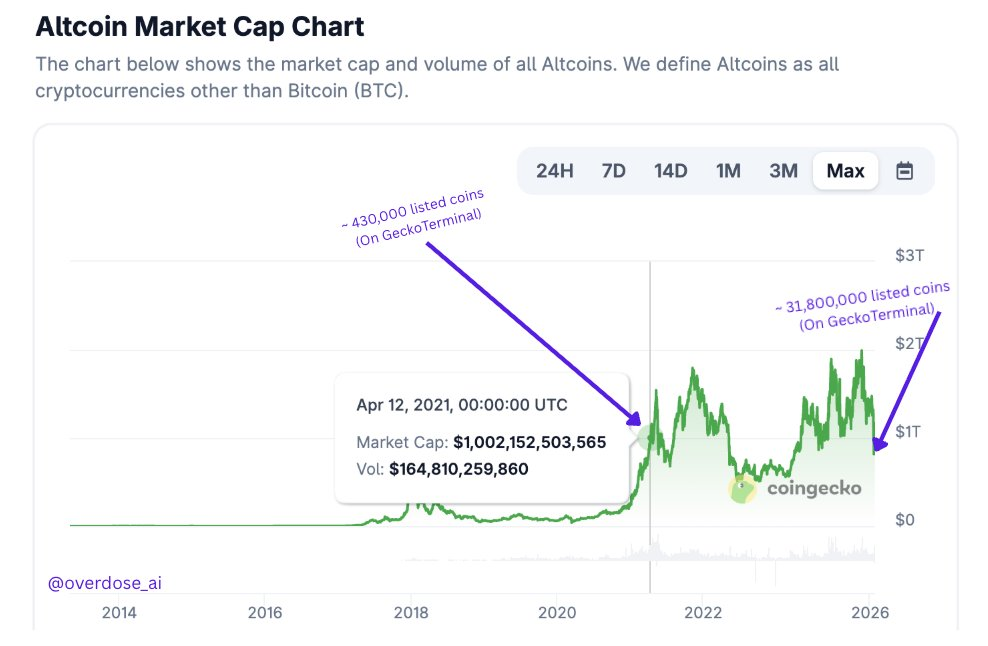
Too many tokens are competing for a market “pie” that has not grown larger. This dynamic makes recovery more fragile and threatens the survival of low-cap tokens.
Excluding the top 10, the remaining market capitalization stands at less than $200 billion. The technical structure shows a head-and-shoulders pattern, and this capitalization is moving toward its neckline support. Analyst Pentoshi commented that even if altcoins rebound, the gains will likely not be substantial.
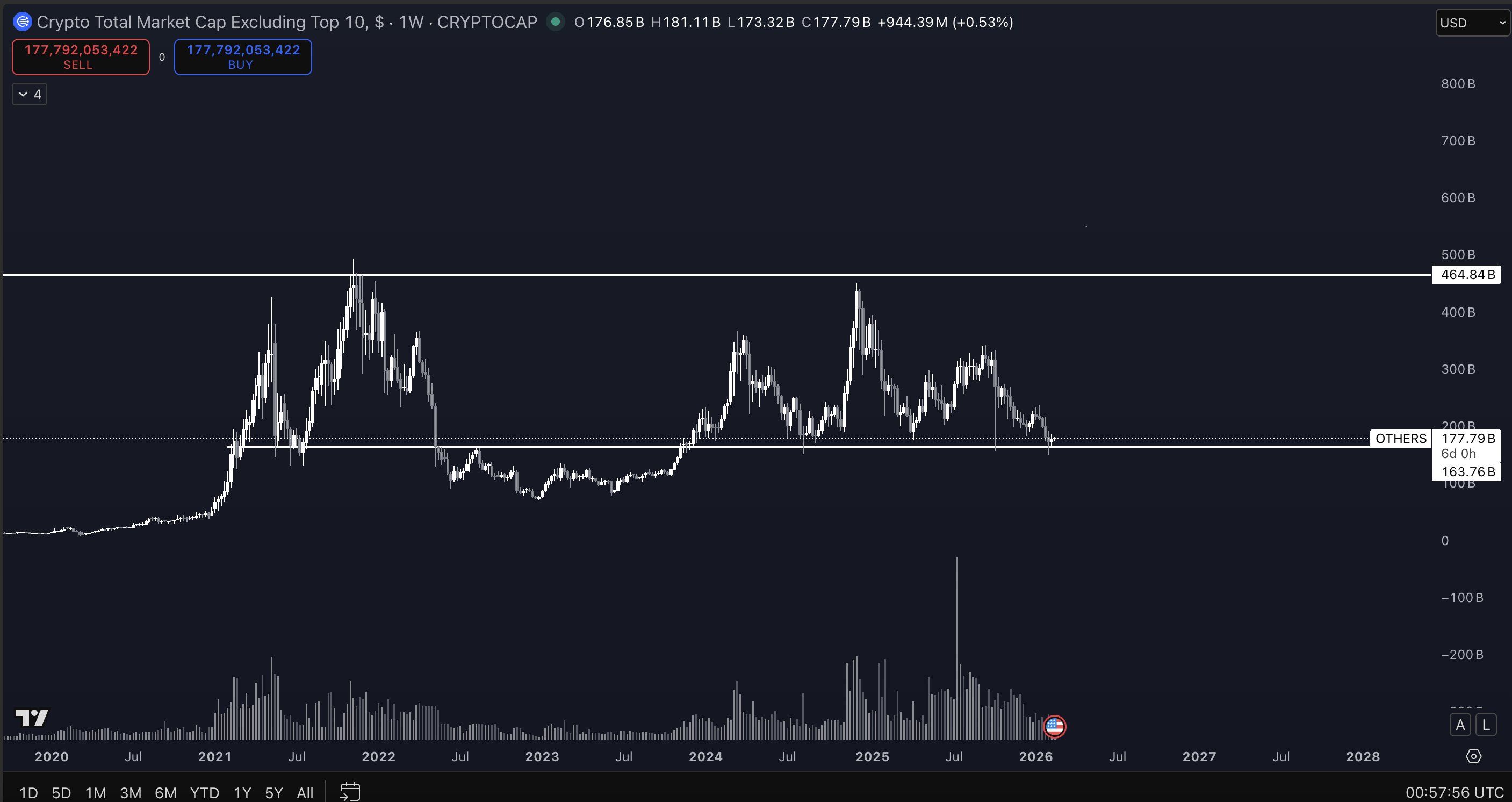
“Even if alts bounce here, it likely won’t be substantial. I think eventually they make new lows… Imo it’s going to take some time to work through,” analyst Pentoshi predicted.
According to CoinGecko research, 53.2% of all cryptocurrencies listed on GeckoTerminal had failed by the end of 2025. In 2025 alone, 11.6 million tokens collapsed.
The current bear market may permanently reshape how investors allocate capital within the altcoin sector. Market participants may become more selective, prioritize liquidity and fundamentals, and reduce exposure to speculative low-cap assets.


Disclosure: This article does not represent investment advice. The content and materials featured on this page are for educational purposes only.
Enso announced live production deployments of cross-chain minting and execution flows powered by Chainlink, enabling assets to move across chains.
Enso today announced live production deployments of cross-chain minting and execution flows powered by Chainlink Cross-Chain Interoperability Protocol (CCIP). With this integration, issuers and asset strategy platforms can move capital across chains and deploy it into live strategies, atomically and pre-simulated, in a single transaction.
The integration is live in production with launch partners including Reservoir, World Liberty Financial (WLFI), Maple, Avant, Liquity, and Dolomite. Enso and Chainlink now enable assets to arrive on destination chains already deployed according to predefined logic.
Stablecoins and yield-bearing assets bridged via CCIP can be automatically routed through swaps, deposits, zaps, and protocol interactions, all executed in a single bundled transaction. This removes operational overhead, removes execution risk, and eliminates the need for manual post-bridge deployment.
At the center of the integration is Enso’s CCIP Receiver, a destination-side smart contract that combines Chainlink’s secure cross-chain messaging with Enso’s deterministic execution engine. Issuers define outcome-driven workflows, such as minting or distributing assets on one chain and programmatically deploying them into yield, liquidity, or treasury strategies on another, without building custom integrations for each network.
This integration also supports capital-efficient hub-and-spoke models for cross-chain asset expansion. Asset issuers such as USD1 by World Liberty Financial and BOLD by Liquity can mint on a primary chain while distributing and deploying across multiple ecosystems without pre-funding fragmented liquidity pools.
Disclosure: This content is provided by a third party. Neither crypto.news nor the author of this article endorses any product mentioned on this page. Users should conduct their own research before taking any action related to the company.
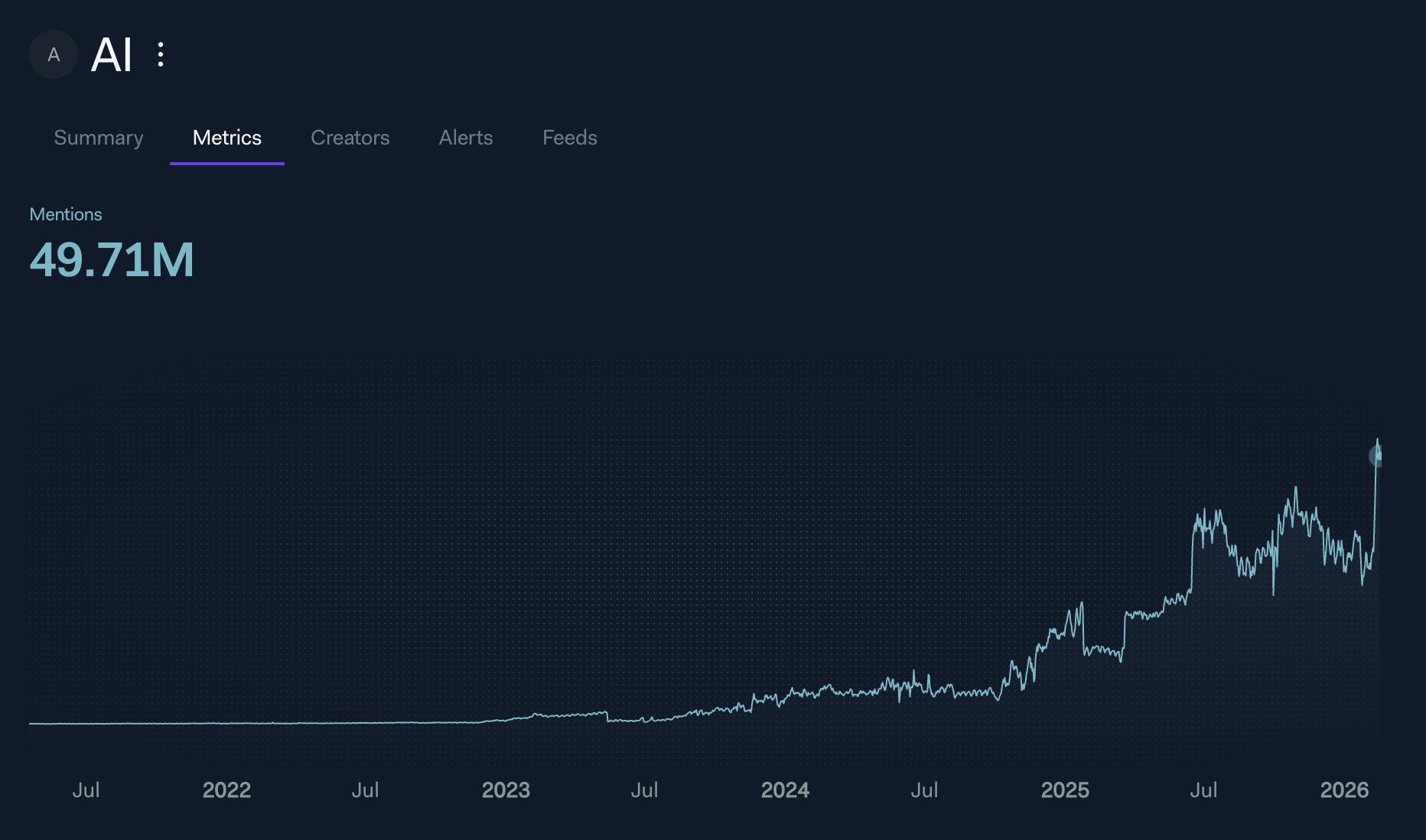
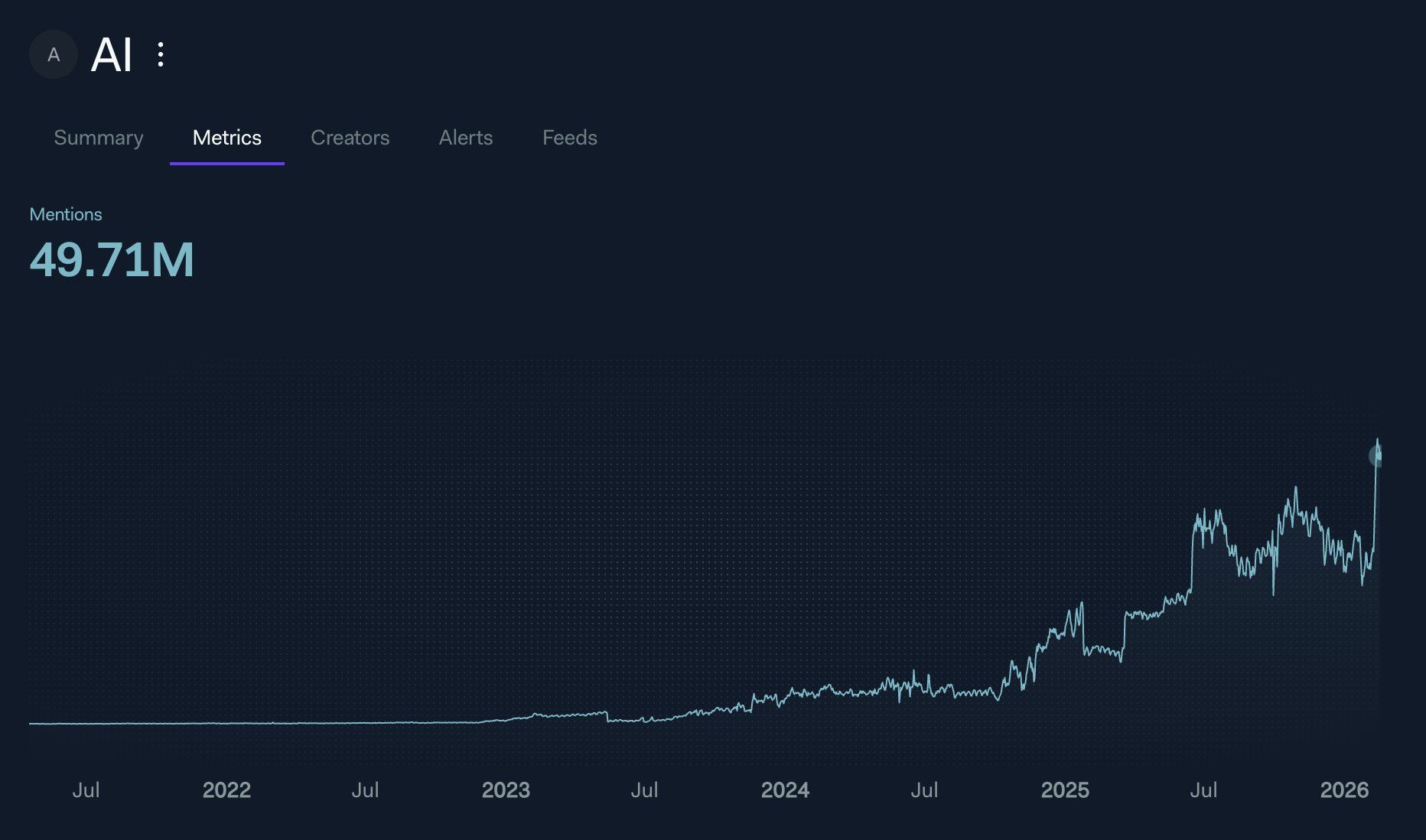
Mentions of artificial intelligence (AI) on social media reached record highs in February 2026, with attention focused on various applications and concerns.
However, this momentum has not extended to the crypto space. The divergence highlights a clear split: while global AI interest continues to climb, decentralized AI projects and blockchain-based AI tokens are experiencing weak performance and limited visibility.
Sponsored
AI Takes Center Stage Online and in Global Investment Markets
Social intelligence platform LunarCrush reported that daily social mentions of “AI” set all-time records, with distinct conversation themes. The analytics platform reported that discussions around new AI models, capabilities, and industry integration accounted for 40% of overall mindshare.
Creative use cases also represented a significant share of the conversation. AI in creative industries such as art, music, writing, and content creation captured 30% of mindshare.
Meanwhile, 20% of AI-related discussions centered on ethics and safety. These conversations focused on responsible development and deployment.
However, concerns appeared to outweigh optimism in several areas. Job displacement fears dominated sentiment, accounting for 60% of mindshare. AI misuse drove 30% of the discussion, while regulation captured 10%.
Sponsored
Interest in AI extends far beyond online conversations. Investment activity reflects the same momentum. According to Crunchbase data, AI attracted nearly half of all global funding in 2025, a sharp increase from 34% in 2024.
Total funds flowing into the sector surged more than 75% year over year, rising from $114 billion invested in 2024.
“The foundation model companies have raised $80 billion in 2025 to date, representing 40% of global AI funding, per Crunchbase data. Model company funding this year has more than doubled from $31 billion in 2024, when that investment totaled about 27% of all AI funding,” the report read.
At the same time, large-scale spending is accelerating across AI infrastructure. Recently, Adani Group unveiled plans to invest $100 billion to develop renewable-energy-powered, AI-ready hyperscale data centers by 2035.
Sponsored
AI Boom Leaves Crypto Tokens Behind
As momentum builds across the AI sector, one segment appears to be receiving comparatively little attention.
Noticeably, there is no major discussion of decentralized AI projects or crypto AI tokens. Blockchain AI lags as mainstream AI receives most of the enthusiasm.
The investment data points to a similar imbalance. BeInCrypto reported that during Q1 2026, Web3 funding was primarily directed toward core infrastructure and institutional-facing financial rails. The largest allocations went to stablecoin payment infrastructure, custody and trading platforms, real-world asset tokenization, and compliance tools.
Sponsored
Decentralized AI projects were largely missing from the list of top-funded categories, highlighting a widening gap between the broader AI boom and blockchain-based AI development.
Market numbers reveal the AI crypto tokens’ ongoing challenge. Over the past month, every major AI-related crypto subsector tracked by CoinGecko has recorded a decline in market capitalization.
The combined market cap of leading AI crypto categories has dropped over 16%. Still, it’s worth noting that the decline comes amid a broader market downturn, which has pulled asset prices lower.
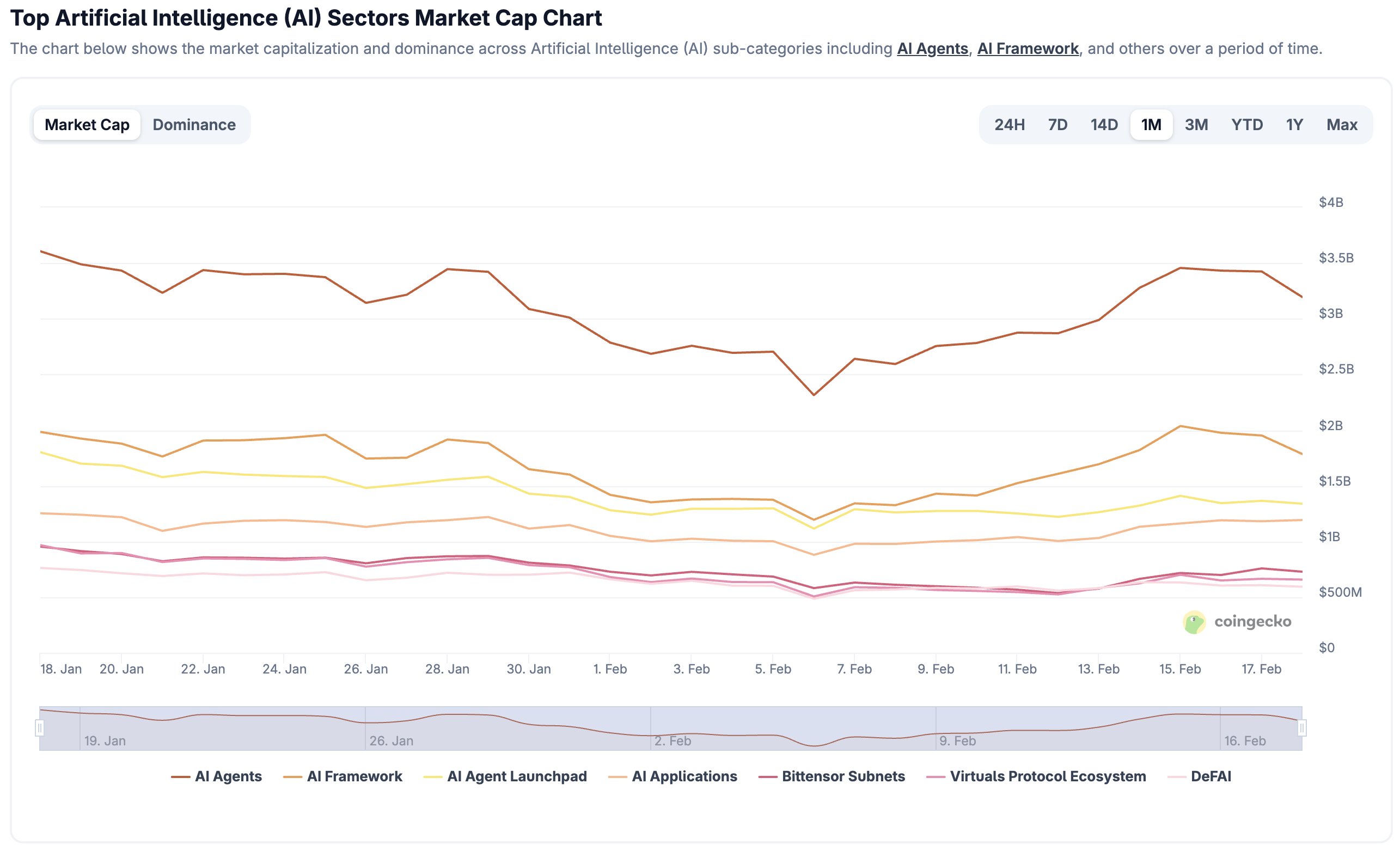
This suggests that surging global interest in AI has not translated into equivalent demand for AI-focused crypto tokens. As capital and attention concentrate on sovereign AI infrastructure, robotics, and enterprise deployment, the key question is whether blockchain-based AI projects can meaningfully capture that momentum, or whether traditional systems will continue absorbing most of the value created by the AI revolution.
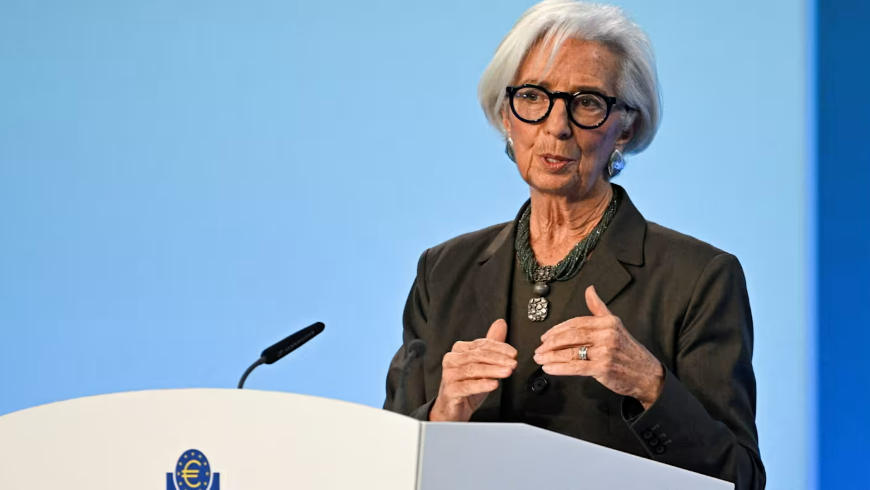
European Central Bank (ECB) President Christine Lagarde is considering leaving before her eight-year term ends in October 2027, the Financial Times reported, citing a person “familiar with her thinking.”
Lagarde, who took office in November 2019, is said to be weighing an early exit ahead of France’s April 2027 presidential election so that outgoing President Emmanuel Macron and German Chancellor Friedrich Merz can agree on a successor, the FT reported Wednesday.
An ECB spokesperson pushed back on the report, telling Cointelegraph: “President Lagarde is totally focused on her mission and has not taken any decision regarding the end of her term.”
ECB navigates digital euro and MiCA-era stablecoins
Her potential departure would come at a sensitive moment for the ECB’s digital agenda.
Under Lagarde, the ECB has pushed ahead with preparatory work on a digital euro and repeatedly highlighted the need to manage risks from privately issued digital money, including stablecoins, within the new European Union Markets in Crypto Assets Regulation (MiCA) regime.
ECB officials have warned that rapidly growing stablecoins could pose financial stability and monetary policy risks in the euro area, even under MiCA’s safeguards, and have argued for a strong market for well‑regulated euro-denominated stablecoins that can compete with dollar tokens.

Related: Digital euro key to payments sovereignty in ‘weaponised’ world: ECB exec
Lagarde herself has been a vocal critic of Bitcoin (BTC) and other crypto assets, calling them “highly speculative,” and saying in a 2022 television interview that crypto is “worth nothing” and based on no underlying assets, repeating that sentiment even with BTC close to all-time highs in November 2025.
A change at the top of the ECB could impact how the institution communicates on, and prioritizes, issues such as the digital euro, stablecoin oversight and crypto-related payment arrangements, even if the overall regulatory direction is set at the EU level.
Shortlist to replace Lagarde shares cautious line on crypto
Economists polled by the FT in December identified Spain’s former Central Bank Governor Pablo Hernández de Cos and his Dutch counterpart Klaas Knot as leading contenders to replace Lagarde, with ECB Executive Board Member Isabel Schnabel and Bundesbank President Joachim Nagel also seen as potential candidates.
All four have taken cautious stances on crypto. In past speeches, Hernández de Cos has framed crypto assets and stablecoins as a financial stability risk that demands strong regulation and supervision, while Knot has called for a robust global regulatory framework for crypto and stablecoins.
Nagel has linked the push for a digital euro to safeguarding European monetary and financial sovereignty, and has called Bitcoin a “digital tulip” that is “anything but transparent,” warning against treating Bitcoin as a reserve asset.
Related: Crypto’s next battle is privacy, but regulators face chicken-egg dilemma
Schnabel previously described Bitcoin as a “speculative asset without any recognizable fundamental value.”
Digital euro timeline hinges on EU lawmakers
The digital euro project still needs the green light from EU lawmakers, while the ECB has moved into a technical preparation stage and is rolling out collaborations to ensure the digital euro is universally accessible to all.
Despite rumors of a possible early departure of Lagarde, ECB Executive Board Member Piero Cipollone confirmed in a speech on Wednesday that EU co‑legislators were expected to adopt the digital euro regulation in the course of 2026.
He said that would enable a 12‑month pilot in a controlled Eurosystem environment starting in the second half of 2027, with real‑world transactions and a limited group of payment service providers, merchants and Eurosystem staff.
The Eurosystem aims to be ready for a potential first issuance of the digital euro during 2029, assuming the legislative process stays on track.
Magazine: Bitcoin’s ‘biggest bull catalyst’ would be Saylor’s liquidation — Santiment founder
Analyst warns Bitcoin nearing Phase 2 bear market as volatility and liquidity trends point to further downside risk across crypto markets.
Veteran on-chain analyst Willy Woo has warned that the Bitcoin (BTC) market is strengthening its bear trend and approaching the second phase of a multi-stage downturn.
The forecast challenges persistent bullish narratives, suggesting the worst may be ahead for the world’s largest cryptocurrency.
Phase 1 Nears Its End as Volatility Spells Trouble
In a series of posts on X on February 18, Woo outlined a three-phase bear market framework, positioning Bitcoin at a crucial juncture. According to him, the first stage of the current bear market started in the third quarter of 2025 when liquidity first broke down, and the price started to follow.
He explained that the key signal comes from volatility metrics used by quantitative analysts, with Bitcoin entering a prolonged decline when volatility spiked upward. That volatility is still climbing, indicating the bear trend is gaining ground.
“In this phase, perma bulls will blindly say it’s a correction inside a broader bull market but will not give you any hard evidence of capital flowing in,” Woo wrote.
The analyst added that his internal liquidity models, released weekly to investors, currently match the volatility signals. In his opinion, the second part of the bear market will kick in when global equities begin to weaken.
He argued that the largest cryptocurrency often reacts faster than equities when capital exits markets because of its smaller size and higher sensitivity to liquidity shifts.
“Under this bear market framework, BTC is presently in Phase 1 and close to Phase 2,” stated Woo.
He characterized the final episode as “the light at the end of the tunnel,” predicting a turnaround in liquidity, with capital outflows hitting a high point before stabilizing. However, he warned that there could be one more price capitulation just before or immediately after the peak outflows.
You may also like:
Cycle Indicators Show Mixed Signals for Long-Term Outlook
Not all analysts are interpreting the data as outright bearish. In a recent post, Axel Adler Jr. wrote that Bitcoin’s Entity-Adjusted Liveliness metric peaked in December 2025 and has started declining, a pattern seen in past accumulation periods lasting between 1.1 and 2.5 years. The indicator tracks BTC movement relative to holding time and tends to fall after distribution periods end.
Another perspective from GugaOnChain focused on valuation. Using the MVRV Z-Score developed by Murad Mahmudov and David Puell, the analyst said the current reading near 0.48 places Bitcoin close to historical accumulation zones rather than overheated territory. That suggests some investors may see current prices as discounted compared with average acquisition costs.
SECRET PARTNERSHIP BONUS for CryptoPotato readers: Use this link to register and unlock $1,500 in exclusive BingX Exchange rewards (limited time offer).

Editor’s note: This editorial perspective highlights a notable step in fintech inclusion. botim money’s expansion into digital silver underscores a growing trend toward accessible, regulated investing within popular UAE apps. By enabling fractional ownership from AED 10 and extending its Invest suite in partnership with OGold, botim aims to broaden asset diversification for millions of users. The move follows botim’s gold investment capability and reflects UAE’s push toward a digital-first, regulated financial ecosystem where everyday people can participate in precious metals markets with ease and security.
Key points
- Digital silver investing is added to botim money’s Invest feature, enabling fractional access from AED 10.
- The launch expands botim’s strategic partnership with OGold to broaden precious metals access in the UAE.
- Gold investment performance (128,000 trades, over AED 100 million) signals strong user demand for expanded metals offerings.
Why this matters
With silver drawing renewed attention as a store of value and industrial metal, botim money’s in-app silver offering lowers entry barriers and provides a regulated, user-friendly path to diversification. The UAE-focused rollout aligns with market demand for digital-first financial tools and broadens access to precious metals for millions of users within a popular fintech ecosystem.
What to watch next
- Uptake of digital silver within botim money’s Invest feature and its impact on user engagement.
- Potential expansion of the precious metals suite to include additional metals or products with partners like OGold.
- Continued alignment with UAE’s digital-first financial ecosystem and regulatory developments.
Disclosure: The content below is a press release provided by the company/PR representative. It is published for informational purposes.
Press release: botim money launches digital silver with fractional access from AED 10
Dubai, UAE – 18 February 2026 – botim money, the financial services arm of botim, today announced the launch of digital silver investing within its ‘Invest’ feature, enabling eligible users to buy, sell, and manage fractional silver holdings from AED 10. The launch follows the in-app gold investing capability introduced in partnership with OGold, expanding botim’s precious metals suite across the UAE.
The new capability is designed to lower traditional entry barriers tied to bulk purchases and offline handling, giving users a simpler way to access silver through a regulated, in-app experience. It forms part of botim’s broader build-out of practical financial tools across the platform, alongside existing payments and remittance use cases.
Since its launch in August 2025, botim money’s gold investment feature recorded 128,000 in-app gold trades with a total amount exceeding AED 100 million. This rapid adoption signals strong and sustained user demand to expand botim money’s ‘Invest’ offerings beyond gold into silver within the same suite.
Sacha Haider, Chief Operating Officer of Astra Tech | botim, said:
We were the first fintech platform to announce plans for a digital gold investment portfolio within botim’s fintech ecosystem in 2023, in partnership with OGold. Since launch, fractional investing has removed traditional minimum investment thresholds that historically limited participation and driven notable growth in usage. Extended to silver and combined with botim’s ease of use and scale, this creates a seamless and inclusive pathway for users to begin investing with confidence.
Bandar Alothman, Chairman & Founder at OGold,
As an Emirati company, our goal at OGold is to make precious metal ownership simple, accessible, and secure for everyone. Partnering with a platform as widely used as botim allows us to extend these innovative silver-earning solutions to millions of users. This is a game-changer for democratizing access to timeless assets through Silver Wakalah, which ensures your silver is not a stagnant investment. Instead of just sitting in a vault, your silver is put to work to grow your wealth with just a few taps.
The launch comes as silver draws renewed attention globally both as a store-of-value asset and as an industrial metal with structural demand drivers. With the global silver market expected to record a sixth consecutive annual deficit in 2026, and a projected shortfall of around 67 million ounces, while retail investment demand is forecast to rise despite softer demand in some industrial and consumer categories.
By extending botim’s investment offering beyond gold into silver, botim is broadening access to asset diversification for everyday users while continuing to build toward the UAE’s ambition of a mature, digital-first financial ecosystem.
The digital silver feature is now available to eligible users through the botim app.
About botim
botim, part of Astra Tech’s ecosystem, is the MENA region’s leading fintech company headquartered in Abu Dhabi. Botim is a fintech-first, AI-native platform offering inclusive, user-centric solutions for financial services. Built on the foundation of being the UAE’s first free VoIP provider, Botim has evolved into a multi-layered ecosystem serving over 150 million users across 155 countries.
Designed to meet the needs of MENA consumers, businesses, and communities, botim delivers integrated services with innovation, accessibility, and regulatory credibility at its core. botim is building the next generation of everyday finance and connectivity easier, smarter, and more inclusive for everyone.
The UK Consumer Price Index (CPI) report released today showed a slowdown in inflation. According to Forex Factory, the annual figure came in at 3.0%, compared with 3.4% the previous month.
Media reports note that:
→ this marks the lowest level since March 2025;
→ the easing in inflation was driven by lower prices for petrol, air fares, food and education.
As a result, optimism prevails in the equity market, with expectations of monetary policy easing gaining traction. According to Trading Economics, the bullish trend is particularly evident in defence and mining stocks.
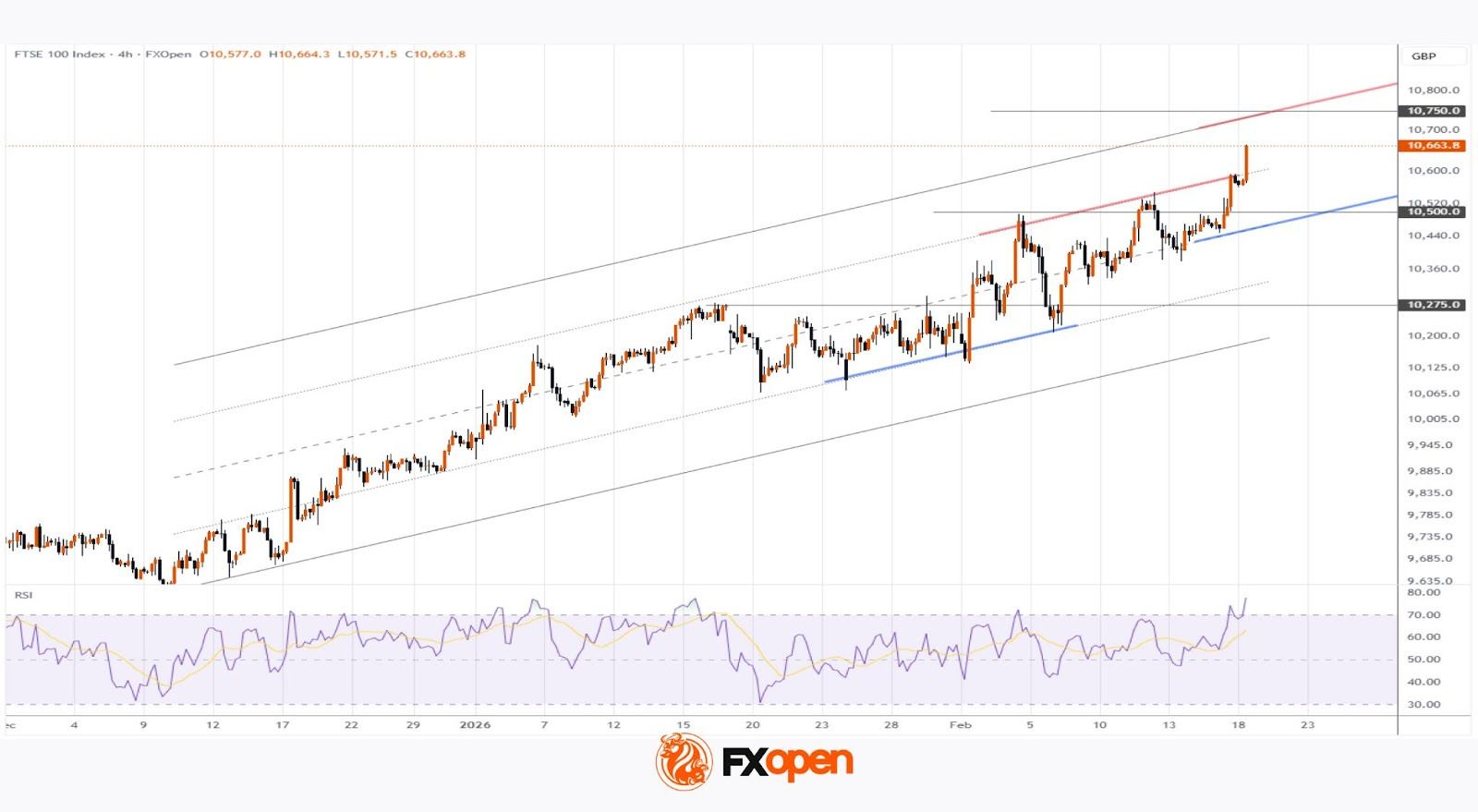
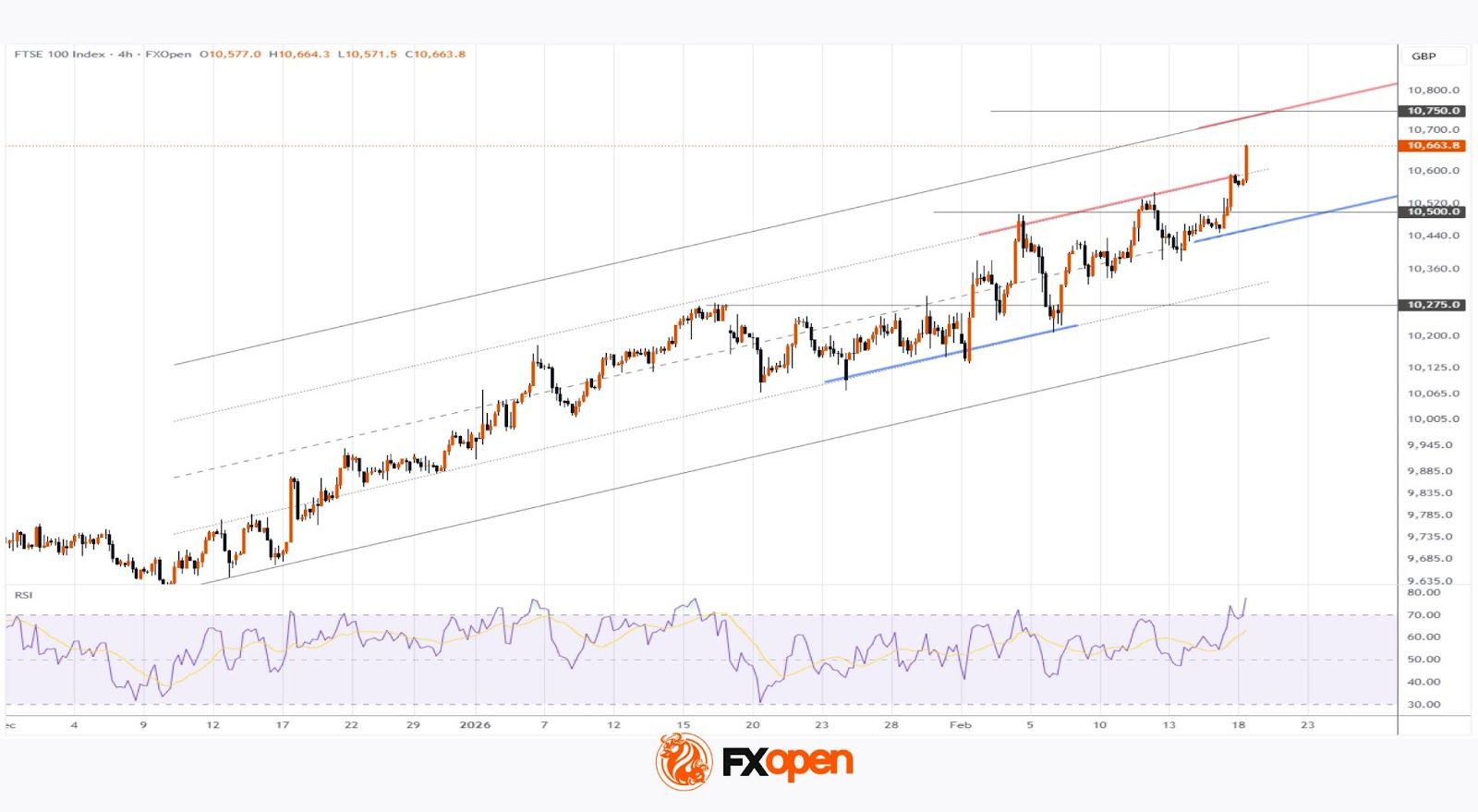
The chart of the UK’s FTSE 100 index (UK 100 on FXOpen) shows the market in a clear uptrend, with a sequence of higher highs and higher lows allowing an ascending channel to be drawn.
Technical Analysis of the FTSE 100 Chart
Bullish strength is highlighted by:
→ the price’s decisive break above the 10,600 level and its ability to hold above it this week;
→ the behaviour of the line dividing the upper half of the channel into two quarters. This line acted as resistance throughout February but was broken to the upside today — and may now serve as support.
The RSI indicator has moved into overbought territory. However, given the strength of the fundamental driver, any pullbacks are unlikely to be deep.
It is reasonable to assume that bullish sentiment will continue to dominate the FTSE 100, with 10,750 — near the upper boundary of the long-term channel — potentially serving as a target for profit-taking.
Trade global index CFDs with zero commission and tight spreads (additional fees may apply). Open your FXOpen account now or learn more about trading index CFDs with FXOpen.
This article represents the opinion of the Companies operating under the FXOpen brand only. It is not to be construed as an offer, solicitation, or recommendation with respect to products and services provided by the Companies operating under the FXOpen brand, nor is it to be considered financial advice.
Editor’s note: In an era of increasingly covert software supply chain threats, Kaspersky’s Keenadu discovery highlights how malware can slip into devices at multiple points—from preinstalled firmware to apps from official stores. This briefing breaks down what Keenadu is, how it operates, and what consumers and vendors should watch for as mobile devices become more integrated with smart ecosystems. While the study is technical, the takeaway is clear: routine device updates and robust security layers remain essential for staying ahead of evolving threats.
Key points
- Keenadu is Android malware that can be preinstalled in firmware, embedded in system apps, or downloaded from official stores.
- Used for ad fraud and can give attackers full control over the device in some variants.
- As of February 2026, over 13,000 infected devices reported; Russia, Japan, Germany, Brazil and others affected.
- Variants include firmware-integrated backdoors, system-app implants, and malicious apps on Google Play.
- Some infected apps on Google Play have been removed; risk persists with other app stores and APKs.
Why this matters
Preinstalled malware threatens users at the earliest moment of device setup, bypassing typical defenses and elevating the risk profile for mobile ecosystems. The Keenadu case underscores the need for rigorous supply-chain verification and proactive security solutions that monitor firmware and app-level integrity.
What to watch next
- Ongoing updates from Kaspersky on Keenadu variants and distribution vectors.
- Monitoring for new devices affected via firmware supply chains or app stores.
- User guidance to apply firmware updates and use reputable security software to detect such threats.
Disclosure: The content below is a press release provided by the company/PR representative. It is published for informational purposes.
Kaspersky finds Keenadu Android malware preinstalled on devices
Kaspersky has detected a new malware for Android devices that it dubbed Keenadu. This malware is distributed in multiple forms – it can be preinstalled directly into devices’ firmware, embedded within system apps, or even downloaded from official app stores such as Google Play. Currently Keenadu is used for ad fraud, with attackers using infected devices as bots to deliver link clicks on ads, but it can also be used for malicious purposes, with some variants even allowing full control of the victim’s device.
As of February 2026, Kaspersky mobile security solutions detected over 13,000 devices infected with Keenadu. The highest numbers of the attacked users have been observed in Russia, Japan, Germany, Brazil, the Netherlands, Turkiye, and other countries have been affected.
Integrated into device firmware
Similar to the Triada backdoor that Kaspersky detected in 2025, some versions of Keenadu are integrated into the firmware of several models of Android tablets at one of the supply chain stages. In this variant, Keenadu is a fully functional backdoor that provides the attackers with unlimited control over the victim’s device. It can infect every app installed on the device, install any apps from APK files and give them any available permissions. As a result, all information on the device, including media, messages, banking credentials, location, etc., can be compromised. The malware even monitors search queries that the user inputs into the Chrome browser in incognito mode.
When integrated into the firmware, the malware behaves differently depending on several factors. It will not activate if the language set on the device is one of Chinese dialects, and the time is set to one of Chinese time zones. It will also not launch if the device doesn’t have Google Play Store and Google Play Services installed.
Embedded within system apps
In this variant, the functionality of Keenadu is limited – it cannot infect every app on the device, but since it exists within a system app (which has elevated privileges compared to usual apps), it can still install any side apps that the attackers choose without the user knowing. What’s more, Kaspersky discovered Keenadu embedded within a system application responsible for unlocking the device with the user’s face. The attackers could potentially acquire victim’s face data. In some cases, Keenadu was embedded within the home screen app which is responsible for the home screen interface.
Embedded within apps distributed through Android app stores
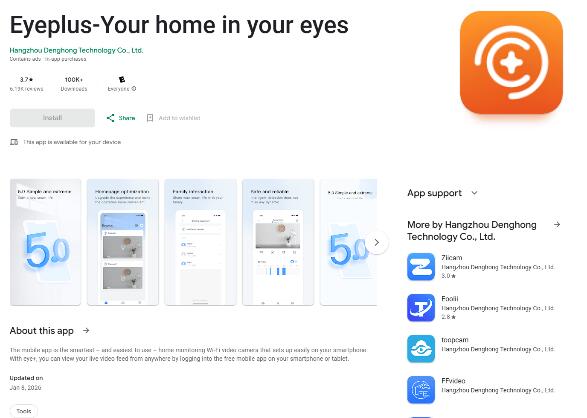
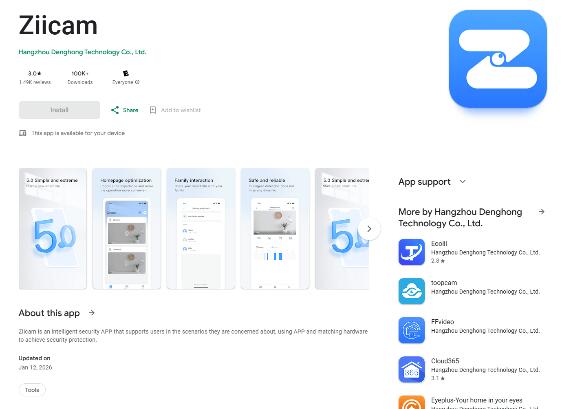
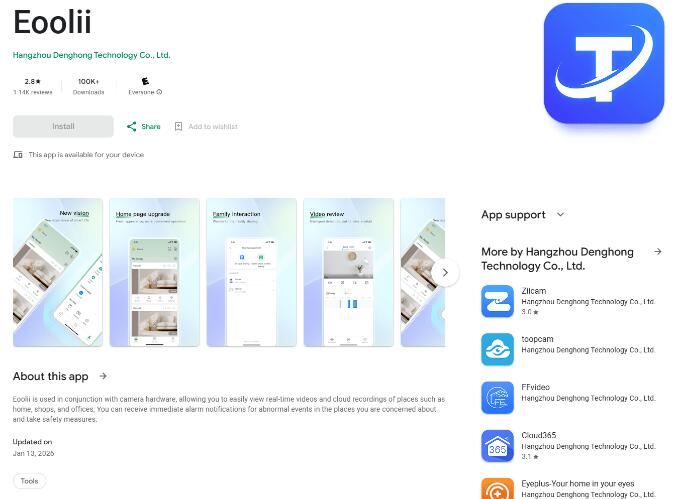
Kaspersky experts also discovered that several apps distributed on Google Play are infected with Keenadu. These are apps for smart home cameras, and they’ve been downloaded over 300,000 times. As of the time of publication, these apps have been removed from Google Play. When the apps are launched, attackers may launch invisible web browser tabs within the apps, that can be used to browse through different websites without the user knowing. Previous research from other cybersecurity researchers also showed similar infected apps being distributed via standalone APK files or through other app stores.
Infected apps on Google Play
As our recent research showed, preinstalled malware is a pressing issue on multiple Android devices. Without any actions on the user side, a device can be infected right out of the box. It is important for users to understand this risk and use security solutions that can detect this type of malware. Vendors likely didn’t know about the supply chain compromise that resulted in Keenadu infiltrating devices, as the malware was imitating legitimate system components. It is important to check every stage of the production process to ensure that device firmware is not infected,” comments Dmitry Kalinin, security researcher at Kaspersky.
See the post on Securelist for more information.
Recommendations:
- Use a reliable security solution to be promptly notified of similar threats on your device.
- If you are using a device with infected firmware, check for firmware updates. After the update, run a scan of the device with a security solution.
- If a system app is infected, we recommend that users stop using it and then disable it. If a launcher app is infected, we recommend disabling the default launcher and using third-party launchers.
About Kaspersky
Kaspersky is a global cybersecurity and digital privacy company founded in 1997. With over a billion devices protected to date from emerging cyberthreats and targeted attacks, Kaspersky’s deep threat intelligence and security expertise is constantly transforming into innovative solutions and services to protect individuals, businesses, critical infrastructure and governments around the globe. The company’s comprehensive security portfolio includes leading digital life protection for personal devices, specialized security products and services for companies, as well as Cyber Immune solutions to fight sophisticated and evolving digital threats. We help millions of individuals and nearly 200,000 corporate clients protect what matters most to them. Learn more at www.kaspersky.com.

Crypto mortgage lender Milo surpasses $100 million in home loans

BAE Systems announce record profits through warmongering

McLaughlin: ASU 2026 Transfer Portal Class Underrated?


-

 Sports6 days ago
Big Tech enters cricket ecosystem as ICC partners Google ahead of T20 WC | T20 World Cup 2026
-

 Video2 days ago
Bitcoin: We’re Entering The Most Dangerous Phase
-

 Tech3 days ago
Luxman Enters Its Second Century with the D-100 SACD Player and L-100 Integrated Amplifier
-

 Video5 days ago
The Final Warning: XRP Is Entering The Chaos Zone
-
 Tech1 day ago
The Music Industry Enters Its Less-Is-More Era
-

 Sports1 day ago
GB's semi-final hopes hang by thread after loss to Switzerland
-

 Crypto World1 day ago
Can XRP Price Successfully Register a 33% Breakout Past $2?
-

 Business12 hours ago
Infosys Limited (INFY) Discusses Tech Transitions and the Unique Aspects of the AI Era Transcript
-

 Video1 day ago
Financial Statement Analysis | Complete Chapter Revision in 10 Minutes | Class 12 Board exam 2026
-
 Crypto World4 days ago
Bhutan’s Bitcoin sales enter third straight week with $6.7M BTC offload
-
 Crypto World7 days ago
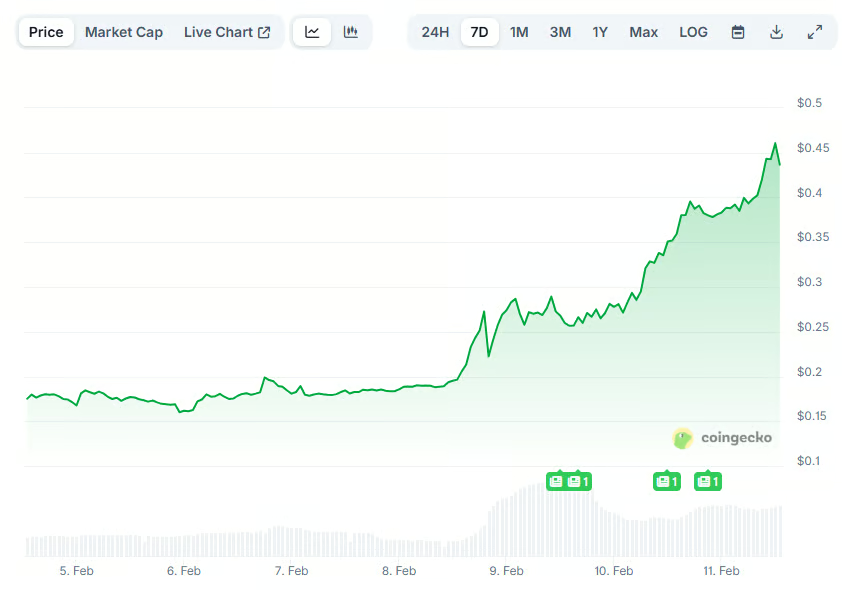
Pippin (PIPPIN) Enters Crypto’s Top 100 Club After Soaring 30% in a Day: More Room for Growth?
-

 Tech3 hours ago
Retro Rover: LT6502 Laptop Packs 8-Bit Power On The Go
-

 Video6 days ago
Prepare: We Are Entering Phase 3 Of The Investing Cycle
-
 NewsBeat3 days ago
The strange Cambridgeshire cemetery that forbade church rectors from entering
-

 Business6 days ago
Barbeques Galore Enters Voluntary Administration
-

 Business5 hours ago
Tesla avoids California suspension after ending ‘autopilot’ marketing
-
 Crypto World6 days ago
Ethereum Price Struggles Below $2,000 Despite Entering Buy Zone
-
 NewsBeat3 days ago
Man dies after entering floodwater during police pursuit
-

 Crypto World5 days ago
Kalshi enters $9B sports insurance market with new brokerage deal
-

 NewsBeat4 days ago
UK construction company enters administration, records show