A spectacular high-pressure water eruption at SpaceX’s Starbase facility in South Texas has captured widespread attention online, with videos of the massive “water blast” racking up millions of views as the company prepares for its 12th Starship test flight.
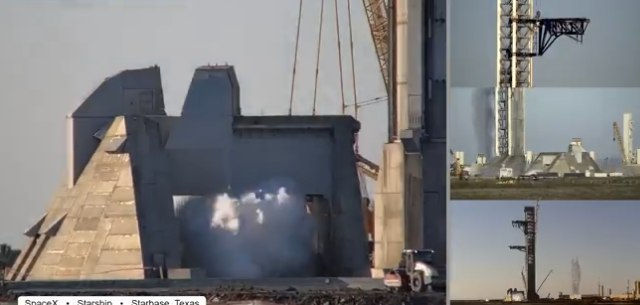
The footage, shared widely on social media platforms including X and captured by local observers and NASASpaceflight livestreams, shows thousands of gallons of water surging upward from beneath Orbital Launch Pad 2 in a towering plume that resembles an explosion or rocket mishap. Posted around Feb. 16, 2026, the clips quickly went viral, prompting initial speculation of an accident at the Boca Chica site.
(VIDEO) SpaceX’s Dramatic Water Deluge Test Goes Viral Ahead of Starship Flight 12 Launch in March
SpaceX conducted the test as a full-duration verification of its upgraded water deluge system — a critical safety feature designed to protect the launch pad, surrounding infrastructure and the rocket itself from the intense heat, acoustic shockwaves and flame produced by the Super Heavy booster’s 33 Raptor 3 engines during liftoff.
The system, which sprays water at extreme pressure through a network of nozzles and a water-cooled steel plate beneath the launch mount, mitigates damage that plagued earlier flights. Initial versions of the deluge were implemented after Flight 1 in 2023 severely cratered the pad. Upgrades for Block 3 vehicles — debuting on Flight 12 — include enhanced flow rates and distribution to handle the increased thrust and acoustic energy of the latest Raptor 3 engines.
Videos from the test show the deluge activating for its planned duration, creating dense clouds of water vapor and spray that enveloped the pad area. Commentators on X praised the performance, with one user noting, “WOW! Starbase Pad 2 water deluge is something else! 33 Raptor 3 engines, no problem, I’m saying!” The successful run bolsters confidence ahead of Flight 12, which will mark the first orbital attempt with the Block 3 (V3) configuration of Starship and Super Heavy.
Advertisement
SpaceX CEO Elon Musk has targeted early March 2026 — potentially as soon as March 7 — for the launch, pending final integrations, static fire tests and regulatory approvals. Booster 19, the Super Heavy prototype assigned to Flight 12, recently completed multiple cryogenic proof tests without issues, addressing anomalies that led to the scrapping of its predecessor, Booster 18. Engine installation of the 33 Raptor 3s is progressing at Mega Bay 1, while Ship 39 undergoes preparations for stacking.
The test comes amid broader momentum for the Starship program. The Federal Aviation Administration recently finalized an environmental review allowing increased launch and landing activity at Starbase, clearing the path for a higher flight cadence in 2026. SpaceX aims to demonstrate key milestones with Flight 12, including improved engine reliability, heat shield performance during reentry and potential in-orbit capabilities paving the way for future refueling demonstrations, lunar missions under NASA’s Artemis program and eventual Mars exploration.
No payload has been announced for Flight 12, consistent with recent integrated flight tests focused on vehicle validation rather than operational missions. The flight profile is expected to mirror recent successes: liftoff from Starbase, booster catch attempt using the Mechazilla tower arms, and Ship achieving orbital velocity before a targeted splashdown in the Indian Ocean or Pacific.
Observers note that the viral water test underscores SpaceX’s iterative approach — rapid testing to refine systems before committing to flight. While some early speculation misinterpreted the footage as a failure, experts emphasized its positive implications for pad longevity and environmental protection during high-thrust launches.
Advertisement
SpaceX has not issued an official statement on the test beyond community updates, but the event aligns with preparations for an aggressive 2026 schedule that could see multiple Starship flights if milestones continue to be met. As regulatory reviews and vehicle integrations advance, attention now shifts to static fire testing of Booster 19 and potential stacking with Ship 39 in the coming weeks.
Administrators confirm the Goole-based emergency vehicle manufacturer has shut down after more than 30 years
O&H Vehicle Conversions had filed a notice of intention to appoint administrators(Image: O&H Vehicle Conversions)
Hopes that jobs could be saved at a Goole-based manufacturer of emergency vehicles have been dashed after administrators were officially appointed. Insolvency experts were brought in to O&H Vehicle Conversions last week amid financial difficulties.
The development brings to an end more than three decades of production at the firm’s Larsen Road facility, and results in the loss of 157 positions. Administrators from BDO LLP said the business had been affected by delivery delays which impacted revenue and cashflow, with the directors believed to be left with no alternative but to place the company into administration.
Attempts to market the business had been ongoing even before BDO’s appointment but a sale as a solvent, going concern could not be achieved. O&H’s 64,000 sqft plant which manufactured ambulances and other rapid response emergency vehicles is now shut.
Mark Thornton, one of the joint administrators said: “It is always a sad day when a longstanding business is forced to close. Given the financial position and outlook for the company, securing a sale of the business as a going concern was not possible.
Advertisement
“The priority of the joint administrators will now be to support employees impacted by the closure and realise assets in line with our duties in order to maximise the return for creditors.”, reports Hull Live.
The shuttering of O&H comes just weeks after CEO Mark Brickhill released a statement saying that since November of the previous year, approximately £2.2m in sales had been postponed. He stated that O&H had received support from shareholders for years, amounting to over £25m in a “very challenging industry”.
The most recent accounts for O&H Vehicle Conversions Group Ltd, spanning the year up to the end of February 2024, reveal a turnover of £22.3m and operating losses exceeding £9.7m. In those accounts, executives attributed delays to multi-year NHS Trust orders for ambulances which needed new post-Brexit accreditations.
Several O&H employees have taken to social media in recent days in search of new employment opportunities. A former director said: “It’s a difficult day, saying goodbye to so many talented and dedicated colleagues at O&H. People who showed up every day with pride, resilience, and a genuine commitment to doing things the right way. Watching a team like that be broken apart is heart breaking.
Advertisement
“I’m incredibly proud of what we achieved together, and I’m grateful for the friendships, the support, and the professionalism you all brought to work every single day. To everyone affected, I wish you nothing but success in finding your next role and hope our paths cross again. If anyone reading this can help my colleagues into their next opportunity, please do reach out to them.”
On-site business partner Samson Aviation has invested in a range of new equipment to handle more cargo
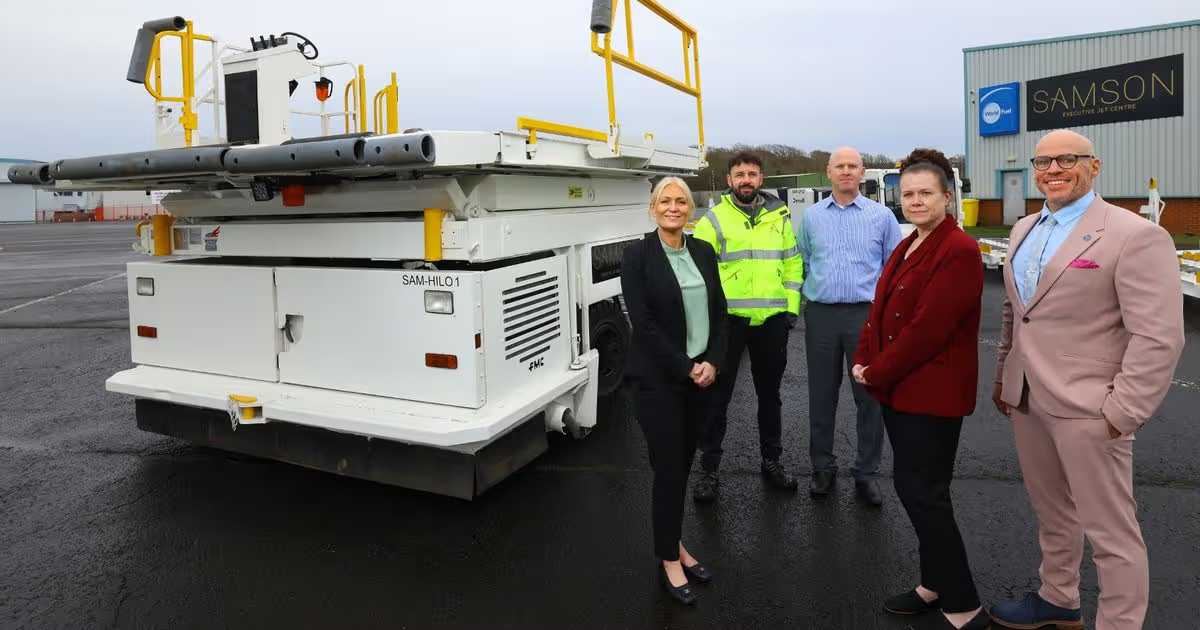
Paula Ives, general manager at Samson Aviation; Liam Adams, Samson operations team leader; David Grace, business development manager at Samson Aviation; Aileen Wallace, cargo business development manager at Newcastle Airport and Leon McQuaid, director of aviation development at Newcastle Airport.(Image: Newcastle Airport.)
Newcastle Airport has strengthened its role as a major logistics hub after expanding cargo services to meet growing demand. The airport’s on-site business partner, Samson Aviation, has invested in a range of new equipment, including a main deck loader capable of handling both widebody and narrowbody passenger and cargo aircraft.
The upgrade enables the airport to handle larger and more specialised cargo, such as heavy machinery, aircraft components, and luxury vehicle, across a wider range of aircraft. The move supports growth beyond the 4,000 tonnes of cargo it currently imports and exports for the region.
The airport supports global trade through its round-the-clock operations and transport connectivity. Emirates’ daily Dubai service can carry up to 21 tonnes of cargo, transporting a wide range of goods including automotive parts and pharmaceuticals.
From Dubai, cargo can be transported to more than 130 destinations worldwide, with Shanghai in China, Melbourne in Australia and Johannesburg in South Africa being among the most popular destinations for exports from Newcastle.
Advertisement
Meanwhile, the freight village offers a range of freight processing facilities, allowing imported goods to be cleared quickly through customs before being transported across the UK and beyond.
A CGI of AirLink, the new new cargo hub earmarked to be built at Newcastle Airport(Image: Newcastle Airport)
In its 2040 Masterplan, the airport has outlined plans to further expand its cargo operations, including building AirLink, a new 750,000sq ft cargo hub, which could create thousands of jobs and boost the regional economy by up to £165m a year.
Leon McQuaid, director of aviation development at Newcastle Airport, said: “We are delighted to further strengthen Newcastle Airport’s position as a leading cargo gateway with the addition of this new equipment. It significantly enhances our capability to handle a wider range of cargo and underlines our ability to support the growing number of businesses choosing the Airport for their import and export needs.
“Our continued investment in our cargo infrastructure demonstrates a clear commitment to growth and we continue to welcome conversations with any cargo or aviation related businesses looking to invest in the region.”
Advertisement
Paula Ives, general manager at Samson Aviation, said: “The investment in the new equipment demonstrates Samson Aviation’s commitment to supporting Newcastle Airport’s growing cargo operations. It will create more opportunities for businesses in the North East, across the UK and internationally to transport larger and more specialised cargo efficiently and connect with key markets around the world.”
Warner Bros. Discovery said Tuesday it will reopen takeover talks with Paramount Skydance after the bidder raised its offer to $31 per share, topping its earlier $30 proposal and putting new pressure on a rival deal with Netflix.
The renewed discussions come after Netflix granted Warner a seven-day waiver to explore whether Paramount can submit a stronger and binding offer.
Warner’s board said it will use this short window to address what it called “deficiencies” in Paramount’s prior bids and to clarify key terms.
A senior Paramount representative told a member of Warner’s board that the company is willing to increase its offer to $31 per share and could potentially improve it further.
Advertisement
Paramount has argued that its proposal is financially superior to Netflix’s $27.75 per share deal and more likely to gain approval from federal antitrust regulators, CBS News reported.
Warner CEO David Zaslav said the company has been clear about the issues in Paramount’s earlier proposals.
“We are engaging with [Paramount Skydance] now to determine whether they can deliver an actionable, binding proposal that provides superior value and certainty for WBD shareholders through their best and final offer,” Zaslav said in a statement.
Warner Bros. Discovery said in a news release that it would engage with Paramount Skydance (the parent company of CBS News) to discuss the company’s $30 per share bid and clarify terms of the deal. https://t.co/rSFWiOoPpT
Under the existing agreement with Netflix, the streaming giant would acquire Warner’s movie studio and streaming assets in a deal valued at $72 billion.
The studio’s film library includes major franchises such as “Harry Potter,” “The Matrix,” and “Casablanca.” Including debt, the enterprise value of the Netflix deal reaches about $83 billion.
Paramount’s approach is broader. It has proposed buying all of Warner Bros. Discovery, including cable networks like CNN, TBS and TNT. According to AP News, its overall bid, including debt, stands at about $108 billion.
Despite reopening talks, Warner’s board continues to recommend that shareholders vote in favor of the Netflix transaction.
Advertisement
A shareholder meeting is scheduled for March 20. Netflix said Warner has until Feb. 23 to negotiate with Paramount before the waiver expires.
In a statement, Netflix expressed confidence in its offer, saying a combined Netflix and Warner would “strengthen the entertainment industry, preserve choice and value for consumers and give creators more opportunities.” The company added that it believes its deal will pass antitrust review.
Investors reacted quickly. Warner shares rose more than 2% in early trading, while Paramount gained over 6%. Netflix stock dipped slightly.
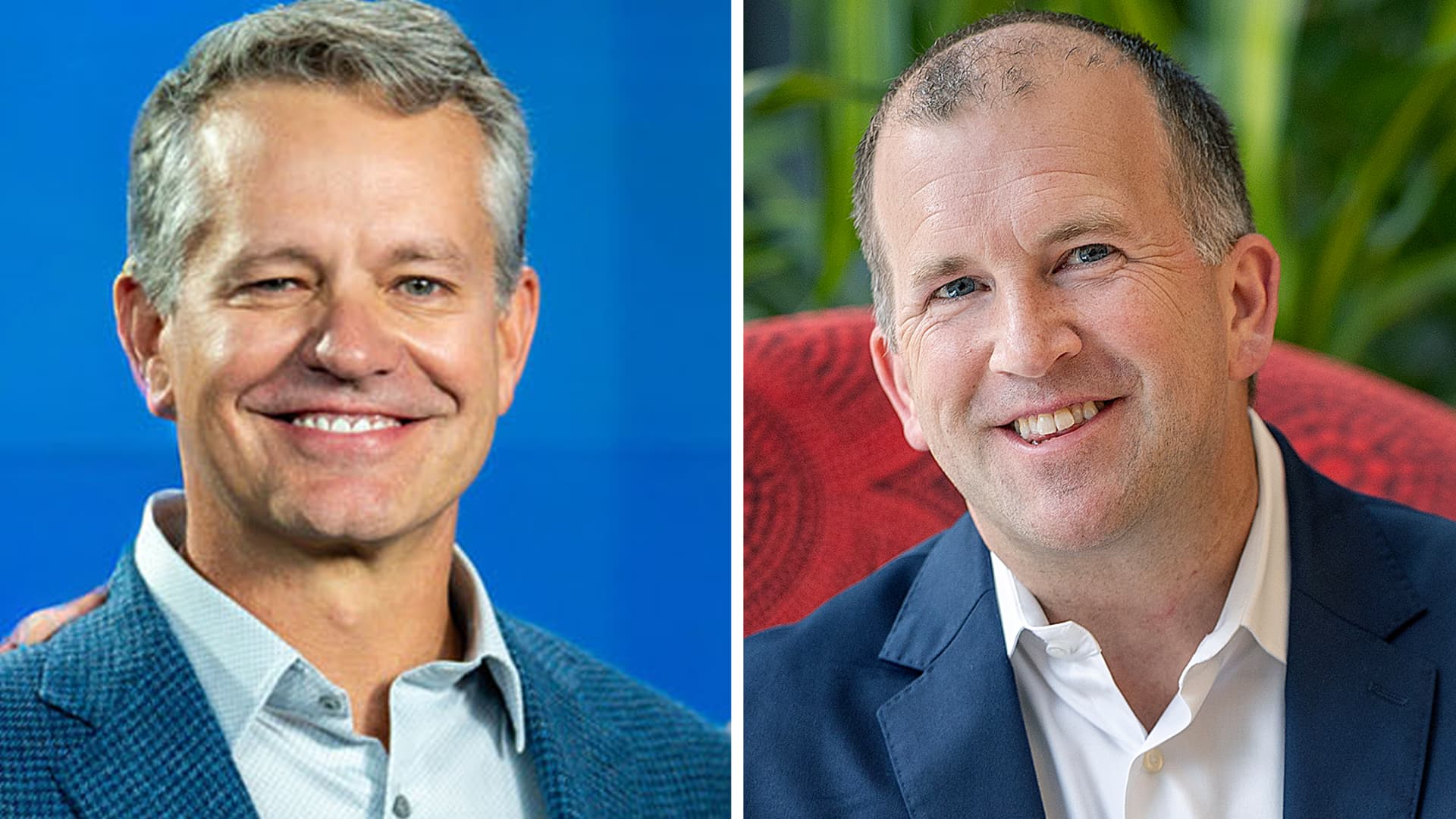
Walmart CEO John Furner, left, and Target CEO Michael Fiddelke.
Walmart (L) | Getty Images (R)
When Walmart and Target report holiday earnings this quarter, investors may quickly brush off those results.
Advertisement
Instead, they will likely focus more on the two big-box retailers’ futures under new CEOs and the outlook for U.S. consumers in 2026.
Both companies had leadership changes this month: Walmart CEO John Furner and Target CEO Michael Fiddelke, both longtime company insiders, took on their roles on Feb. 1.
The rival retailers have contended with the same economic challenges. U.S. consumers are still spending, but buying selectively, as inflation and tariffs fuel higher prices for groceries and other essentials and cause some shoppers to think twice about discretionary purchases.
Yet while both Walmart and Target have new CEOs, their paths forward look distinctly different.
Advertisement
Walmart’s stock has shot up by about 163% over the past five years and has risen about 24% over the last year, as of Tuesday’s market close. It hit a 52-week high Tuesday. Shares of Target, on the other hand, have tumbled by about 40% over the past five years and dropped 9% over the past year.
The retailers’ stock market performances reflect their sharp divergence in sales results. Walmart is attracting shoppers across incomes and gaining momentum with online sales and higher-margin businesses like advertising. Target is struggling with slower sales and weaker store traffic. Walmart expects its full-year net sales to rise by 4.8% and 5.1%. Target, on the other hand, is on track for a full-year sales decline.
Walmart CEO John Furner inherited a business that’s “fundamentally sound” and “on a great trajectory,” said Neil Saunders, managing director and retail analyst at GlobalData.
“In many ways, his job is to keep the ship steady and see what he can do to add to the speed,” he said.
Advertisement
On the other hand, Target CEO Michael Fiddelke has to “sell the Target of the future” after four years of roughly flat annual sales, Saunders said.
“What I think he’ll want to do is to inject some excitement, to say, ‘Look, I’m really excited about this role. I’m really excited about where Target could go. We are going to change things. We’re going to become a different business. We’re going to get back to what we were before,’” he said.
Here’s a closer look at what we know so far about the CEOs’ plans and what investors will listen for during earnings:
Walmart Inc. signage during the company’s listing at the Nasdaq MarketSite in New York, US, on Tuesday, Dec. 9, 2025.
Advertisement
Michael Nagle | Bloomberg | Getty Images
Walmart: Extending the winning streak
Walmart will report its fiscal fourth-quarter earnings before the bell on Thursday.
The retail giant has had a busy few months: Along with getting a new CEO, Walmart’s market cap surpassed $1 trillion in early February. The company also switched its stock listing from the New York Stock Exchange to the tech-heavy Nasdaq 100 in January, a nod to its aim to be perceived by investors more like its key rival Amazon.
When longtime CEO Doug McMillon stepped down from the role, he said in an interview on CNBC’s “Squawk Box” that he was passing the torch to Furner as the company accelerates its artificial intelligence adoption and reshapes its business and the way its customers shop.
Walmart has announced deals with two major AI chatbot platforms, OpenAI’s ChatGPT and Google’s Gemini, to make it easier for shoppers to find and buy its products.
Advertisement
Furner, who like his predecessor moved up the ranks at Walmart during decades at the Arkansas-based company, oversaw the largest segment of the company in his previous role as CEO of Walmart U.S. Furner got picked in part because of his success expanding Walmart’s digital business, a pivotal piece of its future, said Kate McShane, a retail analyst for Goldman Sachs.
Walmart Inc. (NYSE: WMT) announced that its Board of Directors has elected John Furner, 51, to succeed Doug McMillon, 59, as President and Chief Executive Officer of Walmart Inc., effective February 1, 2026.
Courtesy: Walmart Inc.
Walmart in May posted its first profitable quarter for its e-commerce business in the U.S. and globally, as its home deliveries, ads business and third-party marketplace all grow.
Advertisement
Corey Tarlowe, a retail analyst for Jefferies, said Walmart investors “want more of the same” — namely more e-commerce gains, grocery success and market share gains with a wider range of customers, including more affluent shoppers.
Yet Walmart’s results for the holiday quarter could mark an inflection point in the world of retail. Amazon could take the crown as the largest retailer by annual revenue for the first time, even though the company makes a lot of its money from tech services like cloud computing and advertising.
Saunders said the comparison isn’t apples to apples, but is “symbolically important” as the two competitors try to outmatch one another. Walmart has grown in part by leaning on stores to deliver groceries and offer pickup for online orders. Amazon, which recently announced it would shutter Amazon Fresh and Go stores and turn some into Whole Foods locations, had tried to “bolt on” fresh food to its huge existing volume of online orders, he said.
In a memo sent to employees on his second day at CEO, Furner said his leadership will be shaped by his more than 32 years at Walmart, adding he believes the company “is well-positioned to lead in this next era of retail.”
“This next era will unlock new ways to bring our people-led, tech-powered vision to life,” he said in the memo. “By leveraging our global scale, we can better serve customers and members with speed, reliability, and greater experiences, wherever they choose to shop with us.”
He said that strategy is already coming to life as “technology and AI are helping reduce friction in our work, simplify decisions, improve inventory flow, and free up time so you can focus on what matters most: serving customers and members and one another.”
Customers shop at a Target store on Feb. 10, 2026 in Chicago, Illinois.
Advertisement
Scott Olson | Getty Images
Target: Chasing a comeback
For Fiddelke, Target’s earnings report could be the deepest look yet at the cheap chic discounter’s roadmap to return to growth.
The company is chasing a comeback and plans to share its holiday-quarter results and current fiscal year expectations on March 3 at a financial meeting at its Minneapolis headquarters.
The big-box retailer has struggled with a laundry list of challenges, including declining visits to its stores and website, customer complaints about store conditions and backlash to the company’s political and social stances, such as its rollback of diversity, equity and inclusion pledges and its decision not to publicly oppose the surge of immigration enforcement in its hometown.
Target’s earnings report is more highly anticipated than Walmart’s because there are so many questions about its turnaround strategy and how long it may take, Goldman Sachs’ McShane said. Investors have debated how much the company may need to invest in merchandising, marketing and store labor to boost its sales.
“Walmart has pursued a much more aggressive digital agenda than Target between their omnichannel and their automation and their marketplace,” she said.
She added that while Target doesn’t want to be Amazon or Walmart, “they have to figure out who they want to be and how to compete.”
Advertisement
Target’s Chief Operating Officer Michael Fiddelke will take over as CEO from Brian Cornell.
Courtesy of Target
Already, Fiddelke has sent signals that he is making changes. Last week, he announced in an email to employees that the company will step up store staffing, though Fiddelke and the company declined to say how much it would invest in additional hours for employees. It is also cutting about 500 roles at distribution centers and regional offices.
Fiddelke shook up Target’s leadership team effective Sunday, bringing back the role of chief merchant and announcing a high-profile departure. Cara Sylvester, formerly chief guest experience officer, became Target’s chief merchandising officer, and Lisa Roath, formerly chief merchandising officer of food, essentials and beauty, succeeded Fiddelke as chief operating officer.
Advertisement
At the same time, Chief Commercial Officer Rick Gomez is leaving the company after more than a decade, and Jill Sando, chief merchandising officer for apparel and accessories, home and toys and entertainment division Fun101, will retire.
Target has also opened a new concept store in New York City’s SoHo neighborhood. While the location is one of a kind, its focus on fashion may inspire more changes at stores across the country and in the suburbs, McShane said.
That push to feature stronger products is a major piece of Fiddelke’s strategy. In an email to employees and customers during his first week, Fiddelke laid out four priorities: sharpening Target’s merchandising, improving the customer experience, speeding along technology and strengthening the company’s workforce and its surrounding communities.
Jefferies’ Tarlowe said Target’s upcoming investor event is “a chance for them to essentially communicate to everybody and say ‘We hear what you want. Here’s how we are going to deliver on it.’”
Advertisement
“Change is happening, it’s a question of does the market see it and appreciate it,” he said.
A senior marine scientist says the WA govt’s plan to rebuild demersal fish stocks will not work, arguing marine parks are the best way to address ecological and industry concerns.
13F review: Warren Buffett’s Berkshire Hathaway (BRK.B) reveals new bet on New York Times (NYT) and slashes Amazon (AMZN) stake.
Trade deal: Japan is set to invest up to $36B in oil, gas and critical mineral projects in Texas, Ohio and Georgia. Here are the details.
New York City Mayor Zohran Mamdani has pitched hiking property taxes by 9.5% as “a last resort” to help close an estimated $5.4B two-year revenue shortfall, if his proposal to tax the rich falls through. The deadline to finalize the city budget is June 30, following which it would go into effect in July.
Dig deeper: Mamdani initially proposed raising personal income taxes on New Yorkers earning more than $1M annually and hiking taxes on the most profitable corporations. He said this is “the most sustainable and fairest” path to bridge the city’s budget gap, “ending the drain by fixing the imbalance between what the City provides the State and what we receive in return.” But this would require the approval of the governor and state legislature, and New York Governor Kathy Hochul has already opposed this proposal.
Advertisement
Because of this, Mamdani floated the property tax hike and drawing $1.2B from the city’s reserves to plug the budget gap. He said this would be a “more harmful” path that would burden working and middle-class New Yorkers. “We do not want to have to turn to such drastic measures to balance our budget,” the mayor said while announcing his $127B preliminary budget. “But, faced with no other choice, we will be forced to.” If the city’s property taxes were raised, it would be the first such hike in more than two decades. And this would likely lead to higher rents, as landlords pass through the costs to tenants, and may push businesses away from the city.
The pushback: Mamdani’s proposal came a day after Hochul announced that the state will allocate an additional $1.5B over two years to help address New York City’s fiscal challenges. Hochul, who is up for re-election this year, said she is not supportive of a property tax increase, but noted that the decision is up to the City Council and Mamdani. “That’s their prerogative to look at that as an option,” she added. The property tax hike would require approval from the city council, but two of its members rejected the proposal as it would “worsen the affordability crisis.” Mark Levine, the city’s comptroller, said the tax hike would be regressive, and drawing down reserves would leave New York City vulnerable to economic turbulence. (5 comments)
Christine Lagarde weighs quitting as ECB chief before her term ends.
Today’s Markets
Advertisement
In Asia, Japan +1%. Hong Kong closed. China closed. India +0.3%. In Europe, at midday, London +1%. Paris +0.5%. Frankfurt +0.8%. Futures at 7:00, Dow +0.4%. S&P +0.4%. Nasdaq +0.5%. Crude +1.9% to $63.41. Gold +0.6% to $4,932.80. Bitcoin -0.5% to $67,473. Ten-year Treasury Yield unchanged at 4.07%.
On The Calendar
Companies reporting today include Occidental Petroleum (OXY) and Analog Devices (ADI).
A federal judge has dismissed a lawsuit challenging Buffalo Wild Wings’ (BWW) use of the term “boneless wings,” rejecting a customer’s claim that the name misled him into thinking the dish was made from actual chicken wings with the bones removed.
In a lighthearted opinion packed with poultry puns, U.S. District Judge John Tharp Jr. said the plaintiff’s complaint had “no meat on its bones” and failed to show that reasonable consumers are deceived by the name.
Advertisement
The judge likened “boneless wings” to other familiar food nicknames, citing a recent Ohio Supreme Court ruling that noted diners don’t expect “chicken fingers” to be made of fingers.
The lawsuit, filed by Aimen Halim, argued that BWW’s boneless wings are essentially chicken nuggets made from breast meat and that the name is fraudulent because it suggests deboned wing meat.
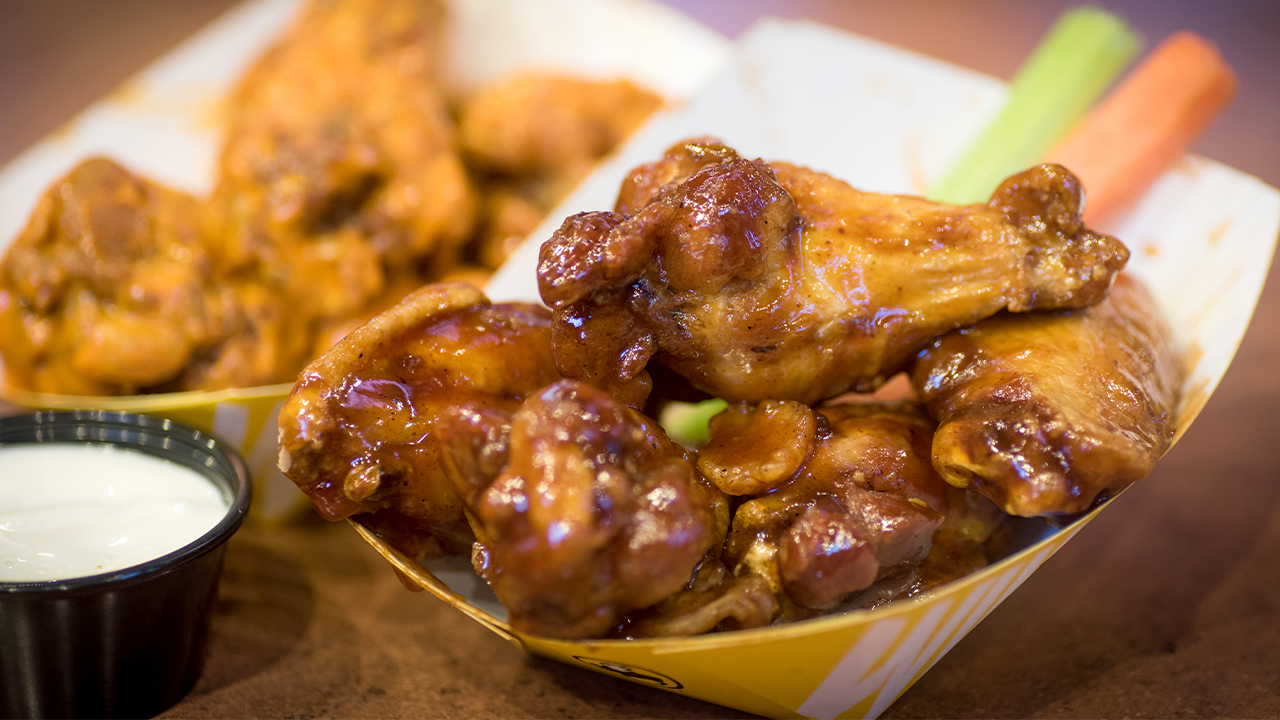
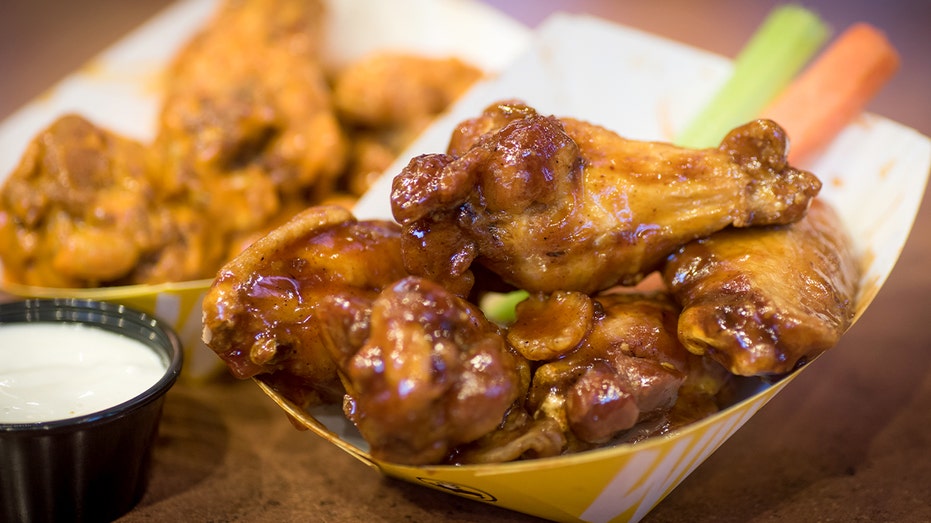
BBQ wings (front) and medium traditional wings at Buffalo Wild Wings in Arlington, Va., on Nov. 28, 2017. (Dixie D. Vereen/For The Washington Post via Getty Images / Getty Images)
Halim brought the suit against BWW alleging violations of the Illinois Consumer Fraud Act, breach of express warranty, common law fraud, and unjust enrichment.
Advertisement
He also sought to bring a nationwide class action, claiming that had he known what he was eating, he would have paid less or not bought the product at all.
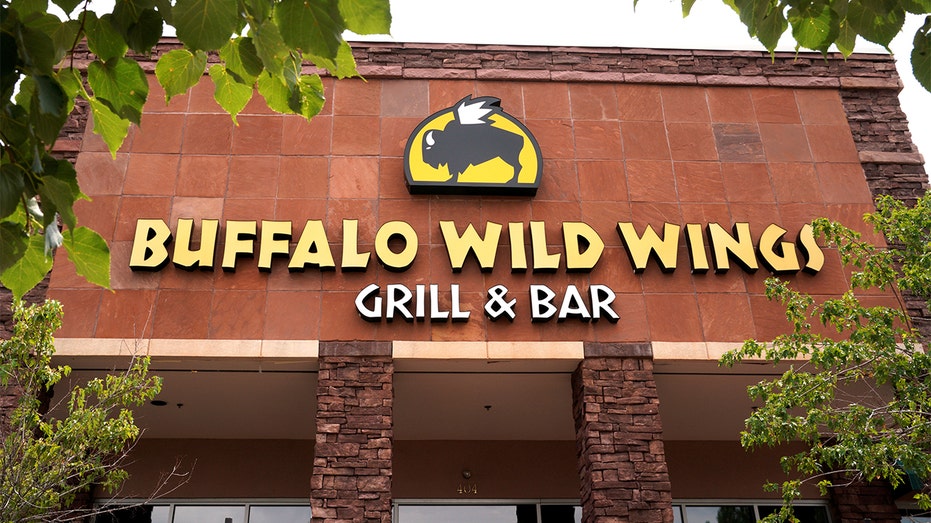
The Buffalo Wild Wings restaurant in Superior, Colo., on July 26, 2017. (Rick Wilking/Reuters / Reuters)
However, the court concluded that the phrase “boneless wing” is a “fanciful name” and that no reasonable consumer would believe they truly were deboned chicken wings “reconstituted into some sort of Franken-wing.”
“Despite his best efforts, Halim did not ‘drum’ up enough factual allegations to state a claim,” Judge Tharp Jr. wrote in his 10-page ruling.
While he found Halim had standing to sue because he alleged economic harm, he dismissed the claims for failing to plausibly allege deception.
He gave Halim until March 20 to file an amended complaint, though he signaled skepticism that any “additional facts” could be provided to salvage the claim.
British Steel has created 23 jobs as part of the contract and also resumed round the clock manufacturing
Coreena Ford Chronicle and Journal business writer and Ivan Morris Poxton
12:07, 18 Feb 2026
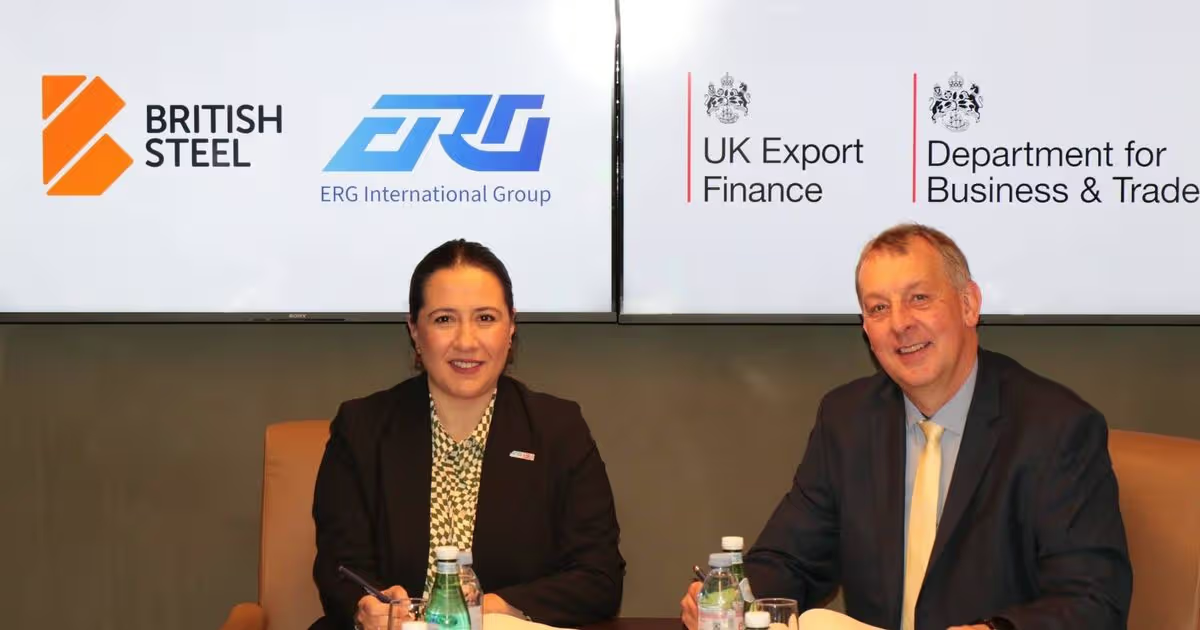
Melike Erdem, CEO of ERG International UK, and Craig Harvey, British Steel’s commercial director- rail, signing the Turkiye rail supply agreement(Image: British Steel)
British Steel has secured a contract worth tens of millions of pounds to provide rail for a significant high-speed electric railway in Turkey. The eight-figure deal, backed by UK Export Finance, will see British Steel deliver 36,000 tonnes of rail to ERG International Group.
The contract has created 23 new roles fresh positions at British Steel’s Scunthorpe plant, also prompted the company to restart round-the-clock rail production for the first time in more than a decade. The rail British Steel will provide will contribute to constructing a 599km railway line linking Turkey’s capital, Ankara, with İzmir.
Advertisement
The confirmed agreement builds upon Prime Minister Sir Keir Starmer’s announcement in November that British Steel would supply £35m worth of its world-class rail products for Turkey’s high-speed rail network.
British Steel’s chief commercial officer, Lisa Coulson, said: “Securing this prestigious contract – with the support of UK Export Finance – was a major achievement and underlines British Steel’s ability to build the sustainable track systems of the future. It also demonstrates the importance of British Steel, the UK’s only manufacturer of rail, to this country’s economy and Britain’s global trading partners.”
She noted the firm was “extremely grateful for the UK Government’s support in sealing this contract” and anticipated collaborative efforts “to secure more orders for our world-class products”. The new high-speed railway will transform transport infrastructure in Turkey, reports Grimsby Live.
Journey times between Ankara and İzmir will be slashed by more than 10 hours. Beyond offering passengers and freight operators a quicker, more effective rail service, it will also deliver substantial emissions reductions through a lower-carbon alternative to existing transport modes.
Advertisement
British Steel will provide its rail to ERG International Group, which is executing the project on behalf of Turkey’s government. The steelmaker is set to supply 60E2 rail, which will be dispatched throughout 2026 in 36-metre lengths. Upon completion, the railway will be operated by Turkish State Railways.
Craig Harvey, British Steel’s commercial director for rail, said: “We have a distinguished record of supplying into high-speed rail projects across the world and have previously delivered rail into Türkiye through ERG for earlier phases of the Ankara to Izmir line. For this new agreement, we were again able to comply with the demanding technical specifications and the project delivery schedule which we can support with a robust logistics supply chain.”
Rail being manufactured at British Steel.(Image: British Steel)
Mr Harvey described the contract as “the catalyst” for resuming round-the-clock rail production at British Steel’s Scunthorpe facility. “We are also optimistic we can supply other steel products into this project and are working with ERG to support its future needs,” he added.
Industry Minister Chris McDonald said: “UK-made steel is renowned for its high quality, and this order is welcome news for British Steel. Supporting deals like this is at the heart of our Steel Strategy. Every tonne of British made steel used in projects at home and abroad helps sustain skilled employment and reinforces its quality for the world’s most ambitious engineering projects.”
Advertisement
ERG International UK’s CEO, Melike Erdem, said the agreement marked “another major milestone in our long-standing partnership with British Steel”.
She further noted that the Ankara-Izmir high-speed rail line is “progressing at pace” and the agreement “ensures the delivery of world-class rail products”. ERG International UK’s chief commercial officer, Mohamed Ibrahim, expressed pride in deepening collaboration with the UK supply chain.
“This new rail supply agreement follows successful deliveries in 2025 and paves the way for further collaboration between ERG International and British Steel on upcoming projects.”