
Crypto World
Pi holds above $0.091 as OpenPay restores cash-in feature



Key takeaways
- Pi Network is trading above $0.091 after gaining 10% in August.
- OpenPay has restored its cash-in feature, enabling users to convert PI and other altcoins into the OUSD stablecoin.
- PI must break above the $0.1000–$0.1022 resistance zone to strengthen its bullish outlook.
Pi Network traded in positive territory above $0.091 on Tuesday, preserving the 10% gain recorded during August.
The token’s latest recovery coincides with OpenPay’s decision to restore its cash-in feature. The service allows users to convert PI and other supported altcoins into the OUSD stablecoin for payments and transfers.
Despite improving utility, PI remains below the psychologically important $0.1000 level. A confirmed breakout above this resistance is required to establish a stronger upward trend.
OpenPay restores cash-in support for PI
OpenPay, a Web3 decentralized wallet connected to the Pi Network ecosystem, announced on Monday that it had reintroduced its cash-in feature following community demand.
The service supports 96 partners, including Pi Network, local banks in the Philippines and international payment providers such as Apple Pay and PayPal.
Users choosing to pay with PI must first convert their tokens into OUSD. The resulting stablecoins can then be used for transfers, QR-code payments or transactions directed back toward a Pi Wallet.
Restoring the feature could increase PI’s practical utility by providing holders with additional ways to move and spend their assets.
However, OpenPay’s additional Know Your Customer requirements may raise privacy and accessibility concerns among some community members.
PI remains capped below $0.1000
PI traded around $0.0915 on Tuesday but remained below the $0.1000 psychological resistance level.
The price continues to move sideways above the 23.6% Fibonacci retracement level at $0.0836. This retracement is based on PI’s decline from $0.1341 to $0.0703.
The consolidation indicates that buyers are defending lower levels, although persistent selling pressure around $0.1000 continues to limit the recovery.
PI must record a confirmed breakout above $0.1000 to strengthen its bullish outlook. The 50% Fibonacci retracement level at $0.1022 reinforces this resistance, creating a significant supply zone between $0.1000 and $0.1022.
A decisive daily close above the area could encourage sidelined buyers to enter the market and extend PI’s recovery toward the 78.6% Fibonacci retracement level at $0.1204.
The Moving Average Convergence Divergence indicator and its signal line are moving sideways slightly above the zero level on the daily chart.
This setup suggests that bullish momentum remains weak despite PI holding onto its recent gains.
The Relative Strength Index stands near 52, slightly above its neutral midpoint. Although the reading provides a mildly constructive signal, it does not indicate strong buying pressure.
Together, the indicators suggest that PI may continue consolidating unless buyers generate enough momentum to overcome the resistance around $0.1000.

The 23.6% Fibonacci retracement level at $0.0836 provides the most important immediate support.
A confirmed breakdown below this level could expose the swing low at $0.0703. Losing that support would weaken the current recovery structure and could push PI into a new price-discovery phase.
PI’s near-term direction will therefore depend on whether buyers can reclaim the $0.1000–$0.1022 resistance zone or sellers force a breakdown below $0.0836.



Strategy has spent $635.2 million repurchasing its STRC perpetual preferred stock as the security continues to trade below its $100 par value despite recovering from a low near $71.
Summary
- Strategy has spent $635.2 million buying back STRC, which remains below its $100 par value at around $97.
- The latest STRC repurchase totaled $151.8 million at an average price of $97.48 per share.
- Strategy returned to Bitcoin buying with a $369.7 million purchase of 4,603 BTC, taking its holdings to 845,050 BTC.
- Strive’s SATA offers a 13% annualized dividend with daily payments, compared with STRC’s 12% rate paid twice monthly.
- SATA has stayed near $100, while Strive’s ASST has gained roughly 60% this year compared with a 15% decline for MSTR.
Strategy disclosed in its latest filing that it bought back another $151.8 million of STRC during the week ended Aug. 30, paying an average $97.48 per share as part of a repurchase program designed to support the preferred stock.
The latest purchase covered 1.56 million STRC shares and came as the company returned to buying Bitcoin after a roughly two-month pause. Strategy acquired 4,603 BTC for $369.7 million at an average price of $80,318 per coin, taking its total holdings to 845,050 BTC.
STRC, known as Stretch, was trading at $97.34 on Tuesday, leaving the preferred stock below the $100 level Strategy has sought to restore through dividend increases, cash reserves and share repurchases.
Strategy STRC buybacks have reached $635.2 million
Strategy introduced a $1 billion authorization for preferred stock repurchases in late June as part of its Digital Credit Capital Framework, which set aside another $1 billion for common stock buybacks and raised STRC’s annual dividend rate to 12%. As previously covered by crypto.news, the new capital framework included a separate program allowing Strategy to sell up to $1.25 billion of Bitcoin if needed.
Since then, the company has steadily used the preferred stock authorization as STRC recovered from its June lows.
The size of Strategy’s weekly purchases has increased along with STRC’s price. During the week ended July 26, the company repurchased $25 million of STRC while the preferred shares remained well below par. At the time, Strategy had increased its dollar reserve to $3.75 billion and kept its Bitcoin holdings unchanged at 843,775 BTC.
Strategy later sold 1,638 BTC for $104.7 million between July 27 and Aug. 2, directing part of its available capital toward preferred stock dividends and repurchases. The Bitcoin sale came as the company increased its cash position and continued supporting STRC.
By the latest reporting week, Strategy was willing to pay an average $97.48 for STRC, less than $3 below its stated $100 par value.
The company funded its latest transactions by selling 4.53 million MSTR shares through its at-the-market program for net proceeds of $602.8 million. Of that amount, $369.7 million funded the Bitcoin purchase, $151.8 million went toward STRC repurchases, $50.7 million was allocated to STRC dividends and $30 million was added to Strategy’s USD Cash account.
Strategy reported $1.61 billion in USD Cash as of Aug. 30, while another $5.1 billion was held in its USD Reserve.
STRC remains short of its $100 par value
STRC has recovered considerably since falling below $75 in late June, but Strategy has yet to push the preferred stock back to $100 on a sustained basis.
Chief Executive Phong Le said in July that Strategy planned to resume issuing STRC once the security returned to par, linking the recovery directly to the company’s ability to use the preferred stock for future Bitcoin purchases.
“We’ll continue to build that. And yeah, when Stretch gets back to par, we’ll issue more. We’ll buy more Bitcoin,” Le said at the time, as crypto.news previously reported.
STRC had been trading near $87 when Le made the comments on July 16. Strategy had spent the preceding weeks building its dollar reserves after the preferred stock fell sharply during June.
The company had already changed STRC’s dividend structure in an attempt to make the security more attractive to income investors. Shareholders approved semi-monthly dividend payments in June, moving distributions to the 15th and final day of each month.
Strategy later raised the annualized dividend rate to 12% as part of its capital framework.
Institutional demand has remained significant despite STRC trading below par. By late July, the preferred stock had become the largest holding in three major U.S. preferred stock exchange-traded funds, which collectively held $756 million of STRC. Institutional holdings had increased 105%, while the retail ownership share fell from 78% to 71%.
Strive’s SATA has held closer to par
Competition from Strive’s Variable Rate Series A Perpetual Preferred Stock, SATA, has provided investors with another Bitcoin treasury-linked income product carrying a higher annualized dividend rate.
Strive has maintained SATA’s dividend rate at 13% for September, compared with STRC’s 12%. SATA pays cash dividends every business day, while STRC distributes dividends twice a month.
Strive began daily SATA distributions on June 16 after moving away from monthly payments. The company said the change made SATA the first U.S.-listed security to make cash dividend payments every business day.
For September, Strive declared daily payments of $0.0516 per share across 21 business days, equivalent to $1.0836 for the full month and a 13% annualized rate.
SATA has remained close to its $100 par value for more than a week, allowing Strive to continue selling shares through its at-the-market program and directing proceeds toward Bitcoin purchases.
The funding model has supported Strive’s Bitcoin accumulation throughout 2026. In June, the company bought 759 BTC for roughly $50 million, with SATA providing a significant portion of the capital used for the purchase.
More recently, Strive acquired another 1,800 BTC over the past week using proceeds supported by SATA issuance, while the preferred stock remained around par.
Strategy has resumed Bitcoin purchases
Strategy’s latest 4,603 BTC acquisition ended a roughly 10-week period without a net Bitcoin purchase and lifted its holdings to 845,050 BTC, worth approximately $65.9 billion at current prices.
The company had spent much of the previous two months directing capital toward cash reserves, preferred stock obligations and STRC repurchases. Its latest transaction returned Bitcoin purchases to the largest use of proceeds from its weekly MSTR issuance, with nearly $370 million of the $602.8 million raised through common stock sales going toward BTC.
Strategy still had approximately $19.09 billion of MSTR shares available for issuance under its at-the-market program as of Aug. 30.
The performance gap between the two companies has remained visible in their common shares. Strive’s ASST has gained roughly 60% since the start of 2026, while Strategy’s MSTR has fallen around 15% over the same period.
Strive reported in August that it acquired 6,236 BTC during the second quarter and 12,237 BTC during the first six months of 2026. Another 303 BTC were purchased between July 1 and Aug. 7, while the company had paid 44 consecutive daily SATA dividends by Aug. 7.
Strive had no short or long-term debt outstanding as of Aug. 7 and reported $154.9 million in cash and cash equivalents.

XRP is holding near the same consolidation zone it’s occupied since retreating from August’s $1.70 peak. The token has shed 8.2% over the past week but remains up nearly 26% on a 30-day basis, a reminder that short-term pullbacks don’t always erase medium-term structure.
Bitwise’s spot XRP ETF, on the other hand, has crossed $507 million in assets under management, with the fund holding 364.8 million XRP as of late August. August inflows into XRP ETFs more than doubled July’s total, and analyst Ali Martinez called XRP’s breakout “confirmed” with a $1.70 target, a call that aged awkwardly once price slipped back below that resistance band within days.
The tension here is straightforward: institutional demand via ETF wrappers is accelerating even as spot price cools off. That gap is exactly the kind of setup that either resolves into a squeeze or a fakeout, and the technicals below suggest which scenario is currently favored.
Discover: The Best Token Presales
Can XRP Price Hit $2 This Week?
XRP’s daily RSI sits near 60.6, or above the 50 midline, meaning momentum hasn’t flipped bearish, but it has cooled meaningfully from overbought territory reached during the August run. Price is consolidating in the $1.36–$1.38 band, a zone that previously capped rallies as resistance and now needs to hold as support.
Immediate support sits at $1.30–$1.35. A daily close below that range would break the sequence of higher lows from August and open the door to $1.27. First resistance is $1.50–$1.60; XRP needs to reclaim and hold that zone before another test of $1.70 becomes credible.

- Bull case: ETF inflows persist, support holds at $1.35, XRP reclaims $1.60 and pushes toward $1.70–$2.00.
- Base case: Range-bound chop between $1.30 and $1.50 while the market digests the September 1 escrow unlock.
- Bear case: Close below $1.30 invalidates the higher-low structure, exposing $1.27 and reviving the longer downtrend from $3.
Traders watching for confirmation before $2 becomes more than a headline number should track the $1.35 level closely, see further breakdown in this XRP price prediction analysis.
Trade XRP on Bybit and Get a Chance to Win Our $1,000 USDT Airdrop
Bitcoin Hyper Targets Early Mover Upside
XRP holders riding the ETF narrative have already captured most of the easy upside from the $1.00 to $1.70 move. At current levels, a rally back to $2 caps out around 45% from the $1.38 price point. It’s solid, but not the kind of asymmetric setup that early-stage capital tends to chase.
The above reasons are pushing a segment of traders toward presale infrastructure plays where the ceiling hasn’t been priced in yet. Enter Bitcoin Hyper ($HYPER), a Bitcoin Layer 2 integrating the Solana Virtual Machine, the first project with SVM execution speeds faster than Solana itself, layered directly onto Bitcoin’s security base.
The presale has raised $33 million at a current token price of $0.0136855, with staking rewards offered at a high 65% APY. Core features include a decentralized canonical bridge for BTC transfers and low-latency smart contract execution, solving Bitcoin’s long-standing programmability gap.
Research Bitcoin Hyper through the official presale page before deciding.
Discover: The Best Crypto to Diversify Your Portfolio
The post XRP Targets $2 as Bitwise ETF Records 500 Million appeared first on Cryptonews.

BYD keeps confirming its latest sales plan is paying off: Push headfirst into overseas market, to make up for the drastic declines back home in China. August sales for Tesla’s erstwhile rival rose 18%, entirely on the back of international markets. Last month, BYD sold 440,293 new energy vehicles, which includes both battery electric cars and plug-in hybrids, according to…
Copyright ©2026 Investor’s Business Daily, LLC. All rights reserved. 87990cbe856818d5eddac44c7b1cdeb8


The Cardano Foundation and Brazilian technology company Blockforce announced on Aug. 31 that Cardano now operates as the public verification layer for an enterprise supply chain platform.
Summary
- Cardano now anchors cryptographic proofs for more than 500,000 supply chain records already in production.
- Confidential records remain permissioned while public Cardano proofs allow independent verification without exposing underlying data.
- Joint engineering reduced public anchoring costs per record by 92%, according to the project partners.
- Azzas 2154 uses the system to trace leather using supplier, fiscal and government database records.
- Signed contracts cover 6.5 million certified records through 2030, with expansion planned across additional industries.
The system has anchored cryptographic proofs for more than 500,000 records, according to the partners’ announcement. It is already operating with major Brazilian fashion companies, including Azzas 2154.
The companies described the deployment as a dual-ledger architecture. Commercial records remain on a restricted network, while corresponding proofs are recorded on Cardano’s public blockchain.
Cardano separates confidential records from public proof
Blockforce stores information about individual supply chain events on a permissioned network. Access remains limited to approved companies, suppliers and other participating parties.
The platform then generates a cryptographic proof for each record and anchors that proof to Cardano. An auditor or regulator can compare a supplied record against its public proof to establish whether the record has changed since anchoring.
This design seeks to resolve a common problem in enterprise blockchain deployments. Companies may need independent verification but cannot publish supplier identities, prices, contracts or other commercially sensitive information on a public ledger.
The architecture does not establish whether the information entered into the private system was accurate. It provides evidence that a particular record existed and has not subsequently been altered. Data quality still depends on source documents, validation procedures and participating organizations.
Azzas 2154 applies the system to leather traceability
Azzas 2154, described by the partners as Latin America’s largest fashion group, is using the platform across its leather supply chain. The company combines fiscal documents, supplier information and official public databases to create an auditable product history.
The fashion group has set a target of tracing 100% of the leather used across its brands by 2030. That remains a future corporate goal rather than a completed result.
European supply chain requirements provide a commercial reason for exporters to improve product records. The European Union’s Ecodesign for Sustainable Products Regulation is establishing Digital Product Passports for priority product categories, including textiles and apparel.
The European Commission expects those passports to store and share information about products’ sustainability and environmental characteristics. The Cardano-Blockforce system could support record verification, but neither company said that using the platform automatically satisfies any particular European regulation.
In related coverage, crypto.news reported that Volvo tested blockchain infrastructure for supplier transactions, component traceability and compliance records. Volvo’s experiment used a closed environment, while Blockforce combines a restricted network with public Cardano proofs.
Batching reduced Cardano anchoring costs by 92%
Publishing an individual blockchain transaction for every supply chain event can become expensive at enterprise volumes. The Cardano Foundation and Blockforce said their engineering work reduced the public anchoring cost per record by 92%.
The partners achieved the reduction by batching certificates before anchoring them to Cardano. Their published architecture uses Blockforce’s uVerify system and configurable batching parameters to combine multiple records into fewer public transactions.
The 92% figure comes from the project partners and has not been supported by a publicly disclosed independent audit. The announcement also did not provide the original cost, the resulting cost per certificate or the network conditions used for the comparison.
Even so, the reported 500,000-record deployment moves the project beyond a limited prototype. It provides an operating example of a hybrid design intended to preserve confidential business data while using a public blockchain as a shared verification layer.
Contracts target 6.5 million records through 2030
The two companies said signed contracts cover 6.5 million certified records through 2030. That figure represents contracted future activity, not records already processed. The confirmed production total currently exceeds 500,000.
Blockforce plans to apply the architecture beyond fashion. The partners identified automotive manufacturing, agribusiness, pharmaceuticals and cosmetics as possible expansion areas. They did not disclose additional customers or deployment dates.
Execution will depend on companies supplying consistent source data and integrating existing documentation systems with the permissioned network. Auditors and regulators must also receive suitable tools for retrieving records and comparing them with Cardano proofs.
Public transaction identifiers, a verification dashboard or an independent system audit would provide more evidence about throughput, costs and reliability as deployment grows. The next measurable milestone will be progress from the current 500,000 records toward the contracted 6.5 million total.
Ethereum price remained trapped between $2,400 support and $2,500 resistance on Sept. 1, with weak trend strength and fading momentum raising the risk of another liquidity-driven pullback.
Summary
- Ethereum price traded near $2,460 after falling roughly 1% over the past seven days.
- The 4-hour ADX dropped to 18.58, showing little strength behind the current price trend.
- Liquidity is concentrated near $2,410 below price and between $2,540 and $2,550 above it.
- US spot Ethereum ETFs attracted $87.68 million on Aug. 31 despite ETH’s muted performance.
According to data from crypto.news, Ethereum (ETH) price was trading near $2,460 at press time, little changed over the previous 24 hours and down about 1% over the past week. The token had retreated from an Aug. 27 high near $2,564 after buyers failed to extend its late-August breakout.
Trading activity has also cooled. CoinGecko data showed that Ethereum’s 24-hour volume had fallen by about 21% to approximately $11.35 billion, indicating lower participation as the price consolidated.
ETH remains caught between support around $2,400 and resistance extending from $2,500 to $2,565. A break from that range could determine whether the August rally resumes or gives way to a deeper correction.
Ethereum price loses momentum below $2,500
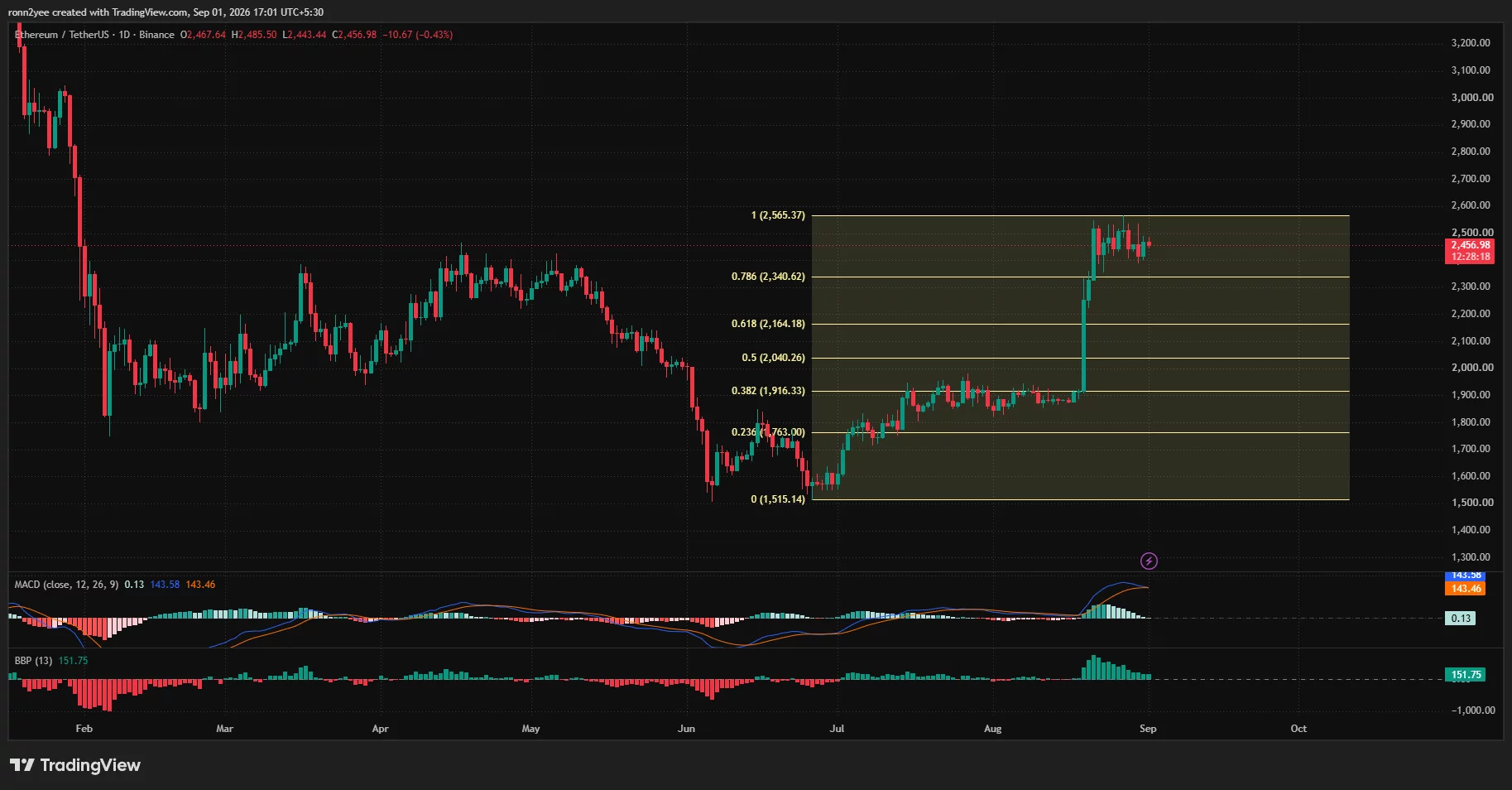
The daily chart shows Ethereum consolidating near the upper end of the advance from its June low of $1,515 to the August high of $2,565.
ETH remains above the 78.6% Fibonacci retracement level at $2,340, which now serves as the main higher-timeframe support. Holding above that level would preserve most of the structure created by the August breakout.
However, momentum has weakened considerably. The daily moving average convergence divergence indicator is close to producing a bearish crossover. The MACD line stands at 143.58, only slightly above the signal line at 143.46, while its histogram has narrowed to almost zero.
Bull-bear power remains positive at 151.75, suggesting buyers have not lost full control. Its bars have nevertheless declined since the initial breakout, showing that bullish pressure is fading as ETH struggles to clear $2,500.
A daily close above $2,565 would invalidate the short-term consolidation and open a path toward $2,600. Continued rejection beneath that area would leave $2,340 exposed, followed by the 61.8% Fibonacci level at $2,164.
4-hour indicators point to range-bound trading
Ethereum’s 4-hour chart provides a more neutral outlook. ETH is trading almost directly on the Bollinger Bands’ middle line at $2,456.53, reflecting a balance between buyers and sellers.
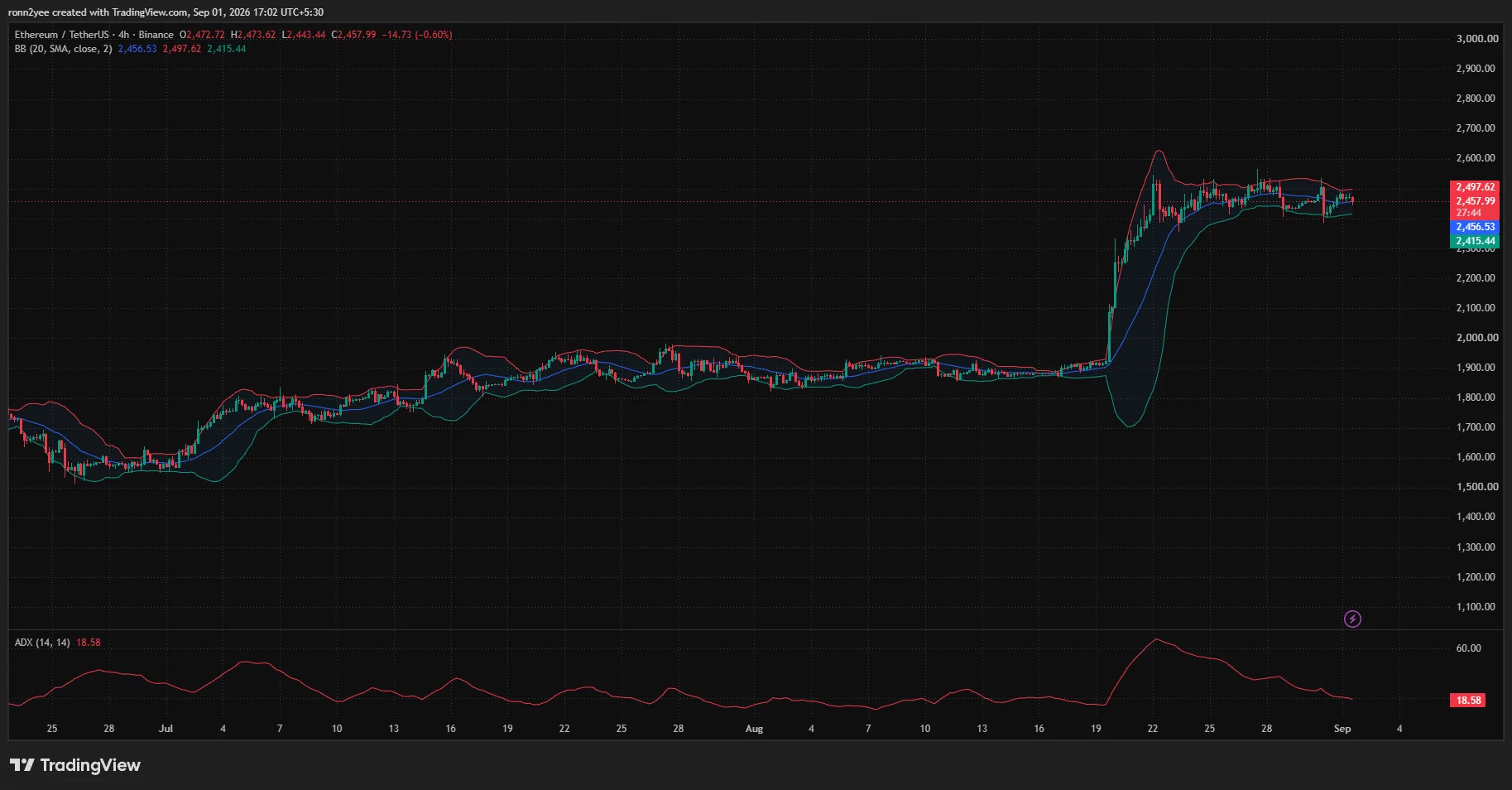
The upper band sits at $2,497.62, making $2,500 the first resistance that bulls must reclaim. The lower band at $2,415.44 aligns with the broader $2,400 support area.
The bands have narrowed after expanding sharply during the Aug. 20 breakout. Such compression often precedes a larger move, although it does not indicate which direction the price will take.
The average directional index has fallen to 18.58 from above 60 following the rally. An ADX reading below 20 generally signals that the market lacks a strong directional trend, supporting the case for continued consolidation until ETH moves outside the Bollinger Bands.
Crypto trader Daan Crypto Trades said ETH was trading in a tight area between its weekly 200-day simple and exponential moving averages and a horizontal price level.
The analyst identified $2,400 and $2,500 as the levels to monitor on daily closes, noting that Ethereum has spent roughly 11 days between them. Under that setup, a sustained close above $2,500 would favor buyers, while a loss of $2,400 would weaken the breakout structure.
Liquidation clusters surround Ethereum price
CoinGlass’s one-week liquidation heatmap shows leveraged positions building on both sides of Ethereum’s current price.
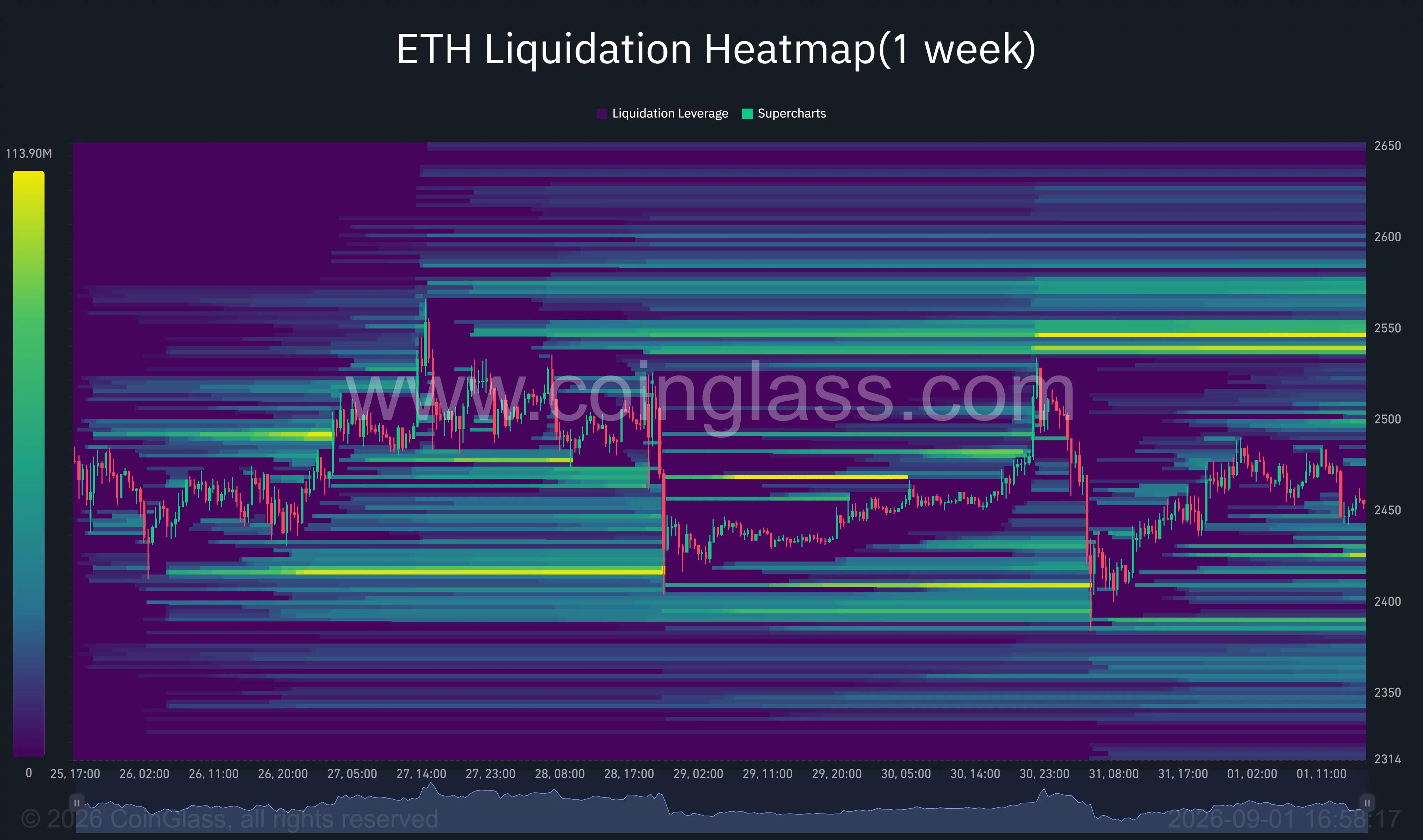
The largest nearby overhead concentration appears between approximately $2,540 and $2,550. A move into that area could force short positions to close, potentially accelerating an upside test of the $2,565 August high.
Additional liquidity rests around $2,495 to $2,505, reinforcing $2,500 as the first barrier.
On the downside, notable clusters appear around $2,420 to $2,410, followed by another concentration close to $2,390. A break below $2,400 could therefore trigger long liquidations and pull ETH toward the lower liquidity zone.
Liquidation maps identify areas where leveraged positions may be forced to close, but they do not guarantee that the price will reach those levels.
Trader Gerla compared Ethereum’s current position with a former support zone that became resistance during the previous market cycle. The analyst said a repeat of that structure could produce more range trading and a sweep toward $1,900–$2,000 before a larger advance.
The comparison represents a long-term scenario rather than a confirmed target. ETH must first lose $2,340 and $2,164 before the $2,000 area becomes a more immediate technical risk.
US Ethereum ETF inflows offer support
Demand through regulated US investment products remains a counterweight to the weak price momentum.
US spot Ethereum ETFs recorded $87.68 million in combined net inflows on Aug. 31, according to SoSoValue data. The session reportedly extended its positive flow streak to 11 trading days.
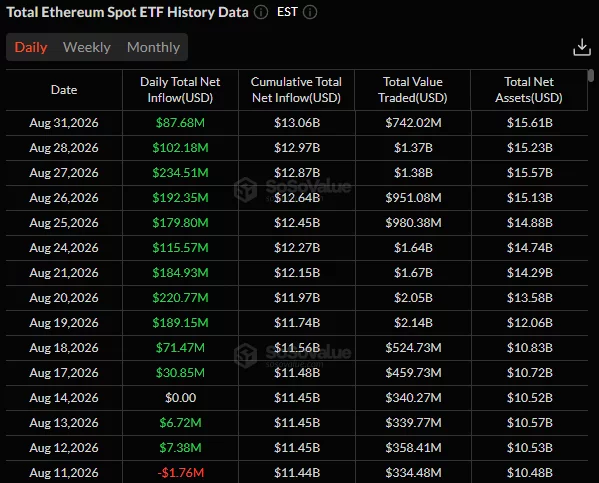
BlackRock’s iShares Ethereum Trust led the daily total with approximately $59.94 million, while the Grayscale Ethereum Mini Trust added about $13.50 million. The products collectively held approximately $15.61 billion in net assets, equal to 5.23% of Ethereum’s market capitalization.
Persistent ETF inflows suggest US investors are adding exposure despite Ethereum’s failure to move above $2,500. However, price confirmation remains absent while trading volume declines and momentum indicators flatten.
Ethereum’s next directional signal will likely come from a daily close outside the $2,400–$2,500 range. A close above the upper boundary would bring $2,550–$2,565 into focus, while a loss of $2,400 would expose $2,340 and increase the risk of a broader retracement.
Disclosure: This article does not represent investment advice. The content and materials featured on this page are for educational purposes only.
Crypto World
Ethena pushes stablecoins into everyday banking with high-yield savings, cards and payments


Ethena Pay offers a 6% dollar savings rate and 5% card cashback, using Avalanche for settlement.

Federal Reserve Board Governor Michael Barr speaks about “Artificial Intelligence and the Labor Market” to the New York Association for Business Economics (NYABE) in New York City, U.S., Feb. 17, 2026.
Brendan McDermid | Reuters
Federal Reserve Governor Michael Barr said Tuesday he would be prepared to support an interest rate hike if inflation doesn’t ease.
Speaking at a banking forum in Washington, the policymaker said he’s concerned about “broader price pressures taking hold” as inflation has remained stuck above the Fed’s 2% target for nearly 5½ years.
“If trends in the data give me some confidence that inflation is moderating on a path to 2%, then I think we can take a bit more time to assess our policy stance,” Barr said in prepared remarks. “However, if inflation appears not to be moderating sufficiently, then I think we should act decisively to raise rates.”
The comments come at a critical time for policy and the broader backdrop of elevated inflation and rising Treasury yields. As a governor, Barr is a permanent voting member on the rate-setting Federal Open Market Committee.
Amid fresh worries over the precarious Middle East situation, yields jumped again Tuesday, with the benchmark 10-year note at a level not seen since mid-January 2025.
At the same time, Fed Chairman Kevin Warsh last week delivered remarks that markets widely interpreted as titled toward a rate hike, possibly as soon as the next policy meeting in two weeks. Barr supported the July decision to keep the benchmark funds rate targeted between 3.5%-3.75%, but markets Tuesday morning were pricing in about a 66% chance of an increase this month, according to the CME Group’s FedWatch.
Barr gave the economy good marks even with elevated inflation.
“Consumer spending to date has been largely resilient,” he said. “But inflation remains too high — and has been for over five years,” he said.
The most recent inflation readings showed headline prices up 3.7% over the past year, or 3.3% excluding food and energy. The Fed will get one more look at inflation data when the consumer and producer price indexes are released next week.
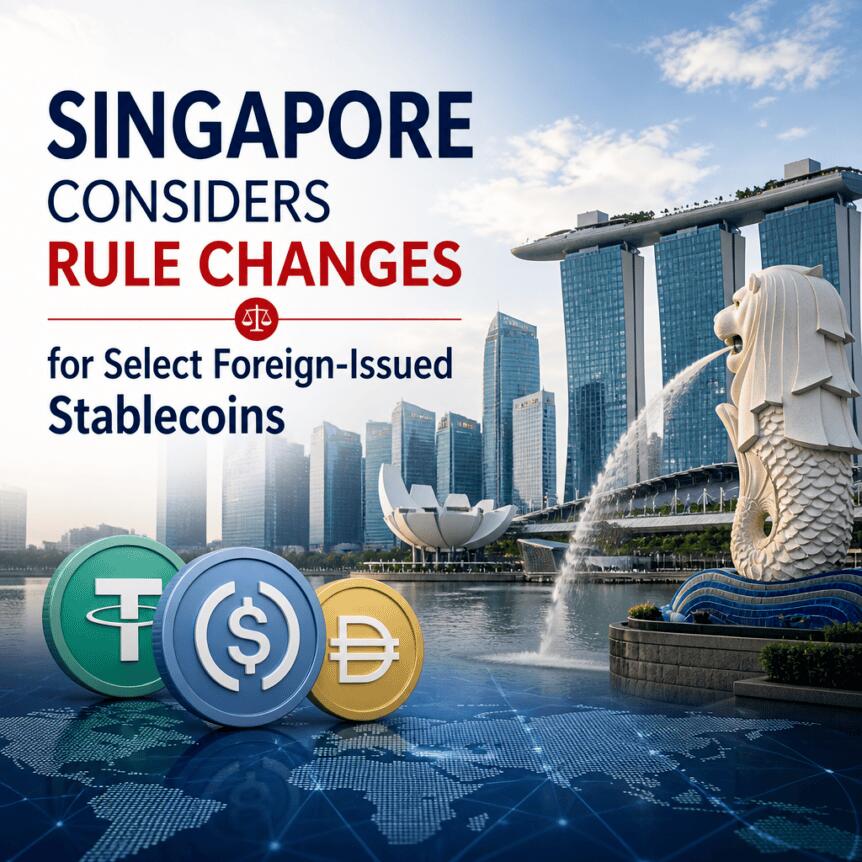
The Monetary Authority of Singapore (MAS) has moved to revisit a key element of its stablecoin regime, proposing changes that would allow some stablecoins connected to multiple jurisdictions to fall under Singapore’s regulatory framework. The development arrives through a new public consultation on amendments to the Payment Services Act (PSA) and associated policy adjustments.
In a consultation opened Tuesday, MAS said it is considering a pathway for “jointly issued” stablecoins—issued by a Singapore entity together with a foreign issuer—to qualify as “MAS-regulated stablecoins” if risks are adequately addressed. The regulator is also exploring whether a limited number of foreign-issued stablecoins could be recognized under similar overseas rules, particularly for cross-border wholesale usage.
Key takeaways
- MAS is consulting on PSA amendments to implement its stablecoin framework and reflect policy developments since 2023.
- Jointly issued stablecoins (Singapore + foreign issuer) could qualify as “MAS-regulated stablecoins” if MAS-set risk conditions are met.
- MAS is considering recognition of a limited set of foreign-issued stablecoins subject to comparable regulatory frameworks abroad.
- Proposals would tighten issuer safeguards, including reserve stability expectations, disclosure requirements, and stress-testing.
- MAS says comments are open until Oct. 16.
Why MAS is rethinking its earlier single-jurisdiction stance
MAS’s 2023 position required qualifying stablecoins to be issued solely in Singapore. MAS then finalized a framework for single-currency stablecoins issued in Singapore and pegged to the Singapore dollar or a G10 currency, under which issuers would operate with specified regulatory controls. According to MAS, the regulator’s earlier approach reflected concerns around whether equivalent regulation and effective cooperation could be secured across jurisdictions.
MAS also highlighted operational and technical issues it said would be difficult under a multi-jurisdiction model—such as establishing where commingled stablecoin reserves originated, and whether those reserves would be sufficient to meet redemption requests in practice.
The new consultation signals a shift from that restrictive baseline. While MAS did not abandon the need for risk controls, it is now proposing mechanisms meant to address those earlier concerns in cases where issuance involves both Singapore and a foreign issuer.
MAS consultation: how “MAS-regulated stablecoins” could work
At the heart of the proposal is an expanded eligibility route within the existing stablecoin framework. MAS said stablecoins jointly issued by a Singapore issuer and a foreign issuer could be regulated under the framework and marketed with the “MAS-regulated stablecoins” label, provided that associated risks are sufficiently mitigated.
MAS is pursuing legislative implementation of its approach by proposing amendments to the PSA, the main law in Singapore governing payment services and payment-service operators. The consultation outlines requirements intended to preserve the same core features of the 2023 framework, including reserve-backed value stability and controls around redemption and disclosures.
Under the proposal, only issuers licensed under the framework would be permitted to market themselves as “MAS-regulated stablecoin” issuers and use the “MAS-regulated stablecoins” designation. Outside of the dedicated framework, MAS indicated that stablecoins would continue to be treated under existing rules as digital payment tokens.
Issuer safeguards MAS wants to add or strengthen
The consultation does not limit itself to eligibility criteria. MAS is also looking to reinforce how compliant issuers must manage reserves, customer protections, and stress resilience.
MAS’s proposal would include requirements relating to reserve-backed stability, capital considerations, redemption “at par,” and issuer disclosures. It also proposes prohibitions and additional operational obligations, including a ban on issuers paying interest on regulated stablecoins.
To test survivability under adverse scenarios, MAS is also proposing that issuers conduct stress tests and maintain recovery and orderly wind-down plans. In addition, the consultation outlines consumer-facing safeguards requiring issuers to protect customer money received before the corresponding stablecoins are issued.
For market participants, these safeguards matter because they define the compliance boundaries for who can access the “MAS-regulated” label—an important distinction in a jurisdiction where regulation can influence banking relationships, distribution, and institutional onboarding.
Recognition of selected foreign-issued stablecoins for wholesale use
Beyond jointly issued products, MAS is considering another pathway: recognizing a limited number of foreign-issued stablecoins regulated under comparable overseas frameworks. MAS’s stated rationale is tied to utility in cross-border wholesale transactions, where certain stablecoins may be used as settlement or liquidity tools between professional counterparties.
The proposal stops short of opening the door broadly to all foreign stablecoins. MAS frames the idea as a controlled recognition approach limited to a small number of eligible instruments, contingent on regulatory comparability and risk mitigation—consistent with how it treated equivalence and cooperation as a key challenge in 2023.
For traders and treasury teams, this distinction could be meaningful. Wholesale settlement use typically prioritizes predictable redeemability, clear governance, and operational certainty—areas where MAS’s emphasis on redemption at par, reserve-backed stability, and stress planning are directly relevant.
What to watch during the consultation period
MAS is accepting public feedback on the proposals until Oct. 16. Market participants will likely focus on how MAS plans to operationalize “sufficiently mitigated” risk in joint issuance structures and what specific criteria may govern recognition of any foreign-issued stablecoins. The outcome could determine whether Singapore’s stablecoin framework becomes more interoperable across borders—or remains largely centered on domestic issuance.
For readers who want to review the regulatory text directly, MAS’s consultation is published here: https://www.mas.gov.sg/publications/consultations/2026/consultation-on-proposed-amendments-to-the-payment-services-act-for-stablecoin-regulation. MAS previously finalized its 2023 stablecoin framework here: https://www.mas.gov.sg/news/media-releases/2023/mas-finalises-stablecoin-regulatory-framework.
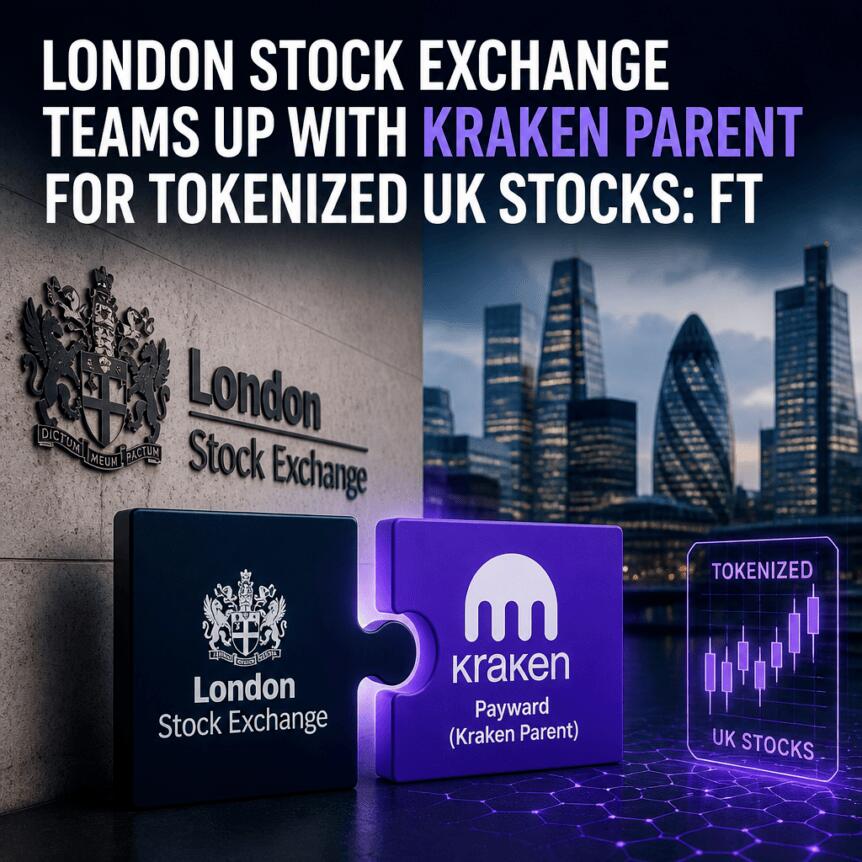
The London Stock Exchange Group (LSEG) is reportedly preparing to bring tokenized stock trading to its next-generation venue in partnership with Kraken’s parent company, Payward. The plan, described by Payward’s chief commercial officer Mark Greenberg in a Tuesday report, targets access to tokenized stocks that track major UK equity products starting in 2027.
According to the Financial Times, the tokenized equities would be listed on LSE’s new night-time trading platform, LSE 24—an initiative designed to run 24/5 trading from Mondays through Fridays. LSE 24 was announced by the exchange operator on July 21.
Key takeaways
- LSEG is moving tokenized equity exposure into a regulated trading venue, with Payward linked to the rollout.
- The targeted launch window for tokenized stocks tracking leading UK equities is 2027.
- Trading would take place on LSE’s planned 24/5 system (LSE 24), aimed at extending market hours versus traditional schedules.
- The announcement places London among several major TradFi firms pursuing tokenized stock products, including Nasdaq and ICE.
- Tokenized stock adoption continues to expand, with onchain totals and holder counts rising as measured by RWA.xyz.
How LSE 24 and Payward could change UK market access
LSE 24 is central to the move. Rather than limiting tokenized assets to a separate experimental platform, the approach described by Payward connects tokenized stocks to a trading venue being built by the London exchange itself. The claimed operating schedule—24/5—matters for investors and trading desks that want greater continuity across the week, particularly around regional evening hours and the transition from Asia to Europe.
For issuers and liquidity providers, tokenization can also shift how equity exposure is distributed and held, including the possibility of fractional ownership depending on the product structure. However, what exactly will be offered—such as which specific UK equity products are covered and how settlement and custody will operate in practice—was not detailed in the excerpted reporting.
Still, the direction is clear: tokenized stocks are being treated less like a standalone blockchain concept and more like an extension of mainstream market infrastructure.
LSE joins a broader tokenized equities race in TradFi
LSE’s reported partnership with Kraken’s parent Payward adds another traditional exchange operator to a trend that has accelerated across major markets. The article notes that other established players are also exploring tokenized equity offerings that can be traded around the clock or with extended hours.
In the United States, Nasdaq agreed to acquire LeveL Markets in August, framing the deal as part of a broader push into tokenized markets with round-the-clock trading capabilities. In Europe, ICE—the parent of the New York Stock Exchange—has also been linked to bringing tokenized stocks to its platform as part of a wider tokenized securities initiative.
Meanwhile, Deutsche Börse has reportedly invested in Payward, citing plans to broaden access to blockchain-based securities and tokenized investment products. Those efforts build on a prior relationship involving Kraken and Payward.
Beyond spot equities, the push is visible across derivatives infrastructure as well. The reporting also points to CME Group’s plans for crypto futures tied to networks including Cardano, Chainlink, and Stellar, as well as later additions involving Avalanche and Sui, each subject to regulatory approval. Taken together, these moves suggest that tokenization is not confined to equity settlements; it is increasingly being treated as a multi-asset market modernization theme.
What the onchain data says about tokenized stocks
Adoption indicators for tokenized equities continue to strengthen. According to data from RWA.xyz, the value of tokenized stocks rose by 15% over the prior 30 days to $2.53 billion. Over the same period, the number of tokenized equity holders increased by 153% to 2.45 million.
These figures do not directly confirm that LSE 24’s product will match these totals or replicate the same user base, but they provide context: tokenized equity participation appears to be expanding rather than stalling. That matters for regulators and market operators because sustained growth makes it more likely that tokenized securities move from pilot programs to repeatable offerings—especially when supported by established venues.
Investors should also note the asymmetry between “onchain growth” and “regulated venue readiness.” Tokenized stocks can exist onchain in various forms, while access through major exchanges typically requires product-specific compliance, market structure approvals, and operational integration that can take longer to execute than blockchain experimentation.
What to watch before 2027
The most actionable information missing from the excerpt is how LSE’s tokenized stock program will be structured end-to-end—particularly around custody, settlement mechanics, and the exact set of UK equity products to be tracked. As with any tokenized securities rollout on a major exchange, regulatory clarity and operational details will likely be as important as the headline partnership.
Readers should watch for further LSEG and Payward updates on product scope, the mechanics of LSE 24, and how the exchange plans to integrate tokenized equities into existing market and investor protections. With TradFi players increasingly converging on tokenized markets, those implementation specifics may determine whether tokenized equities become a practical alternative for broad investor access—or remain a niche parallel market.


Authorities targeted funds from a $140 million sponsorship deal with crypto firm Sorare, though law enforcement confirmed no wrongdoing by the Premier League.

TikTok, Whatnot livestream shopping gains steam in the U.S.

Strategy’s STRC remains below $100 despite $635 million in buybacks

10 Perfect Books That I Knew Would Be Masterpieces From the First 10 Pages





-

 Crypto World7 days ago
SpaceX stock could rise 75% to $240, JPMorgan says
-

 Fashion4 days ago
Weekend Open Thread: Maeve – Corporette.com
-

 Crypto World5 days ago
Bitcoin’s 22% rally now needs real demand to outlast Treasury liquidity boost
-

 Crypto World6 days ago
Warsh Jackson Hole keynote puts financial innovation first
-

 Business5 days ago
Salesforce Stock Soars 19% as Blowout Earnings and Agentforce AI Growth Silence Software Skeptics
-

 Business5 days ago
Apple Confirms September 9 Keynote and Reveals Its Full Pre-Order Schedule
-

 Crypto World6 days ago
Elon Musk Grok Bot Promise: We Will Make You Whole if AI Loses Your Money
-

 Crypto World6 days ago
Did Trump Just Move SpaceX Stock With One Truth Social Post?
-

 Business3 days ago
Onto Innovation Stock: AI’s Next Bottleneck Is Yield (NYSE:ONTO)
-

 Business6 days ago
Walmart takes aim at younger shoppers with new fashion brand
-
 NewsBeat6 days ago
Lindsay Clancy jury braces for closing arguments as judge tells court: ‘You’ve heard all the evidence’ – Live updates
-

 Crypto World4 days ago
Bitcoin price tests $82K resistance as Brandt stays long
-

 Crypto World5 days ago
NVIDIA revenue hits $96.2B as AI demand doubles
-

 Business7 days ago
Thailand’s Eastern Economic Corridor Capital City (EECiti): Key Developments and Investment Opportunities
-

 Business4 days ago
iPhone 18 Pro Pre-Orders Could Shift to Saturday as Apple Reportedly Avoids September 11 Anniversary
-

 NewsBeat7 days ago
Trump’s trade truce with China faces test with Iran effort
-
 Crypto World6 days ago
Nvidia Q2 Earnings Reveal $96.2 Billion Beat, So Why Is NVDA Falling?
-
 Tech3 days ago
Hugging Face built a $4.5 billion empire on free AI models. Now Nvidia is buying it for $12.9 billion
-

 Tech5 days ago
Claude Cowork gets its own browser that doesn’t touch your tabs, bookmarks, or saved passwords
-

 Crypto World5 days ago
Truflation calls for Fed rate cut after PCE forecast
You must be logged in to post a comment Login