
Crypto World
Ethena Expands Ecosystem With Launch of Self-Custodial Money App

Ethena (ENA) has officially launched Ethena Pay, a self-custodial money app the project bills as “the internet money neobank,” advertising a 6% dollar savings rate, 5% card cashback.
It even has free transfers across roughly 50 countries at launch. It also comes with dollar savings, card spending, international transfers and free onramps in dollars, pounds and euros, with fiat account numbers tied to self-custodial stablecoin wallets.
Though access starts with 400 early users and expands weekly through a September beta. Notably, Avalanche (AVAX) is the exclusive settlement network, and a feature called Buy Now Pay Never puts savings rewards toward purchases without touching the principal.
Tiers and Caps
As mentioned, Ethena’s card cashback is at a flat 5%. The product page breaks it into tiers: the free Standard plan pays 4% on spending with cashback capped at $100 a month, while the Pro and VIP plans lift the monthly caps to $360 and $1,000, with 5% reserved for the top tier.
Savings follow the same pattern: Standard accounts earn 5%, upper tiers get the advertised 6%, and rewards pay out daily. A footnote says the rates rest on Ethena-reported weekly data and assume no net staking activity during reward vesting.
Introducing @EthenaPay: the internet money neobank.
→Card spend cashback at 5.0%
→Best-in-class 6.0% dollar savings rate
→Borderless, free, instant global money transfers
→Free global onramps in USD, GBP, EUR and local FX
→Multi-currency high-rewards savings accounts in… https://t.co/d76b1Gul4V pic.twitter.com/1gpw7zS2cZ— Ethena (@ethena) September 1, 2026
Users can generate a virtual Visa card in under a minute, spend it at more than 130 million merchants, and add it to Apple Pay, with Google Pay to follow. Third National issues the card under license from Visa, with program management from Signify Holdings, operating as Rain.
The card is not offered to US persons, and users must be 18 to register. Transfers between Ethena Pay users are free, with no monthly account fees, and euro, yen, and Brazilian real accounts are listed as coming soon.
Not a Bank, Though
Ethena Pay Ltd, incorporated in Malta, has clearly stated that it is not a bank, holds no customer funds, and provides fiat account numbers through licensed banking partners, while wallet keys stay with the user behind passkeys and biometrics.
Moreover, the official site flags that balances carry no coverage from the FDIC, the UK’s Financial Services Compensation Scheme or Malta’s depositor scheme, and the savings rate flows from the yield engine behind USDe, Ethena’s synthetic dollar, which has drawn its returns from a crypto basis trade.
USDe’s circulating supply stands near $4.2 billion, per DefiLlama, and Ethena says it has paid holders more than $750 million in rewards on over $30 billion of mints and redemptions. Ethena has widened its lineup before, launching USDtb, a stablecoin backed primarily by BlackRock’s BUIDL fund.
ENA, which recorded its biggest single day of network growth in more than three months in May after Grayscale added the token to its DeFi Fund, traded 8.6% higher on launch day, per CoinGecko.
The post Ethena Expands Ecosystem With Launch of Self-Custodial Money App appeared first on CryptoPotato.


The U.S. Securities and Exchange Commission has proposed its first major transfer-agent rule overhaul in more than four decades as blockchain recordkeeping, tokenized securities and automated systems enter regulated U.S. markets.
Summary
- The SEC proposal would update registration, recordkeeping, transfer processing, and asset-safeguarding requirements.
- Onchain transfer agents would face controls covering digital records, cybersecurity risks, and business continuity.
- New standards would govern restrictive legends, paying-agent services, and outside technology providers.
- Public comments will remain open for 60 days after Federal Register publication.
The SEC, in a proposed rule, said most of its transfer-agent requirements date from the late 1970s and early 1980s, when investors commonly held paper certificates and firms processed ownership changes manually.
Transfer agents maintain an issuer’s official ownership records, register securities transfers and monitor whether a company issues more securities than authorized. Many also process dividends, interest payments, fund redemptions, and other corporate actions.
Under the proposal, the commission would update rules covering transfer-agent registration, reporting, recordkeeping, processing times, and the protection of securities and client funds. The package also introduces requirements for restrictive legends, paying-agent activity, and the oversight of third-party service providers.
“Market participants are actively seeking to bring blockchain-native, or ‘onchain,’ transfer agents into the U.S. market,” the SEC said.
According to the regulator, firms are developing systems for blockchain-based ownership records, tokenized fund administration and cross-chain interoperability. Such models may require transfer agents to store shareholder information on distributed ledgers and manage processes run through smart contracts.
SEC transfer agent rules would cover digital records
As securities records move away from paper, the SEC said its existing requirements do not fully address information security, cybersecurity, disaster recovery or the operational risks created by connected systems.
Proposed amendments to Rule 17ad-7 would require transfer agents using electronic recordkeeping systems to install controls protecting the integrity, availability, reproducibility, redundancy, and continuity of their records. Firms could continue using current technology if their systems meet the proposed standards.
Records would need protection against unauthorized alteration, deletion, or destruction. Transfer agents would also have to maintain an audit trail identifying who accessed, changed, or deleted a record, along with the date and time of each action or attempted action.
For regulatory examinations, firms would need systems capable of immediately producing records in both human-readable and reasonably usable electronic formats. Recovery controls would also be required for information that becomes damaged, altered, or lost.
Although the proposal would apply to blockchain systems, the SEC described its approach as technology-neutral. The rules would not prescribe one type of database or require transfer agents to adopt distributed ledgers.
Recent registrations show why the distinction matters. In August, Injective Institutional Services secured transfer-agent registration, allowing the company to perform regulated functions connected to maintaining and changing securities ownership records.
The same report noted that Superstate registered its blockchain-based transfer agent in March 2025 to support tokenized funds, including its Short Duration U.S. Government Securities Fund and Crypto Carry Fund. Such registrations do not exempt the firms or their products from federal securities laws.
Safeguarding standards would include cyber risks
Proposed changes to Rule 17ad-12 would replace requirements centered on physical certificates with a risk-management framework covering paper and uncertificated securities.
Registered transfer agents would have to adopt written policies designed to protect securities and funds from theft, loss, misuse, damage, destruction, and unauthorized access. The framework would also require firms to identify, monitor, and reduce material custody, operational, and cybersecurity risks tied to their services.
Client and issuer funds held by a transfer agent would need to remain in a separate bank account designated as a “for the benefit of” account. Under the SEC plan, separating such funds from the transfer agent’s operating money would reduce commingling and help keep customer assets outside the firm’s general estate during insolvency.
Business continuity plans form another part of the proposal. Each transfer agent would need written procedures for events that could disrupt operations, including steps for restoring records and resuming its responsibilities. Firms would have to test, review, and update their plans periodically.
Data included in the proposal show the scale of the regulated activity. Of 253 transfer agents that submitted Form TA-2 for the 2025 reporting year, 152 acted as recordkeeping transfer agents, and 126 provided paying-agent services. Together, transfer agents distributed about $5 trillion in dividends and interest payments during the year.
Reliance on outside companies has also become common. SEC data show that 44% of transfer agents either used a service company for at least part of their work or provided services to another transfer agent in 2025.
Under the proposed framework, using an outside technology or processing company would not remove the registered transfer agent’s regulatory duties. New reporting and oversight requirements would give the SEC more information about the services performed by third parties and the risks created by those arrangements.
Tokenized securities put ownership records in focus
For U.S. investors, a token’s presence on a blockchain does not by itself determine who legally owns the underlying security. Transfer agents remain responsible for the official shareholder register, including changes arising from purchases, sales and corporate actions.
Ownership records can affect voting rights, dividend payments, stock splits, tender offers, and claims during insolvency. Two transfer-agent groups warned the SEC in July that tokens created without an issuer’s approval may not provide the same ownership rights as issuer-backed shares.
Continental Stock Transfer & Trust Company and the Securities Transfer Association asked the regulator to distinguish securities tokenized by an issuer from products created by unrelated platforms. According to the groups, an unaffiliated token may track a stock price or provide an indirect interest in shares without making its buyer a registered shareholder.
Restrictive legends present another recordkeeping issue addressed by the SEC proposal. Such legends identify limits on whether a security can be resold, but the commission’s current rules do not specify a transfer agent’s obligations when investors or issuers request their removal.
The proposed standards would require written policies for handling legend-removal requests and related documentation. Processing controls are intended to reduce delays while preventing restricted securities from entering the public market without a valid legal basis.
U.S. tokenization projects need regulated infrastructure
Traditional market operators are building systems that depend on the same transfer-agent functions covered by the proposal. Intercontinental Exchange agreed in August to invest in tZERO and use its blockchain patents while developing infrastructure for an NYSE-affiliated tokenized securities platform.
Under the arrangement, tZERO will help design digital transfer-agent and broker-dealer systems for issuing, trading, and settling public securities onchain. As crypto.news reported on Sept. 1, the planned platform still needs regulatory approvals before it can begin round-the-clock trading and immediate blockchain settlement.
The commission is separately considering a regulatory route that could let qualified platforms test tokenized U.S. securities under defined conditions. Its 24/7 trading plan could allow eligible products to trade outside regular exchange hours, although the SEC has not announced final eligibility rules or an implementation date.
Transfer-agent oversight forms only one part of the agency’s current rulemaking program. On Aug. 25, the SEC sent proposed custody-rule changes for investment advisers and investment companies to the White House Office of Management and Budget for review. Full requirements covering qualified custodians and crypto assets will not become public until the review ends and commissioners vote on whether to release the proposal.
In May, the regulator also proposed allowing domestic public companies to replace three quarterly Form 10-Q reports with one semiannual Form 10-S. Separate amendments would simplify filer classifications and allow more companies to use streamlined registration procedures for securities offerings.
None of the transfer-agent amendments is final. Interested parties will have 60 days from the proposal’s publication in the Federal Register to submit comments, after which SEC staff may revise the text before placing a final rule before the commission for another vote.
The U.S. Securities and Exchange Commission (SEC) has proposed a significant rewrite of the rules that govern transfer agents—firms responsible for maintaining key records and processing securities transfers. The agency says the overhaul is needed as blockchain-based recordkeeping and tokenized securities move closer to mainstream use in U.S. markets.
In a proposal published by the SEC, the agency outlines updated requirements covering registration, recordkeeping, safeguarding, and securities transfer procedures, while also introducing new controls for risks tied to “digital and automated” market infrastructure. The SEC noted that some market participants are actively looking to use blockchain-native, or “onchain,” transfer-agent models in the U.S.
Key takeaways
- The SEC’s proposal would modernize transfer-agent obligations for registration, recordkeeping, safeguarding, and transfer processing as tokenized securities expand.
- New compliance expectations would address risks the SEC says are not sufficiently covered under rules last updated in the late 1970s and early 1980s.
- The SEC calls out cybersecurity, operational resilience, and safeguarding of investor records as central concerns for digital recordkeeping.
- Transfer agents would face expanded reporting and new standards tied to restrictive legends and third-party service provider use.
Why the SEC is targeting transfer agents
Transfer agents play a critical role in the lifecycle of securities—handling ownership records, processing transactions, and managing investor-facing documentation requirements. The SEC argues that its existing framework has not been substantively updated since the era when paper certificates and manual recordkeeping dominated the market.
In the filing, the SEC points to emerging approaches that rely on blockchain-based recordkeeping and digital administration systems, including models used for tokenized fund administration and interoperability across networks. According to the SEC, the current rules do not adequately reflect these developments, particularly with respect to maintaining secure, reliable, and tamper-resistant investor records.
The SEC also frames the proposal as a response to broader changes in how markets are built and operated, emphasizing that digital and automated infrastructure can introduce new failure modes. In its view, compliance systems must evolve accordingly—especially in areas like cybersecurity and operational resilience, where a technical breakdown can affect investor protections.
What the proposal would change
The SEC’s proposed changes would update multiple layers of transfer-agent regulation. The agency highlights that the proposal covers requirements related to registration, recordkeeping practices, safeguarding responsibilities, and the handling of securities transfers. It also proposes additional standards that would apply as transfer agents incorporate or rely on more automated and digital processes.
Among the specific compliance areas the SEC flags are new or expanded requirements tied to:
- Expanded reporting: the agency is seeking additional disclosures and compliance reporting that better match the realities of digital systems.
- Restrictive legends: updated rules would govern how restrictive legends are handled for securities.
- Third-party service providers: the proposal introduces standards relating to the use of outside vendors or service providers in transfer-agent operations.
While the proposal is designed to accommodate modernization, the SEC’s emphasis is on controlling risk. The agency specifically calls out investor record safeguarding, operational durability, and cybersecurity as areas where the existing rules are described as insufficient for the modern stack—particularly when records are maintained electronically and potentially integrated with broader onchain workflows.
Onchain transfer agents: potential benefits and regulatory friction
The SEC directly acknowledges momentum toward blockchain-native transfer-agent models. In its proposal, the regulator says market participants are seeking ways to bring onchain transfer agents into the U.S., referencing blockchain-native recordkeeping and tokenized-administration approaches.
That acknowledgment is important for two reasons. First, it signals that the SEC is at least formally engaging with the possibility of onchain transfer-agent architectures rather than treating them solely as outside the regulatory perimeter. Second, it clarifies that “onchain” does not remove transfer agents from traditional investor-protection duties; instead, the SEC wants the rulebook to specify how those duties should be met when the underlying infrastructure shifts.
For investors and issuers, this matters because transfer-agent reliability affects the integrity of ownership records and the execution of securities transfers. If modern systems are adopted, market participants will likely need to align their implementations—especially around security controls, system uptime expectations, and how safeguards are enforced and audited.
SEC’s broader push to modernize securities regulation
This transfer-agent proposal sits within a wider pattern of SEC rulemaking aimed at revising outdated frameworks. According to an analysis by law firm Cahill Gordon & Reindel, the SEC has described its ongoing agenda as a mission to simplify its rules.
Earlier in the year, the SEC proposed three major changes to public-company reporting rules. Those steps would allow companies to opt for semiannual reporting, simplify the existing filer classification system, and expand access to streamlined registered securities offerings.
The SEC has also been moving in parallel on custody-related standards for investment advisers and investment companies. Earlier coverage from Cointelegraph noted that the SEC sent a proposed overhaul of custody rules to the White House for review, with potential changes related to how firms custody crypto assets while complying with federal securities rules.
Read together, these initiatives suggest the SEC is trying to reduce friction across multiple points in the securities value chain—from reporting and offerings to custody practices and transfer-agent operations. While each proposal addresses a different function, the common theme is updating rules to better reflect how modern market participants operate and where regulators believe existing requirements no longer map cleanly onto current technology.
What happens next for the transfer-agent rulemaking
The SEC is seeking public comment on the proposed transfer-agent changes. The agency states that comments are due 60 days after the proposal is published in the Federal Register.
Market participants considering blockchain-native transfer-agent systems—and issuers evaluating tokenized structures—should watch the comment process closely. The SEC’s focus on cybersecurity, operational resilience, and safeguarding investor records indicates that technical design choices will likely need to be paired with demonstrable compliance controls as the rulemaking moves forward.
Reference: SEC proposed Transfer Agent Rules (proposal document): https://www.sec.gov/files/rules/proposed/2026/34-106246.pdf


Justin Sun has once again stooped to the lowest level imaginable to sling more accusations against his ex-girlfriend, Jing Tian, despite three days ago telling Changpeng Zhao (the founder of Binance) that he was done airing his personal dirty laundry online and attacking his ex-girlfriend publicly.
This time, Sun is reaching out to one of the most important writers in China, Hu Xijin – who The Guardian labeled as China’s “troll king” – to complain about the betrothal gifts that he is suing to get back from Jing Tian.
Hu Xijin addresses the Sun-Jing drama
The Sun-Jing drama has become front-page news across the mainland; Hu wrote an article to address it. Hu states his conclusion very bluntly: “If someone tries to wash away his evil and hypocrisy by writing short essays, they will certainly not gain widespread sympathy.”
Justin Sun did not like this article.
Shortly after reading the article, Sun hastily took to X. In a post, Sun brings up all the problems he’s been having with Jing and claims the issue is shared by “200 million Chinese men” who he claims face deep, troubling questions about paying a “bride price,” paying “a childbearing price,” and whether “a man should satisfy every demand a woman makes.”
Read more: Justin Sun is suing a movie actress for not giving him her eggs
Hu responded to Sun’s questions in kind in a public post, which, when machine translated, reads, “It’s clear you value the Chinese public opinion arena… Let’s have a good chat when you’re in Beijing.”
Sun has been unable or unwilling to return to the Chinese Mainland for nearly a decade now.
The questions are those you’d expect from a middle school student who has never had a girlfriend and has zero social grace, not a 36-year-old billionaire pleading his case in front of millions of followers.
Justin Sun makes everyone question how liquid he really is
While rumors about how liquid Sun’s investments are and whether he can even access them have been swirling on Chinese social media – as people are beginning to wonder why a billionaire would need to sue his ex for as little as $4 million – he’s decided, as usual, to post about the problems on X.
Without ever getting into details, Sun actually seems to suggest that he is indeed:
- Illiquid
- Hyperconcentrated in crypto
- And won’t trade in his crypto for cash or physical assets because “the people who truly held on and won never did so by ‘cashing out in time.’”
In what has become a bizarre and unexpected 2026 for Justin Sun, the personal, professional, and liquidity walls that supported his success all seem to be collapsing.
Got a tip? Send us an email securely via Protos Leaks. For more informed news and investigations, follow us on X, Bluesky, and Google News, or subscribe to our YouTube channel.
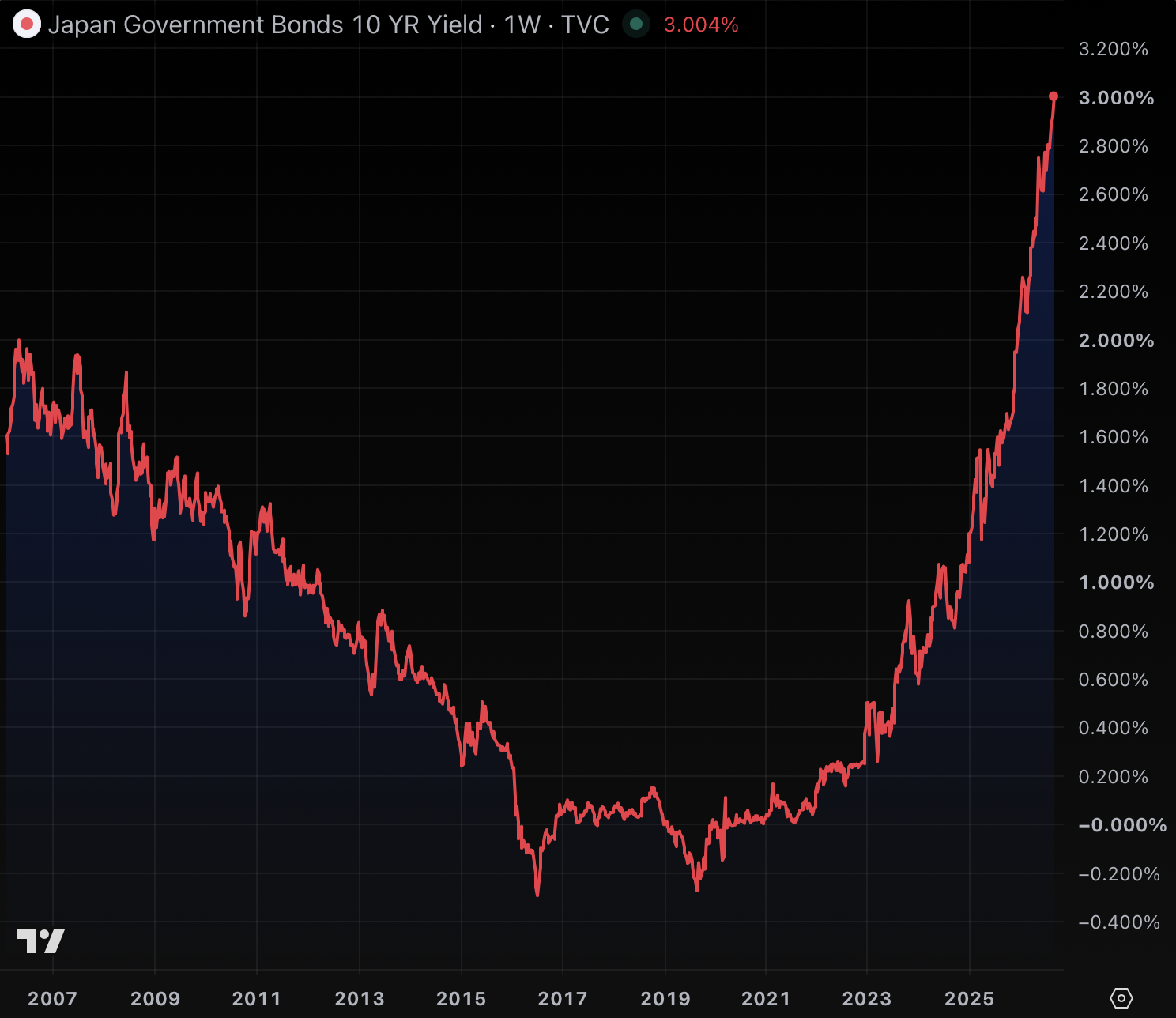
The yield that Japan pays for a 10-year loan reached 3% on Tuesday, its most expensive rate since September 1996.
The government’s borrowing cost has increased 2,900% in less than five years.
Originating a loan of the same duration in early 2022 cost the sovereign just 0.1%.

Japanese government bonds (JGBs) set multi-decade records across their yield curve. The country is paying a 1.81% yield to borrow for two years, 2.26% for five years, 3.8% for 20 years, and 4.18% for 30 years.
Only 40-year JGBs are below a multi-decade record, albeit only slightly: 4.28%. That duration set its recent record at 4.4% in May.
As the government pays up to bond investors, otherwise hesitant buyers are happy to continue attending auctions. Tuesday’s 10-year JGB auction attracted more than three bids per bond, keeping the rate of bidding in-line with the annual average.
Highest cost for Japan to borrow money since the 1990s
Today’s milestone for several durations of JGBs is a multi-decade record but not technically an all-time high. For example, Japanese ministry archives show JGBs offering higher yields in the 1990s.
Sensationally, market data vendor Barchart declared the 30-year print the highest in history, exclaiming: “Dear God!”
Technically, however, 30-year JGBs traded a couple basis points higher in May 2026, not to mention that its formal history runs only back to 1999 when investors would use other durations to construct de facto 30-year hold period.
In any case, JGB yields are certainly higher than it has paid over recent years.
Debt servicing costs skyrocket in Japan
Japan stayed under the radar of bond traders for many years with a high level of domestic credit ownership, foreign exchange rate intervention, mandated bond purchases, and strong employment. For years, JGBs and the yen remained calm and seemingly under control.
Suddenly, however, the Bank of Japan (BOJ) raised its policy rate to 1% in June, the highest in 31 years. Worse, markets now expect a hike to an even more expensive 1.25% cost of borrowing this month.
In addition, inflation fears are rising among normally complacent yen currency traders. The bank’s own July outlook projects core consumer prices rising sharply above its target, pointing to catalysts like expensive crude oil. “The consumer price index is likely to accelerate to a level clearly above 2% from the second half of fiscal 2026,” BOJ guided.
On July 31, with the yen near a 40 year low relative to the US dollar, US and Japan’s governments bought yen together for the first time since 1998. Scott Bessent’s US Treasury paid with euros from its Exchange Stabilization Fund. Japan, the largest foreign holder of US debt, said it would tap a Federal Reserve facility to borrow dollars against its $1.1 trillion US Treasury stockpile.
Tokyo’s finance ministry said, “This joint action countered excessive volatility and disorderly movements in the Japanese yen in recent months.” Bessent hailed the “coordinated foreign exchange actions” against “disorderly yen movements.”
Despite the historic intervention, the yen did not hold the line, and Japanese borrowing costs continued to rise. Eleven days later, the yen was fading again relative to the dollar, and this week it traded back near 160 per dollar.
Debt servicing is set to cost the Japanese government a record 36.6 trillion yen ($230 billion) next year, up 17% in one year.
Got a tip? Send us an email securely via Protos Leaks. For more informed news and investigations, follow us on X, Bluesky, and Google News, or subscribe to our YouTube channel.

More than 40 bridges have been destroyed or damaged, and 25 miles of vital roadways have been erased from the map, or buried under thick mud, cutting off remote mountain communities and compounding the rescue effort. At the same time, 69 schools have been damaged or destroyed, affecting 19,000 children, according to the charity Save The Children. At least 65,000 people have been directly affected.
Much of the downstream death toll was the result of poor planning and weak enforcement of zoning laws, which allowed settlements to be built along riverbanks. Yet nothing could have saved the hydropower plants, which Nepal needs both to wean itself off fossil fuels and to sustain its energy exports. Melting glaciers, a consequence of global warming, combined with high seismic activity, make the Himalayas a hotspot for catastrophic disaster risk downstream.
This is also a lesson for other vulnerable river valleys in Nepal. Four major hydropower plants backed by Indian investments sit in the Arun River basin, directly below Makalu, the world’s fifth highest mountain, at 8,463m, in eastern Nepal. The basin also lies downstream from the Tibetan region of China, where dozens of glacial lakes have swollen in size and could burst at any time. The Arun sits just across the border from the Indian state of Sikkim, where a $1 billion, 1,200-megawatt dam, the Teesta III, was wiped out by a glacial lake outburst in October 2023.


Blockchain enterprise solutions provider Ripple has partnered with digital asset infrastructure company SettleMint to offer financial institutions solutions for custody, issuance and management of tokenized assets across their full lifecycle.
The strategic partnership will integrate Ripple’s institutional digital asset custody infrastructure, Ripple Custody, and SettleMint’s Digital Asset Lifecycle Platform (DALP) to offer institutions a less complex way to secure digital assets, Ripple announced on Tuesday.
A day earlier, digital asset service provider Coincheck Group partnered with wallet infrastructure provider DFNS to build digital asset wallet technology and custody services in Japan.
DFNS’s wallet-as-a-service offers institutions full transaction lifecycle management, including workflow orchestration and governance controls, under a single platform that supports more than 100 blockchain networks.
Both partnerships are seeking to build more institutional digital asset services to address the infrastructure gap hindering the entry of regulated financial institutions.
The Asia-Pacific region ranked as the fastest-growing area for onchain crypto activity and experienced a 69% year-over-year increase in value received, according to Chainalysis’ 2025 global adoption index.
Many countries in the region are developing their own cryptocurrency regulatory frameworks. In July, Japan’s parliament passed revisions that classify crypto assets as financial assets under Japan’s Financial Instruments and Exchange Act.
Japanese Finance Minister Satsuki Katayama signaled the intent to bring crypto under the same umbrella as traditional finance assets in January, to ensure that citizens will “benefit from digital and blockchain-based assets.”
Related: Hyperliquid added to Singapore’s Investor Alert List

A job seeker holds a flyer as they receive information about education careers with the Los Angeles Unified School District while attending a job and resource fair in Los Angeles, California, July 29, 2026.
Patrick T. Fallon | Afp | Getty Images
After a disappointing July payrolls report that showed the economy lost jobs that month, traders on prediction market platforms think August will show a rebound in hiring, though potentially not as strong as economists think.
Speculators on Kalshi see 50-50 odds that more than 50,000 jobs were created last month. That implies a slightly lower outlook than Dow Jones consensus estimate for 53,000 jobs created in August.
On the contracts on the market, traders are asked whether they think the U.S. added more than a certain number of jobs in the month. The contracts are resolved using official data from the Bureau of Labor Statistics.
Prediction market traders on Polymarket give a 48% likelihood the economy created more than 50,000 jobs in August.
For two months in a row, prediction market traders and economists have overestimated payroll numbers. Both expected job creation numbers in the six figures in June — when they actually came in just below 60,000 — and for the economy to create jobs in July when it ended up losing them.
Given that, traders on Kalshi see a wide range for a beat or miss. Speculators on the platform see about 1-in-4 odds for a contract that implies the U.S. actually lost jobs last month, and a similar likelihood for another contract that asks if the country created more than 80,000 jobs in the period.
The August employment reading will be delivered at 8:30 a.m. ET on Friday.
Disclosure: CNBC and Kalshi have a commercial relationship that includes customer acquisition and a minority investment.
Ripple Labs and SettleMint have announced a strategic partnership that plugs Ripple Custody into SettleMint’s Digital Asset Lifecycle Platform (DALP), giving regulated financial institutions a single system to custody, issue and manage tokenized assets across their full lifecycle.
Announced from Singapore, the offering has already commenced in Asia, and the companies plan to extend it to other markets as institutional demand develops. Beyond banks, the stack targets market infrastructure operators and sovereign entities, adding compliance, settlement and servicing to the custody and issuance layer so institutions can drop separate vendors for each function.
“Financial institutions across Asia Pacific are putting digital assets to work. They are asking how to do more without stitching together separate solutions for custody, issuance and governance,” said Fiona Murray, Managing Director, Asia Pacific at Ripple.
The Very Lucrative Tokenization Market
The joint release cites Boston Consulting Group’s May 2026 report, “The Future of Digital Assets,” which describes the shift toward digital assets as a fundamental restructuring of financial infrastructure.
Today, we’re proud to announce a landmark partnership between SettleMint and @Ripple that offers regulated financial institutions a single, connected foundation for digital asset custody, issuance and lifecycle management.
Read the announcement: https://t.co/QkLvqg50Xl pic.twitter.com/1CVO1wCakf
— SettleMint (@SettleMintCom) September 1, 2026
BCG projects that tokenized real-world assets could reach $88 trillion by 2035, and estimates that banks failing to adapt could see profits fall by as much as 30% over the same horizon. The release also names RLUSD, Ripple’s stablecoin, and the cryptocurrency XRP as assets underpinning the company’s solutions.
Elsewhere in the region, Ripple piloted RLUSD in Singapore’s central bank sandbox with supply chain finance firm Unloq in March, and its XRP Ledger featured in a cross-border pilot with JPMorgan, Mastercard and Ondo Finance that settled tokenized US Treasuries in under five seconds.
Custody Stack Assembled Through Deals
Ever since it was founded, Ripple has been selling payments, custody, liquidity and treasury infrastructure to banks and payment providers, and has assembled the custody line through a run of transactions. Moreover, Ripple has put its cumulative M&A and corporate venture spending on crypto infrastructure at around $4 billion.
Those include partnerships with Securosys and Figment, an integration with compliance analytics firm Chainalysis, and the acquisition of wallet infrastructure provider Palisade, which added MPC-based key sharding and multi-chain support.
SettleMint supplies the lifecycle side. Headquartered in Leuven, Belgium (though it has offices in the UAE, Singapore and Japan), the company stated that its composable DALP already runs in production and pre-production deployments across North America, Europe, the Middle East and Asia Pacific for banks, market operators and governments.
“Global capital markets are moving fully on-chain, and that shift only works when digital asset custody and lifecycle management operate as one system rather than two,” noted Adam Popat, CEO of SettleMint.
The post New Important Ripple (XRP) Partnership Targets Banks and Institutional Clients appeared first on CryptoPotato.
Prediction market platform Kalshi announced action against US House of Representatives candidate Laurie Buckhout and ousted Republican lawmaker George Santos over using insider information for trading on event contracts, in one of the first lifetime bans the company has imposed since its launch in 2021.
In separate notices of settlement of disciplinary action announced on Friday, Kalshi’s compliance department said it had permanently suspended Santos from trading on the prediction markets platform and imposed a $71,356 penalty. Buckhout received a three-year suspension and a $2,590 penalty.
Both restrictions by Kalshi were made in response to investigations into Santos and Buckhout trading using event contracts that could be manipulated by their own actions. According to the platform, Buckhout, running in North Carolina’s 1st congressional district, “announced her candidacy for public office and was added as a market option for a contract on a North Carolina Congressional election,” while Santos “engaged in trading activity in certain markets related to his attendance at the State of the Union address” in February 2026.
“If a Trader is a decision maker, either directly or indirectly, or has any influence, directly or indirectly, no matter the scale and importance of the influence, on the outcome of the Underlying event of any Contract, that Trader is prohibited from attempting to enter into any trade, either directly or indirectly, on the market in such Contracts,” state Kalshi’s rules.
The actions by the company represented a significant crackdown at a time when prediction market platforms are under scrutiny by state and federal lawmakers over claims that many of the event contracts are susceptible to manipulation. President Donald Trump’s teleprompter operator, Gabriel Perez, was fined $172,000 by federal regulators after trading event contracts on Kalshi related to Trump’s speeches.
While Kalshi’s compliance department reported that Buckhout “cooperated with the inquiry” and agreed to the three-year trading ban and penalty, the platform made no such statement in Santos’ case suggesting that the former US lawmaker had cooperated with its investigation.
Related: Trump teleprompter operator made $100K betting on Kalshi markets tied to speeches: ABC
Buckhout remains the Republican candidate for North Carolina’s 1st congressional district in the 2026 midterm elections, while Santos, formerly a representative for New York’s 3rd congressional district, was expelled from Congress in December 2023 amid fraud allegations.
In response to the settlement, Santos said in a Monday X post that Kalshi was an “unserious company.” Buckhout reportedly called her actions betting on her own congressional race a “dumb mistake.”
As of Tuesday, Kalshi still listed event contracts related to the outcome of Buckhout’s North Carolina race, giving Democratic incumbent Don Davis a 63% chance over the Republican’s 41%.
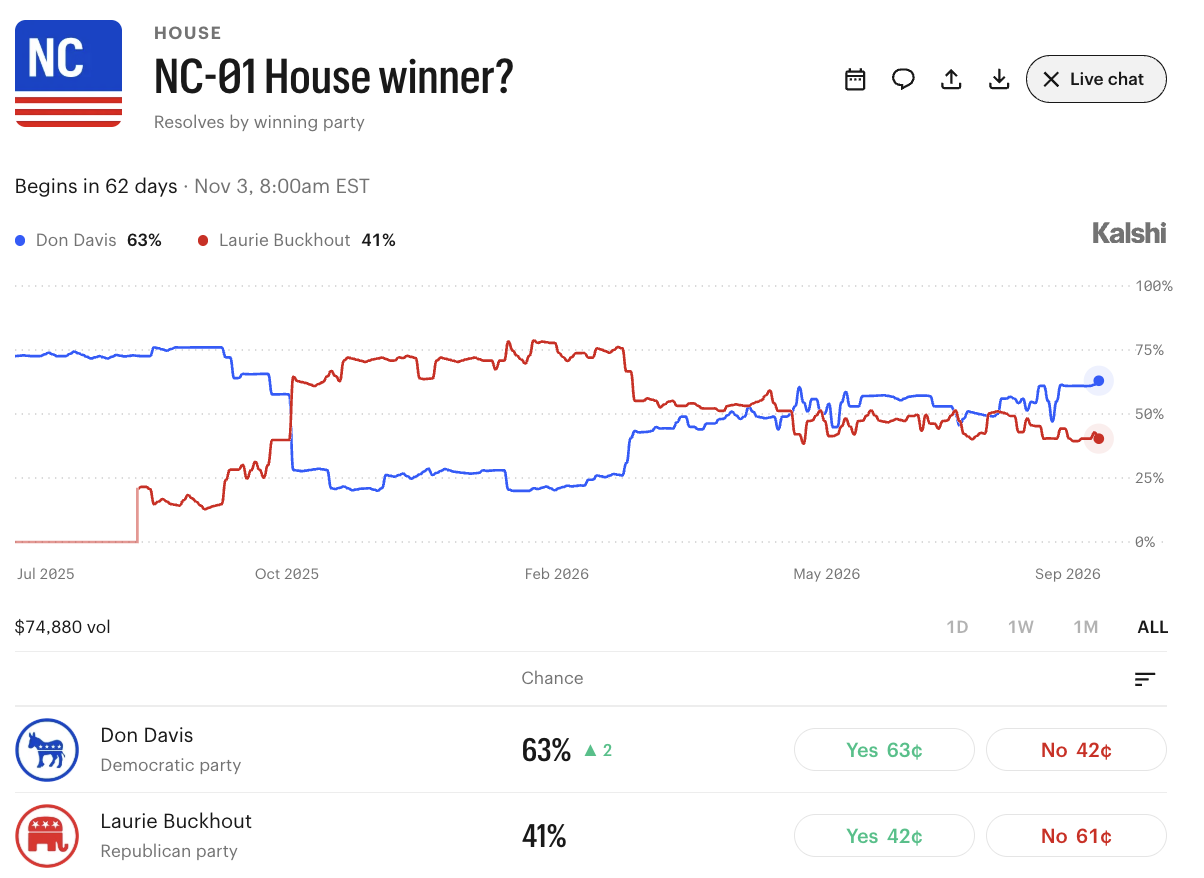
Event contract for Laurie Buckhout in North Carolina House race. Source: Kalshi
CFTC taps emergency authority in fed-state prediction markets legal battle
Kalshi and other prediction market platforms like Polymarket face several lawsuits filed by individual US state gaming authorities over allegations the companies are facilitating illegal bets on sporting events. At the same time, the sole commissioner and chair of the US Commodity Futures Trading Commission (CFTC), Michael Selig, claims that the agency has “exclusive jurisdiction” over prediction markets and vowed to take legal action against any state authority challenging this position.
Last month, the CFTC, in a rare move, invoked emergency authority opposing the state of New York attempting to bar Kalshi from offering contracts tied to sports, elections and other events.
Magazine: Does the Bitcoin rally mean we haven’t wasted our lives in crypto?
The US Securities and Exchange Commission (SEC) has proposed overhauling decades-old rules governing transfer agents as blockchain-based recordkeeping and tokenized securities become more prominent in US markets.
The proposal would update requirements covering registration, recordkeeping, safeguarding and securities transfers, while introducing new rules aimed at risks emerging from increasingly digital and automated market infrastructure.
“Market participants are actively seeking to bring blockchain-native, or ‘onchain’ transfer agents into the U.S. market,” the SEC said, pointing to models for blockchain-based recordkeeping, tokenized fund administration and cross-chain interoperability.
The agency said its existing framework does not adequately address those developments, particularly risks involving cybersecurity, operational resilience and the safeguarding of securities and investor records.
Under the proposal, transfer agents would face expanded reporting requirements and new compliance standards, including rules governing restrictive legends on securities and the use of third-party service providers.
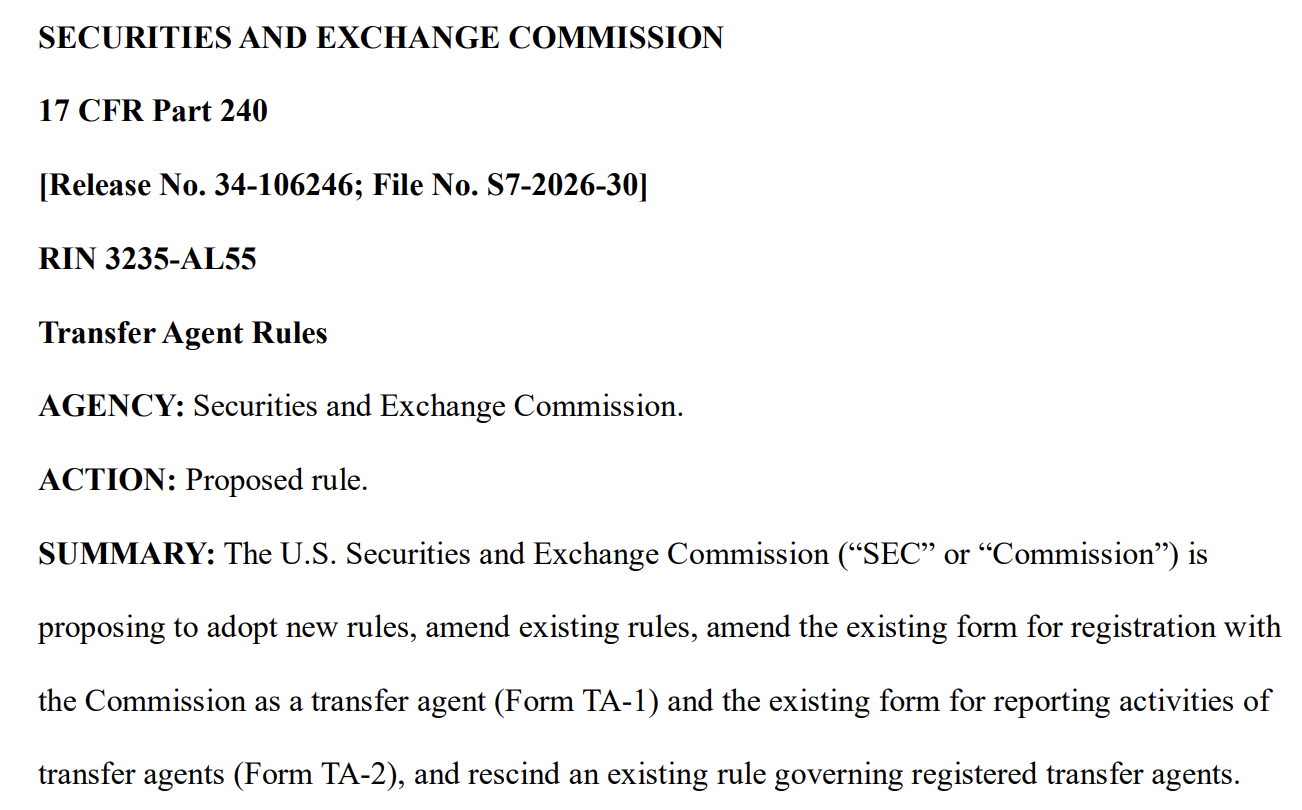
SEC’s proposed Transfer Agent Rules. Source: SEC
The SEC said its transfer agent rules have not been substantively updated since the late 1970s and early 1980s, when the industry still relied heavily on paper certificates and manual recordkeeping.
The regulatory agency is seeking public comment on the proposed changes, with comments due 60 days after the proposal is published in the Federal Register.
Related: CFTC chair says agency will move forward on crypto regulation if CLARITY fails
SEC pursues broader securities rule changes
The SEC is “on a mission to simplify its rules,” according to analysis from law firm Cahill Gordon & Reindel sent to clients on Tuesday.
In May, the SEC proposed three major changes to public-company rules. The proposals would allow companies to opt for semiannual reporting, simplify the existing filer classification system and expand access to streamlined registered securities offerings.
Last week, the SEC sent a proposed overhaul of custody rules for investment advisers and investment companies to the White House for review, with potential changes covering how firms hold crypto assets for clients. The changes could provide clearer standards for how investment advisers and funds custody digital assets while complying with federal securities rules.
Magazine: Does the Bitcoin rally mean we haven’t wasted our lives in crypto?
SEC proposes transfer agent overhaul for tokenized securities

Baby’s Name Prompts Fan Reations

Bitcoin Hits $80K: Cory Klippsten on Crypto’s New Bull Run & Resistance Ahead

Weekend Open Thread – Corporette.com

Weekend Open Thread: Brooks Brothers

London Mayor Sadiq Khan handed a peerage by Keir Starmer alongside 15 other Labour figures… just days before the PM leaves No10
Bitcoin Hits $80K: Cory Klippsten on Crypto’s New Bull Run & Resistance Ahead

Boyce Watkins, Financial Literacy, and Black Capitalism Are All Wrong (Again, Still, Always)

i love allah #money #unfrez #motivation #unfrezzmyaccount #trending #duet #millionaire
-

 Crypto World7 days ago
SpaceX stock could rise 75% to $240, JPMorgan says
-

 Fashion4 days ago
Weekend Open Thread: Maeve – Corporette.com
-

 Crypto World5 days ago
Bitcoin’s 22% rally now needs real demand to outlast Treasury liquidity boost
-

 Crypto World6 days ago
Warsh Jackson Hole keynote puts financial innovation first
-

 Business5 days ago
Salesforce Stock Soars 19% as Blowout Earnings and Agentforce AI Growth Silence Software Skeptics
-

 Crypto World6 days ago
Elon Musk Grok Bot Promise: We Will Make You Whole if AI Loses Your Money
-

 Business5 days ago
Apple Confirms September 9 Keynote and Reveals Its Full Pre-Order Schedule
-

 Crypto World7 days ago
Did Trump Just Move SpaceX Stock With One Truth Social Post?
-

 Business4 days ago
Onto Innovation Stock: AI’s Next Bottleneck Is Yield (NYSE:ONTO)
-
 NewsBeat6 days ago
Lindsay Clancy jury braces for closing arguments as judge tells court: ‘You’ve heard all the evidence’ – Live updates
-

 Business6 days ago
Walmart takes aim at younger shoppers with new fashion brand
-

 Crypto World6 days ago
NVIDIA revenue hits $96.2B as AI demand doubles
-

 Crypto World4 days ago
Bitcoin price tests $82K resistance as Brandt stays long
-

 Business7 days ago
Thailand’s Eastern Economic Corridor Capital City (EECiti): Key Developments and Investment Opportunities
-

 Business4 days ago
iPhone 18 Pro Pre-Orders Could Shift to Saturday as Apple Reportedly Avoids September 11 Anniversary
-

 NewsBeat7 days ago
Trump’s trade truce with China faces test with Iran effort
-
 Crypto World6 days ago
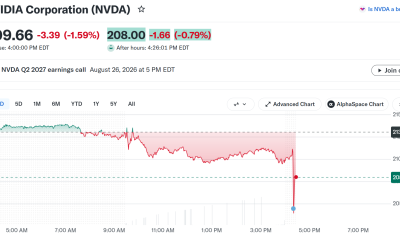
Nvidia Q2 Earnings Reveal $96.2 Billion Beat, So Why Is NVDA Falling?
-
 Tech3 days ago
Hugging Face built a $4.5 billion empire on free AI models. Now Nvidia is buying it for $12.9 billion
-

 Tech6 days ago
Claude Cowork gets its own browser that doesn’t touch your tabs, bookmarks, or saved passwords
-

 Crypto World5 days ago
Truflation calls for Fed rate cut after PCE forecast
You must be logged in to post a comment Login