




Connect with us

Tech

ICE plans to buy Boston Dynamics robot dogs without running a competition

Published

on

US Immigration and Customs Enforcement has posted plans to buy a fleet of Boston Dynamics robot dogs. The listing puts the spend at $1m to $2m. It also says ICE does not intend to compete the purchase.

Joseph Cox found the plan for 404 Media on Friday. It sits in the Department of Homeland Security’s Acquisition Planning Forecast System. That is a public database where federal buyers flag what they intend to purchase, months before they go out to market.

Anyone can read it. Almost nobody does.

ICE published the record on 27 August, under the title “Boston Dynamics SPOT Robots Procurement”.

Advertisement

What the record actually says

ICE wants the robots for “inspection, situational awareness, and hazard assessment in environments that may pose risks to personnel”. The capability “helps improve officer safety”, the record says. It lets the agency reach “dangerous, confined, unstable, or difficult-to-access areas”.

Three fields in the record did not make the coverage.

The competition field reads NO. ICE plans to buy these without a tender, under FAR Subpart 13.5. That is a simplified route for commercial off-the-shelf items, and it exists to spare buyers a full competition on routine kit. The record files the robots under miscellaneous general purpose machinery.

The place of performance is Fort Benning, Georgia. That is an Army installation, not a border sector or a field office, and the record does not explain the choice.

Advertisement

The third detail is the status. This is a forecast, not a contract. The solicitation was due out on 4 September. An award should follow in the last quarter of this financial year, and the work wraps in April 2027. ICE has flagged it as a firm fixed price deal, which means the agency has a number in mind already.

Spot units have carried a list price near $75,000. That puts ICE’s range somewhere in the low tens of machines, though the record covers accessories and support as well as the robots.

The second purchase that week

The robots are not the only thing ICE has been buying. Ryan J. Foley reported for the Associated Press that the agency awarded a $16.7m contract for 6,000 pairs of gloves that deliver electric shocks. The notice went up the same week.

That deal also went out without competition, to Compliant Technologies, a Kentucky manufacturer. The gloves work as ordinary patrol gloves until an officer presses a button, and they have to touch bare skin to deliver the shock.

Advertisement

Officers would use the gloves in “high-tension environments”, ICE said. Its notice listed arrests, transporting combative detainees, and responding to disturbances outside detention facilities.

Sixteen senators led by Catherine Cortez Masto had written to ICE’s acting director hours earlier, asking it to drop the purchase. They questioned whether the agency could deploy the devices safely.

Their letter pointed at “the blatant and tragic misuse of force in Los Angeles, Chicago, Minneapolis, Houston, Maine, and other locations around the country”. ICE published the award notice anyway.

The agency’s own case for the gloves runs the other way. Its notice said the point was to avoid reaching for “more severe force”, firearms included, and to gain control quickly enough to prevent injuries on both sides.

Advertisement

DHS answered its critics in a statement. “Sanctuary politicians attempting to ban our federal law enforcement from any safety equipment is despicable,” it said.

Police have bought Spot before, and given it back

Spot walks on four legs, climbs stairs and carries sensors. Operators drive it by remote or send it along a mapped route. TNW watched Boston Dynamics test it as a parcel delivery robot in July, walking packages from the van to the doorstep.

Police departments got there first. Their record with the robot is mixed. The New York Police Department cancelled its Spot contract in 2021 after public objection. Honolulu police used one to interact with homeless residents, a deployment Vice reported at the time.

Robot dogs are becoming ordinary in security work. TNW reported in June on the machines securing the 2026 World Cup, and in August on robots filling gaps left by security guards quitting at twice the rate of other workers.

Advertisement

What they cannot generally do is exercise authority. China put robot traffic police on the streets this month that can do almost everything except stop you.

The manufacturer drew one line itself

Boston Dynamics led six robotics companies into an open letter in 2022, pledging not to weaponise their machines. The pledge reaches customers as well. The signatories said they would not support anyone else arming the robots either, and called on the rest of the industry to match it.

Nothing in the ICE record suggests weapons. It describes inspection and situational awareness, which is what Spot is sold to do.

The oversight question is the old one

Civil rights advocates have said ICE officers already face criticism over use of force, with little oversight or accountability, the AP reported. That is the backdrop for both purchases.

Advertisement

Neither buy needed a competitive process. Both cleared without one.

Surveillance hardware bought for one stated purpose tends to find others. TNW has tracked that with licence plate readers. Flock’s cameras spread across thousands of American towns before this summer’s backlash. Officers have since faced charges for running searches on people they knew.

Boston Dynamics has not said publicly whether it will take the order.

The Spot listing is still only a listing. Whether ICE buys, how many it takes, and what the robots end up doing at Fort Benning are all questions the forecast leaves open.

Advertisement

Source link

Continue Reading
Click to comment

You must be logged in to post a comment Login

Leave a Reply

Tech

ReactOS 0.4.16 serves ’90s Windows nostalgia with fewer bugs

Published

on

os platforms

30 years on, it’s still alpha, but 0.4.16 brings plenty of bug fixes and quality-of-life improvements – just in time for Windows XP’s 25th anniversary

If you’re pining away for the days when Windows ran well on 64 MB of RAM, there’s a new version of open source NT clone ReactOS promising easier installation and fewer bugs.

Advertisement

ReactOS 0.4.16 was announced over the weekend after a year and a half of development, and its list of improvements is substantial. For those unfamiliar with the ReactOS project, it’s a long-running effort (it spun up in 1996) to create an open source equivalent of Windows NT, with the aim of running Windows applications and drivers. 

If you miss the halcyon days of Windows XP that began a quarter of a century ago, in other words, it’s the project for you. 

Given that it’s an open source project driven by a group of volunteers who’ve had to dodge accusations that they’re just ripping off old copies of a research kernel, compatibility, ease of installation, and stability have all been sore spots for ReactOS. A number of essential elements have been fixed and improved as of 0.4.16, per the team.

“We’re excited to showcase the improvements we’ve made,” the ReactOS builders said in their release notes, with “a unified bootcd and livecd image; video, audio, networking, and storage stack improvements; a new installation type; and third-party code syncs” all mentioned as having been added.

Advertisement

The unified bootcd and livecd mean a single disc can now be used to boot into a temporary version of ReactOS to have a poke around, and to install the OS itself. A graphical installer is also included in the new unified disk image, meaning that there’s no longer a need to navigate a truly old-fashioned interface to get up and running. 

Fixed OS functions

Running old-fashioned software (or modern iterations of it) on newer hardware is bound to be a complicated mess, and that’s true for ReactOS.

Video drivers from “all major … vendors” have been causing issues in the experimental OS for years, the team notes, but apparently one source of the problem has finally been identified and addressed in 0.4.16. The kernel’s system page table entries, it turns out, were filling up when loading third-party graphics drivers because they eat up more memory than most others, so the memory manager layout was modified to increase the number of system PTEs. 

A different problem with blank OpenGL windows on AMD video drivers was resolved separately. Both improvements “fixed many edge case bugs in our win32k.sys driver,” the ReactOS team noted. 

Advertisement

A new HD audio bus driver was brought in to replace an older implementation that was never quite finished, addressing frequent bugchecks when attempting to install HD audio controller drivers. 

As for storage, the 2009 implementation of UniATA gave ReactOS the ability to recognize disk partitions over 8 GB, but the aging driver has since begun to cause slow boot times and load failures. It’s been replaced with a new ATA driver that also allows ReactOS to boot in more environments, including first-generation Hyper-V VMs. A disk cleanup utility was also added. 

Networking support has also been improved, with support for more adapters and virtual environments added. Asynchronous connections are now supported as well. 

There’s also a new headless Server Core installation type of ReactOS available with this release that loads a full Win32 subsystem without the GUI, similar to Windows Server Core that Microsoft released with Windows Server 2008. 

Advertisement

Finally, the ReactOS team has abandoned Windows Server 2003 compatibility restrictions, meaning that its Wine fork designed to interface with Windows-like kernels is no longer limited to Wine 2.x and 3.x, the latest of which was released in 2018. The abandonment of that restriction means ReactOS has been able to update its Wine fork toward Wine 10.0, which was released in early 2025, with 0.4.16 incorporating a significant amount of that work. Support for WineVDM, which increases compatibility for 16-bit Windows applications, was also added in the release. 

“The mission for ReactOS is to ‘[Run] your favorite Windows applications and drivers in an open-source environment you can trust,’” the team said. “With each release we come closer to fulfilling this goal.”

You can download version 0.4.16 of ReactOS here, but the team’s usual warning applies: Despite being a 30-year-old project, it is still in an alpha state “and provides no guarantee of stability, of safety for your files, or that it will work at all on your hardware.” ®

Source link

Advertisement
Continue Reading

Tech

Esoteric N-01XE Brings Grandioso Technology to a $28,000 Network Player/DAC With Five Power Supplies Because Of Course It Does

Published

on

The streaming market has become remarkably good at convincing audiophiles that they need another box between their router and amplifier. Esoteric has taken a somewhat different approach with the new $28,000 N-01XE Network Player/DAC. Rather than pile on features and hope someone notices, the Japanese manufacturer has pulled two of its most important digital technologies from the flagship Grandioso N1 and dropped them into its 01 Series.

The result is a $28,000 network player/DAC weighing more than 61 pounds, with five independent linear power supplies, a fully discrete DAC architecture and optical network connectivity. Because apparently streaming music from Qobuz needed its own power station.

The Grandioso Connection Is the Real Story

The most significant changes are the Master Sound Discrete DAC G2 and fourth-generation Esoteric Network Engine G4, both derived from the Grandioso N1.

That makes the N-01XE more than the usual evolutionary product refresh. Esoteric is moving its newest digital conversion and network technologies into the 01 Series while retaining the kind of mechanical and power-supply engineering that has become part of the brand’s identity. 

Advertisement

The DAC deserves most of the attention. Rather than using a conventional DAC chipset from ESS, AKM or another semiconductor manufacturer, Esoteric builds its Master Sound Discrete DAC G2 in-house around an FPGA-based, multilevel delta-sigma architecture.

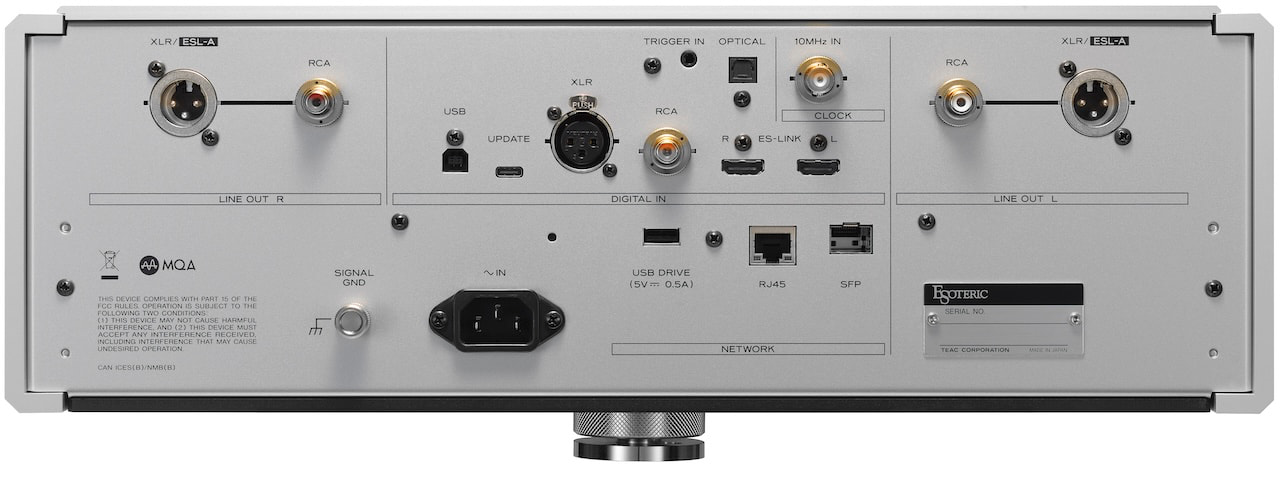
esoteric-n-01xe-rear

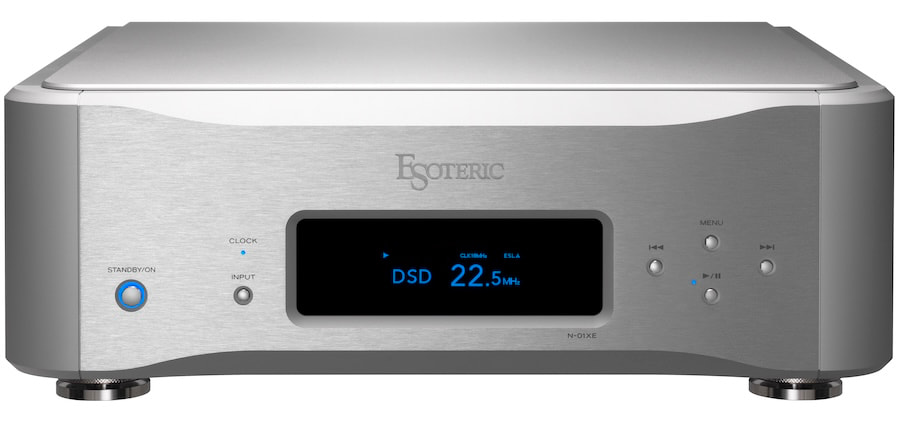
The implementation uses 32 discrete elements per channel, ultra-high-precision MELF resistors and Esoteric’s IDM-01 amplification elements. Separate FPGA algorithms handle PCM and DSD conversion, with support for PCM up to 768 kHz and DSD up to 22.5 MHz. 

The G2 revision also redesigns the flip-flop circuitry controlling the resistor elements and further separates the power supplies for the FPGA, other digital circuitry and the analog stages. Esoteric has even added capacitors close to the resistor elements to improve current delivery and reduce noise. 

That level of engineering is what separates the N-01XE from the ocean of network players built around increasingly similar chipsets and streaming platforms. Whether you can hear $28,000 worth of separation is another discussion entirely.

Advertisement
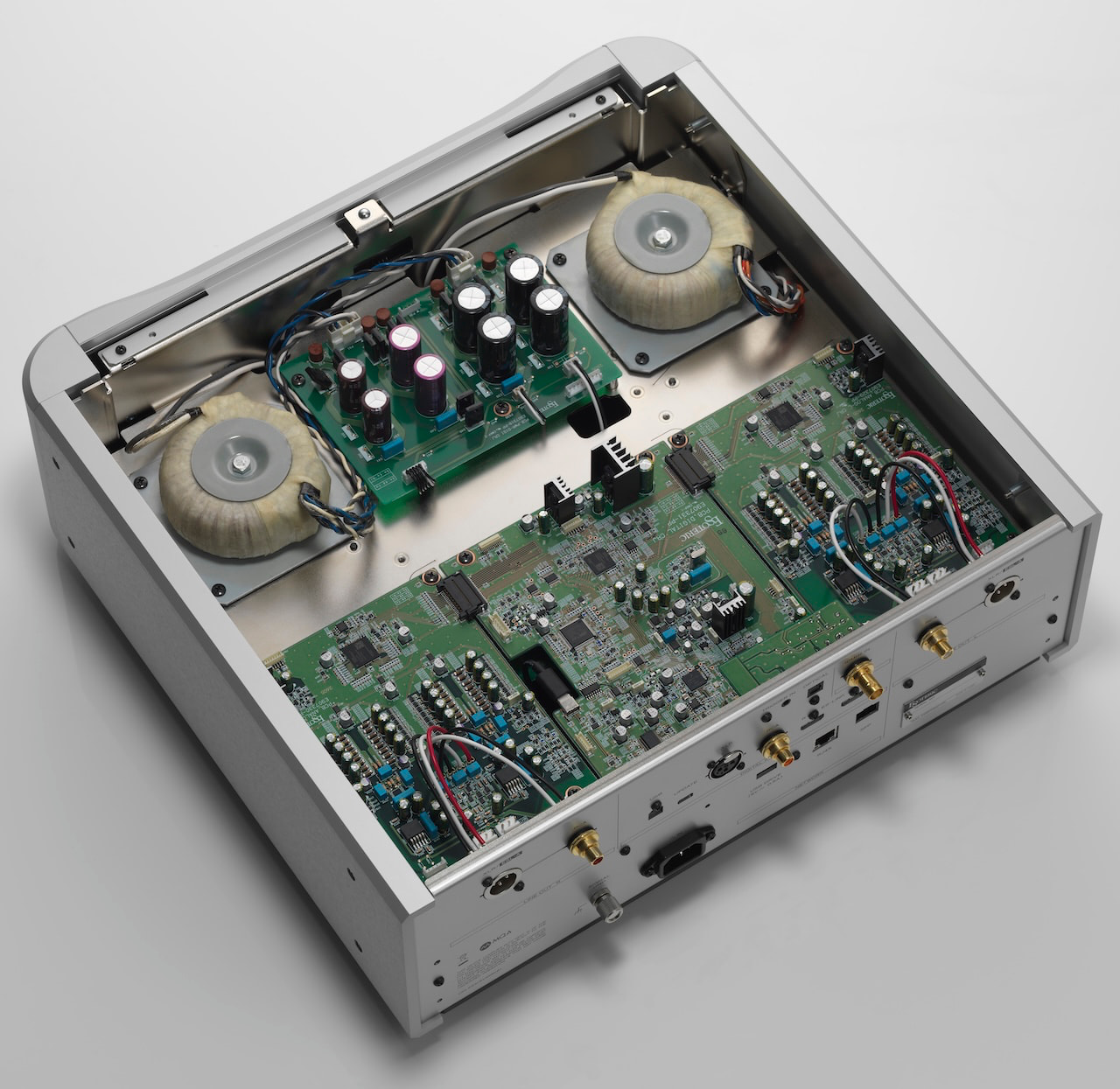
esoteric-n-01xe-inside

Five Linear Power Supplies Inside a Streamer

Esoteric has never been particularly interested in doing things halfway.

Although the N-01XE is a stereo component, the DAC section uses a fully dual-mono architecture, with independent transformers for the left and right channels. Additional dedicated supplies serve the network engine, digital circuitry and microcontroller, bringing the total to five independent linear power supplies. 

There is also a multilayer chassis, semi-floating top panel and Esoteric’s isolation feet. The finished component measures approximately 17 5/8 x 6 1/2 x 17 1/4 inches and weighs 61 3/8 pounds. 

Advertisement. Scroll to continue reading.
Advertisement

Sixty-one pounds for a network player sounds ridiculous until one looks inside an Esoteric component. Nobody in Tokyo received the memo about making streamers small enough to hide behind the sofa.

The Network Engine G4 Takes Fiber Seriously

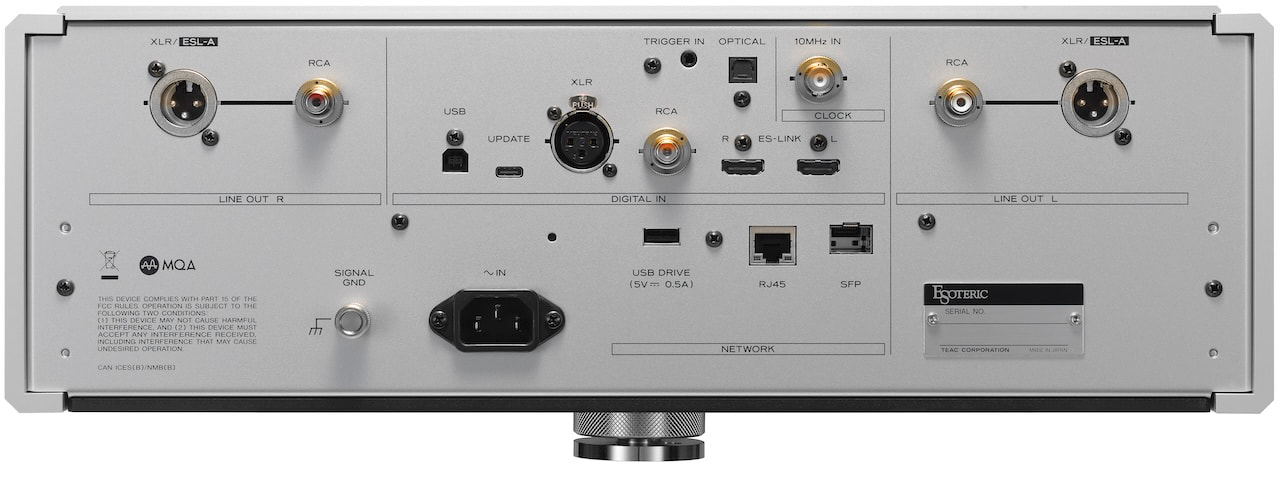
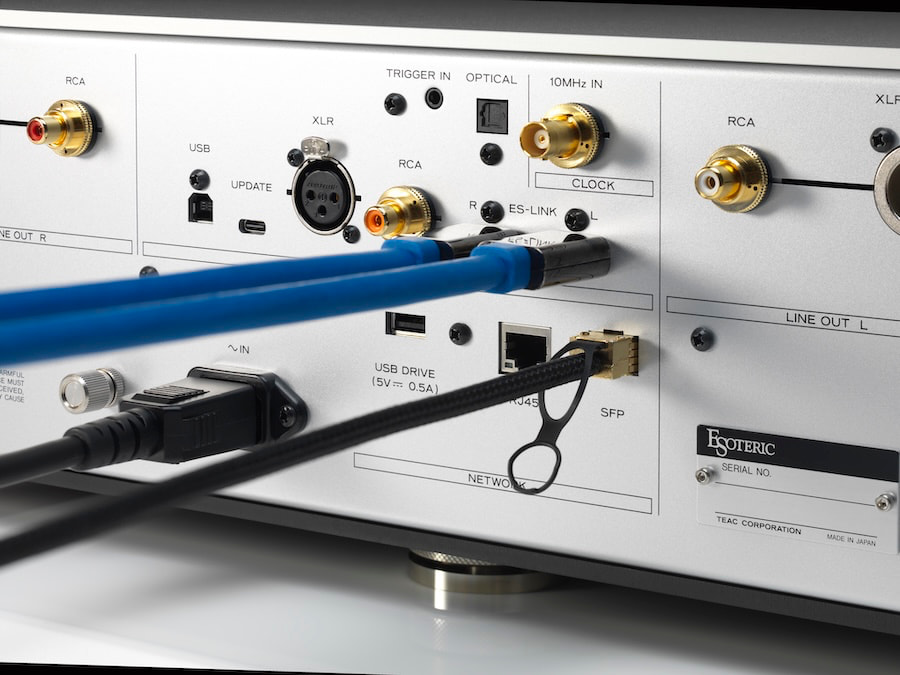
Esoteric’s new Network Engine G4 also deserves more attention than the usual “improved streaming platform” language. The G4 has its own dedicated linear power supply and incorporates both conventional RJ45 Ethernet and an SFP port, allowing the N-01XE to connect to a network using optical fiber.

The potential advantage is electrical isolation. A fiber connection can break the conductive path between the audio component and upstream network hardware, preventing electrical noise from traveling along that connection.

Esoteric also gives the G4 its own built-in network switch functionality, and the RJ45 and SFP connections can be operated simultaneously. The network section uses a toroidal transformer, custom capacitors and Schottky barrier diodes rather than a basic switching supply. 

Advertisement

Streaming support includes TIDAL, TIDAL Connect, Qobuz, Qobuz Connect, Roon, Spotify and QQ Music. USB storage can be connected directly for local playback, and supported formats include DSF, DSDIFF, FLAC, ALAC, WAV, AIFF, MQA, MP3 and AAC. 

esoteric-n-01xe-rear-closeup

Connectivity

Esoteric has also retained plenty of options for owners with serious digital systems.

Digital inputs include ES-Link5, USB Type-B, balanced XLR digital, coaxial RCA and optical, while analog output is provided through RCA and balanced XLR/ES-Link Analog connections.

There is also a 10 MHz BNC clock input for use with external master clocks such as Esoteric’s G-01XD and G-05. ES-Link5 permits connection to compatible Esoteric SACD transports, while ES-Link Analog provides the company’s proprietary current-transmission connection to compatible electronics. 

Advertisement

This is where the N-01XE starts making considerably more sense for someone who already owns other Esoteric components. System integration is clearly part of the proposition.

Some Useful Perspective From My Own Listening Room

I am currently reviewing two components that put the $28,000 Esoteric N-01XE into rather useful perspective: the $6,500 MOON 371 Network Player/Amplifier and Esoteric’s own $13,000 N-05XE Network DAC Preamplifier.

The MOON 371 attacks the problem from almost the opposite direction. For less than one-quarter of the N-01XE’s price, it combines MiND 2 network streaming, DAC, preamplification, MM/MC phono and 100 watts per channel into 8 ohms, doubling to 200 watts into 4 ohms. Add loudspeakers and you essentially have a complete system. 

The N-05XE is an even more interesting comparison because it comes from Esoteric’s own stable. At $13,000, it combines network streaming, the Master Sound Discrete DAC G2, Network Engine G4, a fully balanced dual-mono preamplifier and headphone amplification. It even supports the same SFP optical networking concept found in the new N-01XE. 

Advertisement
Advertisement. Scroll to continue reading.

So why spend another $15,000 on the N-01XE and give up the preamplifier and headphone amplifier?

That question gets to the heart of this product. The N-01XE is not Esoteric’s value proposition or its answer for somebody trying to eliminate boxes. It takes the streaming and conversion side much further, with the more elaborate dual-mono DAC implementation, five independent linear power supplies, more ambitious chassis construction and deeper integration with Esoteric transports, external clocks and ES-Link Analog.

Having the MOON 371 and N-05XE here for review should make that distinction especially interesting. One represents how much functionality and amplification $6,500 can buy in 2026; the other demonstrates how much of Esoteric’s digital technology is already available for $13,000.

Advertisement

The N-01XE has to make the case for spending $28,000 just on the digital front end.

And at that price, it had better be one hell of a case.

What Competes With the Esoteric N-01XE?

Innuos takes a very different approach with the $24,100 ZENith Next-Gen. Like Esoteric, the Portuguese manufacturer has gone to considerable lengths to address power-supply noise, processing architecture and digital signal integrity, but the ZENith is a server/streamer rather than a network player with a reference DAC built in. Add 2TB of internal storage and Innuos’ $1,950 PhoenixUSB output board and the package rises to $27,150, putting it almost directly against the $28,000 N-01XE on price. The catch? You still need a DAC.

The other obvious rival is the dCS Bartók APEX, priced at $20,950, or $22,950 with its headphone amplifier. It combines network streaming, DAC, upsampling and preamplifier functionality around dCS’s proprietary Ring DAC APEX architecture. 

Advertisement

That creates a fascinating philosophical comparison.

dCS has its Ring DAC. Esoteric has its Master Sound Discrete DAC G2. Neither relies on an off-the-shelf converter chipset, and both companies have spent decades developing their own solutions to the same problem.

Neither solution comes cheap.

esoteric-n-01xe-front

The Bottom Line

The Esoteric N-01XE isn’t interesting because it streams Spotify, Qobuz and TIDAL. Products costing 97% less can manage that rather well. What separates it is the hardware behind the streaming.

Advertisement

The second-generation discrete DAC, G4 network engine with optical connectivity, five independent linear power supplies, dual-mono construction and Esoteric system integration make this a very different animal from the typical premium streamer/DAC.

Advertisement. Scroll to continue reading.

The $28,000 price narrows the audience rather dramatically, and the MOON 891 and dCS Bartók APEX both offer considerably more system functionality for less money. Buyers choosing the Esoteric are therefore making a very deliberate decision: they already have the rest of the system and want the digital source treated with the same level of excess normally reserved for amplifiers and turntables.

A 61-pound network player might sound absurd.

Advertisement

In the context of Esoteric, it almost seems inevitable.

Pricing & Availability

The Esoteric N-01XE Network Player/DAC will carry a U.S. MSRP of $28,000, with international shipments scheduled to begin in November 2026.

For more information: esoteric.jp

Advertisement

Source link

Continue Reading

Tech

BT's Old Copper Landline Network Could Be Worth Over $2 Billion

Published

on

BT could make more than $2.7 billion by recycling copper from its aging UK landline network as BT subsidiary Openreach replaces legacy wiring with full-fiber broadband. Engadget reports: BT’s recovered copper was previously valued at around $2 billion. But prices have surged, thanks to rising global demand tied to AI data centers, renewable energy and electrification. With global demand expected to grow sharply over the next decade, the value of BT’s copper could potentially exceed even that $2.7 billion estimate.

The BT subsidiary Openreach is in the process of replacing its legacy copper network with full-fiber broadband, with plans to connect 30 million residences by the end of the decade. It’s already recovered nearly 10,000 metric tons of copper in its latest financial year and over 22,000 metric tons since 2023. “Copper has become one of the most strategic materials in the modern economy,” according to Openreach’s head of sustainability, Abby Chicken.

Unsurprisingly, BT isn’t waiting to profit from the recovered metal. It has an agreement with EMR, a cable recycling company, and recently received $133 million up front for recovered copper.

Read more of this story at Slashdot.

Advertisement

Source link

Continue Reading

Tech

Blockdaemon adviser on the state of stablecoins

Published

on

‘There’s less fragmentation in stablecoins than there is in any other area of blockchain regulation,’ says former Blockdaemon COO and current strategic adviser Amor Sexton.

Since their introduction more than a decade ago, stablecoins have grown from a niche solution for crypto traders, to acting as a middle ground between traditional and decentralised finance, facilitating around $33trn in annual transactions by volume in 2025.

While much of this volume results from trading and internal flows, last year the stablecoin market supported approximately $400bn in organic payment activity according to Artemis Analytics, up from less than $30bn in 2020, albeit a minuscule number in comparison to the trillions that move annual through global payment systems.

We’re in a period of rapid development in this area, with regulations coming in fast, blockchain infrastructure provider Blockdaemon’s former chief operating officer Amor Sexton told SiliconRepublic.com. But they’re only one part of the equation.

Advertisement

“Is it agentic payments? Is it cross-border payments? Is it real-time 24/7 liquidity management for corporate treasures?” she asked. “Regulation is one part of the puzzle, but you need to have all of the other components there and able to operate at scale for you to get adoption.

“So whether that’s looking at compliance processes that are digitised, treasury management functions, or even things like agentic workflows, money always moves as one part of the leg of a transaction.”

Sexton recently established her own consulting service for senior business executives and continues her work with Blockdaemon in an advisory capacity.

Stablecoins can be incredibly useful. Businesses and individuals use stablecoins for faster, cheaper international transfers, for decentralised finance and digital commerce, and to even transfer money internationally with lower fees and faster settlements.

Advertisement

These digital assets issued by private companies are generally pegged to fiat currency, with big-name examples including Circle’s USDC, Tether’s USDT and PayPal’s PYUSD.

In contrast, tokenised deposits are bank-issued digital representations of fiat deposits, recorded on a blockchain. These are minted and backed by regulated banks.

McKinsey recently noted that a larger transformation is unfolding within the traditional banking system, where tokenised deposits already facilitate trillions of dollars in annual transfers, far more than stablecoin payments.

Right where I thought we would be

The US maintains a heavily dominant position in the global stablecoin market, with USD-denominated stablecoins accounting for nearly all transactions. Parts of Asia, including business hubs such as Japan, Hong Kong and Singapore are also heavy adopters of stablecoin payments, according to McKinsey’s analysis.

Advertisement

Recently, the US Treasury Department proposed rules defining what counts as issuing, offering or selling stablecoins in the country, building on top of the Genius Act enacted last year. Effective starting 2027, this new legislation will make it unlawful to issue a payment stablecoin in the US without an appropriate federal or state licence.

Meanwhile, Wells Fargo announced that it would offer tokenised deposits to corporate and commercial clients, and BlackRock introduced two tokenised money market products.

“I personally have probably a different view to a lot of other people in the industry in that I think it’s happened quite quickly,” Sexton said when I asked her about the pace of development in the sector.

“I think a lot of other people in the industry would say it’s happened slowly. That’s probably because I came from an institutional banking background. I understand how long it takes for evolution in this space.”

Advertisement

Regulating stablecoins means taking an approach that balances innovation with appropriate safeguards. “Competing priorities, regulatory clarity – that’s needed. [So] we’re about where I thought we would be.

“The thing about programmable money is that you can program business rules into it. So, I think it’s about thinking through all of those workflows that are necessary in order to have agentic payments actually operate practically.”

Unsurprisingly, AI is playing a key role in fastening the pace of development in this space. “I think we’ll move quicker from here on now because when you have automated workflows.

“You need automated movement of value, and that’s where this technology really comes into play, whether it’s a stablecoin or it’s – you know – tokenised money that’s issued by a bank or even a central bank,” Sexton said.

Advertisement

“It’s a mixture of both the unprecedented proliferation of AI throughout society – not just business – on top of the actual evolution of the technology itself, which is also unprecedented.

“The fact that we’re even having this conversation now shows that there’s a lot of people talking about it and looking at it.

“I think we’re going to see rapid development in the next six to 12 months [in this space],” Sexton said in the interview which took place in May. “It’s a very short time. I wouldn’t have said that a few years ago.”

Rules not so fragmented

“I actually think there’s less fragmentation in stablecoins than there is in any other area of blockchain regulation,” Sexton said.

Advertisement

Over in the EU, the Markets in Crypto-Assets Regulation (MiCAR) began regulating stablecoins back in 2024, ahead of developments in this area elsewhere.

Euro-denominated stablecoins, however, have not been able to capture much of the market, though attempts are being made to change that.

Late last month, Revolut launched announced its first stablecoin, a euro-backed token called EURR, available to select customers in Denmark, Poland and Portugal. Meanwhile, Bank of Ireland and AIB recently joined a consortium of 35 other European banks to work towards issuing a euro-denominated stablecoin.

“Where you have a little bit of fragmentation is around questions of yields and things like that, but to me they’re important discussions to have – but they they’re not an absolute barrier to adoption,” Sexton said.

Advertisement

“What I think needs to happen from a regulatory perspective is recognition of stablecoins as legitimate payment methods that have been issued in other jurisdictions.

“It’s less about fragmentation of ‘how do we regulate the issuer?’ and more about ‘how do we actually treat the stablecoin itself as a means of payment?’”

The future of tokenised money isn’t going to be in just stablecoins, she explained. “You exchange your fiat for stablecoins, and to get out of a stablecoin you exchange the stablecoin for fiat too.

“We’re not talking about a world at the moment where people are necessarily staying in stablecoins for the entire time,” she said.

Advertisement

She believes acceptance is just around the corner. “I’m pro-programmable on-chain money. Stablecoins is one way of achieving that. So yes, I would like a world where we can have finance be more efficient.

“Not just tokenised money, but tokenised equities, tokenised identity.”

Don’t miss out on the knowledge you need to succeed. Sign up for the Daily Brief, Silicon Republic’s digest of need-to-know sci-tech news.

Advertisement

Source link

Continue Reading

Tech

Apple has a new CEO, and Tim Cook signed off quoting Steve Jobs

Published

on

John Ternus became chief executive of Apple on Tuesday. He is the eighth person to hold the job in the company’s 50 years, and the first engineer in the seat since Steve Jobs.

Tim Cook spent his last day writing to staff. Chance Miller obtained the memo for 9to5Mac on Monday, and Mark Gurman reported it for Bloomberg the same morning.

“Today is my last day as CEO of Apple,” it opens. “This is a moment I always knew would come one day, and yet it is still hard to believe it has arrived.”

What Cook actually wrote

The memo says almost nothing about products, AI, China or regulation. It is about culture.

Advertisement

“I am most proud of what an annual report could never capture,” Cook wrote. “This place is proof that culture triumphs over everything.”

He reaches once for a piece of company scripture. Apple has managed to leave its “dent in the universe”, he writes, quoting Jobs, “because of who we are and what we believe”.

On his successor, Cook is unambiguous. He takes “enormous comfort in handing the helm to someone as brilliant and wonderful and capable as John”, and adds that few people understand what it takes to build world-changing products the way Ternus does.

He also makes a point of saying he is not going anywhere. He is stepping away from a role, not the company, and he signs off looking forward to seeing everyone at Apple Park in his new one.

Advertisement

Then he posted on X. “My title changes tomorrow, but the love I have for the Apple community never will,” he wrote. The post has 24.2 million views. Elon Musk replied to congratulate him.

The numbers he leaves behind

Cook took over after trading closed on 24 August 2011. Apple was worth under $350bn. It is now worth about $4.6tn.

Revenue went from $157bn in his first full financial year to an expected $477bn when this one closes in September. Services, which barely existed as a category, brought in more than $109bn in fiscal 2025, over a quarter of the company.

Ryan Vlastelica put the share gain at 2,258% for Bloomberg, or 2,716% counting dividends. Published figures vary between roughly 2,250% and 2,750% depending on the basis used, and Bloomberg corrected its own during the day.

Advertisement

Bank of America worked it out another way. Apple added market value at roughly $32m an hour, every hour, for nearly 15 years.

Who Ternus is

Ternus is 51. He joined Apple in 2001 as an engineer, aged 26, in his second job out of university. He had a mechanical engineering degree from Pennsylvania and four years at a small firm behind him.

His first project was the Cinema Display, a plastic desktop monitor. He worked on the G5-era iMacs, became vice president of hardware engineering in 2013, and has since had a hand in every generation of iPad, the first AirPods, and hardware across the iPhone, Mac and Watch. The thin iPhone Air and the cheaper MacBook Neo are recent ones.

He is not a natural showman, but he is not new to a stage either. He has fronted product launches for years, and TNW reported in July that he wants to build on Apple’s film and TV run, one of the few areas where he had spoken about strategy before taking the job.

Advertisement

He told a room of graduates what he thinks

Ternus gave the engineering commencement address at his old university in 2024. Emma Burleigh pulled the speech for Fortune on Tuesday.

“Always assume you’re as smart as anyone else in the room, but never assume that you know as much as they do,” he told them. He described arriving at Apple at 26 and not being sure he belonged, surrounded by people who knew far more than he did.

He closed the speech by telling the graduates to go and make a dent in the universe.

Two years later his predecessor reached for the same phrase on his way out.

Advertisement

What he inherits

Kalley Huang reported for the New York Times that Ternus takes over amid unusual churn in the executive ranks, and has spent four months installing his own people.

Laura Legros, a hardware engineering vice president who retired in 2022, has rejoined and reports to him, three people familiar with the hiring told the Times. Nate Gatten arrived from American Airlines to run government affairs. Kate Adams and Apple Pay head Jennifer Bailey are both retiring this year. Nearly half the executive team is near retirement age.

Talent has gone the other way too. More than 400 former Apple employees now work at OpenAI, according to Apple’s own lawsuit against the company. Apple’s smart home and mixed reality hardware leads left this year, for Oura and OpenAI respectively.

TNW reported in June that Apple’s design studio had lost nearly every Jony Ive-era designer, and that Ternus intended to rebuild it. In August it cut more than 200 jobs across Siri and Vision Pro. On Monday Phil Schiller handed the App Store to Eddy Cue.

Advertisement

The AI problem is the loudest one. Apple delayed its Siri overhaul, then leaned on Google’s Gemini for part of the next version. Whether that reads as thrift or as weakness depends on where the value in AI settles.

Cook is still in the building

Cook stays as executive chair, handling policymakers, which in practice means Donald Trump and Beijing.

David Yoffie of Harvard Business School told the Times the arrangement gets tested the moment the two men disagree. Ternus could invest harder in AI, revive the car, or end the Vision Pro. “Is Tim going to be comfortable with those changes?” Yoffie asked. Would John feel comfortable making them with Tim there?

So far there is no sign of daylight. TNW covered the farewell party Apple threw Cook a week early, and Cook has said the pair set out to make this the best handover ever.

Advertisement

Ternus gets eight days before the test. Apple holds its iPhone event on 9 September, where a foldable is expected.

Source link

Advertisement
Continue Reading

Tech

OpenClaw 2.0 Is Here, Ushering In the Era of 'Multiplayer' AI Coding

Published

on

An anonymous reader quotes a report from VentureBeat: The viral fervor we saw earlier this year around OpenClaw, the open source AI harness that turns powerful language models into autonomous workers the user can message via their favorite channels (Telegram, iMessage, WhatsApp, Discord etc), has cooled off substantially from its peak in March 2026. But over the weekend, OpenClaw’s creator Peter Steinberger and current team of co-developers gave the world — especially enterprises — a reason to look at it again, announcing OpenClaw 2.0, billed as the most significant update to the harness and surrounding platform yet.

OpenClaw 2.0 seeks to transform what began largely as a personal agent harness into something increasingly designed for teams, shared infrastructure and enterprise workflows. OpenClaw 2.0 introduces a rebuilt browser interface that brings conversations, files, approvals, configuration and live agent activity into a common workspace. It adds shared cloud sessions and multi-user collaboration. And it expands the security model with stronger sandboxing, role-based permissions, approval controls, secrets handling and auditing.

Together, those additions move OpenClaw closer to being infrastructure that an organization could deploy for employees rather than simply a powerful agent an individual developer runs locally. They also sharpen a competitive question surrounding the project: whether OpenClaw has addressed the security and isolation concerns that helped inspire newer alternatives such as NanoClaw. The answer is increasingly yes at the capability level — but not necessarily by default. Over the past two months, OpenClaw has been “build[ing] OpenClaw with OpenClaw,” shifting its team from individual local coding tools to a shared agent environment at team.openclaw.ai that can see what everyone is working on. Steinberger called “multiplayer coding + infinite compute with nodes and cloud sessions” a “game changer,” adding that local coding harnesses now “feel like relics of the past.”

VentureBeat highlights a use case from Solvely CEO Colin Johnson that shows how OpenClaw’s multiplayer WebUI can improve collaboration between developers and AI agents. Instead of simply “messaging a bot,” multiple developers can now join the same live session, see the same history and artifacts, and work “inside the same context.” In Johnson’s case, that meant a developer taking over his project could simply join the existing agent thread rather than rely on a separate handoff document. As he put it, “the session itself became the handoff document.”

Advertisement

Read more of this story at Slashdot.

Source link

Advertisement
Continue Reading

Tech

Eddy Cue quietly became the most powerful executive at Apple

Published

on

Phil Schiller leaving the App Store made Monday’s headlines. The quieter fact underneath it is that Eddy Cue now runs more of Apple than anyone except the new chief executive.

Mark Gurman broke the reshuffle for Bloomberg on Monday, hours before John Ternus took over. Apple has not announced any of it, and declined to comment.

Cue already ran services. He has since collected the App Store, Apple Arcade and, at the end of last year, Health.

Nobody announced that as a promotion. It arrived in pieces, each one attached to somebody else’s departure.

Advertisement

What moved, and to whom

The App Store goes back to the division that had it until 2015, when Schiller and the marketing department took over. Cue gets it after an 11-year gap, and gets it at the moment the store is worth more and is under more legal pressure than at any point in its history.

Carson Oliver runs it day to day and reports straight to Cue. Oliver has spent his whole 14 years at Apple in that department. Ann Thai, who handles distribution tools and third-party marketplaces, now reports to Oliver rather than to Schiller. So does Alex Rofman, who runs Apple Arcade.

Events went somewhere else entirely. Nola Weinstein, Schiller’s deputy on launches since 2023, takes that team. She reports to Kristin Huguet Quayle, Apple’s vice president of communications and public relations.

That is a quiet reclassification. Apple product launches sat under communications until about 2019, then spent seven years as a marketing function under Schiller. They are going back to the press office.

Advertisement

For a company whose launches are its most-watched output, deciding they belong to PR rather than to product marketing is not a small call.

The size of what Cue holds

Services brought in more than $109bn in Apple’s last full financial year, over a quarter of the company. It is the fastest-growing part of the business and the highest margin.

The App Store alone facilitated more than $1.4tn in transactions last year, by Apple’s own count, and Bloomberg puts its direct revenue above $30bn a year.

Jacob Eiting, who runs the subscriptions firm RevenueCat, made the point about scale from the other end. Schiller started on the App Store when it had no apps and no revenue. It now pays developers on the order of $100bn a year.

Advertisement

Cue takes all of that on top of a services division he had already spent a decade building.

The bench emptied first

Cue’s rise is partly a matter of who is left. Apple has lost or is losing most of the executives who ran it alongside Cook.

Jeff Williams retired as chief operating officer in December after 27 years. Dan Riccio, who ran hardware before Ternus, has gone. So has finance chief Luca Maestri, and Lisa Jackson, who handled environment and government affairs. General counsel Kate Adams and Apple Pay head Jennifer Bailey both leave in October. Paul Meade, who ran Vision Pro hardware, left for OpenAI in June.

TNW covered Bailey’s exit in August, when the executive who launched Apple Pay announced her retirement after 25 years.

Advertisement

Schiller is 66 and joined in 1987, with a four-year break in the middle. Gurman was blunt about what the move means: it is part of a retirement plan, and Schiller no longer runs any departments at Apple. He keeps the Fellow title and an advisory role.

Apple has updated his leadership page, and Cue’s, to match.

He had not been coasting in it either. The Wall Street Journal reported in 2024 that Schiller was still working close to 80 hours a week in what was already meant to be a step back.

Cue inherits the legal file too

Whoever runs the App Store runs Apple’s most contested product. TNW reported in June that the Supreme Court would hear Apple’s appeal against the contempt finding in the Epic case, and in August that Apple had replaced its EU Core Technology Fee with a flat 5% commission to settle its Digital Markets Act dispute.

Advertisement

That second change landed 13 days before Schiller stepped back, as TNW noted on Monday, along with the US ruling that found Schiller had argued internally for compliance and been overruled by Tim Cook.

Tim Sweeney, who has spent six years suing Apple over the store Cue now owns, marked the change publicly. He said he hoped Apple would look at the future as optimistically as he does, and grow by bringing computing to people rather than extracting more from them.

“This will be a new age for Apple,” Sweeney wrote.

What it signals about Ternus

Ternus is a hardware engineer. Every account of his appointment framed it as Apple returning to product after 15 years under an operations chief.

Advertisement

His first structural move went the other way. He handed more of the company to the executive who runs the subscription business, the content deals and now the store, while events went to the press office.

Cue has been at Apple since 1989 and has spent recent years talking up its ambitions in entertainment. He now has the App Store, Arcade, Health, TV and the rest of services under him.

That may be a reading of where the money is rather than a change of heart about products. Services is the growth line, and the App Store is the part of it under the most legal pressure.

Apple holds its first event of the Ternus era on 9 September, where a foldable iPhone is expected. Weinstein produces it. Cue owns the store the apps will run on.

Advertisement

Source link

Continue Reading

Tech

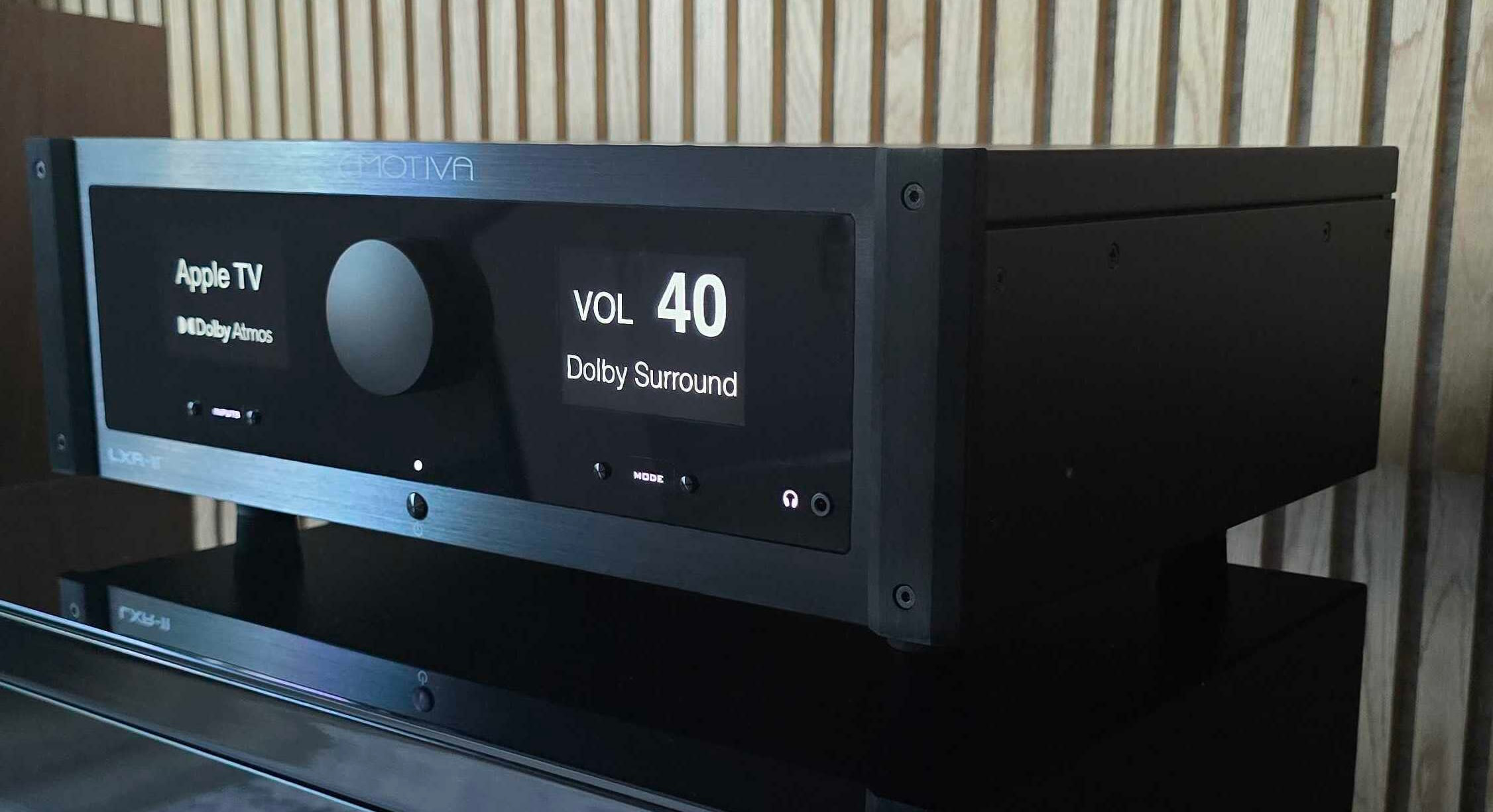
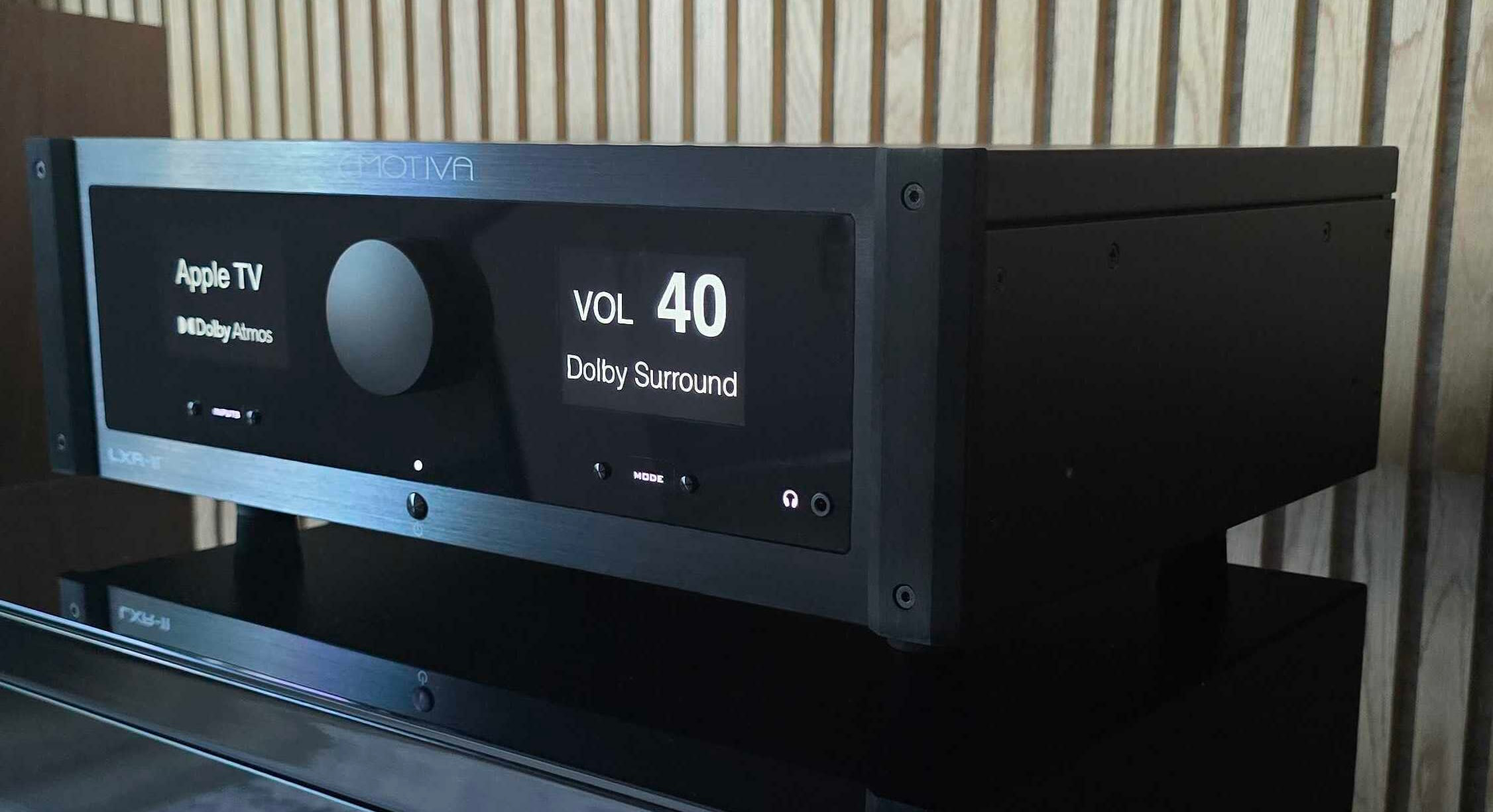
Emotiva LXP-16 and LXR-11 Bring 9.4.6 Home Theater and Dirac ART to CEDIA 2026

Published

on

Emotiva has spent more than two decades building its reputation around a fairly simple proposition: offer serious audio hardware without requiring customers to liquidate part of their retirement portfolio to pay for it.

The new LXP-16 Immersive Cinema Processor and LXR-11 Immersive Cinema Receiver push that philosophy considerably further up the home theater ladder.

Both models will make their public debut at CEDIA Expo 2026 in Denver before their scheduled October release. The LXP-16 is priced at $4,799, while the LXR-11 will sell for $5,999.

What makes the new LX Series interesting is not any single specification. Emotiva is combining 9.4.6-channel immersive processing, four independently managed subwoofer outputs, HDMI 2.1, streaming, and the complete Dirac Live room correction package in two products priced below a number of established high-end alternatives.

Advertisement

And in the case of the LXR-11, Emotiva has thrown eleven channels of Hypex NCOREx amplification into the same chassis.

That is a rather serious amount of hardware for the money.

What Does 9.4.6 Actually Mean?

emotiva-lxp16-front-angle
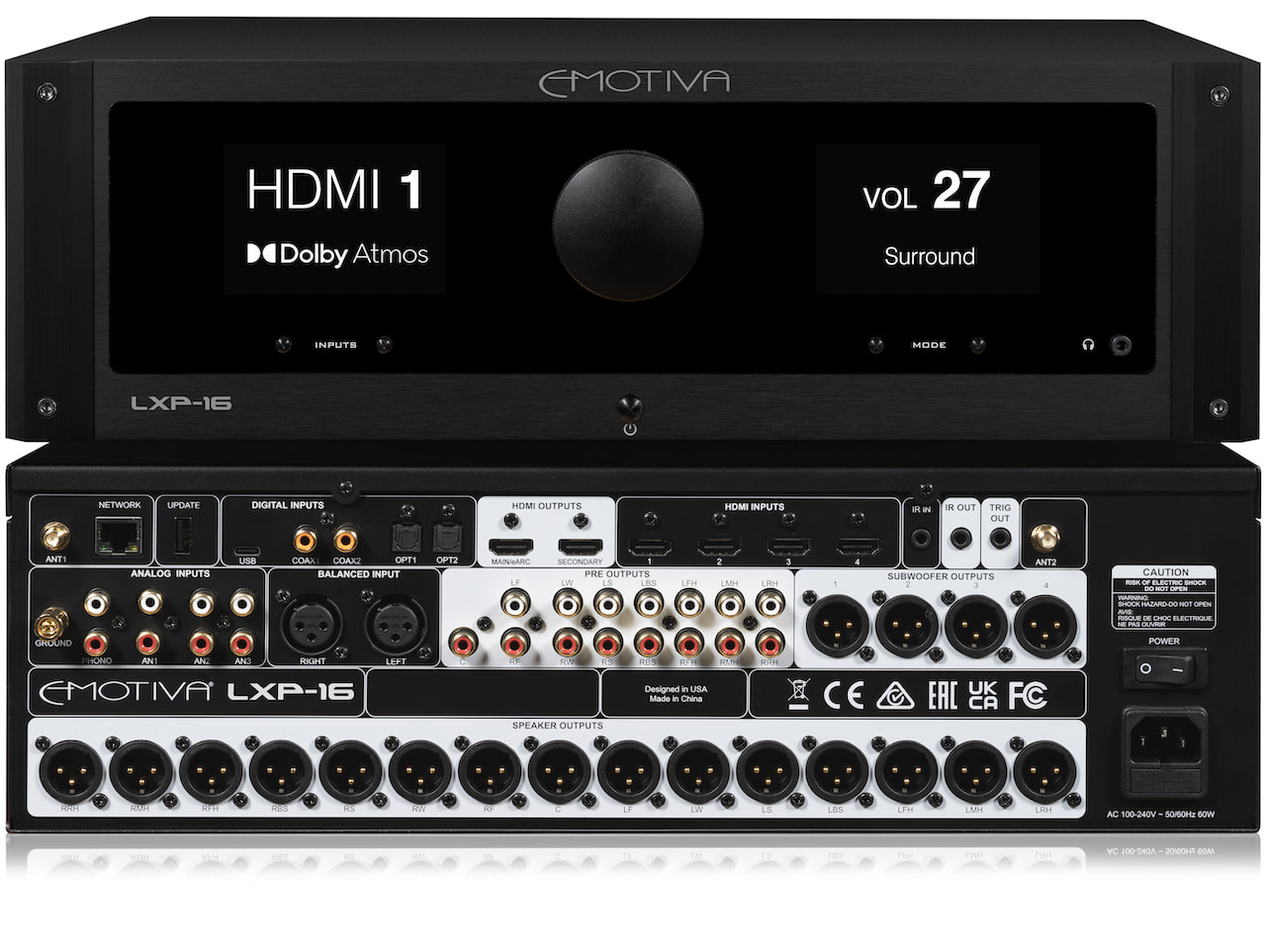
Emotiva LXP-16

Both LX Series models can process a 9.4.6-channel system with left, center and right front channels, a pair of front wides, side surrounds, rear surrounds, four independently managed subwoofers and six height channels.

In practical terms, that means up to 15 independently processed loudspeaker channels plus four independent subwoofer feeds, with support for Dolby Atmos and DTS Pro.

More important for elaborate theater installations, those four subwoofer outputs are not simply four connectors carrying the same signal. Each is a balanced XLR output that can be independently adjusted for level and distance before being integrated by Dirac.

Advertisement

That distinction becomes increasingly important as systems move beyond one or two subwoofers. Multiple subs can improve bass consistency throughout a room, but only when placement, timing, level, and frequency response are properly managed. Four outputs are substantially more useful when the processor actually knows that four different subwoofers exist.

Dirac Live ART Is Included

This might be the most consequential part of the LX Series specification.

Advertisement. Scroll to continue reading.

Both models include licenses for Dirac Live Room Correction, Dirac Live Bass Control, and Dirac Live Active Room Treatment, along with the required calibrated measurement microphone. There is no additional software purchase required to unlock the more advanced Dirac features.

Advertisement

Dirac Live handles frequency response and impulse correction. Bass Control coordinates the loudspeakers and multiple subwoofers around their crossover regions, while Active Room Treatment, or ART, treats the speakers as a coordinated acoustic system and uses their combined output to reduce low-frequency decay within the room.

ART support is becoming increasingly common on premium AV products, but inclusion in the purchase price is not.

ARCAM’s new Radia home theater components support Bass Control and ART as paid upgrades, while compatible Marantz AV receivers and processors also require users to purchase Dirac licenses separately. That gives Emotiva a meaningful advantage before anyone has connected a single loudspeaker.

Emotiva LXP-16 Immersive Cinema Processor

emotiva-lxp16-front-back

The LXP-16 is the separates option and requires external power amplification.

Internally, Emotiva is using a balanced architecture with Analog Devices SHARC DSP processing and ESS Hyperstream DAC technology. Emotiva has not identified the specific ESS DAC chips, so there is no reason to guess.

Advertisement

The processor provides 15 balanced XLR preamp outputs and 15 unbalanced RCA preamp outputs, with both sets available simultaneously. Four additional balanced XLR outputs are dedicated to the subwoofers. Maximum published output is 8V RMS through the balanced connections and 4V RMS through RCA.

LXP-16 Key Specifications:

  • 9.4.6 immersive audio processing
  • Dolby Atmos
  • DTS:X Pro
  • 15 balanced XLR preamp outputs
  • 15 RCA preamp outputs
  • 4 independent balanced XLR subwoofer outputs
  • Analog Devices SHARC DSP
  • ESS Hyperstream DAC architecture
  • Dirac Live Room Correction included
  • Dirac Live Bass Control included
  • Dirac Live Active Room Treatment included
  • 4 HDMI 2.1 inputs
  • 2 HDMI 2.1 outputs
  • 8K/60Hz and 4K/120Hz passthrough
  • Dolby Vision
  • HDR10+
  • HLG
  • VRR
  • ALLM
  • Primary HDMI output with ARC/eARC
  • Moving magnet phono input
  • Balanced XLR stereo analog input
  • 3 RCA stereo analog inputs
  • 2 coaxial and 2 optical digital inputs
  • USB-C PCM input up to 768 kHz
  • Ethernet, Wi-Fi and Bluetooth
  • Bluetooth transmission to headphones or speakers
  • 17 x 13 x 6.25 inches
  • 14 pounds

Emotiva also publishes a frequency response of 20 Hz to 22 kHz within ±0.14 dB from analog sources, along with THD+N below 0.0008% at 1 kHz for line-level sources.

For $4,799, that specification puts the LXP-16 into some rather expensive company.

Emotiva LXR-11 Immersive Cinema Receiver

emotiva-lxr11-front-back

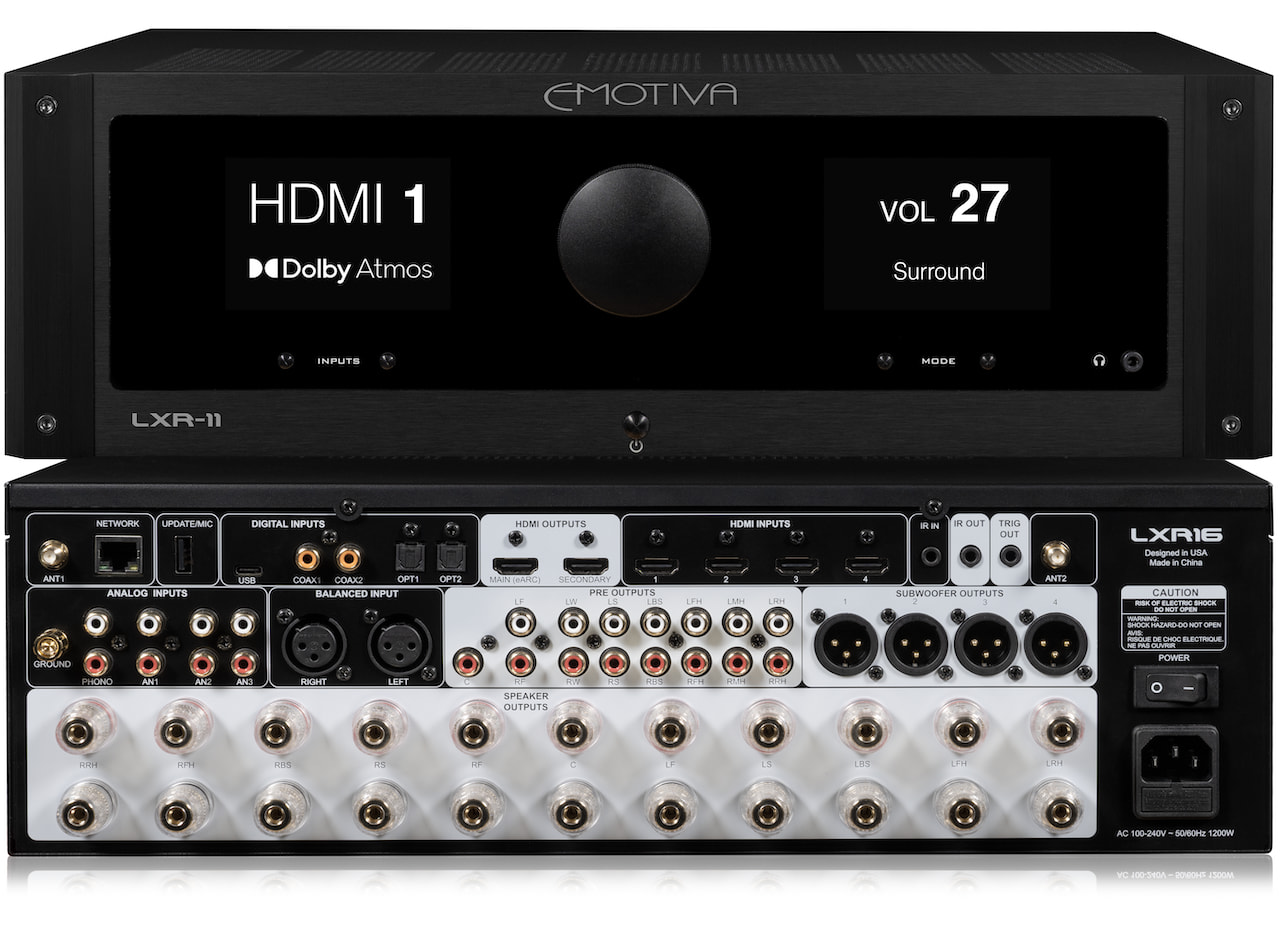
The LXR-11 takes essentially the same processing platform and adds 11 channels of Hypex NCOREx Class D amplification.

That is a notable choice. Hypex amplification has become increasingly common in serious two-channel and multichannel products because it can deliver substantial output from relatively compact, efficient designs.

Emotiva has also made the LXR-11 fanless, which matters in quiet rooms and enclosed equipment installations where mechanical noise is about as welcome as someone opening a bag of potato chips during 2001: A Space Odyssey.

Advertisement
Advertisement. Scroll to continue reading.

The receiver provides 15-channel RCA preamp outputs, allowing external amplification to be added as the system grows. Emotiva also says the internal amplification can be completely switched off if the LXR-11 is eventually used primarily as a processor.

LXR-11 Amplifier Specifications:

Emotiva’s detailed power specifications are unusually useful because they specify how many channels are being driven:

  • 140 watts per channel into 8 ohms, 2 channels driven, 20 Hz to 20 kHz, 0.02% THD
  • 240 watts per channel into 4 ohms, 2 channels driven, 20 Hz to 20 kHz, 0.02% THD
  • 140 watts per channel into 8 ohms, 5 channels driven, 0.1% THD
  • 140 watts per channel into 8 ohms, 7 channels driven, 0.1% THD
  • 100 watts per channel into 8 ohms, 9 channels driven, 0.1% THD

Emotiva has not published an 11-channels-driven power specification, so we are not going to invent one.

The rest of the LXR-11 specification closely mirrors the LXP-16, including four HDMI 2.1 inputs, two outputs, four independent balanced subwoofer outputs, MM phono, USB-C audio, network connectivity, and the complete Dirac package.

Advertisement

Emersa Brings Streaming Into the LX Series

Both models also include Emotiva’s Emersa streaming platform and Emersa Control app.

Published streaming support includes TIDAL Connect, Qobuz Connect, Spotify Connect, DLNA, Google Cast, Bluetooth, and USB playback. The app handles volume, source selection, listening modes, streaming access, and commonly used audio adjustments.

One competitive difference is worth noting: Emotiva’s published specifications currently do not list Apple AirPlay or Roon Ready support, both of which are offered by ARCAM’s newest Radia home theater products. Whether that matters will depend entirely on how a system is used.

There is also a more obvious hardware limitation.

Advertisement

The LX Series provides only four HDMI inputs. ARCAM and Marantz offer seven HDMI inputs on several of their closest competitors. Four will be enough for many installations, especially when eARC moves television apps back through the system, but owners with multiple consoles, disc players, streamers, and specialty video sources should count first and purchase second.

The Competition

Two brands stand out as the most relevant competition based on current technology, channel capability, and pricing: ARCAM and Marantz.

ARCAM Radia

ARCAM’s new AVP45 is probably the closest direct rival to the LXP-16.

Priced at $5,999.95, the AVP45 provides 16-channel processing, balanced outputs, seven HDMI inputs, Dolby Atmos, DTS, Auro-3D, extensive streaming, Roon Ready support, AirPlay, Google Cast, Bluetooth with Snapdragon Sound and Auracast, and Dirac Live. Bass Control and Active Room Treatment are supported but require paid upgrades.

Advertisement
Advertisement. Scroll to continue reading.

The $6,999.95 ARCAM AVA35 is the more logical rival to the LXR-11. It processes up to 16 channels but provides nine channels of Class G amplification rather than eleven. ARCAM counters with more HDMI connectivity, Auro-3D, Roon, AirPlay, and its broader streaming feature set.

The Emotiva advantage is straightforward: more onboard amplifier channels in the receiver, four dedicated balanced subwoofer outputs and the entire Dirac suite already included.

Marantz

Marantz attacks the same market from two different directions.

Advertisement

The $8,000 AV 10 offers 15.4-channel processing, balanced outputs for every channel, seven 8K HDMI inputs, HEOS streaming, Dolby Atmos and a considerably more expensive premium chassis. It also supports Dirac Live, Bass Control and Active Room Treatment, but those features require separate licensing.

At $4,800, the Marantz CINEMA 30 costs less than the Emotiva LXR-11 and includes eleven channels of Class A/B amplification rated at 140 watts per channel with two channels driven. Its processing ceiling is 13.4 channels rather than Emotiva’s 15 speaker channels plus four subwoofers, while HEOS, AirPlay, seven HDMI inputs, Auro-3D and the broader Marantz ecosystem give it a different set of strengths. Dirac remains an optional upgrade.

This is not a case where one specification sheet automatically wins. Marantz has the more mature connected ecosystem and ARCAM offers excellent integration and streaming flexibility. Emotiva is putting more of the expensive acoustic processing into the purchase price.

There Is Another CEDIA Story Here

The hardware is only half of Emotiva’s CEDIA announcement.

Advertisement

The company is also launching a new Authorized Dealer Program and will be meeting with prospective dealers and integrators during the show. Emotiva has historically identified itself as a direct-to-consumer company, and its existing Integrator Program was designed primarily for professionals purchasing equipment for specific installations rather than conventional retail resale.
Emotiva has not yet published enough detail to determine exactly how broadly the new dealer structure will alter that business model.

But appearing at CEDIA with two considerably more ambitious home theater components while simultaneously building a dealer network is not difficult to interpret. Emotiva wants the LX Series specified into professionally designed theaters, not just ordered by enthusiasts already familiar with the brand.

That could ultimately be as important as another HDMI input.

The Bottom Line

Emotiva is not winning this fight simply by being cheaper.

Advertisement

The LXP-16 and LXR-11 combine 15-channel immersive processing, four independent balanced subwoofer outputs, modern HDMI 2.1 video support and the complete Dirac Live suite, while the receiver adds eleven channels of Hypex NCOREx amplification.

Advertisement. Scroll to continue reading.

ARCAM offers more connectivity and a more comprehensive streaming platform. Marantz brings HEOS, seven HDMI inputs, a mature control ecosystem, and formidable competition at both ends of the price range.

But requiring customers to spend nothing extra for Dirac Live Bass Control or Active Room Treatment changes the value equation considerably.

Advertisement

If the LX Series performs as well as its specifications suggest and Emotiva can make its new dealer strategy work, CEDIA 2026 could mark the point where the company stops being viewed primarily as the direct-to-consumer value alternative and starts becoming a much bigger problem for established high-end home theater brands.

Price & Availability

Both are scheduled for release in October 2026, with further launch information expected before availability. They will make their CEDIA Expo debut at Emotiva Booth 2938 in Denver.

Source link

Advertisement
Continue Reading

Tech

Luca Maestri isn’t running Apple’s Corporate Services anymore

Published

on

More executive changes are happening at Apple as Ternus takes over, with former CFO Luca Maestri moving on from managing the company’s Corporate Services.

Luca Maestri was the chief financial officer at Apple under Tim Cook, but switched roles at the end of 2024 to become Vice President of Corporate Services. With Cook out, Maestri has also taken the opportunity to change his portfolio of work.

According to sources of Bloomberg, Maestri left his Corporate Services position in the last few weeks. He has not left the company, however, as he is still on the payroll.

Current CFO Kevan Parekh has now assumed the Corporate Services responsibilities.

Advertisement

It is unclear what his responsibilities now are, if anything, within Apple, beyond hosting a single class. That class is at Apple University, the company’s in-house program for educating executives and employees.

The report continues by saying Maestri is winding down his time at Apple, as he prepares for retirement. It is claimed he only comes into the office once a week.

With seemingly no remit, it seems that he won’t be reporting to new CEO John Ternus at all until Maestri’s eventual departure.

Advertisement

Source link

Continue Reading

Tech

Seattle cannabis data startup Headset to pay $1M to settle allegations over pandemic-era loan

Published

on

(Headset Image)

Seattle-based cannabis data analytics company Headset has agreed to pay more than $1 million to resolve allegations that it improperly received and obtained forgiveness for a federal Paycheck Protection Program (PPP) loan.

The settlement, announced Monday by the U.S. Attorney’s Office for the Western District of Washington, stems from a May 2024 whistleblower lawsuit filed by Sidesolve LLC under the False Claims Act. Sidesolve is a data analytics company that uses AI algorithms to hunt for potential pandemic loan fraud across public records.

The government alleged that Headset was ineligible for the Small Business Administration (SBA) loan it received in February 2021 — and had forgiven in August 2021 — because its work supporting the marijuana industry conflicts with federal law.

Under the terms of the deal, Headset paid $100,000 within 30 days of signing the agreement in early August and will pay the remaining balance of more than $900,000 over four years through August 2030. The company made no admission of wrongdoing, stating it agreed to the payments to avoid the risks and expense of litigation.

Headset was founded in 2015 by Cy Scott, Brian Wansolich, and Scott Vickers. The trio previously co-founded Leafly, the popular online cannabis strain database and marketplace, which was acquired by Privateer Holdings in 2011. After departing Leafly, they launched Headset to bring business intelligence and real-time sales metrics to the legal pot industry.

Advertisement

The startup functions like a Nielsen for the cannabis sector, aggregating point-of-sale data from dispensaries and retailers to provide market trends, pricing insights, and consumer demographics.

Over the years, the company has raised $29.4 million in total funding from investors including Poseidon Asset Management and Canopy Rivers, expanding its data coverage across legal state and international markets.

Source link

Advertisement
Continue Reading

Trending

Copyright © 2025