
Crypto World
Japan Rate Shock Is Hitting Markets. How Will Bitcoin React?

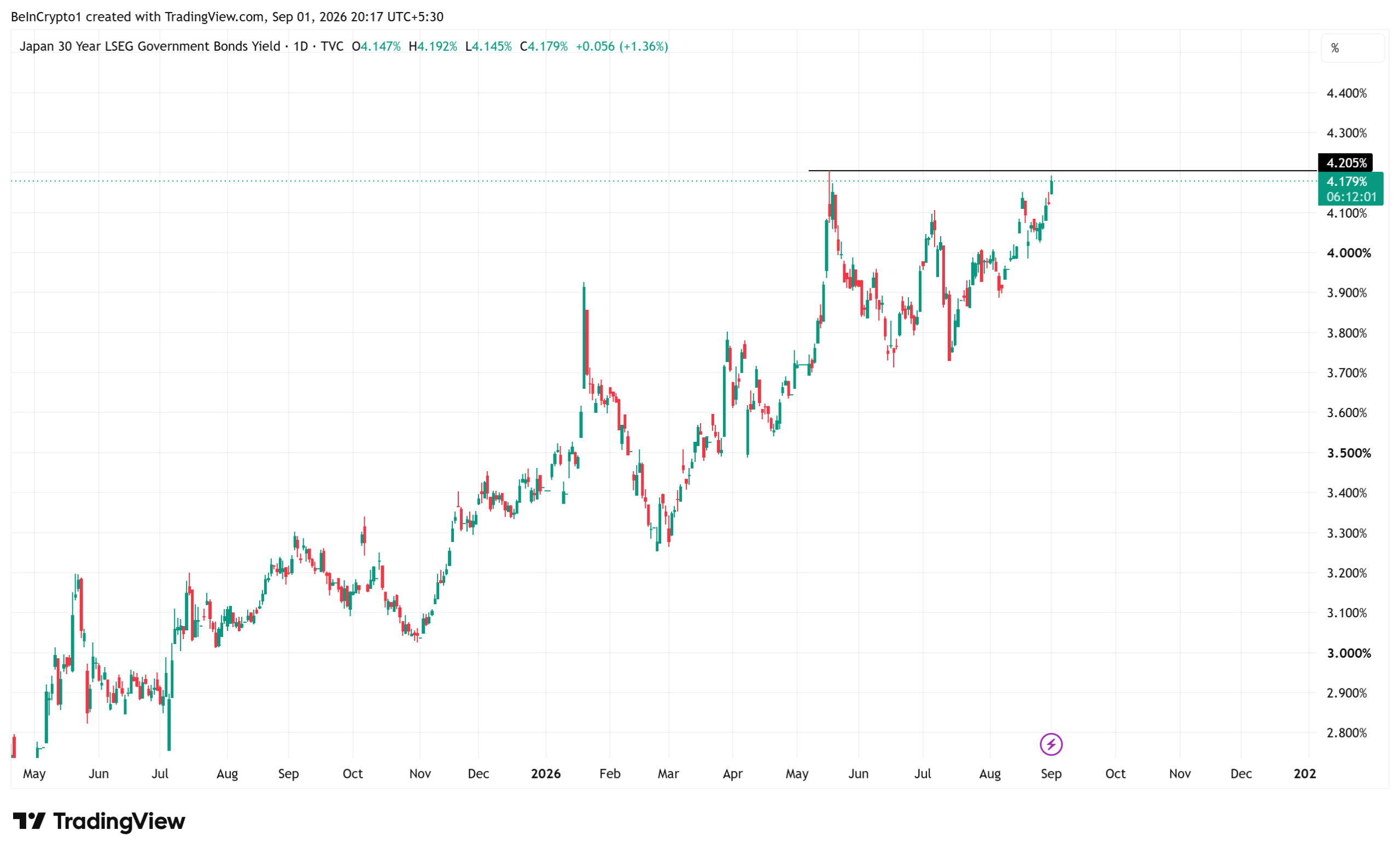
Japan’s rate shock deepened on Tuesday. The 30-year government bond yield approached its all-time high of 4.205%, last tested in May. Meanwhile, the 10-year reached 3% for the first time since 1996.
The rate hike itself was never the surprise. Markets had nearly fully priced a September move. What nobody saw coming was Washington publicly demanding it, and a bond market that broke anyway.

Why Japan’s Rate Shock Is Reaching Global Markets
US Treasury Secretary Scott Bessent met Finance Minister Satsuki Katayama and Bank of Japan (BOJ) Governor Kazuo Ueda at the Group of 20 (G20) finance gathering in Asheville, North Carolina. He pressed for hikes and a clearer fiscal plan.
“I have information that the market doesn’t have, and it’s my belief that the Japanese government and the BOJ will do the things that will lead to a stronger yen,” Bessent said.
Japan’s whole curve gave way, with the two-year hitting a 31-year high, lifting yen carry trade costs that had been near zero for a generation.
Japan’s own budget assumed a 3% long-term rate when it calculated debt-service costs, so Japan’s rising borrowing costs now test that arithmetic.
Other long-end markets moved with it. UK 10-year gilts reached 5.23%, a level last seen in 2008, US 10-year Treasuries traded at 4.78%, and Brent crude climbed above $92 a barrel.
Not everyone reads the selloff as a monetary story. Takahide Kiuchi, a former BOJ board member now at the Nomura Research Institute, framed the 3% print as a verdict on spending under Prime Minister Sanae Takaichi.
“The rise to 3 per cent is a message from the market that could, to some extent, force Takaichi to correct some of her expansionary fiscal policy,” the Financial Times reported, citing Kiuchi.
What a Stronger Yen Would Mean for Bitcoin
Years of near-free yen borrowing funded leveraged bets across equities, bonds, and crypto. Higher Japanese rates make that funding dearer.
The Bank for International Settlements put yen loans to non-banks outside Japan near $250 billion in March 2024, with cross-border yen claims on offshore centers around $500 billion. It cautioned that the true size resists measurement.
When it happened, Bitcoin (BTC) and Ethereum (ETH) shed up to 20% during the August 2024 unwind, as margin calls forced traders to liquidate positions across asset classes.

Yet the currency has not rallied. The dollar sat near 159.75 yen on Monday, just inside the 160 mark that raises the odds of yen-buying intervention.
Japan’s fading yen defense has held no floor since the July 31 joint operation with Washington.
For officials, the line is 160, but for Bitcoin the trigger is speed rather than level, because the pace of the 2024 appreciation, the sharpest single-day currency move the BIS examined, is what broke the trade.
The BOJ decides on September 18, with markets pricing a quarter-point move to 1.25%. Ueda’s guidance on what follows may matter more to crypto than the hike itself.
The post Japan Rate Shock Is Hitting Markets. How Will Bitcoin React? appeared first on BeInCrypto.

Anthropic released Claude Fable 5.1 on Tuesday, and the model ships with a lock on its own reasoning. New developer accounts can no longer rewrite a conversation’s history while keeping Claude’s stored thinking in place.
The company calls Fable 5.1 and its restricted sibling Mythos 5.1 the world’s most advanced models for coding and knowledge work. Both went live across Anthropic’s platform, Amazon Bedrock, Google Cloud and Microsoft Foundry.
Follow us on X to get the latest news as it happens
What Claude Fable 5.1 Costs and Scores
Headline pricing has not moved. Fable 5.1 still costs $10 per million input tokens and $50 per million output.
The savings sit elsewhere. Cache reads fall 75% to $0.25 per million. Anthropic puts typical workloads 25% cheaper, and complex agent tasks up to 45% cheaper.
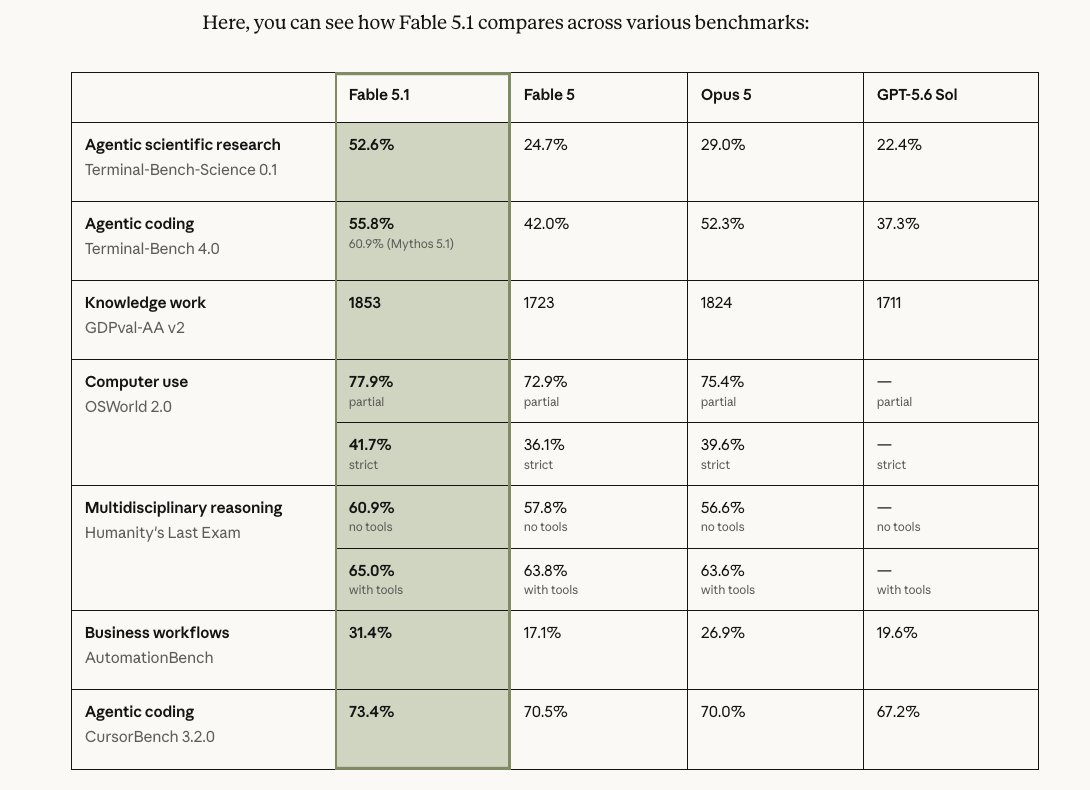
Anthropic’s own scorecard shows the sharpest gain in agentic science work. Fable 5.1 hit 52.6% on Terminal-Bench-Science 0.1, more than double Fable 5’s 24.7%.
The coding lead is narrower. Fable 5.1 took 55.8% on Terminal-Bench 4.0, ahead of Opus 5 at 52.3% and OpenAI’s GPT-5.6 Sol at 37.3%.
Business workflow scores nearly doubled to 31.4% on AutomationBench. Knowledge now runs to June 2026, five months later than Fable 5.

“It’s priced the same as Fable 5, with 75% cheaper API cache reads. It gets a lot further into a long task before it needs your input, is better at telling you when it’s stuck, and its writing style is more natural,” ClaudeDevs noted.
ClaudeDevs is the official updates for developers building with Claude AI.
Why the Copying Protection Matters
According to Anthropic, the quieter change targets rivals.
“It is no longer possible for new API accounts to manually edit Claude’s prior context in a multi-turn conversation while preserving the transcript of Claude’s prior thinking,” the launch post read.
That edit trick is a known route into distillation, or training a cheap model on an expensive one’s answers.
Anthropic put hard numbers on the threat in February. It traced over 16 million Claude exchanges to distillation campaigns run through roughly 24,000 fake accounts.
The company named three Chinese labs, DeepSeek, Moonshot AI and MiniMax. Moonshot alone accounted for 3.4 million exchanges.
White House science adviser Michael Kratsios went further in July. He accused Moonshot of copying Anthropic’s flagship model to build its Kimi K3 system.
Moonshot has not answered publicly.
The restriction applies only to accounts opened on or after August 31. Older accounts stay exempt, and Claude Code, Cowork and Claude.ai users notice nothing.
Anthropic says every account will face the check on future models. Fable 5 stays available until at least June 2027, so nobody has to move today. Fable 5.1 retires no sooner than September 1, 2027.
The post Anthropic Launches Claude Fable 5.1: Can It Stop AI Copycats? appeared first on BeInCrypto.
An affiliate of the political action committee (PAC) Fairshake, which was responsible for pouring more than $130 million in ads and media in the 2024 election cycle, is supporting at least one candidate in Tuesday’s primary in Massachusetts.
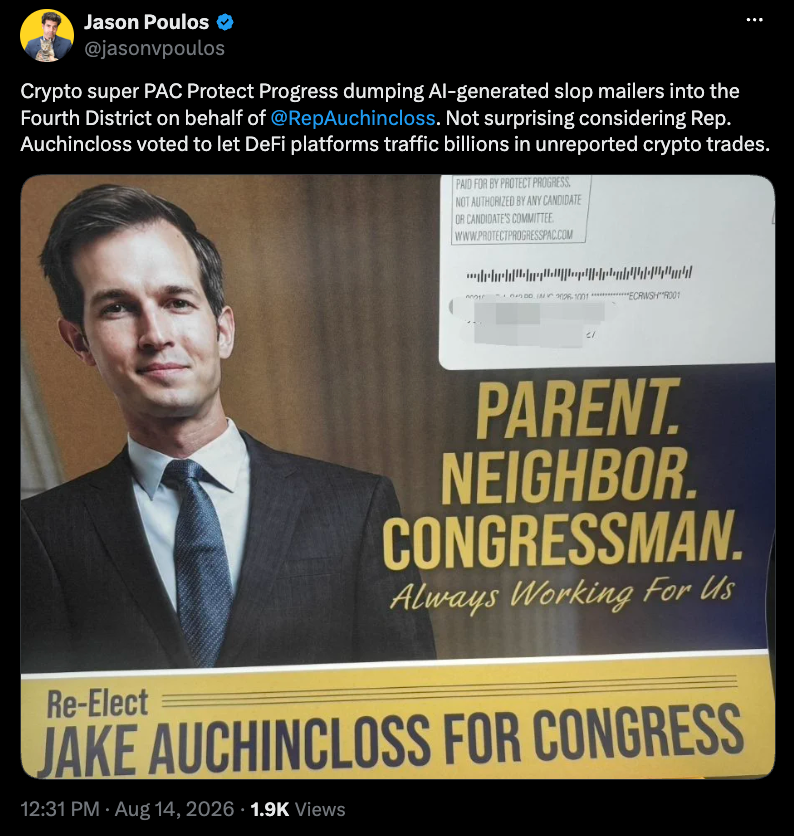
According to Federal Election Commission (FEC) records as of Tuesday, the Protect Progress PAC, a Fairshake affiliate, spent just over $189,000 on media to support Representative Jake Auchincloss running for reelection in Massachusetts’ 4th congressional district. Some of the funds, according to Democratic candidate Jason Poulos, were used to create “AI-generated slop mailers” supporting Auchincloss ahead of the Massachusetts primary, scheduled for Tuesday.
In an Aug. 16 letter, Poulos called on the Democratic lawmaker to “publicly renounce” Protect Progress’ efforts to potentially influence the primary and general election. The candidate claimed Auchincloss had accepted $77,500 directly from “crypto-industry sources” since 2020, pointing to the Massachusetts lawmaker’s record in voting for the Digital Asset Market Clarity Act in July 2025 — a market structure bill not signed into law as it awaits consideration in the Senate.
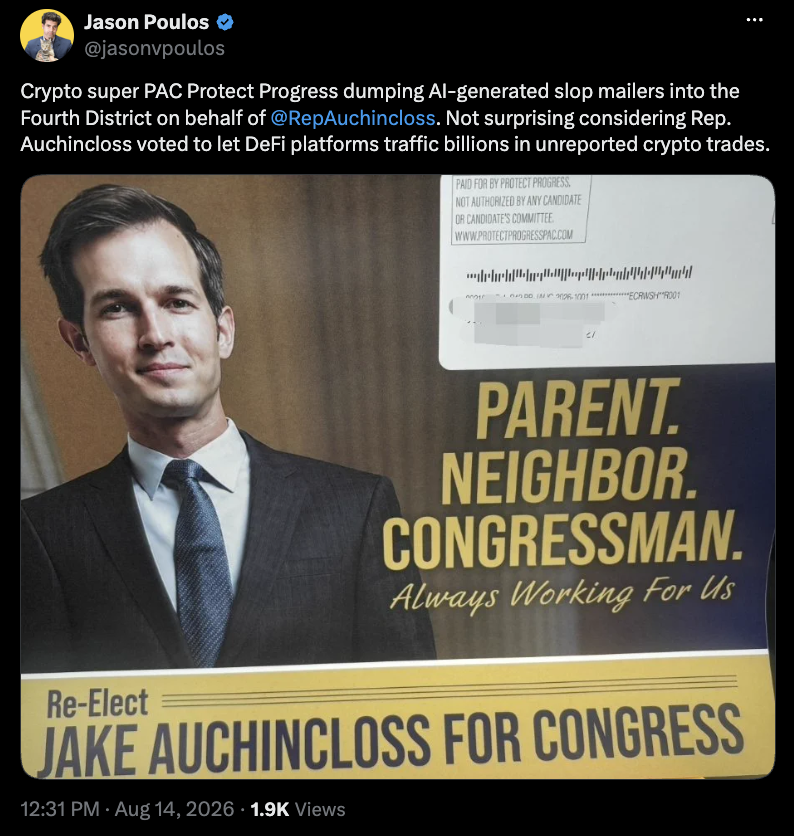
Protect Progress PAC mailer supporting Jake Auchincloss. Source: Jason Poulos
The $189,000 in spending marked Fairshake’s latest attempt to influence the 2026 elections through media and ads unrelated to candidates’ positions on crypto and blockchain. After the PAC and its affiliates spent about $3.6 million on House and Senate races in Alaska, Florida and Wyoming in August, Fairshake reported having $122 million cash on hand ahead of the 2026 midterms.
“With dozens of wins in House and Senate races across the country, and $122 million ready for the fall, we’re not slowing down heading into November,“ Fairshake spokesperson Geoff Vetter said in August.
Massachusetts will be one of the last US states to hold primaries, with just over two months until the general election. New Hampshire, Rhode Island and Delaware are all scheduled to hold primaries in September.
Related: Kalshi issues first lifetime ban for Republican politician over insider bets
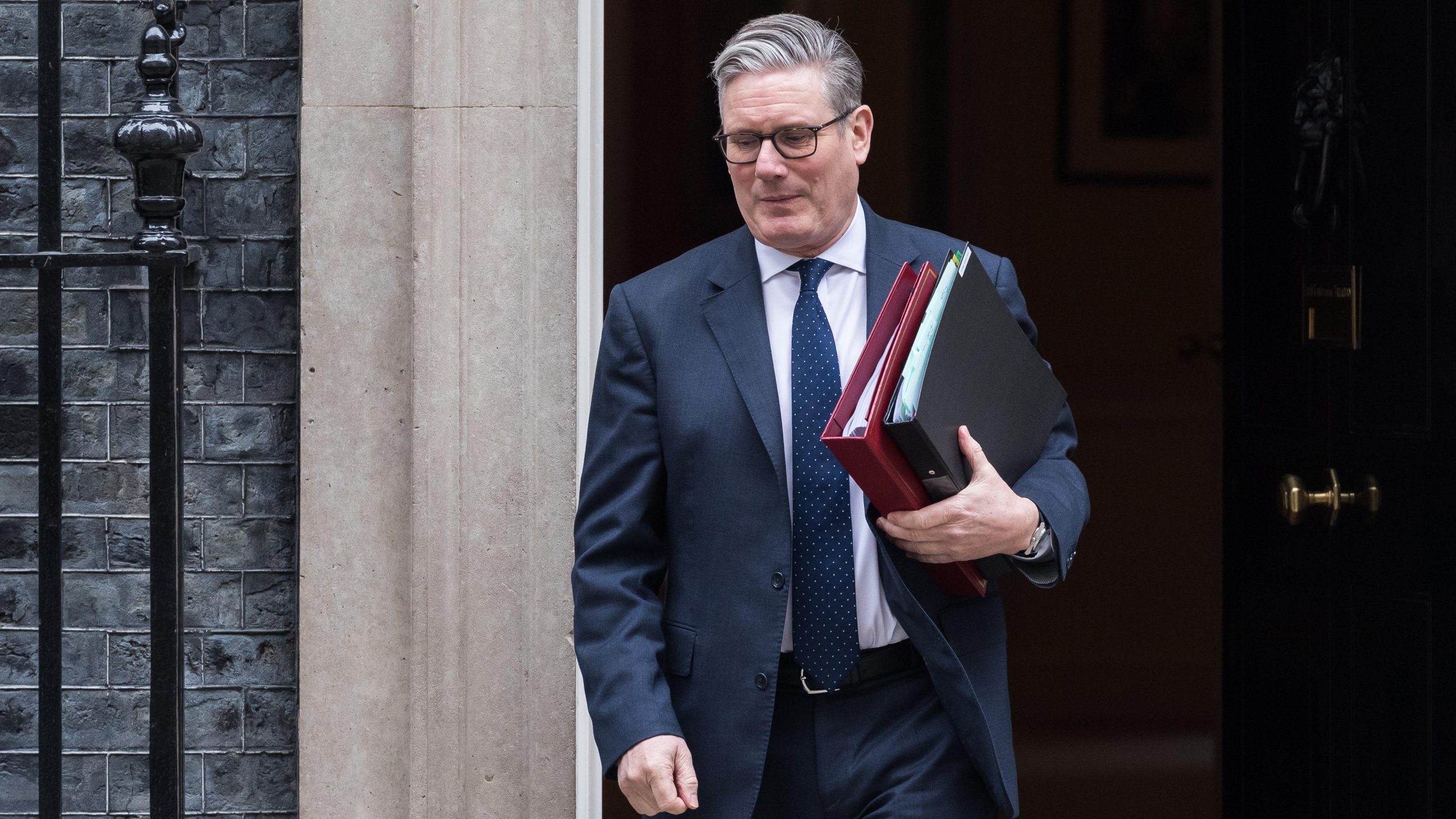
A by-election will now take place to replace Starmer as MP, with details to be finalized on the contenders and exact date.
Shortly after the news broke, Starmer shared a statement via social media, further explaining the reasons behind his departure.
You can read his words in full, below:
“Over the summer, I have had time to reflect and consider my future. I have decided that now is the right time to step down as MP for Holborn and St Pancras and hand the baton over to a successor.
It’s been an honor and privilege to represent the best constituency in the country since taking over from the great Frank Dobson 11 years ago. But it is now time to step aside and focus on other issues: international affairs including defense, security, trade and technology in a fast changing world. I will also continue working with others as I have done over many decades to tackle violence against women and girls.

Solana was trading near $102 on Tuesday, down more than 7% from its recent seven-month high of nearly $110. The recent price weakness has not stopped signs of stronger demand from building across the network.
According to Ali Martinez, Solana recorded an average of 9.5 million new addresses per day over the past week, a level of growth the analyst considers an important adoption signal and one that has historically preceded major rallies.
Bullish Factors
Larger investors are also becoming more active. Wallets holding at least 10,000 SOL rose 1.58% after adding 52 new whale wallets to the network. At the same time, US spot Solana ETFs extended their streak of weekly net inflows to nine weeks. These funds attracted almost $154 million in capital last week. Interestingly, Bitwise’s Solana Staking ETF, BSOL, recently surpassed $1 billion in assets under management within 10 months.
Meanwhile, exchange balances are moving in the opposite direction, as seen with SOL held on exchanges dropping 4.91% after the withdrawal of roughly 2.6 million tokens over the past week. Martinez stated that $103 is an important support level, since it’s backed by 39 million SOL acquired there. The next hurdles are $123 and $132, each tied to about 20 million SOL in previous purchases.
Holding support and breaking those two levels could set up a move toward $150.
A similar sentiment was echoed by crypto investor Batman, who said that Solana may be entering a stronger bullish phase after breaking out of a major accumulation structure. But he expects SOL to retest the $83-$85 zone and believes a successful hold there could eventually push the asset toward $150 or higher.
Another market watcher, Gerla, believes the asset could be preparing for a much larger move after breaking its downtrend. He flagged the formation of higher lows, which suggests that the market may be entering a reaccumulation phase. If the structure remains intact, Gerla said that Solana could target $300 or higher as the next major expansion zone.
Other Key Developments
Solana saw several major developments this week. This includes the conclusion of its first binding on-chain governance vote, which was followed by a 25% increase in network speed, taking slot times from 400ms to 300ms. Separately, Charles Schwab announced plans to add SOL to Schwab Crypto Direct.
Additionally, Solana’s RWA holder base also crossed 350,000, while xStocksFi topped $500 million in AUM across more than 700 tokenized assets. Tokenized commodities on the network also reached a record $50 million in supply, and Solana became the leading network by total x402 transaction volume.
The post Solana’s 7% Pullback Isn’t Slowing Demand: Here’s the $150 Setup appeared first on CryptoPotato.
Robert Kiyosaki says he owes $1.2 billion. The “Rich Dad Poor Dad” author borrowed that money against apartment buildings, not against the Bitcoin (BTC) and gold he promotes to millions of followers.
His former wife and business partner, Kim Kiyosaki, said the figure covers borrowing shared with partners across roughly 1,500 units. Her account puts his own exposure far below the headline.
The $1.2 Billion Is a Partnership Total
Kiyosaki has repeated the number all summer, most recently on the “Get Rich Education” podcast.
“So, I’m a billion two in debt,” the New York reported, citing Kiyosaki.
Follow us on X to get the latest news as it happens
Vanity Fair, whose profile the Post drew on, put his personal share nearer $30 million to $60 million, working backward from his claim of about $3 million in yearly income. That is a fraction of the figure he advertises.
The mechanics are ordinary multifamily finance. When a building appreciates, the owners refinance, and the cash arrives untaxed because nothing was sold. Each deal also sits inside its own limited liability company (LLC), so trouble at one property does not travel to the rest.
Not everyone reads that as safety. John Poole, founder of the Scottsdale consultancy JPTD Partners, told the Post that borrowed money behaves very differently once prices stop climbing.
“Leverage works beautifully on the way up, and if it’s not continuing on that way up, then it’s like a chainsaw financially coming down,” the Post added, citing John Poole of JPTD Partners.
Bitcoin and Gold Sit on the Other Side
The debt story lands awkwardly because Kiyosaki spends most of his airtime telling followers to hold gold and Bitcoin rather than dollars. In July he named Bitcoin and Ethereum beside gold as his own defense against a currency he calls fake.
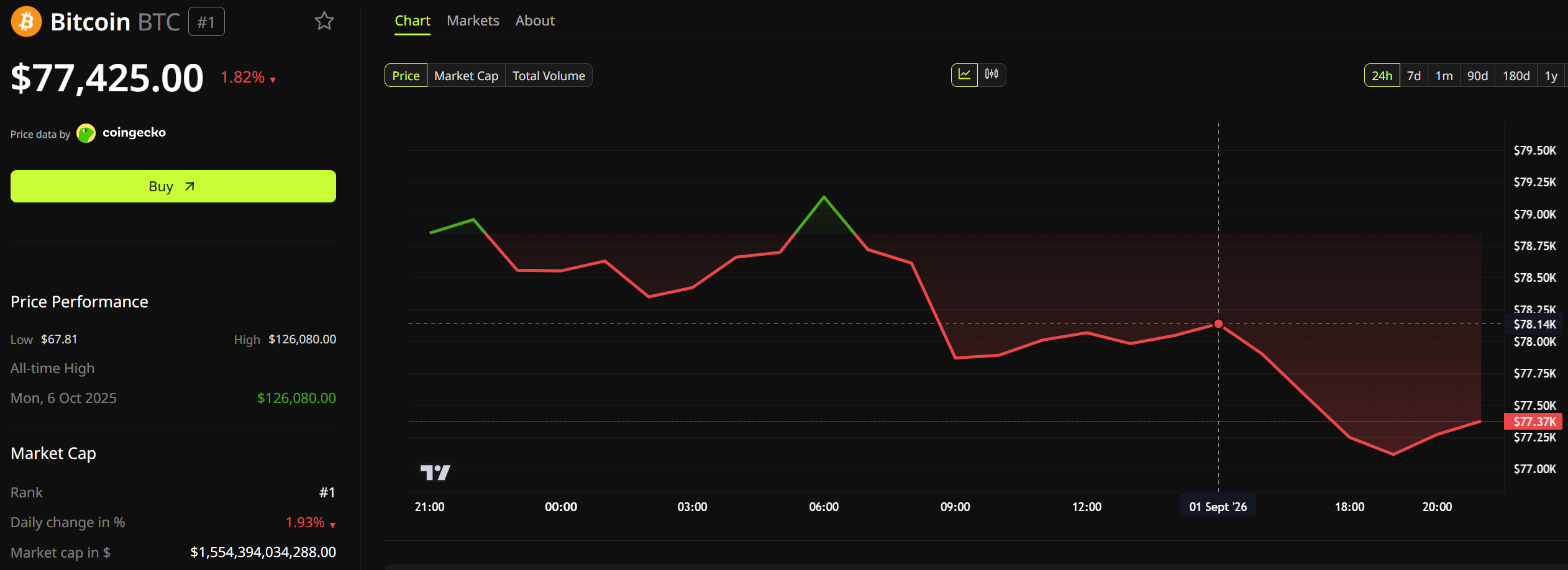
Those holdings are not the collateral. BTC, which trades near $77,425 after slipping 1.8% in a day, secures none of the loans described in the reporting. The mortgages sit on brick and rent rolls.

That leaves a tension he rarely addresses. He warns that cheap credit will break the system, even as US borrowing nears $40 trillion, while running a portfolio that depends on the same credit staying available.
History gives the caution some weight. One of his companies, Rich Global LLC, filed for Chapter 7 in 2012 after losing a judgment, according to ABC News.
Refinancing keeps working while rents cover payments and lenders keep lending. Will Kiyosaki’s followers really understand which half of his message carries the risk?
The post Robert Kiyosaki Is $1.2 Billion in Debt: Is His Bitcoin at Risk? appeared first on BeInCrypto.

Prediction-market exchange Kalshi has permanently banned former US Rep. George Santos from accessing the platform after its Compliance Department found “reasonable cause to believe” that he engaged in insider trading and market manipulation.
The lifetime ban, effective August 28, 2026, is the first permanent penalty of its kind imposed by Kalshi on a user.
Penalty and Lifetime Ban
According to the official compliance document, Santos traded in markets linked to whether he would attend the State of the Union address on February 24, despite being prohibited from trading in those markets because he was capable of influencing the outcome of the underlying event. Kalshi said Santos placed a series of large trades between February 2 and February 25 in contracts whose results depended on his own attendance.
The platform said Santos materially benefited from the activity and earned $17,839.57 from the targeted markets. Alongside the permanent suspension of direct and indirect access to the exchange, the Compliance Department has also imposed a $71,356 penalty.
In response to the development, Santos took to X to attack Kalshi and accused the latter of violating its own notices and deadlines. He said that the August 7 notice allegedly gave his side 30 days before the latest action, as he questioned why the exchange had announced “frivolous nonsense” before that period was over.
“Leaking and attention seeking seem to be the M/O of this organization. Pathetic!”
The action comes after a settlement Santos reached last month with the Commodity Futures Trading Commission, which has said it has jurisdiction over prediction markets. He agreed to pay $35,000 under the settlement but did not admit or deny the agency’s findings. His counsel, Joseph W. Murray, said Santos cooperated with the CFTC.
The former congressman was expelled from the House of Representatives in 2023 after facing federal charges. In April 2025, he was sentenced to more than seven years in prison after pleading guilty to wire fraud and identity theft. In October of that year, Trump announced that he had commuted the sentence, and Santos was released after serving less than three months.
Kalshi had previously suspended three US political candidates after finding they bet on election outcomes they were directly involved in, while calling the activity “political insider trading.”
More Heat on Prediction Markets
Prediction-market platforms face growing scrutiny from regulators and lawmakers. Last month, Baltimore officials sued Kalshi and Polymarket, alleging that their sports prediction contracts amount to unlicensed sports betting and can mislead consumers about their legal and regulatory status.
Meanwhile, Kalshi is also fighting a lawsuit from New York Attorney General Letitia James. The exchange has separately faced a lawsuit from FlightAware over flight-related markets, although that case was withdrawn shortly after being filed.
The post Former US Rep. George Santos Banned From Kalshi for Life After Betting on Himself appeared first on CryptoPotato.
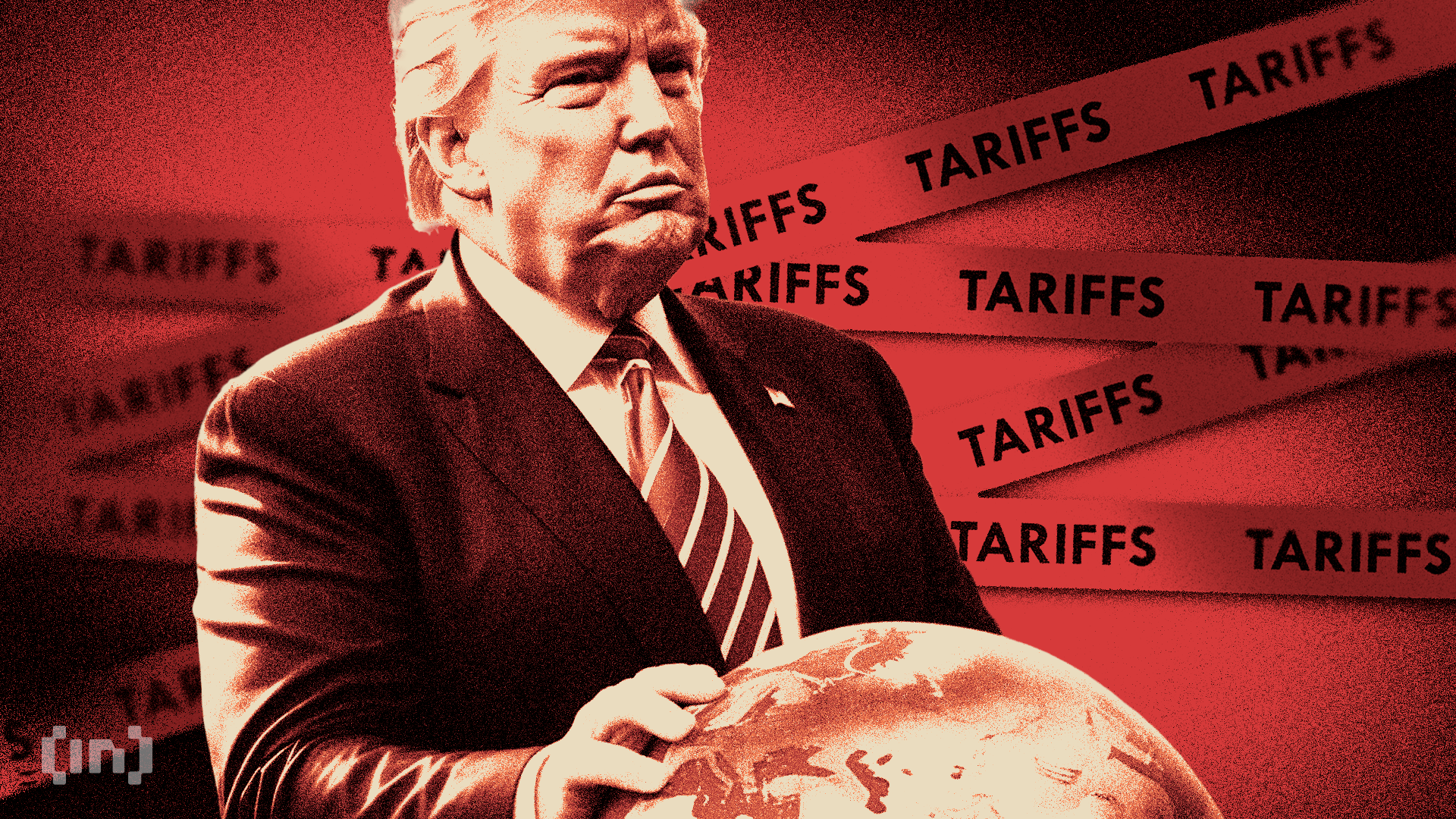

Canadian Prime Minister Mark Carney said trade talks with the United States will restart on one condition. American officials must stop posting memes and start being serious.
He spoke in Ottawa on Tuesday. Canada’s retaliatory tariffs land in one week, and neither side has booked a meeting since talks collapsed in August.
Why US-Canada Trade Talks Collapsed
Canada walked out on August 21 and called its negotiators home. Carney said Washington wanted Canadian industries turned into subsidiaries of US firms, or wound down. He refused.
The US hit back a day later with 50% tariffs on Canadian goods worth roughly $20 billion. That number sounds big, but it only covers about 5% of the $382 billion Canada shipped south last year, US Census Bureau data shows.
To do so, the White House invoked Section 338 of the Tariff Act of 1930. The law lets a president hit countries that discriminate against US exporters. No president had ever used it.
The choice was forced. In February, the Supreme Court struck down Trump tariffs built on a 1977 emergency law. Section 338 caps duties at 50%, so Trump took the ceiling.
“This law is literally a blank canvas because it’s never been litigated,” noted Ryan Majerus, partner at law firm King & Spalding and a former US trade official.
Follow us on X to get the latest news as it happens
The Meme War Now Sets the Tone
Trump signed an order on August 27 renaming Lake Ontario “Lake America” for US government use. He then posted an AI video of armed Canada geese wearing his hairstyle. Treasury Secretary Scott Bessent mocked Canada’s navy on CNBC.
Canada and the rest of the world reject the change and still call it Lake Ontario.
“When the Americans stop doing memes, stop throwing shade, stop trying to be tough and start being serious about having those discussions, we can have those discussions,” said Carney on Tuesday in Ottawa.
Canada’s reply arrives September 8, taxing more than 700 US products and covering C$27.6 billion in trade.
The costs are real, considering softwood lumber duties on Canadian imports now total 45%, the National Association of Home Builders says.
Whether those September 8 duties hold, or become a bargaining chip, will signal more than any post.
The post Trade Talks Can Start When Memes Stop, Canadian PM Warns Trump appeared first on BeInCrypto.

Binance is widening its push into traditional markets by adding options trading tied to more than 1,000 US stocks and exchange-traded funds (ETFs) for eligible users located outside the United States. The rollout uses Binance’s Abu Dhabi-regulated broker-dealer, Nest Trading, while trades are routed to US-registered Alpaca Securities for execution, clearing, settlement, and custody.
The move extends Binance’s existing equities offering, which already covers over 7,000 US stocks and ETFs. Importantly for users comparing products, Binance says the options are physically settled—meaning exercising the contracts results in delivery of the underlying shares, rather than cash or equity-linked perpetual exposure.
Key takeaways
- Binance will offer options on more than 1,000 US stocks and ETFs to eligible non-US users, expanding beyond its current equities lineup.
- Execution, clearing, settlement, and custody are handled via US-registered Alpaca Securities, with product distribution through Nest Trading in Abu Dhabi.
- The options are physically settled, delivering or receiving underlying shares upon exercise.
- Binance points to a sharp rise in traditional-finance derivatives activity on its platform, citing August volume of about $433 billion for TradFi perpetual futures.
- The broader “tokenized securities” trend continues to grow, with RWA.xyz data showing tokenized stocks at about $2.6 billion in distributed value.
Binance adds physically settled options for eligible users outside the US
Binance’s latest expansion targets a segment of traders and hedgers who want listed equity exposure with options’ payoff structure. The company’s announcement frames the update as part of an accelerating shift toward traditional finance tools on crypto exchanges, while also emphasizing operational routing through regulated entities.
Under the plan described by Binance, Nest Trading—licensed as a broker-dealer in Abu Dhabi—will provide the options offering. Orders then go to Alpaca Securities for the steps that typically require local market infrastructure: execution, clearing, settlement, and custody.
That structure matters because options trading is operationally complex and heavily dependent on established market plumbing. Binance’s approach effectively bridges its platform access with US securities-market processes, at least for how orders are finalized and where custody is maintained.
Binance also highlighted that, unlike equity-linked perpetual futures, these options are physically settled. For users, that difference is not cosmetic: physically settled contracts tie the end result to actual share delivery, which can affect strategy design, capital planning, and how positions are managed around exercise and settlement.
Traditional derivatives activity on Binance continues to climb
Alongside the product announcement, Binance cited demand signals from its existing derivatives suite. The company said trading in traditional financial products has increased, pointing specifically to TradFi perpetual futures volume of about $433 billion in August—roughly 15 times January’s total.
While the update is about options availability, Binance’s volume comparison is relevant to investors and traders because it suggests that the platform’s traditional-finance expansion is already pulling meaningful participation. The company’s decision to add options can be interpreted as a response to that engagement: if perpetual exposure is drawing liquidity and usage, adding options may offer more hedging and risk-management capabilities without asking users to leave the exchange ecosystem.
Still, traders should keep expectations grounded. The cited volume figures refer to TradFi perpetual futures, not options volume. The options rollout may attract different behavior—especially for participants who prioritize exercise outcomes and settlement mechanics—so it may take time before Binance’s options markets display the same liquidity profile as its perpetual products.
Tokenized equities keep gaining traction across major exchanges
Binance’s expansion lands amid a wider push by crypto-native firms and traditional brokers into tokenized securities infrastructure. According to RWA.xyz data, tokenized stocks now have about $2.6 billion in distributed value, up from roughly $346 million in the same period a year earlier. The same dataset shows monthly transfer volume rising 93% over the past 30 days to $25.1 billion, alongside a 157% jump in the number of holders to nearly 2.5 million.
These indicators are meaningful because they reflect both growth in asset representation onchain and increased network activity around transfers. In practice, that can improve the usability of tokenized equities—supporting more frequent settlement and more participants accessing the same onchain assets.
Binance’s options addition also fits a broader pattern: multiple venues have been moving toward tokenized equities access for non-US markets, expanding the number of tradable symbols and improving availability windows.
Recent competition: Coinbase, Kraken, and Robinhood expand tokenized equities access
Last week, Coinbase introduced its B20 tokenized equities offering on Base, aiming to give eligible non-US users around-the-clock access to onchain versions of major US companies including Apple, Nvidia, Meta, and Alphabet. Coinbase’s framing also emphasizes interoperability, noting that tokenized assets can be used in DeFi protocols for functions such as trading and collateralized borrowing—an area where onchain distribution can differ from conventional brokerage settlement.
Separately, Kraken expanded its equities reach in August by opening access to more than 7,000 US-listed stocks for eligible European customers, pairing the new offering with its existing lineup of tokenized xStocks. The emphasis here, like other tokenized equities strategies, is scale: more symbols, more customers, and more continuous access can raise the utility of onchain wrappers for traditional assets.
Earlier in the year, Robinhood launched Robinhood Chain and introduced a new generation of Stock Tokens, positioning the effort for eligible users across more than 120 countries. That move underscored the growing interest from consumer- and broker-style platforms in building their own onchain securities rails rather than relying only on existing tokenization partnerships.
Together, these developments highlight a key industry tension: while crypto exchanges and tokenization providers talk about 24/7 access and broader composability with DeFi, the underlying regulatory and settlement requirements still constrain where certain products can be offered and how they settle. Binance’s physically settled options structure—paired with routing to US-registered execution and custody infrastructure—illustrates how that balance is being managed in practice.
For market participants, the next things to watch are practical: how quickly Binance’s new options markets attract liquidity, whether physically settled mechanics influence user onboarding compared with equity offerings alone, and how fast onchain equities activity continues to grow given the RWA.xyz indicators. As more venues add traditional instruments to crypto-adjacent platforms, the competitive edge may increasingly hinge on execution quality, settlement reliability, and access for the right jurisdictions rather than on product announcements alone.

That means that the area where the floods occurred has become far more populated than it once was. “They have always had these flooding events,” says Ekström. “It’s just that now we have a lot more people and infrastructure in these steep valleys. What 100 years ago maybe would have killed dozens of people now kills hundreds of thousands of people.”
How can Nepal prepare for future climate disasters?
Nepal lacks early warning systems that might have made evacuations easier. Mathias Vuille, professor of atmospheric and environmental sciences at the University at Albany, SUNY, notes that, in Switzerland, a landslide and glacial collapse buried a small village last year—but only one person was killed thanks to warning systems.
“We know about the threat, and we’re not completely helpless,” says Vuille. “We can adapt, and while we can’t prevent the process from occurring, we can limit the impacts again, mostly by setting up these warning systems, and having the right plans in place.”
Binance is expanding further into traditional finance by launching options trading on more than 1,000 US stocks and exchange-traded funds for eligible users outside the United States.
The options will be offered through Binance’s Abu Dhabi-regulated broker-dealer, Nest Trading, with orders routed to US-registered Alpaca Securities for execution, clearing, settlement and custody.
The launch builds on Binance’s existing equities offering of more than 7,000 US stocks and ETFs and adds to a growing lineup of traditional financial products available through the platform.
Unlike equity-linked perpetual futures, the options are physically settled, meaning users who exercise them receive or deliver the underlying shares.
According to Binance, the expansion comes as trading in traditional financial products on the platform has accelerated, with TradFi perpetual futures volume reaching about $433 billion in August, roughly 15 times January’s total.
Related: Binance says employees questioned in UAE cleared and released
Tokenized stock market surges as exchanges expand offerings
As crypto exchanges and traditional brokerages expand into tokenized equities, the onchain stock market has expanded sharply over the past year.
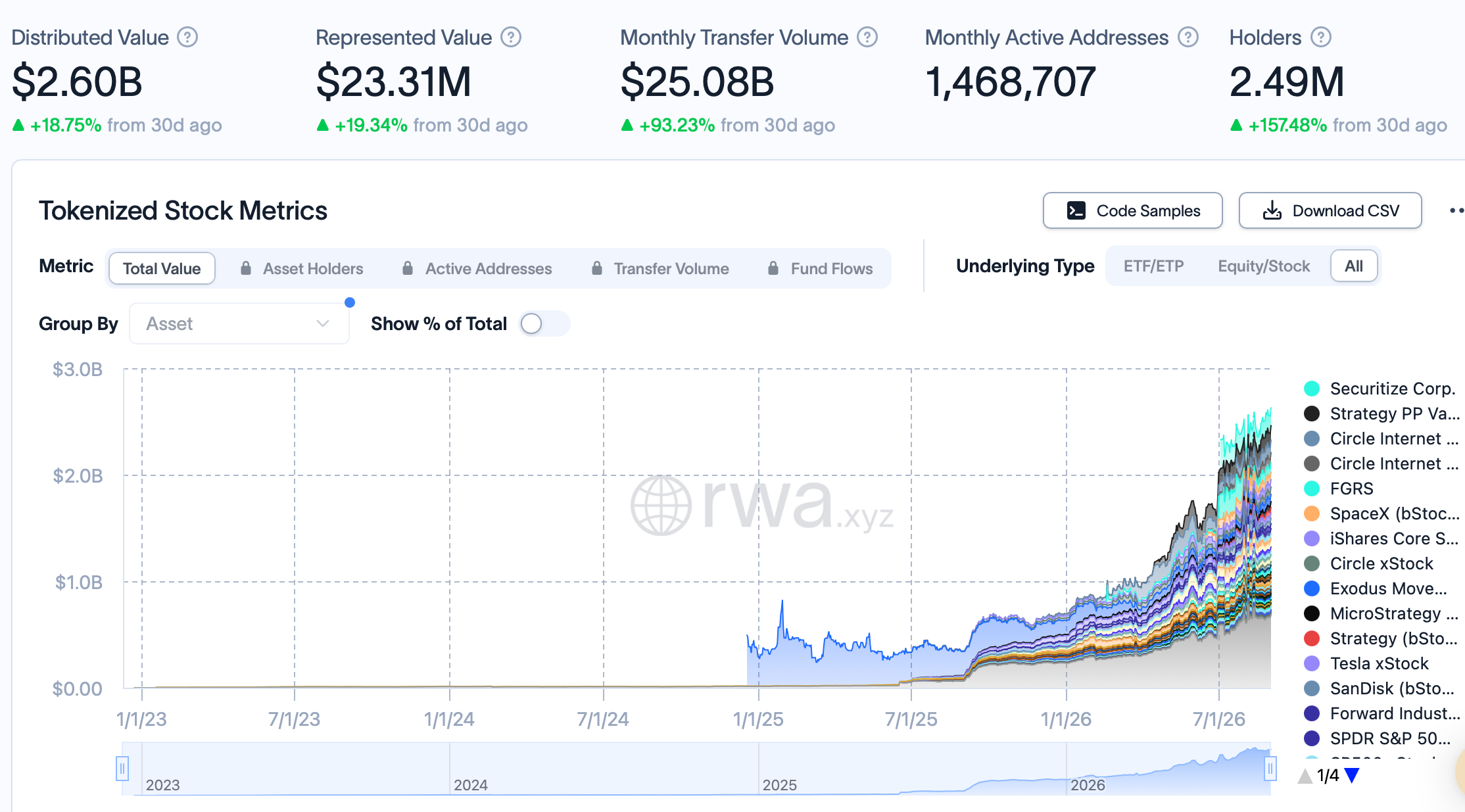
Tokenized stocks now have about $2.6 billion in distributed value, up from roughly $346 million at the same time last year, according to RWA.xyz data. Monthly transfer volume has also climbed 93% over the past 30 days to $25.1 billion, while the number of holders has surged 157% to nearly 2.5 million.
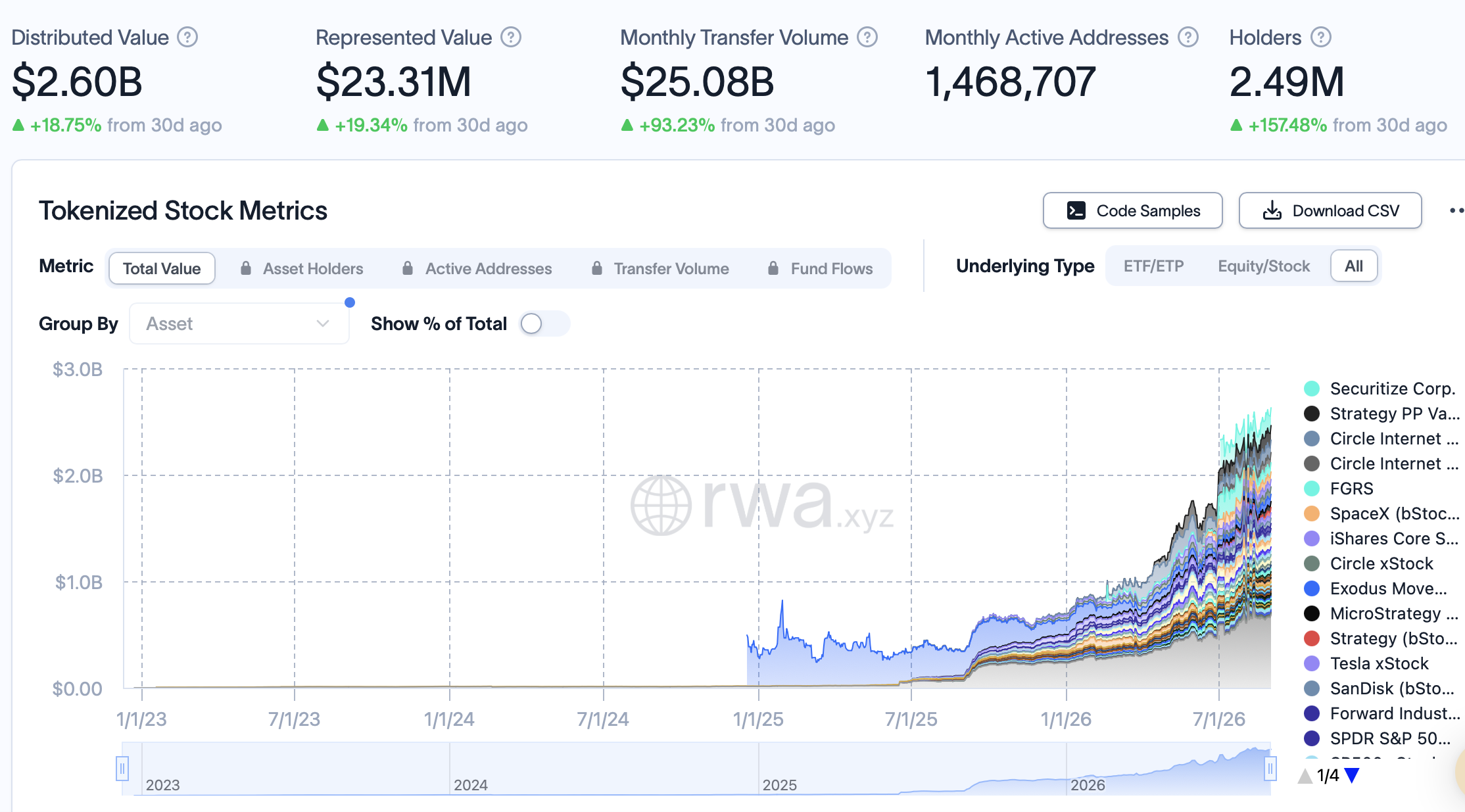
The value of tokenized stocks. Source: RWA.xyz
Last week, Coinbase brought its B20 tokenized equities to Base, giving eligible non-US users 24/7 access to onchain versions of stocks including Apple, Nvidia, Meta and Alphabet. The assets can also be integrated into DeFi protocols for uses such as trading and collateralized borrowing.
Kraken also pushed deeper into equities in August, opening access to more than 7,000 US-listed stocks for eligible European customers and placing them alongside its growing lineup of tokenized xStocks.
In July, US online brokerage Robinhood launched Robinhood Chain alongside a new generation of Stock Tokens available to eligible users in more than 120 countries.

How Gold Plastic Syndrome Is Killing Toys And Game Consoles

Met Office humidity warning as parts of UK facing muggy weather while temperatures climb
Dropbox stock falls after Bloomberg reports data breach





-

 Crypto World7 days ago
SpaceX stock could rise 75% to $240, JPMorgan says
-

 Fashion4 days ago
Weekend Open Thread: Maeve – Corporette.com
-

 Crypto World5 days ago
Bitcoin’s 22% rally now needs real demand to outlast Treasury liquidity boost
-

 Crypto World6 days ago
Warsh Jackson Hole keynote puts financial innovation first
-

 Crypto World6 days ago
Elon Musk Grok Bot Promise: We Will Make You Whole if AI Loses Your Money
-

 Business5 days ago
Salesforce Stock Soars 19% as Blowout Earnings and Agentforce AI Growth Silence Software Skeptics
-

 Business5 days ago
Apple Confirms September 9 Keynote and Reveals Its Full Pre-Order Schedule
-

 Crypto World7 days ago
Did Trump Just Move SpaceX Stock With One Truth Social Post?
-

 Business4 days ago
Onto Innovation Stock: AI’s Next Bottleneck Is Yield (NYSE:ONTO)
-
 NewsBeat6 days ago
Lindsay Clancy jury braces for closing arguments as judge tells court: ‘You’ve heard all the evidence’ – Live updates
-

 Business6 days ago
Walmart takes aim at younger shoppers with new fashion brand
-

 Crypto World6 days ago
NVIDIA revenue hits $96.2B as AI demand doubles
-

 Crypto World4 days ago
Bitcoin price tests $82K resistance as Brandt stays long
-

 Business7 days ago
Thailand’s Eastern Economic Corridor Capital City (EECiti): Key Developments and Investment Opportunities
-

 Business4 days ago
iPhone 18 Pro Pre-Orders Could Shift to Saturday as Apple Reportedly Avoids September 11 Anniversary
-

 NewsBeat7 days ago
Trump’s trade truce with China faces test with Iran effort
-

 Crypto World6 days ago
Nvidia Q2 Earnings Reveal $96.2 Billion Beat, So Why Is NVDA Falling?
-
 Tech3 days ago
Hugging Face built a $4.5 billion empire on free AI models. Now Nvidia is buying it for $12.9 billion
-
 Tech6 days ago
Claude Cowork gets its own browser that doesn’t touch your tabs, bookmarks, or saved passwords
-

 Crypto World5 days ago
Truflation calls for Fed rate cut after PCE forecast
You must be logged in to post a comment Login