Connect with us

NewsBeat

War has shifted how power works in Iran

Published

on

War has shifted how power works in Iran

When Washington unveiled its economic “D-Day” on August 19, the latest tightening of the financial siege and the blockade around Iran’s ports, it believed it was applying decisive leverage. But in Tehran the move was read as something else entirely – as confirmation that the US still prefers pressure to any settlement it might one day have to honour.

Across a political system that agrees on almost nothing, the interpretation was remarkably uniform. The economic stabilisers around the Iranian president, Masoud Pezeshkian, saw the US as reneging on a deal, while Ahmad Vahidi’s Islamic Revolutionary Guard Corps (IRGC) commanders saw their own warnings about American perfidy vindicated.

So whatever faith remained in Iran about US willingness to close a deal has thinned further. That erosion of trust now shapes what Tehran will and will not accept.

It is important to realise that Iran is making existential decisions about the survival strategy of the Islamic Republic itself. The old vocabulary of reformist against principlist – or moderate against hardliner – no longer reflects the real struggle inside the system.

Advertisement

The contest that matters runs between those who believe the Islamic Republic survives best by converting its wartime leverage into economic and diplomatic gains and those who believe survival depends instead on permanent confrontation. Both camps are loyal to the regime, and both argue in good faith about how to keep it alive. That makes the debate far harder to resolve.

It is also a debate with no single arbiter, because Iran today is best understood as a network state. Power runs through a decentralised structure that is horizontal in the way it is organised. The vertical hierarchy once associated with the former supreme leader Ali Khamenei has quietly dissolved.

His son Mojtaba Khamenei sits at the formal apex and shapes outcomes largely through appointments. He has installed Mohsen Rezaee, a founder member of the Islamic Revolutionary Guard Corps (IRGC), as his representative on the supreme national security council. He is also rebuilding the Bayt – the office of the supreme leader that has long been the system’s true centre of gravity – around loyalists such as his new chief of staff, Mahdi Khamoushi.

Yet Mojtaba rules as a balancer rather than a decider, careful never to let any one node or hub dominate the system. Beneath him, authority is spread across the nodes of the security establishment. Rezaee coordinates strategy from the council, while Vahidi commands the military muscle, from the missile force to the naval pressure in the Strait of Hormuz.

Advertisement

Parliamentary speaker, Mohammad Bagher Ghalibaf, brokers the relationship between parliament and the security men. Pezeshkian’s government shoulders the economy, and the foreign minister, Abbas Araghchi, handles the messages abroad. No single figure combines all of these functions in one pair of hands.

Iran’s shifting power balance

But this horizontal picture is shifting, because the war has centralised power even in a system built to disperse it. The longer the confrontation with Washington runs, the more the IRGC moves from being merely the strongest node toward becoming the effective decision-maker.

The IRGC still cannot run the economy, conduct diplomacy and preserve clerical legitimacy all at once. This is why it governs through that coalition rather than in place of it. But a prolonged state of war is exactly the condition under which that necessity begins to erode, because all decisions become related to the conflict and how best to prevail.

The current system in Iran and its position towards a negotiated deal out of the war exists on a spectrum. At one end stand the economic stabilisers around Pezeshkian and Araghchi. Their camp consider the prolonged stalemate untenable and want sanctions relief, the release of frozen assets, and an end to the blockade.

Advertisement
Iran’s parliamentary speaker, Mohammad Bagher Ghalibaf (centre) and foreign minister, Abbas Araghchi (left): different political factions but both aim at a negotiated settlement with the US.
Hamed Malekpour/Middle East Images/StringersHub/Sipa USA

Next come the pragmatic sovereigntists led by Ghalibaf and Rezaei – regime insiders who see diplomacy as the only way out, but not when it comes at the expense of strategic autonomy. Their camp will accept negotiation only from a position of strength and insist that the missile programme and the regional network of proxies stay off the table entirely.

Further along sit the security-first coercionists gathered around Vahidi and the IRGC, who view diplomacy as a tactical instrument at all times subordinate to military leverage.

At the far end are the ideological rejectionists of the Paydari Front and Saeed Jalili’s network. These fundamentalists regard any agreement with Washington as a form of surrender. They function less as a governing bloc than as a spoiler capable of raising the political cost of any deal.

A chance to talk

It is misleading to mistake Iranian dissent for dysfunction, when in truth it is neither. Here is a system arguing with itself about existential questions of statecraft. What is striking about the country now is not the depth of the disagreement but the extent to which the factions agree on the fundamentals.

Advertisement

The spectrum has, without ever announcing it, largely agreed that some form of negotiation is the way out of the crisis. The stabilisers want a deal to rescue the economy. The sovereigntists want one to bank the gains of the war. Even the IRGC appear to want a channel of its own, as recent reports about the Trump administration relaying messages via Iraqi Kurdistan directly to the IRGC leadership suggest.

The fight is therefore no longer about whether to bargain. It’s about the precise ways and means of improving Iran’s position before it commits to anything irreversible.

Washington needs to understand that Iran has already begun to make its choice. Every US economic D-Day that reaches once more for the escalation trap strengthens the rejectionists who insist that confrontation with the US and Israel is permanent. It weakens the factions that have, against considerable odds, talked the system toward the negotiating table.

By seeking to talk to the IRGC, Donald Trump has shown he understands he has a unique opportunity to get out of this self-inflicted quagmire. But he must not allow his ego to stand in the way of the mediators’ arduous efforts.

Advertisement

Source link

Continue Reading
Click to comment

You must be logged in to post a comment Login

Leave a Reply

NewsBeat

Olympic rower ‘who furious speedboat driver tried to ram on the Thames’ tells of moment man ‘lost his mind’

Published

on

The speed boat's skipper starts shouting at Jack Beaumont, who is trying to calm him down

Advertisement

A brave Olympic rower who stopped a motorboat skipper from ramming into other rowers has said he was afraid the man would target him in a ‘river rage’ incident on the Thames.

Jack Beaumont, who won silver in the men’s quadruple sculls in Tokyo five years ago, said he was ‘frightened’ the 67-year-old motorboat driver would ‘really ram into me’.

Courageous Mr Beaumont, 32, intervened early on Sunday morning after the ‘erratic’ and ‘volatile’ man, who has since been arrested, appeared to collide with another rower on a stretch of the river near Maidenhead.

Footage obtained by the Daily Mail showed the motorboat captain volleying abuse at Mr Beaumont, calling him a ‘c***’ and telling him to ‘shut your f***ing mouth’.

Advertisement

The two-time Olympian was training when he saw the motorboat approaching two oncoming single sculls from Maidenhead rowing club.

Mr Beaumont said the rowers had not seen the boat, which appeared to be on the wrong side of the river according to navigation rules.

‘When you’re rowing, you’re going backwards so [the rowers] weren’t expecting him and then at the last second they noticed. One of them managed to manoeuvre around him but the other one hit the boat,’ he told The Times.

‘And then he just lost his mind. He started shouting at them. I can’t remember what he was saying but it was very, very threatening. I was quite concerned because of the way he was speaking to them, I was quite afraid he might hurt them.’

Advertisement

The speed boat’s skipper starts shouting at Jack Beaumont, who is trying to calm him down

The captain reverses towards Mr Beaumont, who gets out of the way in his scull

The captain reverses towards Mr Beaumont, who gets out of the way in his scull

Pictured: Jack Beaumont.

The rower won a silver medal at the 2020 Summer Olympics in Tokyo, Japan

Advertisement

He said he told the rowers to write down the name of the boat, understood to be called the Mayfair Lady, before the captain turned his attention to him.

After hurling abuse, he reversed in an apparent bid to ram the athlete’s scull.

One rower who witnessed the incident said: ‘I was a couple of hundred yards away, going upstream. I saw that there was a speedboat owner pulling out from the bank.

‘He charged over and rammed a rowing boat and the man in it nearly went in [the water]. This is someone in a power boat running somebody over, which is highly dangerous.’

Advertisement

The rower continued: ‘Jack [Beaumont] shouted out, ‘What are you doing?’ The man on the speedboat then started effing and blinding at Jack and tried to ram Jack in his boat. This could have been life-threatening, if not fatal.’

It is understood the boat owner sometimes lives on his craft and has previously argued with members of Maidenhead Rowing Club.

The exchange then intensified with Mr Beaumont attempting to steer clear

The exchange then intensified with Mr Beaumont attempting to steer clear 

The boat gives chase to Mr Beaumont who lures it down the Thames and into the distance

The boat gives chase to Mr Beaumont who lures it down the Thames and into the distance

Advertisement

He was heard shouting at Mr Beaumont from his deck: ‘I did nothing wrong. You f***ers think you own the water.’

The skipper revved his engine and yelled that he would ‘ram’ something down Mr Beaumont’s throat.

A source said: ‘Jack lured the speedboat away from the rowers. You have to wonder what could have happened if there wasn’t someone as able as Jack on hand. If the rowers were only taking their first lessons it could have been so much worse.’

The motorboat captain was arrested on suspicion of making threats to kill, assault and using a watercraft in a manner that endangered a structure or individual. He remained in custody on Tuesday.

Advertisement

Mr Beaumont has previously raced for Maidenhead rowing club and broke his back in 2015, a career-threatening injury he suffered during a Team GB training session in Portugal.

However he went on to place fifth in the quadruple sculls in Rio the following year after being chosen to replace Graeme Thomas, who had fallen ill.

Mr Beaumont’s father, Peter, is also an Olympic oarsman, coming fourth in the men’s eight event at the 1988 Games in Seoul. Maidenhead Rowing Club, founded in 1876, forms part of an exclusive neighbourhood dubbed ‘Hollywood on Thames’.

Advertisement

Advertisement

Source link

Continue Reading

NewsBeat

Signs go up for new JD Sports store in Middlesbrough

Published

on

Signs go up for new JD Sports store in Middlesbrough

The fashion firm, which is currently based at the Cleveland Centre, has erected new hoardings at the neighbouring Hillstreet Shopping Centre. 

The signs, which cover the front window of the 15,714 square foot unit next door to Boots, state that the “bigger and better JD is coming soon”.

It also features QR codes advertising job vacancies alongside huge yellow JD string bags. 

JD Sports signs at the Hillstreet Centre in Middlesbrough (Image: THE NORTHERN ECHO)

Earlier this year, floor plans for the Hillstreet Centre revealed that JD looked set to take over the currently empty unit as an “anchor retailer” of the complex.

Advertisement

It has not yet been confirmed what this means for the brand’s Cleveland Centre store, which remains open, and JD previously declined to comment on the potential relocation. 

The news comes just months after Boots decided to relocate from its Cleveland Centre store to Hillstreet, having been closed at its former home for several months.

JD Sports in the Cleveland Centre in Middlesbrough (Image: THE NORTHERN ECHO)

The firm said the new location, which opened in February, would provide an “elevated shopping experience and an extended range of health, wellness and beauty essentials”.

Discount retailer B&M also recently returned to Middlesbrough town centre in the form of a new store at the Hillstreet Centre in February. 

Advertisement

JD Sports continues to operate a number of other sites in the North East including at the Teesside Park, Cleveland Retail Park, and the Cornmill Shopping Centre in Darlington.

JD has been contacted for more information on the new shop.

Source link

Advertisement
Continue Reading

NewsBeat

Tyler Robinson to stand trial in Charlie Kirk murder case with suspect facing potential death penalty

Published

on

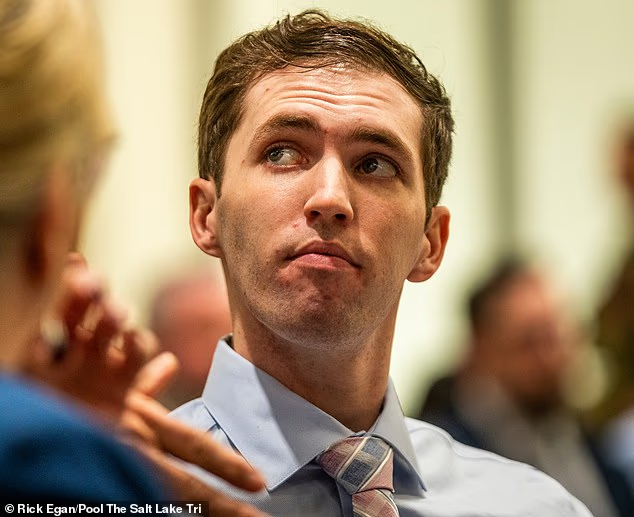
Tyler Robinson, 23, will go to trial for the assassination of conservative activist Charlie Kirk, a judge has ruled

A Utah judge ruled that alleged Charlie Kirk killer Tyler Robinson will face trial and prosecutors could potentially seek the death penalty in the high-profile case. 

Robinson, 23, is accused of firing a single shot into Kirk’s neck, killing the 31-year-old father-of-two during a Turning Point USA event at Utah Valley University nearly a year ago.

He faced a high-stakes moment Tuesday as a judge decided Utah County prosecutors had presented enough evidence to support an aggravated murder charge and send him to trial. 

‘Viewed in the light most favorable to the prosecution, this evidence is sufficient at this stage to support a reasonable belief that the defendant is the individual who shot and killed Charlie Kirk,’ Judge Tony Graf ruled from the bench.

Advertisement

‘Accordingly, the state has demonstrated probable cause as to identity and homicide elements of count one.’ 

The judge also found that the state established probable cause for the victim-targeting allegation, enabling prosecutors to seek the death penalty against Robinson.

But Graf emphasized that whether prosecutors can ultimately prove the aggravating circumstance beyond a reasonable doubt ‘remains for trial.’ 

Kirk’s parents, Robert and Kathryn, arrived at the courthouse arm-in-arm, their faces grim. 

Advertisement

Inside, his widow, Erika Kirk, sat beside them, briefly burying her face in her hands as the judge considered whether still frames from the shooting would be shown. 

Tyler Robinson, 23, will go to trial for the assassination of conservative activist Charlie Kirk, a judge has ruled

Robinson faced a high-stakes hearing Tuesday as the judge heard final arguments on whether prosecutors had enough evidence to send him to trial

Robinson faced a high-stakes hearing Tuesday as the judge heard final arguments on whether prosecutors had enough evidence to send him to trial

Advertisement
Robinson is accused of firing a single shot into Kirk's neck, killing the 31-year-old father-of-two during a Turning Point USA event at Utah Valley University nearly a year ago

Robinson is accused of firing a single shot into Kirk’s neck, killing the 31-year-old father-of-two during a Turning Point USA event at Utah Valley University nearly a year ago

Kirk's parents were seen arriving at the courthouse arm-in-arm, their faces grim as they awaited the decision

Kirk’s parents were seen arriving at the courthouse arm-in-arm, their faces grim as they awaited the decision

The key question in charging Robinson with aggravated murder was whether he endangered others when he allegedly opened fire on Kirk in a crowded area.

Prosecutors argued Robinson knowingly put more than 3,000 people in danger by allegedly firing into the crowd, creating the ‘great risk of death’ they say is required to keep execution in play.

Advertisement

His lawyers countered that the state had failed to meet the legal threshold, arguing he had a specific target and a plan to hit him – not put the crowd in the crosshairs. 

District Judge Tony Graf gave both sides up to two hours each for closing arguments, followed by a one-hour break before announcing his decision from the bench.

The sealed proceeding finally brought months of fiery courtroom battles – and an unusually long preliminary hearing – to an end. 

As closing arguments got underway, with cameras allowed in the courtroom by the judge, Deputy Utah County Attorney Ryan McBride told the court the evidence points directly to Robinson as the gunman who shot Kirk dead last September. 

Advertisement

He declared that ‘it’s not difficult to understand motive here,’ alleging he pulled the trigger because he opposed Kirk’s conservative views, including his stances on Catholicism and ‘traditional’ marriage. 

The key question in charging Robinson with aggravated murder was whether he endangered others when he allegedly opened fire on Kirk in a crowded area

The key question in charging Robinson with aggravated murder was whether he endangered others when he allegedly opened fire on Kirk in a crowded area

Robinson turned himself in just one day after the killing and now faces a single charge of aggravated murder - an offense punishable by death by firing squad

Robinson turned himself in just one day after the killing and now faces a single charge of aggravated murder – an offense punishable by death by firing squad

The pivotal development comes after prosecutors spent five days in July laying out what they called ‘overwhelming’ evidence showing that Robinson was the assassin

The pivotal development comes after prosecutors spent five days in July laying out what they called ‘overwhelming’ evidence showing that Robinson was the assassin 

Advertisement

Kirk’s positions on same-sex marriage and transgender surgeries were sharply at odds with those of Robinson, who was reportedly in a romantic relationship with his roommate, Lance Twiggs, the state argued. 

McBride told the judge Robinson returned to the UVU campus ‘dressed to kill’ after scouting vantage points, allegedly changing into a black shirt and long pants to conceal the rifle he had hidden down his pants. 

Cameras allegedly caught him studying the area earlier that day before he returned armed with a rifle, McBride said.

He allegedly used a screwdriver he had left behind to reassemble part of the weapon before climbing onto the roof. 

Advertisement
Video shown to the court allegedly showed Robinson on a rooftop overlooking the amphitheater where Kirk was speaking
After the shot rang out, Robinson allegedly sprinted across the roof, jumped to ground level and fled on foot

Video shown to the court allegedly showed Robinson on a rooftop overlooking the amphitheater where Kirk was speaking and later fleeing on foot after the shot was fired

‘There, he lay down in a prone position, and he would have seen this mass of people of 3,000 plus people there for the event, took aim, put his crosshairs on Charlie Kirk, and fired,’ McBride said.

McBride then got into the aggravating factors, rejecting the defense’s claim that one shot and no second victim meant the charge could not apply, arguing that interpretation twisted the law.

‘You can’t shoot a rifle into a crowd of 3,000 people without knowing that you create a great risk of death to all those around your target,’ he said.

Advertisement

McBride said testimony showed Robinson fired from just a football field away, arguing it was a matter of ‘millimeters’ between the bullet hitting Kirk and striking someone else. 

‘He came on a mission to kill Charlie Kirk, and if he missed, so be it. He was prepared to take other shots and let the casualties be what they may,’ he said.

McBride pointed to the Trump rally shooting in Pennsylvania as a chilling reminder of the danger of firing into a crowded public event.

He said the president narrowly escaped death when he turned his head, sending the bullet through his ear, while errant rounds struck three other people, killing one. 

Advertisement

‘Not only is there common sense, but there’s recent precedent,’ the prosecutor said.

In a recent 19-page court filing, Robinson's lawyers argued that the shooter ‘hit the intended target’ with a single bullet and did not put other people in the crowd at risk

In a recent 19-page court filing, Robinson’s lawyers argued that the shooter ‘hit the intended target’ with a single bullet and did not put other people in the crowd at risk

In July, former State Bureau of Investigation agent David Hull testified that Robinson arrived at the university hours before the shooting, purchased Chick-fil-A and spoke with Turning Point USA representatives

In July, former State Bureau of Investigation agent David Hull testified that Robinson arrived at the university hours before the shooting, purchased Chick-fil-A and spoke with Turning Point USA representatives 

Prosecutors said a bullet allegedly found in the suspected murder weapon was inscribed with ‘Hey Fascist! CATCH!’ - evidence, they said, that Kirk was targeted because of his politics

Prosecutors said a bullet allegedly found in the suspected murder weapon was inscribed with ‘Hey Fascist! CATCH!’ – evidence, they said, that Kirk was targeted because of his politics 

Advertisement
Before his death, Kirk and the conservative organization he co-founded, Turning Point USA, helped galvanize young voters and mobilize support for President Donald Trump

Before his death, Kirk and the conservative organization he co-founded, Turning Point USA, helped galvanize young voters and mobilize support for President Donald Trump

‘You shoot at someone in a public assassination attempt, you have a great risk of killing someone else,’ he added. 

Robinson, he argued, knew his aim was not perfect – as shown by his target-practice records – yet still carried extra rounds to the event. 

McBride wrapped up his argument by insisting that the 23-year-old killed Kirk simply because ‘he disagreed with him.’ 

Advertisement

‘He did it by firing a high-powered rifle into a group of thousands who surrounded Charlie Kirk literally on all sides,’ he said.

The attorney asked the judge to find probable cause that Robinson knowingly put others at grave risk of death – the aggravating factor that could keep execution on the table.

He also pressed for additional charges alleging Robinson hid the rifle, ditched clothing and told his partner Twiggs to delete messages and keep silent.

Defense attorney Staci Visser then took the floor, arguing that prosecutors had failed to present evidence showing Robinson knowingly created the ‘risk of death.’

Advertisement

She said previous cases lay out three factors for establishing the circumstance: the link between the killing and the danger to others, how close those people were to the victim and how seriously they were threatened. 

The weapon allegedly used in the killing was found wrapped in a towel in a nearby wooded area and allegedly contained DNA from both Robinson and his former romantic partner, Lance Twiggs

The weapon allegedly used in the killing was found wrapped in a towel in a nearby wooded area and allegedly contained DNA from both Robinson and his former romantic partner, Lance Twiggs

Prosecutors cited a text message Robinson allegedly wrote about Kirk: 'I had enough of his hatred. Some hate can't be negotiated out'

Prosecutors cited a text message Robinson allegedly wrote about Kirk: ‘I had enough of his hatred. Some hate can’t be negotiated out’

Twiggs (pictured) said Robinson never spoke about Kirk before the shooting and rarely discussed gender issues or LGBTQ+ rights

Twiggs (pictured) said Robinson never spoke about Kirk before the shooting and rarely discussed gender issues or LGBTQ+ rights

Advertisement
Robinson also faces six additional serious charges, including witness tampering

Robinson also faces six additional serious charges, including witness tampering

‘There were no actual threats by the assailant to the third party. There was no evidence that would suggest that anyone else was threatened,’ Visser said.

She tore into the state’s case, accusing prosecutors of building key parts of their argument on speculation and pointing to the screwdriver found on the roof as one example. 

Prosecutors said the screwdriver that was allegedly used to disassemble and reassemble the rifle contained DNA similar to Robinson’s. Visser acknowledged the state was likely using it to place him on the roof. 

Advertisement

‘The state goes on to ask this court to infer that the rifle was taken apart and put back together with the screwdriver. The state didn’t show actually how that would happen with the screwdriver,’ she told the court. ‘This is just speculation.’

Prosecutors also presented shooting targets riddled with ‘perforations’ that were found in the closet of Robinson’s shared apartment, she said.

In July, the state argued that Robinson ‘loaded his rifle with four cartridges’ and had previously practiced shooting, where he ‘seldom hit the bullseye and sometimes missed the target completely.’ 

Because he knew he could have missed, the state argued that numerous people were ‘within a zone of danger.’ 

Advertisement

‘They didn’t say what kind of gun. We don’t know when those were shot. We don’t know who shot them, and we don’t know the conditions under which those were shot at. They are just targets,’ Visser told the court on Tuesday.

Robinson turned himself in just one day after the killing and now faces a single charge of aggravated murder – an offense punishable by death by firing squad. He also faces six additional serious charges, including witness tampering.

The landmark decision after prosecutors spent five days in July laying out what they called ‘overwhelming’ evidence against Robinson, much of which they reiterated during Tuesday’s hearing.

At the time, the state unveiled a trove of new evidence, including photographs of the rifle allegedly used in the killing. 

Advertisement

They also presented recorded testimony from Robinson’s former partner, images of their text messages and surveillance footage from UVU, shown in court for the first time

Former State Bureau of Investigation agent David Hull walked through the 23-year-old’s alleged movements before and after the shooting, starting with Robinson’s arrival at the university hours earlier. 

He testified that Robinson grabbed a meal from a campus Chick-fil-A before speaking with Turning Point USA representatives. 

Robinson then allegedly changed clothes before taking up a rooftop position overlooking the amphitheater where Kirk was speaking. 

Advertisement

Video shown to the court captured him crouching on the rooftop in the seconds before the killing, Hull testified. After the shot rang out, he allegedly sprinted across the roof, jumped to ground level and fled on foot. 

The poor-aim argument was one of two key planks in the state’s bid to keep the death penalty on the table. The other was an engraved bullet that prosecutors say offered evidence of Robinson’s alleged political motive. 

A bullet allegedly found in the suspected murder weapon was inscribed with ‘Hey Fascist! CATCH!’ – evidence prosecutors said showed that the right-wing influencer was targeted over his political views.

They also cited a text message Robinson allegedly wrote about Kirk: ‘I had enough of his hatred. Some hate can’t be negotiated out.’

Advertisement

Before his death, Kirk and the conservative organization he co-founded, Turning Point USA, helped galvanize young voters and mobilize support for President Donald Trump’s successful bid for a second term. 

Robinson’s roommate, Lance Twiggs, told investigators that Robinson had been considering a gender transition around the time of Kirk’s killing.

Prosecutors revealed a handwritten note Robinson allegedly left for Twiggs that read in part: ‘I had the opportunity to take out Charlie Kirk, and I took it.’ 

DNA evidence also emerged linking Robinson, investigators said, to the suspected murder weapon – a bolt-action rifle with one spent round – and a tool allegedly used to engrave the bullet cartridges. 

Advertisement

The weapon was found wrapped in a towel in a nearby wooded area and contained DNA from both Robinson and Twiggs, Sgt Jennifer Faumuina of the Utah Department of Public Safety testified in July. 

In a recorded interview, Twiggs said Robinson never spoke about Kirk before the shooting and rarely discussed gender issues or LGBTQ+ rights. He did, however, sometimes talk about politics, including Trump. 

Twiggs later told police that Robinson allegedly confessed to killing Kirk and admitted he ‘wished he hadn’t done it.’ 

Throughout the proceedings, Robinson’s attorneys have repeatedly challenged the reliability of DNA tests and other evidence presented by prosecutors.

Advertisement

Even with the case now moving forward, Utah-based attorney Lazaro warned that the legal sparring could continue for months before Robinson ever faces a jury, he told Fox News. 

‘I do think we’re going to see a lot more litigation come down the road in terms of 1102 and expert-witness designations, forensic testimony on the ballistics and things like that,’ she told the outlet.

Source link

Advertisement
Continue Reading

NewsBeat

US launches strikes on Iran following ‘attempted attacks in Strait’

Published

on

Close-up of orangutan's eyes

American forces resumed strikes against Iran on Tuesday, US Central Command (Centcom) has said.

Centcom said the US strikes followed “recent attempted attacks” by the Islamic Revolutionary Guard Corps (IRGC) against commercial shipping in the Strait of Hormuz.

The Iranian Red Crescent said four people including a young child were killed in the US attacks, and more than 50 injured, when after a US missile attack shrapnel hit a home where a wedding celebration was taking place in Sirik in southern Iran.

In response, Iran launched attacks at US military bases in Iraq and Jordan, according to local state media and the Jordanian Armed Forces. Attacks were also reported in Kuwait and Bahrain.

Advertisement

The IRGC said the US would “regret” the strikes. By early Wednesday, it had launched a barrage of ballistic missiles at a US Marine base in Jordan’s Aqaba in retaliation for the Sirik attack, according to Iran’s semi-official Tasnim news agency.

The Jordanian Armed Forces said it had intercepted 13 ballistic missiles, 10 of which were destroyed, while three fell in remote areas. There were no deaths or injuries as a result of the attack from Iran.

The network also said that the country’s national security centre had warned residents of the Aqaba and Mafraq governates of falling debris, adding that the warning had since ended.

Separately, the Kuwait army said its air defences were responding to Iranian missile attacks early Wednesday.

Advertisement

Several explosions were also reported in Bahrain following attacks by Iran, according to Iranian state media.

Donald Trump, when the US strikes were announced on Tuesday afternoon, warned that Iran would be hit again at “a much harder and higher level” if it retaliated.

The attack follows the first known US strikes on Iran since late July earlier this week, when forces attacked two rocket launchers on Larak Island in the Strait. Tehran retaliated by firing missiles at air bases in Jordan and a drone at the UAE.

Centcom said US forces had begun striking IRGC targets at 12:00 ET (16:00 GMT), and had completed the strikes by early Wednesday.

Advertisement

Iranian state media reported a four-year-old child was among the four who had died in the Sirik attack, while other reports said projectiles had hit the areas of Chabahar and Konarak and an airport in Jiroft, and that explosions were heard in Qeshm island and Bandar Abbas.

US Navy Captain Tim Hawkins, speaking on behalf of Centcom, told the BBC it was aware of reports from Iranian state media of the attack in Sirik.

He added: “The US military never targets civilians, unlike the IRGC.”

Trump said Tuesday’s “large and powerful” strikes were a response to Iran’s initial targeting of a US military base in Jordan, adding the country had “failed” at adding sea mines to the Strait.

Advertisement

He also threatened that a much larger-scale attack was “waiting in the wings”.

Source link

Continue Reading

NewsBeat

Range Rover launches first fully electric model

Published

on

Close-up of orangutan's eyes

Range Rover has unveiled its first fully electric model, after a year‑long delay to its planned launch.

The Range Rover Electric, to be built in Solihull, marks a major shift in its electrification programme, backed by large‑scale upgrades across its West Midlands sites.

Parent company JLR said it had up-skilled 10,500 workers for electric production as it pushes ahead with modernisation despite recent financial pressures and planned job cuts.

The launch comes as the Coventry‑based carmaker faces falling profits, supply chain disruption and restructuring following a cyber attack last year.

Advertisement

The company said the launch was being supported by new battery and electric drive unit production lines as well as training around 9,000 employees in Solihull for electrification and a further 1,500 trained across the region.

JLR’s Electric Propulsion Manufacturing Centre in Wolverhampton is now producing battery packs and electric drive units alongside internal combustion engines.

Martin Limpert, managing director of Range Rover, called the new model the result of a decade of “considered engineering”.

JLR’s electric roll-out comes after a turbulent year with profits dropping to £66m in the first quarter after a fire at a key Norwegian supplier.

Advertisement

The business is also undergoing restructuring, confirming that fewer than 300 roles will go less than a year after a cyber attack halted production for more than a month.

At the time of the results, the firm said new product launches would leave “JLR in good shape whilst acknowledging the continuing geopolitical, inflationary and regulatory challenges the industry faces”.

Source link

Advertisement
Continue Reading

NewsBeat

Skincare product sold at Tesco, Asda and more recalled

Published

on

Customer food recall warnings at Asda, Tesco and Waitrose

Simple is recalling its Skin Micellar Cleansing Water because of the potential presence of bacteria which could cause eye inflammation.

Batches of the 200ml, 400ml and 730ml bottles of the skin product have been recalled.

Simple apologised to shoppers, recognising that the recall can be “concerning”.

Advertisement

These are the batches of cleansing water affected by the recalls:

  • 200ml – 610041, 611641, 615941
  • 400ml – 611141, 611341, 611441, 613341, 613441, 614541, 614741, 614841
  • 730ml – 613841, 613941, 611041, 616641, 616741

A spokesman for Simple said: “In the UK and the Republic of Ireland, we are recalling a limited number of Simple Kind to Skin Micellar Cleansing Water 200ml, 400ml and 730ml products with specific batch codes due to the possible presence of bacteria, which has the potential to cause eye inflammation for some consumers. 

“We are recalling these products because the safety of the people who buy and use our products is our top priority.

“Other Simple products are not affected by this issue. 

“We understand that product recalls can be concerning, and we are sorry for any concern or inconvenience this may have caused.

Advertisement

“Stop using it and contact our Consumer Careline by email for further guidance and a refund.”

The batch code can be found on the bottom of the bottle. It is a series of numbers printed directly onto the packaging. 

A Tesco spokesman added: “If you have purchased an affected batch code of one of the products being recalled, please do not use it and instead return it to any Tesco store for a full refund. No receipt is required.”

While an Asda spokesman said: “If you have purchased Kind to Skin Micellar Cleansing Water 200ml or 400ml of the above affected batch codes please stop using the product. You can bring it back to your nearest store where you will be given a full refund. You do not need your receipt.

Advertisement

“Alternatively, you can contact Unilever’s Consumer Careline by email for further guidance and a refund at ukicare@unilever.com. Or via phone: 0800 146 252 (UK) or 1800 604 060 (ROI).

“We are very sorry for any inconvenience caused.”

Source link

Advertisement
Continue Reading

NewsBeat

‘Keir Starmer managed a miracle that few politicians could have pulled off’

Published

on

Daily Mirror

When he was elected Labour leader, he was handed a chalice so full of poison nobody could have predicted what Keir Starmer managed to achieve – and for that he should be remembered with honour

Few politicians could have pulled off the miracle Keir Starmer managed

Farewell from the Commons to Keir Starmer – and who could blame him?

Advertisement

When he was elected Labour leader, the chalice he was handed was so full of poison, few could have predicted the speed and scale of the turnaround he oversaw. Yet he took Labour from basket case to landslide – a miracle that few politicians could have pulled off.

But the job of Prime Minister takes its toll on even the most steadfast of leaders. Sir Keir and his family have had to deal with more than most, particularly the ordeal of being targeted with arson attacks soon after the election.

It’s not a huge surprise he came to the decision to leave Parliament behind him – but that’s no slight on his commitment to public service.

From defending human rights, civil liberties and striking miners in court, ensuring criminals are locked up as Britain’s top prosecutor and leading Britain out of a decade of Tory neglect, his focus has always been on service. And he will no doubt continue this service in his next international role.

Advertisement

However he fared as Prime Minister, as Andy Burnham said in the Commons yesterday, Keir Starmer’s leadership created a Labour Government that has the capacity to change Britain for the better – and for that he should be remembered with honour.

Everybody deserves to live and die in dignity and comfort

Everyone deserves dignity and comfort in life – and that’s no less true at the end of the journey.

Reports of patients facing their final moments in crowded corridors, bathrooms or hospital kitchens are hard to read. And there’s no single cause – with clinicians blaming staff shortages, lack of planning and resources being blamed for the harrowing incidents.

The Government is taking a long hard look at making the NHS fit for the modern age – saving more lives and curing more diseases than ever. But that must include compassionate, pragmatic thinking about how best to ensure as many as possible of those reaching the end of the journey do so peacefully, surrounded by loved ones.

Advertisement

Hollywood will never top hero Richard’s war stories

War hero Richard Brock thought he was done for at just 20 years old, as he waited nervously to storm the beaches of Normandy on D-Day. Now 102, he tells the story with a vividness and clarity that no Hollywood blockbuster could ever match – though many have tried. It’s a gift to the world that he’s still around to tell the tale.

Source link

Continue Reading

NewsBeat

Swansea City to seal Monga move as Matos makes big Vipotnik transfer admission

Published

on

Wales Online

Two deals appear to have collapsed on deadline day – but a move for Monga is still on

Swansea City’s deadline day has taken a dramatic late twist, with two deals collapsing at the eleventh hour.

However, a move for Manchester City youngster Jeremy Monga is still expected to happen, and could be confirmed later tonight.

Ronald and Zeidane Inoussa had both looked set to leave the club today, but both moves have broken down.

Advertisement

The Swans had agreed a fee with Millwall believed to be in the region of £2m for Ronald, with Vitor Matos suggesting the move had fallen through due to a failure to agree personal terms.

JOIN US ON FACEBOOK! Follow Wales Online’s Swansea City FB page for more news and analysis

“Ronald, as far as I know, didn’t reach an agreement, so he’s part of the team,” he said.

Inoussa, meanwhile, had looked set to join Portsmouth on a season-long loan, but that move has also fallen by the wayside.

Advertisement

“I’m not really clear about what the situation was,” Matos added. “But yeah, staying as well. Happy to have him. He’s a wonderful kid.

“I don’t think he goes to Portsmouth, but I think he will stay.”

Meanwhile, it’s understood Swansea’s move for Monga is still set to go through.

Star striker Zan Vipotnik is still in the building, although Matos has suggested there is still a possibility he could go, with the window still open in Portugal, Saudi Arabia and Turkey among others.

Advertisement

Vipotnik was the subject of initial enquiries from Portuguese giants Benfica earlier in the summer, while rivals Sporting have also been touted as possible admirers.

“There are still some markets that are open,” Matos admitted. “So you never know what happens. But at the moment, like I said, he’s here and I’m really happy if he stays.

“We all love him. It’s not easy in terms of dealing with all the noise. Of course, but we are here to take care of him.”

Pressed on whether there might be a possibility he could still go, he added: “We hope he is here, but that is the hard part of the transfer window is that some markets are still open that are massive opportunities for players.”

Advertisement

*Follow all of our social channels to ensure you stay up to date with the latest Swans news. Sign up to our daily newsletter here and our WhatsApp channel here. Our Swansea City correspondent Tom Coleman is also on social media. He can be found on his X account here, on Instagram, on TikTok and on Facebook.

Source link

Advertisement
Continue Reading

NewsBeat

Weather maps show Scotland to plunge to 2C this month

Published

on

Daily Record

The Met Office predicted “unsettled” September conditions with rain and wind

Parts of Scotland could see temperatures drop to as low as 2C this month. ‘Unsettled’ conditions such as long rain spells and wind are predicted for September.

Temperatures look set to plunge from September 11, with the GFS weather model showing highs of just 11-12C around southern and eastern coasts at around midday.

Meanwhile 9C is coming in the Midlands and Northern Ireland, and lows of 2C on the cards in parts of Scotland. The Mirror reports by 6pm on September 11, the data shows highs of just 15C in the south-east – well below what is expected for this time of year – with afternoon temperatures remaining below 10C in Wales, northern England, Northern Ireland and Scotland.

Advertisement

Further cool conditions should follow on September 12, with temperatures dropping to just 1C in parts of northern England and Scotland. Every single county could see temperatures below 10C at midday, the data suggests.

The maps show temperatures peaking at just 13C in the south-east at around 6pm on September 12, with the Midlands reaching 11C, 12C in Northern Ireland and 10C in Scotland.

Similar conditions are expected on September 13 too, with the GFS model once again showing single-digit temperatures across the country at midday – with London at just 7C. Afternoon highs may reach just 14, with the warmest conditions expected in Northern Ireland and the south-west.

Temperature anomaly maps for this period show the UK shaded in areas of dark blue. This indicates that temperatures are expected to drop well below the seasonal average.

Advertisement

The Met Office anticipates “unsettled” conditions for the first half of September, with rain in northern and western regions and drier spells in the south and east.

The Met Office forecast for September 5 to 14 states: “An unsettled period is likely, with many places seeing showers or longer spells of rain at times. Rain is expected to be most frequent across northern and western areas, while the south and east are more likely to see longer, drier spells. There is also the potential for some strong and gusty winds, particularly in the northwest.”

The BBC forecast for September 7 to 13 says conditions should soon turn “cooler”, with “wet and windy or showery weather” on the cards.

It states: “Atlantic weather systems should continue to dominate conditions into the second week of September, with low pressure and frontal systems tracking near or across the UK, so further periods of wet and windy or showery weather look most likely.

Advertisement

“Short-lived drier and sunnier spells should occur in-between, especially in the southern and eastern UK where conditions may be less wet overall than the north and west.”

Ensure our latest stories always appear at the top of your Google Search by making us a Preferred Source. Click here to activate or add us as your Preferred Source in your Google search settings.

Source link

Advertisement
Continue Reading

NewsBeat

Major DWP changes hitting millions before the year is out

Published

on

Major DWP changes hitting millions before the year is out

Millions of people across the UK are set to be affected by changes to the benefits system and other support before the end of the year.

The changes include Winter Fuel Payments worth up to £300, a £150 energy bill discount for eligible households, a major expansion of free school meals and tougher new powers allowing the Department for Work and Pensions (DWP) to recover money it is owed.

Here are the key changes to know about:

Advertisement

Winter Fuel Payment worth up to £300

Older people could receive between £100 and £300 towards their heating costs this winter.

The payment is available to people who were born on or before June 27, 1960 and usually live in England, Wales or Northern Ireland. Those living in Scotland are not eligible for Winter Fuel Payment but may qualify for the separate Pension Age Winter Heating Payment.

Most eligible pensioners will receive the payment automatically.

Letters are due to be sent in October or November, with most payments expected to arrive in November or December 2026.

Advertisement

However, there is an important catch for higher-income pensioners.

If your total income is above £35,000, HMRC will recover the full Winter Fuel Payment through the tax system, unless you opt out this month.

Your partner’s income does not count towards the £35,000 threshold.

£150 Warm Home Discount

Millions of households could also get a £150 discount on their electricity bill through the Warm Home Discount scheme.

Advertisement

The scheme is due to reopen in October 2026 and the money is credited directly to the energy bill rather than being paid into your bank account.

In England and Wales, eligible households generally need to be with a participating energy supplier, receive a qualifying means-tested benefit and have the benefit recipient, their partner or legal representative named on the electricity bill.

Qualifying benefits include Universal Credit, Housing Benefit, income-related Employment and Support Allowance and Pension Credit.

The qualifying date for winter 2026 to 2027 was August 23, 2026, so households needed to meet the relevant conditions on that date for the automatic rebate.

Advertisement

Free school meals expanded

A major change has also arrived for families receiving Universal Credit in England.

From the start of the 2026/27 school year, all pupils in households receiving Universal Credit are eligible for free school meals.

Previously, Universal Credit households generally had to meet an annual household earnings threshold of £7,400.

The expansion means children in households receiving Universal Credit above that threshold can now qualify too.

Advertisement

The Government says more than three million children from Universal Credit families will benefit, with the expansion expected to cover more than half a million additional pupils.

The support could make a significant difference to family budgets, particularly as parents face the cost of school uniforms, childcare and other expenses at the start of the new term.

DWP can recover debts directly from bank accounts

The DWP now has sweeping new powers to recover certain benefit debts.

Under the Public Authorities (Fraud, Error and Recovery) Act 2025, the department can, as a last resort, recover money owed from a person’s bank account using a Direct Deduction Order.

Advertisement

The powers can apply to bank, building society and credit union accounts, and safeguards are in place to assess whether deductions are affordable. Joint accounts can also be considered, although the DWP says sole accounts must be considered first.

The new powers are aimed at people who owe money to the DWP and have failed to agree an appropriate repayment arrangement.

The department has said thousands of people with outstanding debts are being contacted and warned to get in touch.

Some benefit debtors could face a driving ban

The changes also mean persistent benefit debtors could ultimately face a driving ban.

Advertisement

Recommended reading:


The DWP can apply to a court to temporarily disqualify someone from holding a driving licence in the most serious cases where the person has the means to repay but has persistently failed to do so without good reason.

A driving ban can only be considered where at least £1,000 remains outstanding.

There are also protections for people who have an essential need for their licence, such as those whose work depends on driving or people with caring responsibilities.

Advertisement

Any ban is initially suspended while the person keeps to the agreed repayment terms.

The DWP has warned debtors to “get in touch and pay up, or face the consequences.”

Source link

Advertisement
Continue Reading

Trending

Copyright © 2025