A drought lasting months. A blisteringly hot summer that dried up rivers, baked the ground, and made wood as dry as tinder. Warnings of disaster in the face of inaction, ignored for too long, with devastating consequences.
This is not, in fact, the story of climate change and the summer of 2026, but one of the most momentous events in English history. September 2026 marks the 360th anniversary of the Great Fire of London — a conflagration that laid waste to four-fifths of the capital.
As a writer of historical fiction, I can’t help but look for parallels across time. This summer, as I read the terrifying reports of wildfires that spread across Europe and the UK, the sense of human drama felt familiar to me. Homes lost, thousands displaced and untold millions in damage, it all felt like sobering echoes of a past that looms large in our consciousness as Londoners.
Nowhere was his writing more visceral than his descriptions of the Great Fire
Advertisement
I write novels that imagine what Samuel Pepys did after he finished writing his famous diary in the summer of 1669. In my version of history, he becomes a reluctant investigator for the crown. In real life, Pepys was an eyewitness at some of the biggest events in English history. And nowhere was his writing more visceral than his descriptions of the Great Fire. Take this, from September 2, 1666 — the day the fire broke out:
“So I went down to the water-side, and there saw a lamentable fire… Poor people staying in their houses till the very fire touched them, and then running into boats… And among other things, the poor pigeons, I perceive, were loathe to leave their houses, but hovered about the windows and balconies till they were burned, their wings, and fell down.”
A mayor who ignored warnings
No wonder his accounts have become staples of school history lessons. Details such as Pepys burying a Parmesan cheese in his garden are, of course, irresistible. But what’s equally fascinating is how, at first, he went about his day as normally as he could. There were appointments to keep. He went to lunch and met up with his wife in St James’s Park. But then, urban fires were a fact of life in the 17th century. And while the severity of this one took everyone by surprise, many people already knew that a major disaster was inevitable, someday.
Advertisement
In April 1665, King Charles II wrote to the incoming Lord Mayor of London, Sir Thomas Bloodworth, expressing concern at the city’s vulnerability to fire, and offering new powers to prevent them. The Mayor did not respond. Now, you know that internet meme about how the mayor from Jaws is still the mayor in Jaws II and that’s why it’s important to vote in local elections? That’s basically how historians feel about Sir Thomas Bloodworth. When woken in the early hours and told about the fire, Bloodworth is said to have responded, “A woman might piss it out,” and gone back to bed. His dithering over whether or not to pull down houses to act as a firebreak would later turn a disaster into a catastrophe that would doom his city.
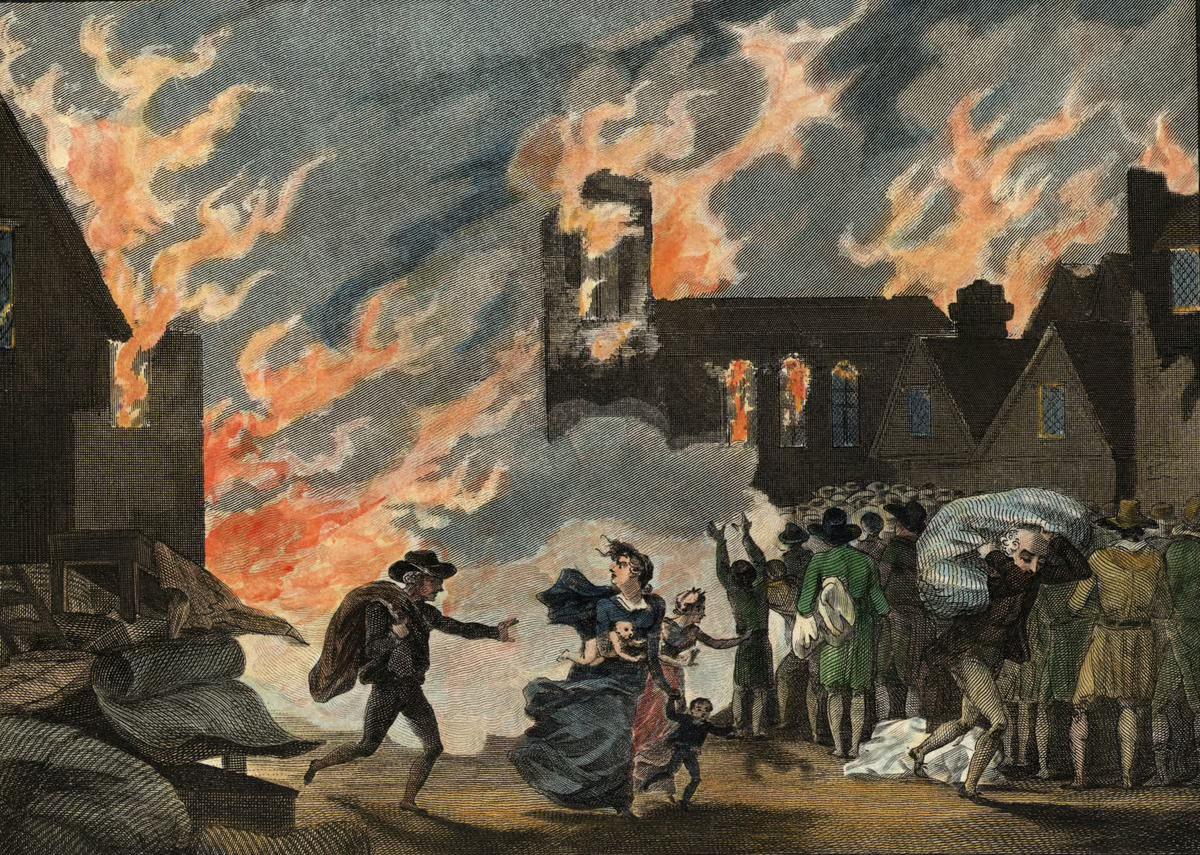
Fleeing the Great Fire of London, 1666
Hulton Archive / Getty Images
Over five days, the Great Fire destroyed an estimated 13,400 buildings. The cost in blood and treasure was immense. Ignore the pernicious myth that hardly anyone died — the fire simply consumed the bodies. Then there’s the economic price to consider. To mark the 350th anniversary of the Great Fire in 2016, the insurance analyst Policy Expert estimated the cost of rebuilding London after the fire to have been around £477 billion in modern terms — closer to £700 billion today.
London rises from the ashes
Advertisement
Statistics like this may pack a punch, but we must remember that behind every one of them lie thousands of untold human stories. To the people who were there, this was no history lesson. It was real life. And life went on after the flames went out. So I invite you to imagine what it must have been like to actually live in London during the years after the Great Fire. People still had to go to work, pay the bills, do the shopping. Just getting your bearings would have been a challenge. For a time, there was still the ominous, burned-out husk of the old St Paul’s Cathedral to aid in navigation. But as new walls went up, viewpoints changed. Higgledy-piggledy timber frames of a lost medieval city replaced with hard-edged brick and stone.
We have to be ready for hotter and drier summers
My new book, Seething Lane, takes place in the winter of 1670. By that time, the process of rebuilding London was in full swing. The air would have rung to the clamour of construction. Traffic must have been a nightmare. What an exciting time that must have been — disorienting, but filled with possibility. A new city was literally rising from the ashes of the old. London was reborn.
As this summer ends and we look at the wreckage of forests and houses destroyed by the fires, Pepys would have considered us lucky. But our fires are a warning, like the one given to Mayor Bloodworth by Charles II. We have to be ready for hotter and drier summers. We need a plan.
A Portland District Court judge was correct in giving a father the power to decide whether his daughter could attend an evangelical church following a clash with the girl’s mother over her religious upbringing, the Maine Supreme Judicial Court ruled on Sept. 1.
The decision keeps in place the lower court’s ruling on a 2024 dispute between Matthew Bradeen and Emily Bickford regarding the religious upbringing of their daughter, who was then 11 years old. Bickford had been bringing her daughter to multiple services a week at Calvary Chapel Greater Portland, an evangelical church in Westbrook.
Bradeen argued the church was a “dangerous and harmful environment” that had caused his daughter to suffer from anxiety. He said she had a panic attack after hearing the church’s teachings on the rapture, a belief that Christians will join God at the end of the world and nonbelievers will be left behind.
The lower court ruled in his favor, saying some of the church’s language was “psychologically damaging the child” because of how it characterized her father, and the state’s high court affirmed this decision on Tuesday.
Advertisement
The lower court ruling gave Bradeen the right to decide whether his daughter could continue to attend Calvary Chapel services or interact with members of the church other than her mother. It also said the pair must “continue to share parental rights and responsibilities” regarding their daughter’s exposure to other religious organizations, but that if they disagreed the father has the right to make final decisions.
Bickford’s lawyer, Mathew Staver, told The Monitor he plans to appeal the case to the U.S. Supreme Court. Staver’s law firm, Liberty Counsel, which describes itself as a “Christian ministry” focused on religious freedom, has been involved in other cases before the U.S. Supreme Court including a 2022 case in which the court ruled in favor of a private religious group that Boston had barred from flying a Christian flag.
In a brief to the Maine Supreme Court, Liberty Counsel argued that the 2024 order violated Bickford’s First Amendment rights through its “open hostility” toward religious beliefs and by preventing her from directing the “religious upbringing of her child as she sees fit.”
“What Maine has done in this decision is put the Supreme Court of Maine at odds with the courts of a number of other states,” Staver said. “I think it will be a case that will be very significant and catch the attention of the Supreme Court because of how far-reaching it is with regards to the First Amendment exercise clause.”
Advertisement
Sign up for Morning Wire:
Our flagship newsletter breaks down the biggest headlines of the day.
Advertisement
Michelle King, an attorney representing the father, said she “anticipated all along” that the case could end up before the Supreme Court. She called the Sept. 1 decision “well thought-out and reasoned” and said Bradeen was happy with the result.
“Anytime you’re in court, it’s stressful,” King said. “But this case has definitely garnered a lot of media attention, and I think that’s always difficult for parents.”
Advertisement
Part of the case centered on one service where Bradeen himself was mentioned by the church’s pastor. While hearings for the original dispute were ongoing, Bickford brought her daughter to a service at Calvary Chapel Greater Portland in which pastor Travis Carey led a six-and-a-half-minute prayer focused on the case, referring to the parents and child by name “almost 30 times,” describing Bradeen as “in need of salvation” and calling the proceedings “an attack on God’s Word.”
According to the Maine Supreme Court, Bickford made no attempt to remove her child from the service and later called it “appropriate.” She “is unwilling to recognize, much less mitigate, the risk that these messages alienate the child from Bradeen or otherwise cause her harm,” the court wrote.
In the 2024 order, Maine District Court Judge Jennifer Nofsinger wrote that the harm caused to the daughter stemmed not from “a belief system that is rooted in the Bible” but from the mother’s “inability to co-parent” on the topic of religion and the fact that she had given control of decisions about her daughter’s best interests to the church and its language had disparaged the father.
“The court found that the child was harmed by Bickford’s decisions to expose the child to messages that characterized Bradeen as an ‘enemy’ who seeks to ‘persecute’ the child and her faith, and by Bickford’s unwillingness to prevent the child from receiving those messages or to take any other steps to reduce the risk of alienating her from Bradeen,” the Maine Supreme Court wrote in its Sept. 1 decision affirming the order.
Advertisement
The final finding “reflected simply that it is harmful for a child to hear negative and frightening messages about one parent from the other parent or the other parent’s authority figures.” The court found that the order rested on the parents’ inability to co-parent on matters of religion, not on the substance of Bickford’s religious beliefs, making it necessary for one parent to be granted decision-making authority over the other.
While Calvary Chapel Greater Portland was not an official party in this case, churches in the evangelical network been at the center of several lawsuits in recent years, including a 2020 lawsuit brought by Calvary Chapel of Bangor against the state for its pandemic restrictions and an ongoing lawsuit brought by Calvary Chapel Belfast alleging religious discrimination after the University of Maine System rescinded its agreement to sell a building to the church. Liberty Counsel represented both churches in their cases.
Bickford and her counsel have 90 days to appeal the decision to the U.S. Supreme Court.
___
Advertisement
This story was originally published by The Maine Monitor and distributed through a partnership with The Associated Press.
In a statement, the Army Cadet League of Canada, a civilian organisation that supports the programme, said it strongly condemns “any online harassment, or mockery of cadets’ achievements”.
“Directing derogatory commentary toward youth who are actively working to better themselves and serve their communities is unacceptable,” the organisation said.
Speaking to broadcaster CBC, Canada’s top military commander, General Jennie Carignan, said they are in contact with the cadets involved and any response they may have.
“We are consulting with them on how they want to go about doing this,” she said.
Advertisement
Other officials weighed in, including Scott Anderson, a Conservative member of parliament for the Canadian city of Vernon and a former military reservist, who in a post directed at Hegseth accused him not living up to the “responsibility and decorum” that comes with his title.
“You have chosen to set both aside and insult two female Canadian non-combatants, and to intentionally shame them before millions. You should be ashamed,” he said.
“Our economies, our continental defence and our cultures are irretrievably intertwined and yet we are two distinct nations. Canadians and Americans should have no problem with each other, but I have a problem with you,” Anderson added.
Trade talks broke down between Canada and the US last month, with both sides accusing the other of last-minute demands that torpedoed a tentative agreement.
Advertisement
The US immediately imposed 50% tariffs on some $20bn (C$28bn) of Canadian imports, and Canada plans to bring in matching countermeasures next week.
Both sides have traded insults, including Ontario Premier Doug Ford calling Trump a “loser”, the US president seeking to change the name of Lake Ontario to Lake America, and transportation secretary Sean Duffy accusing Canada of being a country that “doesn’t have a military”.
Still, the two counties have long been defence partners and allies, including when Canada backed the US in the war in Afghanistan.
Canada has also significantly ramped up defence spending in recent months after years of lagging behind Nato targets.
Advertisement
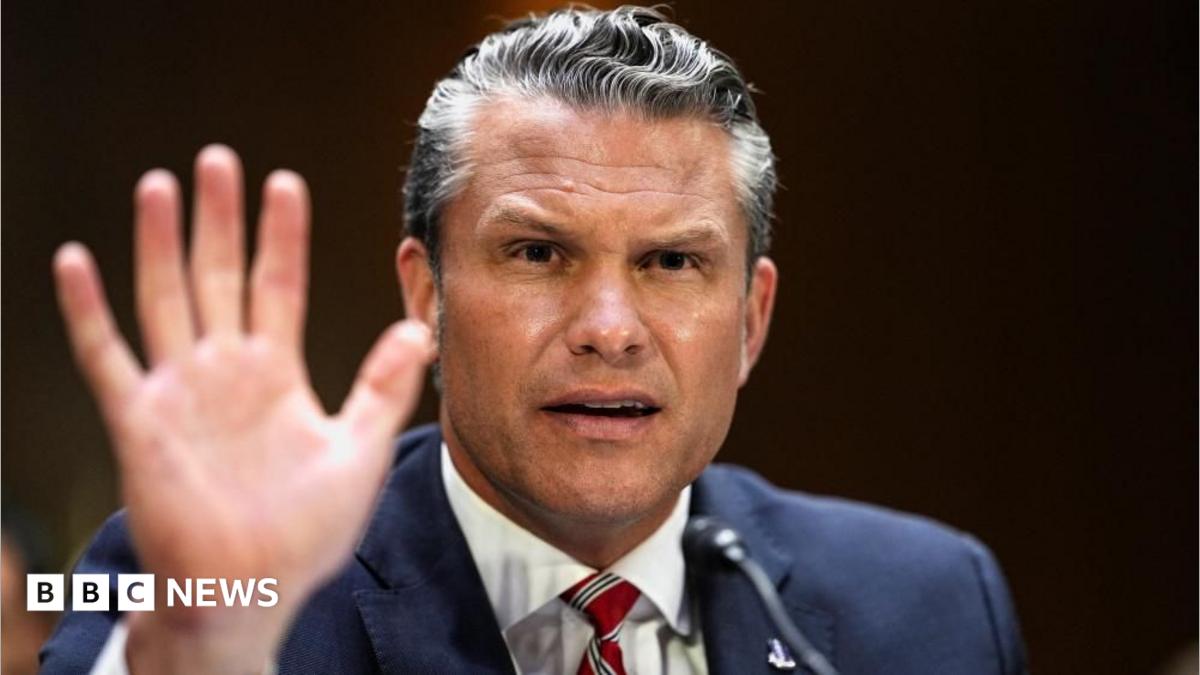
Hegseth, a veteran, is himself under pressure at home following a string of recent high-profile military leaders leaving the Pentagon and questions about the US handling of the Iran war.
He has also long focused on the appearance and physical fitness of US troops and on what he calls the “warrior ethos”.
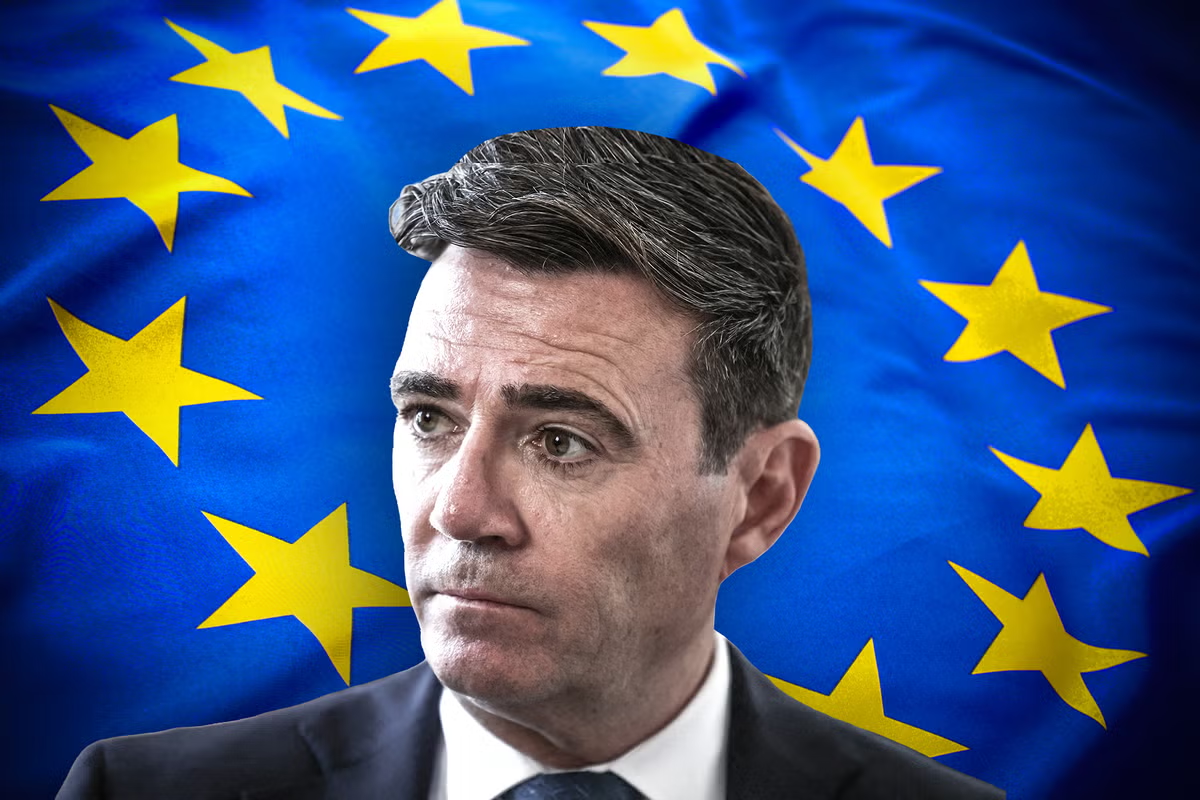
He listed the “series of wrong turns” the UK has made since over the past 40s years and warned that Brexit had embedded the problems in the last decade.
Mr Burnham told MPs: “From the 1980s, this country took a series of wrong turns. Political power was centralised, economic power privatised.
Advertisement
“The country deindustrialised. Austerity followed, hollowing out councils and depriving them of the agency to act to reverse any of this, and then Brexit, compounding the damage, ushering in a decade of low growth and stalled regeneration.”
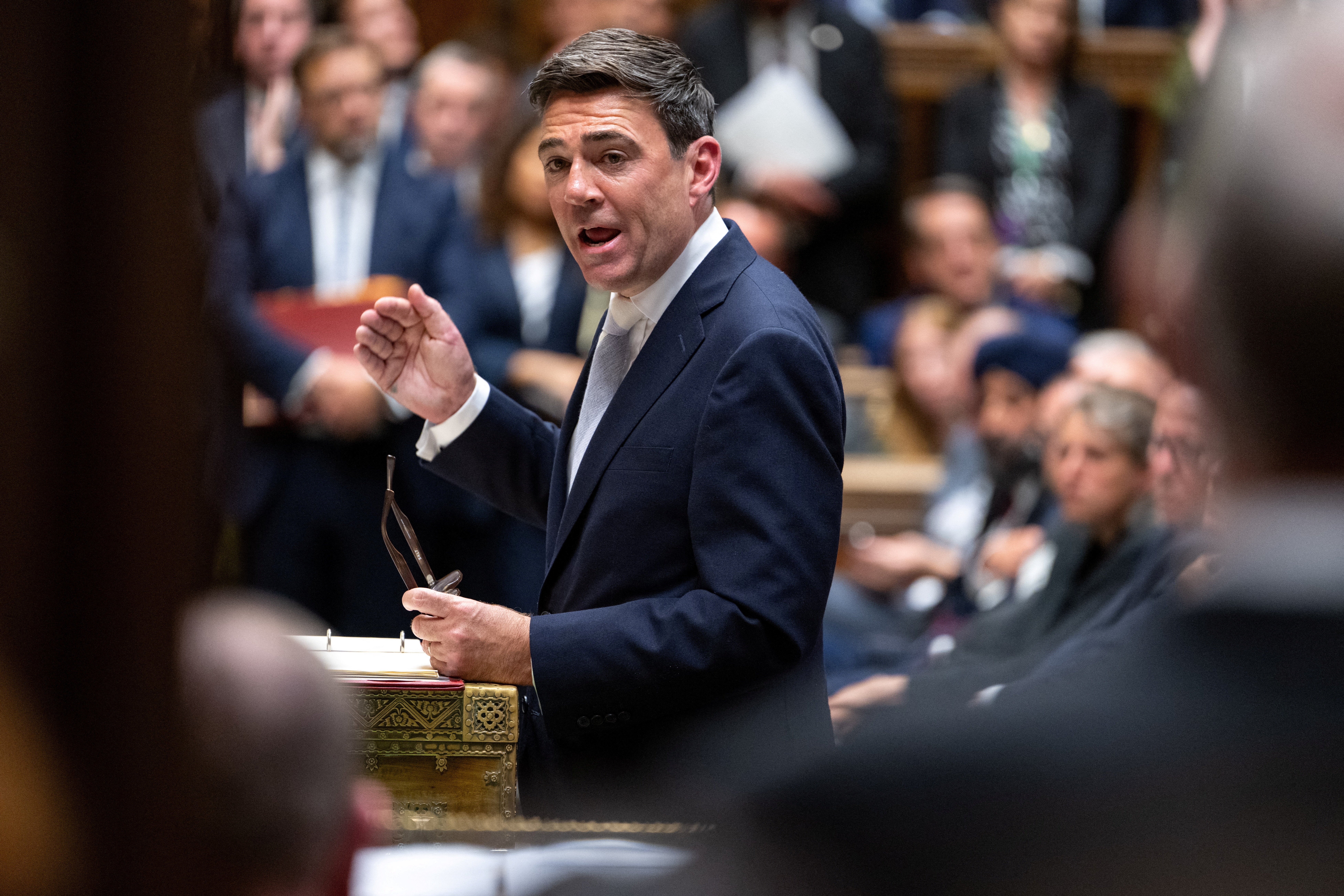
Andy Burnham made his Commons debut as prime minister on Tuesday (Reuters)
According to new polling from YouGov, 55 per cent of British people agree with the prime minister that Brexit was a wrong turn, with 21 per cent disagreeing. 11 per cent said neither and 13 per cent said they did not know.
Among Labour voters at the 2024 general election, 78 per cent believed it to be a wrong turn, while 59 per cent of Reform voters claimed it was a right turn.
Naomi Smith, chief executive of Best for Britain, said: “It’s hugely welcome to hear a prime minister stand at the despatch box and say loudly and clearly that Brexit harmed Britain; far from taking back control, it shrank our economy, left us poorer, weaker, less safe and more divided.”
Advertisement
Europe: The Way Back
We’re campaigning to rebuild Britain’s future in Europe
When it comes to Baroness Thatcher, whose 11 years in Downing Street from 1979 to 1990 made her the longest-serving British prime minister of the 20th century, 35 per cent of Britons believe her premiership represented a wrong turn for the country.
28 per cent said it was more of a right turn, with 14 per cent saying neither and 23 per cent not knowing.
60 per cent of 2024 Conservative voters and 57 per cent of Reform voters said it was a right turn, while 58 per cent of Labour voters believed it to be a wrong turn.
Advertisement
Regarding the privatisation and centralisation of power prominent during the Thatcher years – and the legacy he believes it has left – Mr Burnham claimed this was a “failed economic model”.
He said it had led to high streets across the country being left desolate and described Britain’s water industry as “a leaking monument to that approach, a country run in the private rather than public interest”.
Join the Independent’s new campaign (The Independent)
What you will get by joining our campaign Europe: The Way Back:
A dedicated community: We are fully committed to the long haul, consistently campaigning to secure the absolute best deal for Britain within Europe.
Free weekly newsletter: Every Wednesday, political editor David Maddox and political correspondent Millie Cooke will be in your inbox with exclusive reporting, analysis and insight on the biggest developments shaping relations between Britain and Europe. Each week, they will explain what’s happened, what it means, and what the key political figures, experts and decision-makers are saying about it.
Essential continental updates: Stay informed with regular briefings on the biggest developments in European politics and the specific policies that could pave the way for closer EU relations.
Exclusive content: Get the highest-quality analysis, opinion and debate from political experts across the UK and Europe by subscribing to our premium service.
The Brexit Effect: You’ll get exclusive access to extracts from Anthony Seldon’s major new book, The Brexit Effect, offering an unparalleled analysis of the 10 years since the referendum.
Inform the debate: Receive exclusive invitations to live events, webinars, expert Q&As and podcast recordings.
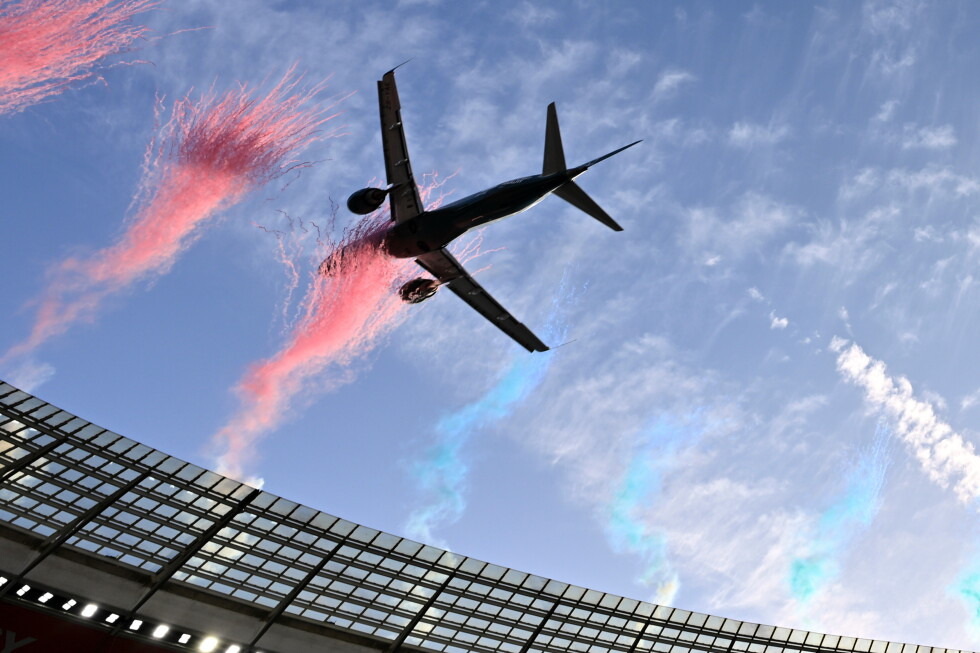
JOHANNESBURG (AP) — A low-altitude flyover by two Airlink passenger jets before a rugby match at Cape Town’s DHL Stadium is being reviewed by South African aviation authorities after it drew safety concerns, officials said Wednesday.
The South African Civil Aviation Authority (SACAA) said it had obtained flight data recordings and requested additional information from regional carrier Airlink as part of its assessment. A full report with recommendations will be issued once the review is complete.
“It is therefore critical that we interrogate this past weekend’s events … to determine if there were any safety concerns which warrant a review,” the agency said in a statement.
Airlink has withdrawn plans for another flyover at the upcoming rugby match in Soweto, according to the SACAA, which is responsible for regulating aviation safety and security.
Advertisement
The flyover ahead of the Springboks-All Blacks rugby match on Aug. 29 drew huge cheers from an estimated crowd of about 56,000, but also sparked a debate over the safety risks after video footage by spectators inside and around the stadium spread online.
Deandra Peters, 25, a pilot and aviation enthusiast attending her first live rugby match, said the crowd in the stadium was electrified by the spectacle in a way that was difficult to capture on video.
“You can watch the planes fly over, but you can’t recreate what it felt like to be inside a stadium full of Springbok supporters absolutely losing their minds,” she told The Associated Press. “The atmosphere was electric — the noise, the pride, the emotion. It was a very uniquely South African moment.”
Airlink on Wednesday said the maneuver had been carefully planned and rehearsed and that safety was “the first consideration at every stage of the process.” It said each aircraft had three senior captains aboard, with more than 75,000 combined flight hours across the crews.
Advertisement
Earlier this week, Airlink had provided the data from the airplanes’ black boxes to the civil aviation authority for review.
The SACAA said it would examine flight data to determine whether any safety concerns warranted a review.
Advertisement
Sign up for Morning Wire:
Our flagship newsletter breaks down the biggest headlines of the day.
Advertisement
The airline acknowledged the enthusiasm generated by the spectacle while also recognizing what it described as the “valid questions and concerns” that followed.
“We never intended to become the news or upstage Rugby’s Greatest Rivalry,” Airlink chief executive de Villiers Engelbrecht said in a statement.
The regulator said the airline had made applications for three flyovers. The most recent one in Cape Town was the second, while the first flyover took place in Johannesburg on Aug. 22. Both were approved in line with the requirements for special air events.
Airlink has withdrawn its application for a flyover scheduled for Sept. 1, over Johannesburg’s FNB Stadium. The airline said forecast weather conditions were unfavorable for a safe formation flyby. SACAA confirmed that the application had been withdrawn.
Advertisement
South African rugby has a long tradition of stadium flybys at major matches, dating back to the 1995 Rugby World Cup final in Johannesburg, when a Boeing 747 swept over Ellis Park before the Springboks faced the All Blacks.
Last Saturday’s flyby was unusually low and dramatic, drawing international attention, with some aviation experts later questioning whether the aircraft had left too little margin for error.
“The fear was that it was gone forever, so it’s great that this hasn’t been the outcome.”
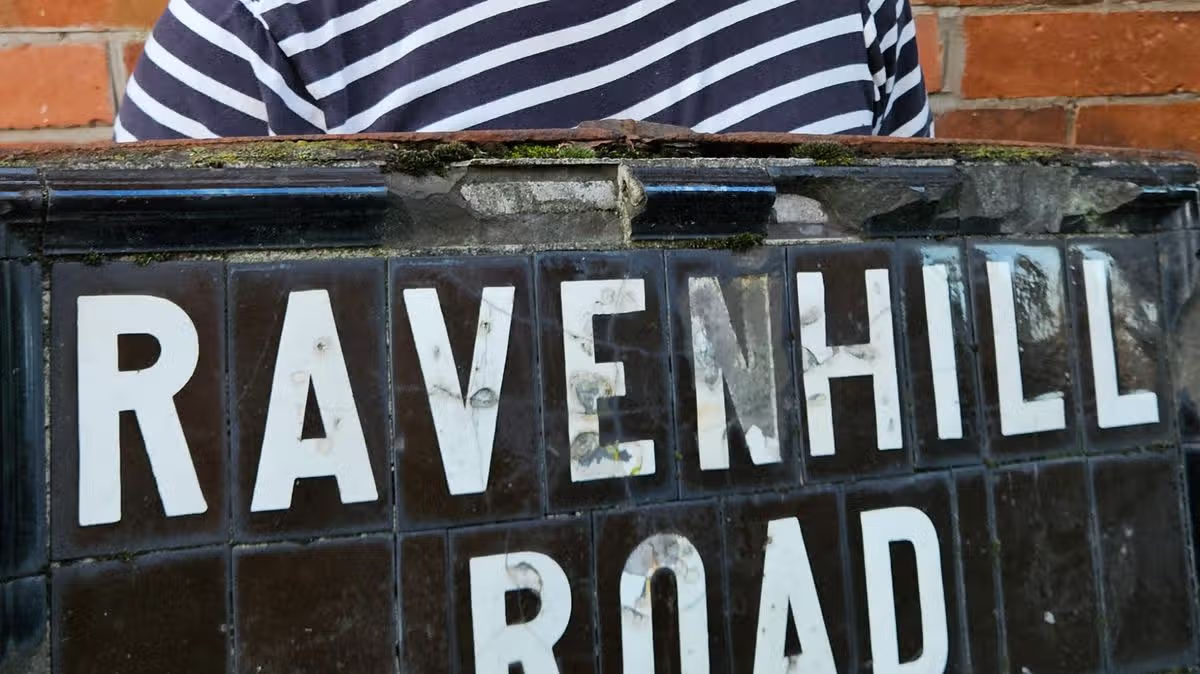
A historic street sign in South Belfast that went missing a number of weeks ago has been recovered half a mile away.
Advertisement
The tiled Ravenhill Road sign, which is more than 100 years old, was reported missing last month after it disappeared from its installed location. The disappearance sparked concerns that the sign had been stolen, something that has happened to other historic signs in the area.
SDLP Botanic councillor Gary McKeown had raised concerns regarding the missing sign and has now said it was recovered half a mile from where it disappeared.
He said that unlike its neighbouring sign for the Ormeau Road, the Ravenhill Road sign did not have listed protection.
Advertisement
He said: “I’m very relieved that the old tiled Ravenhill Road street sign which disappeared a number of weeks ago has been located and recovered. The fear was that it was gone forever, so it’s great that this hasn’t been the outcome. I’m now making arrangements to return it to the council for reinstallation.
“This sign is over 100 years old, and is showing evidence of wear and tear. I brought a proposal through Belfast City Council to develop a programme of restoration and protection of Belfast’s iconic black tiled signs, which has been taken forward and just awaits funding. I’ve asked for this project to be expedited as these signs are an integral part of our city.
“I also discovered that unlike a similar sign for the Ormeau Road which was right beside this one, it doesn’t have listed protection, so I’ve got confirmation now that it will now be formally assessed for listing. Of course, it needs to be reinstalled for this to happen, so the sooner this is done, the better.”
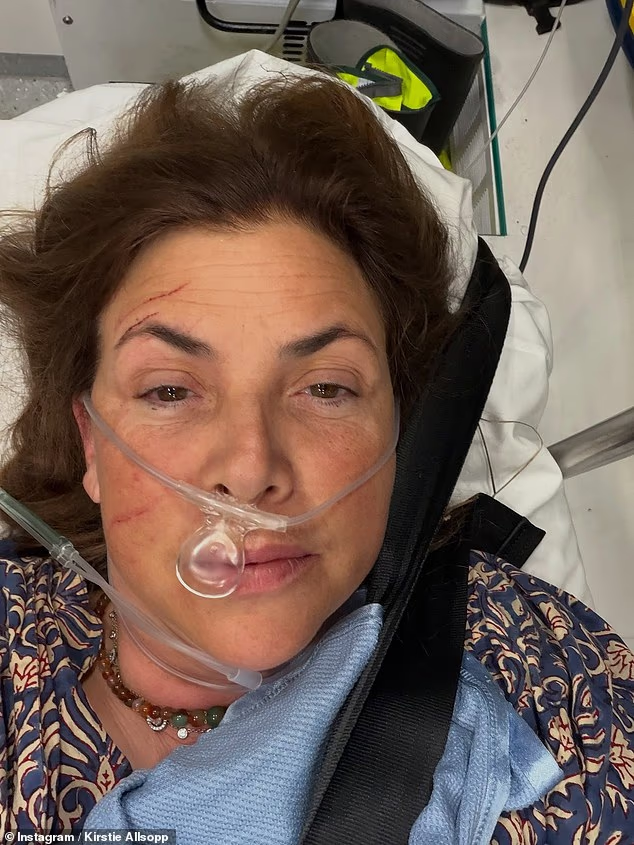
Kirstie Allsopp has revealed she was rushed to hospital to undergo leg surgery after suffering a nasty fall during her family holiday.
The Location, Location, Location star, 55, has shared snaps of her bandaged foot after being airlifted to hospital while on the beach in Cornwall, following a fall on a ‘muddy step’.
Kirstie shared an image of her face covered in tubes as she prepared to undergo surgery on her leg.
The presenter told her followers she’d been enjoying a day on the beach to celebrate her birthday, and said it took ‘a whole host of people’ to help track down her location so an air ambulance could take her to the hospital.
Advertisement
She captioned the post: ‘Almost every year since Oscar was born we have celebrated my birthday at Meadowgate, one of my favourite places on earth.
‘We have a picnic on the beach at Welcombe Mouth, a swim and a walk back to the house for some cake, unfortunately I slipped on a muddy patch on the steep path, and it took a whole host of people to get me to hospital.
Kirstie Allsopp has revealed she was rushed to hospital to undergo leg surgery after suffering a nasty fall during her family holiday
Advertisement
The Location, Location, Location star has shared snaps of her bandaged foot after being airlifted to hospital while on the beach in Cornwall, following a fall on a ‘muddy step’
‘After a little wait while poor Oscar ran as fast as he could to get help, and the @rnli_bude_lifeboat paramedics & @cornwallairamb tracked me down (I ❤️ #whatthreewords) I was given a huge amount of painkillers so I omitted to ask anyone for their social media details, but if this post is wrong I hope someone will tell me.
‘I remember Chris and Jeremy & I think there was a Lee, and there was definitely young Jake in the ambulance.
‘But according to Ben & the boys I have far more people than that to thank. God only knows what I was like to deal with high as a kite!
Advertisement
‘Everyone at Barnstaple hospital has been amazing, kind & caring, so many lovely people doing their absolute best.
‘They have operated on the leg and I’ll be home soon. It’ll be a boot and crutches for a while but I feel very, very lucky that it was possible to reach me and get me to hospital so quickly, and I have a job that I can do on crutches.
‘Not a birthday I am going to forget in a hurry and again, THANK YOU to all those who have been involved in my care.’
Kirstie married property tycoon Ben Anderson in January 2025 after more than 20 years together, and they are parents to sons Bay, 20, and Oscar, 18.
Advertisement
The broadcaster recently looked back on her time presenting Location, Location, Location with her longtime co-host Phil Spencer, joking she was his ‘second choice’ for the job.
In a lengthy Instagram post, Kirstie paid tribute to the ambulance and hospital staff who took care of her, and said she was ‘very very lucky’ they could reach her
The presenter told her followers she’d been enjoying a day on the beach to celebrate her birthday, and said it took ‘a whole host of people’ to help track down her location after the fall
Kirstie shared a snap of the Cornwall Air Ambulance service as they made their way to her on the beach
Advertisement
The property guru showed the X-ray of her injured knee, and shared she would be ‘home soon’ after undergoing the operation on her leg
Speaking on This Morning, she said: ‘There was an Italian girl with legs up to here,’ before pointing to her upper chest.
‘Phil really, really wanted her but the problem was, her accent was so strong.’
Shaking his head, Phil responded: ‘That’s not quite true,’ but Kirstie continued: ‘And then there was a really sweet girl who was an estate agent but I think that she probably was a bit intimidated by the whole thing.
Advertisement
‘He sort of ended up with me by default, we did a non-transmissible pilot, thank god that will never come to air – and we both thought, ‘Oh, that was fun, but we’ve got real jobs’. Then, they commissioned the show and they asked us to present it!’
The duo also reflected on the shock from both show fans and contributors alike about how involved they are in the property searching and buying process behind-the-scenes of the show.
Kirstie and Phil joked that their photo was on a number of fridges after helping families and couples find their dream property up and down the country.
Kirstie said: ‘It’s such a lovely thing to have a job which means that every time you meet anyone, you can have a conversation about something that really matters to them, it’s a great privilege.’
Advertisement
Phil added: ‘I’ve done several re-visits, which we love doing going back a few years later, and it’s really special to find a picture of us and the crew on the day that we filmed and the day we found their house.’
‘I was talking to an estate agent on Friday, I was negotiating a deal that we made, and at the end I said, ‘Keep my number, if there’s a problem, ring me’… and he said, ‘I thought it was all fake,’ Kirstie added.
To which Phil again chimed in: ‘I had a couple, we’d done three days filming and we sat in the pub at the end of the show and we were discussing tactics and value and negotiation, and I got my phone out to ring the agent.
‘They went, ‘Hang on, you’re not actually going to do that are you?”
Advertisement
Kirstie concluded: ‘People think that Phil and I end every working day in a pub, pretending to make a telephone call!’
Tying the knot with property tycoon Ben Anderson in a secret ceremony at Mayfair’s Grosvenor Chapel, the star’s co-host was notably absent from the celebrations.
However, it was later revealed the event was so heavily cloaked in secrecy that even guests were unaware they were attending a wedding until the last minute.
Advertisement
Phil and Kirstie said that while they are great friends of 25 years, they never socialise outside of work.
Speaking in an interview with The Telegraph, Kirstie confessed: ‘We don’t socialise, because we work so much together.’
Phil added: ‘But we’re very, very fond of each other. There’s no one else who’s been through this experience. I put Kirstie among the most important people in my life.’
The pair have been part of each other’s lives through the biggest moments as Kirstie added: ‘In the most significant parts of our lives, we’ve been there for each other. I think Phil was one of the first people I ever told I was pregnant.’
The King, speaking inside the Great Court of the British Museum, said the opponents depicted in the tapestry – the Normans and Anglo-Saxons – would have been glad to see this togetherness between France and the UK – “two great nations, which share such fundamental values”.
“The tapestry’s story is one of ambition and uncertainty, of oaths and journeys, of ships, councils, kings, comets and consequences,” said the King.
“Yet it is not merely an English story, nor only a Norman one. Indeed, from the moment of its creation, it may have brought together our two peoples.”
George Osborne, director of the museum, described the displaying of the Bayeux Tapestry as the “most ambitious exhibition we’ve ever mounted”.
Advertisement
President Macron said a loan of this “masterpiece” had first been proposed in the 1930s, but he was delighted that the idea had come to fruition.
He spoke of the loan of the tapestry as an example of how “we are united” and a “reminder of what our countries can do if they join forces”.
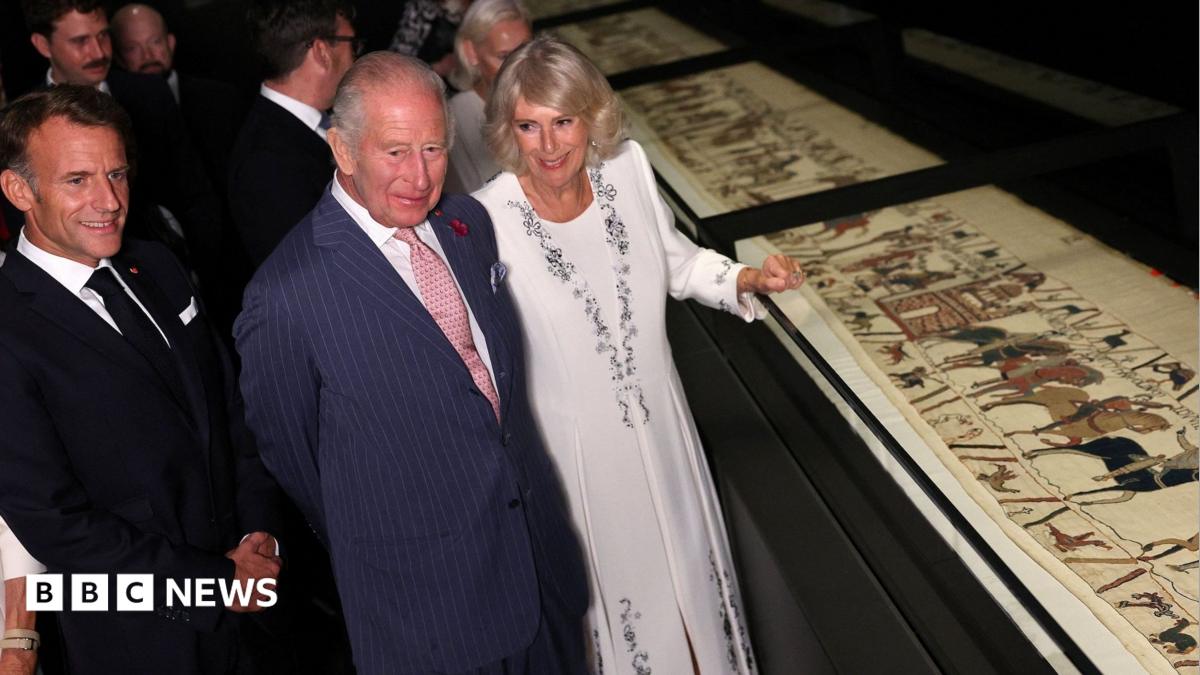
Along with the King and Queen he had a chance to see the historic embroidery in the atmospheric darkness of the British Museum.
The 70m (230ft) tapestry, originally embroidered in England but kept for centuries in France, tells the story of the Norman Conquest and the Battle of Hastings in 1066.
Advertisement
King Charles and Queen Camilla, Burnham and his wife Marie-France van Heel, and Macron and wife Brigitte were shown key scenes in the tapestry, including the Coronation of King Harold and his death in battle.
Sending the tapestry to the British Museum had been announced by Macron during the French state visit to the UK in July 2025, as an emblem of the strong partnership between the countries.
There had been some worries that moving the fragile tapestry could risk causing damage, but French government sources said ahead of the royal preview: “The display conditions at the British Museum are ideal.”
The French authorities welcomed the way that visitors in London would see the tapestry lying flat, rather than upright, with this believed to be better for the conservation of the fibres, sewn more than 900 years ago.
Advertisement
It is believed the final scenes of the tapestry have been lost or destroyed, as it has not always had such careful owners. In the 18th Century, during the French Revolution, it was rescued from being cut up to make covers for soldiers’ carts.
At a state banquet hosted by King Charles in Windsor, Macron had said the missing end of the tapestry was a symbol that “in the great mural of Franco-British history, the end is yet to be written – it is up to us to do it”.
Germans in the eastern state of Saxony-Anhalt will go to the polls on September 7 to elect a new parliament.
With forecasts indicating that the Alternative für Deutschland (AfD) is on course to win around 40% of the vote, which would double its support there compared to five years ago, there is a real chance the far-right party could take over a state government for the first time.
Former East Germany, which was under Communist rule between 1949 and 1989, has proven fertile ground for the far right. The AfD won 34.6% of the vote there in the 2025 federal election, while in Saxony-Anhalt that figure was 37.1%. This was far higher than mainstream parties on the left and right.
Perhaps above all, there is a strong sense in the east of feeling “second-class citizens” in modern Germany, even more than three decades after reunification. Unemployment in Saxony-Anhalt is above the German average, standing at 8.2% in August compared to a national average of 6.5%. The median wage in full-time employment was also around €48,300 (£41,400), below the national level of about €52,000.
The election in Saxony-Anhalt takes place at a time when the AfD is already leading nationwide polls, and when the federal government and chancellor Friedrich Merz are vastly unpopular (with around 85% of voters dissatisfied). It is also happening in a part of the country where the far right tends to do best.
The German chancellor, Friedrich Merz (left), and Saxony-Anhalt Governor Sven Schulze attend a press conference in Quedlinburg on August 31 after a campaign event ahead of the state election. Filip Singer / EPA
The AfD has come top in a state election once before, in Thuringia in 2024. But it did not get a majority of seats. Mainstream parties rallied around and formed a government between the centre-right Christian Democratic Union of Germany (CDU), left-populist Bündnis Sahra Wagenknecht (BSW) and Social Democratic Party of Germany (SPD).
They rely on the support of Die Linke (the Left Party) to function and pass legislation. The CDU has long ruled out any cooperation with the Left Party at the state or national level because of the latter’s historic links to the communist regime in East Germany and continued ideological disagreements. But in practice, in Thuringia and the national parliament, this anti-cooperation line has softened.
Advertisement
In Saxony-Anhalt, as in most other states in Germany, parties need at least 5% of the vote to win any seats in the state parliament. If they fall below that level, they don’t get any. So all eyes will be not only on the result of the AfD, the CDU (which polling suggests is set to take 23% of the vote) and the Left Party (forecast to take 13%) but also smaller parties.
Polling has had the SPD hovering around the 5% mark, although its support seems to have picked up. The same goes for the Greens, while the liberal Free Democratic Party (FDP) looks set to miss out. If the only parties making it over 5% are the AfD, CDU and Left Party, the AfD could win an overall majority of seats. The BSW, which is hovering around the 5% mark, has also made it clear it would not block the AfD entering government.
The AfD’s proposals
The AfD’s manifesto in Saxony-Anhalt is extremely right-wing. Proposals such as ending the right to asylum and a moratorium on non-EU immigration could not be implemented. They are matters for the national not state government.
But other AfD proposals are legally feasible. These include changing the school curriculum to downplay the significance of the Nazi era – a programme one AfD politician, Hans-Thomas Tillschneider, sums up as: “More Bismarck, less Hitler”. This was a reference to Otto von Bismarck, who oversaw the unification of Germany in 1871.
Advertisement
The AfD has also suggested introducing the routine singing of the German national anthem in school assemblies and ending what it calls “inclusion” in mainstream education for children with special needs. Defunding the protestant church, which the AfD has accused of being too focused on social not theological questions, would also be a real possibility.
A particular worry is around Germany’s “constitutional protection” or secret services. There is consideration being given to setting up parallel offices in Saxony-Anhalt to protect sensitive operations in the event of an AfD administration. Many branches and elements of the AfD are under observation by German intelligence agencies on the basis of suspected extremism.
There will almost certainly be wider political ructions from this election if the AfD tops the poll, and even more so if it wins outright control of the state government. Any major changes at the top of German politics will probably wait until after elections in Berlin and Mecklenburg West Pomerania later in the month.
Mainstream parties will want to keep some appearance of unity until then for fear of losing yet more votes. But, at the very least, rumours of an early challenge to Merz are likely to step up a gear.
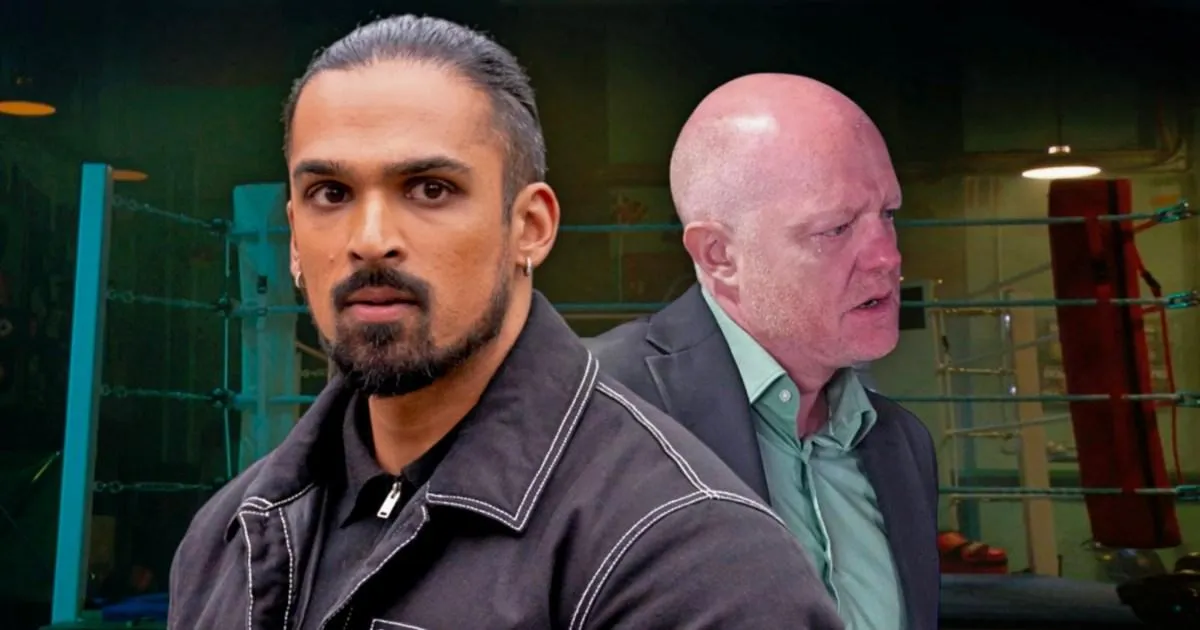
After spotting a cosy moment between Priya and boss Max earlier this week the penny finally dropped for Ravi, who responded by kidnapping Max on the night of his stag do, bundling him into the Boxing Den where he intends to exact his revenge.
After years of betrayals and affairs, have Max’s sins finally caught up with him?
Advertisement
Elsewhere on the Square, Nicola Mitchell (Laura Doddington) agreed to let the Hawkins clan stay at No. 1, despite having discovered that they set fire to their own home in a bid to claim on the insurance – to no avail.
Advertisement
And Linda Carter (Kellie Bright) struggled to hide her feelings for Max – that is, until Clive (Jason Durr) fixed the electrics at the community centre, which led to sparks of a very different kind.
With the credits having rolled on tonight’s visit to Walford, check out what Thursday (September 3) edition of the BBC One soap has got in store for you.
What happens next in EastEnders? New spoilers for Thursday, September 3
Oscar Branning (Pierre Counihan-Moullier) eagerly awaits Max’s arrival so that the stag do proceedings can commence, unaware of the danger his dad faces just around the corner at The Boxing Den.
With Ravi having waited weeks to confront the man Priya has been sleeping with, will he exact revenge on Max? He’s made it clear on at least two occasions previously that he would kill the man in question if he ever found him, so Max is certainly in peril.
Advertisement
Linda it seems is still conflicted over who she wants to be with (Picture: BBC / Jack Barnes / Kieron McCarron)
Ask Metro
Use AI to go deeper into the stories you care about – powered by Metro and trusted publications.
However, we know he is still very much alive come New Year’s Day – courtesy of the flashforward episode – so while death may not be on the cards at this moment in time, one can’t help but wonder just how far Ravi will go.
And speaking of Max, has Linda finally put her feelings for the lothario aside in a bid to move on with Clive? As she prepares for their date, she very much feels ready to move on – that is until Kim (Tameka Empson) lets slip that Max played a key role in saving the community centre.
Advertisement
When Clive shows up, he reveals that the centre is secure, with Linda left reeling as a result. Now that her wish has come true, the question is: can she and Clive move on with their lives together?
Or is Max still lingering in the back of her heart?
EastEnders airs these scenes Thursday September 3 at 7:30pm on BBC One or stream from 6am on BBC iPlayer
If you’ve got a soap or TV story, video or pictures get in touch by emailing us soaps@metro.co.uk – we’d love to hear from you.
People from Belfast have helped fund three maternity mobile units, which are being refused entry into Gaza
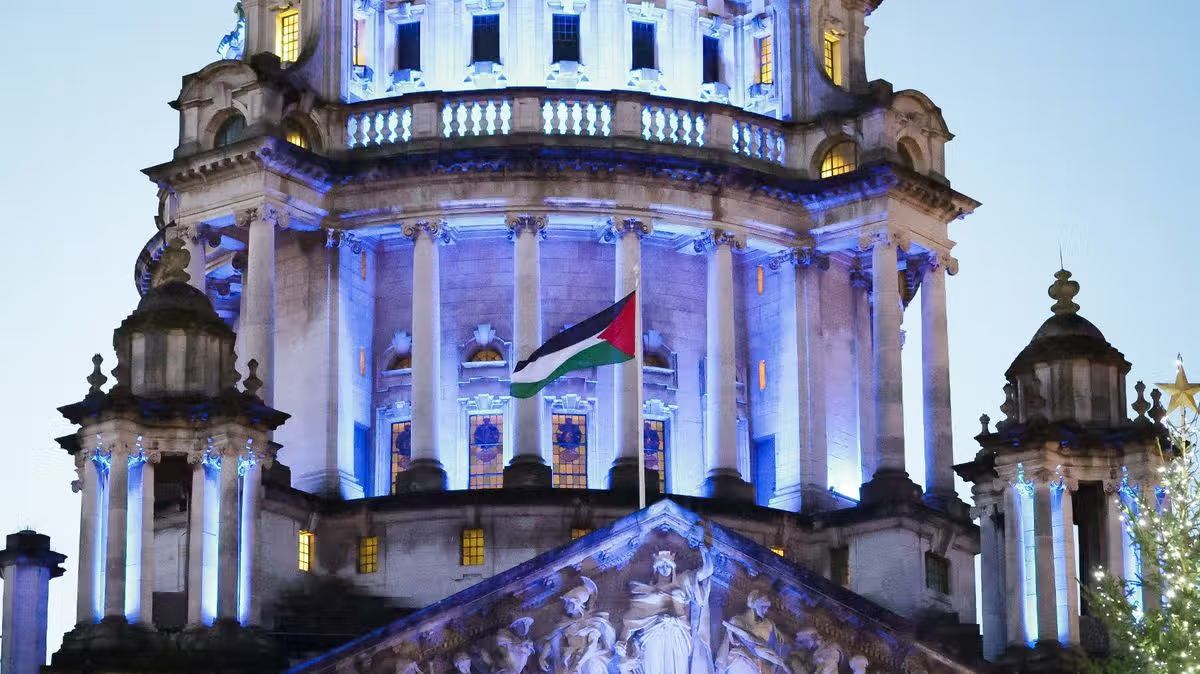
A debate and proposal at Belfast City Hall about three Irish maternity vehicles sent to help pregnant Palestinian women in Gaza has descended into a slanging match over the word “genocide”.
Advertisement
A motion to lobby against the blocking of the maternity units turned into an intractable culture war row at the September meeting of the full Belfast City Council on Tuesday with unionists on one side of the debate, and the rest of the parties on the other.
In the end the “Mobile Maternity Units for Gaza” motion, proposed by Independent Councillor Paul Doherty, and seconded by Independent Councillor Paul McCusker, both of them former SDLP representatives, was passed, but without the support of the DUP, the UUP and the TUV. Representatives from the Gaels Against Genocide volunteer group gave a deputation at the start of the meeting on the issue.
Practically, the successful motion means the council will write to all the NI Executive ministers, calling on them to make “urgent” representations to the Irish Government, UK Government and other relevant international bodies to secure the immediate and unrestricted entry of three mobile maternity units, sent by Irish volunteers Gaels Against Genocide, to Gaza.
The motion states: “This council notes with grave concern the continuing genocide and humanitarian catastrophe in Gaza and the devastating impact on pregnant women, newborn babies and families requiring urgent medical care. It further notes that three mobile maternity units have been developed to provide safe and secure maternity and newborn care for women and babies in Gaza.
“(We) commend the extraordinary fundraising efforts of Gaels Against Genocide and communities across Belfast, the North and across Ireland which have made these three mobile maternity units possible.
“Many Belfast residents have contributed directly to this humanitarian effort, demonstrating the depth of solidarity in our city with Palestinian women, babies and families. (We are) deeply concerned that, despite these efforts and the urgent humanitarian need, the units have not been permitted to enter Gaza, and believe that humanitarian medical aid must never be blocked, and that pregnant women and babies must be protected in all circumstances.”
Advertisement
Representatives from the DUP, the UUP, and the TUV all said that they supported the maternity units entering Gaza, but would not support the motion over the use of the word “genocide.” On a poll in the chamber, 14 elected representatives voted against the motion, from the DUP, UUP and TUV, while all the other parties, including two independents, that is 38 councillors in all, voted to support the motion, and it was passed.
Councillor Doherty said: “This motion tonight is not about politics, it is not about creating division, it is about a basic question of humanity. Three mobile maternity units have been built, and they are ready.
“They were created for women giving birth in conditions that no woman should ever endure. As representatives of Gaels Against Genocide have clearly outlined, these units were created because their maternity hospitals have been damaged and destroyed, because medical supplies have been restricted and doctors and nurses are trying to provide care in circumstances that are almost impossible for us to comprehend.
“Above all of that, women are giving birth in the midst of a genocide. And still these units are being prevented from reaching people they were built to help. That should shock all of us, and should be absolutely deplorable.”
Advertisement
Sinn Féin Councillor Micheal Donnelly said: “The Israeli genocide has already claimed the lives of over 73,000 Palestinians. Over 38,000 of these have been women and children, and 21,700 specifically children.
“The denial of Palestinian national human rights has been the most totemic national democratic struggle of our era. Netanyahu and the Israeli right wing are intent on trying to annihilate the Palestinian people and the full colonisation of all their lands.”
He added: “There can be no justification for preventing life-saving maternal care from reaching pregnant women. Mobile maternity units must be allowed into Gaza urgently, safely and without obstruction.”
DUP Alderman Dean McCullough said: “I would respectfully ask the proposer if he is willing to remove the reference to genocide. It is obviously a contested term, and I appreciate members will hold very strong opposing views on it. The deputation at the outset of the council was a very sincere one, which I don’t even think mentioned genocide.
Advertisement
“(He could drop the word) for the sake of getting the consensus, which I think would be quite something in Belfast City Council. Because we are very clear, any right-thinking person or party wants maternity units in Palestine or any other conflict zone. If we focus on humanitarianism, we need not even debate.”
He asked Councillor Doherty to omit the word from the motion, to which Councillor Doherty replied: “No I will not accept that. This is absolutely a genocide.”
Alderman McCullough said he was “disappointed” with the reply, and added: “The loaded language, which is unnecessary, leaves us no option but to oppose that aspect. But we absolutely support the humanitarianism.”
He added: “I do not accept that Israel is committing genocide, and I reject that allegation. I appreciate the sensitivities of the subject. The International Court of Justice has not found that Israel is committing a genocide, so I will not support Belfast City Council pretending that we can make a ruling when the international court itself has not.”
Advertisement
TUV Councillor Ron McDowell said: “By and large the motion as it stands is a largely inoffensive motion. I don’t think anyone would be against the sentiment.” He asked: “So why will you not adopt a motion of consensus, by focusing on the things that we agree on, and dropping the political element.”
Sinn Féin Councillor Ryan Murphy made a “point of order” and asked if there was “a conflict of interest with Councillor McDowell’s speaking on the subject.” Councillor Murphy raised a “fact finding mission” by Councillor McDowell as an official guest of the Israeli government which took place last year.
Councillor Murphy said: “I am interested around when he went out to Palestine, was this issue of trying to diminish, or to not use the word genocide, discussed when he was doing that visit?”
Amidst calls across the chamber from Alderman McCullough, the Lord Mayor Róis Máire Donnelly said such declarations were “down to the individual.” Councillor McDowell said he was “looking for consensus not division” and said Councillor Murphy “lowered the tone of the debate.”
Advertisement
People Before Profit Councillor Michael Collins said: “I think there is something really cynical about the unionist parties trying to suggest it is all on the rest of this chamber, somehow, to get this motion over the line.
“You can nitpick on whether it is a genocide, but the Genocide Convention has deemed it a genocide, Amnesty International has deemed it a genocide, and the UN itself has deemed it a genocide.
“We know the DUP and Ron willingly go over to do meet and greets with Zionist ministers, and whoever else. We know you don’t have a problem with apartheid, with bombing innocent civilians in Gaza, and you have defended every action Israel took, and defended them to the hilt. We know you have no problem with illegal settlements.
“I don’t understand you saying you just want to be humanitarian, the reality is you have a motion before you about three maternity mobile units that are being denied access to Gaza, and you can’t bring yourself to vote for it. That is on you, it is not on anybody else.
Advertisement
“The party that claims to be pro-life, and chastises everyone in this chamber, can’t bring themselves to support three maternity units for babies in Gaza.”
Councillor Ron McDowell said he was “misrepresented” and added: “I have a problem with apartheid, I see something wrong with illegal settlements, I support ambulances going into Gaza, I don’t support the wording of this motion and I have to separate the two.”

















































You must be logged in to post a comment Login